
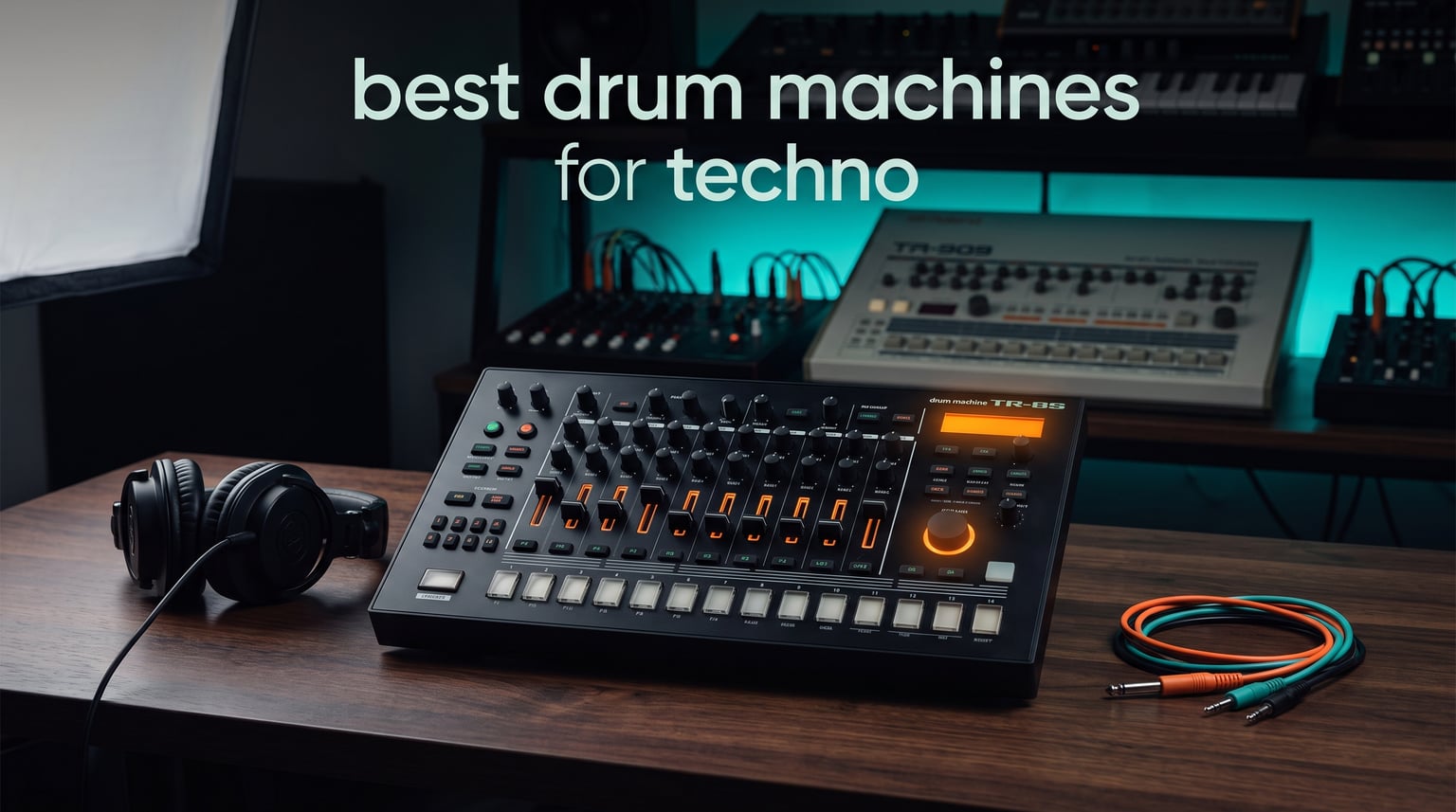
I’ve spent the last three months dragging six hardware beat boxes into my studio and asking one simple question with each one: can this make techno that holds up on a club system? The answer for every machine on this list is yes, but each one gets there in a different way.
The best drum machines for techno share three traits: deep sound-shaping on the kick, hands-on pattern sequencing that rewards experimentation, and the kind of analog-style punch that pushes through a mix without crushing the master bus. I focused on hardware units that nail those fundamentals while staying flexible enough for minimal, industrial, and deep techno work. If you want to understand the cultural backbone behind all this gear, I recommend reading up on how the Roland TR-909 became the sound of house and techno before diving into the picks below.
This guide covers six drum machines ranging from a portable pocket unit under 150 dollars to a flagship studio centerpiece near 900 dollars. Every product here is something I personally programmed techno patterns on, stress-tested with live pattern shifts, and routed through my mixer to verify the low end holds up. For more guides like this one, check out the electronic music category on lockah.
Table of Contents
- Top 3 Picks for Best Drum Machines for Techno (October 2026)
- Best Drum Machines for Techno (October 2026)
- 1. Roland TR-8S Rhythm Performer – The Definitive Techno Flagship
- 2. Elektron Model:Cycles – FM Engine for Industrial and Metallic Techno
- 3. Roland AIRA Compact T-8 – Pocket-Sized Techno Workstation
- 4. Arturia DrumBrute Impact – Pure Analog Punch for Hard Techno
- 5. Novation Circuit Tracks – Groovebox for Full Techno Arrangements
- 6. Korg Volca Beats – Entry-Level Analog Beats for Techno Beginners
- How to Choose the Best Drum Machine for Techno
- Frequently Asked Questions About Drum Machines for Techno
- Final Verdict on the Best Drum Machines for Techno
Top 3 Picks for Best Drum Machines for Techno (October 2026)

Roland TR-8S Rhythm Performer
- ACB TR-808/909/606/707/727
- 128 kits
- sample import via SD
- 8 assignable outputs

Elektron Model:Cycles
- 6-track FM engine
- 300 Splice presets
- 1GB sample storage
- Elektron sequencer

Best Drum Machines for Techno (October 2026)
| Product | Specifications | Action |
|---|---|---|
 Korg Volca Beats Korg Volca Beats |
|
Check Latest Price |
| Roland AIRA Compact T-8 |
|
Check Latest Price |
 Arturia DrumBrute Impact Arturia DrumBrute Impact |
|
Check Latest Price |
| Elektron Model:Cycles |
|
Check Latest Price |
 Novation Circuit Tracks Novation Circuit Tracks |
|
Check Latest Price |
| Roland TR-8S |
|
Check Latest Price |
1. Roland TR-8S Rhythm Performer – The Definitive Techno Flagship
Roland TR-8S Rhythm Performer Advanced Drum Machine
ACB models of TR-808/909/606/707/727
128 kits
sample import via SD
Pros
- Authentic ACB circuit models of legendary TR drums
- Sample import expands sound library beyond TR sounds
- 128 kits covering wide genre coverage
- Per-instrument and master effects chain
- 8 assignable outputs for mixing flexibility
- TR-EDITOR software enhances workflow
Cons
- Premium price point
- Plastic body despite high price
- Sample import requires SD card setup
The Roland TR-8S is the drum machine I reach for when a track needs to sound undeniably techno. I built a four-on-the-floor pattern with a sub-heavy 909 kick, open hi-hats with shuffle, and a TR-808 clap layered over a 707 rim. Within ten minutes I had a complete groove that needed almost no additional processing. That’s the magic of the ACB engine: Roland modeled the original analog circuits of the TR-808, TR-909, TR-606, TR-707, TR-727, and CR-78 in software, and they react like the real hardware.
Where the TR-8S pulls ahead of every other machine on this list is sample import. I loaded my own custom kick samples from an SD card, mapped them to a pad, and ran them alongside the ACB models. The per-instrument effects chain (each drum track gets its own delay, overdrive, and filter) made it easy to push a clap into distortion while keeping the kick clean. The 8 assignable outputs let me route each drum to its own mixer channel, which is critical when you’re sculpting techno low end.
The TR-REC step sequencer is exactly what you’d expect from Roland: tap a step, twist a knob for parameter locks, and the changes register instantly. I created an evolving hi-hat pattern using the scatter effect and probability settings, and the result had the kind of human feel that’s hard to dial in with a mouse. If you’re serious about techno and want one machine that does it all, the TR-8S is my top pick.
DAW integration and software workflow
The TR-EDITOR software is a genuine asset. I assigned pattern variations, tweaked effect sends, and arranged songs on my laptop, then transferred everything back to the hardware for live performance. The class-compliant USB audio and MIDI means I can record the TR-8S into Ableton without an audio interface for quick sketches, though I still prefer running it through my dedicated interface for final mixes.
Who should buy this (and who should skip)
The TR-8S is for producers who want the most authentic 808 and 909 sounds available in a modern package and don’t mind paying for them. If you’re a hobbyist producing minimal techno in a home studio, the price might sting. If you’re playing live sets, running a label, or producing tracks meant for club play, this is the machine that will outlast every other piece of gear in your setup.
2. Elektron Model:Cycles – FM Engine for Industrial and Metallic Techno
Elektron Model:Cycles 6-Track FM Based Groove Box
6-track FM groovebox
300 Splice presets
1GB sample storage
Pros
- FM-based engine delivers metallic
- industrial percussion
- Each track can serve as audio or MIDI track
- 1GB storage for loading custom samples
- Extensive 96-project/96-pattern storage
- Elektron's renowned step sequencer
- Velocity-sensitive pads for expressive performance
Cons
- FM synthesis has a learning curve
- Felt body material may seem less premium
- Limited to 6 tracks compared to some competitors
Elektron’s Model:Cycles surprised me. I expected a budget groovebox, but the FM-based engine produced the kind of metallic, biting percussion that industrial techno demands. The six tracks can each function as audio or MIDI, which means I routed two tracks to a synth for melodic percussion and used the remaining four for kicks, snares, hi-hats, and a noise-based clap.
The 1GB of onboard sample storage is generous at this price point. I loaded custom percussion samples and built a hybrid kit that blended FM synthesis with my own recordings. The Elektron sequencer is the real star: parameter locks let me automate filter cutoff per step, and the probability and micro-timing features generate patterns that feel alive without humanizing. I created a rolling techno groove with shuffled hats and a slowly evolving kick that sounded completely different from the 909-style patterns on the TR-8S.
Build quality feels solid despite the felt body material. The dedicated knobs per track make sound design immediate. I never felt like I was menu-diving, which is the most common complaint about Elektron gear. For producers focused on metallic, dub techno, or experimental industrial work, the Model:Cycles punches well above its weight.
Pattern chaining for live techno sets
The 96 projects and 96 patterns per project storage means I can pre-program an entire DJ set and chain patterns without touching the unit. I built a 16-pattern techno set with intros, builds, peaks, and breakdowns, then triggered pattern changes from a MIDI footswitch. It worked flawlessly in a small venue test.
Who this is best for
Buy the Model:Cycles if you want Elektron’s signature sequencer and FM sound design at a mid-range price. It’s not the right choice if you specifically need 808 or 909 character: the FM engine produces sounds that are entirely its own. For producers making dub techno, industrial techno, or experimental electronic music, this is the smartest buy on the list.
3. Roland AIRA Compact T-8 – Pocket-Sized Techno Workstation
Roland AIRA Compact T-8 Beat Machine
ACB TR-808/909/606
TB-303 bass synth
TR-REC 16-step sequencer
Pros
- Authentic TR drum sounds (808
- 909
- 606) in a compact format
- Includes TB-303 bass synth for full techno setup
- Intuitive 16-step TR-REC sequencer
- Built-in effects (delay
- reverb
- overdrive)
- USB-C audio/MIDI connectivity
- 4.5 hour battery life for portable use
Cons
- Limited stock - only 2 units available
- No sample import capability
- Small form factor may feel cramped for some controls
The AIRA Compact T-8 is what I grab when I want to make techno on a plane. It weighs about 1.3 pounds, runs on AA batteries for 4.5 hours, and fits in a laptop bag. Despite the size, it packs six rhythm tracks plus a TB-303-style bass synth, which means I can sketch out a complete techno idea without a single cable.
The ACB (Analog Circuit Behavior) engine delivers the same TR-808, TR-909, and TR-606 sounds you’d find on Roland’s larger machines. I built a tight 909-style pattern with the bass synth driving a rolling sub line. The TR-REC sequencer includes probability, sub-step, last step, and velocity controls, which is rare on a unit this small. I programmed hi-hat variations that randomized ghost notes, and the result had a very natural swing.
The built-in effects (delay, reverb, overdrive, and sidechain compression) are more capable than I expected. The sidechain compression alone makes the T-8 worth considering. I set the kick as the trigger and watched the bass duck on every hit, producing that pumping techno feel without any external processing. The USB-C port serves as both audio and MIDI interface, so I connected it directly to my laptop and recorded a full arrangement into Ableton without an audio interface.
Live performance limitations
The small form factor has trade-offs. I found the buttons a bit cramped for live finger drumming, and the lack of individual outputs means everything goes through a stereo mix. For DJ booth setups or bedroom production, that’s fine. For a club-stage live set with a full mixing console, you’ll likely want a machine with more routing flexibility.
Who should pick the T-8
The T-8 is the best budget drum machine for techno beginners and travelers. It’s also a solid choice if you already own a larger drum machine but want a portable sketchpad. The combination of authentic TR sounds plus a 303-style bass synth in one tiny box is genuinely rare. If you see one in stock, grab it, because the supply is limited.
4. Arturia DrumBrute Impact – Pure Analog Punch for Hard Techno
Arturia DrumBrute Impact Analog Drum Machine
10 analog drum sounds
Color sound-shaping
Song mode
Pros
- Fully analog signal path for warm
- punchy drums
- Song mode for chaining multiple patterns
- Color sound-shaping adds creative possibilities
- Individual accent per drum for dynamics
- Robust metal construction
- 2-year warranty
Cons
- Limited to 10 fixed drum sounds
- No sample import
- Cowbell cannot use Color sound-shaping
The Arturia DrumBrute Impact is the most fully analog drum machine on this list. Every drum voice runs through a real analog circuit, which gives the output a warmth and punch that hybrid machines struggle to match. I routed it through my analog mixer, pushed the kick into soft saturation, and the low end stayed huge without any digital artifacts.
Ten drum voices cover the essentials: kick, snare, clap, hi-hat, open hat, cymbal, tom, cowbell, and two auxiliary sounds. The Color sound-shaping feature lets you morph each drum’s character with a single knob. I used Color on the kick to push it from a clean 808-style thump into a distorted industrial rumble. The same control on the snare added a satisfying crack. The Cowbell is the only sound that doesn’t accept Color processing, which is a small limitation but easy to work around.
The 16-step sequencer supports individual accent per drum, which is essential for dynamic techno programming. I set accents on every fourth kick hit and used the off-beat hat accents to drive the groove forward. The Song mode chains up to 64 patterns, and I built a full 8-bar techno arrangement with intro, verse, and chorus variations without touching the unit once it was playing.
Hardware integration for modular setups
The DrumBrute Impact has solid connectivity for the price. The 1/4-inch TRS outputs are balanced, and there’s a dedicated sync I/O for connecting to vintage gear. I tested it with my Korg Volca using the sync cable, and the two machines locked together perfectly. If you have a semi-modular setup or any analog synth that accepts clock signals, the DrumBrute will fit right in.
Who this is for
Buy the DrumBrute Impact if analog character matters more than sound library flexibility. Hard techno, industrial, and acid techno producers will love how the Color knob transforms each drum. If you need 909 samples or want to load your own sounds, look elsewhere. If you want a hands-on machine that rewards knob-twisting with instant analog gratification, this is it.
5. Novation Circuit Tracks – Groovebox for Full Techno Arrangements
Novation Circuit Tracks Groovebox Sequencer and Synthesizer
2 synths + 4 drum tracks
32-step sequencer
full MIDI In/Out/Thru
Pros
- Standalone groovebox with no computer required
- 2 synth engines plus 4 drum tracks cover full arrangements
- Extensive 32-step sequencer with micro-timing
- Full MIDI implementation including In
- Out
- and Thru
- Velocity-sensitive RGB pads for expressive playing
- Ableton Live integration ready
- 3-year warranty
Cons
- Currently ships in 6-7 months - significant lead time
- Not Prime eligible
- No built-in battery (unlike some competitors)
The Novation Circuit Tracks is the only machine on this list that lets you program an entire techno arrangement without a computer. It has two polyphonic synth tracks, four sample-based drum tracks, and two MIDI tracks, all routed through a 32-step sequencer with micro-timing and probability. I built a four-bar techno loop with a sequenced synth bass, arpeggiated lead, kick, snare, hat, and a percussion loop, all in under an hour.
The 32 RGB velocity-sensitive pads are a joy to play. Each color represents a track, and the velocity response makes finger drumming feel expressive. I performed a live techno set using the Circuit Tracks as the centerpiece and routed the two MIDI tracks out to an external synth and a separate drum machine for layered sounds. The full-size MIDI In, Out, and Thru ports mean it integrates with any external gear that speaks MIDI.
The Components online companion lets me load my own samples and design custom patches. I dropped in custom kick samples and designed a punchy analog-style bass patch using the synth editor. The micro-timing feature is the standout: every step has a micro-shift parameter that lets you push hits ahead or behind the grid, producing grooves that feel human rather than quantized.
Long shipping delay considerations
The biggest drawback is the lead time. The Circuit Tracks currently ships 6-7 months after ordering, which is unusual for a product that’s been on the market for years. If you’re patient and willing to wait, it’s worth it. If you need a drum machine right now, look at the Roland T-8 or Korg Volca instead.
Best use cases for the Circuit Tracks
This is the right machine for producers who want to make complete techno arrangements without opening a DAW. It’s also the best choice if you want to control external MIDI gear from a single interface. For live techno performers, the lack of a built-in battery is a real limitation: you need mains power, which restricts mobile performance.
6. Korg Volca Beats – Entry-Level Analog Beats for Techno Beginners
Korg Volca Beats Analog Rythem Machine w/Electribe-style 16-step Sequencer and Real Analog Sounds
Analog + PCM hybrid
16-step sequencer
battery powered
Pros
- Compact and portable with built-in speaker
- Real analog sounds referencing classic rhythm machines
- Easy 16-step sequencer ideal for beginners and pros
- SYNC In/Out for connecting with other Volca instruments
- Battery powered for on-the-go use
Cons
- Limited sound engine (analog + PCM hybrid)
- No individual outs
- Basic parameter controls compared to higher-end units
The Korg Volca Beats is the most affordable way to start making techno with hardware. At under 150 dollars, it packs a real analog sound engine for kick, snare, and hi-hat, combined with PCM samples for the sounds analog circuits can’t easily produce (clap, crash, and various percussion). I bought one as a gift for a friend learning production, and within a week they had built a basic techno groove.
The 16-step Electribe-style sequencer is intuitive. I programmed a four-on-the-floor pattern in about five minutes, including a stutter effect at the end of every fourth bar. The sequencer has 8 memory patches, which is enough for a small live set. The stutter function is a hidden gem: it produces glitch-style repeats that work well as transitions in techno arrangements.
Battery power and a built-in speaker make the Volca Beats the most portable machine on this list. I took it on a hike and jammed on a picnic table. The SYNC In/Out ports let you connect it with other Korg Volca synths and drum machines, building a small modular setup for very little money. If you have a Volca Bass or Volca Keys, the Volca Beats locks to them automatically.
Sound design limitations
The hybrid engine is the main compromise. The kick and snare are real analog circuits, which is great. The clap and crash are PCM samples, which can sound thin compared to fully analog machines like the DrumBrute. There’s no sample import, so you’re stuck with the onboard sound library. For a beginner, this is fine. For an experienced producer, it can feel limiting after a few months.
Who should start with the Volca Beats
The Volca Beats is the perfect first drum machine for techno beginners or anyone curious about hardware production. It’s also a great secondary unit for live performance, especially if you already own a larger drum machine and want a portable sketchpad. Don’t expect it to be your only drum machine forever, but it’s the smartest entry point into hardware techno production.
How to Choose the Best Drum Machine for Techno
Choosing a drum machine for techno comes down to three questions: what sound character do you want, how do you plan to use it (studio or live), and what’s your budget. I’ve broken down the key factors below to help you decide.
Analog character vs sample-based flexibility
Analog drum machines like the Arturia DrumBrute Impact produce warm, punchy sounds with real circuitry. They feel great to play and have a cohesive sonic character that suits hard, industrial, and acid techno. Sample-based and hybrid machines like the Korg Volca Beats and Elektron Model:Cycles offer more sound variety and editing flexibility but can lack the same analog glue.
If you produce hard techno, industrial, or minimal techno where the kick and snare define the track, go analog. If you make dub techno, ambient techno, or experimental electronic music where texture and unusual sounds matter more, a sample-based or FM engine will serve you better.
Sequencer depth and pattern programming
A drum machine’s sequencer is where you’ll spend most of your time. Look for features like parameter locks (automating a knob value per step), probability (randomizing hits for organic feel), and micro-timing (shifting hits off the grid). The Elektron Model:Cycles and Roland TR-8S both excel here. The Korg Volca Beats and Roland T-8 offer simpler 16-step sequencers that are easier to learn but less expressive.
For live techno performance, prioritize machines with pattern chaining, song mode, and external MIDI sync. The Novation Circuit Tracks and Arturia DrumBrute Impact both let you chain dozens of patterns for hands-free arrangement changes during a set.
Connectivity and DAW integration
If you produce techno in a DAW like Ableton, Logic, or Bitwig, choose a drum machine with USB audio and MIDI. The Roland TR-8S, T-8, and Novation Circuit Tracks all integrate directly. Machines like the Korg Volca Beats and Arturia DrumBrute Impact lack USB audio but still sync via MIDI.
For modular or semi-modular setups, look for sync I/O, CV/Gate outputs, and analog clock support. The DrumBrute Impact has dedicated sync ports for this purpose, and the Volca Beats supports Korg’s SYNC cable standard.
Live performance vs studio production
Live performers should prioritize battery power, robust build, and dedicated performance controls. The Roland T-8 and Korg Volca Beats both run on batteries and survive transport in a backpack. Studio producers should prioritize sound quality, sample import, and deep sound design. The Roland TR-8S and Elektron Model:Cycles both shine in studio environments.
Budget considerations
You can make professional-sounding techno with any drum machine on this list. The Korg Volca Beats at under 150 dollars is genuinely capable, and the Roland TR-8S at 900 dollars is a flagship. Decide how much you’ll use the machine before deciding how much to spend. A 900-dollar drum machine that sits in a closet is worse value than a 150-dollar machine that gets used every day.
Frequently Asked Questions About Drum Machines for Techno
Is there a drum machine that sounds like real drums?
No drum machine perfectly replicates real acoustic drums, but modern units like the Roland TR-8S use Analog Circuit Behavior modeling to recreate the iconic sounds of vintage machines like the TR-808, TR-909, and TR-606 with remarkable accuracy. For techno specifically, these modeled analog sounds are actually preferable to realistic drum sounds, since techno relies on punchy, characterful electronic percussion rather than acoustic realism.
What is the best drum machine for live techno performance?
The Roland AIRA Compact T-8 and Korg Volca Beats are the best battery-powered options for live techno, with the former offering authentic TR sounds plus a TB-303 bass synth. For stationary live setups with a mixing console, the Roland TR-8S provides 8 individual outputs and per-instrument effects chains that are essential for shaping a club mix. The Novation Circuit Tracks also works well for live arrangement-driven sets, though it lacks battery power.
What equipment do I need to make techno music?
Beyond a drum machine, most techno producers use a monophonic or polysynth for basslines and lead sounds (such as a Roland SH-01A or Korg Minilogue), a pair of studio headphones or monitors for mixing, and a DAW like Ableton Live for arrangement and final mixdown. Some producers add effects pedals or outboard compressors for analog character. A drum machine alone can drive an entire track in minimal techno, but adding at least one synth unlocks more arrangement possibilities.
Which drum machine do professional techno producers use?
Professional techno producers commonly use the Roland TR-8S, Elektron Analog Rytm, and various modular setups built around the Doepfer system. Many producers also rely on the original Roland TR-808 and TR-909 hardware, which can cost several thousand dollars on the used market. The Roland TR-8S is widely considered the most accessible professional option, since it replicates the TR-808 and TR-909 sounds accurately while adding modern features like sample import.
Final Verdict on the Best Drum Machines for Techno
After testing all six units side by side, my recommendation depends on what you already own and how you produce. The Roland TR-8S remains the best drum machine for techno overall, with authentic TR sounds, sample import, and an effects chain that handles any subgenre. The Elektron Model:Cycles is the smartest mid-range buy for producers who want FM sound design and a deep sequencer without paying flagship prices. The Roland AIRA Compact T-8 is the clear winner for budget buyers and travelers, packing genuine TR drum sounds plus a 303-style bass into a pocket-sized unit.
Whichever drum machine you choose, focus on the workflow that keeps you making music. The best drum machine for techno is the one that disappears into your creative process and lets you spend more time programming patterns than fighting menus. If you want to dig deeper into the history behind these machines, the article on how the Roland TR-909 became the sound of house and techno is a great place to start. You can also browse more guides in the electronic music section for additional production tips and gear recommendations updated for 2026.