
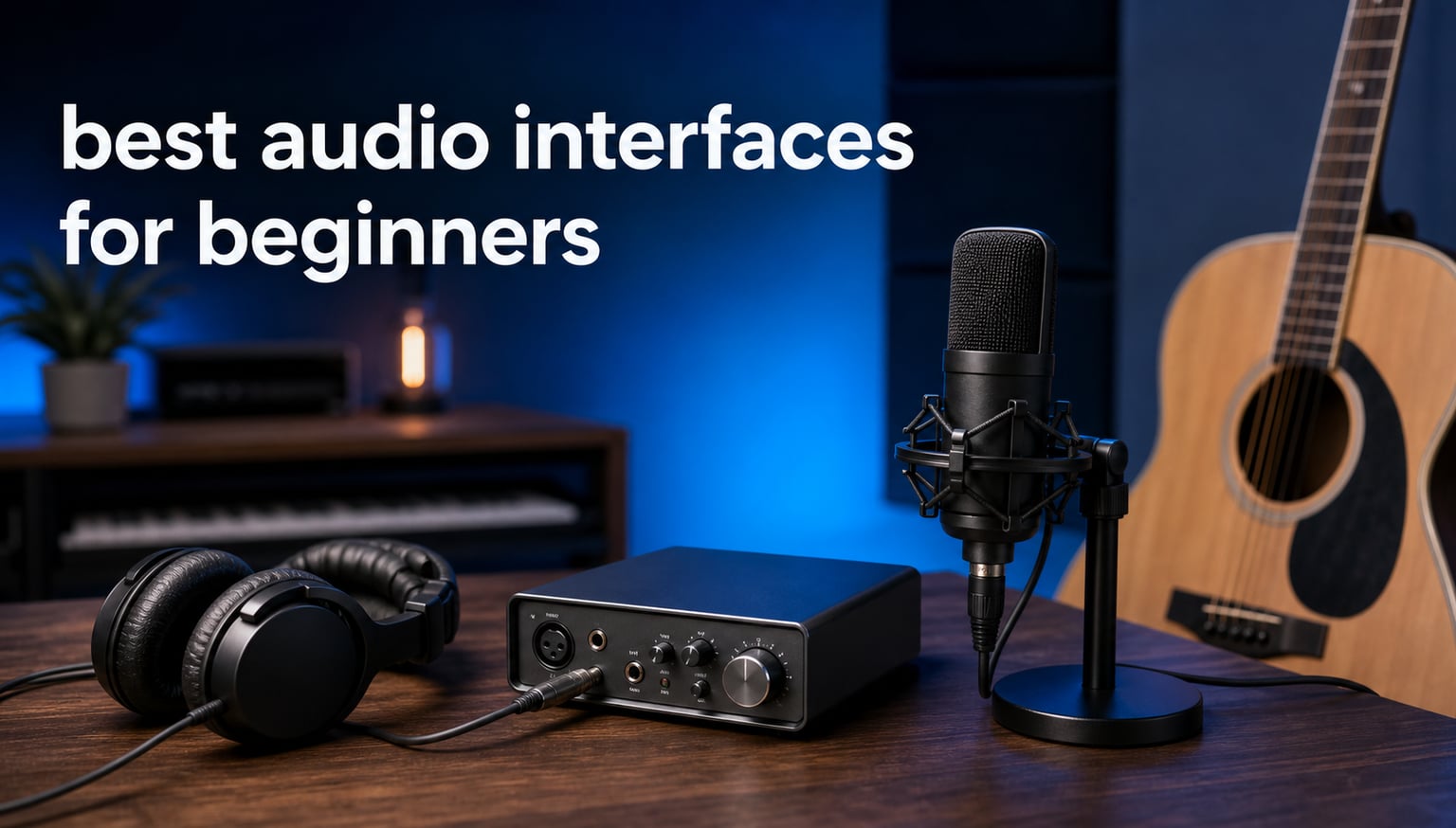
The best audio interfaces for beginners make recording a microphone or instrument feel straightforward: plug in, set a safe level, monitor yourself, and capture sound in a DAW. An audio interface connects microphones and instruments to a computer, boosts their low-level signals with preamps, and converts them into digital audio for recording and playback.
A computer headphone port is not a substitute when you need an XLR microphone input, 48V phantom power for a condenser mic, a proper guitar input, or low-latency monitoring. I would start with the recording situation, not a spec sheet: one vocalist, a singer-songwriter with guitar, a two-person podcast, or a small home studio.
For this guide, we compared eight USB audio interfaces using the supplied product specifications, stated features, verified customer ratings, and common beginner concerns from recording forums. The short version is that the Focusrite Scarlett 2i2 4th Gen is the broadest fit for two sources, the M-Audio M-Track Duo covers a simple two-input setup, and the Audient EVO 4 has automatic level setting for people who find gain knobs intimidating.
The top 3 picks answer the most common beginner setups in September 2026

Best all-rounder: Focusrite Scarlett 2i2 4th Gen for two microphones, guitar plus vocal, or a guest podcast. Best simple two-input starter: M-Audio M-Track Duo for direct monitoring and phantom power. Best for automatic levels: Audient EVO 4 for Smartgain and an uncluttered control approach.
All three support a beginner home-recording path, but their priorities differ. Choose the number of sources you want to record at once before deciding between them.
The best audio interfaces for beginners in 2026 compare eight practical options
| Product | Specifications | Action |
|---|---|---|
 PreSonus Studio 24c PreSonus Studio 24c |
|
Check Latest Price |
 Focusrite Scarlett Solo 4th Gen Focusrite Scarlett Solo 4th Gen |
|
Check Latest Price |
| Focusrite Scarlett 2i2 4th Gen |
|
Check Latest Price |
 MOTU M2 MOTU M2 |
|
Check Latest Price |
 Arturia MiniFuse 1 Arturia MiniFuse 1 |
|
Check Latest Price |
 Universal Audio Volt 2 Universal Audio Volt 2 |
|
Check Latest Price |
 M-Audio M-Track Duo M-Audio M-Track Duo |
|
Check Latest Price |
 Audient EVO 4 Audient EVO 4 |
|
Check Latest Price |
Two inputs means you can record two sources at the same time, such as a vocal and guitar, or two people speaking. A one-input unit is still a good fit when you will only ever track one microphone or instrument at a time.
The PreSonus Studio 24c is the beginner pick for MIDI and bundled recording software
PreSonus Studio 24c 2×2, 192 kHz, USB Audio Interface with Studio One DAW Recording Software
2-in 2-out
MIDI I/O
24-bit 192 kHz
Pros
- Two flexible combo inputs
- MIDI In and Out
- Studio One Artist included
- Four LED meters
- Direct monitoring mixer
Cons
- Two inputs only
- One-year manufacturer warranty
The Studio 24c makes sense when the first setup includes a keyboard controller or external MIDI hardware as well as a microphone. Its stated 2-in/2-out design gives a new producer room for a vocal and instrument session without making the front panel feel crowded.
PreSonus includes Studio One 6 Artist Edition, which gives a newcomer a DAW to begin recording with instead of finding software separately. The interface is USB-C bus-powered, and both USB-C-to-USB-C and USB-C-to-USB-A cables are listed, a useful practical detail for mixed computer setups.
Two XMAX-L mic preamps accept microphone, instrument, or line-level sources through the combo inputs. The four ladder-style LED meters show two input and two main-output levels, so I would find it easier to spot an overly hot signal before recording than on a unit with less visual feedback.
The mixer knob supplies low-latency direct input monitoring, while balanced TRS main outputs connect to monitor speakers. Its 24-bit operation reaches 192 kHz according to the listing, though beginners should prioritize a clean level and quiet room over chasing a high sample-rate setting.
The Studio 24c suits a MIDI-based first studio
MIDI carries performance commands rather than audio, so it matters for connecting older synths, drum machines, or controllers with five-pin MIDI ports. If that is part of your plan, the dedicated MIDI In and Out make the Studio 24c more flexible than interfaces without them.
It also suits a singer-songwriter who wants one mic and one guitar at once. The two balanced main outputs and high-power headphone output cover the usual monitor and headphone connections.
The Studio 24c is less suited to recording a full group
Two simultaneous inputs are the hard limit. A drummer, several podcast guests, or a band will outgrow it and should look for an interface designed with more input channels.
For a first home studio, that limit is usually reasonable; it simply requires planning recording in layers. Record guitar and vocal together, then add other parts one at a time.
The Focusrite Scarlett Solo 4th Gen is the focused one-person vocal and guitar choice
Focusrite Scarlett Solo 4th Gen USB-C Audio Interface
One mic preamp
120 dB range
Air mode
Pros
- 120 dB dynamic range
- Air mode
- Loopback
- USB-C bus-powered
- Large software bundle
Cons
- One mic preamp only
- Not for two microphones at once
The Scarlett Solo 4th Gen is aimed squarely at the solo vocalist, guitarist, or producer who records one main source at a time. It has one microphone preamp and one Hi-Z instrument input, a pairing that fits singing while playing guitar or recording each part separately.
Focusrite states a 120 dB dynamic range and lists Air mode for bringing more presence to vocal and guitar recordings. It also includes loopback, which is useful when routing computer audio into a stream or recording setup.
The software bundle is unusually broad for a first USB audio interface: Pro Tools Intro+, Ableton Live Lite, Cubase LE, and the Hitmaker Expansion are listed. I see that as a chance to try a DAW workflow before committing to one.
It is bus-powered over USB-C and lists support for Mac, Windows, and iOS. The limitation is simple and important: you cannot put two XLR microphones into it for a two-person podcast or a stereo pair.
The Scarlett Solo works when one source is the whole plan
This is a clean fit for voice-over, solo podcasting, guitar recording, and a singer who will overdub rather than record with another vocalist. The single-preamp layout removes a decision and helps keep the first setup compact.
Air mode is a creative option, not a substitute for microphone placement. Begin with it off, get a controlled input level, and then compare a short test take with Air engaged.
The Scarlett Solo falls short for shared recording sessions
A second microphone requires a second preamp, which this model does not have. That makes the Scarlett 2i2 or another two-input interface a better move when a guest, collaborator, or second instrument is likely.
Do not confuse its two channels with two mic preamps. Its product listing specifies one mic preamp and one dedicated instrument input.
The Focusrite Scarlett 2i2 4th Gen is the safest two-input starting point
Focusrite Scarlett 2i2 4th Gen USB-C Audio Interface
Two mic preamps
Auto Gain
Clip Safe
Pros
- Two low-noise mic preamps
- Auto Gain
- Clip Safe
- Air mode
- Full software bundle
Cons
- Larger commitment than Solo
- No MIDI ports listed
The Focusrite Scarlett 2i2 4th Gen is my clearest all-purpose recommendation because its two mic preamps cover the beginner situations that change fastest. You can record two voices, a vocal and guitar, or an instrument and a line-level source without replacing the interface immediately.
Its fourth-generation feature set directly addresses a common beginner mistake: recording too hot. Auto Gain sets a level for a mic or guitar, and Clip Safe is intended to prevent clipping after the level is set.
The listing also specifies 120 dB dynamic range, two instrument and line inputs, Air mode, loopback, and 24-bit/192 kHz recording. Those are useful tools, yet the main advantage remains the plain two-input layout and clear path from first demo to recurring projects.
Focusrite includes Pro Tools Intro+, Ableton Live Lite, Cubase LE, and Hitmaker Expansion. Its 4.6 rating is based on more than 2.5k listed reviews, which gives this model a larger feedback base than several options here.
The Scarlett 2i2 fits recording that may grow beyond one person
Pick it if your first project might become a two-host podcast, acoustic guitar and vocal session, or collaboration. Two preamps keep both microphones independent, so each performer gets their own gain setting.
The headphone output and monitor outputs make it a complete small desk hub. It is also well matched to the best audio interfaces for beginners who want automatic protection against clipped takes.
The Scarlett 2i2 does not replace a MIDI hub or multichannel recorder
The provided product information does not list MIDI In or Out, so choose the PreSonus Studio 24c if five-pin MIDI hardware is a firm need. It also remains a two-input interface, not a solution for recording a full band in one pass.
Auto Gain helps with starting levels, but it cannot repair a noisy room, poor mic placement, or a source that is already distorted. Make a short test recording before an important take.
The MOTU M2 is the straightforward hardware-monitoring choice
MOTU M2 USB-C Audio Interface
2-in 2-out
Two preamps
Hardware monitoring
Pros
- Two preamps
- Hardware monitoring
- USB-C
- 24-bit 192 kHz
- Free content included
Cons
- Compatibility listing is limited
- Two inputs only
The MOTU M2 keeps its proposition concise: two preamps, two inputs and outputs, USB-C, 24-bit/192 kHz operation, and hardware monitoring. That hardware-monitoring feature is the standout for a beginner who wants to hear their live voice or instrument without waiting for the computer.
Latency is the small delay between making a sound and hearing it through software. Hardware monitoring routes the input directly to listening, so you can track comfortably even before learning buffer-size settings in a DAW.
The listing includes more than 6 GB of free content and identifies the M2 as a USB-C interface. Its 4.6 rating comes from more than 1.5k reviews, and experienced users in forum discussions often mention MOTU models favorably when comparing two-input interfaces.
One detail needs checking before purchase: the supplied specifications list Windows as the operating system, while the included content references macOS, Windows, and iOS. Confirm the current manufacturer compatibility and driver details for your particular computer rather than assuming.
The MOTU M2 is strong for performers sensitive to monitoring delay
Guitarists and vocalists who dislike an echo-like delay in headphones should value hardware monitoring. It lets you separate the immediate monitoring task from DAW playback and plugin processing.
Two preamps also cover paired sources. That is enough for a basic two-person conversation or live acoustic performance.
The MOTU M2 requires a compatibility check before setup
Because the supplied listing gives limited operating-system information, download the correct current driver or setup instructions from MOTU before connecting it. This is especially sensible for a first interface, when a driver mismatch can look like a hardware problem.
Do not judge a driver by whether the computer sees the interface once. Test recording and playback at your intended sample rate, then restart the DAW and confirm the inputs remain available.
The Arturia MiniFuse 1 is the portable single-input creative-software choice
Arturia MiniFuse USB Audio & MIDI Interface, MiniFuse 1
One combo input
48V phantom
110 dB range
Pros
- Compact size
- 48V phantom power
- Loopback
- Five-year warranty
- Creative software bundle
Cons
- One input only
- Not for simultaneous two-mic work
The Arturia MiniFuse 1 is a compact one-channel interface for the person recording a voice, guitar, or synth one source at a time. It includes a combo mic, instrument, and line input, 48V phantom power, headphone and stereo outputs, and loopback according to its product information.
Its 110 dB dynamic range and maximum 192 kHz sample rate are solid paper credentials, but the more practical appeal is the starting software. Ableton Live Lite, Analog Lab Intro, Arturia FX, NI Guitar Rig 6 LE, and other included tools give a curious beginner sounds to work with immediately.
The MiniFuse 1 also lists a five-year warranty and support for Windows and macOS. A USB hub and MIDI are included in the stated connection set, a notable feature combination for such a compact interface.
I would see loopback as helpful for tutorials, streaming, and screen-recorded music lessons because it can capture audio from an app. For ordinary vocal recording, the simple front-panel input and phantom-power switch are the daily-use features.
The MiniFuse 1 fits portable one-source sessions
Choose it when the work is a single singer, guitar player, narrator, or synth part at a time and a small footprint matters. A one-input interface can remove unused controls from a first desk setup.
Its 48V phantom power means it can work with a condenser microphone that needs power from the interface. Switch phantom power on only after connecting an appropriate condenser mic and turning the gain down.
The MiniFuse 1 is not the right choice for two live microphones
One combo input means one mic or one instrument can be recorded at once through the interface. A two-host podcast requires two microphone inputs, so the Scarlett 2i2, Studio 24c, Volt 2, M-Track Duo, or EVO 4 makes more sense.
Software bundles add options, not instant skill. Begin with one DAW and one simple project template rather than installing every included application on day one.
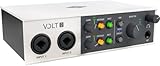
The Universal Audio Volt 2 is the two-input option for vintage-flavored controls
Universal Audio Volt 2 USB Audio Interface
Two channels
Vintage mode
24-bit 192 kHz
Pros
- Vintage preamp mode
- 192 kHz recording
- LUNA DAW included
- Mac Windows and iPad support
- UAD software support
Cons
- External power supply required
- iOS needs a camera adapter
The Universal Audio Volt 2 pairs a two-channel beginner layout with a Vintage mode that aims for the character of UA’s classic 610 preamps. That makes it appealing to a vocalist or songwriter who wants a deliberate tonal option available at the source.
Its supplied features list recording up to 24-bit/192 kHz, the LUNA DAW, UAD plug-ins and instruments, and support for macOS, Windows, iPad, and iPhone. The 4.6 rating is drawn from more than 700 listed reviews.
Two channels are enough for a voice and guitar or two speakers, while the creative software gives the interface a wider production path. Vintage mode should be treated as a sound choice: record a short clean pass and a Vintage-mode pass, then decide which sits better in the project.
The tradeoffs are clearly stated in the product data. It requires an external Volt power supply, and iOS devices need an Apple Lightning-to-USB Camera Adapter, so it is less grab-and-go than a bus-powered model.
The Volt 2 serves creators who want two inputs and tonal variety
It is a good fit for songwriters who want to compare a more characterful preamp setting with a cleaner recording. It also works for a compact podcast or acoustic setup that needs two sources simultaneously.
LUNA and UAD tools can provide a structured place to learn recording and mixing. Keep the first sessions simple: record, edit the obvious mistakes, set levels, and export.
The Volt 2 needs planned power and mobile connections
The external-power requirement is a meaningful distinction if you record away from a desk. Bring the appropriate supply rather than assuming the USB connection powers every use case.
Mobile recording is supported in the listing, but the adapter requirement for Lightning-based iOS devices needs to be included in the setup. Check the ports on your actual device before building around this interface.
The M-Audio M-Track Duo is the basic two-input entry point
M-AUDIO M-Track Duo USB Audio Interface
Two combo inputs
48V phantom
Direct monitoring
Pros
- Two XLR line instrument inputs
- 48V phantom power
- USB Direct monitoring
- MPC Beats included
- Mac and PC support
Cons
- 48 kHz maximum sample rate
- Lower 4.4 rating
The M-Audio M-Track Duo covers the essentials without making the starter layout complicated. It supplies two combo XLR, line, and instrument inputs, 48V phantom power, a headphone output, stereo main outputs, and a USB/Direct switch for zero-latency monitoring.
That input combination is useful for a beginner who wants to try a dynamic microphone, condenser microphone, guitar, keyboard, or two-person spoken recording. It is also one of the most widely reviewed models here, with more than 6.6k listed reviews and a 4.4 rating.
Its maximum sample rate is 48 kHz rather than 96 or 192 kHz. For common music, podcasting, and streaming work, 48 kHz is a normal working setting; learning input gain and monitoring makes a larger audible difference at the start.
MPC Beats is included for production work, and the product information lists Android, Windows, iOS, and macOS compatibility. The USB/Direct switch is a physical reminder that direct monitoring is often the fastest solution when headphone latency appears.
The M-Track Duo works for a simple two-source setup
It is a sensible match for two mics, or one vocal mic plus one guitar, when the goal is basic home recording. The separate input options mean you do not need specialty adapters for ordinary XLR or instrument connections.
Set the switch toward Direct when recording if computer monitoring feels delayed, then use the DAW playback level for the backing track. This avoids trying to solve monitoring with a dozen software settings.
The M-Track Duo is best for fundamentals rather than high-resolution claims
Its 48 kHz ceiling is a real specification difference from several other models in this guide. Choose a higher-rate interface if that specific technical flexibility is part of your plan, but do not mistake a bigger number for better performances.
Give yourself time to learn the included software, and test it with the interface before a recording session. A reliable template with the correct input selected prevents the most common first-day frustration.
The Audient EVO 4 is the automatic-gain pick for nervous first recordings
Audient EVO 4 USB Audio Interface
Smartgain
JFET input
Low-latency mixer
Pros
- Smartgain automatic levels
- JFET instrument input
- AKM converters
- Flexible software mixer
- Simple touch controls
Cons
- 96 kHz maximum sample rate
- Windows-only listing requires checking
The Audient EVO 4 approaches beginner recording from a different angle: Smartgain can automatically dial in a channel level. That directly addresses the question many new users have after connecting a mic: how far should I turn the gain knob before I ruin a take?
Its stated features include a discrete JFET instrument input, AKM analog-to-digital and digital-to-analog converters, a DSP-based low-latency software mixer, flexible routing, and touch-based controls. The maximum sample rate is listed as 96 kHz.
Smartgain is not magic; it is a starting measurement that still benefits from a test phrase sung or spoken at the real performance volume. Still, it can make the first recording feel less technical, which matches the praise it receives in beginner forum conversations.
The supplied specifications list Windows as the operating system, despite the model’s broader reputation. Treat that as a purchase checkpoint: verify the manufacturer’s current compatibility for your operating system and download the official setup material before ordering.
The EVO 4 suits beginners who want help setting input gain
Smartgain is especially useful for a first vocal chain, voice-over setup, or guest who does not know how strongly they will speak. It provides a repeatable first step before you fine-tune by ear.
The JFET instrument input is a useful feature for a guitar audio interface, while the mixer handles low-latency routing. Start with one input, one headphone mix, and one recording track before adding software routing.
The EVO 4 needs an operating-system check before committing
Compatibility and driver setup are frequent beginner pain points, and the provided listing is limited here. Verify your exact computer version and connection type through Audient’s official current documentation.
When installing any driver-based interface, close the DAW, install the official driver, restart the computer if instructed, and select the interface as both input and output in the DAW. Then make a short recording and playback test.
The buying guide starts with the sources you need to record together
Choose one input when you will record one voice, guitar, or instrument at a time. Choose two mic-capable inputs for a vocal-and-guitar performance, two people on microphones, or the freedom to collaborate without buying again.
Combo XLR and quarter-inch inputs accept different source types through one socket. XLR is the standard connection for microphones, while a quarter-inch instrument input is for a guitar or bass; line level is for equipment such as a keyboard or external preamp.
The right gain setting keeps recordings clean before any plugin is added
Gain is the amount of amplification applied to an incoming microphone or instrument signal. Speak, sing, or play the loudest section of the part during a test, then raise gain until the meter is healthy without reaching clipping.
Clipping occurs when the input is too loud for the system to capture cleanly, producing harsh distortion that is difficult to remove. Auto Gain, Clip Safe, and Smartgain can assist, but a quick test take remains the most dependable habit.
Phantom power is for condenser microphones that require 48V
Phantom power sends 48 volts through an XLR cable to compatible condenser microphones. Dynamic mics generally do not need it, and guitars never receive it through an instrument input.
Turn the gain down before switching 48V on or off, connect the microphone first, and consult the microphone documentation. The 48V feature on the MiniFuse 1, M-Track Duo, and other listed models gives a beginner the option to use a condenser mic later.
Direct monitoring solves most first-session latency complaints
Direct or hardware monitoring lets you hear your input at the interface instead of waiting for the signal to travel through the computer and DAW. The Studio 24c mixer knob, MOTU M2 hardware monitoring, and M-Track Duo USB/Direct switch are examples in this guide.
If you want to hear reverb or amp simulation while recording, you may need DAW monitoring and a low buffer size instead. Start with direct monitoring for the dry performance, then add effects during playback if the computer produces delay.
Driver setup matters most on a computer-based recording system
Class-compliant devices can work with a computer’s built-in audio support, while other interfaces may rely on manufacturer drivers for full operation or low-latency performance. The exact approach differs by model and operating system, so use the official current instructions rather than an old forum fix.
Before a session, connect directly to the computer where possible, select the interface in the operating system and DAW, and set one sample rate consistently across both. If crackles occur, close other audio apps and try a larger buffer for playback or mixing.
MIDI ports matter only when external MIDI hardware needs them
MIDI does not carry your microphone audio. It carries note, timing, and control information between devices, such as an older keyboard, synth, or drum machine.
The PreSonus Studio 24c explicitly lists MIDI In and Out, and the MiniFuse 1 listing also names MIDI among its connections. If your controller already connects over USB, separate MIDI ports may not be needed at all.
The frequently asked questions give direct beginner answers
Which interface is best for beginners?
The Focusrite Scarlett 2i2 4th Gen is the broadest beginner choice because it has two microphone preamps, Auto Gain, Clip Safe, Air mode, and a bundled software collection. Choose the Scarlett Solo instead when you only need one microphone or instrument at a time, or the Audient EVO 4 when automatic Smartgain is your main priority.
What is the best budget-friendly audio interface?
The M-Audio M-Track Duo is the basic value-oriented option in this guide. It has two combo microphone, line, and instrument inputs, 48V phantom power, a USB/Direct monitoring switch, and included MPC Beats software. Its maximum sample rate is 48 kHz, which remains practical for common podcasting, streaming, and home-recording projects.
Which audio interface has the best sound quality?
Sound quality depends on the microphone, source, room, gain setting, and recording technique as much as the interface. The Focusrite Scarlett 2i2 and Solo list 120 dB dynamic range, the Arturia MiniFuse 1 lists 110 dB, and several interfaces reach 24-bit/192 kHz. For a first setup, select the inputs and monitoring features that fit your work, then focus on controlled gain and mic placement.
What is the most used audio interface?
The supplied product data identifies the Focusrite Scarlett Solo 4th Gen and Scarlett 2i2 4th Gen as category best sellers, and recording forums often describe the Scarlett 2i2 as a safe beginner choice. Popularity is useful evidence, but the right interface is the one with enough inputs, the connections you need, and a setup you can understand.
The best first interface is the one that matches your next recording
The Focusrite Scarlett 2i2 4th Gen is the strongest all-rounder when two simultaneous sources and beginner-friendly level tools matter. The PreSonus Studio 24c is the better direction for built-in MIDI, while the Audient EVO 4 is compelling when you want Smartgain to help establish a starting level.
The best audio interfaces for beginners in 2026 do not need an overwhelming feature list. Choose the input count you will genuinely use, install the current official software, make a short test recording, and spend the rest of the session making music or telling your story.