
I still remember the first time I heard Nightcall by Kavinsky. It was 2026, and I was watching Drive for the first time. That pulsing bassline, those crystalline synthesizers, the unmistakable 80s atmosphere dripping from every note. I had no idea what I was listening to, but I knew I needed more.
That was my introduction to synthwave.
Since then, I’ve spent countless hours exploring this genre – from the dark, aggressive tones of Perturbator to the dreamy, nostalgic soundscapes of The Midnight. Synthwave isn’t just music. It’s a portal to a version of the 1980s that exists only in our collective imagination.
In this guide, I’ll break down exactly what synthwave is, where it came from, and how a group of internet musicians in the mid-2000s accidentally sparked a global nostalgia movement.
What Is Synthwave? A Clear Definition (2026)
Synthwave is an electronic music microgenre that emerged in the mid-2000s, characterized by heavy use of analog synthesizers, drum machines, and a deliberate aesthetic of 1980s nostalgia. Musicians create tracks that sound like they could have been ripped straight from a 1980s film soundtrack or video game.
The genre draws heavily from the sounds of the 1980s – think Tangerine Dream, Vangelis, John Carpenter, and early electro-pop. But synthwave isn’t just a revival. It’s a reimagining. Artists combine those vintage sounds with modern production techniques to create something that feels simultaneously nostalgic and fresh.
At its core, synthwave celebrates the 1980s as we remember it through movies, television, and video games. It’s the sound of neon lights reflecting off wet pavement. It’s the sound of driving a Ferrari Testarossa down an endless coastal highway at sunset. It’s the sound of a future that never happened but feels strangely familiar.
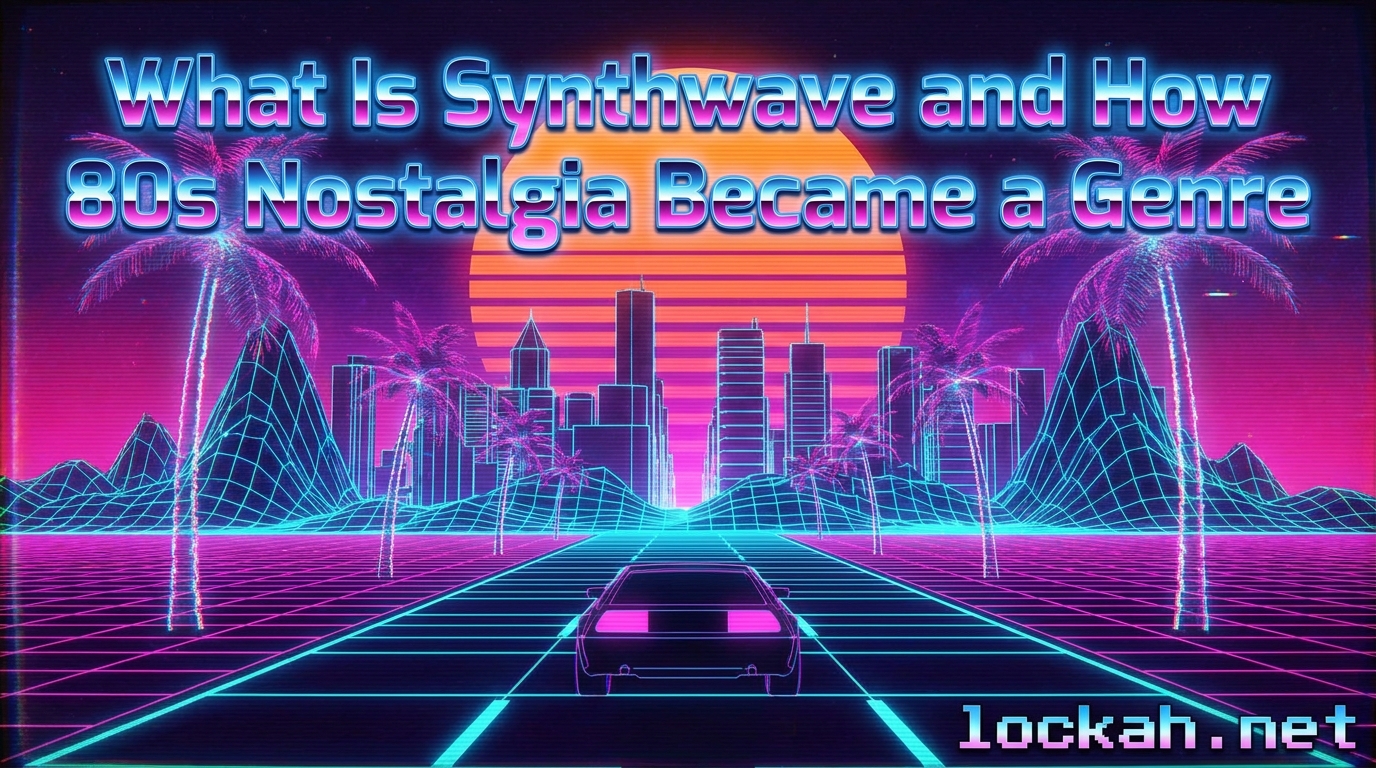
The visual side is just as important. Synthwave artwork features chrome typography, wireframe grids, palm trees against purple sunsets, sports cars from the 80s, and plenty of neon pink and cyan. Many fans discovered the genre through the distinctive album artwork before they even heard the music.
The Origins: How Synthwave Emerged from the Internet?
Synthwave wasn’t born in a studio or planned by record executives. It emerged organically from online communities in the mid-2000s, born from a shared love of 80s culture and French electronic music.
The French Connection
The story begins in France around 2005-2006. A wave of electronic musicians started creating tracks inspired by 1980s film scores and video game music. These early pioneers – artists like Kavinsky, College, and Anoraak – blended the sounds of their childhood with the French house and nu-disco scenes happening around them.
French house music, popularized by Daft Punk and Justice, already had a retro-futuristic quality. It wasn’t a huge leap to strip away the dancefloor focus and lean harder into the cinematic, nostalgic elements. The synthesizer sounds that French house used as accents became the main attraction in synthwave.
These French artists released their music through blogs, MySpace, and early digital distribution platforms. The internet allowed them to find their audience directly, bypassing traditional music industry gatekeepers.
The Bloghouse Era
This was the bloghouse era – roughly 2006 to 2012 – when music blogs held enormous influence over underground music culture. Sites like Valerie Collective became hubs for this emerging sound, connecting artists with fans who were hungry for something that captured the magic of 80s pop culture.
Valerie Collective, founded in 2003, deserves special mention. Based in Nantes, France, they helped define the early synthwave aesthetic. Their artists – including College, Anoraak, and others – created a blueprint that would be replicated and expanded by musicians around the world.
By the late 2000s, the sound had started spreading beyond France. American artists like Com Truise and Neon Indian were putting their own spin on the retro synth sound, often blending it with chillwave and other contemporary genres.
The Sound: What Makes Synthwave Distinctive?
I’ve listened to hundreds of synthwave tracks, and certain production elements appear again and again. Understanding these building blocks helps explain why the genre has such a distinctive, immediately recognizable sound.
The Tools of the Trade
Synthwave producers reach for specific instruments – either hardware originals or software emulations – to achieve that authentic 80s sound:
Analog Synthesizers: The Yamaha DX7, Roland Juno-106, and Prophet-5 appear constantly. These synths defined the sound of 1980s pop music and film scores. Modern producers use vintage hardware or software emulations like Arturia’s V Collection.
Drum Machines: The Roland TR-808 and TR-909 are the backbone of most synthwave beats. That distinctive kick, that crisp snare – these machines created the rhythmic foundation of 80s electronic music. The gated reverb effect on snare drums is practically mandatory in synthwave.
Gated Reverb: Speaking of which, the gated reverb sound – that explosive, echoing snare popularized by Phil Collins and 80s pop producers – is a synthwave staple. It instantly evokes the era.
Sidechain Compression: That pumping effect where the bass ducks under the kick drum? That’s sidechain compression, and synthwave uses it heavily. It creates a driving, propulsive energy perfect for “night driving” music.
The 4-on-the-Floor Beat
Most synthwave tracks use a 4-on-the-floor beat – that steady kick drum on every quarter note that drives dance music. Combined with sidechain compression, it creates the genre’s signature driving rhythm. This is music designed for motion, whether that’s a car on a highway or a character moving through a neon-lit city.
The tempo usually sits between 90 and 130 BPM – not too fast, not too slow. It’s the perfect pace for creating atmosphere while maintaining forward momentum.
Cinematic Atmosphere
Synthwave is fundamentally cinematic music. Even without lyrics, these tracks tell stories. The best synthwave creates a sense of place and narrative – you’re not just listening to a song, you’re entering a world.
Arpeggiated synth patterns create movement and tension. Swelling pads provide emotional weight. Lead melodies soar over the top like themes for heroes we haven’t met yet. Every element serves the atmosphere.
The Visual Aesthetic: Neon, Grids, and Chrome
Synthwave isn’t just an auditory experience – it’s visual too. The aesthetic that accompanies the music is as carefully crafted as the tracks themselves.
The Color Palette
Neon pink, electric blue, deep purple, and sunset orange dominate synthwave artwork. These colors don’t reflect the actual 1980s so much as our collective memory of the era filtered through movies like Blade Runner and Tron.
The contrast is crucial – bright neon against deep blacks, glowing grids fading into digital darkness. This high-contrast look is immediately recognizable and endlessly imitated.
Iconic Imagery
Certain images appear again and again in synthwave art:
Sports Cars: The Ferrari Testarossa, Lamborghini Countach, and DeLorean are practically mascots for the genre. These angular, aspirational vehicles represent freedom, speed, and a certain kind of 80s excess.
Palm Trees and Sunsets: The combination suggests California, Miami, endless summer, and the promise of something just over the horizon.
Wireframe Grids: Those glowing neon grids stretching to an infinite horizon – straight out of early computer graphics and 80s visions of virtual reality.
VHS Effects: Tracking errors, scan lines, and chromatic aberration remind us of the physical media through which many of us experienced 80s culture.
Chrome Typography
The fonts matter too. Chrome effects, geometric sans-serifs, and italicized text that suggests speed and movement. Album covers and track art use typography that wouldn’t look out of place on a 1980s action movie poster.
All these visual elements combine to create a cohesive aesthetic world. When you see a synthwave album cover, you know exactly what you’re going to hear.
80s Nostalgia: Why Millennials Drove the Revival?
Here’s something fascinating about synthwave: many of its biggest fans weren’t alive during the 1980s. So why does this music resonate so deeply with millennials and Gen Z?
Nostalgia for a Time You Didn’t Experience
I was born in the early 90s. I have no direct memory of 1980s culture. Yet synthwave triggers something in me that feels like nostalgia. This phenomenon – call it “secondhand nostalgia” or “media nostalgia” – is central to the genre’s appeal.
Millennials and younger generations experienced the 1980s through media. We watched The Goonies, Back to the Future, and Terminator on VHS. We played games like GTA Vice City that recreated the era. The 80s existed for us as a curated collection of highlights – the best movies, the coolest music, the most iconic imagery.
Synthwave taps into that curated nostalgia. It presents the 80s as we imagine it, not necessarily as it was. It’s a rose-tinted vision where the fashion was always bold, the nights were always neon-lit, and the future looked exciting rather than frightening.
The Appeal of Analog in a Digital World
There’s also something appealing about the analog warmth of synthwave in our hyper-digital present. The imperfections of analog synthesizers, the physicality of drum machines, the “hand-made” quality of 80s production – these contrast sharply with the pristine digital perfection of modern pop production.
Synthwave offers texture. It has character. The sounds aren’t perfect, and that’s the point.
Escapism
In 2026, the world can feel overwhelming. Climate change, political division, economic uncertainty – the present is stressful. Synthwave offers an escape to a simpler time, or at least to a version of the past that feels simpler.
That endless highway, that sunset, that sense of possibility – these are emotional states as much as aesthetic choices. Synthwave lets us visit a place where the future still seemed bright.
Cultural Touchstones: The Films and Games That Shaped Synthwave
Several key moments in pop culture helped bring synthwave from an internet niche to mainstream awareness.
Drive (2011)
When Nicolas Winding Refn’s Drive hit theaters in 2011, it changed everything for synthwave. The film’s soundtrack, featuring Kavinsky’s “Nightcall” and College’s “A Real Hero,” introduced millions to the genre.
Suddenly, people were asking: what is this music? Where can I find more? The film’s neon-lit visuals and retro-cool aesthetic perfectly matched the sound, creating a complete package that showcased what synthwave could be.
“Nightcall” became the gateway track for countless fans. Even today, it remains one of the most-streamed synthwave songs in the world.
Blade Runner (1982)
While predating synthwave by decades, Ridley Scott’s Blade Runner and Vangelis’s iconic soundtrack provided the blueprint for the genre’s visual and sonic aesthetic. The rain-soaked neon streets of future Los Angeles, the synthesizer-heavy score – this is the world synthwave tries to soundtrack.
Many synthwave tracks feel like they could have been composed for Blade Runner or its sequel. The influence is impossible to overstate.
GTA Vice City (2002)
Rockstar’s 2002 masterpiece didn’t just feature 80s music – it immersed players in a lovingly recreated 1986 Miami. For many younger fans, this was their first deep exposure to 80s pop culture.
The game’s radio stations, featuring New Wave, synth-pop, and hair metal, educated a generation about 80s music. When those same players discovered synthwave years later, it felt like coming home.
Forum discussions consistently cite Vice City as the gateway to 80s nostalgia for millennials.
Hotline Miami (2012)
This ultra-violent indie game had a soundtrack that helped define the “darksynth” subgenre. Artists like Perturbator, M|O|O|N, and Scattle provided pulsing, aggressive tracks that matched the game’s neon-drenched violence.
Hotline Miami proved that synthwave could be dark, edgy, and appeal to gamers. It introduced a harder sound to the genre and expanded its audience significantly.
Stranger Things (2016)
The Duffer Brothers’ Netflix hit brought 80s nostalgia to the mainstream in a massive way. The synth-heavy soundtrack, composed by Kyle Dixon and Michael Stein, introduced millions more listeners to the sound of analog synthesizers.
While not strictly synthwave, the Stranger Things soundtrack shares DNA with the genre. It proved there was a massive appetite for retro synthesizer sounds in mainstream media.
The Artists Who Defined the Genre
Synthwave has its pantheon of essential artists. These musicians shaped the sound and continue to influence new generations of producers.
Kavinsky
Vincent Belorgey, better known as Kavinsky, is often credited as the first synthwave artist. His 2007 track “Nightcall” (produced with Guy-Manuel de Homem-Christo of Daft Punk) is arguably the genre’s foundational text.
Kavinsky’s music tells stories. His 2013 album OutRun follows the tale of a crashed Ferrari Testarossa that becomes sentient. That narrative approach, combined with his cinematic production, set the template for much of what followed.
Perturbator
James Kent, recording as Perturbator, brought darkness to synthwave. His aggressive, industrial-influenced sound defined “darksynth” and expanded what the genre could be.
Albums like Dangerous Days and The Uncanny Valley</> are essential listening. Perturbator proved that synthwave could be heavy, complex, and appeal to metal and industrial fans as well as electronic music listeners.
The Midnight
Formed by Tyler Lyle and Tim McEwan, The Midnight represents synthwave’s evolution in the late 2010s. Their sound incorporates saxophone solos, guitar, and vocals while maintaining that core nostalgic feeling.
Tracks like “Sunset” and “Los Angeles” have become anthems for the genre. The Midnight brought emotional songwriting and live instrumentation to synthwave, pushing it beyond instrumental electronic music.
FM-84
British producer FM-84 (Colin Bennett) creates what fans call “dreamwave” – the more atmospheric, uplifting side of synthwave. His 2016 album Atlas is widely considered one of the genre’s masterpieces.
Collaborating frequently with vocalist Ollie Wride, FM-84 creates synthwave that feels like the closing credits of an 80s teen movie. It’s hopeful, romantic, and deeply nostalgic.
Other Essential Artists
The genre is full of talent worth exploring. Gunship creates cinematic concept albums with impressive music videos. Carpenter Brut brings a metal edge to darksynth. Timecop1983 specializes in dreamy, romantic instrumentals. Dance With the Dead blends synthwave with hard rock.
New artists emerge constantly. The synthwave community is active on platforms like Bandcamp, YouTube, and Reddit, constantly sharing and discovering new music.
Subgenres Explained: Outrun, Darksynth, Dreamwave, and More
Like any healthy genre, synthwave has splintered into subgenres. Understanding these distinctions helps you find exactly the sound you’re looking for.
Outrun
The original, purest form of synthwave. Named after Kavinsky’s album OutRun, this style emphasizes driving beats, neon atmosphere, and the feeling of motion. It’s upbeat, energetic, and perfect for actual driving.
Outrun tracks often feature arpeggiated synths, gated reverb snares, and that 4-on-the-floor pulse. It captures the optimistic, aspirational side of 80s nostalgia.
Darksynth
Darksynth takes the synthwave sound and makes it aggressive, horror-influenced, and intense. Think Hotline Miami, think John Carpenter’s darker scores, think industrial music meeting 80s horror.
Perturbator, Carpenter Brut, and GosT are the big names here. Darksynth often features distorted basslines, metal influences, and unsettling atmospheres. It’s synthwave for people who like their nostalgia with an edge.
Dreamwave
On the opposite end of the spectrum, dreamwave emphasizes atmosphere over energy. These tracks are slower, more contemplative, and deeply nostalgic.
FM-84 and Timecop1983 represent this style well. Dreamwave is music for watching sunsets, for late-night contemplation, for remembering places you’ve never been. It’s synthwave at its most emotional.
Retrowave
Sometimes used interchangeably with synthwave, “retrowave” often refers specifically to tracks with vocals and a more pop-oriented structure. The Midnight and FM-84 are essentially retrowave artists.
This subgenre embraces 80s pop songwriting – verses, choruses, bridges, big emotional hooks. It’s synthwave most likely to appeal to fans of mainstream pop music.
Chillwave and Vaporwave Connections
Synthwave sometimes overlaps with related genres. Chillwave shares the nostalgic, lo-fi aesthetic but tends to be more relaxed and less structured. Vaporwave is a separate but related phenomenon – we’ll cover the differences in the next section.
Synthwave vs Vaporwave: Understanding the Difference
People often confuse synthwave and vaporwave. Both emerged from internet culture, both celebrate retro aesthetics, and both use “wave” in their names. But they’re distinct genres with different origins, sounds, and intentions.
The Sound Difference
Synthwave is original compositions that sound like they came from the 1980s. Producers write new music using vintage sounds and techniques.
Vaporwave is manipulated samples from the 80s and 90s. Artists slow down, chop, and process existing music – often smooth jazz, elevator music, and corporate pop – to create something new.
If synthwave is “what if someone made a new 80s soundtrack today,” vaporwave is “what if the 80s never ended and became a weird dream.”
The Visual Difference
Synthwave visuals are energetic, aspirational, and neon-lit. Sports cars, palm trees, chrome typography, grid landscapes. It celebrates the 80s as cool.
Vaporwave visuals are ironic, surreal, and often unsettling. Classical statues, Windows 95 interfaces, corporate logos, Japanese text, glitch effects. It critiques the 80s as much as it celebrates it.
The Intent Difference
Synthwave is generally earnest. Artists genuinely love the 80s and want to recreate that magic. It’s nostalgic in the traditional sense – longing for a past that felt more exciting.
Vaporwave is ironic and often satirical. It comments on consumerism, corporate culture, and the emptiness of late capitalism. The nostalgia in vaporwave is more complicated, more melancholic.
The Listening Experience
Both genres are worth your time, but they serve different purposes. Synthwave is for driving, working out, or imagining yourself as the protagonist of an 80s action movie. Vaporwave is for contemplating the nature of memory, capitalism, and digital culture.
Many fans enjoy both. They’re two sides of the same retro coin.
Frequently Asked Questions
Why is synthwave associated with the 80s?
Synthwave is associated with the 80s because the genre deliberately recreates the sound of 1980s film soundtracks, video game music, and electronic pop. Artists use analog synthesizers, drum machines like the TR-808, and production techniques from that era to create new music that sounds vintage. The visual aesthetic also draws heavily from 80s films like Blade Runner and pop culture imagery.
Where did synthwave originate?
Synthwave originated in France in the mid-2000s, emerging from the French house and nu-disco scenes. Early pioneers like Kavinsky, College, and Anoraak began releasing music through blogs and internet communities around 2005-2007. The genre spread globally through online platforms before breaking into mainstream awareness with films like Drive (2011).
Who pioneered synthwave?
Kavinsky (Vincent Belorgey) is widely credited as the first synthwave artist. His 2007 track Nightcall, produced with Guy-Manuel de Homem-Christo of Daft Punk, established the template for the genre. Other early pioneers include College, Anoraak, and the Valerie Collective based in Nantes, France.
Why does synthwave sound nostalgic?
Synthwave sounds nostalgic because it intentionally uses instruments and production techniques from the 1980s – analog synthesizers like the Roland Juno-106 and Yamaha DX7, gated reverb on snare drums, and drum machines like the TR-808. These sounds trigger memories of 80s films and pop culture. For younger listeners, it creates secondhand nostalgia for a time they experienced through media.
What is the difference between synthwave and retrowave?
Retrowave is technically a subgenre of synthwave that emphasizes vocal tracks and pop song structures. While synthwave can be instrumental or vocal, retrowave specifically refers to the more song-oriented, pop-influenced side of the genre. However, the terms are often used interchangeably, and many artists blend both approaches. The Midnight and FM-84 are examples of retrowave artists.
Is synthwave still popular in 2026?
Yes, synthwave remains popular and continues to evolve. While it peaked in mainstream awareness around 2016-2018 with Stranger Things and The Weeknd’s Blinding Lights, the genre maintains an active community on platforms like Bandcamp, YouTube, and Reddit. New artists emerge constantly, and established acts like The Midnight and Gunship continue to release successful albums and tour globally.
Conclusion
Synthwave started as a niche interest shared by a few French musicians and internet music fans. Today, it’s a global phenomenon that has influenced mainstream artists, soundtracks, and popular culture.
The genre’s power lies in its ability to make us feel nostalgic for a time many of us never experienced. It creates a version of the 1980s that exists only in our collective imagination – a neon-lit world of endless highways, sports cars, and exciting futures.
Whether you’re a longtime fan or just discovering synthwave, there’s never been a better time to explore this genre. Start with the classics – Kavinsky, The Midnight, Perturbator – then dive into the thriving community of artists releasing new music every day.
What is synthwave? It’s more than just a genre. It’s a portal to a past that never was, and a future that never happened. Put on your headphones, queue up a playlist, and take that drive into the sunset.