
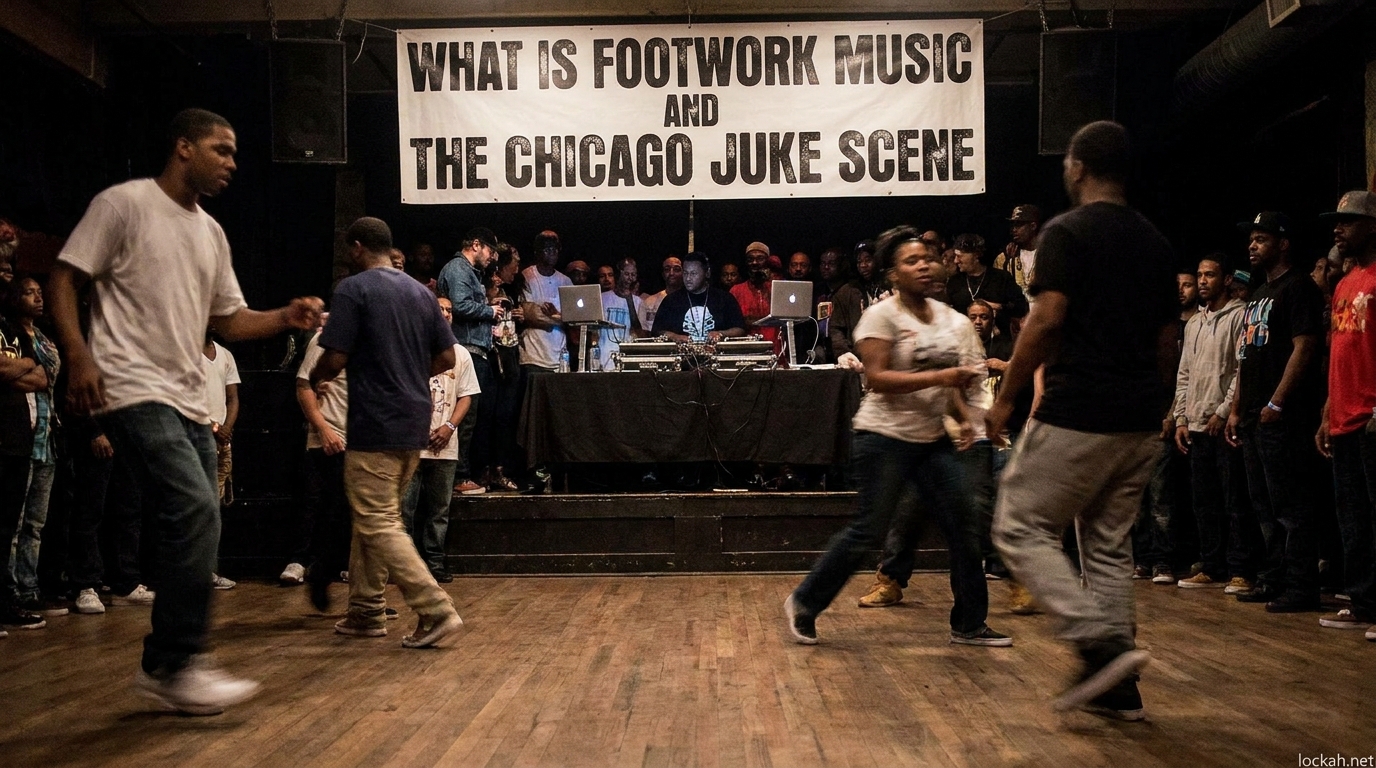
Footwork (also called juke or Chicago juke) is a genre of electronic dance music derived from ghetto house with elements of hip hop, first appearing in Chicago in the late 1990s. The sound is instantly recognizable by its relentless 160 BPM tempo, chopped vocal samples, and syncopated drum patterns that seem to trip over themselves in the most hypnotic way possible. When you first hear footwork music, the speed and complexity can feel overwhelming. But stick with it, and you will discover one of the most innovative American electronic music exports of the past three decades.
Our team has spent years tracing the history of this genre, from the basement parties on Chicago’s South Side to the international festival stages where footwork now commands massive crowds. What makes footwork special is not just the music itself. It is the inseparable bond between the sound and the dance style that shares its name. You cannot understand footwork music without understanding footwork dance, and vice versa.
In this guide, we will break down everything you need to know about footwork music and the Chicago juke scene. We will cover its origins in Chicago’s house music heritage, the key pioneers who built the sound, the technical characteristics that define the genre, and how this local Chicago phenomenon spread to influence electronic music scenes across the UK, Japan, and beyond.
Table of Contents
What is Footwork Music?
Footwork music is a hyperactive offshoot of Chicago house that emerged in the late 1990s, characterized by tempos around 160 beats per minute, intricate drum programming, and heavy use of sampled vocals cut into rhythmic stabs. The genre grew directly out of ghetto house (also called “booty house”), a raw, stripped-down variant of Chicago house that dominated the city’s South and West Side clubs throughout the 1990s. Producers began pushing the tempo faster and experimenting with more complex rhythmic patterns, creating a sound specifically designed to accompany the fast footwork dance style.
The terms “footwork” and “juke” are often used interchangeably, though there are subtle distinctions that we will explore later in this guide. Both terms describe the same musical family that originated in Chicago, but “juke” typically refers to the earlier, slightly slower phase of the sound (around 145-155 BPM), while “footwork” describes the more experimental, faster evolution (160 BPM and above) that gained international recognition in the 2010s.
What separates footwork from other fast electronic genres like drum and bass is its rhythmic DNA. Footwork producers use what fans call “beat-skipping” kick drums. The kick drum pattern deliberately falls off the grid, creating a stuttering, triplet-heavy feel that seems to contradict the steady pulse of the track. This rhythmic complexity is what makes footwork so challenging to produce and so exhilarating to dance to.
The Sound Characteristics at a Glance
Footwork tracks typically run at 160 BPM, though some producers venture slightly above or below this range. The tempo is fast enough to drive intense physical movement but not so fast that it becomes unmanageable for dancers. This 160 BPM sweet spot became the genre’s signature.
Production is almost exclusively done on hardware samplers, particularly the Akai MPC series. The MPC’s pad-based workflow lends itself perfectly to the chopped, staccato style of footwork drum programming. Producers load drum samples, vocal snippets, and melodic elements into the MPC, then trigger them in rapid-fire sequences that would be nearly impossible to program in traditional DAW software.
The sound palette draws heavily from Roland TR-808 and TR-909 drum machines, with booming kicks, crisp snares, and bright hi-hats forming the rhythmic foundation. Layered on top are vocal samples, often taken from hip-hop, R&B, or pop tracks, chopped into one or two-syllable fragments and rearranged into completely new melodic phrases.
Origins in Chicago: The South and West Sides (2026)
To understand footwork music, you need to understand Chicago in the late 1990s. The city’s South Side and West Side neighborhoods were home to a vibrant but economically struggling community where house music had already been the dominant cultural force for over a decade. This was the birthplace of ghetto house, a stripped-down, sexually explicit, and aggressively rhythmic variant of house that prioritized raw energy over polished production.
Ghetto house tracks typically ran at 130-140 BPM with four-on-the-floor kick patterns and repetitive, call-and-response vocal samples. DJs like DJ Deeon, DJ Funk, and DJ Slugo were local heroes, selling tapes and vinyl directly to their communities. The music was functional first and foremost, designed to make people dance at parties, in clubs, and in informal gatherings throughout the neighborhood.
By the late 1990s, a new generation of producers began emerging from this scene. They grew up on ghetto house but were also absorbing influences from hip-hop, particularly the fast, syncopated rhythms of Miami bass and the sample-heavy production style of East Coast rap. These young producers started pushing the tempo higher and experimenting with more complex drum patterns. The result was juke, and eventually, footwork.
The Social Context of Chicago Footwork
Footwork did not emerge in a vacuum. It came from community centers, school talent shows, and basement parties where young people gathered to compete in dance battles. The competitive dance culture provided the perfect environment for the music to evolve. Dancers needed faster, more complex tracks to showcase their skills. Producers responded by creating music specifically designed for these battles.
The era footwork collective, a Chicago-based organization dedicated to preserving and promoting the culture, describes the scene as “a cultural art form and music genre that was created by the youth of Chicago, specifically those from the West and South sides of the city.” This community-driven origin explains why footwork maintained such a strong local identity even as it gained international recognition decades later.
The music also reflected the realities of life in Chicago’s marginalized neighborhoods. Like hip-hop before it, footwork provided an outlet for creative expression and a pathway to recognition for young people with limited resources. You did not need expensive equipment or formal training to make footwork. An MPC, some records to sample, and creativity were enough to get started.
Juke vs Footwork: Understanding the Terminology
One of the most common points of confusion for newcomers is the relationship between “juke” and “footwork.” The two terms describe closely related but distinct phases of the same musical evolution. Understanding this distinction is essential for anyone diving into the genre.
Juke emerged first, in the late 1990s and early 2000s. The term itself comes from Chicago slang meaning to dance or party enthusiastically. Juke tracks typically ran at 145-155 BPM, maintained clearer connections to four-on-the-floor house rhythms, and often featured more straightforward, party-oriented vocals. The sound was designed for juke houses, informal venues where people gathered to dance and socialize.
Footwork represents the more experimental evolution that accelerated in the mid-2000s. The tempo pushed up to 160 BPM and beyond. The rhythms became more complex and syncopated. The production style grew more intricate, with producers like RP Boo and DJ Rashad exploring new rhythmic possibilities. Footwork was specifically designed for the footwork dance style, a competitive street dance characterized by rapid foot movements, glides, and spins.
Today, “footwork” has largely become the dominant term for the genre internationally, while “juke” remains common in Chicago and describes the broader family of fast Chicago dance music. Some producers and fans use the terms interchangeably, while others maintain strict distinctions. The Planet Mu label, which helped introduce the genre to international audiences, used “Bangs & Works” as a compilation title to sidestep the terminology debate entirely.
Key Artists and Pioneers
The footwork scene was built by a relatively small group of dedicated producers who spent years refining the sound before it gained any recognition outside Chicago. These pioneers created the template that the genre follows to this day, and their influence cannot be overstated.
RP Boo: The Founding Father
If there is one name that every footwork discussion must include, it is RP Boo. Born Kavain Space, RP Boo is widely credited as the originator of footwork music as we know it today. His 1997 track “Baby Come On” is often cited as the first true footwork production, introducing the off-kilter drum patterns and sampled vocal style that would define the genre.
RP Boo came from a house music background but had a vision for something faster and more rhythmically complex. His early tracks were created on an MPC and circulated through the Chicago scene on cassette and CD-R. For years, his influence remained largely confined to the local community, with only a handful of releases reaching wider audiences.
It was not until the 2010s, when international labels began releasing footwork compilations, that RP Boo received proper recognition for his foundational role. His 2013 album “Legacy” on Planet Mu was his first official full-length release, arriving nearly 15 years after he had essentially invented the genre. Today, RP Boo remains active, touring internationally and continuing to produce music that pushes the footwork template in new directions.
DJ Rashad: The International Ambassador
No discussion of footwork is complete without DJ Rashad. Born Rashad Harden, he became the genre’s most visible figure and its primary ambassador to the world outside Chicago. Rashad’s career began in the 1990s as a dancer in the footwork scene before he transitioned to production and DJing. This background gave him an intuitive understanding of what worked on the dancefloor.
Rashad was a founding member of the Teklife crew, a collective of producers and DJs that formed in the early 2000s to promote footwork culture. Alongside DJ Spinn and other collaborators, Teklife became the organizational force behind the scene, throwing parties, releasing music, and building the infrastructure that would eventually support international touring.
His 2013 album “Double Cup” on Hyperdub represented a breakthrough moment for footwork. The album received widespread critical acclaim, appearing on year-end lists from Pitchfork, Resident Advisor, and The Guardian. “Double Cup” demonstrated that footwork could sustain a full album format while maintaining the functional, dancefloor-focused energy of the genre’s roots.
Tragically, DJ Rashad passed away in April 2014 at the age of 34. His death was a devastating blow to the footwork community, but his legacy continues to shape the genre. Every footwork producer working today operates in the shadow of Rashad’s influence, and his tracks remain essential listening for anyone trying to understand the genre.
DJ Spinn: The Teklife Captain
DJ Spinn (born Morris Harper) stands alongside Rashad as one of footwork’s most important figures. A founding member of Teklife with Rashad, Spinn has continued to carry the torch for the crew and the genre following his friend’s passing. His production style tends toward the more melodic and accessible side of footwork, making him an ideal entry point for new listeners.
Spinn has been instrumental in maintaining Teklife as a functioning collective and label in the years following Rashad’s death. He has toured extensively, collaborated with producers across multiple genres, and continued to release music that pushes footwork forward while respecting its roots. His 2019 album “Daify” showcased a more mature, refined approach to the genre while maintaining the signature energy.
Other Essential Pioneers
DJ Clent was another early innovator whose influence shaped the genre’s development. His tracks like “3rd World” became anthems in the Chicago scene, and his aggressive, sample-heavy production style influenced countless younger producers. Clent’s work helped establish the darker, more intense strain of footwork that contrasts with the more party-oriented juke sound.
DJ Nate started producing footwork as a teenager and quickly became one of the scene’s most prolific artists. His early work was characterized by emotional, almost melancholic samples set against the genre’s typically aggressive drum patterns. Nate’s 2010 release “Da Trak Genious” compiled many of his best-known early tracks and remains an essential footwork document.
Traxman (aka Trackman) brought decades of experience to the genre, having been active in Chicago’s dance music scene since the 1980s. His productions often incorporate elements of classic Chicago house, juke, and hip-hop, creating a sound that bridges multiple eras of the city’s musical history. His 2012 album “Da Mind of Traxman” on Planet Mu demonstrated the depth and versatility possible within the footwork framework.
The New Generation: Jlin and Beyond
While the pioneers established the foundation, a new generation has expanded footwork’s possibilities. Jlin (Jerrilynn Patton) represents perhaps the most significant evolution of the sound since its inception. Hailing from Gary, Indiana, just outside Chicago, Jlin brought a completely different approach to footwork production.
Her 2015 album “Dark Energy” and 2017 follow-up “Black Origami” pushed footwork into avant-garde territory, with complex polyrhythms, abstract sound design, and compositions that challenged dancers while captivating listeners. Jlin’s work has been praised by experimental music outlets and mainstream publications alike, demonstrating footwork’s potential as an artistic form beyond its functional dance music origins.
Other notable contemporary producers include DJ Taye, who combines footwork with hip-hop and R&B influences, and numerous international artists who have absorbed the Chicago sound and adapted it to their own contexts.
Musical Characteristics: The 160 BPM Sound
Footwork’s distinctive sound comes from a specific set of production techniques and sonic choices that have remained remarkably consistent throughout the genre’s evolution. Understanding these characteristics helps explain why footwork sounds so different from other electronic music genres.
The 160 BPM Foundation
The 160 BPM tempo is the most immediately recognizable characteristic of footwork. This speed places it in a unique position within electronic music. It is faster than most house and techno (typically 120-135 BPM) but slower than drum and bass (160-180 BPM with half-time feel). This tempo creates a sense of relentless forward motion that drives the dance style’s rapid foot movements.
Producers sometimes vary the tempo slightly, dropping to 150 BPM for more relaxed tracks or pushing to 165 BPM for maximum intensity. However, 160 BPM remains the standard reference point. This consistency across the genre means that footwork DJs can mix tracks together without the dramatic tempo shifts common in other genres.
Rhythm and Drum Programming
Footwork’s rhythmic complexity goes far beyond simply playing drums fast. The genre employs several distinctive rhythmic techniques that create its signature off-balance feel. Beat-skipping kick drums place kick hits on unexpected subdivisions of the beat, creating a stumbling, triplet-heavy momentum. Syncopated snare patterns emphasize the off-beats, further destabilizing the groove.
Hi-hats in footwork often roll at double or triple the rate of the main beat, creating a dense rhythmic texture. These rapid-fire hi-hat patterns fill the space between kick and snare hits, adding to the frantic energy. Producers also frequently use pitch-shifted drum samples, creating melodic drum patterns that add another layer of complexity.
The Roland TR-808 drum machine provides the sonic foundation for most footwork tracks. The 808’s distinctive kick drum, with its long decay and sub-bass extension, remains the genre’s bass drum of choice. Snares and claps from the 808 and its successor the TR-909 provide the sharp transient sounds that cut through the mix.
Sampling and Vocal Chops
Footwork relies heavily on sampling, particularly of vocal phrases. Producers chop longer vocal recordings into tiny fragments, sometimes just single syllables, then rearrange these fragments into new rhythmic and melodic patterns. This technique transforms recognizable vocals into abstract percussive elements.
The vocal samples often come from hip-hop and R&B tracks, though producers will sample anything that fits their needs. The chopped vocals serve multiple functions: they provide melodic hooks, they create rhythmic counterpoint to the drums, and they reference the broader African-American musical tradition that footwork exists within.
Some producers, particularly in the “Vocaloid juke” subgenre that emerged in Japan, use synthesized vocals instead of samples. This approach creates a distinctly different texture while maintaining the chopped, rhythmic vocal style characteristic of the genre.
Production Equipment and Workflow
The Akai MPC series dominates footwork production. The MPC’s pad-based interface allows producers to trigger samples in real-time, creating the stuttering, rapid-fire patterns that define the genre. The workflow is tactile and immediate, with producers physically tapping out patterns on the pads rather than drawing notes in a computer interface.
This hardware-focused approach gives footwork a lo-fi, raw quality that distinguishes it from more polished electronic genres. The limitations of older MPC models, with their restricted sample memory and sequencing capabilities, actually shaped the genre’s sound. Producers learned to work within these constraints, creating dense, compressed productions that maximized the limited resources available.
While modern producers increasingly use computer-based DAWs, many still prefer hardware samplers for their tactile response and the specific sonic character they impart. The MPC remains the iconic footwork instrument, as central to the genre as the turntable is to hip-hop or the synthesizer is to techno.
The Dance: Footwork as Movement
You cannot separate footwork music from footwork dance. The two evolved together, each pushing the other to greater complexity. Understanding the dance is essential to understanding the music.
What is the Footwork Dance?
Footwork is a competitive street dance that originated in Chicago in the 1980s and evolved alongside the music that shares its name. The dance style is characterized by rapid foot movements performed close to the ground, with dancers using their feet to create intricate patterns while maintaining upper body control. Speed, precision, and creativity are the key values.
The dance incorporates elements from multiple traditions, including tap, breakdancing, house dance, and Chicago’s own stepping culture. Dancers perform in battles, taking turns showing their skills while competitors and audiences watch. The competitive format drives continuous innovation, with dancers constantly developing new moves to outdo their rivals.
The connection between the music and dance is functional. Footwork tracks are designed to provide the rhythmic framework for specific dance moves. The beat-skipping patterns and syncopated rhythms create opportunities for dancers to execute complex footwork combinations that would not fit over simpler, more straightforward beats.
Dance Battles and Community
Footwork battles have been the primary social context for the dance and music since the genre’s earliest days. These informal competitions take place at parties, in community centers, on street corners, and increasingly at organized events. Two dancers face off, taking turns to demonstrate their skills while a DJ plays footwork tracks.
The judging criteria emphasize originality, technical precision, and musicality. Dancers who simply execute known moves without adding their own flavor will not win battles. The best footwork dancers innovate constantly, creating new combinations and responding to the specific tracks being played.
This competitive culture shaped the music’s development. Producers like RP Boo and DJ Rashad were also dancers before they became producers. They understood from personal experience what kinds of rhythms worked on the dancefloor and which did not. This dancer’s perspective distinguishes footwork producers from many other electronic musicians who approach production purely from a sonic perspective.
The Era Footwork Collective
In recent years, organized efforts have emerged to preserve and promote footwork dance culture. The Era Footwork Collective, founded in Chicago, works to document the dance’s history, provide training to new dancers, and advocate for recognition of footwork as a legitimate art form. Their work has helped bring footwork dance to theater stages and academic contexts while maintaining its roots in street culture.
These preservation efforts are crucial because footwork dance, like the music, existed for decades with minimal documentation. Knowledge was passed directly from dancer to dancer, with little written record or official recognition. Organizations like The Era are now creating archives, teaching curricula, and performance opportunities that ensure the tradition continues.
Teklife, Planet Mu, and Hyperdub: The Infrastructure
For footwork to spread beyond Chicago, it needed infrastructure: labels to release music, networks to distribute it, and organizations to represent artists. Several key entities emerged to fill these roles, each playing a crucial part in the genre’s international growth.
The Teklife Crew
Teklife began as a group of Chicago DJs and producers who joined forces in the early 2000s to promote footwork culture. DJ Rashad and DJ Spinn were central figures in the crew’s formation. What started as a loose affiliation evolved into something more organized, with Teklife becoming a de facto record label, management entity, and cultural ambassador.
The crew model fit footwork’s collaborative nature. Producers shared techniques, traded samples, and supported each other’s events. This collective approach helped the scene survive during periods when external attention was minimal. When footwork began gaining international interest in the 2010s, Teklife was positioned to capitalize on the attention, with established relationships and a catalog of music ready for wider release.
Following DJ Rashad’s death in 2014, DJ Spinn took on a leadership role within Teklife, keeping the crew active and continuing to promote footwork culture. Teklife remains active today, releasing music, organizing events, and serving as the primary institutional representative of Chicago footwork.
Planet Mu and the Bangs & Works Compilations
Planet Mu, a British electronic music label founded by Mike Paradinas (aka u-Ziq), played the most important role in introducing footwork to international audiences. In 2010, Planet Mu released “Bangs & Works Vol. 1,” a compilation featuring tracks from RP Boo, DJ Rashad, DJ Nate, and other Chicago producers. This compilation was the first widely distributed release to focus specifically on footwork.
A second volume followed in 2011, further establishing Planet Mu as the primary international label for footwork. These compilations reached audiences who had never heard of Chicago’s underground dance scene, exposing footwork to fans of IDM, dubstep, and experimental electronic music. The Planet Mu connection helped footwork find an audience in the UK and Europe that would eventually support international touring for Chicago artists.
Planet Mu continued releasing footwork albums throughout the 2010s, including full-lengths by RP Boo, Traxman, and Jlin. The label’s commitment to the genre provided crucial support for artists who had previously struggled to find distribution beyond their local area.
Hyperdub and DJ Rashad’s Double Cup
Hyperdub, the London label founded by Kode9, released DJ Rashad’s “Double Cup” album in 2013. This release represented a breakthrough moment for footwork. Hyperdub’s reputation as a tastemaker in bass music and experimental electronic culture gave Rashad’s work a platform that reached far beyond the existing footwork audience.
“Double Cup” received universal critical acclaim, appearing on year-end best-of lists and generating coverage in mainstream publications that had previously ignored footwork. The album demonstrated that footwork could sustain the full-length album format, with tracks that worked together as a cohesive statement rather than just functional dancefloor tools.
Hyperdub’s involvement signaled that footwork had achieved recognition within the highest tiers of electronic music culture. The label has continued to support footwork-related releases in the years since, maintaining the connection between Chicago and the UK experimental music scene.
From Chicago to the World: International Spread
Footwork remained largely a Chicago phenomenon for over a decade after its emergence. The shift to international recognition happened rapidly in the early 2010s, driven by online distribution, label support, and the universal appeal of the music itself.
UK Adoption and Bass Music Connections
The UK played a crucial role in footwork’s international spread. British electronic music culture has always been receptive to fast, bass-heavy dance music, and footwork found natural allies among dubstep, jungle, and bass music fans. Producers like Addison Groove (aka Tony) were early adopters, incorporating footwork elements into their own productions and introducing the sound to UK audiences.
Addison Groove’s 2010 track “Footcrab” was a pivotal moment, applying footwork’s rhythmic template to a UK bass music context. The track’s success demonstrated that footwork’s appeal extended beyond Chicago, inspiring other UK producers to explore the genre. Labels like Swamp 81 and Night Slugs released footwork-influenced tracks, further normalizing the sound in the UK.
Footwork also found a home on London’s club scene, with nights dedicated to the genre and Chicago artists regularly touring the UK. The connection between Chicago and London has remained strong, with ongoing exchange between the two cities’ scenes.
Japan and Vocaloid Juke
Japan developed one of the most active footwork scenes outside Chicago. Japanese producers embraced the genre’s fast tempo and sample-heavy production style, adapting it to their own cultural context. A distinct subgenre called “Vocaloid juke” emerged, replacing the hip-hop and R&B vocal samples typical of Chicago footwork with synthesized vocals from Yamaha’s Vocaloid software.
This adaptation demonstrates footwork’s flexibility. The rhythmic template works with any vocal source, and Japanese producers proved that the genre could accommodate completely different lyrical content while maintaining its essential character. Vocaloid juke tracks often feature anime-inspired themes and J-pop melodic sensibilities, creating a distinctly Japanese variant of the Chicago sound.
Japanese footwork producers have achieved significant followings both domestically and internationally, with artists like Foodman gaining recognition for their unique takes on the genre. The Japanese scene remains active in 2026, with online communities dedicated to sharing tracks and production techniques.
Latin America and Global Reach
Footwork has spread to Latin America, where it has mixed with local electronic music traditions to create new hybrid forms. Producers in Mexico, Brazil, and Argentina have absorbed footwork’s rhythmic techniques, applying them to their own cultural contexts. The fast tempo and rhythmic complexity translate well to audiences familiar with reggaeton, baile funk, and other high-energy dance music.
The internet has enabled this global spread. Platforms like SoundCloud and Bandcamp allow producers anywhere to share footwork tracks with worldwide audiences. YouTube videos documenting footwork dance have inspired dancers across the globe to learn the style. What began as a hyperlocal Chicago phenomenon has become genuinely global music.
Legacy and Scene Evolution
Footwork has come a long way from basement parties on Chicago’s South Side. The genre has achieved recognition as one of the most important American electronic music exports of the 21st century, influencing countless producers across multiple genres.
DJ Rashad’s Death and the Scene’s Resilience
The footwork community faced its greatest challenge in April 2014, when DJ Rashad passed away suddenly at age 34. Rashad was more than just a talented producer. He was the genre’s most visible figure, its primary ambassador to the world, and a central organizing force within the Teklife crew. His death was devastating.
However, the scene demonstrated remarkable resilience. DJ Spinn stepped up to lead Teklife, ensuring that the crew remained active. Other producers continued releasing music, and the international network of fans and artists that Rashad had helped build rallied to support the Chicago community. Footwork did not fade away. If anything, the years following Rashad’s death saw increased interest in the genre.
Rashad’s legacy continues to shape footwork. His tracks remain essential listening, his production techniques are studied by new producers, and his role in bringing footwork to international audiences is universally acknowledged. Every footwork artist working today carries some of Rashad’s influence.
Recent Developments in 2026
The footwork scene in 2026 continues to evolve. While Chicago remains the genre’s spiritual home, the center of gravity has shifted somewhat toward the international community. Producers from the UK, Japan, and elsewhere now contribute as much to the genre’s development as Chicago artists.
Streaming platforms have changed how footwork reaches audiences. Playlists on Spotify and Apple Music expose the genre to listeners who might never have encountered it otherwise. Social media, particularly TikTok, has introduced footwork dance to new generations of potential fans.
The genre has also influenced mainstream music. Elements of footwork’s rhythmic approach appear in pop and hip-hop production, often without listeners realizing the source. This subtle influence represents a different kind of success than the underground recognition footwork initially sought.
The Future of Footwork
Predicting the future of any music genre is difficult, but footwork has demonstrated remarkable staying power. The genre’s core elements, the 160 BPM tempo, the chopped samples, the syncopated drums, remain as compelling today as they were two decades ago. The connection between the music and dance provides a cultural foundation that pure studio genres often lack.
New producers continue to emerge, both in Chicago and internationally, bringing fresh perspectives to the genre. Jlin’s avant-garde approach has opened doors for experimental variations on the footwork template. The ongoing exchange between Chicago and the global scene ensures that the music continues to evolve rather than stagnating.
For listeners discovering footwork for the first time in 2026, there has never been a better time to explore the genre. The back catalog is rich and deep, the current scene is active and innovative, and the community is welcoming to newcomers who approach the music with genuine interest.
Frequently Asked Questions
What is Chicago Footwork music called?
Chicago Footwork music is called footwork, juke, or Chicago juke. These terms are often used interchangeably, though ‘juke’ typically refers to the earlier form (145-155 BPM) while ‘footwork’ describes the more experimental evolution (160 BPM and above). All three terms describe the same genre family that originated in Chicago’s South and West Side neighborhoods in the late 1990s.
What is the difference between juke and footwork?
Juke emerged first in the late 1990s at 145-155 BPM with more straightforward four-on-the-floor rhythms designed for party dancing. Footwork evolved in the mid-2000s, pushing tempos to 160+ BPM with more complex syncopated rhythms specifically designed for competitive footwork dancing. Today, ‘footwork’ is the dominant international term while ‘juke’ remains common in Chicago.
What is the footwork dance called?
The footwork dance is simply called footwork or Chicago footwork. It is a competitive street dance characterized by rapid foot movements performed close to the ground, incorporating elements from tap, breakdancing, house dance, and Chicago stepping. The dance evolved alongside the music, with both sharing the same name and cultural roots.
Who are the juke artists in Chicago?
Essential Chicago juke and footwork artists include RP Boo (the founding pioneer), DJ Rashad (international ambassador), DJ Spinn (Teklife leader), DJ Clent, DJ Nate, Traxman, and Jlin. The Teklife crew, founded by DJ Rashad and DJ Spinn, remains the primary collective representing Chicago footwork culture today.
What equipment is used to make footwork music?
Footwork is typically produced on hardware samplers, particularly the Akai MPC series (MPC 2000, 1000, 2500). Producers use these to chop vocal samples and program the complex syncopated drum patterns characteristic of the genre. The Roland TR-808 drum machine provides the foundational sounds, with its distinctive kicks, snares, and hi-hats forming the rhythmic backbone of most tracks.
Conclusion
Footwork music and the Chicago juke scene represent one of the most fascinating stories in modern electronic music. What began as a hyperlocal phenomenon in Chicago’s South and West Side neighborhoods has grown into a globally recognized genre that continues to influence producers across multiple continents.
The genre’s unique combination of musical innovation and cultural authenticity sets it apart. Footwork was never designed for commercial success. It was created by and for a specific community, serving functional needs for dance and social gathering. That it achieved international recognition while maintaining its core identity is remarkable.
Whether you are a dancer looking for the perfect battle track, a producer seeking rhythmic inspiration, or simply a music fan curious about one of Chicago’s great cultural exports, footwork has something to offer. Start with the pioneers, RP Boo, DJ Rashad, and DJ Spinn. Explore the international variations. And appreciate the ongoing connection between the music and the movement that shares its name. Footwork music and the Chicago juke scene are living traditions, still evolving in 2026 and beyond.