
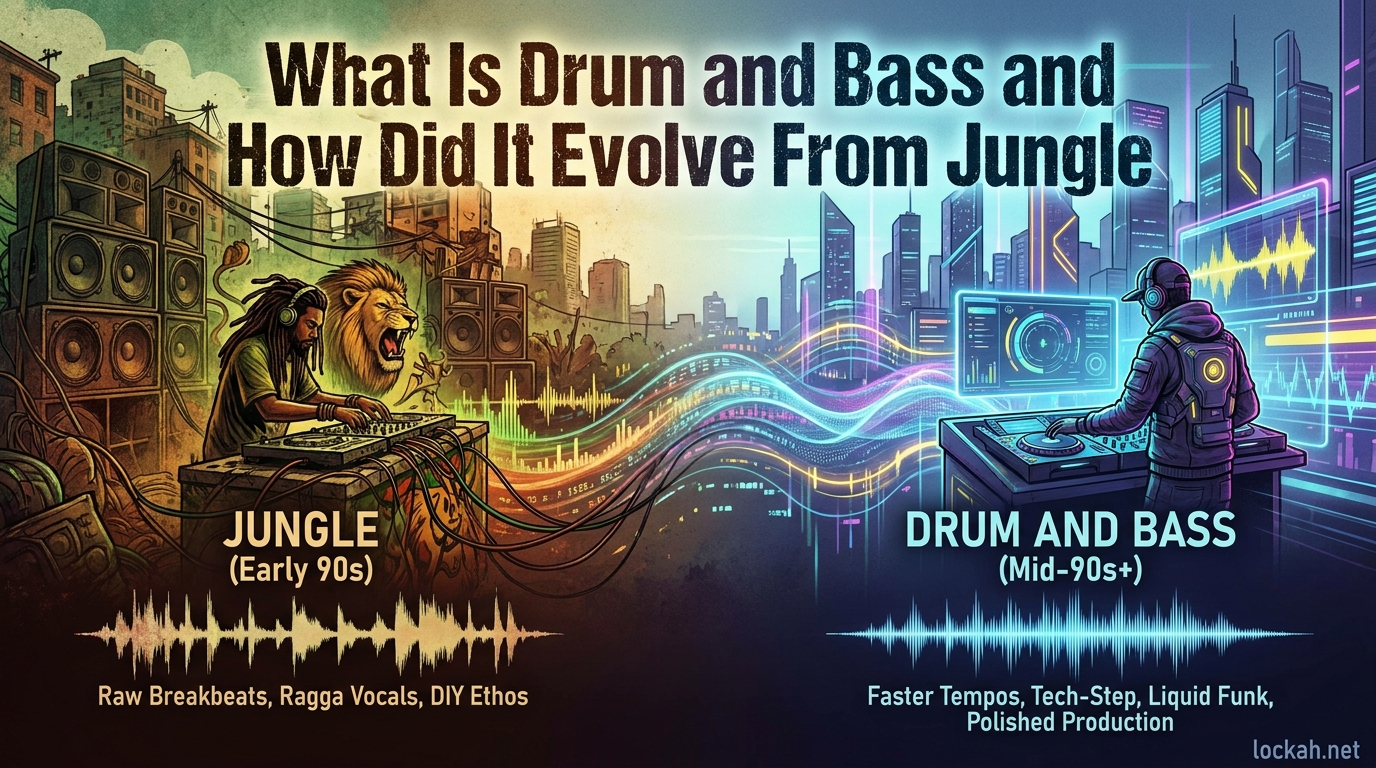
Drum and bass is a genre of electronic dance music that emerged from the UK rave scene in the early 1990s, characterized by rapid breakbeats typically ranging from 160 to 175 BPM and heavy sub-basslines that shake sound systems to their core. What makes this genre fascinating is its direct lineage from jungle music, a style that dominated underground clubs and pirate radio stations just a few years earlier. Understanding what drum and bass is requires exploring its roots in breakbeat hardcore, the cultural melting pot of London’s sound system culture, and the technical innovations that transformed chaotic jungle breaks into the precision-engineered sound we know today.
In this guide, I will walk you through the complete evolution from jungle to drum and bass. You will learn about the key characteristics that define the genre, the pioneers who shaped its sound, the subgenres that emerged over three decades, and why the terminology shift from “jungle” to “drum and bass” happened in the first place. Whether you are a newcomer trying to understand the difference between these closely related genres or a longtime fan looking to deepen your historical knowledge, this article covers everything you need to know.
Table of Contents
What Is Drum and Bass?
Drum and bass is an electronic music genre built on two fundamental elements: complex, fast-paced drum patterns and deep, powerful bass frequencies. The genre typically operates at tempos between 160 and 175 beats per minute, making it one of the faster styles within electronic dance music. Unlike four-on-the-floor genres like house or techno, drum and bass draws its rhythmic foundation from breakbeats, specifically the chopped and rearranged drum patterns sampled from funk and soul records of the 1960s and 1970s.
The “drum” component refers to the intricate breakbeat programming, often featuring the iconic Amen break or other classic drum loops that are sliced, time-stretched, and resequenced into new patterns. The “bass” component emphasizes sub-bass frequencies designed to be felt as much as heard, typically produced using synthesizers like the Roland TB-303 or modern digital equivalents capable of generating pure low-end sine waves that can reach below 50Hz.
What separates drum and bass from its predecessor jungle is primarily production approach and cultural associations. While jungle embraced raw, sample-heavy production with heavy ragga and dancehall influences, drum and bass developed a more refined, engineered sound that expanded beyond its reggae roots to incorporate influences from techno, jazz, ambient, and eventually dubstep and beyond.
How Drum and Bass Compares to Related Genres? (2026)
| Characteristic | Drum and Bass | Jungle | Dubstep | House |
|---|---|---|---|---|
| BPM Range | 160-175 | 150-170 | 70-140 (often halftime) | 120-130 |
| Drum Pattern | Two-step breakbeat | Complex breakbeat | Syncopated 2-step | Four-on-the-floor |
| Bass Focus | Sub-bass + Reese | Sub-bass heavy | Wobble/growl bass | Mid-range warmth |
| Origins | Mid-1990s UK | Early 1990s UK | Late 2000s UK | 1980s Chicago |
| Key Influence | Techno/jazz | Ragga/dancehall | UK garage/2-step | Disco/soul |
Understanding these distinctions helps clarify why drum and bass developed its own identity separate from jungle. While the BPM ranges overlap significantly, the drum pattern structure and production philosophy create distinctly different listening experiences. Jungle feels chaotic and breakbeat-heavy, often described by fans as sounding like “throwing pots and pans down the stairs,” while drum and bass offers a more structured, programmed approach with cleaner individual kick and snare patterns.
Origins in the UK Rave Scene
To understand drum and bass, you must first understand the UK rave scene of the late 1980s. This was a period when British youth culture exploded into warehouse parties, acid house music imported from Chicago, and a DIY ethos that rejected mainstream club culture. The scene was fueled by a generation looking for something new, something that belonged to them rather than the disco and rock traditions of their parents.
Breakbeat hardcore emerged around 1989-1991 as British producers began experimenting with the 4/4 beats of American house and techno by adding complex breakbeats sampled from old funk records. These breakbeats, particularly the Amen break from The Winstons’ “Amen Brother” (1969), became the rhythmic foundation of what would eventually become jungle and drum and bass. Producers discovered that by looping, pitch-shifting, and rearranging these drum patterns, they could create entirely new rhythmic textures that drove dancefloors into a frenzy.
The Sound System Culture Influence
Sound system culture, imported from Jamaica and established in British cities with Caribbean communities, played a crucial role in shaping the sonic identity of drum and bass. Sound systems were mobile disco setups emphasizing massive bass cabinets capable of producing frequencies that you feel in your chest rather than just hear. This physical, body-centric approach to bass became a defining characteristic of the genre.
Pirate radio stations like Kool FM, Rush FM, and Rinse FM became the broadcast outlets for this emerging sound. Operating illegally from tower blocks across London, these stations played breakbeat hardcore, jungle, and early drum and bass to dedicated audiences night after night. The pirate radio infrastructure allowed the scene to develop outside mainstream channels, fostering innovation and connecting communities of ravers across the city.
The Criminal Justice Act and Cultural Resistance
The UK government’s Criminal Justice and Public Order Act of 1994 had a profound impact on rave culture and indirectly shaped drum and bass history. The act specifically targeted “repetitive beats,” giving police powers to shut down outdoor raves and gatherings. This legislation forced the scene indoors into legitimate clubs and created a cultural shift that coincided with the jungle-to-drum-and-bass transition.
Many scene historians believe this legislation accelerated the move away from jungle’s associations with outdoor raves and toward drum and bass’s more club-oriented, refined sound. The underground had to adapt, and the music evolved with it, becoming more sophisticated to match the emerging superclub era while maintaining its underground credibility.
The Birth of Jungle
Jungle emerged as a distinct genre around 1992-1993, evolving from breakbeat hardcore by incorporating heavier reggae and dancehall influences, darker atmospheres, and basslines that pushed sub-frequency limits. The term “jungle” itself has contested origins, with some claiming it referenced the rough urban environments where the music developed, while others connected it to reggae sound system culture where “junglist” referred to someone from Kingston, Jamaica.
Early jungle was defined by its raw energy. Producers like Fabio, Grooverider, and Kenny Ken were creating tracks that combined the frenetic breakbeats of hardcore with sub-bass drops borrowed from reggae dubplates. The music was fast, often reaching 150-160 BPM, with complex drum programming that felt chaotic and organic rather than mechanical. Ragga jungle, a subgenre that leaned heavily into dancehall vocal samples and reggae basslines, became particularly prominent and would later become a point of contention in the genre’s evolution.
The Amen Break: The Building Block
The Amen break is perhaps the single most important sample in drum and bass history. This six-second drum solo from The Winstons’ 1969 track “Amen Brother” became the backbone of thousands of jungle and drum and bass tracks. The break contains a complex, syncopated pattern that, when sped up and chopped, provides an incredibly energetic foundation for dance music.
Producers discovered they could slice the Amen break into individual hits and rearrange them into new patterns, creating variations that maintained the break’s energy while sounding fresh. This technique, called “chopping” or “resequencing,” became a fundamental production skill in the genre. By the mid-1990s, entire subgenres would be defined by how producers manipulated this single break.
Junglist Culture and Identity
“Junglist” became a badge of honor for fans of the genre, representing a cultural identity tied to underground rave culture, sound system principles, and urban British experience. Junglists were distinguished from other ravers by their dedication to the harder, darker sounds emerging from the pirate radio stations and their rejection of the increasingly commercialized happy hardcore scene.
The culture developed its own fashion, language, and social structures. Oversized jeans, hoodies, and sneakers became standard attire. The MC culture that developed alongside the music featured rapid-fire delivery patterns influenced by dancehall toasting and hip-hop. This cultural identity would persist even as the music transformed into drum and bass, creating ongoing debates about terminology and authenticity that continue to this day.
The Jungle to Drum and Bass Transition
The transition from jungle to drum and bass occurred roughly between 1994 and 1996, though exact dates vary depending on who you ask. This was not an abrupt change but a gradual evolution driven by artistic, commercial, and cultural factors. Understanding how jungle became drum and bass requires looking at the tensions within the scene during this pivotal period.
Several factors drove the terminology shift. First, jungle had developed associations with gangster culture and violence in the media, partly due to its ragga influences and the rougher areas where early raves took place. Producers and DJs wanted to distance their music from these negative connotations. Second, the music itself was changing, becoming more sophisticated and less reliant on the ragga samples that had defined jungle. Third, the emerging superclub culture of mid-1990s Britain needed a term that sounded more palatable to mainstream audiences than “jungle.”
The Artistic Shift Away from Ragga
Musically, the jungle-to-drum-and-bass transition involved a move away from ragga vocal samples and dancehall basslines toward more abstract, engineered sounds. Producers like Goldie, Doc Scott, and Photek were creating tracks that emphasized complex drum programming and bass sound design over the reggae influences that had characterized jungle.
The Reese bassline became a defining sound of this transition. Originally a sample from Kevin Saunderson’s 1988 track “Just Want Another Chance,” the Reese is a detuned, modulated bass sound that creates a rich, moving harmonic texture. When producers began synthesizing their own Reese-style basses rather than sampling them, they gained unprecedented control over the low-end frequencies, enabling the precise sub-bass sculpting that became a drum and bass trademark.
Key Tracks That Marked the Transition
Several seminal tracks illustrate this evolution. Goldie’s “Timeless” (1995) is often cited as the first true drum and bass album, featuring the twenty-one-minute title track that showcased the genre’s potential for complex arrangement and emotional depth. Roni Size’s “Brown Paper Bag” (1997) brought live instrumentation and jazz influences to the genre, earning mainstream recognition while maintaining underground credibility.
LTJ Bukem’s “Logical Progression” series on his Good Looking Records label developed the atmospheric, jazz-influenced side of drum and bass that would eventually be called “intelligent” drum and bass. This contrasted with the darker, more industrial techstep sound emerging from labels like No U-Turn and Virus Recordings. Both styles represented different directions the genre could take, yet both were distinct from the ragga jungle that preceded them.
The Terminology Debate
It is important to note that many artists and fans used “jungle” and “drum and bass” interchangeably during this period, and some still do today. The terms were never mutually exclusive, and debates about which label applies to which tracks continue in online forums. What is clear is that by 1996-1997, “drum and bass” had become the dominant term for the genre, while “jungle” came to refer specifically to the earlier style or the ragga-influenced subgenre that continued to exist alongside drum and bass.
Forum discussions from communities like Reddit’s r/jungle and r/DnB reveal ongoing confusion and passion about these terms. Many older fans feel strongly that jungle is distinct from drum and bass and should not be lumped together. Newer fans often struggle to hear the differences that seem obvious to veterans. This tension between preservation and evolution is part of what makes the genre’s history so rich and contested.
Evolution Timeline: From the 90s to 2026
The evolution of drum and bass from its jungle origins to its current state in 2026 follows a fascinating trajectory through multiple stylistic phases. Each era brought new production techniques, subgenres, and cultural contexts while maintaining the core elements that define the genre.
1994-1996: The Transition Years
This period saw jungle gradually transform into drum and bass while both terms coexisted. Labels like Metalheadz, founded by Goldie in 1994, became hubs for the new sound. The Rage nightclub at Heaven in London, where Fabio and Grooverider held their weekly residency, became ground zero for the emerging genre. Techstep began developing as producers explored darker, more industrial sounds influenced by Belgian techno and German hardcore.
1996-1998: Techstep Dominance
Techstep became the dominant drum and bass subgenre during this period, characterized by cold, mechanical drum programming and distorted Reese basslines. Artists like Ed Rush, Optical, and Trace defined this sound, which appealed to fans who found the jazzier side of drum and bass too mellow. The techstep sound was harder, darker, and more focused on dancefloor impact than musical complexity.
This era also saw drum and bass begin its international expansion. While still centered in the UK, scenes were developing in Germany, the Netherlands, and North America. The sound was evolving from a distinctly British phenomenon into a global underground movement.
1998-2002: The Liquid Funk Emergence
High Contrast’s emergence on Hospital Records in the late 1990s marked the beginning of liquid funk, a subgenre that brought musicality, soulful vocals, and melodic elements back to drum and bass. Tracks like “Return of Forever” (2002) demonstrated that drum and bass could be uplifting and accessible while maintaining its energetic core.
Simultaneously, neurofunk developed as an evolution of techstep, featuring more complex sound design and bass modulation. Noisia, emerging from the Netherlands in the early 2000s, would become synonymous with this highly technical, precision-engineered style.
2000s: Global Expansion and Digital Transition
The 2000s brought two major changes to drum and bass. First, the genre achieved truly global reach, with strong scenes developing in Brazil, Russia, New Zealand, Australia, and North America. Second, the transition from vinyl to digital DJing transformed how the music was distributed and consumed.
Pendulum’s “Hold Your Colour” (2005) brought drum and bass to rock audiences, while maintaining credibility with the underground. The band’s fusion of drum and bass with rock instrumentation introduced the genre to festival stages worldwide, though some purists debated whether their sound still qualified as “real” drum and bass.
2010s-Present: Refinement and Diversity
The 2010s saw drum and bass fragment into increasingly diverse subgenres while the core sound continued to evolve. Jump-up, characterized by simple basslines and dancefloor-focused production, gained massive popularity in the UK and Europe. Halftime emerged as a slower, more experimental offshoot influenced by hip-hop and footwork. Minimal drum and bass stripped the sound back to its essentials.
By 2026, drum and bass exists in a mature state with thirty years of history behind it. The genre has maintained its underground credibility while achieving mainstream recognition through festivals like Let It Roll, Rampage, and Sun and Bass. Streaming platforms have made the entire history of the genre accessible to new listeners, while vinyl culture persists among dedicated collectors and DJs.
Key Characteristics and Production Elements
Understanding drum and bass requires familiarity with its technical components. These production elements distinguish the genre and explain why it sounds the way it does.
Breakbeat Manipulation
At the heart of drum and bass lies breakbeat manipulation. Producers take drum breaks from funk, soul, and jazz records, typically recorded in the 1960s and 1970s, and transform them through various techniques. Time-stretching changes the tempo without affecting pitch, allowing breaks to fit the 170-175 BPM range. Chopping involves cutting breaks into individual drum hits that can be rearranged into new patterns.
The Amen break remains the most famous break in drum and bass, but producers also frequently use the Apache break, Think break, Funky Drummer break, and dozens of others. Modern producers often use software like Ableton Live or Logic Pro to manipulate breaks, while the earliest jungle producers worked with hardware samplers like the Akai S950 and Akai MPC60.
The Two-Step Pattern
Drum and bass typically employs a two-step drum pattern, meaning the kick drum falls on beats one and three while snares or claps hit on beats two and four. However, this basic framework is almost always embellished with ghost snares, kicks between the main beats, and complex hi-hat patterns that create the genre’s characteristic rolling feel.
This differs from jungle’s more chaotic breakbeat approach, where multiple drum breaks might be layered and competing for attention. Drum and bass generally feels more programmed and controlled, with each drum hit precisely placed for maximum impact.
Sub-Bass and Reese Basslines
The bass in drum and bass operates in two frequency ranges. Sub-bass occupies the lowest frequencies, often below 60Hz, and is felt physically rather than heard clearly. This requires sound systems capable of reproducing these extreme low frequencies, which is why drum and bass clubs invest heavily in bass cabinets.
The Reese bassline provides the melodic and harmonic content in the low-mid range. Modern Reese basses are created using synthesizers with multiple oscillators slightly detuned from each other, creating a thick, moving sound. Modulation effects like filters and distortion add movement and character to these bass sounds.
Sampling and Sound Design
Sampling remains central to drum and bass production, though modern producers combine samples with synthesized elements. Vocal samples, often cut to single words or syllables, provide rhythmic and textural elements. Atmospheric pads and textures create the dark, immersive soundscapes characteristic of the genre.
Sound design has become increasingly sophisticated, with producers creating custom bass patches and drum kits that give their tracks distinctive signatures. The neurofunk subgenre pushed sound design to its limits, with bass sounds that seem to move and evolve throughout tracks through complex modulation and processing chains.
Major Subgenres Explained
Drum and bass has splintered into numerous subgenres over three decades, each with distinct characteristics and fan bases. Understanding these subgenres helps explain the diversity within the drum and bass umbrella.
Techstep
Techstep emerged in the mid-1990s as a darker, more industrial evolution of drum and bass. Characterized by cold, mechanical drum programming and distorted basslines, techstep drew influence from Belgian techno and German hardcore. Artists like Ed Rush, Optical, Dom and Roland, and Trace defined this sound, which prioritized dancefloor impact over musical complexity. Techstep remains influential today, having evolved into neurofunk.
Neurofunk
Neurofunk represents techstep’s evolution into highly technical, precision-engineered drum and bass. The subgenre features complex bass sound design with extensive modulation, creating basslines that seem to move and evolve throughout tracks. Dutch trio Noisia became the standard-bearers for neurofunk in the 2000s, while labels like Eatbrain and Blackout continue pushing the sound forward. Neurofunk is arguably the most technically demanding subgenre to produce, requiring advanced sound design skills.
Liquid Funk
Liquid funk brought musicality, melody, and soul back to drum and bass during an era dominated by darker sounds. Pioneered by High Contrast, Calibre, and labels like Hospital Records and Soul:r, liquid funk features jazzy chords, soulful vocals, and uplifting melodies. The subgenre proved that drum and bass could be emotional and accessible while maintaining its dancefloor energy. Liquid remains one of the most popular drum and bass subgenres today.
Jump-Up
Jump-up focuses on simplicity and immediate dancefloor impact. Characterized by bouncy basslines, minimal arrangements, and heavy use of MC vocals, jump-up dominates the UK and European drum and bass scenes. Artists like DJ Hazard, Original Sin, and Upgrade built careers on this accessible, party-oriented sound. Critics sometimes dismiss jump-up as simplistic, but its popularity demonstrates that drum and bass thrives across the spectrum from complex to straightforward.
Atmospheric and Intelligent Drum and Bass
LTJ Bukem pioneered atmospheric drum and bass, emphasizing space, texture, and jazz-influenced harmonies over dancefloor aggression. This subgenre features long ambient intros, complex chord progressions, and breakbeats that serve the mood rather than driving the track. The “intelligent” label was controversial, implying that other drum and bass was unintelligent, but the subgenre produced some of the genre’s most beautiful and complex music.
Ragga Jungle
Ragga jungle represents the bridge between dancehall reggae and drum and bass, characterized by reggae basslines, dancehall vocal samples, and breakbeat programming. While jungle as a whole evolved into drum and bass, ragga jungle persisted as a distinct subgenre. Artists like Congo Natty continue flying the ragga jungle flag, maintaining connections to sound system culture and reggae tradition. Understanding ragga jungle is essential for understanding jungle’s roots.
Pioneers and Influential Artists
Drum and bass history is filled with visionary artists who pushed the genre in new directions. These pioneers shaped the sound and culture of the music we hear today.
Goldie and Metalheadz
Goldie stands as perhaps the most important figure in drum and bass history. After founding Metalheadz in 1994, he created a platform for the genre’s most innovative producers. His 1995 album “Timeless” proved drum and bass could sustain long-form composition and emotional depth. The twenty-one-minute title track remains a masterpiece of drum and bass production, showcasing complex arrangement techniques and orchestral elements.
Metalheadz became more than a label; it was a community hub where producers competed to create the most innovative tracks. The Metalheadz Sunday Sessions at the Blue Note in London became legendary events where unreleased dubplates would be tested on discerning audiences.
LTJ Bukem and Good Looking Records
LTJ Bukem pioneered the atmospheric, jazz-influenced side of drum and bass through his Good Looking Records label. His “Logical Progression” series introduced listeners to a more musical, sophisticated take on the genre. Bukem’s DJ sets were legendary for their journey-like quality, building from ambient textures to peak-time rollers.
The artists he championed, including Photek, Peshay, and Blame, developed the intelligent drum and bass sound that offered an alternative to the harder techstep dominating the mid-1990s. Good Looking’s influence continues through artists who prioritize musicality over aggression.
Roni Size and Reprazent
Roni Size brought live instrumentation to drum and bass through his group Reprazent, winning the Mercury Music Prize in 1997 for “New Forms.” This album demonstrated drum and bass’s potential for album-length statements and musical complexity. The track “Brown Paper Bag” became a crossover hit while maintaining underground credibility.
Size’s Bristol background connected drum and bass to the trip-hop scene, creating cross-pollination between genres. His Full Cycle Records became a hub for Bristol drum and bass, including Krust and Die, developing a distinct regional sound within the genre.
Fabio and Grooverider
As resident DJs at the legendary Rage nightclub, Fabio and Grooverider were instrumental in the jungle-to-drum-and-bass transition. Their weekly sessions at Heaven nightclub provided a testing ground for new tracks and helped define the evolving sound. Grooverider became known as the “Godfather of Drum and Bass” for his role in championing the genre’s hardest sounds.
Fabio later pioneered liquid funk through his Creative Source label, demonstrating the versatility of his taste and influence. Both DJs remain active and respected figures in the drum and bass community decades after they started.
Modern Pioneers
Noisia redefined what drum and bass production could achieve in terms of sound design and technical precision. The Dutch trio brought cinematic scope to the genre while maintaining dancefloor functionality. Their influence extends beyond drum and bass into film scoring and game audio.
High Contrast proved liquid funk could achieve mainstream success without sacrificing credibility. His production work for film and television introduced drum and bass to wider audiences. Calibre’s immense discography showcases the depth possible within a relatively narrow genre framework, with dozens of albums exploring subtle variations on the liquid funk template.
Cultural Impact and Legacy
Drum and bass has influenced far more than just dance music. Its impact extends into fashion, technology, and broader cultural movements.
Influence on Other Genres
Dubstep emerged directly from drum and bass, with early dubstep producers like Benga and Skream coming from the UK garage and drum and bass scenes. The half-time rhythms of modern bass music owe debts to drum and bass experimentation. Neurohop, trap, and various forms of bass music all incorporate techniques pioneered in drum and bass studios.
Drum and bass breakbeats influenced hip-hop producers, particularly those working in the underground and instrumental scenes. The genre’s approach to bass has informed everything from EDM to pop production, with sub-bass becoming standard across contemporary music.
Global Spread and Regional Scenes
While drum and bass originated in the UK, it developed strong regional identities worldwide. Brazil produced a distinct drum and bass scene with Portuguese MCs and local influences. Russia and Eastern Europe developed massive scenes with their own production styles. New Zealand and Australia have produced internationally recognized artists and labels.
North America was initially slow to embrace drum and bass, preferring house and techno, but developed dedicated scenes in cities like Toronto, Los Angeles, and San Francisco. Today, American drum and bass is experiencing a resurgence, with festivals and club nights drawing significant crowds.
Festival and Club Culture
Drum and bass maintains a unique position in festival culture. While never achieving the mainstream dominance of house or techno, it has dedicated festivals worldwide. Let It Roll in the Czech Republic, Rampage in Belgium, and Sun and Bass in Sardinia attract tens of thousands of drum and bass fans annually.
The club experience remains central to drum and bass culture. The genre demands powerful sound systems capable of reproducing sub-bass frequencies, creating an immersive physical experience that cannot be replicated on home speakers or headphones.
Vinyl Culture Persistence
Unlike many electronic genres that abandoned vinyl during the digital transition, drum and bass maintained strong vinyl culture. Many DJs still play exclusively vinyl sets, and labels continue releasing vinyl editions of new tracks. This physical connection to the music reflects the genre’s roots in sound system culture and dubplate tradition.
Dubplates, one-off acetate pressings of unreleased tracks, remain status symbols in drum and bass culture. DJs with exclusive dubplates demonstrate their connections to producers and their ability to provide audiences with music they cannot hear elsewhere. This culture of exclusivity maintains the underground ethos that defined the genre from its earliest days.
Frequently Asked Questions
How did jungle become drum and bass?
Jungle became drum and bass through a gradual evolution in the mid-1990s as producers moved away from ragga and dancehall influences toward more refined, engineered sounds. The terminology shift was driven by media pressure, the Criminal Justice Act 1994 forcing the scene indoors, and artistic desires to explore beyond reggae-influenced samples. By 1994-1996, the term drum and bass emerged to describe the cleaner, more sophisticated evolution of jungle music.
How did drum and bass evolve?
Drum and bass evolved through several distinct phases: early 1990s emergence from breakbeat hardcore, mid-1990s transition from jungle with techstep development, late 1990s liquid funk emergence bringing musicality, 2000s global expansion and digital transition, and 2010s-present fragmentation into diverse subgenres like neurofunk and jump-up while maintaining core elements of fast breakbeats and heavy bass.
Did jungle or drum and bass come first?
Jungle came first, emerging in the early 1990s as an evolution of breakbeat hardcore. Drum and bass evolved from jungle in the mid-1990s, initially as a term to distinguish the more refined, less ragga-influenced offshoot from its predecessor. While the terms were used interchangeably for a period, jungle is considered the parent genre that preceded drum and bass.
How is jungle different from drum and bass?
Jungle differs from drum and bass in rhythm, production, and influences. Jungle uses more chaotic, layered breakbeats with heavy ragga and dancehall influence, raw sampling, and reggae basslines. Drum and bass features cleaner two-step drum patterns, more engineered production, diverse influences including techno and jazz, and generally moves away from ragga samples. Both share similar BPM ranges of 160-175, but jungle feels more raw while drum and bass sounds more controlled.
What BPM is drum and bass?
Drum and bass typically operates between 160 and 175 beats per minute, with most modern tracks falling in the 170-175 BPM range. This is significantly faster than house music (120-130 BPM) but shares the same tempo range as its predecessor jungle. The half-time feel created by the two-step drum pattern makes the music feel slower than the actual BPM would suggest.
What is the Amen break?
The Amen break is a six-second drum solo from The Winstons’ 1969 track Amen Brother that became the foundational sample for jungle and drum and bass. When sped up and chopped, this break provides the energetic, syncopated drum patterns that define the genre. Thousands of tracks have used variations of the Amen break, making it arguably the most important sample in electronic music history.
Who are the pioneers of drum and bass?
Key pioneers include Goldie, who founded Metalheadz and released the genre-defining album Timeless; LTJ Bukem, who developed atmospheric drum and bass through Good Looking Records; Roni Size, who brought live instrumentation to the genre; Fabio and Grooverider, whose Rage residency shaped the sound; and Doc Scott, who pioneered techstep. Modern pioneers include Noisia, High Contrast, and Calibre.
What are the main drum and bass subgenres?
Major subgenres include liquid funk (melodic and soulful), neurofunk (technical sound design), jump-up (simple dancefloor-focused), techstep (dark and industrial), atmospheric/intelligent (jazz-influenced and spacey), and ragga jungle (reggae-influenced precursor). Each subgenre emphasizes different aspects of the drum and bass template while maintaining the core elements of fast breakbeats and heavy bass.
What Is Drum and Bass and How Did It Evolve From Jungle: Final Thoughts
Drum and bass represents one of the most enduring and influential genres to emerge from the UK rave scene. From its origins in breakbeat hardcore through its evolution from jungle music, the genre has maintained a unique identity while continuously reinventing itself. The transition from jungle to drum and bass in the mid-1990s was not merely a name change but a fundamental shift in production philosophy, moving from raw sampling to engineered sound design, from ragga influences to diverse musical exploration.
Today in 2026, drum and bass thrives as a global phenomenon with thirty years of history behind it. The genre has spawned countless subgenres, influenced numerous other musical styles, and maintained dedicated communities worldwide. Whether you are drawn to the technical precision of neurofunk, the soulful melodies of liquid funk, or the raw energy of jump-up, drum and bass offers something for every taste within its fast-paced, bass-heavy framework.
Understanding the evolution from jungle to drum and bass helps explain not just a musical history but a cultural one. The genre emerged from sound system culture, pirate radio, and underground raves, developing a vocabulary and identity that persists today. For anyone interested in electronic music history, production techniques, or simply discovering new sounds, exploring drum and bass and its jungle roots opens up a rich world of musical innovation.