
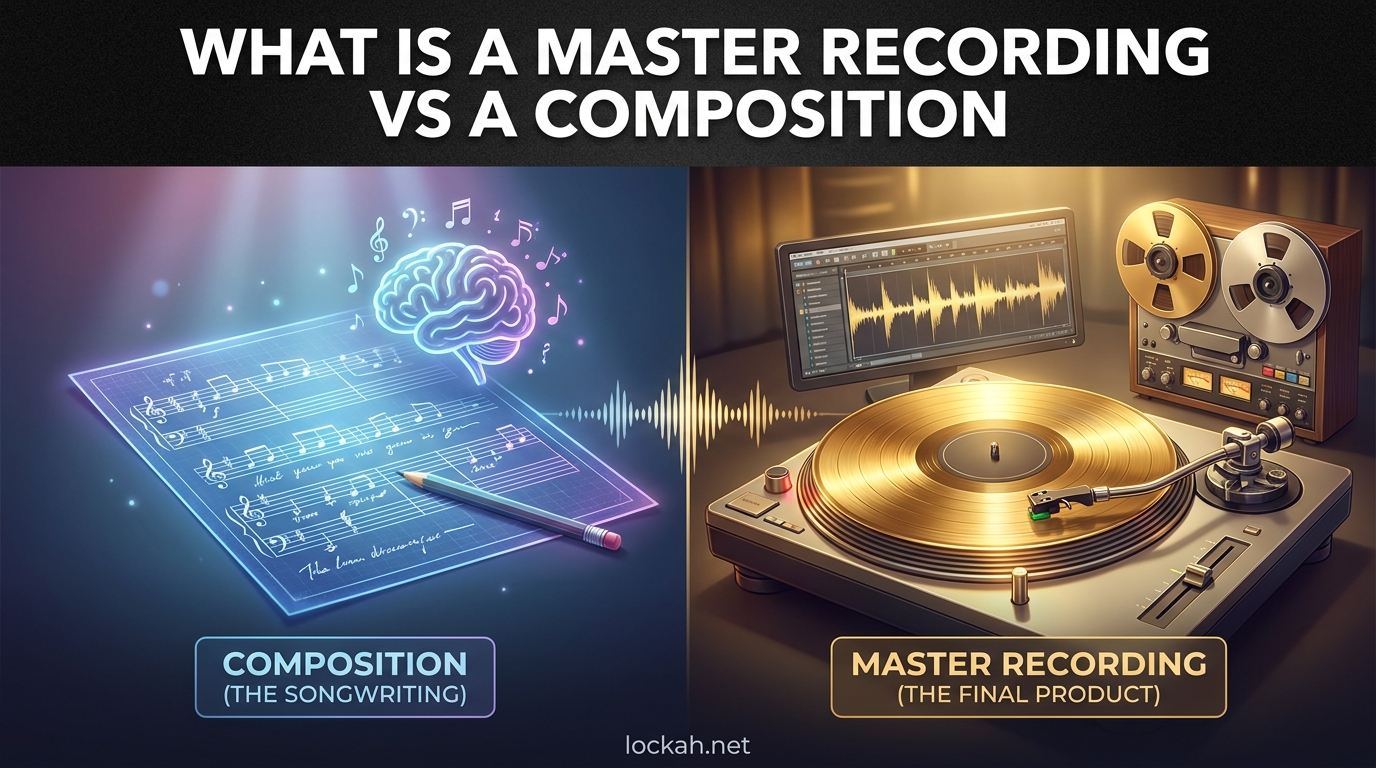
A master recording is the official, original audio recording of a song, while a composition is the underlying musical work consisting of melody and lyrics. Every song has two separate copyrights: the composition (owned by songwriters and publishers) and the sound recording (owned by artists or record labels).
Understanding this distinction is essential for anyone creating or releasing music in 2026. When you write a song and record it, you are actually creating two separate assets with different owners, different royalty streams, and different legal protections. Many independent artists discover this distinction too late, after signing away rights they did not fully understand.
This guide breaks down the difference between master recording vs composition in plain terms. You will learn who owns what, how royalties flow to each side, and why this knowledge can protect your income as an artist. Whether you are releasing your first single or negotiating your tenth sync license, these fundamentals shape every decision in your music career.
Table of Contents
What Is a Master Recording?
A master recording (also called the sound recording or simply “the master”) is the final, official audio file of a song. This is the actual recording that listeners hear on streaming platforms, radio, or vinyl. The master captures the specific performance, production, and sound of that particular recording.
Master rights belong to whoever financed the recording or negotiated ownership in a contract. For most signed artists, the record label owns the master recording in exchange for funding the production, marketing, and distribution of the music. Independent artists who self-fund their recordings typically own their own masters.
The owner of the master recording controls where and how that specific recording is used. They can license it for streaming, sync it to film or television, or block others from using it. When you hear a song on Spotify or Apple Music, the platform pays royalties to the master rights holder.
Each master recording receives an ISRC (International Standard Recording Code), a unique identifier that tracks the specific recording across platforms and countries. This code distinguishes your recording of a song from every other recording of the same composition. When you upload music through a distributor, they assign ISRC codes that follow your recording throughout its commercial life.
Master recordings can appreciate in value over time, especially when they generate consistent streaming revenue or represent culturally significant moments. This is why major labels guard master catalogs so closely. They represent decades of intellectual property that continues generating income long after the initial recording costs were recouped.
What Is a Composition?
A composition (also called the musical work or publishing) is the underlying song itself. The composition consists of the melody, lyrics, and musical structure that a songwriter creates. This exists as an idea that can be performed and recorded in many different ways by many different artists.
Composition rights belong to the songwriter and their publisher. When you write an original song, you automatically own the composition copyright the moment you fix it in a tangible form, such as writing it down or recording a demo. Many songwriters sign publishing deals where a publisher helps administer these rights in exchange for a percentage of publishing royalties.
The owner of the composition controls who can create new recordings of the song. They also collect royalties whenever the composition is performed publicly, reproduced mechanically, or synced to visual media. Every time someone covers your song or plays it on the radio, you earn composition royalties.
Compositions are registered with performing rights organizations (PROs) like ASCAP, BMI, or SOCAN. These organizations track public performances and collect royalties on behalf of songwriters and publishers. Registration ensures you receive payment when your song plays on terrestrial radio, digital radio, live venues, or television broadcasts.
Unlike master recordings, compositions exist independent of any specific performance. A single composition can have hundreds of different master recordings by different artists across decades. Each new recording generates composition royalties for the original songwriter while creating a new master for the recording artist.
Master Recording vs Composition: Key Differences (September 2026)
The clearest way to understand master recording vs composition is to compare them side by side. Here is how the two copyrights differ across ownership, royalties, and use cases.
| Aspect | Composition (Musical Work) | Master Recording (Sound Recording) |
|---|---|---|
| What It Is | The song itself (melody + lyrics) | The actual audio recording |
| Who Owns It | Songwriters and publishers | Artists or record labels |
| Can Be Reproduced | Yes, anyone can record a cover with proper licensing | No, each recording is unique |
| Performance Royalties | Yes, collected by PROs (ASCAP, BMI, SOCAN) | No (except digital performance via SoundExchange) |
| Mechanical Royalties | Yes, for physical and digital reproduction | No |
| Sync Licensing | Required for any visual media use | Required for any visual media use |
| Streaming Payout | ~15-20% of total streaming revenue | ~50-60% of total streaming revenue |
| Registration | PROs (ASCAP, BMI, SOCAN) and copyright office | ISRC codes through distributor |
| Lifespan | Life of author plus 70 years | 95 years from publication or 120 from creation |
Think of the composition as the blueprint and the master recording as the house built from that blueprint. Multiple houses can be built from the same blueprint, but each house is a distinct physical structure. Similarly, multiple artists can record their own versions of the same composition, but each recording is a separate master.
When you stream a song on Spotify, the platform pays both sides separately. The master recording owner receives the larger share through their distributor or label. The composition owner receives a smaller share through their publisher and performing rights organization. This split explains why songwriters often seek to retain publishing rights even when they sign away master rights.
How Royalties Work: Performance, Mechanical, and Sync
Royalties flow differently to composition owners versus master recording owners. Understanding these three main royalty types helps you track where your money comes from and ensure you are collecting everything you are owed.
Performance Royalties
Performance royalties are paid when a song is performed publicly. This includes radio play, live performances, television broadcasts, and non-interactive streaming through services like Pandora or SiriusXM. These royalties go exclusively to the composition side.
Performing rights organizations collect these royalties and distribute them to songwriters and publishers. The master recording owner does not receive performance royalties from traditional radio play in most countries. In the United States, digital performance royalties for sound recordings are handled separately through SoundExchange.
The amount you earn depends on factors including the venue size for live performances, the time of day for radio plays, and the platform for digital streaming. PROs use complex formulas to calculate these payments, which is why accurate registration of your works is critical.
Mechanical Royalties
Mechanical royalties are paid when a song is reproduced physically or digitally. This includes CD sales, vinyl records, permanent digital downloads, and interactive streaming through Spotify and Apple Music. The term “mechanical” dates back to piano rolls and mechanical reproduction devices.
For compositions, mechanical royalties are collected by mechanical rights organizations like the Harry Fox Agency, Music Reports, or the Mechanical Licensing Collective (MLC) in the United States. Master recording owners do not receive mechanical royalties directly, though streaming platforms pay master rights holders a separate streaming royalty that is typically larger than the composition share.
The statutory mechanical rate in the United States is set by the Copyright Royalty Board and adjusts periodically. As of 2026, this rate applies to both physical and digital formats, ensuring songwriters receive compensation for every reproduction of their work.
Sync Licensing
Sync licensing (synchronization) is required when music is paired with visual media like films, television shows, commercials, video games, or online content. Both the composition and the master recording must be licensed separately for each use.
A film producer must secure a sync license from the composition owner (publisher) and a master use license from the master owner (artist or label). This means two separate negotiations and two separate payments. If a producer cannot secure the master license, they may record a new version of the song (a cover) and only need the composition sync license.
Sync fees are typically negotiated directly and can range from a few hundred dollars for small projects to hundreds of thousands for major film placements. The combination of upfront fees and ongoing performance royalties makes sync licensing one of the most lucrative opportunities for rights holders.
Real-World Example: I Will Always Love You
The best way to understand master recording vs composition is through a famous real-world example. Dolly Parton wrote and first recorded “I Will Always Love You” in 1974. She owns both the composition (as the songwriter) and her original master recording from that session.
When Whitney Houston recorded her version for The Bodyguard soundtrack in 1992, she created a new master recording. Arista Records owned Whitney’s master recording. However, Dolly Parton retained ownership of the composition because she wrote the song. No matter who recorded it, the underlying composition remained hers.
This arrangement meant both artists earned significant royalties, but from different streams. Dolly Parton earned composition royalties every time Whitney’s version played on the radio, streamed, or sold copies. She also earned mechanical royalties from each sale because her composition was being reproduced. Whitney Houston and Arista earned the master recording royalties from sales and streaming.
When the song appeared in films, commercials, or television shows, both sides negotiated separately. Dolly Parton controlled the composition sync rights, while Arista controlled the master use rights for Whitney’s version. Producers who wanted Whitney’s iconic version had to pay both parties. Those who only wanted the song itself could hire another vocalist and only license the composition from Dolly Parton.
This example shows why owning your composition is valuable even if someone else records a more famous version. Dolly Parton has earned millions from Whitney’s recording because she maintained her publishing rights. She also retained the right to license her own recording of the song independently, creating multiple income streams from a single composition she wrote decades ago.
Why This Matters for Independent Artists?
Understanding master recording vs composition is not just academic knowledge. It directly impacts your income, control, and long-term career sustainability. Independent artists who grasp these concepts early make better decisions about distribution, licensing, and collaboration.
Retaining Master Ownership
Many independent artists sign with distributors rather than traditional record labels specifically to keep their master rights. When you distribute through platforms like DistroKid, TuneCore, or CD Baby, you typically retain 100% of your master recording ownership. This means you control all licensing decisions and receive the larger share of streaming revenue.
Traditional record labels often require artists to sign away master rights in exchange for recording advances and marketing budgets. While this can accelerate your career through professional production and promotional support, it means the label decides where your music appears and collects the majority of master-related income. The label also controls whether your music stays on streaming platforms.
The decision between retaining masters and partnering with a label depends on your resources and goals. Artists with established audiences and recording budgets often benefit from keeping their masters. New artists without production resources might accept label terms to reach a wider audience, then negotiate differently for future releases.
Registering Both Copyrights
If you write and record your own music, you are creating both copyrights. Many independent artists only register their composition with a PRO and forget to properly document their master recording rights. This can create problems when licensing opportunities arise or disputes occur.
The safest approach is to register your composition with your local PRO and retain clear documentation of your master recording ownership. Your distributor will assign ISRC codes to your masters, which serves as identification but is not the same as copyright registration. Consider filing formal copyright registration with your national copyright office for additional legal protection.
For compositions with multiple co-writers, split sheets document ownership percentages. These agreements prevent disputes years later when royalties start flowing. Similarly, producer agreements should clarify whether the producer receives points on the master, composition credit, or just a flat fee.
Avoiding Common Mistakes
New artists often conflate the two rights when collaborating. A producer might contribute to the recording but not write the song, meaning they should not claim composition ownership. Conversely, a co-writer who did not attend the recording session still owns part of the composition but not the master.
Always clarify ownership splits in writing before releasing music. Split sheets document who owns what percentage of the composition. Master recording ownership should be equally clear, especially when multiple people contribute to the production or funding. Verbal agreements lead to disputes when money enters the picture.
Another common mistake is assuming that owning your masters means you automatically own the composition. If you record a cover song, you own that specific master recording but not the underlying composition. You cannot license your cover for sync without securing composition rights from the original publisher.
Frequently Asked Questions
What is the difference between composition and master recording?
A composition is the underlying song (melody and lyrics) owned by songwriters, while a master recording is the actual audio file owned by artists or labels. Every song has both copyrights, which generate different royalty streams and must be licensed separately.
What is a master recording in music?
A master recording is the official, final audio recording of a song. It represents the specific performance and production that listeners hear. The owner of the master controls where that recording is used and receives streaming and sales revenue.
Does Rihanna own her master recordings?
Rihanna does not own most of her early master recordings. Like many artists who signed with major labels early in their careers, her master recordings from the Def Jam era are owned by Universal Music Group. She has reportedly been working to regain ownership of her catalog.
What is the difference between composition owner and master recording owner?
The composition owner is typically the songwriter or their publisher, controlling the musical work itself. The master recording owner is the artist or record label who funded the recording, controlling the specific audio file. These are often different people or entities.
Can you own your masters and not your composition?
Yes, this is common. An artist might record a song written by someone else, owning the master recording while the songwriter owns the composition. The artist earns master royalties, but the songwriter earns publishing royalties from the same recording.
Do producers own master recordings?
Producers may own a percentage of master recordings if their contract specifies this, but they typically do not own the entire master unless they also funded the recording. Standard producer agreements often give producers points (percentage) on the master or a flat fee.
What happens to royalties when you cover a song?
When you cover a song, you must obtain a mechanical license to pay royalties to the composition owner. You own your new master recording and earn master royalties from it, but you do not earn composition royalties unless you also wrote the song.
Conclusion
Understanding what is a master recording vs a composition explained clearly comes down to this: the composition is the song, and the master is the recording. Every song has two copyrights that generate separate income streams for different rights holders. Songwriters and publishers control the composition while artists and labels control the master recording.
As an independent artist, protecting both rights means properly registering your composition with a performing rights organization, documenting your master ownership clearly, and understanding where your royalties come from. When you know who owns what, you can negotiate better deals and ensure you are compensated fairly for every use of your music.
The music industry runs on these two copyrights. Master recording vs composition is not just terminology. It is the foundation of how music is owned, licensed, and monetized in 2026 and beyond. Take the time to register your works, clarify your agreements, and protect the assets you create. Your future self will thank you when the royalties start flowing.