
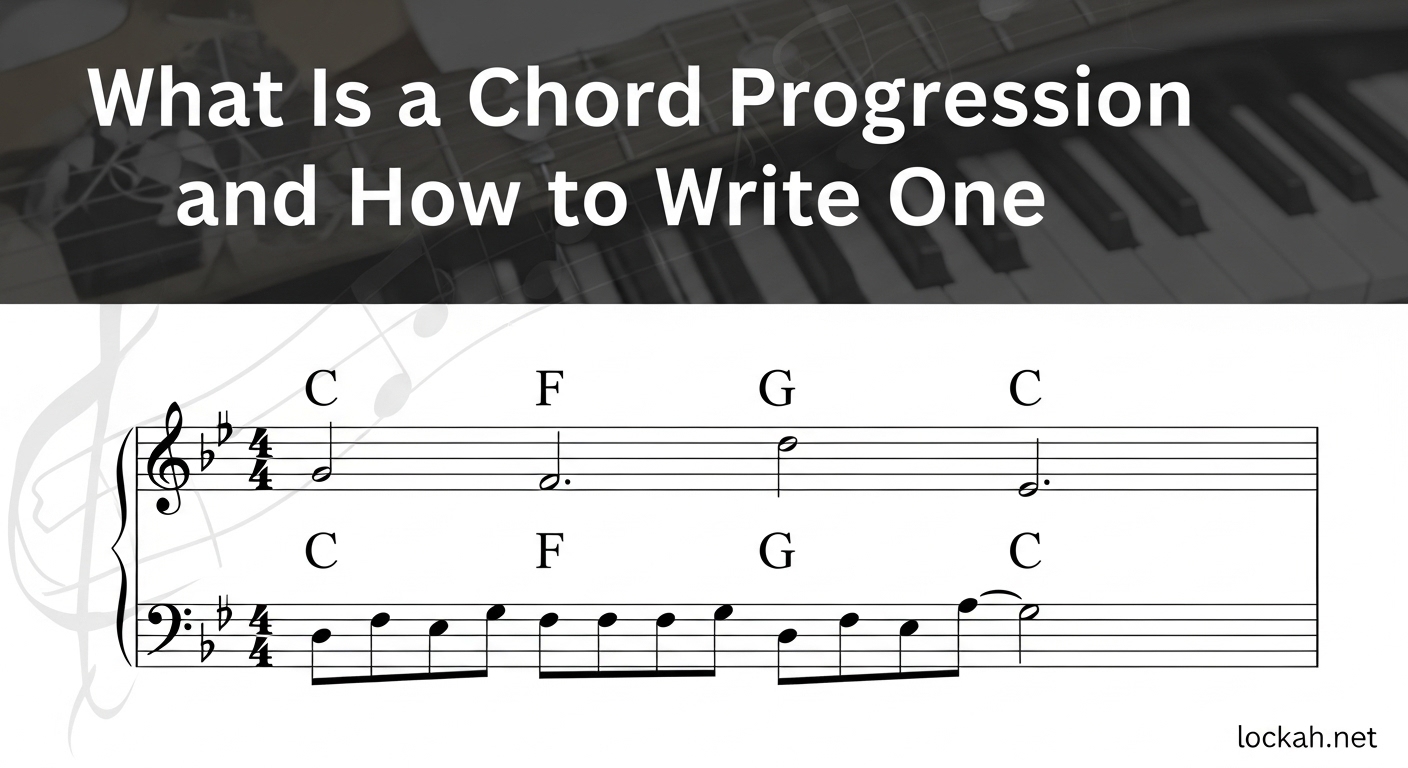
A chord progression is simply the order in which chords are played in a song. It is the harmonic foundation that supports your melody and gives your music its sense of movement, tension, and resolution.
When I first started writing songs, I would randomly hit chords hoping something sounded good. Some combinations worked beautifully. Others fell flat. After studying music theory, I discovered there is a system behind why certain chords work together—and in this guide, I will show you exactly how to write chord progressions that sound intentional and emotionally compelling.
Whether you play guitar, piano, or produce music in a DAW, you will learn a proven 5-step method for writing progressions plus the most common patterns used in hit songs.
Table of Contents
What Is a Chord Progression and How to Write One?
A chord progression is a sequence of chords played one after another. Think of it as the roadmap for your song’s harmony. Each chord has a role—some feel stable and restful, others create tension that wants to resolve.
The concept of functional harmony explains why chords work together. In any key, chords fall into three families:
- Tonic (I, iii, vi) — Home base, stable and resolved
- Subdominant (ii, IV) — Moving away from home, creates mild tension
- Dominant (V, vii°) — Strong tension that pulls back to tonic
Good progressions balance these functions. You start at home (tonic), move away (subdominant), build tension (dominant), then return home (tonic). This Tonic-Subdominant-Dominant-Tonic pattern is the backbone of Western music.
Understanding Chords in a Key
Before writing progressions, you need to know which chords belong to your chosen key. This is where Roman numerals become essential.
Roman Numeral Notation Explained
Musicians use Roman numerals to talk about chords in a key-independent way. Uppercase numerals (I, IV, V) mean major chords. Lowercase numerals (ii, iii, vi) mean minor chords. The diminished chord uses a lowercase numeral with a degree symbol (vii°).
Here are the diatonic chords in a major key:
- I — Major (tonic)
- ii — Minor
- iii — Minor
- IV — Major (subdominant)
- V — Major (dominant)
- vi — Minor
- vii° — Diminished
In the key of C major, these translate to: C, Dm, Em, F, G, Am, B diminished. In G major: G, Am, Bm, C, D, Em, F# diminished. The Roman numerals stay the same no matter what key you are in.
Major vs Minor Keys
In a minor key, the chord qualities shift. The i, iv, and v chords are minor. The III, VI, and VII chords are major. This changes the emotional character of your progressions. Minor key progressions often sound more somber, mysterious, or intense.
How to Write a Chord Progression: The 5-Step Method (2026)
Now let me walk you through the exact process I use to write progressions. This method works in any key and any genre.
Step 1: Pick a Key
Choose a key that fits your vocal range or instrument. C major and G major are beginner-friendly on piano and guitar. If you are writing for a vocalist, consider their comfortable range.
Step 2: Identify Your Chords
Write out the seven diatonic chords for your chosen key using the Roman numeral system. Practice playing each chord so you know how they sound. This builds your harmonic vocabulary.
Step 3: Start on the Tonic
Begin your progression on chord I. This establishes your key immediately. Starting elsewhere is possible but requires more advanced handling. For your first progressions, always begin at home.
Step 4: Follow Functional Harmony
Use the “add-skip” rule to move between chord families. You can move to the next chord in the scale (I to ii, ii to iii) or skip one (I to iii, ii to IV). Avoid jumping randomly across families as this sounds disjointed.
Strong movements include: Tonic to Subdominant, Subdominant to Dominant, Dominant back to Tonic. These create satisfying musical sentences.
Step 5: End with a Cadence
A cadence is a chord pattern that signals the end of a phrase. The authentic cadence (V to I) is the strongest ending. It creates maximum tension then releases it. The plagal cadence (IV to I) is gentler and often called the “Amen” cadence.
Always end your progression back on the tonic. This gives your listener a sense of completion.
The Most Common Chord Progressions
These patterns appear in thousands of songs because they work. Study them, play them, then modify them to make them your own.
The I-IV-V (Three-Chord Song)
This is the foundation of blues, rock, country, and countless pop songs. In C major: C – F – G. In G major: G – C – D. It is simple, versatile, and instantly recognizable.
Famous examples include “Twist and Shout,” “La Bamba,” and “Wild Thing.” The pattern creates a cyclical feel that keeps moving forward.
The I-V-vi-IV (Pop Progression)
Arguably the most popular progression in modern music. In C major: C – G – Am – F. In G major: G – D – Em – C. This progression has an uplifting, anthemic quality.
Songs using this pattern include “Let It Be,” “Someone Like You,” “Counting Stars,” and “When I Come Around.” The emotional arc moves from stable (I) to hopeful (V) to reflective (vi) to resolved (IV).
The Circle Progression
Based on movement around the circle of fifths, this progression creates smooth voice leading. In C major: C – Am – F – G. Each chord shares notes with the next, creating seamless transitions.
This pattern appears in “Don’t Dream It’s Over,” “I’m Yours,” and “Canon in D.” It feels natural and flowing because of the shared tones between adjacent chords.
Tips for Better Chord Progressions
Once you master the basics, try these techniques to add interest:
Borrowed chords — Take chords from a parallel key. In a major key, borrow chords from the minor version. This adds color and emotional complexity.
Secondary dominants — Temporarily treat any chord as a tonic and precede it with its own dominant chord. This creates momentary tension before resolving.
Inversions — Rearrange the notes in your chords so the bass line moves more smoothly. This changes the texture without changing the harmony.
Rhythmic variation — The same progression can sound completely different depending on timing. Hold some chords longer, add syncopation, or break chords into arpeggios.
As forum users often recommend, learn songs by artists you love. You will start recognizing these patterns everywhere. Theory gives you tools, but listening gives you taste.
Frequently Asked Questions
How to actually write chord progressions?
Start by picking a key and identifying the seven diatonic chords. Begin your progression on chord I (the tonic). Move through subdominant chords (ii, IV) to dominant chords (V, vii°) for tension. Always end back on the tonic with a cadence. The most common pattern is I-V-vi-IV or I-IV-V.
What is a chord progression in simple terms?
A chord progression is simply the order in which chords are played in a song. It is the harmonic foundation that creates movement, tension, and resolution in music. Think of it as the roadmap for your song’s harmony.
How to notate chord progressions?
Musicians use Roman numerals to notate progressions. Uppercase numerals (I, IV, V) indicate major chords. Lowercase numerals (ii, iii, vi) indicate minor chords. This system works in any key—for example, I-IV-V in C major is C-F-G, while in G major it is G-C-D.
What are the 10 most popular chord progressions?
The most common progressions include: 1) I-IV-V, 2) I-V-vi-IV, 3) I-vi-IV-V, 4) vi-IV-I-V, 5) I-V-vi-iii-IV, 6) ii-V-I (jazz), 7) I-iii-IV-V, 8) I-ii-iii-IV, 9) Circle progression (I-vi-ii-V), and 10) I-bVII-IV (rock). The first four account for most pop songs.
Conclusion
Writing chord progressions is not about memorizing rules—it is about understanding why chords want to move in certain directions. Start with the tonic, explore the subdominant, build tension with the dominant, then return home.
The I-IV-V and I-V-vi-IV patterns are popular because they follow this logic naturally. Practice them in different keys. Experiment with borrowed chords and inversions. Most importantly, trust your ears. Theory explains what works, but your ears will guide you to what sounds right for your song.
Now pick up your instrument and write your first progression today.