
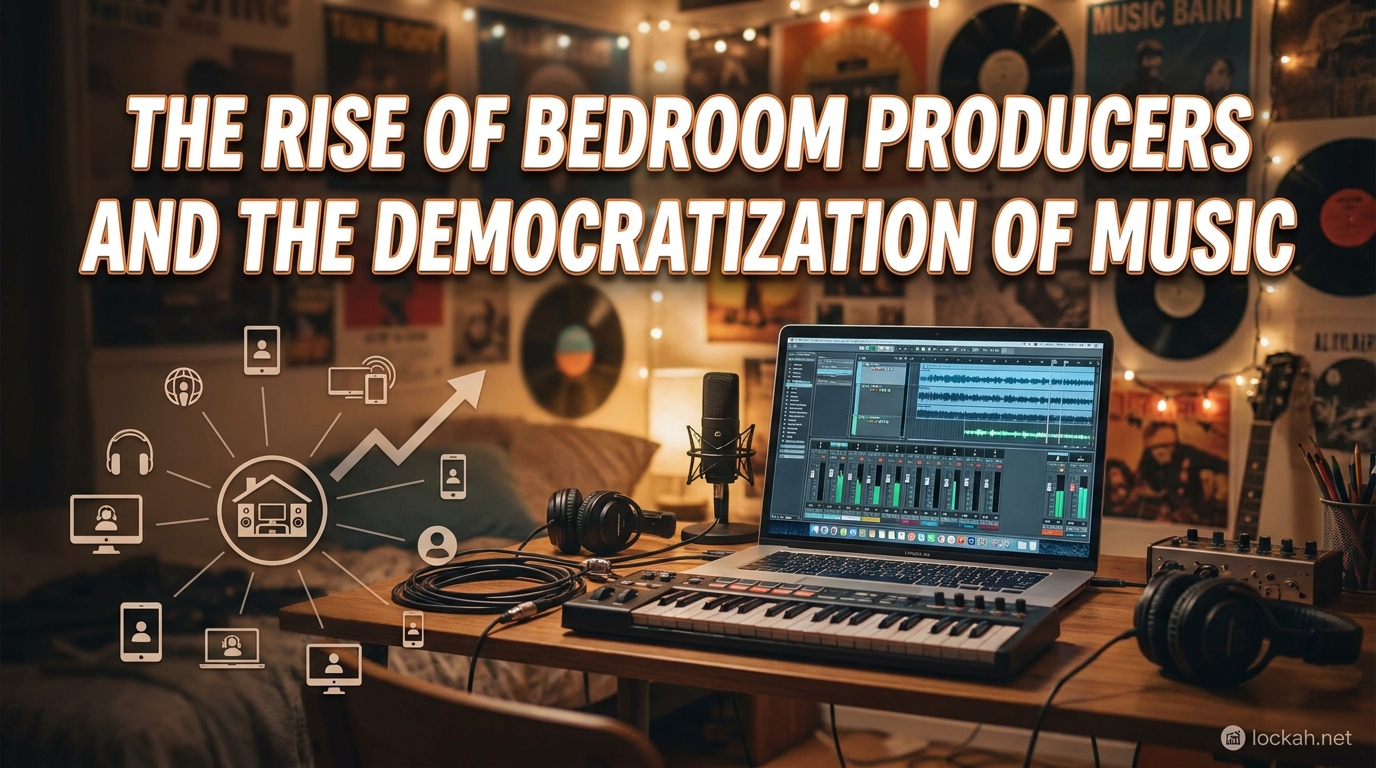
I remember the first time I heard Billie Eilish’s “Ocean Eyes” in 2026. The haunting vocals and layered production felt like it came from a professional studio with a six-figure budget. I was shocked to learn it was recorded in a bedroom by her brother Finneas using a $3000 setup. That moment changed how I thought about music production forever.
The rise of bedroom producers represents the biggest shift in music creation since the invention of the electric guitar. What started as a niche movement has become the dominant force in the industry. Independent artists now produce chart-topping hits from their bedrooms, fundamentally reshaping who gets to make music and how it reaches the world.
In this guide, I will explain what bedroom producers are and why they matter in 2026. You will learn how affordable technology democratized music production. I will share real success stories and practical insights for anyone considering this path.
Table of Contents
What Is a Bedroom Producer?
A bedroom producer is an amateur or semi-professional musician who creates, records, and produces music independently from a home studio setup. The term “bedroom” is metaphorical. Many producers work from spare rooms, basements, or converted closets. The key distinction is independence from traditional commercial recording studios.
Unlike professional studio engineers, bedroom producers handle every stage of production themselves. They write the songs, program the instruments, record the vocals, mix the tracks, and often master the final product. This DIY approach gives complete creative control over the entire process.
The bedroom producer movement gained momentum in the early 2000s but exploded during the 2010s. Digital Audio Workstations (DAWs) became affordable. Computers grew powerful enough to handle complex audio processing. Social media platforms allowed direct artist-to-fan connections without record label gatekeepers.
The DIY Ethos That Defines Bedroom Production
Bedroom producers embrace a do-it-yourself philosophy that prioritizes creativity over expensive equipment. The mindset focuses on resourcefulness and learning. A producer might spend weeks perfecting a synthesizer patch rather than hiring a session musician.
This ethos attracts self-taught producers who learn through YouTube tutorials, online courses, and community forums. Reddit communities like r/bedroomproducers and r/WeAreTheMusicMakers have hundreds of thousands of members sharing tips, feedback, and encouragement. The learning curve feels less steep when you have a global community supporting your growth.
The Technology Revolution That Made Bedroom Production Possible (2026)
The democratization of music production happened because technology removed financial barriers. Three key innovations transformed bedroom setups into professional-capable studios.
Digital Audio Workstations Changed Everything
Digital Audio Workstations (DAWs) are software applications that allow recording, editing, and producing audio files. Before DAWs, music production required expensive tape machines, mixing consoles, and outboard gear. Now a $200 laptop and free software can produce radio-ready tracks.
FL Studio launched in 1997 as FruityLoops and became the gateway DAW for countless bedroom producers. Its pattern-based workflow suits electronic music and hip-hop production perfectly. Ableton Live revolutionized live performance and production with its session view. Logic Pro X offers professional features at consumer prices for Mac users.
Even free options exist. GarageBand comes pre-installed on Apple devices. Cakewalk by BandLab offers a full professional DAW at zero cost. These tools give beginners access to multi-track recording, MIDI sequencing, virtual instruments, and effects processing that previously cost tens of thousands of dollars.
Affordable Hardware Completed the Puzzle
Software alone cannot create music. Bedroom producers need hardware to capture sound and control their DAWs. The good news is that quality equipment has never been more accessible.
MIDI controllers allow producers to play virtual instruments with physical keys, pads, and knobs. Entry-level controllers like the Akai MPK Mini or Novation Launchkey cost under $150. These devices connect via USB and control every aspect of a DAW without requiring additional equipment.
Audio interfaces convert analog signals (microphones, guitars) into digital audio your computer can process. The Focusrite Scarlett Solo costs around $100 and provides professional-quality conversion. Pair it with a $100 condenser microphone like the Audio-Technica AT2020, and you have a vocal recording chain that rivals commercial studios from two decades ago.
Studio monitors and headphones let producers hear their work accurately. The KRK Rokit series and Audio-Technica ATH-M50x headphones have become bedroom studio standards. Combined, a complete beginner setup costs under $1000. Compare that to the $500+ per day rate for commercial studio time.
VST Plugins and the Software Instrument Explosion
Virtual Studio Technology (VST) plugins are software instruments and effects that run inside DAWs. They eliminated the need for physical synthesizers, drum machines, and effect racks. A single plugin can emulate vintage synthesizers worth thousands of dollars.
Native Instruments, Spectrasonics, and Xfer Records created industry-standard virtual instruments. Serum by Xfer Records became the definitive wavetable synthesizer for electronic music. Omnisphere by Spectrasonics offers over 14,000 sounds in a single package. These tools give bedroom producers access to sonic palettes that previously required massive studio budgets.
Free plugins democratized access even further. Companies like Spitfire Audio, Native Instruments, and Valhalla offer professional-quality instruments and effects at no cost. A producer with determination can build a complete studio using entirely free software.
Famous Bedroom Producer Success Stories
Theory means little without proof. These bedroom producers prove that professional success is achievable from humble beginnings.
Billie Eilish and Finneas O’Connell
Billie Eilish represents the ultimate bedroom producer success story. Her debut album “When We All Fall Asleep, Where Do We Go?” won five Grammy Awards including Album of the Year. Every track was written and produced by Billie and her brother Finneas in his childhood bedroom in Highland Park, Los Angeles.
Finneas used Logic Pro X, a Universal Audio Apollo interface, and minimal outboard gear. Their recording space measured roughly 8 by 10 feet. The album has sold over 4 million copies worldwide and amassed billions of streams. It proves that creative vision matters more than expensive facilities.
Flume: From Australian Bedroom to Global Stages
Harley Streten, known as Flume, produced his self-titled debut album from his parents’ house in Sydney, Australia. He was 21 years old with limited equipment. The album won multiple ARIA Awards and launched the future bass genre into mainstream consciousness.
Flume’s success opened doors for countless electronic producers. He showed that experimental, boundary-pushing music could find massive audiences without traditional label backing during the creation phase. His follow-up projects continued the bedroom production approach even as his fame grew.
Clairo and the Viral Bedroom Moment
Clairo (Claire Cottrill) uploaded “Pretty Girl” to YouTube in 2017. The lo-fi bedroom pop track went viral, accumulating over 50 million views. She recorded it using a laptop and basic microphone in her bedroom while recovering from ankle surgery.
The video’s DIY aesthetic matched its production. Clairo’s rise highlighted how platforms like YouTube and SoundCloud could catapult bedroom producers to record deals and touring careers. She maintained her independent spirit even after signing with Fader Label, continuing to self-produce much of her work.
Steve Lacy: The Internet-Collaborative Producer
Steve Lacy gained recognition as a member of The Internet before launching his solo career. He produced tracks for Kendrick Lamar’s “DAMN.” album using only his iPhone and GarageBand. This extreme example of bedroom production showed how minimal equipment could create Grammy-winning material.
Lacy’s approach emphasizes that creativity transcends tools. He now releases full albums and tours globally, but maintains the experimental, self-produced approach that defined his early work. His story resonates with young producers who start with limited resources.
How Democratization Changed the Music Landscape in 2026?
The rise of bedroom producers disrupted the traditional music industry in fundamental ways. Understanding these changes helps explain why the movement matters beyond individual success stories.
The Death of the Gatekeeper Model
Historically, record labels controlled access to music production and distribution. Artists needed label approval to enter professional studios. Labels decided which music reached audiences through radio and retail partnerships. This gatekeeper model limited who could participate in music creation.
Bedroom producers bypassed these gatekeepers entirely. Platforms like SoundCloud, Bandcamp, and Spotify allowed direct uploads. Social media provided marketing channels without PR budgets. Artists could build fanbases organically through authentic connection rather than industry approval.
Labels lost their monopoly on production quality. When bedroom-produced tracks sound indistinguishable from studio recordings, the “professional studio” selling point disappears. Labels now compete with independent artists on a more level playing field.
Genre Blending and Creative Freedom
Bedroom producers often ignore traditional genre boundaries. Without label executives suggesting commercial directions, artists follow their instincts. This freedom produced genre-blending movements like hyperpop, bedroom pop, and cloud rap.
The internet’s global reach exposes producers to diverse influences. A teenager in Iowa can study Japanese city pop, Nigerian Afrobeats, and UK drill in the same afternoon. This cross-pollination creates fresh sounds that traditional industry pipelines rarely produced.
Independent Release Platforms
Distribution services like DistroKid, TuneCore, and CD Baby let bedroom producers release music on Spotify, Apple Music, and other platforms for annual fees under $50. Artists keep 100% of their royalties instead of surrendering ownership to labels.
Bandcamp offers direct-to-fan sales with higher revenue splits than streaming. YouTube provides monetization through ads and memberships. Patreon allows fans to support producers directly. These platforms create sustainable income streams without requiring hit singles.
The Challenges of a Saturated Market
Democratization created problems alongside opportunities. Anyone can upload music, which means millions of tracks flood streaming platforms daily. Standing out requires more than good production.
Market Saturation Is Real
Spotify receives over 100,000 new tracks daily as of 2026. The sheer volume makes discovery difficult for new artists. Bedroom producers compete not just with other independents, but with major label releases backed by million-dollar marketing budgets.
This saturation affects listener behavior too. With unlimited choice, attention spans shorten. Algorithms favor tracks that generate immediate engagement. Artists face pressure to release constantly rather than crafting carefully considered projects.
Quality vs Quantity Debates
Easy production tools tempt overproduction. When creating a track takes hours instead of weeks, some producers sacrifice quality for quantity. Reddit communities frequently discuss this tension. Members ask whether they should release everything they create or curate more carefully.
The democratization of tools does not guarantee democratization of skills. Professional mixing and mastering remain specialized crafts. Many bedroom producers struggle to achieve commercial loudness and clarity despite having capable software. This gap between tool access and skill development frustrates newcomers.
Algorithm Dependency and Platform Changes
Independent artists depend on platform algorithms for discovery. When Spotify or TikTok change their recommendation systems, careers can shift overnight. Bedroom producers lack the industry relationships that help major label artists navigate platform changes.
Additionally, streaming economics favor volume over individual track success. The average Spotify stream pays $0.003 to $0.005. Bedroom producers need millions of streams to generate meaningful income. This reality pushes many toward touring and merchandise, which require resources beyond production skills.
AI and the Future of Bedroom Production (2026)
Artificial intelligence represents the next wave of music democratization. AI tools can generate melodies, suggest chord progressions, and even master tracks automatically. These developments promise to lower barriers further while raising questions about authenticity.
AI Tools for Music Creation
Platforms like AIVA, Amper Music, and Landr offer AI-assisted composition and production. A bedroom producer can input a genre and mood, receiving a generated backing track instantly. Tools like Spleeter separate mixed audio into individual stems, allowing producers to isolate vocals or drums from existing songs.
AI mastering services like LANDR and CloudBounce compete with human mastering engineers at fraction of the cost. For $50 per year, bedroom producers access processing that previously cost $100 per track. The quality gap between AI and human mastering narrows continuously.
The Authenticity Question
As AI tools proliferate, debates about “real” musicianship intensify. Some purists argue that AI-assisted production lacks soul. Others embrace these tools as natural extensions of sampling and sequencing technologies that already revolutionized music.
The most successful bedroom producers in 2026 and beyond will likely combine AI efficiency with human creativity. Using AI for technical tasks while focusing personal energy on creative decisions offers a balanced path forward.
Where Bedroom Production Is Headed
The trajectory points toward continued decentralization. Virtual reality studios may allow remote collaboration in shared spaces. Blockchain technology could revolutionize royalty payments and rights management. The tools will keep improving while costs keep falling.
One certainty remains. Bedroom producers have permanently changed music creation. The genie cannot return to the bottle. Future stars will continue emerging from bedrooms, basements, and dorm rooms rather than traditional industry pipelines.
Frequently Asked Questions
What is a bedroom music producer?
Is 30 too old to start producing music?
Does a producer get 50% of a song?
Who is the #1 music producer?
Conclusion: Your Bedroom Could Be the Next Studio
The rise of bedroom producers and the democratization of music represents more than a technological shift. It signals a cultural change in who gets to participate in creative expression. The barriers that once separated professional musicians from aspiring artists have crumbled.
You now understand what defines a bedroom producer and the technology that made this movement possible. You have seen proof through success stories from Billie Eilish to Flume. The challenges are real, but so are the opportunities.
If you have considered making music, there is no better time than 2026 to start. Download a free DAW. Watch tutorials. Join communities. Your first track will not sound perfect, but neither did the first songs from producers who now fill stadiums. The bedroom producer revolution proves that great music can come from anywhere. It might as well come from you.