
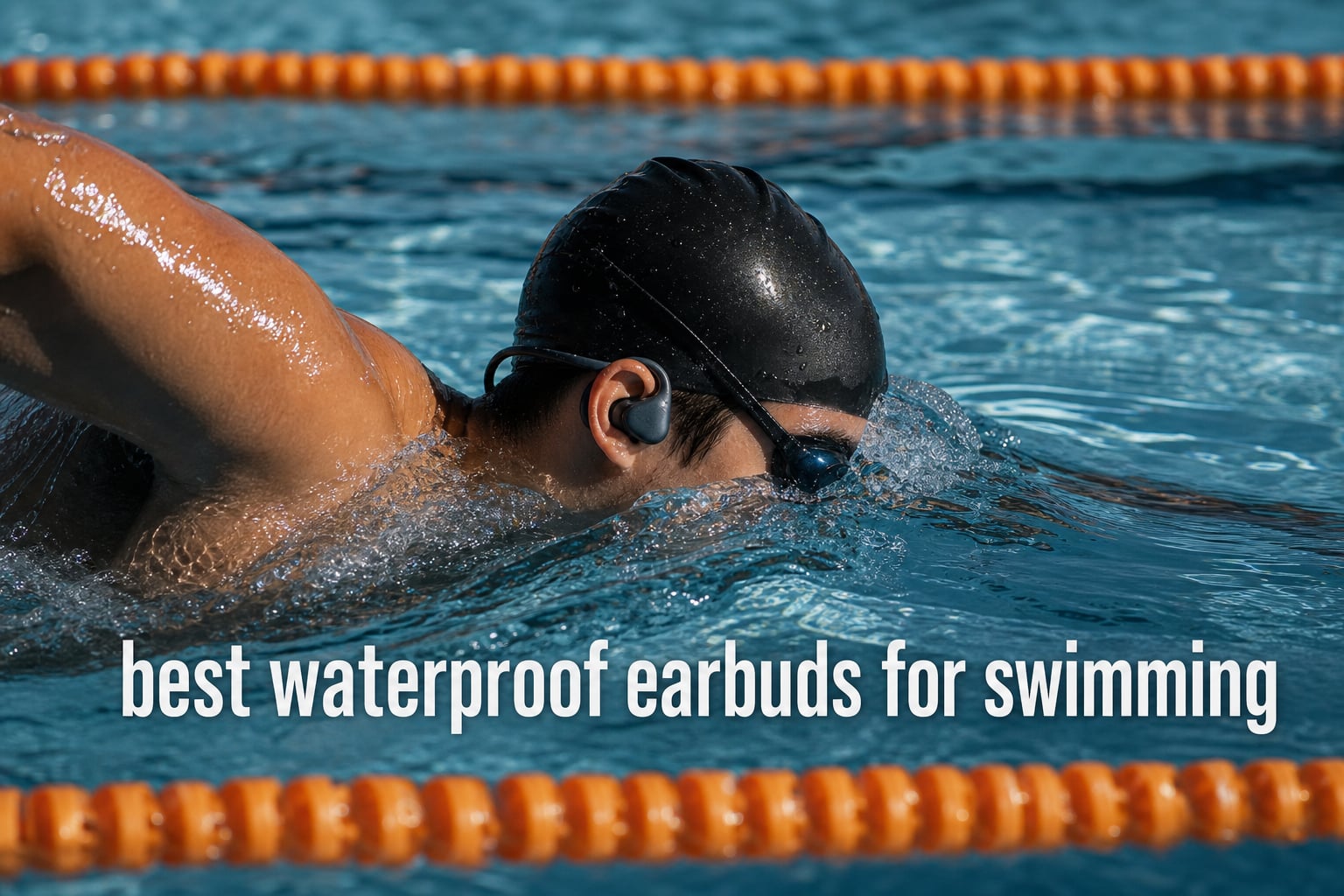
For lap swimming, the best waterproof earbuds for swimming are usually open-ear bone-conduction headphones with an IP68 or IPX8 rating and a built-in MP3 player. That last part matters more than many first-time buyers expect: Bluetooth is useful on deck and on dry land, but it does not carry a reliable signal through water.
Instead of treating every water-resistant earbud as swim-ready, I narrowed this list to the eight analyzed models that state swimming-capable water protection and local audio storage. All eight are open-ear bone-conduction designs, so they sit outside the ear canal and leave room for awareness of a lane mate, coach, or lifeguard.
The main decision is not “Bluetooth or no Bluetooth.” It is whether the device can store your music locally, stays comfortable under your goggles, and has a stated rating suited to the depth and duration of your swim. A swimmer who likes audiobooks may need more storage than a swimmer who rotates a short training playlist, while a long-session swimmer may care most about battery runtime and pressure around the temples.
We reviewed the supplied manufacturer specifications, listed features, ratings, review counts, and recurring swimmer concerns in the research. That approach does not turn a product claim into a laboratory result, so I call out what each listing specifically states and where a buyer should be cautious, particularly around wet controls, stated depth limits, and the fact that “waterproof” still requires sensible care after chlorine or saltwater exposure.
Forum discussions point to the same practical lesson: people often move from in-ear buds to a wraparound bone-conduction frame because it is less likely to shift during strokes. The tradeoff is a different sound presentation. These transmit vibration through the cheekbone area rather than sealing the ear, so audio can feel clearer to some swimmers with included earplugs and more open to others without them.
Table of Contents
The three strongest swimming picks are SHOKZ OpenSwim Pro, ZOVIMAX X7 MAX, and RR SPORTS X26

The OpenSwim Pro is the all-around pick because its listing combines a triple-sealed IP68 build, 9-hour runtime, fast charging, MP3 capacity for up to 8,000 songs, and a 2-year warranty. Its 4.3 rating comes from a far larger review base than the other selections here, which gives that number useful context even though it is not the highest average.
The ZOVIMAX X7 MAX stands out for its stated 12-hour battery life and detailed IPX8 submersion claim of up to 5 meters for 2.5 hours. The RR SPORTS X26 is compelling for swimmers who want 32GB of local storage with a stated IP68 rating for submersion up to 2 meters, while accepting a listed 7-hour battery figure.
Every one of these picks needs MP3 mode in the pool. Bluetooth modes are still worthwhile for a run, commute, gym session, or calls on land, but they are not the route to uninterrupted underwater audio.
These eight waterproof swimming headphones cover different storage, battery, and fit priorities in 2026
| Product | Specifications | Action |
|---|---|---|
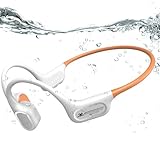 RR SPORTS X26 RR SPORTS X26 |
|
Check Latest Price |
 Dnniakm X7P Dnniakm X7P |
|
Check Latest Price |
 MARLALL S800 MARLALL S800 |
|
Check Latest Price |
 ZOVIMAX X7 MAX ZOVIMAX X7 MAX |
|
Check Latest Price |
 esonstyle X32 esonstyle X32 |
|
Check Latest Price |
| SHOKZ OpenSwim Pro |
|
Check Latest Price |
 PSIER S18 PSIER S18 |
|
Check Latest Price |
 ELYXFUL BCE ELYXFUL BCE |
|
Check Latest Price |
The comparison puts the useful numbers in one place: stated water rating, local storage, battery claim, and a notable physical or audio feature. Storage ranges from 8GB to 64GB, and listed runtimes range from 7 hours to 12 hours, so the right match depends on how often you want to reload music and charge between sessions.
Ratings are snapshots of buyer feedback, not proof that a model will fit every head shape or goggle strap. For that reason, read the review sections below as a fit-and-use-case match rather than a simple ranking from highest star average to lowest.
1. RR SPORTS X26 is a roomy 32GB pick for swimmers who want a large offline library
RR SPORTS IP68 Waterproof Swimming Headphones, Bone Conduction Bluetooth 6.0 Headphones, Built-in 32GB MP3 Player, Soft Lightweight Open-Ear Design for Swimming Marathons Showers Cycling(Peach
IP68 up to 2m
32GB MP3 up to 7000 songs
7-hour battery
Pros
- 32GB local storage
- IP68 stated submersion rating
- soft silicone build
- Bluetooth 6.0
- secure open-ear fit
Cons
- Bluetooth will not work underwater
- 7-hour battery claim
The RR SPORTS X26 makes its case with capacity. Its 32GB built-in MP3 player is listed for up to 7,000 songs, which is enough space to separate steady lap sets, interval mixes, long-form audio, and dry-land listening without constant file swapping.
The technical details state IP68 protection for submersion up to 2 meters, plus a lightweight open-ear design with ultra-soft silicone. Its 4.9 rating is based on 80 reviews, and the listing reports 93% five-star feedback; that is a positive but still much smaller feedback pool than the SHOKZ or PSIER models.
Its listed 7-hour average battery life is suitable for several normal pool sessions between charges, depending on how long you train. I would load files and give the controls a dry run before leaving for the pool, because any Bluetooth 6.0 benefit ends when the device goes under water.
The 32GB MP3 capacity is the reason to choose the X26
A 32GB player reduces the need to curate a tiny library. That matters most if you alternate music, spoken-word files, and several workout moods across the week.
The stated 10-meter Bluetooth range still has a place for land exercise, cycling, or setup near a phone. In the lane, switch to files stored directly on the headset before you start swimming.
The 2-meter IP68 claim suits standard pool use, not careless handling
The listing’s specific two-meter claim is more helpful than a broad “waterproof” label. It gives pool swimmers a stated reference point, but it is not a reason to ignore rinsing or to assume all water types and long-term wear are identical.
After a chlorinated session, rinse the headset in fresh water and dry the charging contacts before connecting a cable or magnetic charger. That small routine also helps you spot strap wear or debris before the next swim.
2. Dnniakm X7P is a 32-gram open-ear option with 32GB of local music space
Bone Conduction Headphones for Swimming, Waterproof Swimming Headphones
IPX8 listed
32GB MP3 up to 9000 songs
8-hour battery
32g
Pros
- 32GB memory
- 8-hour battery
- 32g listed weight
- Bluetooth 5.4
- 2-year service
Cons
- Bluetooth is unavailable underwater
- water-rating wording differs
The Dnniakm X7P pairs 32GB of storage, listed for up to 9,000 songs, with an 8-hour battery claim. If your priority is leaving the phone in a locker while keeping a broad offline library available, its feature set is directly aimed at that use.
Its product details call the rating IPX8, while the technical-details list describes IP68 waterproofing for swimming. I would treat the inconsistency as a question to resolve on the current product page or with the seller before buying, rather than assuming the two labels mean exactly the same thing.
The listed 32-gram weight and open-ear format point toward a light wraparound feel, and Bluetooth 5.4 is provided for dry activities. Smart noise cancellation is also listed, though a swimmer should not expect it to change the basic fact that audio must come from MP3 mode under water.
The 8-hour battery claim makes the X7P practical for regular pool schedules
Eight hours is a sensible middle ground for people who swim several times a week and do not want to recharge after every visit. Charge time is not specified in the supplied data, so I would avoid planning around a last-minute top-up.
The 2-year after-sales service listed by Dnniakm is a useful ownership detail, especially because chlorine exposure and repeated wet-dry cycles are harder on small electronics than ordinary gym use. Keep records of the order and follow the maker’s care directions if a problem appears.
The open-ear frame needs a goggle-strap check before a long session
Put the X7P on first, then test both a single-strap and split-strap goggle arrangement at home. A frame that feels stable standing still can meet a strap differently when you turn your head to breathe.
Bone-conduction bands generally sit around the back of the head rather than inside the ear. That can be more stable than conventional swim earbuds, but comfort remains personal, especially around the temples on longer swims.
3. MARLALL S800 is the lightest listed 32GB model for swimmers who prefer liquid silicone
MARLALL Swimming Headphones-Bone Conduction Headphones, IP68 Waterproof Open Earphones, LiteSurge Bluetooth 5.4 Underwater Sport Earbuds with 32 GB MP3 Memory for Swimming, Marathon-Ashy
IP68 waterproof
32GB MP3 storage
Bluetooth 5.4
22.68g weight
Pros
- 22.68g listed weight
- 32GB storage
- IP68 rating
- liquid silicone
- Bluetooth 5.4
Cons
- Bluetooth does not work underwater
- charge and battery data not specified
The MARLALL S800 is listed at 22.68 grams, making it the lightest product in this group with a stated weight. Its 32GB player is described as holding roughly 5,000 to 8,000 songs, a broad range that reflects differences in audio-file size and format.
IP68 waterproofing, a lightweight open-ear build, Bluetooth 5.4, and premium liquid silicone are its headline specifications. The 4.8 average comes from 72 reviews, with 87% listed as five-star feedback, so it has promising but limited-volume customer evidence.
For a swimmer who dislikes the sensation of a heavy band behind the head, the stated weight is the reason to take notice. Battery life is not supplied for the S800, though, so it is not the model I would choose when a clearly stated long runtime is your non-negotiable.
The low 22.68-gram listed weight favors comfort-focused swimmers
Weight does not tell the whole fit story, but it is a relevant clue when a headset sits against wet skin and under a cap. Liquid silicone may also be appealing to swimmers who prefer a softer contact material around the temples and neck.
Try the band with the cap and goggles you already use, not only without accessories. The most secure position is the one that leaves the band clear of the goggle strap and does not create a pressure point when you push off the wall.
The 32GB player makes file format more important than storage anxiety
With this much capacity, file organization becomes the practical task. Name folders clearly, keep a backup of your library on a computer, and start with a small test album to learn the device’s transfer behavior.
Bluetooth 5.4 is for dry conditions and nearby devices. For pool music, copy compatible audio files to the onboard memory and select the MP3 player mode before entering the water.
4. ZOVIMAX X7 MAX is the battery-first choice with a detailed IPX8 depth statement
ZOVIMAX Bone Conduction Headphones, IPX8 Waterproof Swimming Headphones
IPX8 up to 5m for 2.5h
8GB MP3
12-hour battery
14.2mm drivers
Pros
- 12-hour battery
- stated 5m depth limit
- 14.2mm drivers
- 2-year warranty
- Bluetooth 6.0
Cons
- Only 8GB storage
- Bluetooth cannot operate underwater
The ZOVIMAX X7 MAX has the longest listed battery figure here at 12 hours. It also gives the clearest submersion statement in the supplied data: IPX8 protection up to 5 meters for 2.5 hours, which is more specific than a generic water-resistance label.
Its 8GB MP3 mode offers less room than the 32GB and 64GB alternatives, but it is still enough for a focused swim library. The listing also names 14.2mm dynamic drivers, Bluetooth 6.0, a secure open-ear fit, and a 2-year warranty.
At 4.8 stars from 58 reviews, the X7 MAX is highly rated but has a modest review count. I would see it as an especially strong fit for people who train frequently or take long sessions and would rather charge less often than carry a vast music archive.
The 12-hour battery figure is the X7 MAX’s clearest advantage
Long runtime makes this model convenient for a week that includes pool work, running, and fitness sessions. Actual playback time can vary with volume, file type, and operating mode, so treat the listed 12 hours as a manufacturer figure rather than a guaranteed result.
The presence of local MP3 memory means those long sessions can remain phone-free in the water. Bluetooth 6.0 can reconnect for dry-land use, but it does not remove the need to transfer files for a swim.
The stated 5-meter, 2.5-hour rating needs to match your actual activity
Most lap swimmers will not approach five meters, but a stated depth-and-duration figure is still useful context for pool and open-water training. It does not replace cleaning and drying practices after each use.
The X7 MAX’s secure open-ear profile may work well under goggles, yet swimmers with a very tight cap should check for contact at the back band. A few minutes of head turns, push-off motions, and breathing-side practice can reveal interference early.
5. esonstyle X32 is a 28-gram titanium-frame option for compact MP3 libraries
esonstyle Swimming Headphones Underwater Bluetooth 6.2 – IP68 Waterproof
IP68 up to 3m for 60+ min
8GB MP3
8-hour battery
28g frame
Pros
- 28g titanium frame
- stated 3m depth rating
- 8GB MP3
- 8-hour battery
- Bluetooth 6.0
Cons
- Wet touch controls may be inconsistent
- Bluetooth is not for underwater use
The esonstyle X32 focuses on a compact 28-gram titanium frame, 8GB of MP3 storage for more than 2,000 songs, and an 8-hour battery claim. Its IP68 technical detail states use at 3 meters for 60 or more minutes, which makes the listed limit easy to understand for most pool swimmers.
This is also the most-reviewed non-SHOKZ product in the group, with 177 reviews and a 4.6 average. The supplied review summary notes 77% five-star feedback and some three-star feedback, a useful reminder that a larger review pool can show more mixed experiences.
The X32’s Bluetooth 6.0 and touch-control method add dry-land convenience, but touch controls can be less reliable when wet according to the product analysis. I would make your track or volume adjustments before getting in and learn physical control behavior during a dry session.
The 8GB library is enough when you curate a dedicated swim queue
Two thousand or more songs is substantial for someone who builds a concise pool collection. It can be simpler than carrying a massive archive, especially if you organize tracks by pace, distance set, or workout type.
If you prefer podcasts, audiobooks, or uncompressed music files, capacity disappears faster. In that case, one of the 32GB or 64GB swimming headphones is a more comfortable long-term fit.
The titanium frame and touch controls suit swimmers who plan ahead
A 28-gram frame should feel unobtrusive for many swimmers, but only a real cap-and-goggle check can confirm placement. Do not assume a lighter headset will automatically avoid every strap conflict.
Because wet touch interaction can be inconsistent, prepare the mode, volume, and files in advance. That routine also limits the chance of repeatedly pressing controls while standing in chlorinated water.
6. SHOKZ OpenSwim Pro is the most established all-around option with up to 8,000-song storage
SHOKZ OpenSwim Pro Open-Ear MP3 Headphones, Grey, IP68 Waterproof, 32GB MP3
Triple-sealed IP68
MP3 storage up to 8000 songs
9-hour battery
27.3g
Pros
- triple-sealed IP68 build
- up to 8000 songs
- fast charge
- 9-hour battery
- 2-year warranty
Cons
- Bluetooth does not work underwater
- lower average rating than some newer models
The SHOKZ OpenSwim Pro is the most established model in this set, with a 4.3 average across 3,137 reviews. Its detailed listing describes a triple-sealed IP68 design, open-ear construction, MP3 and Bluetooth modes, 9 hours of music and calls, and local capacity for up to 8,000 songs.
It weighs 27.3 grams and adds features not listed for many rivals: a 10-minute quick charge said to provide 3 hours of listening, magnetic induction charging, multipoint pairing, and app control. The listed 2-year warranty is another practical point for a device likely to see repeated pool exposure.
Forum research repeatedly names the OpenSwim Pro as a strong all-around swim choice, particularly for the stable bone-conduction style. The larger review base deserves attention: the supplied data shows 73% five-star, 9% four-star, and a visible share of lower ratings, so it is well-known rather than universally perfect.
The MP3 and Bluetooth split makes the OpenSwim Pro a true multi-sport model
For swimming, load music to its internal player and select MP3 mode. For a run, ride, call, or gym workout on land, Bluetooth 5.4 and its stated 33-foot range can connect to a compatible device.
That division is worth embracing rather than fighting. A swimmer who expects live phone streaming in the middle of a lane will be disappointed by every Bluetooth-based model on this page, including this one.
The quick-charge and 9-hour specifications help regular training routines
A stated 10-minute charge for 3 hours of listening is useful when you notice a low battery before leaving. Magnetic induction charging can also be less fiddly than a loose port, provided the contacts are clean and fully dry.
The OpenSwim Pro is compatible with Android, iPhone, Mac, PC, and Watch according to its listing. Use a computer when you need to transfer MP3 files, then keep a copy of the music folder elsewhere so replacing or editing the library is simple.
7. PSIER S18 is a high-review-count 32GB option with EQ and 14mm drivers
PSIER Bone Conduction Headphones, IPX8 Waterproof MP3 Mode for Underwater
IPX8 waterproof
32GB MP3 up to 4000 songs
8-hour battery
14mm drivers
Pros
- 32GB local storage
- IPX8 rating
- 8-hour runtime
- 14mm drivers
- custom EQ settings
Cons
- Bluetooth is unusable underwater
- touch controls need practice
The PSIER S18 combines IPX8 water resistance, 32GB of internal storage for up to 4,000 songs, 14mm bone-conduction drivers, and 8 hours of continuous playback. It has 2,650 reviews, the second-largest feedback pool in this roundup, alongside a 4.3 average.
Its supplied specifications also list fast magnetic charging, customizable EQ settings, multi-device connectivity, and AI music creation through the Boean app. The app feature is an extra rather than a core swim requirement; local-file playback and a stable fit are still what make it relevant in the pool.
The review distribution is more varied than the small, highly rated listings, with 70% five-star and 14% four-star feedback. That makes it sensible to read recent user reports about fit and controls, especially if you want to adjust settings mid-workout.
The 32GB capacity and EQ options suit swimmers who like to organize sound
Thirty-two gigabytes gives the S18 room for a broad music library without a phone. Custom EQ settings may appeal to listeners who want to adjust the presentation for their preference, though bone conduction will not sound exactly like sealed in-ear headphones.
For underwater listening, included or separately chosen swim earplugs can change the perceived balance by reducing outside water noise. Use earplugs safely and only where awareness of your surroundings remains appropriate.
The S18 is better for preset controls than mid-pool adjustments
The supplied analysis says its touch controls may take practice. Make changes while dry, then begin the set with the volume and mode already chosen rather than relying on a wet fingertip during a turn.
The listed Bluetooth version appears as 5.6 in product details and 6.0 in technical details. Since the exact version does not change the underwater limitation, I would verify the current listing if that dry-land specification matters to you.
8. ELYXFUL BCE is the 64GB storage leader for swimmers with large offline collections
ELYXFUL Bone Conduction Swimming Headphones, IP68 Waterproof Bluetooth & 64GB MP3 Player, Open-Ear Water Headphones for Swimming with Mic, Secure Fit, Great for Running, Cycling, and Workouts
IP68 full submersion
64GB MP3 player
8+ hour battery
earplugs included
Pros
- 64GB storage
- IP68 waterproofing
- earplugs included
- 8+ hour playback
- 2-year warranty
Cons
- Bluetooth cannot work underwater
- larger 0.36kg listed weight needs verification
The ELYXFUL BCE has the largest stated local library in this list: 64GB. Its IP68 design is described as suitable for full submersion, and its 8-plus-hour playback claim, included waterproof earplugs, wraparound frame, built-in microphone, and 2-year manufacturer warranty create a feature-rich package for phone-free listening.
It holds a 4.2 average from 302 reviews, with 64% listed as five-star and 17% as four-star. That is a reasonable amount of customer feedback but a more mixed signal than the highest-rated entries, so capacity should be the main reason to choose it rather than star rating alone.
The supplied product details list item weight as 0.36 kilograms, which is far higher than the gram weights stated for the other wraparound headsets. I would verify that figure in the current listing before deciding, because it may materially affect comfort if it is accurate.
The 64GB player answers the needs of large-library swimmers
More storage makes sense for long audiobooks, numerous playlists, or music files that take more space. It also means you can refresh the library less often, provided you keep folders tidy and retain a backup on a computer.
The included earplugs are a practical differentiator. Many bone-conduction users find that earplugs change the underwater audio impression, but fit them comfortably and follow pool rules about hearing ambient instructions.
The wraparound design needs a weight and goggle-fit check
The BCE is advertised for a secure fit during flip turns and sprints, but personal fit cannot be read from a specification. Check how the band sits against your cap, especially if your goggles use a wide rear strap.
Its Bluetooth 5.3 connection and 33-foot stated range are dry-land features. Before pool use, transfer compatible audio to the 64GB MP3 player, choose MP3 mode, and make all setup changes while the headset is dry.
The right swimming headphones come down to water rating, offline files, fit, and care
All eight products here are advertised as open-ear bone-conduction swimming headphones, so the decision begins with the details behind that shared form. The following checks help separate a headset that merely sounds appealing from one that fits your actual pool routine.
IP68 and IPX8 labels answer different parts of the water-protection question
For swimming, look for a product that specifically states IP68 or IPX8 protection and mentions submersion, not simply splash resistance. IPX8 is a water-only rating where the maker should provide immersion conditions, while IP68 adds a dust digit and an immersion digit; the exact depth and duration can still vary by product.
Within this list, the RR SPORTS X26 states IP68 to 2 meters, esonstyle X32 states IP68 to 3 meters for 60 or more minutes, and ZOVIMAX X7 MAX states IPX8 up to 5 meters for 2.5 hours. Those product-specific statements are more actionable than assuming one rating guarantees the same performance across every brand.
No consumer electronic device should be treated as invincible. Rinse after chlorinated or saltwater use, dry it before charging, and inspect the charging points and frame regularly; saltwater, sunscreen, sand, and pool chemicals create different stresses than clear tap water.
Local MP3 files are how swimmers listen underwater without a Bluetooth signal
Bluetooth radio signals weaken sharply in water, which is why waterproof wireless earbuds paired to a phone are not a reliable solution once your head is submerged. A swimming headset works around that limitation by storing compatible audio files in onboard memory and playing them locally.
The basic transfer process is straightforward: charge the headset, connect it to a computer as directed by its maker, copy a small folder of compatible audio files to its internal storage, safely disconnect it, and select MP3 mode. Test that folder while dry before pool day, then start the swim with your preferred track and volume already selected.
Storage dictates how much curation you need. The 8GB models suit a focused collection; 32GB models create room for thousands of tracks; and ELYXFUL’s stated 64GB capacity suits large libraries and lengthy spoken-word files.
Bone conduction keeps the ear canal open, which changes both awareness and sound
Bone-conduction headphones press transducers near the cheekbones rather than plugging the ears. The open-ear approach can help you remain aware of people and instructions around you, and the wraparound band can avoid the “earbud fell out on a flip turn” problem described frequently by swimmers.
It is not the same acoustic experience as a sealed in-ear design. Sound can feel different underwater, and many swimmers experiment with earplugs to alter the perceived bass and outside noise; comfort and safe awareness should guide that choice.
Before committing, rehearse your breathing side, wall push-off, cap, and goggles with the headset. A fit that looks secure on a product image may press against the goggle strap or shift depending on your head shape and stroke.
Battery claims should cover a real week of training, not only one short session
Listed playback runs from 7 hours on the RR SPORTS X26 to 12 hours on the ZOVIMAX X7 MAX. The SHOKZ OpenSwim Pro lists 9 hours and a short quick-charge claim, while Dnniakm, esonstyle, and PSIER each list 8 hours and ELYXFUL lists 8 or more hours.
For two or three shorter swims a week, any of these stated figures can be workable. For frequent training, select a model with a longer stated runtime or easy charging pattern, and avoid leaving charging until the moment you are walking out the door.
Dry the device completely before charging. That habit is simple, but it is particularly important for a product that has just been in chemically treated water or open water.
Goggle compatibility is decided by strap placement and a short movement check
Put a bone-conduction headset on before your goggles, then position the rear goggle strap so it does not cross directly over the band. A split strap often gives more routing options than a single wide strap, though either can work when adjusted carefully.
Do a few head turns, simulated pushes, and breathing-side rotations before the first full session. If the frame contacts the strap, move the goggles slightly higher or lower first; avoid forcing a tight cap or strap over a band that is already creating pressure.
Open-water swimmers should pay extra attention to awareness, changing water conditions, and saltwater cleanup. A headset may have a stated water rating, yet safe open-water swimming still requires attention to boats, currents, other swimmers, and event rules.
These common waterproof swimming earbud questions have direct answers
Which earbuds are completely waterproof?
For swimming, choose headphones that specifically state an IP68 or IPX8 water rating and a submersion use case. In this roundup, RR SPORTS X26, MARLALL S800, esonstyle X32, SHOKZ OpenSwim Pro, and ELYXFUL BCE state IP68 protection, while Dnniakm X7P, ZOVIMAX X7 MAX, and PSIER S18 list IPX8 or related IPX8 specifications. Check the maker’s stated depth and duration because ratings do not all mean the same thing.
Are there any 100% waterproof earbuds?
No electronic headphone should be treated as 100% immune to every condition forever. IP68 and IPX8 swimming headphones are designed for stated immersion conditions, but chlorine, salt, sand, wear, impact, and charging while wet can still cause problems. Follow the listed depth and duration limit, rinse after use, dry before charging, and inspect the device regularly.
Do waterproof earbuds actually work?
Yes, swimming headphones can play audio underwater when they use a waterproof design and store audio files directly on the device. Bluetooth from a phone does not reliably pass through water, so a built-in MP3 player is the feature that makes lap-swim listening work. Bone-conduction models also use a wraparound open-ear fit that can stay put better than traditional in-ear buds for many swimmers.
How do swimmers listen to music while swimming?
Swimmers usually copy compatible music or audio files from a computer to the headphone’s built-in MP3 storage, then select MP3 mode before entering the pool. Prepare volume and track selection while dry because Bluetooth does not work reliably underwater and wet touch controls can be inconvenient. Storage options in this roundup range from 8GB to 64GB, so choose based on how large your offline library needs to be.
The best choice is the model whose MP3 storage, fit, and stated water limit match your swim
For the most established all-around feature set, choose the SHOKZ OpenSwim Pro. Choose the ZOVIMAX X7 MAX if its stated 12-hour battery and specific IPX8 depth detail fit your schedule, the RR SPORTS X26 or PSIER S18 for 32GB libraries, or the ELYXFUL BCE when 64GB capacity is the priority.
The best waterproof earbuds for swimming in 2026 are not the ones with the newest Bluetooth label alone. Pick a swim-ready IP68 or IPX8 model, transfer files before practice, test it with your goggles, and rinse and dry it after every pool or open-water session.