
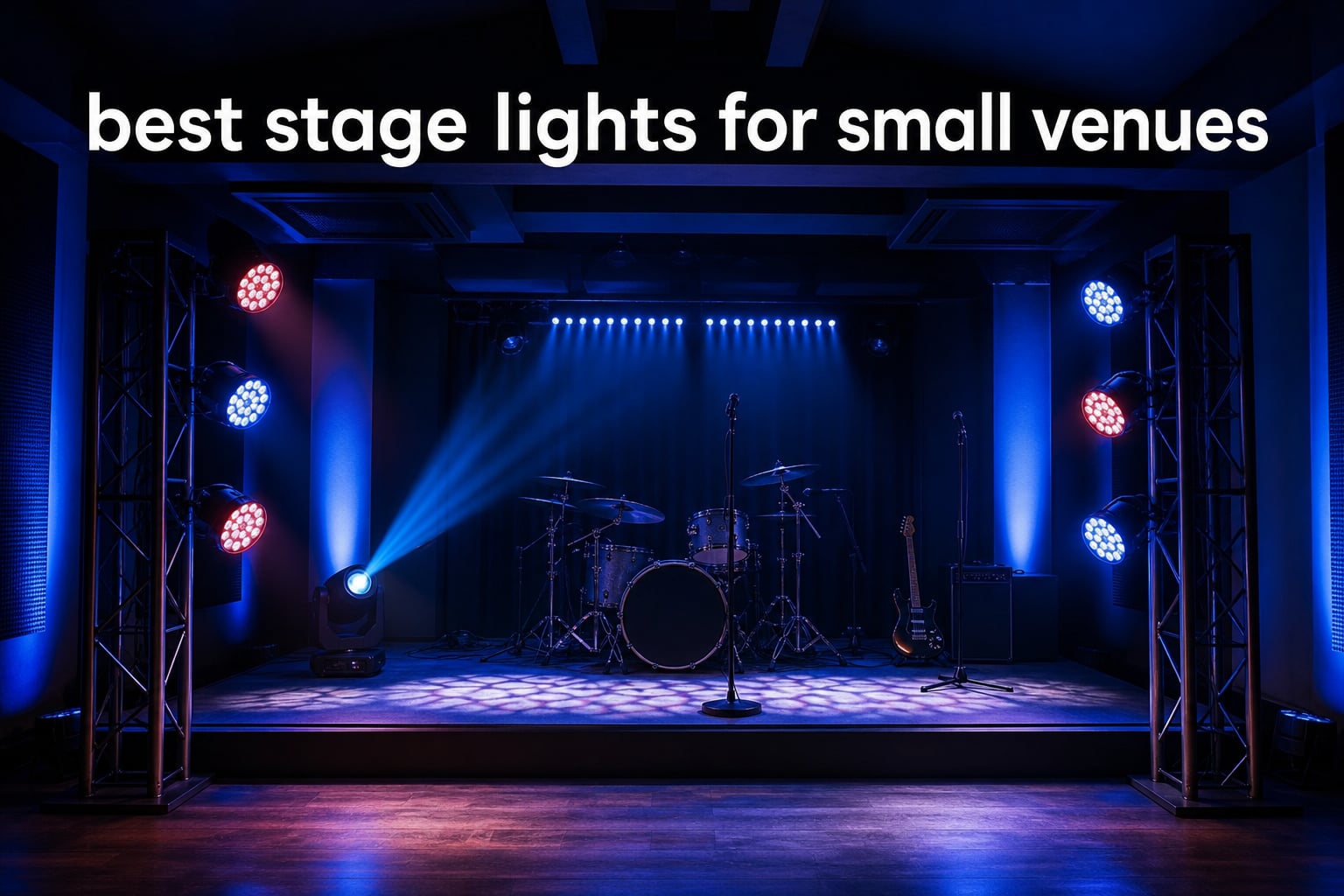
The best stage lights for small venues are usually compact LED PARs for performer visibility, plus one effects fixture when the room needs movement. A tiny bar stage, rehearsal room, church platform, or DJ corner does not need a ceiling full of fixtures; it needs deliberate front light, back color, and controls the operator can run during a show.
For most very small rooms, a practical starting point is three or four lights: two aimed at faces, one behind the performers, and one for a color wash or effect. That mirrors the advice working musicians and lighting-tech discussions return to again and again: buy the roles your stage lacks instead of buying duplicates just because a fixture has a long effects list.
I focused this 2026 guide on eight compact products with supplied, verifiable specifications and customer ratings. There are RGB and RGBW PAR packs, a linear wash bar, two moving effects options, and a portable all-in-one bar, so you can match the fixture to a band gig, a small church service, a club corner, or a DJ set without pretending one style does every job.
The top three picks give most small stages a clear starting point in 2026
The Betopper four-pack is my overall pick because it brings four 120W RGBW fixtures, a specified 15-degree beam, 5,000-lumen maximum output, and a listed CRI of 95. The OPPSK dual-effect pair is the better fit when animated ring effects matter, while the OPPSK 36W four-pack makes a simple remote-or-DMX color wash accessible for a first rig.


These stage lights for small venues cover every fixture role
The quick comparison below includes all eight choices. Read the individual notes after it for the real trade-offs: RGBW versus RGB color, narrow beam versus wash coverage, a fixture’s mounting options, and how many DMX channels a beginner will actually want to manage.
| Product | Specifications | Action |
|---|---|---|
| Betopper 120W RGBW Par 4-Pack |
|
Check Latest Price |
| OPPSK 100W Dual-Effect Par 2-Pack |
|
Check Latest Price |
| OPPSK 36W RGB Par 4-Pack |
|
Check Latest Price |
 LaluceNatz 120W RGBW Wash Bar LaluceNatz 120W RGBW Wash Bar |
|
Check Latest Price |
 Lumvraneo 150W Six-Arm Moving Light Lumvraneo 150W Six-Arm Moving Light |
|
Check Latest Price |
 OPPSK 180W RGBW Par 2-Pack OPPSK 180W RGBW Par 2-Pack |
|
Check Latest Price |
 HOLDLAMP 120W Moving Head HOLDLAMP 120W Moving Head |
|
Check Latest Price |
 Telbum 5-in-1 DJ Bar with Stand Telbum 5-in-1 DJ Bar with Stand |
|
Check Latest Price |
1. Betopper 120W RGBW Par 4-Pack is the best overall wash system
BETOPPER Stage Lighting 120W Par Light RGBW 4-in-1 Stage Lights, DJ Light DMX for Concert and Events,4 Packs
4-pack
120W RGBW
5000 lumens
15-degree beam
Pros
- RGBW four-in-one color
- CRI 95 listed
- Four control modes
- Metal bracket
Cons
- Corded power only
- No batteries included
The Betopper set makes the most sense when you need a full four-fixture foundation rather than one impressive-looking effect. Four matching RGBW PARs let you cover the basic small-stage jobs at once: two front positions, a rear color pair, or four evenly spaced uplights around performers or a backdrop.
The supplied listing specifies 120W per light, RGBW four-in-one LEDs, a 15-degree beam angle, and maximum output of 5,000 lumens. Its listed CRI is 95, which is the specification I would prioritize when singers, speakers, or worship leaders need to look believable rather than tinted by an RGB-only wash.
Control options include Auto, Sound, DMX, and master-slave modes, with 4- or 8-channel operation. That range gives a beginner a straightforward path for a first show and leaves room to build scenes later with DMX512 control.
The metal bracket is another practical point for a travelling setup, as each fixture can be positioned on a floor or supported from suitable hardware. At 4.74 kilograms per listed unit, this is not a tiny pocket light, so plan the transport case and placement before committing to four.
The four-fixture count fits a small stage from day one
This package aligns unusually well with the three-to-four light minimum that comes up in small-venue discussions. I would set two units at front-left and front-right for face light, then use the remaining pair as backlight or side color before adding any moving fixture.
The 15-degree beam calls for aim rather than casual placement. It can create defined pools and stronger accents, but a very wide stage may need greater fixture-to-subject distance or more than one angle to avoid dark gaps.
The RGBW engine supports more natural performer color
RGBW adds a white emitter alongside red, green, and blue, so it is the more sensible route when faces are central to the show. The high listed CRI also makes this the strongest option here for stages that alternate between music, announcements, and streamed services.
The limitation is not output but system complexity: four fixtures mean four addresses if you run them independently. Use master-slave or a shared DMX address for the first event, then separate zones only when you have a clear reason to program them.
2. OPPSK 100W Dual-Effect Par 2-Pack is the best value for layered effects
OPPSK 2Pack 100W Dimmable 14LED Stage Par Light with LED Ring
2-pack
100W LEDs
Dual-layer effect
Remote and DMX
Pros
- Dual-layer LED design
- Remote and DMX control
- Sound-active modes
- Built-in cooling fan
Cons
- Plastic construction
- Corded power only
This OPPSK pair is for a stage that already has usable face light and needs a more animated color layer. Each fixture combines 14 main LEDs with 10 surrounding ring LEDs, allowing the light to create a layered look that a standard single-plane PAR does not attempt.
The supplied specifications list 100W operation, remote and DMX control, sound activation, and a built-in cooling fan. At four pounds and roughly 6.9 by 6.9 by 3.9 inches, the compact body is friendly to a floor position beside a drum riser or a quick portable stand setup.
Its modes include auto, master-slave, sound active, color snap, fade, pulse, and strobe. That is plenty for a DJ or band gig where changes need to track energy without one person constantly programming a controller.
I would not treat the remote as a replacement for a planned show. It is useful for a fixed color or a quick cue, whereas DMX gives repeatable color, dimmer, and effect choices across two fixtures.
The dual-layer design gives DJs and bands a visible effect
Put this pair behind performers, at the ends of a short truss, or on the floor pointing into a rear wall. The main LEDs and ring LEDs are suited to visual texture, especially where the audience sees the fixture itself as part of the presentation.
A compact moving effect can be tempting, but static PAR bodies are easier to place safely in tight rooms. This pair provides activity without the pan-and-tilt sweep that can distract from a singer in a low-ceiling venue.
The controls make first DMX steps less intimidating
Remote operation, sound response, and master-slave behavior provide ways to get light on a stage before a DMX controller is in the picture. When you add DMX, label both fixtures and test their addresses before doors open; channel confusion is a frequent beginner frustration.
The housing is listed as plastic, which is a reasonable compromise for a compact pair but not the same as a metal fixture when gear is moved constantly. Pack it so the lenses and controls are protected, and avoid relying on the body for hard knocks.
3. OPPSK 36W RGB Par 4-Pack is the easiest entry color wash
OPPSK 36W 36LEDs RGB Stage Par Lights by Remote DMX Control – 4Pack
4-pack
36W RGB
25-degree beam
Remote and DMX512
Pros
- Four-fixture package
- Remote and DMX512
- Floor or truss mounting
- Sound activation
Cons
- RGB without white
- 36W output
The 36W OPPSK four-pack is the straightforward choice for a first color-wash rig. It provides four fixtures with 36 RGB LEDs each, 25-degree beams, remote control, DMX512 compatibility, and sound-active, auto, and master-slave modes.
Four lights are more useful than a lone fixture when a small band needs coverage across a 10-by-10-foot stage. Place them as background color, side wash, or uplights, and you can create a basic look that feels intentional even without a controller.
At 36W, these are not the option I would select to fight a bright room from far away. The lower output is better understood as portable color and atmosphere for bars, DJ corners, rehearsal spaces, and close-range performance areas.
The listed ABS-and-metal build and floor-or-truss mounting offer welcome flexibility. The pack also includes four remote controllers, which helps when the lights are used in standalone roles rather than connected to a DMX line.
The 25-degree beam gives a wider wash than the narrow PAR pick
A 25-degree beam is less concentrated than the Betopper’s listed 15-degree beam, so each fixture spreads its color more readily across a close wall or back curtain. That makes this four-pack especially handy for a small venue where fixtures sit near the stage.
Keep expectations tied to distance. A wash loses intensity as it travels, so test the farthest placement during setup instead of judging it from a table at home.
The RGB-only color mix favors atmosphere over face light
RGB mixing can produce saturated blues, reds, greens, purples, and other stage colors, which is exactly what many band gig lighting setups need behind performers. It does not include a listed white LED, so I would keep a separate neutral front-light plan for speakers and close-up performers.
That division of labor is helpful, not a flaw: let these PARs supply color while dedicated front fixtures handle visibility. It also avoids the common mistake of expecting one low-output RGB fixture to serve as every part of a lighting system.
4. LaluceNatz 120W RGBW Wash Bar is the best backdrop and side-wash choice
LaluceNatz Stage Wash Light Bar: 120W RGBW LEDs Individually Controlled DMX Light Bar – 114 Colorful Chase Effects & 15 Static Colors – Sound DMX Control for DJ Wedding Party Club GigBar Live Show
120W bar
18 RGBW LEDs
114 chase effects
4 DMX modes
Pros
- Individually controlled LEDs
- RGBW color mixing
- Four DMX modes
- Daisy chains six units
Cons
- Single linear fixture
- Corded power only
A linear bar solves a different problem from a round PAR. The LaluceNatz model has 18 RGBW four-in-one LEDs at 8W each and is meant to lay down a long strip of color across a backdrop, band riser, wall, or architectural edge.
Its supplied information lists 120W, 114 chase programs, 15 static colors, and 118 built-in program macros. That makes it a stronger choice for a room that needs visible motion across a broad horizontal surface without adding a moving head.
DMX modes span 4, 8, 26, and 72 channels. The low channel modes are the sensible place to begin, while 72 channels allow far more detailed per-LED control for operators who are ready to program a chase instead of selecting a macro.
The aluminum shell is stated to aid heat dispersion, and the fixture can daisy-chain with up to six units. Its listed 40-inch length needs a measured location; it is a purposeful scenic fixture, not something to squeeze casually into a narrow floor gap.
The horizontal format fills areas PAR cans leave uneven
Use the bar at the back of a small stage to light a banner, a drum riser, or a curtain from below or above. It can also sit vertically at stage edge if the mounting plan is stable, creating a column of color that gives a short room more height.
This is the fixture I would add after a basic face-light and backlight plan exists. A wash bar increases atmosphere and movement, but it is not a substitute for two aimed front sources when the audience needs to see faces.
The DMX modes let the rig grow without forcing a complex first show
At four or eight channels, an operator can deal with broad color and effect behavior without becoming lost in individual pixel commands. That is useful in small venues where one person may be mixing sound, calling cues, and running lights.
If you use the higher 26- or 72-channel settings, write the address and mode on tape beside the display. The extra creative control is real, but it only helps if the controller patch matches the fixture before the audience arrives.
5. Lumvraneo 150W Six-Arm Moving Light is the best energetic beam effect
Moving Head DJ Lights 150W RGBW, 6-Arm Party Stage Light with Remote
150W RGBW
Six-arm beams
540-degree pan
22-channel DMX
Pros
- Six-arm beam effect
- 540-degree pan
- Sound and DMX modes
- Sharp haze beams
Cons
- One fixture only
- Iron and plastic body
The Lumvraneo is not a primary wash fixture; it is the one product in this list built to make a small dance floor or DJ stage feel active. Its six-arm RGBW beam arrangement, bee-eye effect, red-green starlight, and white and amber strobes bring a very different look from a conventional PAR.
The listed 150W fixture has 540-degree pan and 180-degree tilt, so it can sweep a room rather than merely color a wall. It offers DMX-512 operation at 22 channels as well as sound-activated, master-slave, and auto-run modes.
Sharp beams are stated to show through haze or fog. In a venue that permits atmospheric effects, that is where this type of fixture has its most dramatic role; without haze, you will still see moving light on surfaces but not the same visible shafts.
I would use one as a back-of-room or rear-stage accent and keep its movement away from performers’ eyes. A single effect fixture works best when it has a job, rather than when it is asked to light every person on stage.
The pan and tilt create movement in a compact room
The broad pan range and 180-degree tilt can sweep beams across a low ceiling, rear wall, or dance floor. Set movement limits during soundcheck so the fixture does not repeatedly hit a singer, a camera position, or audience seating at close range.
Sound-active mode is useful for a hands-off DJ setup, while a DMX cue gives better timing for a band’s intro, chorus, or finale. The real decision is whether someone will operate it; more movement is not automatically better movement.
The six-arm effect belongs behind the front-light system
This Lumvraneo adds energy after two fixed lights have already made performers visible. That order matters in a small room because effects can make a stage feel busy while still leaving faces underlit.
Plan a secure ceiling or truss mounting position if you want its motion to clear the room. The product is listed at 5.95 pounds and includes a metal mounting bracket, but any overhead installation still needs appropriate venue hardware and safety practice.
6. OPPSK 180W RGBW Par 2-Pack is the strongest compact RGBW pair
OPPSK 2-Pack 180W RGBW Par Lights for Stage
2-pack
180W RGBW
25-degree beam
32 color macros
Pros
- RGBW color mixing
- 32 built-in macros
- Four mounting options
- DMX and sound modes
Cons
- Plastic body
- Limited beam-angle choice
The OPPSK 180W RGBW pair is a good middle ground for someone who needs more intensity and white-capable color mixing but does not need four fixtures at once. Each light has 18 LEDs, a stated 25-degree beam, 32 built-in color macros, dimming, and a remote alongside its DMX controls.
The product data lists 4- and 8-channel DMX operation, sound control, auto mode, and master-slave mode. Those options are practical for a pair mounted as left and right front color, used as rear accents, or split between a stage and a backdrop.
Its dual handles support floor, wall, ceiling, or truss mounting. That versatility matters in a small venue, where the most useful opening may be a corner shelf one week and a low stand the next.
The built-in fan is specified for overheating prevention. I would still leave air space around the fixture and run it through a full rehearsal, especially if it will stay on for an extended service or multiple band sets.
The RGBW mix supports both color and neutral-looking cues
Having a listed white LED changes the role of a compact PAR pair. You can use saturated color for songs, then shift to a less theatrical look for introductions, spoken moments, or a close-up performer without swapping fixtures.
The 32 built-in macros also reduce the need to create every color by hand. They are useful starting points, though I would audition them against real skin tones and the venue wall color rather than assuming every preset will suit the room.
The pair format works when the room has two key positions
Two matching fixtures naturally suit symmetrical positions: front-left and front-right, or rear-left and rear-right. Start with both in the same DMX mode and color, then divide them into separate addresses only after the basic look is working.
A two-pack cannot give the complete coverage of a four-pack by itself. Pair it with existing house front lighting or another fixed wash source if the goal is an evenly lit band rather than two accents.
7. HOLDLAMP 120W Moving Head is the best narrow-beam gobo accent
HOLDLAMP 120W Moving Head DJ Lights,18-Facet Prism Stage Lighting 8 Gobos and 8 Colors Spotlight with DMX and Sound Activated Modes for Wedding Parties Church Live Band Show Bar
120W white LED
5000+ lumens
2.8-degree beam
7 gobos
Pros
- 5000+ lumen output
- 18-facet prism
- Seven rotating gobos
- Silent fan listed
Cons
- 240V specification
- 90-day warranty
The HOLDLAMP moving head is the pick for a crisp spotlight-style accent rather than a color wash. Its listed 120W white LED source produces 5,000-plus lumens, through a very narrow 2.8-degree beam, with seven rotating gobos, eight colors, and an 18-facet circular prism.
Those numbers make the fixture appropriate for a long throw, a textured wall projection, or a controlled beam effect. The listing says its best projection distance is three to eight meters, so measure the venue before deciding this narrow tool belongs on a very short stage.
It provides 12 DMX channel modes, 3-pin DMX input and output, pan/tilt inversion, fine pan/tilt, and a stated 1-to-12 Hz strobe range. The constant-temperature system and silent fan are valuable details for a quiet speech or worship setting where motor and fan noise can matter.
This is an effect specialist, not a front wash. I would use it to punctuate a song, project texture above a performer, or send a tight beam over a crowd, while fixed fixtures handle the work of lighting faces.
The 2.8-degree beam rewards careful distance and aim
A 2.8-degree beam is extremely narrow compared with the 15- and 25-degree PAR options in this guide. That concentration can look striking in a deeper room, but it will not cover several musicians standing shoulder to shoulder.
Use the fixture at a safe elevated or rear position and set its focus point during an empty-room test. With a narrow source, a small adjustment in angle changes the target area a lot, which is why a planned mounting point matters.
The gobo and prism effects add texture instead of broad color
The seven rotating gobos and 18-facet prism are for pattern and refraction effects. They give a bar, club, or live-band intro a graphic look that a simple wash cannot produce, particularly on a wall or haze-filled air path.
Check local electrical compatibility before installation because the supplied product details state 240 volts AC. The manufacturer’s stated 90-day warranty is also shorter than some other choices here, so it is fair to weigh that against how often the fixture will travel.
8. Telbum 5-in-1 DJ Bar with Stand is the most portable all-in-one party rig
Telbum DJ Lights with Stand, 5 in 1 Party Bar Light Set with Rotating Ball, Strobe, UV, Colorful LED Par Light and Pattern, Sound Activated DJ Lighting System for Disco Stage Gig Band Wedding
5-in-1 bar
40W
Sound active
Tripod included
Pros
- Five built-in effects
- Tripod stand included
- Sound activated
- UV and white strobe
Cons
- 40W output
- Floor-mount format
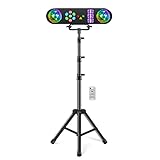
The Telbum system is the fastest route to a varied DJ-style look from one portable bar. It combines a rotating disco ball, colorful PAR light, red-and-green pattern light, UV or black light, and a white LED strobe, with a foldable, detachable, retractable tripod stand included.
Its 40W rating makes it less about throwing light across a large room and more about adding a complete effects package to a close dance floor, party corner, or solo DJ setup. The sound-activated mode changes colors and speed with music rhythm, which is appealing when there is no dedicated lighting operator.
The PAR section offers jump, fade, strobe, and static color modes, while the white strobe has four adjustable flashing speeds. You also get a remote, so the operator can make a broad change without reaching the bar during an event.
For a singer-songwriter stage or presentation, I would not make this the primary choice because the multi-effect approach can compete with the performer. For an energetic party, wedding dance floor, or band changeover, its wide mix of effects can be exactly the point.
The included tripod makes a portable setup genuinely simple
The stand reduces the amount of separate hardware a mobile DJ must pack, and the 4.7-pound listed weight supports that portable role. Put the bar behind or beside the performance area so its effects project outward rather than directly into performers’ faces.
The floor-mount format is a limitation for venues that need fixtures above a stage or on a truss. It is best treated as a self-contained party bar, not as a substitute for carefully aimed front stage lighting.
The five effects suit music-led events more than neutral illumination
The combination of rotating ball, patterns, UV, PAR color, and strobe gives a lively show with minimal programming. Use the sound mode for informal events, then select a fixed look from the remote when a speech, announcement, or photographer needs less visual distraction.
Because the output is listed at 40W, set realistic expectations in a large or bright room. It has the most variety per fixture in this roundup, while a dedicated PAR pack or moving head has a more focused job.
The right small-venue rig starts with fixture roles, not fixture count
Small venue lighting works when each fixture has a visible purpose. Start by identifying where people stand, where the audience looks from, and whether the priority is a band, a DJ, a church service, or spoken presentation; then assign front light, backlight, color wash, and effect roles in that order.
LED fixtures suit small rooms because the researched comparison set is compact and includes control options from standalone and sound-active modes through DMX512. The practical benefits are lower fixture size and flexible color use, but the real win is that a small rig can be expanded one useful role at a time.
Three or four fixtures can light a tiny stage effectively
For a stage around 10 by 10 feet, begin with this simple arrangement:
Place one front fixture to the audience’s left and one to the right, aimed downward toward performers’ faces rather than straight into their eyes.
Place one fixture behind the performers for separation from the back wall, using a saturated color or a restrained complementary tone.
Add a fourth fixture as a backdrop wash, side accent, or movement effect only after the first three jobs are covered.
This direct layout reflects the common three-to-four-light recommendation from working users and fits within the broader three-to-six-light range cited by small-venue lighting competitors. The key is to create depth with front and rear direction, not to fire every fixture at the same point.
RGBW is the better choice when faces matter on camera or in person
RGB fixtures are excellent for saturated ambience, and the OPPSK 36W pack shows how useful they can be for a low-footprint background wash. RGBW fixtures such as the Betopper four-pack, LaluceNatz bar, Lumvraneo effect, and OPPSK 180W pair add a white LED that is more suitable when neutral-looking light is part of the brief.
Forum feedback specifically favors RGBW with amber over RGB-only for skin-tone work, but no selected product here lists an amber channel. In that situation, start with a low-saturation RGBW white or a tested macro, and avoid assuming a vivid blue or green wash will flatter a vocalist.
DMX control is the repeatable answer, while standalone modes are the quick answer
Standalone auto, sound-active, remote, and master-slave modes are good for a fast setup. They allow a small venue to get a coordinated look without a controller, particularly when multiple matching fixtures can mirror one master fixture.
DMX is the better choice when you need cues that happen the same way every time: dim front light for a song intro, change the rear wash for a chorus, or stop the strobe during a spoken segment. Begin with low-channel modes, label the DMX input and output direction, and write each fixture’s address on tape.
Wired DMX has the most direct path in the supplied specifications, which repeatedly list DMX or DMX512 compatibility and, for the HOLDLAMP, 3-pin DMX in and out. None of the analyzed products claims wireless DMX, so do not assume a wireless controller will communicate with these fixtures without a separate compatible wireless system.
Beam angle decides whether a fixture paints a wall or marks a point
A 25-degree PAR beam, as listed for both OPPSK PAR options, is suited to close-range wash coverage. The Betopper’s 15-degree specification concentrates light more tightly, while the HOLDLAMP’s 2.8-degree beam is a narrow visual accent intended for a clearly chosen target and a useful throw distance.
Before buying, use a tape measure and mark where the fixture can actually sit. A wider beam is generally easier for a close backdrop; a narrow beam can look brighter at a point but may leave a broad stage unlit.
An incremental rig avoids overbuying and reveals what the room lacks
My preferred order is two fixed front-capable lights, one rear color source, and then a fourth fixture based on the venue’s actual weakness. That fourth piece may be another PAR, a linear bar for the backdrop, or a moving effect for a DJ-oriented space.
Run one full rehearsal with performers in their real positions. Check face visibility, shadows from microphones, glare toward the audience, cable routes, and whether the sound-active settings respond sensibly to the room before adding more fixtures.
Safe placement and maintenance keep a compact rig dependable
Keep corded fixtures clear of walking paths, provide ventilation around units with fans, and use mounting methods appropriate to the location. Products in this list support different positions—floor, truss, wall, pole, or ceiling—so verify the specific product’s listed mount type instead of treating every bracket as interchangeable.
After each event, inspect lenses, brackets, connectors, and power cables, then test all modes before the next load-in. Simple habits matter more than elaborate programming when a small venue has one person doing several production jobs.
These answers cover the most common small-stage lighting questions
What is the best lighting for a small stage?
The best lighting for a small stage begins with two front lights for faces, one backlight for separation, and a fourth color or effect light when needed. RGBW PAR lights are the most flexible all-around choice when the stage hosts both music and spoken moments.
What is the 5’7u0022 lighting rule?
The available stage-lighting research does not define a universal 5’7u0022 lighting rule for small venues. Plan fixture height and aim around performer visibility, audience sight lines, mounting safety, and the real dimensions of the room instead of relying on that phrase as a standard.
What are the best stage lights?
The best stage lights depend on the job: RGBW PARs handle flexible color wash, linear bars cover backdrops, moving heads add beams and patterns, and all-in-one bars suit portable DJ effects. For a first small rig, fixed PAR fixtures usually solve more practical needs than an effect light alone.
How do you light up a small stage?
Light a small stage by placing two fixtures in front of performers at opposite angles, one fixture behind them for depth, and one optional wash or effect light for color. Test the setup with people on stage, use low-channel or standalone modes first, and add DMX scenes only after face visibility and safe cable routing are right.
The Betopper four-pack is the best balanced choice for small venues
The Betopper 120W RGBW four-pack is my first recommendation because four fixtures cover the essential positions while its listed RGBW engine, CRI 95, 15-degree beam, and control modes leave room for serious use. Choose the OPPSK 36W pack for basic color coverage, the LaluceNatz bar for a long backdrop wash, or a moving fixture when fixed front light is already handled.
The best stage lights for small venues in 2026 are the ones that make performers visible before they make the room busy. Start with a small, role-based setup, test it with real people on stage, and add motion or extra color only where the venue benefits.