
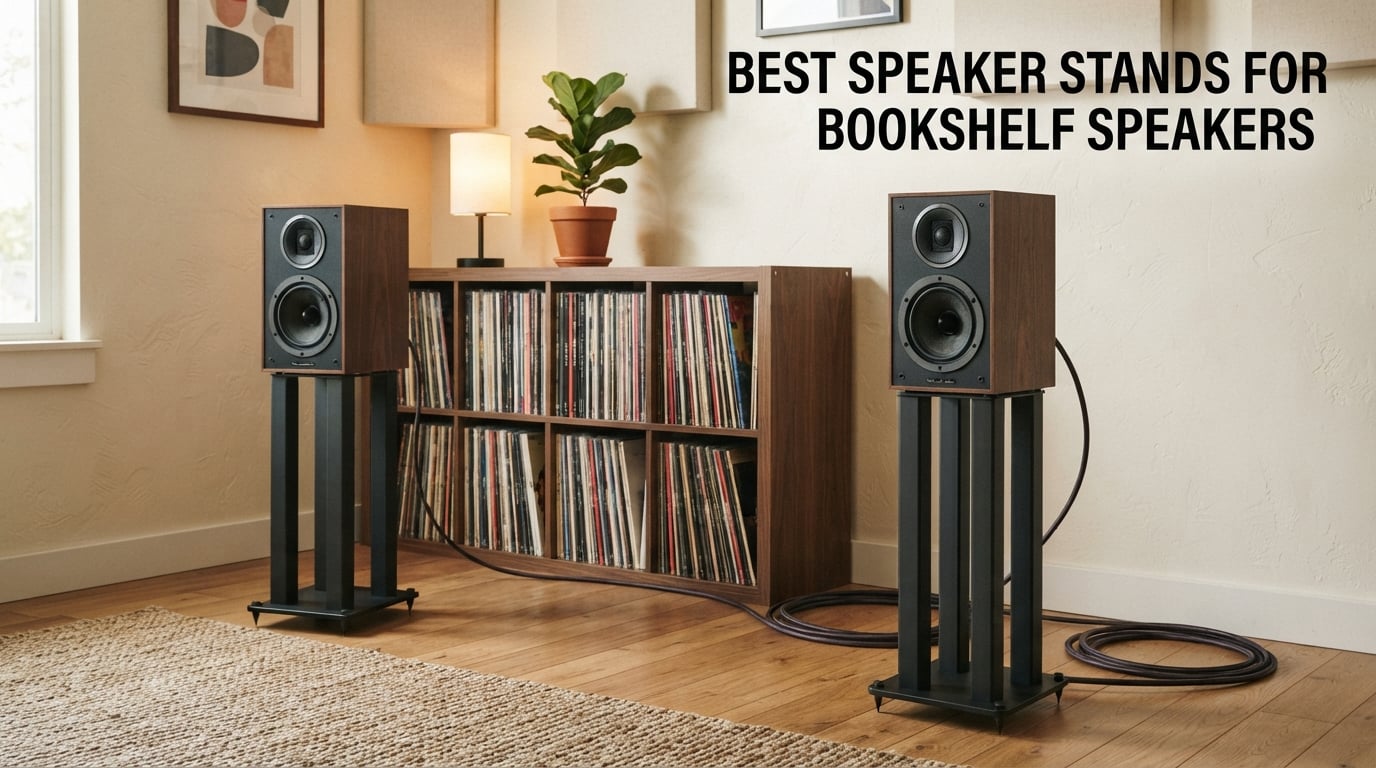
The best speaker stands for bookshelf speakers put the tweeter near your seated ear height, give each cabinet a stable footprint, and get the speaker clear of furniture that can muddy the presentation. That basic job matters more than a fancy finish: a stand that fits the speaker, does not wobble, and lets you place a stereo pair properly is the useful upgrade.
Our shortlist covers eight floor speaker stands with verified specifications from the product data: fixed and adjustable heights, load limits from 11 to 60 pounds, cable-routing options, and different ways to deal with hard floors and carpet. I would begin by measuring the speaker’s base, its weight, and your ear height from the listening seat; those three measurements rule out a surprising number of poor matches.
Stands are worth using when a bookshelf speaker would otherwise sit on a desk, cabinet, or crowded shelf. They help put the left and right speakers at similar height and distance, reduce nearby surface reflections, and make safe placement easier; they do not replace thoughtful speaker positioning or turn an unsuitable stand into a safe one.
Table of Contents
- Top 3 Picks: MOUNTUP leads for range, PEGZONE leads for load, and Rfiver aims speakers precisely.
- The best speaker stands for bookshelf speakers in 2026 cover eight verified fit-and-placement options.
- Best overall for flexible placement: 1. MOUNTUP Adjustable Speaker Stands.
- MOUNTUP Universal Speaker Stands Pair, 28.3″ to 37.4″ Height Adjustable Floor Speaker Stands, Holds Bookshelf & Large Satellite Studio Speakers, Cable Concealing, 22LBS Capacity, 9.8″ Plate, Black
- Height adjustment makes ear-level placement easier.
- Top-plate fit determines whether the capacity matters.
- Best for high listening positions: 2. 5Rcom Tall Adjustable Speaker Stands.
- Best premium build for heavier speakers: 3. Kanto SPH.
- Kanto SPH Adjustable Height Bookshelf Speaker Stands, Pair | Heavy Duty Steel Floor Speaker Stands 24 to 42 in | Holds 30 lb | Internal Cable Management | Reduced Vibration | Carpet Spikes | Black
- Steel and a locking system prioritize a quiet support.
- A 30-pound rating suits more substantial bookshelf cabinets.
- Best fixed 31-inch choice: 4. ELIVED Universal Speaker Stands.
- Best for a simple surround layout: 5. MOUNTUP 31-Inch Speaker Stands.
- MOUNTUP Universal Speaker Stands Pair for Surround Sound Home Theater, 31″ Height Floor Speaker Stands Max 22LBS, Bookshelf Studio Satellite Speakers Fit Klipsch Polk Yamaha, Non Slip Pad Easy Install
- A 9.8-inch plate suits compact cabinet footprints.
- Fixed height favors predictable home-theater placement.
- Best for aiming compact speakers: 6. Rfiver 45-Degree Swivel Speaker Stands.
- Rfiver Upgraded 45° Swivel Speaker Stands Pair for Surround Sound, Heavy Duty 28 Inch Bookshelf Speaker Stand Each Holds 22lbs Large Speaker, Floor Speaker Stand Built-in Cable Management, 1 Pair
- Directional control helps when placement cannot be ideal.
- The compact top plate limits the speaker shapes that fit.
- Best load capacity without adjustment: 7. PEGZONE 30-Inch Speaker Stands.
- Best for resonance-focused setups: 8. Rockville RHT28D Speaker Stands.
- Choose speaker stands by matching height, footprint, weight, floor, and cable route.
- Answers to common speaker-stand questions give the short version before you measure.
- The MOUNTUP adjustable pair is the safest first choice for most compatible bookshelf speakers.
Top 3 Picks: MOUNTUP leads for range, PEGZONE leads for load, and Rfiver aims speakers precisely.
Choose MOUNTUP’s adjustable pair when the listening position or rear-surround height may change. Choose PEGZONE when a heavy bookshelf speaker needs a high stated capacity, and choose Rfiver when directing a speaker toward the seat matters more than changing its overall height.

The best speaker stands for bookshelf speakers in 2026 cover eight verified fit-and-placement options.
This quick overview puts height, stated capacity, and the feature that separates each pair in one place. Verify the speaker’s footprint against the actual top plate before ordering, particularly with wide or deep cabinets.
| Product | Specifications | Action |
|---|---|---|
| MOUNTUP Adjustable |
|
View Details |
 5Rcom Tall Adjustable 5Rcom Tall Adjustable |
|
View Details |
 Kanto SPH Kanto SPH |
|
View Details |
 ELIVED 31 Inch ELIVED 31 Inch |
|
View Details |
 MOUNTUP 31 Inch MOUNTUP 31 Inch |
|
View Details |
 Rfiver Swivel Rfiver Swivel |
|
View Details |
 PEGZONE Fixed PEGZONE Fixed |
|
View Details |
 Rockville RHT28D Rockville RHT28D |
|
View Details |
Best overall for flexible placement: 1. MOUNTUP Adjustable Speaker Stands.
Pros
- Broad height range
- 22 lb capacity
- Cable concealment
- Anti-slip pads
Cons
- Glass base needs care
- Plate fit still needs measuring
The MOUNTUP adjustable pair is the most balanced starting point because its 28.3-to-37.4-inch range can accommodate lower seating as well as a sofa that puts rear speakers higher than the listener. Its 9.8-by-9.8-inch square plate and stated 22-pound-per-stand limit suit many compact and medium bookshelf speakers, provided the cabinet base fits fully inside that plate.
I like the practical split between rubber foot pads for tile or wood and metal nails for carpet. That gives the installer a way to set the base for the floor rather than treating every room alike, which is a useful response to the wobble concerns common in audio forums.
The hollow pole routes speaker cable through an opening stated as 0.87 by 1.8 inches. Check the thickness and connector size of your cable first, especially if your powered speakers use bulky plugs rather than bare wire.
Height adjustment makes ear-level placement easier.
Measure from the floor to the center of the tweeter while seated, then set the stand so that point is as close as practical to your ear. The adjustment range is the reason I would choose this model for a mixed-use living room instead of guessing that a fixed 30- or 31-inch stand will work.
The product data also lists a tempered-glass base measuring 11.8 inches wide. Keep that footprint clear of traffic lanes and do not rely on the stand to compensate for an uneven floor.
Top-plate fit determines whether the capacity matters.
A 22-pound rating is not permission to place any 22-pound cabinet on top. The speaker needs a flat, supported base, and its center of gravity should remain well within the plate rather than hanging far over an edge.
The included anti-slip pads help resist movement at the speaker-to-plate contact point. They are not a substitute for matching the cabinet dimensions to the plate, a mismatch that community buyers repeatedly flag after purchase.
Best for high listening positions: 2. 5Rcom Tall Adjustable Speaker Stands.
Pros
- Very tall adjustment
- 360 degree rotation
- Concealed cable channel
- Two foot types
Cons
- 11 lb limit
- Confirm speaker footprint
The 5Rcom pair answers a narrow but real problem: standard stands can be too short when speakers need to clear the back of a sofa or meet a raised listening position. Its stated 32.7-to-43.3-inch range is the tallest in this group, and the top plate rotates through 360 degrees for orientation changes.
That flexibility comes with a restrictive stated 11-pound load capacity. I would treat it as a stand for compact satellite speakers, small studio monitors, or light bookshelf speakers, not as a general heavy-duty answer.
The concealed channel is stated at 1.2 inches high by 0.7 inches deep, so it is worth checking plug dimensions before assembly. Rubber feet and metal feet are included for hard floors and carpet.
Rotation helps aim surround speakers at the seat.
A rotating plate can make small angle corrections without shifting the entire base. That is useful for rear or side channels in a home-theater setup, where a speaker may need to aim inward from behind a couch.
Do not confuse plate rotation with tilt adjustment. The data confirms rotation, but it does not claim that the speaker can be tilted up or down, so height remains the primary tool for tweeter placement.
The 11-pound limit defines the right buyer.
Weigh each speaker, including anything permanently attached to it, before choosing this pair. Leave a sensible margin rather than selecting a stand whose limit exactly matches the cabinet weight.
Its tall range solves a problem that forum users mention often, but the tradeoff is clear: this is a height-first choice for lighter speakers. Larger cabinets should move to one of the 22-, 30-, 55-, or 60-pound options below.
Best premium build for heavier speakers: 3. Kanto SPH.
Pros
- 30 lb capacity
- 14 inch adjustment
- Steel construction
- Rubber feet and spikes
Cons
- Verify plate dimensions
- Substantial setup for small rooms
Kanto’s SPH pair combines a broad 24-to-42-inch adjustment span with the highest adjustable-stand capacity here at 30 pounds. The all-steel structure and dual-screw locking system make it the sensible pick when the speaker is heavier and the ability to set a precise tweeter height still matters.
The listed footprint is 10.5 by 8.8 inches and the stand itself weighs 14.4 pounds. I would map the speaker base on paper before buying, since a capacity figure alone does not tell us whether a deep cabinet will sit comfortably on the top surface.
Rubber feet and carpet spikes arrive with the pair, so the same model can be set up on hard flooring or carpet. Kanto also includes internal cable management, a welcome detail when the stands sit in an open part of a room.
Steel and a locking system prioritize a quiet support.
Resonance control starts with a rigid connection between speaker, top plate, column, and base. The dual-screw lock is relevant because a height-adjustable stand needs to stay fixed after placement; loose hardware is where rattles and gradual movement can begin.
I would recheck the locks after the first few listening sessions and after moving the speakers. That small maintenance habit is especially sensible with any adjustable floor speaker stand.
A 30-pound rating suits more substantial bookshelf cabinets.
This rating gives Kanto more headroom than the 11- and 22-pound models in this comparison. It still requires a complete fit check, since a tall, narrow speaker with its weight high above the plate may be less secure than a lower, wider one of the same mass.
For a stereo system, place the two bases symmetrically when possible and leave enough clearance from the wall for speaker ports. The stand contributes support and height; room boundaries still shape bass response.
Best fixed 31-inch choice: 4. ELIVED Universal Speaker Stands.
Speaker Stands Pair, 31″ Fixed Height, Max 22 lbs, Tempered Glass Base
31 inch fixed
22 lb each
11.8 inch glass base
Pros
- 10-year warranty
- 22 lb support
- Two cable holes
- Metal or rubber feet
Cons
- Fixed 31 inch height
- Measure top plate fit
The ELIVED pair is for rooms where 31 inches already places the tweeters close to ear level and adjustment would add no benefit. It has a stated 22-pound capacity, an 11.8-inch glass base, and a 10-year warranty, making it a straightforward fixed-height option for compatible speakers.
Two large cable holes in the pole are listed at 1.8 inches high by 0.9 inches wide, with soft rubber grommets around the openings. That detail matters for powered bookshelf speakers, where cable routing can become the untidy part of an otherwise clean setup.
The stand includes metal and rubber feet. I would use the feet intended for the actual floor surface, then check that all base contact points sit firmly before setting a speaker on the plate.
A fixed 31-inch height works only after measuring.
Fixed stands can be simpler and more rigid, but only when their height fits the room. Sit in your usual chair, measure your ear height, and compare it with the tweeter center rather than assuming every bookshelf speaker has the same cabinet proportions.
If the tweeter ends up a little above or below ear level, small changes to seating position or speaker rake may help. Do not stack books, blocks, or loose objects under a floor stand to chase an exact measurement.
Dual cable holes make wired setups less distracting.
Routing wires through a pole helps keep a living-room audio system from looking improvised. Plan the cable path from speaker to amplifier before final placement so the cable is not stretched tight when you pull the stand outward for better stereo spacing.
The provided grommets are intended to protect the cable at the opening. Feed cables before placing the speaker, since many connector types are easier to guide through an empty stand.
Best for a simple surround layout: 5. MOUNTUP 31-Inch Speaker Stands.
Pros
- 9.8 inch top plate
- 22.1 lb capacity
- Cable hole
- Quick assembly
Cons
- Fixed height
- Review base stability after assembly
This fixed-height MOUNTUP pair uses a 31-inch pole, a stated 22.1-pound capacity, and a 9.8-by-9.8-inch square top plate. Those numbers make it a practical contender for light-to-medium speakers in a surround system where the rear channels need to rise above furniture without taking much floor space.
The alloy-steel structure pairs with an 11.8-inch tempered-glass base, while rubber pads and metal nails are supplied for different surfaces. The product information says assembly can be done with the included Allen key in about 10 minutes; I would still tighten hardware gradually and evenly rather than rushing the final turns.
Its cable opening is stated as 0.86 inches wide by 1.8 inches high. That is a useful hidden route for conventional speaker wire, but adapters and thick power cords should be checked against the opening before the stand is committed to a location.
A 9.8-inch plate suits compact cabinet footprints.
The plate dimension is clear, which makes the fit decision easier. Place a tape outline of 9.8 by 9.8 inches on the speaker base and confirm that the supported area feels sensible, not merely possible.
Anti-slip pads can be positioned to suit the speaker base. The pads help with grip, while the square plate size remains the non-negotiable measurement for safe support.
Fixed height favors predictable home-theater placement.
For rear surrounds, 31 inches can be effective when it puts drivers near the listener’s head level or above a sofa back. It is less forgiving if the listening position changes, so measure after accounting for the speaker’s own cabinet height.
Keep both stands the same distance from the primary listening area where the room allows it. Matching height and angle between channels supports more consistent surround effects than a stand choice alone can provide.
Best for aiming compact speakers: 6. Rfiver 45-Degree Swivel Speaker Stands.
Pros
- 45 degree aiming
- 22 lb capacity
- Cable holes
- 5-year warranty
Cons
- 28.3 inch fixed height
- 7.8 inch plate needs checking
Rfiver’s key difference is its stated 45-degree adjustable glass top plate, which can direct a speaker toward the listening position without moving the whole stand. The stand is 28.3 inches tall, supports up to 22 pounds per stand, and is especially relevant for compact bookshelf or surround speakers that sit slightly off-axis from the couch.
The top plate is listed as a 7.8-inch square glass surface with a rubber pad, while the base measures 11.81 inches. That smaller top plate makes footprint matching even more important here; it is not the one I would select for a wide, heavy cabinet just because the load number appears adequate.
Cable routing uses two holes in the 27-inch pole, each stated at 1.6 inches high by 0.8 inches wide. The pair also includes metal and rubber foot choices plus a five-year manufacturer warranty.
Directional control helps when placement cannot be ideal.
Speaker placement often has to work around doors, furniture, and shared rooms. The swivel lets you toe a speaker toward the listening seat after the stable base is already placed, which can be easier than repeatedly shifting a full stand.
Angle adjustment should be modest and matched between left and right speakers. Start with both speakers aimed toward the listener, then make small, equal changes while listening to familiar voices or centrally mixed instruments.
The compact top plate limits the speaker shapes that fit.
A 7.8-inch square top surface is a firm compatibility filter. Check not only the base width and depth but also whether rubber feet or an uneven cabinet underside would reduce contact with the plate.
The one-piece molded glass base is intended to add stability. Keep the center of gravity over that base and avoid placing a large speaker so far forward that normal bumps could make it unstable.
Best load capacity without adjustment: 7. PEGZONE 30-Inch Speaker Stands.
Speaker Stands Pair, 30″ Fixed Height, 55lbs Weight Capacity, Glass Base
30 inch fixed
55 lb each
11.8 inch glass base
Pros
- 55 lb capacity
- Cable management
- Two foot options
- Large glass base
Cons
- Fixed height
- Confirm plate dimensions
PEGZONE’s 30-inch pair is the strongest fit when the speaker weight is the priority and the room already works with a fixed height. Its stated 55-pound capacity is far above the other metal-and-glass floor speaker stands in this group, and it uses an 11.8-by-11.8-inch tempered-glass base.
Integrated cable management and interchangeable rubber pads or spikes make the setup less bare-bones than the capacity figure suggests. I would put it on the shortlist for larger bookshelf speakers after confirming the size of the actual top support, which is not specified in the analyzed data.
The listed height is 30.1 inches, close to the usual seated-ear-level target in many chairs but not a universal answer. Speaker cabinet height determines where the tweeter lands, so use the measurement rather than the stand’s marketing description.
The 55-pound capacity gives heavy cabinets useful headroom.
High stated capacity is valuable when a speaker approaches the limits of lighter stands. It can also reduce the temptation to buy a stand that barely supports the cabinet, an approach that leaves no margin for a top-heavy shape or everyday bumps.
Capacity and stability are related but not identical. A speaker still needs a properly sized contact area, a level floor, and a centered position on the stand.
Spikes and pads match the base to the floor.
Rubber pads are the sensible starting point on hard flooring when protecting the surface is part of the brief. Spikes can suit carpeted rooms when installed carefully, but they do not correct a bad plate-to-speaker match.
After the final setup, press gently on each stand from several directions before placing electronics nearby. This simple stability check is more meaningful than judging a stand only by its material or stated load limit.
Best for resonance-focused setups: 8. Rockville RHT28D Speaker Stands.
Rockville RHT28D Pair 28″ Bookshelf Home Theater Speaker Stands, Dark Wood
28 inch fixed
60 lb each
Dual MDF platforms
Pros
- 60 lb capacity
- Dual platforms
- Sand-fillable body
- EVA isolation pads
Cons
- Fixed 28 inch height
- Plate choice needs measuring
Rockville’s RHT28D pair takes a different route from the steel-and-glass models: MDF construction, a sand-fillable body, EVA isolation pads, and both brass and rubber spikes. It carries the highest stated capacity in the list at 60 pounds per stand, and its two top-platform sizes address the common complaint that one plate size cannot fit every speaker.
The two stated platform options measure 9.25 by 7.28 inches and 9.25 by 11.8 inches. That second depth is useful for many larger bookshelf cabinets, but I would still measure the base and choose the platform that gives the cabinet broad, stable contact.
At 28 inches, this is a fixed-height solution for lower seating or speakers whose tweeters sit high in the cabinet. Its dark wood finish may suit a traditional stereo system better than a minimalist metal stand.
Sand filling adds mass when the room calls for it.
A mass-loadable speaker stand has a hollow section that can be filled to increase its weight and resist movement. Rockville lists an empty body design for sand filling, giving owners a way to tune the stand’s mass rather than treating the stock weight as final.
Filling is optional and adds cleanup and moving effort. I would assemble and position the empty pair first, then decide whether additional mass is needed after a careful stability check.
Dual platforms solve more footprint problems than a single plate.
The larger 9.25-by-11.8-inch platform is the reason to consider this model for deeper speaker cabinets. The smaller platform gives an alternative for compact speakers, which can help preserve a proportional look without using a broad plate unnecessarily.
EVA pads and spike options provide different contact choices, while the MDF body is specified as helping minimize resonance. Room placement still matters: leave space around rear ports and avoid forcing the base into a corner simply to hide it.
Choose speaker stands by matching height, footprint, weight, floor, and cable route.
The right stand is not simply the tallest or strongest model. Follow these five checks in order, and rule out a stand as soon as one of its verified dimensions does not work for your speakers or room.
- Measure the speaker’s base width, depth, and weight.
- Measure seated ear height and the distance from the speaker bottom to its tweeter center.
- Compare the speaker’s footprint with the top plate, not just the overall base.
- Choose capacity with margin, then choose feet or spikes for the actual floor.
- Plan cables and speaker spacing before final assembly.
Tweeters should sit near seated ear level.
Speaker stands raise bookshelf speakers so the tweeter, the driver that handles much of the treble detail, is near ear height at the main seat. The result can be clearer stereo imaging and a more stable sense of where voices and instruments sit between the speakers.
Exact alignment is helpful but not magic. If your speaker has a 30-inch stand under it, the tweeter height depends on where that driver sits in the cabinet, so measure the full stack rather than shopping by stand height alone.
Top plates must support the cabinet base safely.
Check the top plate’s width and depth first, then compare the weight rating. A plate that is too small can leave the cabinet overhanging or make it easier to knock out of position, even if the stated load limit seems generous.
Forum discussions consistently highlight small plates as a source of regret. This is why the 7.8-inch Rfiver plate, the 9.8-inch MOUNTUP plates, and Rockville’s dual-platform choices should be evaluated against a tape outline of your own speaker base.
Stable bases reduce movement and unwanted vibration.
Steel construction, glass bases, MDF bodies, rubber pads, carpet spikes, and sand-fillable columns address stability in different ways. Their effect depends on assembly, the floor, and the speaker’s center of gravity; no material label excuses loose hardware or a cabinet that is poorly supported.
On hard floors, rubber feet help protect the surface and can limit sliding. On carpet, spikes may provide a firmer footing, but install them with care and make the stand level before putting speakers on top.
Cable routes matter most with powered speakers.
Speaker stands with cable management hide conventional speaker wire inside the column, but confirm channel dimensions when your setup includes power leads, thick connectors, or adapters. Cable slack also matters: speakers may need to move away from walls or farther apart after initial listening.
Route the cable before the speaker goes on the plate and leave a gentle service loop near the floor. A stretched cable can tug at a speaker or connector when someone moves the stand for cleaning.
Room placement changes what the stand can accomplish.
Stands get speakers away from a desk or cabinet, but they cannot erase bass buildup from a corner or reflections from a nearby wall. Start with the pair at similar distance from the listening seat, give rear-ported speakers breathing room, and make small placement changes while listening.
Concrete blocks may be stable, as some audio communities point out, but purpose-made stands offer predictable height, cable routing, and a safer-looking footprint in shared spaces. A good stand is the one that meets the measurements and lets you keep both speakers where they sound and live best.
Answers to common speaker-stand questions give the short version before you measure.
What are the best speaker stands for bookshelf speakers?
The MOUNTUP adjustable pair is the broadest all-around match because it combines a 28.3-to-37.4-inch range, a 22-pound rating, a 9.8-inch plate, and cable concealment. PEGZONE is the better fit for a heavy compatible speaker with its 55-pound rating, while Rfiver is useful when a compact speaker needs directional adjustment.
How do I choose the right speaker stands?
Measure the speaker base and weight, then measure seated ear height and the cabinet distance to the tweeter. Choose a top plate that supports the cabinet safely, a capacity above its weight, suitable feet for the floor, and a cable route that fits your connectors.
What height should speaker stands be?
Speaker stands should place the tweeter near ear level at your main listening seat. Measure from the floor to your seated ear and account for the distance from the speaker bottom to its tweeter, because a 30-inch stand produces different tweeter heights with different cabinets.
Are speaker stands worth it?
Speaker stands are worth it when they place bookshelf speakers near ear level, provide a stable base, and move the cabinets away from furniture that can interfere with placement. They work best alongside sensible spacing from walls and careful left-right symmetry.
What are the best budget speaker stands?
The Rfiver pair is a practical low-cost-oriented choice for compact speakers because it offers a 45-degree swivel plate, a 22-pound rating, cable routing, and a five-year warranty. The fixed MOUNTUP and ELIVED pairs are also sensible when their 31-inch height and plate dimensions fit the room and speaker.
The MOUNTUP adjustable pair is the safest first choice for most compatible bookshelf speakers.
For most rooms, start with the MOUNTUP adjustable stand because its height range, 9.8-inch plate, 22-pound rating, and cable concealment cover the most common needs. Move to Kanto for heavier speakers that need adjustment, PEGZONE or Rockville for high stated capacity, and Rfiver when speaker direction is the priority.
The best speaker stands for bookshelf speakers in 2026 are the pairs that match your measurements, floor, and listening seat rather than a generic category label. Measure twice, assemble on level ground, and only then place the speakers for a careful listening check.