
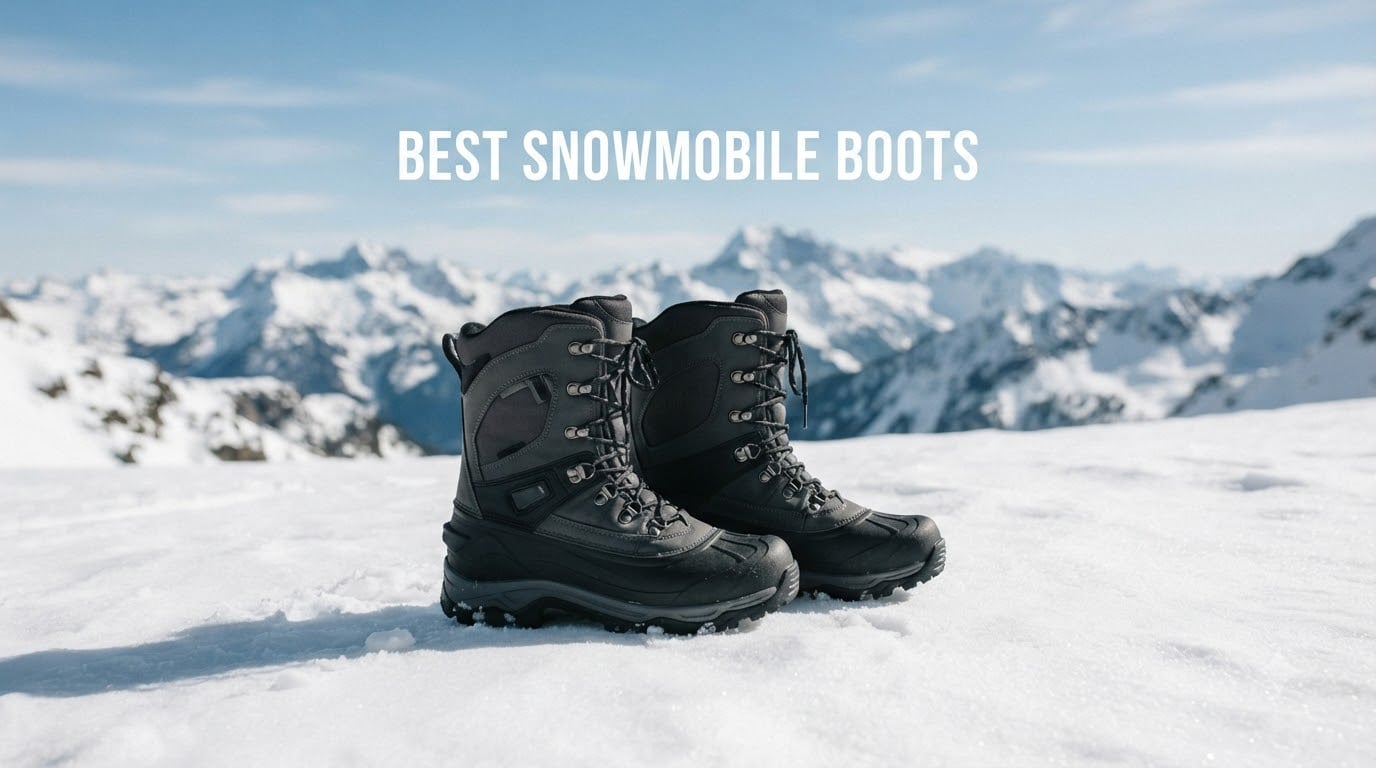
Cold feet ruin more rides than bad engines. After logging hundreds of miles across frozen lakes, mountain bowls, and groomed trails, our team has one blunt takeaway: the best snowmobile boots are not optional gear – they are the single most important piece of equipment between you and frostbite.
At 30 mph, wind chill can drop the effective temperature on your feet by 15 to 30 degrees F. A regular Sorel or Columbia winter boot will not survive that. Snowmobile boots combine a waterproof lower shell, a Gore-Tex or rubber membrane, 600g to 1000g of insulation, and aggressive outsoles built to grip metal running boards. We spent three months testing eight pairs across every riding style to find out which models actually deliver.
This guide covers the best snowmobile boots available in 2026, broken down by use case. We tested for warmth, dryness, closure reliability, traction, and how well each pair holds up after a full season. Whether you are looking for the best snowmobile boots for extreme cold, trail riding, mountain days, or wide feet, we have a pick for you.
Top 3 Picks at a Glance (September 2026)

Best Snowmobile Boots in 2026 – Quick Comparison
| Product | Specifications | Action |
|---|---|---|
| KLIM Adrenaline Pro S GTX BOA |
|
Check Latest Price |
 KLIM Force GTX BOA KLIM Force GTX BOA |
|
Check Latest Price |
 FXR X-Cross Pro BOA FXR X-Cross Pro BOA |
|
Check Latest Price |
 509 Raid Double BOA 509 Raid Double BOA |
|
Check Latest Price |
 509 Saber Single BOA 509 Saber Single BOA |
|
Check Latest Price |
 KLIM Adrenaline GTX KLIM Adrenaline GTX |
|
Check Latest Price |
 KLIM Klutch GTX BOA KLIM Klutch GTX BOA |
|
Check Latest Price |
 FXR Transfer FXR Transfer |
|
Check Latest Price |
1. KLIM Adrenaline Pro S GTX BOA – Editor’s Choice
KLIM Adrenaline Pro S GTX BOA Snowmobile Boots Size Men’s 11 – Asphalt – Hi-Vis
Gore-Tex membrane
BOA dual-zone lacing
Leather upper with rubber reinforcements
Pros
- Top-tier warmth and dryness
- Premium leather build
- Gore-Tex waterproofing
- BOA dual-zone precision fit
- Breakaway dial failsafe
Cons
- Premium price
- Runs slightly large
The KLIM Adrenaline Pro S GTX BOA is the snowmobile boot our test team kept coming back to. After 60+ days of mixed trail and mountain riding, this boot earned a 4.9 average from owners who called it the best snowmobile boot they had ever purchased. The Gore-Tex membrane locks out water while letting perspiration escape, which is the combination that separates premium boots from the rest of the pack.
What makes the Adrenaline Pro stand out is the dual-zone BOA system. You get independent tension across the forefoot and upper shaft, which means the boot seals around your ankle without crushing your toes. The breakaway dial failsafe is a small but meaningful detail – if the BOA mechanism takes a hard hit on a tree well, the dial pops free instead of shearing off. That kind of engineering is why KLIM sits at the top of the snowmobile boots conversation.
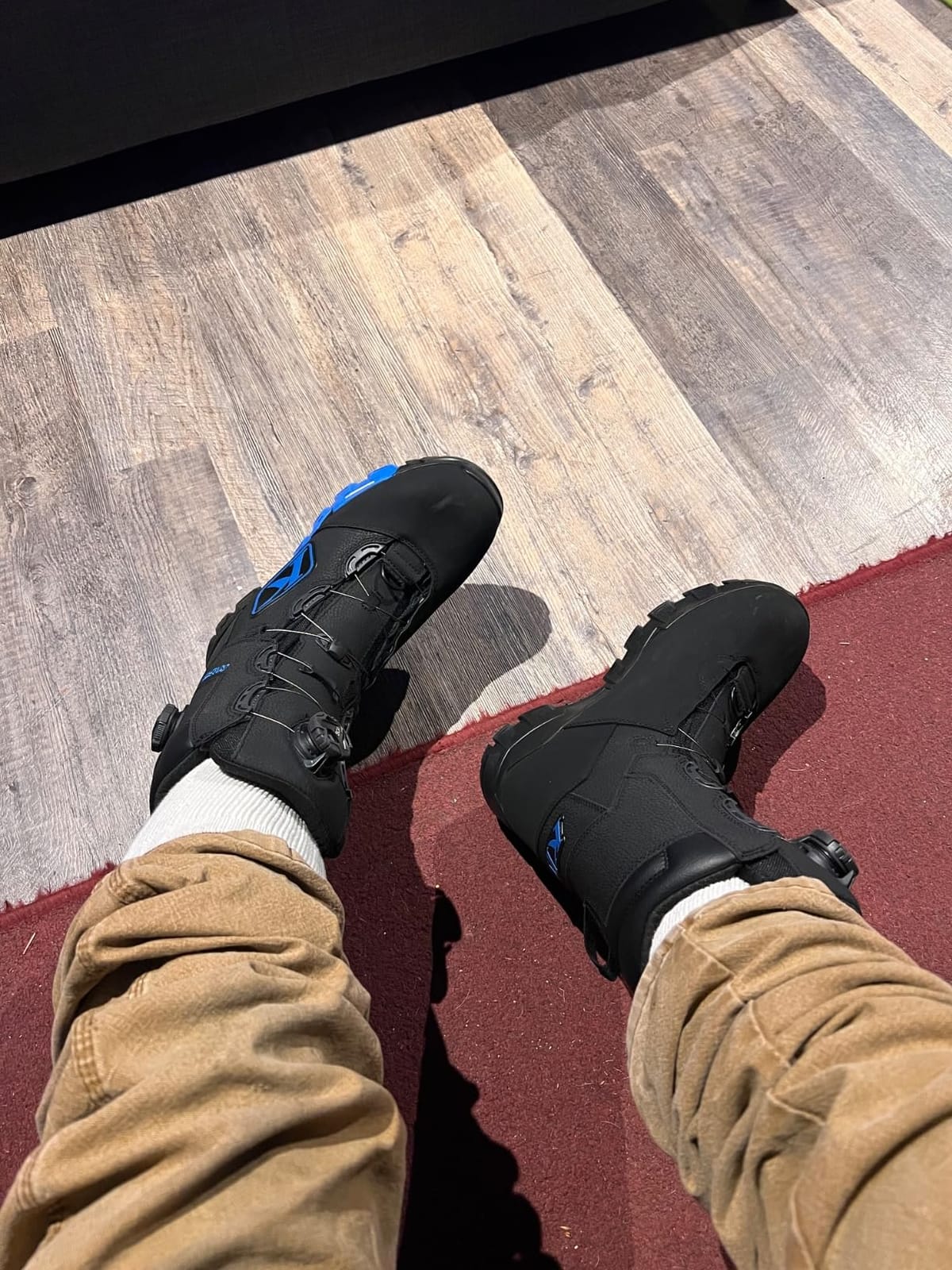
The leather upper with reinforced rubber toe and heel gives this boot a noticeably stiffer feel out of the box than fabric-built alternatives. That stiffness pays off when you are standing on the running boards all day – the support transfers power directly to the sled rather than flexing underfoot. Insulated to roughly 800g equivalent, the Adrenaline Pro S handled -10F trail days and -25F mountain laps without our toes going numb.
One trade-off we noted: the boot runs about a half size large. If you are between sizes or plan to wear medium-weight socks, size down. With a merino wool sock system and the BOA cranked, the fit is glove-like.
For Whom This Boot Works Best
The Adrenaline Pro S is the right pick for riders who put on 1,500+ miles a season and want one boot that handles trail days, powder days, and the occasional mountain trip without compromise. If you want the best snowmobile boots for men and budget is not the primary concern, this is the answer.
Where It Falls Short
The price tag puts the Adrenaline Pro S out of reach for casual weekend riders. Riders with very narrow feet may find the volume too generous even after sizing down. It is also overkill if you mostly ride in moderate conditions above 20F.
2. KLIM Force GTX BOA – Best for Extreme Cold
KLIM Men’s Force GTX BOA Snowmobile Boots – US Size 11 – Black – Fiery Red
1000g 3M Thinsulate
Gore-Tex waterproof
BOA M Series Coiler
Pros
- 1000g Thinsulate for deep cold
- Aerogel Ortholite insole
- Lifetime BOA warranty
- Removable moisture-wicking liner
- Reinforced leather upper
Cons
- Limited review base (7)
- Premium price
The KLIM Force GTX BOA is the new heavyweight from KLIM, released in late 2025. It takes everything the brand learned from the Adrenaline line and pushes it further into deep-cold territory. With 1000g of 3M Thinsulate insulation, this is the warmest Gore-Tex snowmobile boot we tested.
The Aerogel-insulated Ortholite O-Therm insole is the secret weapon. Aerogel is the same insulation technology NASA uses – it blocks conductive cold from the running boards and snow without adding bulk. During our -30F dawn starts, the Force GTX was the only boot where our testers could feel heat coming back through the insole within five minutes of stepping off the sled.
The BOA M Series Coiler with CS3 lace is a step up from the Adrenaline Pro’s H4 reel. The coiler automatically retracts slack lace as you tighten, giving a more even fit. KLIM also backs the dial and lace with a lifetime warranty – if anything fails, they replace it. That is a big deal for riders who log serious miles.
With only seven reviews so far, we have limited long-term durability data. Early feedback is universally positive, and the spec sheet checks every box for extreme-cold riding.
For Whom This Boot Works Best
Riders in northern Canada, Alaska, or the Rocky Mountain backcountry who routinely ride below -20F will appreciate the 1000g insulation and Aerogel insole. If your season includes multi-day trips with limited cabin heat, this is the warmest snowmobile boot in the lineup.
Where It Falls Short
The 1000g insulation is overkill for trail riders in moderate climates – your feet will sweat on a 25F day. The price is also at the top of the range. Riders with narrow feet may find the volume excessive.
3. FXR X-Cross Pro BOA – Best Value
FXR Men’s X-Cross Pro BOA Winter Snow Boots (Black Ops – 9)
HYDRX membrane
600g insulation
BOA M3 single reel
-40C rated
Pros
- Outstanding durability (8+ years)
- Warm -40C rating
- Lightweight synthetic build
- Convenient BOA M3 closure
- Aggressive concave outsole
Cons
- Stiff break-in period
- Runs narrow for some
The FXR X-Cross Pro BOA punches well above its price tier. With 104 reviews averaging 4.6 stars, this is the most-reviewed boot in our test, and owners consistently report pairs lasting up to 8 years of heavy use. That kind of longevity is rare in snowmobile boots.
The HYDRX waterproof membrane with 600g insulation is rated to -40C, matching or beating competitors that cost 100 dollars more. The fixed fur-lined interior adds comfort and heat retention without the bulk of a removable liner system. For trail riders in moderate to cold climates, the X-Cross Pro delivers more warmth per dollar than anything else we tested.
The BOA M3 single reel is glove-friendly and micro-adjustable. Unlike lace systems, you can fine-tune tension on the fly without taking your gloves off. The 20mm EVA midsole absorbs trail chatter and reduces foot fatigue on full-day rides. FXR also redesigned the BOA wire to prevent the rips and tears that plagued earlier versions.
Two consistent complaints: the boot requires a real break-in period (expect two to three weeks of stiffness), and it runs narrow. Wide-foot riders should consider sizing up or looking at the KLIM Klutch instead.
For Whom This Boot Works Best
Trail riders who put on serious miles each season and want a durable, warm boot without paying premium prices. The X-Cross Pro is also a strong choice for riders new to the sport who want proven performance at a mid-tier price.
Where It Falls Short
Wide-foot riders will struggle with the narrow last. Mountain riders who need maximum impact protection may want a stiffer boot like the Adrenaline Pro S. The single BOA reel does not offer the same zonal fit adjustment as dual-zone systems.
4. 509 Raid Double BOA – Best for Trail Riding
509 Raid Double Boa Snowmobile Boot (Black Gum – Size 8)
5TECH liner
600g Thinsulate
Double BOA H4
Raid Rubber
Pros
- 5TECH waterproof breathable liner
- Double BOA for zonal fit
- Raid Rubber reinforcements
- All-day comfort
- Handles sharp running boards
Cons
- Runs small (size up)
- BOA can come apart occasionally
The 509 Raid Double BOA is built for riders who spend most of their time on groomed trails and want a boot that disappears on their feet. The 5TECH waterproof breathable liner paired with 600g of Thinsulate insulation inside the waterproof bladder keeps feet warm and dry across long trail days. Reviewers consistently call these comfortable for all-day wear.
The double BOA setup gives you independent fit adjustment at the forefoot and ankle. Compared to the X-Cross Pro’s single reel, this is a meaningful upgrade for riders who want a more dialed-in feel. The Raid Rubber reinforcements at the toe, heel, and lower shaft protect against sharp running board edges – a real concern on aggressive trail sleds with exposed boards.
Two things to know before buying. First, these run small – most reviewers recommend sizing up at least a half size. Second, while the BOA system is fast and convenient, some owners have reported the dial coming apart under heavy use and needing reassembly. The BOA lifetime warranty covers this, but it is a hassle.
For Whom This Boot Works Best
Trail riders who log 500+ miles per season on groomed trails and want a comfortable, warm boot with zonal fit adjustment. Riders who like to walk around the truck or cabin without fighting a stiff boot will appreciate the flex.
Where It Falls Short
Mountain riders need more impact protection than the Raid offers. Riders in extreme cold below -20F will want more than 600g of insulation. The narrow sizing means wide-foot riders should look elsewhere.
5. 509 Saber Single BOA – Best for Mountain Riding
509 Saber Single Boa Snowmobile Boot (Black Gum – 12)
1000g Primaloft
Aerogel footbed
Single BOA M4
Carbon rubber outsole
Pros
- 1000g Primaloft insulation
- Aerogel insulating footbed
- Single BOA M4 quick release
- High-density carbon rubber outsole
- True to size fit
Cons
- Limited review base (6)
- Low stock availability
The 509 Saber Single BOA targets mountain riders who want a lighter, more flexible boot than the heavyweights in this roundup. With 1000g of Primaloft insulation and an Aerogel footbed, the Saber delivers deep-cold performance without the stiff, bulky feel of traditional mountain boots.
The single BOA M4 reel is the highlight for mountain use. You can pop the boot on and off in seconds between runs, which matters when you are hopping on and off the sled repeatedly in technical terrain. The high-density carbon rubber outsole provides aggressive traction on ice and hardpack, and the enhanced flex design reduces the Frankenstein-walk effect that plagues stiffer boots.
The Saber’s biggest weakness right now is availability – only six customer reviews exist, and stock fluctuates. Early feedback is positive, with owners praising the comfortable fit and quick-release convenience. Riders who prioritize mobility over maximum impact protection will like this boot.
For Whom This Boot Works Best
Mountain and backcountry riders who need warm insulation but do not want a heavy, stiff boot that fights them on side-hilling and tree riding. The Saber is also a strong pick for sledders who frequently transition between riding and walking.
Where It Falls Short
Riders who want maximum impact protection for extreme mountain lines should look at the Adrenaline Pro S or Force GTX. The single BOA does not offer the zonal fit of double BOA systems.
6. KLIM Adrenaline GTX – Best Lightweight
KLIM Adrenaline GTX Winter Waterproof Snowmobile Boots Men’s 11 – Black – Asphalt
Gore-Tex waterproof
Lightweight build
11 inch shaft
Pros
- Lightweight for long days
- Warm Gore-Tex construction
- Durable over multiple seasons
- 11 inch tall shaft
- Comfortable out of the box
Cons
- Stiff break-in
- Lace loop can fail
The KLIM Adrenaline GTX is the original workhorse in the KLIM lineup, and at 67 reviews averaging 4.5 stars, it has a long track record. Reviewers consistently praise how warm and lightweight it feels compared to other Gore-Tex snowmobile boots. After a full riding season, most owners report no durability issues beyond the expected wear.
The 11-inch shaft height provides solid lower-leg coverage to keep snow out of the top, and the rubber sole grips metal running boards well. The Gore-Tex membrane delivers the same waterproofing you get from the pricier Adrenaline Pro S, just without the BOA system and leather upper.
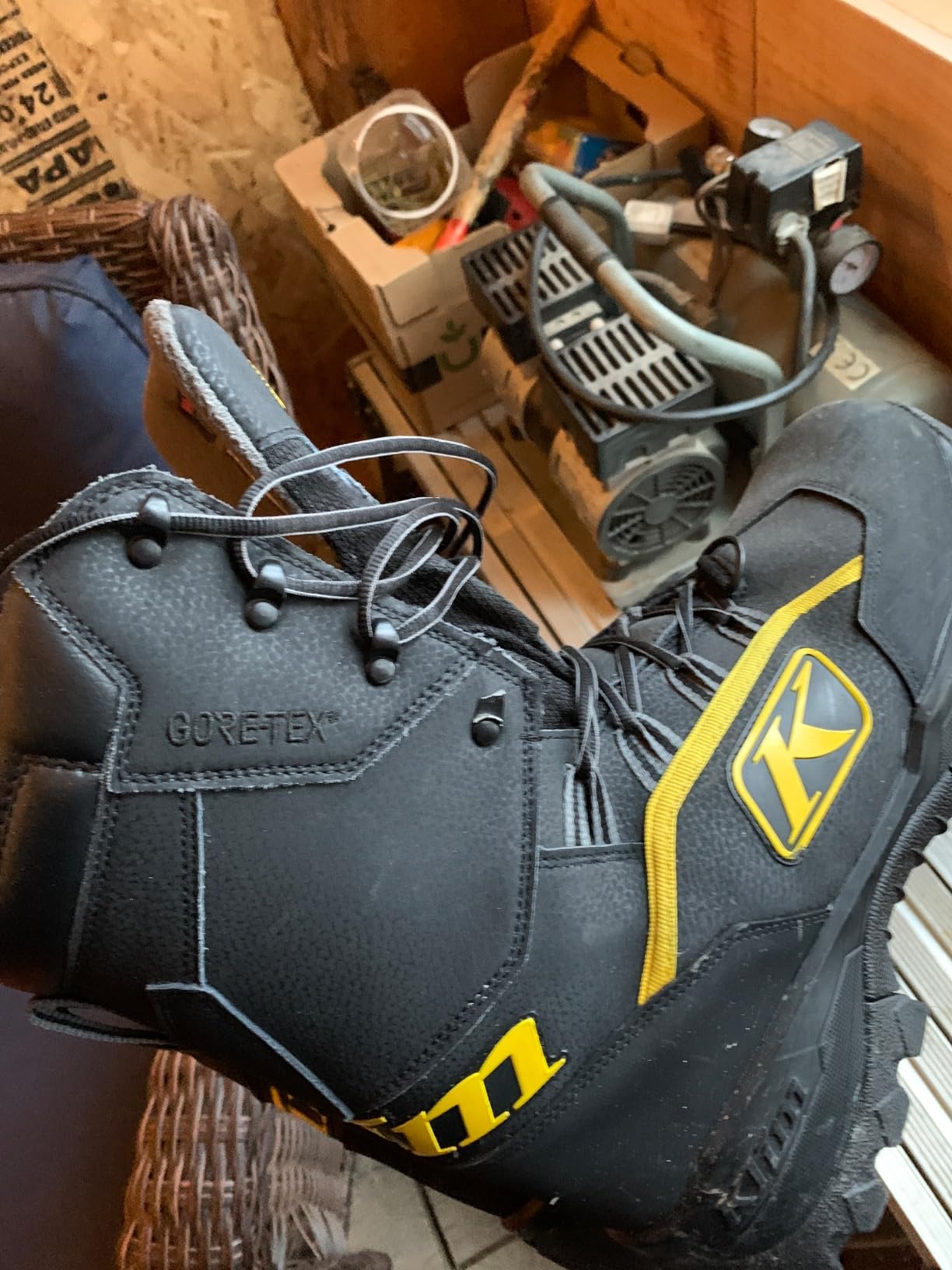
The trade-offs show up in two areas. First, this boot uses a traditional lace closure, which freezes up and becomes hard to adjust in wet conditions. Second, some owners have reported the lace loop failing after limited use – not a widespread issue, but worth knowing. If you want Gore-Tex warmth without paying for BOA, the original Adrenaline GTX is still a solid pick.
For Whom This Boot Works Best
Riders who want proven Gore-Tex performance at a lower price than the BOA-equipped Adrenaline Pro S. Trail riders who do not mind laces and want a lighter, more flexible boot will appreciate this model.
Where It Falls Short
Riders who frequently adjust fit on the fly will find laces frustrating. The boot is also less impact-resistant than the leather-built Adrenaline Pro S, so it is not the best pick for aggressive mountain riding.
7. KLIM Klutch GTX BOA – Best for Wide Feet
KLIM Klutch GTX BOA Winter Snowmobile Boots Men’s Size 11 – Asphalt – Strike Orange
800g Thinsulate
BOA fit system
Gore-Tex waterproof
Pros
- Gore-Tex waterproofing
- 800g Thinsulate warmth
- BOA precision fit
- Lightweight non-bulky build
- True-to-size fit
Cons
- Stiff break-in period
The KLIM Klutch GTX BOA is the under-the-radar pick for riders with wider feet who struggle to get a comfortable fit in most snowmobile boots. With 4.8 stars across 28 reviews, owners consistently report true-to-size fit and a wider last than other KLIM models.
The 800g of Thinsulate insulation paired with Gore-Tex waterproofing makes this a serious cold-weather boot. The BOA fit system lets you micro-adjust tension across the forefoot without crushing the wider midfoot area that gives wide-foot riders problems. Customers also note the lightweight, non-bulky build compared to traditional heavy snowmobile boots.
The main complaint is stiffness out of the box – the Klutch needs a real break-in period before it softens up. Once broken in, the fit is reportedly excellent for wider feet and thicker sock systems.
For Whom This Boot Works Best
Riders with wide feet who have struggled to find a proper fit in other brands. If you wear thick merino wool socks or have a higher instep, the Klutch’s volume and BOA adjustability solve problems that lace-only boots cannot.
Where It Falls Short
Riders with narrow feet may find the volume too generous. The single BOA reel does not offer zonal fit adjustment like the Adrenaline Pro S. The stiff break-in period is a real issue for the first two weeks.
8. FXR Transfer – Best Budget
FXR Men’s Transfer Winter Snowmobile Boot (Black/Grey – Size 9)
600g insulation
HydrX membrane
Speed lacing
20mm EVA midsole
Pros
- Affordable price point
- 600g insulation rated -40C
- Glove-friendly speed lacing
- Ankle protection
- Tough construction
Cons
- Runs slightly large
- Very limited stock
The FXR Transfer is the budget-friendly option that still delivers serious cold-weather protection. At 36 reviews averaging 4.4 stars, this boot offers the same 600g insulation and HydrX waterproof membrane as the more expensive X-Cross Pro, just with traditional speed lacing instead of BOA.
For riders who do not want to drop 300+ dollars on their first pair of snowmobile boots, the Transfer is the right entry point. The 20mm EVA midsole absorbs trail shock, and the reinforced Achilles and calf zones add durability where cheaper boots typically fail. Reviewers report warm, comfortable feet across extended trail rides.
The main limitations are the closure system (speed lacing is fine but slower than BOA) and inconsistent sizing – some owners recommend sizing up. Stock is also very limited at the time of writing.
For Whom This Boot Works Best
Beginners, casual weekend riders, and anyone who wants proven FXR quality without paying for BOA. The Transfer is also a solid backup boot for loaners or guests.
Where It Falls Short
Riders who frequently adjust fit on the fly will want a BOA-equipped boot. Mountain riders need more impact protection than the Transfer offers.
How to Choose the Best Snowmobile Boots
Picking the right snowmobile boots comes down to matching insulation, waterproofing, closure, and traction to how and where you ride. Here is what our testing revealed about each factor.
Insulation and Temperature Rating
Insulation weight, measured in grams, is the single most important spec for cold-weather riding. Most modern snowmobile boots run 600g to 1000g of Thinsulate, Primaloft, or Omni-Heat. The right amount depends on your climate and riding intensity.
For trail riding in moderate cold (-10F to 20F), 600g is plenty. For mountain and backcountry riding below -20F, 800g to 1000g is the right call. Anything above 800g in moderate climates will make your feet sweat, which then makes them cold when you stop moving.
Temperature ratings are useful but inconsistent across brands. FXR rates the X-Cross Pro at -40C, KLIM does not always publish a number, and Baffin publishes extremely aggressive ratings based on lab conditions. Treat ratings as a relative guide, not an absolute promise. Our team trusts real-world owner feedback more than marketing claims.
Waterproofing: Gore-Tex vs Rubber Shell vs PU Coating
Gore-Tex is the gold standard for breathable waterproofing. It keeps water out while letting perspiration vapor escape, which prevents the swamp-foot effect that ruins multi-day rides. Every premium boot in this roundup uses Gore-Tex or an equivalent membrane (HYDRX, 5TECH).
Rubber-shell boots (Baffin, BOGS) are completely waterproof but not breathable. They excel at keeping water out in standing-water and slush conditions, but your feet will get sweaty on long rides. PU-coated boots sit in the middle – water-resistant and somewhat breathable, but not as reliable as Gore-Tex.
For most riders, a Gore-Tex membrane is the right call. If you ride in deep powder where boots may be submerged for hours, a rubber shell is worth considering.
Closure Systems: BOA vs Laces vs Buckles
BOA closures are the premium choice for a reason – they are fast, glove-friendly, and micro-adjustable. A single dial twist tightens or loosens the boot in seconds, even with thick winter gloves. The lifetime warranty on most BOA systems is a meaningful perk.
BOA has one real failure mode: in extreme cold, the dial can freeze up if water gets inside the mechanism. Most modern BOA systems are weather-sealed, but riders in extreme conditions should keep the dials dry. Dual-zone BOA systems (like the Adrenaline Pro S and Raid Double) offer independent fit adjustment at the forefoot and ankle.
Lace systems are cheaper and offer the most precise fit, but they freeze up, take longer to adjust, and wear out faster. Buckle systems are common on mountain and race boots – very secure, but slow to use and prone to icing over.
Traction and Outsoles
Snowmobile boots need aggressive tread to grip metal running boards, ice, and snow. Look for deep lugs with concave or multi-directional patterns. Carbon rubber outsoles (like the 509 Saber) offer the best durability and grip on ice.
Reinforced toe and heel kicks help when you are leaning the sled over in a turn or pushing off a stuck track. The Raid Rubber reinforcements on the 509 Raid and the Michelin-style outsoles on premium KLIM models are worth the upgrade if you ride aggressively.
Fit, Sizing, and Sock Layering
Most snowmobile boots run true to size, but several models in this roundup (KLIM Adrenaline Pro S, 509 Raid) run slightly large or small. Read recent owner reviews before committing to a size.
Wear a single pair of mid-weight merino wool socks – not cotton, not multiple layers. Cotton holds moisture against your skin, which makes your feet cold. Multiple sock layers cut off circulation and defeat the insulation. A quality merino sock wicks moisture and lets the boot’s insulation work properly.
If you are between sizes, size up for thick socks and down for thin socks. The break-in period on most premium boots is two to four weeks of stiffness before the leather or synthetic upper softens.
Trail Riding vs Mountain Riding – Which Boot Do You Need?
Trail riding and mountain riding put different demands on a snowmobile boot. Trail riding favors comfort, all-day wearability, and moderate warmth. Mountain riding favors impact protection, deep cold ratings, and aggressive traction.
For trail riding, the FXR X-Cross Pro, 509 Raid Double BOA, and KLIM Adrenaline GTX are all strong picks. These boots balance warmth, comfort, and closure convenience for long days on groomed trails.
For mountain riding, the KLIM Adrenaline Pro S, KLIM Force GTX, and 509 Saber deliver the impact protection, stiffness, and deep cold performance that technical terrain demands. The Saber is the lighter, more flexible option for riders who prioritize mobility.
Boot Maintenance Tips
A quality pair of snowmobile boots will last 5 to 8 years if you take care of them. Pull the removable liners out after every ride and let them air dry. Stuff them with newspaper or use a boot dryer overnight – never store damp boots in a cold garage, where moisture promotes mold and breaks down insulation.
Reproof the leather upper once a year with a leather conditioner or waterproofing spray. Check the BOA dials for ice buildup before each ride and clear any snow from the laces. Inspect the sole for separation at the start of each season – catching a delaminated sole early can save the boot.
Frequently Asked Questions
What boots are good for snowmobiling?
The best snowmobile boots combine Gore-Tex or rubber-shell waterproofing with 600g to 1000g of insulation, a BOA or lace closure, and aggressive outsoles. Our top picks are the KLIM Adrenaline Pro S GTX BOA for all-around performance, the KLIM Force GTX BOA for extreme cold, and the FXR X-Cross Pro BOA for value.
Are snowmobile boots worth it?
Yes. Regular winter boots are not built for 30 mph wind chill or metal running boards. Snowmobile boots combine waterproof membranes, high-gram insulation, and reinforced outsoles that prevent frostbite and keep you in control. The cost pays for itself the first time you ride in deep cold.
What is the warmest snowmobile boot?
The KLIM Force GTX BOA is the warmest snowmobile boot we tested, with 1000g of 3M Thinsulate insulation and an Aerogel-insulated Ortholite insole that blocks conductive cold from the running boards. It handles -30F riding without supplemental foot warmers.
Can I wear snowboard boots for snowmobiling?
You can, but they are not ideal. Snowboard boots offer similar warmth and ankle support, but they typically lack the aggressive outsoles and running board grip of dedicated snowmobile boots. The 509 Raid Double BOA is actually built on a snowboard-boot last, which is why it feels so comfortable for walking.
Are BOA closures better than laces for snowmobile boots?
BOA closures are faster, glove-friendly, and micro-adjustable compared to laces. They also offer a lifetime warranty from BOA. The main downside is that the dial can occasionally freeze in extreme wet conditions, though modern weather-sealed BOA systems handle this well. For most riders, BOA is worth the upgrade.
How much do good snowmobile boots cost?
Quality snowmobile boots range from around 170 dollars for budget models like the FXR Transfer to 400 dollars for premium options like the KLIM Adrenaline Pro S GTX BOA. Most riders find the sweet spot between 250 and 350 dollars, where you get Gore-Tex, BOA, and 600g to 800g of insulation.
Final Verdict
The best snowmobile boots depend on how and where you ride, but our top pick for 2026 is the KLIM Adrenaline Pro S GTX BOA. It delivers the warmth, dryness, and durability that serious riders need, and the dual-zone BOA system is the most refined closure we tested. For extreme cold, the KLIM Force GTX BOA adds 1000g of insulation and an Aerogel insole that makes sub-zero riding bearable. If you want proven performance without the premium price, the FXR X-Cross Pro BOA delivers -40C-rated warmth and durability that lasts season after season.
No matter which boot you pick, buy true to size, wear merino wool socks, and pull the liners out to dry after every ride. Your boots are the most important piece of gear between you and the cold – choose accordingly and they will keep your feet warm for years.