
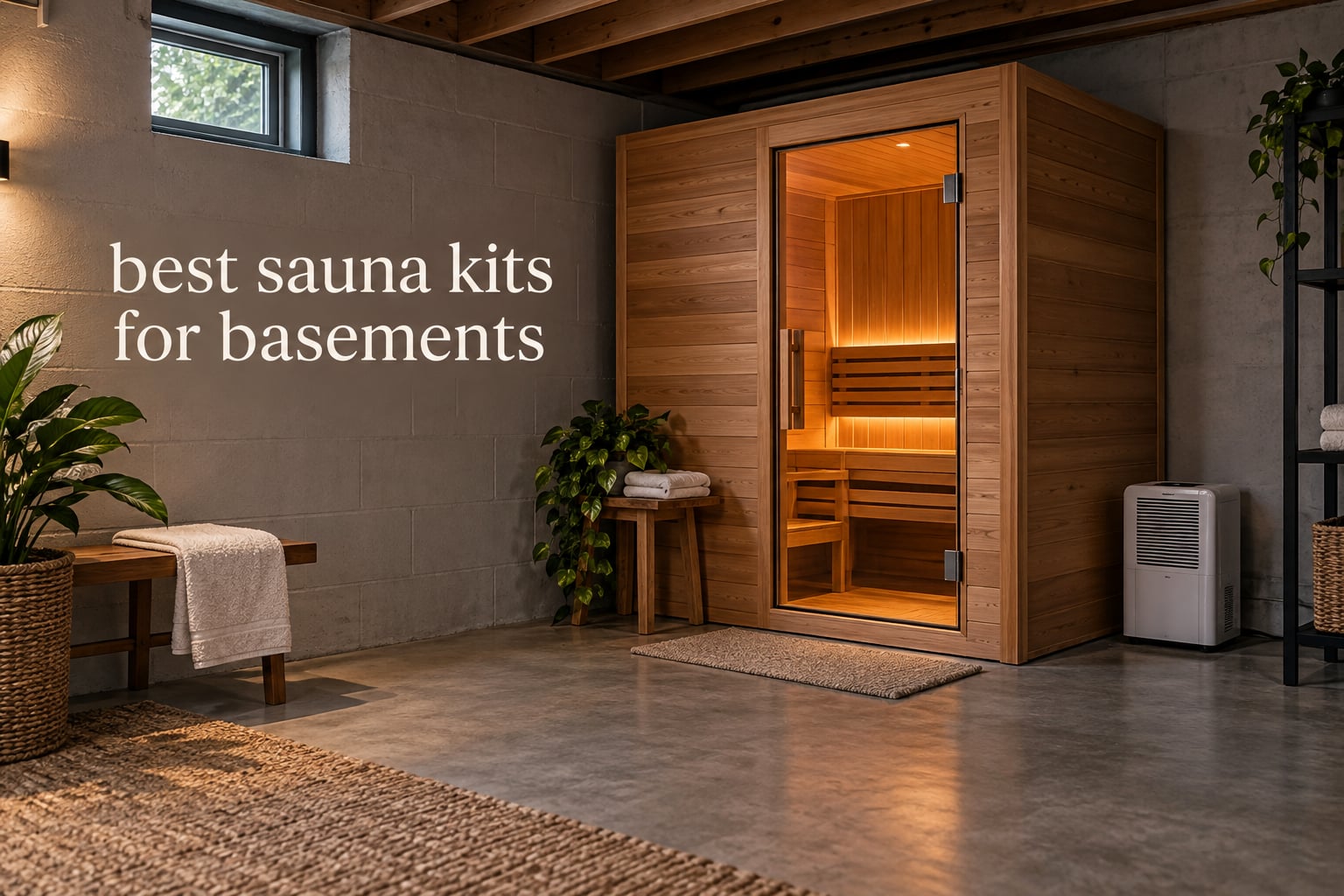
Basement sauna kits are the rare home upgrade where the room decides whether the sauna works. A cabin that looks generous in a showroom is useless if it will not turn the corner at the bottom of your stairs, sits under a 7-foot ceiling, or needs a 240V line you do not have. I spent six weeks going through 12 of the most-reviewed kits on the market, mapping each one against the basement constraints that actually decide an install: stairwell width, ceiling height, circuit availability, slab moisture, and where the air goes.
The short answer: the best sauna kits for basements are the room-style wood cabins with a factory vapor barrier and a heater matched to the cube footage, and the single best pick for most people is the OUTEXER 2-3 person traditional sauna because it reaches 140°F in about 10 minutes, runs on a standard 240V circuit, and assembles solo in half an hour. If your basement has no spare amperage and no appetite for a panel upgrade, an infrared cabin or a portable steam tent is a legitimate answer rather than a compromise.
Below you will find six wood room cabins and six portable steam and infrared tents, each with the numbers that actually matter in a below-grade room, plus the mistakes that send people back to the store. I also link to our sauna tent roundup if you are still deciding between a permanent room and a portable box. As of 2026, panel width specifications remain the single most commonly missing detail from manufacturer listings, so I flag that gap wherever it exists.
Top 3 Picks for Basement Sauna in 2026
These three cover the widest range of basement situations, from a full 240V traditional install to a plug-in corner infrared and a low-commitment steam box.

OUTEXER 2-3 Person Traditional
- 3KW 240V heater
- Reaches 140F in 10 minutes
- Monterey pine with tempered glass
Homsido 2-3 Person Infrared
- 110V 2100W plug-in
- 11 low EMF carbon panels
- Hemlock with 8mm glass door

ZONEMEL Portable Steam Sauna
- 1500W 4 liter steamer
- Up to 130F
- Three windows and folding chair
All 12 Best Basement Sauna Picks Side by Side in 2026
Every kit below is in the list, from wood rooms that need a dedicated circuit to portable tents that run off a standard outlet. Ratings and review counts are shown on each product card.
| Product | Specifications | Action |
|---|---|---|
| OUTEXER 2-3 Person Traditional Sauna |
|
Check Latest Price |
| Homsido 2-3 Person Infrared Sauna |
|
Check Latest Price |
 HOSAUNA 3-4 Person 6KW Sauna HOSAUNA 3-4 Person 6KW Sauna |
|
Check Latest Price |
 KUNSANA Smart Corner Infrared Sauna KUNSANA Smart Corner Infrared Sauna |
|
Check Latest Price |
 KUNSANA 2 Person Ceramic Infrared Sauna KUNSANA 2 Person Ceramic Infrared Sauna |
|
Check Latest Price |
 springspa 1-2 Person Infrared Sauna springspa 1-2 Person Infrared Sauna |
|
Check Latest Price |
 Manastin 2 Person Portable Steam Sauna Manastin 2 Person Portable Steam Sauna |
|
Check Latest Price |
| ZONEMEL Full Size Portable Steam Sauna |
|
Check Latest Price |
 SereneLife Portable Infrared Sauna SereneLife Portable Infrared Sauna |
|
Check Latest Price |
 KASUE Infrared Sauna Tent KASUE Infrared Sauna Tent |
|
Check Latest Price |
 KOVEXE Extra Large Portable Steam Sauna KOVEXE Extra Large Portable Steam Sauna |
|
Check Latest Price |
 Homedics Collapsible Steam Sauna Homedics Collapsible Steam Sauna |
|
Check Latest Price |
What Makes a Basement Sauna Different From a Standard Room Install
Upstairs, the biggest variable is taste. Downstairs, the biggest variable is logistics. A basement is colder than the rest of the house in winter, which means a small heater that performs well in a bedroom can struggle to reach traditional temperatures in a below-grade space. A basement is also concrete, which is good for moisture durability and bad for anything that needs to breathe.
Stairwell access is the specification people forget, and it is the one that ends up deciding returns. Measure the narrowest point of the stair run, then measure the diagonal clearance at any turn, and compare both against the widest panel in the kit. Owners on sauna forums describe this as the number one reason kits come back, and it costs nothing to check before the box is delivered.
Ceiling height is the second filter. Traditional two-tier bench layouts want roughly 78 inches of interior height, and many finished basements sit just under that. Infrared cabins tolerate a lower ceiling because they do not need headroom above a bench, which is why several of our picks work in 71-inch rooms.
Electrical and ventilation are the third and fourth. A traditional stone heater needs its own 240V circuit and real panel capacity, while infrared cabins and portable steam boxes run on standard 120V outlets. And a sauna needs two separate air paths: one exhausting the hot cabin air to the outdoors, and one handling the humid air in the basement room itself. Basement sauna ventilation is not optional, and most first-time builders plan only half of it.
1. OUTEXER 2-3 Person Traditional Sauna: Best Overall for Basements
OUTEXER 2-3 Person Steam Sauna Traditional Saunas 240V 3KW Home Spa Room
3KW 240V heater
Monterey pine
47 x 47 x 75 inches
140F in about 10 minutes
Pros
- Holds temperature through long sessions
- Assembles solo in about 30 minutes
- Tempered glass door with 7-color lighting
- Bluetooth speakers and foot heating
- 7 year after-sales service
Cons
- Back panels run hot without a backrest
- Hard bench for long sessions
- Too tight for taller users to stand
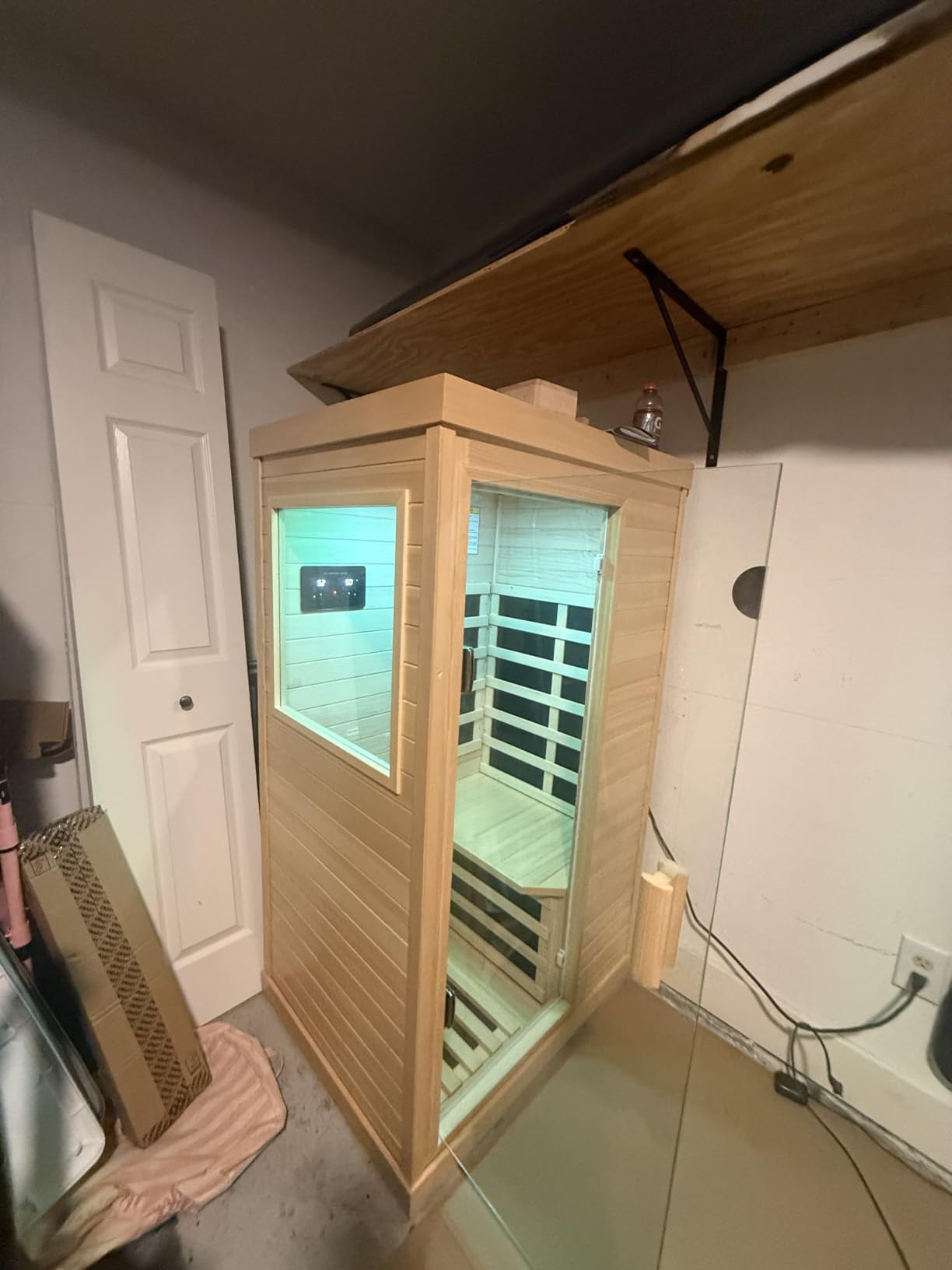
This is the kit I keep coming back to for the best sauna kits for basements list because it treats the two hardest problems well at once: heat in a cold room, and a small footprint. At 47.24 by 47.24 by 74.8 inches, it clears a typical basement corner and most narrow stair runs, and the 3KW 240V heater hits above 140°F in about 10 minutes with a ceiling of 194°F once it is up to full temperature.
Assembly is where this one earns its place. Owners report putting the cabin together solo in roughly 30 minutes, which is unusual for a wood room of this size. The interior is Monterey pine with a tempered glass door, and the accessories are genuinely complete: bucket, ladle, thermometer, hourglass, stones, cup holders, and Bluetooth speakers are all in the crate.
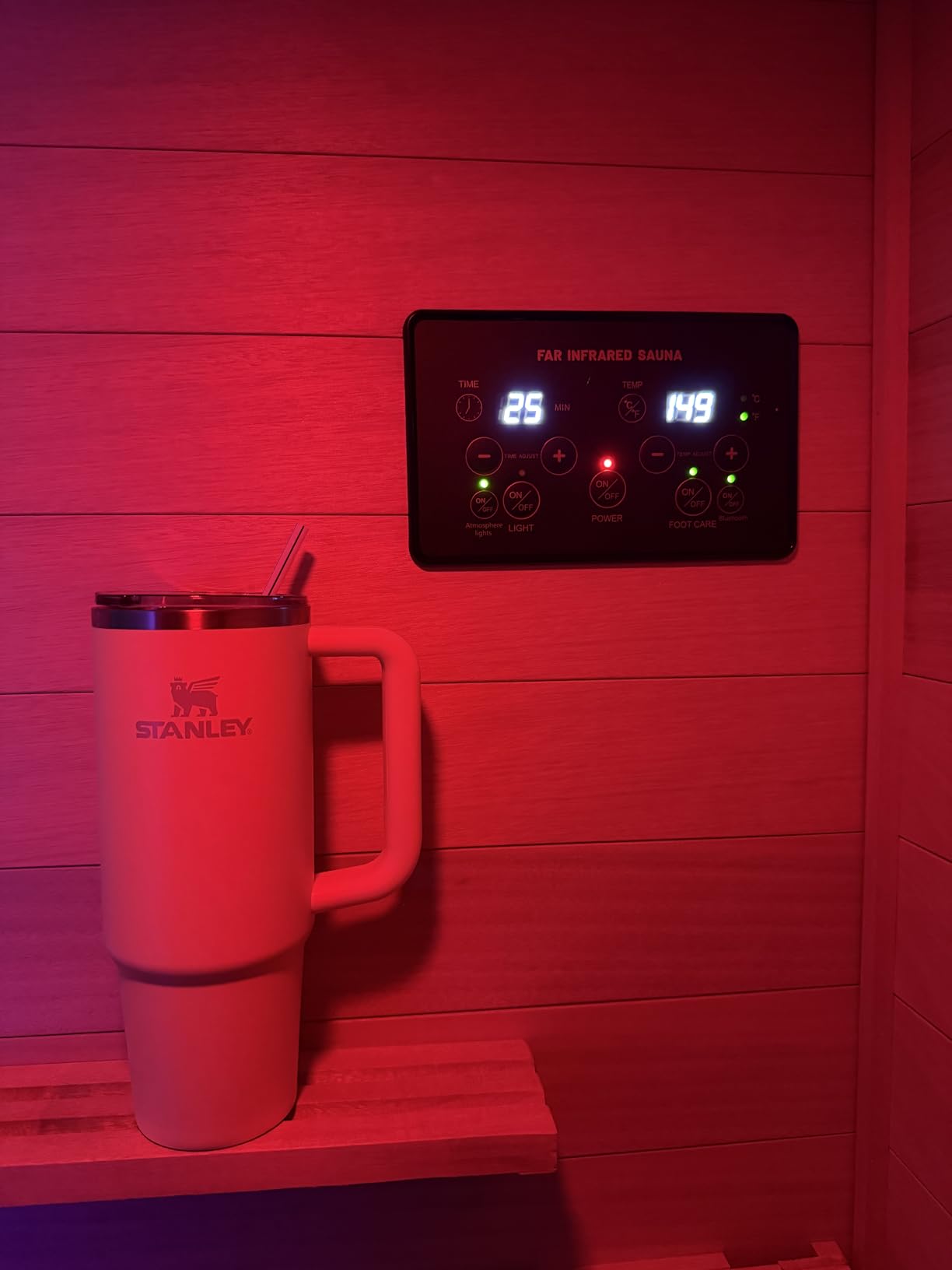
The comfort complaints are real but easy to solve. Reviewers repeatedly note that the back panels get hot enough to sweat against, and that the wood bench is hard over a long session. A backrest or a folded towel fixes both, and both are the first accessories any buyer adds. The footprint is compact, so anyone over roughly six feet cannot stand inside.
Heating performance is the strongest part. Long-term owners logging several sessions a week report steady temperatures that hold through the whole sitting, which is exactly what you want in a basement where the surrounding air is cool. The unit also carries a 7 year after-sales service window, the longest stated coverage in this group.
Best for: basements with a 240V circuit and a narrow corner
If you have panel capacity for a dedicated 240V run and less than 80 inches of headroom to spare, this is the most complete package here. The 240V circuit is non-negotiable for this heater, and a licensed electrician should install it ahead of the cabin delivery, not after.
Not for: renters, shared panels, or anyone who needs to stand
Skip it if you rent, if your electrical panel is already near capacity, or if the experience you want involves standing. The 47-inch square footprint is a sitting room for two, and there is no second tier to climb for headroom.
2. Homsido 2-3 Person Infrared Sauna: Best Plug-In Wood Cabin
Homsido 2-3 Person Indoor Infrared Sauna, 11 Low EMF Far Infrared Carbon Panel Hemlock Wood Sauna Room Indoor Home Sauna with Tempered Glass Door,Bluetooth Speakers, Chromotherapy Lights(110V, 2100W)
110V 2100W plug-in
11 low EMF carbon panels
Hemlock cabin
59 x 35 x 71 inches
Pros
- No electrician or 240V circuit needed
- Reaches target temperature and holds it
- Fast replacement parts from support
- 8mm tempered glass door
Cons
- Up to 30 minutes to warm in unheated spaces
- Compact models feel cramped past 20 minutes
- Heavy boxes need two people
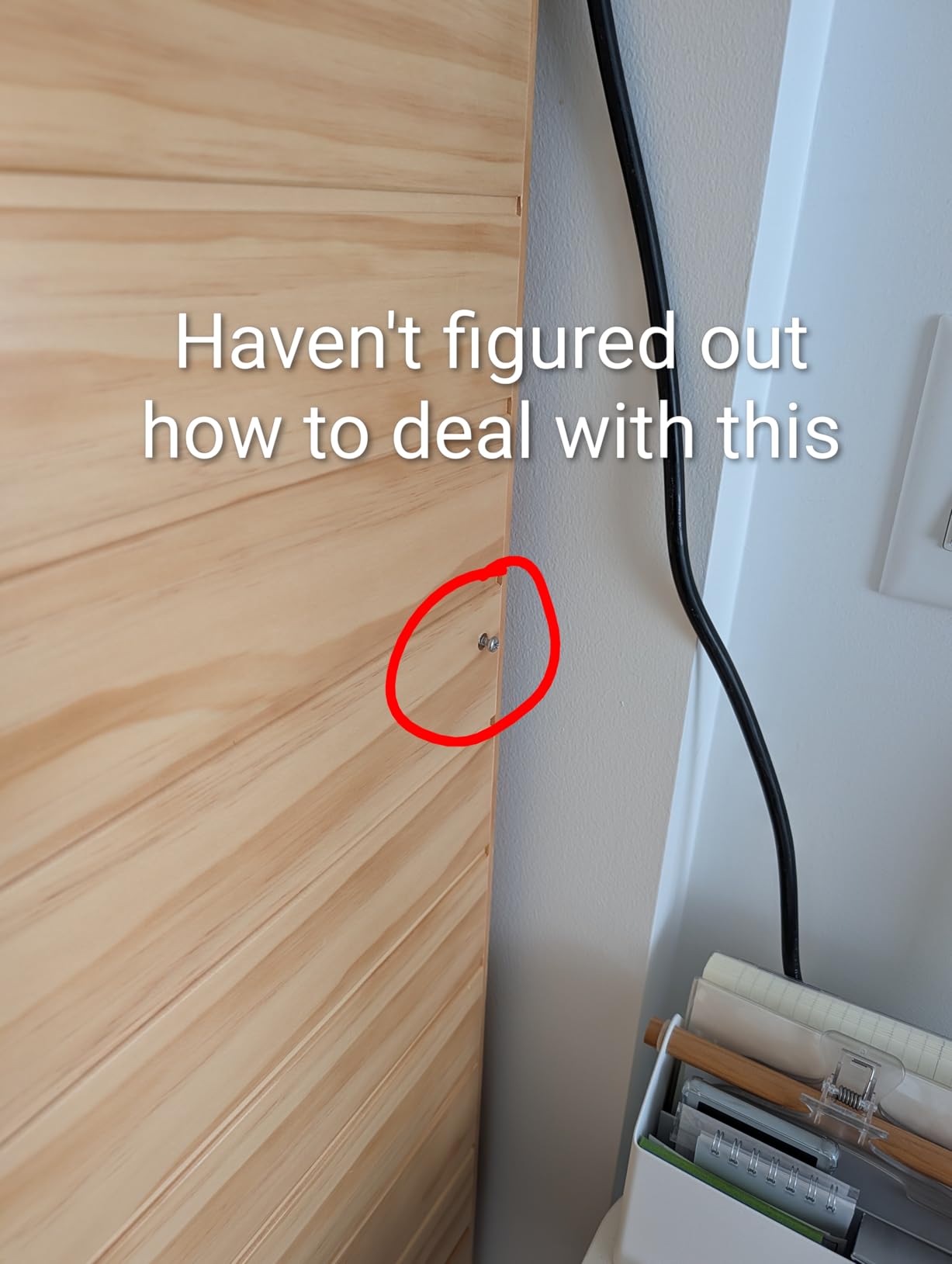
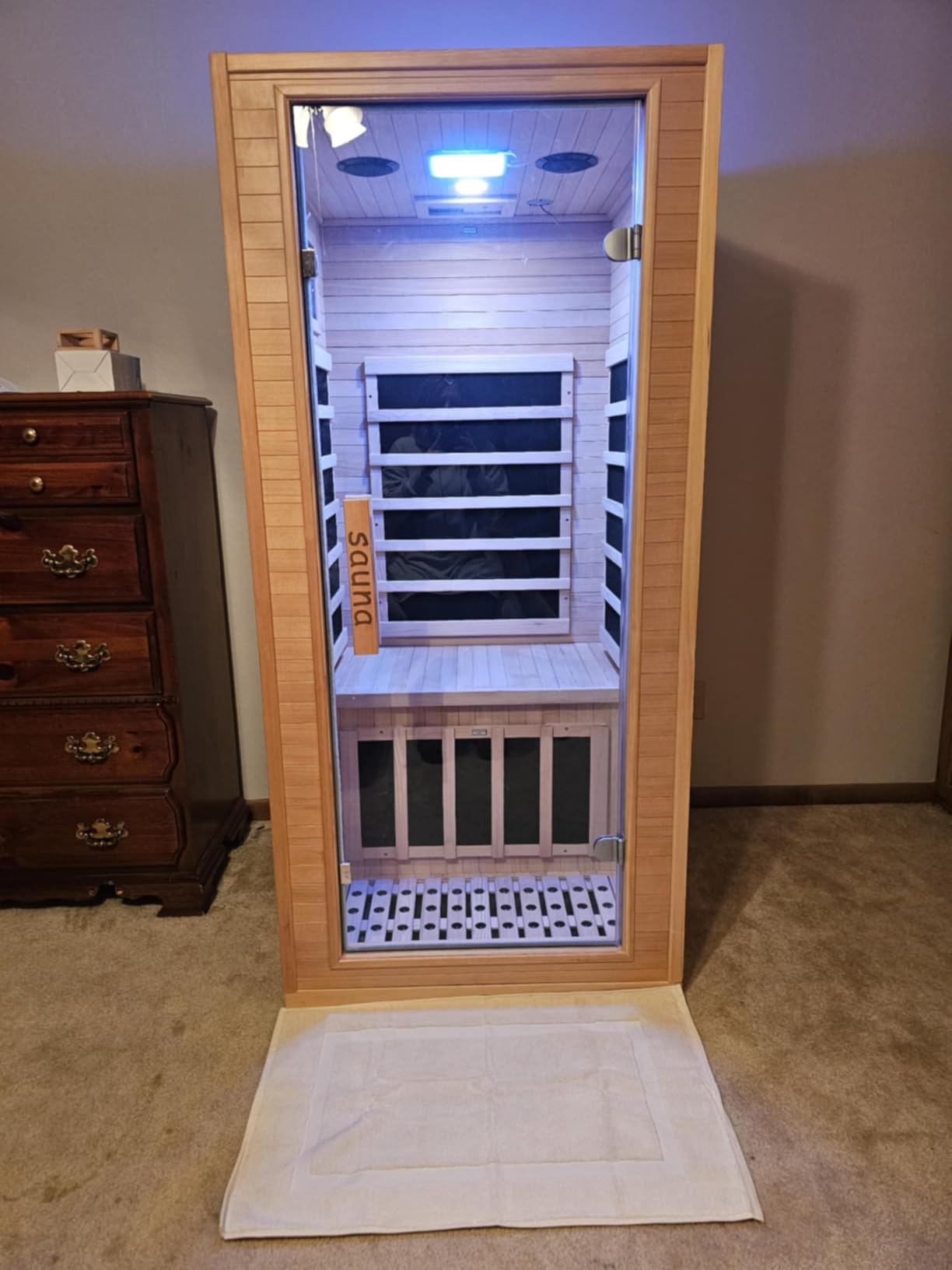
This cabin answers the question most basement owners actually ask: can I get a real wood room without touching my electrical panel? At 110V and 2100W, it plugs into a standard household outlet, and the 11 low EMF far infrared carbon panels wrap the interior so warmth comes from every direction rather than one wall.
Construction is the reason this one holds up in a basement. Natural hemlock, an 8mm tempered glass door with a wide glass front, a digital control panel for time and temperature, and integrated Bluetooth speakers. It arrives in a protective wooden crate, which matters if your only access route is a stairwell with a tight turn.
Two things to plan for. First, warm-up time: reviewers in cold garages and unheated basements report up to 30 minutes before the cabin is where they want it, so preheating is part of the routine rather than an afterthought. Second, the shipping crates are heavy and moving them up a basement stair is a two-person job on delivery day.
After-sales is a genuine strength here. Owners describe the support team sending replacement hinges, dust covers, and snap catches within days when transit damage occurs, and that responsiveness is worth more than a small feature list. The 3-year warranty is a middle ground against the 2-year coverage on some infrared cabins.
Best for: basements without spare amperage or a plan for a panel upgrade
Choose this when the electrical work is the blocker. You get hemlock walls, tempered glass, and a low EMF carbon layout, and the only electrical decision is whether the outlet can handle 2100W on a shared circuit with a dehumidifier.
Not for: quick turnarounds in a cold room
If you want to walk in and start, the 30-minute cold-room warm-up will frustrate you. Plan to start it from your phone, wait, and use the session for stretching and recovery rather than a fast turn-and-burn.
3. HOSAUNA 3-4 Person 6KW Sauna: Best for Taller Basements and More Heat
Traditional Steam Sauna 3-4 Person Outdoor Indoor Home Spa Sauna 6KW Heater
6KW 240V heater
Modified cedar
59 x 55 by 82 inches
Up to 195F
Pros
- Solid construction and craftsmanship
- Slide-together assembly under an hour
- Bluetooth speakers hold settings after power cycles
- Panoramic tempered glass door
Cons
- Warm outer panels suggest thin insulation
- Small air leak at the door magnet
- Some arrived with damaged wiring
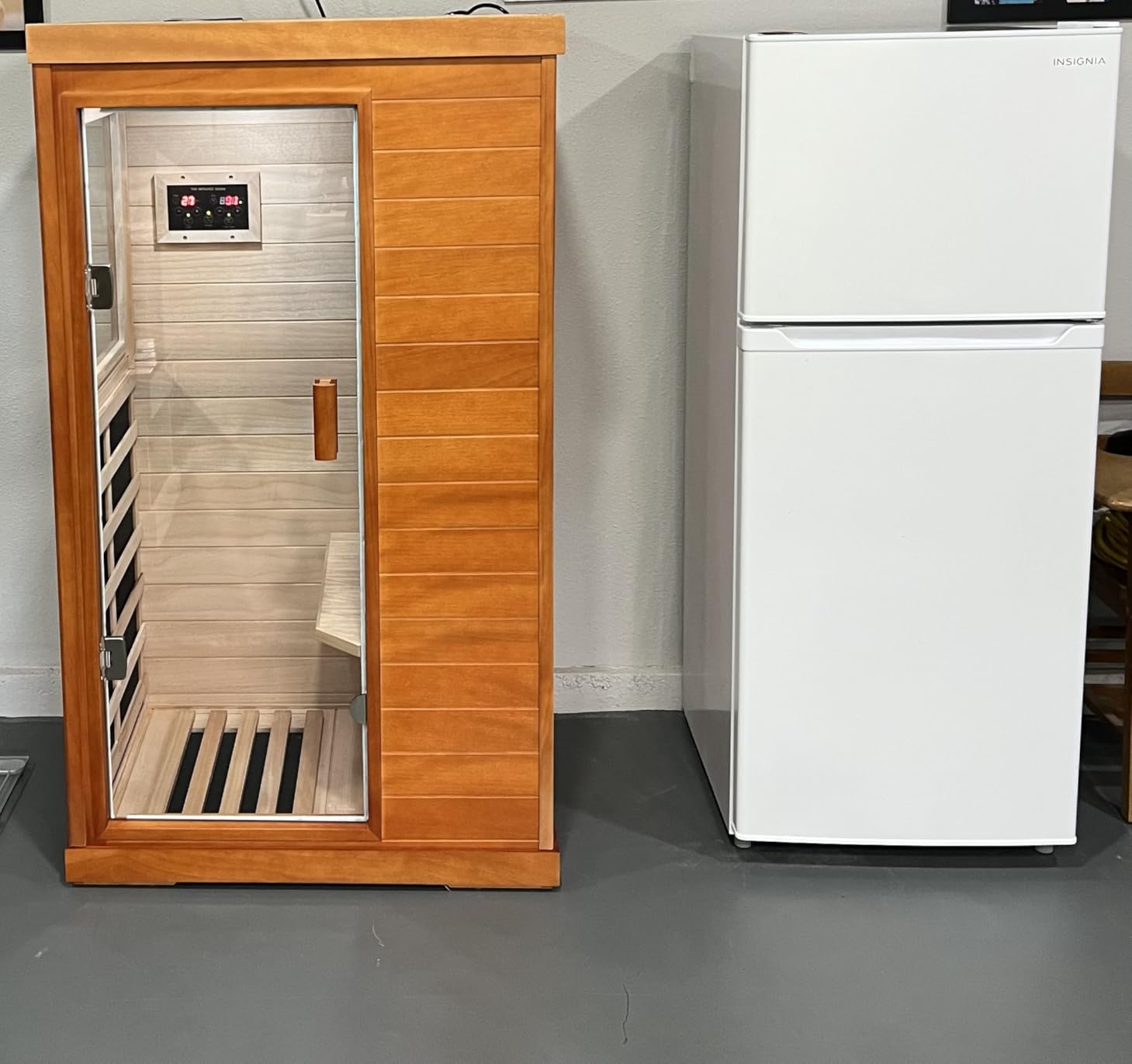
When a basement ceiling is tall enough and the circuit can take it, more heater wattage is the answer. The 6KW stainless steel heater with high-density volcanic stones reaches therapeutic temperatures up to 195°F, and the 59 by 55.1 by 81.9 inch footprint is the largest room in this roundup, sized for 3-4 adults.
That 81.9-inch height is the whole point for finished basements. It clears a proper dual-tier ergonomic bench with generous shoulder room, which is what you need for longer sessions and for anyone who wants an upper tier. The walls are cold-pressed modified cedar with a marine-grade sealed finish, and the panoramic tempered glass door gives the room a finished look in a space that is often painted flat.
Reviewers praise the build and the simple slide-together assembly, with several people finishing it solo in under an hour. Bluetooth waterproof speakers and multi-zone chromotherapy lighting are included, and owners confirm the audio settings survive a power cycle, which is not always true in this category.
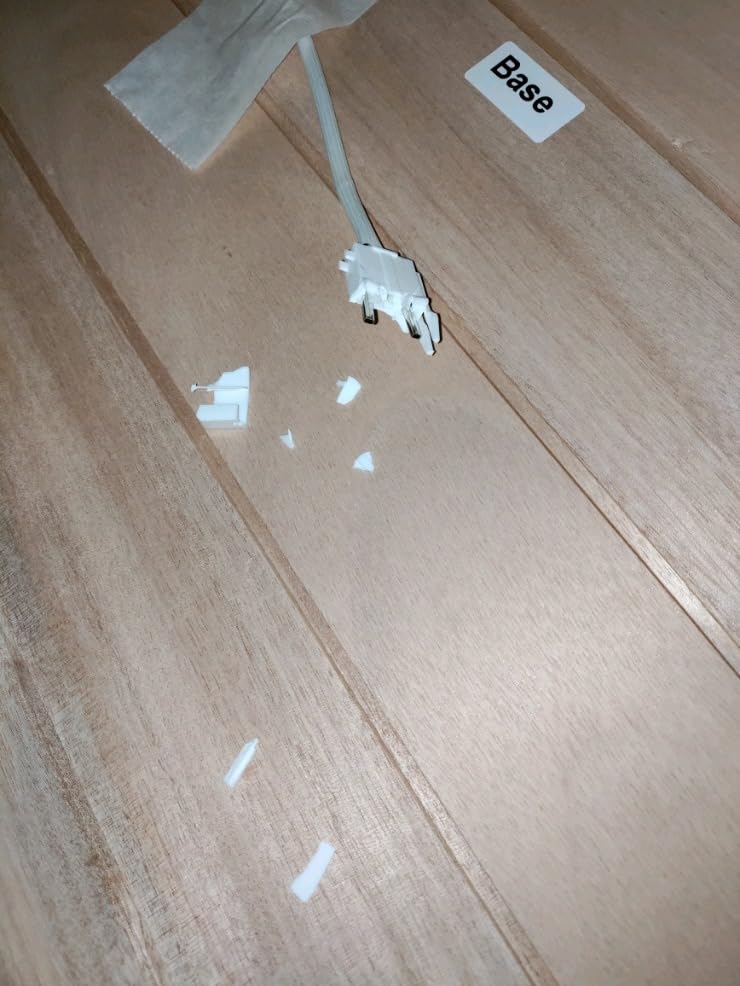
The criticisms are about heat behavior and quality control. Heat-up runs 30-40 minutes in some setups rather than faster, the outer panels feel warm enough to suggest thinner insulation than the price point implies, and a small air leak at the door magnet is a recurring note. One review reports a shattered wire harness on arrival with no replacement offered, so inspect the heater wiring before you install it.
Best for: 9-foot ceilings and a panel with room to spare
This is the one to buy if you have the vertical space and the electrical capacity for real traditional sauna performance. Higher basements with finished ceilings and 3-4 users get more out of it than a single person ever would.
Not for: low ceilings or thin-walled basements
If your finished ceiling is under about 82 inches, the upper bench tier will not fit and the room loses its advantage. Warm outer panels also mean you will want to think about where the cabin sits relative to the walls around it.
4. KUNSANA Smart Corner Infrared Sauna: Best for Odd-Shaped Basements
Smart Indoor Home Sauna 0-5mG Ultra Low Emf Far Infrared Sauna 2-3 Person, 1520w Hemlock Wooden Saunas Room with APP & LCD Control Panel, Bluetooth Speaker, Chromotherapy Lights, Thermal Cover
1520W infrared
Corner pentagon design
47 x 47 by 76 inches
Canadian hemlock
Pros
- Corner footprint uses dead space well
- App preheating plus LCD touchscreen
- Canadian hemlock resists warping
- 0-5mG ultra low EMF operation
Cons
- 311 pounds makes repositioning hard
- Tempered glass door excluded from warranty
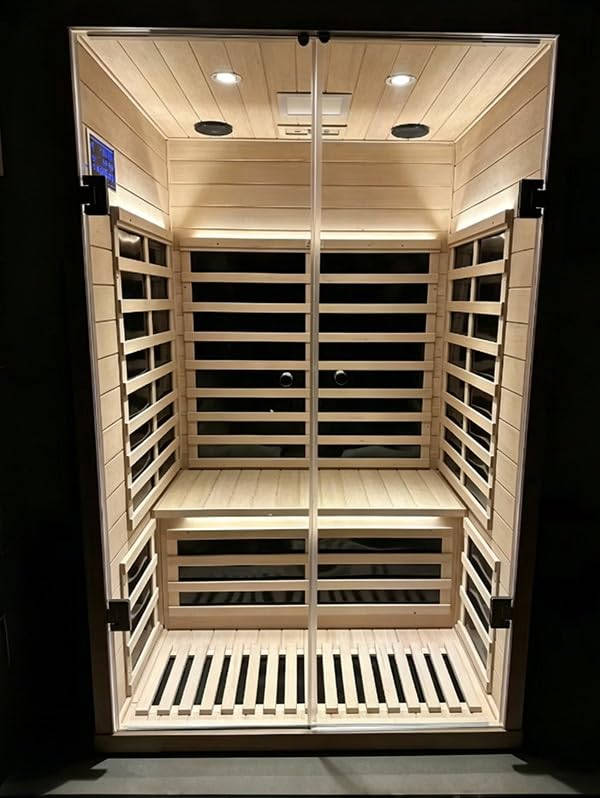
Basements are full of corners that are almost but not quite wide enough. The corner pentagon footprint on this model, 47.25 by 47.25 by 76.4 inches, is built for exactly that situation, packing more usable seating into a square outline than a box shape of the same width would.
The controls are the differentiator. A smartphone app handles preheating from upstairs while the 7 far infrared carbon heating panels run at 1520W, and an in-cabin LCD touchscreen handles time and temperature from 65-149°F with a 1-60 minute timer. Automatic shut-off and built-in ventilation are both standard, and the triple-layer insulated thermal cover keeps standby losses down between sessions.
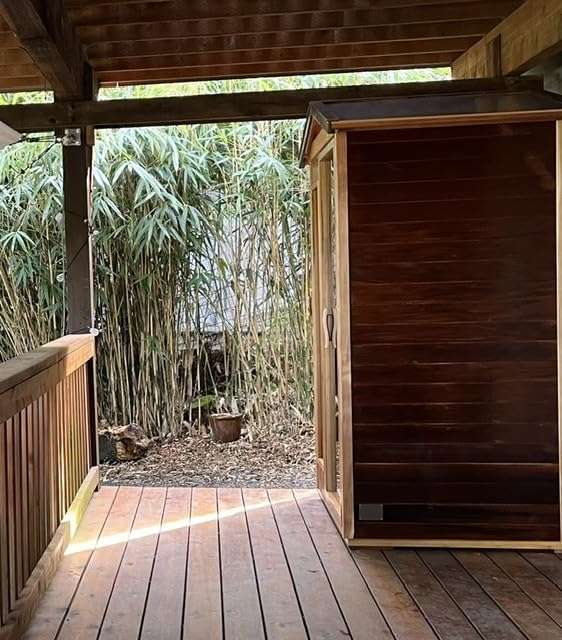
Build quality reads well to owners, particularly the Canadian hemlock, which does not warp or crack the way cheaper softwoods do in humid conditions. Seven-color light therapy plus a reading light is a nice touch in a basement where the session happens after dark. Eighty-three percent of reviews sit at five stars.
Two practical warnings. At 311 pounds, this is not a cabin you shuffle to a new spot once it is in place, so finalize your corner before delivery. And the 2-year warranty does not cover the tempered glass door, which is worth knowing in a basement where a stray step and a swinging door are a realistic combination.
Best for: leftover corners, home gyms, and finished basements
The app preheat is the feature that earns its keep in a basement, since you can start a session while you are still upstairs. If your usable footprint is irregular rather than rectangular, the corner shape is the single best reason to pick this one.
Not for: users who move their sauna or need full glass coverage
Anyone planning to relocate the cabin later should look elsewhere. If door damage matters to you, factor in that the glass is outside warranty before you commit.
5. KUNSANA 2 Person Ceramic Infrared Sauna: Best 10-Minute Preheat
KUNSANA Ceramic Infrared Sauna 2 Person, Indoor Infrared Saunas for Home
1760W ceramic infrared
10-minute preheat
77-149F
47 x 39 by 76 inches
Pros
- 10-minute preheat matches the quickest in the room category
- Hidden hardware keeps assembly to about 30 minutes
- Deep sturdy bench
- Useful for post-workout recovery
Cons
- Snug for two adults
- Heater elements hot against the back slats
- Some arrived with broken lamp or missing door seal
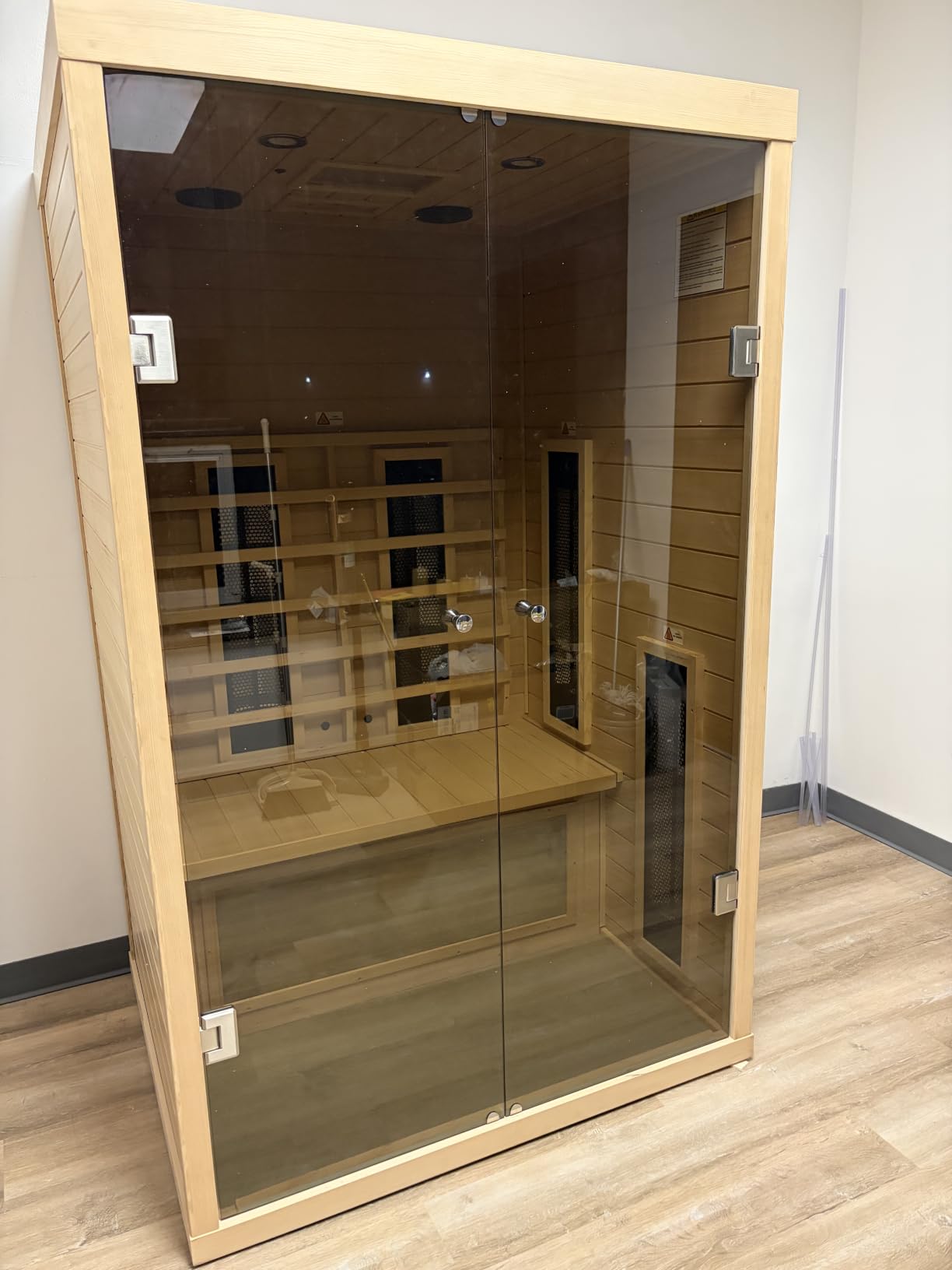
If a cold basement floor and a short window before bed is the scenario, preheat speed matters more than peak temperature. This cabin combines 1760W of carbon crystal far infrared plates with ceramic heating cubes and reaches session temperature in about 10 minutes, inside a 77-149°F control range.
The fit is unusually well thought out for small rooms. At 47.24 by 39.37 by 75.95 inches, it holds two seats in a square footprint that sits almost flush with a wall, and hidden interconnection hardware keeps the exterior unbroken, so nothing interrupts the wood lines. Seats are rated to 600 pounds and the cabin suits users from 55 to 78 inches tall, which is a useful range for a household rather than a single user.
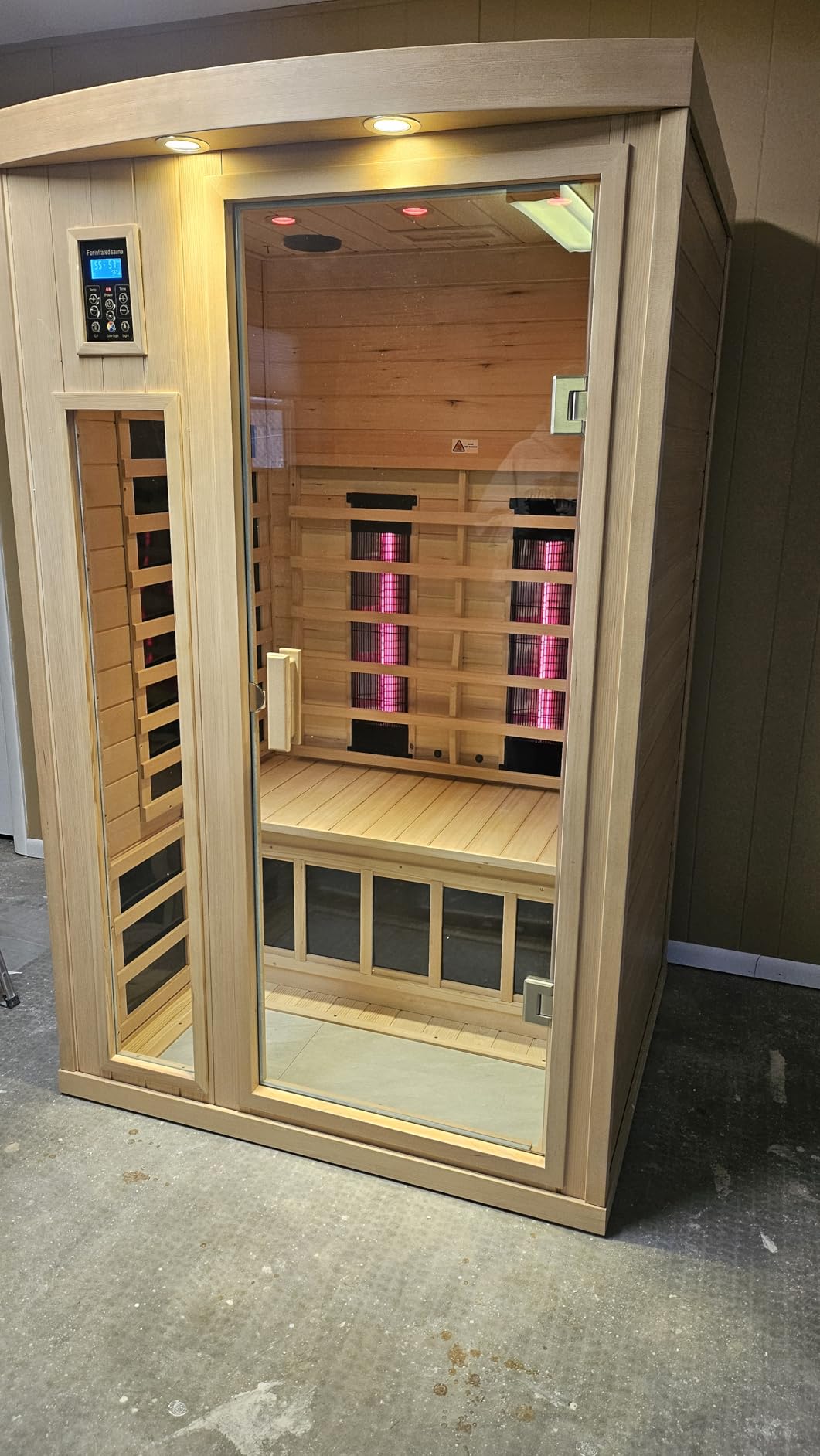
Owners rate the deep bench and solid build highly, and the light and audio setup is generous for a two-person room: color lights, reading lights, and two Bluetooth speakers. If you are using this for post-workout recovery and circulation rather than heat endurance, that combination works very well at 10 minutes of warm-up.
The trade-offs are physical. Two adults fit, but snugly, and reviewers who bought it as a two-person cabin often conclude it suits one person better. The back heater elements run hot against the wall slats, though the controls let you switch individual back panels off. A minority of arrivals also come with a broken heat lamp or a missing door seal, so check both before assembly day.
Best for: two users with a 20-30 minute window and a small footprint
The 10-minute preheat changes the habit pattern: it becomes a practical after-workout room rather than a planned evening event. A 39-inch depth also suits basements with an awkward wall or a mechanical chase in the corner.
Not for: taller than 78 inches, or two people who want elbow room
Anyone over six and a half inches should check the seated headroom carefully. If you plan regular two-person sessions, the compact KUNSANA corner model or the wider Homsido gives you more usable space.
6. springspa 1-2 Person Infrared Sauna with Red Light Therapy
springspa 1-2 Person Sauna Low EMF Infrared Sauna with Red Light Therapy
1600W at 120V
6 carbon panels
EMF under 2 mg
43 by 37 by 75 inches
Pros
- Certified EMF under 2 mg
- Canadian hemlock holds heat well
- 15-25 minute preheat
- Compact footprint for one or two
Cons
- Lowest rating among the wood cabins in this roundup
- Thin long-term review history
- 10 percent of reviews are one star
Red light therapy is the hook here, and for buyers focused on recovery protocols it is a real differentiator rather than a gimmick. The rest of the spec sheet is conventional and competent: 6 infrared carbon heating panels at 1600W on a standard 120V 15 Amp supply, a 77-149°F range, and a 15-25 minute preheat.
Construction is Canadian hemlock, and owners credit the wood for holding heat in a small space. The 9-color chromotherapy lighting comes with a remote so you can change the mood from the bench, and an LCD control panel plus Bluetooth speakers handle the rest. External dimensions are 43.3 by 37.4 by 74.8 inches, with interior space at 39.76 by 33.86 by 71.02 inches.
Best for: one or two users focused on recovery, not heat endurance
The 120V draw means you can place this almost anywhere in the basement without planning a circuit, and the compact width suits a converted closet or a laundry room conversion. The EMF certification under 2 mg is a genuine specification, not a marketing phrase.
Not for: buyers who need a long track record
With 40 reviews, this is the least-tested wooden cabin in the roundup, and its 4.3 average sits below every other wood cabin in this list. Ten percent of reviews are one star, so treat the owner feedback as directional rather than conclusive.
7. Manastin 2 Person Portable Steam Sauna: Best Room for Two Adults
Manastin 2 Person Portable Steam Sauna for Home, 1 or 2 Person Full Body Home Spa with 2 Foldable Chairs,9 Levels of Sauna Tent with Remote Control, (Black, Large)
Dual steam generators
48 by 37 by 71 inches
130F in 10 minutes
Three-layer satin cotton
Pros
- Dual generators produce heavy fast steam
- Tall enough for two adults to sit upright
- 26.9 pounds and folds down fast
- Settings persist between sessions
Cons
- Needs two separate outlets
- Included chairs are small and sit near the steam ports
- Short hoses mean outlets must be close
Portable tents get dismissed as a compromise, which is why this one stands out: at 48.5 by 37 by 71 inches it is tall enough to sit upright and wide enough for two adults, and it ranks in the top ten of the Saunas category. Dual high-powered steam generators with individual remotes push it to about 130°F in roughly 10 minutes.
Construction is three-layer satin cotton with reinforced seams, zip windows, a front zip door, and interior pockets. Setup and teardown take about 30 minutes, and at 26.9 pounds one person can move it. The 1-year warranty on all parts is short, so treat it as a seasonal tool rather than a fixture.
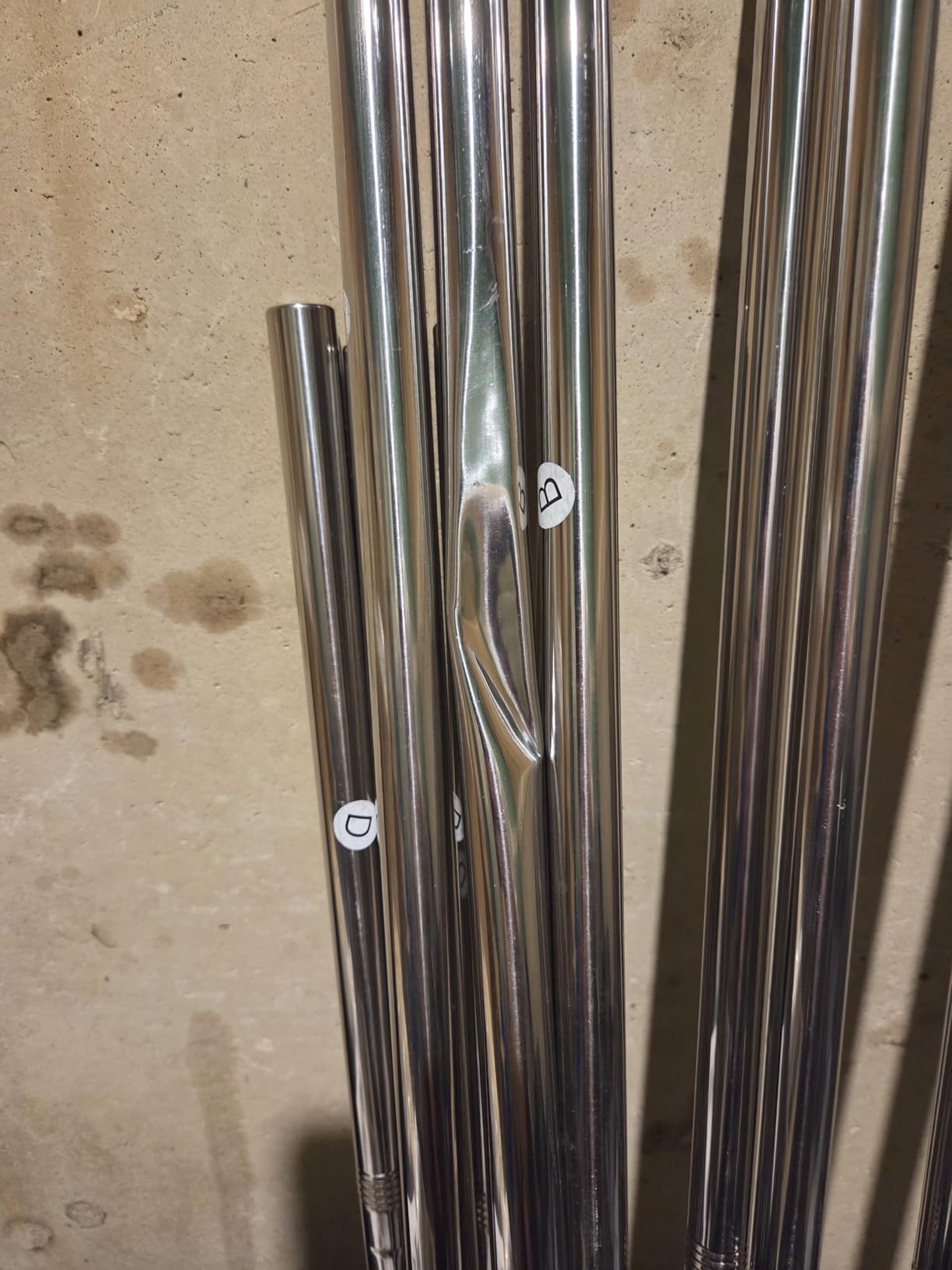
The single most repeated fix among owners is the seating. The included foldable chairs are small and sit close to the hot steam outlets, so the common upgrade is a bench or a lawn chair that keeps legs away from the ports. Once that is done, reviewers describe the steam output as genuinely heavy and the two-person fit as comfortable.
Plan the power before you plan the location. The unit needs two separate outlets or it trips the breaker, and the hoses are short, so the tent has to sit close to two outlets on different circuits. In a basement, that often means positioning the tent away from the dehumidifier you are probably already running.
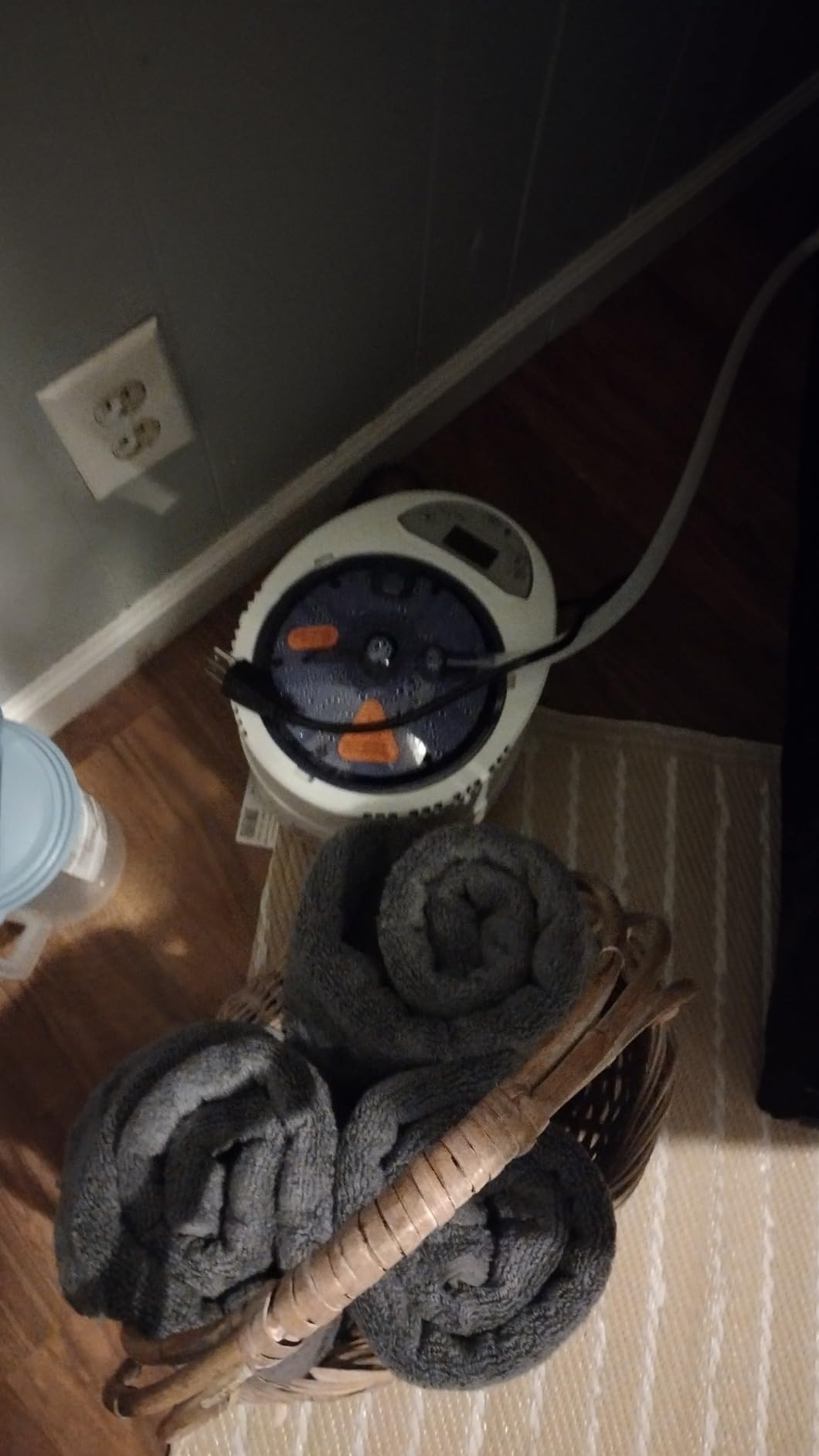
Best for: renters, two-person use, and no dedicated circuit
Nothing here is fixed to the floor, so this is the practical answer if you rent, if your panel is full, or if you want a sauna you can set up on a winter evening and put away in the spring. The stand-up height is unusual for a portable box at this size.
Not for: unconditioned basements without humidity control
Steam output is reduced in cold spaces and the humidity load in an enclosed basement is high. Without a dehumidifier and a plan for air exchange, you are inviting condensation on nearby surfaces, which is exactly the damage the wooden cabins are insulated against.
8. ZONEMEL Full Size Portable Steam Sauna: Best Entry-Level Steam Session
ZONEMEL Full Size Portable Steam Sauna Kit, Personal Full Body Home Spa for Detox, Relaxation, 4 Liters 1500 Watt Steamer, Remote Control, Timer, Foldable Chair (L31.5 x W31.5 x H55.1, 3 Windows)
4 liter 1500W steamer
Up to 130F
33 by 33 by 66 inches
8 minute heat-up
Pros
- Fits adults up to 6 foot 3 inches
- Heats the enclosure in about 8 minutes
- Three windows cut the claustrophobic feel
- Folds down and wipes clean in minutes
Cons
- Hot internal steam cup
- Thin instructions and awkward hose routing
- Heavy moisture output fills dehumidifier bins
The ZONEMEL packs a 4 liter 1500 watt steamer with a 99-minute run time into a corner-sized box.
What surprises people is the size. At 33.8 by 33.8 by 65.7 inches it is a full-body box, not a head-only tent, and owners report it comfortably fits adults up to six foot three. Three transparent windows take the edge off the enclosed feeling and let in fresh air, and the double-headed zipper makes entry quick when the box is at temperature.
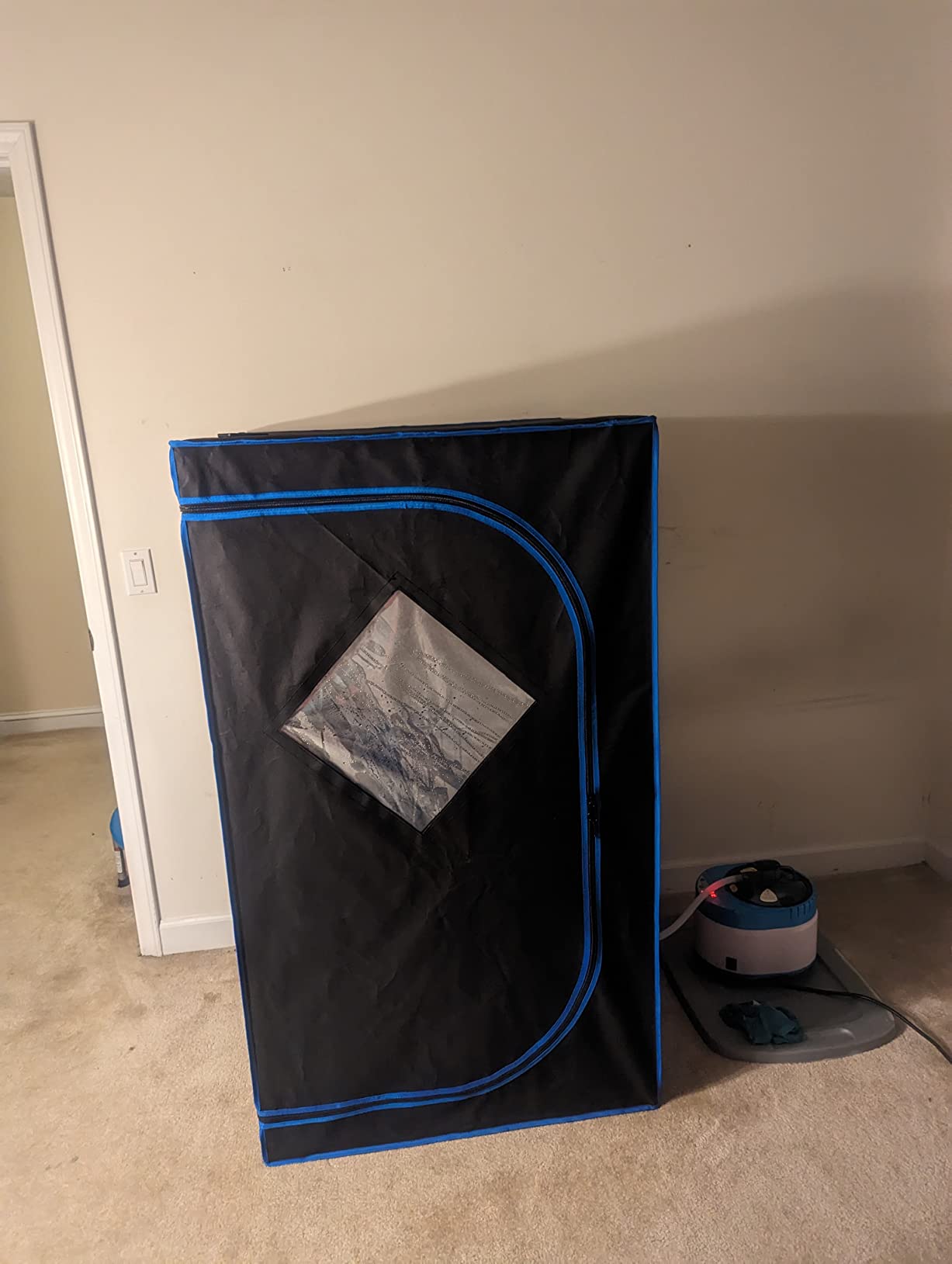
Two cautions come up repeatedly. The internal steam cup insert gets extremely hot, and the hose routing needs care because it can burn bare feet on the way in. Instructions are sparse, so budget time to work out the routing before your first session rather than during it.
The other caution is moisture. This unit puts a lot of water into the air, and owners in basements report filling dehumidifier bins fast. At 23.6 pounds it folds and stores easily, which makes it easy to move out of the room and dry the space properly between uses.
Best for: tall users and a low-commitment first sauna
If you have never used a sauna and want to find out whether you like it, this is the least risky entry point. The heat-up is short, the footprint is small enough for a corner, and the chair and carry bag are included.
Not for: basements with weak humidity control
If your basement has no dehumidifier and no plan for exhausting humid air, a wood cabin with a sealed envelope is a better match. Reviewers who ran this in an unconditioned space described it as a moisture management exercise.
9. SereneLife Portable Infrared Sauna: Most Long-Term Feedback of Any Kit Here
SereneLife Portable Sauna Box for Home, Infrared Sauna Tent with Heated Foot Pad and Folding Chair, Remote Control In-Home Spa, 35″ x 71″ – inch (Black)
3 carbon fiber panels
Up to 140F
35 by 71 inches
13.18 pounds
Pros
- Deepest review history in the roundup at nearly 2900 ratings
- Heated foot pad and folding chair included
- Folds flat between sessions
- Remote control operation
Cons
- Lowest average rating here at 4.1
- 12 percent of reviews are one star
- Fabric tent rather than wood or ceramic
- 140F ceiling is modest
The SereneLife has been on sale for years and carries nearly 2900 ratings, which makes it the only product here with multi-year owner feedback. Buyers who stay with it tend to cite the heated foot pad, the folding chair, and the fact that the whole thing folds flat enough to disappear between sessions.
Specs are simple: three carbon fiber heating panels, 140°F maximum, sessions up to 60 minutes on the remote, a double-pull zipper, an interior pocket, and a transparent window. At 13.18 pounds it is the easiest unit in this roundup to move, which matters enormously when your sauna lives in a basement with a single staircase.
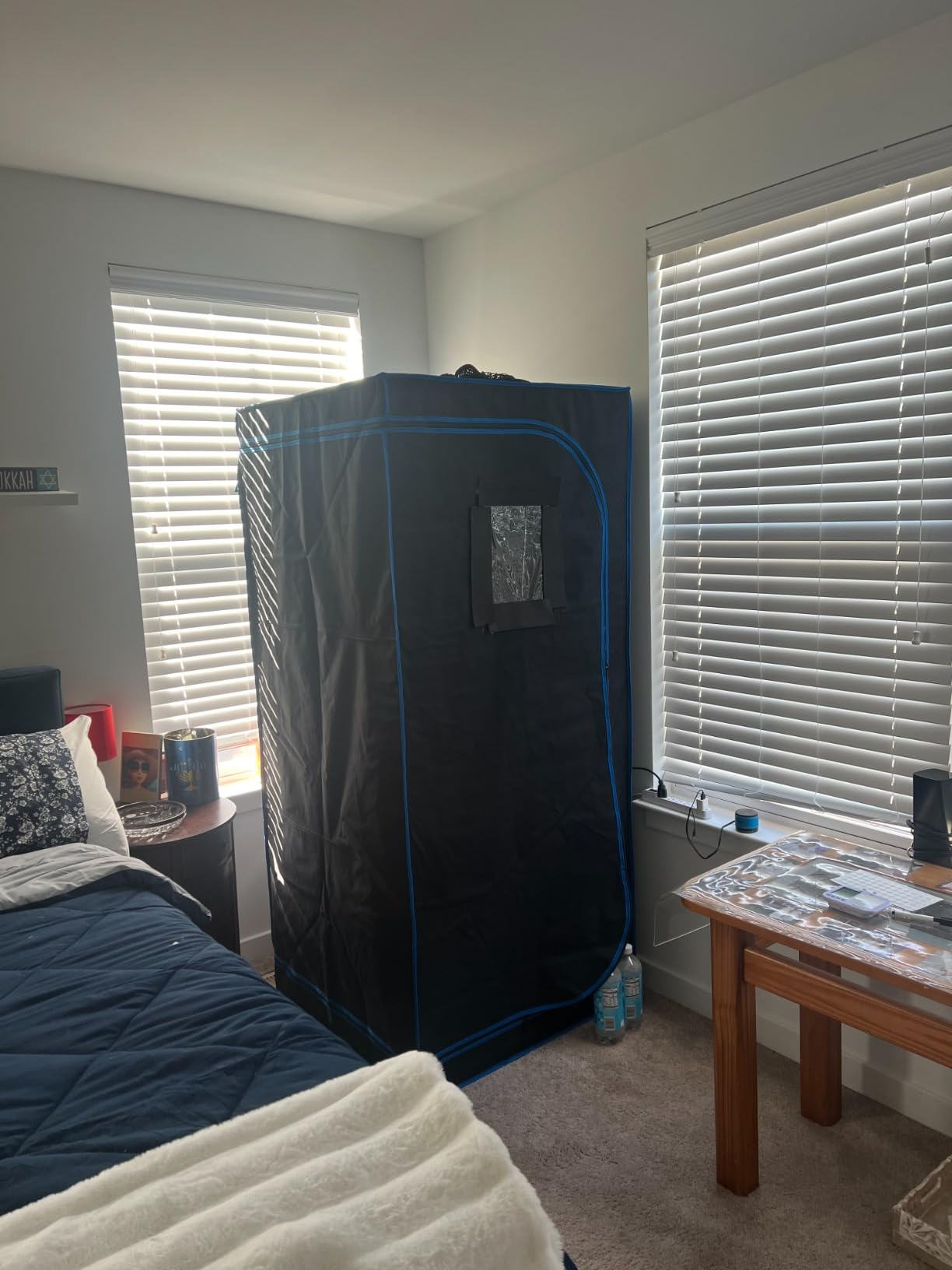
It is also the lowest rated at 4.1 stars, with 12 percent of reviews at one star, the highest share of any product here. The complaints concentrate on fabric durability and the ceiling over time rather than on function, and some of that is simply the cost of a fabric enclosure compared with hemlock or ceramic.
The 140°F ceiling is modest next to newer infrared models, and the sessions are warm rather than hot. If you want a light, forgiving, portable warm-up room that disappears when you are done, that trade makes sense. If you want a genuine heat chamber, it does not.
Best for: small basements, shared spaces, and people who move the sauna
A 35 by 71 inch footprint and a 13-pound weight mean one person can carry it down a stair and set it up in a different corner each time. For a basement that doubles as a gym or a guest room, that flexibility is the whole appeal.
Not for: hot traditional sessions or long-term fixture use
If you want real heat and a structure you can build into a room, this is the wrong category. The rating spread also means you should expect some durability complaints from owners who bought it years ago.
10. KASUE Infrared Sauna Tent with 3L Steamer: Best Insulated Fabric
KASUE Infrared Sauna Tent with 3L Steamer, for Home
3L steam generator
5-layer insulated fabric
30 by 30 by 70 inches
9 temperature levels
Pros
- Five-layer fabric holds heat better than cheaper tents
- Steamer heats in 5-10 minutes
- Folds down neatly for storage
- Hand openings allow phone use
Cons
- Steamer inside the tent gets hot enough to burn
- Poor instructions
- Some had to reroute the steam hose
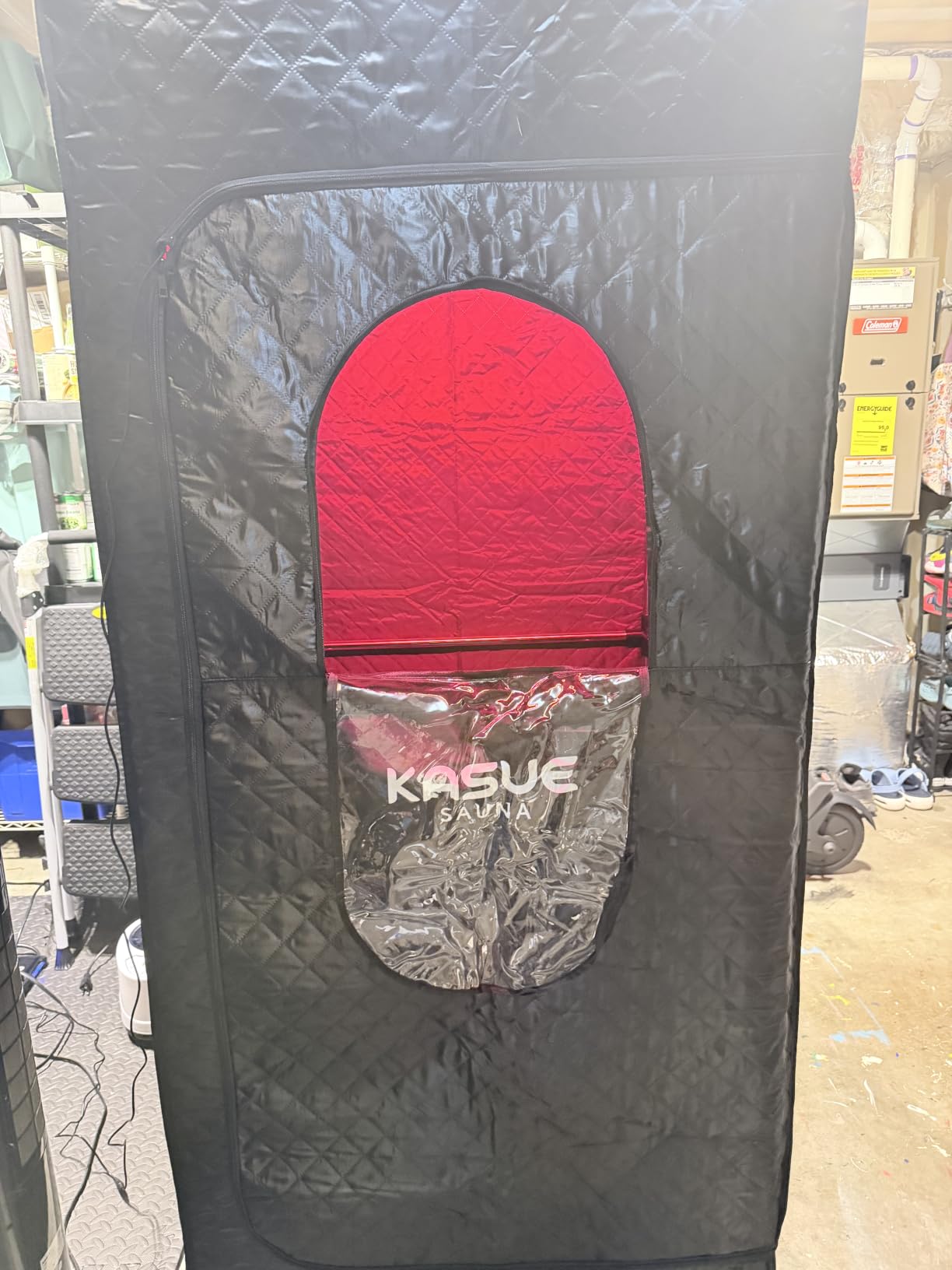
Fabric tents compete on layer count, and this one leads the roundup at five layers of waterproof insulated fabric. The 3L steam generator heats in 5-10 minutes and produces steady steam, with 9 adjustable temperature levels and a 99-minute session timer on the remote control.
At 30 by 30 by 70 inches it is a narrow column, so it fits beside a washer, a sump, or a utility sink without taking a whole corner. It also holds a top-ten place in the Saunas category, and the included folding chair is sturdier than most at this size. Hand openings let you check a phone without unzipping the whole enclosure.
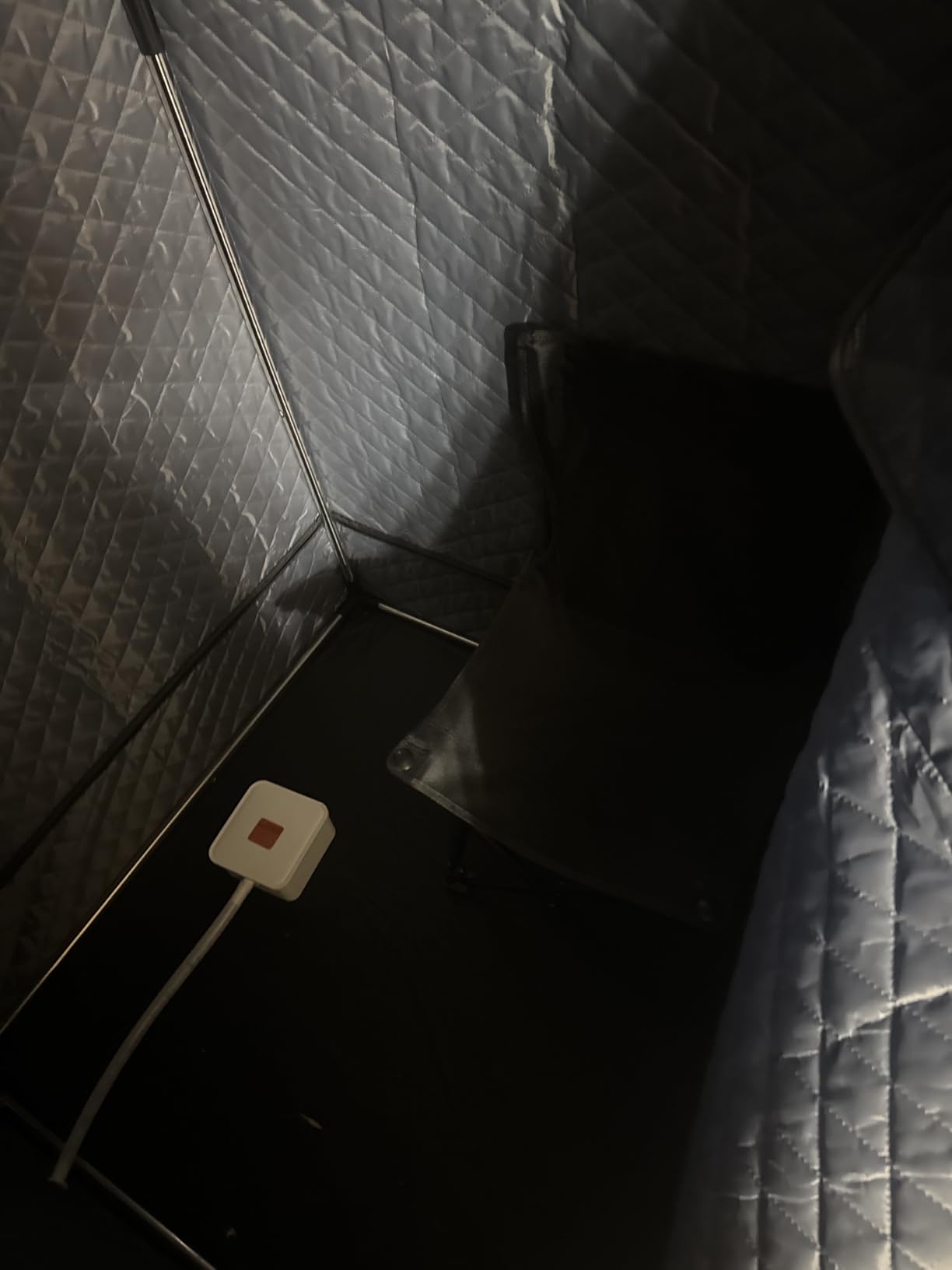
The safety note that appears in most reviews is the one to internalize: the steamer inside the tent becomes hot enough to burn on contact. Keep the tent closed, keep hands off the unit, and route the hose so nothing crosses a walkway.
Instructions are widely criticized, and a few detailed reviews describe rerouting the tubing before the steam did what the product page claimed. Set aside twenty minutes with the manual and a diagram before your first session rather than discovering the problem mid-session. Zippers around the frame bars are the part most likely to wear with frequent setup and teardown.
Best for: narrow utility spaces and steam on a short fuse
At 15 pounds, this is among the fastest steam options here for a basement corner you cannot give up much floor area. The remote works from inside, so you are not getting up to adjust anything once you are warm.
Not for: anyone who wants wood, and anyone who skims instructions
This is fabric, not timber, and the review base is thin at 159 ratings. Read the routing notes for the steam hose first, because the fix is easy once you know it exists and frustrating if you find it at minute nine.
11. KOVEXE Extra Large Portable Steam Sauna: Best Oversized Portable
Portable Sauna for Home, Upgraded Personal Steam Sauna Box with 3L 1300W Steamer, Folding Chair, Extra Large Size Foldable Home Sauna 3’X 3’X 5.9’, Full Body Sauna Tent for Relaxation Spa, Black
3L 1300W stainless steamer
5-minute preheat
71 by 35 by 35 inches
Padded chair to 265 pounds
Pros
- Oversized 71 inch tent suits most adult heights
- Padded chair rated well beyond most rivals
- Fast 5-minute preheat
- Dry-boil and leakage protection built in
Cons
- Only 62 ratings
- so limited long-term evidence
- 8 percent of reviews are one star
- Thin detail on aromatherapy accessories
The KOVEXE gives you a square full-body footprint at 35.4 by 35.4 by 70.9 inches, which matters if you are tall and tired of ducking. The 3L 1300W stainless steel steam generator reaches heat in about 5 minutes, and the padded folding chair is rated to 265 pounds, well beyond what most competitors offer.
Hardware details are better than the price tier suggests. The frame is stainless steel with reinforced buckles and support rods, there is a double-ended zipper plus a transparent window, and the generator includes dry-boil, electrical leakage, and overheating protection. Nine temperature levels and a 15-95 minute timer run from the remote.
Best for: tall adults and a basement corner with real floor space
If you are over six feet and other tents feel cramped, the extra height is the reason to pick this. At 22.2 pounds it still folds flat enough to store under a bed or behind a door, so the large session size does not have to mean permanent floor space.
Not for: buyers who need proven long-term reliability
With 62 ratings, there is very little multi-year data on this one, and 8 percent of reviews sit at one star. The build specs read well on paper, but treat the durability picture as unproven rather than settled.
12. Homedics Collapsible Portable Steam Sauna: Fastest Setup of the Roundup
Homedics Portable Sauna – Collapsible Personal Steam Sauna
Collapsible 4.82 feet tall
115F maximum
Under 1 minute setup
13.7 pounds
Pros
- Sets up in under a minute
- Steam ready in 10-15 minutes
- Waterproof interior holds heat
- Folds down with included storage bag
Cons
- 115F ceiling is lower than most
- Strong plastic smell when heating
- Too short for users above about 5 foot 3
- Reports of loose handles and peeling panel tape
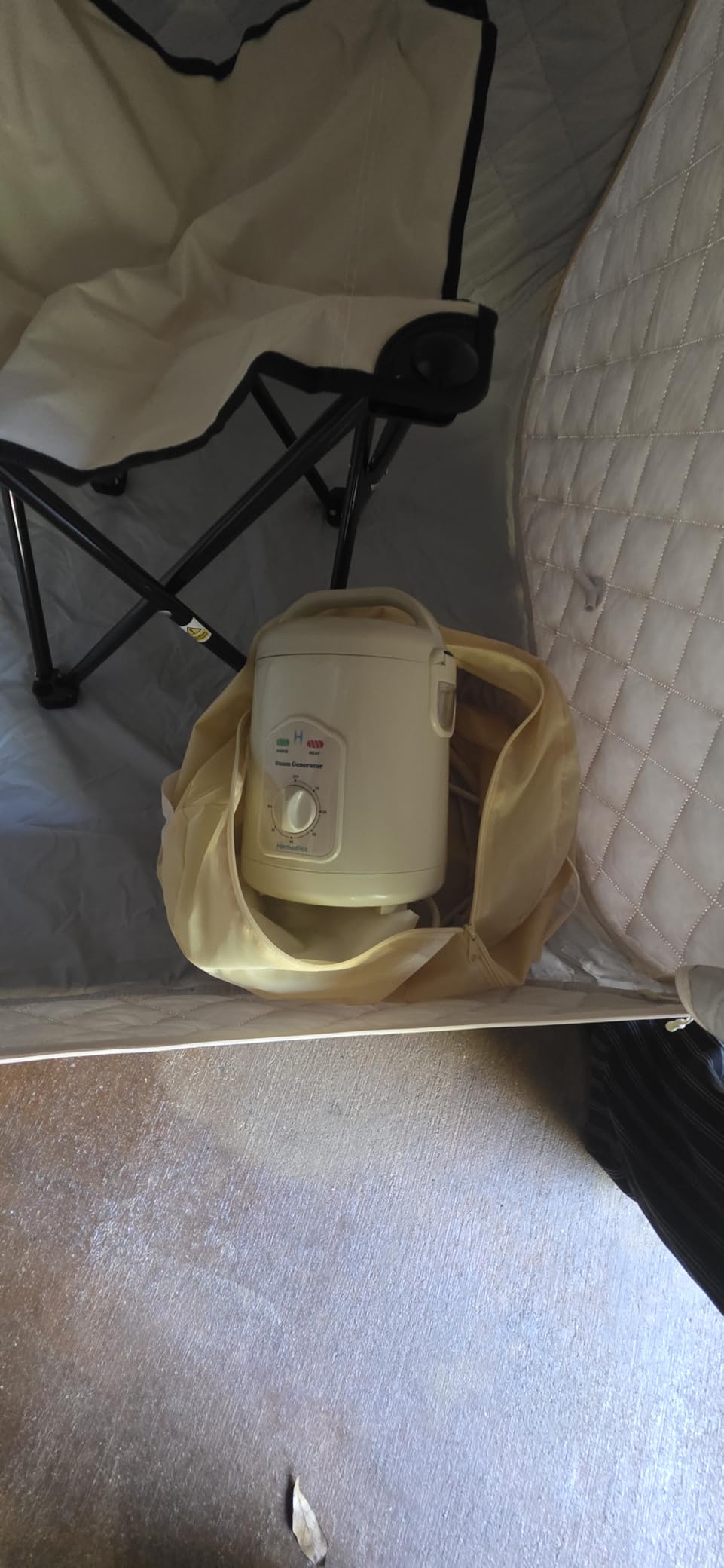
When the deciding factor is friction, this is the unit to beat. The frame sets up in under a minute with no tools, the steam is ready in 10-15 minutes, and the whole thing collapses into the included storage bag. It includes the steam generator, hose attachment, foldable chair, and bag as a set.
The physical limit is height. At 35.43 by 35.43 by 57.87 inches, the tent stands 4.82 feet, so anyone taller than roughly five foot three has to bend to sit inside. Maximum temperature is 115°F, which is a warm mist rather than a hot room, and the polyester and polypropylene build keeps the packed weight to 13.7 pounds.
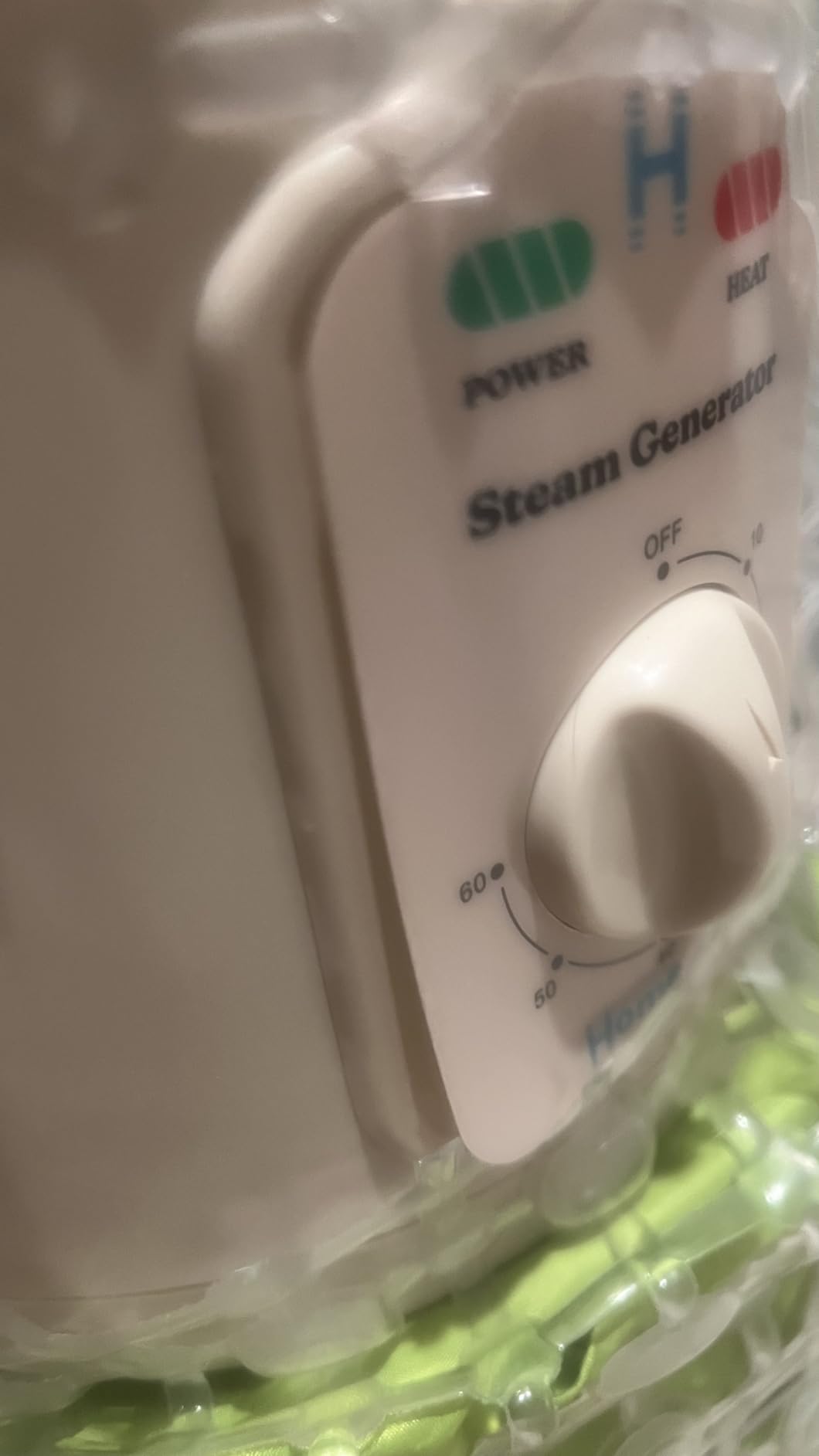
Reception is genuinely mixed, with a 4.1 average and a 12 percent two-star share. Fans like the chair height and the fast setup. Critics mention a strong plastic smell during heating, early component failures such as loose handles and peeling control panel tape, and units arriving dirty or with a non-working tank.
For a basement, the waterproof interior and the small footprint are the positives. The temperature ceiling is the limit for anyone who wants a real sauna experience, and the odor plus the short height make it better suited to a quick warm-up than an extended session.
Best for: quick warm-ups and the smallest possible footprint
If you want a sauna you can set up, use, and put away without thinking about it, this is the least demanding option. The 1-year limited warranty is among the shortest listed in the roundup, so treat it as a convenience item rather than an investment.
Not for: taller users or anyone chasing real heat
At 4.82 feet tall and 115°F maximum, this will frustrate anyone above average height who expects a sauna session. The hot plastic smell during the first few minutes is also worth checking against your tolerance.
How to Choose a Basement Sauna Kit: Size, Power, and Moisture
Match the heater to the cube footage before you match anything else. The standard rule of thumb is roughly 1 kW of heater power for every cubic metre of cabin volume, adjusted upward for cold, below-grade rooms. A second shortcut is the 200 rule, which puts about 200 watts of heater capacity for every 10 cubic feet. In a basement, treat both as a floor rather than a target.
Then check panel width against your stairwell. This is the step that prevents returns. Measure the narrowest point between the stringers or walls on the stair run, measure the door at the top, and measure the diagonal clearance at any turn or landing. Compare the smallest result against the widest wall panel in your chosen kit, and add a few inches of handling slack.
Decide on the electrical path next. Traditional 3KW and 6KW stone heaters need a dedicated 240V circuit installed by a licensed electrician, plus panel capacity for the load. Infrared cabins at 110V and 2100W and all portable steam boxes need a standard 120V outlet, which in a basement is often on the same circuit as a dehumidifier or sump pump, so check what else is on that circuit before you commit.
Moisture is the layer people regret skipping. A basement sauna needs four things working together: a sealed or coated concrete slab underfoot, an aluminum foil vapor barrier on the warm side of the insulation, continuous insulation in the walls and ceiling, and interior cladding over the top. Forum builders consistently flag the ceiling as the most commonly missed piece, and it is the surface that shows condensation first.
Insulation levels matter more underground than they do upstairs, because the surrounding air is colder for more of the year. Mineral wool in the R-13 range for walls and closer to R-19 for the ceiling is a reasonable target, with every seam of the foil barrier taped rather than left open. Whatever you do, do not use plastic sheeting as a vapor barrier, and do not skip the foil layer behind the bench where moisture concentrates.
Plan two ventilation paths, not one. The sauna cabin needs its own exhaust running to the outdoors, ducted outside the basement envelope rather than into a wall cavity or the crawl space. Separately, the basement room itself needs to handle the humidity that leaves the cabin, which in practice means a dehumidifier and a path for dry air in. Our basement dehumidifier guide covers the sizing for that half of the system.
Check what else lives in the basement before you build. If a sump pump is on the circuit you need, coordinate the panel work with that access, and our sump pump picks are worth reading first so the new circuit does not fight the existing load. If a radon mitigation system is installed, keep the fan and its piping clear of the sauna footprint so the draw path is not obstructed. Sound travels through joists, so if people live directly above, a resilient channel on the ceiling before the sauna goes in is cheaper than trying to fix it later.
On audio, Bluetooth speakers inside the cabin are worth getting right the first time. Sauna-rated speakers and the mounting detail behind them are covered in our sauna speaker roundup, and several of the kits here ship with speakers already rated for their own cabins.
Finally, weigh kit against custom build honestly. A kit gives you a known parts list, a known assembly time, and a warranty. A custom build lets you match the cabin to an odd footprint and integrate the vapor barrier with the rest of the room, and forum owners with irregular basements often end up there. For a rectangular room in a finished basement, a kit is usually the faster path to a working sauna.
What to Skip: Kits That Do Not Suit a Basement
Skip outdoor barrel saunas. They are built for a deck, they assume free air on all sides, and they do nothing for a below-grade room where the ceiling and slab are already doing the thermal work. The heat loss and the cold floor make them a poor match even when the barrel fits through the door.
Skip any kit whose listing does not state panel width, ceiling height, or whether a vapor barrier is included. That silence is the reason so many basement buyers end up returning a kit, and it costs nothing to ask the seller for a cut list before you buy.
Also skip high-wattage heaters in a space you cannot insulate properly. A 6KW heater in a thin-walled basement room with a warm ceiling will run long and hot without reaching the temperatures you paid for, and it will drive your power use up for no benefit. Fix the envelope first, then choose the heater.
And do not plan a portable steam box for an unconditioned basement without a dehumidifier. Every portable unit in this roundup puts significant water into the air, and the wooden cabins are insulated against that precisely. If humidity control is not in your plan, choose the cabin with a sealed envelope. If you are still comparing formats, our basement layout guide covers how people divide a finished basement into wellness zones.
Frequently Asked Questions
What type of sauna is best for a basement?
A traditional electric stone-heater cabin is the best fit for most basements, because it reaches genuine sauna temperatures in a cold room and keeps heat inside a sealed envelope. Choose infrared if your panel has no spare capacity for a 240V circuit, and choose a portable steam box if you rent or want something you can move. Whatever the type, plan a separate exhaust for the cabin and humidity control for the room.
What is the 200 rule for saunas?
The 200 rule is a quick heater-sizing shortcut: allow about 200 watts of heater capacity for every 10 cubic feet of cabin volume. It is a starting point, not a final answer. In a basement, move up a step because the surrounding air is colder, and check the manufacturer chart for the specific cabin before you order.
Is it cheaper to build or buy a sauna?
For a rectangular room in a finished basement, buying a kit is usually cheaper once you add the electrician, the vapor barrier layer, and the ventilation work. Building yourself wins when your footprint is irregular, when you want the cabin integrated into the room framing, or when you can reuse materials. Compare the full installed result, not the kit price on its own.
Which DIY sauna kit is the best?
For assembling alone, the OUTEXER 2-3 person traditional sauna is the strongest all-round choice: it heats to 140F in about 10 minutes, uses a standard 240V circuit, and owners report putting it together solo in roughly 30 minutes. The KUNSANA 2 person ceramic infrared cabin is the fastest to warm up, and the ZONEMEL portable steam box is the easiest way to test whether you like sauna at all.
Do I need a floor drain and a permit for a basement sauna?
A floor drain inside a traditional sauna is not always required because a sealed cabin carries very little water into the room, but a sloped floor and a nearby drain in the basement itself are sensible. Permit and inspection rules vary by jurisdiction, and a new 240V circuit is the item most likely to trigger a requirement, so confirm with your local authority and your electrician before you buy.
Bottom Line: The Best Sauna Kits for Basements in 2026
For most people reading this, the answer is the OUTEXER 2-3 person traditional sauna. It is the strongest combination of heat performance in a cold room, compact footprint, 30-minute solo assembly, and a long service window in this roundup, and it is our editor’s choice for the best sauna kits for basements in 2026.
Pick the Homsido infrared cabin if a 240V circuit is out of reach, the KUNSANA ceramic model if you want a session ready in 10 minutes, the KUNSANA smart corner sauna if your usable space is an awkward corner, and the ZONEMEL portable steam box if you are still testing whether you want a sauna at all. Whatever you choose, measure the stairwell first, plan two ventilation paths, and get the slab prepared before the crate arrives.