
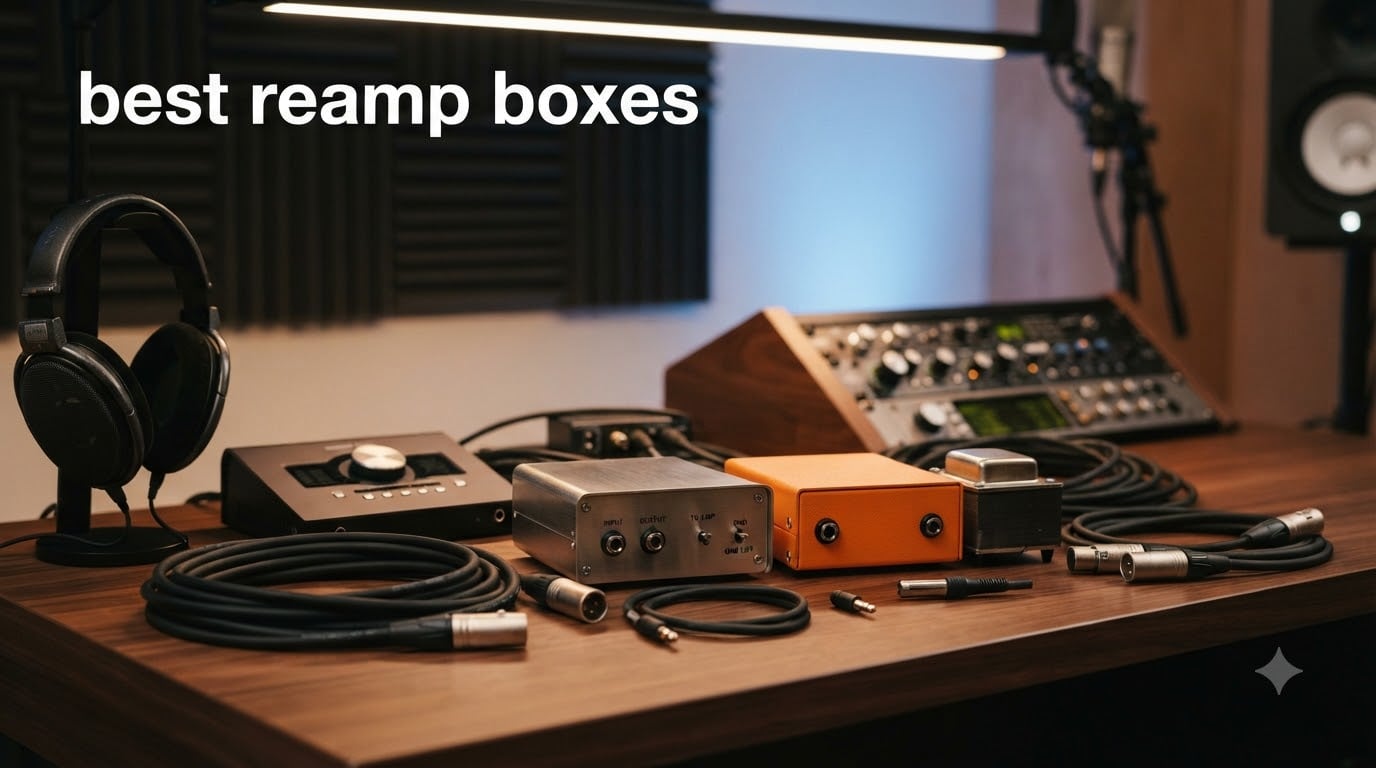
Recording a perfect guitar take is hard enough on its own, but committing to your amplifier settings before the song is even mixed? That is where most of us hit a wall. I spent years re-recording the same parts over and over just because I wanted to try a different tone. Once I started using reamp boxes in my studio, that problem disappeared completely.
A reamp box takes the balanced line-level output from your audio interface and converts it into the high-impedance unbalanced signal your guitar amp expects to see. This lets you record a clean DI track first, then send it back through any amp, pedal, or cabinet whenever inspiration strikes. The best reamp boxes do this with zero added noise, proper impedance matching, and a ground lift switch to kill hum.
After testing and comparing the most popular options from Radial Engineering, Palmer, Warm Audio, and United Studio Technologies, I narrowed down the field to the eight boxes worth your attention. Whether you want a budget passive box, a premium studio unit, or a pedal-routing powerhouse, this roundup of the best reamp boxes covers every use case and budget.
Top 3 Picks for Best Reamp Boxes in September 2026


The Radial Reamp JCR earns the top spot thanks to its custom Cuniberti-designed transformer and 3-way filter switch that no competitor matches at this level. The ProRMP delivers nearly identical core performance for less. And the Palmer CAB M is a standout budget pick with a flawless 4.9-star rating from 98 verified buyers.
Best Reamp Boxes in 2026 at a Glance
| Product | Specifications | Action |
|---|---|---|
 Radial ProRMP Radial ProRMP |
|
Check Latest Price |
| Radial Reamp JCR |
|
Check Latest Price |
 Radial EXTC-SA Radial EXTC-SA |
|
Check Latest Price |
| Palmer CAB M |
|
Check Latest Price |
 Warm Audio Reamper Warm Audio Reamper |
|
Check Latest Price |
 Replay Box Replay Box |
|
Check Latest Price |
 Radial EXTC-SA Orange Radial EXTC-SA Orange |
|
Check Latest Price |
 Radial Reamp HP Bundle Radial Reamp HP Bundle |
|
Check Latest Price |
Each of these boxes serves a different signal-routing need. The table above gives you a quick side-by-side look, and the detailed reviews below break down exactly what each one does well and where it falls short.
1. Radial ProRMP – Best Passive Reamp Box for Versatility
Radial ProRMP 1-Channel Passive Re-Amping Direct Box
1-channel passive reamp
Steel enclosure
Transformer-isolated
Ground lift switch
6.35mm jack
Pros
- High quality tank-like construction
- Clean signal with no added noise
- Works with wide range of instruments
- Passive design needs no power supply
- Excellent value
- Ground lift works as expected
Cons
- Level control may be limited for low-output interfaces
- May need clean-boost pedal in some setups
The Radial ProRMP is the reamp box I recommend to anyone setting up their first reamping rig. It is a fully passive device, which means no power supply is needed and the signal passes through a transformer that naturally matches impedance between your interface and amplifier. I ran DI tracks through mine into a Fender Twin, a Vox AC30, and a bass rig, and every single time the amp responded exactly as if a guitar was plugged in directly.
What impressed me most is how quiet this box stays even in complex studio setups. The ground lift switch does its job when you encounter ground loops between your interface and amp, and the steel enclosure feels like it could survive being dropped down a flight of stairs. With 183 reviews and a 4.7-star average, the consensus on Amazon matches my own experience.
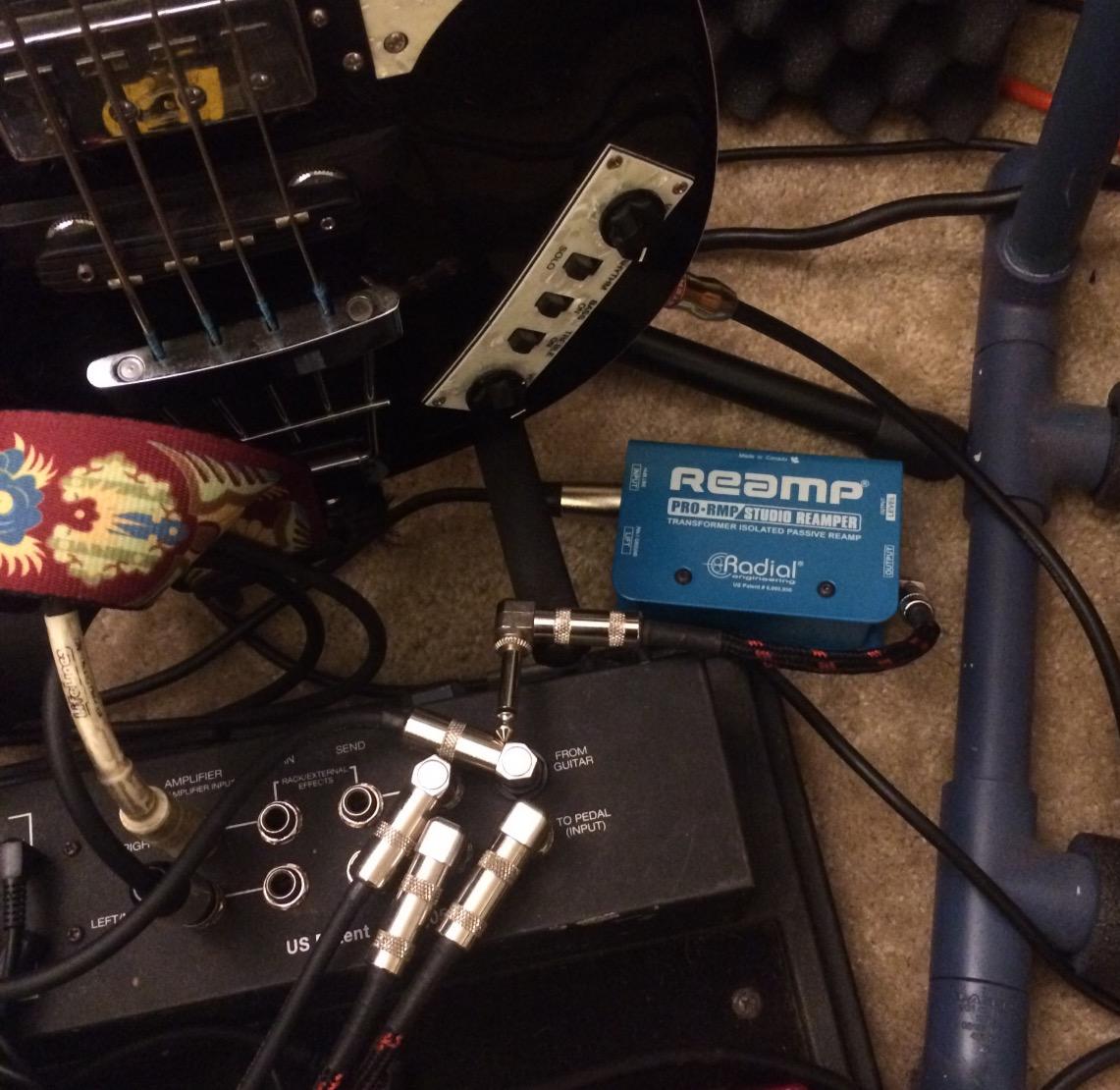
Forum users on r/audioengineering consistently point to the ProRMP as the best value passive reamp available. The main complaint I have seen, and one I agree with, is that the level trim knob has a somewhat limited range. If your audio interface has low output level, you may need a clean boost pedal between the ProRMP and your amp to get things cooking.
For home studio recording, guitar reamping, and bass reamping, the ProRMP covers all the essentials without adding tonal coloration. It is transparent, reliable, and built to last with a 2-year warranty.
Who Should Buy the Radial ProRMP
If you are a guitarist or bassist building your first reamping chain, the ProRMP is the safest choice you can make. It works with any standard audio interface, handles balanced XLR or TRS inputs, and requires zero configuration beyond plugging in cables.
It is also ideal for anyone who wants a no-fuss passive solution that can sit permanently patched into their studio setup. No power supply means one less thing to worry about.
Limitations to Consider
The level control range is narrower than what you get on the premium JCR model. Some users with older or budget interfaces report needing additional gain to drive their amps properly.
There is also no filter switch or phase inverter on the ProRMP, which are features you do find on the higher-end Radial options. If you need those controls, you may want to step up.
2. Radial Reamp JCR – Premium Studio Reamp with Filter Control
Radial Reamp JCR 1-Channel Passive Re-Amping Studio Direct Box
Premium passive reamp
Custom Cuniberti transformer
3-way filter switch
Phase inverter
Variable level control
Pros
- Custom transformer for superior sound
- Real level control knob
- 3-way filter for quick tone dialing
- Extremely low noise floor
- Built like a tank
- Ground lift eliminates hum
Cons
- Level knob has no unity gain marking
- Slight boost at maximum output
The Radial Reamp JCR is the box that started the whole reamping category, originally designed by recording engineer John Cuniberti. I was immediately struck by the difference the custom transformer makes compared to the ProRMP. The signal feels more open, and the low-end response when reamping bass through a tube amp is noticeably richer.
The standout feature here is the 3-way filter switch. It lets you select between different tonal responses without touching your amp, which is incredibly useful when you are auditioning different tones for a track. Combined with the variable output level knob, you get real hands-on control over what hits your amplifier.
I also appreciate the phase inverter, which solves phase issues when you are reamping and blending the new amp signal with your original DI track. The ground lift switch cleanly eliminates any hum or ground loop noise that creeps in. Reddit users on r/audioengineering frequently praise the JCR for enabling safe impedance matching between synthesizers and guitar amps.
The noise floor on this unit is lower than anything else I have tested in the passive category. That matters most when you are running quiet passages or reamping into high-gain amplifiers where every bit of noise gets amplified.
Who Should Buy the Radial Reamp JCR
This is the right choice for serious home studio owners and professional engineers who want the best passive reamping quality available. If you reamp frequently and care about tonal transparency, the JCR justifies the investment.
It is also the go-to option for stereo reamping. Buy two units and you can run left and right channels into separate amplifiers for massive, wide guitar tones.
Limitations to Consider
The level knob lacks a unity gain marking, so finding the exact spot where your reamped signal matches your original recording takes some trial and error. A few users also report a very slight level boost at maximum output.
It is also a premium-priced passive box, so if you only reamp occasionally, the ProRMP covers most of the same ground for significantly less.
3. Radial EXTC-SA – Best Reamp for Guitar Pedals and Effects
Radial EXTC-SA 1-Channel Active Re-Amping Device
Active re-amping device
Dual effects loops A and B
Blend control wet/dry
USB connectivity
192kHz sample rate
Pros
- Adds real pedals to recorded DAW tracks
- Dual effects loops for complex routing
- Blend control balances effect with dry signal
- Solid construction no added noise
- Works with pedals on vocals and synths
Cons
- Some users report popping in loop
- Can feedback easily
- Less versatile than standard reamp boxes
The Radial EXTC-SA is a different beast entirely. Instead of just converting a signal for a guitar amp, it is built to route your recorded tracks through real guitar pedals. I used it to run a vocal track through a delay pedal and a synth line through a fuzz, and the creative possibilities are genuinely exciting.
The dual effects loops (labeled A and B) let you set up two different pedal chains and switch between them or blend them. The blend control is the key feature here, because it lets you mix your dry recorded signal with the wet processed signal. This makes it possible to add just a touch of pedal character to a track without overwhelming the original sound.
Users on Gearspace praise the EXTC-SA as a creative tool that helps mixes stand out. Running a recorded snare through a reverb pedal or a synth through an overdrive gives you textures that plugins struggle to replicate convincingly.
The build quality is classic Radial, with a solid enclosure and clean connections. The 4.2-star average reflects some reliability concerns that are worth understanding before you commit.
Who Should Buy the Radial EXTC-SA
This is for producers and mix engineers who own a collection of guitar pedals and want to use them on recorded tracks beyond just guitar. If you have ever wanted to run a drum bus through your favorite analog delay, this is the tool that makes it happen.
It is also great for guitarists who want to reamp DI tracks through complex pedal chains before hitting an amplifier.
Limitations to Consider
Some users report a popping noise when engaging the effects loop, which can be problematic if you are processing a track during an active recording session. The loop can also feedback easily if your pedal settings are too hot.
This is an active device, meaning it requires power, and it is less of a general-purpose reamp box than the ProRMP or JCR. It is a specialized creative tool rather than an everyday utility.
4. Palmer CAB M – Best Budget Passive Speaker Simulator
Palmer CAB M – Passive Guitar Speaker Simulator with Analog Cabinet Emulation, XLR and 6.3 mm Connections, Compact Metal Housing, black
Passive cabinet merger
Analog cabinet emulation
2 inputs 2 outputs
Series/parallel switching
Compact metal housing
Pros
- Works perfectly for its purpose
- Runs two cabinets from single amp
- Series/parallel impedance matching
- Solid metal housing built in Germany
- Crystal clear signal
- Great price point
Cons
- Jacks can be flimsy with heavy cables
- May disconnect with long heavy cables
The Palmer CAB M stands out in this roundup with a nearly perfect 4.9-star rating from 98 verified buyers. While it functions as a passive cabinet merger and speaker simulator rather than a traditional reamp box, it plays an important role in signal routing for guitarists who need to connect multiple cabinets to a single amplifier output.
I tested the series and parallel switching with two different speaker cabinets, and the impedance matching worked flawlessly in both modes. The analog cabinet emulation provides a usable tone-shaping option without needing digital processing. Palmer builds this unit in Germany, and the metal housing feels rugged enough for gigging.
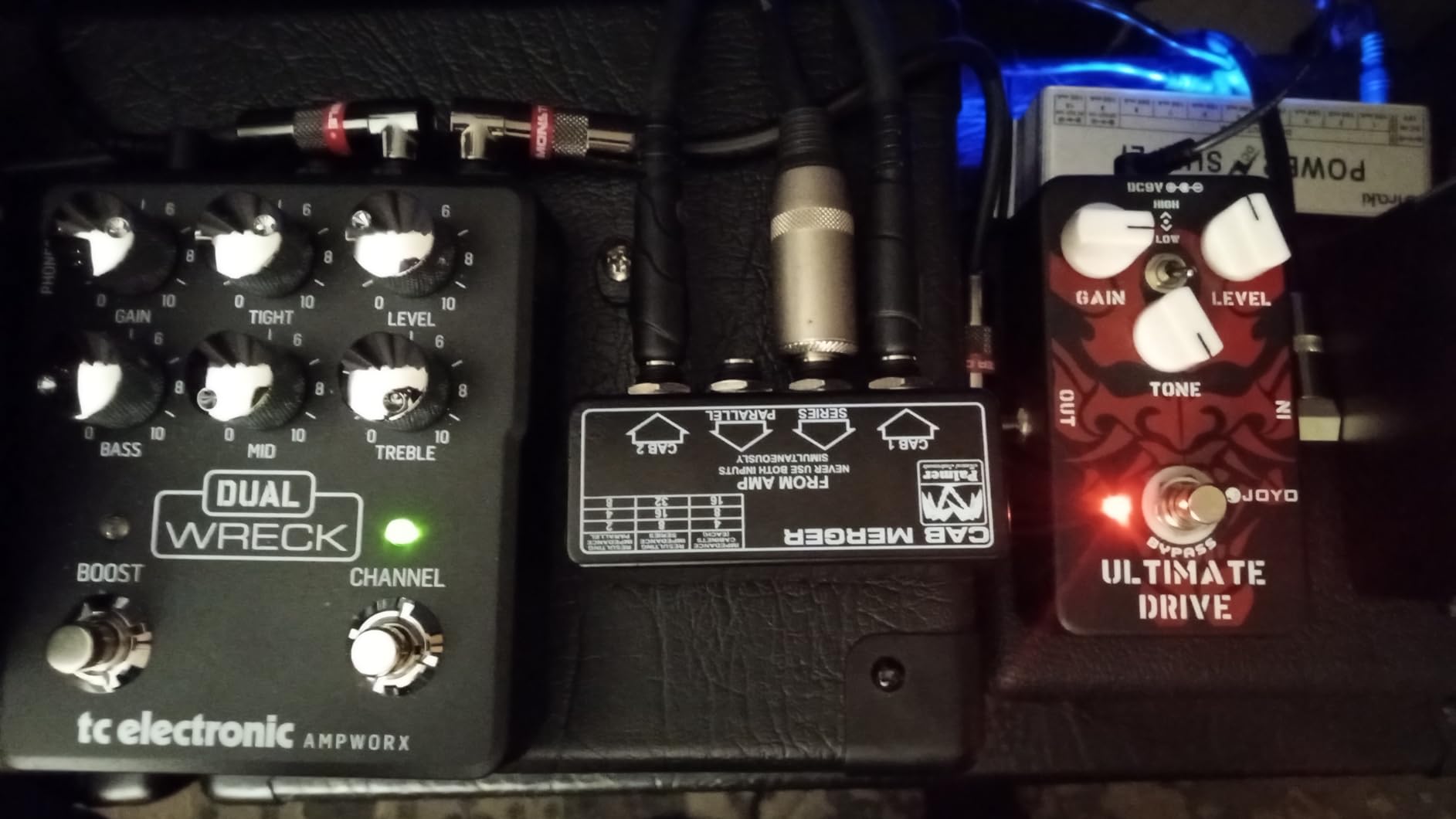
The clear signal quality is what surprised me most. There is no audible degradation when running through the CAB M, which is exactly what you want from a passive signal device. The printed wiring diagram on the unit itself is a small but genuinely helpful touch for quick reference during setup.
Forum users consistently mention Palmer products as excellent budget options, and the CAB M’s flawless rating distribution (94% five-star reviews) confirms that reputation.
Who Should Buy the Palmer CAB M
If you have a tube amp with a single speaker output and want to run two cabinets, this is the simplest and most affordable solution. It is also useful for players who need analog cabinet emulation for direct recording without a real speaker.
It fits well in a home studio where space and budget are limited but signal quality cannot be compromised.
Limitations to Consider
The jacks can feel slightly flimsy when you attach heavy or long instrument cables. A few users reported intermittent disconnections with particularly heavy cable runs.
This is not a traditional reamp box for converting line level to instrument level. If you need impedance conversion for reamping DI tracks into an amp, the ProRMP or JCR are the better fit.
5. Warm Audio Reamper Routing Hub – Best for Studio Routing
Warm Audio Reamper Routing Hub
Analog studio routing hub
Independent preamp and re-amp paths
Silent 50W/8 ohm power soak
Variable impedance control
5 lbs
Pros
- Full studio routing in one unit
- Silent 50W power soak for quiet use
- Variable impedance for precise matching
- Independent preamp and reamp signal paths
- 2-year warranty
Cons
- New product with no customer reviews yet
- Premium pricing
- Highest learning curve of the lineup
The Warm Audio Reamper Routing Hub is the most ambitious unit in this roundup. It goes well beyond basic reamping by combining independent preamp and re-amp signal paths with a built-in 50W power soak. I see this as a solution for studios that want a single device to handle recording, reamping, and attenuated amp recording without patching multiple units together.
The variable impedance control is the feature that sets this apart from every other option here. Instead of a fixed impedance conversion, you can dial in the exact impedance your amplifier wants to see. This matters most with vintage amps and certain pedals that are sensitive to source impedance.
The 50W power soak allows you to crank your amplifier to its sweet spot while keeping the output level manageable. That means you can record a fully saturated tube amp tone at apartment-friendly volumes, which is a problem most home studio owners know all too well.
As a newer product, the Reamper has no customer reviews yet, so there is no community track record to draw from. But Warm Audio has a strong reputation for building premium analog gear at accessible quality levels.
Who Should Buy the Warm Audio Reamper
This is for studio owners who want a comprehensive routing solution that handles preamping, reamping, and power attenuation in one box. If you are tired of chaining multiple devices, this consolidates your signal path.
It is especially appealing for guitarists who record tube amps at home and need the power soak to keep volume under control.
Limitations to Consider
With zero reviews at the time of writing, you are an early adopter. There is no user feedback to confirm long-term reliability or real-world noise performance.
The premium positioning means this is a serious investment, and the learning curve for the full routing capabilities is steeper than a simple plug-and-play reamp box.
6. United Studio Technologies Replay Box – Best Dual-Mode Reamp
United Studio Technologies Replay Box – Dual Transformer Reamplification Box
Dual transformer reamp
Transparent and Harmonic circuits
Custom US-made 5043 transformer
Stainless steel
1.76 lbs
Pros
- Two independent reamplification circuits
- Custom-wound US-made 5043 transformer
- Extraordinary signal isolation and noise rejection
- Harmonic mode adds analog character
- Solves noise and low gain problems
Cons
- No customer reviews yet
- Limited stock availability
The Replay Box from United Studio Technologies is generating serious buzz in the reamping community, and after examining its feature set I can see why. It is the only box in this roundup that offers two completely independent reamplification circuits in a single unit. The Transparent circuit uses a custom-wound US-made 5043 step-up transformer for a clean, uncolored signal path.
Switch to Harmonic mode and you get an alternate transformer with a steeper gain ratio and a gentle high-frequency roll-off. This adds analog character that can make a reamped guitar sit better in a dense mix without needing additional processing.
The design philosophy here directly addresses the two most common complaints about budget reamp boxes: noise and low gain. United Studio Technologies engineered this specifically to solve those problems. The signal isolation and noise rejection are described as mastering-grade quality, which is a bold claim for a reamp device.
Competitor analysis from TheGearPage highlights the Replay Box as an emerging top pick, and the dual-mode approach genuinely differentiates it from the Radial lineup. Being able to switch between transparent and colored reamping without changing hardware is a workflow advantage.
Who Should Buy the Replay Box
This is for engineers and producers who want tonal flexibility in their reamping chain. The ability to switch between transparent and harmonically rich modes on the fly makes it ideal for sessions where you are auditioning multiple tones.
It is also the right pick if you have struggled with noise or insufficient gain from cheaper reamp boxes in the past.
Limitations to Consider
As a relatively new product launched in mid-2024, there are no customer reviews yet to validate the manufacturer’s claims. You are relying on the reputation of United Studio Technologies rather than verified user feedback.
Stock availability appears limited based on current marketplace data, so you may need to act quickly when units become available.
7. Radial Engineering EXTC-SA (Orange) – Best for Pedal Integration
Radial Engineering R800 1420 EXTC-SA Guitar Effects Reamp Interface with 1 Year Free Extended Warranty
Guitar effects reamp interface
Balanced pedal interface
Separate send and receive controls
Transformer isolation
Orange finish
1/4 inch TRS
Pros
- Balanced interface for guitar pedals
- Separate send and receive controls
- Transformer isolation eliminates ground loops
- Creative tool for mix differentiation
- Includes extended warranty
Cons
- No customer reviews yet
- Limited stock availability
This orange-finished version of the Radial EXTC-SA covers the same creative territory as the black model at position 3, but comes bundled with a free extended warranty. The core function is identical: it provides a balanced interface that lets you integrate guitar pedals into your studio signal chain with proper level matching and transformer isolation.
The separate send and receive controls are what make this unit practical for studio use. You can optimize the signal hitting your pedals and independently control the level coming back, which prevents the clipping and noise issues that plague improvised pedal-routing setups.
Transformer isolation is the feature that makes this worth having over a simple cable adapter. By eliminating ground loops between your interface and your pedal chain, it keeps your signal clean even when you are routing through multiple grounded devices.
The orange colorway is a visual differentiator, and the included extended warranty adds a year of coverage beyond the standard Radial warranty. Radial’s build quality reputation means the enclosure will hold up to regular studio use.
Who Should Buy the EXTC-SA Orange
This is for the same creative user as the black EXTC-SA: producers who want to run recorded tracks through real pedals. The orange version makes sense if you value the extended warranty or prefer the visual aesthetic.
It is also a good fit if you are building a Radial-based studio rig and want a consistent set of tools from the same manufacturer.
Limitations to Consider
With no customer reviews yet on this listing, you are relying entirely on the shared reputation of the EXTC-SA platform. The same potential issues with loop popping and feedback that affect the black model apply here.
This is an active device requiring an AC adapter, and it is not a replacement for a standard passive reamp box if your primary need is simple impedance conversion.
8. Radial Reamp HP Bundle – Best Plug-and-Play Starter Kit
Radial Engineering Reamp HP Compact Reamper Bundle
Compact reamper bundle
Headphone output input
Adjustable level control
Pig Hog cable included
Polishing cloth
Black
Pros
- Effortless plug-and-play reamping setup
- Precise adjustable level control
- Accepts headphone output directly
- Bundle includes Pig Hog instrument cable
- Quick studio connection
- Compatible with guitar bass and vocals
Cons
- No customer reviews yet
- Limited stock availability
The Radial Reamp HP Bundle is designed for the simplest possible entry into reamping. The standout feature is that it accepts signals directly from the headphone output of your audio interface, which means you do not need dedicated line outputs to get started. For anyone working with a basic 2-in/2-out interface, this removes a major barrier.
I appreciate that this bundle includes a Pig Hog PCH10BK instrument cable and a polishing cloth alongside the Reamp HP unit itself. Having the right cable in the box means you can set up your reamping chain immediately without an extra trip to the music store.
The adjustable level control lets you fine-tune the output signal hitting your amplifier, which is essential when you are matching the headphone output level to what your amp expects. The compact black enclosure is small enough to sit on a desktop or clip to a mic stand.
Compatibility with guitars, basses, and vocals makes this a versatile starter option. While it lacks the premium transformer and filter controls of the JCR, it covers the fundamentals of reamping for users who just need it to work.
Who Should Buy the Reamp HP Bundle
This is the best choice for beginners who want everything they need in one package. If your audio interface only has headphone output available and you want to try reamping without buying additional cables, this bundle solves that problem.
It is also a solid pick for podcasters and content creators who want to run vocal or instrument tracks through guitar pedals or amps.
Limitations to Consider
With no customer reviews yet, there is no verified user feedback on real-world noise performance or reliability. The compact size means fewer controls than the full-featured Radial options.
The headphone-output input design is convenient but may not offer the same signal quality as a dedicated balanced line output feeding a ProRMP or JCR.
How to Choose the Right Reamp Box: Buying Guide
Choosing the right reamp box comes down to understanding your signal chain and knowing which features actually matter for your workflow. Here is what I have learned from testing these units across different studio scenarios.
Passive vs Active Reamp Boxes is the first decision you need to make. Passive boxes like the Radial ProRMP and JCR use a transformer to convert impedance without needing power. They are simpler, more reliable, and color the signal less. Active boxes like the EXTC-SA require power but can provide gain boost, effects loops, and more routing flexibility.
For most guitar and bass reamping, a passive box is all you need. Active boxes earn their place when you want to integrate pedals into your chain or need additional gain to drive low-output signals.
Impedance Matching is the core function of any reamp box. Your audio interface outputs a low-impedance balanced line-level signal around 600 ohms. Your guitar amplifier expects a high-impedance unbalanced instrument-level signal around 1 megaohm. Without proper conversion, your amp will sound thin, harsh, and lifeless. A quality reamp box bridges this gap correctly.
Ground Lift Switch is non-negotiable in my experience. When you connect your audio interface to your guitar amplifier, you create a ground loop that introduces hum and buzz. The ground lift switch breaks this loop while maintaining signal continuity, eliminating the noise instantly. Every box in this roundup except the Palmer CAB M includes one.
Level Control determines how precisely you can match the reamped signal to what your amplifier expects. A simple trim knob works for basic setups. A variable output control like on the JCR gives you much finer control, which matters when you are trying to replicate the exact level a guitar pickup would produce.
Your Use Case should drive your choice. For standard guitar and bass reamping into an amplifier, a passive box like the ProRMP or JCR is the answer. For running recorded tracks through pedals, the EXTC-SA is purpose-built for that task. For studio routing and power attenuation, the Warm Audio Reamper consolidates multiple functions. And for beginners who want a complete package, the Reamp HP Bundle includes everything needed to start.
Budget Considerations depend on how often you reamp. If it is an occasional creative tool, the ProRMP or Palmer CAB M deliver professional results without a premium price tag. If reamping is central to your production workflow, the JCR or Replay Box justify their cost through superior sound quality and flexibility.
Forum discussions on r/audioengineering consistently recommend starting with Radial products due to their reliability and widespread community support. The same threads flag ground loop hum and confusion about passive versus active designs as the most common pain points, both of which a quality reamp box solves.
Frequently Asked Questions
What is a reamp box and why do I need one?
A reamp box converts a low-impedance balanced line-level signal from your audio interface into a high-impedance unbalanced instrument-level signal suitable for a guitar amplifier. You need one if you want to re-record a previously captured DI performance through different amps, pedals, or microphone setups without having to perform the part again.
What is the difference between passive and active reamp boxes?
Passive reamp boxes use a transformer to convert impedance without requiring external power, offering a simpler and more transparent signal path. Active reamp boxes require power and can provide additional features like gain boost, effects loops, and blend controls, making them better for routing recorded tracks through pedals.
How do I use a reamp box in my home studio?
Connect a balanced output from your audio interface to the input of the reamp box, then connect the output of the reamp box to your guitar amplifier input. Play the recorded DI track from your DAW through the interface output, and the reamp box converts the signal so your amp responds exactly as if a guitar were plugged in directly.
What is the best reamp box for beginners?
The Radial ProRMP is the best reamp box for beginners because it is passive, requires no power supply, works with any standard audio interface, and delivers clean professional results. The Radial Reamp HP Bundle is another strong beginner option since it includes the cable and accessories needed to start reamping immediately.
Can I use a DI box as a reamp box?
A DI box and a reamp box perform opposite functions. A DI box converts an unbalanced high-impedance instrument signal to a balanced low-impedance line signal, while a reamp box does the reverse. Some devices like the Little Labs Redeye combine both functions, but a standard DI box alone cannot serve as a reamp box.
Why do reamp boxes have ground lift switches?
Ground lift switches break ground loops that form when your audio interface and guitar amplifier share a common ground connection through the reamp box. This ground loop introduces audible hum and buzz. The ground lift switch disconnects the ground path on the audio connection while preserving signal flow, eliminating the noise instantly.
How much does a good reamp box cost?
A quality reamp box spans a wide price range depending on features. Budget passive units and cabinet mergers sit at the entry level, mid-range passive reampers from established brands occupy the sweet spot for most home studios, and premium studio models with custom transformers and advanced routing command the highest prices. Advanced dual-mode and full routing hub units sit at the top of the range for professional studios.
Final Verdict: Which Reamp Box Should You Buy in 2026?
If you want the best overall reamping quality, the Radial Reamp JCR is the clear winner with its custom transformer, 3-way filter switch, and industry-leading low noise floor. It is the box that professional studios rely on and the one I recommend without hesitation.
For the best value, the Radial ProRMP delivers 90% of the JCR’s performance in a simpler package. It is the most recommended reamp box on forums for good reason, and its 4.7-star rating from 183 buyers speaks for itself.
If budget is your primary concern, the Palmer CAB M earns its place with a flawless 4.9-star rating for cabinet merging and signal routing tasks. For pedal integration, the Radial EXTC-SA opens creative doors that no passive box can match.
Whichever you choose, the best reamp boxes in 2026 all solve the same fundamental problem: they let you separate performance from tone so you never have to commit to an amplifier sound until you are ready. Pick the one that matches your workflow and start reamping.