
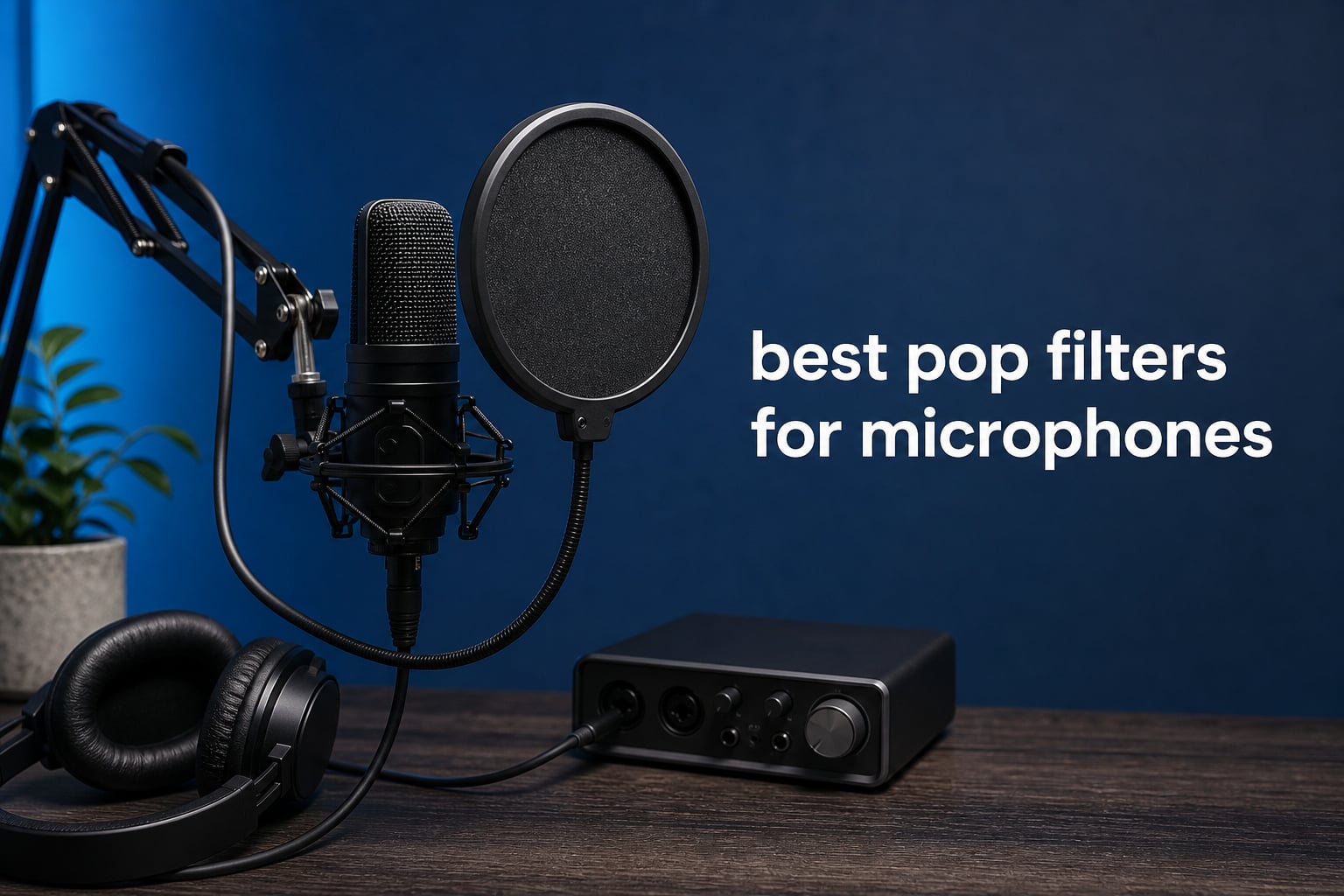
The best pop filters for microphones stop the burst of air from P and B sounds before it overloads the capsule. That small barrier can spare a vocal take, a podcast intro, or a live stream from the hard thump that is difficult to repair later.
A pop filter does not turn an untreated room into a studio, and it does not replace sensible mic technique. It diffuses and redirects airflow, while the microphone captures the voice behind it; that is why a well-fitted screen can help even a modest USB microphone sound more controlled.
I would start with the microphone, not the filter material. An exact-fit cover is usually the tidiest choice for a PodMic or a listed Audio-Technica model, while an arm-mounted metal screen is more flexible when the setup changes; the eight picks below cover both approaches without pretending that one design fits every mic.
The top three choices cover most recording setups in 2026
The Stedman Proscreen XL V2 is the most substantial all-metal, arm-mounted option here. The Aokeo is a broadly compatible metal-mesh alternative, while the KayNicam sleeve is the compact choice for compatible cylindrical microphones.

Stedman Proscreen XL V2
- 6.125 in metal screen
- 16.5 in heavy-duty gooseneck
- Clamp fits arms up to 1.5 in


KayNicam 3-Layer Professional Cover
- Mesh metal and foam layers
- Elastic sleeve
- Fits 35-60 mm microphones
These eight pop filters make the shortlist in 2026.
Use this overview to narrow the field by mounting style and microphone fit. A stated compatibility match matters more than a generic claim, especially when a boom arm, shock mount, or microphone body has limited clearance.
| Product | Specifications | Action |
|---|---|---|
| Stedman Proscreen XL V2 |
|
View on Amazon |
| Aokeo Metal Pop Filter |
|
View on Amazon |
| KayNicam 3-Layer Cover |
|
View on Amazon |
 RØDE WS14 RØDE WS14 |
|
View on Amazon |
 HyperX Shield HyperX Shield |
|
View on Amazon |
 Audio-Technica AT8175 Audio-Technica AT8175 |
|
View on Amazon |
 SUUNTOK Metal Pop Filter SUUNTOK Metal Pop Filter |
|
View on Amazon |
 GDPONRM Isolation Ball GDPONRM Isolation Ball |
|
View on Amazon |
1. The Stedman Proscreen XL V2 is the most durable large-screen choice.
StarlitGem Stedman Proscreen XL V2 Pop Filter for Microphones
6.125 in metal screen
16.5 in heavy-duty gooseneck
Clamp fits arms up to 1.5 in
Pros
- Metal airflow redirection
- Oversized screen
- Heavy-duty gooseneck
- All-metal construction
- Tool-free setup
Cons
- Only 17 listed reviews
- Needs a boom arm or stand clamp
The Proscreen XL V2 is the pick I would put beside a fixed vocal position where a large shield and a firm gooseneck matter. Its stated 6.125-inch metal screen gives the singer or speaker more room to move slightly without drifting beyond the protected area.
Stedman says its metal screen redirects airflow downward rather than relying on a fabric layer to catch it. That design is aimed at taking the force out of P and B plosives while preserving vocal clarity, which is the central trade-off with any plosive filter.
The 16.5-inch heavy-duty gooseneck and clamp for boom arms up to 1.5 inches wide address two complaints that show up often in voice-recording discussions: a screen that sags and a clamp that cannot grip the arm. I would still measure a thick or unusually shaped arm before ordering.
Its all-metal construction and Made in USA claim make this a focused choice for a long-lived studio pop filter. The limited review volume is the reason to treat the 4.6 rating as useful, but less broadly proven than a similarly rated item with thousands of ratings.
The large metal screen suits a consistent seated or standing vocal position.
Choose this design when the microphone stays on a desk arm or studio stand and the performer works close to the same spot. The oversized screen gives more latitude than a small round shield while leaving the microphone itself uncovered.
It is also a sensible fit for singers and voice actors who want a physical distance marker. Put the screen between the mouth and mic, then speak or sing into it rather than pressing toward the capsule.
The clamp fit needs checking before a purchase.
The published clamp limit is boom arms up to 1.5 inches wide. That is a concrete compatibility check, and it matters more than whether a product calls itself universal.
If your setup has no arm or stand edge to clamp onto, select a microphone-specific cover instead. A large external screen also needs room in front of the mic, so it is less tidy for an extremely tight camera frame.
2. The Aokeo Metal Pop Filter is the broad-compatibility metal-mesh choice.
Aokeo Metal Pop Filter,Metal Mesh Layer Microphone Windscreen for Hyperx QuadCast, Blue Yeti and Other Mics,Pop Shield with Flexible 360° Gooseneck Clip Stabilization Arm
Metal mesh
Steel gooseneck
Adjustable rotating clamp
Pros
- Universal compatibility
- Durable metal mesh
- Adjustable gooseneck
- Scratch-proof gripper
- For singers streamers and actors
Cons
- May need positioning adjustment
- Clamp setup takes more space
The Aokeo is one of the best pop filters for microphones when the mic may change later, because it uses an adjustable screw clamp and a separate steel gooseneck rather than a model-specific shell. The product data specifically names HyperX QuadCast and Blue Yeti among the microphones it is made to work with.
Its curved metal design is intended to block pops, hissing, and lisping sounds. I would regard the metal mesh as the long-term practical feature here: it is less exposed to stretching than nylon, and it can be wiped rather than needing a delicate fabric wash.
The large review base of more than 12,000 ratings gives its 4.5 rating more context than a new listing with a similar average. That does not remove the need to position it properly; a user still has to aim the screen at the mouth-to-capsule path.
The rotating clamp uses a scratch-proof gripper, and the gooseneck is described as fully supporting the filter. Those details make sense for a desk-mounted streaming microphone, where a clamp that twists or a screen that slowly falls can interrupt a recording session.
The flexible clamp works with changing desk and boom-arm setups.
This is the one I would choose for a Blue Yeti, QuadCast, or another microphone that may move from a desk stand to an arm. The separate filter can be positioned without relying on the microphone body having a particular shape.
Leave enough room to rotate the clamp and keep it clear of a shock mount. A few minutes spent checking arm thickness and cable routing prevents a clamp from fighting the rest of the setup.
The metal screen needs deliberate mouth-to-mic alignment.
Metal mesh does not make placement automatic. Start with the screen a short distance in front of the microphone and talk through it, then move it until forceful consonants are controlled without blocking the camera or your notes.
Do not stack a second pop filter in front of it by default. Voice-acting discussions report that two screens can reduce articulation and create a lispy quality, so add another layer only after recording a clear comparison.
3. The KayNicam 3-Layer Cover is the compact sleeve option for compatible mics.
KayNicam Pop Filter for Microphone, 3-Layer Professional Cover (Mesh/Metal/Foam) with Elastic Sleeve, Universal Fit for 1.4″ to 2.4″ (35-60mm) Mics, for Podcasting, Streaming, Recording. POP SHIELD
Mesh metal and foam layers
Elastic sleeve
Fits 35-60 mm microphones
Pros
- Three-layer construction
- Portable design
- ABS frame
- Wide 35-60 mm fit
- Easy head installation
Cons
- Does not fit Blue Yeti
- Fit must match microphone diameter
The KayNicam takes a different route from a clamped circular screen: its elastic sleeve fits over the microphone head. The stated fit range is 35 to 60 mm, so the first step is to measure the widest part of the mic you plan to cover.
Its three-layer design combines mesh, metal, and foam, with the listing describing plosive and sibilance reduction. I would consider it for a compact podcasting or travel rig where an external gooseneck and clamp would add more hardware than the desk can comfortably hold.
The product data lists compatibility with several cylindrical models, including the AT2020, Rode NT1, and Scarlett CM25. It also plainly excludes Blue Yeti microphones, which is a helpful reminder that sleeve covers are about body diameter and shape, not just microphone category.
An ABS frame and lightweight size suit a filter that stays attached to the microphone. Unlike a gooseneck filter, it cannot act as a distance guide for the speaker, so careful technique remains part of the setup.
The sleeve design saves space on a small recording desk.
Select this type when your microphone is the right diameter and you want no clamp, arm, or separate screen in front of it. It can keep a compact streaming or narration setup less crowded.
It is not a universal answer for every large USB microphone. Check the specified 35 to 60 mm range and the microphone head shape before choosing it.
The three layers need regular inspection and gentle cleaning.
Foam and fine mesh can collect moisture and dust during frequent voice work. Remove the cover according to its fit, then use a soft dry brush or a lightly damp cloth only when the maker’s care directions permit it.
Let every layer dry completely before returning it to the microphone. A clean cover makes it easier to assess whether a dull sound comes from placement, the room, or the filter itself.
4. The RØDE WS14 is the low-profile exact-fit option for PodMic users.
RØDE WS14 Premium Pop Filter for PodMic and PodMic USB (White)
For PodMic and PodMic USB
High-density foam
Low-profile design
Pros
- Purpose-built PodMic fit
- Discreet on-camera profile
- Shape-supporting ribs
- High-density foam
- Multiple colour choices
Cons
- Only fits specified PodMic models
- Foam needs more care than metal mesh
The RØDE WS14 solves the compatibility question by being purpose-built for the PodMic and PodMic USB. I would pick a designed-for-the-mic cover like this when a clean camera profile and a stable fit matter more than being able to reposition a separate screen.
RØDE describes the WS14 as high-density foam with supporting ribs to hold its shape. The low-profile form is relevant to video podcasts and streaming, where a round screen on a long gooseneck can compete with the presenter in the frame.
At 34 grams, it adds little stated weight to the microphone. The available color choices may help it match a visible setup, but the practical reason to buy it is still the exact PodMic and PodMic USB fit.
The limitation is clear: it is not a universal microphone pop filter. A different mic needs a different option, and foam also deserves more routine attention than a metal screen because it can retain dust and moisture.
The purpose-built cover keeps a PodMic setup visually simple.
Use the WS14 if your recording chain already centers on a PodMic or PodMic USB and you want a filter that does not require a desk clamp. It is especially useful when the microphone appears on camera at close range.
The fitted form also avoids the trial-and-error of positioning a gooseneck. That is helpful for a repeatable podcast desk where the mic stays in one location.
The foam cover needs routine hygiene checks.
Inspect high-density foam for dust, makeup transfer, or moisture after regular sessions. Follow the manufacturer’s care guidance rather than soaking it, since shape retention is part of the product’s design.
If the foam looks worn or no longer sits evenly on the ribs, replace it rather than forcing it into place. A clean, correctly seated cover has a better chance of working as intended.
5. The HyperX Shield is the adjustable metal-mesh pick for HyperX rigs.
HyperX Shield Microphone Pop Filter
Corrosion-resistant metal mesh
13.5 in gooseneck
Rubber-padded C-clamp
Pros
- Easy-clean metal mesh
- 35 cm gooseneck
- Toolless mounting
- Rubber-padded clamp
- HyperX shock-mount compatibility
Cons
- Mainly designed for HyperX setups
- Heavier than a foam cover
The HyperX Shield is a standalone metal screen with a 35 cm, or 13.5-inch, flexible gooseneck. It is designed to work with HyperX QuadCast and ProCast microphone families, and its stated compatibility with most HyperX shock mounts makes it a strong match within that ecosystem.
The corrosion-resistant metal mesh is described as easy to clean. I like this construction for a shared recording station, where a screen benefits from a quick wipe-down between users instead of relying on fabric that can stretch or absorb residue.
Its C-clamp mounts without tools to most microphone arms or stands and includes rubber padding. The padding is a small detail, but it matters when you want a clamp to stay put without marking a painted arm or desk edge.
Although the product is marketed around HyperX gear, the standalone clamp is not physically tied to one microphone body. Check the arm, stand, and shock-mount geometry first, then treat the named HyperX compatibility as the surest starting point.
The padded clamp suits an arm or stand that needs tool-free changes.
Pick the Shield when you move a microphone arm between streaming, gaming, and recording positions. The 13.5-inch gooseneck offers enough reach to keep the screen in the airflow path while leaving the microphone controls accessible.
Make one adjustment at a time: clamp position first, gooseneck curve second, and screen angle last. That sequence makes it easier to identify what shifted if the filter starts to sit too close to the capsule.
The metal mesh supports easy surface cleaning.
For routine cleaning, disconnect the filter from the immediate work area and gently wipe the metal mesh with a clean, lightly damp cloth. Do not push the mesh inward or apply liquid near a connected microphone.
Dry it before recording, then listen to a short spoken sample. Cleaning is also a good time to check the gooseneck for a loose joint or a clamp pad that has accumulated debris.
6. The Audio-Technica AT8175 is the stable dedicated choice for AT20-series mics.
Audio-Technica AT8175 20 Series Exclusive Pop Filter Pop Guard Compatible Models: AT2020USB-X AT2020USB+ AT2020, AT2020GM AT2035, AT2050
AT20-series design
Stable installation
For vocals and narration
Pros
- Dedicated AT20-series fit
- Stable installation
- Pop-noise reduction
- For narration and vocals
- Two-year warranty
Cons
- Limited to listed AT20 models
- Not a universal clamp-on design
The Audio-Technica AT8175 is built for the AT20 series rather than for a general boom arm. The manufacturer lists the AT2020USB-X, AT2020USB+, AT2020, AT2020GM, AT2035, and AT2050 as compatible models, so owners of those microphones can make a direct fit decision.
Its stated purpose is to reduce popping noise for web distribution, vocals, and narration recording. I would favor a manufacturer-matched part when a generic clamp would interfere with the microphone’s controls, body shape, or normal positioning.
At 31.1 grams, it is listed as light, and its stable installation is the key feature rather than a long reach or a large screen. That can be useful in a small home studio where an external circular pop screen would take up camera or monitor space.
The trade-off is simple: this pop guard is only helpful if you own one of the listed AT20-series models. A Blue Yeti, a PodMic, or a differently shaped condenser needs a different filter, even if it is used for the same voice-over task.
The listed AT20-series compatibility removes most fit uncertainty.
This is the direct choice for an AT2020USB-X, AT2020USB+, AT2020, AT2020GM, AT2035, or AT2050. Read the exact model name on the microphone before ordering, since closely related product families can have different bodies.
A dedicated guard also keeps the visual setup restrained. That can suit narration, remote calls, and a camera angle where a large round screen is unwanted.
The close-fitting design still benefits from off-axis speaking.
Turn the microphone slightly so forceful airflow is not aimed straight at the capsule, then speak across it rather than directly into it. This off-axis technique works alongside a filter and does not require extra gear.
Record a sentence with several P and B sounds at your usual volume. If pops persist, adjust your distance before adding another filter layer, because too much screening can make articulation less natural.
7. The SUUNTOK Metal Pop Filter is the reinforced-gooseneck universal option.
SUUNTOK Pop Filter, Upgraded High Performance Microphone Pop Filter, Ideal Pop Filter for Microphone Recording Sessions and Broadcasting (Metal)
Steel shield
12.2 in reinforced gooseneck
Clamp fits arms up to 1.5 in
Pros
- Steel construction
- Long reinforced gooseneck
- Wide universal clamp
- All-in-one kit
- Tool-free setup
Cons
- Heavier than foam alternatives
- Requires a clamp mounting point
The SUUNTOK combines a steel metal shield, a 12.2-inch reinforced gooseneck, and a universal clamp in one kit. Its stated clamp capacity is up to 1.5 inches wide across round, square, or oversized boom arms, which makes mounting compatibility its headline strength.
I would look at this model when a standard thin gooseneck has been a source of frustration. The reinforced arm is explicitly intended to prevent sagging, a worthwhile specification for a screen that must hold its angle through a long podcast or streaming session.
It is available in several screen widths: 3.4, 4.5, 5.4, and 6.9 inches. That range lets the buyer choose coverage based on how much room exists around the microphone instead of assuming the largest screen is always better.
Metal construction adds weight compared with a foam cover, but the all-in-one format provides the filter, clamp, and gooseneck together. A clamp-on design remains a poor fit for a microphone that only sits on a small tripod with no usable mounting edge.
The clamp range suits many round and square boom arms.
Check the arm at the intended clamp point, not at its thinnest section. The listed maximum is 1.5 inches wide, and irregular braces or cable channels can change the real space available.
Once mounted, keep the gooseneck curve gentle rather than folding it sharply. That preserves reach and makes small placement corrections easier.
The screen-width choices let you match coverage to your recording space.
A smaller screen can make sense in a close camera shot or a tightly packed desk. A wider screen gives more room for a vocalist who changes position slightly while speaking or singing.
Choose for the airflow path, not for visual size alone. The screen only needs to sit between the mouth and capsule; it does not need to cover every part of the microphone body.
8. The GDPONRM Isolation Ball adds foam treatment around compatible condenser mics.
GDPONRM Microphone Wind Shield Pop Filter Isolation Ball, Acoustic for Record Studios Mic, Sound-Absorbing Foam Five-sided Seal Design to Effectively Reduces Noise and Reflections, black
Five-sided foam seal
Dual-layer pop filter
Fits 50-68 mm microphones
Pros
- Sound-absorbing foam
- Dual-layer filter
- Five-sided seal
- Portable 200 g design
- 50-68 mm compatibility
Cons
- Mic and holder are not included
- Fit is limited to 50-68 mm mics
The GDPONRM Isolation Ball is more than a front screen: it uses high-density foam and a five-sided seal around the microphone. The listing also includes a dual-layer pop filter, so this is the option for someone who wants plosive control alongside some reduction of nearby audio-wave bounce and interference.
It is specified for microphones with a 50 to 68 mm diameter and weighs 200 grams. I would measure the condenser microphone body and check that the mount can carry the combined arrangement before treating it as a drop-on solution.
This design is portable and aimed at podcasting, dubbing, live streaming, and recording. It can be useful where a full reflection filter would be too large, but it is not a replacement for treating a noisy room or moving away from a reflective wall.
The microphone and holder are not included. That sounds obvious, yet it affects the real setup: you still need a stable stand or arm and a microphone whose diameter falls inside the published range.
The five-sided foam design helps in a compact reflective recording area.
Choose this form when the microphone sits near hard surfaces and you need a portable layer of surrounding foam as well as a plosive screen. It is a more involved accessory than a flat circular filter.
Keep expectations narrow: foam around the mic can reduce nearby reflections, but it cannot remove traffic noise, computer fans, or every room problem. Source noise should be reduced before recording whenever possible.
The 50 to 68 mm fit range is the deciding compatibility check.
Measure in millimeters at the microphone body section that enters the isolation ball. A near match is not the same as a safe fit, especially if switches, knobs, or a shock mount add width.
Do not force foam around an oversized microphone. A compressed or misshapen fit can obstruct controls and makes it harder to place the microphone consistently.
A good pop filter works by breaking up plosive airflow before the capsule.
A plosive is the fast air burst created by consonants such as P and B. When that burst hits a microphone capsule directly, it can create a low-frequency thump or distorted pop that is much harder to remove than a normal level adjustment.
The basic setup is simple: place the pop filter between the mouth and the microphone, then position the microphone and filter so the screen catches the airflow without becoming an obstacle. Start with the filter roughly 2 to 3 inches from the microphone, then speak at your normal recording distance and listen back.
A nylon screen is light and forgiving, while metal is durable and easier to wipe.
Dual-layer nylon designs diffuse air through fabric layers and can work well for vocals and speech. Their downsides are stretching, tearing, and the possibility of retaining dust or moisture after frequent use.
Metal screens redirect and disperse airflow through a rigid mesh. They are generally easier to clean and less likely to lose tension, though screen shape, clamp quality, and placement still decide whether the result sounds clear.
A dedicated cover is best when the microphone model is listed by name.
Choose a fitted product such as the RØDE WS14 or Audio-Technica AT8175 when your exact microphone is listed as compatible. A dedicated part usually takes less space and avoids guessing whether an arm clamp will clear a shock mount.
Choose a universal clamp-on screen when you use several microphones, need adjustable distance, or have a model such as a Blue Yeti that benefits from a separate screen. Measure both microphone clearance and clamp location before ordering.
A firm gooseneck and a padded clamp prevent the most annoying setup failures.
A weak gooseneck can sag slowly, turning a carefully placed screen into an ineffective one. Look for stated reinforced or heavy-duty construction when you record for long periods or use a heavier metal screen.
Check clamp width, desk thickness, and arm shape. Rubber pads or scratch-proof grippers help protect the surface, but they do not make an undersized or oversized clamp fit.
Off-axis technique reduces plosives even when a filter is installed.
Angle the microphone slightly and speak across the front rather than blasting air directly into it. This approach can lower plosive force without asking a filter to do every part of the job.
Start with one filter and record a short test sentence containing words such as “people,” “podcast,” and “bright.” If P sounds still hit hard, adjust distance and angle first; stacking two filters can reduce clarity and articulation.
Regular cleaning keeps foam, fabric, and mesh ready for close vocal work.
Wipe metal mesh gently with a clean cloth and dry it fully before use. For foam or fabric, follow the maker’s care directions, remove surface dust carefully, and avoid aggressive washing that changes the material or fit.
Make cleaning part of a monthly setup check. Also inspect clamps, threads, gooseneck tension, elastic sleeves, and the microphone’s own grill, because a loose mount or blocked screen can affect your recording routine.
These common pop-filter questions have direct answers.
What is a pop filter and how can it help with a cheap microphone?
A pop filter is a screen or cover that diffuses the burst of air from P and B sounds before it hits a microphone capsule. It can help a modest microphone record speech more cleanly by reducing plosive thumps, although it cannot remove room noise or replace careful mic positioning.
Is it worth it to get a pop filter for my microphone, and what exactly does it do?
A pop filter is useful for podcasts, vocals, streaming, voice acting, and narration because it breaks up and redirects plosive airflow before it reaches the microphone. Use it with a sensible speaking distance and slight off-axis angle for the best chance of clear articulation.
How do I choose the best pop filter?
Match the filter to your microphone and mounting space first. Choose a dedicated cover for an exact listed model, a clamp-on metal screen for adjustable placement, or a sleeve only when the published diameter range matches your microphone; then check gooseneck strength, clamp width, and cleaning needs.
How do I stop plosives without a pop filter?
Move slightly off-axis, keep a little more distance from the microphone, and speak across rather than straight into the capsule. These techniques reduce direct air blasts, but a correctly placed pop filter remains the more consistent solution for close vocal recording.
What’s the current Best Pop filter?
The best choice depends on microphone fit and mounting needs. The Stedman Proscreen XL V2 is the all-metal large-screen choice in this guide, while the Aokeo offers a universal metal-mesh clamp approach and the RØDE WS14 is designed specifically for PodMic and PodMic USB users.
The right choice is the one that fits your microphone and your recording routine.
For a large, durable external screen, I would start with the Stedman Proscreen XL V2. Choose the Aokeo or SUUNTOK when an adjustable clamp and metal mesh suit the rig, and choose the RØDE WS14 or AT8175 when the microphone is one of the explicitly supported models.
The best pop filters for microphones in 2026 are not interchangeable accessories. Measure first, mount the filter about 2 to 3 inches from the mic, test it with your normal speaking voice, and pick the option that controls airflow without crowding the way you record.