
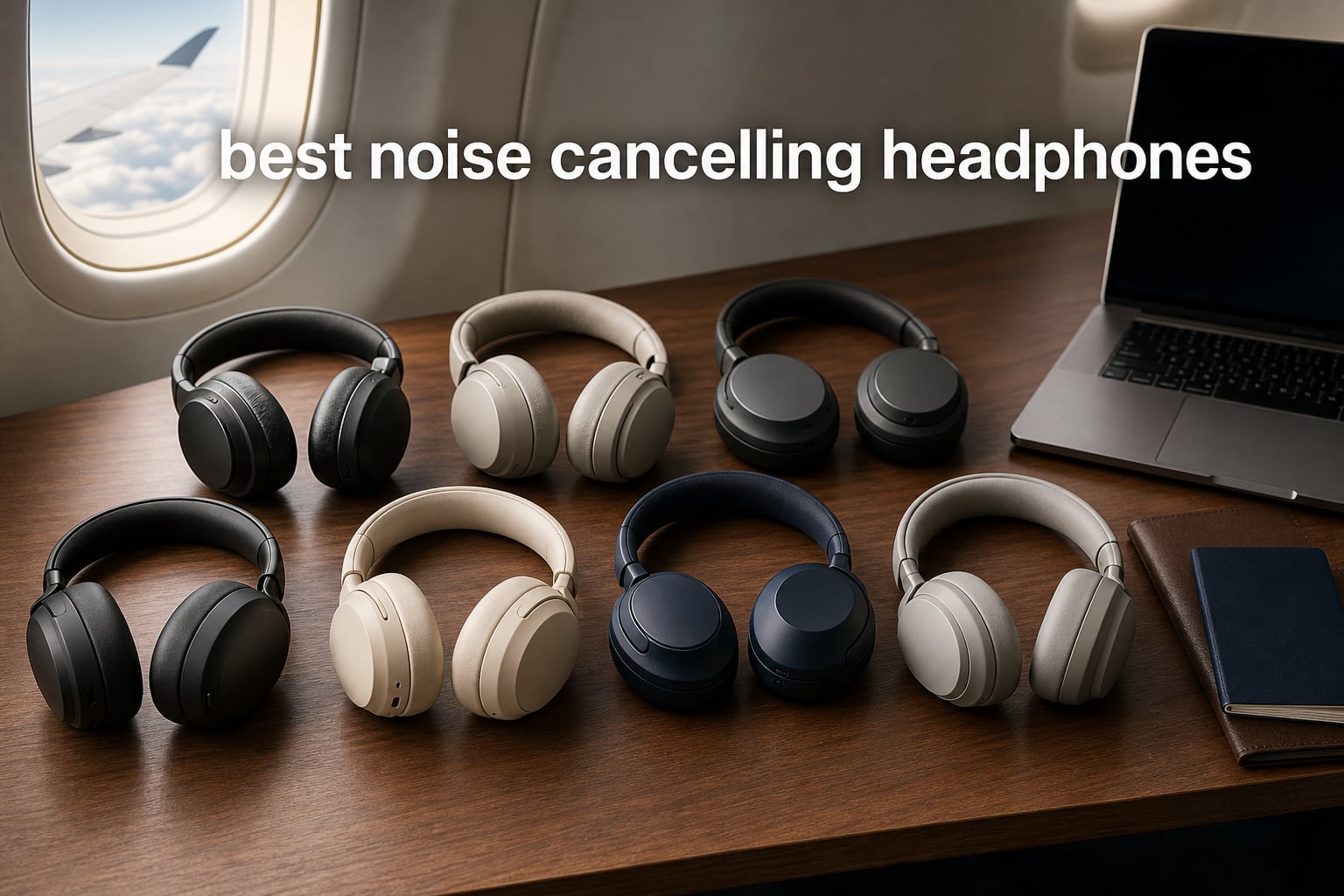
The best noise cancelling headphones 2026 are the Sony WH-1000XM6 for all-around ANC, the Bose QuietComfort Ultra Headphones (2nd Gen) for a comfort-first choice, and the Soundcore Q20i for a feature-rich basic pick. Each is an over-ear wireless model, but their battery claims, wired options, app controls, codecs, and fit priorities differ enough that a single winner will not suit every listener.
Active noise cancellation, usually called ANC, uses microphones to hear incoming sound and produces an opposing signal that reduces the noise reaching your ears. It works alongside passive isolation from the ear cushions, so a good seal matters just as much as the electronics when you are on a train, in an open office, or on a flight.
I built this guide from the published specifications and retailer review data for all eight analyzed models, not from invented lab figures or a pretend long-term test. That matters because the product data can verify a stated 30-hour battery claim, an included dongle, or a codec, while it cannot honestly prove that one pair will fit every head or erase every sound.
For a fast decision, choose Sony when blocking distractions and a foldable travel design lead your list; choose Bose when plush cushions and listening modes matter most; choose Apple if you already use an iPhone and want its H2 features. Android listeners who care about high-resolution wireless audio should pay close attention to LDAC or aptX support, while anyone connecting to a seatback system should favor a model with the appropriate wired connection or transmitter.
Table of Contents
The three best noise cancelling headphones are Sony, Bose, and Soundcore for distinct needs
The Sony WH-1000XM6 is the strongest all-round match because its specification list combines 12 microphones, an Adaptive NC Optimizer, LDAC support, 30 hours of battery life, and a foldable case. Bose is the simpler alternative for listeners who put cushion comfort and mode switching first, while Soundcore supplies multipoint pairing, an EQ app, and long claimed runtime in a less elaborate package.
- Sony WH-1000XM6: Best overall for travel and commuters who want 12 microphones, adaptive cancellation, LDAC, and a compact folding design.
- Bose QuietComfort Ultra Headphones (2nd Gen): Best comfort-oriented flagship, with Quiet, Aware, Immersion, and Cinema modes plus plush cushions.
- Soundcore Q20i: Best basic choice for listeners who want hybrid ANC, dual-device pairing, a 22-preset EQ app, and up to 40 hours with ANC stated by the maker.

The eight noise cancelling headphones below cover travel, work, sound quality, and long battery needs
This overview is a starting point, not a replacement for checking fit and current compatibility. The ratings shown in the product cards come from the analyzed retailer listings; a high count can indicate broad ownership, but it does not turn a stated feature into a universal result.
| Product | Specifications | Action |
|---|---|---|
 Sony WH-1000XM6 Sony WH-1000XM6 |
|
View Details |
| Bose QuietComfort Ultra 2nd Gen |
|
View Details |
 Soundcore Q20i Soundcore Q20i |
|
View Details |
 Apple AirPods Max 2 Apple AirPods Max 2 |
|
View Details |
 JBL Tour One M3 Smart Tx JBL Tour One M3 Smart Tx |
|
View Details |
 Bowers & Wilkins Px7 S3 Bowers & Wilkins Px7 S3 |
|
View Details |
 Edifier W820NB Plus Gen 2 Edifier W820NB Plus Gen 2 |
|
View Details |
 Sennheiser HDB 630 Sennheiser HDB 630 |
|
View Details |
Sony WH-1000XM6 is the best overall choice for adaptive ANC and travel (1)
Sony WH-1000XM6 The Best Noise Cancelling Wireless Headphones, Black
12 microphones
LDAC support
30-hour battery
Pros
- 12 microphones
- LDAC support
- foldable case
- quick charging
Cons
- 3.5-hour stated charge time
- app settings can take time
The Sony WH-1000XM6 is the clearest all-purpose recommendation in this group because Sony pairs its HD Noise Canceling Processor QN3 with 12 microphones and an Adaptive NC Optimizer. The company says the optimizer adjusts for the environment, air pressure, and the way the headphones are worn, which makes it especially relevant to frequent flyers and changing commutes.
Its 30 mm carbon-fiber dome driver, high-resolution audio support, and LDAC codec give Android listeners a useful wireless audio path. Sony also lists a six-microphone AI beamforming system for calls, so this is one of the more complete work-and-travel packages rather than an ANC-only pair.
Battery life is listed at 30 hours, and Sony states that a three-minute charge provides three hours of playback. The foldable design and magnetic-closure case answer a practical complaint about some modern flagships: a travel headphone should take less room in a bag, not merely reduce noise.
The retailer listing carries a 4.3 out of 5 rating from 3,224 reviews, with 71% of those ratings at five stars. Community discussion repeatedly treats Sony’s XM line as the all-around ANC reference, but some users also find Sony’s app settings busy, so I would set up ambient sound, EQ, and device behavior before relying on it for a trip.
The WH-1000XM6 is best for travelers who need adaptive control and a compact case
The adaptive feature set is the key reason to choose the XM6 for flights, rail journeys, and variable office noise. A changing seal, cabin pressure, and different background sounds are exactly the situations Sony says its optimizer is designed to address.
The foldable frame matters if you carry headphones every day, and the included compact case keeps that advantage meaningful. For calls in shared spaces, the six-microphone beamforming claim is also more relevant than a generic promise of clear voice pickup.
The WH-1000XM6 is less suited to listeners who want the simplest controls or iPhone codec support
LDAC is a meaningful Sony feature for compatible Android hardware, but it is not an iPhone codec. iPhone owners can still connect over Bluetooth, yet they should not buy this model solely for LDAC.
Anyone who dislikes adjusting settings may prefer a headphone with fewer app decisions. If you own the preceding XM5, compare the features you use now with the XM6’s 12-microphone system, QN3 processor, folding case, and adaptive behavior rather than treating a new model number as an automatic reason to replace working headphones.
Bose QuietComfort Ultra Headphones (2nd Gen) are the comfort-first flagship (2)
Bose QuietComfort Ultra Bluetooth Headphones (2nd Gen), Wireless Headphones with Spatial Audio, Over Ear Noise Cancelling with Mic, Up to 30 Hours of Play time, Black
Quiet and Aware modes
Spatial Audio
30-hour battery
Pros
- Plush cushions
- three listening modes
- Bluetooth 5.4
- USB Voice
Cons
- Not water resistant
- Immersive Audio lowers stated battery life
The Bose QuietComfort Ultra Headphones (2nd Gen) target a different kind of buyer: the person for whom pressure around the ears can end a listening session early. Bose lists plush cushions and a metal headband, and the forum research makes comfort during extended wear one of the most repeated deciding factors.
Bose calls its three listening options Quiet Mode, Aware Mode, and Immersion Mode. That gives you a direct way to move from reduced outside sound to increased awareness, while Immersion adds the brand’s spatialized audio treatment.
The published battery figure is up to 30 hours in standard use and 23 hours with Immersive Audio. That distinction is useful because spatial features can change runtime, and it is better to choose based on the mode you actually plan to leave on.
The product listing reports 4.3 out of 5 from 2,309 reviews, including 73% five-star ratings. Bose’s CustomTune analyzes the listener’s ears for personalized audio, while its noise-rejecting microphones use AI-based background-noise suppression for calls; neither feature removes the need to judge fit during a return window.
The QuietComfort Ultra is best for long sessions where cushion feel decides the purchase
If headphones are for long flights, full workdays, or film watching, a comfort-led design is not a minor detail. Bose combines the plush cushion design with a stated 30-foot Bluetooth range and Bluetooth Core 5.4, which is a sensible feature set for room-to-room daily listening.
Cinema Mode is aimed at video content, and USB Voice provides a two-way communication option. Those additions make this Bose a better fit for someone who moves between music, meetings, and video rather than a listener focused only on one album format.
The QuietComfort Ultra is less suited to rain-prone use or maximum spatial-runtime use
The listing says this model is not water resistant, so I would not make it the first choice for workouts where heavy sweat or rain is expected. Its 0.48 kg listed item weight also reinforces the need to try the headband and clamp feel personally if weight sensitivity is a concern.
Immersive Audio shortens the stated runtime from 30 to 23 hours. Listeners who care more about long stretches between charges than spatial processing can use Quiet or Aware modes and keep that trade-off in view.
Soundcore Q20i is the best basic pick for long ANC playback and app EQ (3)
Soundcore by Anker Q20i Hybrid Active Noise Cancelling Headphones, Black
Hybrid ANC
40-hour ANC playtime
22 EQ presets
Pros
- Dual connections
- fast charging
- Transparency mode
- 40 mm drivers
Cons
- Bluetooth 5.0
- 20-hour average battery field differs from feature claim
The Soundcore Q20i is the straightforward route to hybrid active noise cancellation without the more specialized wireless or spatial systems found elsewhere here. Anker says it uses two internal and two external microphones to reduce up to 90% of external noise, a manufacturer claim that sets a useful expectation without pretending it is a universal isolation measurement.
Soundcore pairs oversized 40 mm dynamic drivers with BassUp processing and says Hi-Res Audio is available through the AUX connection. The app includes 22 preset EQ choices, so I would look here if you want to tune bass or try a different balance rather than accept one fixed sound profile.
Its feature list claims 40 hours of playback with ANC and 60 hours in normal mode, plus four hours of playback from a five-minute charge. The specification field separately lists 20 hours as average battery life, so treat the longer figures as mode-dependent claims and match them to your use instead of assuming every condition gives the same result.
The Q20i has a 4.6 rating from 69,160 reviews, the largest review total among these eight listings. That broad feedback base is useful context, but its Bluetooth 5.0 connection and 10-meter range are a more basic set of connection details than the newer versions offered by a few rivals.
The Q20i is best for everyday listeners who want multipoint and adjustable sound
Dual Connections lets the Q20i pair with two devices at once, a practical feature if you switch from a laptop to a phone. Transparency Mode is equally practical: it lets you hear what is around you without taking the headphones off.
The 16-ohm impedance and 40 mm drivers are paired with a 20 Hz to 20,000 Hz stated frequency response. That published specification does not tell us how every person will hear the tuning, but the EQ app offers a clear route to make a personal adjustment.
The Q20i is less suited to listeners who need a newer Bluetooth version or premium codec list
The product data names Bluetooth 5.0 and does not list LDAC, aptX, or a comparable advanced codec. If Android high-resolution wireless playback is at the top of your list, the Edifier, Bowers & Wilkins, Sony, or Sennheiser models state more relevant codec support.
Its water-resistant designation should not be mistaken for a full sports rating because no specific IP level is supplied in the product data. Keep it for commutes and desk time unless the maker’s current documentation confirms the protection you need.
Apple AirPods Max 2 is the best match for iPhone listeners who use Apple features (4)
Apple AirPods Max 2 Wireless Over-Ear Headphones – Midnight
H2 chip
Adaptive Audio
USB-C lossless
Pros
- Apple feature integration
- Personalized Spatial Audio
- Adaptive Audio
- Live Translation
Cons
- 20-hour stated battery
- 0.39 kg listed weight
The AirPods Max 2 is the obvious specialist pick for an iPhone-centered setup. Apple lists an H2 chip, Adaptive Audio, Conversation Awareness, Personalized Spatial Audio with dynamic head tracking, and Live Translation powered by Apple Intelligence, all of which point toward ecosystem behavior rather than a codec-first Android approach.
Apple says this generation provides up to 1.5 times more active noise cancellation than its prior generation. That is a comparison from Apple, not a cross-brand measurement, but it clarifies the intended upgrade: buyers looking for Apple features plus a stronger stated ANC system than the preceding AirPods Max have a concrete reason to compare generations.
USB-C lossless audio is an important wired option in the listing. It makes this model more interesting for listeners who sometimes want a direct digital connection, although your source device, cable, and music service still determine what format is actually available.
The analyzed listing has a 4.6 rating from 476 reviews, with 82% at five stars. It also lists a 0.39 kg item weight and up to 20 hours with ANC and Spatial Audio, so I would give fit and charging routine more attention here than with the 30-, 60-, or 88-hour claims elsewhere in this guide.
The AirPods Max 2 is best for iPhone owners who want Apple-specific adaptive features
Adaptive Audio adjusts noise cancellation to the environment, while Conversation Awareness lowers music when you speak. Those are easy-to-understand daily conveniences for people who move between an office, home, and public spaces without wanting to change settings constantly.
The breathable knit-mesh canopy and memory-foam cushions are designed for extended listening, and Personalized Spatial Audio adds a head-tracked presentation. It is a sensible choice if those features are part of how you already use an iPhone, rather than a reason to change platforms.
The AirPods Max 2 is less suited to listeners who prioritize battery duration or Android codecs
At up to 20 hours with ANC and Spatial Audio, its published battery duration is shorter than every other model in this roundup except none; the next closest listed claim is 30 hours. That does not make 20 hours inadequate, but it changes the charging expectation for frequent travelers.
The forum research consistently frames AirPods Max as an iPhone recommendation because its strongest features live in the Apple ecosystem. Android users should examine the exact Bluetooth behavior they need instead of assuming the H2-based features will transfer in the same way.
JBL Tour One M3 Smart Tx is the best choice for flexible wired-source travel (5)
JBL Tour One M3 Smart Tx – Noise Cancelling Headphones – Blue
Smart Tx
8-mic adaptive ANC
40-hour ANC playback
Pros
- 3.5 mm and USB-C sources
- Smart Tx
- 70-hour total playback
- head tracking
Cons
- 278 g weight
- shorter 18-hour Smart Tx battery
The JBL Tour One M3 Smart Tx has the most travel-specific connection story in this group. Its Smart Tx transmitter can connect through 3.5 mm, USB-C, or analog sources, and JBL explicitly mentions in-flight entertainment among those sources.
JBL lists eight-microphone True Adaptive Noise Cancelling 2.0, with real-time adjustments, alongside four microphones and adaptive beamforming for calls. Its 40 mm mica dome drivers, 20 Hz to 40 kHz stated frequency response, and Hi-Res Audio support give the model an unusually feature-dense specification sheet.
The stated playback figure is 70 hours total and 40 hours with ANC on, while the Smart Tx itself is listed for 18 hours. That split is important on a long trip: the headphones and the transmitter are separate devices with separate charging needs.
This listing reports 4.4 out of 5 from 112 reviews, including 79% five-star ratings. JBL also adds Spatial 360 sound with integrated head tracking, Smart Talk that pauses music when you speak, and Personi-Fi 3.0 audio profiling; I would prioritize the transmitter first because it is the feature that differentiates it most clearly.
The Tour One M3 is best for flyers who use seatback entertainment or mixed sources
Many wireless headphones are easy with a phone but awkward with an airplane screen, a desktop audio output, or other analog gear. The Smart Tx tackles that exact problem by giving the headphone a dedicated connection path from 3.5 mm, USB-C, and analog sources.
Its 2-hour stated charging time and 40-hour ANC playback claim also make the headphones suitable for long stretches away from a wall outlet. Pack the transmitter and its needed cable with the headphone case, because leaving it behind removes a central reason to choose this JBL.
The Tour One M3 is less suited to minimalists who do not need a transmitter
Smart Tx is useful hardware, but it is another item to charge, carry, and keep track of. If every source you use is already Bluetooth, the extra connection system may add complexity without solving a real problem.
The listing gives a 278 g item weight, so comfort still depends on your own head shape and clamp preference. Spatial 360 and Smart Talk are extras worth trying, yet the central purchase decision should be whether wired-source flexibility changes your actual listening routine.
Bowers & Wilkins Px7 S3 is the best fit for aptX listeners who value refined tuning tools (6)
Bowers & Wilkins Px7 S3 Wireless Over-Ear Headphones, Anthracite Black
aptX Adaptive
8 microphones
30-hour battery
Pros
- aptX Lossless support
- 5-band EQ
- 15-minute quick charge
- 2-year warranty
Cons
- Not water resistant
- Bluetooth 5.0
The Bowers & Wilkins Px7 S3 puts its emphasis on sound adjustment and high-resolution Bluetooth support. Its product details name 40 mm drivers, 24-bit DSP, aptX Lossless, and aptX Adaptive, plus a five-band EQ in the Bowers & Wilkins Music app.
Those capabilities make it a strong candidate for Android listeners who want to shape their sound carefully. The same listing includes a USB-C to 3.5 mm stereo-jack audio cable and a USB-C to USB-C cable, so it arrives better prepared for wired listening than a Bluetooth-only package.
Its adaptive ANC system uses eight precision microphones, while the claimed playback duration is up to 30 hours. A 15-minute top-up is stated to provide seven hours of playback, which is a particularly useful quick-charge figure when you notice a low battery shortly before leaving.
The Px7 S3’s retailer rating is 4.3 out of 5 from 830 reviews, including 66% five-star ratings. Bowers & Wilkins lists a two-year warranty, but the item-weight field says 1.13 kg, a figure that is unusual for headphones and worth checking against current manufacturer documentation before making a comfort decision.
The Px7 S3 is best for compatible Android listeners who want aptX and a five-band EQ
aptX Adaptive and aptX Lossless are only useful when the source supports them, so confirm your phone, tablet, computer, or included adapter plan first. Unlike a vague claim of premium sound, those named formats and the five-band EQ give a buyer specific tools to assess.
The 20 Hz to 20,000 Hz stated frequency range and 33-ohm impedance provide more technical context, while the app controls ANC and audio preferences. I would choose it for deliberate music listening and light tuning rather than for a person who never wants to open an app.
The Px7 S3 is less suited to outdoor exercise or buyers who cannot confirm the listed weight
The product data calls it not water resistant, which rules it out as the safe pick for wet outdoor use. Its Bluetooth version is 5.0 as listed, despite the advanced aptX feature set, so newer version numbers are not its main attraction.
The supplied 1.13 kg weight may reflect packaged weight or a listing error rather than wearable mass; the data does not clarify it. Since comfort is repeatedly a forum dealbreaker, verify current official specifications and use a return policy that lets you assess fit rather than making a decision from that single field.
Edifier W820NB Plus Gen 2 is the best battery-life pick with LDAC and multipoint (7)
Edifier W820NB Plus Gen 2 Over-Ear Noise Cancelling Headphone, Dark Gray
-49 dB ANC
LDAC support
88-hour playback
Pros
- 49-hour ANC claim
- Bluetooth 6.1
- multipoint
- USB-C wired mode
Cons
- 4.2 rating
- ANC figure is maker stated
The Edifier W820NB Plus Gen 2 has the most ambitious battery figures in this roundup: up to 88 hours total playback and 49 hours with ANC according to the listing. It also says a 15-minute charge adds 15 hours, making battery planning its chief advantage.
Edifier lists hybrid ANC rated at up to -49 dB, multiple ANC modes, and adjustment through the EDIFIER ConneX app. That number is a manufacturer specification, not a direct comparison to Sony’s microphone count or Bose’s modes, so it is best read as a stated maximum rather than proof of a category ranking.
The technical package is unusually strong for its class: 40 mm titanium-coated drivers, LDAC and SBC codecs, Bluetooth 6.1, multipoint pairing, a gaming mode for lower latency, and USB-C wired mode. Its published 247 g weight and foldable memory-foam design also suggest a portable format, though comfort is always personal.
The analyzed retailer listing has a 4.2 out of 5 rating from 465 reviews, with 62% five-star ratings. AI call noise cancellation and spatial sound are added features, but I would buy this Edifier for the stated runtime, Android-friendly LDAC, and two-device connection rather than for any single processing mode.
The W820NB Plus Gen 2 is best for listeners who want long claimed runtime and current connections
Commuters who do not want frequent charging will notice the 49-hour ANC figure immediately. The ability to play and charge simultaneously, according to the feature list, is another helpful detail for desk use and long sessions.
Bluetooth 6.1 and multipoint pairing make this Edifier suited to people moving between a computer and phone. LDAC gives compatible Android devices a named higher-resolution wireless codec, while USB-C wired mode adds another listening route when wireless is not wanted.
The W820NB Plus Gen 2 is less suited to buyers who require a large review base or measured ANC comparison
Its 465-review count is much smaller than the Soundcore’s 69,160 or Sony’s 3,224 in the listings analyzed here. That does not make the product poor, but it gives you less broad retailer feedback to read about fit, firmware behavior, and durability.
Edifier’s -49 dB figure should not be compared one-for-one with another maker’s ANC wording because the available data does not provide a shared measurement method. For a purchase centered entirely on the absolute strongest cancellation, Sony’s broad all-around feature set is the more conservative recommendation in this guide.
Sennheiser HDB 630 is the best sound-focused pick with wired high-resolution listening (8)
Sennheiser HDB 630 Wireless Audiophile Headphones with Incl. Hi-Res Dongle
42 mm driver
USB-C lossless
60-hour battery
Pros
- aptX Adaptive
- 5-band parametric EQ
- hi-res dongle
- 60-hour battery
Cons
- 4.1 rating
- not water resistant
The Sennheiser HDB 630 is the model for listeners who put sound control and wired playback ahead of a minimalist ANC package. Its 42 mm transducer is described as neutral audiophile tuning, and Sennheiser includes a BTD 700 high-resolution Bluetooth dongle to support its wireless audio goal.
It supports aptX HD and aptX Adaptive wirelessly, then offers USB-C for lossless listening up to 24-bit/96 kHz according to the feature list. The in-app five-band parametric EQ and crossfeed function make this one of the most hands-on choices here for people who already understand why they want an adjustable sound profile.
Sennheiser lists adaptive ANC and Transparency Mode, but its standout battery claim is 60 hours, with a 10-minute fast charge adding seven hours. The product data also lists 30 milliseconds of audio latency, a relevant detail for viewers and casual games even though exact experience can depend on the source connection.
The HDB 630 has a 4.1 rating from 166 reviews, including 64% five-star ratings. This is a much smaller feedback pool than the mainstream Sony, Bose, or Soundcore options, so I would read the current feedback carefully and buy it for its named audio paths, not because the word audiophile alone sounds persuasive.
The HDB 630 is best for listeners who will use USB-C lossless or aptX Adaptive
The included BTD 700 dongle distinguishes the HDB 630 from models that merely state Bluetooth support. It gives a compatible computer a direct route toward the headphone’s high-resolution wireless feature set, while USB-C supports a separate wired lossless mode.
The 470-ohm impedance, 105 dB sensitivity, and 40 kHz frequency-response figure are published technical details for the sound-focused buyer. They should support research rather than replace it: your source, preferred EQ, and music library remain part of the listening decision.
The HDB 630 is less suited to listeners who want simple controls, wet-weather use, or broad owner feedback
A five-band parametric EQ and crossfeed are useful only if you enjoy making deliberate adjustments. If you want to take a headphone out of the box, leave it in one ANC mode, and never think about audio settings again, Bose or Apple may feel more direct.
The listing says it is not water resistant, and its 166-review count is the smallest in this roundup. It also lists a 950 g item weight, another unusually high listing figure that should be confirmed through current official documentation before treating it as a wearable-weight fact.
Choose noise cancelling headphones by matching ANC, comfort, connections, and care to your routine
Start with where the headphones will spend most of their time. Air travel and train commuting reward adaptive ANC, strong ear-cup seals, a folding case, and a charging plan; office work also puts call microphones, transparency or aware modes, and multipoint connection high on the list.
There is no honest universal comfort winner because glasses, ear shape, hair, clamping force, and heat tolerance change the result. Forum discussions repeatedly place all-day comfort among the first reasons people return headphones, so check the weight, cushion material, return terms, and whether the model creates pressure after an hour rather than judging it from a five-minute try-on.
ANC works best on steady noise, while passive isolation helps with the rest
ANC microphones detect outside sound, and the headphone creates an inverse sound wave to reduce it through destructive interference. This is especially useful for steady low-frequency sounds such as engines, ventilation, and train rumble.
Passive isolation comes from the physical ear-cup seal and reduces sound without electronics. Sudden voices, high-pitched sounds, and a poor seal can still break through, which is why a well-fitting over-ear design matters even when a model advertises a large ANC number.
Codec compatibility is decided by the source device, not just the headphone box
LDAC is listed on the Sony WH-1000XM6 and Edifier W820NB Plus Gen 2; aptX Adaptive is listed on the Bowers & Wilkins Px7 S3 and Sennheiser HDB 630. Those codecs are most relevant to compatible Android devices or computers, not a blanket upgrade for every phone.
iPhone listeners should not assume aptX support, a confusion that appears often in headphone forums. Apple AirPods Max 2 instead makes its case through H2-driven features and USB-C lossless audio, while any wired use should be checked against the source device and supplied cable.
Battery claims should be read with the enabled mode beside them
Manufacturers report different conditions: Apple lists up to 20 hours with ANC and Spatial Audio, Sony and Bose list 30 hours, JBL lists 40 hours with ANC and 70 hours total, Edifier lists 49 hours with ANC and 88 hours total, Soundcore lists 40 hours with ANC, and Sennheiser lists 60 hours. The key comparison is the condition you will actually use, not the largest number alone.
Quick-charge figures can matter more than maximum runtime if you forget to charge. Sony lists three hours from three minutes, Soundcore lists four hours from five minutes, Bowers & Wilkins and Sennheiser each list seven hours from a short top-up, and Edifier lists 15 hours from 15 minutes.
Wired flexibility matters most for flights, computers, and lossless listening
JBL’s Smart Tx is the standout for seatback and analog sources because it can connect through 3.5 mm, USB-C, or analog equipment. Soundcore states Hi-Res Audio through AUX, Bowers & Wilkins includes both USB-C-to-3.5 mm and USB-C-to-USB-C cables, and Sennheiser and Apple list USB-C lossless paths.
Ask a simple question before buying: will you only pair to a phone, or will you need a plane screen, desktop, controller, or USB-C source? That answer can remove several otherwise excellent headphones from contention and make the JBL or Sennheiser the sensible answer.
Long-term ownership depends on firmware, batteries, cushions, and realistic expectations
Community feedback raises concerns about firmware changes, battery aging, ear-pad wear, and dropped multipoint connections. No product record here can predict those outcomes for every owner, but you can reduce risk by installing updates deliberately, reading recent support feedback, and checking replacement-pad availability before the return period closes.
Water resistance also varies: Soundcore and Edifier are described as water resistant, while Bose, Bowers & Wilkins, and Sennheiser are listed as not water resistant. Neither label is a substitute for a stated IP rating, so do not make a rain or gym decision without checking the maker’s latest documentation.
The answers below explain the leading noise cancelling headphone choices
What are the best noise-canceling headphones in 2026?
The Sony WH-1000XM6 is the best overall choice in this guide for its 12 microphones, Adaptive NC Optimizer, LDAC support, 30-hour battery claim, and foldable case. Bose QuietComfort Ultra Headphones (2nd Gen) is the comfort-first alternative, while Soundcore Q20i suits listeners who want hybrid ANC, dual-device pairing, and app EQ.
What headphones have the absolute best noise cancelling?
Sony WH-1000XM6 is the conservative top pick for pure all-around noise cancellation here because Sony lists 12 microphones, the HD Noise Canceling Processor QN3, and an Adaptive NC Optimizer that adjusts to environment, air pressure, and fit. Actual results still depend on seal, fit, and the type of sound around you.
What is the best ANC in-ear headphones in 2026?
This guide compares over-ear headphones, not in-ear earbuds, so it does not name an in-ear ANC winner. For an over-ear fit, choose based on ANC controls, cushion seal, battery claim, and device compatibility; earbuds need a separate fit and microphone comparison.
What is the king of noise cancelling headphones?
The Sony WH-1000XM6 is the king of noise cancelling headphones for most buyers in this roundup. Its stated 12-microphone system, adaptive cancellation feature, 30-hour battery claim, LDAC support, call beamforming, and foldable case give it the broadest mix of travel and daily-use features.
Sony WH-1000XM6 is the best overall noise cancelling headphone for 2026
Sony WH-1000XM6 is my starting recommendation for a buyer who wants adaptive ANC, travel-friendly folding, 30-hour stated battery life, clear call features, and LDAC in one over-ear headphone. Bose QuietComfort Ultra Headphones (2nd Gen) is the better direction when cushion comfort and listening modes rank first, while Soundcore Q20i and Edifier W820NB Plus Gen 2 bring long stated runtime and useful app features to less demanding use cases.
For music-first listening, match the source device to the codec or wired path: Bowers & Wilkins and Sennheiser emphasize aptX options, Apple centers on its own H2 features and USB-C lossless, and JBL has the strongest answer for seatback and analog travel sources. Read the feature list against your actual route, phone, and comfort needs, then choose the pair that solves those daily problems instead of chasing a specification that your setup cannot use.