
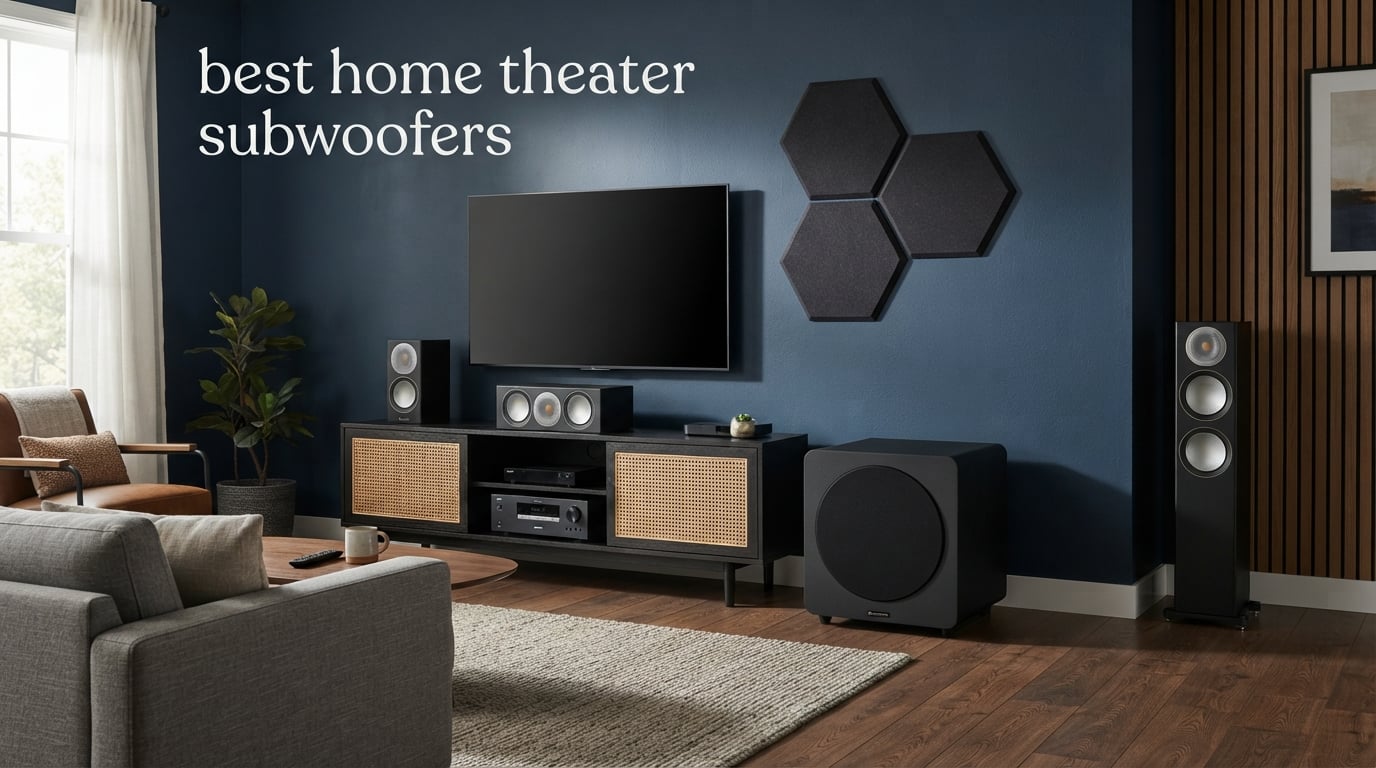
The best home theater subwoofers for most rooms are the Klipsch R-120SW, Polk Signature Elite ES12, and Klipsch RP-1200SW. Each is a powered, ported model with a 12 inch driver, but their output and room fit differ. Choose the R-120SW for balanced impact, the ES12 for its published 18 Hz extension, and the RP-1200SW for high-output large-room systems.
A subwoofer is the speaker that handles the low-frequency effects regular speakers leave behind: the weight of a soundtrack, the rumble under an on-screen engine, and the foundation in music. For a home theater, the important details are not just driver diameter or a peak-output headline; enclosure design, low-frequency extension, controls, and placement matter just as much.
I built this guide around the published specifications and review records for ten currently listed models, rather than inventing listening-test results. My practical advice also reflects the recurring community concerns: a sub that stops around 50 Hz may add some weight but misses much of the deepest movie LFE, large rooms need meaningful output, and a careful setup can matter as much as the badge on the cabinet.
Start with your room and receiver. A modest 10 inch subwoofer can be a sensible match for a compact media room, while a larger open-plan room often calls for a 12 inch driver, deeper published response, or eventually two matched subs to smooth out seat-to-seat bass.
Table of Contents
Our top 3 picks are the R-120SW, CS1000, and S 810
The Klipsch R-120SW is my broadest recommendation because its published 29 Hz to 120 Hz response, rear port, 12 inch driver, and 200-watt continuous amplifier form a capable movie-focused package. The Dayton Audio CS1000 stands out when flexible inputs and a compact 10 inch cabinet matter, while the Jamo S 810 is the slim-space option for listeners who want a bottom-mounted Class D design.
These labels are starting points, not substitutes for matching the subwoofer to your room. The comparison card makes the first three easy to scan; the reviews below explain where their connection options, dimensions, and response claims make more sense.
These 10 home theater subwoofers cover compact to large-room needs in 2026
The table below compares the facts that are useful before you read the full reviews: driver size, amplifier specification, stated low-end response where supplied, and a notable setup feature. Published figures are not interchangeable measurement results, so use them to narrow choices rather than treat one number as a whole performance story.
| Product | Specifications | Action |
|---|---|---|
 Klipsch R-120SW Klipsch R-120SW |
|
View Details |
 Klipsch Sub-120 Klipsch Sub-120 |
|
View Details |
 Polk Signature Elite ES12 Polk Signature Elite ES12 |
|
View Details |
 Polk PSW10 Polk PSW10 |
|
View Details |
 Klipsch R-101SW Klipsch R-101SW |
|
View Details |
 Dayton Audio Classic CS1000 Dayton Audio Classic CS1000 |
|
View Details |
 Polk Monitor XT12 Polk Monitor XT12 |
|
View Details |
 Klipsch RP-1200SW Klipsch RP-1200SW |
|
View Details |
 Jamo Studio S 810 Jamo Studio S 810 |
|
View Details |
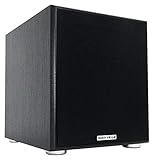 Rockville Rock Shaker 10 Rockville Rock Shaker 10 |
|
View Details |
1. Klipsch R-120SW is a strong all-rounder for movie systems
Klipsch R-120SW Subwoofer, Black
12 inch driver
29 Hz to 120 Hz
200W continuous, 400W peak
Pros
- 12 inch high-excursion driver
- 29 Hz stated low end
- 200W continuous amplifier
- 116 dB stated output
- rear bass-reflex port
Cons
- Wired connection only
- needs clearance behind cabinet
The R-120SW earns the lead slot because the published specification is unusually clear about the pieces home-theater shoppers need to weigh. Klipsch lists a 12 inch high-excursion spun-copper woofer, 200 watts of amplifier power with 400 watts peak, a 29 Hz to 120 Hz response at plus or minus 3 dB, and 116 dB maximum acoustic output.
That is a sensible set of numbers for a dedicated TV wall or conventional 5.1 and 7.1 receiver system. The rear-firing bass-reflex port supports the kind of impact people expect from movie effects, but it also means the cabinet needs breathing room from the wall.
I also like that the published weight is 31 pounds, which is manageable when trying a few positions in a room. Its 19.2 by 14 by 16.5 inch dimensions are not tiny, so I would mark out the floor space before committing to a front-corner location.
The R-120SW fits medium rooms with a conventional AV receiver
Use its RCA connection with the receiver’s dedicated subwoofer or LFE output, then begin with the receiver’s bass-management setting rather than trying to run every control at once. The listed 5.1 and 7.1 compatibility makes this a straightforward candidate for a standard surround layout.
A 12 inch driver and 29 Hz stated extension put it ahead of subwoofers whose claimed low end sits around 40 or 50 Hz when movie effects are the priority. It is still wise to temper expectations in a very large, open room, where air volume can absorb the benefit of a single sub.
The R-120SW needs rear clearance and a wired path
The rear port should not be pressed flat against drywall or buried in a closed cabinet. Leave room behind it, then move the sub a little at a time while replaying a familiar bass-heavy scene; that small adjustment often changes boominess more than a control tweak.
There is no wireless connection specified, so plan for a physical RCA/LFE cable or a separately chosen wireless kit. The listing also calls it wired-only and not waterproof, which rules out treating it as a patio or damp-space speaker.
2. Klipsch Sub-120 is a front-firing 12 inch alternative
Klipsch Synergy Black Label Sub-120 12” Front-Firing Subwoofer with 200 Watts of continuous & 400 watts of Dynamic Power, and Digital Amplifier for Powerful Home Theater Bass in Black
12 inch front driver
200W continuous
400W dynamic power
Pros
- 12 inch front-firing driver
- 200W continuous power
- receiver compatibility
- removable grille
- three-year parts warranty
Cons
- Wired connection only
- large cabinet footprint
The Klipsch Synergy Black Label Sub-120 takes a different physical approach from the R-120SW: its 12 inch Cerametallic driver fires forward. Klipsch specifies 200 watts continuous and 400 watts dynamic power, so its amplifier claim sits in the same general class as the R-120SW even though the cabinet arrangement differs.
Front firing can make placement less intimidating when the sub must face into a room, beside a media console, or near furniture. It does not make a subwoofer location-proof, but it gives a clearer starting orientation than a rear-firing driver in a crowded setup.
The Sub-120 is substantial at 36.4 pounds, with listed dimensions of 23.7 by 17.7 by 21.3 inches. I would treat those measurements as a serious furniture decision, particularly in a narrow apartment living room where a deep cabinet can block a walkway.
The Sub-120 works well when front-facing placement is simpler
The product is listed as compatible with televisions, home theaters, gaming consoles, and streaming devices, while its review data says it is compatible with almost any AV receiver. In practice, the relevant connection is still the receiver’s subwoofer output, not a direct audio link to a streaming box.
Its strong, flexible removable grille is useful in rooms where a front-facing cone may be within reach of children or pets. Leave the grille on if protection matters more than seeing the copper driver.
The Sub-120 demands floor space before you choose it
Do not confuse a 12 inch driver with a compact subwoofer; the stated exterior measurements are larger than several 10 inch choices in this guide. Measure depth from the wall and the swing of nearby doors, then decide whether a front corner or the side wall leaves enough open space.
The listing specifies wired connectivity only. If hiding a cable is the main obstacle, solve cable routing first or choose equipment with a stated wireless expansion option rather than assuming a standard wired sub has it.
3. Polk Signature Elite ES12 reaches deepest on its published specification
Polk Audio Signature Elite ES12 Powered Subwoofer, Stunning Black
12 inch long-throw woofer
300W Class D
18 Hz stated extension
Pros
- 18 Hz stated low end
- 300W Class D amplifier
- dual Power Ports
- phase control
- braced ported cabinet
Cons
- 51 pound cabinet
- limited review count
The Polk Signature Elite ES12 is the one I would examine first when the goal is deeper published extension without moving to a much larger driver. Polk states that its 12 inch long-throw woofer and 300-watt Class D amplifier reach 18 Hz through dual Power Ports designed to reduce turbulence.
That 18 Hz figure is meaningful on paper because it approaches the very low effects that give film soundtracks their physical scale. It should not be compared as a laboratory result against another company’s number without independent measurements, yet it clearly puts the ES12 in a more ambitious category than a model specified around 40 Hz.
Polk also includes Time-Smart Phase Control with 360-degree adjustment and a rigid, internally braced ported cabinet. I see those as useful integration features when the sub must blend with existing speakers rather than merely produce the most apparent bass at one seat.
The ES12 suits listeners seeking low extension and phase control
Its 300-watt Class D amplifier, long-throw woofer, and dual-port design make the ES12 a logical home theater subwoofer for a room that can accommodate a 51-pound cabinet. The specified 5.1 and 7.1 support also fits a receiver-centered system.
Begin with the receiver’s automatic calibration if available, then use the phase control only if bass seems to cancel around the crossover region. A smooth handoff matters more than turning up the level until every scene sounds oversized.
The ES12 needs careful handling and realistic evidence standards
At 51 pounds and 19 inches deep, the ES12 is not a casual one-person move for every household. Get the final location close before connecting it, and use furniture sliders or help if your floor surface needs protection.
The available record reports a 4.8 rating from 26 reviews, which is a much smaller sample than some established models here. I would give more weight to its published construction and controls than to treating that early rating as a long-term reliability verdict.
4. Polk PSW10 is a simple 10 inch sub for modest systems
Polk Audio PSW10 10″ Subwoofer, Big Bass Compact Design, Up to 100 Watts
10 inch Dynamic Balance driver
50W RMS
40 Hz to 160 Hz response
Pros
- Speaker and line-level inputs
- adjustable crossover
- large review history
- phase toggle
- 10 inch driver
Cons
- 50W RMS amplifier
- 40 Hz stated low end
The Polk PSW10 is a practical choice when the rest of the system is modest and connection flexibility is more important than chasing the lowest possible specification. It uses a 10 inch Dynamic Balance woofer, a directed port, and a 50-watt RMS amplifier rated up to 100 watts.
Polk publishes a 40 Hz to 160 Hz response at minus 3 dB and an 80 to 160 Hz crossover range. That lower limit is the tradeoff to understand: it can add audible body to movies and music, but it will not reproduce the deepest LFE effects the way an 18, 24, or 29 Hz design is intended to.
Its 4.7 rating is supported by more than 15k reviews in the provided data, the largest review history in this group. A large review count is useful context, though it does not change the limits set by a smaller driver and lower-power amplifier.
The PSW10 fits small rooms and older stereo connections
The PSW10 has speaker-level inputs and outputs along with line-level inputs, which is especially helpful for an older integrated amplifier that lacks a dedicated subwoofer output. Use the crossover control to hand off bass gradually, then keep the phase toggle at the setting that gives fuller bass at the main seat.
For a compact media room, this can fill in the range that small bookshelf speakers leave thin. I would pair it with realistic expectations instead of calling it room-shaking bass for a large open plan.
The PSW10 is limited when deep movie LFE is your main goal
Forum discussions repeatedly flag a 50 Hz lower limit as only a small step beyond many bookshelves. At the PSW10’s stated 40 Hz lower point, it reaches lower than that concern but still leaves a significant portion of the deepest cinematic effects to larger, lower-tuned models.
Its phase toggle is 0 or 180 degrees rather than a continuously variable control. That is enough for basic integration, but placement and receiver calibration take on more importance when you need a fine adjustment.
5. Klipsch R-101SW is a flexible front-firing 10 inch choice
Klipsch Reference R-101SW 10” Front-Firing Subwoofer with All-new Spun-Copper 10” woofers and an All-Digital Amplifier for Premium Home Theater Sound in Black
10 inch front driver
all-digital amplifier
29.5 Hz stated response
Pros
- Front-firing 10 inch driver
- 29.5 Hz stated response
- low-pass and phase controls
- Line/LFE inputs
- 30 pound weight
Cons
- Limited review count
- wired-only connection
The Klipsch R-101SW brings a useful combination of a 10 inch front-firing driver and a published 29.5 Hz response. Its all-digital amplifier is listed at 300 watts maximum, and its smaller driver can make it easier to place than the company’s bigger 12 inch cabinets.
I would not read maximum output as the same thing as a continuous power rating, so I keep that distinction clear when comparing it with the R-120SW. The more helpful day-to-day features are the low-pass crossover, phase control, and line/LFE inputs for an AV receiver.
At 30 pounds and 19.7 by 14 by 14.6 inches, this is still a floor-standing piece of equipment, but it is less imposing than many large-sub choices. The front-firing orientation is useful if the visual layout puts the driver toward the room.
The R-101SW is a good fit when placement flexibility comes first
Its front-firing design and 10 inch driver suit a compact room where the sub must sit near a television stand or along a side wall. Run an LFE cable from the receiver when possible, since the receiver can then set the crossover and level with the rest of the surround channels.
The 29.5 Hz published response suggests a more movie-capable foundation than entry-level models that start near 40 Hz. In a small room, that can be enough extension to feel more complete without overfilling the visual space.
The R-101SW needs a cautious power comparison
The listing calls out 300 watts maximum rather than a continuous RMS figure. Compare it as a manufacturer maximum-output claim, not as a direct substitute for a model whose continuous rating is specified differently.
The review record lists a 4.7 rating from 195 reviews, so there is some customer evidence but not the volume attached to the PSW10 or R-120SW. Its stated wired connectivity also means it needs a planned cable route.
6. Dayton Audio Classic CS1000 is the connection-friendly compact pick
Dayton Audio Classic CS1000 – 10″ 180W Powered Subwoofer with Class-D Amplifier, Deep Bass and Clean Design for Home Theater & Music – Wood
10 inch driver
180W Class D
28 Hz stated response
Pros
- 28 Hz stated response
- 180W Class D amp
- RCA LFE and speaker inputs
- auto-on feature
- five-year warranty
Cons
- Only wood finish listed
- more output may suit bigger rooms
The Dayton Audio Classic CS1000 is the 10 inch model I would look at when you need several input paths without a large cabinet. Its published specifications include a 180-watt Class D amplifier, 28 Hz response, RCA, LFE, and speaker-wire inputs, plus an auto-on feature.
That mix is unusually friendly to both modern receivers and simpler stereo equipment. The speaker-level connection is the detail that matters when an amplifier has no dedicated subwoofer pre-out, while the LFE input makes a conventional home theater hookup direct.
The wood-grain cabinet measures 16 by 13.5 by 14.37 inches, which is notably easier to work around than several 12 inch alternatives. Dayton also states a five-year warranty, a useful published durability detail when you are comparing more than raw output claims.
The CS1000 suits compact rooms and mixed equipment
If the system includes bookshelf speakers, a television receiver, or an older stereo amp, the CS1000 gives you ways to connect without adding an extra converter. I would start with the LFE input for an AV receiver and reserve the speaker-level route for an amplifier that truly needs it.
Its 28 Hz stated response sits in a useful range for movies, particularly in a small or medium enclosed room. The braced cabinet is also specified as part of the clean-bass design, which matters because cabinet vibration can blur what the driver is doing.
The CS1000 is not the first choice for a very large open room
A 180-watt amplifier and 10 inch driver are a thoughtful compact combination, not a claim to fill every open-plan living room at high levels. If the room opens into a kitchen or hallway, choose based on the full air volume rather than the footprint of the sofa area alone.
The supplied data shows a 4.7 rating from 88 reviews. That is a promising but limited sample, so the published input set, dimensions, warranty, and 28 Hz claim are the stronger reasons to put it on a short list.
7. Polk Monitor XT12 is a 12 inch match for Monitor XT systems
Polk Audio Monitor XT12 12″ Powered Subwoofer, Deep Bass (Midnight Black)
12 inch balanced woofer
100W Class A/B
24 Hz stated extension
Pros
- 24 Hz stated low end
- 12 inch driver
- rigid MDF cabinet
- RCA LFE and binding posts
- Atmos and DTS:X ready
Cons
- 100W amplifier
- Class A/B runs warmer than Class D
The Polk Monitor XT12 pairs a 12 inch dynamically balanced woofer with a 100-watt Class A/B amplifier and a stated 24 Hz bass extension. That published low-end figure is attractive for film use, while its binding-post inputs make it easier to connect to equipment beyond a standard AV receiver.
Polk describes a rigid, critically braced MDF cabinet and a variable 80 to 160 Hz crossover. It is also stated as compatible with Dolby Atmos and DTS:X AV receivers, which means it is positioned for current surround formats rather than only basic stereo systems.
The XT12 is specifically described as timbre matched to Polk Monitor XT speakers. A subwoofer handles a different frequency range from the mains, so brand matching is not mandatory, but it can simplify the visual and system-design decision for someone already using that speaker family.
The XT12 fits Polk Monitor XT owners and versatile wiring needs
Use the RCA/LFE input with a receiver, or consider the five-way binding posts when the amplifier does not provide a sub output. The 0/180 phase polarity control is basic but functional, and the variable crossover gives more adjustment than a fixed crossover arrangement.
At 39 pounds and 16 by 18 by 16 inches, the cabinet is large enough to plan around but not as heavy as the ES12. The removable grille can protect the 12 inch driver in a shared living space.
The XT12 needs sensible expectations about amplifier power
The stated 24 Hz extension is promising, but the amplifier is specified at 100 watts. Output depends on driver behavior, cabinet, room gain, and the content, so no one number should decide the comparison.
A Class A/B amplifier may run warmer than Class D, as the product data notes. Give the amplifier area open air and do not enclose the sub tightly inside a media cabinet.
8. Klipsch RP-1200SW is the high-output 12 inch choice for big rooms
Klipsch Reference Premiere RP-1200SW 12″ High Excursion Subwoofer
12 inch Cerametallic driver
800W maximum
front slot port
Pros
- 800W maximum amplifier
- front-firing 12 inch driver
- Aerofoil slot port
- wireless expansion port
- premium construction
Cons
- Large 69 pound cabinet
- limited review count
The Klipsch Reference Premiere RP-1200SW is the strongest fit here for someone building around a large room and seeking a more forceful published amplifier specification. Klipsch lists an 800-watt maximum high-efficiency Class D amplifier, a redesigned 12 inch Cerametallic woofer, and a front-firing driver with an Aerofoil front slot port.
That layout is intended to produce substantial output while preserving placement options at the front of a room. The cabinet is correspondingly serious: the supplied dimensions are 25.92 by 17 by 18.89 inches, and its weight is 31.3 kilograms, or roughly 69 pounds.
The RP-1200SW also includes a WA-2 wireless port in its stated connectivity. That is expansion readiness, not proof that a wireless adapter is included, so I would confirm what is required before designing a cable-free installation around it.
The RP-1200SW suits large rooms and impact-focused cinema playback
For a larger enclosed theater or a room with significant open air, the higher-output design is the reason to consider this model over a compact 10 inch sub. Its 12 inch driver, Class D amplifier, and front slot port are built around scale rather than a small footprint.
It is also a sensible candidate for a later dual-sub setup if room measurements and receiver outputs support another matching unit. Two subs can reduce uneven bass across multiple seats, although they need placement and calibration rather than simply doubling the level.
The RP-1200SW requires a committed location and wireless planning
This is not a subwoofer to slide around casually while you decide where it looks best. Plan the path from the entry door to the room, protect the floor, and leave enough clearance around the front slot port and amplifier controls.
Use a wired LFE run if practical, even with a wireless port available. A physical connection avoids another component in the signal chain, while wireless can be useful when routing a cable across the room is genuinely impractical.
9. Jamo Studio Series S 810 is a slim-space bass reflex option
Jamo Studio Series S 810 Subwoofer (Black)
10 inch polyfiber driver
150W Class D
bottom-mounted amplifier
Pros
- 10 inch polyfiber driver
- 150W Class D amplifier
- slot port
- compact height
- Bass Boost feature
Cons
- Wired-only connection
- one-year warranty
The Jamo Studio Series S 810 is shaped for rooms where the usual tall, boxy subwoofer is hard to accommodate. It measures 19 by 19 by 12 inches, using a 10 inch polyfiber woofer, a slot-ported bass-reflex design, and a 150-watt bottom-mounted Class D amplifier.
The low 12 inch height is the headline here. That form can make the S 810 easier to place beneath or beside some furniture, though the 19 inch width and depth still mean it needs a real patch of open floor.
Jamo also lists a Bass Boost feature. I would use any boost cautiously: it can add perceived punch at lighter listening levels, but aggressive boost can make a room mode or a weak placement more obvious rather than fixing it.
The S 810 fits apartments where height is the limiting factor
This is the apartment-friendly pick when furniture clearance, visual intrusion, and a compact profile are central concerns. Its 29.3-pound weight also makes initial placement less demanding than the heavyweight premium cabinets.
Apartment-friendly does not mean neighbor-proof. Put it on a stable floor, begin at a low level, avoid shared-wall corners when possible, and use the receiver’s night or dynamic-range setting for late sessions if that option exists.
The S 810 trades deep-extension certainty for a compact form
The provided listing gives 180 Hz as a frequency-response specification but does not provide a low-frequency cutoff comparable to the 18, 24, 28, or 29 Hz figures above. I would not invent one; the compact cabinet and 150-watt amplifier are the concrete facts to weigh.
The supplied review record is 4.4 from 268 reviews, with a one-year limited warranty stated. It is a sensible space-led choice, but listeners seeking the deepest subwoofer for movies should favor a model with a documented low-end figure.
10. Rockville Rock Shaker 10 offers high connection flexibility and controls
Rockville Rock Shaker 10″ Black Powered Subwoofer Home Theater
10 inch driver
300W RMS, 600W peak
20 Hz to 200 Hz claim
Pros
- 300W RMS Class D amplifier
- adjustable crossover and phase
- RCA and high-level I/O
- MDF enclosure
- 20 Hz stated response
Cons
- Lower rating than rivals
- one-year warranty
The Rockville Rock Shaker 10 brings a feature-dense specification to a 10 inch design. It lists 300 watts RMS and 600 watts peak through a Class D amplifier, adjustable volume, crossover, and phase controls, along with RCA line inputs and outputs plus high-level speaker inputs and outputs.
The product page also claims a 20 Hz to 200 Hz frequency response. That is an ambitious published range for this cabinet class, so I would treat it as the manufacturer specification and compare it with room needs, connection options, and review feedback rather than assuming the number alone settles performance.
A 20-pound listed weight and 18.9 by 18.3 by 14.6 inch dimensions make it easier to reposition than several 12 inch selections. The MDF enclosure and detachable foam grille are practical build details for a mixed home-theater and music setup.
The Rock Shaker 10 fits systems that need high-level inputs
The high-level inputs and outputs are useful with an older receiver or amplifier that has no subwoofer pre-out. With an AV receiver, use its RCA/LFE sub output and let the receiver coordinate bass management before reaching for the sub’s manual crossover control.
Its adjustable phase control offers more tuning range than a simple 0/180 switch. Try both placement and phase slowly, because the goal is consistent bass at the seating position, not the loudest possible note in one corner.
The Rock Shaker 10 needs a review-record tradeoff
The available customer record is 4.3 from 985 reviews, below the ratings attached to the Klipsch and Polk leaders in this guide. That does not erase its useful inputs and controls, but it is a reason to weigh the complete record rather than focus only on peak-power language.
The stated warranty is one year, and the product is listed as wired. For a system you expect to keep for many years, compare that warranty term and the physical cable plan with the five-year coverage stated for several other choices.
Choose the right subwoofer by room volume, extension, and connections
The best choice starts with the room, not the size of your television. Measure the enclosed space, note open doorways and adjoining areas, identify where a cable can run, and only then compare the driver, enclosure, and amplifier details.
A 10 inch sub fits compact rooms, while 12 inch models suit more air volume
For a small enclosed room, a well-placed 10 inch powered subwoofer such as the Dayton CS1000, Klipsch R-101SW, Polk PSW10, Jamo S 810, or Rock Shaker 10 can give small speakers a proper low-end foundation. Their cabinet sizes and output claims still differ, so driver diameter alone is not a full answer.
A 12 inch model moves more air in broad terms and often comes in a larger cabinet. In a medium or large room, the Klipsch R-120SW, Sub-120, Polk ES12, Polk XT12, or Klipsch RP-1200SW offers the scale to investigate first.
What size subwoofer for home theater is best? A 10 inch subwoofer is often enough for a small enclosed room, while a 12 inch model is the better starting point for a medium or large room. Choose by room volume and low-frequency extension, not driver size alone; two matched subs can improve evenness across several seats.
Ported designs favor movie impact, while sealed models favor compact control
A ported subwoofer uses a tuned opening to reinforce output around its design range. The R-120SW’s rear port, ES12’s dual Power Ports, RP-1200SW’s front slot port, and S 810’s slot port are examples of the approach, which is often attractive for movie soundtracks and high-impact effects.
A sealed subwoofer has no port and is commonly chosen for a smaller cabinet and a different bass character. Neither enclosure type wins in every room; a well-built design, adequate output, and good placement carry more weight than treating sealed versus ported as a universal rule.
Low-frequency extension tells you more than a peak-power headline
Look for the lowest stated frequency and how the manufacturer states it. The R-120SW specifies 29 Hz to 120 Hz at plus or minus 3 dB, the PSW10 states 40 Hz to 160 Hz at minus 3 dB, and models such as the ES12, XT12, CS1000, R-101SW, and Rock Shaker list lower-limit claims in their supplied specifications.
Movie LFE asks more from a system than mid-bass punch. This is why community discussions warn against models that stop around 50 Hz: they may make sound fuller but do not reach much of the low-frequency material that makes cinematic sound feel complete.
Compare RMS or continuous power separately from peak or maximum power. The PSW10’s 50 watts RMS, the R-120SW’s 200 watts continuous, the Sub-120’s 200 watts continuous, and the Rock Shaker’s 300 watts RMS are clearer continuous figures than a maximum-only claim, although cabinet and driver design remain part of the result.
Match the input type to your receiver before you select a cabinet
An AV receiver with a subwoofer pre-out should connect to the sub’s LFE or line-level input. That is the cleanest route for the R-101SW, ES12, R-120SW, RP-1200SW, and other models here with RCA/LFE connections, because the receiver can manage crossover and level as part of its speaker calibration.
Speaker-level inputs are more useful when you have an older amplifier or stereo receiver without a sub output. The PSW10, CS1000, Monitor XT12, and Rock Shaker 10 list that flexibility, so they are easier candidates for legacy systems.
Wireless subwoofer integration can reduce cable-routing hassle, but it is not a free pass for every product. The RP-1200SW lists a WA-2 wireless port, which signals an expansion path; it does not mean every other wired model can send audio wirelessly without additional hardware.
Placement and calibration solve more problems than turning up the gain
Begin with the sub near the front wall, leaving room around a rear port and avoiding a tightly closed cabinet. If bass is boomy, move it a short distance from a corner; if it is weak at the main seat, try another wall or use the familiar “subwoofer crawl” approach by testing where bass sounds most even around the room.
Set the receiver’s crossover near the point where the main speakers begin to lose output, then run room calibration if your receiver provides it. With the receiver handling bass management, avoid stacking incompatible crossover settings; a sensible starting point is more useful than maxing every dial.
For a couch with several listeners, two matched subs can improve bass consistency across seats. Place them thoughtfully, calibrate both, and remember the goal is smoother distribution rather than a louder single seat.
These common questions answer the last home-theater decisions
What are the top five subwoofers?
The top five picks in this guide are the Klipsch R-120SW, Polk Signature Elite ES12, Klipsch Reference Premiere RP-1200SW, Dayton Audio Classic CS1000, and Klipsch R-101SW. They cover different room sizes and connection needs, from compact 10 inch models to higher-output 12 inch ported designs.
What is the hardest hitting subwoofer?
The Klipsch RP-1200SW is the strongest high-output choice in this group on its published specifications. It combines a 12 inch Cerametallic driver, an 800-watt maximum Class D amplifier, and a front slot-ported cabinet. Big-room placement and calibration still determine how much impact reaches the listening seat.
What size subwoofer is best for home theatre?
A 10 inch subwoofer is often enough for a small enclosed room, while a 12 inch model is a better starting point for medium and large rooms. Check the stated low-frequency extension, amplifier rating, and cabinet size too. Two properly placed matching subs can make bass more even across multiple seats.
What subwoofers are used in theaters?
Commercial theaters use multiple large, professional low-frequency speaker systems designed for very large rooms, not one typical living-room subwoofer. At home, a capable powered subwoofer with real low extension is the practical equivalent. A larger room may benefit from two matched home-theater subs for smoother bass distribution.
The Klipsch R-120SW is the clearest starting pick for most buyers
For most medium rooms, I would start with the Klipsch R-120SW because its 12 inch driver, 29 Hz stated response, continuous-power figure, and rear-ported cabinet form a well-defined home-theater package. Choose the Polk ES12 if the 18 Hz claim and phase control fit your aims, the RP-1200SW when large-room output is central, or the CS1000 when compact dimensions and input flexibility decide the purchase.
The best home theater subwoofers in 2026 are the ones that fit your room, connect cleanly to your system, and reach low enough for the movie experience you want. Recheck cabinet dimensions and input type, then use the product details above to make the final comparison.