
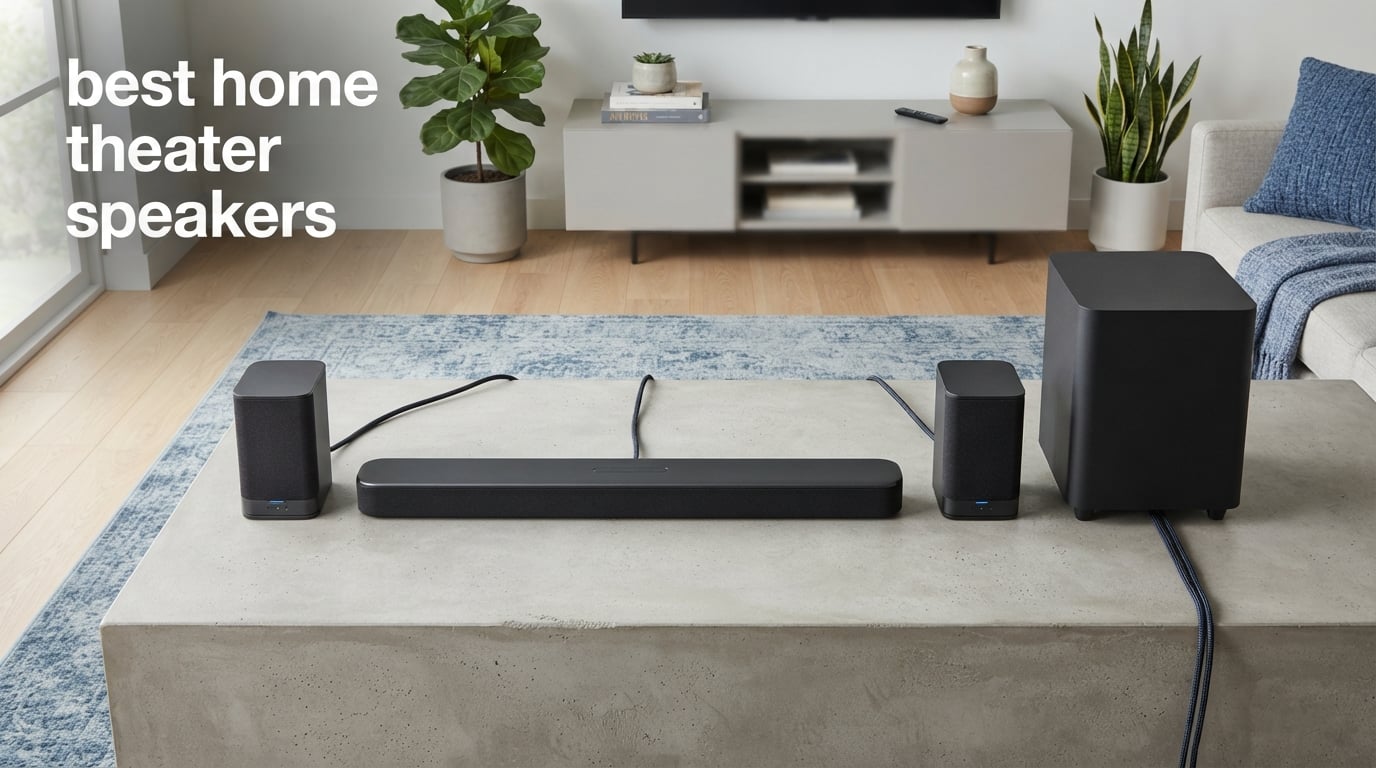
Finding the best home theater speakers is less about chasing the largest channel number and more about matching a system to your room, TV connections, and listening habits. A good surround sound system makes dialogue easier to follow, puts effects around the seating position, and adds weight that a television’s own speakers cannot supply.
I approached this list as a practical shortlist of complete, powered systems rather than a claim that one brand fits every room. That matters because these are bundled soundbars and home cinema speakers; they do not need an AV receiver, but they also do not offer the mix-and-match path of passive speakers home theater enthusiasts often build over time.
Our picks cover 2.1, 4.1, 5.1, 7.1, and 11.2.6 layouts, plus Dolby Atmos speakers, DTS:X support, wireless rears, and room-calibration features where the product data confirms them. I give extra weight to clear dialogue, a real subwoofer for home theater, connection options, review volume, and the physical reality of getting speakers and cables into a living room.
There is one useful expectation to set before choosing: a channel label alone does not describe the whole experience. A well-placed 5.1 channel speaker system with a dedicated center channel speaker can feel more convincing than a crowded 7.1 setup whose rear speakers have nowhere sensible to sit.
Table of Contents
The Top 3 Picks Give Most Rooms a Clear Starting Point


Choose the Nakamichi Shockwafe Wireless 11.2.6 when a large room can accommodate a 54-inch soundbar, two substantial subwoofers, and separate surround speakers. Its 11.2.6 architecture and six discrete height channels make it the most ambitious package here.
Choose the Sony BRAVIA Theater System 6 when dialogue clarity, Dolby Atmos and DTS:X decoding, and a conventional 5.1 layout matter more than an extreme channel count. Its dedicated center channel and BRAVIA-specific Voice Zoom 3 feature make the case especially strong for compatible Sony TV owners.
Choose the ULTIMEA Poseidon M60 for a compact, feature-rich 5.1 starting point with Dolby Atmos, HDMI eARC, app control, and the largest review sample in this group. Its 2.2k+ ratings provide more buyer-feedback context than the newer Ultimea models.
These Are the Best Home Theater Speakers in 2026 at a Glance
| Product | Specifications | Action |
|---|---|---|
| Nakamichi Shockwafe 11.2.6 |
|
View Details |
 ULTIMEA Aura A60 Pro 7.1 ULTIMEA Aura A60 Pro 7.1 |
|
View Details |
 ULTIMEA Poseidon M60 5.1 ULTIMEA Poseidon M60 5.1 |
|
View Details |
| Sony BRAVIA Theater System 6 |
|
View Details |
 Saiyin 2.1 Sound Bar Saiyin 2.1 Sound Bar |
|
View Details |
 LG S40TR 4.1 LG S40TR 4.1 |
|
View Details |
 ULTIMEA Aura A40 7.1 ULTIMEA Aura A40 7.1 |
|
View Details |
 Bose Smart Ultra System Bose Smart Ultra System |
|
View Details |
The comparison is deliberately broad: the Saiyin is a stereo 2.1 upgrade, while the Nakamichi is an 11.2.6 surround package. I would not call them interchangeable just because both sit beneath a TV.
For movies, true physical rear speakers usually give directional effects more definition than a bar working alone. For apartments or rooms with tight seating, a smaller 2.1 or 4.1 system can be the more sensible choice because placement and neighbor-friendly bass control matter as much as raw output.
Nakamichi Shockwafe Is the Large-Room Immersion Pick
Nakamichi Shockwafe 11.2.6 Dolby Atmos/DTSX Surround Soundbar,Dual 10″ Subs
11.2.6 channels
Dual 10 inch subs
HDMI 2.1 eARC
Pros
- Six discrete height channels
- Dual 10 inch subwoofers
- 4K 120Hz HDMI support
- AirPlay 2 and Bluetooth
Cons
- Large physical footprint
- Three-box setup
The Nakamichi Shockwafe Wireless is the clear choice here for someone building around a large screen in a room that has real space behind and beside the sofa. Its 11.2.6 channel layout, bipolar surrounds, and six discrete height channels give it more physical channels than any other model on this list.
I like that the package includes two wireless 10-inch subwoofers instead of asking one cabinet to cover the whole room. The supplied data also lists HDMI eARC, two HDMI 2.1 inputs, and 4K 120Hz Dolby Vision and HDR10+ pass-through, which is relevant for modern consoles and high-frame-rate video gear.
Reported buyer feedback is strongly positive: it has a 4.7 rating from 101 reviews, with users highlighting the immersive field and powerful bass. That is encouraging, though 101 reviews are a smaller evidence base than the thousands attached to the Poseidon M60 or Saiyin.
The trade-off is not subtle. The soundbar is 54 inches wide, each subwoofer is over 22 inches tall, and the system ships in three boxes, so I would measure the furniture, cable paths, and delivery route before committing to it.
A large dedicated room is its best fit
This system suits a large room theater where the listening position is not pressed against a wall and each surround can occupy a defined side or rear location. The two subwoofers can help distribute bass across more of the room, but placement still decides whether that bass is controlled or boomy.
It also fits viewers who want a soundbar-based system without adding a separate AV receiver. AirPlay 2 and Bluetooth add straightforward music streaming when the television is off.
HDMI 2.1 sources are its connection strength
Gamers with a compatible display can make use of the stated 4K 120Hz pass-through, while HDMI eARC gives the TV a clean return path for supported audio formats. I would use certified HDMI cables and check the TV’s eARC setting before judging sound quality.
This is not the compact home theater speakers answer. It is a physically serious package for a buyer who wants maximum immersion and accepts a more involved install.
ULTIMEA Aura A60 Pro Is the Adjustable 7.1 Atmos Choice
ULTIMEA 7.1ch Surround Sound System for TV with Dolby Atmos, Aura A60 Pro
7.1 Dolby Atmos
Four surround speakers
121 app EQ presets
Pros
- Four surround speakers included
- HDMI eARC
- Wide EQ selection
- 5.25 inch subwoofer
Cons
- Limited review history
- Some speaker runs need planning
The ULTIMEA Aura A60 Pro is for viewers who want physical speakers around the room and a large degree of app-based adjustment. It is a 7.1-channel Dolby Atmos soundbar package with four surround speakers, a 5.25-inch wired subwoofer, HDMI eARC, and Bluetooth 5.4.
Its strongest differentiator is control. The Ultimea app provides 121 preset EQ matrices and 10-band equalizer settings, so I would start with dialogue and surround levels rather than assuming the factory mode is right for every room.
The system’s listed layout uses two front wired surround speakers and two rear wireless speakers. That hybrid approach may simplify the rear portion of a living room, although it still needs planning for the wired speakers and the subwoofer.
Its 4.6 rating comes from 49 reviews, and reported comments praise the surround effect and app control. I see that as a promising but early record, not the same confidence level a much larger review sample provides.
A flexible seating area is its best fit
This is a better match for a couch with room to its sides and rear than for a single chair against a wall. Four included surround speakers give the system more placement options than a basic soundbar-plus-subwoofer package.
If the room is modest, begin with conservative subwoofer and rear levels. Too much bass or surround level can blur dialogue, especially when the nearest speaker is close to the listener.
Hands-on EQ control is its deciding feature
The 10-band EQ and large preset catalog appeal to people who want to tune movies, music listening, gaming audio, or nighttime sessions independently. A preset cannot repair poor placement, but it can refine brightness, bass emphasis, and voice balance after placement is set.
I would choose this model for the adjustments and speaker count, not for an assumption that every Atmos soundtrack will create overhead effects in every ceiling and room shape.
ULTIMEA Poseidon M60 Is the Proven Entry-Level 5.1 Pick
ULTIMEA 5.1CH Surround Sound Bar System with Dolby Atmos, Poseidon M60
5.1 Dolby Atmos
VoiceMX dialogue
300 watts peak
Pros
- Large 2.2k+ review sample
- VoiceMX dialogue mode
- HDMI eARC
- App level adjustment
Cons
- Listed 45 Hz low end
- Wired subwoofer
The ULTIMEA Poseidon M60 is the straightforward starter recommendation for shoppers who want the best home theater speakers in a compact all-in-one direction. It combines a 5.1 channel Dolby Atmos soundbar, a wired wooden subwoofer, HDMI eARC, Bluetooth 5.4, app control, and a 300-watt peak output claim.
VoiceMX is the feature I would try first for television and film. Dialogue often gets buried under music and effects, and this system is specifically built to make voices clearer rather than forcing listeners to constantly reach for the remote.
It has a 4.5 rating from 2,239 reviews, the most substantial review pool in this lineup. Reported owner feedback praises the Atmos effect and overall value, while the listed low-frequency response bottoms out at 45 Hz, a reminder not to expect the deepest bass extension.
The 5.25-inch wired subwoofer uses a wooden enclosure and BassMX processing. That is a sensible formula for a small room setup, but the cable from bar to sub needs a planned route instead of being stretched across a walkway.
A small or medium living room is its best fit
I would place the M60 in a small or medium living room where simple setup and dialogue clarity take priority over a speaker-filled layout. It can mount on a wall or sit below the TV, which helps if the console is narrow.
Its supplied material says setup can take under a minute, but sound settings and TV menus still deserve a few minutes of attention. Set the TV to eARC when available and check that its audio output is not locked to a stereo-only format.
Movie dialogue is its clearest advantage
VoiceMX, app adjustment, and surround-level control give this model several ways to tailor speech for everyday viewing. It is also a good fit for a family room where different people prefer different bass and clarity levels.
For late-night apartment use, reduce the subwoofer before reducing the entire master volume. That retains dialogue intelligibility while limiting the low-frequency energy that travels through walls and floors.
Sony BRAVIA Theater System 6 Is the Clear-Dialogue 5.1 Pick
Sony BRAVIA Theater System 6 5.1ch Soundbar with Subwoofer & Rear Speakers
5.1 channels
Dolby Atmos and DTS:X
Dedicated center channel
Pros
- Dedicated center channel
- Dolby Atmos and DTS:X
- Wireless rear speakers
- BRAVIA app control
Cons
- Bluetooth issues reported
- Best extras need a BRAVIA TV
The Sony BRAVIA Theater System 6 is a solid answer for a viewer who values speech intelligibility and familiar 5.1 surround sound. It pairs a soundbar, subwoofer, left and right rear speakers, and a dedicated center channel with Dolby Atmos and DTS:X support.
A dedicated center channel speaker is meaningful because that channel carries much of the dialogue in film and TV mixes. Sony also includes Voice Zoom 3 for compatible BRAVIA TVs, so compatible owners have an extra speech-control option beyond standard volume adjustment.
The product data cites a 1,000-watt maximum output and lists DSEE music restoration, Multi Stereo, and BRAVIA Connect app control. I would treat the channel layout and dialogue tools as the bigger buying reasons than a maximum-output number on its own.
It holds a 4.5 rating from 439 reviews, with reported praise for Sony sound quality and BRAVIA TV pairing. The same data flags Bluetooth reliability concerns from some users, which makes a wired TV connection the sensible primary connection for home cinema use.
A dialogue-first movie setup is its best fit
Choose this package if missed lines are the chief complaint with TV audio or a current soundbar. The center channel and Voice Zoom 3 make its purpose easy to understand, especially in living rooms where speech competes with appliances or street noise.
The rear speakers provide real back-channel placement, which is more convincing for passing effects than virtual processing alone. Put them slightly behind the seating position at roughly ear level when possible.
A compatible BRAVIA TV gets the extra features
Voice Zoom 3 is listed for compatible BRAVIA televisions, so buyers with another TV should focus on the system’s core 5.1 layout, Atmos, DTS:X, and dedicated center channel. Those fundamentals still make sense independently of the TV-specific feature.
I would connect the system with HDMI where the television supports it, then use Bluetooth for casual music only. This approach avoids making the wireless link a single point of failure for nightly viewing.
Saiyin 2.1 Is the Compact Stereo Upgrade Pick
Saiyin Sound Bar with Subwoofer, Home Theater Surround System for TV PC
2.1 channels
5 inch ported subwoofer
Optical and Bluetooth
Pros
- Large 3.9k+ review sample
- Separate 5 inch subwoofer
- Three content EQ modes
- Three-year warranty
Cons
- No Dolby or DTS support
- PCM or stereo output required
- No rear surround
The Saiyin sound bar is not a true surround sound system, and that clarity makes it useful. It is a 2.1 channel setup with a 5-inch subwoofer, dual bass reflex ports, Bluetooth 5.3, optical and AUX inputs, and three EQ modes for news, movies, and music.
I included it because not every TV room can accept rear speakers or a wide soundbar. The smaller system still delivers a separate subwoofer, adjustable bass, and a 28-degree sound-dispersion angle, which are meaningful steps up from thin television speakers.
Its 4.4 rating from 3,945 reviews gives it the largest buyer sample in this roundup. Reported feedback calls out good bass and a strong basic upgrade, while the supplied data is explicit that it does not work with Dolby or DTS audio formats.
That limitation is important: set the TV’s digital audio output to PCM or Stereo, as specified, rather than expecting multichannel bitstreams to play correctly. I prefer a product that states its format boundary plainly to one that suggests surround capability it cannot deliver.
A bedroom or apartment is its best fit
This is the compact home theater speakers option for a bedroom, apartment, desk setup, or secondary television. The included wall-mount kit can free up surface space, and the separate subwoofer brings more low-end presence without adding multiple satellites.
Start at a modest bass level when the subwoofer is close to a shared wall. The three EQ modes make it easy to select a news setting for speech-heavy viewing and a movie setting for more impact.
PCM compatibility is its key requirement
Buy this only if stereo output is acceptable for the source devices. It has no Dolby or DTS compatibility and no rear channels, so it cannot turn a multichannel soundtrack into physical surround sound.
For Fire TV users, Fire TV remote compatibility reduces remote clutter. The three-year full warranty is also a welcome practical feature in a simple system that may see daily use.
LG S40TR Is the Straightforward LG TV Companion
LG S40TR 4.1 ch. Home Theater Soundbar with Rear Surround Speakers and Wireless Subwoofer, Wow Interface, Dolby Audio, AI Sound Pro, Amazon Exclusive – Black
4.1 channels
Wireless rears and subwoofer
Dolby Audio
Pros
- Wireless rear speakers
- Wireless subwoofer
- WOW Orchestra with LG TV
- Clear Voice Plus
Cons
- May lack scale in large rooms
- No listed Dolby Atmos support
The LG S40TR makes the most sense for an LG television owner seeking real rear speakers without adding an AV receiver. Its 4.1 configuration includes a soundbar, wireless subwoofer, and wireless rear speakers, along with Dolby Audio, Clear Voice Plus, Smart Up-Mixer, and app-based equalizer controls.
WOW Orchestra is its standout integration feature: compatible LG TVs can use their own speakers together with the soundbar. WOW Interface also aims to keep controls in one place, which is appealing if remote juggling has made a current setup annoying.
This system has a 4.4 rating from 569 reviews. Reported feedback highlights easy setup and sound quality, while some buyers feel bass may not be sufficient for a larger room; that aligns with choosing it for modest spaces rather than an expansive theater.
There is no listed Dolby Atmos support in the supplied specifications, so I would choose it for its physical 4.1 layout and LG integration, not as an Atmos-focused system. Dolby Digital and DTS Digital compatibility are listed in the review data.
An LG television owner is its best fit
An LG TV can bring the biggest convenience benefit from WOW Orchestra and WOW Interface. Those features do not replace correct speaker placement, but they can make daily control less fiddly than a mixed-brand setup.
Wireless rear connectivity is a real advantage in a rental or living room where long speaker cables are undesirable. The speakers still need power and a position, so “wireless” should not be read as “place anywhere without planning.”
A modest room is its scale limit
I would reserve the S40TR for a small or medium room with seating that can give the rears a clear line to the listening area. Clear Voice Plus and the Smart Up-Mixer are useful for everyday television that is not encoded as a multichannel film mix.
For a large open-plan room or a listener who wants overhead effects, the Sony, Nakamichi, or one of the Dolby Atmos-capable Ultimea packages is a more fitting direction.
ULTIMEA Aura A40 Is the Flexible Virtual 7.1 Gaming Pick
ULTIMEA 7.1ch Virtual Surround Sound Bar, with Subwoofer, 4 Surround Speakers, 330W, Sound System for Smart TV, Home Theater Soundbar for TV, App Control, Opt/AUX/BT, Aura A40 (2026 New)
Virtual 7.1
Four adjustable speakers
330 watts peak
Pros
- Four included speakers
- 13 surround levels
- App EQ and six modes
- Broad device compatibility
Cons
- Wired subwoofer
- Virtual rather than stated Dolby Atmos
- Small review sample
The ULTIMEA Aura A40 is aimed at people who want a configurable 7.1-style system for television, console, projector, or desktop use. It uses virtual 7.1 surround processing, four adjustable surround speakers, a wired subwoofer, and a stated 330-watt peak output.
SurroundX technology, AI audio tuning, 13 surround-level adjustments, a 10-band EQ, and six sound modes give the A40 a particularly hands-on personality. I see the Movie, Music, Voice, Sport, Game, and Night modes as useful starting points rather than substitutes for trying a few listening positions.
It supports Bluetooth 5.3, optical, AUX, and USB, and the product data lists compatibility with consoles, projectors, desktops, smartphones, and TVs. That flexibility is valuable for a gaming room that does more than one job.
The review record is limited: 35 ratings produce a 4.3 average. Buyers report good surround performance and value but also mention setup complexity, so I would factor in an evening to arrange the four speakers and make the app settings work for the room.
A multipurpose gaming room is its best fit
This package is a natural match for a console or projector room where sources change often. The wide input selection makes it less dependent on one display’s connection set, and the Game mode gives a quick baseline for testing positional effects.
Virtual 7.1 is not the same claim as discrete Dolby Atmos height channels. It can broaden the sound field, but I would not buy it specifically for overhead-object audio.
Fine surround adjustment is its main appeal
Thirteen adjustable surround levels let users tailor output when the left and right seating positions are uneven or a rear speaker must sit closer to one person. That is practical in real rooms that do not resemble a symmetrical theater diagram.
The wired subwoofer is the placement constraint to check first. Route its cable safely and try moving the subwoofer before boosting its level if bass sounds hollow or overly thick.
Bose Smart Ultra Is the Voice-Controlled Calibration Pick
Bose Home Theater System Smart Ultra Dolby Atmos Soundbar, Bass Module 700 2X Wireless Surround Speaker, (Black)
Dolby Atmos
Bass Module 700
Wireless surrounds
Pros
- ADAPTiQ room calibration
- Alexa and Google Assistant
- Wireless surround speakers
- Voice4video control
Cons
- Heavy total system
- Smaller 100-review sample
The Bose Home Theater System is the premium pick for a buyer who values room calibration and voice control alongside Dolby Atmos. The bundle brings together the Smart Ultra Soundbar, Bass Module 700, two wireless surround speakers, Alexa and Google Assistant, and the ADAPTiQ calibration headset.
ADAPTiQ is more than a convenience checkbox: room boundaries, furniture, and seating change how bass and upper frequencies arrive at the listener. I would run its calibration after putting the seating and speakers where they will actually stay, then listen with familiar dialogue and music before making further changes.
The system is listed as 3.1 channel Dolby Atmos output and includes surrounds in the package. Its reported 4.2 rating across 100 reviews is the lowest average among these eight, although buyer comments still praise the sound and Atmos presentation.
It also weighs 59.38 pounds in total, so a stable surface and a planned installation are sensible. Voice4video and built-in assistants can reduce routine control steps for a user who prefers spoken commands to app or remote menus.
A calibration-focused living room is its best fit
This Bose bundle fits a living room with irregular furniture or challenging acoustics where auto room calibration is appealing. Calibration cannot remove every echo or room mode, yet it is a meaningful feature for a buyer who does not want to manually work through many EQ controls.
Its wireless surround speakers reduce long signal-cable runs, but each unit’s location and power access should still be checked. Place them to the sides or slightly behind the seats instead of hiding them far across the room.
Voice control is its daily-use advantage
Alexa, Google Assistant, and Voice4video make this model attractive for households that already use voice commands. I would still keep the remote accessible for input changes and detailed adjustments, since spoken control is best for frequent simple actions.
Choose it for the Bose feature set, calibration approach, and bundled surround hardware, while acknowledging the 4.2 average rating and modest review count. A prospective buyer should compare that feedback against the features they will genuinely use.
The Right Home Theater Speaker System Starts With Room and Format
A home theater speaker system sends different soundtrack channels to front, center, surround, and subwoofer positions. In a traditional component setup, an AV receiver decodes Dolby Atmos or DTS:X and powers passive speakers; every product above instead includes its own amplification and does not ask you to match receiver power.
Forum discussions repeatedly show the same sticking point: people get overwhelmed by impedance, sensitivity rating, frequency response, crossover network, RMS power handling, and peak power. Those specs matter in a component system, but a bundled soundbar package is simpler because the manufacturer has already paired its amplification with its speakers.
A 5.1 system is better for most ordinary rooms
A 5.1 arrangement uses front left, center, front right, left surround, right surround, and one subwoofer. It gives films real directional movement and a dedicated dialogue path without demanding the rear-wall distance and side space needed to make seven channels worthwhile.
A 7.1 surround sound system adds two rear channels. Choose it only when seating is away from the back wall and the room has a credible place for those extra speakers; otherwise, a careful 5.1 layout is usually the better use of the space.
A component system is better when upgrades matter most
Component speakers offer the clearest route to upgrades: you can select bookshelf speakers, floorstanding speakers, a center channel, and a subwoofer independently, then use an AV receiver compatible speakers setup. This approach can provide excellent channel separation, but it requires more wiring, placement work, and attention to impedance.
A soundbar system is better when simplicity, fewer boxes, and a low-friction install matter most. The upgrade reports in home-theater forums are still useful context: many people moving from TV speakers or a basic bar find even an entry-level package with physical rears to be a major step forward.
Dolby Atmos is best when placement supports it
Dolby Atmos adds height information to a soundtrack, which can make rain, aircraft, and ambient effects feel less tied to the screen. The Nakamichi states six discrete height channels, while the Sony and several Ultimea models list Atmos support; results will still depend on the room, ceiling, and speaker geometry.
Do not buy an Atmos label alone. First check whether the package has physical height channels or uses processing, then put the bar where the drivers are not blocked by a cabinet shelf or TV overhang.
HDMI eARC is best for a simple TV connection
HDMI eARC is the preferred connection on the Nakamichi, Aura A60 Pro, and Poseidon M60 because it can return supported audio from the TV to the sound system through one cable. It also allows the television remote to handle basic volume in many installations.
Optical is still a useful fallback, but format support can be more limited. The Saiyin specifically needs PCM or Stereo output, so check the television audio menu after connecting any source rather than assuming every bar accepts every format.
A modest bass setting is better for apartments
Low frequencies travel through floors and shared walls more readily than dialogue. For apartment-friendly viewing, move the subwoofer away from a corner if bass is excessive, use a night mode where available, and lower the subwoofer level before turning down the whole system.
Simple room treatment helps too: a rug, curtains, and soft furniture can reduce reflections that make speech edgy. Those changes cost no additional electronics knowledge and often improve clarity more than a random EQ boost.
A short setup routine gives the best first result
- Place the soundbar centered beneath the screen, with its drivers unobstructed.
- Put a subwoofer near the front wall first, then move it if bass sounds uneven at the seat.
- Place physical rear speakers to the sides or just behind the listening position near ear height.
- Use HDMI eARC when the product and TV support it, then select the appropriate TV audio format.
- Play a familiar dialogue scene, set center or voice enhancement first, then refine bass and surround levels.
I would not judge a new system in its first five minutes. Community advice is right on this point: speaker placement, calibration, and a careful check of the TV output setting are more useful than treating a brand name or power figure as proof of performance.
These FAQs Answer the Most Common Home Theater Questions
What is the best brand of speakers for home theater?
There is no single best brand for every home theater. Nakamichi is the strongest choice here for maximum channel count, Sony emphasizes 5.1 dialogue clarity and BRAVIA features, LG suits LG TV integration, Bose adds calibration and voice control, and Ultimea offers several adjustable bundled systems. Choose by room size, channels, TV connection, and speaker placement rather than brand alone.
What are the best sounding home speakers?
The best sounding home speakers are the ones that match the room and use case. For the most enveloping package on this list, choose the Nakamichi Shockwafe 11.2.6 with dual subwoofers and six height channels. For clear film dialogue, the Sony BRAVIA Theater System 6 has a dedicated center channel. For a smaller setup, the ULTIMEA Poseidon M60 combines 5.1 Dolby Atmos with dialogue adjustment.
Is 5.1 or 7.1 better for home theater?
A 5.1 system is better for most living rooms because it provides front, center, surround, and subwoofer channels without demanding much space behind the seating. A 7.1 system is better only when the seating is away from the rear wall and the room allows separate placement for extra rear channels. Proper placement matters more than adding channels that cannot be positioned well.
The Best Choice Depends on the Room You Actually Have
The Nakamichi Shockwafe Wireless is my top recommendation when the goal is an expansive sound field, discrete height channels, dual subwoofers, and modern HDMI 2.1 connectivity. The Sony BRAVIA Theater System 6 is the clearer pick when a dedicated center channel and easy 5.1 movie playback come first.
For a smaller room, the ULTIMEA Poseidon M60 offers the most convincing blend of a reported 4.5 rating from 2.2k+ reviews, Dolby Atmos, voice enhancement, and compact 5.1 hardware. The Saiyin is the honest choice when stereo with stronger bass is enough and multichannel formats are not required.
Use this best home theater speakers guide as a room-and-use-case checklist in 2026, not as a reason to buy more channels than the space can support. Measure first, use HDMI eARC where applicable, place the speakers deliberately, and select the package whose stated capabilities meet the way you watch.