
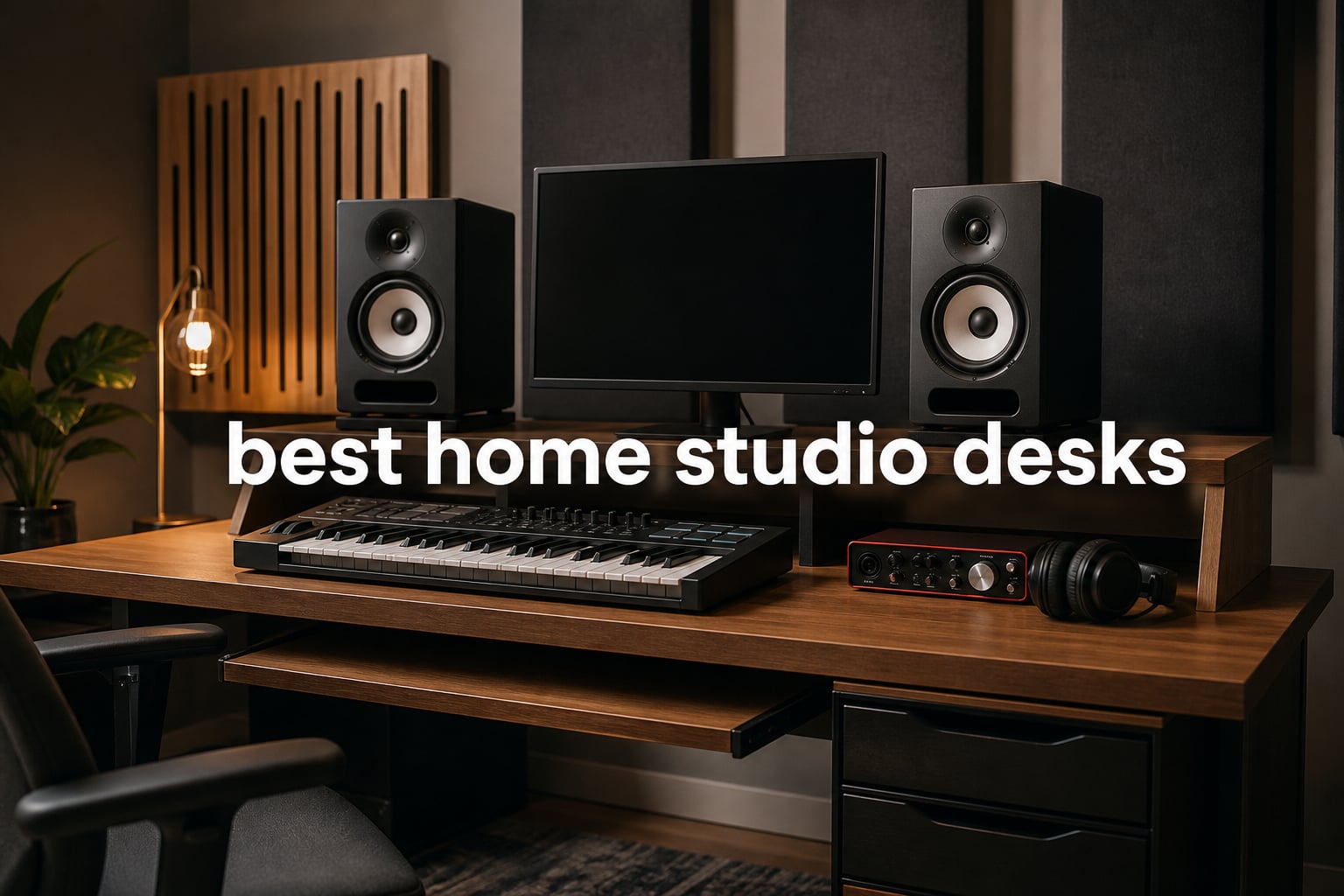
The best home studio desks put the gear you touch most within easy reach without turning monitor placement or legroom into an afterthought. A proper music production desk can give a MIDI keyboard, display, audio interface, nearfield monitors, and cables defined places; a generic office desk usually makes you improvise all of that.
I approached this list as a fit-and-function decision rather than a list of flashy extras. The verified listings below give us dimensions, desk materials, trays, shelves, load figures where supplied, and stated limitations, so you can match a studio workstation to the gear and room you actually have.
A dedicated desk is not compulsory for making music, but it can remove friction from every session. If you are planning the wider room around it, our studio setup guide and these reverb techniques are useful next reads once your listening position is settled.
For 2026, my short answer is to start with the Glorious Sound Desk Compact for a compact production-focused layout, the Armocity for practical powered storage, or the LYYL if a full 88-key controller has to live under the work surface. The rest of the picks cover wide dual-monitor rigs, small apartments, movable workstations, and desks with extra speaker or storage space.
Table of Contents
The top 3 picks are the Glorious, Armocity, and LYYL desks.
These three answer the most common home-studio briefs: a purpose-built compact workstation, an accessible desk with power and cable-routing help, and a specialist 88-key keyboard solution. Check the physical measurements against your room before treating any badge as a final answer.


The best home studio desks in 2026 cover compact to wide setups.
This overview includes every desk analyzed for this guide. I have highlighted the setup-defining features rather than pretending that desks with different footprints serve the same producer.
| Product | Specifications | Action |
|---|---|---|
| Glorious Sound Desk Compact |
|
Check Latest Price |
 SEDETA L Shaped Gaming Desk SEDETA L Shaped Gaming Desk |
|
Check Latest Price |
 EUREKA ERGONOMIC 72-inch Desk EUREKA ERGONOMIC 72-inch Desk |
|
Check Latest Price |
 Acme Suitor Studio Desk Acme Suitor Studio Desk |
|
Check Latest Price |
 Acme Eleazar 71-inch Desk Acme Eleazar 71-inch Desk |
|
Check Latest Price |
 On-Stage WS7500 Workstation On-Stage WS7500 Workstation |
|
Check Latest Price |
 Acme Eleazar 4-Shelf Desk Acme Eleazar 4-Shelf Desk |
|
Check Latest Price |
| Armocity Music Studio Desk |
|
Check Latest Price |
 Acme Saida Music Desk Acme Saida Music Desk |
|
Check Latest Price |
 Monoprice Stage Right Desk Monoprice Stage Right Desk |
|
Check Latest Price |
| LYYL 88-Key Studio Desk |
|
Check Latest Price |
 Zreephy 63-inch Recording Desk Zreephy 63-inch Recording Desk |
|
Check Latest Price |
The best compact choice is 1. Glorious Sound Desk Compact Studio Workstation.
Glorious Sound Desk C Studio Workstation with Pull-Out Keyboard Compartment
39.88 x 25.59 x 36.69 in
2 x 3U racks
61-key pull-out tray
Pros
- Purpose-built rack bays
- Pull-out keyboard tray
- Cable ducts
- Compact three-level layout
Cons
- Assembly needs two people
- No electric height adjustment
The Glorious Sound Desk Compact makes the clearest case for a small, dedicated music production desk. Its 39.88 by 25.59 inch footprint is manageable compared with the wide desks here, while its 36.69 inch total height creates separate working levels for screens, monitors, and controllers.
What separates it from a basic computer desk is the pair of 3U 19-inch rack bays. That is six total rack spaces split across both sides, which is useful only if you genuinely own rack-width hardware or plan to add it.
I would shortlist this for a bedroom producer using up to a 61-key controller. The pull-out tray, cable ducts, and stated 35 kilogram maximum top load give the layout a focused, equipment-first logic.
The compact layout works best when your keyboard is 61 keys or smaller.
The listing states that the pull-out tray fits up to 61 keys, so do not assume a full piano-style controller will fit. Measure the controller body, not just the number of keys, because casing and side controls add width.
The rack bays matter most when you own rack-width hardware.
Two 3U bays can tidy a small interface, preamp, or other compatible outboard gear, but they are not general drawers. Plan airflow and cable exit paths before filling either side.
The best flexible room layout is 2. SEDETA L Shaped Gaming Desk.
SEDETA L Shaped Gaming Desk, Reversible Computer Desk, Gaming Desk with Power Outlets & LED Strip, Monitor Shelf, Keyboard Tray, Pegboard and Storage Shelves for Home Office, Black
59.01 x 19.71 x 35.41 in
Reversible L shape
4 outlets and 2 USB ports
Pros
- Reversible configuration
- Built-in charging
- Keyboard tray
- Three-tier storage
Cons
- Shallow 19.71-inch depth
- Assembly tools are not included
The SEDETA is not sold as dedicated studio furniture, yet its reversible L layout can make sense when production shares a room with a computer workstation. Its 59.01 inch width and 19.71 inch depth leave a relatively slim main surface, while the shelf, pegboard, storage bag, and three-tier storage give accessories a home.
The built-in charging station provides four outlets and two USB ports. That can reduce adapter clutter for controllers, a laptop, and phone, though I would still keep audio power and signal cables organized separately where possible.
I would choose this model only after mapping monitor placement on the shallow surface. The RGB strip and music-sync modes are optional decoration rather than reasons to select a recording studio desk.
The reversible design suits a combined production and work room.
You can configure the storage on either side or convert the unit into a longer desk for two people. That flexibility is useful when a room layout changes, but it does not create rack mounting or a dedicated speaker bridge.
The 19.71-inch depth needs a monitor-placement check.
Forum discussions repeatedly flag awkward monitor placement on unsuitable desks. With this depth, confirm that your displays, monitor stands, and listening distance can work without crowding the front edge.
The best wide dual-monitor surface is 3. EUREKA ERGONOMIC 72-inch Gaming Desk.
EUREKA ERGONOMIC Gaming Desk Wing Shaped Keyboard Tray 72 Inch Walnut
72 x 24 x 30 in
400-pound capacity
Dual monitor shelves
Pros
- Wide 72-inch worktop
- 400-pound stated capacity
- Two monitor shelves
- Cable grommets
Cons
- Fixed height
- Assembly tools are not included
The EUREKA ERGONOMIC desk answers the producer who needs horizontal space more than rack bays. The 72 by 24 inch surface and wing-shaped desktop give you room for a computer, controllers, and a broad working zone, with a stated maximum capacity of 400 pounds.
It includes two monitor shelves with customizable RGB lighting, two cable-management grommets, power-socket holders, device grooves, a cup holder, and dual headphone hangers. The pull-out keyboard tray includes a precision mouse pad, an unusual combination that may suit hybrid gaming and recording rooms.
For a wide music studio furniture layout, I like that the desk does not ask you to stack every device on one flat plane. The 30 inch fixed desk height means chair adjustment does the ergonomic work, so test your seated elbow position first.
The broad top suits large computer and controller layouts.
A 72-inch width gives more separation between computer gear and hands-on devices than compact desks can offer. It is a strong fit for producers who keep multiple screens or larger control surfaces on the desk.
The raised shelves still need a speaker-width check.
Narrow monitor shelves are a recurring user complaint, and the listing does not give individual shelf dimensions. Verify the footprint of each studio monitor and leave room for safe positioning before relying on the shelves.
The best movable basic workstation is 4. Acme Suitor Studio Desk.
Acme 47″ Inch Music Recording Studio Computer Gaming Wooden Desk with Sliding Keyboard Tray & Cup Holder, Wooden Top Shelf & Botton Metal Frame, Casters Included, Easy Assembly, Black Finish
47 x 28 x 38 in
Keyboard tray
Caster wheels and shelf
Pros
- Caster wheels included
- Keyboard tray
- Shelf and drawer
- Cup and headset holders
Cons
- Full assembly needs two people
- No rack bays
The Acme Suitor is a 47 by 28 by 38 inch recording-oriented desk with a keyboard tray, a shelf, a drawer, caster wheels, a cup holder, and a headset hook. It is a simple way to get a tiered work area without filling the room with a wide console-style desk.
The listed 42 inch by 20 inch by 24 inch leg space gives a useful reference point for chair and pedal clearance. Its upper structure is also listed for a maximum 43-inch flat monitor, which is different from a promise about studio monitor speaker dimensions.
I would see this as a practical home recording desk for a compact computer-and-controller setup. The wheels are helpful if the room does double duty, but lock the desk or otherwise prevent movement before working with sensitive gear.
The caster wheels suit rooms that have to change function.
Mobility helps when you must move a desk for recording, cleaning, or a temporary room layout. It also means stability deserves attention, particularly if speaker vibration or a heavy display is part of the setup.
The storage is useful for accessories rather than rack gear.
One shelf and one drawer can hold headphones, cables, and small peripherals. There is no stated 19-inch rack provision, so outboard equipment needs another solution.
The best wide mobile studio desk is 5. Acme Eleazar 71-inch Desk.
Acme 71″ Inch Music Recording Studio Computer Gaming Desk with Wood Storage Keyboard Tray, Wing Shaped & 2 Stands Tray & Botton Shelf, Metal Frame, Casters Included, Easy Assembly, Black Oak Finish
71 x 40 x 37 in
Keyboard tray
Wood top with metal support
Pros
- 71-inch width
- Deep 40-inch surface
- Keyboard tray
- Caster wheels
Cons
- Large room requirement
- Only one drawer
The 71-inch Acme Eleazar moves into larger-furniture territory with its 40 inch depth and 37 inch height. A wooden top and base with metal support, two stands, a keyboard tray, a drawer, and caster wheels make it a traditional broad studio workstation rather than a minimal desktop.
That 40 inch depth can give you generous room for a display and controller, yet depth is not automatically better in a mixing position. It can push screens and speakers farther away than a small room permits, which is a concern raised often in producer forums.
I would consider this desk for a room where the chair can sit far enough from the front wall and cable runs can be planned behind it. The stated 24 inch clearance under the keyboard is useful, but a full-size controller still needs its own measurement check.
The 40-inch depth helps only in a room that can support it.
A deep desk can keep a controller and computer from competing for the same edge. In a tight room, however, it can force monitoring positions that are harder to dial in.
The rolling base requires a stable final position.
Casters make the 71-inch unit more movable than many wide desks. Once positioned, check that the desk sits level and does not shift while you are operating controllers or typing.
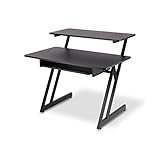
The best compact steel-frame workstation is 6. On-Stage WS7500.
On-Stage WS7500 Series Wood Studio Workstation – Black
43 x 30 x 37.5 in
175-pound capacity
Two-tier steel Z frame
Pros
- Heavy-duty steel frame
- Upper monitor tier
- Pullout keyboard tray
- Accessory-compatible
Cons
- Compact 43-inch width
- Assembly required
The On-Stage WS7500 is a two-tier studio workstation with a 43 inch width, a 30 inch depth, and a 37.5 inch total height. Its heavy-duty steel Z-style frame has a stated 175 pound capacity, and the upper tier is intended for computer and speaker monitors.
The main surface sits 29 inches off the ground, while the keyboard tray slides out underneath. This is a sensible arrangement for a compact computer, MIDI keyboard, and monitor pair, and On-Stage lists compatible accessories for later expansion.
I would put it high on a shortlist when floor space is limited but you still want a recognizable studio layout. The 43 inch span is not a cure-all for large controllers, multiple displays, or broad speaker spacing.
The two-tier format separates monitors from the work surface.
Separating displays and speakers from the controller area can improve day-to-day access to the keyboard tray. Check the upper shelf area against the bases of your monitors instead of relying on the general description.
The steel frame supports a focused compact rig.
The stated 175 pound maximum gives useful capacity context for modest gear collections. It is still wise to distribute gear rather than placing concentrated weight at one extreme edge.
The best high-storage choice is 7. Acme Eleazar 4-Shelf Desk.
Acme 83″ Inch Music Recording Studio Computer Gaming Desk with Wood Storage Keyboard Tray, Wing Shaped & 3 Stands Tray & Botton Shelf Metal Frame, Casters Included, Easy Assembly, Black Oak Finish
83 x 40 x 37 in
Four shelves
Keyboard tray and casters
Pros
- Four enclosed shelves
- Very wide surface
- Keyboard tray
- Caster wheels
Cons
- Large 83-inch footprint
- Partial assembly required
The four-shelf Acme Eleazar is the largest desk in this guide by listed width at 83 inches, with a 40 inch depth and 37 inch height. It combines four enclosed shelves, a keyboard tray, three stands, caster wheels, and a wooden top and base.
For someone storing lots of cables, controllers, books, or computer accessories, the enclosed-shelf count is the headline feature. It also has 24 inches of clearance under the keyboard and a stated 30 inch leg height, details worth comparing with your chair and controller position.
I would reserve this for a dedicated room where its size becomes an organizing advantage rather than an obstruction. It is not a small-studio shortcut, even though the casters offer some mobility.
The four enclosed shelves suit gear that should not live on the desktop.
Keeping cables, spare peripherals, and less-used accessories below the top can make a wide working surface easier to keep clear. The shelves are not specified as rack spaces, so do not treat them as a substitute for 19-inch mounting.
The 83-inch width needs a full-room measurement.
Measure the door route, wall span, and chair travel before ordering a workstation of this size. A desk can fit against a wall yet still leave too little space to sit and move comfortably.
The best powered compact studio desk is 8. Armocity Music Studio Desk.
Armocity Music Studio Desk Production Workstation – Recording Studio Desk
47.3 x 22.8 x 40 in
Monitor stand
3 USB ports and 2 outlets
Pros
- Built-in USB and outlets
- Raised monitor stand
- Pull-out tray
- Velcro wire organization
Cons
- Assembly is required
- 22.8-inch depth is compact
The Armocity is one of the most purpose-aligned small studio furniture options here: it has a raised monitor stand, a pull-out keyboard tray, three storage layers, Z-shaped metal legs, and a 47.3 inch-wide form. The manufacturer also includes velcro tape for wire organization, a welcome detail for a desk that will collect power and audio leads.
Its power module has three USB ports and two outlet plugs. That can keep smaller chargers and computer accessories close, although I would plan cable routing before assembling the three levels rather than trying to fix a tangled setup afterward.
At 22.8 inches deep, this is a compact home studio table rather than a broad mixing console. The raised stand is intended to bring monitors closer to eye level, while the tray creates room for a controller underneath.
The onboard power helps with low-voltage production accessories.
The three USB ports and two outlets can cut down on separate charging blocks around the desk. Do not overload any desk-mounted power point, and keep audio cables from becoming a loose bundle around the legs.
The 47-inch monitor shelf suits a compact two-screen plan.
The listing says the shelf fits two monitors, which is useful for computer displays. If you plan to place studio monitor speakers there, verify base dimensions and stable placement independently.
The best speaker-shelf layout is 9. Acme Saida Music Desk.
Acme Saida Rectangular Music Desk with Headphone Holders in Black
71 x 32 x 40 in
Two speaker shelves
Sliding keyboard tray
Pros
- Two elevated speaker shelves
- 71-inch work surface
- Keyboard tray
- Two headphone holders
Cons
- Heavy 77.1-pound unit
- Assembly required
The Acme Saida is a 71 by 32 by 40 inch music desk built from MDF, metal, and paper veneer. It offers a spacious main surface, a sliding keyboard tray, two elevated speaker shelves, two headphone holders, and a metal frame under a carbon-grain finish.
Two dedicated speaker shelves are a better starting point than balancing speakers between controllers on a flat desktop. Still, speaker location affects listening more than furniture labels do, so I would confirm the shelf width, depth, and height work with your monitor model.
This is a sensible pick for a producer who values separation between speakers, headphones, controller, and desktop gear. Its listed 77.1 pound weight and 32 inch depth suggest planning its final placement before assembly.
The twin shelves separate monitoring gear from the main work zone.
Keeping speakers elevated can free up the desk surface for a keyboard, interface, and computer. Use isolation pads or the approach recommended by your monitor maker if your setup calls for them.
The headphone holders help keep a busy desk accessible.
Two holders give headphones a consistent parking place rather than leaving them on a controller or work surface. This is a small feature, but it supports the faster setup and pack-down rhythm that home studios need.
The best small-apartment choice is 10. Monoprice Stage Right Recording Studio Desk.
Monoprice Recording Studio Desk – with Raised Platform and Keyboard Tray, Black – Stage Right
31.5 x 24 x 38 in
175-pound capacity
Raised platform and tray
Pros
- Very compact 31.5-inch width
- Quick assembly with tools
- Raised platform
- Lightweight steel build
Cons
- Limited width for large rigs
- No warranty listed
The Monoprice Stage Right desk is the space-saving answer in this roundup, with a listed 31.5 inch width, 24 inch depth, and 38 inch height. It combines a raised platform, pullout keyboard tray, steel construction, and a stated 175 pound maximum capacity in a unit that weighs about 30 pounds.
The included hardware and tools are said to make assembly quick. That is useful if you are setting up in an apartment or a multipurpose room, although the short width means every item on the desk needs a deliberate place.
I would choose this desk for a laptop or compact display, small monitors if their bases fit safely, and a narrow MIDI controller. It is not the one for a broad keyboard, several rack units, or a large dual-display setup.
The 31.5-inch width fits places that wider desks cannot.
A small footprint can free room for acoustic treatment, instrument stands, or basic movement around the chair. The compromise is a restricted top surface, so count the width of every permanent device.
The raised platform creates a simple two-level workspace.
The upper shelf is listed at 38 inches from the ground and is intended for monitor speakers. Confirm your seated sightline and the physical base sizes before setting speakers or displays there.
The best full-size keyboard choice is 11. LYYL 88-Key Music Studio Desk.
LYYL Music Studio Desk with Keyboard Tray and Height Adjustment Bracket, for Full 88 Keys (Music Producer Desk) (Black, 88 Keys)
61.4 x 23.6 x 32.4 in
88-key tray
Four tray height options
Pros
- Designed for 88-key keyboards
- Four tray heights
- 55-pound tray capacity
- Cable tray system
Cons
- Limited stock noted
- Six-month manufacturer warranty
The LYYL is the specialist choice for a full 88-key controller, not a generic desk with a vaguely described drawer. Its 61.4 by 23.6 by 32.4 inch frame uses a patented three-way rail system, Häfelle rails, industrial-grade steel, CARB Phase 2 compliant MDF wood, and a keyboard tray rated for up to 55 pounds.
The key feature is the height-adjustment bracket with four tray positions. A keyboard tray that places wrists too high or too low can spoil an otherwise tidy studio, so having four options makes this model more adaptable than fixed-tray alternatives.
I would select it when piano-style playing is central to the setup and the controller needs to disappear beneath the worktop between sessions. The multi-panel and cable tray system is also useful for keeping the wide controller’s connections organized.
The dedicated 88-key tray is the reason to choose this desk.
Many pull-out trays accommodate smaller controllers but do not state suitability for full-size keyboards. This listing explicitly identifies the 88-key configuration, yet you should still compare your controller’s exact dimensions and weight to the desk data.
The four height positions support a better playing posture.
Adjustable tray height helps align the keybed with your chair and elbow position. Set it with your normal playing posture, not only for a quick fit under the desktop.
The best reinforced 63-inch choice is 12. Zreephy Music Studio Recording Desk.
Zreephy Music Studio Recording Desk with 1 Piano Keyboard Tray, Music Production Workstation, Home Office Furniture Wooden Table (Black Board + Black Frame, 63 inches)
63 x 23 x 32 in
Steel frame
Sliding keyboard tray
Pros
- 63-inch width
- Reinforced steel frame
- Two speaker stands
- Three drawers and two shelves
Cons
- Heavy 99-pound unit
- Limited review history
The Zreephy is a 63 by 23 by 32 inch desk with a high-grade carbon-steel frame, transverse reinforcement tubes, a 0.98 inch solid wood composite top, and non-slip foot pads. It also has a sliding keyboard drawer, two speaker or microphone stands, three drawers, and two shelves.
This is a storage-heavy alternative for a producer who wants a long surface but not the 71 to 83 inch span of the larger Acme desks. The 99 pound listed weight points to a substantial assembly and makes its final location worth deciding in advance.
I would use the two elevated stands for speakers, microphones, or other gear only after confirming fit and cable routes. Optional risers are mentioned for height adjustment, but the standard desk height is listed as 32 inches.
The reinforced frame suits a fixed home-studio installation.
The carbon-steel frame, transverse tubes, and non-slip pads are useful signals for a desk intended to stay put. This is less convenient for a room where the furniture must move every week.
The drawers and shelves suit producers with many small accessories.
Three drawers and two shelves can remove adapters, headphones, manuals, and spare cables from the working surface. Keep heavy gear balanced and avoid blocking the keyboard tray’s travel.
Choose a studio desk by measuring the room, gear, and listening position first.
The best desk is the one that fits your physical workflow, not the one with the longest feature list. Before choosing, record the room width, usable wall span, chair travel, door swing, desk depth, controller dimensions, monitor bases, and every device that must live within reach.
Choose width by counting permanent gear rather than guessing.
Put the computer, displays, controller, audio interface, monitor stands, and any pad controller on paper at their actual widths. Add empty working space for a mouse, notes, and arm movement; a desk that is full on day one becomes frustrating when you add one more device.
The Monoprice at 31.5 inches and the Glorious at 39.88 inches suit compact plans, while the EUREKA at 72 inches and Acme Eleazar 4-Shelf at 83 inches need far more room. A wide producer desk may help organization, but it must not prevent a chair from moving or force monitors into poor locations.
Choose depth by checking monitor distance and keyboard reach.
Shallow desks such as the SEDETA at 19.71 inches or Zreephy at 23 inches need extra thought if you use large displays and nearfield monitors. Deep options such as the 40-inch Acme Eleazars offer more placement room, but a deep desktop can also place a screen or speaker farther away than a compact room supports.
Community discussions consistently call out desks that are too deep and monitor shelves that are too narrow. I would mock up the front edge with tape on the floor and use boxes for your speakers before committing to a desk footprint.
Choose a keyboard tray by controller dimensions, weight, and playing posture.
A tray is not automatically a good tray. Check width, usable depth, clearance for knees, rail travel, and controller weight, then sit at the target height with your arms relaxed at the keys.
The Glorious is stated for up to 61 keys, while the LYYL expressly targets 88-key keyboards and gives four height positions with a 55 pound tray capacity. The other listed pull-out trays may suit compact controllers, but their listings do not make the same full-size promise.
Choose rack space only when your hardware calls for 19-inch mounting.
Rack bays are useful for compatible preamps, processors, interfaces, and other rack-width units, not as a general sign of a better desk. The Glorious provides two 3U bays, which is six total U-spaces split between two sides.
Plan each unit’s depth, heat, front-panel access, and cables before purchase. If you work entirely in the box with a laptop and compact interface, shelves and cable routing may be more useful than empty rack bays.
Choose monitor shelves by physical footprint and safe placement.
A raised monitor shelf can open desktop space and bring computer displays closer to eye level. Speaker placement needs more care: confirm the shelf supports each base safely and that the final height and spacing suit your listening position.
The Acme Saida includes two speaker shelves, the EUREKA lists dual monitor shelves, and the Zreephy has two speaker or microphone stands. Do not interpret those labels as proof that every nearfield monitor will fit; the listing should give shelf dimensions, or you should measure directly before selecting.
Choose cable management before the first cable goes in.
Cable disorder is one of the clearest frustrations in studio-desk discussions because a neat desk can become a tangled desk after power supplies, USB hubs, displays, and audio lines arrive. Look for intentional routing like the Glorious cable ducts, EUREKA grommets, Armocity velcro tape, or LYYL cable tray system.
Separate power leads from audio connections where your setup allows, leave enough slack for tray movement, and label both ends before routing cables through a desk. I also leave an accessible service loop for the device most likely to change, usually the computer or interface.
Choose stability and assembly effort as part of the specification.
Desks with casters are convenient, but they should be level and immobile during critical work. Fixed steel frames, such as the On-Stage Z frame and Zreephy reinforced frame, suit installations that will remain in one place.
Many desks here require assembly, and several listings recommend two people or do not include tools. Sort hardware, protect the finish during assembly, and tighten in stages; then recheck all fasteners after the desk has been loaded with normal gear.
Once your furniture works, production becomes less interrupted by searching for a cable or clearing a place for a controller. For the creative side of what happens at that desk, this music theory guide can give your next session a useful starting point.
The answers to common home studio desk questions are below.
Do I need a studio desk?
You do not need a studio desk to make music, but a dedicated workstation can make a home setup easier to use. It provides defined places for a computer, MIDI keyboard, monitors, rack gear, and cable routing, which can improve access and seated comfort during longer sessions.
How much does a studio desk cost?
The amount varies with footprint, materials, storage, keyboard-tray design, rack capacity, and specialized rail hardware. Compare current retailer listings yourself, but choose first by room fit, controller compatibility, monitor placement, and construction rather than by a single figure.
What is the best height for a studio desk?
The best height lets you sit with relaxed shoulders and forearms close to level when using your keyboard and controller. A fixed-height desk should be paired with an adjustable chair; a height-adjustable keyboard tray, such as the LYYL design, gives more control over playing position.
The Glorious, Armocity, and LYYL are the clearest picks for 2026 setups.
Choose the Glorious Sound Desk Compact for compact rack-and-controller organization, the Armocity for a practical powered workstation with a raised shelf, and the LYYL when an 88-key keyboard is non-negotiable. The best home studio desks work when their dimensions match the room and their layout matches the way you create.
Measure twice, map your speaker and controller positions, then choose the smallest desk that gives every permanent piece of gear a sensible place. A coherent home studio setup starts with that physical clarity.