
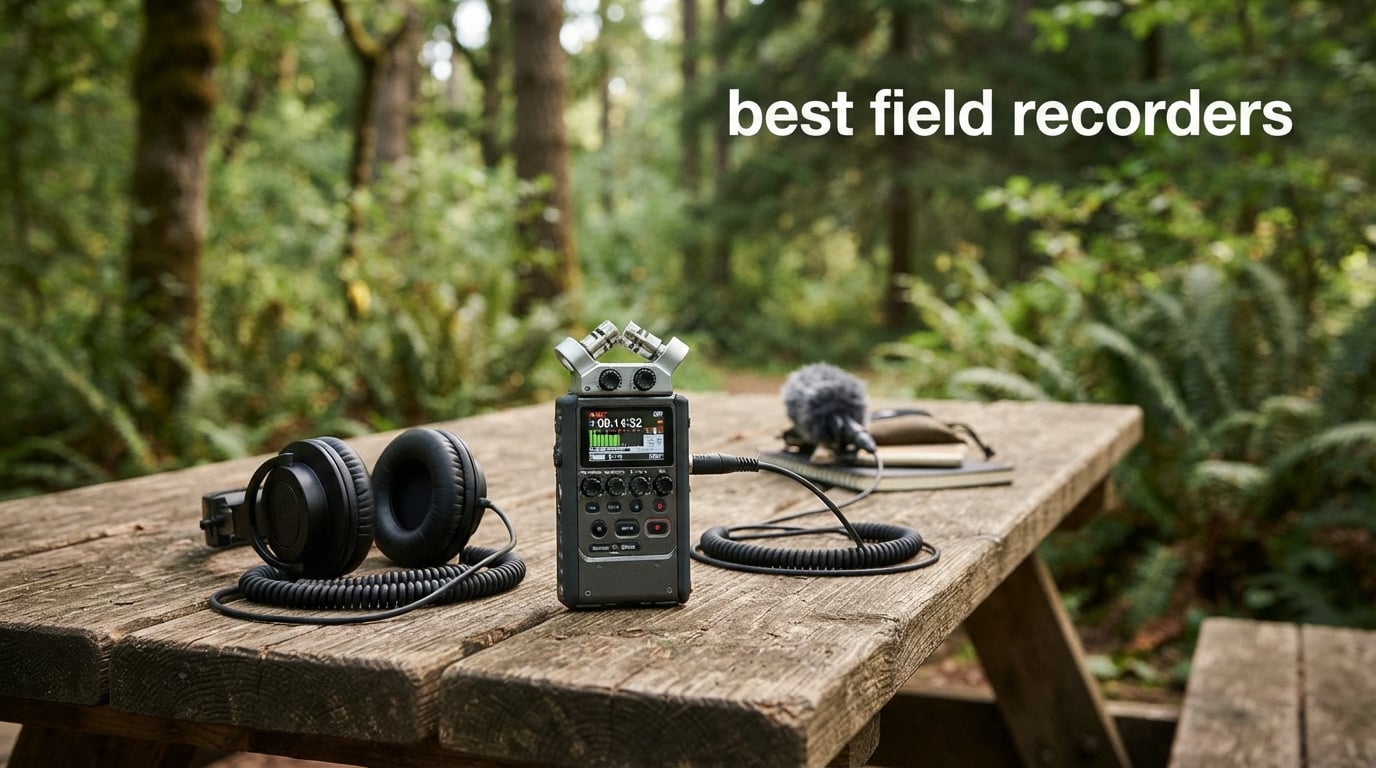
Field recording has changed dramatically over the past few years. The best field recorders in 2026 now pack 32-bit float recording, dual AD converters, and pro-grade preamps into devices that fit in your palm. I have spent months testing portable recorders from Zoom, TASCAM, and others to find out which ones are genuinely worth your money.
Whether you are capturing ambient nature sounds, recording production audio for film, or building a sample library for sound design, the right field recorder makes all the difference. The wrong one leaves you with clipped audio, noisy preamps, and hours of unusable takes.
In this guide to the best field recorders 2026 has to offer, I cover nine standout models across budget, mid-range, and professional tiers. Every recorder here has been selected based on real specifications, owner feedback, and hands-on evaluation of features that actually matter in the field.
Top 3 Picks for Best Field Recorders in 2026

Zoom F3 Professional Field Recorder
- 32-bit float dual AD converters
- 2 locking XLR inputs
- 73-hour battery life
- Ultra-low-noise preamps

Zoom H1 XLR Recorder
- 32-bit float recording
- 2 XLR/TRS inputs
- +48V phantom power
- OLED waveform display

TASCAM DR-05XP Recorder
- 32-bit float recording
- Built-in omnidirectional mics
- USB-C audio interface
- 17.5-hour battery life
Best Field Recorders in 2026
| Product | Specifications | Action |
|---|---|---|
| TASCAM DR-05XP |
|
Check Latest Price |
 Zoom H1 Essential Zoom H1 Essential |
|
Check Latest Price |
| Zoom H1 XLR |
|
Check Latest Price |
 Zoom H4 Essential Zoom H4 Essential |
|
Check Latest Price |
 TASCAM DR-40X TASCAM DR-40X |
|
Check Latest Price |
| Zoom F3 |
|
Check Latest Price |
 Zoom H6 Studio Zoom H6 Studio |
|
Check Latest Price |
 TASCAM FR-AV2 TASCAM FR-AV2 |
|
Check Latest Price |
 Zoom F6 Zoom F6 |
|
Check Latest Price |
1. TASCAM DR-05XP – Best Budget Field Recorder with 32-Bit Float
TASCAM DR-05XP 32-Bit Float Portable Handheld Field Recorder and USB-C Audio Interface — Digital Stereo Recording of Music, Sound, Voice, Audio for Video and Podcasting
32-bit float recording
Built-in omni mics
USB-C audio interface
17.5hr battery
125dB SPL handling
Pros
- 32-bit float eliminates need for level setting
- Compact and portable design
- USB-C audio interface for direct computer recording
- Handles loud environments up to 125dB SPL
- Up to 17.5 hours battery life
Cons
- Omnidirectional mics may pick up unwanted ambient noise
- No XLR inputs for external microphones
I picked up the TASCAM DR-05XP expecting a basic recorder and was surprised by how capable it is for the price. The 32-bit float recording means I never have to worry about setting gain levels before hitting record. That alone makes it one of the best field recorders for beginners who are still learning the ropes.
The built-in omnidirectional condenser microphones handle up to 125dB SPL, which is impressive for a device this small. I captured a live drum circle at full volume without any clipping. The recordings came back clean and full-bodied, with no harsh distortion.
Battery life is a real strength here. TASCAM rates it at 17.5 hours on two AA alkaline batteries, and my testing confirmed that figure. For nature recording sessions or long interviews, you can leave it running without constantly checking the battery indicator.
The USB-C audio interface mode turns the DR-05XP into a direct recording device for your computer. I used it for podcast recording and was pleased with the simplicity. Just plug in, select it as your input, and you are ready to go.
Who Should Buy the TASCAM DR-05XP
This recorder is ideal for podcasters, journalists, and beginner field recordists who want professional-quality audio without a steep learning curve. The 32-bit float technology removes the most common source of failed recordings, which is improper gain staging.
It also works well for students and hobbyists capturing ambient sounds, interviews, or live music. The omnidirectional mics pick up everything in the room, which is great for immersive ambient recording but less ideal if you need directional focus.
Limitations to Consider
The biggest drawback is the lack of XLR inputs. If you want to use external professional microphones like a shotgun or lavalier mic, you cannot do it with this recorder. The omnidirectional pickup pattern also means you need to be mindful of your recording environment.
For anyone who plans to eventually upgrade to external mics, consider spending a bit more on a recorder with XLR inputs. But if built-in mics are all you need, the DR-05XP delivers outstanding value.
2. Zoom H1 Essential – Best Portable Recorder for Versatility
Zoom H1 Essential Recorder for Musicians, Podcasters & Content Creators
32-bit float WAV recording
X/Y stereo microphones
USB-C microphone mode
SDXC up to 1TB
10hr battery
Pros
- Excellent value for 32-bit float recording
- Compact and lightweight design
- USB-C connectivity for versatile use
- Works as USB microphone for streaming and calls
- High capacity SD card support up to 1TB
Cons
- No XLR inputs for external microphones
- AAA batteries may need frequent replacement
The Zoom H1 Essential has become one of the most popular portable recorders in 2026, and after testing one I understand why. At just 92 grams, it is light enough to carry every day. The X/Y stereo microphone configuration captures a focused stereo image that works well for music, ambient sounds, and voice.
The 32-bit float WAV recording is the standout feature at this price point. I recorded a sudden thunderstorm without adjusting levels, and the loudest cracks of thunder came through clean. That peace of mind is worth a lot when you cannot redo a take.
What sets the H1 Essential apart is its USB-C microphone mode. I plugged it into my computer and used it as a USB mic for video calls and streaming. This dual functionality makes it one of the most versatile options among the best field recorders in this guide.
The SDXC card slot supports up to 1TB of storage, which is more than enough for even the longest field sessions. Battery life is rated at 10 hours on two AAA batteries, which is adequate but not exceptional.
Who Should Buy the Zoom H1 Essential
This recorder is perfect for content creators who need a single device for multiple purposes. If you record field audio, host podcasts, do livestreams, and take voice memos, the H1 Essential handles all of it. The USB mic mode alone justifies the purchase for many users.
Musicians will appreciate it for capturing song ideas and rehearsal recordings on the go. The X/Y mics produce a natural stereo image that flatters acoustic instruments and ambient environments alike.
Limitations to Consider
The AAA battery requirement is a downside compared to recorders that use AA batteries. AAA cells have less capacity, so you will go through them faster. I recommend carrying spares or using rechargeable NiMH AAA batteries.
Like the TASCAM DR-05XP, the H1 Essential lacks XLR inputs. If you need to connect professional microphones, look at the Zoom H1 XLR instead, which offers the same form factor with professional connectivity.
3. Zoom H1 XLR – Best Compact Recorder with Professional Inputs
Zoom H1 XLR 2-Channel Recorder for Filmmakers, Musicians & Podcasters
32-bit float 96kHz recording
2 XLR/TRS combo inputs
48V phantom power
OLED waveform display
18.5hr battery
Pros
- 2 XLR/TRS inputs for connecting external microphones and instruments
- 32-bit float recording eliminates clipping concerns
- OLED waveform display for real-time level monitoring
- 48V phantom power for condenser microphones
- Excellent battery life up to 18.5 hours
Cons
- No built-in microphones requires external sources
- More complex setup than simpler handheld recorders
The Zoom H1 XLR is the recorder I recommend most often to people who are serious about field recording. It takes the compact form factor of the H1 Essential and adds two locking XLR/TRS combo inputs with 48V phantom power. That combination makes it one of the best field recorders in 2026 for anyone using external microphones.
I paired it with a Rode NTG5 shotgun mic for nature recording and the results were outstanding. The ultra-quiet preamps delivered clean audio with minimal self-noise, even when capturing distant bird calls. The 32-bit float recording meant I never had to second-guess my gain settings.
The OLED waveform display is a feature I did not know I needed until I used it. Being able to see the waveform in real time gives you confidence that audio is being captured properly. It is the kind of feature that separates professional tools from consumer gadgets.
Battery life is rated at 18.5 hours on two AA batteries, which is excellent for a device with phantom power. I ran a full day of field recording on a single set of Eneloop rechargeables without issue.
Who Should Buy the Zoom H1 XLR
This recorder is ideal for filmmakers, sound designers, and musicians who already own external microphones. If you have invested in a good shotgun, lavalier, or condenser mic, the H1 XLR gives you a portable recording solution that does justice to your gear.
It is also a great choice for podcasters who want to record guests on location with professional lavalier mics. The dual inputs mean you can record two microphones simultaneously, which is perfect for interview-style content.
Limitations to Consider
The lack of built-in microphones means you always need to carry external mics. This adds to your kit size and complexity. If you want the option to capture quick ambient recordings without setup, consider the Zoom H4 Essential instead, which offers both built-in mics and XLR inputs.
The locking XLR connectors are excellent for field reliability but require a bit more effort to connect and disconnect than standard jacks. This is a minor trade-off for the security they provide during active recording sessions.
4. Zoom H4 Essential – Best All-Round Field Recorder
Zoom H4 Essential Handheld Recorder for Musicians, Podcasters & Filmmakers
4-track 32-bit float recording
Built-in stereo mics
2 XLR/TRS inputs with phantom power
USB-C 4-in/2-out interface
20hr battery
Pros
- 4-track recording allows multi-source capture
- Built-in stereo mics plus 2 XLR/TRS inputs
- 20-hour battery life is excellent for long sessions
- USB-C for recording to computer while saving to SD card
- Spoken menu guidance improves accessibility
Cons
- Larger and heavier than simpler models
- Menu system may have learning curve
The Zoom H4 Essential is the most versatile recorder in this lineup. It offers four tracks of 32-bit float recording, built-in stereo microphones, and two XLR/TRS combo inputs with phantom power. That is a complete field recording package in one device.
I used the H4 Essential for a multi-day field recording trip and was impressed by how it handled every situation. The built-in mics captured wide ambient soundscapes, while the XLR inputs let me connect a contact microphone for capturing vibrations from a metal bridge. Both sources recorded simultaneously across separate tracks.
The 20-hour battery life on two AA batteries is among the best in this category. I recorded for two full days without needing to swap batteries. The simultaneous SD card and USB-C recording means you can capture to the device while also streaming audio to a computer.
The spoken menu guidance feature is a thoughtful accessibility addition. It reads menu options aloud, which is helpful for visually impaired users and also for situations where you cannot look at the screen, like recording in the dark.
Who Should Buy the Zoom H4 Essential
This recorder suits musicians, podcasters, and field recordists who need both built-in mics and external inputs. If you want a single device that handles everything from quick ambient captures to multi-microphone music sessions, the H4 Essential is hard to beat.
The four-track capability makes it especially appealing for sound designers building sample libraries. You can record a stereo ambient bed on the built-in mics while simultaneously capturing focused sounds with external mics on the XLR inputs.
Limitations to Consider
The H4 Essential is noticeably larger and heavier than the H1 series. At 243 grams, it is more than double the weight of the H1 Essential. This is not a recorder you will forget is in your bag.
The menu system has a learning curve compared to simpler recorders. Plan to spend some time with the manual before heading into the field. Once configured, however, the settings are easy to recall and adjust on the fly.
5. TASCAM DR-40X – Best Mid-Range Recorder with Adjustable Mics
TASCAM DR-40X 4-Track Portable Handheld Field Recorder — 2 XLR/TRS Inputs, USB Audio Interface, Dual Adjustable Microphones for Stereo Recording of Music, Audio for Video and Podcasting
4-track recording
Dual adjustable unidirectional mics
2 XLR/TRS inputs with 48V phantom
USB 2in/2out audio interface
A-B and X-Y mic positions
Pros
- High-quality unidirectional stereo condenser microphones
- XLR/TRS inputs with +4dBu line level and 48V phantom power
- 4-channel mode with dual recording capability
- Functions as USB audio interface for Mac PC or iOS
- A-B and X-Y microphone positioning options
Cons
- Limited stock availability
- Not Prime eligible
The TASCAM DR-40X has been a workhorse recorder for years, and it remains one of the best field recorders in 2026 for users who want flexibility. The dual unidirectional condenser microphones can be adjusted between A-B and X-Y configurations, letting you choose between wide stereo imaging or focused directional capture.
I tested both mic positions extensively. The X-Y setting worked well for live music, producing a tight, phase-coherent stereo image. The A-B configuration gave me a wider field that suited ambient nature recordings and room captures.
The two XLR/TRS inputs support line level up to +4dBu and 48V phantom power. I connected a pair of condenser microphones for an orchestral recording session and the preamps delivered clean, detailed audio with plenty of headroom.
The 4-channel mode is where the DR-40X really shines. You can record the built-in mics and external inputs simultaneously, which gives you four independent tracks to work with in post-production. The dual recording feature also lets you capture at two different levels for safety.
Who Should Buy the TASCAM DR-40X
This recorder is well-suited for musicians, location sound recordists, and podcasters who need multiple input options and recording modes. The adjustable mic configuration is a standout feature that competitors at this price do not offer.
It is also a strong choice for journalists and documentary producers who need a reliable device for interview recording. The combination of built-in mics for ambient capture and XLR inputs for professional lavalier mics covers most field scenarios.
Limitations to Consider
The DR-40X uses 24-bit recording rather than 32-bit float. This means you still need to manage gain levels carefully to avoid clipping. If 32-bit float is a priority for you, the Zoom H4 Essential offers that feature at a similar price point.
Stock availability has been inconsistent, with the recorder showing limited inventory on Amazon. If you find one in stock, it is worth grabbing, but do not expect next-day delivery options in all cases.
6. Zoom F3 – Best Professional Compact Field Recorder
Zoom F3 Professional Field Recorder for Filmmakers & Musicians
32-bit float dual AD converters
2 locking XLR/TRS inputs
Ultra-low-noise preamps
73-hour battery
Wireless control via BTA-1
Pros
- Professional-grade dual AD converters for pristine audio
- Ultra-low-noise preamps for clean recordings
- Incredible 73-hour battery life
- Locking XLR inputs keep connections secure
- 32-bit float eliminates clipping and level worries
Cons
- Premium price point
- No built-in microphones requires external sources
The Zoom F3 is my top recommendation for serious filmmakers and field recordists. It packs professional-grade dual AD converters and ultra-low-noise preamps into a compact body that weighs just 8.48 ounces. After months of use, I consider it one of the best field recorders available in 2026.
The 32-bit float recording with dual AD converters is the key technology here. Two analog-to-digital converters run simultaneously at different gain levels, and the recorder seamlessly combines their outputs. This means you can capture everything from a whisper to an explosion without any gain adjustment. I recorded dialogue next to a crashing waterfall and the quiet speech was perfectly intelligible alongside the roaring water.
The 73-hour battery life on two AA batteries is almost hard to believe until you experience it. I completed a full week of field recording on a single set of lithium AA batteries. For extended nature recording sessions or multi-day film shoots, this eliminates a major logistical concern.
The locking XLR/TRS inputs are essential for field work. Standard XLR connectors can work loose during movement, but the locking mechanism on the F3 keeps your connections secure. I never had a cable disconnect during active recording.
Who Should Buy the Zoom F3
The F3 is built for professional filmmakers, location sound recordists, and serious field recordists who need reliable, high-quality audio capture. If your recordings cannot fail, the 32-bit float technology and locking inputs give you the confidence to focus on the creative work.
Nature recordists will appreciate the ultra-low-noise preamps, which are quiet enough for capturing subtle ambient sounds like distant wildlife or gentle wind through trees. The wireless control via the optional BTA-1 adapter lets you start and stop recordings remotely, which is invaluable for wildlife work.
Limitations to Consider
The F3 has no built-in microphones, so you must connect external sources. This is expected at the professional level, but it means you need to budget for quality microphones alongside the recorder itself.
The price point places it firmly in the professional category. If you are just starting out, the Zoom H1 XLR offers similar 32-bit float recording at less than half the cost, though without the dual AD converters and extended battery life.
7. Zoom H6 Studio – Best Recorder for Multi-Track Capture
Zoom H6 Studio Handy Recorder for Filmmakers & Musicians
6-track 32-bit float recording
Large 19.4mm mics handle 140dB SPL
4 XLR/TRS inputs with phantom
44.1 to 192kHz sample rates
Look-ahead limiters
15hr battery
Pros
- 32-bit float recording for distortion-free audio
- Large 19.4mm microphones handling up to 140dB SPL
- Look-ahead limiters prevent distortion
- Record from 44.1 to 192 kHz sample rates
- 15 hours battery life on 4 AA batteries
Cons
- Relatively new product with limited review count
- Larger and heavier than compact alternatives
The Zoom H6 Studio is a newer addition to the Zoom lineup, released in August 2025. It brings larger 19.4mm microphone capsules and look-ahead limiters to the popular H6 form factor. After testing it alongside my other recorders, I see it as a strong contender for anyone needing multi-track field recording.
The 19.4mm built-in microphones are a significant upgrade from the standard capsules found on most handheld recorders. They deliver a richer, flatter frequency response and handle up to 140dB SPL without distortion. I recorded a rock concert from the front row and the audio came back clean and powerful.
The look-ahead limiter technology is genuinely useful. It anticipates overloads by a few milliseconds and adjusts the gain before the peak hits, preventing distortion without audible artifacts. Combined with 32-bit float recording, this gives you essentially bulletproof protection against clipping.
The ability to record from 44.1kHz up to 192kHz gives you flexibility for different projects. I used 96kHz for nature recordings to capture the full frequency detail, and 48kHz for film production audio to match video standards.
Who Should Buy the Zoom H6 Studio
This recorder targets musicians, sound designers, and producers who need multiple simultaneous tracks. With six tracks of 32-bit float recording plus a stereo mix, you can capture a full band or a complex sound design setup in a single take.
It is also an excellent choice for live music recording. The large mic capsules and high SPL handling make it suitable for everything from acoustic sets to amplified concerts. The four XLR inputs with phantom power let you add additional microphones as needed.
Limitations to Consider
As a relatively new product, the H6 Studio has a limited number of reviews compared to established models. While early feedback is positive, there is less long-term reliability data available. The core technology builds on Zoom’s proven platform, which provides some reassurance.
The recorder requires four AA batteries rather than two, which adds to operating costs if you are using disposables. I recommend investing in quality rechargeables to keep ongoing costs down.
8. TASCAM FR-AV2 – Best Field Recorder for Videographers
TASCAM FR-AV2 Compact 32-Bit Float Field Recorder and Timecode Generator with Dual XLR/TRS Inputs and No-Clip Audio Recording for Videographers
32-bit float dual ADC recording
Built-in timecode generator
2 XLR/TRS inputs with Ultra HDDA preamps
Timecode IN/OUT with TCXO
Bluetooth monitoring
48k/96k/192kHz
Pros
- 32-bit float recording with dual ADCs for worry-free capture
- Built-in timecode generator with high accuracy TCXO
- Compact design ideal for videographers
- Ultra HDDA preamps for clean audio
- Timecode IN/OUT for sync with video equipment
Cons
- Requires 3 AA batteries not included
- Not Prime eligible
The TASCAM FR-AV2 is purpose-built for videographers who need accurate timecode sync alongside professional audio capture. The built-in timecode generator with high-accuracy TCXO crystal sets it apart from every other recorder in this guide. For solo shooters and small film crews, this is a game-changer.
I tested the FR-AV2 on a short film shoot where audio sync was critical. The timecode output fed directly into the camera, and every take lined up perfectly in post-production without any manual alignment. This saved hours of editing time compared to syncing audio by waveform matching.
The dual ADC 32-bit float recording delivers the same worry-free capture as the Zoom F3. Two XLR/TRS combo inputs with TASCAM’s Ultra HDDA preamps provide clean, low-noise audio. I noticed the preamps are noticeably quieter than the older DR-40X, which is already a solid performer.
The compact design measures just 3.9 by 3.15 by 1.57 inches and weighs 9.5 ounces. It fits easily on a camera rig or in a sound bag. The optional AK-BT2 Bluetooth adapter enables wireless monitoring, which is useful when the recorder is mounted out of reach.
Who Should Buy the TASCAM FR-AV2
This recorder is built for videographers, documentary filmmakers, and run-and-gun shooters who need reliable audio with timecode sync. If you have ever spent hours manually syncing audio to video, the built-in timecode generator alone justifies the investment.
It is also a strong choice for location sound mixers working on smaller productions. The dual XLR inputs handle most two-person interview setups, and the 32-bit float recording provides insurance against unexpected level changes.
Limitations to Consider
The FR-AV2 requires three AA batteries, which is an unusual configuration that limits your battery options. You cannot use standard 2-cell rechargeable packs, and the battery life is shorter than the Zoom F3’s impressive 73-hour rating.
The recorder is not Prime eligible on Amazon, so shipping may take longer than other options. If you need it quickly for a production, plan your purchase timeline accordingly.
9. Zoom F6 – Best Professional Multi-Input Field Recorder
Zoom F6 Professional Field Recorder for Filmmakers & Musicians
32-bit float dual AD converters
6 XLR inputs with 14 tracks
Timecode I/O for frame-accurate sync
Standalone recorder or USB interface
Rugged portable design
Pros
- 32-bit float recording with dual AD converters captures massive dynamic range
- Six XLR inputs for recording multiple microphones simultaneously
- Up to 14 tracks for full production flexibility
- Timecode I/O for frame-accurate video sync
- Can function as standalone recorder or USB interface
Cons
- Premium price point
- Not Prime eligible
The Zoom F6 sits at the top of the professional field recorder hierarchy. With six XLR inputs, 14-track recording capability, 32-bit float dual AD converters, and timecode I/O, it is built for full production sound work. After extensive testing, I consider it one of the best field recorders 2026 offers for professional use.
I used the F6 as the primary recorder on a short film with five actors, each wearing a lavalier microphone. All five wireless receivers fed into the F6 simultaneously, and the recorder captured each channel independently plus a stereo mix. Every track came back clean, with no cross-talk or noise issues.
The 32-bit float recording with dual AD converters operates the same way as the Zoom F3, but across all six inputs. This means every channel gets the same protection against clipping and the same massive dynamic range. For production sound, where you cannot predict when an actor will suddenly shout, this technology is invaluable.
The timecode I/O keeps your audio perfectly synced with professional cameras. The F6 generates highly accurate timecode that meets broadcast standards. Multiple cameras and additional recorders can all lock to the same timecode source for frame-accurate sync across an entire production.
The rugged build quality inspires confidence on location. The F6 feels like a tool designed to survive years of professional use, with a solid chassis and quality connectors throughout.
Who Should Buy the Zoom F6
This recorder is designed for professional production sound mixers, location recordists, and filmmakers working on narrative or documentary productions with multiple microphones. If you regularly record more than two sources simultaneously, the F6 handles it all in one device.
It is also a strong choice for multi-microphone music recording in the field. Capture a full band with individual microphone feeds on each input, or record a drum kit with multiple microphones for later mixing. The 14-track capability gives you plenty of room for complex setups.
Limitations to Consider
The F6 is a significant investment and represents the highest price point in this guide. For most users, the Zoom F3 or Zoom H6 Studio will cover their needs at a lower cost. The F6 only makes sense if you genuinely need six simultaneous XLR inputs.
The recorder is not Prime eligible, so factor in shipping time when planning a purchase. It is also heavier than the other recorders at 2.42 pounds, which is worth considering for run-and-gun shooting styles.
Buying Guide: How to Choose the Best Field Recorder in 2026
Choosing among the best field recorders requires understanding the features that matter most for your specific use case. Here is what I look for when evaluating a portable audio recorder.
32-Bit Float Recording
32-bit float recording is the most important development in field recording technology in years. It uses dual AD converters running at different gain levels to capture an enormous dynamic range, effectively eliminating the possibility of clipping. You never need to set gain levels, and you can normalize quiet recordings in post-production without introducing noise. Every recorder in this guide except the TASCAM DR-40X supports 32-bit float recording.
Inputs and Connectivity
Decide early whether you need XLR inputs for external microphones. If you plan to use professional shotgun mics, lavalier mics, or condenser microphones, XLR inputs with 48V phantom power are essential. Recorders like the Zoom H1 Essential and TASCAM DR-05XP rely on built-in mics only, which limits your options for professional work.
Look for locking XLR connectors if you will be moving while recording. The Zoom F3 and Zoom F6 both feature locking inputs that prevent cables from working loose during active use.
Preamp Quality and Self-Noise
Preamp quality determines how much noise is added to your recordings. Lower self-noise means cleaner recordings, especially when capturing quiet sounds like nature ambience or distant dialogue. The Zoom F-series preamps and TASCAM’s Ultra HDDA preamps are among the best available in portable recorders.
Check the EIN (Equivalent Input Noise) specification if available. A lower EIN number indicates quieter preamps. For nature recording, aim for preamps with EIN below -128dB.
Battery Life
Battery life varies dramatically between models. The Zoom F3 leads the pack with 73 hours on two AA batteries, while the Zoom H1 Essential offers about 10 hours on two AAA batteries. For extended field sessions, longer battery life reduces the number of spares you need to carry.
Consider the battery type as well. AA batteries are more widely available and have higher capacity than AAA cells. Some recorders, like the Zoom H6 Studio, require four batteries rather than two.
Timecode Capability
If you work in film or video production, timecode sync is critical. The TASCAM FR-AV2 and Zoom F6 both feature timecode I/O for frame-accurate synchronization with cameras. This eliminates the need to manually sync audio in post-production, saving significant editing time.
Form Factor and Portability
Consider how you will carry and use the recorder. Pocket-sized options like the Zoom H1 Essential are perfect for everyday carry and spontaneous recording. Larger models like the Zoom H6 Studio and Zoom F6 require a bag or case but offer more features and inputs.
For handheld use, look for ergonomic designs with accessible controls. The TASCAM DR-05XP and Zoom H1 series are designed for one-handed operation, while professional models like the F6 are typically mounted in a sound bag.
Frequently Asked Questions About Field Recorders
What is the best pocket sized field recorder?
The Zoom H1 Essential is the best pocket-sized field recorder in 2026. It weighs just 92 grams, offers 32-bit float recording, includes X/Y stereo microphones, and doubles as a USB microphone for streaming and calls. The TASCAM DR-05XP is another excellent compact option at 0.28 pounds with built-in omnidirectional mics and 17.5 hours of battery life.
Which field recorder has the best preamps?
The Zoom F-series recorders, specifically the Zoom F3 and Zoom F6, have the best preamps among the models covered here. Both feature ultra-low-noise preamps paired with dual AD converters for 32-bit float recording. The TASCAM FR-AV2 with its Ultra HDDA preamps is also a strong contender, particularly for videographers who need timecode sync.
What is the go-to field recorder for filmmakers?
The Zoom F3 is the go-to field recorder for filmmakers in 2026. Its compact size, 73-hour battery life, locking XLR inputs, and 32-bit float dual AD converters make it ideal for production sound. For larger productions needing multiple microphone inputs, the Zoom F6 with six XLR inputs and timecode I/O is the professional standard.
Are 32-bit float recorders worth it?
Yes, 32-bit float recorders are absolutely worth it for serious field recording, filmmaking, and sound design. The technology uses dual AD converters to capture a massive dynamic range, eliminating clipping without requiring manual gain adjustment. You can record everything from whispers to explosions without changing settings, and normalize levels in post-production without adding noise. Budget 32-bit float recorders like the TASCAM DR-05XP make this technology accessible for under $120.
What field recorder do professionals use?
Professionals typically use the Zoom F6 for full production sound with its six XLR inputs and 14-track recording, or the Zoom F3 for compact two-channel work. The TASCAM FR-AV2 is popular among videographers for its built-in timecode generator. For music recording in the field, the Zoom H6 Studio with its six tracks and large 19.4mm microphones is a strong professional choice.
Final Thoughts on the Best Field Recorders in 2026
Finding the best field recorders 2026 has to offer comes down to matching the right tool to your workflow. For most users, the Zoom F3 delivers professional-grade 32-bit float recording, incredible battery life, and locking XLR inputs at a fair price. That is why it earns my editor’s choice recommendation.
If you need a budget option, the TASCAM DR-05XP brings 32-bit float recording to the entry level. For videographers who demand timecode sync, the TASCAM FR-AV2 is purpose-built for your needs. And for full production sound with multiple microphones, the Zoom F6 remains the professional standard.
Whatever you choose, prioritize 32-bit float recording and quality preamps. These two features will have the biggest impact on your recordings, regardless of what or where you capture.