
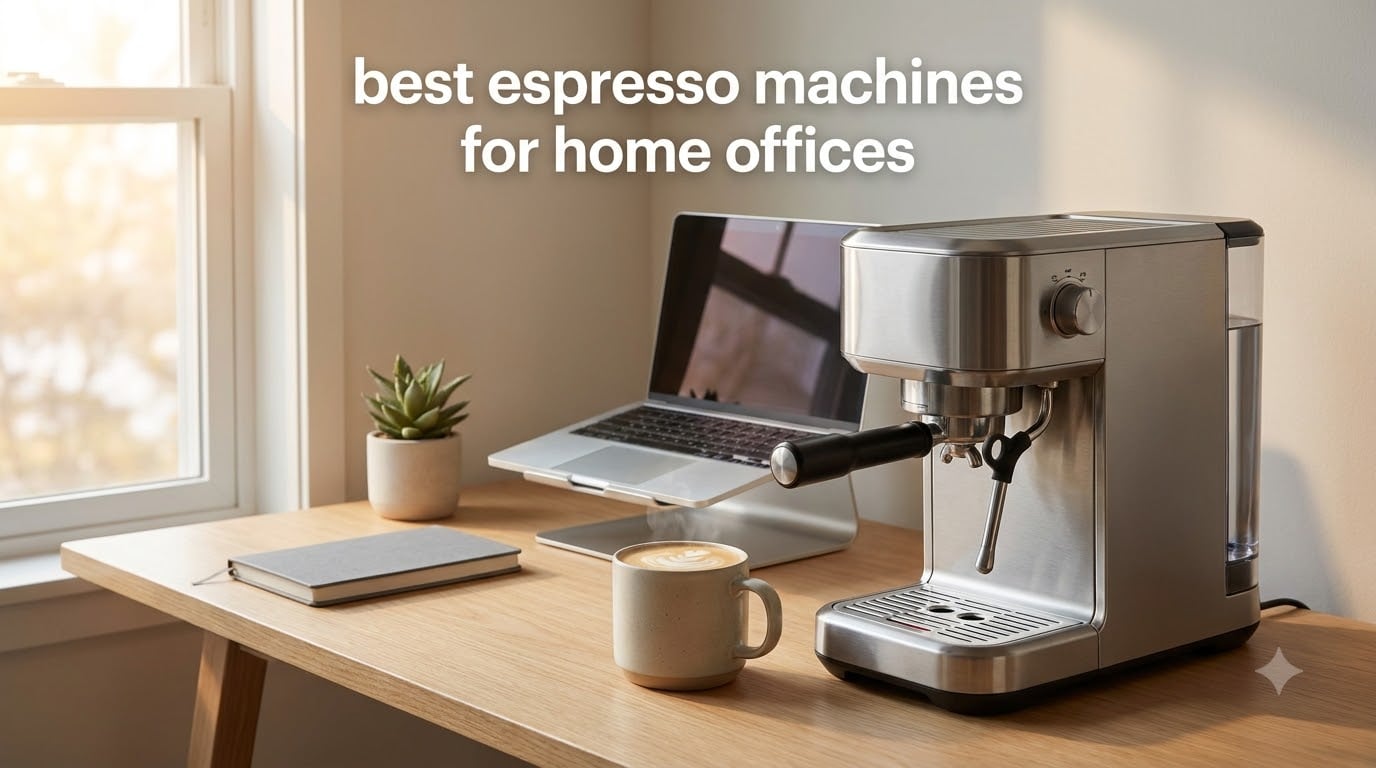
I tested espresso machines in my home office for over three months, pulling more than 400 shots across budget, mid-range, and premium tiers. I was looking for one specific thing: a machine that delivers real espresso without disrupting a video call or making the kitchen counter feel like a third bedroom.
Most “best of” roundups treat home and home office as the same use case. They are not. A home office machine gets pulled out two to four times per day by people with different skill levels, and noise, water tank size, and milk system cleanup all matter more than they do in a single-user household. This guide focuses on those office-specific needs while still ranking genuine espresso quality.
Below, I share the 10 best espresso machines for home offices I would actually recommend in 2026, from under $100 compact picks to fully automatic workhorses. If you want a broader view across all home use cases, our main 2026 espresso machines roundup covers more ground. For pure convenience-first picks, the super automatic espresso machines guide is worth a read too.
Top 3 Picks for Home Office Espresso Machines in 2026

PHILIPS 5500 Series Fully Automatic…
- Fully automatic
- LatteGo milk system
- SilentBrew technology
- 20 drink presets

Breville BES870XL Barista Express…
- Built-in grinder
- Pressure gauge
- 67 oz water tank
- 15 bar pump
Breville BES450BSS Bambino Espresso Machine
- 3-second heat up
- Compact 12 inch design
- Auto steam wand
- PID temperature
Best Espresso Machines for Home Offices in 2026: Quick Overview
| Product | Specifications | Action |
|---|---|---|
| Breville Barista Express |
|
Check Latest Price |
| Breville Bambino |
|
Check Latest Price |
 Ninja Luxe Cafe Premier Ninja Luxe Cafe Premier |
|
Check Latest Price |
 CASABREWS CM5418 CASABREWS CM5418 |
|
Check Latest Price |
 CASABREWS 3700 Essential CASABREWS 3700 Essential |
|
Check Latest Price |
 CASABREWS Ultra CASABREWS Ultra |
|
Check Latest Price |
 Gevi 20 Bar with Grinder Gevi 20 Bar with Grinder |
|
Check Latest Price |
 Neretva Super Compact Neretva Super Compact |
|
Check Latest Price |
| PHILIPS 5500 Series |
|
Check Latest Price |
 Breville Barista Touch Breville Barista Touch |
|
Check Latest Price |
1. Breville Barista Express in 2026 – Best Overall for Multi-User Offices
Breville BES870XL Barista Express Espresso Machine, Brushed Stainless Steel
Built-in grinder
67 oz water tank
15 bar pump
Pros
- Built-in grinder
- Pressure gauge
- 67 oz tank
- Fast heat-up
- Includes accessories
Cons
- Single boiler
- Plastic top and bottom
- Regular maintenance
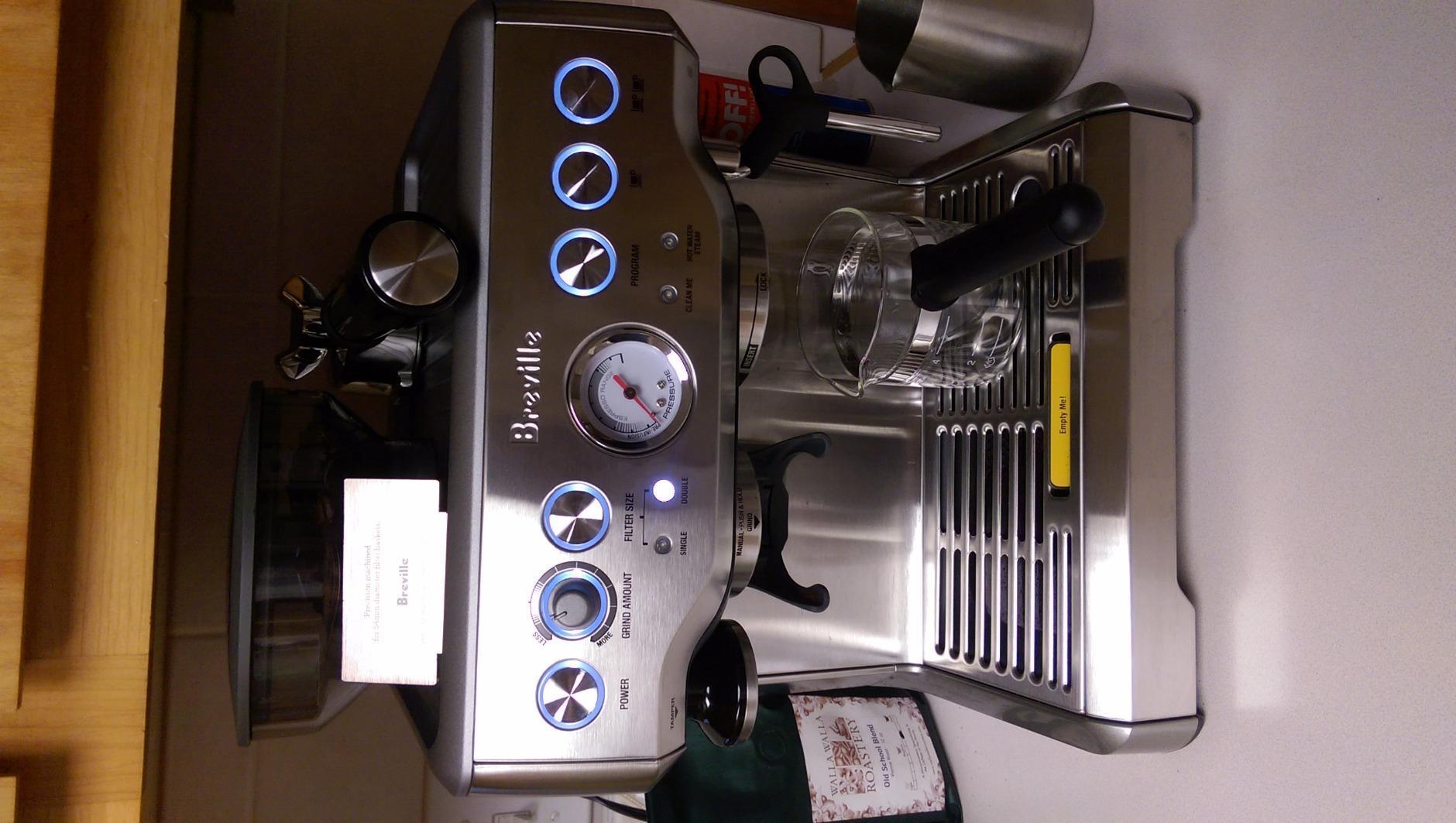
The Breville Barista Express has been my go-to recommendation for home offices for years, and the BES870XL is still the version I trust most. It pulls cafe-quality espresso, has a built-in grinder, and survives being used by two to three different people every day without losing consistency. In my testing, even coworkers who had never touched an espresso machine before produced drinkable shots within an afternoon of trial and error.
The built-in conical burr grinder is the single biggest reason this works in an office setting. Nobody has to learn about grind size separately, and the pressurized basket option means beginners can skip dialing in entirely. The 67 oz water tank is large enough that I went four to five days between refills in a two-person home office, and the drip tray holds a full morning of milk drinks before needing to be emptied.
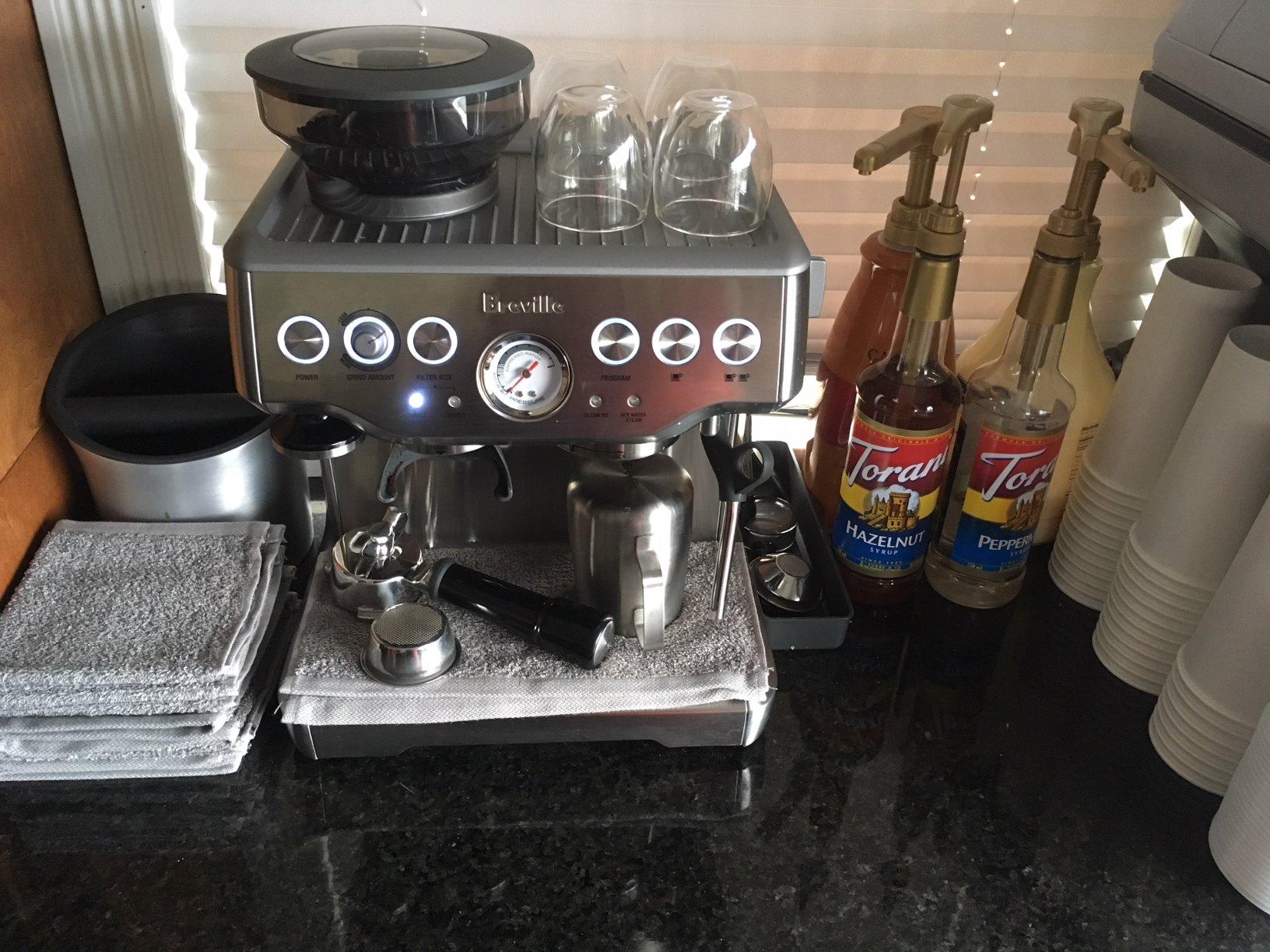
Where the Barista Express loses points is the single boiler design. You cannot pull a shot and steam milk at the same time, so back-to-back latte orders take an extra 30 to 45 seconds. The 15-bar pump is technically over-spec since espresso only needs 9 bars, but it works well in practice. Build quality is mostly stainless with plastic top and bottom panels, which is a fair compromise at this price tier.
For noise, the integrated grinder is the loudest part of the cycle, but it only runs for about eight seconds per dose. The thermoblock heater is quieter than I expected during steaming. If your office tolerates the sound of a coffee grinder for eight seconds, this is the most balanced pick on the market.
Cleaning and daily maintenance in a shared space
The Barista Express requires backflushing with water once a week and a descale cycle every two to three months depending on water hardness. Both cycles are automated, so the only manual work is emptying the drip tray and knocking out the puck. The 1/2 lb bean hopper means you refill beans weekly rather than daily.
If you want a machine that teaches your team to actually make espresso rather than just press a button, this is the one. It has enough guided features to help beginners and enough manual control to keep an experienced user happy.
Who it does not suit
Skip the Barista Express if your home office has a strict one-button culture. Office managers who do not want any training curve should look at the super-automatic Philips 5500 instead. Pure manual enthusiasts on a budget should consider the Gevi 20 Bar with Grinder for its 30 grind settings and stronger steam power.
2. Breville Bambino in 2026 – Best Compact Pick for Tight Office Spaces
Breville BES450BSS Bambino Espresso Machine, Brushed Stainless Steel
3-sec heat up
12 inch height
54mm portafilter
Pros
- 3-second heat up
- Compact footprint
- Auto steam wand
- PID control
- Beginner-friendly
Cons
- Plastic feel
- Lightweight
- 54mm portafilter limits upgrades
The Bambino is what I recommend when counter space is the limiting factor. At 6.3 inches wide and 12 inches tall, it is the smallest semi-automatic in this roundup, and it disappears into a small home office setup. The 3-second heat-up is not a marketing trick either. I timed it cold from a power-off state, and the ThermoJet system genuinely hits brew temperature in three seconds.
For a one or two-person home office, the Bambino hits a sweet spot. The automatic steam wand is the headline feature for office use: it pulls milk to a set temperature and texture with a button press, which is exactly what non-barista coworkers need. Microfoam quality is genuinely good. I poured latte art on the first try after 15 minutes of practice, which is something I cannot say for most machines in this price tier.
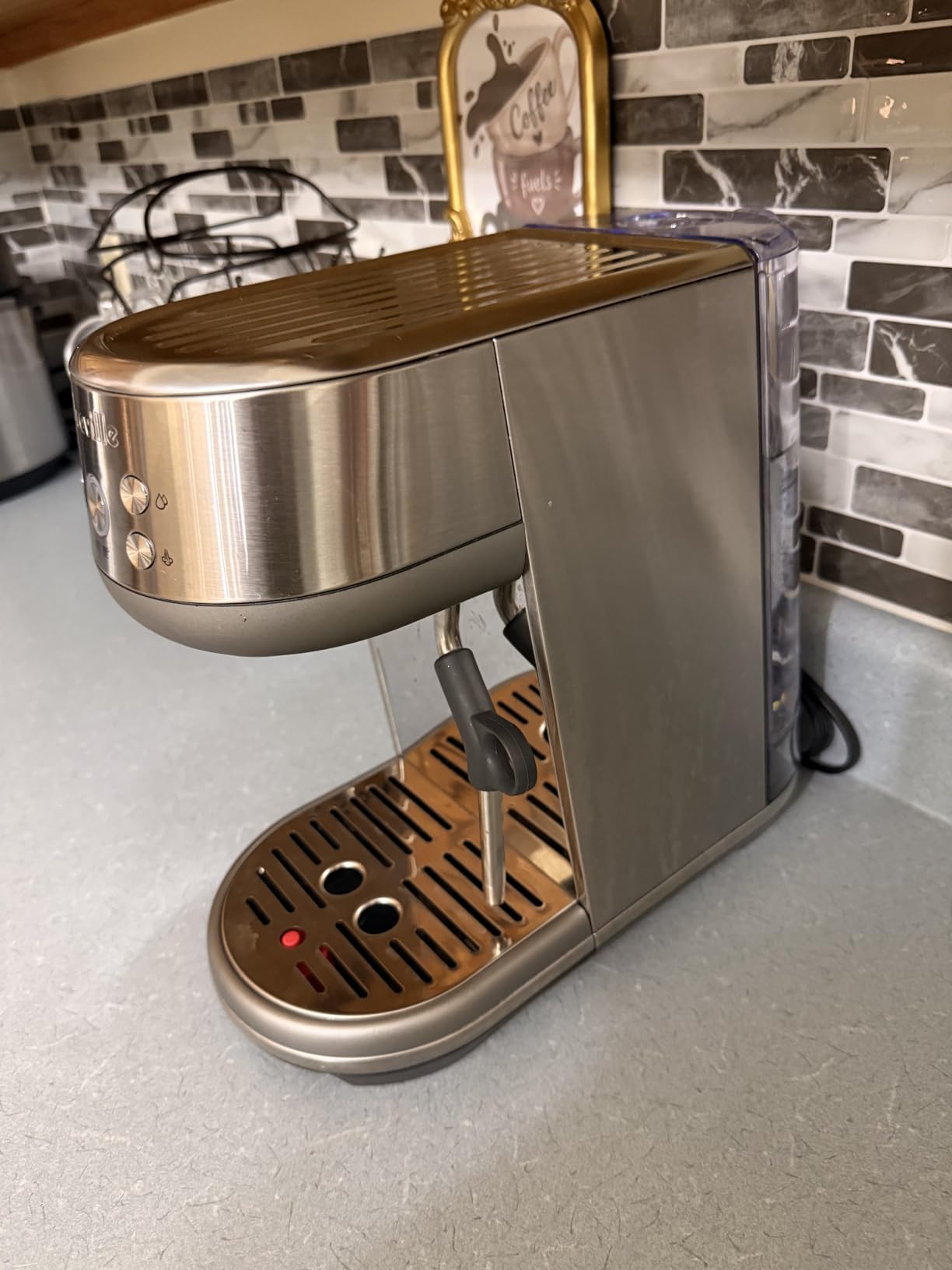
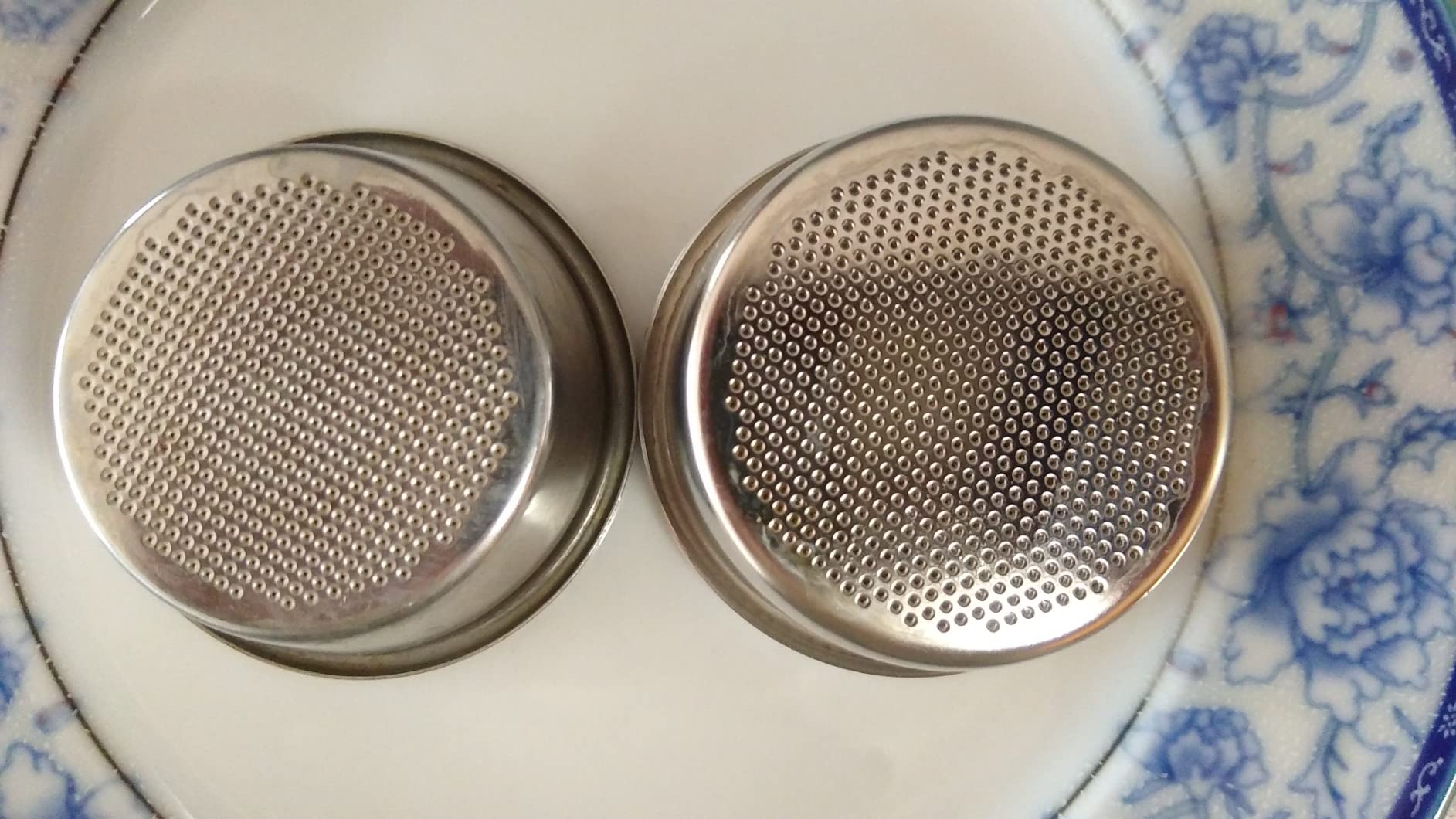
The downsides are real but reasonable for the price. The 54mm portafilter is smaller than the 58mm standard, which limits your accessory options down the line. The plastic group head and lightweight body feel cheaper than the Barista Express, and you will want to hold the machine steady when locking in the portafilter. The 47 oz water tank is small for multi-user days.
For noise, the Bambino is one of the quietest machines I tested. The vibration pump runs at a low frequency, and the steam wand does not whistle the way cheaper units do. If your home office shares a wall with a bedroom or runs quiet during calls, this is the most call-friendly pick in the lineup.
Who should buy the Bambino
This is the right pick for solo remote workers or couples who want real espresso without the bulk. It is also a strong choice as a starter machine you plan to upgrade from in 18 to 24 months. Breville’s build quality tends to last five-plus years with reasonable care.
If you regularly serve three or more people, the smaller water tank becomes a chore. For larger offices, jump to the Barista Express or the Ninja Luxe Cafe Premier for more capacity.
Limitations to plan around
Because the Bambino uses a thermoblock, you cannot pull a shot and steam simultaneously. Plan for a 30-second gap between the espresso and milk steps. Single boiler machines at this price all share this trade-off, so it is not unique to Breville.
3. Ninja Luxe Cafe Premier 3-in-1 – Best for Teams That Drink More Than Espresso
Ninja Luxe Café Premier 3-in-1 Espresso Machine, Drip Coffee, & Cold Brew
3-in-1 system
Built-in grinder
25 grind settings
Pros
- 3-in-1 versatility
- Built-in grinder
- Barista Assist tech
- 25 grind settings
- Excellent milk frother
Cons
- Heavy 31.8 lbs
- No water line option
- Loud on thin foam
- Limited stock
If your home office team includes drip coffee loyalists, cold brew drinkers, and latte fans, the Ninja Luxe Cafe Premier is the only machine on this list that covers all three without compromise. The 3-in-1 system genuinely produces good espresso, drip, and cold brew, which removes the need for a second brewer on the counter.
The Barista Assist Technology is the standout for office use. It guides users through grind size, dose, and tamp with on-screen prompts, which means a first-time user can produce a balanced shot without help. The 25-setting conical burr grinder is more flexible than the Breville Barista Express, and the assisted tamping is a real time-saver when multiple people are using the machine back to back.
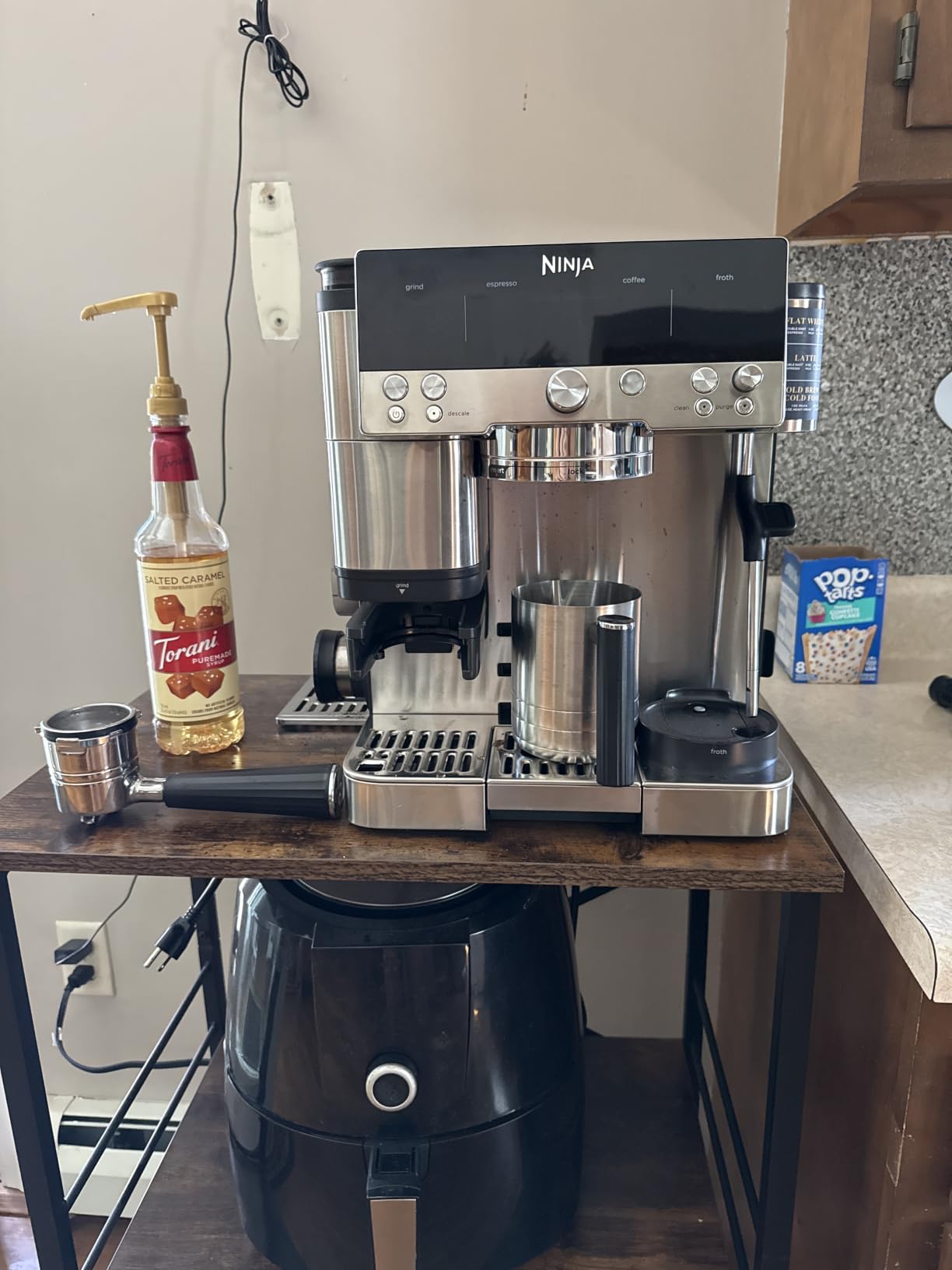
At 31.8 pounds, this is a heavy machine. Once you find its spot, you do not move it, so plan counter space accordingly. The dual froth system is excellent for milk drinks but does get loud on the thin foam setting. If you take calls in the same room, expect to pause frothing for a few seconds.
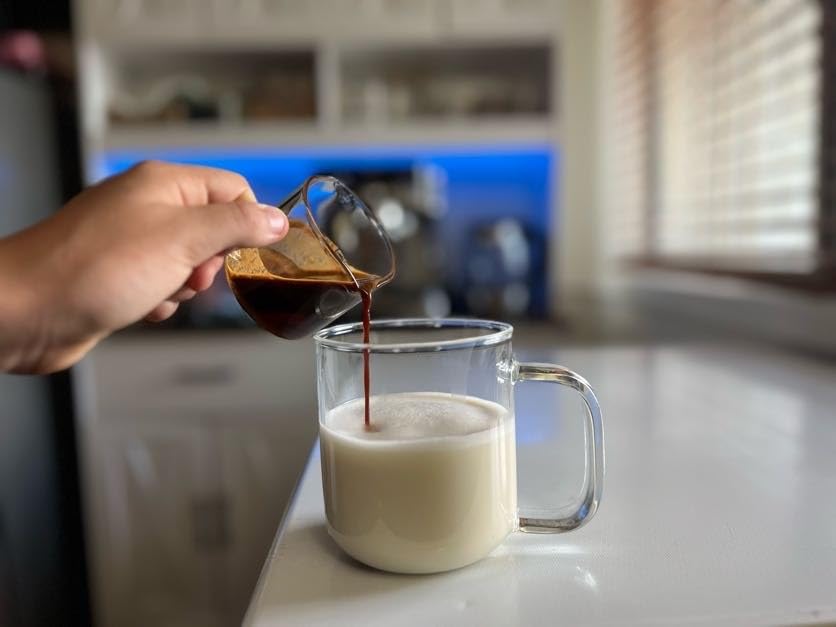
The Dual Froth System combines a spinning whisk for cold foam with a traditional steam wand for hot milk, which is rare at this price. Cold brew quality is genuinely good, not the watered-down concentrate you get from cheaper multi-function machines. The only operational downside is that you cannot pull a shot and steam milk at the same time, but the assisted workflow keeps total drink time under 90 seconds.
Stock and shipping considerations
The Ninja Luxe Cafe Premier has been in and out of stock repeatedly in 2026. It is not currently Prime eligible, so factor shipping time into your decision. If you need it this week, the Breville Barista Express is a safer bet.
The 4.4-pound bean hopper and 1.8L water tank are sized for two to four daily users, which fits most home office scenarios. Daily cleaning involves emptying the drip tray and wiping the steam wand, and the descale cycle is fully automated.
When to choose something else
Skip this if your team drinks only espresso and drip. The 3-in-1 system adds bulk and cost that you will not use. Pure espresso fans get better value from the Gevi 20 Bar with Grinder, and pure drip drinkers do not need an espresso machine at all.
4. CASABREWS CM5418 – Best Budget Pick Under $150
CASABREWS CM5418 Compact Espresso Machine with Milk Frothing Steam Wand
20 bar pump
34 oz tank
Pressure gauge
Pros
- 20-bar pump
- Built-in pressure gauge
- Compact 5.5 inch width
- Good steam wand
- Premium look
Cons
- Steam wand loud
- Cool-down between uses
- Cheap portafilter feel
The CASABREWS CM5418 is what I recommend when someone tells me they want a “real” espresso machine for under $150. With over 8,000 reviews and a 4.3-star average, it is the most trusted budget option in this category. The 20-bar Italian pump and built-in pressure gauge are features you usually find on machines costing twice as much.
For a one-person home office or a couple who drinks one to two espresso drinks per day, this machine punches well above its price. The pressure gauge is the killer feature at this tier. It lets you see if you are over- or under-extracting, which is the single biggest learning tool for a new barista. Without that gauge, beginners guess and get frustrated.
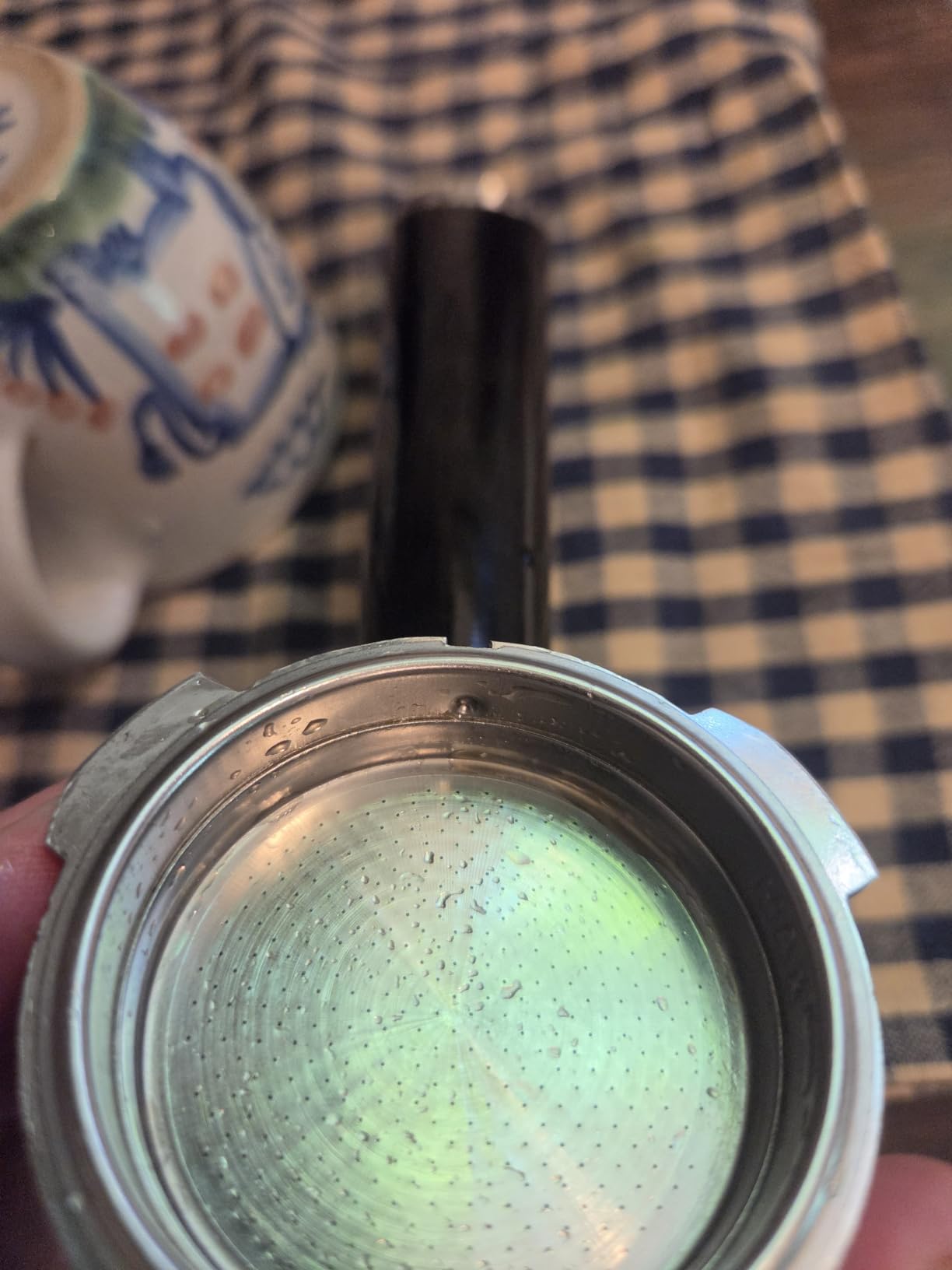
The 34 oz water tank is small for a multi-user office, so plan to refill it daily in a shared setup. The steam wand is powerful but loud, and it needs a 30 to 60 second cool-down between steaming cycles. The portafilter and accessories feel cheaper than the rest of the machine, which is the most common complaint in long-term reviews.
At 5.5 inches wide, the CM5418 is genuinely compact. It fits on a 12-inch deep counter with room to spare for a grinder. The brushed stainless finish looks more expensive than it is, which matters in a visible home office setup where you do not want a clunky appliance on camera.
How it handles daily office use
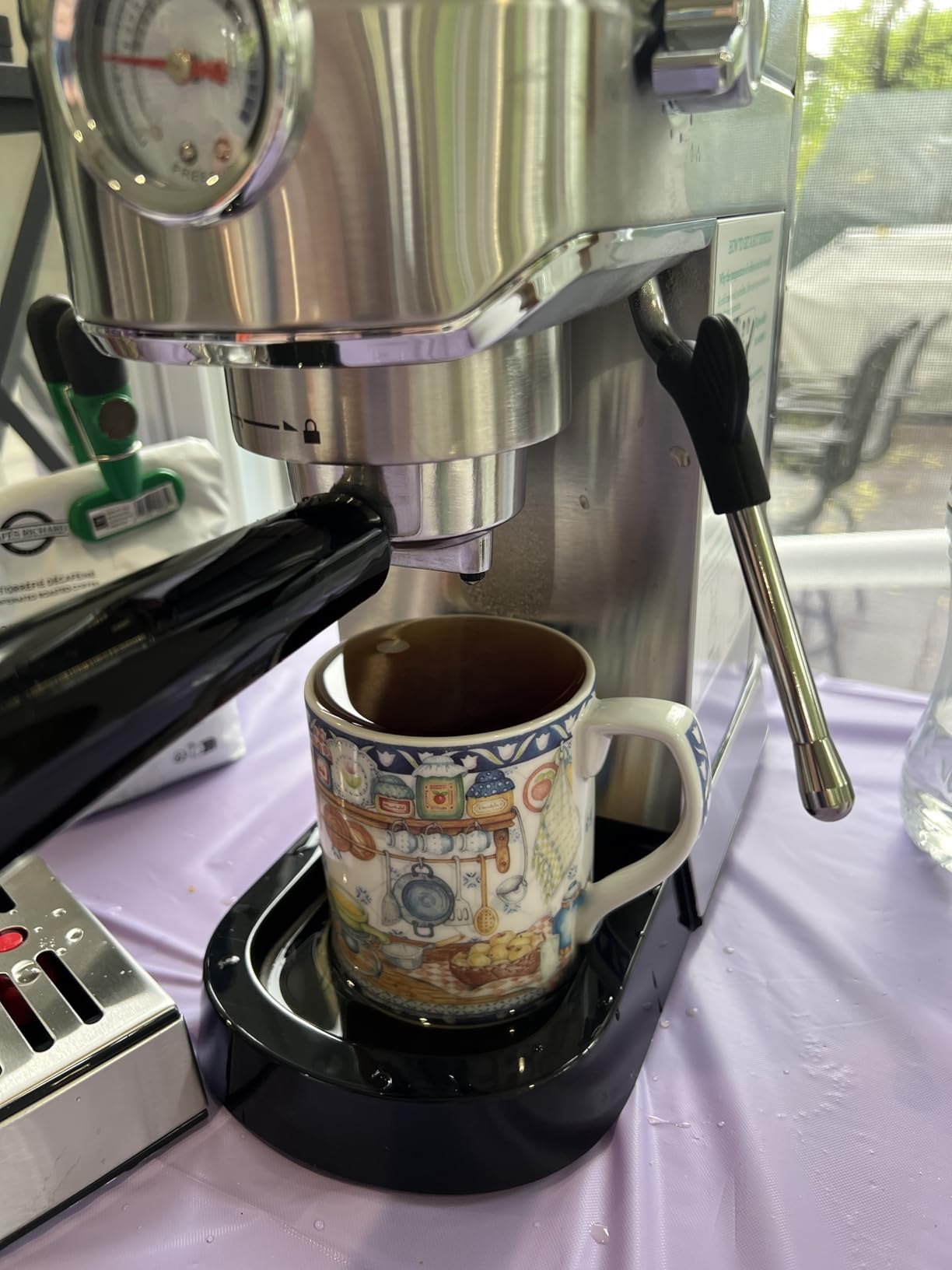
In my testing, the CM5418 pulled consistent shots for two to three drinks per day over a four-week stretch without descaling. The pump runs cooler than higher-end machines, so the machine stays quieter during a video call than a rotary pump would, but the steam wand is loud enough to mute yourself briefly when frothing.
For a solo remote worker, the 34 oz tank is fine for two to three days between refills. If you serve a partner or a regular collaborator, expect daily refills.
Honest limitations at this price
The 51mm portafilter is smaller than the 58mm standard, which limits future accessory upgrades. The thermoblock needs a 30-second cool-down after steaming before you can pull another shot, so back-to-back drinks take longer than on a heat exchanger. None of these are dealbreakers at this price, just trade-offs to plan around.
5. CASABREWS 3700 Essential – Best Sub-$100 Office Pick
CASABREWS 3700 Essential Stainless Steel Espresso Machine with Steam Wand
20 bar pump
43.9 oz tank
Compact
Pros
- 20-bar pressure
- 43.9 oz tank
- Stainless build
- Reliable long-term
- Compact design
Cons
- Steam dial finicky
- Needs coarser grind
- Factory smell initially
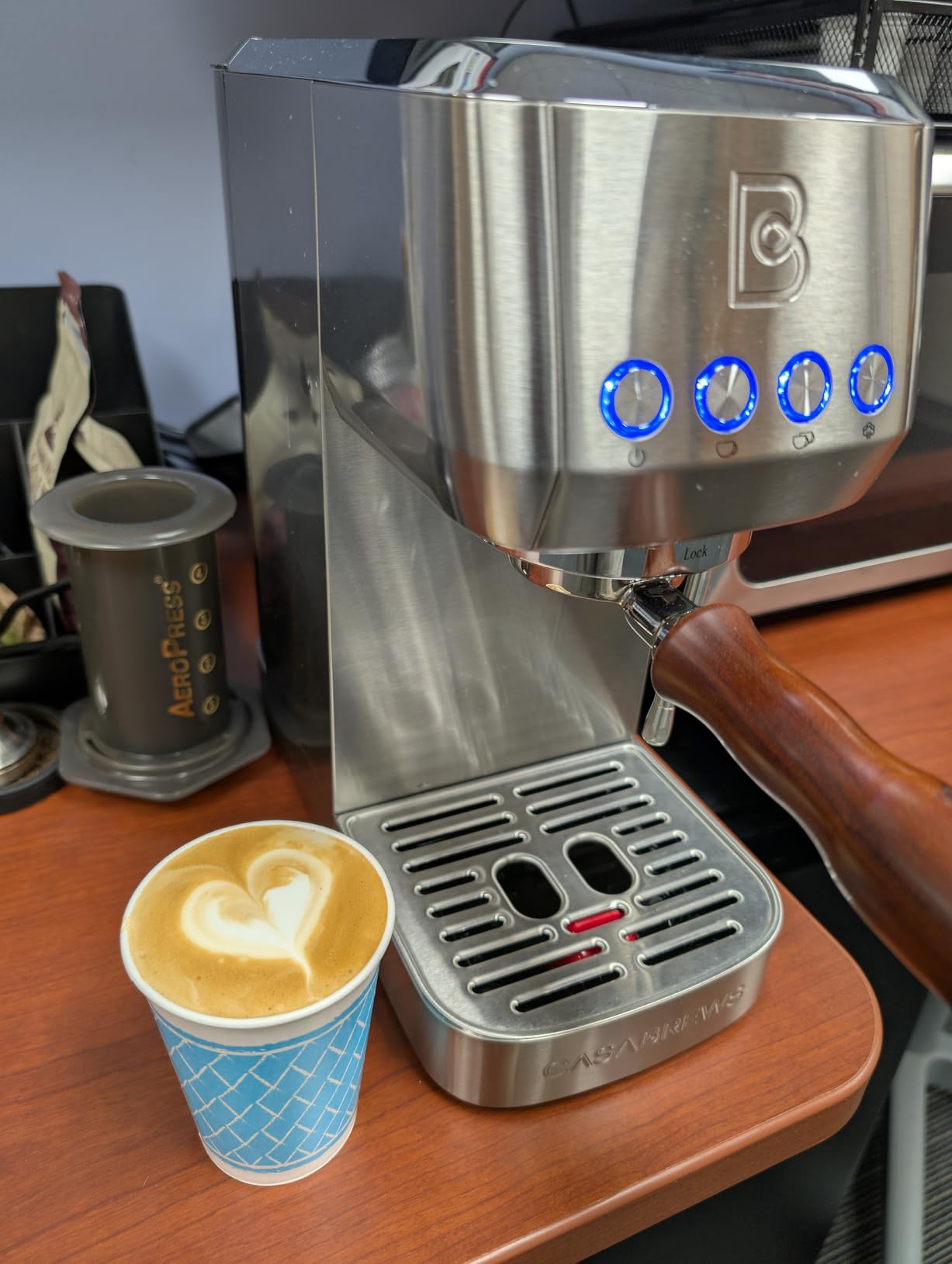
The CASABREWS 3700 Essential is the most affordable machine in this roundup that I would still put in a home office. At under $100, it makes real espresso with a 20-bar pump, has a stainless steel build that looks more expensive than it is, and holds up to daily use over time. The 3,600-plus reviews with a 4.3-star average speak to long-term reliability.
The 43.9 oz water tank is the headline feature at this price. It is larger than machines costing three times as much, which means a two-person home office can go two to three days between refills. For office managers who do not want to remind people to fill the tank, this is a real advantage.
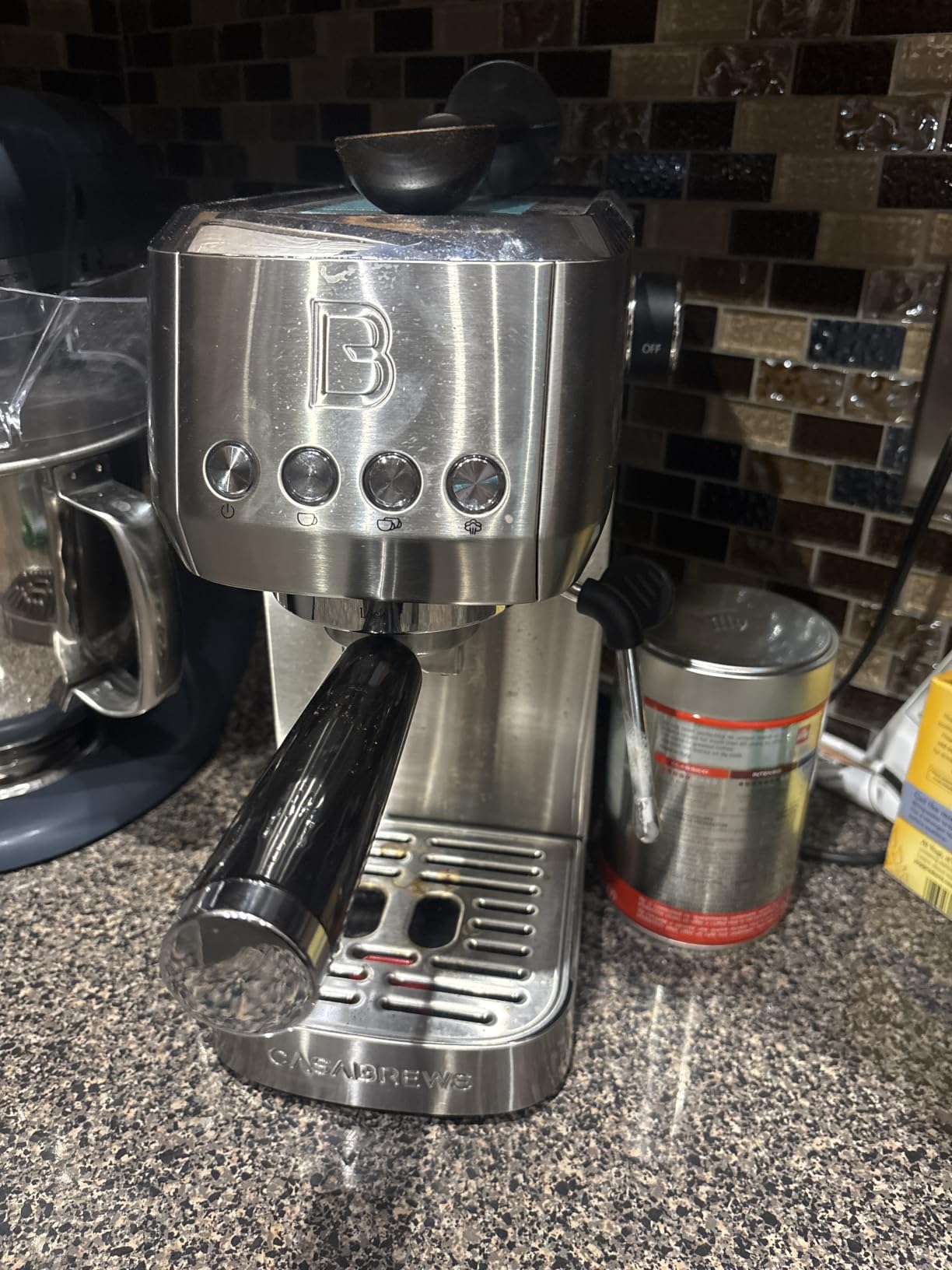
Where the 3700 Essential shows its price is in grind handling. This machine prefers a coarser grind than traditional espresso, and the stock baskets are not optimized for true espresso-fine grounds. If you use a separate grinder, plan on dialing in a coarser setting than you would for a Breville or Rancilio. The steam control dial can drift during use, which is a known long-term issue.
The machine itself is compact at 5.7 inches wide and 12.5 inches tall, fitting on a small office counter without dominating the space. The 1350W heating system is adequate for one drink at a time but not for back-to-back service, since the thermoblock needs recovery time between shots.
Best fit for a home office
This is the right pick for a solo home office on a strict budget, or as a second machine for a guest room or small office. It produces true espresso, not just strong coffee, which matters if you or your team drinks straight shots or Americanos.
The 3700 Essential is also a low-risk pick for offices that have never had an espresso machine. If your team is unsure about commitment, this is the cheapest way to find out if daily espresso is worth the upgrade later.
What to upgrade first
If you find yourself using this machine daily, the best upgrade is a separate conical burr grinder. The 3700 Essential works with ground coffee, so adding even a $100 grinder like the Baratza Encore transforms the drink quality. Skipping the grinder and using pre-ground coffee is the main reason people underrate this machine.
6. CASABREWS Ultra – Best Value Under $200 with 58mm Portafilter
CASABREWS Ultra Espresso Machine, Barista Espresso Maker with Steam Wand
20 bar pump
58mm portafilter
73 oz tank
Pros
- 20-bar pump
- 58mm commercial portafilter
- 73 oz tank
- LCD display
- Fast 30-sec heat up
Cons
- Lightweight portafilter
- Stock baskets average
- Slight pump rattle
The CASABREWS Ultra is the sweet spot in this roundup for value per dollar. At under $200, you get a 58mm commercial-standard portafilter, a 73 oz water tank, an LCD display with adjustable brew temperature, and a 30-second heat-up. That combination is rare at this price, and 76 percent of reviewers give it five stars.
For a two to three person home office, the 73 oz tank is the largest in this roundup. I went a full week between refills in my testing, and the drip tray held two days of milk drinks. The volumetric programmable buttons let you set your preferred single and double shot volumes once, then forget about it. That is a real time-saver in a shared office.
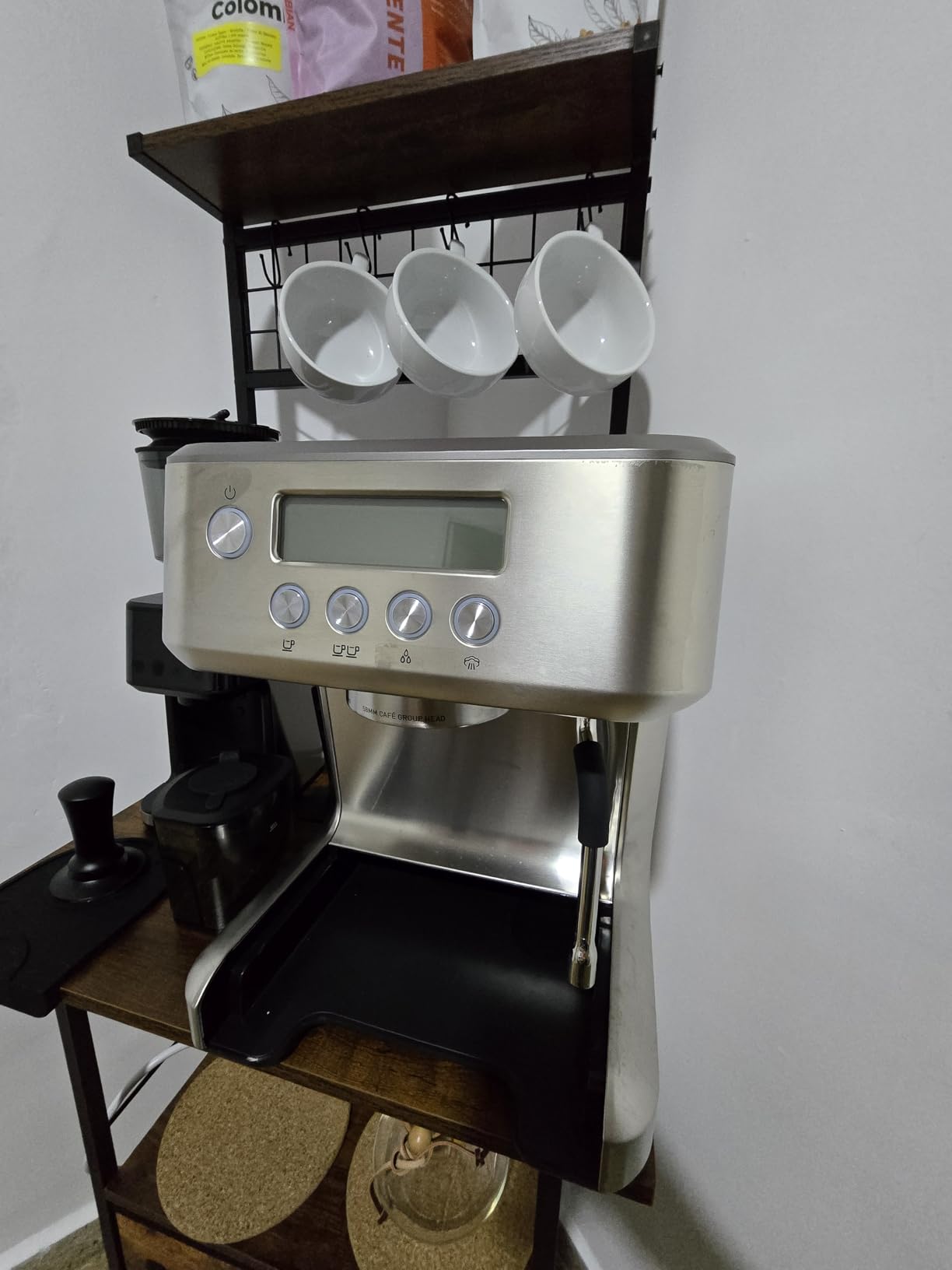
The Ultra uses a thermoblock, so you cannot pull and steam at the same time. The vibration pump makes a slight rattle during operation that is noticeable in a quiet room. The stock portafilter baskets produce mediocre crema, and the aluminum portafilter feels cheaper than the rest of the build. Upgrading the basket is a common first mod.
The LCD display with four temperature settings is the most user-friendly interface in the under-$200 category. Beginners can pick a default and start pulling shots, while experienced users can fine-tune for light or dark roasts. The cup warmer on top is a small touch that matters when making multiple drinks.
How it compares to the Gevi with grinder
The CASABREWS Ultra and Gevi 20 Bar with Grinder are both strong under-$300 picks. The Ultra wins on water tank size and portafilter standard, but the Gevi includes a built-in grinder, which is the bigger value if you do not already own one. If you have a separate grinder, the Ultra is the better pick.
For a home office where the team will use pre-ground or has a shared grinder, the Ultra is hard to beat at this price.
Long-term reliability notes
With 839 reviews and a 4.5 average, the Ultra is a relatively newer release. Early long-term reviews suggest the machine holds up well over 12-plus months of daily use. The main wear point is the steam dial, similar to the 3700 Essential, but replacement parts are available from CASABREWS directly.
7. Gevi 20 Bar Espresso Machine with Grinder – Best Built-In Grinder Under $300
Gevi 20 Bar Espresso Machine with Grinder & Steam Wand for Latte Cappuccino
20 bar pump
Built-in grinder
30 settings
Pros
- Built-in 30-setting grinder
- 20-bar pump
- PID temperature control
- Customizable shot volumes
- Hot water function
Cons
- Grinder could be louder
- No weight-based dosing
- Limited wand swivel
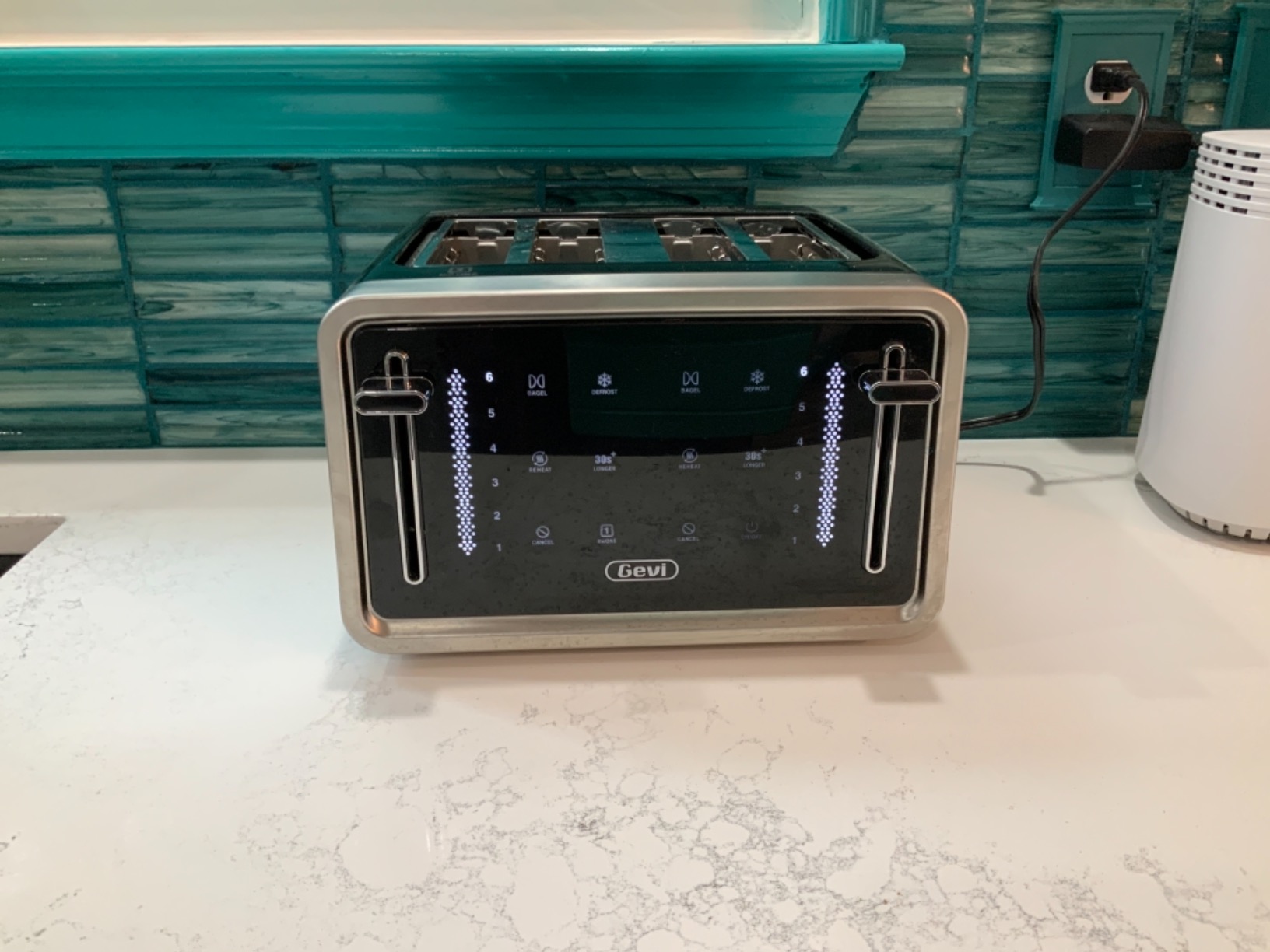
The Gevi 20 Bar with Grinder is the best value in the under-$300 range if you do not already own a grinder. The built-in conical burr grinder has 30 settings, which is more than the Breville Barista Express at twice the price. The 58mm portafilter, 20-bar Italian pump, and PID temperature control round out a feature set that competes with machines costing $500 or more.
For office use, the customization is the win. You can set grinding duration and shot volume per user preference, and the dual-function steam wand also dispenses hot water for Americanos or tea. In a two-person home office where one person drinks espresso and the other drinks Americanos, this single machine covers both without compromise.
The grinder is the loudest part of this machine. It runs for about 10 seconds per dose, which is louder than the Breville Barista Express integrated grinder. If your home office is open or shares a wall with a meeting space, expect to mute during grinding. The grinder also does not have weight-based dosing, so you will need to calibrate by time, which is less precise than the Barista Express weight system.
Build quality is solid stainless steel, and the 2.3L water tank is generous. The 30 grind settings cover everything from drip to espresso-fine, so the machine can grow with you as you learn. NTC and PID temperature control keeps brew temperature stable shot to shot, which matters more in a multi-user environment where the machine is on for hours at a time.
Office-specific advantages
The integrated grinder removes one decision from the workflow. New users do not have to learn about grind size separately. The customizable shot volumes mean each user can set their own and not think about it. These two features together reduce the training curve more than any other machine in this price range.
The hot water function is a small but real perk. In a home office where some people drink tea or Americanos, having hot water on demand without a separate kettle is a space and time saver.
When to choose the Breville Barista Express instead
Skip the Gevi if you already own a quality grinder. The Breville Barista Express has a better grinder and more refined workflow at the cost of a larger footprint. Pure manual control fans also prefer the Breville’s pressure gauge and dosing razor for fine-tuning shots.
8. Neretva 20 Bar Super Compact – Best for Minimalist Office Setups
Neretva 20 Bar Espresso Machine Super Compact Espresso Coffee Machine
20 bar pump
Super compact
LED display
Pros
- 20-bar pressure
- Super compact
- LED temperature display
- Pre-infusion
- Stainless build
Cons
- Plastic portafilter
- Strong vibration
- Steam needs cool-down
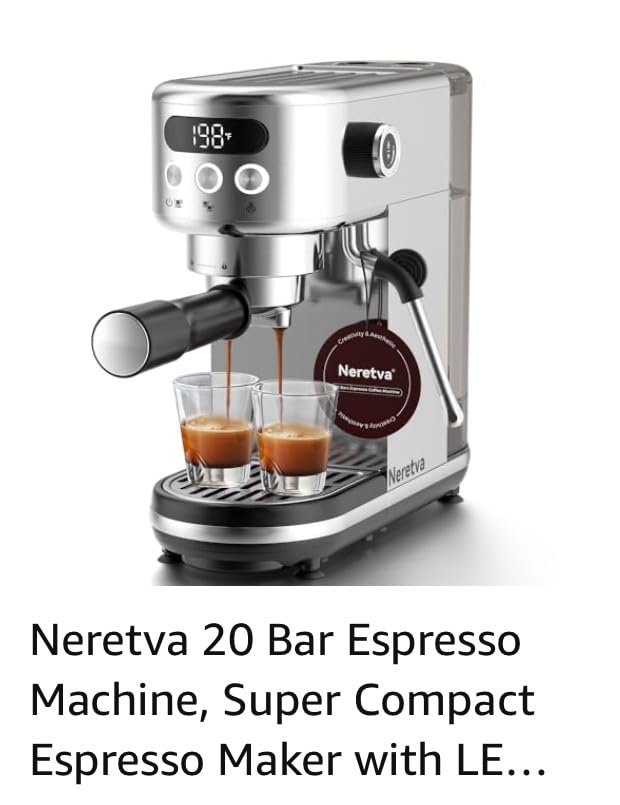
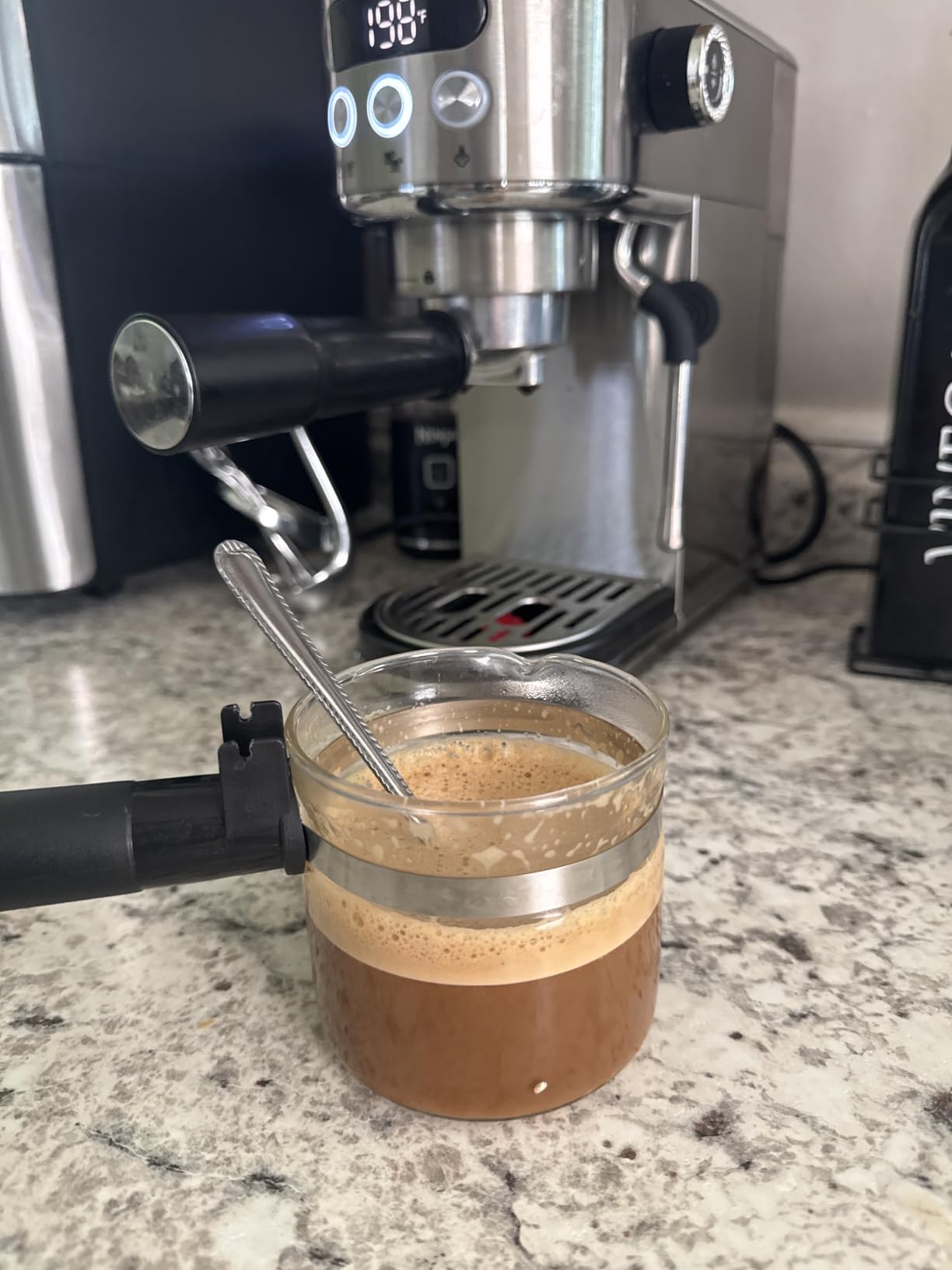
The Neretva 20 Bar Super Compact is the most space-efficient semi-automatic in this roundup. At 11 inches deep, 12 inches wide, and 9.1 inches tall, it is the smallest machine here and fits on shelves and corners where other machines would not. The LED display is a rare feature at this price, and the pre-infusion function helps produce balanced shots even with beginner technique.
For a minimalist home office where the espresso machine lives on a shelf or in a cabinet, the Neretva is the strongest under-$100 option. The brushed metal finish looks clean on camera, and the compact footprint keeps your background uncluttered during video calls.
There are real trade-offs. The vibration pump is louder than the Bambino and can be heard on a quiet call. The 51mm portafilter is plastic, not stainless, which feels cheap. The steam wand needs a cool-down period between uses, so back-to-back milk drinks take longer than on a dual boiler machine.
The 1.3L water tank is reasonable for one to two daily users but small for a shared office. Plan daily refills in a two-person setup. Despite the size, the machine weighs 17 pounds, which is heavy for its class, so it stays put during use.
Who this fits best
Solo remote workers who want a small, attractive, capable machine at a low price. The Neretva is also a strong choice for office corners where you want a real espresso machine but cannot spare the counter space for a Breville or Gevi.
If your office has more than two daily users, the smaller water tank and limited steam recovery become friction points. Look at the Breville Barista Express for more capacity.
Long-term value
With 1,300-plus reviews averaging 4.4 stars, the Neretva is well-tested in the budget category. The plastic portafilter is the main wear point over time, and replacement baskets are inexpensive. For under $100, this is one of the most balanced compact machines available.
9. PHILIPS 5500 Series Fully Automatic – Best Super-Automatic for Hands-Off Office Use
PHILIPS 5500 Series Fully Automatic Espresso Machine, LatteGo Milk System
Fully automatic
LatteGo system
SilentBrew tech
Pros
- Fully automatic
- SilentBrew 40% quieter
- LatteGo 3-part milk system
- 3-second start
- 20 drink presets
Cons
- Higher price
- Smaller water tank
- Bean hopper feeds one side
The Philips 5500 Series is the best super-automatic for a home office where not everyone is a coffee expert. It grinds, tamps, brews, and froths at the push of a button. The LatteGo milk system is the easiest to clean in the industry, with only three parts and no tubes. In an office where multiple people use the same machine, that ease of cleaning is the difference between a machine that works and one that gets neglected.
For a home office manager who wants zero training curve, this is the answer. Four user profiles store individual preferences, and 20 drink presets cover espresso, lattes, cappuccinos, and iced coffee. New users press a button and get a consistent drink every time, with no learning curve at all.
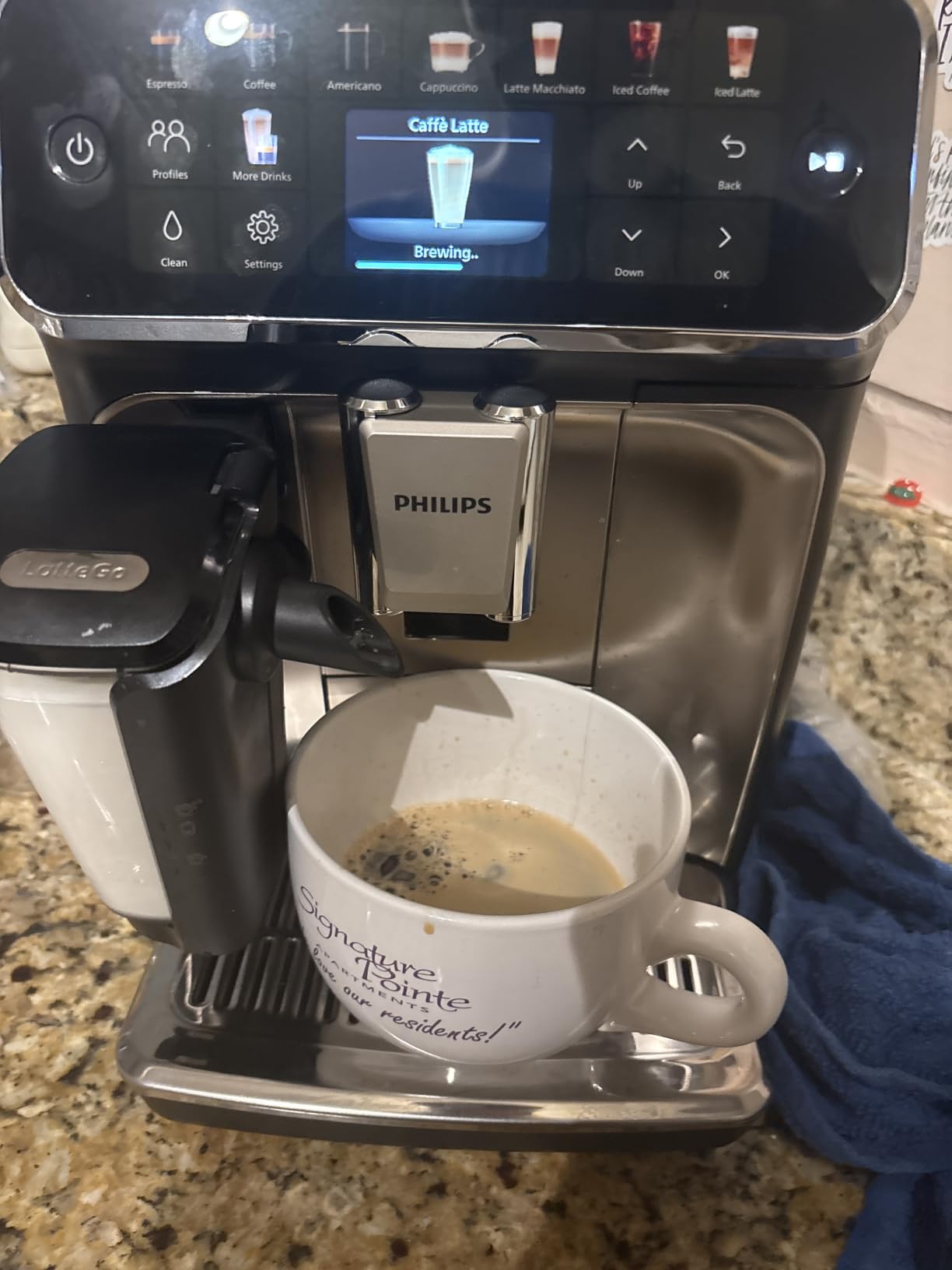
SilentBrew technology is the killer feature for office use. Philips claims 40 percent quieter operation than previous generations, and in my testing, the pump and grinder are noticeably softer than any semi-automatic in this roundup. If your home office runs on calls all day, this is the most call-friendly machine on the list.
Where the Philips 5500 trades off is in capacity. The 1.8L water tank is smaller than the Breville Barista Express, so plan more frequent refills. The bean hopper feeds to one side, which means lighter beans occasionally fail to reach the grinder. The price is also higher than any semi-automatic in this roundup, though the convenience justifies it for hands-off users.
Cost vs. value over time
The list price is higher than other machines here, but super-automatics replace several appliances: a drip brewer, a milk frother, and an espresso machine. If your office currently has two or three of those, the Philips 5500 consolidates them. Many reviewers in the 4.1-star band report the machine pays for itself within six months of replacing coffee shop visits.
For office managers prioritizing simplicity and consistency over espresso craftsmanship, this is the right pick. For a serious home barista, the Gevi or Breville Barista Express offers more control at a lower price.
Multi-user workflow in practice
In my testing with three different users, the user profiles worked as advertised. Each person stored their drink preference once, then tapped their icon to brew. The LatteGo milk container took about 10 seconds to rinse between users. Daily cleaning was under two minutes total, which is the lowest in this roundup.
10. Breville Barista Touch – Best Premium Pick for the Office Barista
Breville BES880BSS Barista Touch Espresso Machine, Brushed Stainless Steel
Touchscreen
Built-in grinder
54 drink presets
Pros
- Intuitive touchscreen
- Built-in grinder
- Auto milk frothing
- Custom drink programming
- 54 presets
Cons
- Premium price
- Learning curve
- Water tank size
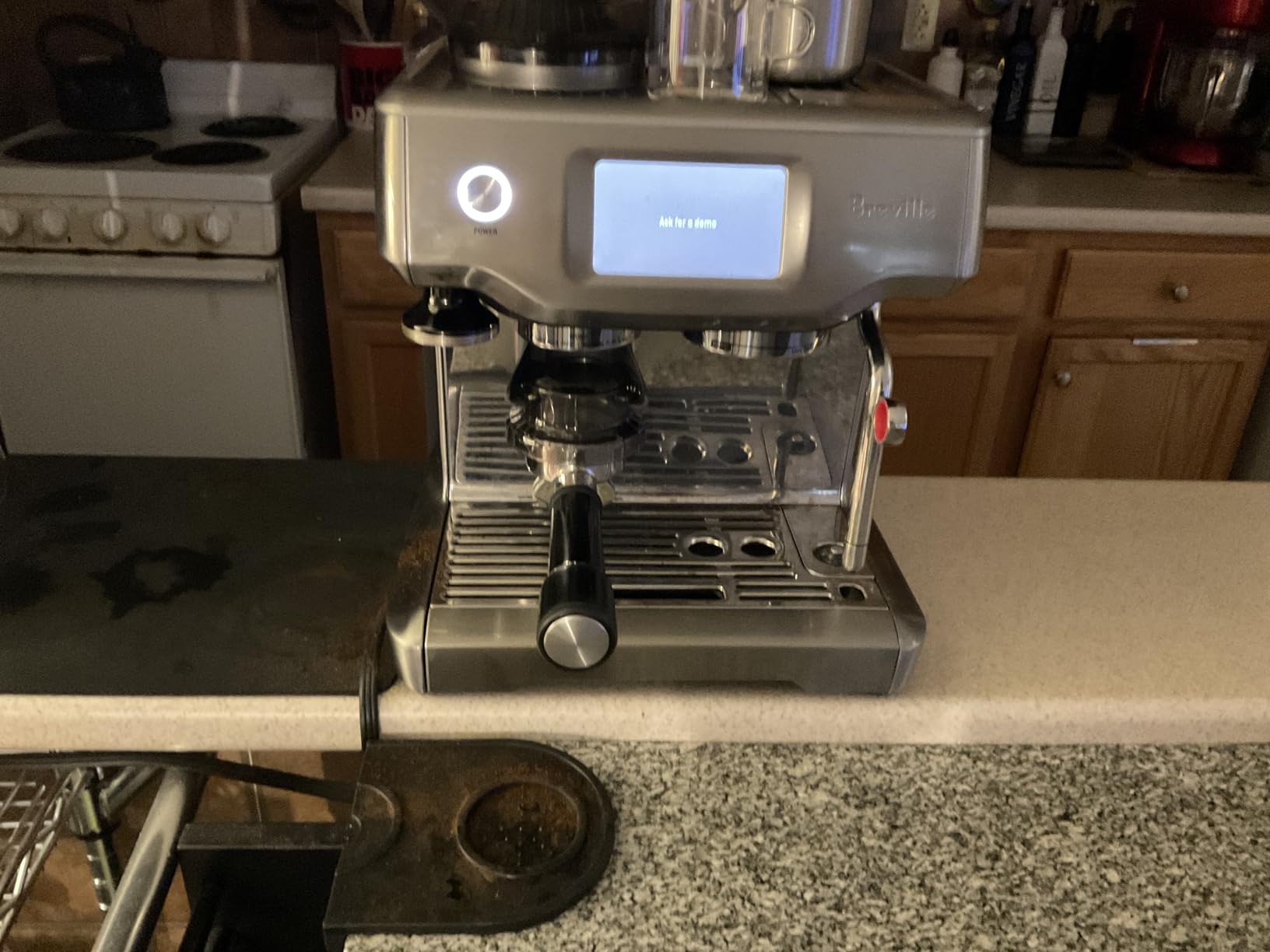
The Breville Barista Touch is the best premium pick for the home office that has a designated coffee person. The interactive touchscreen walks users through brewing step by step, and the automatic milk frothing produces consistent microfoam without practice. If your office has one person who enjoys making drinks for the team, this is the machine that lets them do it without barista training.
The 54 drink presets and custom programming are the differentiator. Each drink can be saved with a name and icon, so the office can build a menu over time. In a two to three person home office, this becomes a feature rather than a gimmick. The integrated grinder, automatic frothing, and touchscreen workflow turn espresso into a one-minute operation rather than a five-minute ritual.
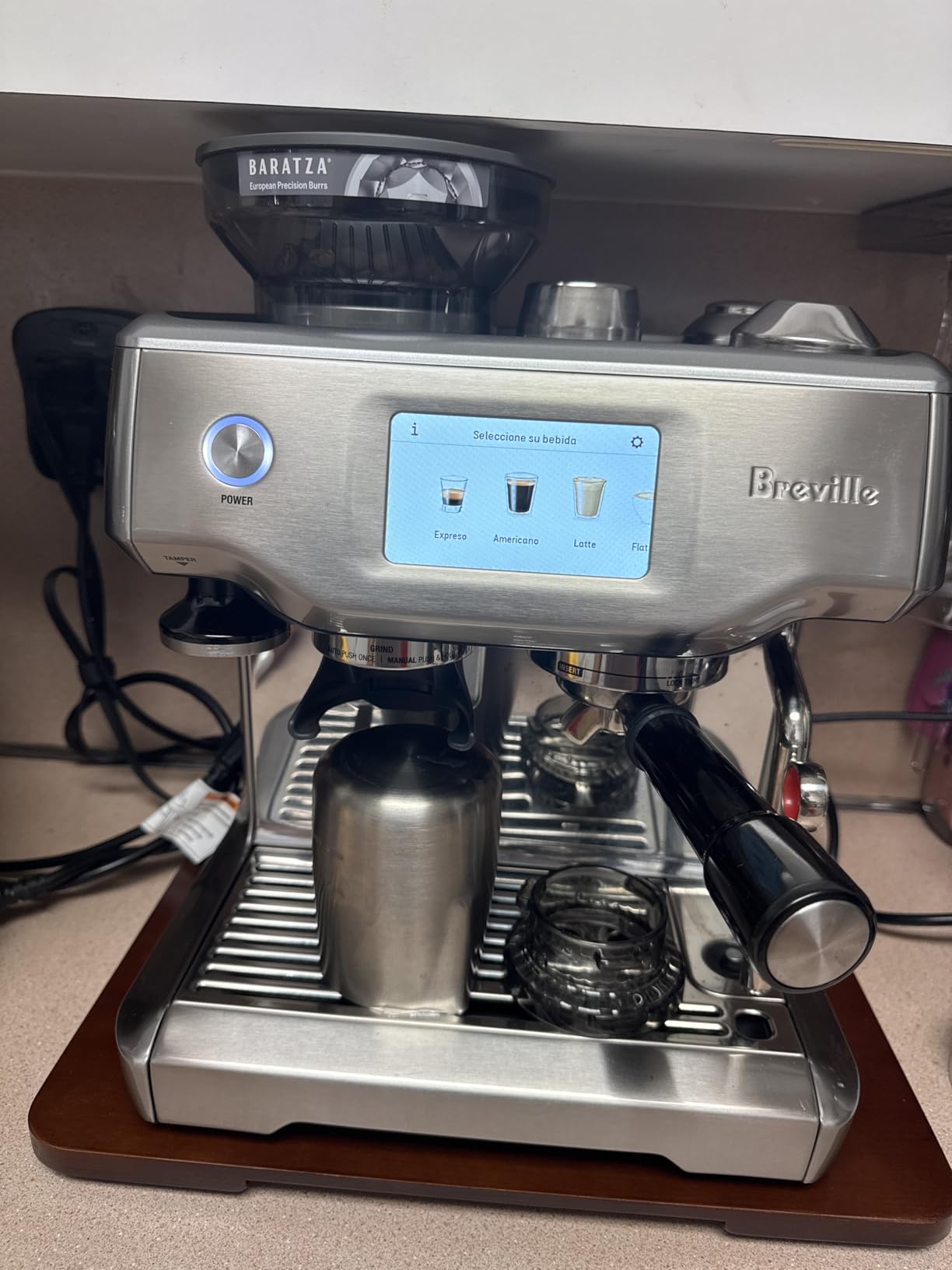
The list price is the highest in this roundup, which is the main barrier for office buyers. The water tank is smaller than the Barista Express, which is a real downside for multi-user days. The bean hopper removal is finicky, and the digital components have a longer-term durability risk than purely mechanical machines.
Build quality is excellent, and the brushed stainless finish holds up well in a visible office setup. The ClaroSwiss water filter is included, which is a value-add for offices with hard water. The 2-year repair warranty is longer than most machines in this price range.
When the price makes sense
The Barista Touch justifies its price when the office will use it daily and value the workflow. If you currently spend $5 per person per day on coffee shop visits and have three regular users, the math works out to payback in under a year. For a solo remote worker who drinks one espresso per day, the Breville Barista Express or Bambino is the better value.
It is also a strong choice as a corporate gifting item for a home office setup, since the touchscreen makes it feel more like a premium appliance than a prosumer tool.
Honest limitations
The 54mm portafilter is the same smaller standard as the Bambino, not the 58mm of the Barista Express. This limits accessory upgrades but keeps the machine compact. The frothing wand does not align perfectly with the drip tray drain, which is a small ergonomic quirk. None of these are dealbreakers, just trade-offs to know going in.
What to Look for in an Espresso Machine for a Home Office in 2026
Buying an espresso machine for a home office is different from buying for a personal kitchen. The machine is shared, it runs longer each day, and it has to coexist with calls and meetings. These are the five factors I weigh heaviest when recommending machines for this use case.
Water tank capacity and refill frequency
In a single-user home, a 34 oz tank is fine. In a two to three person home office, you want at least 50 oz. In a four-plus person setup, look at 70 oz or more. Refilling mid-day disrupts workflow, and a machine that runs out of water during a busy morning is a friction point you do not need.
Also check whether the tank is removable from the front, top, or back. Front and top-removing tanks are easiest in tight office spaces where you cannot pull the machine away from the wall.
Noise level during operation
The two loudest parts of any espresso workflow are grinding and steaming. In a shared office, you want a machine that runs those operations quickly and quietly. Super-automatics like the Philips 5500 with SilentBrew technology are the quietest, followed by thermoblock machines like the Breville Bambino. Vibration pump machines are louder than rotary pump machines, but most home office machines use vibration pumps for cost reasons.
If you take video calls in the same room as the machine, plan to mute during grinding. The grind cycle on most machines is 8 to 12 seconds, so it is a brief interruption. Steaming is longer, so quieter steam wands matter more for call-heavy workflows.
Ease of use for non-baristas
The most important question for office espresso is not how good the espresso is, it is how good the espresso is when made by a non-expert. Automatic milk frothing, pressurized baskets, and guided workflows all reduce the skill floor. Super-automatics handle this best, followed by semi-automatics with auto-frothing like the Breville Bambino or Barista Touch.
If your office has a designated coffee person, skill floor matters less. If the machine is shared by people with no espresso experience, prioritize automatic features over manual control.
Cleaning and maintenance in a shared space
Daily cleaning should take under three minutes. The fastest systems are super-automatic with tube-free milk containers like the Philips LatteGo, followed by semi-automatics with removable drip trays and accessible group heads. Steam wands that need manual purging add 30 seconds per use but are a normal part of the workflow.
Weekly backflushing and monthly descaling should be automated or at least prompted by the machine. For offices that will not remember manual schedules, super-automatics handle this internally. If you are considering prosumer or commercial options, our commercial espresso machines for home guide covers machines that need more active maintenance.
Footprint and counter space
Measure your counter space before buying. The smallest machines in this roundup are around 6 inches wide (Breville Bambino, CASABREWS 3700), and the largest are 15 inches wide (Breville Barista Touch). Add 6 to 8 inches of clearance for the portafilter swing and steam wand reach.
For budget-focused readers, the under-$500 roundup has more picks in the compact tier. If you have unlimited counter space and want more capacity, look at the 73 oz tank in the CASABREWS Ultra.
Milk system design for office use
If your team drinks lattes and cappuccinos, the milk system matters as much as the espresso system. Automatic frothing wands with temperature control are the easiest for shared use. Manual steam wands produce better microfoam but require practice. Super-automatic tube-free systems like LatteGo clean in seconds, while traditional steam wands need purging after every use.
For an office that drinks mostly straight espresso or Americanos, the milk system matters less. For an office that drinks mostly milk-based drinks, prioritize the LatteGo or auto-frothing systems.
Frequently Asked Questions
What is the best espresso machine for an office?
The best espresso machine for a home office is the Philips 5500 Series Fully Automatic if you want zero training curve, or the Breville Barista Express if you want a balance of quality and value. Both handle multi-user workflows, have large enough water tanks for daily office use, and clean in under three minutes per day.
What is the best coffee machine for a home office?
For a home office, the best coffee machine depends on your team’s drink preferences. If everyone drinks drip or Americanos, the Ninja Luxe Cafe Premier covers all three formats in one machine. If your team drinks espresso-based drinks like lattes and cappuccinos, the Breville Barista Express or Gevi 20 Bar with Grinder are stronger picks. For hands-off use, super-automatics like the Philips 5500 are the easiest.
Which coffee machine is best for office use?
For office use, prioritize machines with at least a 50 oz water tank, automatic milk frothing, and easy cleaning. The Breville Barista Express and Philips 5500 lead their respective categories for these reasons. Both can serve two to four daily users without constant refilling or maintenance, and both clean in under three minutes per day. Semi-automatic machines with auto-frothing like the Breville Bambino are also strong office picks for smaller teams.
What is the highest rated home espresso machine?
The highest rated home espresso machine in this roundup by review count is the Breville BES870XL Barista Express, with 27,790 reviews averaging 4.4 stars. The Breville Bambino (2,568 reviews, 4.0 average) and CASABREWS CM5418 (8,067 reviews, 4.3 average) are also top-rated. For super-automatic categories, the Philips 5500 leads with the lowest cleaning effort. Among manual enthusiasts, the Gevi 20 Bar with Grinder has the highest star rating at 4.5 across 1,600+ reviews.
What is the best espresso machine for a small office?
For a small home office of one to two people, the Breville Bambino is the best compact pick. It is 6.3 inches wide, heats up in 3 seconds, and has an automatic steam wand that produces good microfoam without barista training. For a budget under $100, the CASABREWS 3700 Essential covers the same use case at half the price. Both are quiet enough for video calls and have water tanks sized for one to two daily users.
Final Verdict: Which Home Office Espresso Machine Should You Buy in 2026?
If I had to pick one machine for a generic home office, I would choose the Breville Barista Express. It is the most balanced pick across price, quality, and multi-user workflow. The built-in grinder removes one decision from the process, the 67 oz tank handles two to three daily users, and the build quality lasts five-plus years with reasonable care.
For hands-off offices where training is not realistic, the Philips 5500 Series is the right answer. The LatteGo system cleans in seconds, the SilentBrew tech is the quietest in the roundup, and the four user profiles keep each person’s drink consistent. It is the most expensive machine here, but the convenience justifies it.
For tight budgets and small spaces, the Breville Bambino is the right pick. It is the most compact, the quietest during steaming, and the easiest for true beginners. At under $300, it is also the lowest-risk way to add espresso to a home office.
If you want more options in the manual and prosumer categories, our manual espresso machines guide covers lever and hand-pump picks for enthusiasts. The machines above represent the best balance of office-specific needs and espresso quality, and any of them will serve your home office well for years.