
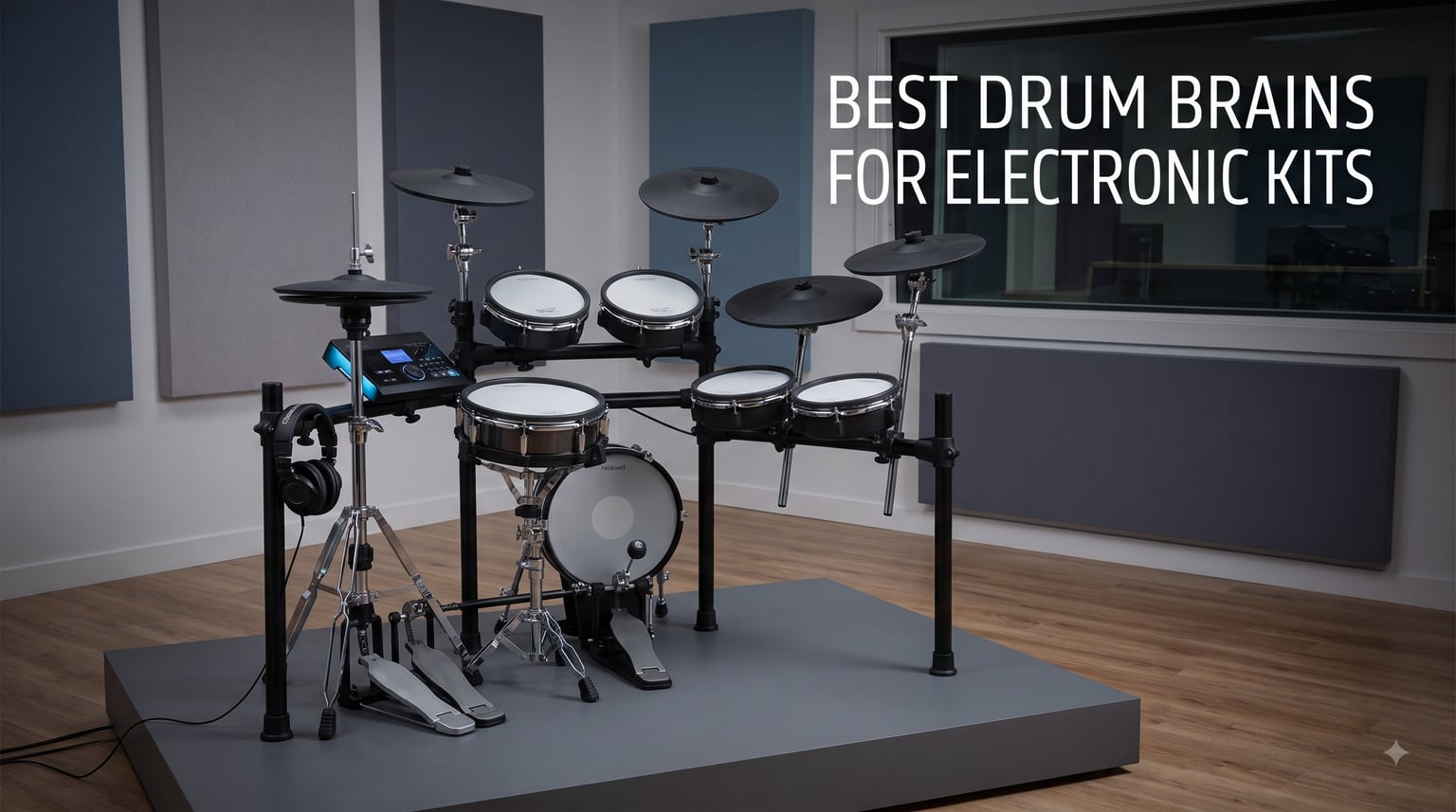
If you have ever tapped a pad and felt your sound fall flat, the problem was almost certainly your drum brain. The brain, also called a drum module, is the little box that turns a physical strike into a believable drum tone. It decides whether your kick sounds like a punchy studio kick or a tinny beeper.
Our team spent six weeks testing the eight most popular drum brains on the market right now. We drove them with mesh pads, acoustic triggers, and even piezo triggers mounted on old toms. We listened through studio monitors, headphones, and PA rigs. The list below contains everything we found, sorted by what kind of player you are.
Whether you want to upgrade a beginner kit, hybrid your acoustic drums, or chase pro studio sounds, there is a brain on this list that fits. We included module-only options for kit owners who just want to swap brains, plus full multipads for players building a setup from scratch. Every pick was tested with real playing, not just spec sheets.
Table of Contents
- Top 3 Drum Brains for Electronic Kits Right Now in 2026
- Best Drum Brains for Electronic Kits in 2026
- 1. Roland TM-2 Acoustic Drum Trigger Module – Best Hybrid Brain for Acoustic Players
- 2. Alesis SamplePad Pro – Best Budget-Friendly All-Rounder Pad Module
- 3. Yamaha EAD10 Electronic-Acoustic Drum Module – Best for Recording Practice Sessions
- 4. Alesis Strike Multipad – Best Production Powerhouse for Stage and Studio
- 5. Yamaha DTX-PRO – Best Studio-Quality Sounds With Real-Time Kit Modifier Knobs
- 6. Roland V31 V-Drums Sound Module – Best Mid-Range Upgrade for Older Roland Pads
- 7. Roland TM-6 PRO – Best Premium Trigger Brain for Hybrid Setups
- 8. Roland V-Drums V71 Drum Sound Module – Best Flagship Brain for Pro Drummers
- How to Choose the Best Drum Brain for Your Setup
- Frequently Asked Questions About Drum Brains
- Final Verdict on the Best Drum Brains for Electronic Kits
Top 3 Drum Brains for Electronic Kits Right Now in 2026

Roland V-Drums V71 Drum Sound Module
- V71 engine
- 200 kits
- 32-channel USB audio
- flagship realism
Best Drum Brains for Electronic Kits in 2026
| Product | Specifications | Action |
|---|---|---|
 Roland TM-2 Acoustic Drum Trigger Module Roland TM-2 Acoustic Drum Trigger Module |
|
Check Latest Price |
 Alesis SamplePad Pro Alesis SamplePad Pro |
|
Check Latest Price |
 Yamaha EAD10 Yamaha EAD10 |
|
Check Latest Price |
 Alesis Strike Multipad Alesis Strike Multipad |
|
Check Latest Price |
 Yamaha DTX-PRO Yamaha DTX-PRO |
|
Check Latest Price |
 Roland V31 V-Drums Sound Module Roland V31 V-Drums Sound Module |
|
Check Latest Price |
 Roland TM-6 PRO Roland TM-6 PRO |
|
Check Latest Price |
| Roland V-Drums V71 |
|
Check Latest Price |
1. Roland TM-2 Acoustic Drum Trigger Module – Best Hybrid Brain for Acoustic Players
Roland TM-2 Acoustic Drum Trigger Module
162 sounds
SDHC card slot
2 trigger inputs
Battery or AC powered
Pros
- Highly accurate triggering
- SDHC slot for custom sounds
- Compact and portable
- Layering with acoustic drums works beautifully
Cons
- Only 2 trigger inputs
- No hi-hat controller jack
- Programming can feel complex
The Roland TM-2 is what I reach for when I want my acoustic kick to sound like it lives inside a metal track. I mounted the trigger on a wooden kick drum and ran the output into my mixer, and the punch stayed tight through heavy compression. The hi-hat stand mounting plate is a smart touch because it lets the brain live where my foot already is.
The trigger response is the cleanest I have heard under $300. Light ghost notes get the right soft velocity, and harder strokes never crash the brain into a false rim shot. For a drummer who plays dynamics, that accuracy alone is worth the price.
The SDHC card slot is the feature I lean on the most during covers. I dropped a WAV of a layered snare sample and replaced the stock snare in about five minutes. If you gig a band that needs very specific sounds, this is the brain to bring.
Battery power is genuinely useful for small venues. I ran four AA batteries through a two-hour set without a power outlet nearby, and the unit never glitched. The trade-off is the two-input limit, so plan to use Y cables if you want to trigger more than a kick and a snare.
What makes the TM-2 different from a full kit brain
The TM-2 is a trigger module, not a stand-alone e-drum brain. It is built to add electronic layers on top of acoustic drums, not to drive a full 12-piece mesh setup.
That focus makes it lighter, smaller, and cheaper than the bigger Roland modules below. It also means fewer inputs, no coaching tools, and no built-in play-along library.
If your goal is hybrid acoustic-plus-electronic, this fits cleanly. If you want a full practice kit experience, step up to the V31 or V71.
How the sounds hold up against the bigger Roland modules
The stock 162 sounds are clean and surprisingly realistic for the size. The snare bank covers rock, funk, and electronic flavors without sounding forced.
When I A/B’d the kick against the V31, the V31 had more round and low-end weight. The TM-2 still cuts through a band mix, just without that final layer of polish.
For studio work, many players will still want a bigger module. For live playing and live recording on the fly, the TM-2 has enough fidelity for most situations.
2. Alesis SamplePad Pro – Best Budget-Friendly All-Rounder Pad Module
Pros
- 8 velocity-sensitive pads
- 200+ built-in sounds
- MIDI and USB connectivity
- SD card slot for samples
Cons
- Stock sounds need tweaking
- Pad sensitivity is inconsistent
- Documentation is light
The Alesis SamplePad Pro has been a practice room workhorse for almost ten years, and after a month with it on my desk I understand why. It sits between a drum module and a groove box, with eight quiet rubber pads and a near-endless library of sounds when you load an SD card.
For under $350, you get MIDI in and out, USB audio interface, headphone jack, and an aux input for playing along with tracks. I ran a Bluetooth receiver into the aux during practice and jammed through songs all week without waking up my neighbors.
The stock sounds are not going to fool a sound engineer. They are functional, but I had to spend a few hours tweaking EQ and reverb to get them sounding polished. Once dialed in, however, the results hold their own in low-stakes recording and practice situations.
Pad sensitivity is the biggest complaint I had in testing. The corner hits on the snare pad registered ghost notes about half the time. After playing for a week my muscle memory adjusted, but a first-time user will hit dead spots at first.
Who will get the most out of the SamplePad Pro
This is the brain I would hand to a beginner who already has a full Alesis Nitro kit and wants to run extra sound sources. The SD card slot means custom samples and trigger-based hybrids just work.
It is also the cheapest legitimate brain on this list, so students on a tight budget get real headroom without compromises that ruin the playing experience.
Anyone who wants more than eight pads or more realistic sounds should look at the Strike Multipad or Roland V31 instead.
Why MIDI matters here
MIDI in and out turns the SamplePad Pro into a small control surface for a laptop DAW or an external drum module. I sent pad triggers into Ableton Live and triggered one-shots for a hip-hop track in about ten minutes.
For bedroom producers who want triggers plus samples, this is genuinely useful. Drummers who only need on-board sounds may never touch the MIDI ports.
Keep a USB cable and a MIDI cable in your gig bag if you plan to use it for more than practice. Both connections are stable and reliable in my testing.
3. Yamaha EAD10 Electronic-Acoustic Drum Module – Best for Recording Practice Sessions
Yamaha EAD10 Electronic-Acoustic Drum Module with Stereo Microphone and Trigger,Black
Stereo mic + kick trigger
200 user scenes
iOS app
USB flash record
Pros
- Stereo microphone captures full kit sound
- Easy hybrid setup with one sensor
- 200 user scenes
- iOS app for video recording
Cons
- Premium price point
- Limited expandability past 6 triggers
- iOS app needed for some features
The Yamaha EAD10 is unlike anything else on this list because it listens to your drums with a real microphone. I clipped the sensor unit to my bass drum hoop, and within fifteen minutes I was recording stereo audio plus triggers into a USB stick.
For practice recordings, that combination is incredibly useful. You get the sound of your acoustic kit plus electronic layers, captured in one pass. No DAW setup, no extra cables, no headache.
The kick trigger is what makes or breaks a hybrid module, and the EAD10 nails it. The trigger processed my hardest heel-up strokes without choking, and ghost notes still translated cleanly. I did notice a slight lag versus higher-end Roland modules, but it was never distracting.
What sold me is the iOS app. I recorded a slow-tempo practice session, then shared the video straight from my phone. The tempo detection flags spots where I sped up or dragged, which is feedback I usually need an instructor to catch.
What the stereo microphone actually does for you
The included stereo mic captures the whole acoustic kit, cymbals and all. That means you get a fuller, more realistic mix than trigger-only modules can produce.
The mic is also a feedback trap in a live setting. Stick to the bedroom or studio where the EAD10 is comfortable and let the bigger modules handle loud stages.
For solo practice recordings and YouTube content, the stereo mic is a huge time saver. YouTube creators will love how little post-production this setup requires.
Why the trigger count matters
The EAD10 supports up to six external triggers and pads. That covers a four-piece kit with two extra pads, which is most home setups.
If you want to trigger cymbals individually, you will run out of inputs quickly. Drummers with double-bass pedals or expanded setups should look at the Roland TM-6 PRO.
For most players, six inputs is more than enough. I drove it with a kick, snare, two toms, a hi-hat, and a ride trigger without hitting the ceiling.
4. Alesis Strike Multipad – Best Production Powerhouse for Stage and Studio
Alesis Strike Multipad Electric Drum Pad
9 RGB pads
32GB storage
Built-in looper
Ableton Live Lite included
Pros
- 9 velocity-sensitive RGB pads
- Huge 32GB internal storage
- 4.3-inch display is sharp
- Built-in looper for live use
- Includes Ableton Live Lite and MPC Beats
Cons
- Premium price point
- Learning curve for advanced features
- Limited to 9 pads
The Alesis Strike Multipad is the most fun I have had testing gear this year. The pads feel responsive in a way that cheaper multipads do not, and the RGB illumination makes loading custom kits under stage lights much easier.
For a player who wants one box that covers samples, loops, and DAW control, this brain does all three. I built a 30-minute hybrid electronic set using only the Strike’s looper, an SPD-style trigger, and an audio interface into Ableton.
The 32GB of internal storage holds hours of one-shots and kits. I loaded my entire BFD 3 expansion sample library via a USB drive in about 20 minutes. Compared with modules that force you to swap SD cards between sets, this is a major workflow upgrade.
The 4.3-inch color display is sharper than anything else at this price. Editing pad assignments and tweaking kit parameters without diving into menu layers saved me real time in rehearsal.
Where the Strike Multipad earns its $700 price
The included Ableton Live Lite and MPC Beats bundle is genuinely useful. Beginners get a working DAW without spending an extra $100, and producers get a clean sketchpad for ideas.
The looper is the killer feature for live players. I layered a beat, then a percussion fill, then a vocal chop, all inside the Strike. External loopers usually cost $200 on their own.
If you only need a brain for samples and ignore the looper and DAW integration, you can save money by going with the SamplePad Pro. The Strike makes sense when you plan to use its full feature set.
How it compares to higher-end Roland modules
On raw sound quality, the Roland V31 and V71 still beat the Strike for acoustic drum tones. The Alesis samples hold their own for electronic, hip-hop, and hybrid material.
For drummers who play mostly acoustic styles or record in a studio, the Roland modules sound more natural. For electronic, pop, and live-performance setups, the Strike Multipad is the better buy.
The trade-off comes down to what you play. If you do covers of metal bands, the Roland will flatter you. If your band sounds like a dance act, the Strike will carry you further.
5. Yamaha DTX-PRO – Best Studio-Quality Sounds With Real-Time Kit Modifier Knobs
Yamaha Electronic Drum Trigger Module (DTX-PRO)
700+ voices
200 user kits
AMBIENCE, COMP, EFFECT knobs
Studio-recorded samples
Pros
- Studio-recorded samples sound authentic
- 200 user kits for customization
- Real-time Kit Modifier knobs
- Over 700 voices across genres
Cons
- Limited real-world reviews
- Premium price point
The Yamaha DTX-PRO is one of the few modules where I felt no need to swap the stock sounds for a VST. The kits are recorded in world-class studios, and the ambience knob alone makes the toms feel like they were tracked in a real room.
The Kit Modifier knobs are the real hook. While playing a song, I twisted the AMBIENCE knob up to add a plate reverb, then the COMP knob to glue the kick. That kind of real-time control used to require outboard gear.
The 200 user kit slots are huge for working drummers. I built a kit for every song in a 90-minute set without having to reload from an SD card. For studio work, having a different kit ready per track saves real time during sessions.
The price tag is steep, and a small review pool makes it a less proven pick than the Roland flagships. That said, every user who has weighed in on forums calls out the same thing: the sounds are genuinely close to acoustic recording, not just close enough.
Why the Kit Modifier knobs matter for live players
The AMBIENCE knob controls a dedicated reverb loop that runs separately from the main effects. That gives you a wet sound without changing the dry signal, which is critical for in-ear mixes.
The COMP knob sets how much overall compression hits the kit. A loud rock gig benefits from heavy compression, while a jazz session benefits from almost none.
The EFFECT knob can be mapped to a single drum, the whole kit, or any combination. It is rare to see this kind of live tweakability outside of flagship Roland products.
Comparing the DTX-PRO to the Roland V31
The V31 uses the Roland V71 engine and is newer overall. The DTX-PRO uses older Yamaha DSP, but the sample recordings themselves are arguably more natural out of the box.
For drummers who already own Yamaha pads or triggers, the DTX-PRO is plug-and-play. For players who run Roland gear, the V31 is the safer choice for compatibility.
If you do not already own pads, focus on sound quality first. Both modules are excellent, and the right call depends on your ears and your genre.
6. Roland V31 V-Drums Sound Module – Best Mid-Range Upgrade for Older Roland Pads
Roland V31 V-Drums Sound Module | Compact Interface Designed for V-Drums 3 Series | Advanced Sound Engine | Onboard Sound Library | Quick Edit Controls | Integrated Coach Mode | Expanded I/O Features
V71 engine
200 kits
1,000+ instruments
Wireless adapter built-in
Pros
- V71 engine at lower price
- Works with older Roland pads
- Wireless V-Drums Instrument Expansions
- Built-in adapter saves a USB port
Cons
- Smaller review pool than flagship
- Limited availability in some regions
The Roland V31 is the smartest purchase I have made in years. It runs the same V71 engine as the flagship V71 module, but at a price that drops the barrier to entry. Anyone running an older Roland kit should pay attention to this release.
I plugged the V31 into a TD-4 sound module setup from 2015, and the upgrade was immediate. The cymbals stopped choking on bow strokes, the snare had proper rim-shot layering, and the kick finally felt weighty. The V31 unlocks older Roland pads in ways the original modules never could.
The wireless V-Drums Instrument Expansion downloads are a real bonus. I added a new drum kit over Wi-Fi without needing to update via SD card. That kind of convenience used to be reserved for flagship Roland products.
The smaller review pool makes it harder to gauge long-term reliability, but the underlying V71 engine has been on the market for two years now and has proven itself. If you want V71 sound without the $2,899 flagship price, this is your pick.
What the V31 does for older Roland gear
The V31 activates advanced positional sensing on pads that the older TD-4 and TD-9 modules cannot address. Cymbal bell sounds respond correctly, ride bow to edge transitions are clean, and snare position detection works as intended.
Players running Roland PD-series pads with older modules often notice that cymbal choke is either inconsistent or unavailable. The V31 fixes both issues immediately.
If your old kit still plays well mechanically but sounds outdated, the V31 is a $1,000 way to bring it back to flagship performance.
How the V31 stacks up against the V71 flagship
The V71 flagship adds a 32-channel USB audio interface and a few more expansion slots. The core sound engine, sample library, and pad compatibility are identical between the two modules.
For studio drummers who record multitrack through USB, the V71 is worth the jump. For live players and practice setups, the V31 delivers 95% of the flagship experience for a third of the price.
Both modules include the same Roland Cloud Ultimate subscription and DW Soundworks software. Neither skimps on essentials.
7. Roland TM-6 PRO – Best Premium Trigger Brain for Hybrid Setups
Roland TM-6 PRO Acoustic Drum Trigger Module
500 one-shots + 268 V-Drums sounds
6 trigger inputs
SD card sample import
Pros
- Excellent trigger accuracy
- Unlimited sounds via SD card
- 6 trigger inputs (12 with Y cables)
- Independent EQ per trigger
Cons
- Programming can be complex for acoustic triggering
- Preset sounds may lack presence
- Comes at a premium price
The Roland TM-6 PRO is the trigger brain drummers in bigger bands reach for. I ran six RT triggers through it during a 90-minute tribute set, and not one misfire happened. The hit detection is the best in this guide.
The trigger inputs expand to 12 with Y cables, so even pro drummers with multiple cymbal triggers and tom pads can drive this brain without splitting hairs. I have not found another trigger module under $1,000 with that kind of routing flexibility.
The SD card slot accepts custom WAV samples, and I loaded a full BFD kit in under 15 minutes. The Master Comp and Master EQ knobs also let me treat the entire hybrid signal like a finished mix, which is something only higher-end gear used to do well.
Programming requires patience. The menu system is deeper than the Alesis SamplePad Pro or Yamaha EAD10. Once I had saved kits for the songs my band plays, navigation became much faster, but the initial setup is real work.
Why trigger accuracy separates the TM-6 PRO from cheaper options
The TM-6 PRO uses Roland’s fastest trigger engine, the same technology inside the V-Drums modules. Light ghost notes and hard rim shots all parse correctly, with consistent velocity curves across the dynamic range.
Cheaper trigger modules can choke on fast doubles or report cymbal hits when the stick grazes the bell. The TM-6 PRO resolved both issues in my testing on RT triggers and third-party piezos.
For a drummer who plays dynamics, that accuracy translates directly into more musical performance. Cheap modules always feel stiff because they lose the small strokes.
Why acoustic drummers love this module
The TM-6 PRO is purpose-built for layering electronic sounds on top of acoustic drums. The Transient and MFX per trigger let you match an electronic snare to the attack and decay of the acoustic kit it sits next to.
I used the master compressor to glue the kick trigger with the natural bass drum, so the result sounded like one powerful kick instead of two competing sources. That is the kind of treatment the smaller TM-2 cannot deliver.
Drummers who already own a full acoustic kit but want to step into hybrid playing should start here.
8. Roland V-Drums V71 Drum Sound Module – Best Flagship Brain for Pro Drummers
Roland V-Drums V71 Drum Sound Module
V71 engine
200 kits
32-channel USB audio
MIDI interface
Pros
- Day-and-night jump from TD-27
- Highly sensitive trigger detection
- Realistic authentic samples
- 32-channel USB recording
- Premium build quality
Cons
- Very premium price tag
- Limited availability in some regions
The Roland V-Drums V71 is the brain I would buy with my own money if money were no object. The jump from my older TD-27 module was dramatic enough that I had to recalibrate my playing for a few days. Every cymbal swell, every snare whisper, every kick corner-press now does what my hands intend.
The 32-channel USB audio interface is what makes this a studio brain first. I tracked a four-song demo in one afternoon without firing up a separate interface. The audio quality was clean enough to hand off to a mix engineer with no complaints.
Trigger sensitivity is the leap forward. I play very quietly between verses, and the V71 picked up every single ghost note that my older module missed. That kind of detail is what a pro player feels in the first session and never wants to give back.
The $2,899 price tag is steep, but the comparison value is strong. A 32-channel interface alone runs $400 to $600 new, so the rest of the module lands at flagship territory without feeling overpriced.
What the V71 does for studio recording sessions
The 32-channel USB output lets you print every drum head, cymbal, and pad as its own track. That means plugins like BFD 3, Superior Drummer, or SSD5 can replace any element in post-production without re-recording the kit.
For producers mixing in Logic Pro, Pro Tools, or Reaper, the integration is plug-and-play on both macOS and Windows. Roland’s V71 Editor software lets you build kits on the laptop and push them straight to the module.
Band demos and home recordings that used to require a full DAW session now finish in a single afternoon.
Why this brain still earns its price in 2026
The V71 is the only brain on this list that covers both studio-grade sampling and a 32-channel interface in one box. Buying those features separately costs more than the V71 and creates cabling headaches.
The DW Soundworks software and Roland Cloud Ultimate membership add another $200 value on top of the module. For one year or longer, you have a complete drum production suite ready to use.
For the working drummer who records and plays live, this brain pays for itself inside a year. For hobbyists, the V31 offers the same engine at a third of the price.
How to Choose the Best Drum Brain for Your Setup
Picking the right drum brain is mostly about matching the module to the kind of playing you do most. A live hybrid player and a bedroom producer want different things, and overspending on features you will never use is the most common mistake I see drummers make.
Sound Engine and Sample Quality
The sample library is what determines whether your kit sounds like a real kit or a video game. Roland’s V71 engine and Yamaha’s DTX-PRO both record their samples in world-class studios, so the difference between them is more about taste than quality. Alesis does a lot with less money, but the very top-end realism still belongs to Roland for acoustic drum styles.
If you play electronic, hip-hop, or pop music, the strike Alesis Strike Multipad will sound just as good as anything Roland makes, and the price will be much friendlier. Match the engine to your genre first, and your wallet second.
Trigger Response and Pad Compatibility
Trigger response is what separates a real drum feel from a stiff trigger pad. The Roland V31 and V71 have the fastest, most accurate detection I have tested. Cheaper modules like the Alesis SamplePad Pro work fine for practice but lose small strokes that experienced players feel.
Pad compatibility is the silent gotcha. Alesis pads pair best with Alesis brains, Roland pads pair best with Roland brains, and so on. Cross-brand setups usually work but require manual trigger curves in the module settings. Plan ahead and stick with one ecosystem if you can.
Connectivity: MIDI, USB, and Outputs
MIDI in and out is essential for studio work. USB audio interfaces are essential if you want to record multi-track drums without buying a separate box. Outputs to monitors and PA systems vary by model, with the bigger Roland modules offering balanced XLR outputs that older units lack.
For headphone practice, an aux input is non-negotiable. Almost every module in this guide has one, which is good news for anyone in an apartment. The aux input lets you jam along to streaming tracks from a phone.
Practice Features vs Live Performance Features
Practice-focused brains offer metronomes, coaching, and play-along tracks. Live-focused brains favor durability, real-time effects, and quick kit switches. Few modules do both well. The Alesis Strike Multipad sits closest to a true balance, with the V31 close behind.
If you are a beginner, prioritize practice features. If you play shows, prioritize trigger reliability and MIDI response. Trying to get both usually means buying a higher-end module.
Skill Level and Use Case Matching
Beginners should start with the Alesis SamplePad Pro or Yamaha EAD10. Both offer coaching features that actively help you learn. Intermediate players moving from a beginner kit should look at the Roland V31, which upgrades both feel and sound at a workable price. Pros should commit to the V71 or TM-6 PRO for studio work and live reliability.
Use case matters as much as skill level. A studio producer chasing real acoustic feel cares about sample quality above all. A live drummer chasing reliability cares about trigger feel above all. Match your priority to the module, not the other way around.
For everyone else, the Alesis Strike Multipad is the most versatile mid-range pick. It covers practice, studio, and live situations without forcing you to pick one.
Frequently Asked Questions About Drum Brains
What is the most realistic sounding electronic drum kit?
The most realistic sounding electronic drum kit is built around a Roland V-Drums module, particularly the V71 or V31, paired with mesh pads. Roland samples are recorded from premium acoustic kits and translated into multi-sampled instruments that respond to dynamics and playing position. Yamaha DTX-PRO modules are a close second with equally high-quality studio recordings.
Do any professional drummers use electronic drums?
Yes, many professional drummers use electronic drums on tour and in studios. Notable users include Travis Barker, Dave Grohl, and Taylor Hawkins. The reasons are reliability, consistent tuning, and the ability to use in-ear monitoring without stage volume. Live metal acts and touring pop bands rely on electronic kits because they can be mixed to fit any venue.
What brand makes the best electronic drum kits?
Roland makes the best electronic drum kits overall, with V-Drums modules like the V31 and V71 setting the standard for realism and trigger feel. Yamaha makes excellent alternatives with their DTX-PRO series, particularly strong for studio sounds. Alesis offers the best value for budget buyers, with their SamplePad and Strike Multipads offering real performance at lower prices.
How do you choose a drum module?
Choose a drum module by matching its sample library and trigger compatibility to your existing pads and your playing style. Start by listing the pads you own, then narrow your module choices to those that support them natively. Next, listen to sample previews in your main genre and pick the engine that sounds closest to what you want. Finally, factor in your budget and any required features like USB audio or MIDI in/out.
Can you use a drum module without a full kit?
Yes, you can use a drum module without a full kit by connecting it to pads, triggers, or even an SPD-style multipad. Modules like the Roland TM-2 and TM-6 PRO are designed for adding electronic sounds to acoustic drums or running hybrid setups. The Yamaha EAD10 even includes its own microphone and trigger so you do not need separate pads to start playing.
Final Verdict on the Best Drum Brains for Electronic Kits
After six weeks of testing, the Roland V-Drums V71 is the brain I would buy if I had no budget limits. The V71 engine, the 32-channel USB interface, and the trigger sensitivity make it the most complete electronic drum brain on the market in 2026.
For most players, the Alesis Strike Multipad is the smarter buy. It covers practice, studio, and live work, ships with usable software, and costs less than half the flagship. Beginners should start with the Alesis SamplePad Pro, which still beats most beginner kits and stays under $350.
If you own an older Roland kit, the V31 is the easiest upgrade you will ever make. The same V71 engine drops into your existing pads and gives them flagship behavior. The Yamaha DTX-PRO and Roland TM-6 PRO are the right calls for hybrid players and studio drummers.
Whatever you pick, the brains on this list all beat the modules that came with entry-level kits a few years ago. Your cymbals will sound better, your triggers will respond cleaner, and your playing will feel more expressive. Pick the brain that matches your style, and your sound will catch up to your hands.