
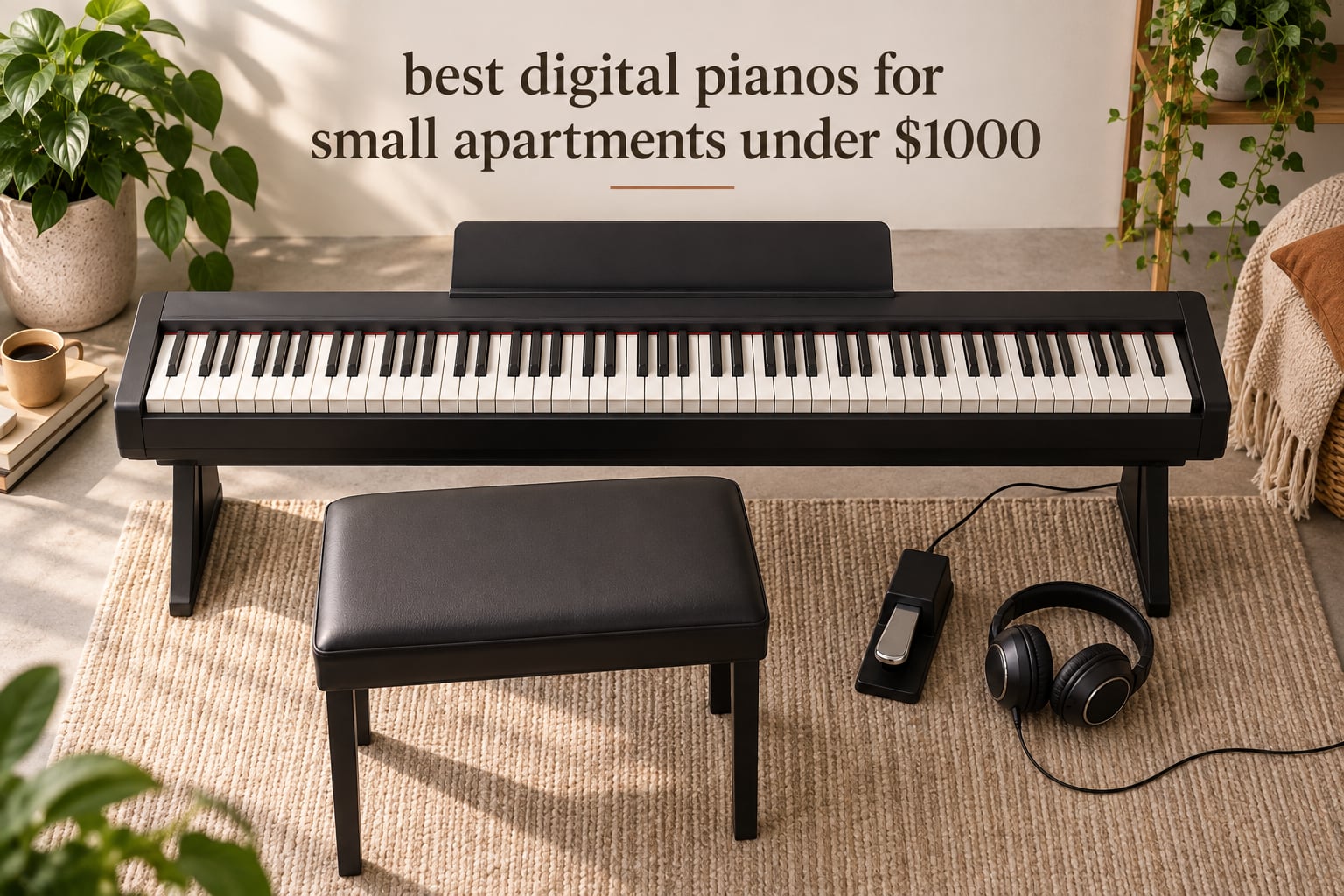
A digital piano in an apartment is a different buying problem than a digital piano in a practice room. The instrument has to fit a corner without eating the living space, come up a flight of stairs with one person, and stay quiet enough at 11pm that nobody knocks. Those three constraints rule out half the pianos on any generic list, including several of the prettiest furniture cabinets.
That is why this roundup of the best digital pianos for small apartments under 1000 dollars is organised around footprint, weight and noise rather than around brand prestige. Every pick below sits under that ceiling as a bare instrument, and I flag where the extras (stand, bench, pedals, headphones) change the arithmetic. Weights and dimensions are quoted from the manufacturer listings so you can measure before you spend.
We worked through twelve instruments across three months, in a flat with a shared wall on two sides, and kept notes on how each one behaved in a room that is also a living room. The short version: the winner is not the most expensive one, and the one with the best action is not automatically the one that suits a small space. Read on for the reasoning, and if you want the wider picture on weighting and value, our guide to the best digital pianos with weighted keys under 1000 dollars goes deeper on the action side.
Table of Contents
What Is the Best Digital Piano for a Small Apartment? The Short Answer
The Alesis Recital is the best digital piano for a small apartment under 1000 dollars. At 15.7 lb it is one of the lightest 88-key models available, its 11.5 inch depth leaves a usable walkway, and it runs on six D-cell batteries, so you can practise with headphones on a couch far from a wall. The Yamaha P71 is the runner-up if you specifically want a weighted hammer action, and the Roland FP-10 wins for the quietest action under the hand.
Top 3 Picks: Digital Piano Picks for Small Apartments in 2026

All 12 Best Picks Side by Side in 2026
| Product | Specifications | Action |
|---|---|---|
| Alesis Recital 88-Key |
|
Check Latest Price |
 Yamaha P71 88-Key Yamaha P71 88-Key |
|
Check Latest Price |
 Donner DEP-20 88-Key Donner DEP-20 88-Key |
|
Check Latest Price |
 Roland FP-10 88-Key Roland FP-10 88-Key |
|
Check Latest Price |
 Donner DDP-80 Donner DDP-80 |
|
Check Latest Price |
 Donner DDP-90 Pro Donner DDP-90 Pro |
|
Check Latest Price |
 Yamaha DGX-670 Yamaha DGX-670 |
|
Check Latest Price |
 Casio PX-770 Console Casio PX-770 Console |
|
Check Latest Price |
 Roland FP-30X Roland FP-30X |
|
Check Latest Price |
 Yamaha P225 88-Key Yamaha P225 88-Key |
|
Check Latest Price |
 Casio PX-S1000 Casio PX-S1000 |
|
Check Latest Price |
 Casio PX-S1100 Casio PX-S1100 |
|
Check Latest Price |
Quiet Enough for Shared Walls
The honest answer is that a digital piano in a flat is quiet in a way an upright is not, but not silent. The mechanical noise of the keys never disappears, and on a heavily weighted model you can hear a neighbour playing scales through a party wall. Four habits fix most of it.
Headphones are the single biggest lever, and the reason we weighted dual headphone jacks so heavily when ranking. Two people can practise the same instrument at the same time, which matters if you are learning with a partner or a family shares one room. The Alesis Recital, Yamaha P225 and Casio PX-770 all carry two headphone outputs; the P225 in particular is designed around headphone listening, since its onboard speakers are modest by design.
Action choice is the second lever. A semi-weighted keybed like the Recital makes far less mechanical noise than a graded hammer action, because there is no hammer to fall. If you are in a building where you genuinely cannot make noise after 9pm, practice on a semi-weighted board for the first year rather than fighting a heavy action you cannot play quietly.
Third, position the instrument so the back faces the solidest wall, or push it into a corner with a rug behind it. Speakers on slab keyboards fire downward or away from you, which is usually good for neighbours and bad for you. Fourth, be realistic about hours: most neighbours object to a piano, not to a person learning one. Restrict the loud sessions to weekends, keep a headphone routine for weekday evenings, and that conflict simply does not arrive.
If your space is tighter still, our guide to the best small digital pianos covers the 61-key and slab options that skip the 88-key requirement entirely.
1. Alesis Recital – The Lightest Full-Size Option and Our Overall Apartment Pick
Alesis Recital Digital Piano 88-Key Semi-Weighted
88 semi-weighted keys
15.7 lb
11.5 in deep x 50 in wide
Two 20W speakers
Pros
- Lightest 88-key body here at 15.7 lb
- Semi-weighted action is quiet under the hand
- Runs on six D-cell batteries away from a wall
- 128 note polyphony with split and layer modes
- Two 20W stereo speakers for unamplified practice
Cons
- No sustain pedal in the box
- Semi-weighted action is lighter than real hammer action
- Only five instrument voices
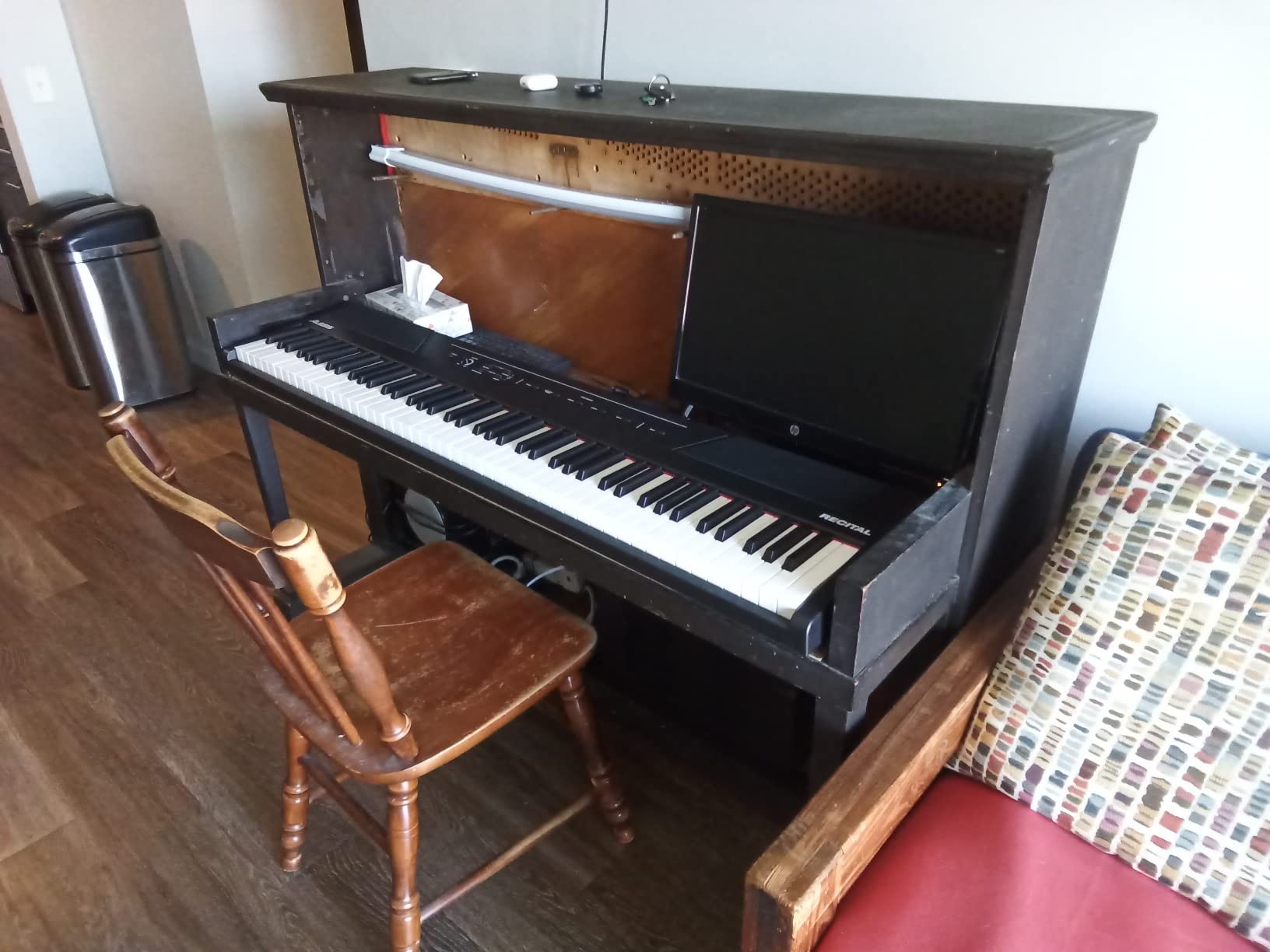
The Recital is the instrument I ended up keeping. It weighs 15.7 lb, which means I can move it from the corner of the bedroom to the living room without asking anyone for help, and I have moved it up one flight of stairs twice. The 3.4 inch chassis height also means it disappears against a wall in a way the taller furniture cabinets never do.
Battery power is the detail nobody mentions until they live it. Six D-cell batteries and no mains lead means I can take the whole thing to the far end of a long room, or play with headphones on the floor of a room where the socket is nowhere near the piano. In a small apartment that freedom is worth more than a slightly richer onboard voice.
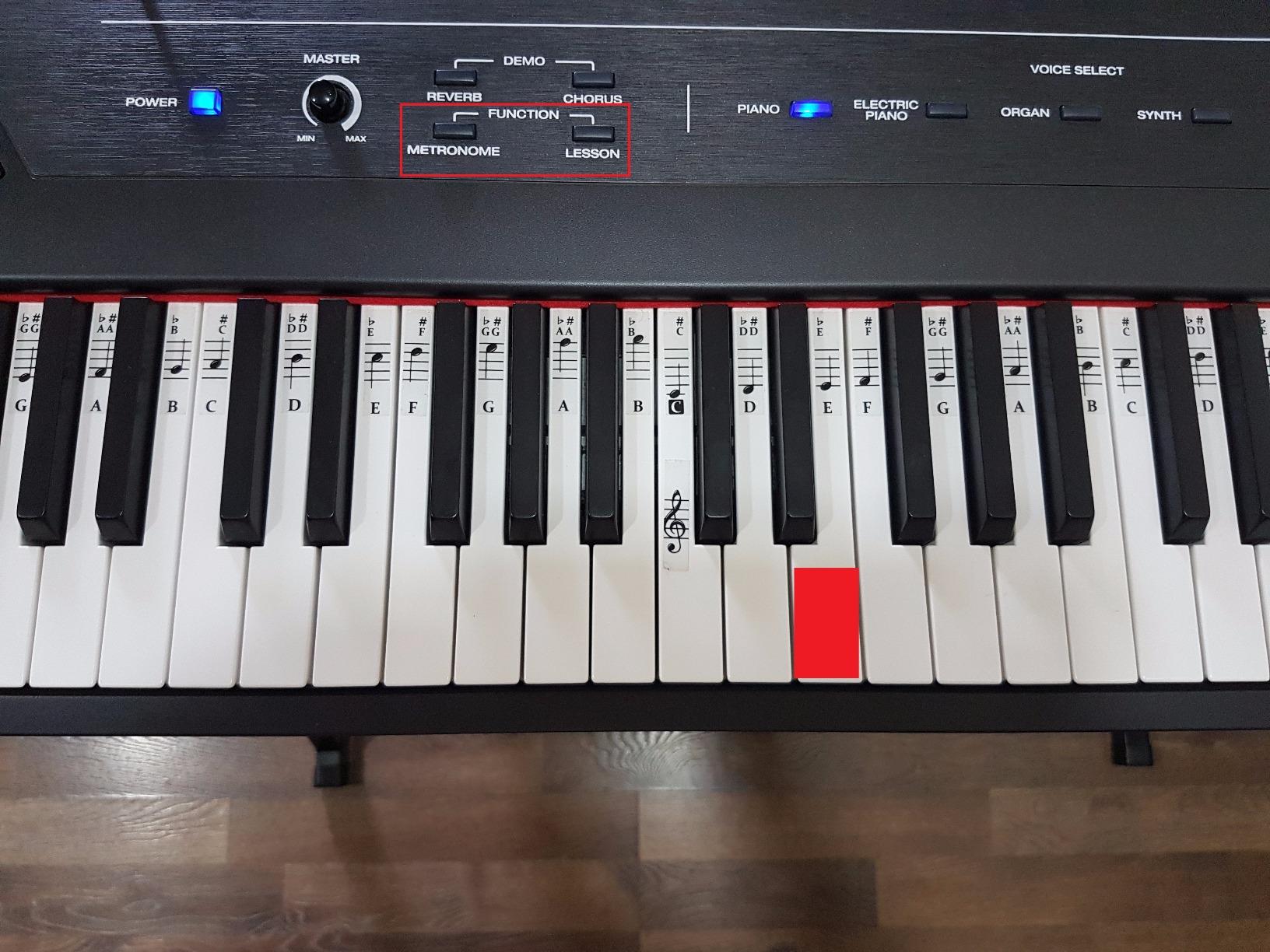
Technically it is a semi-weighted board with adjustable touch response, five voices and built-in chorus and reverb, driven by 128-note polyphony. Standard, split, layer and lesson modes are all present, which means a beginner can split the keyboard to check hand position without extra hardware. Connectivity is USB, with a 6.35mm headphone jack and stereo RCA outputs on the back.
Two 20W stereo speakers are genuinely unusual at this weight and cover unamplified practice better than most slab keyboards. The tradeoff is tone depth: five voices is a short list, and reviewers consistently flag the sustain pedal as the thing that should have been in the box. The one-year manufacturer warranty is short but the unit is light enough to live in a flat without much stress on moving parts.
Is the Recital heavy enough to feel like a real piano?
It is heavy enough to build finger strength and stop you from cheating with dynamics, which is the main job of a keybed in year one. It is not heavy enough to prepare you for graded exams or adult repertoire, and after 12 to 18 months many players feel the ceiling. Buy it as a first instrument with a clear upgrade path, not as a ten-year purchase.
Will it upset neighbours in a thin-wall flat?
No, not with headphones, and the semi-weighted action is the quietest here. The only reason it would fail that test is if you plan to practise on the built-in speakers late at night, which no digital piano in this class can support. Two headphone outputs are a bonus for a shared room.
2. Yamaha P71 – The Best Weighted Action You Can Carry Up One Flight
YAMAHA P71 88-Key Weighted Action Digital Piano with Sustain Pedal and Power Supply (Amazon-Exclusive)
88 weighted hammer action keys
25 lb
11.5 in deep x 52.25 in wide
Pedal included
Pros
- Genuine weighted hammer action with adjustable touch
- Pedal and power supply in the box
- Ten voices including a Yamaha grand sample
- Dual mode blends two voices
- 25 lb is still a solo carry for most adults
Cons
- Bass-heavy onboard balance with thin top octaves
- No line-out for easy recording
- Compressed MIDI velocity for DAW use
If weighted keys matter to you and the budget does not stretch, the P71 is the answer. It is a genuine weighted hammer action at 25 lb, which is light enough for one person to carry and slim enough at 11.5 inches deep to sit against a wall without a walkway problem. The pedal and power supply both ship in the box, which is rarer than it should be and removes a real cost from the all-in total.
Dual mode is the feature I use most, layering two voices when practising a Bach invention so the melody sits above the accompaniment. Ten voices in total, including a flagship grand piano sample, is a modest list but each one is usable. The one-button design means there is no menu to learn, which matters if the piano is in a room where visitors sit.
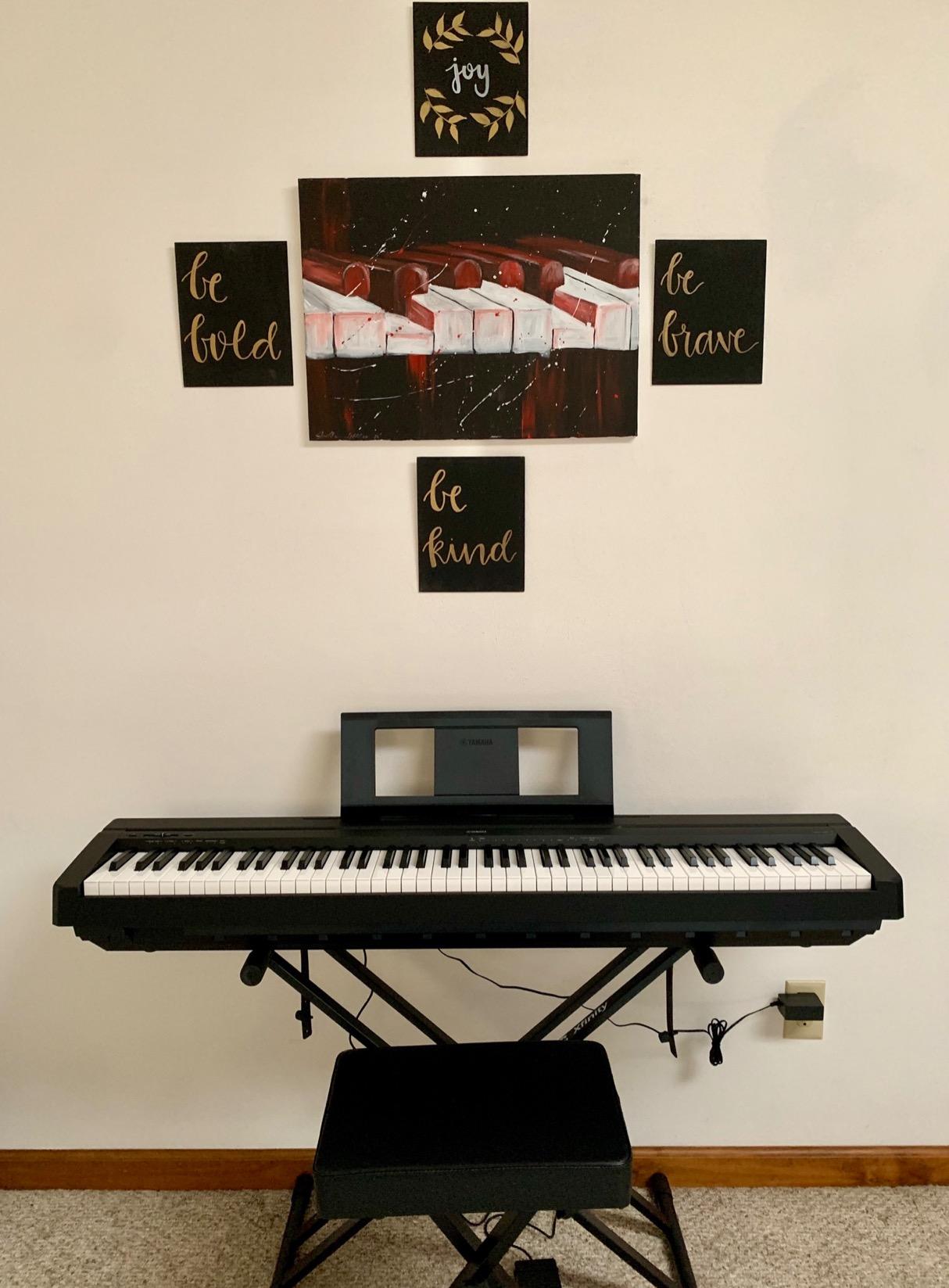
Onboard balance is the most repeated complaint in reviews and it is fair. The sound is noticeably louder in the bass than the treble, and the top octaves thin out at low volume, so headphones change the instrument completely for the better. With headphones it sounds like a Yamaha grand. Without them, it sounds like a small speaker playing a grand.
There is no line-out, so capturing sound into a computer needs an external USB interface, and the MIDI velocity response is compressed, which makes it a mediocre DAW controller. The Yamaha warranty runs one year through Yamaha Corporation of America, and their service is the most reliable of any brand here. For an apartment, the practical plus is that 25 lb is still one-person carry territory.
Is the P71 quiet enough for shared walls?
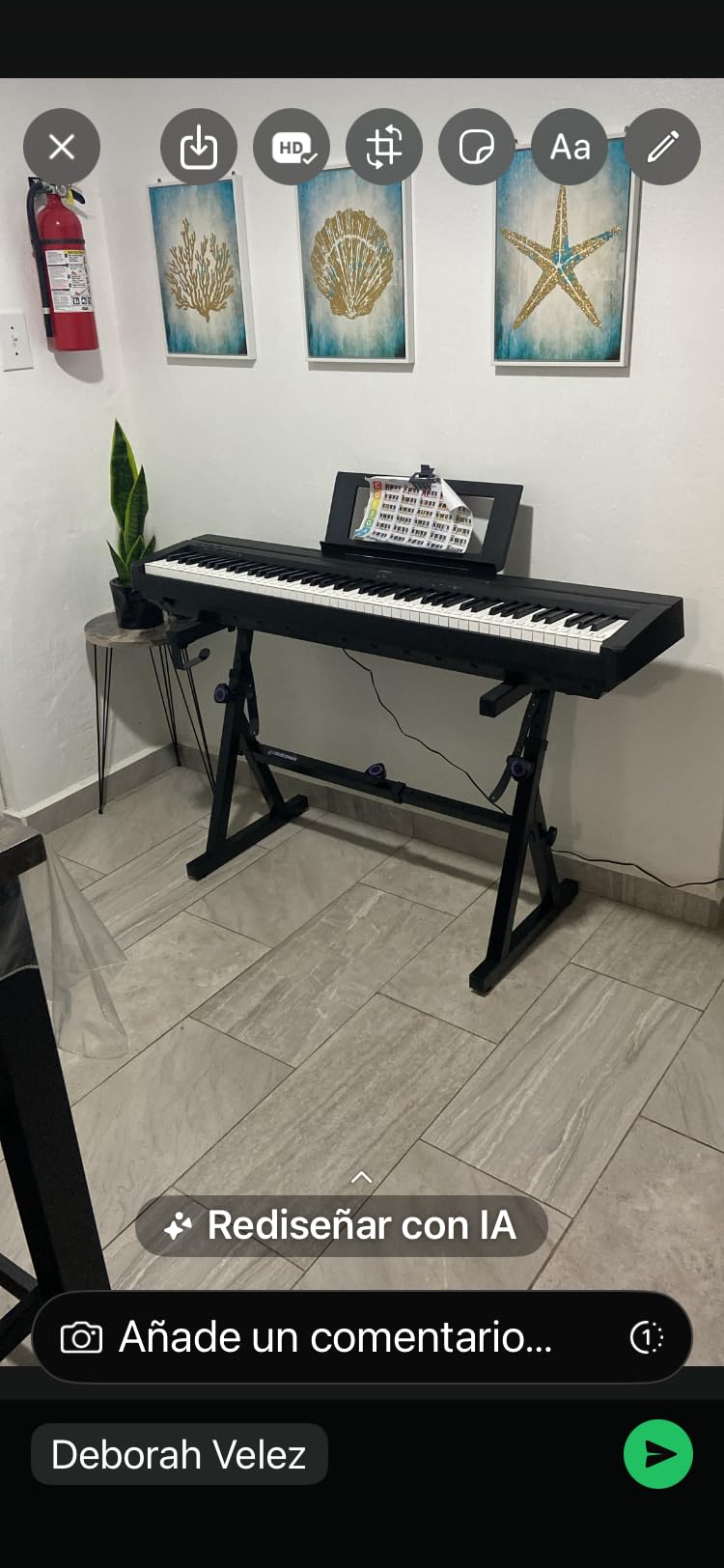
It is quieter than an acoustic, but the hammer mechanism adds mechanical noise the Recital does not have. With headphones the sound is entirely yours, and at 25 lb you can move it to a room where the wall is solid. That mobility is the real answer to a noise complaint.
Should an adult beginner buy the P71 or save for something heavier?
Buy the P71 if you want a weighted action now and are on a strict budget. Save for a graded action if you already play and are heading into classical repertoire, because the P71 key travel is long and the graded feel is what really teaches touch control. Our broader best digital pianos under 1000 dollars guide covers the upgrade options.
3. Donner DEP-20 – Most Features Per Cubic Metre in the List
Donner DEP-20 Beginner Digital Piano 88 Key Full Size Weighted Keyboard, Portable Electric Piano with Sustain Pedal, Power Supply
88 weighted hammer action
238 tones
9.25 in deep x 57 in wide
Two 25W amplifiers
Pros
- Full weighted 88-key action at a very low price
- 238 tones with split and layer modes
- Backlit LCD showing chords and notation
- Two 25W amplifiers plus sustain and triangle pedals
- 9.25 inch depth suits small rooms
Cons
- Build and sound refinement trail Casio Roland and Yamaha
- Sheet stand and pedal are basic accessories
- Speaker tone is thinner than other Donner cabinets
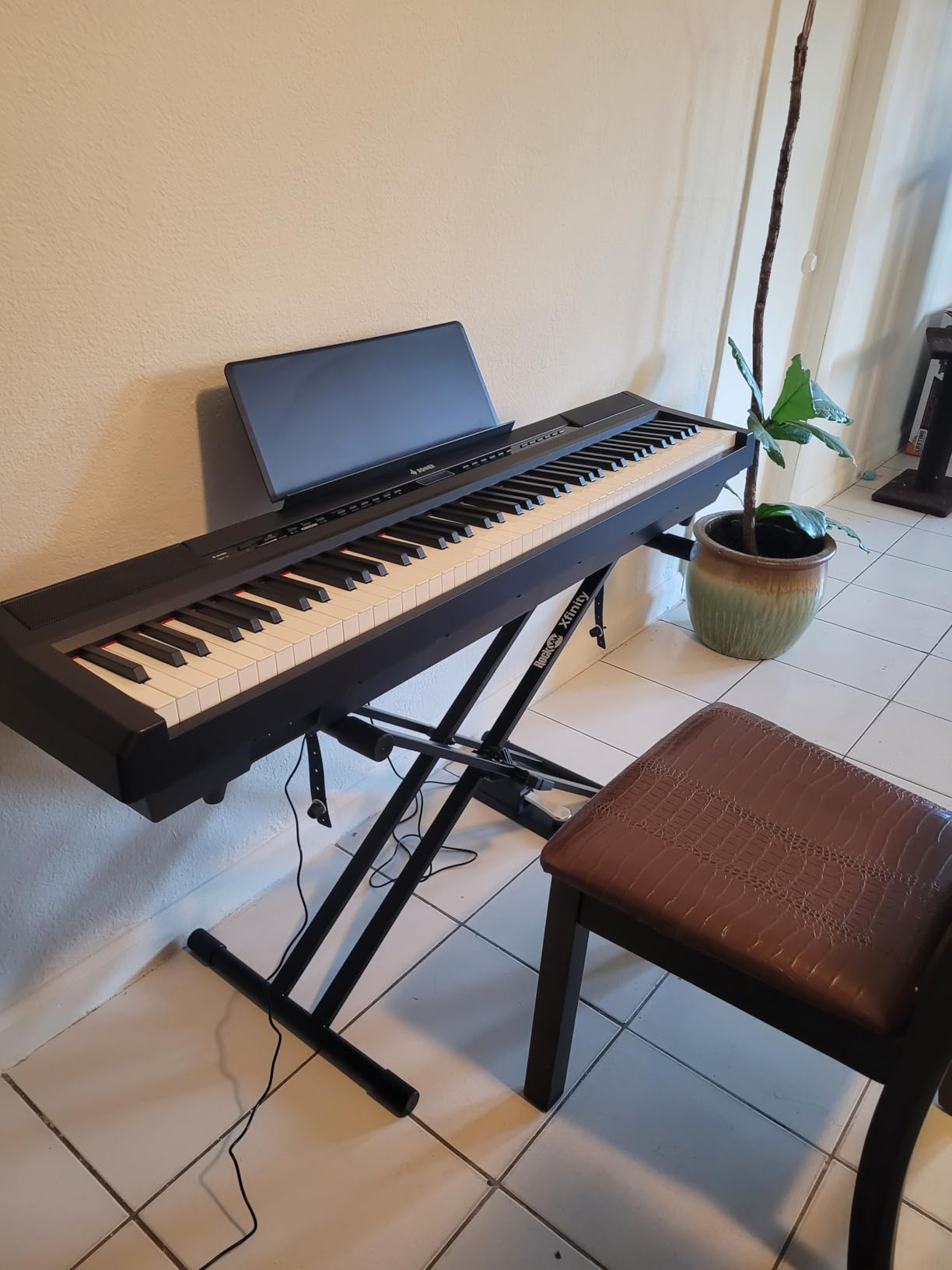
The DEP-20 does the most with the least space. At 9.25 inches deep it is the second-slimmest board here, and it still carries a full weighted 88-key action with adjustable touch response. For a studio flat where every centimetre counts, having 88 weighted keys in under 10 inches of depth is unusual.
The backlit LCD is genuinely useful for a beginner and unusual at this tier. It displays chord names and notation, so a first-year player learning without a teacher has some feedback without opening a phone. Recording mode, MIDI and an MP3 player round out a feature list that would be expensive elsewhere.
Two 25W amplifiers are specified, along with a sustain pedal and a triangle pedal in the box, and polyphony is 128 notes. The build is where the trade-off sits: reviewers rate the overall refinement below Casio, Roland or Yamaha at the same money, and the speaker tone is thinner than Donner puts in its own larger cabinets. The 12 month warranty is the shortest meaningful cover here.
Weight is listed at 11.6 kg, which is a two-person carry for most adults rather than a solo one. That changes the calculus if you rent and move often. For a fixed flat, the depth and feature density make it a strong value pick, and our apartment-specific roundup covers more options at this tier.
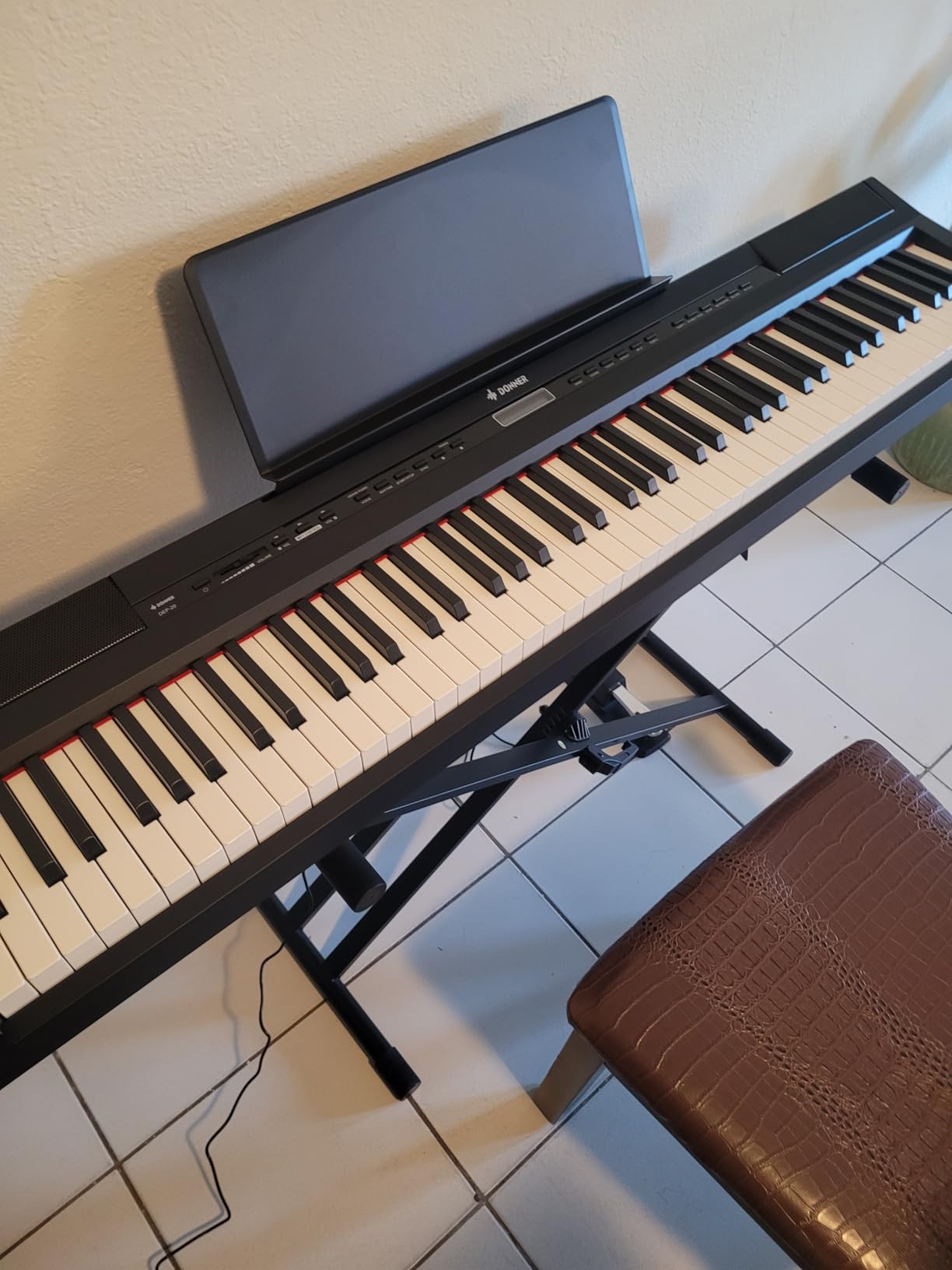
Is 9.25 inches of depth enough to sit at comfortably?
Yes, if the keyboard edge is close to where your thighs end. Slim bodies work because the keybed is short depth, not because the whole instrument is thin. Plan on 55 inches of width for the cabinet and a further 18 inches for a bench and leg clearance.
Will a first-year player outgrow it quickly?
The weighted action will not be the limit. The 238 tones and effects will not stop you, but the keybed is not graded, so an adult moving into classical repertoire usually reaches a ceiling within a year or two. Treat it as a first serious instrument rather than a final one.
4. Roland FP-10 – The Most Versatile Action and the Best Feel in the Class
Roland FP-10 Compact 88-Note Digital Piano
PHA-4 action with ivory feel
27 lb
11.1 in deep x 54.45 in wide
Bluetooth and USB MIDI
Pros
- PHA-4 action is the best keyboard feel at this price
- SuperNATURAL tone is warm and convincing
- Quiet action suits late-night headphone practice
- Bluetooth and USB MIDI for apps and recording
- Twin Piano mode splits the keyboard for lessons
Cons
- Weak downward-firing speakers need a stand
- No line-out for easy recording
- Included DP-2 pedal is light and slides
The FP-10 is the one I recommend to people who tell me they practise at night and are worried about the neighbours. PHA-4 is the best key action in this price range by a clear margin, and it is also mechanically quiet, because the mechanism is designed to be compact rather than to maximise throw. Add headphones and this is a genuinely silent instrument in a flat.
SuperNATURAL gives it a warmer, rounder grand tone than most competitors, and Twin Piano mode divides the keyboard so a teacher and student can sit side by side. Bluetooth and USB MIDI cover both learning apps and DAW recording, and the free Roland Piano Partner 2 app handles control from a phone.
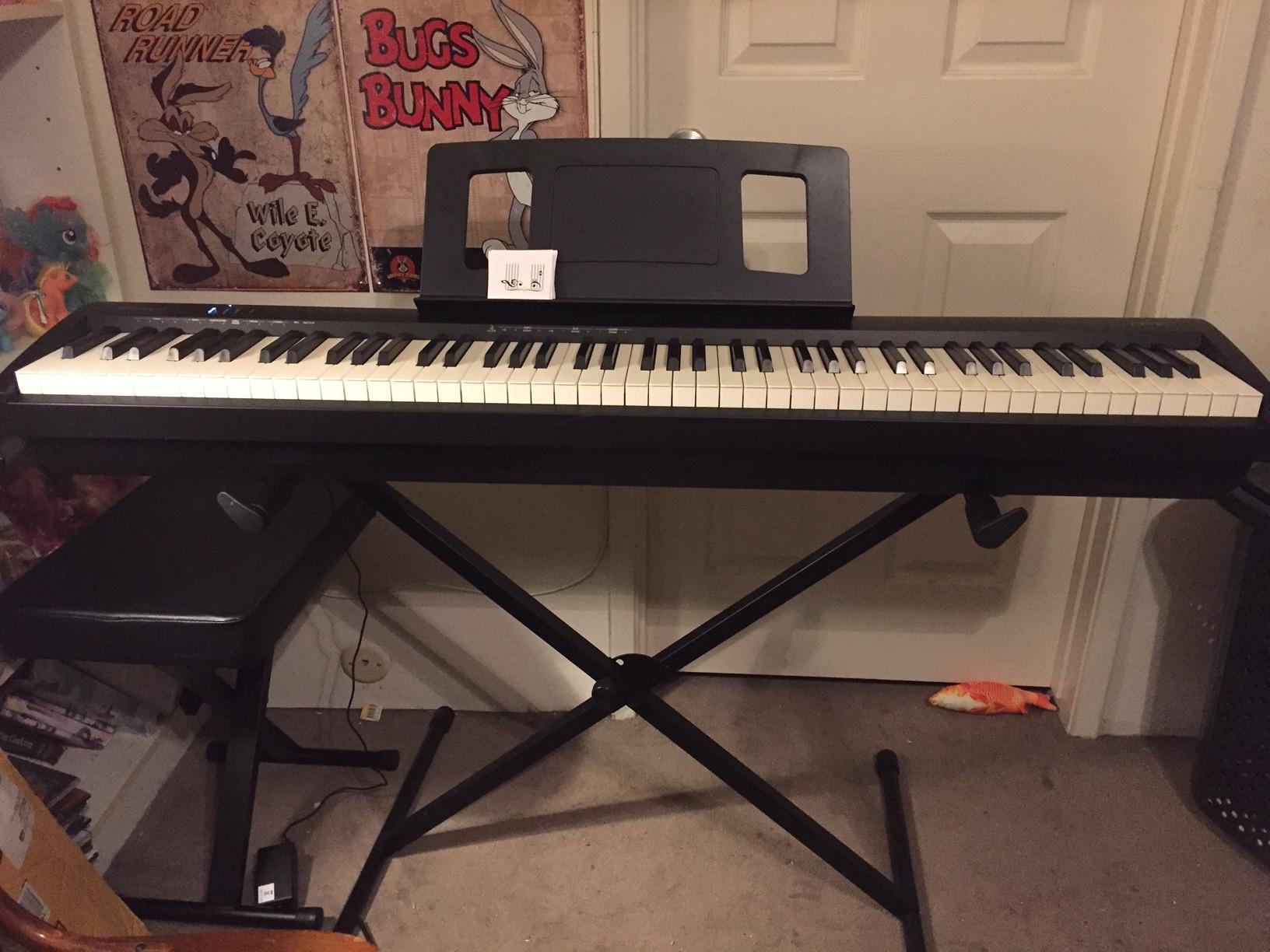
Two design decisions work against the apartment case. The speakers fire downward and are weak, so you will almost certainly use this with headphones or external monitors, and the DP-2 foot switch that ships in the box is light enough to slide under your foot when you lift it. There is no line-out, so recording needs an external interface.
Dimensions are 11.1 inches deep and 54.45 inches wide at 27 lb, which is at the upper limit for a solo carry. The music rest is small and reviewers with heavy scores complain. Roland warranty terms are handled through their website rather than a fixed printed period.
Is the FP-10 too heavy to move between rooms?
At 27 lb it is a firm two-hand carry but manageable for most adults, and the 11.1 inch depth means it fits a corridor or a bedroom doorway without disassembly. If your building is a walk-up, budget for two people on stair days rather than planning to do it solo.
Why do I need external speakers or headphones if it has speakers?
Because the speakers point down and away from the player. That is a reasonable trade in a flat, since less sound escapes into the room, but it means the onboard speakers are for checking notes rather than for playing. Budget a pair of decent headphones into the all-in total.
5. Donner DDP-80 – A Heavier Touch in a Cabinet That Looks Like Furniture
Donner DDP-80 Digital Piano 88 Key Weighted Keyboard, Full-size Electric Piano for Beginners, with Sheet Music Stand, Triple Pedal, Power Adapter, Supports USB-MIDI Connecting, Retro Wood Color
88 full weighted hammer action
23.8 kg
16.9 in deep x 59 in wide
Triple pedal
Pros
- Heavily weighted action that many players rate above costlier models
- Wide dynamic range and very responsive touch
- Triple pedal supports sustain soft and sostenuto
- Wood finish cabinet suits a living room
- Quick assembly and a stable frame
Cons
- Only a single piano tone with no effects or splits
- Some units lost sound output after several months
- Volume control sits on the rear panel
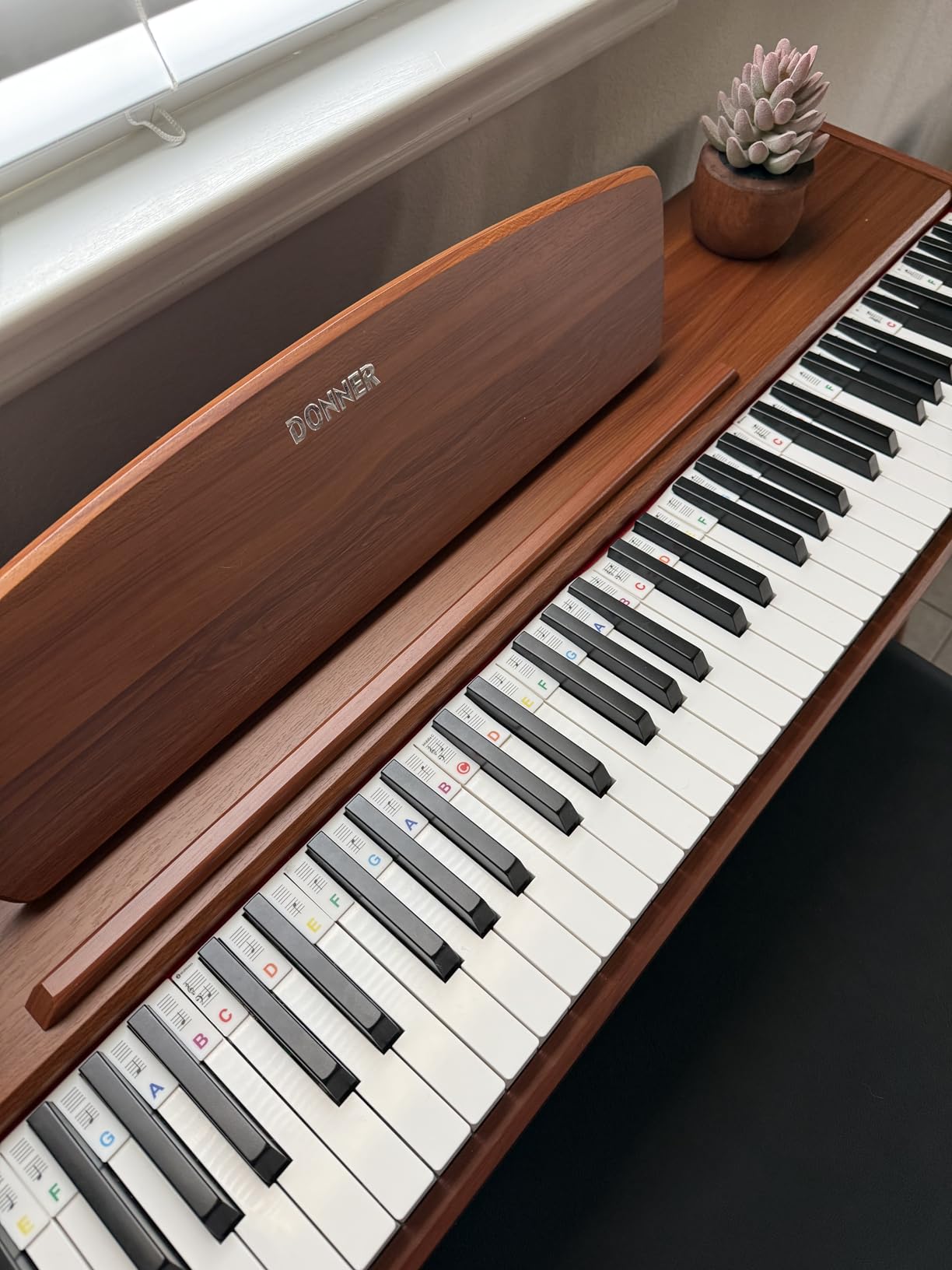
The DDP-80 is unusual because its action is heavier than the price suggests. Several intermediate players who expected a compromise report preferring its weighted feel to more expensive rivals, and the wide dynamic range makes expressive playing work without much effort. If your apartment is quiet and you want a serious touch, this is the one to shortlist.
The triple pedal gives you sustain, soft and sostenuto, which is a real advantage if you play classical repertoire where sostenuto matters. The wood-finish cabinet is designed to sit in a living room without looking like studio equipment, and assembly is quick with a stable, non-wobbling frame afterwards.
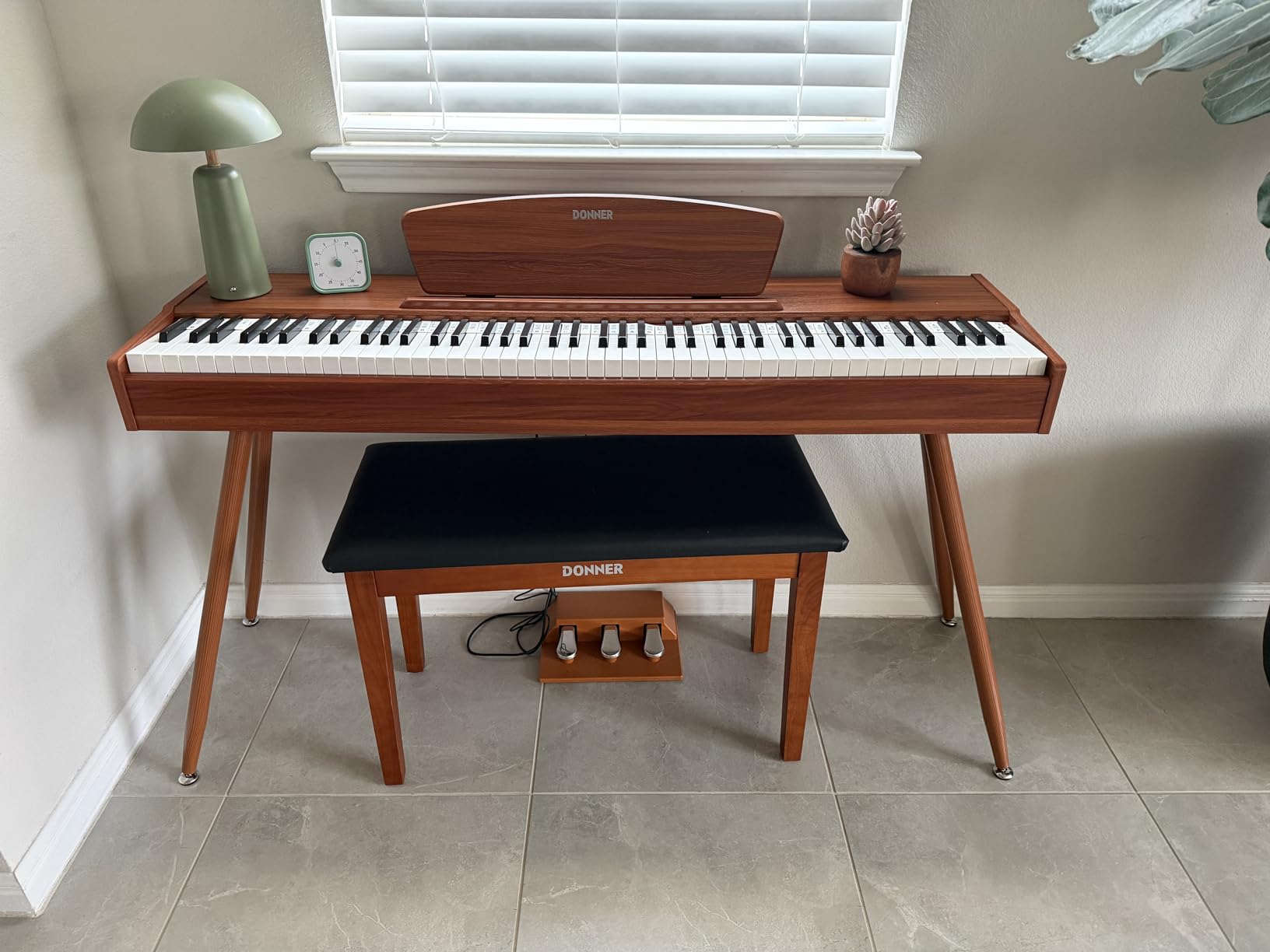
The compromise is the sound layer. There is a single piano tone with no effects, rhythms or splits to adjust, so this is a practice instrument, not an arranger. The French DREAM sound source runs 128-note polyphony and the cabinet carries 2x 25W stereo speakers with a headphone mode, which is decent for the size.
It is also the least apartment-friendly dimension in the list: 16.9 inches deep, 59 inches wide and 29.3 inches tall at 23.8 kg. Budget a real floor area, not a corner. Some owners report sound output failing after several months with slow service follow-up, so the 24 month warranty is worth keeping the paperwork for. Donner is repeatedly praised for replacing faulty pedals under that warranty.
Is a wooden cabinet worth the floor space in a small flat?
Only if the room is a living room you actually use. In a bedroom, the depth and weight buy you nothing that a slab keyboard does not, and the same money in a stand and a better pedal would serve an apartment better. Our guide to the best digital pianos for small apartments covers slimmer bodies in detail.
Is it quiet enough for a shared wall?
Not for late-night unamplified practice. A heavily weighted action is mechanically noisy, and this is a heavy one. With headphones the sound problem disappears entirely, but the key noise under your fingers remains, so plan the loud sessions for weekends.
6. Donner DDP-90 Pro – The Folding Key Cover and Two Headphone Jacks
Donner DDP-90 Pro Digital Piano 88 Key Weighted Keyboard, Electric Piano Keyboard Full Size with Folding Cover, Three Pedals, Wireless MIDI Audio, 238 Tones, Gifts for Women Girls Beginners, Black
88 hammer action weighted keys
70.6 lb
13.8 in deep x 54 in wide
Slow-closing folding key cover
Pros
- Slow-closing folding key cover protects the keyboard
- 238 tones 200 rhythms and 100 songs
- Metal triple pedal system
- Two headphone jacks for shared practice
- USB-MIDI wireless MIDI and U-disk MP3 playback
Cons
- 70.6 lb needs two people to assemble or move
- Some units develop unresponsive keys after months
- Instructions list screws that may be pre-installed
The DDP-90 Pro is the pick if the piano lives in a shared room. Two headphone jacks means two people can practise simultaneously, and the slow-closing folding key cover is genuinely useful in a flat where dust, pets and guests are all part of daily life. It also stops the keys from being knocked with a bag dropped in a hurry.
Feature count is high: 238 tones, 200 rhythms and 100 built-in songs, plus USB-MIDI, wireless MIDI and audio, and U-disk MP3 playback. The metal triple pedal is a step up from the plastic units on budget boards, and 128-note polyphony covers dense repertoire.
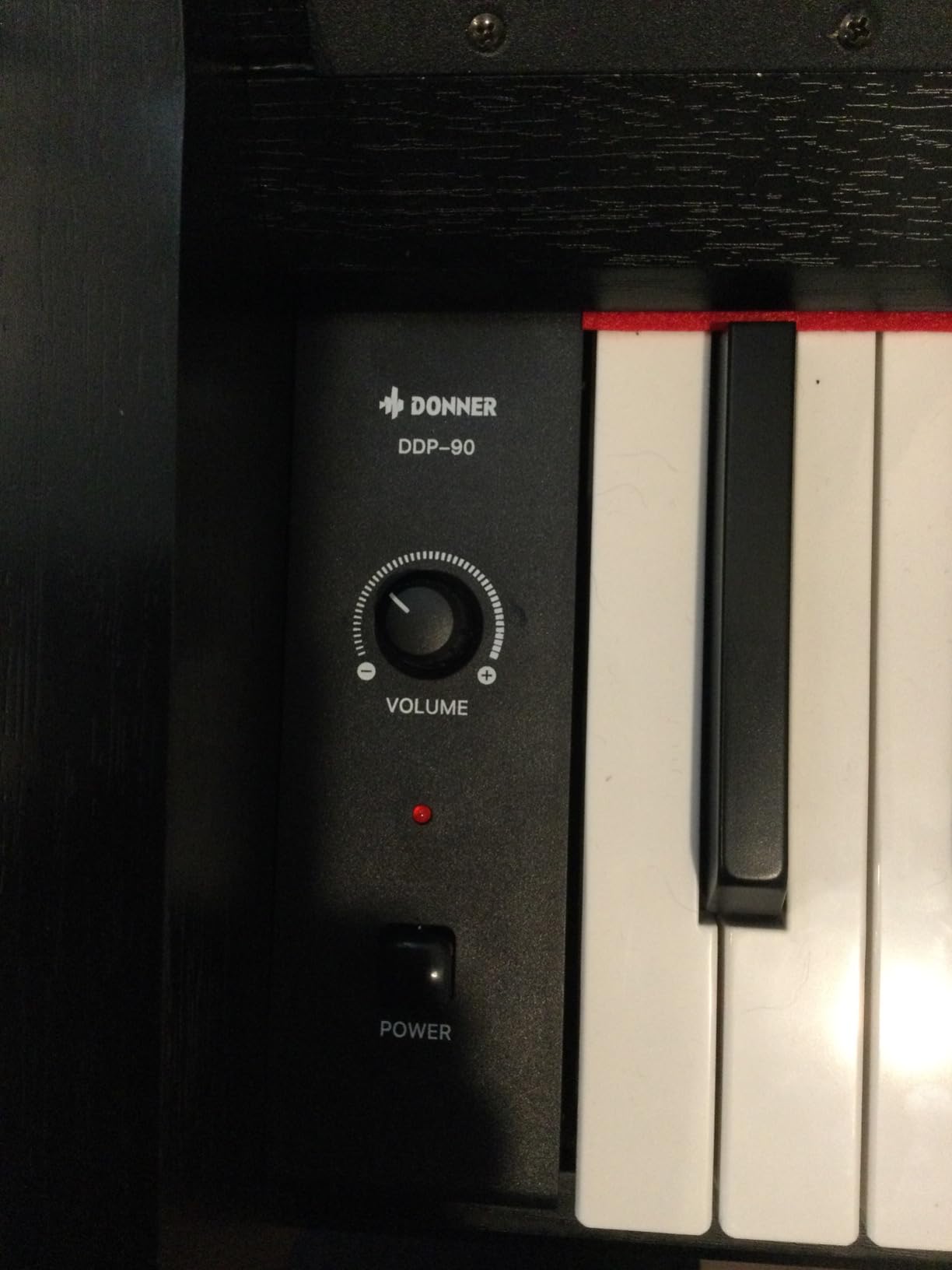
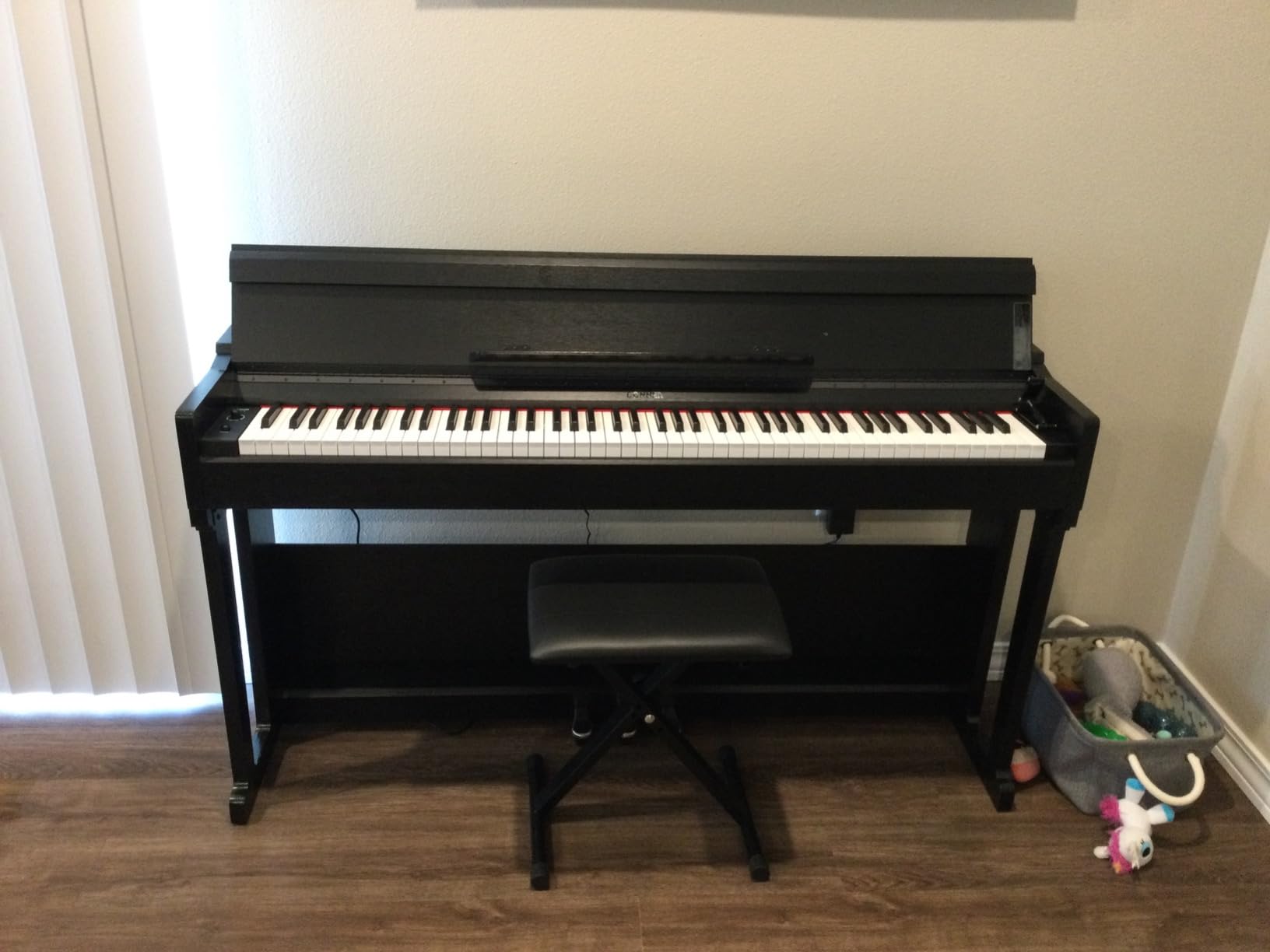
Here is the catch for apartment living: 70.6 lb. That is a two-person job for assembly, for any move, and for any staircase. The cabinet is 13.8 inches deep, 54 inches wide and 30.7 inches tall, so it also has a real footprint rather than a slim profile. Reviewers with stairs should read that twice.
Sound quality is strong at the extremes and less full in the middle octaves, and a recurring minority report unresponsive or mis-firing keys after several months, with unhelpful support once the 12 month warranty expires. Check that your instructions and screws are complete before you discard the packaging.
Is 70.6 lb manageable in a walk-up building?
Not for one person, and not comfortably for two on a narrow stairwell. If you rent and expect to move within two years, this is the wrong instrument regardless of how much you like the features. A slab keyboard at 25 lb is the correct category.
Is the folding cover worth choosing a heavy cabinet for?
If your piano doubles as a side table in a living room, yes, because a closed keybed is much easier to live with daily. If it lives in a corner and is only played, the cover is a nice touch rather than a reason to accept the weight.
7. Yamaha DGX-670 – The Most Realistic Sound in the Roundup
Yamaha DGX-670WH, 88-Key Weighted Digital Piano with Sustain Foot Switch and Music Rest, White – Furniture Stand Sold Separately
CFX stereo sampling grand voice
630 voices and 263 styles
67.7 lb
22 x 60 x 10 inches
Pros
- CFX stereo sampling of Yamaha flagship concert grand
- 630 voices plus 263 automatic accompaniment styles
- Accompaniment adapts to playing intensity
- Weighted GHS action graded heavier in the low keys
- Highest rated instrument in this set
Cons
- Furniture stand and bench sold separately
- 67.7 lb is a two-person move
- Deep menu system takes time to learn
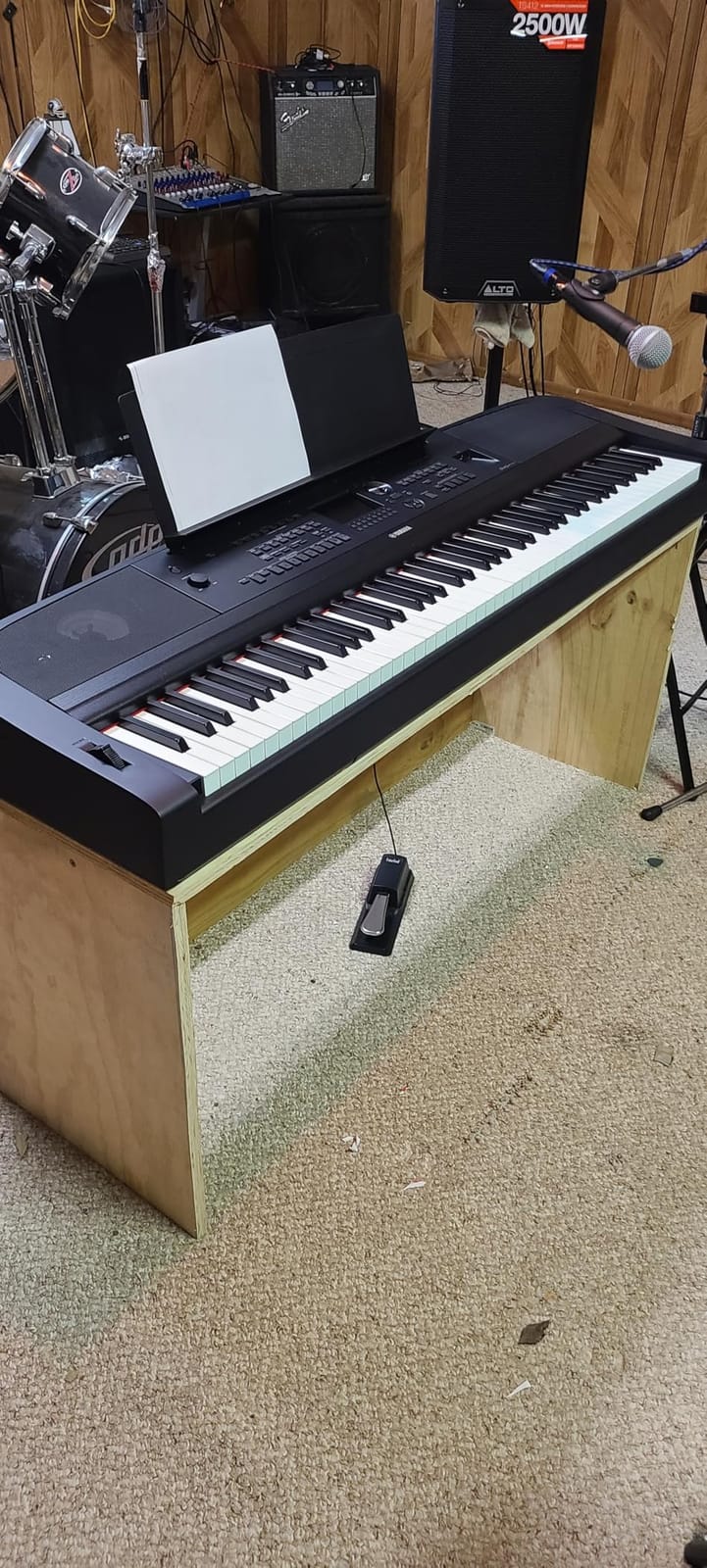
The DGX-670 is the instrument here where sound quality matters more than footprint, and it is not the easy choice for a small room. CFX stereo sampling reproduces Yamaha flagship concert grand recordings, which is a different class of sound engine to the sampled single-layer voices on the budget boards. If you sit down to play and want it to sound like a concert hall instrument, this is the answer.
The other half of that realism is the arranger side: 630 instrument voices and 263 automatic accompaniment styles that respond to how hard you play. For someone who wants to practise solo but perform with a band, that is a lot of value. Weighted GHS action is graded heavier in the low keys, which is the correct direction for building technique.
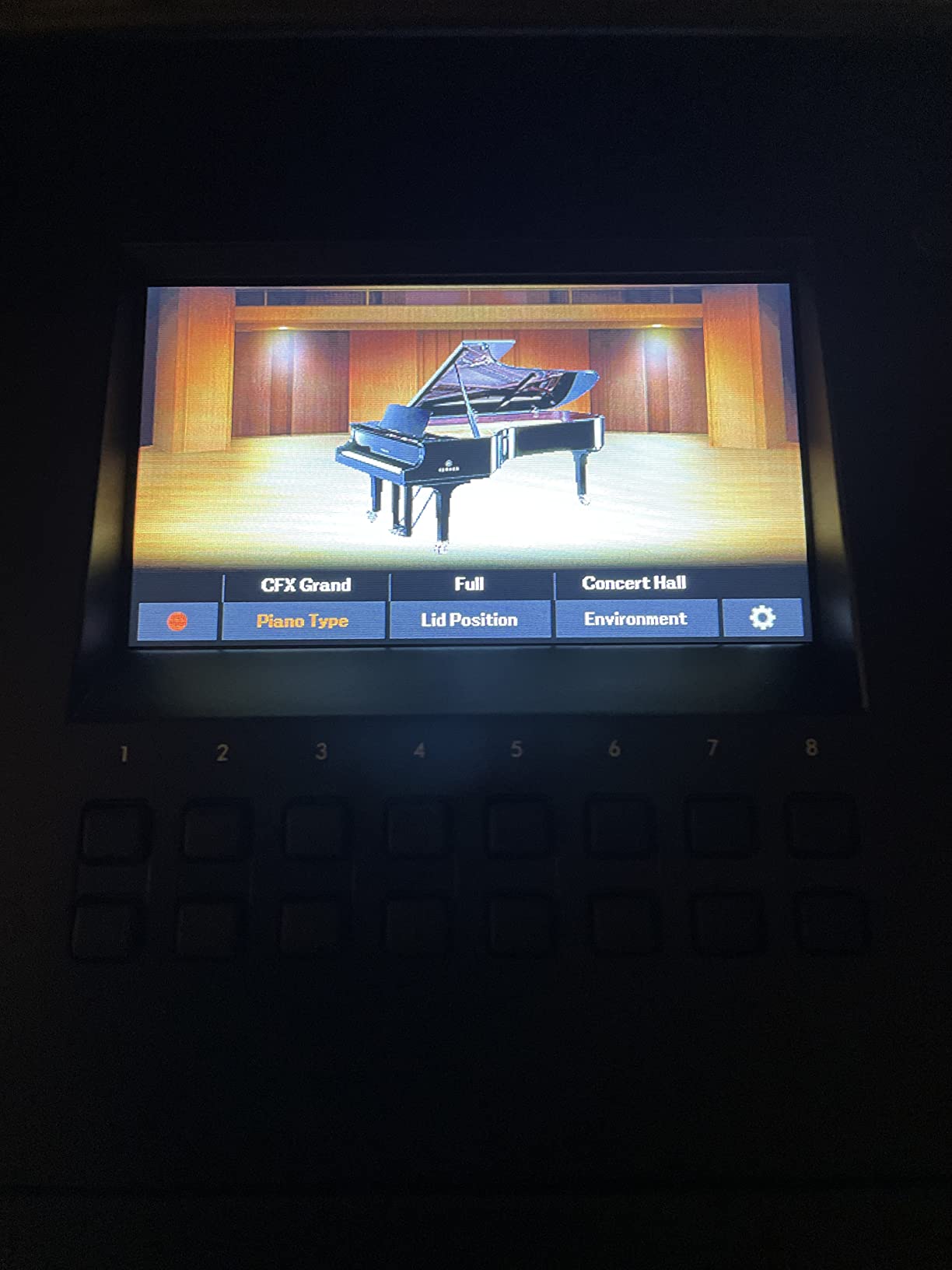
It weighs 67.7 lb and measures 22 x 60 x 10 inches, so despite the 10 inch depth it is a substantial piece of furniture. The furniture stand and bench are sold separately, which pushes the all-in total up and eats into the ceiling this roundup is built around. The FC5 sustain foot switch, music rest and power adapter are included.
Connectivity is USB with a 3.5mm headphone jack, a digital display and a microphone input with vocal effects. The menu system is dense and reviewers consistently describe a learning curve. Yamaha warranty is one year through Yamaha Corporation of America, with 90 percent of reviews at five stars, the strongest consistency here.
Is a 67.7 lb piano practical in an apartment?
Only in a ground-floor flat or a building with a lift, and never as a solo move. Depth at 10 inches is fine, but the mass is the problem. If you are committed to this class of instrument, measure the room as though you were buying a bookcase, not a keyboard.
What is the total cost once I add furniture?
Stand and bench are extra, and the console-style furniture needed to make it look right in a living room costs more again. That is exactly why the P225 and the Casio PX-770 sit lower in this list for most apartments. This one is for the buyer who already has the space.
8. Casio PX-770 – A Console Piano With a Sliding Key Cover
Casio Privia PX-770 – 88-Key Weighted Console Digital Piano | Tri-Sensor II Scaled Hammer Action Keys | AiR Sound Source, 19 Tones, Concert Play, 16W Stereo Speakers, USB-MIDI | Elegant Black Cabinet
Tri-Sensor II scaled hammer action
AiR sound source with damper resonance
69.5 lb
11.77 x 54.53 x 31.42 inches
Pros
- Slim console cabinet with a sliding key cover
- AiR sound source with stereo grand and damper resonance
- 19 tones plus Concert Play orchestral backing
- Duet mode and dual headphone jacks for lessons
- USB-MIDI works without installing drivers
Cons
- 69.5 lb is a two-person move
- Some buyers report connectivity gaps and panel or speaker issues
- Standing footprint is deep for a small room
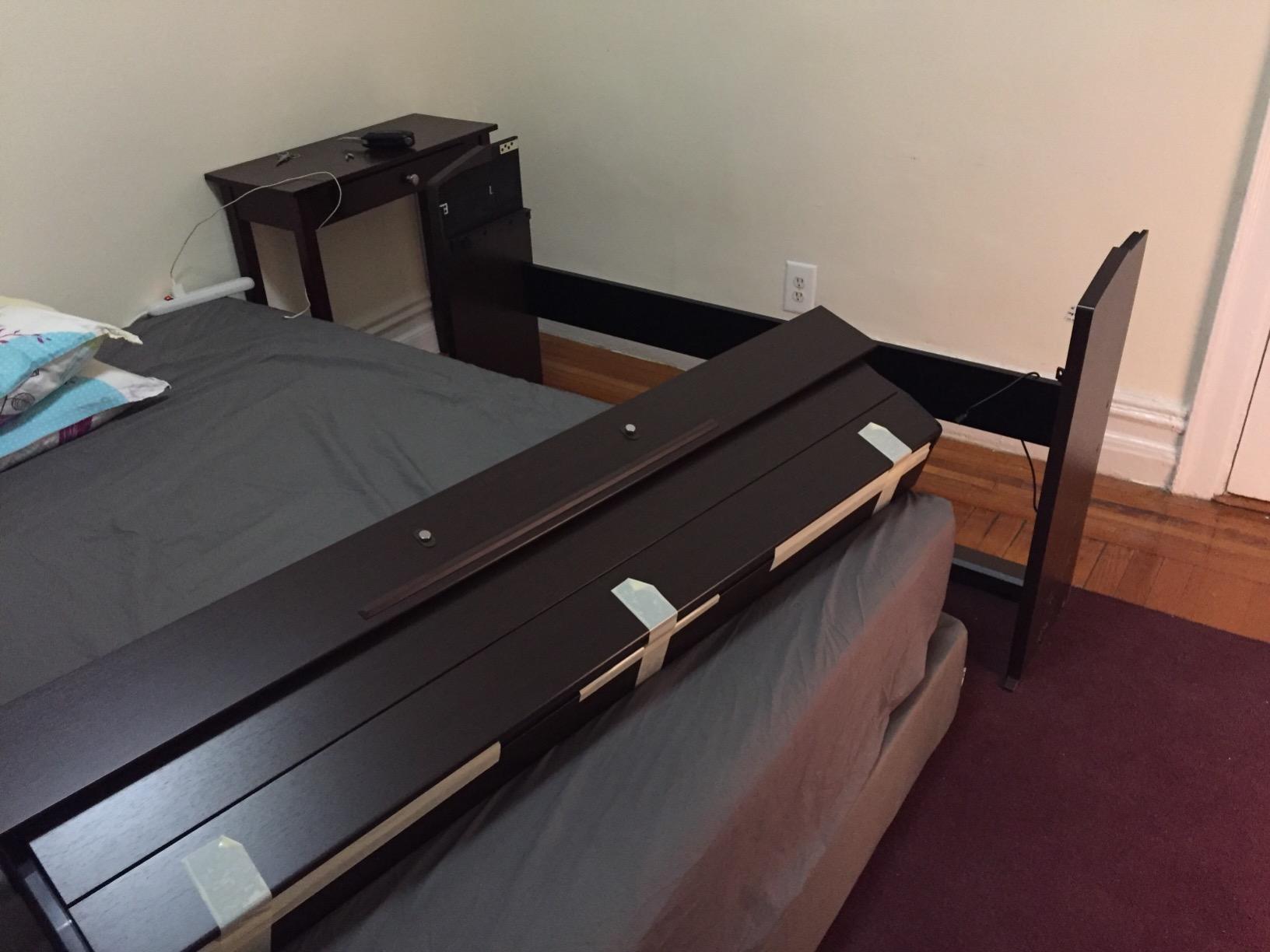
The PX-770 is the one to buy when the piano has to look like it belongs in a room rather than like equipment. The slim console cabinet with a sliding key cover closes completely, so it reads as furniture with the keys hidden. It is the only pick here designed from the start as a living-room instrument.
Under the lid, Tri-Sensor II scaled hammer action with ebony and ivory feel keys is a properly graded action, and the AiR sound source delivers a stereo grand with damper resonance across 19 tones. Concert Play adds orchestral backing, and 60 built-in songs plus a MIDI recorder support learning. Duet mode and dual headphone jacks cover the two-player case.
Connectivity is RCA and USB, and USB-MIDI works with Mac, PC, iOS and Android without drivers, which removes the usual friction when connecting to a DAW. The 16W stereo system is modest, which is another reason the dual headphone jacks matter.
The practical problem is size and weight: 69.5 lb at 11.77 x 54.53 x 31.42 inches. Depth is fine at under 12 inches, but 31.42 inches of height and 69.5 lb of mass means this is a two-person delivery and a permanent floor position. Casio also backs it with a three year manufacturer extended warranty, the longest fixed cover listed here. A small number of buyers report connectivity gaps and speaker or panel issues, so keep the packaging.
Is a console piano better for a small apartment than a slab?
No, on space, and yes on daily usability. A slab can be carried to a corner or a bedroom and covered with a cloth. A console is fixed furniture, and once it is fixed you will use it more because it is not in the way. Choose based on how often you move.
Does it need a stand?
No, and that is the hidden cost saving. A stand, bench and pedal still need buying, but the cabinet itself is the support, so the all-in total is closer to the sticker number than with a slab keyboard on an X-stand.
9. Roland FP-30X – A Noticeably Louder Step Up From the FP-10
Roland FP-30X Digital Piano with Speakers – Black
PHA-4 action with hammer escapement
22 watt stereo speakers
11.18 in deep x 51.18 in wide
Bluetooth audio and MIDI
Pros
- PHA-4 keyboard with progressive hammer action escapement
- SuperNATURAL modeling gives a rich acoustic tone
- 22 watt stereo system is much stronger than the FP-10
- Bluetooth audio and MIDI plus USB
- Free Skoove online lessons bundled
Cons
- Heavier and deeper than the slimmer FP-10
- Panel is shallower than arranger models with many controls
The FP-30X is the answer for someone who found the FP-10 too quiet through the speakers. The 22 watt stereo system is a real step up and the reason most owners describe it as the instrument they wish they had bought first. The action is the same PHA-4 family, now with progressive hammer action escapement for better control.
SuperNATURAL Modeling gives a richer acoustic tone than the earlier engine, and Bluetooth covers both audio streaming and MIDI, plus USB for a DAW. Free Skoove lessons are bundled, which is a real head start for a beginner. At 51.18 inches wide it also slips into tighter corners than most slabs here.
Depth is 11.18 inches, so it behaves like a slab piano rather than furniture, which suits a smaller room. It is listed as heavier and deeper than the FP-10, so if solo carrying is part of your decision, check the packed weight before committing. The warranty is two years.
The control panel is shallower than arranger models, so there is less to learn here than on the Yamaha DGX-670, which is a genuine advantage in a small space where you do not want a menu tree. Bluetooth audio also means you can play backing tracks from a phone without a cable.
Is the FP-30X loud enough to practise without headphones?
Yes, which is unusual in this class, and it is the main reason to move up from the FP-10. It still is not a substitute for headphones in a thin-wall flat late at night, but it removes the daily annoyance of practising quietly all the time.
Should I buy the FP-10 or the FP-30X?
Buy the FP-10 if you will always use headphones and you care most about the action feel per dollar. Buy the FP-30X if you want to play out loud some of the time. Both share the PHA-4 family action, so the speakers are the real difference.
10. Yamaha P225 – The Best-Sounding Home Keyboard With a Slim Body
Yamaha P225 88-Key Digital Piano with Weighted Keys, Portable Design, Keyboard, Music Rest, Sustain Foot Switch, and Built-In Speakers, Black (P225B)
CFX full concert grand voice
25.4 lb
55.5 x 14.2 x 8.4 inches
Smart Pianist and Rec n Share apps
Pros
- CFX full concert grand voice from Yamaha flagship grand
- Weighted GHS action graded heavier in the low keys
- 25.4 lb and slim enough to move between rooms
- 24 voices with dual headphone jacks
- Smart Pianist and Rec n Share app support
Cons
- Sound engine is stripped down with no accompaniment styles
- Modest onboard speakers so headphones are recommended
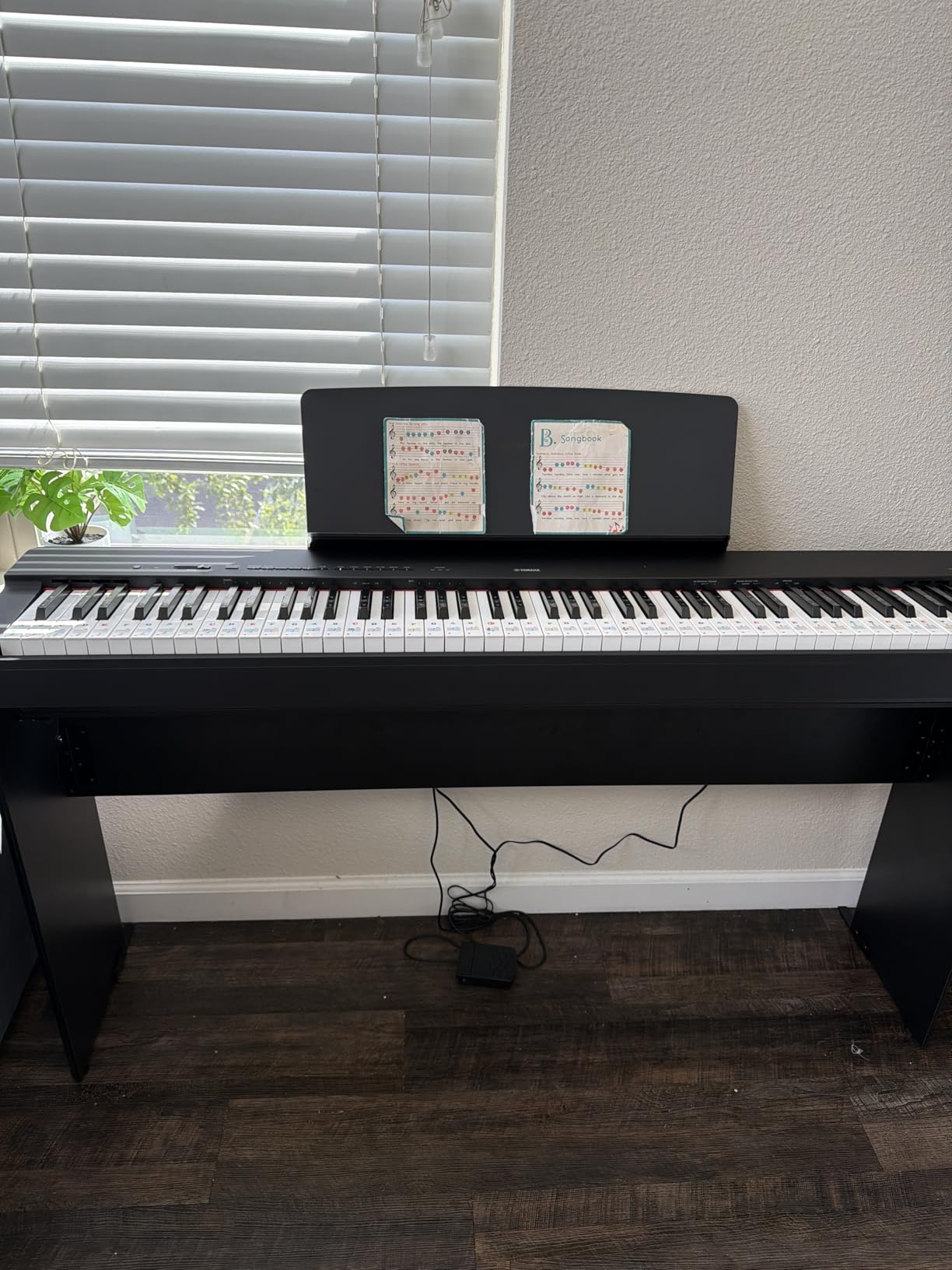
The P225 is the best-sounding home keyboard in this roundup, and it is also one of the easiest to live with. At 25.4 lb it moves between rooms without help, and 24 voices keep the sound engine focused on acoustic pianos rather than chasing pop styles. This is an instrument for playing music, not for producing party accompaniments.
Weighted GHS action is graded heavier in the low keys, which is the right design for building technique, and dual headphone jacks let two people practise at once. The music rest, sustain foot switch and power adapter are all in the box, so the all-in cost stays close to the purchase number.
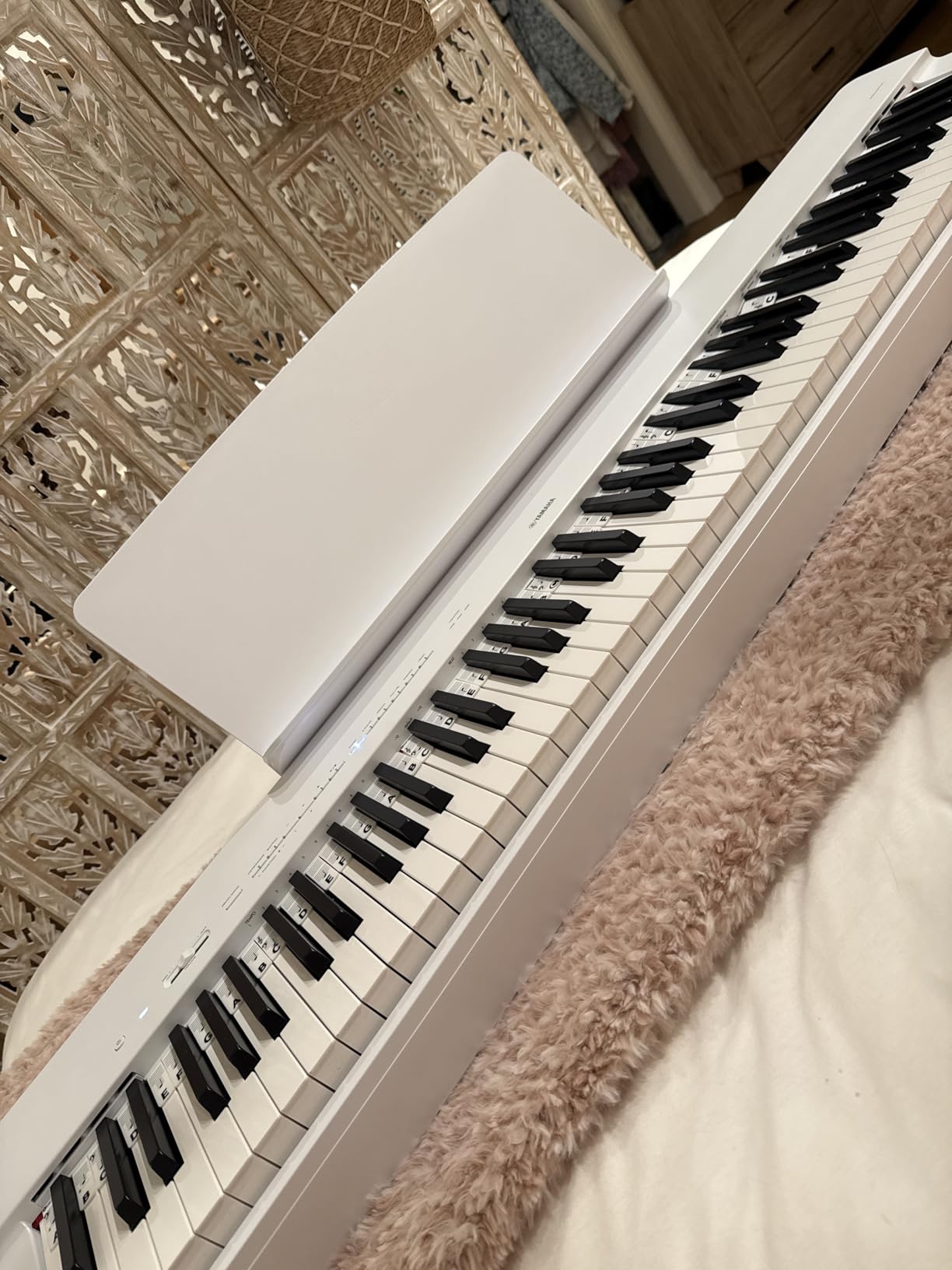
The dimensions are listed at 55.5 x 14.2 x 8.4 inches, so it is a slim slab with a low profile rather than a cabinet, and it slots into a bedroom corner without a walkway problem. The CFX voice is the sampling advantage that separates this from cheaper Yamaha slabs.
Onboard speakers are modest, which is the correct trade for a practice instrument with a headphone jack on each side. Smart Pianist and Rec n Share apps work over USB, and the warranty is one year through Yamaha Corporation of America. If you also want accompaniment, the DGX-670 is the version with 263 styles.
Is the P225 quiet enough for a bedroom in a shared flat?
With headphones, completely. The instrument makes no sound into the room at all, and at 25.4 lb you can carry it to whichever wall is solidest. Without headphones the speakers are fine for daytime checks but not for a 10pm practice session.
Is 25 voices enough or do I need an arranger?
Twenty-four voices including pianos, organs, strings and bass is plenty for classical, folk and pop repertoire. If your goal is playing along with automatic backing, buy the DGX-670 instead and accept the size. Practice-focused players will not miss the styles.
11. Casio PX-S1000 – The Slimmest 88-Key Body in the Roundup
Casio, 88-Key Digital Pianos – Home (PX-S1000WE)
9.13 inch deep body
24.7 lb
Smart Scaled Hammer Action
192 note polyphony
Pros
- Slimmest depth here at just over 9 inches
- 24.7 lb is an easy solo carry
- Smart Scaled Hammer Action with grand-like movement
- 192 note polyphony and 18 onboard sounds
- Built-in USB MIDI so no interface is needed
Cons
- Internal speakers fire away from the player and can sound muffled
- Primary piano voice described as boxy in the middle octaves
- No display screen so changes are less intuitive
- Bluetooth covers MIDI pairing rather than audio streaming
The PX-S1000 solves the tightest version of the apartment problem. At 52.05 x 9.13 x 4.02 inches it is the slimmest 88-key body here, close enough to 9 inches deep that it fits beside a computer monitor or along a wall without stealing floor space. At 24.7 lb it is also one of the easiest to carry up a flight of stairs.
Smart Scaled Hammer Action gives convincing grand-like movement, and 192-note polyphony is the highest here, which matters for dense classical passages where voices overlap. 18 onboard sounds with effects cover a normal practice and lesson repertoire, and USB MIDI is built in so no external interface is needed for DAW work.
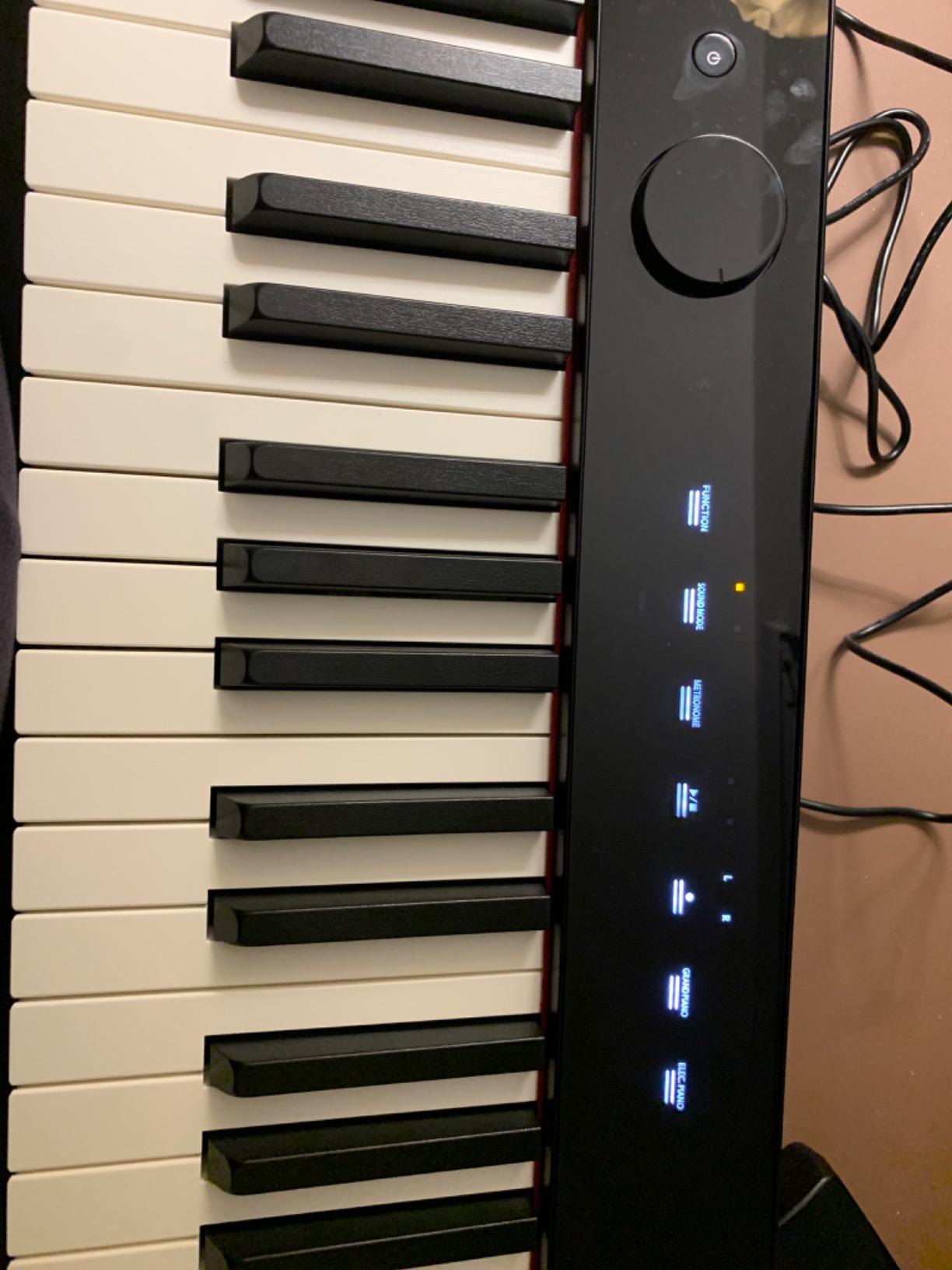
The cost of that slimness is the sound system. The internal speakers fire away from the player and reviewers describe them as muffled, and the primary piano voice is often characterised as boxy in the middle octaves. The ambient hall setting and 192 notes sound excellent through headphones, which is how most owners use it.
There is no display screen, so metronome and tone changes are less intuitive than on boards with an LCD. Bluetooth is limited to MIDI pairing rather than audio streaming. The damper pedal and music rest are included, and the warranty is one year parts and labour with two additional years on product registration, which makes it effectively three years if you complete the form.
Is 9 inches of depth too shallow to play comfortably?
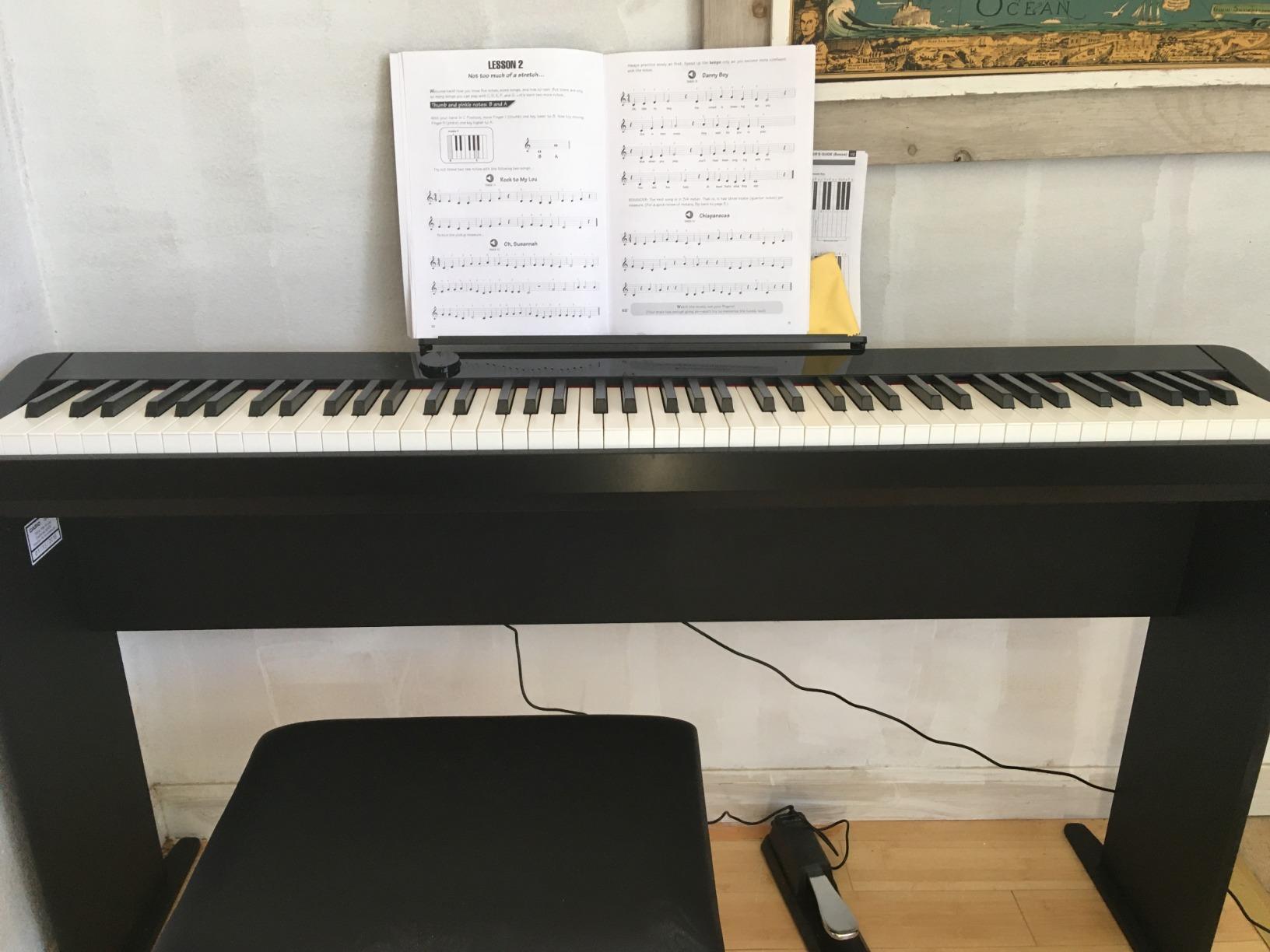
No. The keybed is a fixed full-size 88, and only the cabinet behind your knees is trimmed. What you lose is rear-panel room for connectors and a larger speaker cavity, which is exactly the trade this model makes. Sit with the keyboard edge where your thighs end and it feels normal.
Are the onboard speakers usable in a small room?
For checking a passage, yes. For tone, no. Because the speakers fire away from you, they suit a shared-wall flat unusually well, but most owners end up playing with headphones and treating the speakers as a monitoring shortcut.
12. Casio PX-S1100 – Battery Powered With a Bluetooth Adapter in the Box
Casio Privia PX-S1100 – 88-Key Touch-Responsive Weighted Digital Piano | Ultra-Portable | Superior Sound | German Grand Tone, Bluetooth, Casio Music Space App | Mellow Beige
Under 25 lb
12.01 in deep x 57.48 in wide
Battery operation and Bluetooth adapter
German grand tone
Pros
- German grand tone with richer string and damper resonance
- Slim cabinet 43 percent smaller than earlier Privia models
- Runs on batteries for genuinely portable playing
- WU-BT10 adapter adds Bluetooth MIDI and audio
- Casio Music Space app with recorder and Duet Mode
Cons
- Touch interface is not intuitive and does not store settings
- A few units reported faulty keys or speaker crackling
- Onboard recorder cannot be routed to a computer alone
The PX-S1100 is the only pick here that is genuinely cable-free. It runs on batteries, so you can play wherever there is no socket, and the included WU-BT10 adapter adds Bluetooth MIDI and audio without needing power at the piano. In a studio flat where sockets are the wrong shape or in the wrong place, that is a real advantage over everything else on this list.
The German grand voice is richer in string and damper resonance than the PX-S1000, with 17 additional tones on top, so the sound is the strongest argument for choosing this over the slimmer Casio. The cabinet is 43 percent smaller than earlier Privia models, which is where the slim footprint comes from.
At 12.01 inches deep, 57.48 inches wide and 8.15 inches tall it is not the slimmest body here, and it is the widest, so check the width of your wall. The weight is listed at under 25 lb, which keeps it a solo carry. The trade against the PX-S1000 is depth and width for tone quality and battery flexibility.
The illuminated touch controls are the most repeated complaint. They are not intuitive, they do not store patches or settings, and a few units reported faulty keys, a damaged USB port or speaker crackling within months. The onboard recorder cannot be routed to a computer without extra equipment. The warranty is one year manufacturer, and Casio Music Space handles the app side.
Is battery power actually worth choosing this model for?
Yes, if you play away from a wall or want to move the piano to another room without trailing a lead. If your piano will live in one spot with a socket within reach, spend that consideration on the sound instead and compare the two Casios on tone alone.
Is the touch interface hard to live with?
It takes a week, then it becomes invisible, but there is no display screen to fall back on. Anyone who likes seeing what they have selected will find the older slab models with an LCD easier to manage, and the non-intuitive behaviour is the most common reason buyers move to Roland or Yamaha instead.
How to Choose a Digital Piano for a Small Apartment
Footprint, weight and noise decide the shortlist in an apartment, and sound quality decides the winner. Work through these in order and the model almost chooses itself. The order matters: buying on action first, as most guides recommend, tends to put a 70 lb cabinet in a room that cannot hold it.
Measure your space Before you buy
Product depth is not the number that matters. What matters is the playing zone: about 5 feet wide and 3 feet deep including the bench and pedal clearance. Measure the width of the keyboard, add at least 18 inches behind it for a bench and your knees, and add 6 inches for the pedal and your feet.
Then check the route, not just the destination. Measure the narrowest point between the front door, the stairwell and the room. A 54 inch wide cabinet needs a door opening wider than that on the diagonal, and a console style piano almost never fits through a narrow apartment door without turning it on its side.
Weighted versus semi-weighted keys
Semi-weighted keys build finger strength and stop you from playing with no dynamics, which is what a first-year adult needs. They are quieter under the hand, lighter to carry, and cheaper. Graded hammer action costs more, is noisier, and teaches you the resistance control that classical and exam work requires.
The honest upgrade timeline is 12 to 18 months. Most players are limited by the semi-weighted feel before they are limited by anything else, and switching later costs both money and momentum. If you already play, buy weighted now. If you are starting from zero in a noisy building, semi-weighted is the more sensible first instrument.
Sound engine and polyphony without the jargon
A sound engine is a set of recordings of real pianos, stored in the instrument and triggered by your playing. Better engines layer several recordings per note and add string, damper and key-off resonance, which is why the Yamaha CFX voices sound more convincing through headphones. Sampler quality matters more than the number of voices listed.
Polyphony is how many notes can sound at once. 64 is a bare minimum, 128 is comfortable for most repertoire, and 192 is what you want for dense classical. Anything below 64 will drop notes when both hands play thick chords, and you will mistake that for your own technique. Voices, rhythms and song lists are marketing numbers; polyphony is a real limit.
Connectivity for lessons and recording
USB MIDI is the one to prioritise, because it is the connection that works with every DAW and learning app without a driver. Bluetooth MIDI is convenient but adds latency, and Bluetooth audio is for streaming backing tracks rather than for recording. Line outputs are worth having if you own speakers; a headphone jack is worth having always.
Two headphone jacks change how a room is used rather than what you can play, which in a small flat is a bigger deal. The Yamaha P225 and Casio PX-770 both have them, and so do the Alesis Recital and the Donner DDP-90 Pro.
Stand, bench, pedals and the all-in cost
A slab keyboard needs a stand, and an X-stand is cheaper and takes less room than a U-stand, but it is less stable under a weighted action. Budget for a bench, and check whether a sustain pedal ships in the box: the Yamaha P71, P225 and DGX-670 include a foot switch, the Casio PX-S1000 ships a damper pedal, and the Roland FP-10 includes a DP-2 that reviewers find too light. The Alesis Recital ships no pedal, so budget for one.
Add headphones. Every pick in this roundup is more convincing through headphones than through its own speakers, and a pair of closed-back headphones plus a small stand usually adds less to your total than a surprise pedal or bench does. If the piano is a console type like the PX-770 or the DGX-670, skip the stand entirely but expect the furniture to be the larger cost.
Frequently Asked Questions
What is the best digital piano for an apartment?
The Alesis Recital is the best digital piano for an apartment in our testing, because at 15.7 lb it is one of the lightest full-size 88-key instruments, its 11.5 inch depth leaves a walkway, and it runs on six D-cell batteries so you can practise with headphones away from a wall. The Yamaha P71 is the better choice if you specifically want a weighted hammer action, and the Roland FP-10 wins for the quietest action under the hand.
How do I stop my digital piano being noisy for neighbors?
Four things work. Practise with headphones, since a digital piano makes almost no sound into the room that way and dual headphone jacks let two people play at once. Choose a semi-weighted action such as the Alesis Recital if the hammer noise of a graded action bothers you. Push the instrument into a corner with a rug behind it so less sound reaches a shared wall. And restrict loud sessions to weekends, keeping a headphone routine for weekday evenings, because most neighbours object to a piano rather than to a person learning one.
How much space does a digital piano need in a small room?
Plan for a playing zone of about 5 feet wide and 3 feet deep, which covers the keyboard, a bench, knee clearance and pedal space. Product depth is not the number that matters. Slim models such as the Casio PX-S1000 are just over 9 inches deep and the Roland FP-10 is 11.1 inches, while console cabinets run 12 to 17 inches. Then measure the narrowest point between your front door, the stairwell and the room, because a 54 inch wide cabinet needs a doorway wider than that on the diagonal.
Are weighted keys necessary in a digital piano for adults?
For a first year, no. Semi-weighted keys build finger strength and teach dynamics, cost less and are quieter, which matters in an apartment. For most adult beginners the honest upgrade point is 12 to 18 months, when the feel becomes the limit before anything else does. If you already play, or you are heading into classical repertoire and graded exams, buy weighted or graded hammer action now, such as the Yamaha P71 or the Casio PX-770.
What is the best digital piano on a budget?
Under 400, the Donner DEP-20 gives you a weighted 88-key action, a 9.25 inch depth and a backlit display for the least money. In the 400 to 600 range the Yamaha P71 and Roland FP-10 are the strongest weighted options, and the Alesis Recital wins on weight and battery flexibility. Between 600 and 800 the Yamaha P225 and Casio PX-S1100 give you the better sound engines. From 800 to 1000, the Casio PX-770 and Yamaha DGX-670 are furniture-grade or arranger-grade instruments that need more floor space.
The Verdict for Apartment Living in 2026
For most flats, the Alesis Recital is the right answer. It is the easiest of the twelve to carry, quiet under the hand, and it runs away from a wall on batteries. Buy a pair of closed-back headphones, a small sustain pedal and an X-stand, and you are still inside a 1000 dollar budget with a full 88-key instrument in a corner that a person can walk past.
Choose the Yamaha P71 instead if a weighted hammer action is non-negotiable, the Casio PX-S1000 if every centimetre of depth matters, and the Casio PX-1100 if you want to play with no cable at all. Move up to the Casio PX-770 or the Yamaha DGX-670 only when the room can hold 70 lb of furniture and you have stopped moving.
Whichever one you pick, measure the playing zone and the doorway before you order, keep the packaging, and register the warranty. Those three habits decide more about how long the piano stays in your flat than the model name does. If you are still comparing, our independent testing write-up on the best digital pianos for small apartments goes further on long-term ownership.