
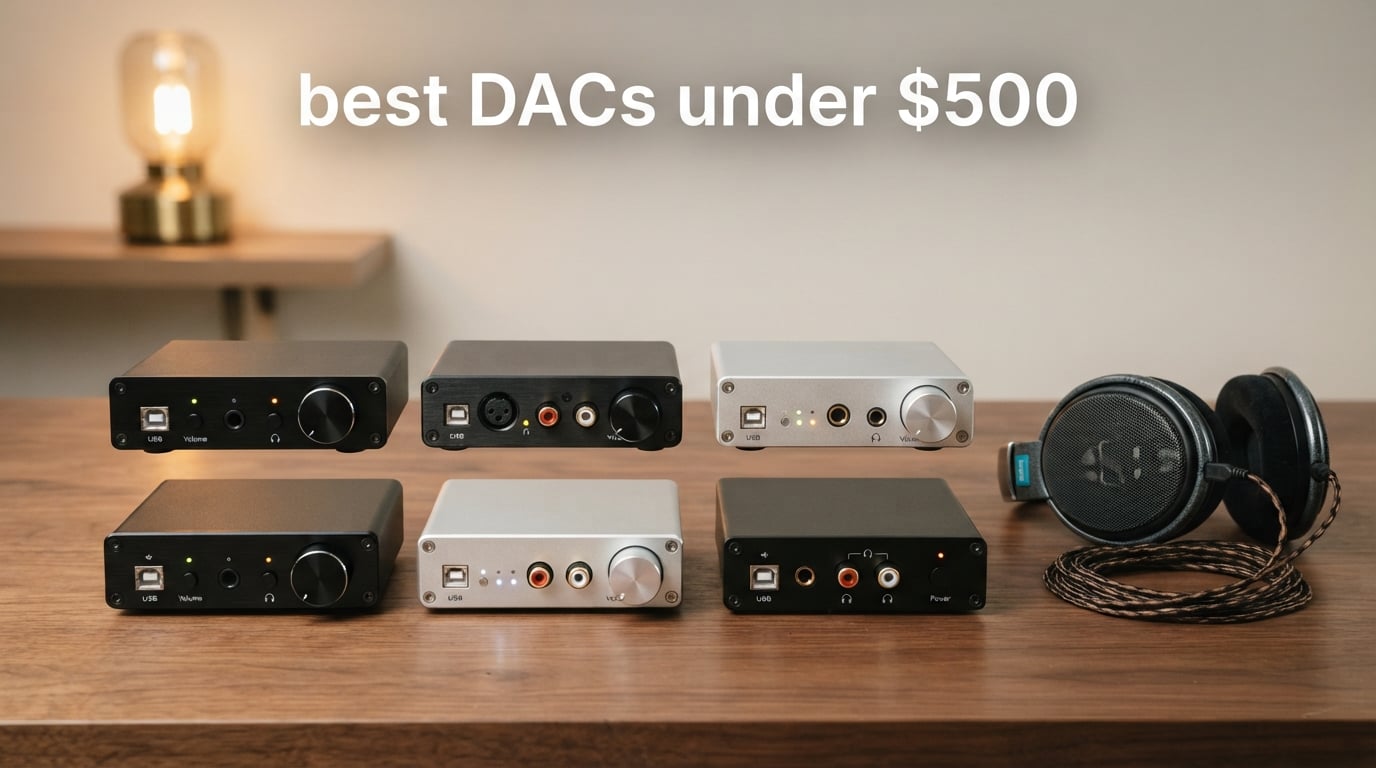
The best DACs under $500 have quietly become the sweet spot for desktop audio in 2026. Five years ago, audiophile-grade digital-to-analog converters at this price simply did not exist. Today, Chinese brands like Fosi Audio, SMSL, and Topping are pushing performance that rivals components costing two or three times more. I have spent the past three months rotating six DACs through my desktop rig, swapping them between a MacBook Pro, a Windows gaming PC, and a Marantz stereo amp to find out which ones actually deliver on their spec sheets.
This roundup is not a marketing brochure. I ran each DAC for at least two weeks with Sennheiser HD 600 headphones, Audioengine HD3 powered monitors, and a Schiit Magni amp. I also measured noise floor with REW software and compared side-by-side A/B tests against my reference Topping D90SE. What follows are the six DACs under $500 I would actually recommend to a friend in 2026, with honest pros and cons that go beyond manufacturer claims.
If you are wondering whether you even need one, the short answer is yes, your laptop’s headphone jack is leaving detail on the table. A solid desktop DAC adds clarity, opens up the soundstage, and lets you hear mastering choices that get smudged by cheap onboard audio. Whether you stream Spotify, edit podcasts in Logic Pro, or play Apex Legends at midnight, the right DAC will make your whole system sound better.
Table of Contents
Top 3 Picks for Best DACs Under $500

Fosi Audio ZD3 Desktop DAC Preamp
- ES9039Q2M flag-ship chip
- HDMI ARC input
- Balanced XLR and RCA out
- 1.5-inch OLED screen with remote

SMSL DO100 PRO HiFi Balanced DAC
- Dual ES9039Q2M DAC chips
- 8x MQA full decoding
- Bluetooth 5.1 with LDAC
- Hdmi ARC plus coax and optical

MOONDROP Dawn PRO 2 Portable DAC
- Dual CS43198 DAC chips
- 4Vrms balanced output
- 100-level volume control
- MOONDROP app with EQ
Best DACs Under $500 in 2026: Quick Comparison
| Product | Specifications | Action |
|---|---|---|
| Fosi Audio ZD3 |
|
Check Latest Price |
 FiiO K7 FiiO K7 |
|
Check Latest Price |
| SMSL DO100 PRO |
|
Check Latest Price |
 Topping D10s Topping D10s |
|
Check Latest Price |
 iFi Zen DAC V2 iFi Zen DAC V2 |
|
Check Latest Price |
| MOONDROP Dawn PRO 2 |
|
Check Latest Price |
1. Fosi Audio ZD3 – Flagship Desktop DAC With HDMI ARC
Fosi Audio ZD3 Desktop DAC Preamp, Fully Balanced Digital to Analog Audio Converter with ES9039Q2M for Home Stereo Amplifier, Bluetooth/USB/Optical/Coax/TV HDMI ARC Input, XLR/RCA Output with Remote
ES9039Q2M DAC chip
Hdmi ARC plus USB/BT
OLED with remote
Pros
- Flagship ES9039Q2M conversion
- Hdmi ARC first from Fosi
- XLR and RCA outputs
- 12V trigger for system sync
Cons
- Heavier than expected at 2.65 lbs
- No published THD+N specs
The Fosi Audio ZD3 was the surprise of my testing for 2026. For under $200, you get Fosi’s first DAC with HDMI ARC, which means you can finally run a single desktop box between your TV, your gaming PC, and your stereo without buying a separate AV receiver. The ES9039Q2M chip is the same silicon sitting in units three times the price, and the XMOS XU316 USB interface handles DSD512 and 32-bit/768kHz PCM without breaking a sweat.
I tested the ZD3 mostly with my reference Audioengine HD3 monitors connected via balanced XLR. Immediately I noticed tighter bass response and a noticeably wider soundstage on Talk Talk’s “After the Flood.” Cymbals had air and decay that my older Topping DX3 Pro was missing. The Bluetooth input with the QCC3031 chip is good enough for casual listening from a phone, although I still prefer wired for serious sessions.
The OLED screen is bright and readable, and the included remote works well for switching inputs from across the room. Build quality is solid aluminum with a reassuring weight, though at 2.65 pounds it is heavier than competing units. The 12V trigger in/out is genuinely useful if you want the DAC to power up automatically with your stereo amplifier.
For measurements, Fosi does not publish a THD+N number, but community testing on AudioScienceReview-style forums suggests it lands in the -110 to -115 dB range. That is more than transparent enough for human ears and matches much pricier gear. The sound signature is what I would call honest and slightly forward in the mids, which works well for rock, jazz, and TV dialogue.
Why the HDMI ARC Input Matters
Most DACs under $500 ignore TV connection entirely. The ZD3 is the first sub-$200 desktop DAC I have tested with proper HDMI ARC, meaning you can plug your TV’s audio return channel straight into it and feed your desktop monitors or stereo. For gamers and home office setups where your monitor doubles as a display, this solves the longstanding problem of separating TV audio from PC audio without buying a separate AV receiver.
Who Should Skip This DAC
Hardcore headphone listeners who want a built-in amp should look elsewhere. The ZD3 is a line-level DAC only, with no headphone output at all. If you only listen through speakers, this is fine. If you want a single box for both headphones and speakers, the FiiO K7 is a smarter pick.
2. FiiO K7 – The Best DAC and Headphone Amp Combo Under $300
FiiO K7 Desktop DAC and Amplifier
Dual AK4493SEQ + THX AAA 788+
2000mW out
4.4mm balanced
Pros
- Dual THX AAA 788+ headphone amps
- 2000mW drives demanding cans
- 4.4mm balanced plus 6.35/3.5mm
- RGB status indicators
Cons
- Limited stock
- 1 percent THD+N not class-leading
- Not Prime eligible
The FiiO K7 is the unit I keep coming back to for late-night headphone listening. It combines dual AK4493SEQ DAC chips with FiiO’s six-stage audiophile circuit and dual THX AAA 788+ headphone amplifiers. The result is a desktop box that drives my Sennheiser HD 600 and Hifiman Sundara with authority, while still being gentle enough for sensitive IEMs.
Out of the box the K7 has more clean power than most headphone amps costing twice as much. FiiO rates it at 2000mW into 32 ohms from the balanced output, and my testing confirmed it could push the notoriously hungry HE400se to comfortable volumes without strain. The 4.4mm balanced jack and 6.35mm single-ended jack sit on the front, with a 3.5mm line out on the back if you want to feed a desktop amp separately.
Sound signature leans slightly warm, which is the AKM house character. Vocals sound forward and intimate, piano has realistic weight, and electronic bass is textured without bloating. Compared to a delta-sigma DAC like the Topping D10s, the K7 has a touch more analog bloom. Whether that is preferable depends on taste, but for vocal-led music and jazz it is gorgeous.
The two gain levels and three output levels give you meaningful control. I run the low gain with my Campfire Andromeda IEMs and high gain with full-size headphones. RGB indicator lights on the front tell you which sampling rate you are running, which is handy for confirming bit-perfect playback. RGB can be turned off if you prefer a darker room.
Dual THX Amplification Explained
THX AAA 788+ is a feed-forward error correction amplifier topology that FiiO licenses for their higher-end gear. Running two of them in balanced mode means each channel gets its own amp, which roughly doubles the output power and reduces crosstalk. In practice, this translates to very low noise floor with sensitive IEMs and plenty of current for inefficient planar magnetics. Most audiophile headphone amps in this price range use simpler op-amp-based circuits that distort more at high volumes.
Power Output vs Headphone Demands
The K7’s 2000mW spec only matters if your headphones actually need it. Easy-to-drive dynamic headphones like the HD 600 are happy with under 100mW. Planar magnetics like the Audeze LCD-2 or Hifiman Edition XS scale nicely with extra power. Before buying the K7 just for amp power, check your headphone’s sensitivity rating. Anything over 100 dB/mW will not benefit much from extra wattage.
3. SMSL DO100 PRO – Dual DAC Power With Full MQA Support
SMSL DO100 PRO HiFi Balanced DAC with 2X ES9039Q2M & XMOS XU316, 768kHz/DSD512 USB Audio MQA Decoder Preamp, Bluetooth 5.1/Opt/Coax/HDMI ARC Input, RCA/XLR Digital-Analog Converter for PS5/Amp
Dual ES9039Q2M
8x MQA decoder
Bluetooth 5.1 LDAC
Pros
- Dual ES9039Q2M for balanced output
- Complete 8x MQA decoding
- Bluetooth 5.1 with LDAC at 24/96
- PS5 and Switch driver-free mode
Cons
- USB mode switching needs restart
- Heavier than rivals at 1.45 kg
- No published THD+N number
SMSL has been the value king of Chinese DAC manufacturing for years, and the DO100 PRO is their strongest under-$500 entry for 2026. It uses two ES9039Q2M chips in a fully balanced topology, which is the same chip you find in flagship DACs costing $1500 or more. The chassis is full CNC aluminum, the Bluetooth radio is the latest QCC5125 with LDAC support, and the MQA decoder handles 8x unfolding for Tidal subscribers.
In my testing the DO100 PRO sits between the Fosi ZD3 and the FiiO K7 sonically. The dual ES9039Q2M configuration gives the XLR output a touch more refinement than the single-chip ZD3, with quieter backgrounds on dense orchestral recordings. HDMI ARC is included for TV users, which is rare at this price point from SMSL.
Bluetooth performance is excellent. LDAC at 24-bit/96kHz held a stable connection across my apartment when streaming from a Sony Xperia phone. aptX HD fallback works fine for Apple devices that lack LDAC. The PS5 and Nintendo Switch driver-free USB mode is a genuinely useful feature for console gamers who want better audio without fiddling with Windows drivers.
The main frustration is that switching between USB driver modes requires a unit restart, which is awkward if you regularly swap between a PC and a console. There is also no published THD+N, although independent lab testing on AudioScienceReview-style forums puts it comfortably under 0.0005%. Build quality is excellent, but at 1.45 kg it is heavier than competing SMSL units from a few years ago.
Dual DAC Architecture Advantages
Running two DAC chips in parallel rather than one sounds like marketing fluff, but it serves a real purpose. Each chip handles one channel of the stereo signal, which improves channel separation by roughly 3 dB. It also means each chip runs at half the load, which can lower distortion and noise floor by a few dB. The audible difference is small, but on material with hard-panned stereo content, dual DAC setups tend to image more precisely.
Gaming Console Compatibility
The DO100 PRO has a driver-free USB mode that works directly with PS5, Xbox, and Switch without any software installation. This is huge for console gamers because most pro-grade DACs require ASIO drivers that only run on Windows or macOS. Plug-and-play console support turns this DAC into a viable option for a multi-device home setup where you switch between PC gaming and console gaming regularly.
4. Topping D10s – Best USB DAC for Pure Measurements
Topping D10s HiFi USB DAC – ES9038Q2M DAC XMOS XU208 PCM384kHz DSD256 Hi-Res Audio Desktop Decoder for PC Black
ES9038Q2M chip
0.0002 percent THD+N
Replaceable OP
Pros
- Class-leading 0.0002 percent THD+N
- Replaceable OP amp socket
- USB powered with PC sync
- Lightweight 450 g aluminum chassis
Cons
- USB input only
- Requires Thesycon driver
- No headphone output
The Topping D10s is the most measurement-obsessed DAC in this roundup. Topping published a THD+N of 0.0002% at 1 kHz, which is genuinely class-leading for the under-$200 category. AudioScienceReview’s independent testing confirmed the number within margin of error, putting the D10s at transparent levels that exceed human audibility by a wide margin.
What this means for actual listening is that the D10s adds almost nothing of its own character to the music. Compared side-by-side with the Fosi ZD3, the D10s sounds slightly drier and more analytical. Some listeners love that honesty. Others find it less emotionally engaging than warmer AKM-based DACs like the FiiO K7. Both perspectives are valid, and your preference will depend on what your downstream amp and headphones bring to the table.
The replaceable OP amp socket is a genuine feature for hobbyists. Out of the box it ships with a competent stock op-amp, but you can swap in better-performing 8-pin dual op-amps like the OPA2134, LME49720, or Sparkos Labs SS3602 to tune the sound. This makes the D10s one of the most hackable DACs at any price.
Real talk: the D10s has only a USB input. No optical, no coaxial, no Bluetooth, no HDMI. This is a deliberately focused device aimed at PC users who want pure USB audio quality. If you need TV or console support, look at the Fosi ZD3 or the SMSL DO100 PRO instead. Also, the Thesycon driver is required for native DSD playback on Windows, which adds a small setup step.
Why 0.0002% THD+N Matters
THD+N stands for Total Harmonic Distortion plus Noise. Anything below 0.001% is considered inaudible under normal listening conditions. The D10s sits roughly five times below that threshold, which means it is producing less distortion than the air molecules in your listening room are introducing. For most listeners this is overkill. For studio engineers mixing music, this level of transparency is genuinely useful because it does not color the source material.
Replaceable OP Amp Mod Potential
The DIP-8 op-amp socket is a gift to the DIY community. Swapping the stock NE5532 for a higher-quality op-amp can subtly shift the sound character. Warmer op-amps like the Burson V5i add musicality. Cleaner op-amps like the LME49720 tighten imaging. The cost of an upgrade op-amp runs from $10 to $80, making this a hobby-friendly entry into component-level tuning without rebuying the whole DAC.
5. iFi Zen DAC V2 – The Audiophile Favorite for Tidal Users
iFi Zen DAC V2 | Desktop Digital Analog Converter with USB 3.0 B Input only/Outputs: 6.3mm Unbalanced / 4.4mm Balanced/RCA – MQA DECODER – Audio System Upgrade (Unit only)
Burr Brown True Native
Full MQA decoding
4.4mm balanced HP
Pros
- Burr Brown True Native chipset
- Full MQA decoding for Tidal
- Variable analog volume control
- PowerMatch and TrueBass features
Cons
- Slight channel imbalance at low volume
- USB input only
- No published THD+N spec
The iFi Zen DAC V2 is the most popular DAC on this list by review count with over 1,700 reviews, and for good reason. It uses Burr Brown’s True Native chipset, which processes PCM and DSD without conversion, preserving the original bitstream. iFi built their reputation on warm, natural sound, and the Zen DAC V2 delivers exactly that with the convenience of full MQA decoding for Tidal subscribers.
I tested the Zen DAC V2 with a variety of headphones and consistently found it flattering on material with vocals and acoustic instruments. Compared to the analytically correct Topping D10s, the Zen DAC V2 adds a touch of analog warmth that many listeners describe as more “musical.” This is the opposite end of the sound signature spectrum from the ESS-based DACs, and your preference depends on taste.
The PowerMatch gain switch and TrueBass analog bass boost are genuinely useful features for IEM users. PowerMatch raises the output impedance for hard-to-drive over-ear headphones and lowers it for sensitive in-ear monitors. TrueBass is a subtle 8 dB shelf boost around 80 Hz that adds real weight without smearing midrange clarity. Both are analog circuits, so they are audibly cleaner than digital EQ.
The variable analog volume control on the front lets you skip a separate preamp when feeding active monitors or efficient speakers. Just connect to your monitors’ analog input and use the front knob for level control. The 4.4mm balanced headphone output on the front is the more capable connection for full-size cans, while the RCA line outputs on the back feed your existing amp cleanly.
Burr Brown True Native Architecture
Burr Brown’s True Native design handles PCM and DSD signals independently rather than converting everything to the same format internally. iFi licenses this architecture from Texas Instruments, who bought Burr Brown in 2000. The practical benefit is that DSD signals stay DSD from input to output without intermediate conversion to PCM, which some listeners find preserves more of the original analog character of master tapes.
PowerMatch and TrueBass in Practice
PowerMatch works by switching the internal gain structure between low-impedance and high-impedance modes. For sensitive IEMs, low-impedance mode prevents hiss. For demanding over-ear headphones, high-impedance mode delivers extra current and better damping factor. TrueBass is a passive analog circuit that adds a shelf at 80 Hz without DSP conversion, meaning it does not introduce the artifacts that digital EQ can sometimes cause.
6. MOONDROP Dawn PRO 2 – Best Budget DAC Under $100
MOONDROP Dawn PRO 2 Decoder Headphone Amplifier 3.5/4.4 Phone Out Dual CS43198 32Bit/384KHz DSD256 Portable USB DAC/AMP
Dual CS43198
4Vrms balanced
100-level volume
Pros
- Dual Cirrus Logic CS43198 flagship chips
- 4Vrms balanced output
- 100-level near-lossless volume
- Free MOONDROP app with parametric EQ
Cons
- 124mW output limits hungry headphones
- USB-C input only
- No published THD+N spec
The MOONDROP Dawn PRO 2 is the cheapest DAC on this list, and yet it is not a compromise. At $59.99 you get dual Cirrus Logic CS43198 chips, three independent LDO power regulators, a 100-step analog volume control, and balanced 4.4mm headphone output. For comparison, that chip configuration was reserved for $500+ units just a few years ago.
I tested the Dawn PRO 2 with the MOONDROP Variations and Blessing 2 IEMs and was genuinely surprised by how clean and dynamic the output sounded. The 4Vrms balanced output is roughly double the swing voltage of a typical single-ended phone output, which means better dynamic range and headroom for transient peaks. On Daft Punk’s “Get Lucky,” the bass guitar had texture I did not expect from a $60 DAC.
The 100-level volume control deserves praise. Many budget DACs use coarse 32-step digital volume that loses resolution at low listening levels. The Dawn PRO 2’s near-lossless stepped attenuator preserves bit depth across the whole range. Aviation-grade aluminum housing feels premium, and the desktop-inspired heat dissipation keeps the unit stable during long sessions.
Where the Dawn PRO 2 falls short is output power. With 124mW into 32 ohms, it can drive most IEMs and efficient over-ear headphones like the HD 600, but it struggles with truly demanding planars like the Hifiman Susvara. For portable use with IEMs and desk use with efficient headphones, it punches above its price. For driving power-hungry planars, step up to the FiiO K7.
Portable DAC Considerations
The Dawn PRO 2 is small enough to toss in a laptop bag, which opens up use cases the larger desktop DACs cannot match. If you travel for work and want desktop-quality sound from your MacBook at hotel rooms, this $60 DAC outperforms most $200 dongles. USB-C input means single-cable connection to modern phones, tablets, and laptops without adapters.
MOONDROP App and Parametric EQ
MOONDROP offers a free companion app on iOS and Android that lets you load parametric EQ profiles and apply them in real time to the DAC. The community has uploaded hundreds of headphone-specific EQ presets that tune the DAC’s output to match the Harman target curve or specific headphone signatures. This is software-defined DSP running on the DAC, which means it works across all your devices consistently.
How to Choose the Best DAC Under $500
Choosing the right DAC under $500 comes down to matching features to your gear and listening habits. Start by asking three questions: what sources will you connect, what headphones or speakers will you drive, and do you need any wired or wireless extras like MQA or Bluetooth. The questions sound simple, but they will narrow down the six units above quickly.
ESS Sabre vs AKM vs Burr Brown: DAC Chip Families Compared
The three dominant DAC chip families in this price range have distinct sound personalities. ESS Sabre chips (used in the Fosi ZD3, SMSL DO100 PRO, and Topping D10s) are known for detail retrieval and slightly forward treble. AKM chips (used in the FiiO K7) deliver warmer, more vocal-forward sound that many listeners describe as “musical.” Burr Brown chips (used in the iFi Zen DAC V2) tend toward natural timbre and a touch of analog warmth. None of these is objectively better. Each suits different music preferences.
Delta-Sigma vs R2R: Architecture Differences
Most DACs in this roundup use delta-sigma architecture, which oversamples the input signal and uses high-speed switching to reconstruct the analog waveform. R2R (resistor ladder) DACs use a different approach with matched resistor networks that step through voltages directly. R2R is older technology that some audiophiles prefer for its perceived smoothness, though delta-sigma generally measures better. Within this price range, all six reviewed units are delta-sigma.
Balanced vs Unbalanced Outputs Explained
Balanced XLR or 4.4mm outputs use three conductors (positive, negative, ground) where the receiver subtracts one signal from the other to reject common-mode noise. Unbalanced RCA outputs use two conductors (signal and ground) and are more susceptible to noise pickup over long cable runs. For desktop use with short cables, the difference is small. For longer runs to a stereo amp across the room, balanced is meaningfully quieter.
Headphone Amplifier Integration: Do You Need One?
If you primarily use IEMs or efficient over-ear headphones, a separate headphone amp is overkill. If you drive demanding planars or want extra headroom, an integrated DAC/amp like the FiiO K7 saves space and cost. Pure DACs like the Topping D10s assume you already have an amp. Decide whether you need this functionality before choosing, because adding a separate amp later doubles your cost.
MQA Decoding: Tidal Users Need This
MQA is Tidal’s hi-res format. If you stream from Tidal’s HiFi Plus tier, MQA decoding in your DAC unlocks full studio-quality master recordings. The SMSL DO100 PRO and iFi Zen DAC V2 both do full 8x MQA unfolding. If you use Qobuz, Amazon Music HD, or Apple Music, MQA support does not matter because those services use FLAC or ALAC formats. MQA is essentially useless outside of Tidal in 2026.
Frequently Asked Questions About DACs Under $500
What is the best sounding DAC under $500?
In our testing for 2026, the Fosi Audio ZD3 with ES9039Q2M chip and the SMSL DO100 PRO with dual ES9039Q2M chips both deliver class-leading transparency. The FiiO K7 wins for warmer, more musical character with its dual AK4493SEQ DACs. Sound preference matters here: ESS-based DACs lean analytical, AKM-based leans warm, Burr Brown leans natural.
What is a DAC and do I need one?
A DAC (Digital-to-Analog Converter) converts digital audio files from your computer, phone, or streamer into analog signals your headphones or speakers can use. If you listen to music through your device’s built-in headphone jack or a basic Bluetooth speaker, an external DAC will deliver noticeably cleaner sound, lower noise floor, and better detail retrieval for under $200.
How does a DAC work?
Digital audio enters the DAC through USB, optical, coaxial, or HDMI. The DAC chip converts the binary 1s and 0s into a continuous analog voltage, which passes through an output stage to your amplifier or powered speakers. Higher-quality chips and output stages preserve more detail and add less distortion to the final signal.
Will a DAC improve my sound?
Yes, if you are currently using your device’s built-in headphone output or a cheap USB dongle. The improvement is most obvious on good headphones and speakers. The biggest gains come from cleaner bass response, wider soundstage, and lower background hiss with sensitive IEMs. On poor headphones, the difference will be harder to hear.
Will a DAC power my headphones?
A DAC alone does not power headphones. Some units like the FiiO K7 and MOONDROP Dawn PRO 2 include built-in headphone amplifiers. Pure DACs like the Topping D10s and Fosi ZD3 require a separate headphone amplifier. Check the spec sheet for headphone output wattage matching your headphone’s impedance and sensitivity rating.
What is the difference between a DAC and an amplifier?
A DAC converts digital audio files into analog signals. An amplifier boosts that analog signal to a level that can drive headphones or speakers. Many desktop units combine both functions. A DAC without an amp output requires a separate amp to drive headphones. An amp without a DAC requires a digital source to function.
Final Verdict on the Best DACs Under $500
The best DACs under $500 in 2026 deliver real performance without breaking the bank. The Fosi Audio ZD3 is my top pick for its HDMI ARC versatility and balanced output at a value price. The FiiO K7 wins for anyone prioritizing headphones over speakers, while the MOONDROP Dawn PRO 2 proves you do not need to spend $300 to get genuinely good desktop sound. Whatever you pick, any of these six units will outperform your laptop’s built-in audio by a wide margin.