
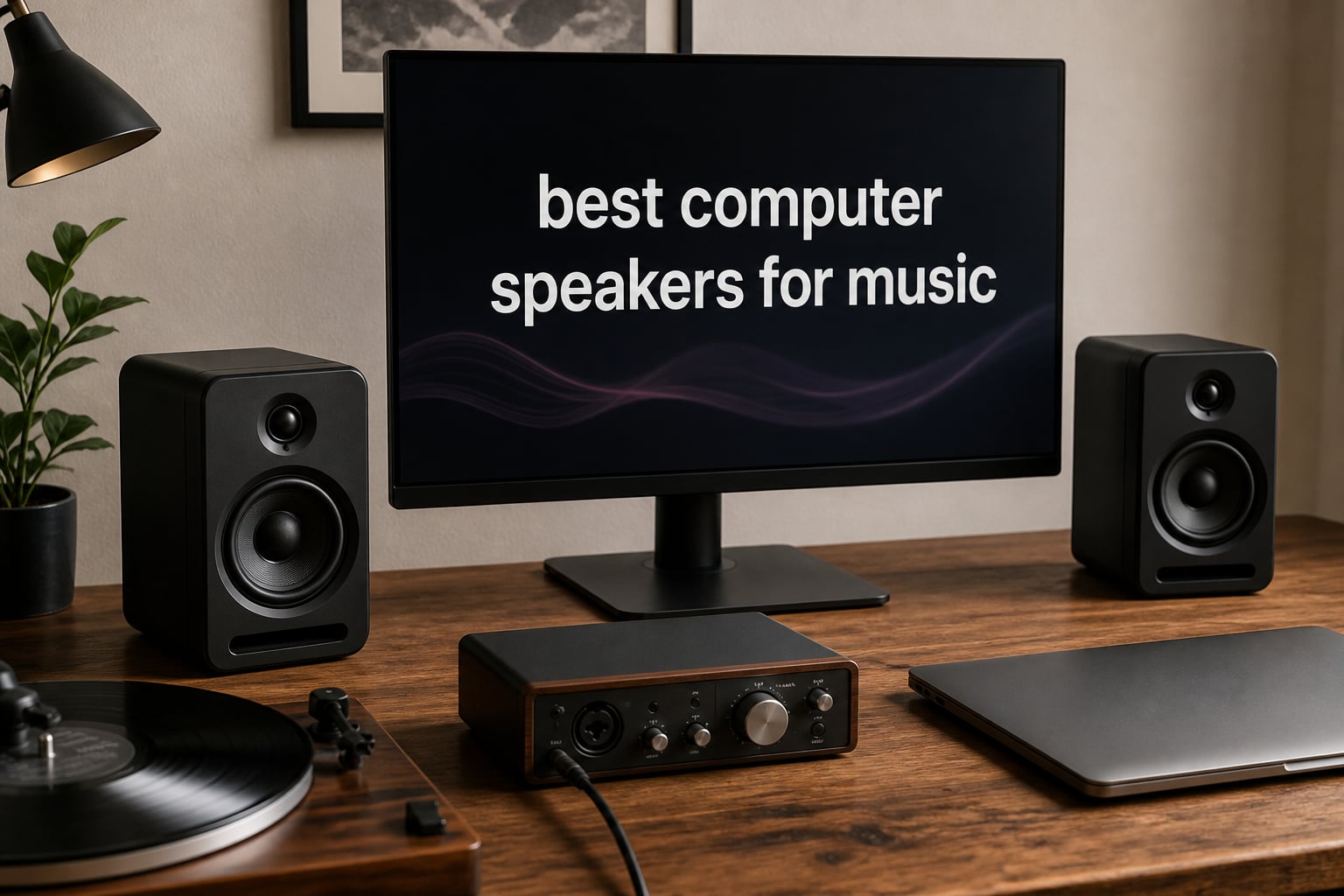
The best computer speakers for music give a desktop the stereo separation, usable bass, and clear vocal range that a laptop or monitor speaker cannot. A good powered pair also keeps the setup simple: amplification is inside the speakers, so the computer, phone, or audio interface can connect directly.
For this guide, we reviewed the supplied product specifications, listed features, and customer-review summaries for 12 powered desktop options. We did not claim a hands-on listening test where one was not provided; instead, we compared the real driver, cabinet, power, input, and review information that helps a music listener make a sensible choice.
Computer speakers are good for music when they form a genuine left-right pair and sit correctly at a desk. The biggest gains usually come from moving away from tiny built-in drivers, keeping each speaker a little apart, and choosing a wired digital or balanced input when the source supports it.
Music fans often want an engaging desktop audio system, while producers tend to want a more neutral nearfield speaker that makes mix decisions easier to judge. If you make electronic tracks, our guide to best computer speakers for music production adds practical context for building a listening setup around your work.
Desk depth matters as much as headline power. Small speakers can sound focused at close range, but a larger woofer and an MDF cabinet can be a better fit when you have room and want less cabinet vibration; that preference comes up repeatedly in community discussions about desktop audio.
Table of Contents
The three strongest computer speakers for music match three common desk setups
The Edifier MR3 is our editor’s choice for listeners who want studio-style connections and a stated 52Hz to 40kHz response. The Edifier M60 is the best-value compact choice for a small desk with USB-C and LDAC, while the PreSonus Eris 3.5 is the budget pick for a straightforward active-monitor layout.
Those labels are use-case judgments based on the specifications and available customer feedback, not claims that one sound signature suits every listener. Choose the MR3 for balanced inputs, the M60 for small-space convenience, or the Eris 3.5 for familiar monitor controls and a front headphone jack.


These 12 computer speakers for music cover compact, monitor, and full-featured desktop systems in 2026
The comparison below contains every model in this guide. Read the feature labels as a quick way to narrow the field by connection type, driver size, and system expansion rather than as a substitute for checking whether a pair fits your desk.
For computer audio, USB-C, optical, RCA, AUX, HDMI eARC, and balanced TRS serve different jobs. A monitor with TRS can suit an audio interface, while USB-C or optical is often the cleaner direct route from a computer.
| Product | Specifications | Action |
|---|---|---|
 Audio-Technica AT-SP3X Audio-Technica AT-SP3X |
|
View on Amazon |
 FiiO SA1 Desktop Speaker FiiO SA1 Desktop Speaker |
|
View on Amazon |
 IBALL BOX H1 IBALL BOX H1 |
|
View on Amazon |
 Harman Kardon SoundSticks 5 Harman Kardon SoundSticks 5 |
|
View on Amazon |
 Edifier M60 Edifier M60 |
|
View on Amazon |
| Edifier MR3 |
|
View on Amazon |
 MEVOSTO DS19 MEVOSTO DS19 |
|
View on Amazon |
 Edifier M90 Edifier M90 |
|
View on Amazon |
| PreSonus Eris 3.5 |
|
View on Amazon |
 Saiyin DS6701S Saiyin DS6701S |
|
View on Amazon |
 OHAYO C6 OHAYO C6 |
|
View on Amazon |
 NSY Audio BS301 NSY Audio BS301 |
|
View on Amazon |
1. Audio-Technica AT-SP3X is the compact bookshelf choice for simple music listening
Audio-Technica AT-SP3X Bookshelf Speakers
3 inch drivers
30W maximum output
RCA and Bluetooth
Pros
- Compact full-range design
- Dual RCA inputs
- Multipoint Bluetooth
- Two-year limited warranty
Cons
- Plastic enclosure
- Requires AAAA batteries
The Audio-Technica AT-SP3X makes sense when you want a recognizable audio brand in a compact bookshelf format. Its 4.8 rating comes from 415 reviews, and the available review summary highlights full-range sound and connection flexibility rather than app-heavy extras.
I would put this pair on a work desk where physical depth is available, since the listed dimensions are 14 inches deep, 8 inches wide, and 11 inches high. The 3-inch drivers and 30-watt maximum output point it toward close listening instead of filling a large room.
Dual RCA jacks give the AT-SP3X a straightforward wired route from a DAC, interface, or computer adapter. Bluetooth adds casual phone streaming, and multipoint pairing can keep two devices connected at once without repeatedly repairing them.
The specification lists a 70dB signal-to-noise ratio and a 10-meter maximum wireless range. I would treat those figures as useful baseline details, then prioritize speaker placement and source quality before expecting a tiny desktop system to produce deep sub-bass.
A compact desk with regular wired and wireless use suits the AT-SP3X
This pair is for someone who switches between a computer and a phone but does not need balanced inputs or a headphone output. The included 6.6-foot speaker cable and international plug adapters are practical setup items that reduce extra shopping.
The user feedback is unusually strong for the review count, with 90 percent five-star ratings in the supplied summary. That does not prove the pair will match every taste, but it supports its position as an easy, compact music-listening choice.
A production interface or bass-focused desk calls for another model
The AT-SP3X listing does not show USB, optical, balanced TRS, or a dedicated subwoofer output. A producer using an interface, or a listener planning a later bass-system expansion, should look at the MR3 or M90 instead.
Its plastic enclosure and stated battery requirement are also worth knowing before purchase. Those are not sound-quality verdicts, but they distinguish this simple pair from wood-cabinet alternatives.
2. FiiO SA1 is the control-rich desktop speaker for listeners who tune their system
FiiO SA1 High-Fidelity Desktop Speaker. 31-Band PEQ, LDAC Bluetooth,20W2+5W2 Output, Phono Preamp, Wood Fiber Woofer, Aluminum-Magnesium Tweeter (White)
31-band PEQ
LDAC Bluetooth
USB, optical and phono
Pros
- 31-band PEQ
- LDAC streaming
- Optical and USB inputs
- Built-in phono preamp
Cons
- Only 20 reviews
- Availability status unknown
The FiiO SA1 stands out because it pairs conventional desktop connections with a 31-band lossless PEQ. That level of equalization can help a careful listener adjust a desk setup, though it also asks you to make decisions rather than simply accept a factory voicing.
Its supplied rating is 4.8 from 20 reviews, which is a very small feedback sample beside several other models here. I would read that score as encouraging but give more weight to the listed inputs and control features when deciding.
The SA1 accepts Bluetooth, coaxial, optical, RCA, and USB sources. It also includes LDAC Bluetooth and a phono preamp, making it unusually adaptable for a computer, digital source, and turntable-based listening corner.
FiiO lists a wood-fiber woofer with an aluminum-magnesium tweeter in a wood and aluminum-magnesium enclosure. The pair is specified at 20 watts and a 3.5-inch speaker size, so it remains a desktop system despite the broad feature set.
An input-heavy desk benefits most from the FiiO SA1
This is a strong candidate when a computer, console, music player, and turntable may share one pair of speakers. The optical and USB connections can avoid an analog computer output, while the phono stage handles a turntable connection without a separate phono preamp.
I would also favor it for the person who enjoys adjusting rather than guessing. A 31-band PEQ is more precise than basic bass and treble knobs, but it is only useful if you are willing to listen and make modest changes.
A plug-and-play listener may prefer simpler front controls
The supplied control method lists buttons and a remote, not front-panel tone knobs. Someone who wants instant bass or treble changes beside the keyboard may find the H1 or MEVOSTO DS19 more direct.
The product data lists one unit count despite describing a desktop speaker system, so confirm the package details before ordering. The limited one-year warranty is another real specification to compare against longer coverage on alternatives.
3. IBALL BOX H1 is the direct USB-C DAC choice for a feature-packed desktop
IBALL·BOX H1 Computer Speakers for Desktop PC, Monitor & Laptop, 60W Powered 2.0 Stereo with Bluetooth, 24-Bit USB-C DAC, Optical, 3.5mm AUX, Bass/Treble Control, Black
60W powered stereo
24-bit USB-C DAC
Optical and AUX
Pros
- 24-bit USB-C DAC
- 60W stereo output
- Front tone controls
- Optical and AUX inputs
Cons
- Availability status unknown
- No balanced input listed
The IBALL BOX H1 checks several boxes that matter to computer-audio buyers: a 24-bit USB-C DAC, optical input, Bluetooth 5.0, and front bass and treble controls. It is a practical choice for a PC user who wants a wired digital path without buying a separate converter.
The supplied customer data shows a 4.7 rating from 69 reviews, with 87 percent five-star ratings. That is not an enormous review pool, yet the summary repeatedly credits sound quality, connections, and accessible controls.
IBALL BOX specifies dual 3-inch carbon-fiber woofers, dual 1-inch silk-dome tweeters, and 60 watts of maximum output in a 2.0 format. The stated 95dB signal-to-noise ratio is also the highest numerical figure of that kind among products that disclose it here.
At 5.39 inches deep, 4.57 inches wide, and 7.09 inches high, each cabinet is suited to a constrained desk. The H1 has a stated 4-ohm impedance and a 40.2Hz frequency-response figure, though the listing does not provide a full frequency range.
A computer with USB-C or optical output is the H1’s natural partner
Use USB-C when you want the listed internal 24-bit DAC to process the computer’s audio digitally. Optical is useful for hardware that provides that output, while AUX keeps compatibility with older analog sources.
I like that the bass and treble controls are on the front, where they are reachable during a listening session. That matters when speakers sit near a wall or on a desk surface that changes the perceived low end.
An audio interface setup needs a speaker with balanced inputs
No balanced TRS or XLR connection is listed for the H1. That makes it less appropriate for a production desk built around an interface with balanced outputs, even though its USB-C input is appealing for ordinary computer audio.
It is also a 2.0 system without a listed subwoofer output. Choose a model with a dedicated expansion output if adding a powered subwoofer is already part of your plan.
4. Harman Kardon SoundSticks 5 is the room-forward 2.1 system for music and TV
Harman Kardon SoundSticks 5 2.1-Channel Bluetooth Speaker with HDMI – White – 3-Way Speaker Design with Multicolor Light Show – Music Streaming & Auracast Multi-Speaker Connection
3-way design
190W maximum output
HDMI ARC and Bluetooth
Pros
- Down-firing subwoofer
- HDMI ARC
- Bluetooth dual-device support
- Auracast connection
Cons
- No waterproof rating
- Availability status unknown
The Harman Kardon SoundSticks 5 approaches desktop audio differently from the compact 2.0 pairs in this guide. Its 2.1 layout includes a down-firing subwoofer and a stated three-way design, so it is aimed at listeners who want a more room-present system.
The data gives it a 4.7 rating from 23 reviews. That small sample and the product’s style-led design mean I would buy it for the specific combination of bass system, HDMI ARC, and visual presentation rather than treating it as a studio monitor.
Harman Kardon specifies 190 watts of maximum output and an 80dB signal-to-noise ratio. Bluetooth can connect up to two devices, while HDMI ARC lets a television share the system and use TV-oriented control behavior.
Auracast support is another unusual feature here, allowing multi-speaker broadcasting with compatible products. The Harman Kardon One app provides customization, and the integrated multicolor light show is part of the system rather than an afterthought.
A desk that also serves a television setup benefits from SoundSticks 5
HDMI ARC is the decisive feature if you want one speaker system for a computer and television. The dedicated subwoofer can also appeal to listeners whose music and films benefit from a separate low-frequency cabinet.
I would reserve enough floor or desk space for the 2.1 arrangement before choosing it. The listed system dimensions are 9.4 by 9.4 by 11.2 inches, and the subwoofer placement matters to how bass reaches the seat.
A neutral close-range monitor task favors a 2.0 studio pair instead
This is not the first choice for judging a mix at a nearfield desk. The supplied data does not list balanced inputs, a monitor mode, or a stated flat-response range, all of which make the MR3 more relevant to that job.
The system is also not water resistant and has a one-year limited warranty. Those facts may not matter in a dry indoor setup, but they are part of a complete ownership comparison.
5. Edifier M60 is the compact high-resolution choice for a small modern desk
Edifier M60 Multimedia Speaker, 66W RMS Computer Speaker, Black
66W RMS
LDAC Bluetooth
USB-C and AUX
Pros
- 66W RMS output
- LDAC Bluetooth
- USB-C input
- 15-degree aluminum stands
Cons
- No waterproof rating
- No balanced input listed
The Edifier M60 earns its position because it combines compact cabinets with a useful desktop feature mix. Edifier lists 66 watts RMS, a 3-inch long-throw aluminum-diaphragm driver, a 1-inch silk-dome tweeter, USB-C, AUX, and Bluetooth 5.3 with LDAC.
Its 4.6 rating is supported by 1.8k reviews, which is one of the larger evidence pools in this selection. The supplied summary describes it as a top seller whose users frequently praise its compact size and audio quality.
Each M60 is listed at 3.93 inches deep, 6.61 inches wide, and 5.78 inches high. That narrow footprint helps on crowded desks, and the included aluminum stands angle the speakers upward by 15 degrees toward a seated listener.
The cap-sensitive touch panel lights automatically, and Edifier ConneX app support supplies another control option. I would see the app as a convenience feature, while the included stands are the more immediately meaningful addition for desktop placement.
A shallow desk with USB-C devices is an excellent fit for the M60
The M60 is for laptop and desktop users who want a tidy digital connection and do not have room for large 5-inch cabinets. USB-C and AUX cover wired sources, while LDAC Bluetooth provides a higher-data wireless option with compatible devices.
Place the pair symmetrically and aim the built-in stands toward ear level. That simple nearfield geometry matters because correct direction can make vocal focus and left-right imaging easier to hear at a desk.
A balanced studio chain or subwoofer plan points elsewhere
The M60 listing does not specify balanced TRS inputs or a subwoofer output. Those omissions do not limit ordinary music listening, but they steer interface users toward the MR3 and system builders toward the M90.
Small 3-inch drivers are a good match for compact placement, not a promise of large-room bass weight. If you listen farther away or want a larger woofer, the MEVOSTO DS19 is a more appropriate physical format.
6. Edifier MR3 is the studio-style choice for balanced computer audio and production work
Edifier MR3 Powered Studio Monitor, Speaker Hi-Res Active Bluetooth Speaker
52Hz-40kHz response
Balanced TRS input
92.5dB peak SPL
Pros
- Balanced TRS input
- Hi-Res Audio certification
- Music and Monitor modes
- MDF cabinet
Cons
- Limited color options
- No subwoofer output listed
The Edifier MR3 is the clearest fit for a listener who wants a speaker with monitor-oriented features but still needs ordinary desktop connections. The supplied specification states a 52Hz to 40kHz response, 18 watts by two RMS output, a 92.5dB peak SPL, and three sound modes: Music, Monitor, and Custom.
Its 4.7 rating comes from 660 reviews, with 81 percent five-star ratings in the supplied distribution. That meaningful feedback sample, balanced TRS input, and MDF cabinet are why our team selected it as the overall choice for a music-minded desktop.
Balanced TRS, RCA, AUX, Bluetooth 5.4, and a headphone output make the MR3 unusually flexible. A producer can connect an interface through TRS, while a computer or phone can use its more casual source options.
The drivers are listed as 3.5-inch mid-low units with 1-inch tweeters. MDF is often preferred by desktop-audio communities because it can reduce cabinet vibration compared with lighter plastic, and the listing explicitly says the cabinet is built to reduce distortion.
A computer plus audio interface setup is where the MR3 makes the most sense
The balanced TRS input is the deciding factor for production desks and other setups using an interface. It gives the MR3 a direct connection category that many multimedia speakers do not disclose.
I would start in Monitor mode when accuracy is the goal, then try Music or Custom mode for relaxed listening. The companion app allows EQ control, but modest adjustments are usually easier to judge after the speakers are positioned well.
A very large room or a bass-expansion plan needs a different format
A 3.5-inch driver is appropriate for nearfield listening, but it has physical limits. The stated 52Hz lower response is informative, yet listeners who want much deeper bass may prefer a 2.1 system or an option with a listed subwoofer output.
The MR3 is supplied in limited color options and does not list a sub out. It remains a versatile 2.0 pair, but those details help prevent a mismatch with a decor-first or expansion-first desk plan.
7. MEVOSTO DS19 is the larger-woofer choice for listeners who want simple tone adjustment
MEVOSTO 5-Inch Powered Bookshelf Speakers: PC Speakers for Record Player
5 inch woofer
36W RMS
USB, RCA and AUX
Pros
- 5 inch woofers
- USB digital audio
- Ten-level tone adjustment
- Bluetooth 5.4
Cons
- No Dolby Audio support
- No balanced input listed
The MEVOSTO DS19 brings a 5-inch woofer to a list dominated by 3-inch and 3.5-inch desktop units. That larger driver is the principal reason to consider it when a desk has enough clearance and you want more driver area for bass and midrange reproduction.
It carries a 4.6 rating from 656 reviews, with 77 percent five-star ratings in the supplied breakdown. Its user-facing features are straightforward: Bluetooth 5.4, USB digital audio, RCA, AUX, a remote, and 10-level bass and treble adjustment.
The product data calls out a wood enclosure, two 1-inch silk-dome tweeters, 36 watts RMS, and 110 watts peak power. Its disclosed 15-meter Bluetooth range is longer than the 10-meter range listed for several compact alternatives.
I would not treat the listed 80Hz frequency-response figure as a complete picture of performance because no upper limit appears beside it. Still, the driver size and physical cabinet make its intended role clear: this is a more traditional bookshelf-style desktop pair.
A roomy desk and hands-on tonal preferences suit the DS19
The DS19 is for someone who enjoys changing bass and treble to match different recordings or placement. Ten adjustment levels offer more granularity than a basic two-knob layout, and the remote helps when the speakers are not within arm’s reach.
USB digital audio is helpful when you want a direct computer connection. RCA and AUX retain compatibility with analog gear, so this pair can anchor a simple PC audio system without an external amplifier.
A balanced interface or cinema-focused system favors another connection set
The listing does not include balanced TRS, optical, HDMI, or Dolby Audio support. Those absences matter if you use professional outputs, need a television connection, or want particular surround-processing features.
The cabinets measure 10 inches deep, so measure before placing them behind a monitor. That depth is the trade-off for the 5-inch driver and should be viewed as a desk-fit question, not a flaw.
8. Edifier M90 is the expandable desktop system with HDMI eARC and subwoofer output
Edifier M90 Computer Speakers, 100W RMS Desktop Speakers, Black
100W RMS
HDMI eARC and optical
Subwoofer output
Pros
- 100W RMS power
- HDMI eARC
- LDAC Bluetooth
- Dedicated subwoofer output
Cons
- No waterproof rating
- Availability status unknown
The Edifier M90 is built for a listener who wants a desktop pair to do more than sit beside a computer. Its 100 watts RMS, 4-inch aluminum drivers, 1-inch silk-dome tweeters, HDMI eARC, optical, USB-C, AUX, Bluetooth 6.0, and dedicated subwoofer output form the broadest expansion set in this guide.
The available rating is 4.6 from 97 reviews, with 81 percent five-star ratings. I would call that a promising but still modest review base, then focus on the concrete connectivity advantages that distinguish the M90 from smaller Edifier pairs.
HDMI eARC matters if a television shares your work or music space because it can support TV remote control behavior. Optical and USB-C make the system easier to connect digitally, while the supplied remote and ConneX app offer two ways to control it.
LDAC and Bluetooth 6.0 with multipoint connection make wireless playback more flexible. The listing also specifies Hi-Res Audio support and 40kHz as the upper end of its stated frequency response.
A mixed computer, television, and music corner benefits most from the M90
Choose this pair when the speaker system must cover several devices without constant cable swapping. HDMI eARC suits a television, USB-C suits many computers, and optical can serve other digital hardware.
The dedicated sub out is especially useful because it gives a stated path to add a powered subwoofer later. That is a real system-building advantage over a sealed 2.0 purchase with no disclosed expansion connection.
A minimal desk with no need for expansion can save space with a smaller pair
The listed dimensions are 15.62 inches deep, 11.96 inches wide, and 13.18 inches high, and the weight is 8 kilograms. These are substantial desktop speakers, so they need more planning than the M60 or H1.
No waterproof rating is listed. More importantly for a production user, the supplied inputs do not name a balanced TRS connection, so the MR3 remains the more direct interface-oriented option.
9. PreSonus Eris 3.5 is the familiar active-monitor choice for entry-level nearfield listening
PreSonus Eris 3.5 Powered Studio Monitors, Pair — 3.5” Active Near
50W amplification
80Hz-20kHz response
TRS, RCA and aux
Pros
- 50W built-in amplification
- TRS and RCA inputs
- High and low tuning controls
- Front headphone jack
Cons
- 80Hz low-frequency limit
- No batteries
The PreSonus Eris 3.5 is a well-known shape of product: a complete active nearfield-monitor pair with 3.5-inch woven-composite woofers, 1-inch silk-dome tweeters, and 50 watts of built-in amplification. Its feature set speaks directly to a music-production or desk-listening setup.
The listing reports a 4.5 rating from 1,583 reviews, giving it one of the strongest feedback samples in the guide. The review summary calls out clear, dynamic sound and the usefulness of the high- and low-frequency acoustic tuning controls.
Balanced 1/4-inch TRS, RCA, and a front-panel auxiliary input provide practical source choices. The front headphone jack is another desk-friendly touch when you need to switch from speakers to headphones without reaching behind a cabinet.
PreSonus lists an 80Hz to 20kHz response and 5.5-by-6-by-8.3-inch dimensions per speaker. That disclosed 80Hz lower limit is worth respecting: a small nearfield pair can be articulate without reproducing the lowest octave of bass-heavy music.
An entry-level interface and close seated position suit the Eris 3.5
The TRS input and acoustic tuning controls make the Eris 3.5 a sensible first monitor pair for a compact production desk. I would position the tweeters close to ear height, form an equilateral triangle with the listening position, and make only small control changes after placement.
For ordinary music, those same controls can help compensate for a desk close to a wall. They are not room correction, but they offer a more relevant adjustment path than no tuning at all.
Deep electronic bass and wireless-first listening call for different features
The specified 80Hz lower response means a separate subwoofer or a larger speaker is more appropriate for listeners who prioritize very low bass. The supplied listing does include Bluetooth in connectivity details, but it does not position wireless codec support as a central feature.
The Eris 3.5 is corded electric with no batteries, and it is not water resistant. Those are normal conditions for a desktop monitor, but they make it unsuitable as a portable or outdoor solution.
10. Saiyin DS6701S is the connection-rich bookshelf pair for a computer and basic TV system
Saiyin Powered Bluetooth Bookshelf Speakers
30W x 2 RMS
Optical and coaxial
Bluetooth 5.3
Pros
- Optical and coaxial inputs
- 30W x 2 output
- Remote control
- Three-year warranty
Cons
- Turntable needs a preamp
- No balanced input listed
The Saiyin DS6701S is appealing because it puts optical and coaxial inputs into an active bookshelf design with Bluetooth 5.3, RCA, and AUX. That broad basic connection list suits a multi-device desk even though the product does not include the production-focused features of the MR3.
Its 4.4 rating is based on 2,093 reviews, the largest review count in the supplied data. The distribution shows 73 percent five-star ratings, and the product summary emphasizes connection variety, remote control, and a three-year manufacturer warranty.
The pair is specified at 30 watts by two RMS with 3.75-inch woofers and 0.5-inch silk-dome horn tweeters. Its ABS, MDF, and metal enclosure materials suggest a mix of construction choices rather than a single all-MDF cabinet.
I would pay close attention to the turntable note: the supplied data says a turntable may require a preamp for a PHONO output and a Bluetooth transmitter for wireless operation. A computer user will be more interested in the wired optical, coaxial, RCA, and AUX routes.
A computer and television sharing a traditional input set fit the Saiyin DS6701S
Optical and coaxial can be useful with hardware that provides either digital output, while RCA and AUX cover older analog devices. The remote and cabinet buttons give you two control methods without depending on an app.
The three-year warranty is longer than several alternatives that list one or two years. Warranty length does not define audio quality, but it is a meaningful ownership detail for a fixed desktop system.
A turntable without supporting equipment or a balanced interface needs another choice
This pair is not a direct answer to every turntable setup because PHONO-level output needs a preamp. The FiiO SA1 is more convenient if an integrated phono preamp is a key requirement.
No balanced input appears in the supplied specification. Producers routing signal from an interface should favor the MR3 or another model that explicitly lists a balanced connection.
11. OHAYO C6 is the compact MDF option for straightforward PC music and gaming
OHAYO 60W Computer Speakers for Music and Gaming, Active Bluetooth 5.3, Stereo 2.0 Speakers for Desktop PC or Laptop, 3.5mm Aux RCA USB Input, 1 Pair, Black
30W x 2 output
MDF enclosure
Bluetooth, RCA, AUX, USB
Pros
- 30W x 2 output
- MDF wooden enclosure
- Multiple wired inputs
- Front volume knob
Cons
- No waterproof rating
- No balanced input listed
The OHAYO C6 concentrates on familiar desktop priorities: 30 watts by two output, 3-inch carbon-fiber full-range drivers, 0.75-inch carbon-fiber silk-dome tweeters, a rear bass port, and a compact MDF wooden enclosure. Its design is plainly aimed at a PC or laptop position rather than a large-room system.
The product has a 4.4 rating from 957 reviews, and the supplied feedback describes powerful sound, versatile connections, and a solid MDF build. That is a useful amount of customer information for buyers who want a simple active pair.
Bluetooth 5.3, USB, RCA, and AUX cover common sources. The integrated independent sound card and front volume control are listed features, which make the C6 appealing for someone who wants to avoid a separate desktop DAC or control box.
The cabinets measure 6.5 inches deep, 4.33 inches wide, and 4.72 inches high. Their small size makes them easy to place beside a monitor, but the rear bass port needs some breathing room rather than being pressed flat against a wall.
A compact computer desk with several common sources suits the OHAYO C6
The USB input is useful for a computer, and RCA or AUX help when an analog source joins the setup. Bluetooth is there for casual listening, while the front knob keeps daily volume adjustment within reach.
I would choose the C6 for its stated MDF construction if cabinet material is part of your shortlist. Desktop-audio communities often prefer MDF because it can control unwanted cabinet resonance better than lighter plastic alternatives.
A detailed interface workflow or a subwoofer plan requires more specific connections
The C6 does not list balanced TRS, optical, HDMI, or a dedicated subwoofer output. It will fit a conventional PC audio setup, but those missing connections limit how it integrates into an expanding production or home-theater system.
The speaker is corded and not water resistant. Those limits are common for desktop systems and simply confirm that its intended home is an indoor desk.
12. NSY Audio BS301 is the basic active bookshelf pair for a plug-and-play desktop
NSY Audio Powered Computer Speakers for Desktop PC and Music, White Pair
60W maximum output
3 inch drivers
Bluetooth, RCA, USB, AUX
Pros
- Plug-and-play setup
- Bluetooth 5.3
- Multiple inputs
- Front volume and power dial
Cons
- 4.2 rating
- No balanced input listed
The NSY Audio BS301 is the simplest route in this set to a powered 2.0 bookshelf system with Bluetooth, RCA, USB, and AUX. Its product data emphasizes plug-and-play operation, a combined front power and volume dial, and compatibility with desktop computers, laptops, consoles, televisions, and turntables.
The supplied rating is 4.2 from 245 reviews, lower than the other picks but still based on a real feedback pool. Customer notes praise the value proposition, easy setup, and decent sound, while the rating distribution also shows more mixed responses than the leading models.
NSY specifies 3-inch drivers, 60 watts maximum output, Bluetooth 5.3 with a 33-foot range, and a 16kHz frequency-response figure. The technical details also describe an MDF wooden enclosure, although the product-details area lists plastic as enclosure material; that inconsistency is worth checking on the live listing.
The pair measures 5 inches deep, 4.8 inches wide, and 6.9 inches high, and weighs 6 pounds. I would call that a small physical footprint for an active desktop pair, especially when you want simple controls instead of an app.
A first desktop speaker upgrade with easy setup fits the BS301
The BS301 is for a listener replacing built-in computer speakers and prioritizing basic connections. USB, RCA, AUX, and Bluetooth 5.3 cover the everyday paths most casual systems use, and no software is listed as necessary.
The front dial makes it easy to control power and volume. That direct operation is valuable at a work desk where a speaker should not require a phone or remote for every adjustment.
A critical music listener should move up to a better-documented pair
The 4.2 rating and the enclosure-material discrepancy give a careful buyer reasons to compare it against more consistently documented options. It does not list balanced inputs, optical, HDMI, tone controls, or a subwoofer output.
The BS301 can be a workable basic pair, but its stated 16kHz response figure is less extensive than the full ranges disclosed for studio-oriented alternatives. For critical music listening, clearer technical disclosure is a worthwhile reason to consider the MR3, M60, or Eris 3.5.
The right computer speakers for music start with your listening distance and connections
Start with the distance between your ears and the speakers, then work backward to size and inputs. A desktop pair is usually used as a nearfield system, which means the speakers sit close to the listener and can produce a focused stereo image without needing extreme output.
Place the left and right speakers about as far apart as each is from your head, then aim them toward your ears. Keep tweeters near ear height when possible, and leave some space behind a rear-ported cabinet so the wall does not exaggerate bass.
Powered speakers are the simplest answer for most computer desks
Powered speakers have amplification built in, so they connect directly to a computer, phone, DAC, or interface. Every product in this guide is an active system, which avoids the need to match a separate amplifier to passive bookshelf speakers.
That simplicity does not mean all powered speakers connect the same way. USB-C and optical can carry a digital signal from compatible equipment, while RCA and 3.5mm AUX accept analog output; Bluetooth is convenient, but wired digital connections avoid wireless compression and pairing issues noted by many forum users.
A DAC matters when your computer’s analog output adds noise or lacks the inputs you need
A DAC converts digital audio from a computer into analog audio for an amplifier or powered speaker. A built-in DAC can reduce reliance on a computer’s headphone output, especially when the speaker offers USB-C, USB, or optical input.
The H1 lists a 24-bit USB-C DAC, the M60 accepts USB-C, and the FiiO SA1 accepts USB, optical, and coaxial sources. You do not need a separate DAC if a speaker’s digital input already serves your computer well, but an external interface remains useful when you need balanced outputs or recording connections.
Studio monitors are the better answer when mix decisions matter
Studio monitors aim for a more neutral, informative presentation than many consumer multimedia speakers. That does not make them automatically more enjoyable for every genre, but it can help a producer hear balance, harshness, and low-end buildup with fewer intentional sound enhancements.
The Edifier MR3 and PreSonus Eris 3.5 are the most monitor-oriented models here because they list balanced TRS inputs and tuning or monitor controls. For casual music, the M60, H1, and AT-SP3X may be easier fits when compact size and direct consumer connections matter more.
Driver size and cabinet material change what a small desk can realistically deliver
A larger woofer usually moves more air, but cabinet size, tuning, placement, and amplifier design matter too. The 5-inch MEVOSTO DS19 has more cone area than a 3-inch M60, while the SoundSticks 5 adds a separate subwoofer to handle low frequencies differently.
MDF cabinets are often favored because they can reduce vibration, a point raised often in desktop-audio discussions. The MR3, M60, MEVOSTO DS19, and OHAYO C6 all list MDF or wood-based cabinet construction, whereas the NSY data contains conflicting material information that deserves a closer check.
Speakers are better than soundbars for music when stereo placement is the priority
Separate left and right speakers let you place the channels apart and create a real stereo image. A soundbar may save space and suit television dialogue, but it usually cannot match the channel separation of a well-positioned pair on a desk.
Choose a soundbar only when one narrow cabinet is the physical requirement. For music listening, a 2.0 pair such as the MR3 or M60 is the more direct route to stereo placement, and a 2.1 system such as SoundSticks 5 adds dedicated bass without giving up separate left and right satellites.
Connection planning prevents the most common desktop-audio mismatch
List every device you will connect before selecting speakers. A laptop may need USB-C, a desktop interface may need balanced TRS, a television may need HDMI eARC or optical, and a turntable may need a phono preamp such as the one in the FiiO SA1.
Also decide whether a subwoofer is part of your later plan. The Edifier M90 explicitly lists a dedicated subwoofer output, while several compact 2.0 speakers do not, so that one connection can decide which model is appropriate.
These common computer-speaker questions have short, practical answers
Are computer speakers good for music?
Yes. Powered computer speakers are good for music when they use separate left and right cabinets, larger drivers than a laptop, and sensible placement at a desk. A wired digital or balanced connection can also avoid issues from a computer headphone output or Bluetooth compression.
What type of speaker is best for music?
The best type depends on the job. Powered bookshelf speakers suit convenient everyday listening, while active studio monitors suit close-range production and mixing because they often include balanced inputs and neutral-monitoring controls. Choose a 2.1 system when a separate subwoofer is more important than compact placement.
Which speaker is best for a desktop computer?
The Edifier MR3 is the strongest desktop choice here for balanced TRS, RCA, AUX, Bluetooth, a headphone output, and monitor-oriented modes. The Edifier M60 is better for a smaller desk with USB-C, while the PreSonus Eris 3.5 is a direct entry-level nearfield-monitor option.
Are speakers or soundbars better for PC?
Separate speakers are usually better for music on a PC because you can place left and right channels apart for clearer stereo imaging. A soundbar is useful when space is so limited that two cabinets will not fit, or when television dialogue is the main priority.
The best computer speakers for music depend on the desk you actually have
The Edifier MR3 is the most complete starting point for a music-focused desktop because it combines balanced TRS, everyday inputs, monitor-oriented modes, and an MDF cabinet. Choose the Edifier M60 when desk space is tight and USB-C or LDAC matters, or the PreSonus Eris 3.5 when an entry-level active-monitor layout and front headphone connection are your priorities.
The FiiO SA1 stands apart for its PEQ and phono preamp, while the Edifier M90 is the clear expansion pick because it lists HDMI eARC and a subwoofer output. Before choosing from the best computer speakers for music in 2026, measure your desk, list the inputs your devices need, and decide whether accurate close listening or bigger bass is the real goal.