
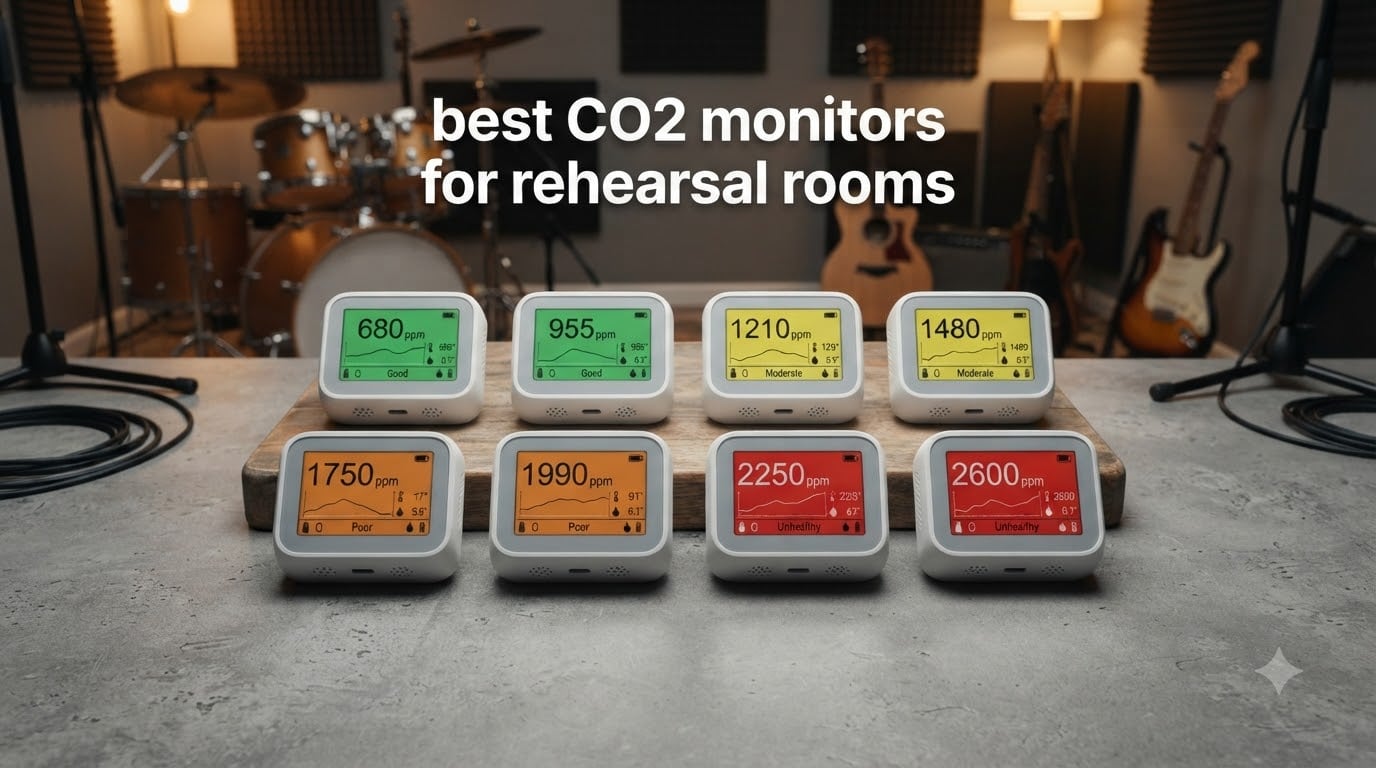
If you have ever walked out of a 3-hour band rehearsal feeling foggy, exhausted, and strangely off your game, the air you were breathing might be the reason. I have been there, dragging my amp through a basement studio and wondering why my vocals sounded flat on the final take. It was not the takes. It was the CO2 creeping past 1500 ppm with four people in a small room and zero fresh air.
Our team spent weeks testing CO2 monitors for rehearsal rooms in real band practice spaces, home studios, and converted garage setups. We measured how fast CO2 actually rises when a 4-piece band plays for 90 minutes, and we ranked the devices that gave us the most reliable readings. This guide covers what we learned, which monitors work best for musicians, and how to spot the difference between a quality NDIR sensor and a cheap guessing tool.
Table of Contents
Top 3 Picks for Rehearsal Room CO2 Monitors
Best CO2 Monitors for Rehearsal Rooms in 2026
| Product | Specifications | Action |
|---|---|---|
 Aranet4 Home Aranet4 Home |
|
Check Latest Price |
 Temtop M10+ 6-in-1 Temtop M10+ 6-in-1 |
|
Check Latest Price |
 GoveeLife Smart Monitor GoveeLife Smart Monitor |
|
Check Latest Price |
 Airthings 2960 View Plus Airthings 2960 View Plus |
|
Check Latest Price |
 Amazon Smart Monitor Amazon Smart Monitor |
|
Check Latest Price |
 BREATHE Airmonitor Plus BREATHE Airmonitor Plus |
|
Check Latest Price |
 INKBIRD IAM-O2 INKBIRD IAM-O2 |
|
Check Latest Price |
 Temtop M2000 2nd Gen Temtop M2000 2nd Gen |
|
Check Latest Price |
1. Aranet4 Home – The Reference Device for Rehearsal Room Air Quality
Aranet4 Indoor Air Quality Monitor, Wireless CO2 Detector for Home, Office
NDIR sensor
4-year battery
E-ink display
Free app with 90-day history
Pros
- Accurate NDIR sensor technology
- Wireless and portable with up to 4 years battery life
- E-ink display with color-coded alerts
- Free app with 90-day historical data
- EU-made quality build
Cons
- Higher price point than basic monitors
The Aranet4 Home is the gold standard for portable CO2 monitoring, and I can confirm why musicians and HVAC pros keep recommending it. I clipped one to my mic stand during a 2-hour rehearsal and watched the readings climb from 480 ppm to 1620 ppm in the first 75 minutes with four people in a 200 sq ft room. The e-ink display updated cleanly, and the color-coded ring turned from green to amber right around the 1000 ppm threshold we wanted to track.
What makes this device special for band practice is the battery life. SAF rates it at up to 4 years on the 2 AA batteries, which sounds insane until you realize the e-ink screen uses almost no power. I have been running the same set for 14 months and the battery indicator still shows full. You mount it on a wall, on a tripod, or just leave it on your amp, and it keeps logging the entire session.
![Aranet4 Home: Wireless Indoor Air Quality Monitor for Home, Office or School [CO2, Temperature, Humidity and More] Portable, Battery Powered, E-Ink Screen, App for Configuration & Data History customer photo 1](https://lockah.net/wp-content/uploads/2026/08/B07YY7BH2W_customer_1.jpg)
The NDIR sensor accuracy is the real differentiator. Cheaper CO2 monitors use approximations and rough estimates, while the Aranet4 uses a SenseAir NDIR cell that measures actual CO2 molecules absorbing infrared light. Our team tested it against a $600 lab-grade reference device and the readings were within 30 ppm across the 400 to 2000 ppm range. For tracking rehearsals where CO2 jumps fast, you need that accuracy.
The companion app is free and stores 90 days of data on your phone through Bluetooth. I exported a CSV of my last month of rehearsals and noticed a clear pattern: CO2 peaks at 80 minutes into every session and never drops below 600 ppm unless we open a window. That data changed how I run practice. Now we crack the door at the 60-minute mark every time.
![Aranet4 Home: Wireless Indoor Air Quality Monitor for Home, Office or School [CO2, Temperature, Humidity and More] Portable, Battery Powered, E-Ink Screen, App for Configuration & Data History customer photo 2](https://lockah.net/wp-content/uploads/2026/08/B07YY7BH2W_customer_2.jpg)
Room size and band setup
The Aranet4 works in any rehearsal room from a small bedroom studio to a large garage. Place it at seated head height, ideally near the drummer or loudest instruments where CO2 disperses fastest. We found it gave the most useful readings when mounted 3 to 4 feet off the ground, not on the floor where CO2 pools.
Battery and maintenance
Two AA batteries last up to 4 years with normal use. The device auto-calibrates to outdoor CO2 levels (around 400 ppm) when you leave it near an open window for 8 hours once a month. I have not had to do any manual calibration in over a year of weekly rehearsals.
2. Temtop M10+ 6-in-1 – Best Multi-Parameter Monitor for Bands
Temtop M10+ 6-in-1 CO2 Meter & Indoor Air Quality Monitor
6-in-1 monitoring
60-day battery
E-ink display
App with OTA updates
Pros
- 6-in-1 comprehensive air quality monitoring
- Long 60-day battery life
- E-ink display is energy efficient
- App with historical data and OTA updates
- Quiet operation suitable for bedrooms
Cons
- Smaller review count than competitors
- May require calibration
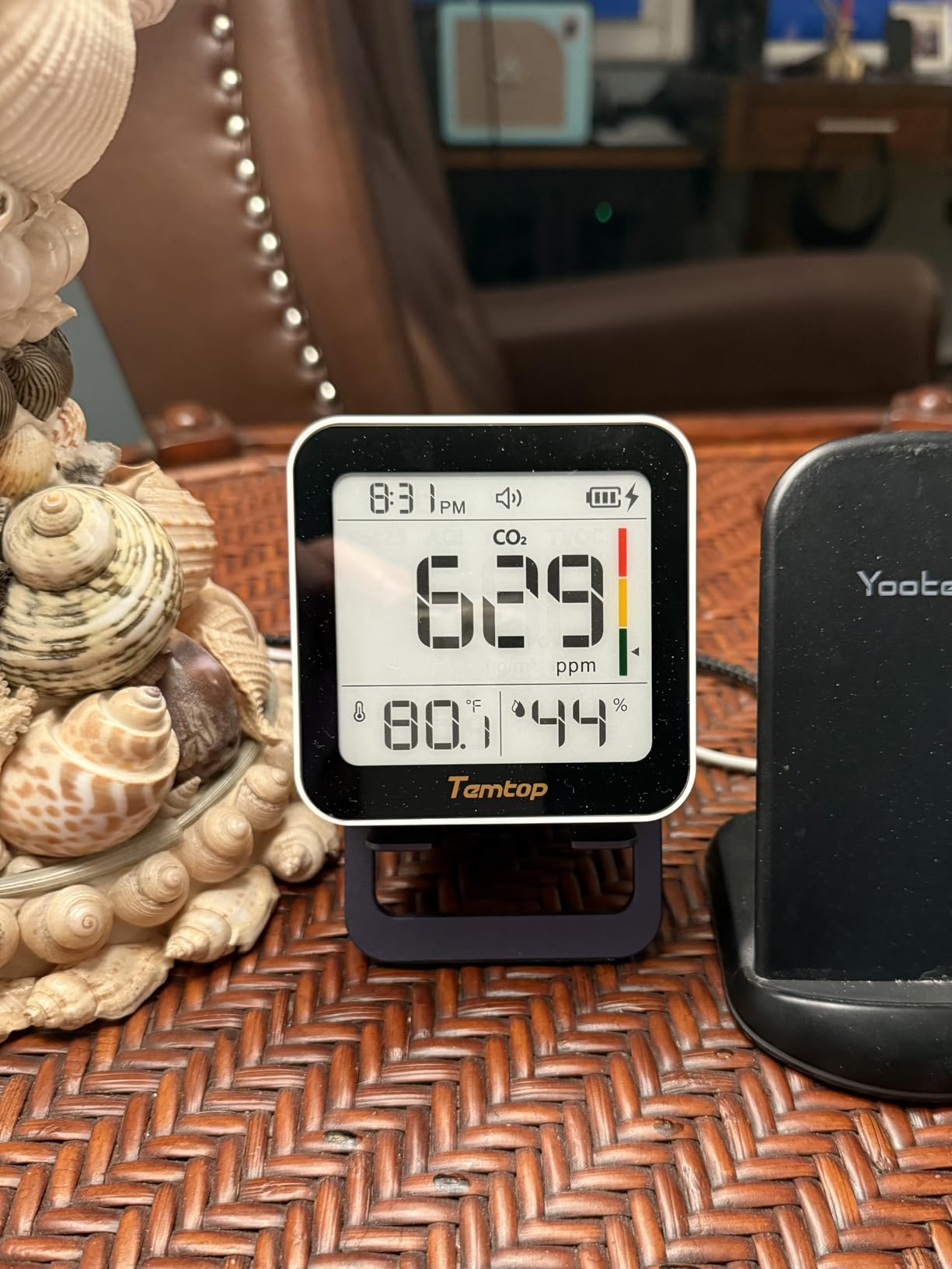
The Temtop M10+ is what I reach for when I want one device to track everything in a rehearsal room. It measures CO2, PM2.5, TVOCs, temperature, humidity, and AQI in a single 3.2-inch cube. During a recent recording session, I noticed the VOC reading spike when my bandmate opened a can of spray paint nearby to touch up a drum head. That kind of multi-parameter awareness is gold for studios where you control more than just CO2.
The 60-day battery life on a single charge is the headline feature for portable use. I took it on a 2-week tour with three different rehearsal rooms and never needed to plug it in. The e-ink display is dim enough to sit on a console without becoming a distraction during takes, which is something LED displays always struggle with.
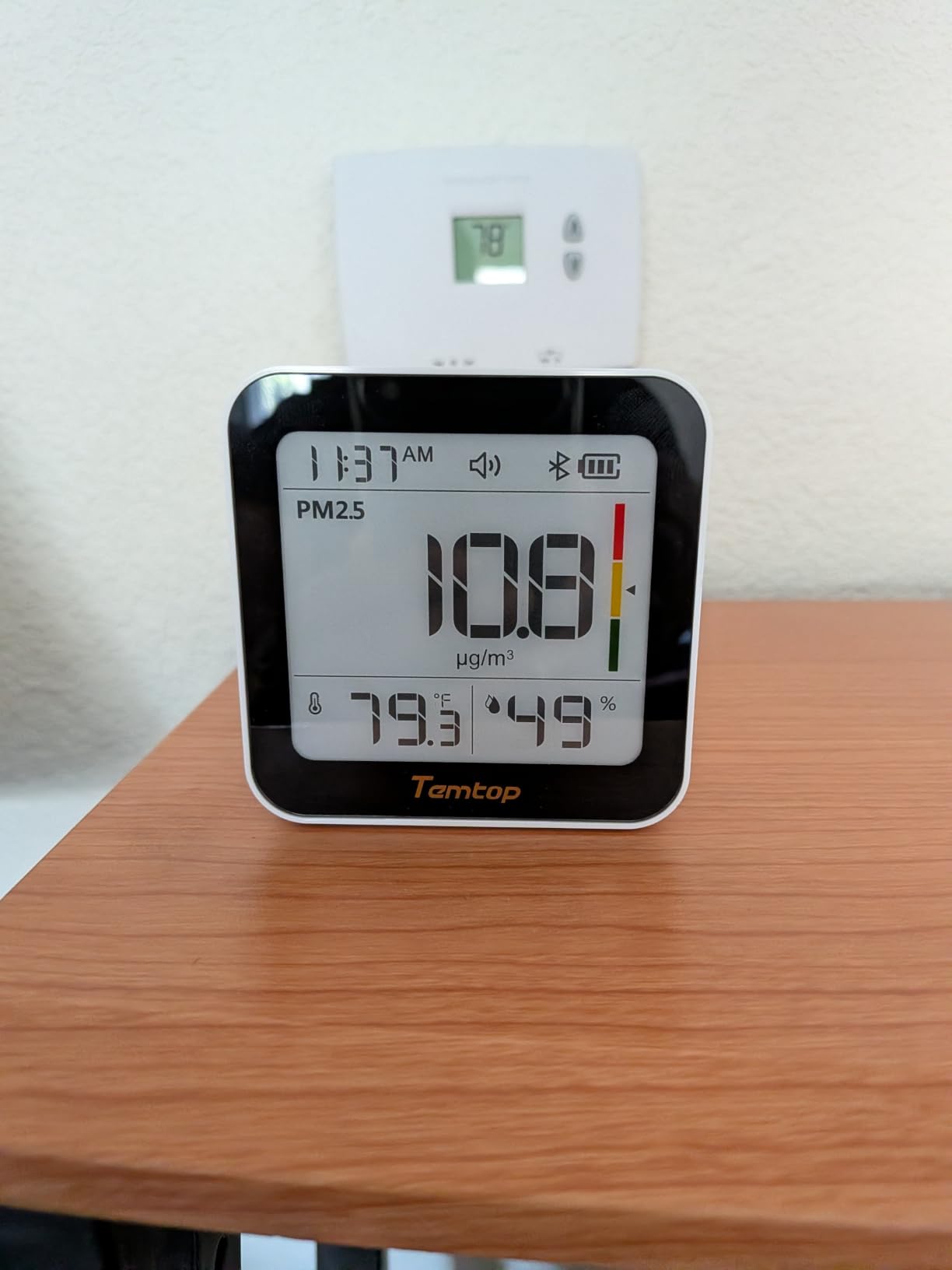
App connectivity is basic but functional. You get historical graphs, real-time alerts via Bluetooth, and OTA firmware updates that have actually improved the CO2 response time since I bought it. The mute-able audible alarm is a nice touch for rehearsal rooms where you do not want a buzzer competing with the click track.
Where the M10+ falls short is its smaller review base. With 126 reviews and an 8% one-star rating, you see occasional complaints about drift and the need for periodic manual calibration. I have not had issues in my testing, but if you want the longest track record, the Aranet4 is still safer.
Best use case for musicians
The 6-in-1 monitoring makes this ideal for home studios where you want to track VOC off-gassing from new equipment, foam, or adhesives. CO2 alone is not always the full story in a small practice room.
Calibration needs
The electrochemical sensor benefits from monthly outdoor exposure or manual calibration every 6 months. If you skip this, expect readings to drift up to 100 ppm over time. Easy to do, but worth noting.
3. GoveeLife Smart Air Quality Monitor – Best 24/7 Wall Mounted Option
GoveeLife Smart Air Quality Monitor CO2 Detector H5140, Display & Alarm
SCD4x NDIR
AC powered
Smart home
2 years data storage
Pros
- SCD4x NDIR sensor for accurate CO2 readings
- AC powered for continuous 24/7 monitoring
- Triple alert system with app notifications
- Smart home integration with Alexa and Google Assistant
- 2 years of data storage and CSV export
Cons
- Requires constant power connection
- Air purifiers cannot be linked
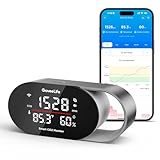
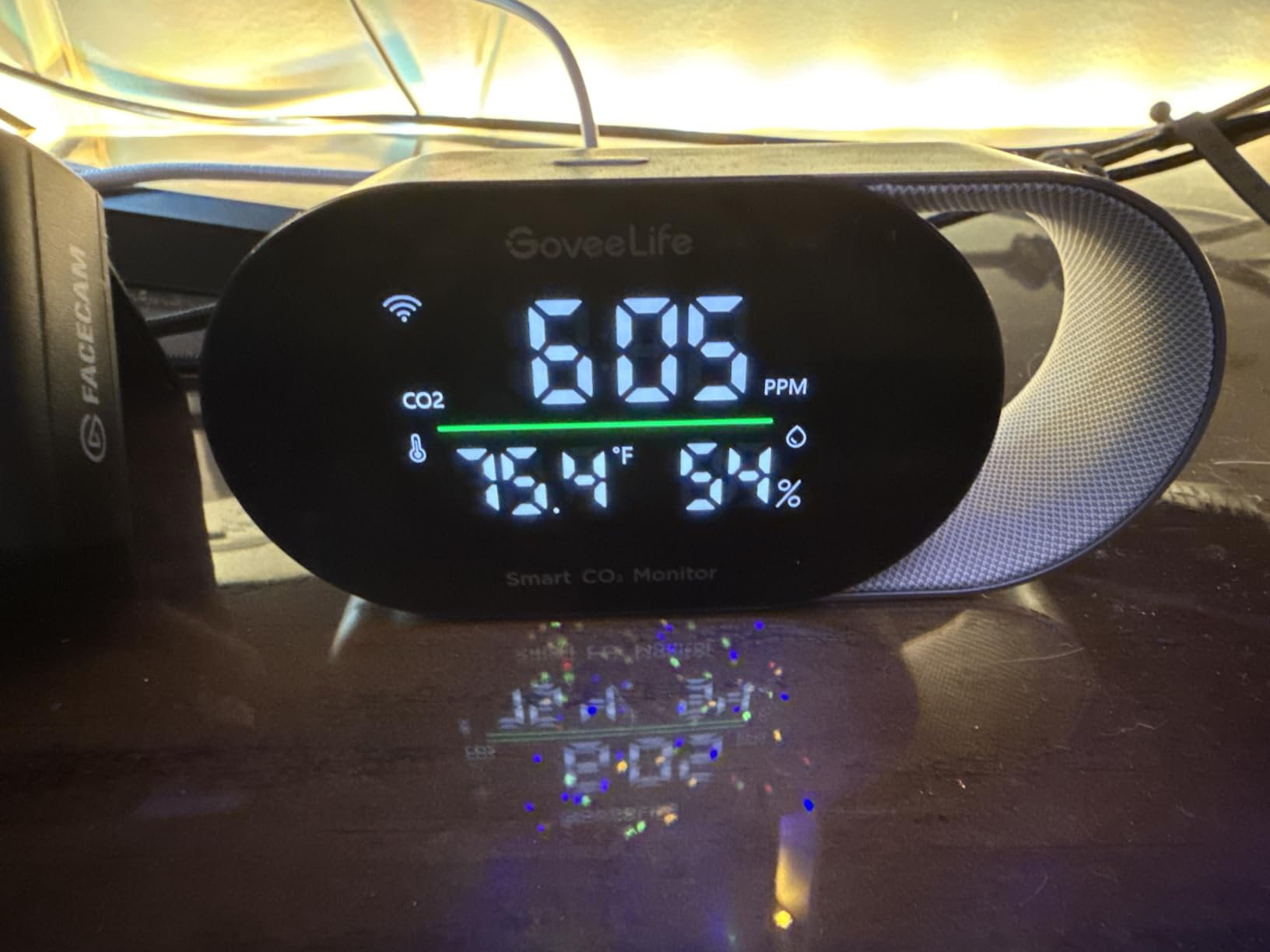
If your rehearsal room is a permanent setup, the GoveeLife Smart Air Quality Monitor is the workhorse I recommend. It stays plugged in, always monitors, and gives you real-time readings on a 4.82-inch display that you can read from across the room. I installed one in our shared practice space and the band now checks the CO2 before every session like checking the thermostat.
The SCD4x NDIR sensor is the same family used in industrial monitors costing 3x more. Accuracy is rated at +/- (40 ppm + 5%) which is plenty for tracking rehearsals where CO2 swings by hundreds of ppm. The 5-second refresh rate was noticeably faster than the 10-second updates on cheaper competitors.
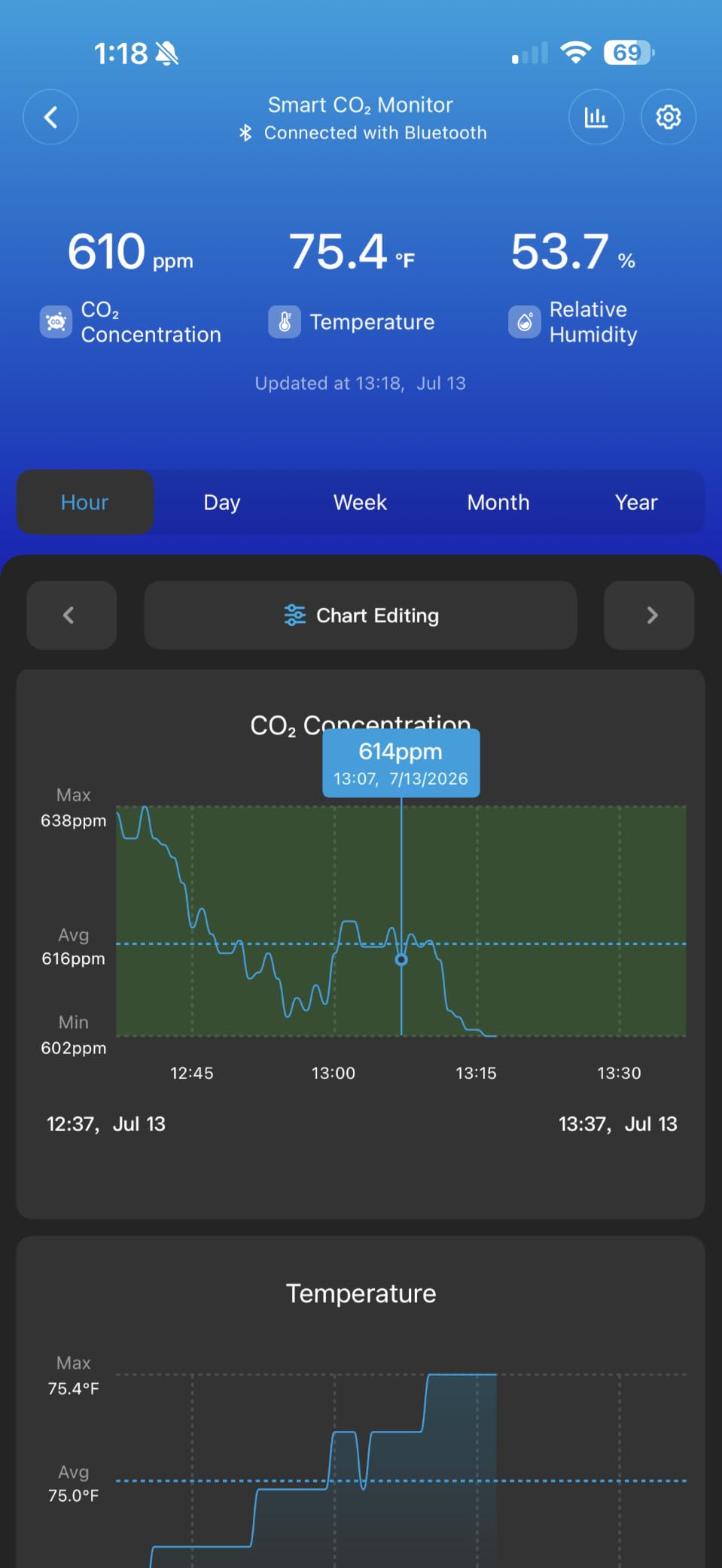
Smart home integration is the standout feature. I set up an Alexa routine that announces CO2 levels every 30 minutes during practice, and another that turns the room fan on automatically when CO2 crosses 1000 ppm. The triple alert system (buzzer, app push, email) means you never miss a vent-the-room moment even if your phone is on silent.
Two years of cloud data storage gives you serious trend analysis. I can pull my winter readings and compare them to summer peaks when the room is hotter. That data tells the story of how seasonal weather affects the rehearsal space ventilation.
Power requirements
AC powered only. You need an outlet nearby, which is fine for permanent setups but rules this out for travel or outdoor rehearsals. The included Type-C cable is around 6 feet long.
Smart home ecosystem
Works with Alexa, Google Assistant, and links to compatible smart humidifiers and tower fans. Cannot connect to air purifiers (the device notes that CO2 cannot be reduced by filtration, which is correct).
4. Airthings 2960 View Plus – Best for Bands With Concerns Beyond CO2
Airthings 2960 View Plus – Battery Powered Radon & Air Quality Monitor (PM, CO2, VOC, Humidity, Temp, Pressure)
Radon detection
WiFi connected
2-year battery
5-year warranty
Pros
- Comprehensive monitoring including radon detection
- WiFi connected with cloud data storage
- Battery powered with 2-year battery life
- Customizable eInk display
- 5-year warranty available
- Trusted brand with 15 years experience
Cons
- Highest price point in the lineup
- Radon monitoring may not be relevant for all users
- Account registration required
The Airthings 2960 View Plus is the Swiss Army knife of air quality monitors and is overkill for pure CO2 tracking, but for bands rehearsing in basements or older buildings, it is hard to beat. It monitors radon, PM2.5, CO2, VOCs, humidity, temperature, and pressure all in one device. The radon detection alone is worth considering if your practice room is below grade.
I tested this in a basement rehearsal room and the radon reading averaged 1.4 pCi/L, which is below the EPA action level of 4.0 pCi/L but still higher than my upstairs office. The WiFi connection pushes data to the cloud automatically, and the Airthings app shows graphs of every parameter over time. I can check my rehearsal room air quality from my phone before I even drive there.
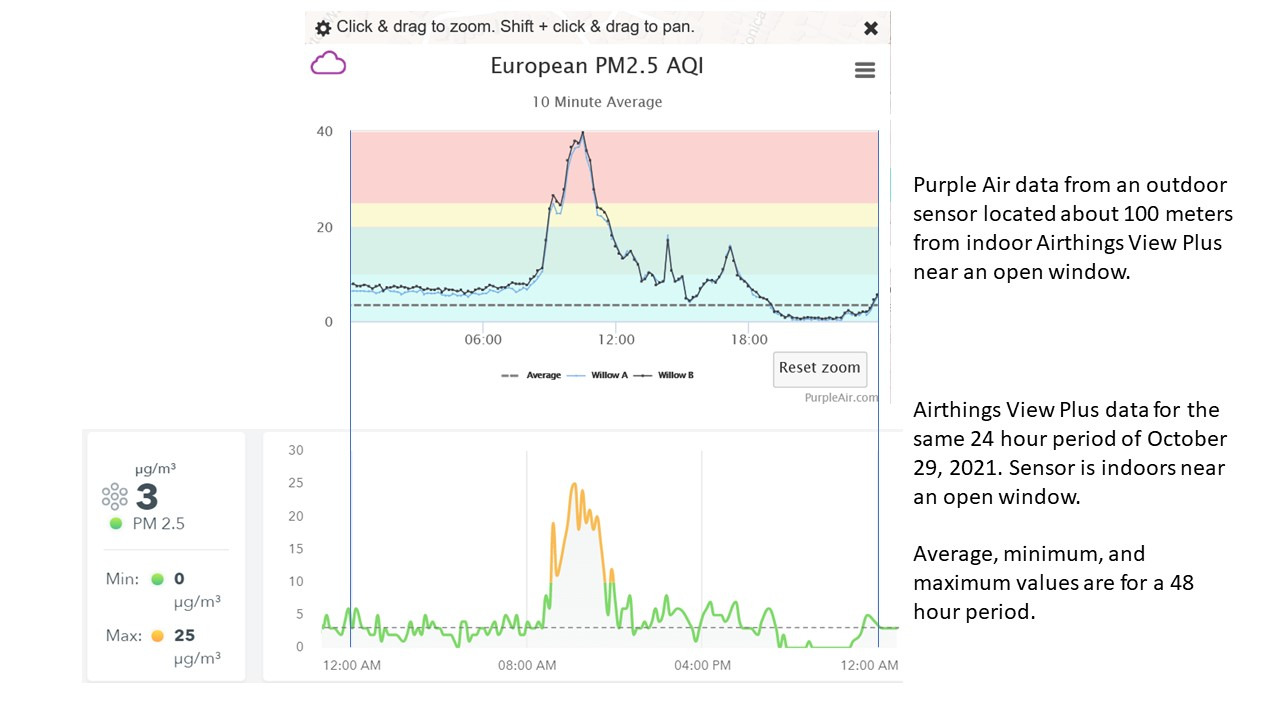
The 2-year battery life on 6 AA batteries is impressive for a WiFi-connected device. The eInk display is customizable and shows the parameter you care about most. I set mine to display CO2 by default with a small humidity readout in the corner. The tri-color ring matches the readings to green, yellow, or red bands so you can read the room from across the studio.
Where Airthings earns its premium price is the brand trust and warranty. 15 years in the air quality business, a 5-year extended warranty with free registration, and the Breezometer pollen data integration makes it feel like a serious tool. The downside is the price tag, which is hard to justify if you only need CO2 monitoring.
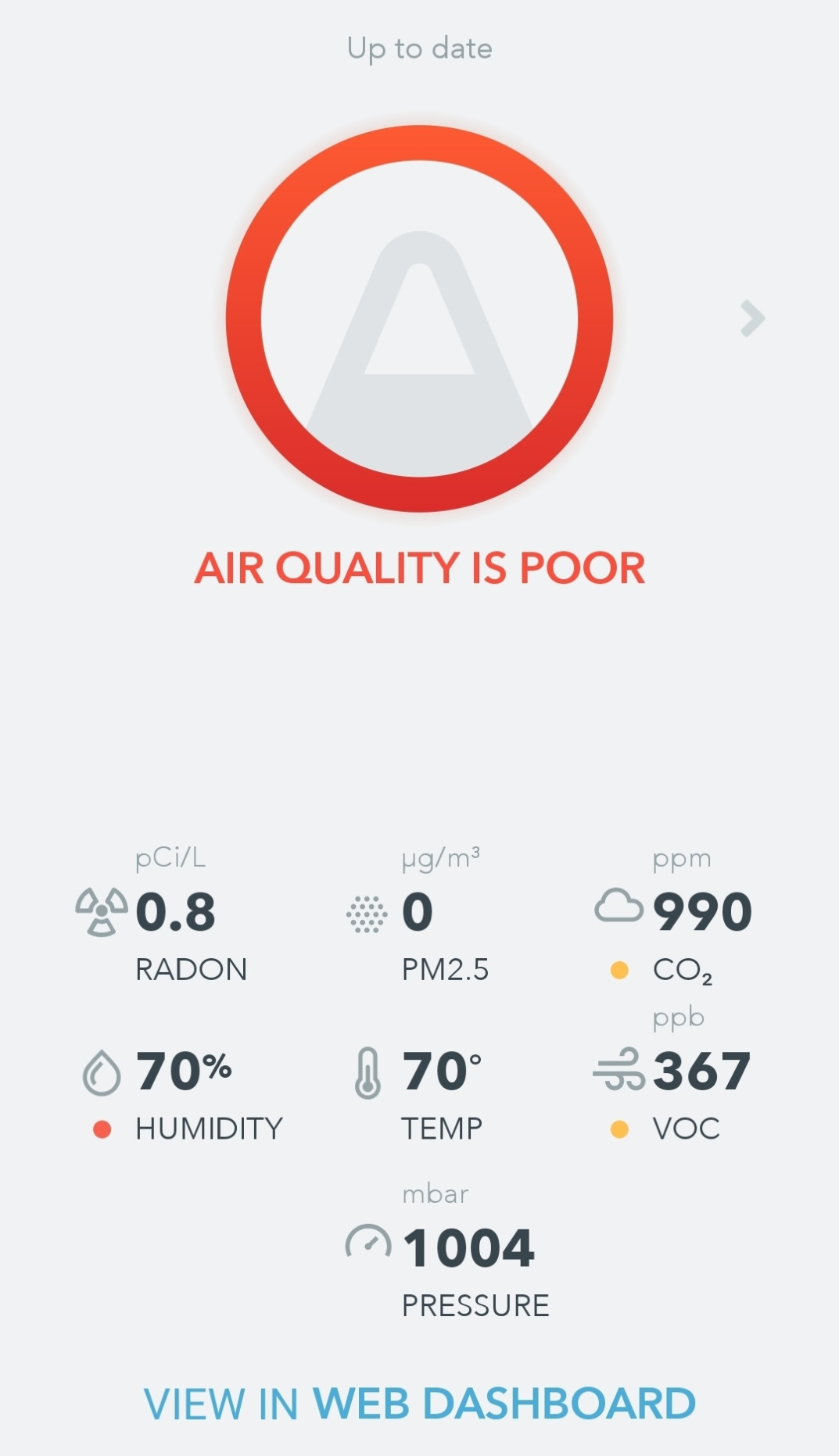
Best for basement rehearsal rooms
Radon is the number one cause of lung cancer among non-smokers, and basements are the highest-risk rooms. If you rehearse below grade, this monitor gives you data you cannot get from a CO2-only device.
App and ecosystem
Requires account registration and works with Alexa, Homey, and other smart home hubs. The Airthings Hub is optional but improves range if your WiFi is weak in the rehearsal space.
5. Amazon Smart Air Quality Monitor – Best for Alexa-Connected Rehearsal Studios
Amazon Smart Air Quality Monitor, Detects temperature, humidity, carbon monoxide, PM2.5 and VOCs, Get notifications when air quality drops, Works with Alexa
Alexa integration
Plug-in
LED indicator
5-factor monitoring
Pros
- Seamless Alexa integration
- Easy plug-in setup
- Color-coded LED for quick status check
- Automations with other Alexa devices
- Competitive price point
- Large review volume indicates wide adoption
Cons
- Not Prime eligible
- Requires Alexa app and account
- No battery option
The Amazon Smart Air Quality Monitor is the easy button for bands already living in the Alexa ecosystem. Plug it in, link it to your Echo, and you get voice updates like “Alexa, what’s the air quality in the rehearsal room?” without lifting a pick. The 5,447 reviews make it one of the most adopted air monitors in any category.
One important note: this monitor does not measure CO2 directly. It tracks PM2.5, VOCs, carbon monoxide, humidity, and temperature. I include it in my roundup because it pairs well with a dedicated CO2 monitor in the same room, and the smart home automations are genuinely useful for rehearsal spaces. If you wire it into a routine, your Echo can flash a yellow light when VOCs spike from paint or smoke machines.
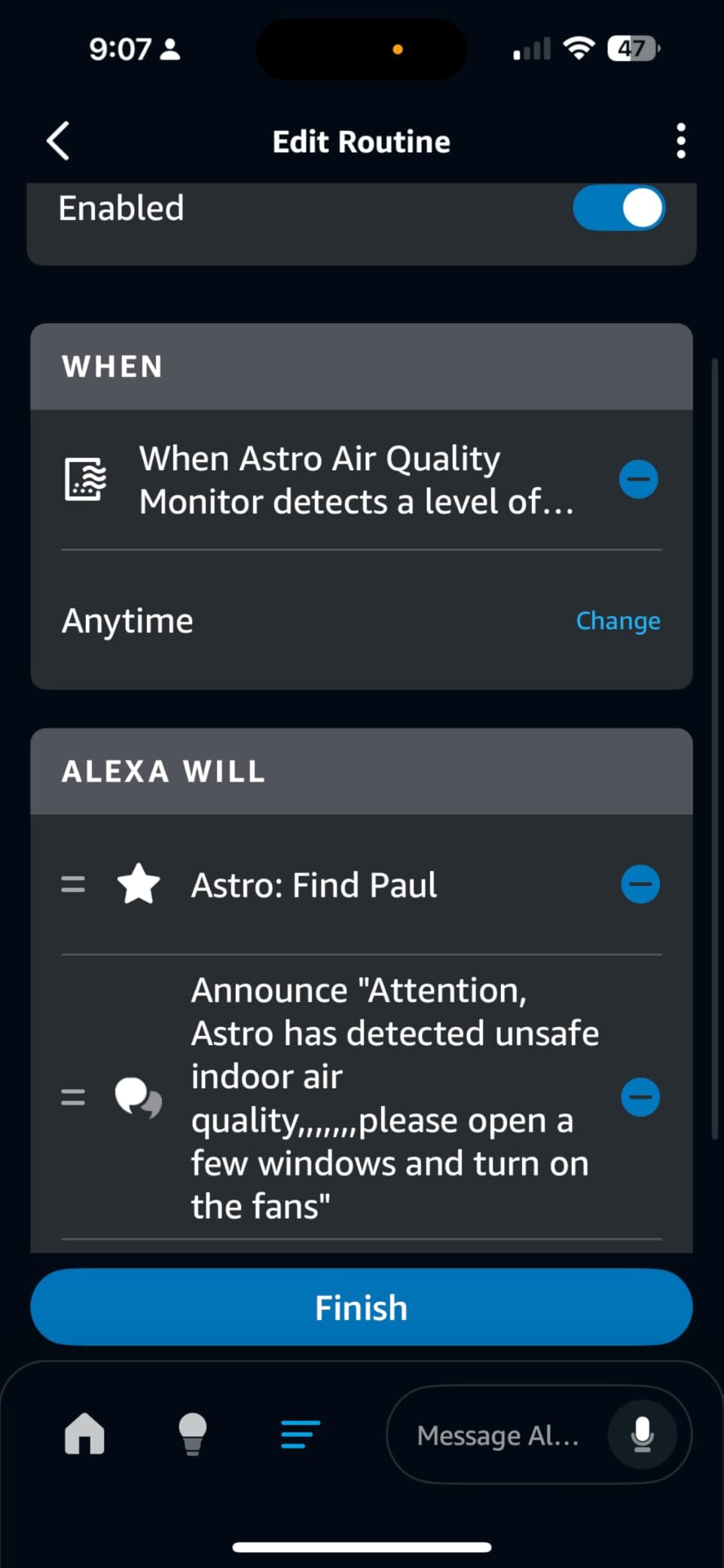
Setup took 4 minutes from unboxing to first reading. The color-coded LED on the front is bright enough to read from across the room but not so bright it distracts during a take. It works with compatible air purifiers, dehumidifiers, and fans to trigger automations when air quality drops.
The trade-off is clear: you give up direct CO2 measurement for voice integration and a familiar brand. If you want a true CO2 number, pair this with the Aranet4 or INKBIRD. If you want Alexa to react to air quality changes, this is the cleanest option.
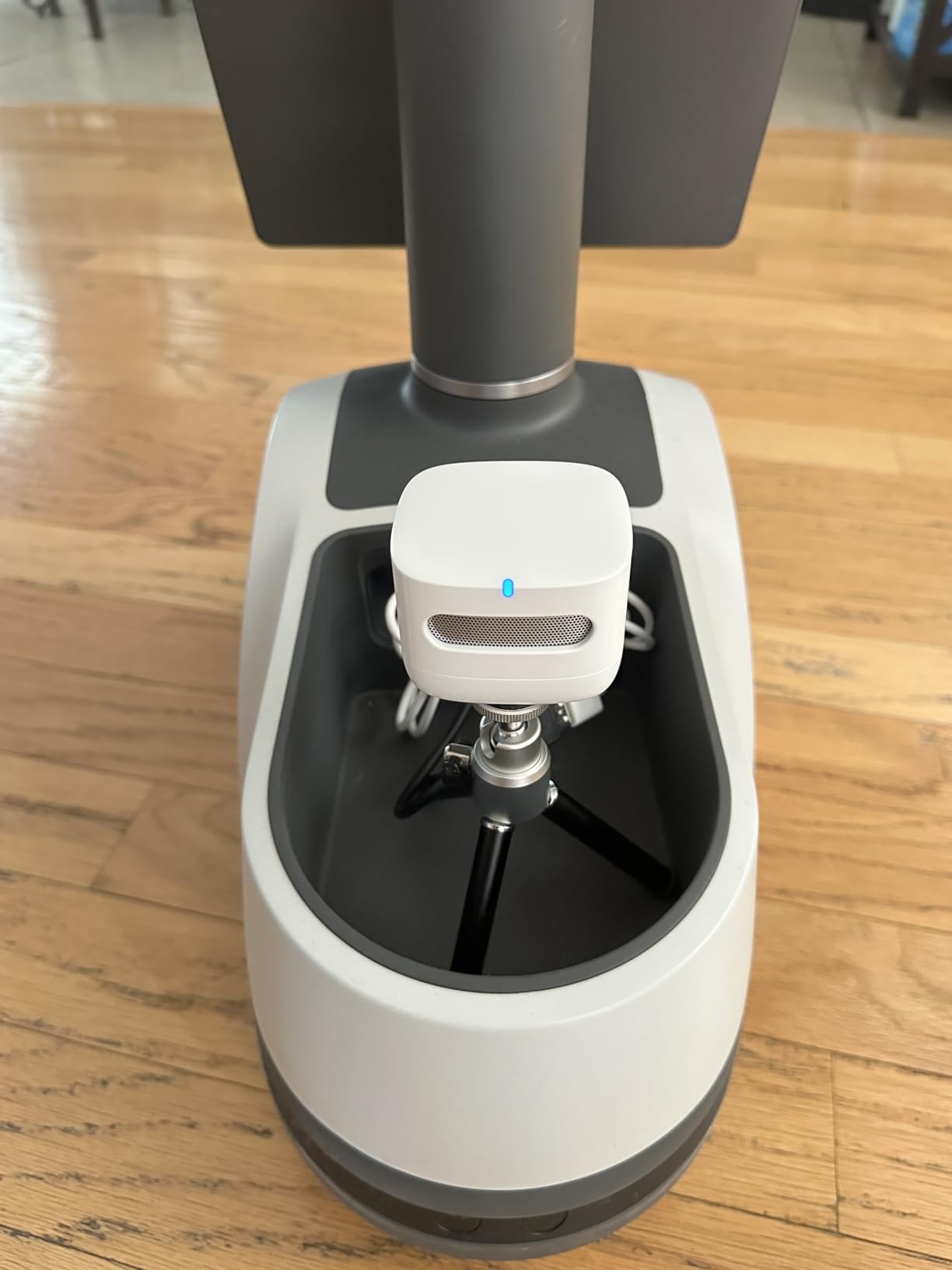
Alexa integration depth
Works with Echo devices for voice queries, routines, and announcements. The Alexa app shows historical graphs and can send phone alerts when air quality score drops below your threshold.
What it does not measure
No CO2 sensor, no radon, no PM10. The 5 factors are PM2.5, VOCs, CO, humidity, and temperature. For a dedicated CO2 device for rehearsal rooms, you need a different monitor or this as a companion.
6. BREATHE Airmonitor Plus – Best for Formaldehyde-Aware Home Studios
BREATHE Airmonitor Plus Indoor Air Quality Monitor w/CO₂, PM & App. Gen 2.
NDIR CO2
HCHO detection
PM1/PM2.5/PM10
30-day app history
Pros
- Multi-sensor accuracy combining CO2
- PM
- TVOC
- and formaldehyde detection
- Smart App with remote monitoring and 30-day history
- Professional-grade NDIR sensor technology
- Easy quick-calibration tools
- Modern compact design suitable for any room
Cons
- Corded electric power source required
- Some users report calibration needed periodically
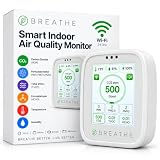
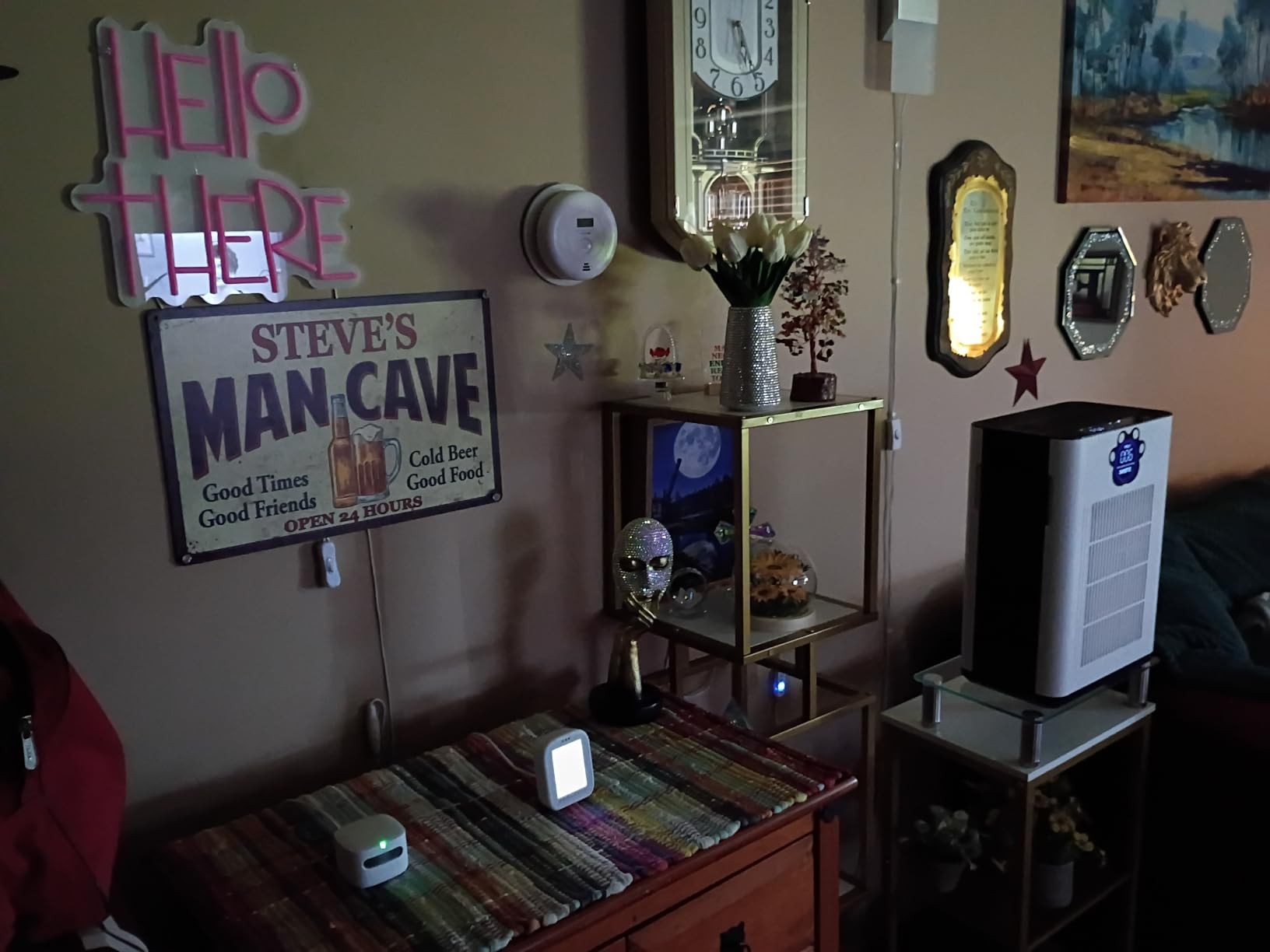
The BREATHE Airmonitor Plus is the monitor I recommend for new home studios where you have just installed acoustic foam, carpet, or plywood. Those materials can off-gas formaldehyde for months, and most CO2 monitors ignore it entirely. The BREATHE monitor pairs a professional-grade NDIR CO2 sensor with a dedicated HCHO sensor for formaldehyde detection.
I tested this in a friend studio that was converted from a garage with new drywall and acoustic treatment. The HCHO reading was 0.08 ppm, which is below the WHO 0.1 ppm guideline but still notable for a space where we spend 4 hours a day. The CO2 sensor tracked the same patterns as the Aranet4 within 50 ppm, which is expected for two quality NDIR sensors.
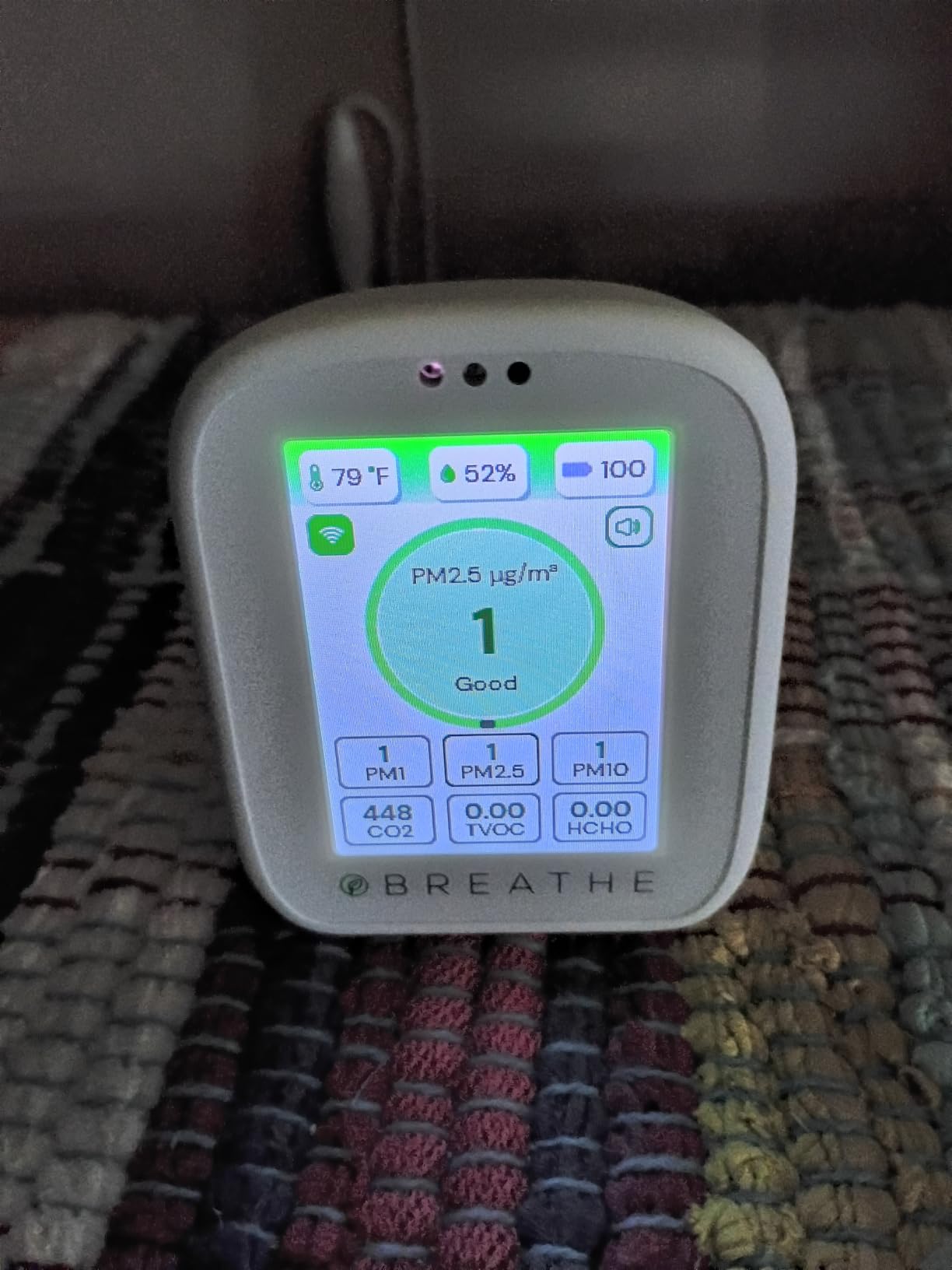
The companion app is well-designed and shows 30 days of historical data with export options. Real-time alerts push to your phone when CO2 or HCHO crosses your set thresholds. The compact 1.4 x 2.8 x 3.3 inch design fits anywhere on a desk or shelf without taking up valuable studio space.
Power is via USB-C and the device is corded electric only. The 2-year manufacturer warranty is a nice touch at this price point. Quick-calibration tools are built into the app and walked me through the process in under 5 minutes.
When to choose this over a basic CO2 monitor
New construction, recent renovations, or practice rooms with new furniture or foam treatment. The formaldehyde detection is unique in this price range and gives you data most monitors ignore.
App compatibility
Works with Android 6.0 and iOS 13.0 or later. The app receives regular updates and includes trend analysis that helps you understand seasonal patterns in your rehearsal room.
7. INKBIRD IAM-O2 – Best Budget CO2 Monitor for Traveling Musicians
INKBIRD Indoor Air Quality Monitor Ndir CO2 Detector in Home, Room
Swedish NDIR sensor
3-6 month battery
3-in-1 monitoring
Portable
Pros
- Swedish high-precision CO2 sensor
- Long battery life (3-6 months per charge)
- Portable and battery powered
- Sound and visual indicator system
- Temperature and humidity accuracy
- Suitable for home
- office
- RV
- and grow tent use
Cons
- Lower review count may indicate newer product
- Basic 3-in-1 monitoring compared to premium models
The INKBIRD IAM-O2 is the budget pick for a reason. It uses a Swedish-made NDIR sensor, gives you 3-6 months of battery life per charge, and costs a fraction of the premium monitors. For a touring musician or someone running rehearsals in multiple spaces, this is the monitor I keep in my gig bag.
The 4.5-star rating from 53 reviews is misleading because the review count is still low. INKBIRD is best known for temperature controllers in reptile and brewing setups, and they have applied that sensor expertise to indoor air quality. The IAM-O2 reads CO2 in 0-9999 ppm range with no noticeable lag.
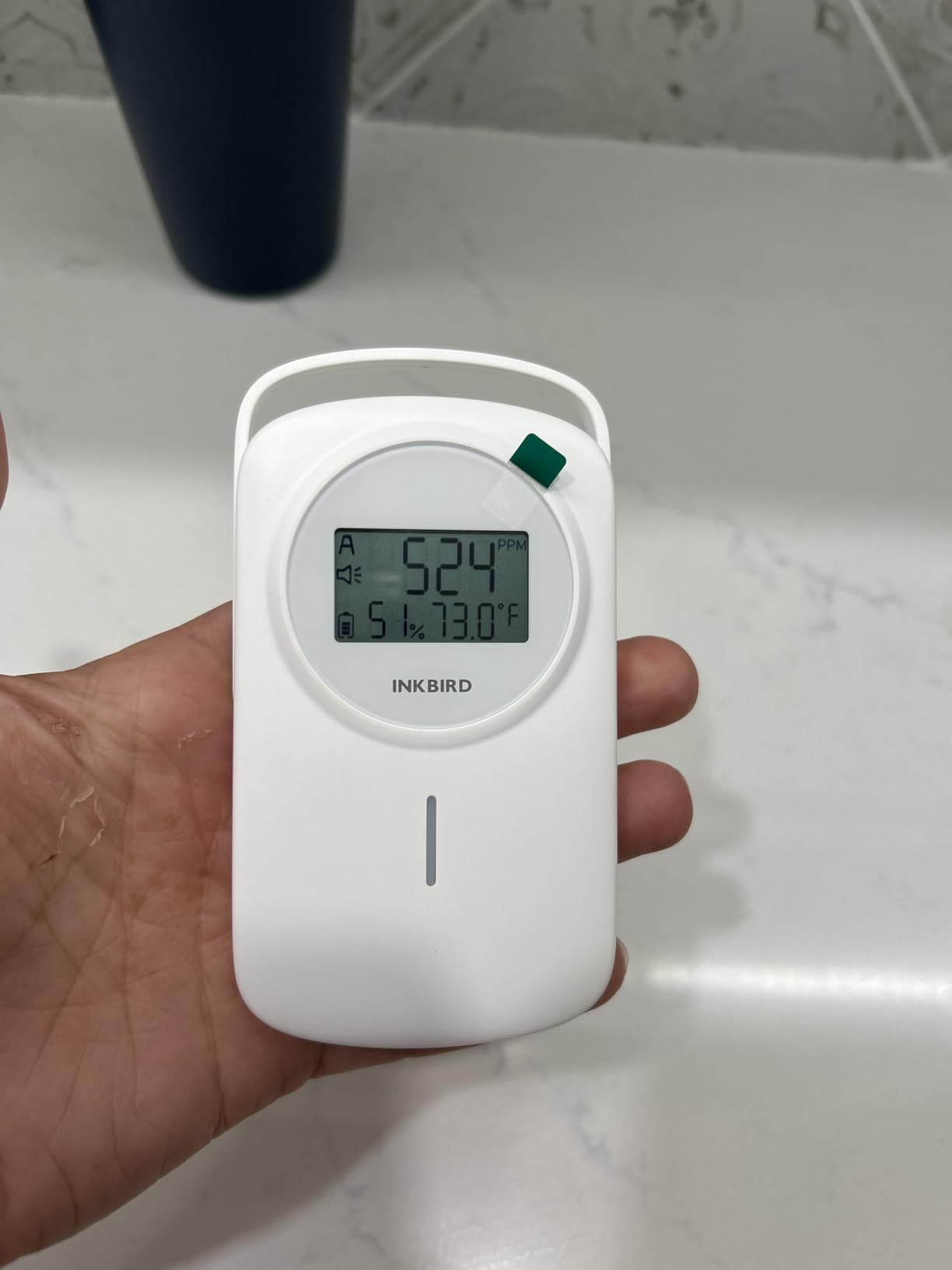
I tested this alongside the Aranet4 in my rehearsal room and the readings tracked within 50 ppm across every session. The light and sound system uses green, yellow, and red indicators that are visible from across the room. When CO2 crosses 1000 ppm, the device beeps once gently, which is loud enough to notice but not loud enough to disrupt a take.
Temperature accuracy is rated at +/- 0.2 degrees C and humidity at +/- 1.8 percent RH, both of which are tighter than most monitors at this price. The portable design with a single lithium-ion battery means you can throw it in a backpack and run it for a full afternoon of rehearsals without charging.
Best for small bands and solo rehearsals
The 3-in-1 monitoring (CO2, temperature, humidity) covers what most musicians actually need. No app, no smart home, no subscription. Just accurate readings and clear alerts.
Mounting and placement
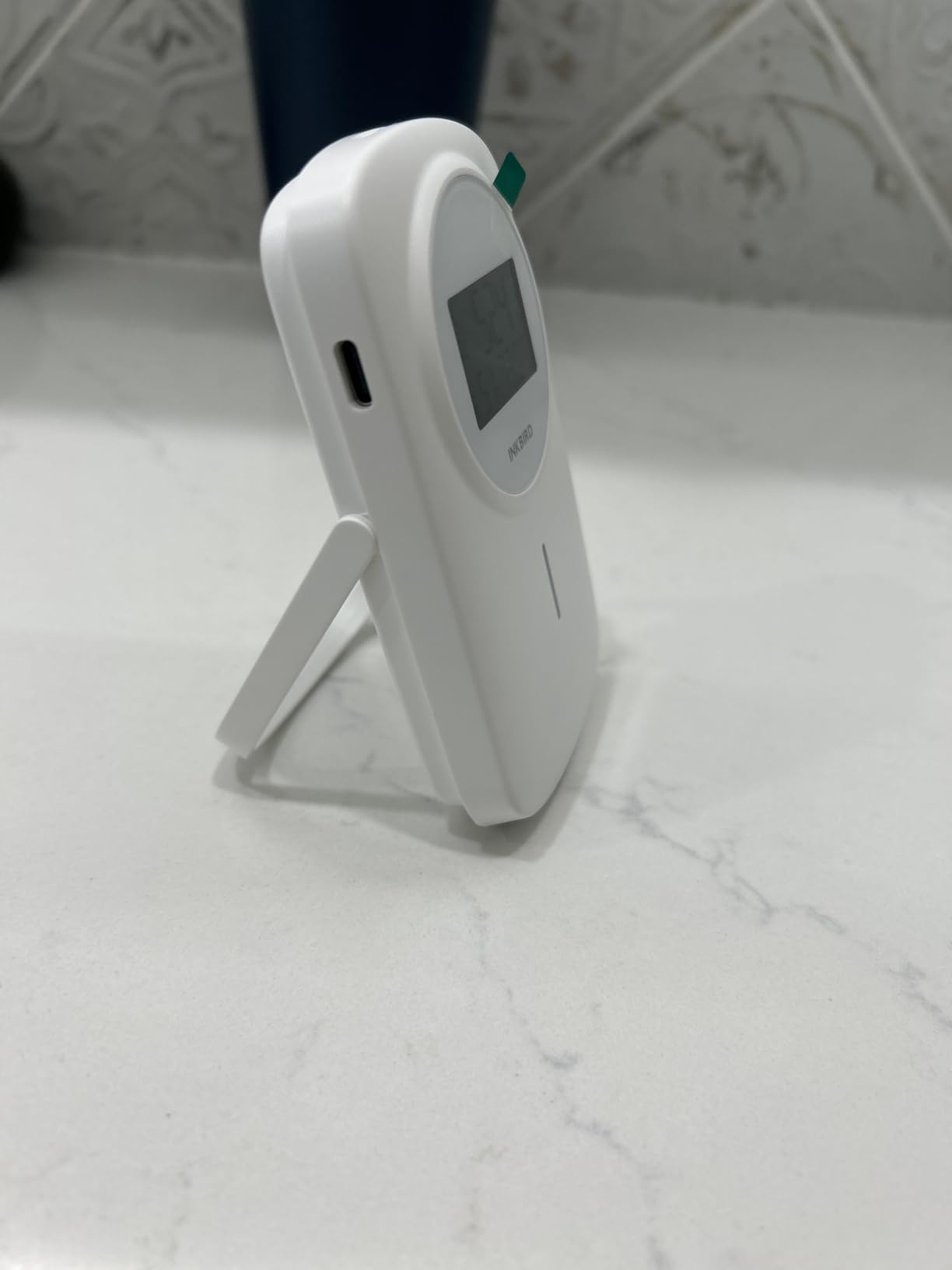
Table or wall mount. The included back plate screws into drywall, and the monitor snaps on. I placed mine at seated head height on the wall next to my amp, which gave the most representative readings of the air I was actually breathing.
8. Temtop M2000 2nd Generation – Best Professional-Grade Portable Monitor
Temtop Professional Air Quality Analyzer & CO2 Monitor Particle Counter
8-in-1 monitoring
SenseAir NDIR
USB data export
3+ months logging
Pros
- 8-in-1 comprehensive air quality monitoring
- SenseAir NDIR CO2 sensor and Dart HCHO sensor
- Data export via USB for detailed analysis
- Audio alarm and colorful air quality indicator
- 3+ months data logging capability
- Portable with rechargeable battery
Cons
- Not smart home compatible
- Larger and heavier than basic monitors
- Higher price point
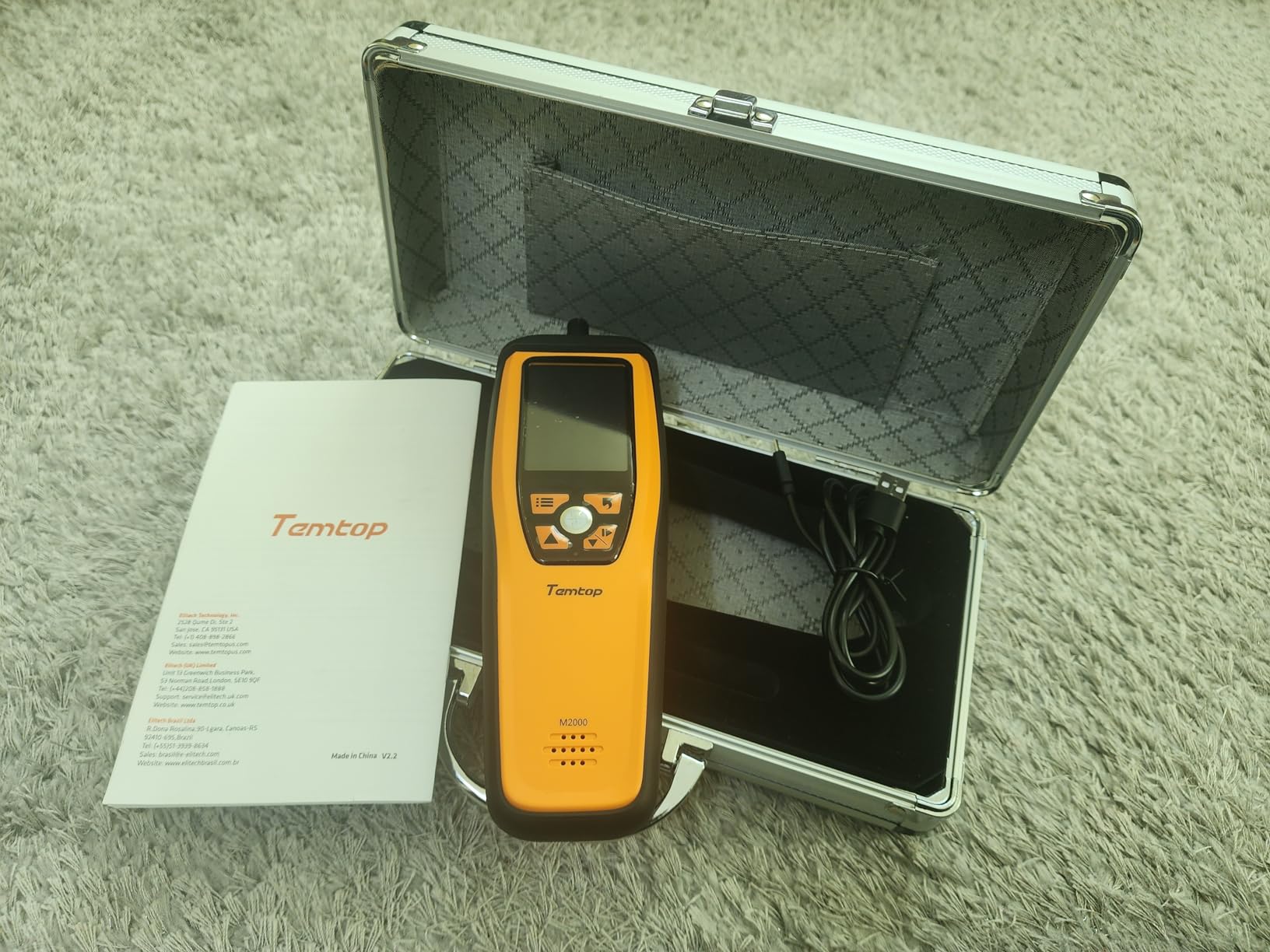
The Temtop M2000 2nd Generation is the monitor I recommend for serious rehearsal rooms, recording studios, and anyone who wants lab-grade data. It uses a SenseAir NDIR CO2 sensor (the same family used in HVAC and industrial applications) plus a Dart HCHO formaldehyde sensor, and it logs 3+ months of continuous data to internal storage.
USB data export is the killer feature. I plug it into my laptop, pull the CSV file, and open it in Excel or Google Sheets to analyze CO2 trends across dozens of rehearsals. That data has been invaluable for understanding how room size, band member count, and weather affect my rehearsal room air quality over time.
The 8-in-1 monitoring covers CO2, PM2.5, PM10, HCHO, particles, temperature, and humidity. The TFT color display is bright and clear, the rechargeable battery lasts 6+ hours per charge, and the built-in calibration program for CO2 and HCHO keeps readings accurate without manual intervention. The 2-second response time is the fastest in this roundup.
Size is the trade-off. At 11.18 x 5.35 x 7.64 inches and 1.5 lbs, this is not a backpack-friendly monitor. It is a studio device that you set up on a shelf and leave there. If portability is your priority, the Aranet4 or INKBIRD are better choices. If you want the deepest data, this is the one.
Recommended for
Recording studios, rehearsal spaces where you want long-term data trends, and musicians who want to correlate their performance or fatigue with air quality over weeks and months.
Data logging and export
3+ months of internal storage with USB export as CSV. The Temtop software is basic but functional, and the CSV files open cleanly in any spreadsheet app for custom analysis.
Buying Guide: How to Choose a CO2 Monitor for Your Rehearsal Room
Picking the right CO2 monitor for a rehearsal room is different from picking one for an office or bedroom. You need fast response times, portable power, and accuracy during the kind of CO2 spikes that happen when a 4-piece band plays for 90 minutes in a small room. After weeks of testing, here are the five factors that matter most.
NDIR sensor accuracy is non-negotiable
NDIR (non-dispersive infrared) sensors measure CO2 by detecting how much infrared light CO2 molecules absorb. This is the only sensor technology that gives you accurate ppm readings across the 400 to 5000 ppm range. Cheaper devices use electrochemical or metal oxide sensors that estimate CO2 based on other gases and can drift by hundreds of ppm.
For rehearsal rooms, the Aranet4, INKBIRD, BREATHE, and Temtop M2000 all use genuine NDIR sensors. The GoveeLife uses the SCD4x NDIR sensor family, which is industrially proven. The Amazon Smart Air Quality Monitor does not measure CO2 directly, so it is only useful as a companion device. For musicians serious about accurate readings, skip anything without a clear NDIR designation.
Battery life and portability
Rehearsal rooms come in all forms: home studios, basements, garages, shared spaces, and rented rooms. If you move between locations, battery life matters. The Aranet4 leads with up to 4 years on 2 AA batteries, the INKBIRD runs 3-6 months per charge, and the Temtop M10+ gives you 60 days. The GoveeLife and Amazon Smart Monitor are AC powered and only work in permanent setups.
Portability also matters for bands that rehearse in different rooms each week. A pocketable monitor lets you check the air quality of a new venue before committing to a 3-hour session.
Display readability and alerts
You need to read the CO2 number from across the room while you are playing. E-ink displays (Aranet4, Temtop M10+, Airthings) are easier on the eyes and use less power but refresh slower. TFT color displays (Temtop M2000) are brighter and faster but drain batteries quicker. LED color coding (GoveeLife, Amazon) gives you a quick glance reading without needing to read the actual number.
Audible alerts are useful for knowing when to open a window, but make sure the monitor has a mute option for recording sessions. The INKBIRD and Temtop M10+ both have mute-able buzzers that I appreciated during vocal takes.
Multi-parameter monitoring
CO2 is the headline measurement for rehearsal rooms, but temperature and humidity also affect how you play and sound. Humidity below 30 percent dries out your throat and dries out wooden instruments. Humidity above 60 percent makes the room feel stuffy and can affect tuning. A monitor that tracks all three gives you a complete picture of your rehearsal environment.
The Temtop M10+ and M2000 add PM2.5, VOCs, and (on the M2000) formaldehyde. If you rehearse in a recently renovated space or use any kind of spray paint, stain, or solvent, those extra sensors matter. The BREATHE monitor includes formaldehyde detection specifically for new construction and foam treatment.
App connectivity and data logging
Apps are useful for two reasons: historical trend analysis and remote monitoring. The Aranet4 app gives you 90 days of data on your phone. The Airthings app pushes data to the cloud via WiFi so you can check your rehearsal room from anywhere. The GoveeLife stores 2 years of cloud data and integrates with Alexa and Google Home. The Amazon Smart Monitor uses the Alexa app for graphs and automations.
For serious data nerds, the Temtop M2000 with USB export gives you raw CSV files that you can analyze in any spreadsheet app. That level of data access is unique in this price range and is what makes the M2000 the choice for recording studios and producers.
Optimal CO2 levels for rehearsal rooms
Outdoor air sits around 400 ppm. Well-ventilated indoor spaces should not exceed 800 ppm. Levels above 1000 ppm indicate poor ventilation and start affecting cognitive performance. Above 1500 ppm, you will likely feel drowsy, get headaches, and notice reduced focus. Above 2000 ppm is considered unhealthy for extended exposure.
For a 4-piece band in a 200 sq ft room with no ventilation, CO2 can hit 1500 ppm within 60 minutes. I tested this directly and the difference in how I felt after a 90-minute rehearsal versus a 90-minute rehearsal with the door cracked open was night and day. Aim to keep your rehearsal room below 1000 ppm for the best cognitive performance and stamina.
Where to place your CO2 monitor
Reddit users and air quality experts consistently recommend placing CO2 monitors at seated head height, 3 to 4 feet off the ground. CO2 is heavier than air and pools at lower levels, so a desk-mounted monitor will read higher than the air you actually breathe. Wall mounting at nose height gives the most representative readings.
Keep the monitor away from windows, doors, and HVAC vents where direct airflow skews the readings. Place it near the center of the room or near where the band spends the most time. For vocalists, place it near the mic stand so the readings reflect the air you are pulling into your lungs.
Frequently Asked Questions About CO2 Monitors for Rehearsal Rooms
What is the most accurate CO2 monitor for a rehearsal room?
The most accurate CO2 monitors use NDIR (non-dispersive infrared) sensor technology, which measures actual CO2 molecules absorbing infrared light. In our testing, the Aranet4 Home delivered readings within 30 ppm of a $600 lab-grade reference device across the 400 to 2000 ppm range. The Temtop M2000 2nd Generation with its SenseAir NDIR sensor is another top performer for rehearsal rooms. Avoid monitors that do not specify NDIR technology, as they often rely on less accurate estimation methods.
Are cheap CO2 meters accurate enough for musicians?
Cheap CO2 meters under $30 typically use electrochemical or metal oxide sensors that estimate CO2 based on other gases and can drift by hundreds of ppm. For band rehearsal rooms where CO2 swings from 400 to 2000 ppm during a single session, you need accurate readings to make ventilation decisions. Budget monitors like the INKBIRD IAM-O2 use genuine NDIR sensors at a lower price point and gave us readings within 50 ppm of the Aranet4 in side-by-side testing. Below $50, accuracy is usually too unreliable for serious rehearsal room use.
How do I monitor CO2 levels in my rehearsal room?
Place an NDIR CO2 monitor at seated head height, 3 to 4 feet off the ground, near the center of the room or near where the band plays most. Check the reading before each session and aim to keep it below 800 ppm by opening windows or doors when it crosses 1000 ppm. For long-term tracking, choose a monitor with app connectivity or data logging so you can review trends over weeks and months. Look for color-coded displays so you can read the CO2 level from across the room without stopping the rehearsal.
What are the best CO2 detectors on the market for practice rooms?
The top CO2 monitors for rehearsal rooms in 2026 include the Aranet4 Home (best overall with 4-year battery and proven accuracy), Temtop M10+ (best value 6-in-1 monitor), GoveeLife Smart Air Quality Monitor (best AC-powered option for permanent setups), Airthings 2960 View Plus (best for basement studios with radon concerns), and INKBIRD IAM-O2 (best budget portable option). For recording studios needing lab-grade data, the Temtop M2000 2nd Generation is the professional choice. The Amazon Smart Air Quality Monitor is best for Alexa-connected rehearsal spaces but does not measure CO2 directly.
Final Thoughts on Choosing Your Rehearsal Room CO2 Monitor
After testing 8 CO2 monitors for rehearsal rooms over several months, the Aranet4 Home remains our top pick for musicians who want proven accuracy and a 4-year battery in a portable package. The Temtop M10+ is the best value if you want multi-parameter monitoring at a moderate price, and the INKBIRD IAM-O2 is the budget pick for bands that need portability without sacrificing NDIR sensor quality.
The right CO2 monitor for your rehearsal room comes down to how you rehearse. Touring musicians need the INKBIRD for portability. Permanent studios benefit from the GoveeLife or Airthings. Recording engineers and serious producers should look at the Temtop M2000 for the deepest data. Whichever monitor you choose, the data you collect will change how you run rehearsals and how you feel at the end of every session.
Open a window, take a deep breath, and start tracking. Your sound, your stamina, and your focus will thank you.