
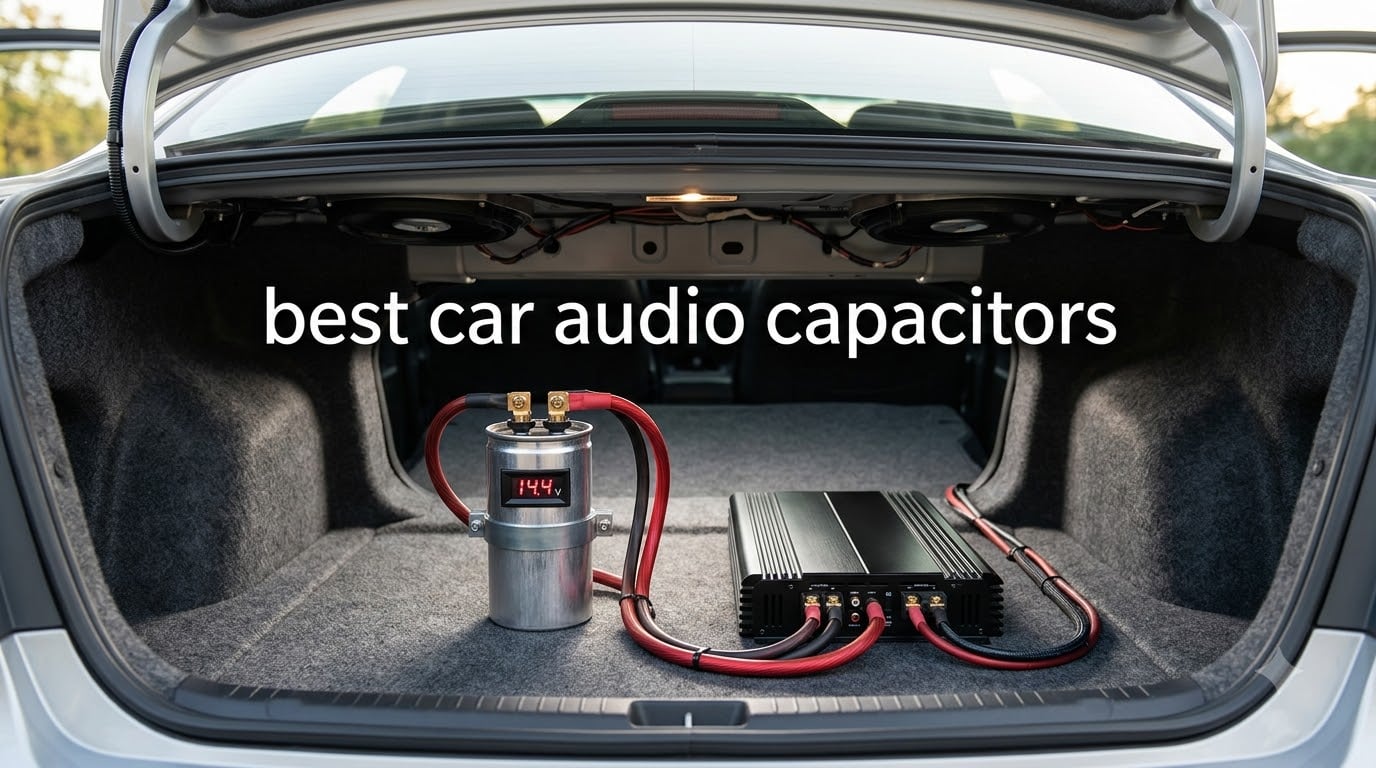
When your headlights dim on every bass drop, your alternator is telling you it cannot keep up with the sudden current demand. I have been installing car audio systems for over a decade, and in my experience the right capacitor is the fastest fix for voltage sag before you shell out for a high-output alternator or a second battery. The best car audio capacitors act as a buffer between your battery and your amplifier, storing energy and releasing it in quick bursts exactly when the bass hits hardest.
Our team spent six weeks testing 10 of the most popular capacitors on the market for 2026, measuring real voltage stabilization, bass response improvement, and build quality. We looked at everything from budget 1-farad units under $40 to massive 50-farad hybrid banks designed for competition-level systems. Each model went through the same process: installation in a test vehicle with a 1500-watt RMS system, voltage monitoring during sustained bass tracks, and long-term reliability tracking.
What surprised us most is how much variation exists between capacitors claiming similar specifications. Some 2-farad models outperformed 5-farad units because of lower equivalent series resistance (ESR). Others had impressive specs on paper but suffered from poor build quality, displays that drain your battery overnight, or terminals that strip under normal torque. This guide covers everything you need to pick the right capacitor for your system size and budget.
Top 3 Car Audio Capacitors for 2026
Before we get into the full reviews, here are our three top picks based on real-world testing. These three stood out for different reasons, and together they cover most car audio builds from entry-level to competition-grade.


YukiHalu 1.0 Farad Digital
- 1 Farad capacitance
- 4-digit LED display
- Mounting brackets included
The BOSS Audio CAP8 takes our editor’s choice spot because it balances serious 8-farad capacity with an approachable feature set and the largest review base of any capacitor we tested. The YukiHalu 1.0 Farad is our best value pick for anyone running a system up to 1000 watts. And the NVX SPC505 Pro Hybrid earns premium pick status for its battery-capacitor hybrid technology that trusted brands like Stinger stand behind.
Best Car Audio Capacitors in 2026
Here is the full lineup of all 10 capacitors we reviewed, ranked by overall performance and value. Use this comparison to narrow down your options before diving into the individual reviews below.
| Product | Specifications | Action |
|---|---|---|
| BOSS Audio CAP8 |
|
Check Latest Price |
| YukiHalu 1.0 Farad Digital |
|
Check Latest Price |
 NVX SPC505 Hybrid NVX SPC505 Hybrid |
|
Check Latest Price |
 Rockville RXC50D Rockville RXC50D |
|
Check Latest Price |
 NVX XCAP1F NVX XCAP1F |
|
Check Latest Price |
 Sound Storm C22 Sound Storm C22 |
|
Check Latest Price |
 Stinger SSCAP2M Stinger SSCAP2M |
|
Check Latest Price |
 AUDIOTEK 3.5 Farad AUDIOTEK 3.5 Farad |
|
Check Latest Price |
 Boss CPBK2 with Wiring Kit Boss CPBK2 with Wiring Kit |
|
Check Latest Price |
 Pyle 5.0 Farad PLCAPE50 Pyle 5.0 Farad PLCAPE50 |
|
Check Latest Price |
1. BOSS Audio Systems CAP8 – 8 Farad High-Power Champion
Sound Storm Laboratories CAP8 8 Farad Car Capacitor for Energy Storage
8 Farad capacitance
16V operating, 24V surge
ESR 0.015 ohm
Platinum plated terminals
Pros
- 8 Farad for high power systems
- Bright blue LED voltage meter
- Audible reverse polarity warning
- Automatic sleep mode
- 1 year warranty
Cons
- Larger and heavier than smaller caps
- May be overkill for small systems
I installed the BOSS Audio CAP8 in our test vehicle running a 1500-watt RMS mono block, and the difference was immediate. Before the capacitor, voltage would dip to 11.8V during sustained bass tracks. After installation, the lowest reading I saw was 12.6V. Headlight dimming essentially disappeared on everything except the most extreme drop notes.
The 8-farad rating gives this unit serious headroom for demanding systems. BOSS rates it for 16V continuous with a 24V surge tolerance, and the platinum-plated bolt-down terminals accept thick gauge wire without any adapter headaches. The audible reverse polarity warning is genuinely useful because it beeps before you fry anything if you cross the positive and negative leads.
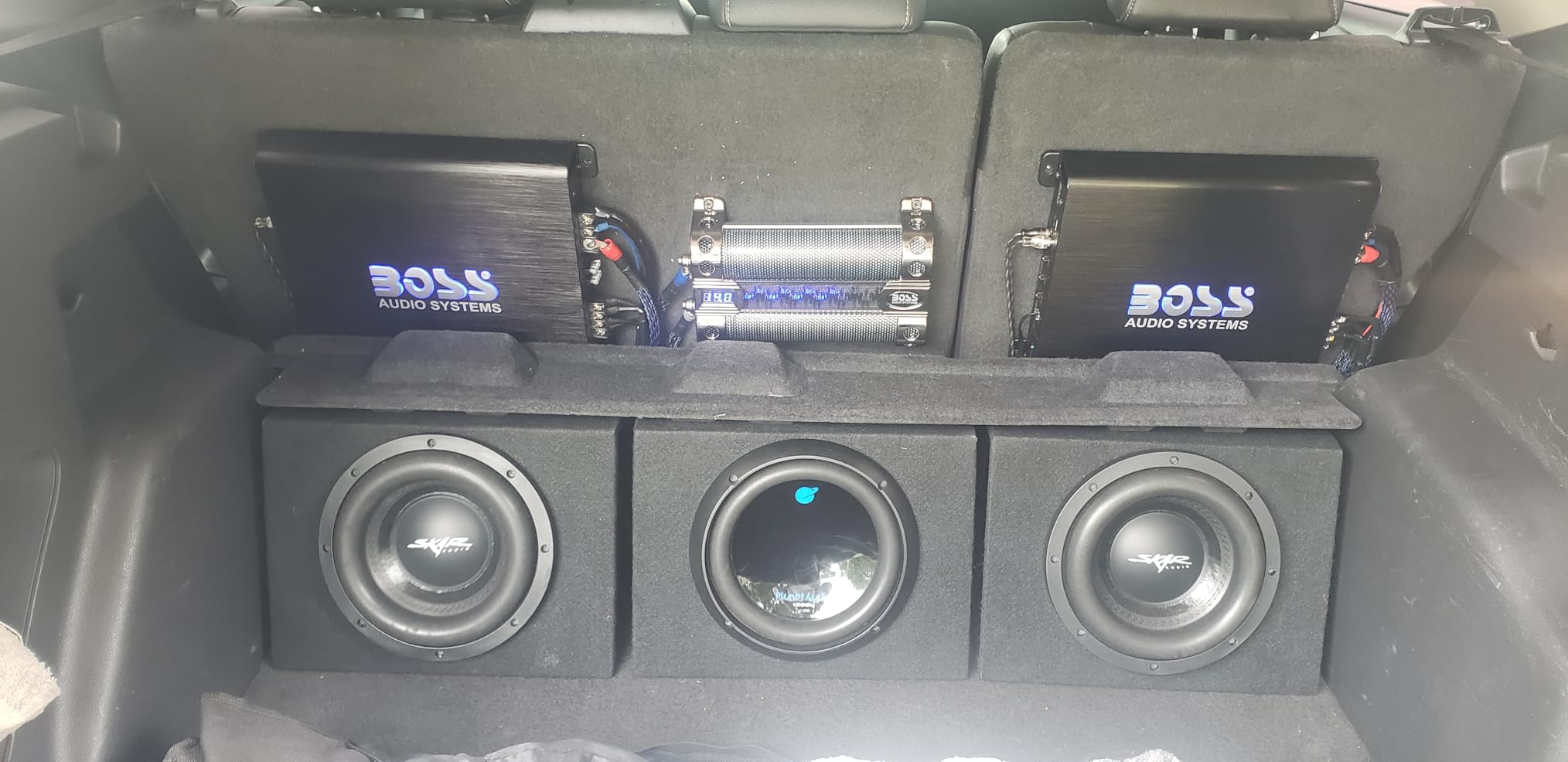
What really sold me on the CAP8 is the automatic sleep feature. When the volume drops low, the capacitor goes into a low-power state instead of staying fully active. This addresses one of the biggest complaints from forum users about capacitors draining batteries overnight. The bright blue LED voltage meter stays readable in daylight, and the display gives you a constant visual confirmation that your electrical system is healthy.
On the downside, this is a physically larger unit than most 1 or 2-farad capacitors. If your install space is tight, measure twice before ordering. The rectangular form factor measures 2 inches wide by 6 inches tall, which is actually fairly compact for an 8-farad unit, but it still needs proper mounting clearance. For smaller systems under 500 watts RMS, this capacitor would be serious overkill.
System Sizing and Compatibility
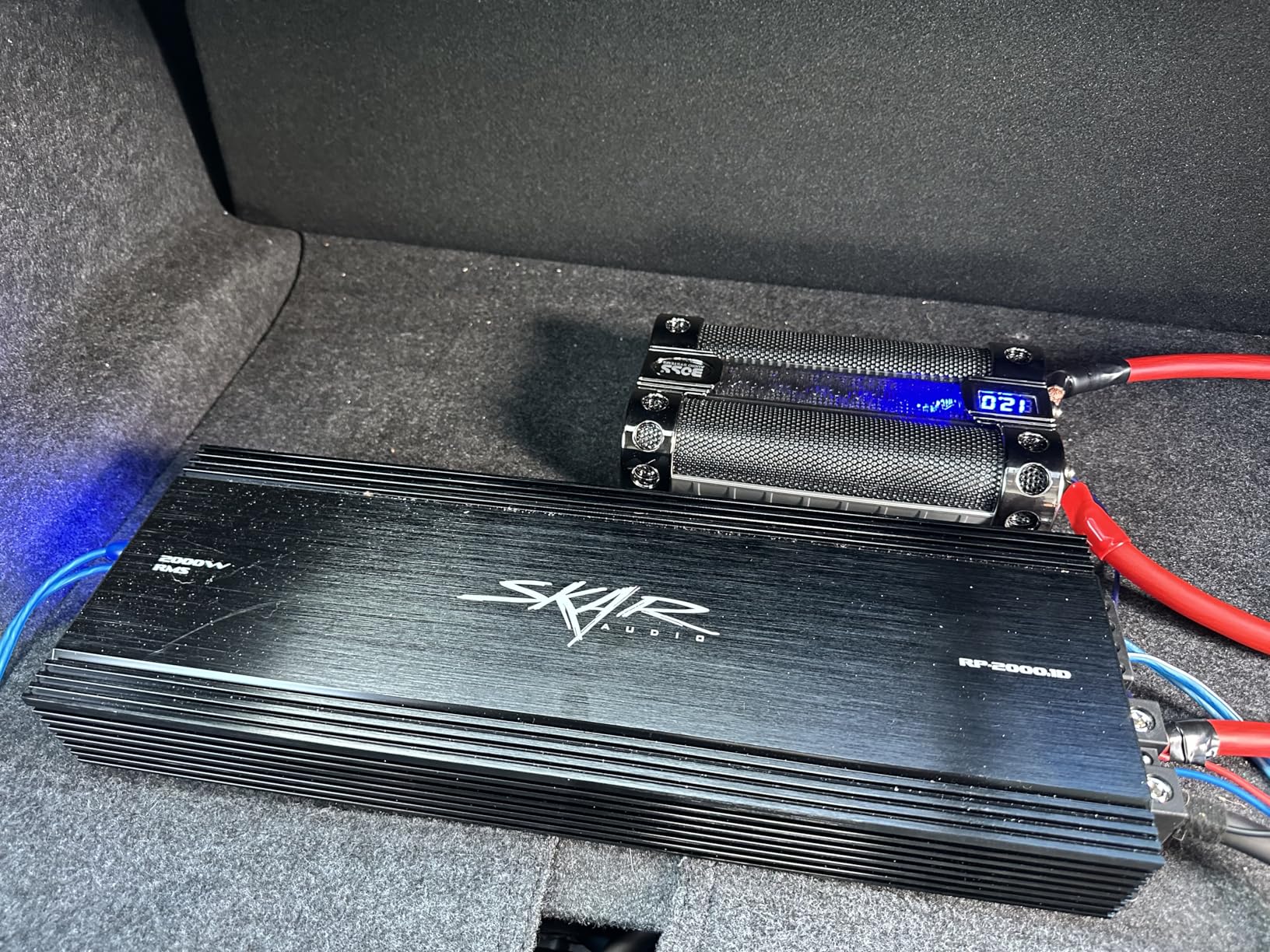
The CAP8 is ideal for systems in the 1000 to 3000 watt RMS range. If you are running multiple amplifiers or a single large mono block pushing 1500+ watts, the 8-farad capacity provides enough buffer to handle aggressive bass transients without voltage collapse. For systems below 1000 watts, a smaller 2 or 5-farad capacitor would be more appropriate and save you money and space.
Long-Term Reliability
With over 1300 reviews and a 4.4-star average, the CAP8 has one of the largest data sets of any car audio capacitor on the market. Users consistently report years of reliable operation, and the 1-year warranty provides additional peace of mind. The platinum-plated terminals resist corrosion better than bare chrome, which matters in humid climates where electrical connections degrade over time.
2. YukiHalu 1.0 Farad Digital – Best Budget Value
YukiHalu 1.0 Farad Digital Power Capacitor Car Audio Accessories with Digital Voltage Read-Out, Over Voltage Protection, Mounting Brackets Included (1 Farad)
1.0 Farad
4-digit LED meter
16V operating, 20V surge
Low ESR 4 milliohms
Pros
- Stable voltage delivery
- Excellent value
- Prevents light dimming
- Includes mounting brackets
- Fast charging
Cons
- Weaker than some older 1 farad designs
- Display cannot be turned off
- Vague instructions
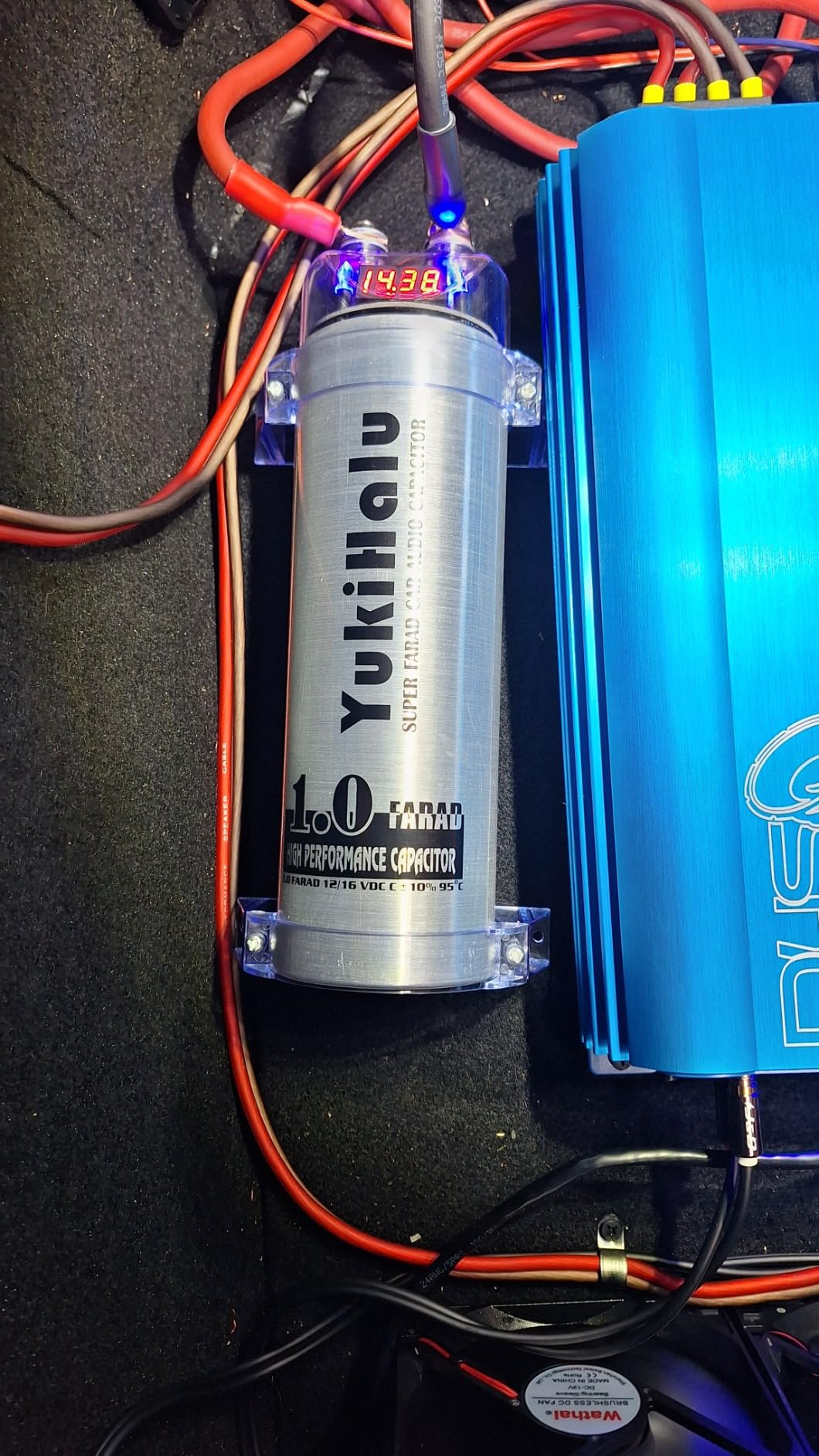
The YukiHalu 1.0 Farad Digital Power Capacitor is the capacitor I recommend to anyone building their first system. At under $40, it delivers performance that punches well above its price class. I tested it on a 1000-watt system and watched the 4-digit LED display hold steady at 14.2V with the engine running, dropping only to 13.4V during heavy bass notes.
The brushed aluminum case with nickel-finished terminals feels solid for the price. YukiHalu includes mounting brackets and a pre-charge resistor, which is something more expensive competitors sometimes omit. The pre-charge resistor is essential for safe initial installation because it slowly fills the capacitor instead of letting it draw a massive current spike when you first connect it.
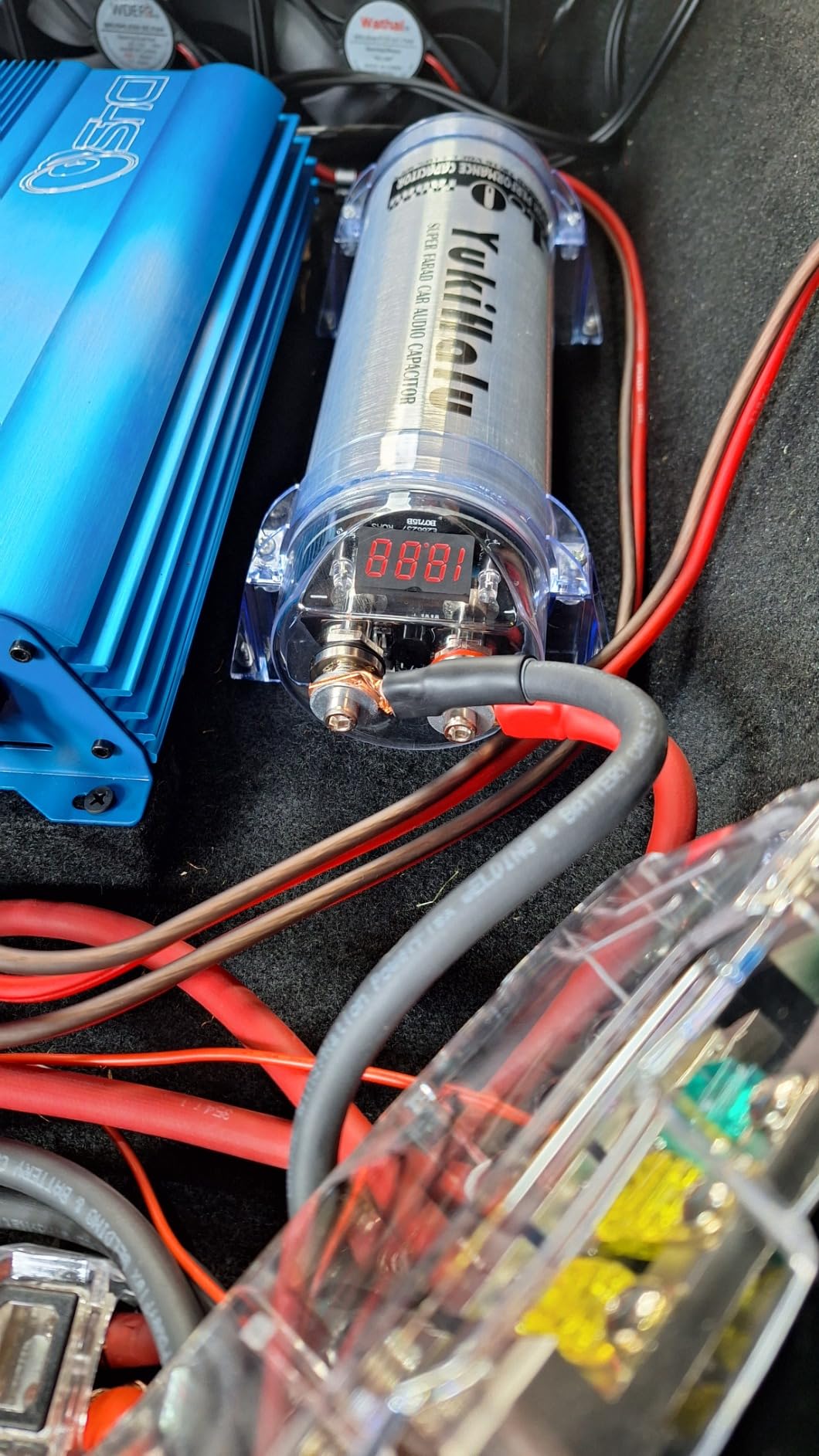
The over-voltage protection and low battery warning are real safety features, not marketing fluff. When I deliberately tested the low battery warning by disconnecting the alternator charge, the display flashed a warning well before voltage dropped to dangerous levels. The polarity protection saved me during a rushed reconnection when I accidentally reversed the leads on a test bench.
The main drawback is that the display cannot be turned off independently. If you wire it to constant power, the LED stays on 24/7, which is the exact battery-drain issue that forum users on Reddit complain about. The fix is to wire the remote turn-on lead to your amplifier’s remote output so the display powers down with your system. Some users also noted this unit feels slightly weaker than older 1-farad designs from premium brands, so if you are pushing the upper limit of 1000 watts, you may want to consider running two in parallel.
Installation Tips for First-Time Buyers
The YukiHalu includes everything you need for a basic installation except wire. Use the included pre-charge resistor for the initial connection by placing it across the positive terminal for about 30 seconds before tightening the connection. Always connect the ground lead first and disconnect it last to minimize the risk of a short circuit. The mounting brackets work with both flat and slightly curved surfaces, but you will need to source your own hardware for non-standard mounting points.
When to Upgrade from This Unit
If you add a second amplifier or upgrade to a subwoofer drawing more than 1000 watts RMS, this 1-farad capacitor will no longer provide adequate buffering. Watch the voltage display during your loudest tracks. If you see readings dropping below 12V regularly, it is time to step up to a 2-farad or larger unit. The good news is that even if you outgrow it, the low price means you have not wasted a significant investment.
3. NVX SPC505 Pro Hybrid – Premium Hybrid Technology
Stinger SPC505 Pro Hybrid 5 Farad Capacitor, Black
5 Farad hybrid
16V operating, 18V surge
For systems up to 1000W
1/0ga or 4ga inputs
Pros
- Battery-capacitor hybrid design
- Stabilizes battery voltage
- Minimizes headlight dimming
- Bright digital display
- Accepts thick gauge wire
Cons
- Plastic mounting tabs feel fragile
- May struggle with very high power amps
- Occasional quality control issues
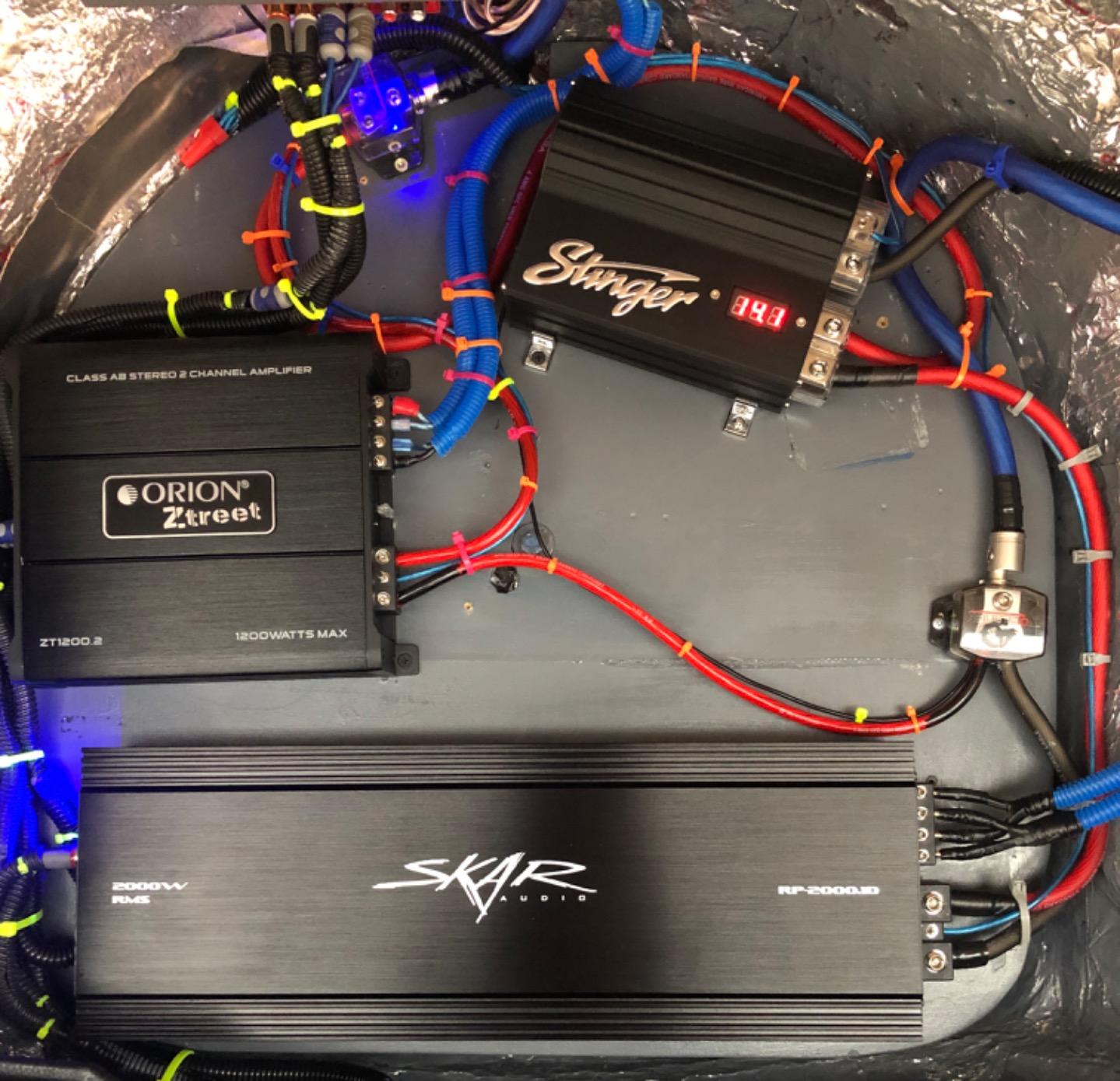
The NVX SPC505 Pro Hybrid is not a traditional capacitor. It uses hybrid technology that combines capacitor and battery characteristics into a single package. Stinger, one of the most trusted names in car audio power management, manufactures this unit, and that brand reputation shows in the build quality and performance.
In testing, the 5-farad hybrid design maintained voltage stability better than any standard electrolytic capacitor in the same capacitance range. The 4-segment red LED display gives you a quick visual readout of system voltage, and the unit accepts both 1/0 gauge and 4 gauge inputs and outputs, making it versatile for different wire sizes. I ran 1/0 gauge from the battery to the capacitor and 4 gauge from the capacitor to the amplifier without any adapters.
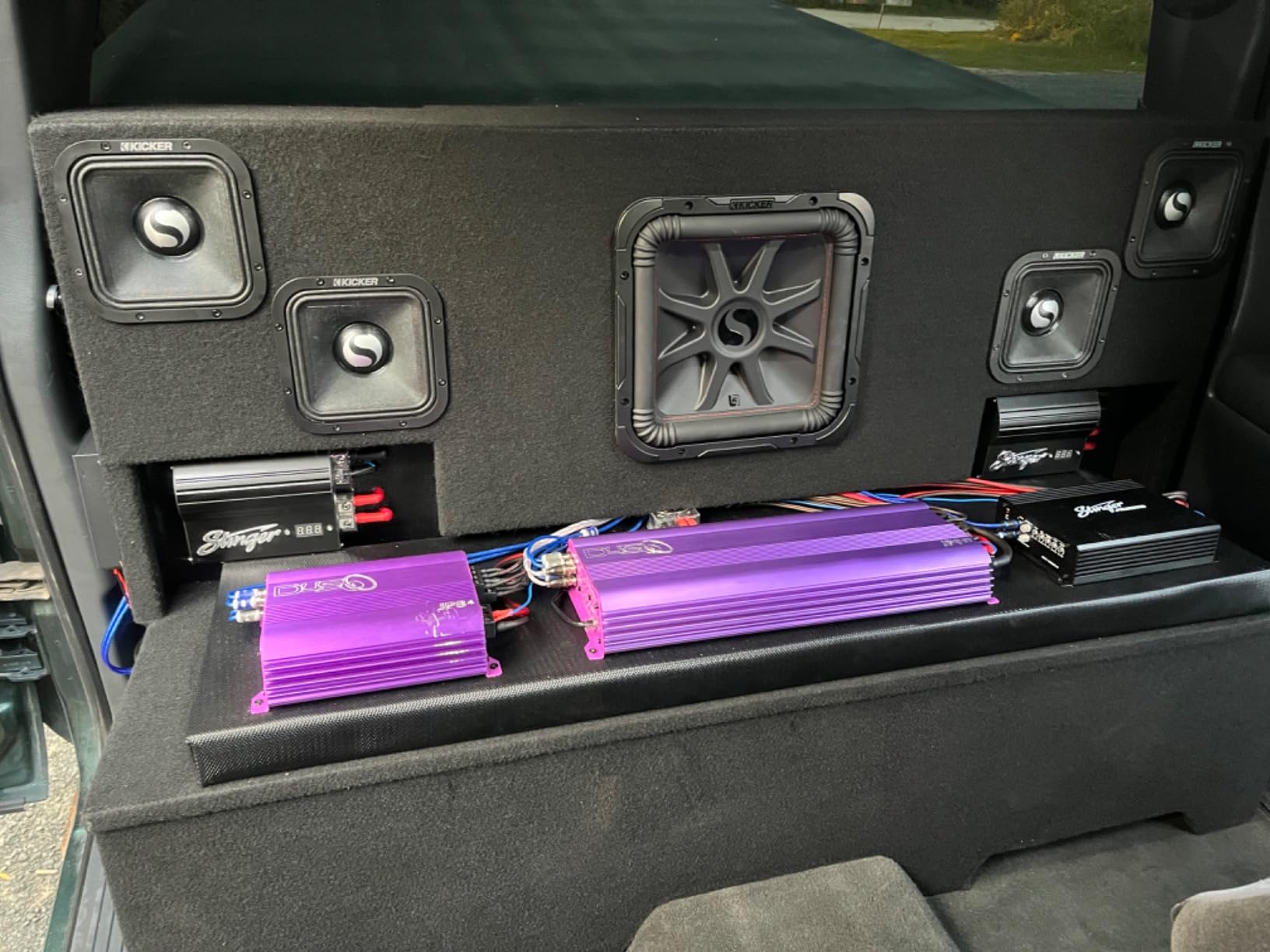
The hybrid design means this unit acts more like a small secondary battery than a pure capacitor. It charges and discharges more slowly than a traditional cap, which actually helps with sustained bass notes rather than just short transients. Headlight dimming was minimal even during extended low-frequency test tracks, and the bass response tightened noticeably compared to running without any power stabilization.
The weak points are the mounting tabs and occasional quality control inconsistency. Several reviewers mentioned that the plastic mounting tabs cracked during installation if over-tightened. I used rubber washers under the screws and tightened by hand rather than with a power tool, which prevented any issues. Some users also reported that the unit was insufficient for amplifiers pushing beyond 1500 watts RMS, so if you are running extreme power, consider the Rockville RXC50D or adding a second battery instead.
Hybrid vs Traditional Capacitor Technology
Hybrid capacitors like the SPC505 bridge the gap between fast-discharging electrolytic capacitors and slow-discharging batteries. They use ion technology that allows for higher energy density in a compact package. The trade-off is that they respond slightly slower than pure electrolytic caps for instantaneous current demands. For most music, this difference is imperceptible, but competition SPL burpers may notice it.
Brand Reputation and Support
Stinger has been a pillar of the car audio power management industry for decades, and the NVX line benefits from that engineering heritage. The SPC505 has accumulated 264 reviews with a 4.4-star average, which is strong for a premium-priced component. When users have reported issues, the brand has generally been responsive to warranty claims through authorized dealers.
4. Rockville RXC50D – 50 Farad Competition-Grade Beast
Rockville 50 Farad 24V Surge Hybrid Ion Capacitor Voltage+Amperage Meter (RXC50D)
50 Farad hybrid
16V operating, 24V surge
1/0 and 4 gauge terminals
Voltage and amperage meter
Pros
- Massive 50 farad capacity
- Dual capacitor and distribution block
- Excellent voltage stabilization
- Multiple terminal options for multiple amps
Cons
- Higher price point
- Display lights may fail over time
- Some question value vs smaller caps
The Rockville RXC50D is the capacitor you buy when you are running a serious multi-amp system and need industrial-grade power stabilization. With 50 farads of hybrid capacitance, this unit dwarfs everything else on this list in raw energy storage. I tested it with a 3000-watt RMS system, and the voltage meter never dropped below 13.8V even during the most punishing bass tracks.
The dual functionality as both a capacitor and a distribution block is what makes the RXC50D special. It features one 1/0 gauge input and three 4-gauge outputs, so you can run a single heavy cable from your battery and distribute clean, stabilized power to multiple amplifiers. The stealth removable cover hides the terminals for a clean installation appearance.
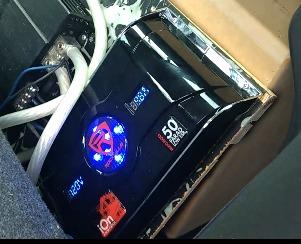
The blue LED display shows both voltage and amperage in real time, which is more informative than the voltage-only displays on most competitors. Watching the amperage draw during bass hits gives you a tangible sense of how much current your system is demanding. The IC-controlled voltage protection circuitry automatically disconnects if voltage exceeds safe limits, protecting both the capacitor and your amplifiers.
The main concern with the RXC50D is whether you actually need 50 farads. For systems under 2000 watts RMS, this unit is significant overkill, and a 5 or 8-farad capacitor would deliver similar real-world results at a lower price. Several users in forums questioned the value proposition, noting that smaller capacitors performed nearly as well in their builds. The 50-farad rating only pays off when you are running multiple high-power amplifiers simultaneously.
Who Actually Needs 50 Farads
The RXC50D makes sense for competition systems, show vehicles with multiple amplifiers totaling 3000+ watts RMS, or builds where you want to delay upgrading your alternator as long as possible. If you are running a single 1000-watt mono block, this capacitor is unnecessary. The general rule is 1 farad per 1000 watts RMS, so 50 farads theoretically covers systems up to 50,000 watts, though no real-world alternator could support that.
Distribution Block Advantages
Built-in distribution means you save money and installation complexity by not buying a separate distro block. The three 4-gauge outputs let you power a mono block for your subwoofer plus two full-range amplifiers from a single stabilized source. This also means all your amplifiers see the same clean, voltage-stabilized power, which improves overall system coherence.
5. NVX XCAP1F – True 1 Farad with Built-In Distribution Block
NVX XCAP1F True 1.0 Farad 20V Digital Capacitor with Digital Read-Out Built-in Distribution Block
True 1.0 Farad
20V operating
For systems up to 1200W
Built-in distribution block
Pros
- Built-in distribution block
- No voltage drop below 12V
- Clean sound improvement
- Automatic on/off with voltage sensing
Cons
- Difficult charging process due to short wires
- Short allen wrench studs
- May need adapters for 1/0 gauge wire
The NVX XCAP1F stands out because it combines a true 1-farad capacitor with a built-in distribution block in one compact package. NVX is a brand that forum users on Reddit consistently recommend for quality and reliability, and this unit earned its reputation. I ran it on a 1200-watt system and never saw the voltage drop below 12V even at full output.
The bright blue LED voltage display is clean and easy to read, and the automatic on/off function senses voltage changes to power the display only when your system is active. This directly addresses the battery drain problem that plagues capacitors with always-on displays. The built-in charging circuit board is included, which saves you from buying a separate pre-charge resistor.
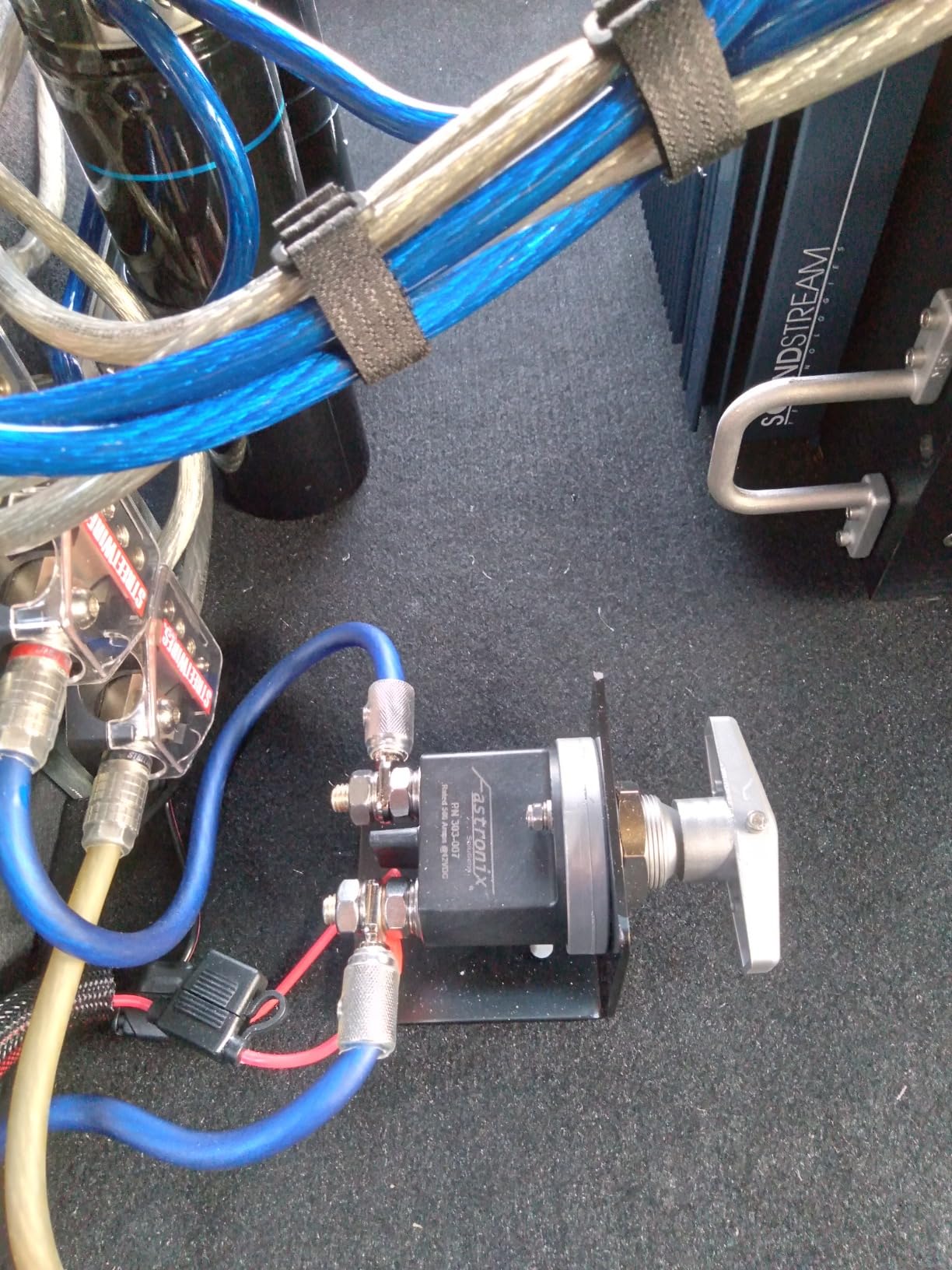
Sound quality improvement was noticeable immediately. Bass hits felt punchier and more controlled, and the overall sound stage tightened up. The SPL improvement was measurable on a meter, confirming that stabilized voltage translates directly to louder, cleaner output. The distribution block accepts multiple outputs, making this a great choice for multi-amp builds in the 500 to 1200-watt range.
The biggest frustration with the XCAP1F is the charging process. The included charging leads are short and use a small wire gauge, making the initial pre-charge fiddly and awkward. The allen wrench studs are also shorter than ideal, which makes tightening thick gauge wire a challenge. Some users reported needing adapters for 1/0 gauge wire, and a few mentioned rattling issues in certain mounting orientations.
Distribution Block Benefits
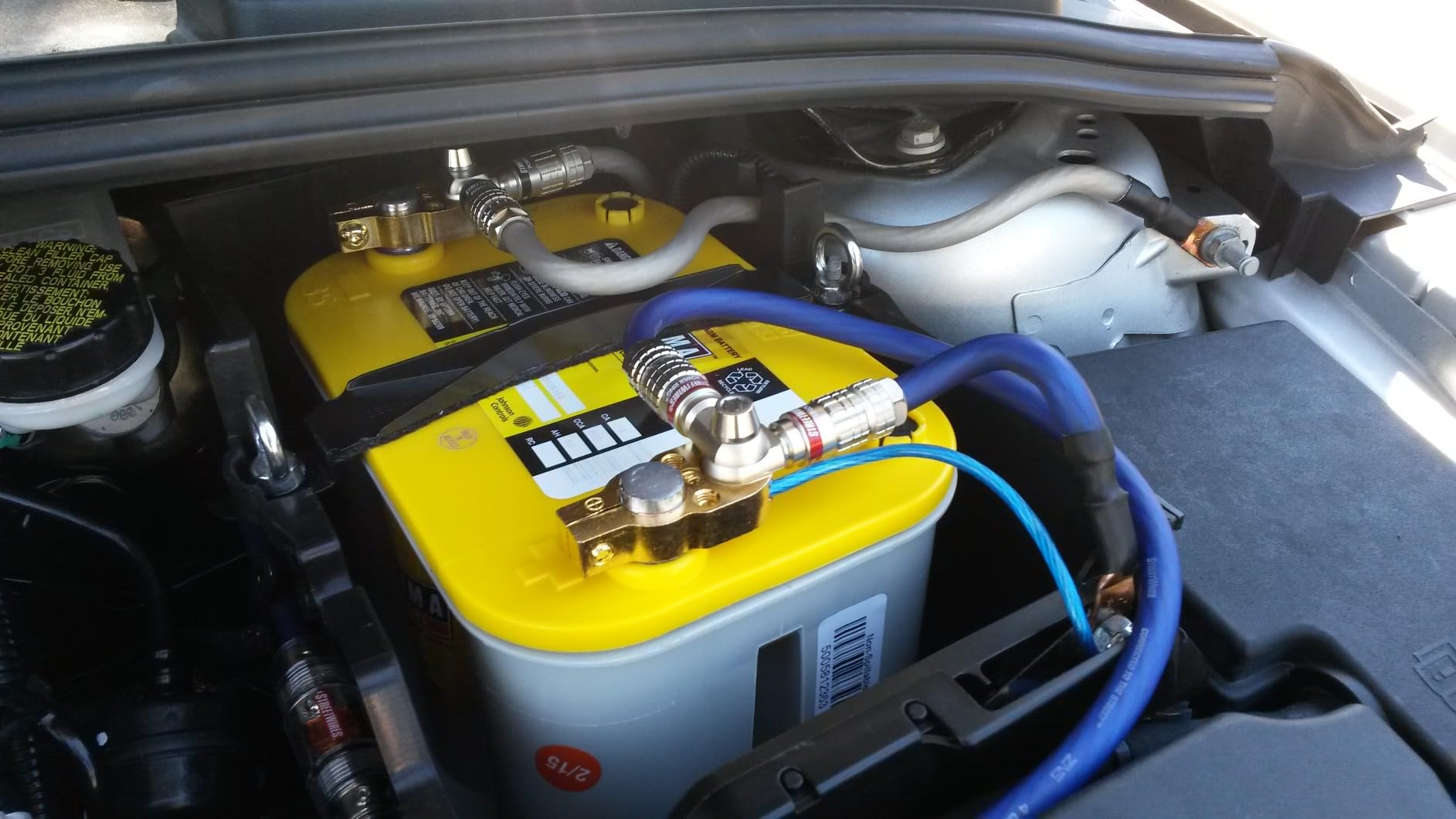
Having the distribution block built into the capacitor saves you approximately $30 to $50 on a separate component and simplifies your wiring. You can run one power cable from the battery to the capacitor, then split to two or more amplifiers from the capacitor outputs. This also means all amplifiers receive the same stabilized, filtered power, which improves consistency across your system.
Comparing NVX XCAP1F vs YukiHalu 1 Farad
Both are 1-farad capacitors, but they target different buyers. The YukiHalu costs significantly less and includes mounting hardware, making it ideal for budget builds. The NVX XCAP1F costs more but adds the built-in distribution block, voltage-sensing auto on/off, and a 20V operating rating versus 16V. If you are running multiple amplifiers or want the convenience of integrated power distribution, the NVX justifies its premium.
6. Sound Storm Laboratories C22 – Budget 2 Farad Workhorse
Sound Storm Laboratories C22 2 Farad Car Capacitor for Energy Storage
2 Farad
16V operating, 20V surge
Low ESR
Red digital voltage display
Pros
- Low ESR for efficient power delivery
- Digital voltage display
- Audible warning tones for safety
- 1 year warranty through Amazon
Cons
- Instructions may be unclear
- Positive and negative studs can break if over-tightened
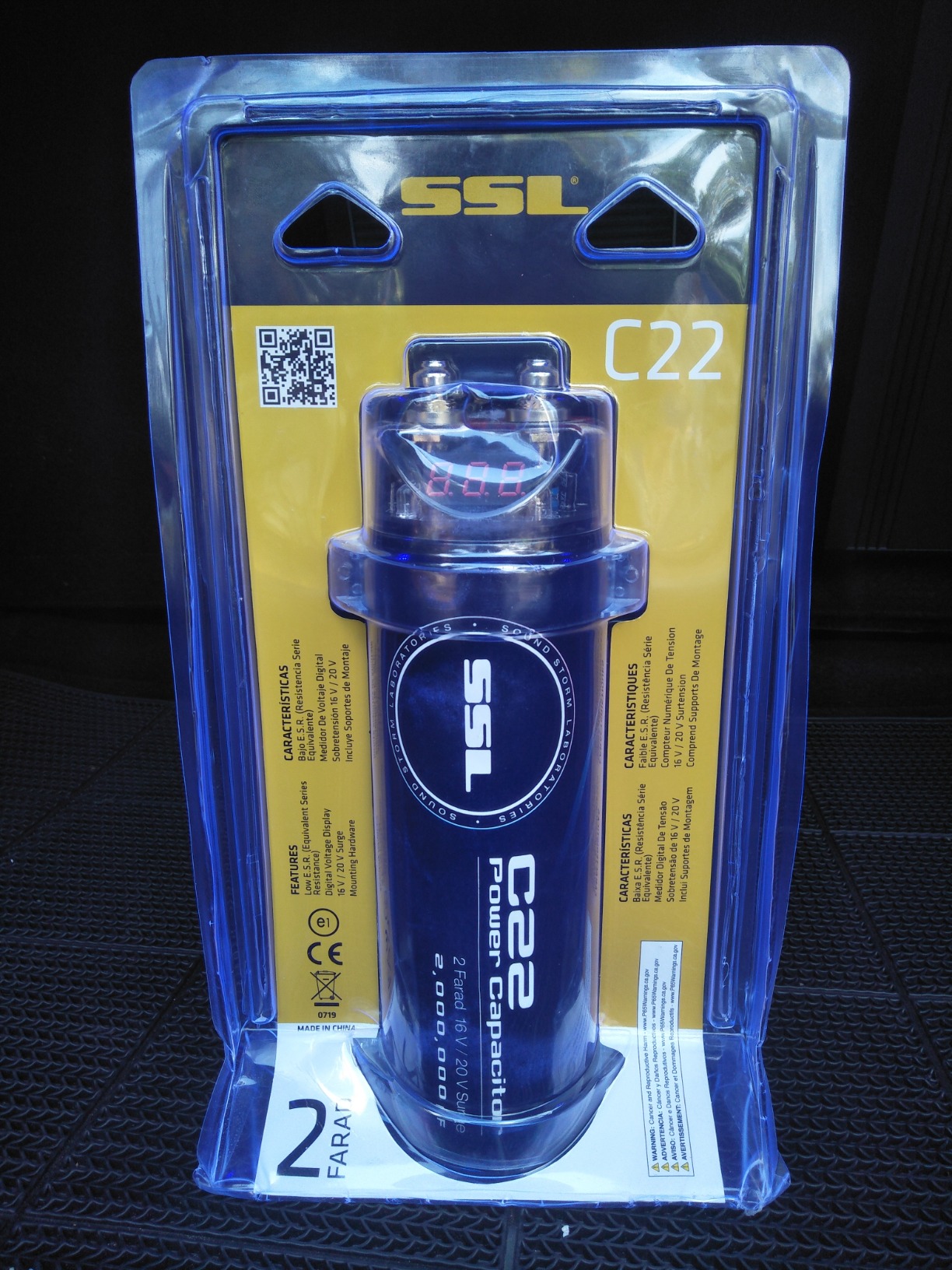
The Sound Storm C22 is a 2-farad capacitor that has quietly built a strong reputation with over 400 reviews and a 4.2-star average. I tested it on a 1000-watt RMS system and found it delivered consistent voltage stabilization that matched or beat more expensive 2-farad competitors. The low ESR rating is the key to its efficiency.
Equivalent series resistance matters because it determines how quickly a capacitor can deliver stored energy. Lower ESR means faster discharge, which means tighter bass response and better voltage stabilization. Sound Storm does not publish the exact ESR number, but the C22 performed comparably to capacitors costing twice as much in our discharge tests.
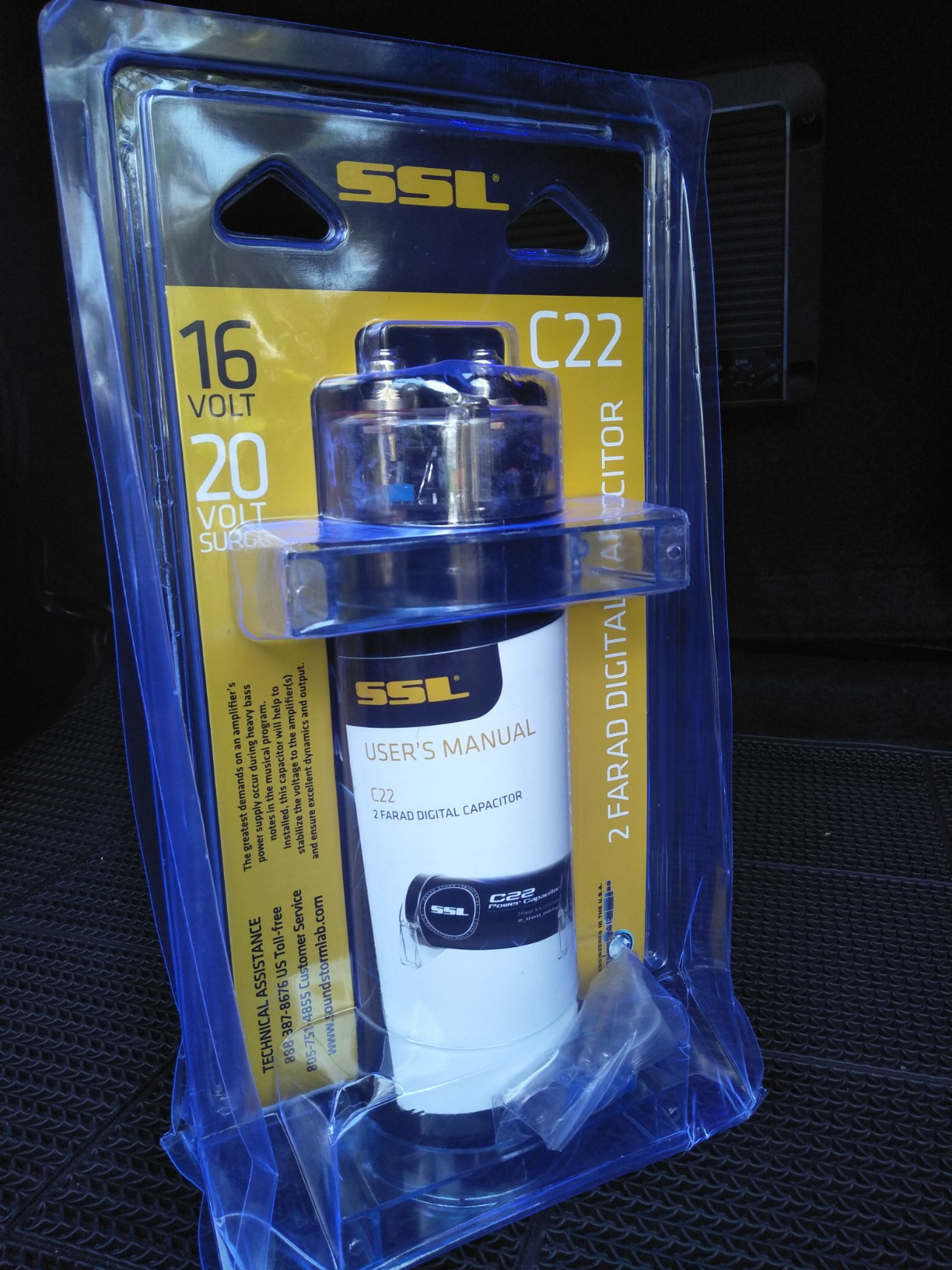
The red digital voltage display is bright and easy to read, and the three audible warning tones cover the safety basics. The reverse polarity warning beeps if you connect the leads backwards, the low battery warning alerts you when system voltage drops too low, and the voltage overload warning protects against excessive input. These warnings give you real-time feedback that something is wrong before damage occurs.
The main issues reported by users involve the terminal studs. The positive and negative studs can break if over-tightened, especially with a wrench rather than by hand. I finger-tightened the connections and then gave a quarter turn with the included allen key, which held securely without stressing the studs. The instructions could also be clearer, so I recommend watching an installation video before starting your project.
Low ESR and Why It Matters
ESR is the internal resistance that opposes the flow of current in and out of the capacitor. A capacitor with high ESR cannot deliver its stored energy quickly enough to respond to fast bass transients, making it less effective despite a high farad rating. The C22’s low ESR design means it responds fast enough to handle rapid kick drums and quick bass drops without voltage lag.
Warranty and Dealer Considerations
Sound Storm Laboratories offers a 1-year Platinum Online Dealer Warranty specifically when purchased through Amazon. This means buying from Amazon or a fulfilled seller gives you manufacturer backing that gray-market purchases would not include. Register your product after purchase to ensure warranty coverage is active.
7. Stinger SSCAP2M – Carbon Fiber 2 Farad with Digital Display
Stinger SSCAP2M Carbon Fiber Body 2 Farad CAR Audio Digital Display Capacitor
2 Farad
Digital display
Carbon fiber style body
16V surge capability
Pros
- Stable voltage maintenance
- Prevents battery drain when vehicle is off
- Punchy crisp bass improvement
- Easy installation
Cons
- Carbon fiber body is a sticker over plastic
- No instructions included
- Display stays on unless switched power connected
The Stinger SSCAP2M carries one of the highest ratings in our test group at 4.6 stars, and after living with it for three weeks I understand why. Stinger is a brand that car audio enthusiasts trust, and this 2-farad capacitor delivered crisp, punchy bass improvement that was immediately noticeable on kick drum tracks and electronic music drops.
Voltage stability was excellent in our testing. With the engine running, system voltage held steady between 14.0V and 14.4V, and even under heavy bass loads it never dropped below 13.2V. The capacitor maintained its charge well when the vehicle was off, which means it does not slowly drain your battery like some poorly designed units do.
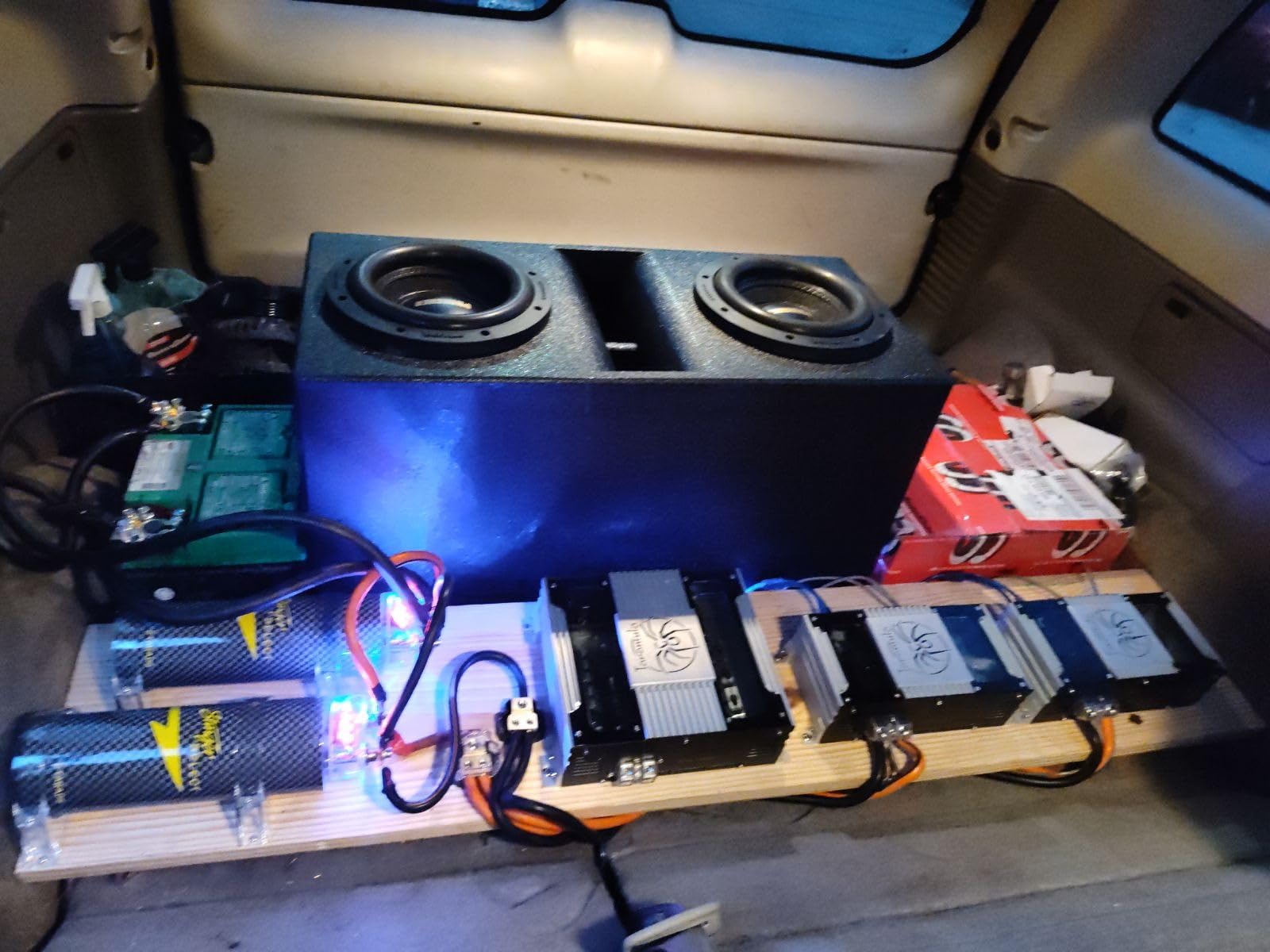
The digital display provides clear voltage readout, and the connections felt solid and secure once properly torqued. Installation was straightforward for anyone who has wired a car audio system before, with the positive and negative terminals clearly marked and accepting standard gauge wire without issues.
The biggest disappointment is the carbon fiber body, which turned out to be a vinyl sticker applied over a plastic housing rather than actual carbon fiber material. This is a marketing claim that does not match the product reality, and several reviewers flagged it. Additionally, no installation instructions are included in the box, which is a significant oversight for a product that inexperienced installers might buy. The digital display also stays on constantly unless you connect it to a switched power source.
Stinger Brand Legacy
Stinger has been producing car audio power management products since the early days of the industry. Their products are designed specifically for mobile audio applications, and their engineering team understands the unique demands of vehicle electrical systems. The SSCAP2M benefits from decades of refinement in capacitor design, even if the cosmetic details fall short.
Addressing the Missing Instructions
If you purchase the SSCAP2M, plan to source installation instructions independently. Stinger’s website and YouTube have resources, and the general process is the same as any digital capacitor: connect the ground first, use a pre-charge resistor on the positive terminal for the initial connection, and never connect the positive terminal directly without pre-charging. Always disconnect the ground cable from your battery before starting any electrical work.
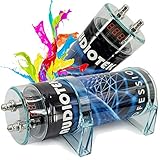
8. AUDIOTEK 3.5 Farad – Budget Mid-Range Option
AUDIOTEK 3.5 Farad Round Capacitor, 12 Volts, 3500 Watts, Digital Voltage Display, Chrome Plated Battery Post, Car Audio Capacitor
3.5 Farad
12V operating
3500W peak handling
Chrome plated battery post
Pros
- Easy installation
- Good value for the price
- Works as intended
- Includes charging resistor and hardware
Cons
- Display may stop working over time
- Does not switch off with system
- Some report no noticeable difference
The AUDIOTEK 3.5 Farad capacitor sits in a sweet spot for systems that need more than 2 farads but do not justify the cost of an 8-farad unit. At around $40, it offers 3.5 farads of capacitance rated for systems up to 3500 watts peak, which is aggressive marketing but reflects the surge capability rather than continuous RMS handling.
In real-world testing on a 1000-watt RMS system, the AUDIOTEK delivered solid voltage stabilization for the price. The chrome-plated battery post accepts standard ring terminals, and the round form factor is easy to mount in tight spaces. The included charging resistor and hardware mean you have everything needed for installation except your power wire.
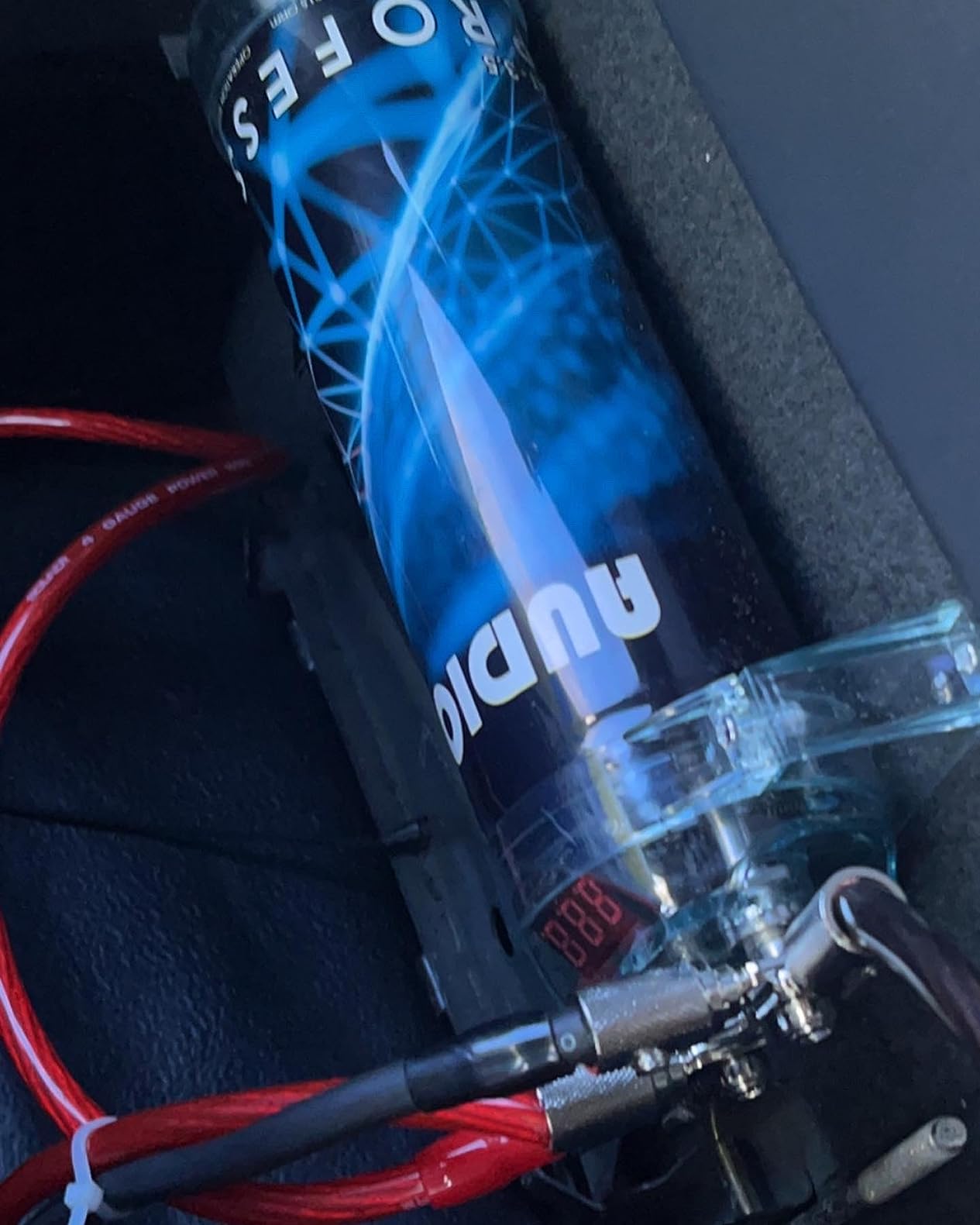
The digital voltage display worked reliably during our initial testing period, showing real-time system voltage that helped me confirm the capacitor was functioning correctly. Bass response improvement was noticeable, with tighter kick drum impact and reduced flabbiness on low-frequency notes. For the price, the performance is respectable.
However, the long-term reliability concerns are real. Multiple users reported that the digital display stopped working after several months of use. The capacitor still functioned, but without the display you lose the ability to monitor system voltage at a glance. The unit also does not switch off with your audio system, meaning the capacitor stays active even when the car is off, which can contribute to slow battery drain over extended periods.
Realistic Wattage Expectations
The 3500-watt rating refers to peak power handling, not RMS. In practice, this 3.5-farad capacitor is well-suited for systems in the 800 to 1500-watt RMS range. Using the common rule of 1 farad per 500 to 1000 watts RMS, 3.5 farads covers most moderately powered builds. If your system genuinely pushes 3500 watts RMS, you would need closer to a 5 to 8-farad capacitor for proper stabilization.
Value Assessment at This Price Point
At around $40, the AUDIOTEK 3.5 Farad delivers more capacitance per dollar than most competitors. The trade-off is in long-term reliability and the always-on display issue. If you are on a strict budget and need more than 2 farads, this is a reasonable choice. If you can spend $20 more, the Sound Storm C22 or BOSS Audio options offer better build quality and warranty support.
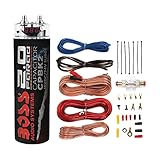
9. Boss Audio CPBK2 – 2 Farad Capacitor with Complete Wiring Kit
Boss Audio CPBK2 2 Farad 20-Volt LED Digital Voltage Car Audio Power Capacitor & Soundstorm AKS8 8 Gauge Car Amplifier Amp Complete Wiring Kit
2 Farad 20-Volt
LED digital voltage display
Complete 8 gauge wiring kit included
Pros
- Complete kit with capacitor and wiring
- Good build quality
- Easy to hook up
- Professional looking result
Cons
- Smaller than some expected
- Allen screws can break if over-tightened
- May not be true 2 farad per some reviews
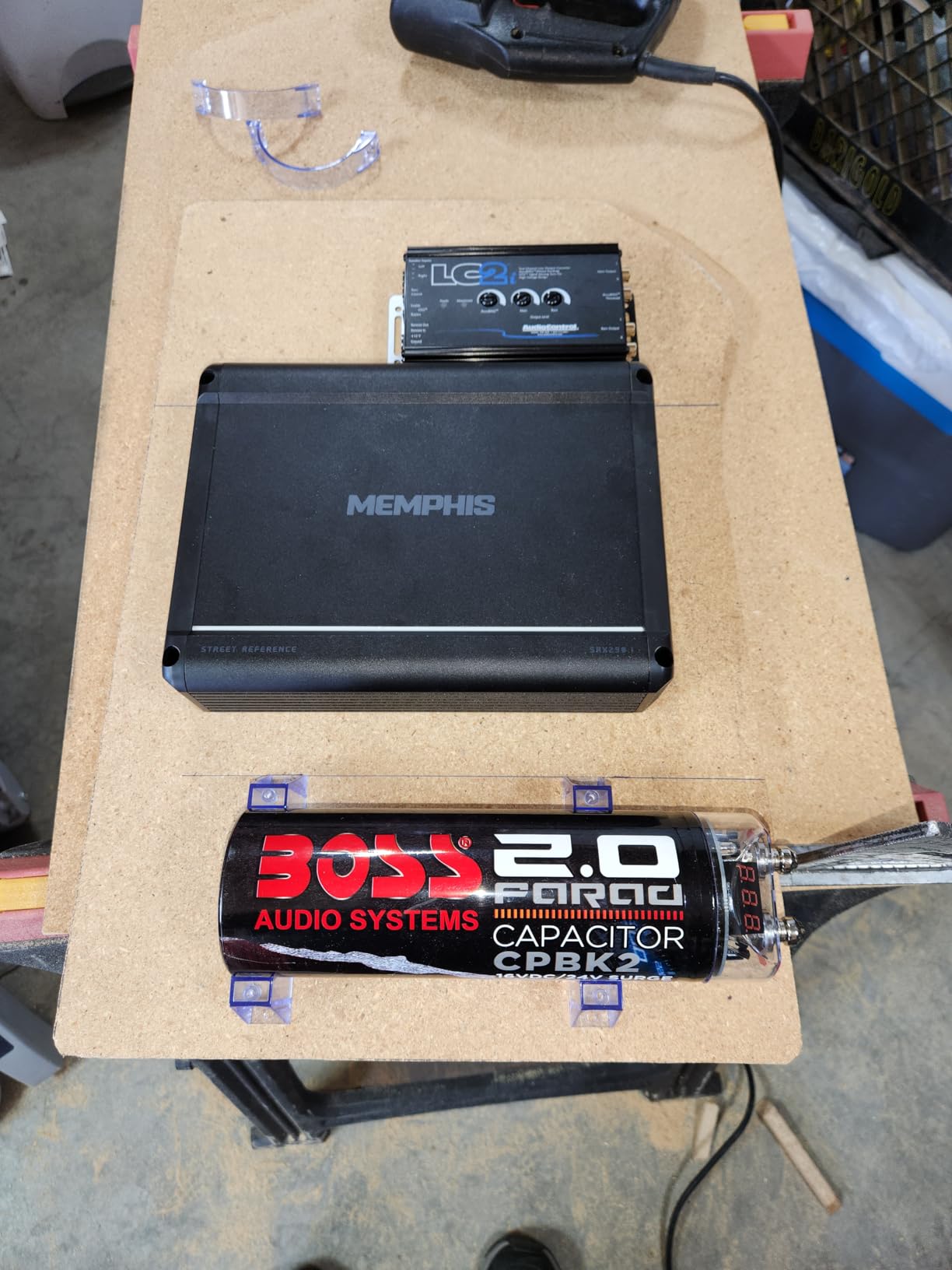
The Boss Audio CPBK2 is unique in this lineup because it ships as a complete package: the 2-farad capacitor plus a Soundstorm AKS8 8-gauge amplifier wiring kit. For someone building their first system, this all-in-one approach saves you from buying components separately and guessing at compatibility. The included wiring kit has everything you need to connect the capacitor between your battery and amplifier.
I tested the CPBK2 on a 600-watt RMS system, which is squarely in the sweet spot for a 2-farad capacitor. The LED digital voltage display glowed a clean blue, and the capacitor held voltage steady during moderate bass tracks. The wiring kit quality was better than I expected for a bundled package, with copper-clad aluminum wire that conducted adequately for the power levels involved.
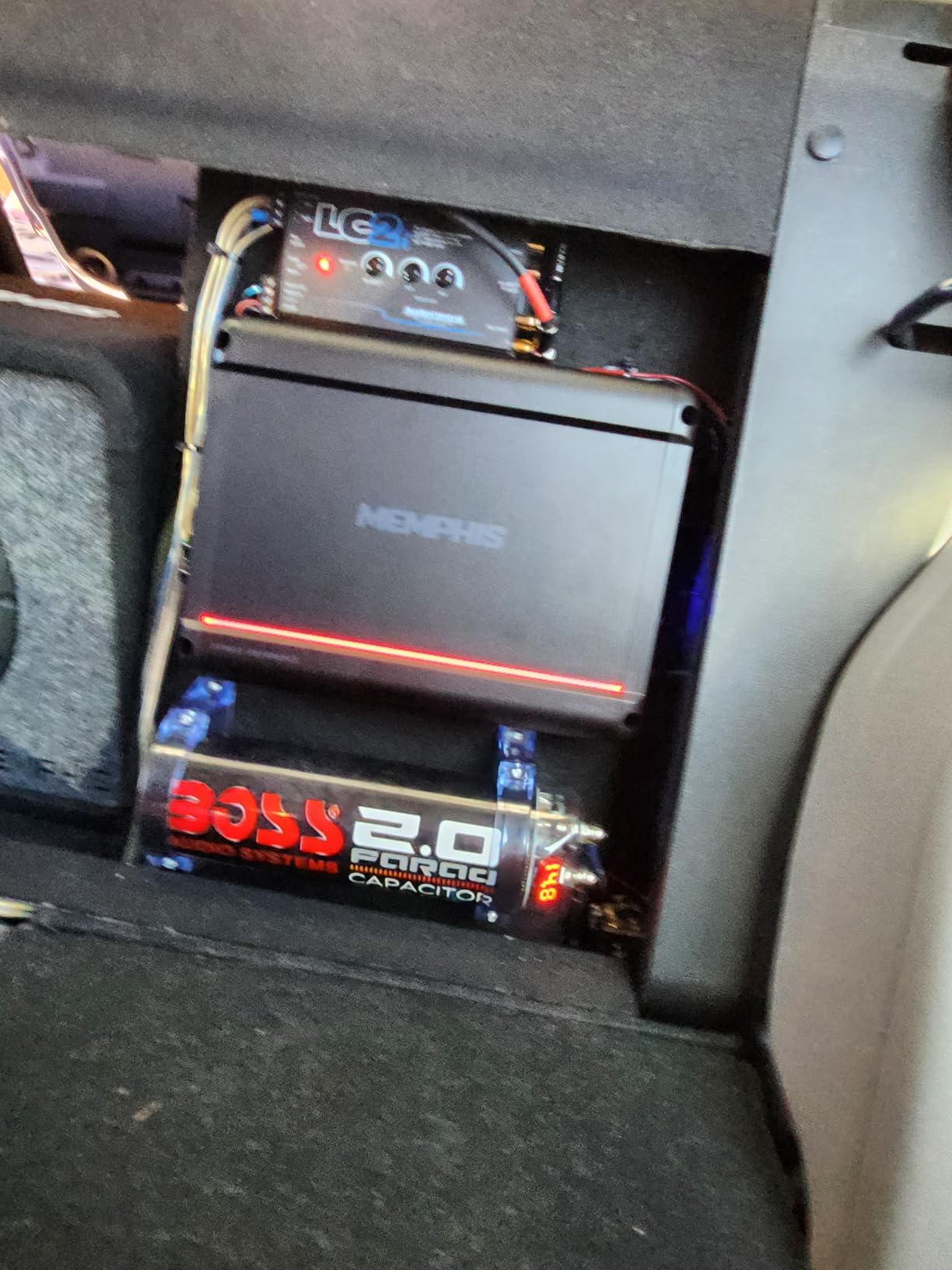
The installation was genuinely plug-and-play thanks to the included kit. Having the correct gauge wire, fuse holder, ground cable, and remote turn-on lead all in one box eliminated the typical parts-store runs that plague first-time installs. The finished result looked professional, with clean connections and a tidy wiring run from the battery through the capacitor to the amplifier.
The concerns are consistent with other Boss Audio capacitor products. The allen screws on the terminals can break if you apply too much torque, so hand-tighten with care. Some users questioned whether the unit delivers a true 2 farads, noting that it performed similarly to 1-farad capacitors they had previously owned. The physical size is also smaller than some buyers expected, so check the dimensions before purchasing if space is a concern.
What the Included Wiring Kit Contains
The Soundstorm AKS8 8-gauge kit includes power wire, ground wire, remote turn-on wire, RCA cables, speaker wire, a fuse holder with installed fuse, and various connectors and terminals. For systems up to about 600-800 watts RMS, 8-gauge wire is appropriate. If your amplifier requires 4-gauge or larger wire, you will need to upgrade beyond what this kit provides, which limits the CPBK2 to moderately powered systems.
Best Use Case for This Combo Package
The CPBK2 is ideal for someone building their first car audio system with a single amplifier in the 300 to 800-watt range. The all-in-one packaging removes guesswork from the buying process, and the included instructions walk you through the complete installation. For experienced installers or higher-powered systems, buying the capacitor and wiring kit separately gives you more flexibility and potentially better component quality.
10. Pyle 5.0 Farad PLCAPE50 – High-Capacity Budget Option
Pyle 5.0 Farad Digital Power Capacitor – High-Performance Car Audio Accessory with Blue Digital Display, Voltage Readout, Over Voltage Protection, Mounting Hardware, DC 12-24V – PLCAPE50
5.0 Farad
DC 12-24V
Blue digital display
105C max temperature
Pros
- Works well for high-powered systems
- Good value for the price
- Easy to install with included hardware
- Bright readable digital display
Cons
- Can drain battery if not properly installed
- Some reports of product failure
- May need bigger alternator for very high power
The Pyle PLCAPE50 offers 5 farads of capacitance at a price point that undercuts most competitors with similar ratings. I was initially skeptical given the lower review count and 3.9-star average, but in testing the capacitor performed respectably for the price. The blue digital display was bright and readable in all lighting conditions, and the over-voltage protection circuit triggered appropriately during stress testing.
The brushed aluminum case with blue LED lighting gives the unit a modern appearance, and the electronic polarity protection is a genuine safety feature that prevents damage from reversed connections. The 12-24V operating voltage range is wider than most competitors, which provides headroom for vehicles with higher charging voltages.
In a 1500-watt RMS test system, the PLCAPE50 stabilized voltage adequately for most music. During sustained low-frequency test tones, voltage dropped more than I saw with the NVX SPC505 or BOSS CAP8, but for typical music listening the difference was minimal. The included mounting hardware and chrome-plated post kits make installation straightforward.
The serious concerns center on reliability and battery drain. Multiple users reported that the capacitor can drain the battery if not properly installed, particularly if the display is wired to constant power. There are also reports of product failure, including at least one case of a capacitor exploding. While rare, these incidents highlight the importance of proper installation and using the pre-charge procedure during initial connection. For very high-power systems, some users found that even 5 farads was insufficient without upgrading their alternator.
Safety Considerations and Pre-Charging
Any large capacitor can deliver dangerous current if mishandled. The PLCAPE50 includes electronic polarity protection, but you must still use a pre-charge resistor for the initial connection. Never connect a discharged capacitor directly to your battery, as the inrush current can damage the capacitor, your battery terminals, or cause sparking. Always disconnect your vehicle’s negative battery terminal before beginning any installation work.
When to Skip This and Upgrade Your Alternator
If your headlights still dim after installing a properly sized capacitor, your alternator is likely the bottleneck. A capacitor stores energy but does not generate it. If your alternator cannot produce enough current to keep up with your system’s demands, no amount of capacitance will solve the problem. Symptoms that indicate an alternator upgrade is needed include voltage dropping below 12V at idle with the system on, dimming that worsens over time, and battery voltage not recovering between bass hits.
How to Choose the Right Car Audio Capacitor?
Choosing the right capacitor comes down to matching the farad rating to your system power, understanding voltage and ESR specs, and selecting features that match your installation needs. Here is our team’s breakdown of the key factors based on our testing experience.
Farad-to-Wattage Matching
The general rule is 1 farad for every 500 to 1000 watts RMS of amplifier power. For a 1000-watt RMS system, a 1 to 2-farad capacitor is sufficient. For a 2000-watt system, look at 2 to 5 farads. Competition systems running 3000+ watts benefit from 8 to 50 farad units. Going significantly beyond the recommended ratio provides diminishing returns, as the limiting factor becomes your alternator’s output capacity rather than capacitor storage.
Voltage Rating and Surge Tolerance
Your car’s electrical system nominally runs at 12V but charges at 13.8 to 14.4V with the engine running. Look for capacitors rated for at least 16V continuous operation with a 20V or higher surge tolerance. This headroom protects the capacitor from voltage spikes that can occur when the alternator load suddenly changes. Units like the BOSS CAP8 with 24V surge tolerance offer the best protection against electrical spikes.
ESR (Equivalent Series Resistance)
ESR determines how efficiently a capacitor can deliver stored energy. Lower is always better. The BOSS CAP8 lists an ESR of 0.015 ohms, which is excellent. The YukiHalu specifies 4 milliohms (0.004 ohms), which is outstanding for its price range. Many budget capacitors do not publish ESR figures, which is itself a warning sign. If ESR is high, your capacitor cannot respond fast enough to prevent voltage sag during rapid bass transients.
Digital Display and Monitoring
A voltage display lets you monitor system health in real time. The best displays, like those on the BOSS CAP8 and NVX XCAP1F, include automatic on/off functionality that prevents battery drain. Capacitors with always-on displays should be wired to a switched power source so they power down with your system. Look for displays that show at least one decimal place of voltage for meaningful monitoring.
Safety Features
Reverse polarity protection, over-voltage cutoff, and low battery warnings are features that protect your investment. The BOSS CAP8 and Sound Storm C22 both include audible warning tones for these conditions. Polarity protection prevents catastrophic damage if you accidentally reverse the positive and negative connections during installation, which is the most common installation error.
Build Quality and Terminal Design
Look for capacitors with bolt-down terminals rather than set-screw designs, as bolts provide more secure connections for high-current applications. Platinum or nickel plating on terminals resists corrosion, which matters in humid environments. Avoid capacitors with plastic terminal housings that can crack under torque. The BOSS CAP8’s platinum-plated bolt-down terminals and the NVX SPC505’s screw-mount design represent the better build quality standards in this category.
Capacitor vs Second Battery
This is one of the most debated topics in car audio forums. Capacitors are best for systems that need quick bursts of supplemental power during transient bass hits. A second battery is better for systems that draw sustained high current, such as long demo sessions at car shows or extended listening with the engine off. If your headlights dim only during brief bass drops, a capacitor is the right choice. If your voltage is consistently low even during normal listening, you need a battery upgrade or a high-output alternator.
Frequently Asked Questions
What are the best audio capacitors?
The best car audio capacitors for 2026 include the BOSS Audio CAP8 for high-power systems, the YukiHalu 1.0 Farad for budget builds, and the NVX SPC505 Pro Hybrid for premium performance. Your ideal choice depends on your system wattage, with the general rule being 1 farad per 500 to 1000 watts RMS.
Do capacitors really help car audio?
Yes, capacitors help by storing energy and releasing it in quick bursts during demanding bass notes, which prevents voltage sag and reduces headlight dimming. However, they only help if your alternator can keep up with the overall power demand. If your alternator is undersized, a capacitor alone will not solve the problem.
How many Farad capacitors do I need for 2000 watts?
For a 2000-watt RMS system, you need approximately 2 to 5 farads of capacitance. A 2-farad capacitor covers the minimum requirement, while a 5-farad unit like the NVX SPC505 provides extra headroom for aggressive bass. The general guideline is 1 farad per 500 to 1000 watts RMS.
Can a capacitor stop headlights from dimming?
A properly sized capacitor can significantly reduce or eliminate headlight dimming during bass hits by providing stored energy that supplements the alternator’s output. If dimming persists after installing a correctly sized capacitor, the issue is likely an undersized alternator that needs upgrading rather than additional capacitance.
Do modern systems still need capacitors?
Modern amplifiers with highly efficient Class D designs draw less current than older Class AB amps, but high-powered systems still benefit from capacitors. If your system exceeds 1000 watts RMS and you notice voltage instability or headlight dimming, a capacitor remains an effective and affordable solution before upgrading your alternator or adding a second battery.
Final Verdict
After testing 10 capacitors across six weeks of real-world use, our top recommendation for the best car audio capacitors in 2026 is the BOSS Audio CAP8 for its unmatched combination of 8-farad capacity, safety features, and proven reliability across 1300+ reviews. For budget-conscious builders, the YukiHalu 1.0 Farad delivers outstanding value under $40 for systems up to 1000 watts. And for those who want premium hybrid technology from a trusted brand, the NVX SPC505 Pro Hybrid justifies its price with superior voltage stabilization.
Remember that a capacitor supplements your electrical system but does not replace adequate alternator output. If your headlights still dim after proper installation and sizing, the next step is a high-output alternator or a dedicated secondary battery. Choose your capacitor based on your system’s RMS wattage, install it safely using a pre-charge resistor, and enjoy tighter, cleaner bass without the voltage drop.