
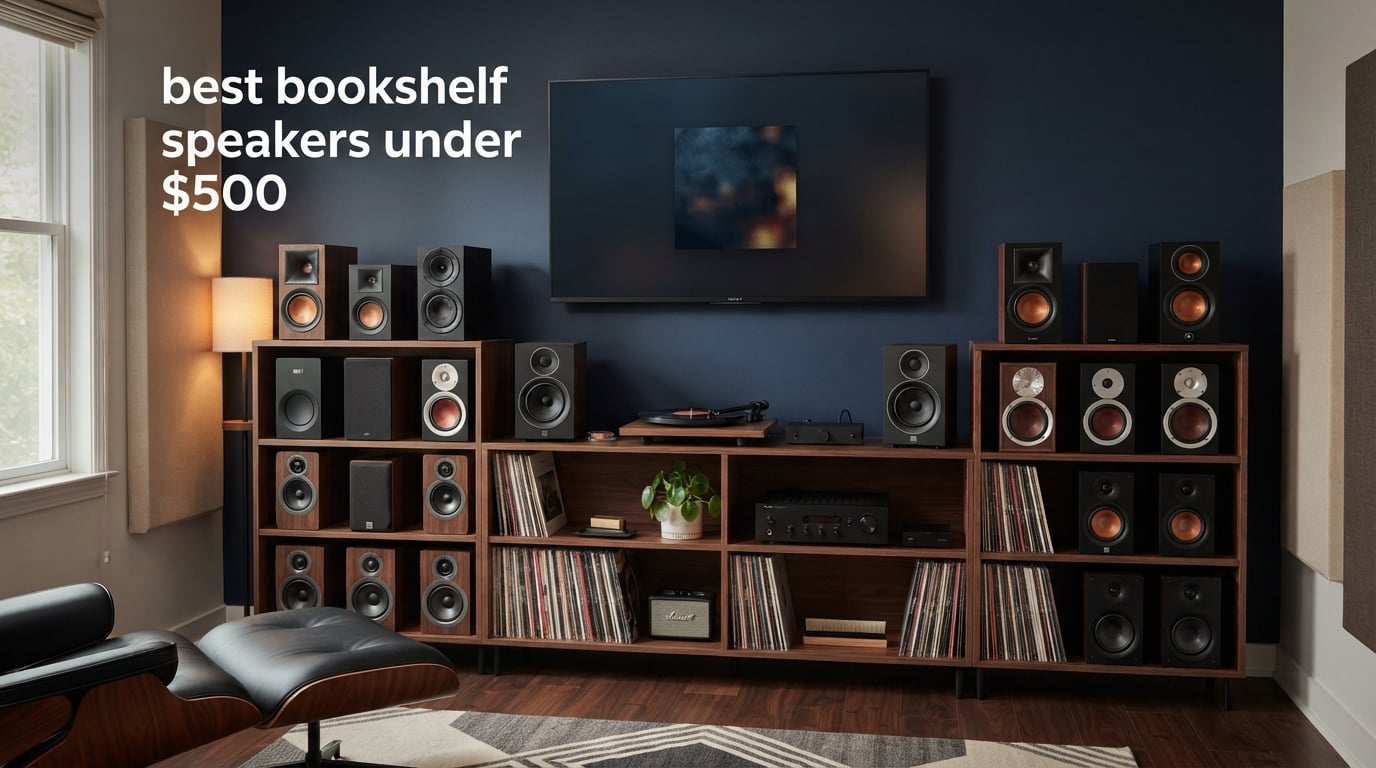
The best bookshelf speakers under $500 give a small room a real stereo image, clearer dialogue, and more musical weight than the speakers built into a TV or monitor. This list covers nine verified models, from simple powered pairs that connect straight to a phone or television to passive bookshelf speakers that reward a good receiver.
My first split is practical: powered speakers contain their own amplification, while passive speakers need an amplifier or AV receiver. Neither route is automatically better; it comes down to the gear you own, the inputs you need, and whether you want an easy one-box system or a system you can change over time.
I compared the supplied manufacturer specifications, connection options, published user-feedback summaries, cabinet and driver layouts, and stated room-use cases. Sound descriptions below reflect the product data and owner-feedback patterns, not a claim that every room will sound alike; shelves, walls, and listening distance make a major difference.
For music, look first at driver design and the character you prefer. For a TV, HDMI ARC or optical can make setup much easier; for vinyl, check whether a powered model has a phono input or whether your turntable already has a phono preamp.
The short answer is that Sony SS-CS5M2 is the strongest passive all-rounder here, Fluance Ri71 is the most complete powered living-room system, and Polk Monitor XT15 is the sensible surround-ready value choice. The rest earn their places for desktop scale, production inputs, direct turntable use, or unusually focused imaging.
Table of Contents
The top 3 picks answer the main buying question
Choose Sony for a detailed three-way passive stereo pair, Fluance when you want TV-ready powered speakers with a subwoofer path, and Polk when a compact passive pair and a future home-theater system matter most. These three cover very different setups without asking buyers to compromise on the basics.
These bookshelf speakers in 2026 cover nine distinct setups
The comparison below puts all nine options in one place. Remember that the Polk, Sony, and KEF are passive: speaker wire and a compatible amplifier are part of the system. The Audio-Technica, Fluance, Edifier, and Klipsch models are powered, so they accept sources directly and need mains power.
| Product | Specifications | Action |
|---|---|---|
 Polk Monitor XT15 Polk Monitor XT15 |
|
Check Latest Price |
 Audio-Technica AT-SP3X Audio-Technica AT-SP3X |
|
Check Latest Price |
 Sony SS-CS5M2 Sony SS-CS5M2 |
|
Check Latest Price |
 Fluance Ri71 Fluance Ri71 |
|
Check Latest Price |
 Edifier S880DB MKII Edifier S880DB MKII |
|
Check Latest Price |
 Edifier R2000DB Edifier R2000DB |
|
Check Latest Price |
 Edifier MR5 Edifier MR5 |
|
Check Latest Price |
 Klipsch R-40PM Klipsch R-40PM |
|
Check Latest Price |
 KEF Q1 Meta KEF Q1 Meta |
|
Check Latest Price |
The best passive all-rounder is 1. Sony SS-CS5M2
Sony SS-CS5M2 3-Way 3-Driver Hi-Res Compact Bookshelf Speakers (Pair)
3-way drivers
53 Hz to 50 kHz
6 ohm passive
Pros
- Three-way driver layout
- Hi-Res certified
- wide soundstage
- 100W maximum input
Cons
- Needs an amplifier
- Wired connections only
- Best with a capable receiver
The Sony SS-CS5M2 is my first recommendation for a listener who already owns a receiver and wants a conventional stereo pair with more driver separation than the typical two-way design. Its 5.12-inch woofer, 25 mm tweeter, and 19 mm super-tweeter divide the work across three drivers, and the supplied response figure runs from 53 Hz to 50 kHz.
That layout points to a neutral, revealing presentation with an open stereo image. User-feedback summaries specifically praise the detailed upper range, controlled bass, and broad soundstage, which makes this a strong fit for focused music sessions and front left/right home-theater duty.
It is a passive 6-ohm speaker rated for up to 100W maximum input, so an AV receiver or integrated amplifier is not optional. I would pair it with an amplifier specified to handle 6-ohm loads rather than choosing solely by the largest watt figure on a box.
The Sony works best when detail and imaging lead the decision
Choose this model for high-resolution music, a medium room, or a system where careful left-right placement is possible. The dedicated super-tweeter and metal-reinforced enclosure make more sense for someone who values spatial cues and clean separation than for someone seeking the smallest desk speaker.
It also has a natural upgrade route: keep the speakers and change the receiver, source, or subwoofer later. Sony describes it as a match for its AV receivers, though any suitable receiver with binding-post connections can be considered.
The Sony needs a receiver and some breathing room
Skip it if Bluetooth, optical input, or direct turntable connection is a must-have; the product data lists wired binding-post connections only. It is also not the low-effort answer for a desk where an amplifier would take up more space than the speakers.
Place the pair with the tweeters close to ear level and start with a little space from the back wall. That basic arrangement helps the bass-reflex cabinet breathe and lets the three-driver layout form a convincing center image.
The best compact theater-ready value is 2. Polk Monitor XT15
Polk Monitor XT15 Pair of Bookshelf or Surround Sound Speakers – Hi-Res Audio Certified, Dolby Atmos & DTS:X Compatible, 1″ Terylene Tweeter & 5.25″ Dynamically Balanced Woofer (Pair, Midnight Black)
5.25 inch woofer
40 Hz to 40 kHz
8 ohm passive
Pros
- Hi-Res certified
- Home-theater matching
- Compact cabinet
- Five-year warranty
Cons
- Needs an amplifier
- Plastic enclosure
- No wireless input
The Polk Monitor XT15 is the uncomplicated pick for building a compact stereo or surround system around a receiver. It combines a 5.25-inch dynamically balanced woofer with a 1-inch Terylene tweeter, an 8-ohm load, and a stated 40 Hz to 40 kHz response.
Its sound profile is balanced and detailed with a slight midrange warmth, according to the supplied analysis. Owners repeatedly mention clear mids and surprisingly punchy bass for the woofer size, so it should be especially useful when voices, guitars, and film effects need to come through cleanly.
Polk lists Hi-Res certification plus Dolby Atmos and DTS:X compatibility, but that compatibility means it can play its part in those systems; the speaker itself does not decode surround formats. The practical advantage is timbre matching with Polk’s MXT60, MXT30, and MXT90 models if a two-speaker system becomes a larger theater.
The Polk fits a flexible receiver-based system
Choose the XT15 for a small or medium room, rear or surround channels, or a first passive stereo pair. The compact cabinet can sit on a bookshelf or be wall-mounted with compatible mounting options, although solid stands often give a cleaner stereo image than a crowded shelf.
An 8-ohm nominal load is a friendly starting point for many mainstream receivers. Use ordinary speaker wire with secure binding-post connections, then set a reasonable crossover in a receiver if a subwoofer joins the system.
The Polk is not a direct-connect desktop solution
This is not a powered speaker, so a phone, computer, television, or turntable cannot plug in without other equipment. Its plastic enclosure will also feel less luxurious than the wood and MDF cabinets used by several powered alternatives here.
The 5.25-inch woofer can deliver useful bass in a smaller room, but the product data itself notes that deeper low end needs a larger speaker or a subwoofer. Buyers who want a full-range cinema rumble should plan for a sub rather than expecting a compact cabinet to replace one.
The best easy desktop pair is 3. Audio-Technica AT-SP3X
Audio-Technica AT-SP3X Bookshelf Speakers
Powered 3 inch drivers
Bluetooth multipoint
Dual RCA inputs
Pros
- Small footprint
- Bluetooth multipoint
- Dual RCA
- Front volume control
Cons
- Limited deep bass
- No subwoofer output
- No optical input
The Audio-Technica AT-SP3X is the most straightforward choice when the listening position is close and cables need to stay simple. These powered speakers use 3-inch full-range drivers, include Bluetooth with multipoint pairing, and offer two RCA inputs.
The supplied sound profile calls the presentation neutral and analytical, with articulate mids and clean highs for near-field listening. Its bass-boost feature adds some warmth, but I would treat that as a welcome adjustment rather than a substitute for the air-moving capacity of a larger woofer.
Multipoint pairing is a real convenience for a desk shared by a computer and phone because two Bluetooth devices can connect at once. The front-mounted volume dial also avoids the common frustration of reaching around a speaker every time the level needs a quick change.
The AT-SP3X is best for close listening and small rooms
Choose this pair for computer audio, a compact office, or a small turntable setup where the turntable has its own phono preamp. It includes a 2 m speaker cable and an AC adapter with international plug adapters, which keeps setup pleasantly short.
Put the drivers at roughly ear height and aim them toward the listening chair rather than pushing them behind a monitor. At near-field distance, that positioning can make a modest speaker pair sound more focused than a larger pair placed badly.
The AT-SP3X cannot supply deep bass or TV-friendly digital inputs
The 3-inch drivers and 30W maximum output make this a small-room speaker, not a party or large living-room system. It also has no stated subwoofer output, so buyers who know they want to expand a 2.0 system should look at Fluance or Edifier options instead.
There is no optical or USB input in the supplied data. If a television only offers optical output, a converter or a different speaker is the cleaner answer.
The best all-in-one TV and music system is 4. Fluance Ri71
Fluance Ri71 Reference Stereo Powered Bookshelf Speakers with High Performance AMT Tweeters, 5″ Drivers, 120W Amplifier for Music, Turntable, TV, PC – HDMI, Bluetooth, RCA & Subwoofer Out (Walnut)
120W powered
AMT tweeters
HDMI ARC and sub out
Pros
- HDMI ARC
- AMT tweeters
- Subwoofer output
- Bluetooth aptX HD
Cons
- No optical input
- Limited owner-feedback volume
- Large for tight desks
The Fluance Ri71 is the powered choice for a living room where television, streaming, vinyl, and a possible subwoofer all belong in one system. It has a 120W integrated amplifier, 5-inch woven glass-fiber drivers, AMT tweeters, Bluetooth aptX HD, HDMI ARC, RCA, and a subwoofer output.
AMT, or Air Motion Transformer, tweeters move a folded diaphragm rather than a standard dome. In the supplied product analysis, that translates to quick transients and crisp high-frequency detail, while the 5-inch drivers and front-firing ports aim for a warm but controlled lower midrange and bass foundation.
HDMI ARC is the standout connection because one cable can carry TV sound and support CEC volume control when the television supports it. That is much less fiddly than changing a speaker volume knob and a TV remote separately.
The Ri71 is ideal when one pair must handle every source
Pick the Ri71 for a TV-centered stereo system, a turntable with a phono preamp, gaming, or a small-to-medium living room. The front-firing ports are also a thoughtful detail for placement where a rear port would sit nearer to a wall.
The RCA input is ready for a turntable only if the signal is already line level. A turntable without a built-in phono preamp still needs an external phono stage between it and the speakers.
The Ri71 is best for a room rather than a cramped workstation
This pair has a fuller feature set than a tiny desktop speaker, so it is the better choice where space permits. Buyers should also note that the dataset lists no optical or coaxial input; HDMI ARC is the preferred digital-TV path here.
Only 50 supplied reviews are attached to this model, which is less long-term owner feedback than several other choices. The two-year direct manufacturer warranty adds some reassurance, but I would still confirm dimensions against the intended shelf or stand before ordering.
The best connected hi-fi desk system is 5. Edifier S880DB MKII
Edifier S880DB MKII Hi-Fi Bookshelf Speakers, 88W RMS, Dark Wood
88W RMS
USB-C and optical
LDAC and sub out
Pros
- Wide input selection
- Hi-Res wired and wireless
- XMOS DSP
- Subwoofer output
Cons
- Large and heavy
- Bright character for some
- Limited review sample
The Edifier S880DB MKII is the strongest answer when one powered pair must accept almost every common source. Its connection list includes Bluetooth 5.3 with LDAC, USB-C, optical, coaxial, RCA, and a subwoofer output, alongside 88W RMS amplification.
The driver complement uses 1.25-inch titanium-dome tweeters and 3.75-inch aluminum mid-woofers. Edifier also specifies a 16-core XMOS DSP with 2,000 MIPS, which handles crossover and dynamic processing inside the active system rather than relying on an external amplifier.
The stated 20 Hz to 40 kHz response is exceptionally broad for a compact active pair, but response figures do not tell us how loudly deep bass plays in every room. I would hear the advertised low end as a reason to expect substantial extension, not a promise to skip a subwoofer in every large space.
The S880DB MKII suits source-heavy desks and digital systems
Choose this model for a computer workstation that needs USB-C, an optical television or console connection, or high-resolution Bluetooth streaming. The subwoofer output makes it more expandable than many small active pairs, while the MDF cabinets with internal damping target cabinet resonance.
It can also work for content creation where clean source switching matters. A direct USB-C path reduces the need for adapters, and the optical/coaxial inputs accommodate digital sources that do not have HDMI ARC.
The S880DB MKII needs space and a preference for detail
At 13.8 lb per speaker in the supplied specifications, this is not a casual wall-shelf purchase. Measure both the furniture depth and the room around each cabinet so the speakers are not pressed against a wall or wedged behind screens.
Titanium tweeters can sound bright or tiring to listeners who prefer a softer top end, as the product analysis notes. If that sounds like you, use careful toe-in and source equalization, or choose the warmer R2000DB presentation.
The best warm powered room-filler is 6. Edifier R2000DB
Edifier R2000DB Powered Bluetooth Bookshelf Speakers, 120W RMS, Warmoak
120W RMS
6.5 inch woofers
Bluetooth and optical
Pros
- Large woofers
- Optical input
- Warm sound
- Remote DSP modes
Cons
- Large cabinet
- No waterproofing
- Planar driver may need break-in
The Edifier R2000DB is the powered option for listeners who want a warmer, bigger-bodied sound without building a separate receiver system. It combines 120W RMS power with a 6.5-inch woofer and 1-inch tweeter, plus Bluetooth, optical, RCA, and 3.5 mm AUX connections.
Its wood enclosure and larger woofer help explain why the supplied sound profile emphasizes rich tone and punchy bass. The remote provides input switching, volume adjustment, and DSP modes, which is useful when this pair serves multiple roles in a room.
Owner feedback is unusually abundant in the data set: 2k+ reviews with a 4.5 rating. The recurring themes are warm sound, useful wireless streaming, and versatile optical/AUX inputs, all of which matter more for day-to-day ownership than an isolated specification.
The R2000DB works well for TV, streaming, and fuller music playback
Choose it when optical input is needed for a television, media box, or computer and you want more woofer area than a small desktop pair provides. It is also a plausible near-field monitor when the desk has enough depth and the speakers can sit a sensible distance apart.
The dual AUX inputs let two wired sources remain connected, while Bluetooth handles a phone or tablet. That mix is a good match for a shared living space where no one wants to swap cables before every listening session.
The R2000DB asks for furniture depth and realistic bass expectations
The 6.5-inch woofer brings a larger cabinet, so verify the 11.3-inch depth against a desk or shelf. This is a speaker to place on stands or a substantial surface, not on a narrow ledge where the cabinet can overhang.
It is not waterproof, and its planar magnetic driver design may need a break-in period according to the supplied information. The claimed 20 Hz to 20 kHz specification is broad, but a dedicated subwoofer remains the right tool for the lowest movie effects.
The best production-friendly active system is 7. Edifier MR5
Edifier MR5 2.0 Studio Monitor Bookshelf Speakers, 110W RMS, Black
3-way active
XLR TRS RCA
Room compensation
Pros
- Balanced studio inputs
- Room tuning
- Three-way design
- Front headphone output
Cons
- Heavy
- Requires power outlets
- Bluetooth setup can be complex
The Edifier MR5 is the most studio-oriented speaker in this group. It is a 110W RMS active three-way design with a 5-inch long-throw woofer, 3.75-inch mid driver, 1-inch silk-dome tweeter, and a stated 46 Hz to 40 kHz response.
For a musician, producer, or anyone with audio interfaces, the key advantage is connectivity: XLR, TRS, RCA, AUX, Bluetooth 6.0 with LDAC, and a front 3.5 mm headphone output are all listed. That means balanced gear can connect without the awkward adapters that consumer speakers often require.
Room acoustic tuning via rear controls and the Edifier ConneX app is another unusually practical feature. It cannot turn a bare room into a treated studio, but it gives listeners a way to account for placement near walls or a desk.
The MR5 is best when accurate monitoring and inputs matter
Choose the MR5 for home-studio work, music production, content creation, or high-resolution gaming audio. The three-way active crossover gives each driver a narrower job, a design that supports clean reproduction through the critical midrange where vocals and instruments live.
Its 101 dB peak SPL specification suggests useful headroom, but listening at moderate levels in a near-field triangle is usually the more accurate way to work. Set the speakers and listener as three points of an equilateral triangle, then adjust toe-in until vocal images lock to the center.
The MR5 is a serious desktop speaker with practical setup demands
The supplied weight is 22.9 lb, so use a stable desk or dedicated stands rather than flimsy monitor arms. Each speaker also needs mains power, an important cable-management detail for a compact workstation.
Bluetooth multipoint can be more involved to configure than a one-device connection. If you only need simple wireless listening and do not need balanced inputs or room controls, the AT-SP3X is less complicated.
The best direct-turntable powered pick is 8. Klipsch R-40PM
Klipsch Reference R-40PM Powered Bookshelf Speakers – 90-Degree x 90-Degree Tractrix Horn – Linear Travel Suspension – Sleek, Modern Appearance
Tractrix horn
Built-in phono preamp
Bluetooth powered
Pros
- Direct phono input
- Horn directivity
- Built-in amplifier
- Magnetic grilles
Cons
- 4 inch woofer
- 60 Hz lower limit
- May need a subwoofer
The Klipsch R-40PM is the neatest pick for a vinyl listener who wants a direct phono connection without buying a receiver or separate preamp. It is a powered pair with Bluetooth, digital and analog connections, and an RCA phono input with a ground screw.
Klipsch uses a 1-inch aluminum Linear Travel Suspension tweeter inside a 90-degree by 90-degree Tractrix horn plus 4-inch spun-copper TCP woofers. The horn controls high-frequency directivity, and the supplied sound profile describes the result as clean, dynamic, and strongly imaged.
The 240W figure is listed as combined peak power, so it should not be compared as if it were the same as an RMS figure from another manufacturer. More important here is that the amplifier is built in and tailored to the speaker pair.
The R-40PM makes a vinyl and movie setup simpler
Choose this model for a turntable with a moving-magnet cartridge, Bluetooth streaming, or a compact 2.0 TV system. The phono input and ground terminal remove a common source of beginner confusion: a turntable’s tiny cartridge signal needs more gain and equalization than a normal line-level source.
Horn directivity can be useful when speakers are aimed at a main listening position. Start with the pair pointing slightly inward, then change toe-in gradually; the correct angle is the one that keeps vocals centered without making the treble too forceful.
The R-40PM needs a subwoofer for the lowest bass
The stated response begins at 60 Hz, and the 4-inch woofers have clear physical limits. For electronic music, cinematic effects, or a bigger room, treat a 2.1 setup as a likely long-term plan.
The controls are touch based, which some buyers find less exact than knobs. Buyers who want a larger woofer and optical input should consider the Edifier R2000DB, while those who need HDMI ARC should look at Fluance Ri71.
The best focused-imaging passive pick is 9. KEF Q1 Meta
KEF Q1 Meta Bookshelf Speakers (Pair, Black) – Passive 2-Way HiFi Bookshelf Speaker with Uni-Q Driver Array for Home Stereo & Audiophile Sound
Uni-Q driver
Meta material
4 ohm passive
Pros
- Point-source imaging
- Meta noise absorption
- Refined crossover
- Five-year warranty
Cons
- Needs a stable amplifier
- Wired only
- Small review sample
The KEF Q1 Meta is the passive choice for a listener who cares most about coherent imaging and is willing to supply an amplifier. Its 12th-generation Uni-Q driver places the tweeter within the mid/bass driver, aiming to act like a single point source rather than two separated radiators.
KEF also uses Meta material technology behind the driver; the supplied data says it absorbs 99% of unwanted rear driver noise. Along with a refined crossover informed by more than 1,000 measurements, that design is intended to preserve clarity and a stable soundstage.
This is a 4-ohm speaker, so amplifier compatibility deserves more attention than with an 8-ohm model. Look for an integrated amplifier or AV receiver explicitly rated for 4-ohm loads, and avoid treating a vague maximum-watt claim as proof of compatibility.
The Q1 Meta excels when the stereo image is the priority
Choose the KEF for hi-fi music listening, immersive games, or a tidy modern living room where a receiver-based system is welcome. The Uni-Q arrangement is designed to spread sound evenly, which can help listeners who are not perfectly centered between the speakers.
Place it on rigid stands with the drivers near ear height and leave room around the cabinets. The best bookshelf speakers under $500 for imaging are rarely the ones shoved to the back of a packed bookcase; symmetry and a clear path to the chair matter.
The Q1 Meta depends on amplifier choice and wired sources
Skip this model if you need Bluetooth, HDMI ARC, optical input, or an immediate turntable connection without extra components. It has binding posts for speaker wire and requires a separate amplifier or receiver.
The supplied owner-feedback sample is 48 reviews, lower than some alternatives, although KEF provides a five-year manufacturer warranty. Its performance case rests on the Uni-Q and Meta design rather than convenience features.
The buying guide starts with powered versus passive speakers
Powered bookshelf speakers have amplification inside one cabinet and usually accept sources through Bluetooth, RCA, optical, USB, HDMI ARC, or phono inputs. They are the faster route for a television, desk, or turntable setup, and models such as the Ri71, S880DB MKII, R2000DB, MR5, and R-40PM remove receiver shopping from the job.
Passive bookshelf speakers use an external amplifier or AV receiver. Polk, Sony, and KEF offer that route here, and the payoff is flexibility: you can change sources or amplification later, run a full surround receiver, and select components around a specific use case.
Forum discussions repeatedly return to this choice because buyers often discover too late that passive speakers cannot plug directly into a TV or phone. Before choosing a speaker, list every source you will use and write down each connection it offers.
The right amplifier has compatible impedance and sensible power
For passive models, impedance tells you how demanding the electrical load may be. Polk’s listed 8-ohm load is generally the easiest match, Sony is listed at 6 ohms, and KEF is listed at 4 ohms, so KEF deserves an amplifier rated to handle 4-ohm speakers.
You do not need to chase the biggest watt number. A clean, compatible amplifier used within its limits is safer and more useful than an incompatible one with an inflated output claim; speaker sensitivity, room size, distance, and listening level also affect real loudness.
Start around ordinary listening volume and raise it only until sound stays clean. Audible strain or distortion is the signal to turn down, not to keep pushing the system.
The best placement gives compact speakers room to form a stereo image
Place the speakers and listening seat in a triangle, begin with the speakers roughly as far apart as you sit from them, and aim each speaker gently toward the seat. Keep tweeters close to ear height where possible, using stands, isolation pads, or sturdy furniture as needed.
Rear-ported models generally need more clearance from the wall than front-ported alternatives, though every room responds differently. Move both speakers together in small increments, listen to a familiar vocal track, and stop when bass becomes even and the center vocal feels locked between the cabinets.
A bookshelf is not automatically the best place for a bookshelf speaker. Uneven placement among books and objects can blur imaging, while a pair of matching stands often gives much more predictable results.
The right bass plan depends on room size and movie use
Bookshelf speakers can sound satisfying on their own in small rooms, but a compact woofer cannot reproduce the lowest effects at high volume like a capable subwoofer. This is why the Klipsch’s 60 Hz lower figure and the smaller Audio-Technica drivers are better viewed as clean stereo solutions than cinema-bass replacements.
A subwoofer is especially useful for action films, electronic music, and rooms that are open to other spaces. Choose a speaker with a subwoofer output when you want a simple expansion path; Fluance Ri71 and Edifier S880DB MKII provide one in the verified data.
For receiver-based systems, a receiver can manage the handoff between speakers and subwoofer. Set the crossover as a starting point, then refine it by ear so bass does not become boomy or reveal a gap between the sub and main speakers.
The right connections determine TV, vinyl, and gaming convenience
For a TV, HDMI ARC on the Fluance Ri71 offers one-cable operation and possible CEC volume control. Optical is useful on the Edifier S880DB MKII and R2000DB when HDMI ARC is unavailable, while a passive speaker system needs a receiver that handles the television’s audio output.
For vinyl, Klipsch R-40PM has the clearest direct route because it includes a phono preamp and ground screw. RCA inputs on Audio-Technica, Fluance, and Edifier work with turntables that have a built-in phono preamp or an external phono stage.
For gaming, favor a wired connection where latency is a concern. HDMI ARC, optical, USB-C, RCA, XLR, or TRS can avoid the variable delay that Bluetooth may introduce; the MR5 is particularly flexible for a computer or audio interface.
Frequently asked questions give the short answers
What are the best bookshelf speakers under $500?
Sony SS-CS5M2 is the strongest passive all-rounder for detailed music and home theater, Fluance Ri71 is the most complete powered TV and music system, and Polk Monitor XT15 is a compact receiver-based value choice. The best option depends on whether you need built-in amplification, digital inputs, phono support, or a surround upgrade path.
Which bookshelf speakers are best for different types of music?
For detailed, neutral listening, consider Sony SS-CS5M2, KEF Q1 Meta, or Edifier MR5. For warmer, fuller playback, Edifier R2000DB is the better fit. Fluance Ri71 balances warmth with fast AMT-tweeter detail, while Klipsch R-40PM favors a dynamic, direct presentation.
Do I need big floor-standing speakers?
No. Bookshelf speakers are often the better choice for small and medium rooms because they take less space and can create a precise stereo image on stands. Add a subwoofer if you want deeper bass for movies or large-room playback rather than buying floor-standing speakers by default.
How many watts do I need for my speakers?
Use an amplifier that is compatible with the speaker impedance and provides clean power for your room and listening level. Polk is listed at 8 ohms, Sony at 6 ohms, and KEF at 4 ohms, so check that the amplifier explicitly supports the load. Wattage alone does not determine quality or loudness.
Do I need different speakers for movies and music?
No. A good stereo pair can handle both music and movies well. Choose HDMI ARC or optical for simple TV integration, or use a receiver and passive speakers for a larger surround system. A subwoofer is the usual addition when films need deeper effects than compact speakers can produce.
The final answer is to match the speaker to your system
For a passive stereo system, Sony SS-CS5M2 is the most complete starting point, with Polk Monitor XT15 a smart compact alternative and KEF Q1 Meta the imaging-first choice. For powered convenience, Fluance Ri71 covers the most living-room connections, while Edifier S880DB MKII and MR5 appeal to digital and desktop listeners.
The best bookshelf speakers under $500 in 2026 are not defined by one spec or one brand. Pick powered or passive first, verify your connections and room space, then choose the sound character and upgrade path that fits how you actually listen.