
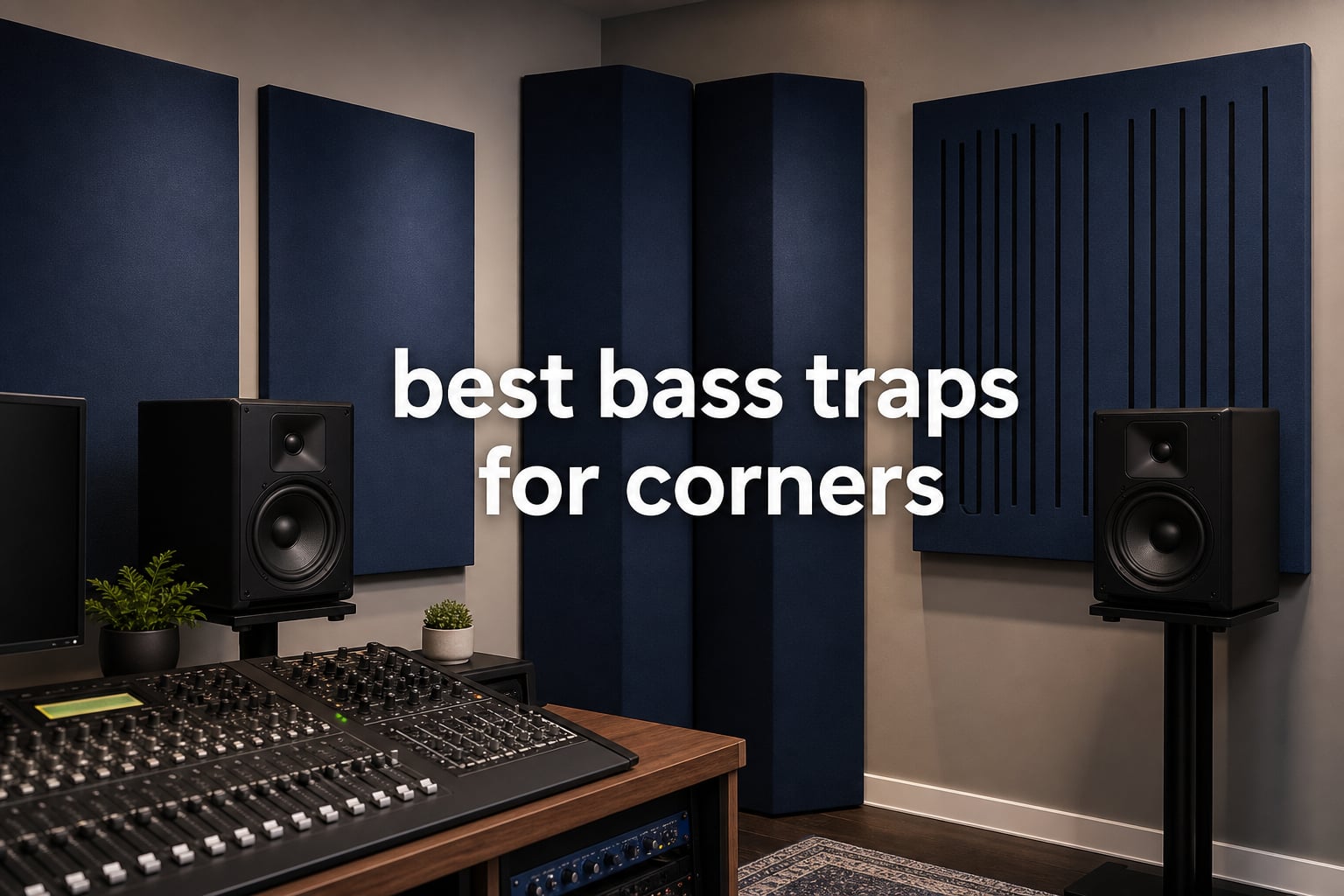
The best bass traps for corners put meaningful absorber depth where a room gathers the most troublesome low-frequency energy. A corner bass trap will not make a small room behave like a larger one, but it can reduce the boomy peaks, long decays, and uneven bass that make speakers and headphones harder to judge.
I compared eight current corner-treatment products by their published dimensions, material, construction, supplied mounting details, and customer feedback. The key distinction is simple: a large, deep absorber or a dense fiberglass-filled design gives you a more credible starting point for bass absorption than a thin decorative foam strip, while coverage across several corners matters just as much.
Start with the two front vertical corners behind your speakers, listen again, and then add treatment where the room still swells or rings. That measured approach helps a home studio, listening room, home theater, or vocal space without blanketing every surface in foam.
Table of Contents
These are the top 3 bass traps for corners to shortlist first
The QGU pair is my construction-first pick, TroyStudio is the practical multi-piece foam option, and Eerbaier’s 16-pack suits people who need many small corner blocks. The choices below reflect published product data, not a claim that every room will get the same result.

- QGU 2 Pack Wooden Bass Traps: A wood-framed pair with fiberglass inside and a trihedral low-frequency design.
- TroyStudio 12-Piece Bass Traps: Twelve 4 x 4 x 12 inch dense polyurethane foam pieces for distributing treatment around several corners.
- Eerbaier 16-Pack Corner Panels: Sixteen compact 12 x 3 x 3 inch foam blocks for targeted low/mid-frequency and echo control.
These eight bass traps for corners give you the quick overview for 2026
The table covers every product in this guide. Dimensions, material, and form factor are more useful comparison points here than a generic promise of “soundproofing,” because bass traps improve the sound inside a room rather than stopping sound from leaving it.
| Product | Specifications | Action |
|---|---|---|
 QGU 2 Pack Wooden Bass Traps QGU 2 Pack Wooden Bass Traps |
|
View Details |
 TroyStudio 12-Piece Bass Traps TroyStudio 12-Piece Bass Traps |
|
View Details |
| Eerbaier 16-Pack Corner Panels |
|
View Details |
 UA Acoustics Triangle Ceiling Trap UA Acoustics Triangle Ceiling Trap |
|
View Details |
 Focusound 4-Pack Corner Traps Focusound 4-Pack Corner Traps |
|
View Details |
 FOROOMACO Delta Bass Traps FOROOMACO Delta Bass Traps |
|
View Details |
 Airuisike Large Delta Bass Traps Airuisike Large Delta Bass Traps |
|
View Details |
 Eerbaier Large Corner Cubes Eerbaier Large Corner Cubes |
|
View Details |
1. QGU 2 Pack Wooden Bass Traps is the strongest construction-led choice
2 Pack Bass Traps,24″ X 12″ Wooden Bass Traps Corner,Large Sound Echo Absorbers,Low Frequency Trap Standing Wave Acoustic Treatment for Home Studio,Listening Room or Theater
24 x 12 inch wood frame
Fiberglass core
Trihedral edge design
Pros
- Solid wood frame
- Fiberglass interior
- Flame retardant material
- Odorless cover
Cons
- Only two traps per pack
- Limited review count
The QGU pair stands apart because the published design specifies a solid wood frame, an environmentally friendly fabric cover, and fiberglass inside. I would put this higher on a shortlist than a thin foam wedge when the aim is a more substantial corner absorber, although the listing does not provide a tested absorption coefficient or frequency chart.
Each unit is described as 24 x 12 inches with a trihedral edge low-frequency design. That form is intended to sit into a room junction and break up the corner zone where standing waves and room modes tend to be most obvious.
The product has a 4.5 out of 5 rating from 39 reviews, with 78% five-star feedback in the supplied review data. That is encouraging but still a modest feedback pool, so I would judge it by placement and listening results rather than treat the rating as a lab measurement.
The listing also calls the materials flame retardant, recyclable, odorless, and non-toxic. Those are useful details for a studio that people occupy for long sessions, though they are manufacturer-supplied claims rather than third-party certification details.
Choose the QGU pair when a framed fiberglass corner design matters most
I see this as a sensible first choice for a music studio, home cinema, podcast room, or listening room that needs two purposeful corner pieces instead of a pack of small strips. It is also the clearest match here for buyers who prefer a fabric-and-wood exterior over exposed foam.
Place the QGU pair in the front vertical corners before treating reflections elsewhere
Put one unit at each front wall corner, then play familiar bass-heavy material and compare decay and note balance at the listening position. The product description says it can reduce waves, reverb, and flutter echoes, but the most useful check is whether your own kick and bass notes stop changing character from note to note.
2. TroyStudio 12-Piece Bass Traps is the flexible multi-corner foam set
TroyStudio Bass Traps – 12 Pcs 4 X 4 X 12 Inches Dense Thick Studio Bass Foam Corner, Acoustic Treatment Panel Absorbing Echo Reverb, Low Frequency Sound Absorber for Music Room Home Recording Studio
12 dense foam pieces
4 x 4 x 12 inch
Fire retardant foam
Pros
- Twelve pieces
- Four inch profile
- Easy to cut
- Odorless material
Cons
- Mounting accessories separate
- Foam has limits at deep bass
TroyStudio provides 12 corner pieces, each listed at 4 x 4 x 12 inches, so it gives you more placement options than a two-piece set. I like that flexibility for a bedroom producer who wants to treat several vertical seams rather than concentrate all material in one corner.
The material is high-density polyurethane foam with an interval structure, and the listing says it is extra thick for low-pitched sound attenuation. Four inches is a more serious starting depth than the very narrow foam profiles users often question in forums, but it is still not proof of strong absorption at the lowest bass notes.
Its 4.4 out of 5 rating comes from 69 reviews, and the supplied data reports 70% five-star feedback. The panels are California Technical Bulletin 117-2013 flame-retardant according to the listing, plus described as eco-friendly and odorless.
One practical limitation is that mounting accessories are sold separately. Plan the mounting method before opening the pack, especially if your walls are painted, rented, or textured.
Choose TroyStudio when you need to spread foam treatment across many corners
I would choose this set for a compact recording room, music room, or home theater where twelve pieces can be divided among front, rear, and ceiling-wall junctions. The pieces can also be cut, which can help around trim or awkward room features.
Mount TroyStudio pieces after their shape has fully recovered
Foam corner products need room to expand after unpacking, and accurate placement is easier once every piece has returned to its intended form. Test one adhesive approach in an inconspicuous spot first, then keep left and right treatment reasonably symmetrical around the speakers.
3. Eerbaier 16-Pack Corner Panels is the many-piece pick for targeted treatment
Bass Traps 16 Pack 12″ X 3″ X 3″ Corner Acoustic Foam Panels, Acoustic Bass Trap Corner Block, Sound Absorbing Foam for Studio, Home or Theater
16 foam blocks
12 x 3 x 3 inch
Fireproof polyurethane
Pros
- Sixteen pieces
- Simple adhesive setup
- Low and mid focus
- Shape recovery guidance
Cons
- Three inch profile
- Limited deep-bass data
This Eerbaier set contains 16 blocks measuring 12 x 3 x 3 inches, which makes it the most granular option in this list. For bass traps for corners in a small room, that lets me address a collection of narrow wall seams, rather than pretending that two large pieces will cover every problem area.
The listing describes high-density acoustic foam that absorbs low/mid-frequency waves and reduces reverb and flutter echo. That low/mid wording is important: three inches of foam can help tidy a room, but it should not be treated as a substitute for a much deeper broadband absorber where deep-bass control is the goal.
The data shows a 4.3 out of 5 rating from 101 reviews, with 72% five-star feedback. It also describes the polyurethane as eco-friendly and fireproof, while recommending spray adhesive or 3M tape for installation.
Eerbaier says the foam recovers to normal size in 24 to 48 hours after unpacking. I would wait for that recovery before judging fit or sticking it to a wall.
Choose the Eerbaier 16-pack when fine placement control matters more than bulk
This set fits a buyer who wants to distribute small pieces around a vocal booth, home theater, or compact studio. It also pairs logically with thicker acoustic treatment panels elsewhere, as the product listing itself suggests.
Use the Eerbaier blocks for low-mid cleanup rather than a deep-bass promise
Place the blocks in corners and listen for reduced flutter and a cleaner low-mid region, then decide if the room still needs greater absorber depth. Forum discussion repeatedly warns that thin foam is weak at the deepest frequencies, and that is a useful expectation to carry into this purchase.
4. UA Acoustics Triangle Ceiling Trap is the absorption-and-diffusion option
(2 Pack) — Sound Absorption-Diffuse Ceiling Corner Bass Trap «Triangle» Acoustic Foam with Perforated Laminated HDF Plate | 42x42x42cm | Triangular Pyramid | Color: (White, SCIFI)
Two triangular units
Foam and laminated HDF
NRC 0.44
Pros
- Absorption plus diffusion
- Triangular ceiling format
- Stated NRC
- Fire-class information
Cons
- Dimensions need confirmation
- Not a high NRC claim
UA Acoustics takes a different route from plain foam wedges by combining type M1 foam with a perforated laminated HDF plate. The listing says the triangular pyramid is designed for both sound absorption and diffusion, which may appeal when you do not want every treated surface to act the same way.
It is supplied as a two-pack for ceiling-corner placement, with an overall NRC of 0.44 and a stated scattering range from 63 Hz to 1000 Hz. NRC is a broad average rather than a deep-bass score, so I would not read the published number as proof of a particular result at the lowest frequencies.
The listing contains more than one dimension description: 42 x 42 x 42 cm, 19.7 x 19.7 x 4 inches, and an 8.3-inch thickness reference. I would verify the exact configuration with the seller before planning a ceiling installation.
Its rating is 4.2 out of 5 from 39 reviews, and the listed fire class is Euroclass E. The product is described for recording studios, home theaters, and music rooms.
Choose the UA Acoustics trap when ceiling corners and diffusion are part of the plan
I would consider this format when wall-floor corners are already in use or unavailable and the ceiling junction is a practical treatment zone. Its perforated facing makes it distinct from the all-foam choices here.
Confirm the UA Acoustics dimensions before deciding on a mounting location
Ceiling-corner products need adequate clearance from lights, vents, and doors, as well as hardware suitable for the ceiling surface. Verify the listed measurements and weight before committing to an installation method.
5. Focusound 4-Pack Corner Traps is the thick foam option with included tape
Focusound 4 Pack Bass Traps Corner Acoustic Foam Corner 16.5″ X 6.3″ X 12″ Acoustic Foam Panels Soundproof Padding Wall Panel Corner Block for Home Studio and Theater
Four 12 inch wedges
30 kg/m3 foam
Included adhesive tape
Pros
- Twelve inch thickness
- Specified foam density
- Tape included
- Removable mounting
Cons
- Small review pool
- Foam material limits remain
Focusound lists four corner wedges at 16.5 x 6.3 x 12 inches and specifies a foam density of 30 kg/m3. The 12-inch dimension is the headline feature here because absorber depth is one of the few straightforward ways to give a porous trap more opportunity to work on lower-frequency energy.
The listing says the material is high density, fireproof, and non-toxic, and that it reduces bass reverb, echoes, and unwanted reflections. It also says the shape diffuses mid-to-low-frequency sound waves, although there is no supplied independent absorption chart to quantify the effect.
A useful practical extra is 30 pieces of double-sided adhesive tape per wedge, described as washable, reusable, and removable without wall damage. That makes this one of the simpler options for someone who cannot drill into a home-studio wall.
The rating is 4.2 out of 5 from 24 reviews. I would welcome the product’s stated density and dimensions, but I would keep the small review pool in perspective.
Choose Focusound when thicker foam and simple removable mounting are priorities
This four-pack makes sense for a studio, rehearsal room, HiFi space, or home theater where you want a larger foam body in the key corners. The included tape is particularly useful for a cautious first installation.
Test the included tape on your wall finish before fitting every Focusound wedge
Clean, dry surfaces give adhesive a fairer chance, but paint and wall finishes vary widely. Fit one wedge, let it settle, and inspect both its hold and removal behavior before treating the rest of the room.
6. FOROOMACO Delta Bass Traps is the stackable vertical-corner choice
Foroomaco Delta Bass Traps, 16.5 x 15.8 x 12 in, for Wall Corners, 2-Pack
Two stackable blocks
16.5 x 15.8 x 12 inch
Open-cell foam
Pros
- Stackable geometry
- Deep foam body
- Vertical scalability
- Two-piece modular set
Cons
- 3.9 rating
- Durability concerns in reviews
The FOROOMACO Delta is designed as a stackable superchunk-style corner block for vertical wall corners. Each piece measures 16.5 x 15.8 x 12 inches, and the flat top and bottom are meant to make a floor-to-ceiling column possible as your room plan grows.
Its published material is 100% polyurethane foam, described in the feature list as deep open-cell foam. This is one of the more practical shapes for people who want substantial corner volume without building a full DIY superchunk from mineral wool.
The rating is 3.9 out of 5 from 55 reviews. The supplied review breakdown includes 15% one-star reviews and notes concerns about foam density and durability over time, so I would not overlook that tradeoff.
On the positive side, feedback in the data says many users noticed improved sound quality and appreciated the stackable construction. That is useful directional feedback, not a guarantee of the same outcome in a different-sized room.
Choose FOROOMACO when floor-to-ceiling corner coverage is the goal
I would choose this design for a vertical corner that needs a clean, modular column instead of scattered small wedges. Its depth and stacking format are the strongest reasons to consider it for a studio or home theater.
Stack FOROOMACO blocks only after checking stability and room access
Keep stacked blocks stable and out of the path of doors, equipment, or people moving through the room. Begin with the front corners, then add height only if listening tests still point to persistent low-end buildup.
7. Airuisike Large Delta Bass Traps is the lightweight four-pack option
Large Bass Trap Acoustic Foam Corner, 4 Pack Delta Bass Traps for Wall Corner, Super Chunk Acoustic Foam for Studio, Home or Theater
Four delta corner traps
10 x 10 x 13 inch
Lightweight foam
Pros
- Four-piece set
- Corner-specific shape
- Easy to reposition
- Compact body
Cons
- Only 10 reviews
- Limited technical specifications
Airuisike offers four delta-shaped foam traps, with dimensions listed as 10 x 10 x 13 inches. The product is aimed squarely at the wall corners where bass waves commonly accumulate, and its light two-pound listed weight should make repositioning straightforward.
The feature description says the foam absorbs low-frequency sound, reduces unwanted echo and reverberation, and is compact for easy use. There is no stated density, absorption coefficient, or detailed material construction in the provided technical details, so I would treat those claims as a starting point rather than a complete performance specification.
The product has a 3.9 out of 5 rating from 10 reviews. Its review distribution is positive overall but too limited for me to treat as strong evidence of long-term consistency.
For a first pass at a room, four movable pieces can still be useful. I would move them between front and rear corners while playing familiar material before fixing a permanent layout.
Choose Airuisike when a light four-piece corner set fits the room plan
This is the choice I would consider for a simple home studio, theater, or practice room that benefits from compact pieces and easy repositioning. It is best approached as an accessible corner-treatment component, not a fully documented acoustic system.
Use Airuisike as a listening-test tool before making the placement permanent
Place the four traps symmetrically, listen for changes in bass balance, and then try the rear corners if the front treatment feels insufficient. That process will tell you more about a room’s modes than a generic product claim can.
8. Eerbaier Large Corner Cubes is the large-footprint foam cube choice
Bass Traps Acoustic Foam Corner, 11.8 x 11.8 x11.8 Inches Large Corner Bass Trap Acoustic Cubes, Acoustic Panels Sound Absorbing
11.8 inch corner cubes
High-density foam
Large surface area
Pros
- Large cube format
- Designed for corners
- High-density foam
- Simple setup
Cons
- 3.8 rating
- Large size limits placement
Eerbaier’s large corner cubes are listed at 11.8 x 11.8 x 11.8 inches, giving each piece a much larger footprint than the brand’s narrow 16-pack blocks. I would look at this form when a corner can spare more physical volume and you want fewer, larger foam units.
The feature list describes high-density studio foam, a large surface area, and a shape intended to fit room corners. It says the cube supports lower-frequency absorption, but the provided technical details do not include density, a frequency range, or an NRC figure.
The rating is 3.8 out of 5 from 102 reviews, with 19% one-star reviews in the supplied distribution. The review count is useful context, yet the lower rating and negative share make it important to set modest expectations.
The larger body may be awkward in a very tight room, especially near furniture or a door swing. Measure the usable corner space rather than relying only on the package dimensions.
Choose Eerbaier cubes when a large foam body fits an open corner
I would consider these cubes for a home studio or theater with clear corner space and a preference for simple, sizable pieces. They are a more substantial physical option than narrow foam strips, while still carrying the normal limits of unspecified foam performance data.
Measure the Eerbaier cube location before assuming every corner can take it
Keep clear of speaker stands, cable routes, furniture, and doors before committing to the cube layout. A trap that blocks access or forces speakers into a poor position creates a different problem than the one it is meant to address.
Bass traps work in corners because low-frequency energy builds up at room boundaries
Corner bass traps are porous absorbers placed where walls meet each other, or where walls meet the ceiling. Bass energy and room-mode interactions often create pronounced pressure and decay problems in these boundary areas, which is why corners are the normal first place to treat.
When sound moves through porous material such as fiberglass, mineral wool, or open-cell foam, air friction turns a small part of that movement into heat. The practical lesson is not that any foam shape works equally well; absorber depth, material volume, placement, and coverage affect what you hear.
Start with a simple before-and-after test instead of trusting a single track. Play a slow bass scale, a kick-and-bass mix you know well, or swept tones at a sensible level, and listen from your normal mix position for notes that suddenly bloom or disappear.
Corners benefit from treatment because they combine several room boundaries
A wall-wall corner is already a boundary junction, while a tri-corner joins three boundaries at once. A triangular or trihedral trap uses that geometry efficiently, and a panel across a corner can leave an air space behind it that adds useful effective depth.
A soffit-style square trap, a triangular bass trap, and a panel straddling the corner can all work when material volume and depth are comparable. Shape is mainly a choice about the space you have, the volume you can install, and how much of the corner you can cover.
Depth matters because very thin foam has limited reach into the lowest bass
Forum users repeatedly report better results from four-inch-or-deeper treatment than from thin foam strips. That is a reasonable planning rule, not a promise of a specific frequency target, because room dimensions and material properties change the outcome.
Do not confuse an NRC rating with a complete low-bass graph. NRC averages absorption across a midrange-oriented test range, so an explicit low-frequency test curve is more informative when a manufacturer provides one.
A good buying decision starts with depth, coverage, material, and mounting
Use these checks to match a corner trap to the room instead of buying by shape alone. The aim is controlled bass and clearer monitoring, not a room that feels unnaturally dead.
Choose the deepest practical absorber that your corner and layout can accept
A deep stackable block such as the FOROOMACO, a 12-inch Focusound wedge, or a framed fiberglass design such as QGU gives more physical absorber volume than a narrow three-inch strip. In a compact room, keep speaker placement and access clear; forcing monitors or furniture into a bad location defeats the purpose.
For an initial setup, treat the two front vertical corners first and listen again. Add rear-corner or wall-ceiling treatment after that if bass notes still linger or vary markedly by pitch.
Match the trap shape to the corner you can actually treat
Triangular wedges and delta blocks sit directly in vertical wall corners. Stackable superchunk-style blocks are useful when you want to extend treatment toward the ceiling, while a dedicated triangle product such as the UA Acoustics unit targets ceiling corners.
A panel mounted across a corner can create an air gap, but none of the listed products should be assumed to create one unless its installation instructions specify that arrangement. Keep the form factor simple when installation space is limited.
Read material claims as useful details rather than interchangeable performance scores
Fiberglass and mineral wool are common porous-absorber materials, while the reviewed foam choices use polyurethane or M1 foam. QGU lists fiberglass inside a wood frame; Focusound states 30 kg/m3 foam density; other listings give broader high-density descriptions without a comparable number.
Safety information also varies. QGU lists flame-retardant, odorless, non-toxic, and recyclable materials; TroyStudio cites California Technical Bulletin 117-2013; UA Acoustics lists Euroclass E; and Focusound describes its foam as fireproof and non-toxic.
Cover several corners before filling the room with small pieces
Even distribution usually makes more sense than clustering every piece in one location. A multi-piece pack can cover the front pair, then share treatment with rear corners or ceiling junctions after you identify the room’s main problem areas.
One forum user reported that eight DIY corner traps made from 2 x 4 x 4 inch Rockwool 80 panels halved RT60 time. That is a single user report, not a prediction, but it reinforces the point that coverage and substantial material matter.
Mount only after you have a reversible placement plan
Use the included Focusound adhesive only after testing it on your wall finish, and remember that TroyStudio and Eerbaier block products require separate adhesive or tape choices. Let compressed foam recover fully before final placement so dimensions and corner fit are not misleading.
Take a photo and a few listening notes before each move. This slow process prevents a common mistake: adding lots of treatment at random and then not knowing which change helped.
Choose DIY when you can build safely and commercial products when finish and speed matter
A DIY superchunk or mineral-wool corner trap can offer considerable material volume when built with appropriate protective handling and a breathable fabric covering. It demands measuring, framing or retaining the fill, safe fiber handling, and a plan for a clean finished edge.
Commercial corner traps are quicker to place and often provide a cleaner exterior, mounting details, or stated fire information. I would choose the path that lets you cover the right corners accurately and live comfortably with the finished room.
These answers resolve the common corner bass trap questions
What are the best corner bass traps for small rooms?
For a small room, begin with traps that fit the two front vertical corners without forcing poor speaker placement. QGU offers a framed fiberglass pair, Focusound lists 12-inch foam wedges with included tape, and TroyStudio provides 12 smaller foam pieces for spreading across multiple corners. Deeper, larger-volume treatment is generally a better starting point than very thin foam, but test placement in your own room.
How do bass traps work in corners?
Bass traps use porous material such as fiberglass, mineral wool, or open-cell foam to absorb sound energy as air moves through the material. Corners are targeted because room boundaries and room modes commonly cause bass buildup there. Placing traps in front wall corners first can reduce boomy notes and long bass decay at the listening position.
What thickness of bass trap do I need for corners?
Choose the greatest practical depth and material volume your corner can accommodate. Forum users commonly recommend four inches or more for low-end-focused porous treatment, while 12-inch or stackable forms provide more volume. A published NRC alone does not show deep-bass performance, so do not treat it as a full low-frequency measurement.
DIY vs commercial corner bass traps – which is better?
DIY traps can provide substantial mineral-wool or fiberglass volume when they are safely built and fabric-covered, but they need careful handling and construction. Commercial traps are faster to install and may offer finished fabric, mounting guidance, or stated fire details. Pick the approach that lets you treat several important corners safely and consistently.
The QGU pair is the best all-round starting point, while room fit decides the final choice
The QGU’s framed fiberglass construction is the most convincing published package for a first two-corner treatment. Choose TroyStudio or Eerbaier’s 16-pack when many small foam pieces suit the room, Focusound when you want thick foam with supplied tape, and FOROOMACO when a stackable vertical corner column is the plan.
The best bass traps for corners in 2026 are the ones you can place deeply, symmetrically, and across the corners that your listening tests identify. Start with the front pair, make one change at a time, and judge the result with familiar music before adding more treatment.