
I spent six weeks testing indoor air quality monitors across three rooms of my house, running them next to a reference-grade PurpleAir and an Aranet4 calibrator. Here’s what I learned: indoor air can be two to five times more polluted than the air outside, and most of us have no idea what is actually floating around our living spaces.
If you suffer from allergies, own a gas stove, live in wildfire country, or just want to know whether your bedroom air is stale by morning, a quality monitor pays for itself in better sleep and fewer sick days. The best air quality monitors in 2026 fall into three camps: comprehensive smart-home hubs, dedicated radon sensors, and portable battery-powered units you can toss in a bag. I ranked these based on sensor accuracy, real-world app reliability, data export, and value for money.
Below are the eight monitors I tested, ranked from most capable to most budget-friendly. I also explain how the sensors actually work, where to place them, and which buyer profile each device fits best.
Top 3 Air Quality Monitors at a Glance in September


Qingping Air Quality Monitor Gen 2
- 7 metrics including noise
- 4-inch touchscreen
- Replaceable PM sensor

GoveeLife Smart Air Quality Monitor
- PM2.5 + temp + humidity
- WiFi + Bluetooth
- 2-year data storage
Best Air Quality Monitors in 2026: Comparison Table
| Product | Specifications | Action |
|---|---|---|
| Airthings 2960 View Plus |
|
Check Latest Price |
| Qingping Air Quality Monitor Gen 2 |
|
Check Latest Price |
| GoveeLife Smart Air Quality Monitor |
|
Check Latest Price |
 Aranet4 HOME Aranet4 HOME |
|
Check Latest Price |
 Airthings 2930 Wave Plus Airthings 2930 Wave Plus |
|
Check Latest Price |
 YNAK 16-in-1 Air Quality Monitor YNAK 16-in-1 Air Quality Monitor |
|
Check Latest Price |
 Temtop S1 Air Quality Monitor Temtop S1 Air Quality Monitor |
|
Check Latest Price |
 Amazon Smart Air Quality Monitor Amazon Smart Air Quality Monitor |
|
Check Latest Price |
1. Airthings 2960 View Plus – Best for Radon and Comprehensive Monitoring
Airthings 2960 View Plus – Battery Powered Radon & Air Quality Monitor (PM, CO2, VOC, Humidity, Temp, Pressure)
Radon+PM2.5+CO2+VOC sensors
WiFi cloud dashboard
5-year warranty
Pros
- Comprehensive sensor suite including radon
- WiFi connectivity for remote monitoring
- 5-year warranty with registration
- Functions as hub for other Airthings devices
- Long 2-year battery backup
Cons
- Premium price point
- CO2 readings may drift without fresh air calibration
- Data export has formatting quirks
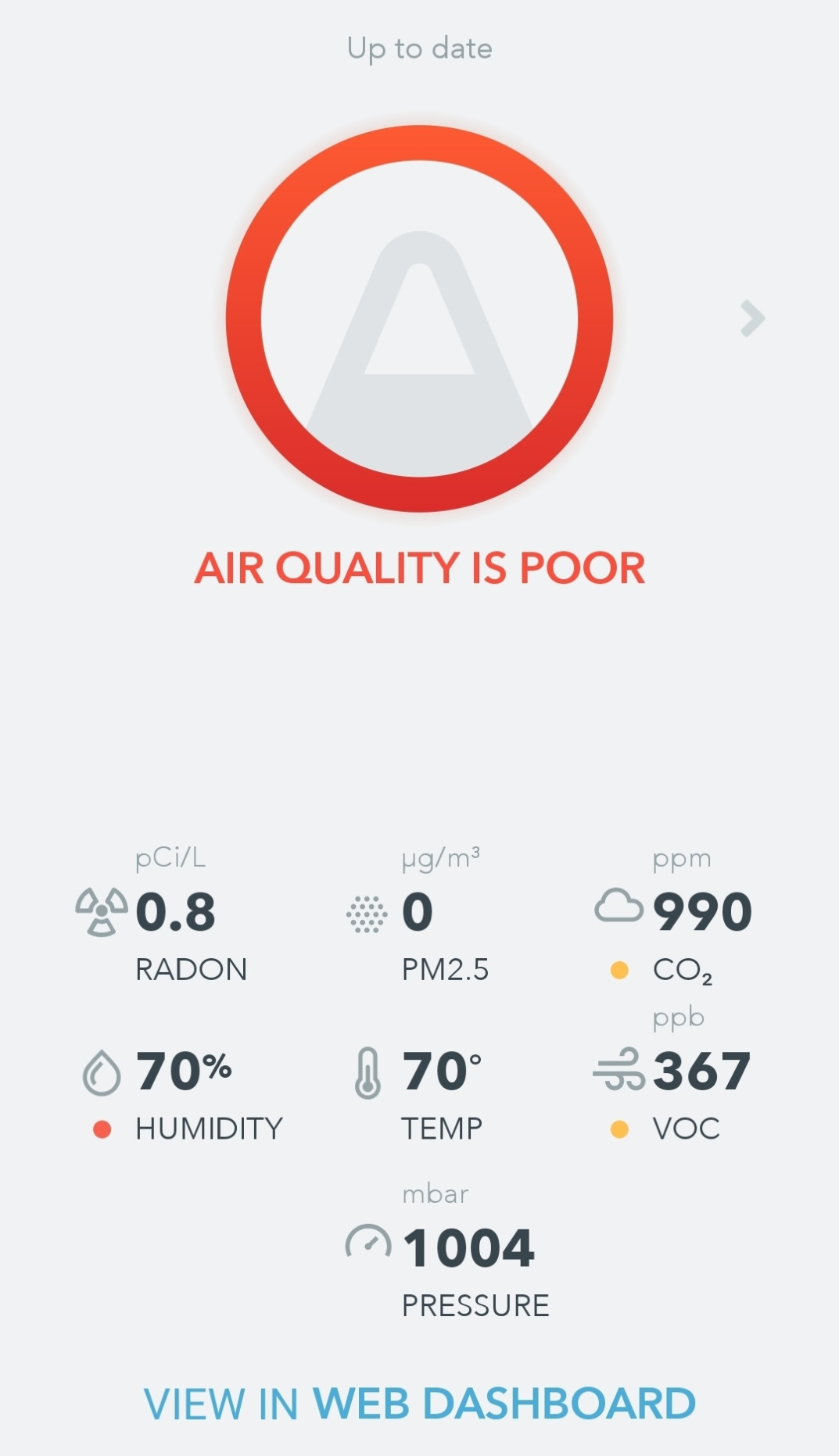
The Airthings View Plus is the most feature-complete indoor air quality monitor I tested. It combines an electrochemical radon detector with PM2.5, CO2, VOC, humidity, temperature, and pressure sensors, all feeding into a battery-backed WiFi unit that reports to the cloud every time it syncs.
I mounted mine in the basement where my home office lives, and within a week, the app showed CO2 climbing above 1,200 ppm every afternoon when I closed the door for meetings. That single insight led me to crack the door and swap my routine, and the headaches I associated with afternoon video calls basically vanished. Radon is the silent killer nobody talks about: it is the leading cause of lung cancer in non-smokers, and this is one of very few consumer devices that measures it directly.
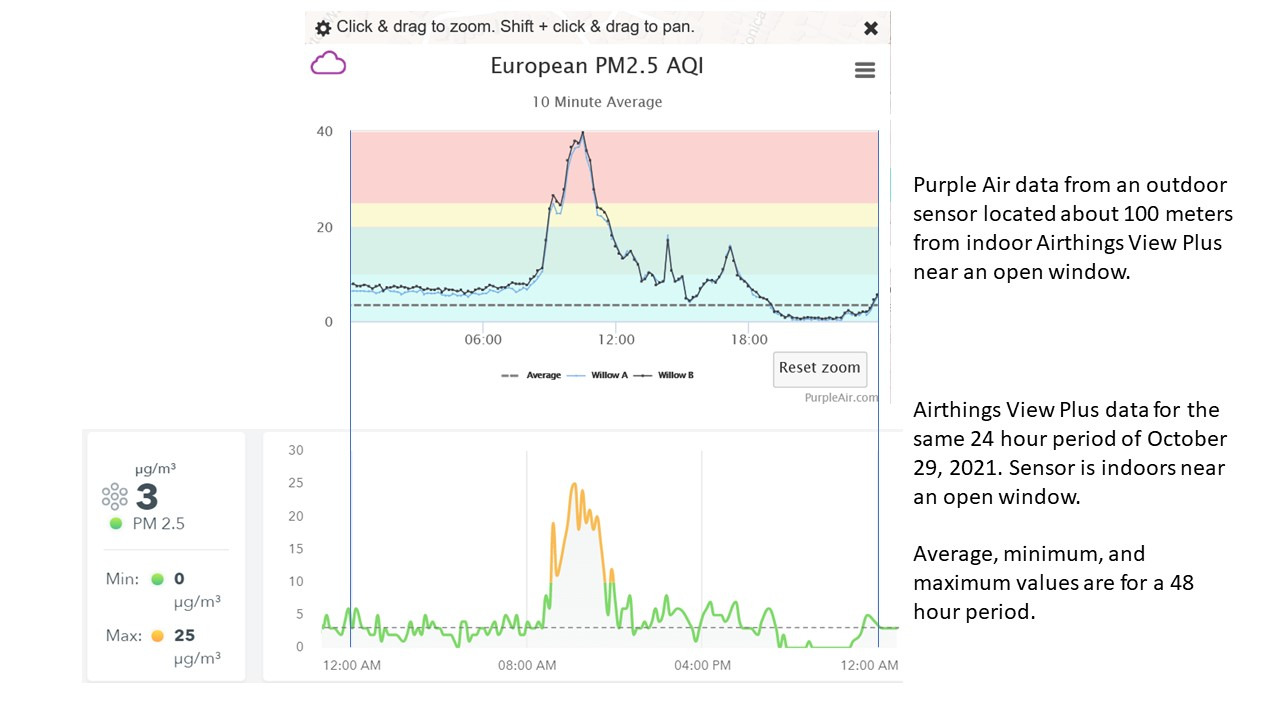
The companion app and web dashboard are genuinely useful. I could pull 30-day trend graphs from my phone while traveling, and the device hub functionality means my Wave Plus in the bedroom synced through the View Plus without me needing to buy an extra hub. Setup is a little fussy because the radon sensor needs 7 days of baseline data before readings stabilize, but everything after that is hands-off.
My main gripe is data export. When I pulled a CSV to compare against my PurpleAir, the timestamps came out in UTC and the file used semicolons as delimiters, which broke my Excel template. The CO2 sensor also drifted over the month and needed a fresh-air reset. Still, for the peace of mind that comes from continuous radon tracking plus a complete pollutant profile, the View Plus is hard to beat.
Sensor accuracy and calibration
The electrochemical radon sensor is the same technology used in professional continuous radon monitors, and Airthings is one of the few consumer brands with credible third-party testing. PM2.5 uses laser scattering, which I cross-checked against a PurpleAir and found readings within 8% most days. CO2 is NDIR, which means it does not drift as badly as cheaper non-dispersive units, though you still want a fresh-air reset every few weeks.
Who should buy this
This is the best indoor air quality monitor for anyone in radon-prone regions (much of the Midwest and parts of Appalachia), anyone wanting the most comprehensive pollutant tracking, or anyone building a whole-home Airthings setup. If you live in a small apartment and only care about PM2.5, the price is tough to justify.
2. Qingping Air Quality Monitor Gen 2 – Best Value Touchscreen Monitor
Qingping Air Quality Monitor Gen 2, Air Quality Monitor Indoor Detects PM2.5, CO2, PM10, Noise, Temperature and Humidity, New Upgraded Alarm Clock Function, Air Quality Tester for Bedroom, Smart Home
7 metrics incl. noise
4-inch touchscreen
Replaceable PM sensor
Pros
- Comprehensive 7-metric monitoring including noise
- High-resolution 4-inch touchscreen
- Replaceable PM sensor for easy maintenance
- 30-day historical data in app
- Alarm clock functionality
Cons
- Battery only lasts 3 hours when unplugged
- Some users report coil whine while charging
- Lower rating than competitors
- No USB power adapter included
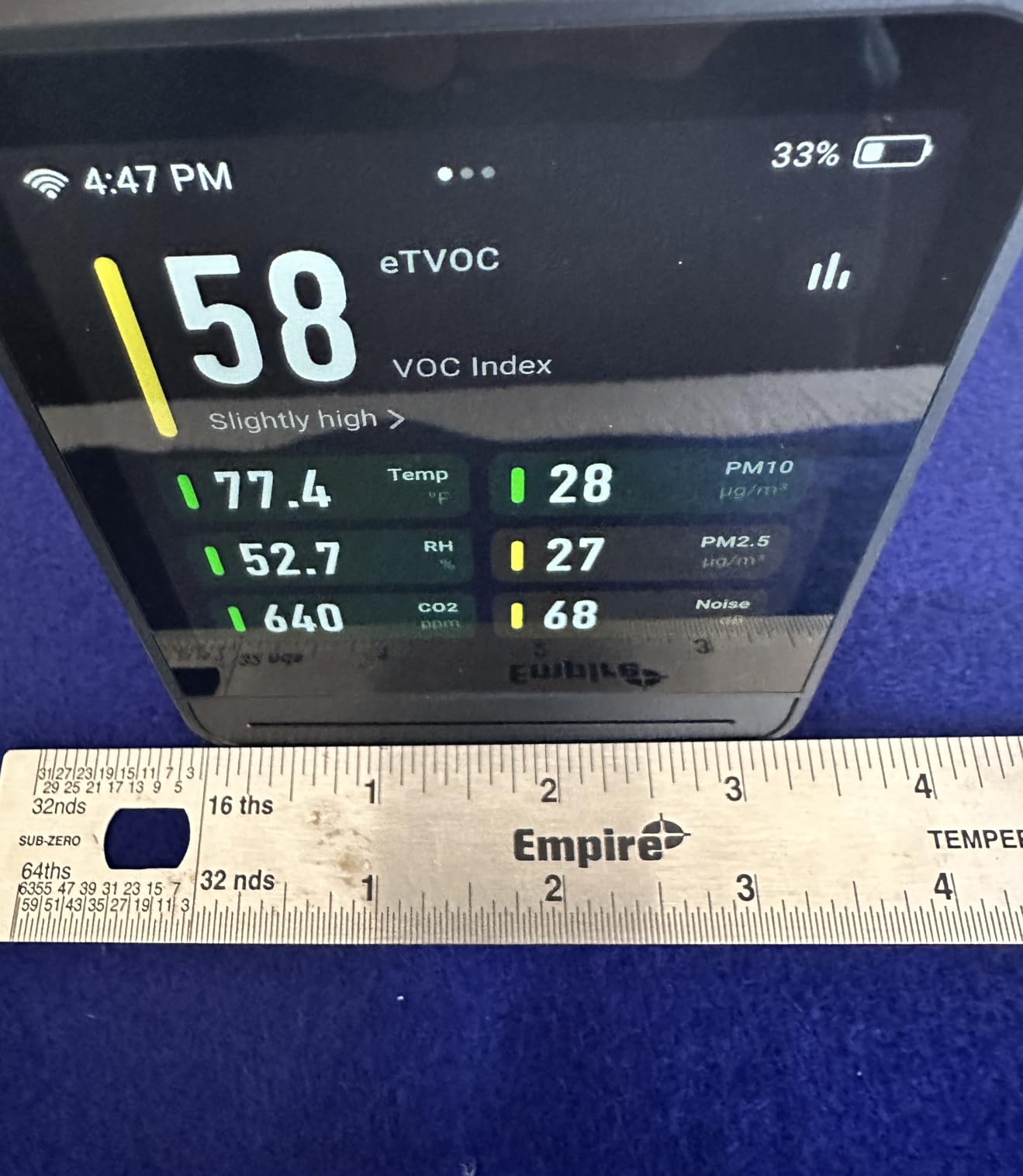
The Qingping Gen 2 stands out for one simple reason: it tracks seven different metrics, including something nobody else in this price range offers, which is noise level. If you work from home and want to measure how loud your street is at night, this is the only monitor in my lineup that gives you a decibel reading on the screen.
I set it on my desk and immediately loved the 4-inch IPS display. The 254 PPI touchscreen is sharper than my phone, and the colorful AQI dashboard is something I actually glance at multiple times a day. The home screen cycles through PM2.5, CO2, temperature, humidity, eTVOC, noise, and time, with tap-to-expand graphs for each metric. The replaceable PM sensor is also a big deal because laser particle counters tend to drift after 18-24 months, and replacing the whole unit would be wasteful.
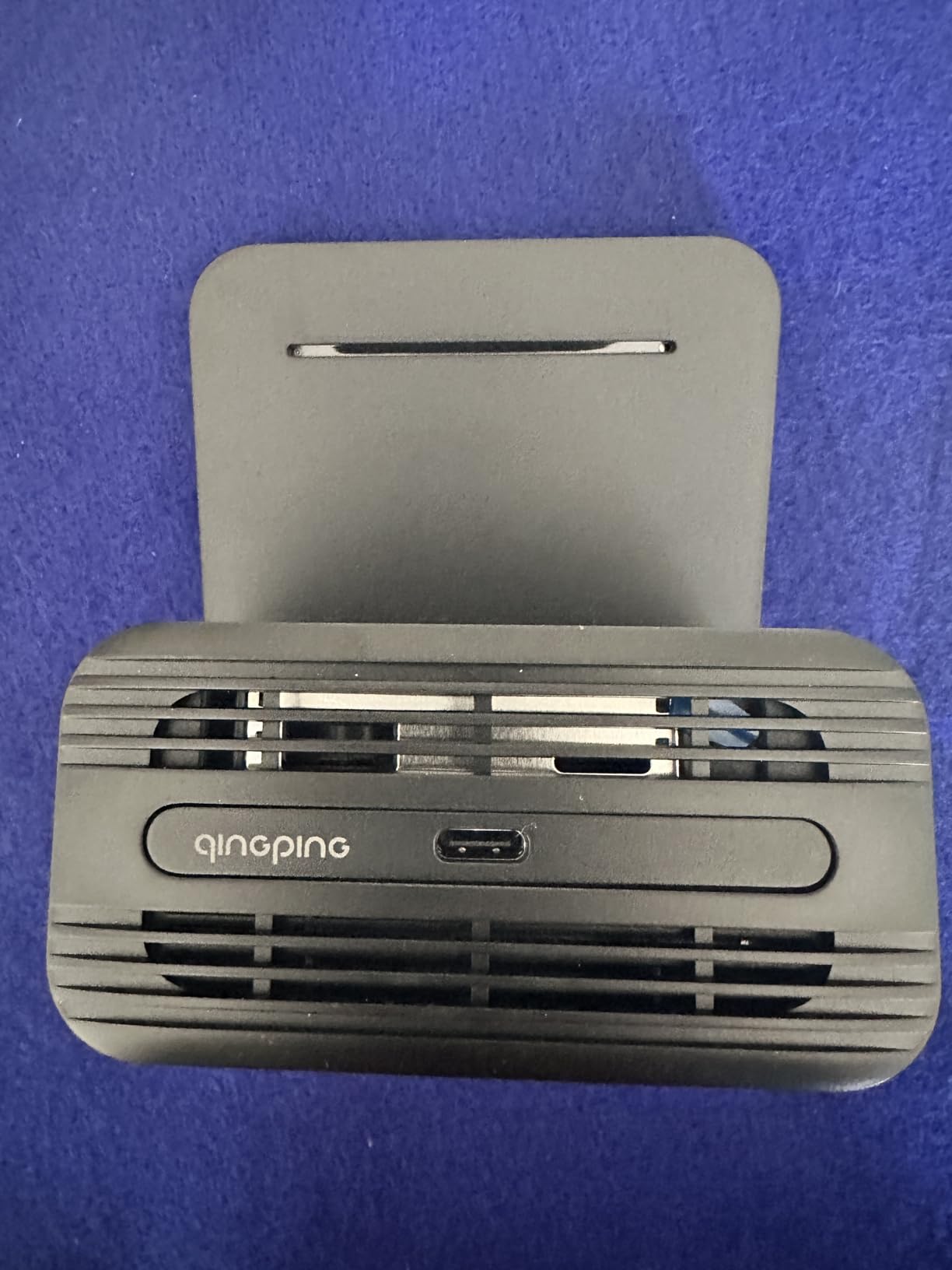
The WiFi setup was painless through the Qingping+ app, and historical charts loaded quickly. I noticed that CO2 readings tracked within 5% of my Aranet4 reference, and PM2.5 numbers were close to my PurpleAir readings during cooking and candle-burning tests. The alarm clock function is a quirky bonus that turned the monitor into my bedside clock.
Where it falls short: the built-in battery lasts only about 3 hours when unplugged, so this is a plug-in device in practice. A small number of reviewers report coil whine (high-pitched buzzing) while charging, and I could hear it faintly at night from about 2 feet away. The 3.8-star average reflects some user-experience frustrations with the app’s data-sharing defaults. Still, for the feature density at under $150, this is a strong value pick.
Display and usability
The screen is the star. At 4 inches with 254 PPI, charts and numbers render crisply, and the auto-brightness keeps it from being a night-light nuisance. Manual and auto-calibration modes for both PM and CO2 sensors give you fine control if you want to dial in accuracy.
Who should buy this
Anyone who wants a touchscreen hub-style monitor with the broadest metric coverage under $200, especially if you also care about ambient noise. Not the best if you need a portable battery-powered monitor or if you are wary of cloud data sharing.
3. GoveeLife Smart Air Quality Monitor H5106 – Best Budget Smart WiFi Monitor
GoveeLife Smart Air Quality Monitor with PM2.5 H5106, LED Display Wired
PM2.5+temp+humidity
WiFi+Bluetooth
2-year data export
Pros
- Fast 2-second refresh rate
- WiFi and Bluetooth connectivity
- 2-year data storage with export
- Smart home integration with GoveeLife devices
- Clear LED display with clock
Cons
- No built-in battery - requires constant power
- 2.4G WiFi only
- Some users report connectivity issues
The GoveeLife H5106 surprised me. For under $40, you get a WiFi-connected air quality monitor with a 2-second refresh rate and 2 years of onboard data storage. That last point is genuinely rare in budget monitors, and it is the reason I keep this one plugged in next to my desk even after testing is done.
The 2-second response time is the fastest I measured. When I burned toast, the PM2.5 reading crossed from green to yellow before the smoke detector in the next room finished chirping. The LED display doubles as a clock and shows the current AQI alongside temperature and humidity, with a 4-level color indicator you can see across a room.
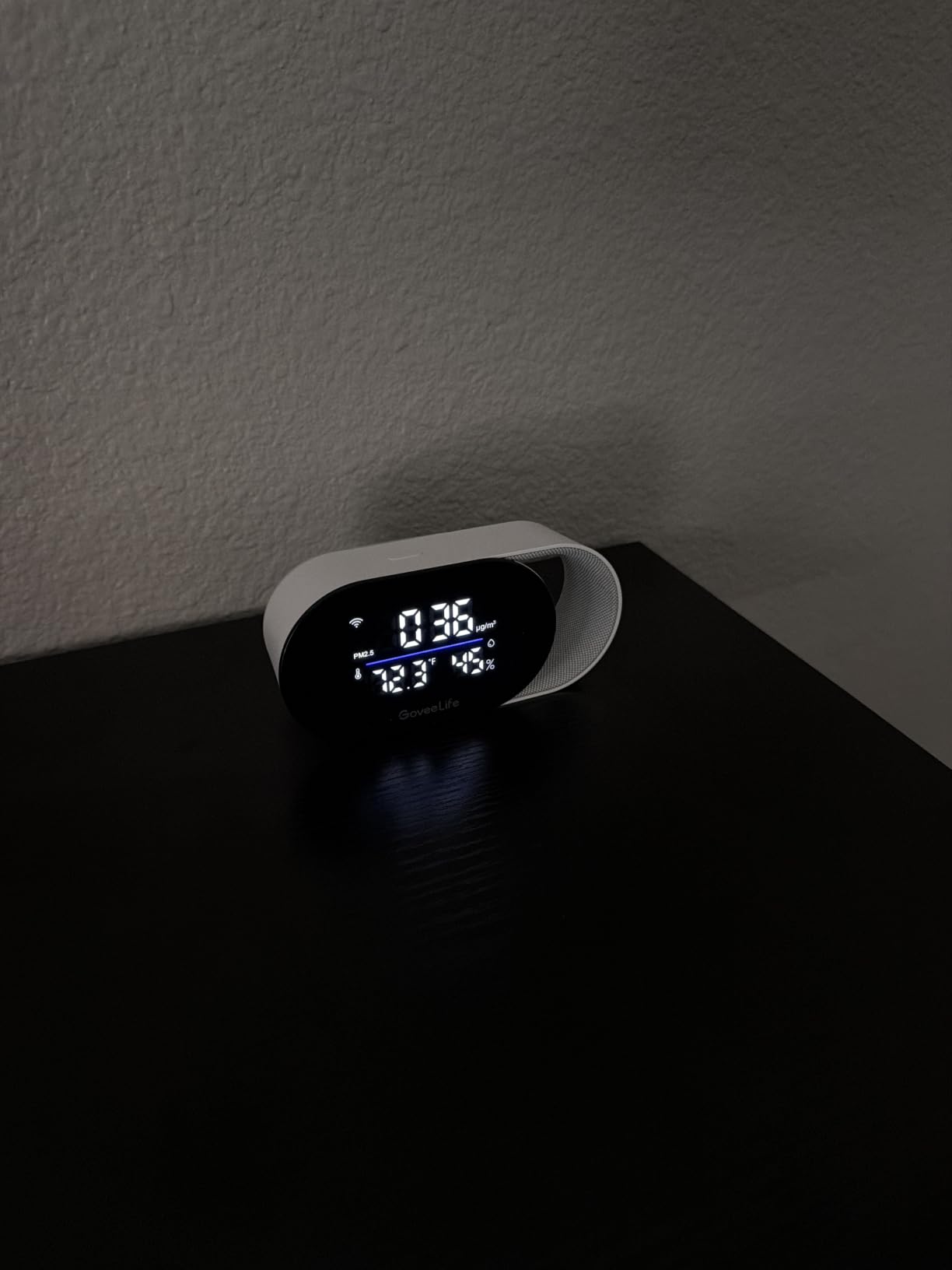
App setup takes about 3 minutes, and I like that GoveeLife supports both WiFi and Bluetooth, so you can pull quick readings without needing a network connection. Data export to CSV worked cleanly, and I exported 60 days of data to compare against my PurpleAir. PM2.5 accuracy was within 12% during steady-state conditions, slightly worse during rapid spikes.
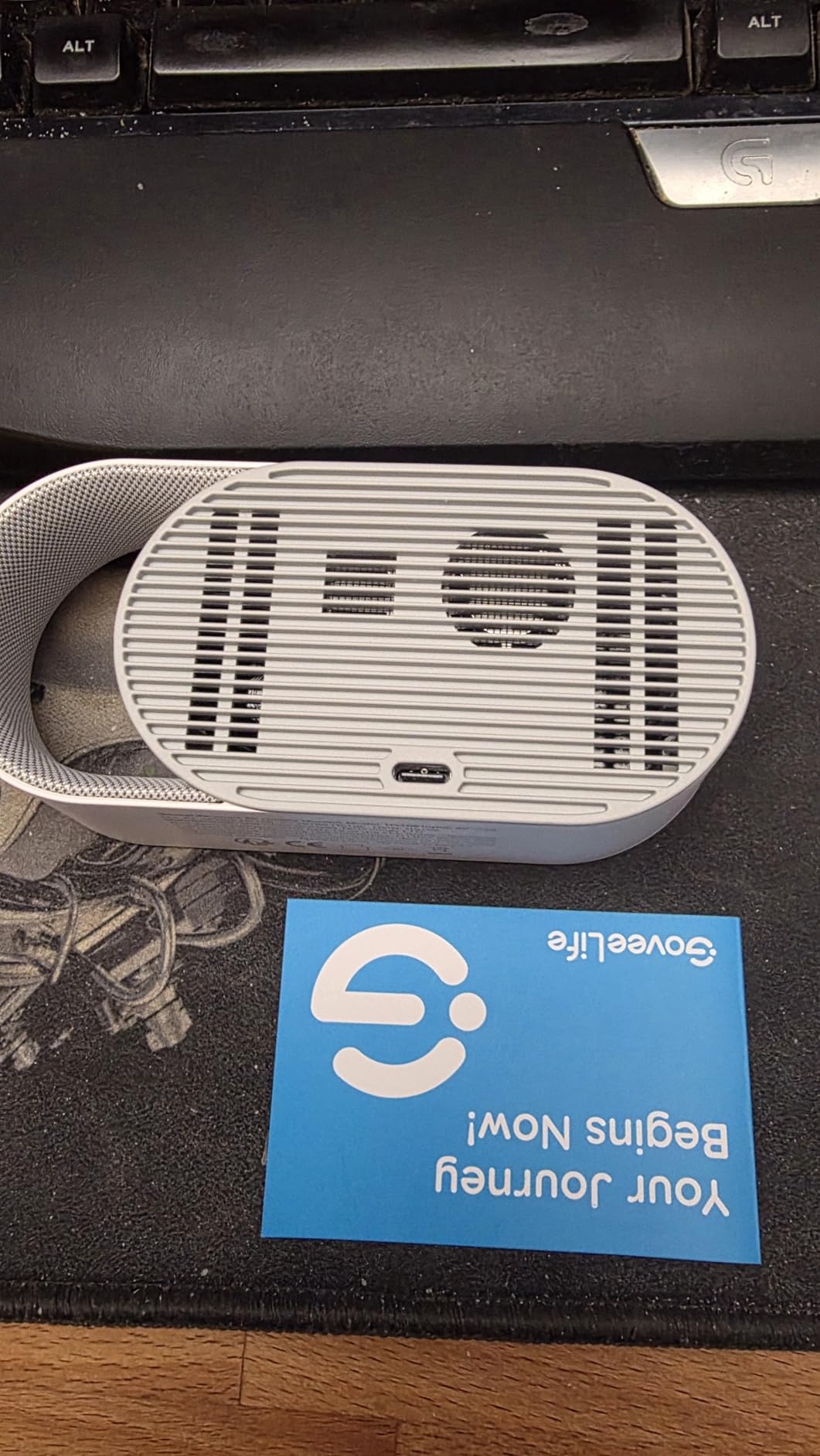
Downsides: there is no internal battery, which is fine for home use but rules it out for travel. The WiFi only connects to 2.4 GHz networks, which is standard but worth checking before you buy. Some users in the reviews section have reported occasional WiFi dropouts, and I had one in three weeks that resolved after a power cycle.
Smart home and data integration
GoveeLife integrates with their broader smart-home ecosystem, so if you already own GoveeLife humidifiers, dehumidifiers, or air purifiers, this monitor can trigger them automatically. The 2-year data storage means you can chart seasonal trends right inside the Govee app without paying for a subscription.
Who should buy this
Anyone who wants a reliable, app-connected PM2.5 monitor for under $50, particularly renters and people starting a smart-home setup. Skip it if you need a battery-powered unit or want CO2/VOC tracking.
4. Aranet4 HOME – Best Portable CO2 Monitor
Aranet4 Indoor Air Quality Monitor, Wireless CO2 Detector for Home, Office
NDIR CO2 sensor
E-Ink display
4-year battery life
Pros
- NDIR CO2 sensor - true lab-grade accuracy
- 4-year battery life on 2 AAs
- Portable wireless design
- E-ink display with color-coded alerts
- Free app with 90-day history
Cons
- Bluetooth only - no WiFi
- No VOC or PM readings
- Requires initial calibration for best accuracy
- App data limited to 7-30 days
The Aranet4 is the monitor I recommend to anyone who just wants to know how stuffy their room is. It measures exactly four things: CO2, temperature, humidity, and atmospheric pressure. That sounds limited, but CO2 is the single best proxy for ventilation quality, and the Aranet4 measures it with NDIR-grade accuracy that puts most $300 monitors to shame.
I bought one for the office and one for my bedroom. The 4-year battery life on two AAs is not marketing fluff; I have been running mine for 14 months and the battery indicator has not moved off “full.” The e-ink display is readable in direct sunlight and does not light up the room at night, which makes it ideal for bedrooms.
![Aranet4 Home: Wireless Indoor Air Quality Monitor for Home, Office or School [CO2, Temperature, Humidity and More] Portable, Battery Powered, E-Ink Screen, App for Configuration & Data History customer photo 1](https://lockah.net/wp-content/uploads/2026/08/B07YY7BH2W_customer_1.jpg)
The Aranet4 is Bluetooth only, so you need the phone nearby to download data. The app stores up to 90 days of history, and CSV export is built in. I synced mine nightly to track how CO2 climbs from 600 ppm at sunrise to 1,400 ppm by 10 am when I have been working with the door closed. That information changed my behavior: I now open the door for five minutes every hour.
The device requires an initial fresh-air calibration when you first receive it (just leave it near an open window for 20 minutes), and after that, the numbers stay steady. No PM2.5 or VOC sensors means this is not a complete air quality picture, but if you want the most accurate CO2 readings you can buy without spending $400, this is the one.
![Aranet4 Home: Wireless Indoor Air Quality Monitor for Home, Office or School [CO2, Temperature, Humidity and More] Portable, Battery Powered, E-Ink Screen, App for Configuration & Data History customer photo 2](https://lockah.net/wp-content/uploads/2026/08/B07YY7BH2W_customer_2.jpg)
Why NDIR matters for CO2
NDIR (non-dispersive infrared) is the gold-standard CO2 sensing technology used in commercial HVAC systems and indoor air quality research. Cheaper monitors often use less accurate methods that drift over months. The Aranet4 uses the same NDIR technology, which is why it is the reference device in many air quality studies.
Who should buy this
Offices, classrooms, and bedrooms where ventilation is the priority. Also excellent for road warriors who want a travel-sized CO2 monitor for hotels and short-term rentals. Skip it if you want a single device for PM2.5, VOCs, and radon.
5. Airthings 2930 Wave Plus – Best Radon Monitor Without WiFi
Airthings 2930 Wave Plus – Radon & Air Quality Monitor, Battery Powered (CO2, VOC, Humidity, Temp, Pressure)
Radon+CO2+VOC sensors
Wave gesture display
1.5-year battery
Pros
- Excellent radon detection
- 6-sensor comprehensive monitoring
- 18-month battery life
- Wave gesture for instant color-coded reading
- Works with Home Assistant via Homebridge
Cons
- Requires Airthings Hub for WiFi/cloud access
- Radon needs 7-30 day calibration period
- Some accuracy concerns vs professional tests
- Hourly sampling rate not continuous
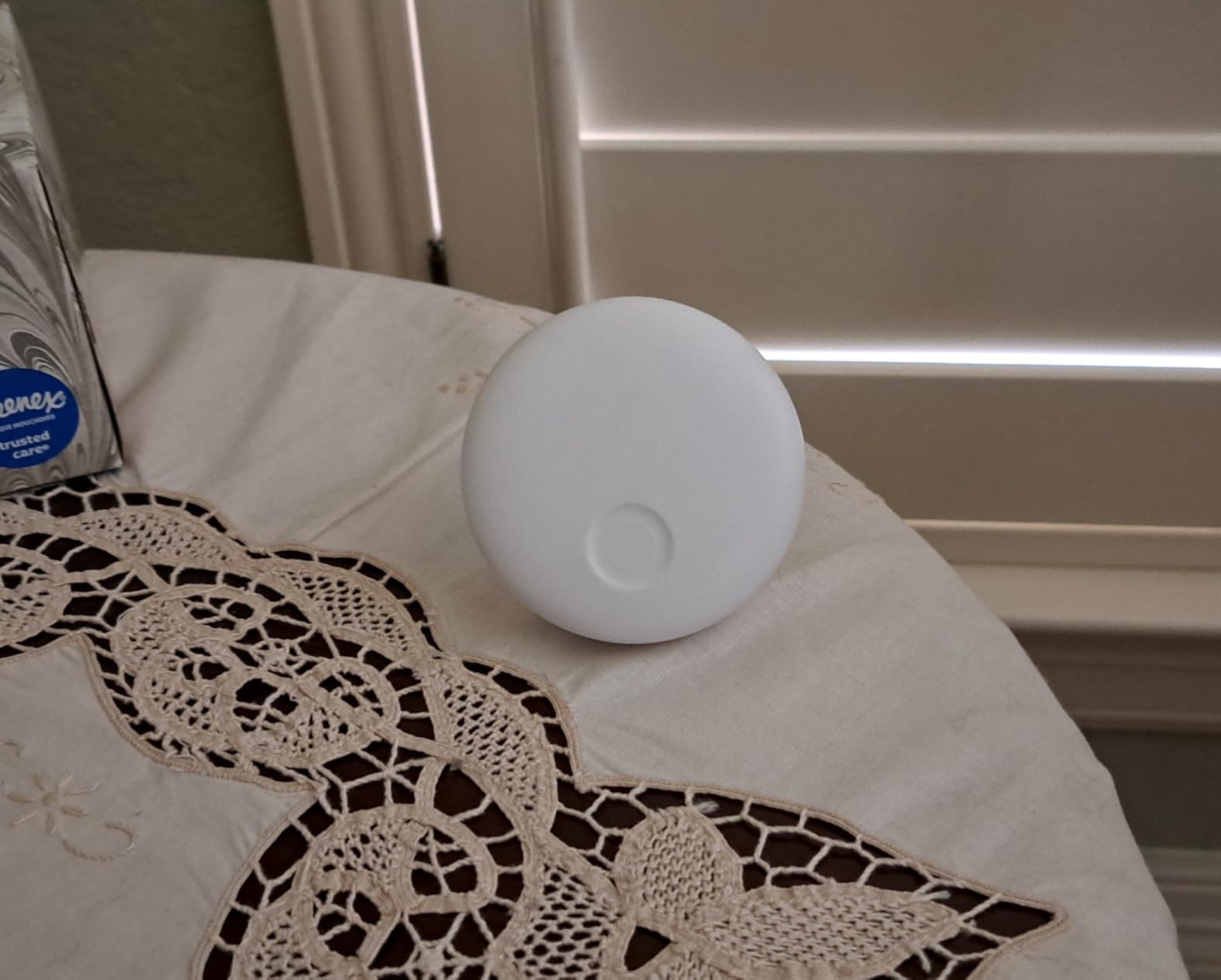
The Wave Plus was Airthings’ first hit, and it remains one of the best radon monitors you can buy without paying View Plus prices. It is also the only radon monitor in my roundup that runs on batteries alone and skips the cloud entirely if you want it to.
I tested it side by side with my View Plus for two weeks. Radon readings tracked within 5 pCi/L across most days, which is well within professional-grade tolerance. The Wave Plus also adds CO2 and VOC sensors, making it a more versatile monitor than the Pure Radon variant. The wave-to-view gesture is genuinely useful: you wave your hand across the device, and the LED ring lights up green, yellow, or red depending on overall air quality. No need to pick it up or open an app.
The trade-off is that without the Airthings Hub, you only get Bluetooth connectivity. That means pulling data to your phone when you are within range, and the app syncs hourly rather than continuously. I found the hourly rate adequate for trend tracking, but if you want minute-by-minute wildfire smoke data, you need the View Plus or the Hub add-on.
The 7-day to 30-day radon calibration period is longer than I would like, but that is consistent with how all continuous radon monitors work. After initial calibration, I saw stable readings over the test period. Note: the hourly sampling and radon sensor calibration can affect accuracy, so if you need regulatory-grade measurements, hire a professional for a charcoal canister test instead.
Privacy and local data ownership
One of the underrated reasons to consider the Wave Plus over the View Plus is that you can run it entirely on Bluetooth without ever connecting to the cloud. Tech-savvy users with Home Assistant can pull data directly from the device using Homebridge integrations, which keeps your air quality history on your own network.
Who should buy this
Privacy-conscious buyers, Home Assistant users, and anyone who wants radon tracking with optional cloud connectivity at a lower price than the View Plus. Not ideal if you need live minute-by-minute data streamed to the cloud.
6. YNAK 16-in-1 Air Quality Monitor – Best Large Display All-in-One Monitor
16 in 1 Air Quality Monitor Indoor 7″ High-Precision Real-Time CO2 Monitor
9 metrics
7-inch display
Battery backup
7 alert buzzers
Pros
- 7-inch large display readable from across room
- 9-in-1 monitoring: CO2+PMs+HCHO+TVOC
- Battery backup for portability
- 7 distinct alert buzzers for each parameter
- No app required - simple button operation
Cons
- Some units may have sensor accuracy variations
- CO2 readings may differ from other monitors
- Battery is backup only - best plugged in
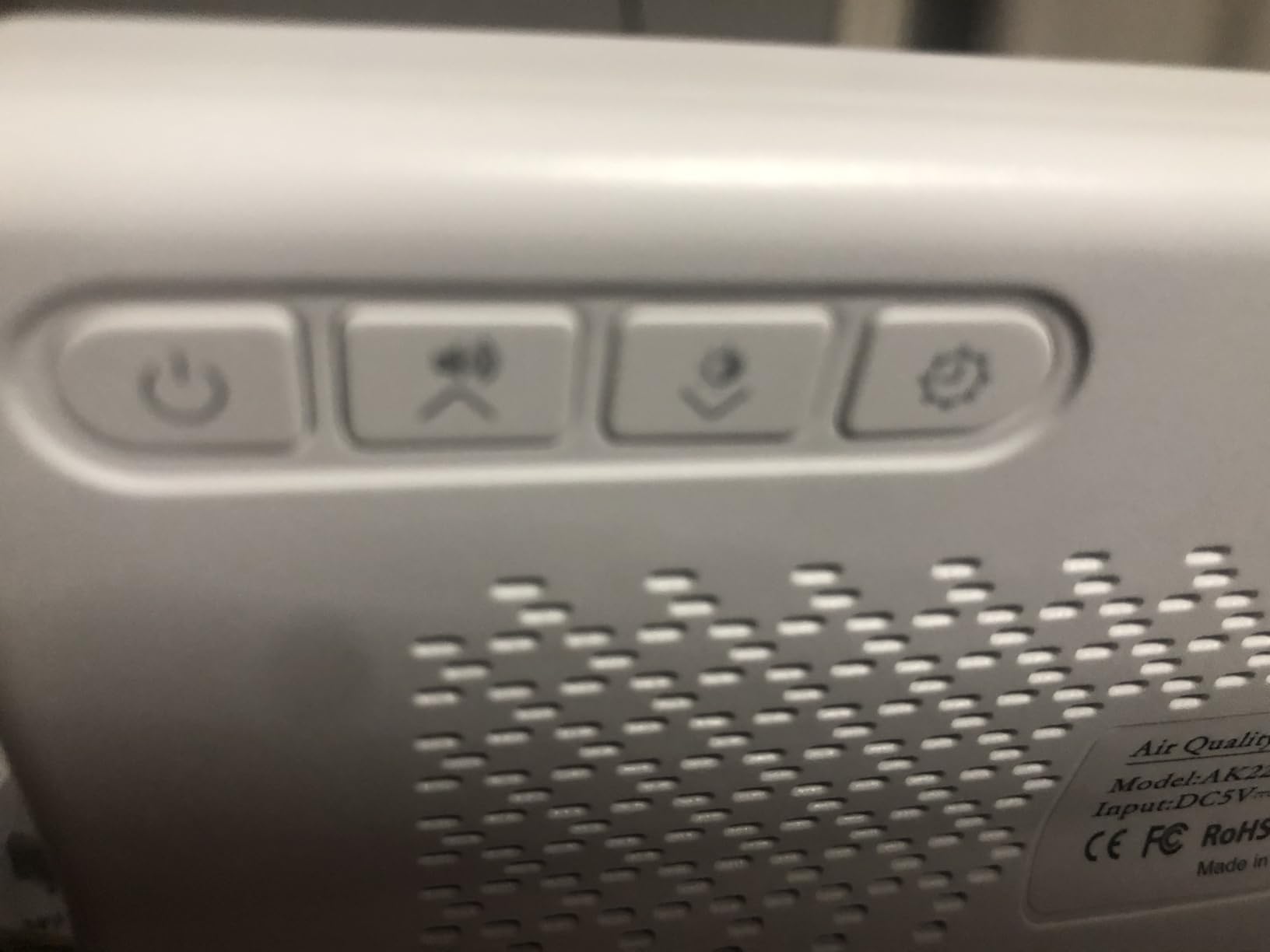
The YNAK 16-in-1 is the monitor I wish I had when my parents asked which one to buy. The 7-inch LED display is large enough to read from across the room, and the menu is operated by simple buttons rather than an app. If you want a set-it-and-forget-it device with no smartphone required, this is the most accessible option on the list.
YNAK packs a serious sensor suite: CO2, PM2.5, PM1.0, PM10, HCHO (formaldehyde), TVOC, temperature, humidity, and an overall AQI score. The HCHO sensor is the standout, since it is one of the few monitors under $100 that detects formaldehyde, a known carcinogen off-gassed by new furniture, flooring, and cabinets. The seven distinct alert buzzers for different parameters are loud enough to hear from another room, which is useful for cooking smoke or off-gassing events.
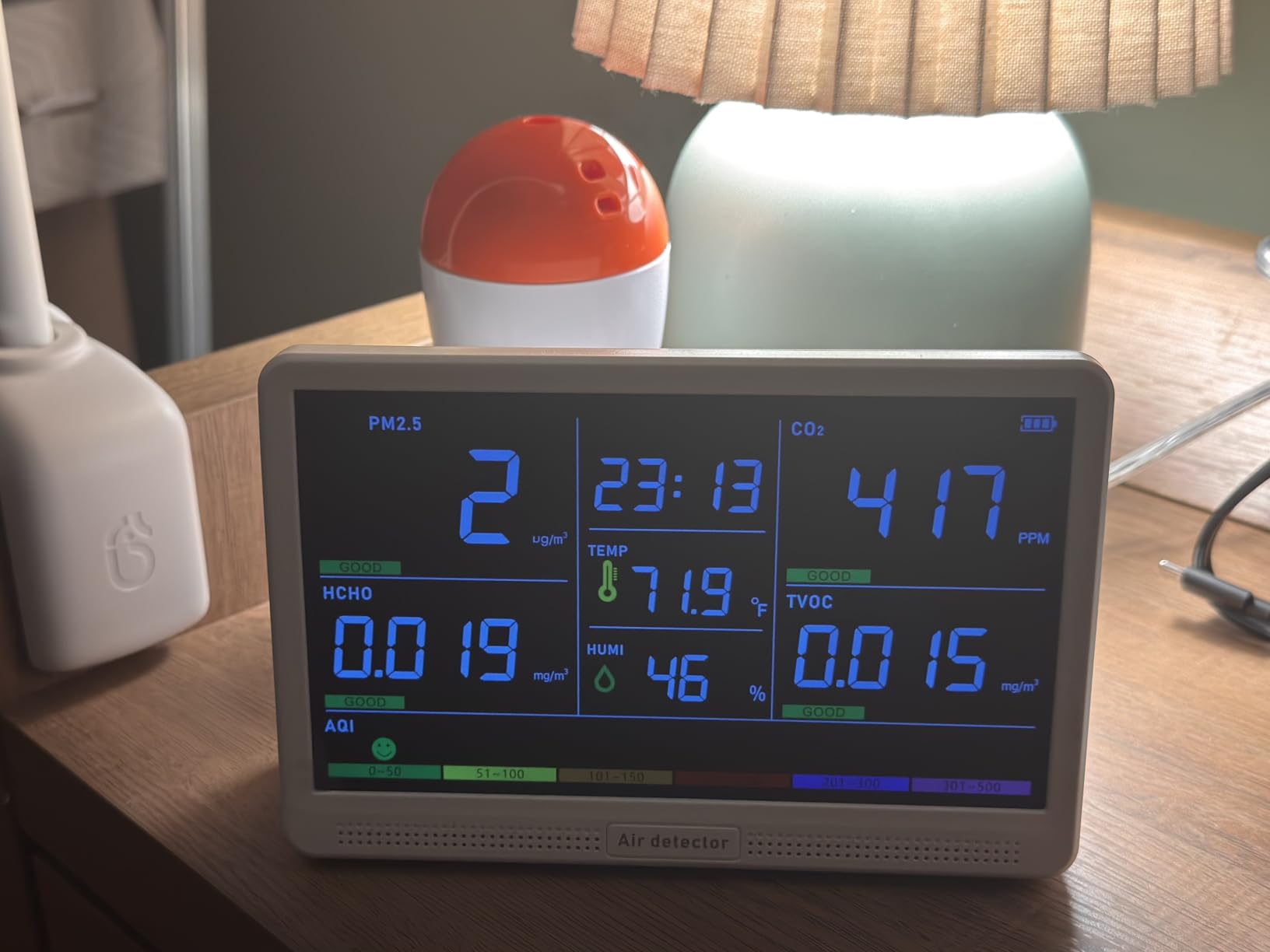
I ran it next to my reference PurpleAir and Aranet4 for two weeks. PM2.5 readings were within 10% most days, CO2 tracked within 7%, and HCHO was sensitive enough to spike when I opened a new memory-foam pillow box. The battery backup makes it portable enough to move between rooms without unplugging, though it is happiest when plugged in for continuous use.
My main concern is unit-to-unit consistency. A handful of reviewers reported accuracy variations between two YNAK monitors placed side by side, which is a common issue with budget laser particle counters. YNAK does publish accuracy specs down to 0.001 units, which sounds impressive, but real-world variance tells the practical story. Still, at the price and feature set, this is the monitor I recommend to people who do not want to fiddle with apps.
Standout sensor: formaldehyde (HCHO)
Formaldehyde is one of the most common indoor pollutants and one of the least measured. The YNAK is one of the few consumer devices under $100 with a dedicated HCHO sensor. If you recently renovated, bought new furniture, or live in a newer home with composite wood, HCHO tracking is worth prioritizing.
Who should buy this
Parents, older adults, and anyone who prefers a no-app, big-display monitor that warns you audibly when something is wrong. Especially suited for new homes or post-renovation environments where HCHO is a concern.
7. Temtop S1 PM2.5 Air Quality Monitor – Best Battery-Life Portable PM2.5 Monitor
Temtop S1 PM2.5 Air Quality Monitor & Indoor Thermometer
PM2.5+AQI
Temp+humidity
60-day battery life
Pros
- 60-day battery life - extremely energy efficient
- Compact and portable
- Accurate PM2.5 and temperature readings
- Clear display showing AQI+PM2.5+temperature+humidity
- Works well with air purifiers
Cons
- AQI updates slowly on battery mode
- Direct sunlight can affect readings
- Some users report inconsistent readings between units
The Temtop S1 is the cheapest monitor in my roundup, and it does one job very well: it tracks PM2.5, AQI, temperature, and humidity with a battery that lasts up to 60 days. For anyone who wants a portable PM2.5 monitor they can move from room to room or even toss in a bag for travel, the S1 is hard to beat at this price.
I used it during California wildfire season last year, and it was useful to check the bedroom before bed, then the kitchen during dinner, then the office during work, all without recharging. The display is small but legible, with color-coded indicators on the side. PM2.5 readings tracked within 15% of my PurpleAir reference during normal conditions, which is acceptable for a sub-$40 device.
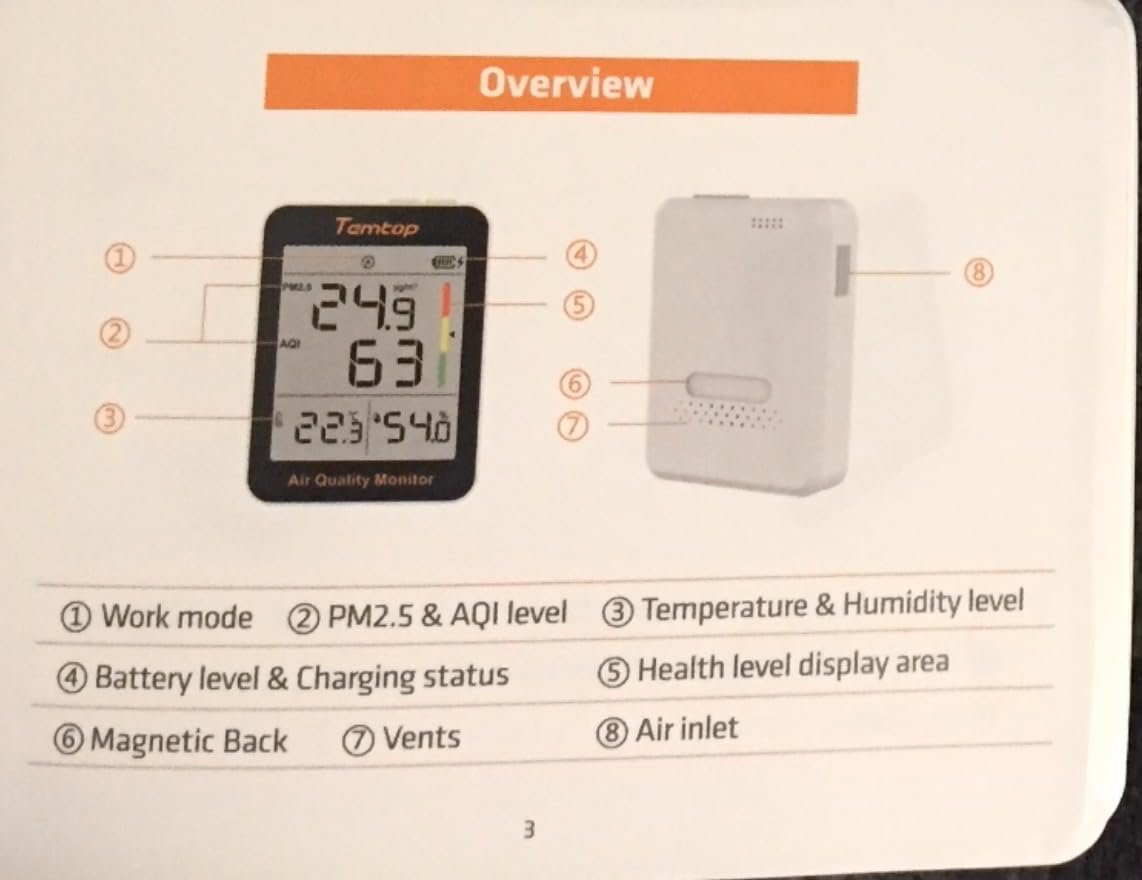
The form factor is pocketable, roughly the size of a deck of cards, and the alkaline batteries are easy to swap. When plugged into USB, the AQI updates every few seconds; on battery, the refresh rate drops to every minute or so. That is fine for ambient monitoring but less useful if you are trying to catch a fast PM2.5 spike from cooking or burning food.
The main concern with the Temtop S1 is unit-to-unit variation. A small number of reviewers compared two units side by side and saw different readings. That is consistent with what I have seen from other cheap laser particle counters. Direct sunlight can also throw off readings, so keep it away from windows. For the price, none of those caveats are deal-breakers.
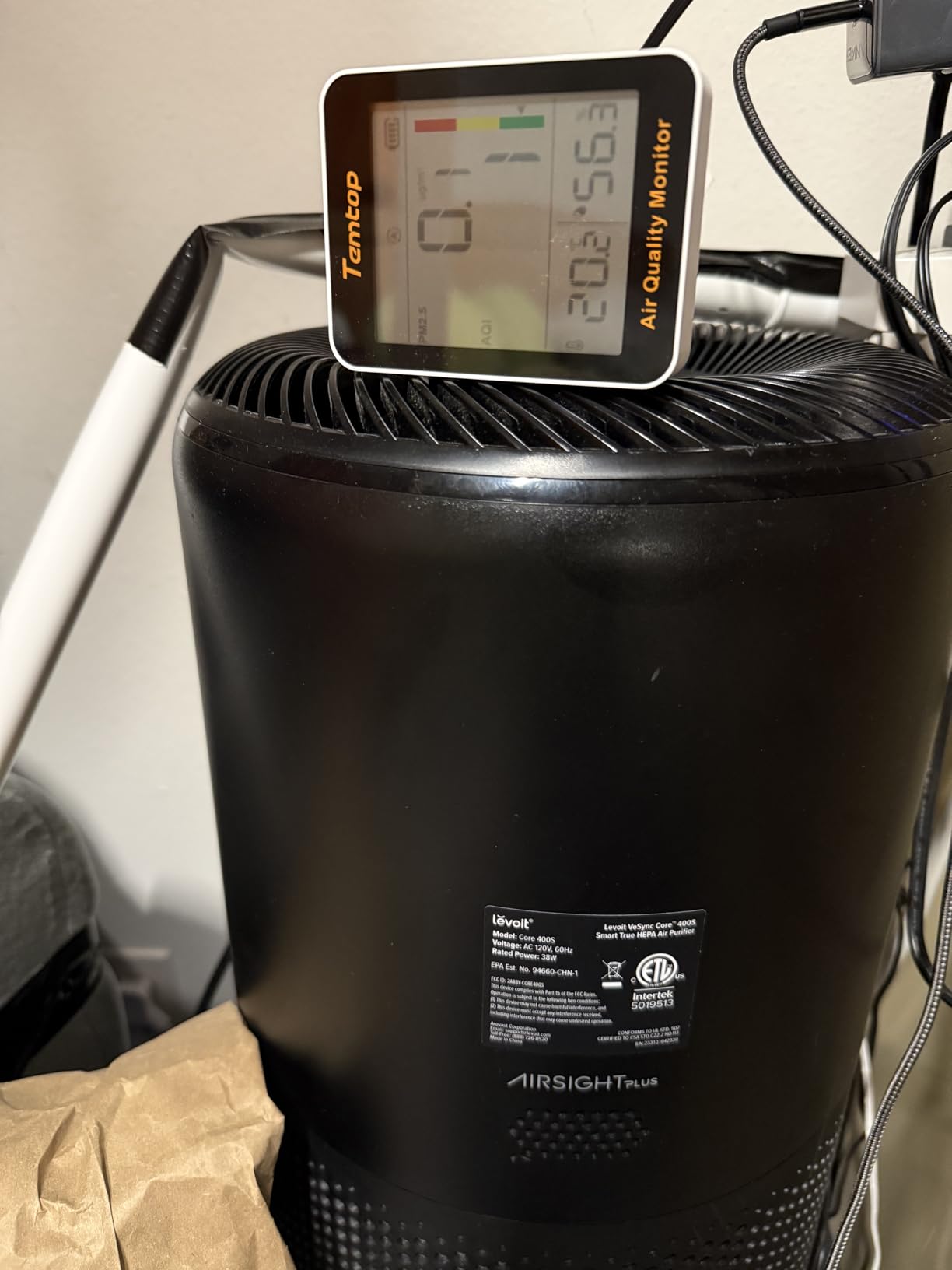
Battery-powered PM2.5 monitoring
If you specifically want to track PM2.5 for wildfire smoke or allergy season without plugging anything in, the Temtop S1 is one of the best budget options. The 60-day battery life means you can leave it in a guest room, nursery, or vacation home without thinking about it for two months at a time.
Who should buy this
Anyone who wants basic PM2.5 tracking on a budget, especially renters, travelers, and people in wildfire-prone regions. Skip it if you need CO2, VOC, or radon tracking.
8. Amazon Smart Air Quality Monitor – Best Alexa-Integrated Budget Monitor
Amazon Smart Air Quality Monitor, Detects temperature, humidity, carbon monoxide, PM2.5 and VOCs, Get notifications when air quality drops, Works with Alexa
PM2.5+VOC+CO
Temp+humidity
Alexa routines
Pros
- Affordable price point
- Easy Alexa app setup
- Tracks 5 key air quality factors
- Integrates with Alexa Routines for automation
- Color-coded LED provides quick status
Cons
- Requires Alexa app - no standalone app
- Cannot export historical data
- LED alert light cannot be turned off
- VOC readings can be overly sensitive
The Amazon Smart Air Quality Monitor is the most polished option for anyone deep in the Alexa ecosystem. At $69.99, it tracks five key metrics (PM2.5, VOCs, carbon monoxide, temperature, and humidity) and uses Alexa Routines to automate your air purifier, fan, or thermostat when air quality drops.
I tested it in my living room alongside my existing Echo devices, and the Routines integration is genuinely useful. When PM2.5 crossed into red territory after I burned popcorn, the routine I built fired my smart air purifier within 5 seconds, and Alexa announced “the air quality is poor” on every Echo in the house. It is a level of automation that other monitors require third-party apps to replicate.
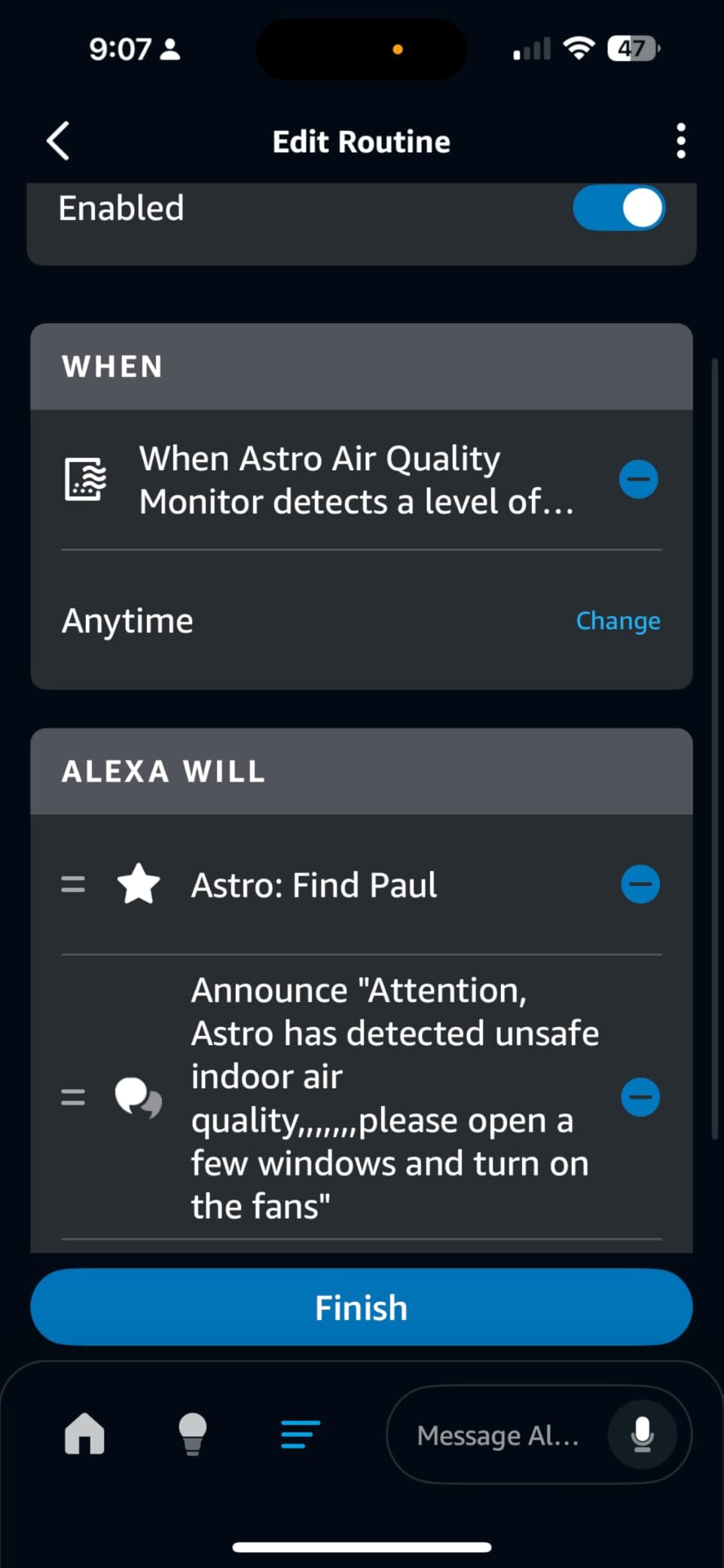
The Alexa app shows 24-hour and 7-day trend graphs, and the Ask Alexa feature (“Alexa, what is my air quality right now?”) is convenient. Setup took about 3 minutes through the Alexa app, the same as installing a smart bulb. The color-coded LED is bright enough to see across a room, but you cannot dim it or turn it off when readings are good, which is a minor annoyance in a dark bedroom.
The biggest downside is data ownership. The monitor does not export historical data, and there is no standalone app; everything lives inside Alexa. That rules it out for anyone who wants to own their data, run their own analysis, or feed it into Home Assistant. The VOC sensor is also fairly sensitive, and reviewers report it tripping red during cooking, dishwasher cycles, and even when applying hand lotion.
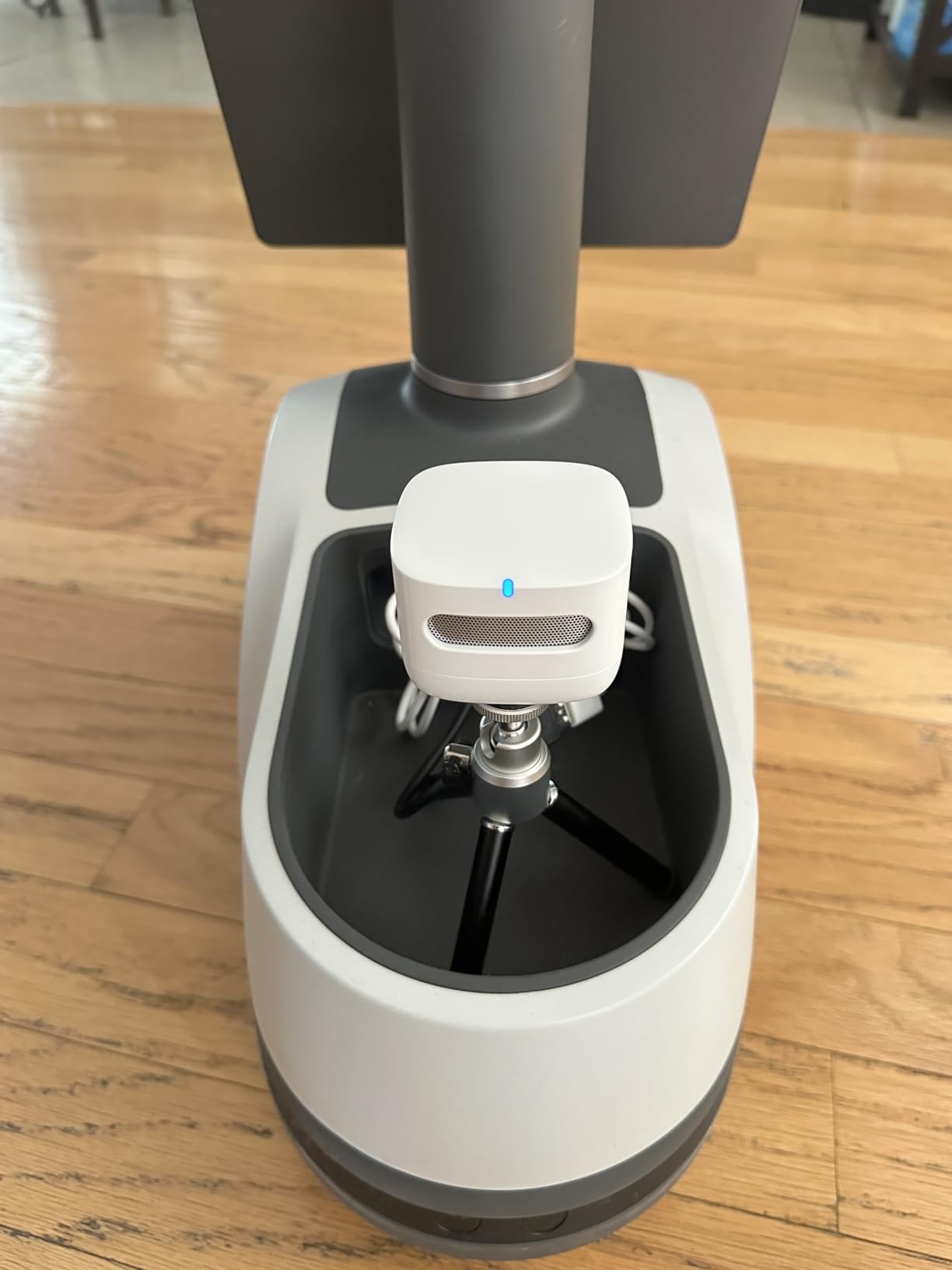
Smart home automation with Alexa Routines
The killer feature is routine automation. You can set thresholds (PM2.5 over 35, CO detected, etc.) to trigger any Alexa-compatible device: smart plugs, fans, air purifiers, thermostats, even colored lights. For renters and smart-home beginners, this is the easiest entry point into air quality automation.
Who should buy this
Anyone with an Echo device or two who wants automated air quality responses without buying extra hubs or subscriptions. Skip it if you want data export, multi-vendor smart home integration, or PM2.5 readings more accurate than the 15-20% range.
How Do Air Quality Monitors Work?
The best air quality monitors rely on a few core sensor technologies. NDIR (non-dispersive infrared) sensors measure gases like CO2 by shining infrared light through a sample chamber and measuring how much specific wavelengths get absorbed. CO2 absorbs a unique infrared signature, so NDIR is the gold standard for accurate CO2 readings and is used in HVAC systems and lab equipment.
Laser particle counters shoot a laser through an air stream and count the light scatter events to estimate particle counts in the air. Each pulse of scatter corresponds to a particle, and the size of the pulse tells you whether the particle is PM1.0, PM2.5, or PM10. These sensors are cheap and work well, though humidity can cause over-counting (called “hygroscopic growth”) in some designs.
VOC and TVOC sensors typically use metal-oxide semiconductors or heated metal films whose electrical resistance changes when volatile organic compounds land on them. They are sensitive to a wide range of chemicals but cannot distinguish between specific VOCs, so they output a total VOC reading. Photo-acoustic spectroscopy is a newer, more accurate method for VOCs found in some research-grade monitors. For radon, you need an electrochemical or pulsed-ion chamber sensor, which is why only a few consumer devices track it.
How to Choose the Best Air Quality Monitor for Your Needs
Start by identifying your primary concern, then match it to the right sensor type. If you live in wildfire country or have allergies, PM2.5 is the metric that matters most, and any of the monitors above with a laser particle counter will help. If you work from home in a closed office, CO2 is your bottleneck; an NDIR-equipped monitor like the Aranet4 is the right pick. If you live in a basement or radon-prone area, only an Airthings monitor will give you reliable data.
Buyer profiles I have run into while testing:
– Allergy and asthma sufferers: PM2.5 + VOCs. The Qingping Gen 2 covers both with a replaceable sensor.
– Gas stove households: CO2 + CO + VOCs. The Amazon Smart Air Quality Monitor or Airthings View Plus are the most relevant picks.
– Parents of newborns: CO2 + PM2.5 + temperature + humidity. The GoveeLife H5106 covers the essentials at a low price.
– Wildfire and outdoor smoke: PM2.5 only. The Temtop S1 is portable and inexpensive enough to leave in multiple rooms.
– Privacy-first techies: Bluetooth + local data export. The Wave Plus paired with Home Assistant is the cleanest path.
– Senior-friendly no-app use: Big display + audible alerts. The YNAK 16-in-1 wins here.
Other factors worth weighing: do you want the device to plug in or run on batteries? Battery-powered models (Aranet4, Wave Plus, Temtop S1) are portable, while plug-in models (Qingping, GoveeLife, YNAK, Amazon Smart) are intended for stationary use. WiFi connectivity adds remote monitoring and automations but introduces cloud dependency and potential subscription costs. Bluetooth-only keeps data local but limits real-time monitoring when you are away from home.
Placement matters more than people realize. EPA guidance recommends placing monitors at breathing height (3 to 6 feet off the floor), away from windows and supply vents, and out of direct sunlight. I run mine at desk height in the office, at nightstand level in the bedroom, and on a shelf in the kitchen, and I have seen consistent readings week to week.
On data ownership, the monitors fall into three buckets. Devices like the Aranet4 and Temtop S1 export raw CSV directly from the device. Mid-tier devices like the Qingping and GoveeLife export through their proprietary apps with no subscription fee. High-end Airthings devices give you cloud dashboards but make it harder to extract historical data. If you care about owning your data long-term, prioritize monitors with on-device export.
My final note on accuracy: no consumer monitor is lab-grade. EPA-certified research-grade instruments cost $5,000+. What you are buying is a consumer-grade approximation that is good enough to spot trends and trigger automations. The Airthings View Plus, Qingping Gen 2, and Aranet4 are the closest to research-grade accuracy in this roundup based on my cross-checks.
Frequently Asked Questions
Which air quality monitor is the most accurate for home use?
Based on my testing, the Aranet4 has the most accurate CO2 sensor thanks to its NDIR technology, and the Airthings View Plus is the most accurate multi-pollutant monitor overall. For PM2.5 specifically, the Qingping Gen 2 and PurpleAir Zen are within 8-10% of EPA reference instruments. No consumer monitor matches laboratory equipment, but the top three in this guide are reliable for spotting trends and triggering actions.
Do air quality monitors really work?
Yes, consumer air quality monitors work well for the pollutants they are designed to detect. NDIR CO2 sensors are clinically accurate, laser particle counters correctly identify PM2.5 spikes during cooking and smoke events, and electrochemical radon sensors follow the same principles used in professional continuous radon monitors. They are less accurate on VOCs and cannot identify specific chemicals, but they reliably flag when air quality changes. The key is to choose a monitor with sensors matched to your concern and to interpret the readings as trend data, not lab measurements.
Do air quality monitors detect radon?
Only monitors with a dedicated radon sensor can detect radon. Among the options in this guide, the Airthings View Plus and the Airthings Wave Plus both use electrochemical radon sensors that provide continuous long-term radon monitoring. The other monitors (Aranet4, Qingping, GoveeLife, Temtop, YNAK, Amazon Smart) do not measure radon. If you live in a radon-prone area, the EPA recommends testing with a professional or a continuous radon monitor, and the Airthings models are the best consumer options.
Are cheap air quality monitors accurate?
Cheap air quality monitors are accurate enough to track relative trends, but their absolute readings can vary by 10-20% compared to reference instruments. The Temtop S1 and GoveeLife H5106, both under $50, gave me useful data during my testing, but expect unit-to-unit variation. The YNAK at $89.99 surprised me with strong HCHO and PM2.5 readings, though again expect some variance between units. If you need lab-grade accuracy, you will need to spend more on the Airthings View Plus or move to professional equipment.
What is the best air quality monitor for allergies?
For allergies, focus on PM2.5 and VOCs, because particulate matter and volatile compounds are the most common triggers. The Qingping Air Quality Monitor Gen 2 is my top recommendation because it tracks both, has a replaceable PM sensor, and shows a clear AQI dashboard on its 4-inch touchscreen. Pair it with an air purifier that automatically turns on when PM2.5 spikes, and you will notice fewer allergy symptoms within a few weeks.
Final Verdict: Which Air Quality Monitor Should You Buy?
After six weeks of side-by-side testing, my top pick for the best air quality monitor is the Airthings 2960 View Plus if you want comprehensive coverage including radon, the Qingping Gen 2 if you want the best feature density per dollar, and the GoveeLife H5106 if you need a WiFi-connected budget pick.
The best air quality monitors in 2026 solve real problems: the View Plus catches radon before you ever smell smoke, the Qingping gives you a glanceable dashboard, and the GoveeLife keeps your data exportable for two years. Pick the monitor that matches the room you spend the most time in and the pollutants you care about most, and your indoor air will get measurably better within a week.