
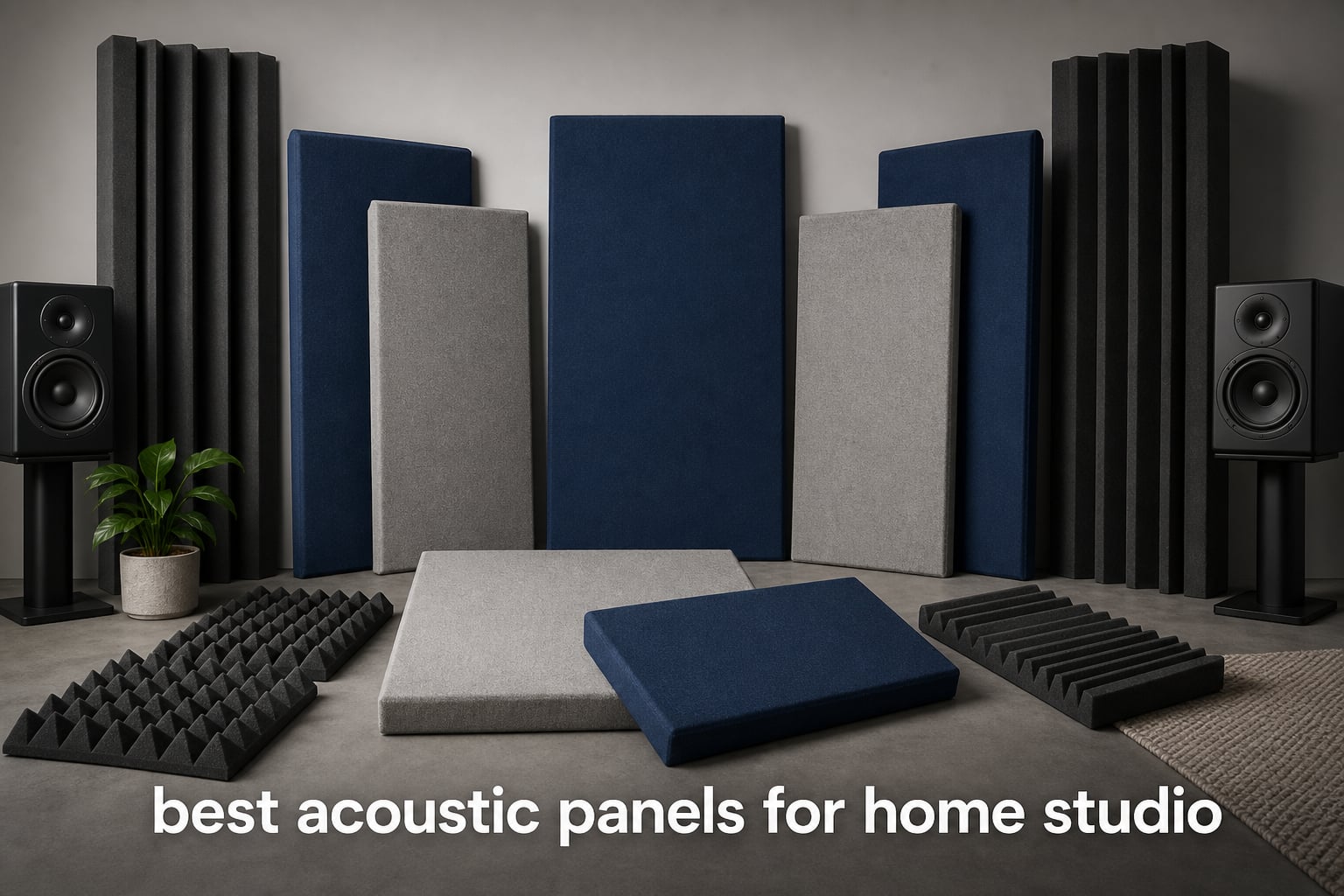
Good acoustic panels for home studio work make recordings and mixes easier to judge because they reduce the reflections that blur detail. They do not stop music, voices, or drums from leaving the room, so the first decision is whether you need acoustic treatment inside the room or actual sound isolation from neighbors.
I approached this list by separating published absorption claims from claims a listing does not document. The eight products below cover a useful range: dense mineral wool and fiberglass panels for broadband absorption, foam tiles for reflections and flutter echo, self-adhesive polyester panels for easy placement, and corner bass traps for low-frequency buildup.
For most first rooms, I would start at the listening position and the first reflection points rather than covering every wall. Community discussions repeatedly make the same point: placement and useful thickness matter more than an impressive-looking grid of thin foam, and a few correctly positioned sound absorbing panels can make a much clearer difference than random coverage.
This guide uses listing specifications, stated ratings, supplied review data, and the questions that appear most often in home-studio discussions. That means no invented lab results: where a maker publishes an NRC rating, I name it; where it does not, I treat the product as an application-specific option rather than pretending it has a measured number.
Table of Contents
The top three picks answer most home-studio needs quickly
The ATS Acoustics panel is the clearest first choice when you want a published NRC 1.0, a mineral wool core, and a Class 1 or Class A ASTM E84 fire rating. Its 24 x 48 x 2 inch format gives it a familiar professional-panel footprint for side walls, rear-wall reflection control, or a ceiling cloud.
The UMIACOUSTICS set is the practical choice when removability matters. It supplies four 2 inch fiberglass panels plus a metal template and nails for wall or ceiling hanging, which addresses a frequent renter concern: treating a room without committing to a permanent adhesive layout.
The Jdejiela set is the accessible large-format foam option for someone concentrating on upper-bass, midrange, and treble reflections rather than expecting one product to fix a room’s bass response. Its listing describes four 48 x 24 x 2 inch flame-retardant polyurethane foam panels, so it covers a lot more surface than tiny starter tiles.
The most effective acoustic panels are usually dense, porous panels with enough depth and placed at reflection points. In this group, the ATS panel has the strongest published broadband figure, while the UMIACOUSTICS set brings four removable fiberglass panels and the TroyStudio bass traps add a different job: treating corners where low-frequency energy tends to collect.
The eight acoustic panels for home studio setups compare by material and job
| Product | Specifications | Action |
|---|---|---|
 ATS Acoustics Sona Fabric Panel ATS Acoustics Sona Fabric Panel |
|
Check Latest Price |
 UMIACOUSTICS Fiberglass 4-Pack UMIACOUSTICS Fiberglass 4-Pack |
|
Check Latest Price |
 Jdejiela Egg Crate Foam 4-Pack Jdejiela Egg Crate Foam 4-Pack |
|
Check Latest Price |
 Foam Factory Wedge Tile 24-Pack Foam Factory Wedge Tile 24-Pack |
|
Check Latest Price |
 Dailycooper Self-Adhesive 12-Pack Dailycooper Self-Adhesive 12-Pack |
|
Check Latest Price |
 NEPIS Brick Panel 20-Pack NEPIS Brick Panel 20-Pack |
|
Check Latest Price |
 TroyStudio Groove Foam 36-Pack TroyStudio Groove Foam 36-Pack |
|
Check Latest Price |
 TroyStudio Bass Traps 12-Pack TroyStudio Bass Traps 12-Pack |
|
Check Latest Price |
Material and thickness give this comparison its meaning. Mineral wool and fiberglass are fibrous, porous absorbers commonly used for broadband acoustic treatment, while the foam and polyester choices here are easier to cut, move, or attach but come with very different thicknesses and stated performance data.
NRC, or Noise Reduction Coefficient, is a laboratory absorption average that runs from 0 to 1.0. A stated NRC 1.0 does not mean a panel erases every sound in every room; it means the tested panel absorbed essentially all incident sound on average under the test conditions, and room placement still changes what you hear.
Do not compare a published NRC figure to an unlisted one as though they are equal. The ATS listing states NRC 1.0, the NEPIS listing says its NRC exceeds 0.95, and the TroyStudio Groove listing states NRC 0.8; the remaining listings in this selection describe materials and intended effects but do not provide an NRC figure in the supplied product data.
1. ATS Acoustics is the reference pick for documented broadband absorption
ATS Acoustics Sound Absorbing Acoustic Panel with Sona Fabric, NRC 1.0, Fire Rated, 24″ x 48″ x 2″ (Deep Ocean)
24 x 48 x 2 inch
Mineral wool core
NRC 1.0
Pros
- NRC 1.0
- Class A fire rated
- Mineral wool core
- Wood frame
- Included hardware
Cons
- Single-panel format
- Not Prime eligible
When I narrow a home-studio list to the products with the most complete supplied performance information, this ATS Acoustics panel rises straight to the top. Its listing specifies a 24 x 48 x 2 inch panel, a mineral wool core, an NRC of 1.0, and a solid wood internal frame, so I can judge it on more than a vague “soundproof” claim.
I also like that the stated use case is straightforward: mount a flush, fabric-wrapped absorber where a reflection is causing trouble. The Deep Ocean Sona fabric is a room-finish decision, while the mineral wool and 2 inch depth are the parts that matter for the acoustic role.
The listing says the panel is Class 1 or Class A fire rated under ASTM E84 and includes a mounting template and installation hardware. That is meaningful for a dedicated work room, especially when you want a finished panel rather than a DIY frame, fabric, and insulation project.
A 2 inch broadband panel is still not a standalone bass-treatment plan. I would pair side-wall and rear-wall absorption with corner treatment if the mix position has boomy lows, rather than expecting any single flat panel to solve room modes.
The documented NRC makes this a confident choice for reflection control
The published NRC 1.0 is the strongest stated coefficient among these eight listings. For a producer or voice-over creator who wants material and absorption information before choosing, that documentation makes the ATS panel easier to place in a deliberate treatment plan.
Use its 24 x 48 inch face in portrait or landscape orientation according to the reflection area. A pair can address the left and right first-reflection points, and another pair can work behind speakers or on the rear wall after you listen for remaining slap echo.
The finished fabric panel suits a studio that needs a permanent-looking result
The wood frame and Sona fabric make more visual sense in a studio, listening room, or office than exposed foam when the room also has to look presentable. The listing also says it is manufactured in the USA, which may matter to buyers choosing between otherwise similar formats.
The trade-off is that this is a single, substantial panel rather than a large grid of small pieces. Plan the wall positions before mounting, because the strongest benefit comes from intentional reflection control, not treating the most convenient empty patch of wall.
2. UMIACOUSTICS is the practical removable fiberglass-panel set
4 Pack Acoustic Panels 23.6″x11.8″ Soundproof Fiberglass Panel, Linen
Four 2 inch panels
Fiberglass core
Removable hanging
Pros
- Four-panel set
- 2 inch thickness
- Fiberglass core
- Removable mounting
- E0 rating
Cons
- NRC not listed
- Individual panel dimensions are compact
I would put the UMIACOUSTICS pack near the top of a shortlist for a bedroom studio or rented office because it combines four panels with a removable hanging method. The supplied data describes metal templates and nails for stable wall or ceiling mounting, so it avoids asking you to begin with a blanket adhesive decision.
Each panel is listed at 23.6 x 11.8 inches, and the set uses 2 inch white fiberglass inside 100% polyester high-density fabric. That means the individual pieces are modest in size, but four panels let you spread treatment across several reflection zones instead of treating just one spot.
The product describes 2 inch thickness as better than standard 1 inch poly-fiber panels, a sensible distinction for a room where reverberation is the main complaint. The listing also cites an E0 environmental rating, and it names studios, gaming rooms, theaters, meeting rooms, and offices as intended spaces.
No NRC value appears in the supplied listing, so I would not assign this set a made-up performance score. Its case rests on real practical details: fiberglass construction, 2 inch depth, fabric wrapping, four pieces, and a removable mounting approach.
The removable hardware makes this a strong option for changing rooms
Renters often ask how to treat reflections without leaving a wall full of adhesive residue. The listed metal template and nails make this set particularly relevant when you may move panels, adjust a ceiling position, or change the room layout after adding a desk or microphone stand.
Start with one panel at each side-wall mirror point and use the other two behind the monitor position or on the wall behind you. Listen again before ordering more, because speaker distance and room symmetry change which reflection is most distracting.
The compact panels fit focused treatment rather than whole-wall coverage
These are better for targeted zones than for wrapping an entire large room. Four smaller pieces can be helpful around a podcast desk, compact monitor rig, or gaming setup, but a large mix room will usually need more broadband area and dedicated corner treatment.
The fabric-wrapped finish also offers a less technical appearance than bare foam. If visual restraint matters in a shared room, that can be as useful as the easy hanging system when choosing between treatment types.
3. Jdejiela is the large-format foam choice for early reflection coverage
Jdejiela 4 Pack Egg Crate Foam Sound Proof Foam Panels for Walls,48”X24”X2” inch Acoustic Panels, high-Density Fireproof soundproof Wall Panels, Professional Acoustic Treatment (BlacK)
Four 48 x 24 panels
2 inch foam
Flame retardant
Pros
- Large panel format
- 2 inch foam
- Egg crate geometry
- Flame retardant
- Easy installation
Cons
- No NRC listed
- Foam is not bass trapping
For someone trying to cover meaningful wall area with fewer pieces, I see the appeal of this Jdejiela four-pack immediately. Each listed panel measures 48 x 24 x 2 inches, so the package can address a sizeable section behind a desk, a rear wall, or a first-reflection zone without assembling dozens of small squares.
The listing describes high-density, flame-retardant polyurethane foam with a three-dimensional egg-crate shape. That texture increases the exposed surface area, but I would choose it for managing reflections, echo, and reverb in the voice and instrument range, not as a replacement for a dense bass trap in a corner.
The product mentions use in studios, offices, home theaters, and podcast setups, which matches the flexible role of a large foam absorber. It also says the material is non-toxic and odorless, details worth checking when panels will be close to a desk, bed, or vocal booth.
There is no NRC figure in the supplied listing. That does not make the panels useless; it tells me to judge them by their listed 2 inch depth, foam format, room role, and user feedback rather than placing them beside a lab-rated mineral-wool panel as a direct numerical match.
The large panels make this set useful when wall coverage is the goal
Four 48 x 24 inch pieces can make a more coherent treatment area than scattered tiny tiles. I would use them as a broad absorber behind a speaking position or at side reflections, leaving the vertical corners available for bass traps.
The egg-crate profile has an obvious studio look, so decide whether that suits the room before mounting. Its geometry can also make a large treated area look less flat than plain black foam sheets.
The foam format works best after expectations are set correctly
Forum participants often warn that acoustic foam alone does not give a small room full-range control, and that warning is fair. This set can reduce audible brightness, flutter echo, and short reflections, but it cannot add mass to a wall or stop sound transmission to another room.
Use it alongside sensible speaker placement and, where needed, corner bass traps. That combination keeps a foam purchase in the job it does well instead of asking it to cure a bass problem it was never designed to address.
4. Foam Factory is the flexible wedge-tile set for flutter echo
Foam Factory Inc 24 Pack Color Acoustic Foam Panel Studio Soundproofing Wedge Wall Tiles 12” X 12” X 2” (Charcoal)
24 square feet
2 inch wedge foam
High-density polyurethane
Pros
- 24 square feet coverage
- High-density foam
- Flame retardant
- Uncompressed delivery
- Flexible layout
Cons
- No NRC listed
- Mounting material not included
I would choose the Foam Factory 24-pack when I need a tile format that can follow an awkward wall, door, ceiling strip, or a small isolated reflection area. The listing gives each charcoal wedge tile a 12 x 12 x 2 inch size and calls out 24 square feet of customizable coverage across the package.
Unlike compressed foam that has to recover shape after arrival, these panels are described as ready to use out of the box. The specified 1.5 pound high-density polyurethane foam is intended to reduce flutter echoes, waves, and reverberations, which is the appropriate frame for a wedge product.
The listing says the foam is flame retardant according to a fire-safety testing agency and can mount with spray adhesive, double-sided tape, nails, or staples. I would test a removable layout with a few tiles first, since the best configuration depends on where the room produces the most audible ping or slap.
Its coverage figure is useful but not a promise of a specific RT60 result. RT60 is the time it takes sound to decay by 60 decibels, and it responds to room volume, hard surfaces, furnishings, absorber area, and placement—not merely the number of foam squares on a wall.
The individual tiles make this set adaptable to irregular surfaces
Small tiles are useful around doors, alcoves, angled ceilings, or a narrow strip above a desk where a 24 x 48 inch panel will not fit. They also let you create a checkerboard or continuous field without cutting a large fabric-wrapped panel.
I would leave at least one listening session between layout changes. A room can become less reflective yet still sound unbalanced if only one side wall receives treatment, so match coverage on left and right reflection areas where possible.
The 2 inch foam targets reflections rather than deep bass
The wedge geometry and 2 inch depth give this product a clear role in midrange and high-frequency control. It is a sensible way to calm a lively voice-over space, guitar corner, or rear-wall slap, provided the low end is addressed separately when necessary.
Use the stated 24 square feet as planning information, not a reason to cover surfaces at random. A few panels placed with the mirror test can have a more useful effect than using the same tiles as general decoration.
5. Dailycooper is the easiest self-adhesive accent treatment
Dailycooper 12 Pack Self-Adhesive Acoustic Panels 12″ X 10″ X 0.4″ – Sound Proof Foam Panels for Walls with High Density, Y-Lined Design, Flame Resistant, Absorb Noise and Eliminate Echoes(Black)
Twelve polyester panels
0.4 inch profile
Self-adhesive backing
Pros
- Self-adhesive backing
- High listed density
- Flame retardant
- Odorless polyester
- Easy to cut
Cons
- 0.4 inch profile
- 7.5 square feet per pack
The Dailycooper pack answers a very specific need: simple, no-extra-tape placement for a small treatment project. It includes 12 self-adhesive polyester panels measuring 12 x 10 x 0.4 inches, with a stated total coverage of about 7.5 square feet.
I would see it as a small-area treatment, not a primary broadband package for a mixing room. The listed 0.4 inch profile is far thinner than the 2 inch fiberglass, mineral-wool, and foam products above, so physics sets the expectation before the adhesive backing ever comes into play.
The manufacturer states a 9.4 pound-per-cubic-foot density and a Y-lined beveled design. It also describes the material as 100% polyester, flame retardant, odorless, and safe to touch, which fits a close-up application around a workstation or a compact recording corner.
Because it is easy to cut, this pack could help tidy a narrow reflection strip or add a decorative treatment pattern in a shared space. I would avoid using thin decorative panels as the whole plan when monitoring accuracy or bass buildup is the real reason for treatment.
The adhesive backing makes this set suitable for a quick small-space project
The self-adhesive design removes the separate adhesive step that comes with many foam tiles. That can be helpful for a short recording wall, a small gaming corner, or a visual accent around a microphone position.
Check the wall surface before committing. Adhesive performance depends on a clean, dry surface, and renters should consider whether removing any adhesive-mounted product later fits their lease and wall finish.
The thin profile limits this set to light reflection control
At 0.4 inches, the panels are best treated as a supplement for upper-frequency reflection and flutter reduction. They do not provide the depth of a 2 inch absorber, and they are not a bass-trap substitute.
If a clap test reveals a sharp ring near a desk, a limited array may improve that narrow issue. If bass notes vary wildly at the chair, move the listening position and add corner-focused treatment instead of adding more thin tiles.
6. NEPIS is the decorative self-adhesive option with a stated NRC claim
20 Pack Acoustic Panels with Self Adhesive, 11.8″ X 11.8″ X 0.36″ High Density Sound Proof Foam Panels for Wall, Soundproof Wall Panel, Brick Sound Absorbing Panel for Home Studio Office Decor – Black
Twenty polyester panels
20 square feet
NRC above 0.95
Pros
- Listed NRC above 0.95
- 20 square feet coverage
- Self-adhesive backing
- High listed density
- Brick design
Cons
- 0.4 inch thickness
- More panels may be needed for large rooms
The NEPIS set stands out among the thin self-adhesive choices because its supplied listing states an NRC coefficient exceeding 0.95. It contains 20 black brick-pattern polyester panels, each 12 x 12 x 0.4 inches, with a stated coverage total of 20 square feet.
I would still read that claim alongside the product’s physical depth rather than in isolation. The listing describes a high material density of up to 14.35 pounds per cubic foot, yet 0.4 inch panels have a different low-frequency role than a 2 inch mineral-wool board or a thick corner trap.
The 3D brick design is more decorative than a plain square panel, and the self-adhesive backing supports a fast layout. For a video-call background, compact podcast set, office, or home-studio wall that must look finished, that visual difference can matter as much as the installation shortcut.
The listing says the polyester is eco-friendly, odorless, non-toxic, and designed for easy installation without extra tape or spray. Its own limitations are also useful: more panels may be required in a larger space, and its thin profile may not cover some bass frequencies well.
The stated NRC provides a useful comparison point for a thin panel
Among this selection, this is one of only three listings that supplies an NRC claim. Treat it as a published product claim rather than a guarantee that the room will meet a target RT60, because room geometry and total treatment area still rule the final result.
I would place the first batch where speech or monitoring sounds most splashy, then listen for changes. A measured or careful before-and-after listening check is more trustworthy than assuming the brick pattern itself is creating diffusion.
The brick design fits studios that also serve as living spaces
The 3D pattern can look more intentional than conventional foam wedges, which may help in a home office, streaming setup, or shared room. It is also easy to arrange as a continuous grid because every piece has the same 12 inch square face.
Reserve deep corners for bass traps and leave balanced left-right reflection points for thicker panels when possible. That layered approach gives decorative, thin treatment a sensible role without making it carry all of the room-acoustics work.
7. TroyStudio Groove gives broad 2 inch foam coverage for mids and highs
TroyStudio Groove Acoustic Foam Panels, 36 Pcs 2 Inches 12 X 12 Broadband Sound Absorbing Foam, Dense Soundproof Padding Tile, Recording Studio Foam Absorber, Groove Decorative 3D Wall Ceiling Panel
Thirty-six 2 inch tiles
36 square feet
NRC 0.8
Pros
- 36 square feet coverage
- 2 inch thickness
- NRC 0.8
- Flame retardant
- Easy to cut
Cons
- Adhesive sold separately
- Not a dedicated bass trap
The TroyStudio Groove pack gives you the largest stated coverage area in this roundup: 36 pieces, each 12 x 12 x 2 inches, for a listed 36 square feet. If I needed to reduce reflection across a larger wall or ceiling section using foam, that quantity and 2 inch depth make it more compelling than thin peel-and-stick sets.
The supplied product data names an NRC of 0.8 and an average absorption coefficient of 0.77. It also describes a periodic groove structure, so the visual pattern is part of the product rather than a plain foam slab.
TroyStudio says the foam is flame retardant under California Technical Bulletin 117-2013, odorless, non-toxic, and easy to cut. Those details are especially useful for custom ceiling shapes, a streamer backdrop, or a room where wall panels need to wrap around shelves and outlets.
Installation is not completely tool-free because double-sided tape is sold separately and additional adhesive may be needed for secure mounting. I would plan the attachment method before opening the pack, then keep the layout balanced across the listening area.
The stated 36 square feet makes this a practical large-area foam kit
A 36-square-foot figure makes it easier to map the pack to real walls. For example, it can form a broad rear-wall field, paired side-wall zones, or a ceiling cloud area above a compact production desk, depending on the room’s reflections.
Place coverage after identifying the problems rather than installing all 36 tiles at once. First-reflection points and the ceiling zone above the desk normally deserve attention before purely decorative patches near the door.
The published NRC 0.8 supports a mid-and-high treatment role
NRC 0.8 is a meaningful published figure for a foam tile, but it should not be translated into “0.8 of all sound disappears.” It tells you about absorption under a standardized approach, while low-frequency room modes still need placement changes, depth, and corner control.
This is a good companion to bass traps rather than a replacement for them. The 2 inch foam can calm fast reflections while the corners receive the thicker, purpose-built pieces that work where bass energy collects.
8. TroyStudio Bass Traps are the corner-treatment companion for low frequencies
TroyStudio Bass Traps – 12 Pcs 4 X 4 X 12 Inches Dense Thick Studio Bass Foam Corner, Acoustic Treatment Panel Absorbing Echo Reverb, Low Frequency Sound Absorber for Music Room Home Recording Studio
Twelve corner traps
4 x 4 x 12 inch
Low-frequency focus
Pros
- Corner-specific shape
- Dense thick foam
- Low-frequency focus
- Flame retardant
- Twelve pieces
Cons
- Mounting accessories sold separately
- Limited review volume
The TroyStudio Bass Traps have a job none of the flat wall products can fully take over: they fit in corners between walls, floors, and ceilings, where bass energy commonly accumulates. The set includes 12 dense foam pieces sized 4 x 4 x 12 inches and is specifically described as a low-frequency sound absorber.
For my own treatment plan, I would think of these as partners to wall panels, not an alternative to them. Flat absorbers manage the early reflections that affect stereo imaging and vocal clarity; corner pieces help with the muffled bass, overlapping sounds, and uneven low end that the product listing calls out.
The supplied features say the traps use a periodic structure, are flame retardant under California Technical Bulletin 117-2013, and are odorless and non-toxic. Their compact strips can go into vertical wall corners or other corner transitions without taking as much wall face as a large broadband panel.
Accessories are sold separately, so plan mounting before you decide where every trap will go. The relatively modest review count compared with the TroyStudio Groove pack is another reason to treat its intended role and physical form as the decision point rather than assuming it has identical user proof.
The corner shape addresses a room problem flat panels leave behind
Low-frequency waves are long and interact with room boundaries in ways that make bass build up in corners. That is why bass traps belong in a home-studio plan even after you have installed good side-wall acoustic panels.
Start with the front vertical corners behind the monitors, then listen at the chair for changes in bass notes and kick-drum weight. If the rear corners are accessible, they are another logical place after the front pair are treated.
The compact strips suit a staged bass-treatment plan
Twelve pieces let you distribute traps across more than one corner or stack them through a taller section. I would begin with symmetry at the front of the room so the left and right speaker boundaries are treated in the same way.
These foam traps cannot soundproof a room or make a small room acoustically perfect. They are a focused addition for low-frequency absorption, and their strongest result comes when used with sensible monitor placement, broadband wall absorption, and careful listening.
The right buying guide starts with the problem you hear
Buy acoustic treatment to improve the sound inside your studio, not to block sound passing through a shared wall. Soundproofing needs mass, sealed gaps, decoupling, and construction choices; porous acoustic panels absorb reflected sound and reduce echo, reverberation, and comb filtering inside the space.
That distinction keeps budgets and expectations realistic. If a neighbor hears your kick drum, wall-mounted foam is not the cure; if your vocal recordings sound boxy or your mix position has obvious side-wall reflections, absorption is the sensible first step.
NRC tells you how much tested sound a panel absorbs on average
NRC is the Noise Reduction Coefficient, generally expressed from 0 to 1.0. For this list, the ATS listing states NRC 1.0, the NEPIS listing claims above 0.95, and the TroyStudio Groove listing states 0.8.
Use a published NRC as one comparison point, not the only one. Thickness, material, total square footage, air gap, room placement, and the specific frequencies causing trouble all affect the audible result.
Fiberglass and mineral wool give broadband panels their depth and density
Fiberglass and mineral wool are porous fibrous materials that work well in fabric-wrapped broadband absorbers. The ATS mineral-wool panel and UMIACOUSTICS fiberglass set are therefore better starting points when your goal is serious first-reflection control rather than a decorative surface treatment.
Foam is lighter and easier to cut into tiles, which helps with customized areas and large visual patterns. Community advice consistently favors 4 inch panels for stronger low-frequency control, but the researched flat panels here are 2 inches; use them for broadband reflection work and add corner traps where the bass needs help.
Two inch panels suit reflections while thicker corner treatment helps bass
A 2 inch panel is a sensible baseline for side-wall reflection points, a rear-wall absorber, or a ceiling cloud in a small home recording studio. It has enough depth to be more purposeful than a thin decorative tile, particularly when the absorber has a dense fiberglass or mineral-wool core.
Thin 0.4 inch polyester panels have a different role: small-area echo reduction, a visual pattern, or a finishing layer near a desk. Treat the thickness as a design limit, not a marketing detail, and do not expect a thin panel to control the same range as a deep broadband absorber or a 4 x 4 inch corner trap.
The mirror test finds the first reflection points without special tools
- Place your chair and monitors where you normally mix or record.
- Have a second person slide a small mirror along the left side wall at ear height.
- Mark the point where you can first see the left speaker from the chair, then repeat for the right side wall.
- Center matched acoustic panels around those marks and check the ceiling area above the desk next.
This method works because the mirror identifies a direct reflection path from the speaker to your ears. Treating symmetrical first-reflection points is usually more useful than putting the entire pack on the wall behind the computer because it happens to be empty.
After the first placement, clap in the room and play familiar speech, music, and bass-heavy material. Move gradually: a room that is less reverberant is helpful, but a room treated only on one side can still make panning and tonal balance harder to judge.
Coverage should be planned by room function rather than wall area alone
A small podcasting booth may begin with panels behind and beside the talker, plus a ceiling piece if the ceiling is low and hard. A music-production room should prioritize symmetrical side-wall reflections, the ceiling cloud area, and front or rear bass management around the listening position.
For a home theater or gaming room, start with the wall points that create distracting slap or dialogue blur, then use aesthetic products only where they do not displace more useful treatment. The stated coverage figures in this list—7.5, 20, 24, and 36 square feet on several multi-packs—help map products to a real layout.
Fire ratings and mounting choices matter in a room you use daily
Check fire information before treating a whole room. The ATS listing states Class 1 or Class A under ASTM E84, while the Jdejiela, Foam Factory, TroyStudio Groove, and TroyStudio Bass Traps listings describe flame-retardant properties; the exact labels are not interchangeable, so read the supplied certification language for the product you choose.
Mounting is equally practical. ATS includes a template and hardware, UMIACOUSTICS lists removable hanging hardware, Dailycooper and NEPIS use self-adhesive backs, while Foam Factory and the TroyStudio products call for a separate mounting approach or accessories.
DIY panels save labor cost only when you can build and mount them safely
DIY builders in audio forums often recommend Rockwool or Owens Corning 703 for homemade broadband panels, mainly because they can choose the thickness, frame depth, fabric, and final panel size. That route can make sense if you have the tools, a safe way to handle insulation, and the time to build several matching units.
Purchased panels are the simpler choice when you want tested claims, a finished fabric surface, included mounting, or a removable system. I would not choose DIY just because it is popular; choose it when the build itself fits your skills and you can place the finished panels where they will do useful work.
The common questions have direct acoustic-treatment answers
What are the most effective acoustic panels?
The most effective panels are usually thick, porous broadband absorbers placed at first reflection points and paired with corner bass treatment. In this group, the ATS Acoustics panel has the strongest published NRC at 1.0 and a mineral wool core; the UMIACOUSTICS set offers 2 inch fiberglass panels, while TroyStudio bass traps serve a separate corner-treatment role.
What materials are best to use to soundproof a home studio?
Acoustic panels do not soundproof a home studio; they improve sound inside it by absorbing reflections. For acoustic treatment, mineral wool and fiberglass are strong materials for broadband panels, while foam and polyester panels can reduce selected reflections. Stopping noise to neighbors requires construction measures such as mass, sealing, and decoupling.
How do you place acoustic panels in a home studio?
Start at the side-wall first reflection points, found by sliding a mirror along each wall while seated at the listening position and marking where each speaker becomes visible. Then consider a ceiling cloud, the wall behind the monitors or listener, and corner bass traps. Keep left and right treatment balanced, then listen and adjust.
Who makes the best acoustic wall panels?
The best maker depends on the job and the published details you need. ATS Acoustics is the clearest choice here for a stated NRC 1.0, mineral wool core, and Class A fire rating. UMIACOUSTICS is useful for removable fiberglass panels, while TroyStudio offers both broad foam coverage and dedicated corner bass traps.
The best choice is the panel that treats your actual room problem
For the strongest documented flat-panel choice, select the ATS Acoustics mineral-wool panel. For removable fiberglass treatment, choose the UMIACOUSTICS four-pack; for wide foam coverage, consider the TroyStudio Groove set; and for corners where bass builds up, add the TroyStudio Bass Traps.
The best acoustic panels for home studio work in 2026 are not the ones that cover the most wall by default. Mark the reflection points, decide whether bass is part of the issue, confirm your mounting and fire-safety needs, then choose the material and thickness that match that plan.