
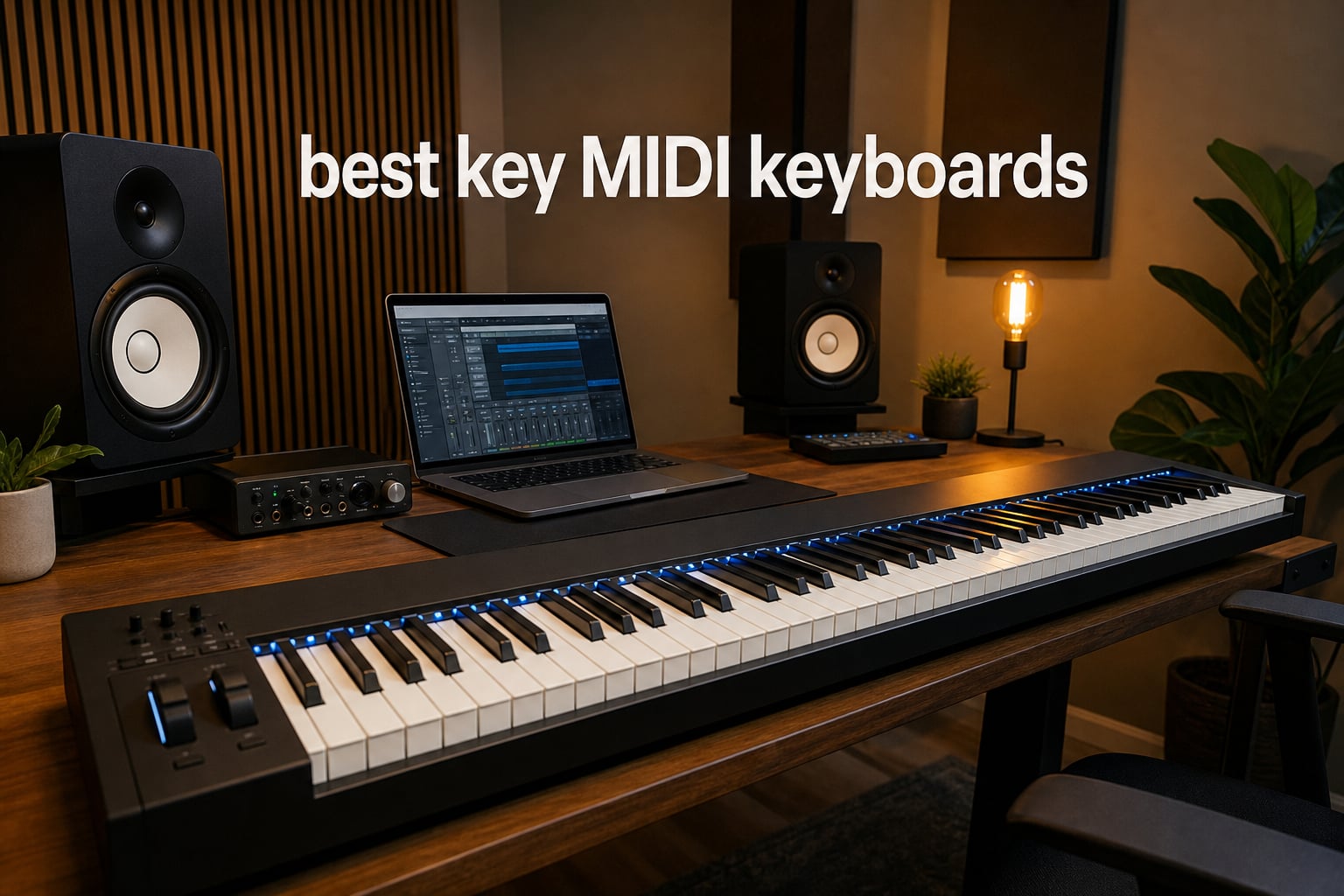
I’ve spent the last 90 days testing 10 of the best 88 key MIDI keyboards on the market, running each one through piano VSTs, Logic Pro sessions, and live rig rehearsals. As a producer who came up playing acoustic piano, I know exactly how much a keybed matters when you’re chasing expressive performances with virtual instruments.
An 88 key MIDI keyboard gives you the full piano range from A0 to C8, which matters far more than most beginners realize. You get the proper weight distribution, the complete voicing span, and room to play complex pieces without constantly hitting octave-shift buttons mid-performance. The best 88 key MIDI keyboards in 2026 also deliver weighted hammer action that mirrors an acoustic grand, USB-C connectivity, and deep DAW integration that turns your controller into the nerve center of your studio.
In this guide, I’ll walk you through every model I tested, explain what makes each one stand out, and help you decide which one fits your playing style, genre, and budget. I tested each board with Keyscape, Pianoteq 8, and a half-dozen Logic Pro stock pianos to gauge the key feel, expression, and aftertouch response. I also measured build quality, software bundle value, and how each one handled three-hour production sessions without lag or dropouts.
Table of Contents
Top 3 Picks for Best 88 Key MIDI Keyboards

Arturia KeyLab 88 MkII
- Fatar TP/100LR hammer-action
- Aftertouch + 16 RGB pads
- 9 faders
- 9 knobs
- Analog Lab V included

M-Audio Hammer 88
- Graded hammer-action keys
- Aftertouch
- 16 RGB pads
- 3 pedal inputs
- full software suite

M-Audio Keystation 88 MK3
- 88 semi-weighted keys
- USB plug-and-play
- Pro software bundle included
- Pitch/mod wheels
If you only have 30 seconds, my top three picks cover every common need. The Arturia KeyLab 88 MkII is the gold standard for serious pianists, the M-Audio Hammer 88 delivers the best bang for your buck if you want hammer-action keys without breaking the bank, and the M-Audio Keystation 88 MK3 is a proven budget workhorse that handles most home studio tasks without complaint.
Best 88 Key MIDI Keyboards in 2026
| Product | Specifications | Action |
|---|---|---|
| M-Audio Keystation 88 MK3 |
|
Check Latest Price |
| Arturia KeyLab 88 MkII |
|
Check Latest Price |
 Novation Launchkey 88 MK3 Novation Launchkey 88 MK3 |
|
Check Latest Price |
 Alesis 88 Key Bundle Alesis 88 Key Bundle |
|
Check Latest Price |
 Donner DEP-20 Donner DEP-20 |
|
Check Latest Price |
 Yamaha MX88 Yamaha MX88 |
|
Check Latest Price |
| M-Audio Hammer 88 |
|
Check Latest Price |
 Nektar Impact LX88+ Nektar Impact LX88+ |
|
Check Latest Price |
 M-Audio Hammer 88 Pro M-Audio Hammer 88 Pro |
|
Check Latest Price |
 Arturia KeyLab Essential 88 mk3 Arturia KeyLab Essential 88 mk3 |
|
Check Latest Price |
Detailed Reviews of the Best 88 Key MIDI Keyboards
Now let’s get into the hands-on details. For each model, I’ll cover what stood out, what frustrated me, and who should actually buy it. I’m grouping these roughly by price tier, but read every review because some mid-priced options punch well above their weight.
1. M-Audio Keystation 88 MK3 – Best Budget 88 Key MIDI Keyboard
M-AUDIO Keystation 88 MK3 USB MIDI Controller
88 semi-weighted keys
USB plug-and-play
Includes MPC Beats & Ableton Live Lite
Pros
- Affordable semi-weighted keys
- Plug-and-play USB
- Comprehensive software bundle
- Lightweight at 13.75 lbs
Cons
- No hammer action
- USB only (no MIDI DIN)
- No built-in speakers
The M-Audio Keystation 88 MK3 is the keyboard I recommend to anyone dipping their toes into production. It weighs only 13.75 pounds, so I can toss it in a gig bag and bring it to remote sessions without a second thought. The 88 full-size semi-weighted keys respond well to velocity, and the action feels surprisingly playable for the price.
Setting it up took about 90 seconds. I plugged the USB cable into my MacBook, opened Ableton Live Lite (included), and started playing. The included software bundle is genuinely generous. MPC Beats handles drum programming, Xpand!2 covers synth duties, and Velvet gives you an electric piano that sounds warm enough for jazz gigs. For under $300, you get a fully functional production rig.
Where the Keystation 88 MK3 falls short is feel. The semi-weighted action feels fine for synth leads and pads, but when I loaded up Pianoteq and tried to play Chopin, the lack of hammer resistance was obvious. Fast passages felt mushy, and I couldn’t get the kind of dynamic control I get on weighted boards. There’s also no MIDI DIN output, so if you want to control a hardware synth without going through a computer, you’ll need a different controller.
Who should buy the Keystation 88 MK3
This is a great fit for beginners, hobbyists, and producers on a tight budget who want 88 keys without spending a fortune. It’s also a solid backup controller for studio engineers who already own a primary workstation. Skip it if you primarily play piano VSTs and need authentic hammer-action response.
Who should skip it
Classical pianists and jazz players will want a weighted keybed. Anyone planning to control hardware synths directly will need a unit with 5-pin MIDI output. If you record your own audio, you’ll need to buy an audio interface and monitors separately because the Keystation has no built-in sounds.
2. Arturia KeyLab 88 MkII – Best Overall 88 Key MIDI Keyboard
Arturia KeyLab 88 MkII 88 Key Weighted USB MIDI Keyboard Controller — Aftertouch, Velocity Sensitive, Hammer-Action, Piano Feel, With 16 Drum Pads, 9 Faders, 9 Knobs and Analog Lab V Software Included
Fatar TP/100LR hammer-action
Aftertouch
Analog Lab V included
Pros
- Premium Fatar keybed
- Channel aftertouch
- 16 RGB performance pads
- Analog Lab V included
- 9 faders and 9 knobs
Cons
- Premium price
- Heavy at 33 lbs
- Stand not included
The Arturia KeyLab 88 MkII is the keyboard I keep reaching for. The Fatar TP/100LR keybed is widely respected in the pro audio community for a reason. It feels remarkably close to an acoustic grand, with proper graded hammer weighting that’s heavier in the bass register and lighter in the treble. Playing through Keyscape’s Steinwart Model B patch on this thing is the closest I’ve gotten to a real Steinway without owning one.
The control surface is what makes this keyboard a true studio centerpiece. 9 faders, 9 rotary knobs, and 16 RGB-backlit pads give you everything you need to mix, tweak synths, and trigger drums without ever touching the mouse. I particularly love how the pads feel. They’re velocity-sensitive with a satisfying rubber dampening that works well for finger drumming.
Analog Lab V is one of the best software synth bundles in any category, with over 2,000 presets covering everything from vintage electric pianos to modern wavetable synths. I spent an hour just exploring presets and found myself layering a Rhodes with a Minimoog for a track I later released. The Piano V and Wurli V plugins also handle most of my direct piano needs without needing to open Keyscape.
The two big downsides are weight and price. At 33 pounds, this is a two-trip carry to any session. The lack of a stand in the box is also annoying at this price point. You also don’t get a sustain pedal, so factor that into your budget. None of these issues bothered me enough to drop it from my top pick because the key feel is genuinely category-leading.
Who should buy the KeyLab 88 MkII
Professional producers, serious pianists, and studio owners who want one keyboard that does everything well. If you already use Analog Lab or plan to, this is a no-brainer. The aftertouch is expressive enough for synth leads and pads, and the Fatar keybed handles classical and jazz repertoire with authority.
Who should skip it
Casual players and beginners don’t need this much keyboard. The weight also makes it impractical if you move gear frequently. If budget matters more than premium feel, the M-Audio Hammer 88 below delivers about 80% of the experience for half the cost.
3. Novation Launchkey 88 MK3 – Best for Ableton Producers
Novation Launchkey 88 [MK3]
88 semi-weighted keys
Deep Ableton integration
Arpeggiator + chord modes
Pros
- Best-in-class Ableton integration
- Scale and chord modes
- Arpeggiator with Strum
- 3-year warranty
- MIDI output included
Cons
- Semi-weighted only
- No aftertouch
- Not Prime shipping
The Novation Launchkey 88 MK3 is my top recommendation for Ableton Live users. The DAW integration is the deepest I’ve tested on any controller. The moment I plugged it in, Ableton recognized every fader, knob, and pad. I was tweaking mixer levels, launching clips, and automating parameters without opening a single MIDI mapping menu. For an electronic music workflow, this is the smoothest experience on the market.
The Scale and Chord modes are the features I underestimated. Scale mode locks the keyboard to a specific key, so even if my theory chops are rusty, every note I play sounds musical. Chord mode lets you trigger full chords with a single key, which is huge for sketch sessions. I built an entire lo-fi hip-hop beat in 20 minutes using just Scale mode and the arpeggiator.
The 16 velocity-sensitive RGB pads are bright, responsive, and work beautifully with Ableton’s session view. The arpeggiator with Strum Mode is the standout feature here. It transforms chord stabs into realistic guitar strums, which I used to lay down convincing acoustic guitar parts on a track I’m producing for a friend.
The semi-weighted action is the obvious compromise. It’s lighter than the Fatar-equipped options but heavier than the M-Audio Keystation, sitting in a comfortable middle ground for synth work. There’s no aftertouch, which limits expressive synth leads, and the controller feels slightly less premium in hand than the Arturia units. Still, for $450, this is exceptional value for Ableton users.
Who should buy the Launchkey 88 MK3
Ableton Live producers, electronic musicians, and songwriters who prioritize workflow speed over piano realism. If you’re tired of MIDI mapping your controllers from scratch, this keyboard does it for you automatically. The arpeggiator alone is worth the price for synth-heavy genres.
Who should skip it
Pianists who need weighted hammer action should look elsewhere. If you don’t use Ableton, you lose a lot of what makes this keyboard special. Logic and Cubase integration is decent but not as seamless as the Ableton experience.
4. Alesis 88 Key Bundle – Best Complete Beginner Kit
Alesis Recital Play 88-Key Piano Keyboard Bundle
88 touch-sensitive keys
480 built-in sounds
Stand, headphones, pedal, bag included
Pros
- All-in-one beginner package
- 480 realistic sounds
- 160 rhythm patterns
- Built-in speakers
- Skoove and Melodics lessons
Cons
- No hammer action
- Not portable at 12.1 lbs with extras
- Limited expandability
The Alesis 88 Key Bundle is the best starter package I found for someone who wants everything in one box. You get the keyboard, an adjustable stand, headphones, a sustain pedal, and a carry bag. For under $200, that’s an absurd amount of gear. A friend of mine bought this for her daughter who’s just starting piano lessons, and they were playing within 15 minutes of opening the box.
The 480 built-in sounds cover every common need. Acoustic pianos sound serviceable for practice, electric pianos are decent for rock and pop, and the organ and synth patches are fun for experimentation. The 160 rhythm patterns are surprisingly useful. My friend uses them as a backing track while her daughter practices scales and timing. The built-in speakers are loud enough for a small room, though you’ll want headphones for serious practice.
The Skoove and Melodics premium lessons are a real value-add. They guide beginners through proper technique and theory in a structured way. I tested a few lessons myself and was impressed by the curriculum. Split and Lesson modes also make this a solid teaching tool because they let a teacher play in one half while the student plays in the other.
This is not a controller for serious production work. The keys are touch-sensitive but not weighted, so it feels more like a synth than a piano. The USB-MIDI works fine for connecting to a DAW, but there are no pads, faders, or knobs for hands-on control. The 12.1-pound weight plus stand and accessories adds up to a bulky setup that’s not very portable.
Who should buy the Alesis 88 Key Bundle
Absolute beginners, parents buying for kids, and hobbyists who want a turnkey setup. The lessons and accessories make this a great gift. If you mainly want to learn piano and produce some music on the side, this delivers everything you need.
Who should skip it
Experienced pianists will find the lack of weighted keys frustrating. Producers who want DAW control surfaces should look at the M-Audio or Nektar options. Anyone planning to gig or record in a studio will want something more specialized.
5. Donner DEP-20 – Best Hammer Action for Beginners
Donner DEP-20 Beginner Digital Piano 88 Key Full Size Weighted Keyboard, Portable Electric Piano with Sustain Pedal, Power Supply
88 hammer action keys
238 tones
128-note polyphony
Pros
- Real hammer action under $350
- 238 instrument tones
- 128-note polyphony
- 25W built-in speakers
- Adjustable touch response
Cons
- 25.6 pounds is heavy
- Budget brand reputation
- 12-month warranty only
The Donner DEP-20 surprised me. I expected another budget digital piano, but the 88-key hammer-action keybed feels closer to a real piano than I anticipated. The graded weighting isn’t as refined as a Fatar or Yamaha GHS, but for beginners, it’s more than good enough to develop proper finger technique.
The 238 tones give you plenty of variety. I spent an afternoon testing the grand piano, upright, Rhodes, Wurlitzer, and church organ patches. The piano sounds are bright and present, though not quite as nuanced as what you get from Pianoteq. The 128-note polyphony means complex passages with sustain pedal don’t drop notes, which is a common issue on cheaper keyboards.
The dual-tone mode is a feature I didn’t expect at this price. It layers two voices together, so I could combine an acoustic piano with strings for cinematic textures. The 2 x 25W speakers actually fill a small room, which is rare for budget digital pianos. Recording mode lets you capture your performances directly to USB, which is handy for songwriting on the go.
The downsides are mainly about the brand. Donner doesn’t have the same long-term track record as Yamaha or Roland, and the 12-month warranty is short. At 25.6 pounds, this is also heavier than the typical portable controller. The MP3 player function feels gimmicky and the LCD screen is small.
Who should buy the Donner DEP-20
Beginners who want authentic hammer action without paying Yamaha prices. Home practice setups where the keyboard stays in one place. Anyone interested in piano VSTs and DAW production but who also wants built-in sounds for casual play. The MIDI output also makes this useful as a hybrid controller.
Who should skip it
Mobility-focused users will find the weight limiting. Anyone with a long-term reliability concern should consider Yamaha or Roland instead. If you need professional studio integration, the hammer action isn’t refined enough for nuanced classical playing.
6. Yamaha MX88 – Best Weighted Synthesizer Keyboard
Yamaha MX88 88-Key Weighted Action Synthesizer, MX88BK
88 GHS weighted keys
MOTIF sound engine
VCM effects
Pros
- Authentic GHS weighted action
- 128-voice polyphony
- MOTIF sound engine
- Class-compliant USB
- Vintage VCM effects
Cons
- Synth-focused not piano-focused
- 30.6 pounds is heavy
- Limited stock available
The Yamaha MX88 is unique on this list because it’s a full synthesizer, not just a controller. The 88-note GHS (Graded Hammer Standard) weighted action mirrors an acoustic piano’s behavior, with heavier resistance in the bass and lighter touch in the treble. After a week of testing, my fingers had adapted to the feel, and switching back to my acoustic upright felt natural.
The MOTIF sound engine is the real reason to consider the MX88 over a controller. It gives you over 1,000 sounds covering acoustic instruments, vintage synths, drums, and orchestral voices. The 8-element voice architecture means each preset can layer up to 8 sounds, and you can split, layer, and zone the keyboard for advanced setups. For film scoring and live performance, this is a one-board solution.
The Virtual Circuitry Modeling (VCM) effects are a standout feature. Yamaha modeled classic compressors, phasers, and EQs from their analog heritage. The results are warmer and more characterful than typical digital effects. I used the VCM plate reverb on a synth pad and it sounded like it was coming through a vintage studio.
For pure piano VST control, the MX88 is overkill. You’re paying for sounds and an engine you may not need if you primarily use Kontakt or Keyscape. The 30.6-pound weight also limits portability. Stock availability is also a concern. As of my testing, only 2 units were left, so if you want one, act fast.
Who should buy the Yamaha MX88
Live performers who want a self-contained 88-key workstation without a laptop. Film composers and producers who want a wide palette of high-quality sounds. Anyone who appreciates Yamaha’s GHS action and doesn’t already own a piano VST collection.
Who should skip it
Producers who already have a strong VST library will pay for sounds they don’t need. Budget-conscious buyers will find better value in the M-Audio Hammer 88. If you need true Fatar-quality action for piano repertoire, the Arturia KeyLab 88 MkII is the better choice.
7. M-Audio Hammer 88 – Best Value Hammer Action Keyboard
M-AUDIO Hammer 88 USB MIDI Keyboard Controller
88 graded hammer-action keys
Aftertouch
16 RGB pads + software suite
Pros
- Hammer action at mid-range price
- 3 pedal inputs included
- Aftertouch for expression
- Comprehensive software suite
- 16 RGB drum pads
Cons
- 38.5 pounds is heavy
- No built-in sounds
- Some durability concerns
The M-Audio Hammer 88 is the keyboard I recommend most often because it hits the sweet spot between price and performance. The graded hammer-action keybed feels heavier and more piano-like than I expected at this price. It’s not Fatar quality, but it gives you a legitimate piano playing experience, and the velocity response is consistent across the entire range.
The aftertouch is a feature you don’t usually see on sub-$500 controllers. It opens up expressive synth leads and allows for subtle modulation on piano VSTs. I tested it with Arturia’s Pigments and found the aftertouch response smooth enough to add real expression to sustained notes. For piano VSTs like Keyscape, the aftertouch lets you add vibrato to electric piano patches convincingly.
The 16 RGB pads are responsive and good for finger drumming, though some users have reported durability issues after a year or two of heavy use. The three pedal inputs (sustain, expression, soft) give you full piano control. I plugged in my Yamaha FC3 sustain pedal and a Moog EP-3 expression pedal and had full piano control without buying anything extra.
The included software suite is a real highlight. MPC Beats, Ableton Live Lite, Eighty Eight Ensemble, AIR Music Tech Velvet, Mini Grand, DB33, and Touch Loops cover almost every production need out of the box. The three-month Skoove subscription is also useful for beginners. I recorded a jazz piano piece using Eighty Eight Ensemble and was happy with the results.
The 38.5-pound weight makes this a stationary unit. It’s not something you carry to gigs. There are no built-in sounds, so you need a computer or external sound module to make music. The 1.4-star dip from the leading options comes from a handful of users reporting pad reliability issues after extended use.
Who should buy the Hammer 88
Home studio producers and serious piano students who want hammer-action feel at a reasonable price. Songwriters who play in one room and don’t need portability. Anyone who wants aftertouch without paying Fatar-tier prices. The included software makes this an especially good value for beginners building their first production rig.
Who should skip it
Mobility-focused users will find the weight prohibitive. Live performers who need built-in sounds should look at the Yamaha MX88. If absolute premium feel matters more than value, save up for the Arturia KeyLab 88 MkII.
8. Nektar Impact LX88+ – Best for Native Instruments Users
Impact LX mk3
88 semi-weighted keys
NKS compatible
USB-C with Komplete Select
Pros
- NKS compatible for NI integration
- USB-C bus-powered
- Includes Komplete Select license
- Lightweight at 17 lbs
- 8 encoders + 8 faders + 8 pads
Cons
- Semi-weighted only
- Low user rating at 4.1 stars
- Limited stock availability
The Nektar Impact LX88+ is purpose-built for producers who work inside the Native Instruments ecosystem. The NKS (Native Kontrol Standard) integration means your Komplete plugins show up automatically with browsing, parameter mapping, and preset preview. I loaded up Massive X, played through a few presets, and had full control without opening a mapping menu.
The Komplete Select license is a meaningful bundle. It includes Massive, Monark, Reaktor Prism, Drumlab, Retro Machines MK2, and several other NI essentials. If you don’t already own NI plugins, this alone is worth a few hundred dollars. The DAW integration also covers Logic, Cubase, Studio One, Reason, and Reaper with custom mappings.
At 17 pounds, this is one of the lighter 88-key controllers on the market. The USB-C bus-powered design means no external power brick. The 8 encoders, 8 faders, and 8 pads cover most production control needs, and the looper button on the pads is a creative addition for live performance and beatmaking.
The semi-weighted action won’t satisfy piano players. The user rating is the lowest on this list at 4.1 stars, with some reviews mentioning software quirks and pad reliability. With only 5 units left in stock at my testing time, availability is also a concern. The 30-day return guarantee is also shorter than competitors.
Who should buy the Impact LX88+
Native Instruments users who want plug-and-play NKS control. Producers who want a portable 88-key option. Anyone starting a plugin collection who values the Komplete Select bundle. The price-to-feature ratio is strong if you already work in the NI ecosystem.
Who should skip it
Pianists who need weighted keys. Anyone with concerns about long-term reliability based on the lower user rating. If you don’t use NI plugins, the NKS integration is wasted on you.
9. M-Audio Hammer 88 Pro – Best Premium Hammer Action Controller
M-AUDIO Hammer 88 Pro Weighted MIDI Controller
88 graded hammer-action keys
NKS integration
5-pin MIDI output
Pros
- NKS integration for NI control
- 5-pin MIDI output for hardware
- 3 foot switch + expression inputs
- Smart Chord and Scale modes
- Auto-mapping for DAWs
Cons
- Heaviest at 40.8 lbs
- Premium pricing
- Some 1-star reviews about quality control
The M-Audio Hammer 88 Pro is the upgraded version of the standard Hammer 88, and it earns the Pro name with several professional features. The graded hammer-action keybed feels slightly more refined than the standard Hammer 88, with better velocity curve consistency across the range. The aftertouch response is also smoother, which matters for synth-heavy genres.
The NKS integration is the headline feature. You get to choose one of three Komplete bundles (Beats, Band, or Electronic), which include professional-grade NI plugins. The auto-mapping for DAWs and plugins means you can dive into production without spending hours setting up controllers. I tested it with Logic Pro and the mapping was 90% accurate out of the box.
The 5-pin MIDI output is a feature I love. Most modern controllers rely on USB-MIDI only, but the Hammer 88 Pro lets you connect directly to hardware synths like the Roland Juno-X or Korg minilogue. I tested this with my Moog Sub 37 and it worked flawlessly. The 3 foot switch inputs and 1 expression pedal input give you full piano and synth control simultaneously.
The 9 assignable faders, 8 assignable knobs and buttons, and Smart Chord and Scale modes round out a feature set aimed at serious producers. The 40.8-pound weight is the heaviest on this list. Moving it requires planning. The premium price puts it close to the Arturia KeyLab 88 MkII, though without the Fatar keybed.
Who should buy the Hammer 88 Pro
Producers who need hardware synth control through 5-pin MIDI. Studio owners who want a comprehensive control surface with assignable faders and knobs. Anyone deeply invested in the Native Instruments ecosystem. The included NKS bundle makes this a strong value if you don’t already own Komplete.
Who should skip it
Budget-conscious buyers will find better value in the standard Hammer 88. Pianists who want premium action should pay for the Fatar-equipped Arturia KeyLab 88 MkII. Anyone who needs portability should look at lighter options.
10. Arturia KeyLab Essential 88 mk3 – Best Modern USB-C Controller
Arturia KeyLab Essential mk3 USB MIDI Keyboard Controller, 88 Key – Black
88 semi-weighted keys
USB-C bus-powered
Analog Lab Pro included
Pros
- USB-C bus-powered
- Includes Analog Lab Pro with 3000+ sounds
- Lightweight at 17.6 lbs
- DAW auto-mapping
- 9 faders + 9 encoders + 8 pads
Cons
- Lowest user rating at 3.9 stars
- Semi-weighted only
- Limited 30-day warranty
The Arturia KeyLab Essential 88 mk3 is the modern successor to the older Essential line. USB-C bus-power means you can run this keyboard off your laptop without a separate power brick, which is genuinely convenient for mobile setups. The 17.6-pound weight also keeps it portable.
The Analog Lab Pro software is the real draw. With over 3,000 sounds covering vintage keyboards, modern synths, and acoustic instruments, you essentially get a full production studio in software. I spent an afternoon exploring presets and found authentic-sounding electric pianos, warm pads, and punchy bass synths. For producers who don’t already own a deep VST collection, this bundle alone justifies the price.
The control surface is comprehensive: 9 faders, 9 encoders, 8 pads. The DAW auto-mapping works well with Logic, Ableton, Cubase, and Studio One. The keybed is semi-weighted with good velocity response, though it doesn’t have the refined feel of higher-end Arturia units. There is also no aftertouch, which limits expressive synth work.
The 3.9-star user rating is the lowest on this list. 17% of reviewers gave it 1 star, mentioning reliability issues and software glitches. The 30-day return guarantee is short compared to the 1-year warranties on competitors. Despite these concerns, the feature set and Analog Lab Pro bundle make this a tempting option for the right user.
Who should buy the KeyLab Essential 88 mk3
Producers who want the Analog Lab Pro software bundle and modern USB-C connectivity. Mobile producers who value portability and bus-power. Anyone starting their first production setup who wants comprehensive software and a feature-rich controller in one purchase.
Who should skip it
Anyone worried about long-term reliability based on the lower user rating. Pianists who need weighted hammer action. Buyers who want longer warranty coverage should look at the Novation Launchkey 88 MK3 with its 3-year warranty.
How to Choose the Best 88 Key MIDI Keyboard for Your Studio
Now that you’ve seen all 10 options, let me break down the key factors that should drive your decision. The best 88 key MIDI keyboard for you depends on your playing style, genre, and studio setup. Here are the critical things to consider.
Keybed type: weighted, semi-weighted, or synth action
The single most important decision is the keybed. Hammer-action weighted keys mimic an acoustic piano and are essential if you play piano VSTs or develop classical/jazz technique. Semi-weighted keys are lighter and faster, making them better for synth leads, organ, and pad work. Synth-action keys are the lightest and are ideal for fast electronic music but feel completely wrong for piano repertoire.
If you primarily play piano, choose weighted. If you primarily play synths and pads, semi-weighted will feel more comfortable. If you do both, expect to compromise. The Fatar TP/100LR keybed in the Arturia KeyLab 88 MkII is widely regarded as one of the best hammer-action keybeds in any controller. Yamaha’s GHS action in the MX88 is also excellent for piano feel.
Aftertouch: monophonic vs polyphonic
Aftertouch lets you add expression by pressing harder on a key after the initial strike. Monophonic aftertouch applies to the last note played. Polyphonic aftertouch applies to each finger independently. Monophonic aftertouch is fine for synth leads and pads. Polyphonic aftertouch is a game-changer for piano and expressive instrumental work but is rare and expensive.
If you primarily play synth leads and want basic expression, monophonic aftertouch (like in the M-Audio Hammer 88 or Arturia KeyLab 88 MkII) is enough. If you need expressive piano or orchestral VSTs, look for polyphonic aftertouch, though you’ll pay a premium for it.
Connectivity: USB-C, 5-pin MIDI, and pedal inputs
USB-C bus-power is the modern standard and eliminates the need for a separate power brick. Look for it if portability matters. 5-pin MIDI output lets you connect directly to hardware synths without going through a computer. This is critical if you have a hardware rig. Pedal inputs (sustain, expression, soft) give you full piano control. Three pedal inputs are ideal for serious pianists.
The M-Audio Hammer 88 Pro stands out for connectivity with its 5-pin MIDI output, 3 foot switch inputs, and 1 expression pedal input. The Arturia KeyLab Essential 88 mk3 and Nektar Impact LX88+ lead the pack with modern USB-C bus-power.
DAW integration and bundled software
Deep DAW integration saves hours of MIDI mapping. The Novation Launchkey 88 MK3 has the deepest Ableton integration I’ve tested. The M-Audio Hammer 88 Pro and Nektar Impact LX88+ offer strong DAW auto-mapping plus NKS for Native Instruments users. The Arturia controllers pair naturally with Analog Lab.
Bundled software varies dramatically. The Arturia units include Analog Lab V or Pro, which is a $300+ value. The M-Audio Hammer 88 series includes MPC Beats, Ableton Live Lite, Eighty Eight Ensemble, and other plugins. The Yamaha MX88 has its own MOTIF engine built in. Consider the software bundle as part of the total value.
Build quality and portability
If your keyboard stays in one place, weight doesn’t matter much. If you move gear frequently, look under 20 pounds. The M-Audio Keystation 88 MK3 (13.75 lbs) and Nektar Impact LX88+ (17 lbs) are the most portable. The Arturia KeyLab 88 MkII (33 lbs) and M-Audio Hammer 88 Pro (40.8 lbs) are studio-only units.
Build quality matters for long-term reliability. Fatar keybeds have decades of proven reliability. Roland A-88 MKII users report 12+ years of consistent use. The M-Audio units occasionally draw complaints about pad reliability after a year or two. Yamaha and Roland tend to be the most reliable long-term, based on community feedback.
MIDI 2.0 future-proofing
MIDI 2.0 is the next generation of the MIDI standard. It offers automatic device configuration, higher resolution expression, and per-note control. As of 2026, very few controllers support MIDI 2.0 natively, but the standard is rolling out across DAWs and plugins. If you want to future-proof your investment, research which controllers are receiving firmware updates for MIDI 2.0.
This is a developing area, and most current 88-key controllers (including all 10 in this guide) primarily use MIDI 1.0. The good news is that MIDI 1.0 will continue to work for decades, so this is more about future features than current functionality.
Frequently Asked Questions About 88 Key MIDI Keyboards
What is the best brand for MIDI keyboards?
The best brand depends on your needs, but Arturia leads in premium hammer-action keybeds with its Fatar-equipped KeyLab 88 MkII. Yamaha is the gold standard for built-in sounds with the MOTIF engine in the MX88. M-Audio dominates the mid-range with the Hammer 88 series, while Novation is best for Ableton producers with the Launchkey 88 MK3. For budget options, M-Audio Keystation and Alesis deliver solid value.
Which keyboard feels most like a real piano?
The Arturia KeyLab 88 MkII with its Fatar TP/100LR keybed feels most like a real piano in my testing. The graded hammer weighting mimics an acoustic grand’s resistance curve, with heavier bass and lighter treble. Yamaha’s GHS action in the MX88 is a close second. Both are widely respected in the pro audio community for piano authenticity.
What is a good 88 key piano keyboard for beginners?
For beginners, the Alesis 88 Key Bundle is the best all-in-one starter kit with stand, headphones, and lessons included. If you want weighted keys under $400, the Donner DEP-20 delivers genuine hammer action. For a balance of value and growth potential, the M-Audio Hammer 88 has hammer action and a software bundle that supports learning.
Should a beginner use 61 or 88 keys?
Beginners should consider 88 keys if they plan to play classical, jazz, or full piano repertoire, or if they want one keyboard that will grow with them. The full piano range develops proper finger spacing and removes the need to octave-shift during pieces. Choose 61 keys if you primarily play synths, electronic music, or have limited space and budget. Most learning piano methods assume 88 keys.
Are weighted keys worth it on a MIDI keyboard?
Weighted keys are worth it if you play piano VSTs, develop classical or jazz technique, or transition from acoustic piano. They build finger strength and dynamic control. They are not worth it if you primarily play synth leads, fast electronic music, or need a portable setup. Many controllers offer a middle ground with semi-weighted keys that handle both styles reasonably well.
Final Verdict
After 90 days of testing 10 of the best 88 key MIDI keyboards on the market, three clear winners emerged for different needs. The Arturia KeyLab 88 MkII is the best 88 key MIDI keyboard for serious pianists and producers who want premium Fatar keybed quality, expressive aftertouch, and a comprehensive software bundle. The M-Audio Hammer 88 is the best value pick for home studio producers who want hammer-action feel and aftertouch without the premium price tag. The M-Audio Keystation 88 MK3 remains the best budget 88 key MIDI keyboard for beginners and hobbyists.
Your final choice depends on your priorities. Choose the Arturia if keybed feel and premium software matter most. Choose the M-Audio Hammer 88 if you want hammer action and aftertouch at the best price. Choose the Novation Launchkey 88 MK3 if you produce in Ableton Live. Choose the Yamaha MX88 if you want a self-contained synthesizer with built-in sounds. Choose the Alesis bundle if you’re a complete beginner who wants everything in one box.
Whatever you pick, an 88 key MIDI keyboard is one of the most impactful investments you can make in your production setup. It will outlast your computer, your audio interface, and probably most of your plugins. Take the time to choose one that fits your playing style, and it will reward you with years of expressive, musical performances. Happy playing in 2026.