
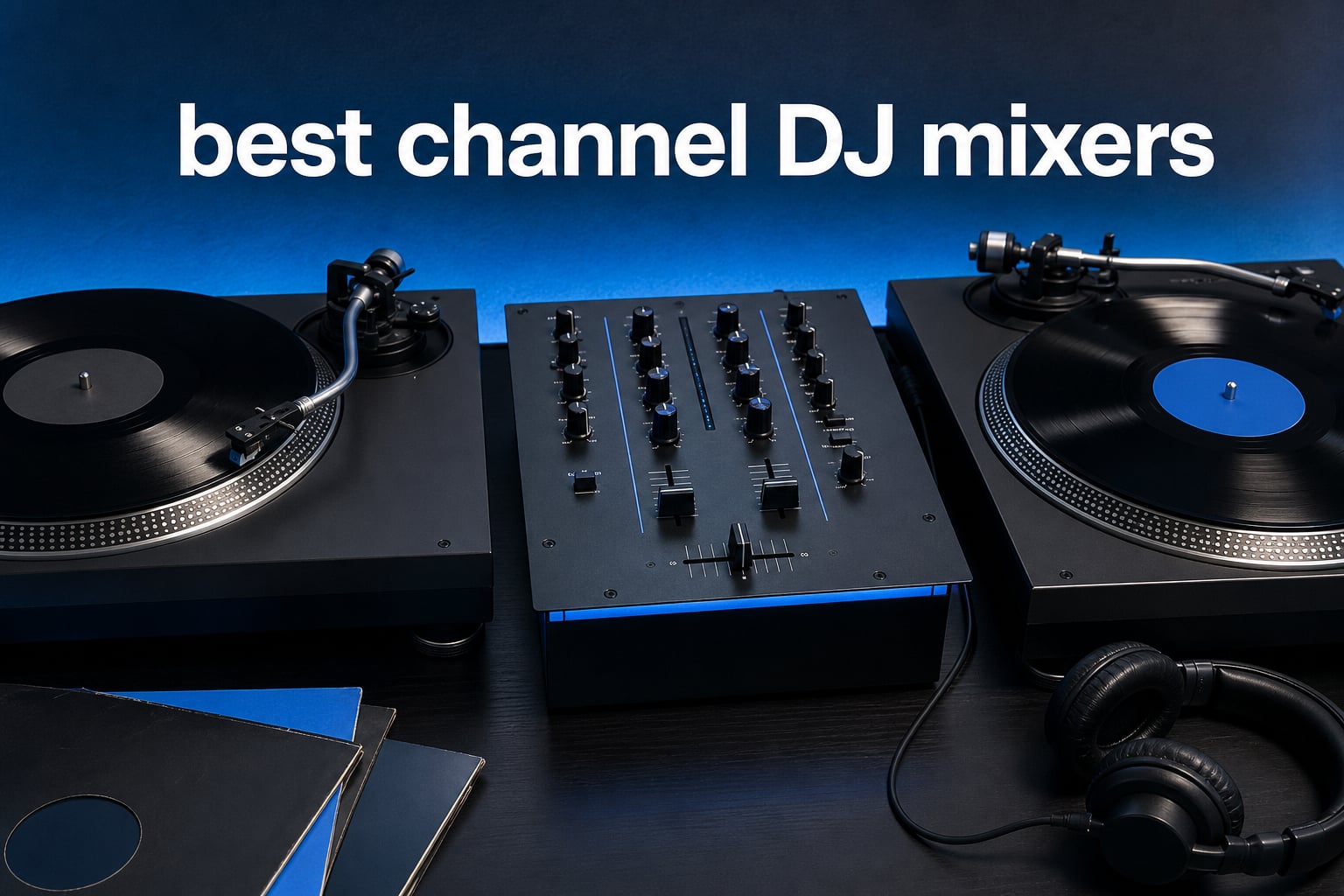
The best 2 channel DJ mixers give you a focused way to blend two turntables, CDJs, media players, or software decks without filling the booth with controls you will not use. A mixer takes those two signals, lets you set level and EQ for each, cue in headphones, and blend them with channel faders or the crossfader before sending the result to speakers.
Two channels are enough for DJing when you mix one outgoing track into one incoming track, which remains the everyday workflow for open-format, house, techno, vinyl, and scratch sets. I would pick the layout for the setup first: a club mixer favors clean transitions and source flexibility, while a battle mixer puts fader response, pads, and performance controls in reach.
For this 2026 guide, we compared eight standalone two-channel units using only their available product specifications, stated features, and buyer feedback. The short version is simple: choose the Pioneer DJM-S11 for an advanced Serato or rekordbox scratch workflow, the DJM-250MK2 for a compact DVS-capable all-round setup, and the Numark M2 when simple practice and a replaceable fader matter more than software features.
Table of Contents
The top 3 picks answer three different DJ setups
The Pioneer DJM-S11 is the feature-led scratch choice because its listing confirms USB audio, XLR and RCA outputs, and support for both Serato DJ Pro and rekordbox. The DJM-250MK2 is the more direct route to a compact Pioneer-style two-deck setup, with rekordbox DVS included, dual headphone outputs, and mic plus AUX use.
The Numark M2 is the stripped-back practice pick: it has two channels, per-channel three-band EQ, phono and line connections, and a replaceable crossfader with reverse and slope controls. That separation matters because a simple mixer is often easier to learn on than a pad-heavy performance surface.

The best 2 channel DJ mixers in 2026 cover scratch, club, and analogue setups
This overview puts all eight choices in one place. Read the notes under each review before deciding, especially if you use turntables, need a balanced XLR output, or expect to work with a particular DJ software system.
| Product | Specifications | Action |
|---|---|---|
| Pioneer DJ DJM-S11 |
|
Check Latest Price |
 Pioneer DJ DJM-250MK2 Pioneer DJ DJM-250MK2 |
|
Check Latest Price |
 Numark M2 Numark M2 |
|
Check Latest Price |
 Pioneer DJ DJM-S7 Pioneer DJ DJM-S7 |
|
Check Latest Price |
 Ecler NUO 2.0 Ecler NUO 2.0 |
|
Check Latest Price |
 Numark Scratch Numark Scratch |
|
Check Latest Price |
 Pioneer DJ DJM-450 Pioneer DJ DJM-450 |
|
Check Latest Price |
 Behringer PRO MIXER NOX101 Behringer PRO MIXER NOX101 |
|
Check Latest Price |
1. The Pioneer DJ DJM-S11 is the advanced scratch and software pick
Pioneer DJ DJM-S11 Professional Scratch Style 2-Channel DJ Mixer for Serato DJ Pro or Rekordbox
2 channels
USB input
XLR and RCA outputs
Pros
- Serato DJ Pro and rekordbox compatible
- Professional scratch layout
- USB connectivity
- XLR and RCA outputs
Cons
- Only 18 listed reviews
- Substantial 7.5 kg weight
The DJM-S11 makes the most sense for a DJ whose set is built around scratch routines and laptop performance. Its product listing calls it a professional scratch-style two-channel mixer and confirms compatibility with Serato DJ Pro or rekordbox, so the software decision is not an afterthought here.
I like that the available data is specific about physical output options: XLR and RCA are both listed, alongside USB connectivity. The published 105 dB noise figure also gives a useful reference point for a mixer intended to sit at the center of a serious sound system.
Its 5.0 rating comes from 18 listed reviews, which is a very small sample beside several alternatives here. Treat that rating as a positive signal rather than proof of long-term consensus, and check that its USB-based workflow actually matches the software and sources you own.
The DJM-S11 fits performance DJs who need software flexibility
Choose this model when Serato DJ Pro or rekordbox is already part of your routine and a purpose-built scratch layout is the goal. It is also sensible when an XLR main connection is needed alongside RCA, rather than forcing an adapter-based booth setup.
The reported dimensions are 20 inches deep, 8 inches wide, and 12 inches high, so I would measure the case or table before committing. Its 7.5 kg stated weight also suggests treating it as a substantial piece of gear rather than a casual grab-and-go mixer.
The DJM-S11 is less sensible when a simple analogue mixer is enough
There is no reason to pay for a dense software-focused scratch platform if you only need two turntables and basic fade control. A more direct analogue-style option gives you fewer controls to learn and keeps attention on cueing, phrasing, and EQ.
Community conversations regularly distinguish club transitions from battle technique, and that distinction applies here. The S11 belongs on the performance end of that split, not the minimal home-practice end.
2. The Pioneer DJ DJM-250MK2 is the compact DVS-ready all-rounder
Pioneer DJ DJM-250MK2 2-Channel DJ Mixer,Black
2 channels
rekordbox DVS included
USB and XLR
Pros
- rekordbox DVS included
- Two headphone outputs
- Mic and AUX together
- XLR and RCA connections
Cons
- No separate performance pads listed
- Small review sample versus entry models
The DJM-250MK2 answers a common beginner question well: it supplies two channels, USB connectivity, and included rekordbox DVS without turning the front panel into a performance-pad grid. That makes it a strong all-round starting point for DJing with players, turntables, or a software-connected setup.
Its listing claims warm, high-quality sound from digital and analogue sources, and it includes both XLR and RCA connections. Two headphone outputs, one quarter-inch and one 3.5 mm, make sharing a cue position or using different headphone plugs less awkward.
The product data also confirms that the microphone and AUX input can operate simultaneously. That is a practical little detail for mobile practice rigs, small events, or anyone who needs an extra source without constantly repatching cables.
The DJM-250MK2 works when rekordbox DVS and clear cueing matter
Pick this Pioneer DJ mixer when rekordbox DVS is the software path you want to explore and you prefer a compact two-deck workflow. The 174 listed reviews at 4.6 out of 5 provide a broader feedback base than the S11, though they do not replace checking current software requirements.
Its listed 20 Hz frequency specification and 105 dB noise level give you hard data to compare with the other USB-capable choices. I would still prioritize the number and type of inputs needed for your sources over any single specification line.
The DJM-250MK2 is not the pick for pad-led battle routines
The available feature list does not mention performance pads, paddle effects, or a specialist fader system. DJs who want those controls under their fingers should look toward the DJM-S7 or Numark Scratch instead.
Vinyl DJs should also confirm their cartridges, grounding needs, and turntable connections before choosing any mixer. The source connection is where a great on-paper setup can become frustrating in a real room.
3. The Numark M2 is the straightforward practice scratch mixer
Numark M2 2-Channel Scratch DJ Mixer
2 channels
Replaceable crossfader
3-band EQ
Pros
- Replaceable crossfader
- Reverse and slope controls
- Phono and line inputs
- Rackmount facilities
Cons
- RCA master output
- No stated DVS software inclusion
The Numark M2 removes the distractions and covers the core physical controls a new DJ needs: two channels, three-band EQ per channel, a mic input, channel faders, and a crossfader. Its replaceable crossfader also has reverse and slope controls, which lets a learner explore different cut behavior without moving to a dedicated battle mixer.
Connection options are unusually clear in the listing. You get two switchable phono or line RCA inputs, two line RCA inputs, a quarter-inch mic input, plus RCA master and record outputs and a quarter-inch headphone output.
The mixer is rack mountable, a useful point for a fixed home, bar, or mobile case installation. At 4.5 out of 5 from 866 listed reviews, it has the deepest review base in this roundup, and that breadth is helpful when comparing a simple budget DJ mixer with more specialized designs.
The Numark M2 suits a hands-on learner with turntables or simple players
This is the one I would consider for home practice when the aim is learning beatmatching, headphone cueing, EQ transitions, and crossfader basics. Its switchable phono and line inputs are particularly relevant when a beginner has turntables now or plans to add them later.
Forum discussions repeatedly flag worn crossfaders on inexpensive mixers, so the M2’s replaceable-fader design is meaningful. It does not promise a professional battle fader, but it gives you a serviceable path if the fader becomes the part that needs attention.
The Numark M2 is limited for digital performance workflows
The listing does say USB connectivity, yet it does not state bundled DVS software, a built-in DVS license, or a named DJ software integration. Do not assume any USB label means a complete laptop-DJ package.
It also lists RCA as the master output rather than XLR. That can be entirely fine for a home setup, but DJs connecting directly to a professional PA should confirm the signal path they need.
4. The Pioneer DJ DJM-S7 is the pad-focused Serato performance choice
Pioneer DJ DJM-S7 2-channel Mixer for Serato DJ
2 channels
16 performance pads
Dual USB
Pros
- 16 Serato performance pads
- Dual USB audio interfaces
- Bluetooth connectivity
- Magvel Fader Pro
Cons
- No rekordbox compatibility stated
- Listed as battery powered
The Pioneer DJ DJM-S7 is the clear middle route between a basic two-channel mixer and the S11’s higher-end scratch focus. The listing confirms 16 performance pads for Serato DJ effects, dual USB audio interfaces, Bluetooth, and a Magvel Fader Pro.
That combination gives it a more active performance profile than the DJM-250MK2. The dual USB interfaces may matter to DJs who expect to switch between computers, while XLR and RCA outputs give the stated connection flexibility for different playback systems.
Its 4.5 rating is based on 90 listed reviews. I would weigh that solid feedback against the fact that the available listing identifies Serato DJ features but does not claim rekordbox support for this model.
The DJM-S7 is right when pad control and a quality fader are central
Choose the S7 when you want direct access to performance pads alongside a named Magvel Fader Pro. DJs who mix routines, trigger effects, and want a two-channel battle mixer will get more relevant controls than from a club-first layout.
Bluetooth is another documented feature, although it should be viewed as a convenience connection rather than a replacement for confirming your primary audio routing. For a sound system, I would use the stated XLR or RCA outputs appropriate to the equipment.
The DJM-S7 requires a software and power check before purchase
The product information lists USB audio input and Serato DJ performance pads, so Serato users have the clearest match. Anyone committed to a different software ecosystem should verify current compatibility from the software provider before making a hardware decision.
The supplied technical listing also calls the mixer battery powered, while other details describe USB and corded-style DJ connections. That inconsistency is a reason to verify the power specification with the seller or manufacturer rather than planning a case around an assumption.
5. The Ecler NUO 2.0 is the analogue-first vinyl and club option
ECLER NUO 2.0 2-Channel Analog DJ Mixer
2 channels
Two phono inputs
XLR and RCA outputs
Pros
- Two phono inputs
- Three line inputs
- Eternal Crossfader compatible
- 3-band EQ kill switches
Cons
- Eternal Crossfader sold separately
- 230V operation listed
The Ecler NUO 2.0 aims at DJs who value an analogue-focused signal path and generous source connections. Its product information lists two mixing channels plus a micro or line channel, two phono inputs, three line inputs, and both master XLR and RCA outputs.
Large ergonomic EQ knobs and three-band EQ kill switches are documented features, giving a DJ a tactile, direct way to shape a blend. The listing also describes the sound as Ecler analogue sound, a claim that lines up with the brand preference often voiced by DJs who care about filter and mix character.
It is compatible with the Ecler Eternal Crossfader, but that fader is sold separately according to the product data. That difference matters: compatibility is not the same as having the part installed.
The NUO 2.0 fits vinyl DJs who need phono and line flexibility
This is a strong candidate when the booth has two turntables, several line-level sources, and a need for balanced XLR output. The two stated phono inputs make it more directly suited to a vinyl DJing setup than a mixer whose listing only emphasizes USB.
Community feedback often praises Allen & Heath for sound and filter character, but this Ecler is a separate analogue-oriented choice with its own documented connectivity. I would not treat brand reputation as a substitute for matching your turntable and output connections.
The NUO 2.0 needs a regional power and fader plan
The product listing specifies 230V AC operation. Check the voltage in your region and the exact seller version before ordering, because a mismatch is not a small setup detail.
It also does not list bundled Serato DJ Pro, rekordbox DVS, pads, or USB sound-card features. That is not a flaw for an analogue mixer, but it means laptop-DVS buyers should select it only after mapping every necessary interface and license.
6. The Numark Scratch is the Serato battle mixer with an InnoFader
Numark Scratch 2-Channel DJ Scratch Mixer
2 channels
Serato DJ Pro
InnoFader and DVS
Pros
- Serato DJ Pro included
- InnoFader crossfader
- DVS license included
- 24-bit sound quality
- XLR output
Cons
- Control vinyl or CDs required for DVS
- No rekordbox support stated
The Numark Scratch packages several scratch-specific facts into one two-channel design: Serato DJ Pro is included, a DVS license is included, and the unit has an InnoFader crossfader with reverse and slope control. For a DJ comparing a scratch mixer against a plain two-channel unit, those are practical distinctions rather than decorative specs.
The listing also records 24-bit sound quality, phono or line inputs, a combo XLR and quarter-inch mic input, balanced XLR output, a separate booth or zone output, and two headphone cue connections. Six direct-access effect selectors, dual paddle launch triggers, filter knobs, and dedicated instant-looping knobs expand what you can do without reaching for a laptop trackpad.
It has 627 listed reviews at 4.4 out of 5, which is a sizeable feedback pool for a performance-oriented mixer. Buyer feedback describes it as a highly rated professional scratch option, but the product data makes one important limit clear: DVS control vinyl or CDs are separate.
The Numark Scratch is best for Serato DJs learning battle techniques
Pick this mixer when you want named scratch hardware, a stated Serato DJ Pro inclusion, and a DVS license in the documented feature set. The InnoFader, slope adjustment, and reverse control are especially relevant for practicing cuts rather than only long-form club transitions.
The separate booth output and balanced XLR connection are also useful for DJs who need a more flexible monitor and main-output arrangement. Those are connections worth planning before the mixer arrives, not after the first event setup.
The Numark Scratch still needs DVS media and software confirmation
A DVS license does not make turntables communicate with software by itself. The listing says you need separate control vinyl or CDs, so include those media in the setup checklist.
Its software claim is specifically Serato DJ Pro; it does not state rekordbox compatibility. A DJ changing platforms should confirm current driver, operating-system, and software support directly before relying on any mixer at a gig.
7. The Pioneer DJ DJM-450 is the effects-led two-channel club mixer
Pioneer DJ DJM-450 2-Channel DJ Mixer, Beat FX, DVS, rekordbox
2 channels
Built-in FX
XLR and RCA outputs
Pros
- Built-in and mobile app FX
- USB connection
- Mic and AUX together
- PC and Mac support
Cons
- No DVS license stated
- Limited 62-review sample
The Pioneer DJ DJM-450 brings the strongest documented effects angle among the club-oriented options here. Its feature list includes built-in FX plus external FX from mobile apps via USB, as well as smartphone or tablet connectivity for instrument and effects apps.
It also supports a microphone and AUX source at the same time, and the listing identifies XLR terminals and RCA connections. For a small booth or home setup that moves between digital and analogue sources, those are more useful facts than an oversized feature checklist.
The DJM-450 has a 4.4 rating from 62 listed reviews. It is described as delivering warm, high-quality sound from digital or analogue sources, yet I would read that as a manufacturer-backed product claim and make the purchase decision on features and source needs you can verify.
The DJM-450 serves transition-focused DJs who want effects control
Choose the DJM-450 when built-in effects and USB-linked mobile effects are part of how you mix. It suits a club mixer workflow where shaping transitions matters as much as fast cuts and pad routines.
PC and Mac connectivity for TRAKTOR SCRATCH control media is stated in the product data. That makes it worth a look for DJs working with that system, subject to checking present software and driver compatibility.
The DJM-450 is not a confirmed all-in-one DVS package
The available details describe TRAKTOR SCRATCH control-media connectivity, but they do not claim an included DVS license or bundled software. Keep those separate categories when comparing it with the Numark Scratch or DJM-250MK2.
The product details list a 94 dB noise level, while several other models list higher figures. Numbers recorded in different listings do not make a full sound-quality test, so use them as one input among outputs, workflow, and your speaker system.
8. The Behringer PRO MIXER NOX101 is the no-frills full-kill EQ choice
Behringer Nox101 Dj Mixers
2 channels
Full-kill 3-band EQ
Ultraglide crossfader
Pros
- Full-kill EQ
- Full VCA control
- Ultraglide crossfader
- XLR TRS and RCA connections
Cons
- No listed USB or DVS features
- Lower 4.3 rating in this group
The Behringer PRO MIXER NOX101 is the simplest alternative here for a DJ who wants a conventional two-channel layout with explicit EQ and fader features. The listing specifies three-band EQ with full-kill filters, full VCA control, and an Ultraglide crossfader.
Full-kill EQ means a band can be cut completely, which can be useful for clean bass swaps or isolating frequencies during a transition. It does not automatically make someone a better mixer, but it is a clear creative control that some entry mixers do not advertise.
The available connections span RCA, TRS, and XLR, giving more output and input format options than a basic RCA-only unit. Its 4.3 rating from 422 listed reviews is lower than the other selections, so I would give extra attention to the fit of its controls and connections instead of choosing solely on the review count.
The NOX101 works for basic EQ mixing with varied connections
Consider this model when your priority is a classic two-channel mixer with full-kill EQ and a conventional crossfader. The stated XLR, TRS, and RCA connectivity makes it a candidate for a simple home or mobile system with mixed cable types.
VCA-controlled mixer functions may appeal to DJs seeking consistent control behavior, but the available data does not add named software integration or performance pads. Its strengths are direct mixing controls, not a digital workflow.
The NOX101 is not a DVS-ready or USB-featured choice in the listing
No USB sound card, bundled software, DVS license, Bluetooth function, or pad section is listed. A laptop DJ should not buy it expecting those functions to appear through a cable alone.
It is better viewed as a focused budget DJ mixer for sources you can already connect through its documented analogue connections. That can be exactly the right answer for two players and speakers, but it is a different answer from a Serato battle setup.
The right buying checks start with your sources and mixing style
A two-channel mixer is not automatically a beginner mixer, a club mixer, or a scratch mixer. Start by writing down the two sources you will connect, the software you actually use, and whether your transitions depend on EQ and effects or on sharp crossfader cuts.
The mixer type should match the way you perform
A club-focused mixer prioritizes blending, EQ work, cueing, effects, and clean output routing. The DJM-250MK2 and DJM-450 fit that general direction from their listed connectivity and effects or DVS features, while the DJM-S7 and Numark Scratch explicitly emphasize performance controls and named fader systems.
A battle mixer puts the crossfader at the center of the instrument. If scratching is the reason you are buying, look for a stated replaceable fader, reverse and slope control, or a named fader such as the Magvel Fader Pro or InnoFader instead of assuming every crossfader will feel alike.
An analogue-first mixer favors direct source connections and tactile control over laptop integration. The Ecler NUO 2.0 is the clearest example in this list, with two phono inputs, three line inputs, EQ kill switches, and master XLR plus RCA outputs.
The inputs and phono stage decide whether vinyl will work cleanly
Turntables need phono-capable inputs, while media players and other audio sources typically use line-level connections. The Numark M2 lists switchable phono or line RCA inputs, the Ecler lists two phono inputs, and the Numark Scratch lists phono or line inputs; those are the kinds of details to compare against your equipment.
Forum discussions repeatedly point out that phono preamp behavior can be disappointing on cheap mixers. The product data here does not provide laboratory phono-preamp measurements, so a vinyl DJ should not invent a ranking; confirm the needed inputs, read current owner reports, and audition when possible.
Do not overlook outputs. XLR is a common balanced main-output format for professional audio connections, while RCA is widespread for consumer equipment and smaller rigs; a booth output can be useful when the DJ needs a separate monitor feed.
The software package must be stated, not assumed from USB
USB can mean many things: a computer audio interface, a connection for an app, or simply a stated connectivity option. It does not by itself promise Serato DJ Pro, rekordbox DVS, a DVS license, or control media.
In this group, the DJM-S11 is specifically listed for Serato DJ Pro or rekordbox, the DJM-250MK2 includes rekordbox DVS, and the Numark Scratch includes Serato DJ Pro plus a DVS license. The DJM-450 states PC and Mac connectivity for TRAKTOR SCRATCH control media, while the DJM-S7 specifically lists Serato performance pads.
Before ordering, check the DJ software website for the version of the operating system and drivers you use. That one check prevents the common mistake of treating DVS-ready language, a USB port, and included software as the same thing.
The fader controls tell you more than a generic scratch label
For smooth mixes, almost any well-functioning crossfader may be sufficient. For cutting and crab scratches, the action, curve, reverse setting, and serviceability become much more important.
The M2 states that its crossfader is replaceable and has reverse and slope controls. The Numark Scratch lists an InnoFader with reverse and slope adjustment, the DJM-S7 has a Magvel Fader Pro, and the NOX101 lists an Ultraglide crossfader.
There is no universal winner because hand feel is personal. I would choose the fader system that matches the kind of practice you will do every week, not the one with the longest feature name.
The learning path is easier when the control surface stays relevant
A DJ mixer for beginners should make gain staging, headphone cueing, EQ, and transitions understandable. The Numark M2 is appealing on that basis because its physical layout is direct, while the DJM-250MK2 adds a clearer route into rekordbox DVS.
More controls are valuable when they solve a real performance need. Pads, effect selectors, and loop controls can be exciting, but a new DJ will progress faster by first setting channel gain correctly and learning to phrase one track into another.
Finally, measure the booth, list the cables, and identify the output at the speakers before choosing. That mundane preparation is the difference between a mixer that feels immediately useful and one that needs adapters or missing hardware on day one.
The most common two-channel mixer questions have practical answers
Is 2 channels enough for DJing?
Yes. Two channels are enough for the standard task of cueing one track while another plays, then blending between them with EQ, channel faders, and the crossfader. A two-channel mixer is especially suited to two turntables or two media players; DJs who regularly layer three or more sources need more channels.
What is the best 2-channel DJ controller?
A standalone DJ mixer is not a DJ controller. For a two-channel standalone mixer, the Pioneer DJ DJM-S11 is the feature-led pick in this guide for Serato DJ Pro or rekordbox scratch workflows. Choose a controller only if you also need integrated decks and software control.
What mixer do most DJs use?
Most DJs use the mixer that fits their venue, sources, and performance style rather than one universal model. Pioneer DJ mixers are common in club-oriented setups, while scratch DJs often prioritize a dedicated fader and stated Serato or DVS support. Check the booth standard where you expect to play.
What is the best DJ mixer for a beginner?
The Numark M2 is the clearest beginner choice here if you want to learn physical mixing fundamentals, because it has two channels, three-band EQ, phono or line inputs, and a replaceable crossfader. The Pioneer DJM-250MK2 is the better fit if included rekordbox DVS is part of your learning plan.
What is the best mixer for scratching?
The Pioneer DJ DJM-S11 is the strongest advanced scratch choice in this list because it is listed for Serato DJ Pro or rekordbox and has USB plus XLR and RCA outputs. The Numark Scratch is a focused alternative with an InnoFader, Serato DJ Pro, and a DVS license included.
The best final choice is the mixer that matches your next setup
The best 2 channel DJ mixers are not interchangeable. The Pioneer DJM-S11 is the advanced software-and-scratch recommendation, the DJM-250MK2 covers compact rekordbox DVS-oriented mixing, the Numark Scratch serves a Serato battle path, and the Numark M2 keeps practice direct and accessible.
For an analogue-centered vinyl system, the Ecler NUO 2.0 brings the most explicitly stated phono and line flexibility. For effects-led club transitions, the DJM-450 is the more appropriate route, while the NOX101 is the plain full-kill-EQ alternative.
In 2026, use the table to narrow your shortlist, then verify your source inputs, outputs, DJ software, and power needs against the product listing before you commit. That check will matter longer than any generic best-of label.