
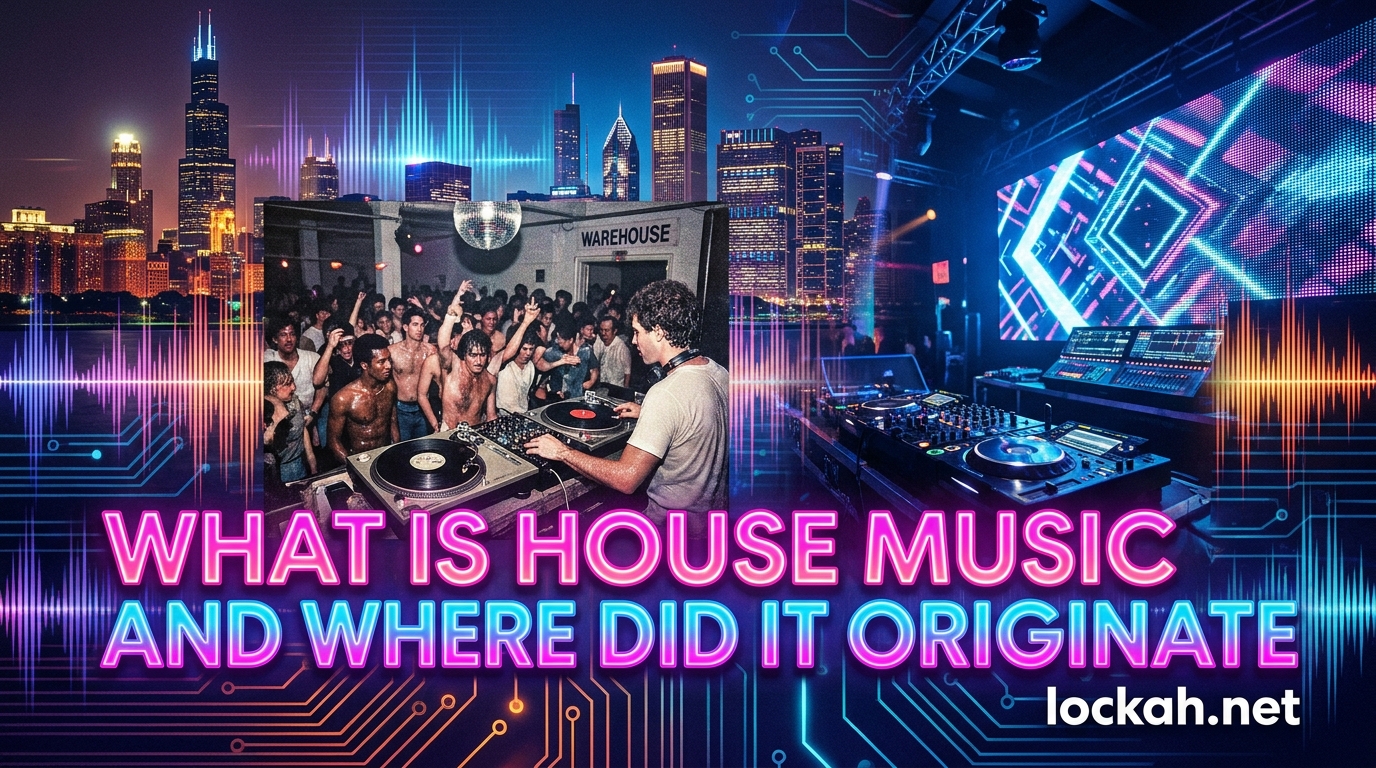
I’ll never forget the first time I stepped onto a dancefloor where house music was playing. The bass pulsed through my chest in perfect rhythm. Everyone moved together like we were part of something bigger than ourselves. That night changed how I understood music forever.
House music is a genre of electronic dance music characterized by repetitive four-on-the-floor beats, synthesized basslines, and soulful vocals. It originated in Chicago during the early 1980s, born from the creative vision of Black and queer DJs who transformed disco into something entirely new.
Our team spent months researching the origins of this revolutionary sound. We spoke with historians, dug through archives, and traced the genre from underground Chicago clubs to its global dominance today. This guide answers exactly what is house music and where did it originate, giving you the full story behind one of music’s most influential genres.
Table of Contents
What Is House Music and Where Did It Originate?
House music represents more than just a genre. It is a cultural movement that emerged from the marginalized communities of Chicago’s South Side in the early 1980s. DJs and producers took the remnants of disco and forged a new sound using drum machines, synthesizers, and reel-to-reel tape edits.
The term “house music” itself tells you exactly where this genre came from. The name refers to The Warehouse, a Chicago nightclub where DJ Frankie Knuckles pioneered the sound. Record stores began labeling music “as played at The Warehouse,” which eventually shortened to simply “house.”
The Four-on-the-Floor Beat Explained
The heartbeat of house music is something called the “four-on-the-floor” beat. This means the kick drum hits on every single beat of the measure. Boom. Boom. Boom. Boom. That relentless, driving pulse keeps dancers locked into the groove for hours.
If you have ever found yourself unconsciously nodding your head to electronic dance music, you were probably responding to this pattern. The four-on-the-floor beat creates a hypnotic foundation that makes house music instantly recognizable. It is the single most defining characteristic of the genre.
Think of it like a metronome for your body. The consistent kick drum eliminates any guesswork about when to move. Your feet, your hips, your shoulders all align with that steady thump. This is why house music creates such powerful communal experiences on the dancefloor.
Tempo and Technical Characteristics
House music typically operates between 120 and 130 beats per minute. This tempo hits a sweet spot that is energetic enough to keep you moving, but not so fast that you burn out after one song. DJs can mix tracks seamlessly because most house music shares this consistent BPM range.
The genre relies heavily on electronic instruments. Drum machines like the Roland TR-808 and TR-909 provide the percussive backbone. Synthesizers create lush chords and driving basslines. Samplers allow producers to chop up and repurpose disco vocals, funk breaks, and soulful melodies.
Soulful vocals remain a crucial element, even in purely electronic productions. Many house tracks feature powerful singers delivering uplifting messages about love, unity, and freedom. Others use chopped samples from classic disco and soul records, giving the music a familiar warmth amid the electronic precision.
The Birth of House Music in Chicago (2026)
Chicago in the late 1970s was a city divided. Economic struggles, racial tensions, and the collapse of the industrial economy created hardship for many residents. Yet within this challenging environment, something extraordinary emerged from the South Side’s underground club scene.
The story of house music cannot be separated from the marginalized communities that created it. Black, Latino, and LGBTQ+ Chicagoans found themselves excluded from mainstream disco venues. They built their own spaces where they could express themselves freely, dance without judgment, and create music that spoke to their experiences.
The Warehouse: Ground Zero
The Warehouse opened in 1977 at 206 South Jefferson Street in Chicago’s West Loop. Robert Williams founded the club specifically for his friend Frankie Knuckles, who had gained recognition as a DJ in New York. The venue became the epicenter of a musical revolution.
Frankie Knuckles transformed how people experienced dance music. He would extend breaks, layer percussion, and blend tracks in ways nobody had heard before. The crowd at The Warehouse came for the music and stayed for the community. This was not just a club. It was a sanctuary.
The Warehouse operated from midnight to noon on weekends. Attendees paid five dollars at the door and received fruit, snacks, and non-alcoholic beverages. The focus stayed entirely on the music and the dancefloor experience. This model influenced countless clubs that followed.
Disco Demolition Night and the Anti-Disco Backlash
To understand why house music emerged, you need to know about Disco Demolition Night. On July 12, 1979, Chicago’s Comiskey Park hosted a promotional event where fans brought disco records to be destroyed in a massive explosion between games of a White Sox doubleheader.
The event turned into a riot. Thousands of mostly white rock fans stormed the field, burning and smashing disco records. The underlying racism and homophobia of the anti-disco movement pushed Black, Latino, and LGBTQ+ communities to create their own musical spaces. House music rose from this rejection.
The anti-disco backlash effectively killed the commercial disco industry. Radio stations stopped playing the music. Record labels dropped disco artists. But the desire to dance never disappeared. Chicago’s underground scene kept the spirit alive by reinventing the sound entirely.
The Rise of DJ Culture
Chicago DJs developed innovative techniques that defined the genre. They used reel-to-reel tape machines to extend drum breaks and add percussion. They layered synthesizer basslines under existing disco tracks. They created edits that transformed familiar songs into extended dancefloor anthems.
Ron Hardy became another legendary figure at a club called the Muzic Box. Where Frankie Knuckles was smooth and soulful, Hardy was raw and experimental. He would play tracks at wrong speeds, create chaotic mixes, and push boundaries that shocked and thrilled his audiences.
These DJs were not just playing records. They were creating new music from existing materials. The DJ became a producer, an editor, and a composer. This philosophy of remixing and repurposing remains central to electronic music production today.
What Makes House Music Distinctive?
Understanding house music means recognizing its unique combination of elements. While the four-on-the-floor beat provides the foundation, several other characteristics define the genre and distinguish it from similar styles like techno and disco.
The instrumentation sets house apart from its predecessors. Where disco relied on live musicians, house embraced drum machines and synthesizers. This shift gave producers complete control over every sound. They could create perfectly quantized rhythms that human drummers could not replicate.
Production Techniques and Equipment
The Roland TR-808 and TR-909 drum machines became iconic tools for house producers. These machines allowed creators to program precise drum patterns and adjust every element of the percussion. The distinctive kick, snare, and hi-hat sounds of these machines still define house music today.
Synthesizers like the Roland TB-303 created the squelching basslines that characterize acid house. Other producers favored the warm pads and strings of the Korg M1 or the Yamaha DX7. Each piece of equipment imparted its own sonic character to the tracks produced with it.
Sampling technology revolutionized the genre. Producers could lift a vocal hook from a disco record, chop a drum break from a funk song, and layer them over original synthesizer compositions. This collage approach became a defining feature of house production.
The Emotional Core
Despite its electronic foundations, house music maintains deep emotional resonance. The genre grew from communities seeking joy amid hardship. That spirit of celebration permeates the music. Even instrumental tracks carry an uplifting, hopeful energy.
Vocals in house music often feature themes of unity, love, and liberation. Songs declare that we are all family, that music brings us together, that the dancefloor is a space of freedom. These messages were revolutionary for marginalized communities who found acceptance in house music spaces.
The repetitive nature of house creates a trance-like state. As layers build and loops cycle, dancers enter a meditative flow. This is not accidental. The music was designed to facilitate communal experiences where individual worries dissolve into collective movement.
House Music vs Techno: Key Differences
Many newcomers confuse house music with techno. While both genres use electronic instruments and four-on-the-floor beats, they have distinct origins, sounds, and purposes. Understanding the differences helps you identify what you are hearing.
| Characteristic | House Music | Techno |
|---|---|---|
| Origin | Chicago, early 1980s | Detroit, mid-1980s |
| Sound | Soulful, warm, disco-influenced | Industrial, cold, futuristic |
| BPM Range | 120-130 | 125-150 |
| Mood | Uplifting, celebratory | Hypnotic, mechanical |
| Vocals | Often soulful and prominent | Rare or processed beyond recognition |
| Key Artists | Frankie Knuckles, Larry Levan | Juan Atkins, Derrick May |
Think of house as the soulful cousin of techno. Where house embraces warmth, vocals, and disco heritage, techno pursues a futuristic, machine-like aesthetic. Both genres revolutionized dance music, but they speak to different emotional needs.
The Many Flavors of House Music
Over four decades, house music has splintered into countless subgenres. Each variant maintains the four-on-the-floor foundation while emphasizing different elements. Understanding these distinctions helps you navigate the vast world of house music.
Deep House
Deep house emerged in the mid-1980s as a more soulful, introspective variant. Artists like Larry Heard (recording as Mr. Fingers) created tracks with jazz-influenced chords, complex basslines, and an atmospheric quality. The tempo often sits at the lower end of the house range, around 120 BPM.
The sound draws heavily from soul, jazz, and funk. Synthesizer pads create lush textures. Basslines wander melodically rather than staying strictly functional. Vocals, when present, tend toward the smooth and soulful rather than the anthemic.
Deep house prioritizes groove over drama. These tracks work perfectly for laid-back listening or early-evening DJ sets. The genre has experienced multiple resurgences, remaining consistently popular among discerning dance music fans.
Acid House
Acid house exploded in the late 1980s with a distinctive squelching sound. The TB-303 bass synthesizer, originally designed to accompany guitar practice, became the defining instrument. Producers discovered that manipulating its filters created the “acid” sound that gave the subgenre its name.
Chicago artists like Phuture, DJ Pierre, and Marshall Jefferson pioneered the style. Tracks like “Acid Tracks” by Phuture introduced the world to this raw, hypnotic sound. The genre became associated with the UK rave scene and the Second Summer of Love in 1988-1989.
Acid house has a psychedelic, trance-inducing quality. The TB-303 squelch cuts through mixes with an almost aggressive presence. Despite its seemingly simple elements, the genre creates powerful emotional responses that have kept it relevant for decades.
Tech House
Tech house bridges the gap between house and techno. The genre maintains house’s groove and structure while incorporating techno’s more mechanical, repetitive elements. It emerged in the mid-1990s as DJs began blending the two genres in their sets.
The sound features techno-style drum programming and sound design applied to house’s song structures. Basslines tend toward the minimal and functional. Builds and drops create dancefloor drama while maintaining underground credibility.
Tech house has become one of the most popular subgenres in 2026. Artists like Fisher, Cloonee, and Chris Lake dominate festival stages with this accessible yet underground sound. The genre strikes a balance that works for both casual listeners and dedicated dance music fans.
Progressive House
Progressive house emerged in the early 1990s with longer, more gradual song structures. Where traditional house tracks loop relatively static elements, progressive house evolves continuously. Melodies develop over eight or sixteen bars. Energy builds gradually toward climactic moments.
The genre found massive commercial success in the 2000s and 2010s. Artists like deadmau5, Eric Prydz, and Swedish House Mafia brought progressive house to mainstream audiences. Festival anthems with soaring melodies and massive drops became the sound of EDM’s global explosion.
Some purists distinguish between “progressive house” (the underground, groove-focused original) and “EDM” or “big room” (the commercial festival variant). Both share the gradual build structure, but the production values and target audiences differ significantly.
Soulful and Funky House
Soulful house returns to the genre’s disco roots with emphasis on live instrumentation, powerful vocals, and funk influences. Producers sample heavily from 1970s soul and disco records. Live musicians often contribute bass, guitar, and keyboard parts.
The sound celebrates the Black and LGBTQ+ heritage of house music. Labels like Defected Records and Soulfuric Deep have kept this style alive for decades. It remains particularly popular in the UK, South Africa, and New York City.
Funky house emphasizes groovy basslines and danceable rhythms borrowed from funk and boogie. The tempo stays upbeat. The mood stays joyful. This is party music designed to make people smile and move.
Pioneers Who Shaped the Sound
House music did not emerge from a vacuum. Specific individuals created the sounds, established the venues, and built the community that made this genre possible. Understanding these pioneers gives you deeper appreciation for the music you hear today.
Frankie Knuckles: The Godfather of House
No single person is more associated with house music than Frankie Knuckles. Born in the Bronx, he developed his DJ skills in New York before Robert Williams convinced him to move to Chicago and become the resident DJ at The Warehouse.
Knuckles pioneered the art of the extended mix. He would take the best parts of disco records, the breaks and instrumental passages, and loop them to create entirely new compositions. His smooth, soulful approach defined the sound of classic Chicago house.
After The Warehouse closed in 1983, Knuckles opened his own club called the Power Plant. He began producing original tracks, including the 1986 classic “Your Love” and the 1991 hit “The Whistle Song.” Chicago declared August 25, 2004, as Frankie Knuckles Day in his honor. He passed away in 2014, but his influence continues to shape dance music globally.
Larry Levan and the New York Connection
While Chicago birthed house music, New York’s parallel scene at the Paradise Garage significantly influenced the genre. Larry Levan served as resident DJ at this legendary after-hours club from 1977 until 1987. His eclectic, risk-taking approach inspired Frankie Knuckles and countless others.
Levan was known for playing diverse genres, blending rock, reggae, and synth-pop with disco and early electronic tracks. The sound system at Paradise Garage was legendary for its power and clarity. Many consider the Garage the spiritual predecessor to modern dance music culture.
The connection between Chicago and New York remained strong. DJs traveled between the cities, sharing records and techniques. The Paradise Garage closed in 1987, but its influence on house music and club culture cannot be overstated.
Marshall Jefferson and the Next Wave
Marshall Jefferson emerged as a key producer in the mid-1980s, bridging the gap between DJ culture and original production. His 1986 track “Move Your Body” became one of the definitive house music anthems. The declaration that “house music is a controllable desire you can dance to” captures the genre’s essence perfectly.
Jefferson’s productions combined drum machines, synthesizers, and powerful vocal performances. He worked extensively with Chicago’s Trax Records, the label that documented and distributed much of the early house music canon. His tracks reached international audiences and established house as a global genre.
Other crucial pioneers include Farley Jackmaster Funk, whose “Love Can’t Turn Around” became the first house record to cross over to the UK pop charts. Steve Silk Hurley brought production polish with tracks like “Jack Your Body.” Ron Hardy’s raw, experimental approach at the Muzic Box pushed the genre into wilder territory.
Essential Tracks to Know
If you want to understand house music, you need to hear the classics that defined the genre. These tracks represent different eras, styles, and approaches within the house music continuum.
“Your Love” by Frankie Knuckles and Jamie Principle (1986) captures the romantic, soulful side of early house. The sparse production and emotive vocals demonstrate how powerful simple elements can be. “Move Your Body” by Marshall Jefferson (1986) brings the piano-driven, anthemic quality that became a house staple.
“Can You Feel It” by Mr. Fingers (1986) defines deep house with its jazz chords and contemplative mood. “Acid Tracks” by Phuture (1987) introduced the world to the TB-303 and acid house. “French Kiss” by Lil Louis (1989) brought sexual tension and organic build-ups to the mainstream.
For a more contemporary entry point, try “One More Time” by Daft Punk (2000), which brought house structures to global pop audiences. “Finally” by Kings of Tomorrow (2000) represents the soulful house tradition. “Cola” by CamelPhat and Elderbrook (2017) shows how house continues evolving in 2026.
Frequently Asked Questions
Where did house music originally start?
House music originally started in Chicago, Illinois, in the early 1980s. It emerged from the underground club scene on the city’s South Side, specifically at a nightclub called The Warehouse where DJ Frankie Knuckles pioneered the sound by extending disco breaks and adding drum machine percussion.
What city is known for house music?
Chicago is universally recognized as the birthplace of house music and remains most closely associated with the genre. While Detroit developed techno and New York had parallel influences through clubs like Paradise Garage, Chicago gave the world house music and continues to celebrate this heritage.
Why do they call it house music?
The name comes from The Warehouse, a Chicago nightclub that operated from 1977 to 1983. Record stores began labeling music as played at The Warehouse to help customers identify the sound. This phrase eventually shortened to simply house music.
Is house music LGBTQ?
House music was born from queer Black underground club culture in Chicago. The genre emerged from spaces created by and for marginalized communities, including LGBTQ+ people of color. While house music welcomes everyone today, its origins and spirit remain deeply connected to LGBTQ+ history and culture.
What defines a house music song?
House music is defined by four key characteristics: a four-on-the-floor beat where the kick drum hits every beat, a tempo between 120-130 BPM, synthesized basslines and melodies, and often soulful vocals or samples. The combination creates an infectious, danceable groove designed for the club.
What is the difference between house and techno?
House music originated in Chicago with a soulful, warm, disco-influenced sound and often features prominent vocals. Techno emerged from Detroit with a colder, more industrial, futuristic aesthetic and typically avoids recognizable vocals. House runs 120-130 BPM while techno tends faster at 125-150 BPM.
The Lasting Legacy of House Music
House music has traveled far from its origins at The Warehouse in Chicago. What began as an underground movement created by marginalized communities has influenced virtually every corner of popular music. The four-on-the-floor beat now drives pop hits, hip-hop tracks, and commercial jingles worldwide.
The genre’s impact extends beyond music. House culture established the model for modern club culture, DJ performance, and electronic music production. The emphasis on inclusive spaces influenced how venues operate today. The philosophy that the dancefloor belongs to everyone remains radical and necessary.
When you understand what is house music and where did it originate, you recognize something profound. This genre represents creativity born from necessity, joy found in struggle, and community built through sound. The next time you hear that steady kick drum driving through a track, remember the Chicago pioneers who created this gift for the world.
We recommend exploring the classics mentioned in this guide, visiting local house music events, and supporting the artists keeping this culture alive. House music was created for you, whoever you are. The dancefloor remains open.