
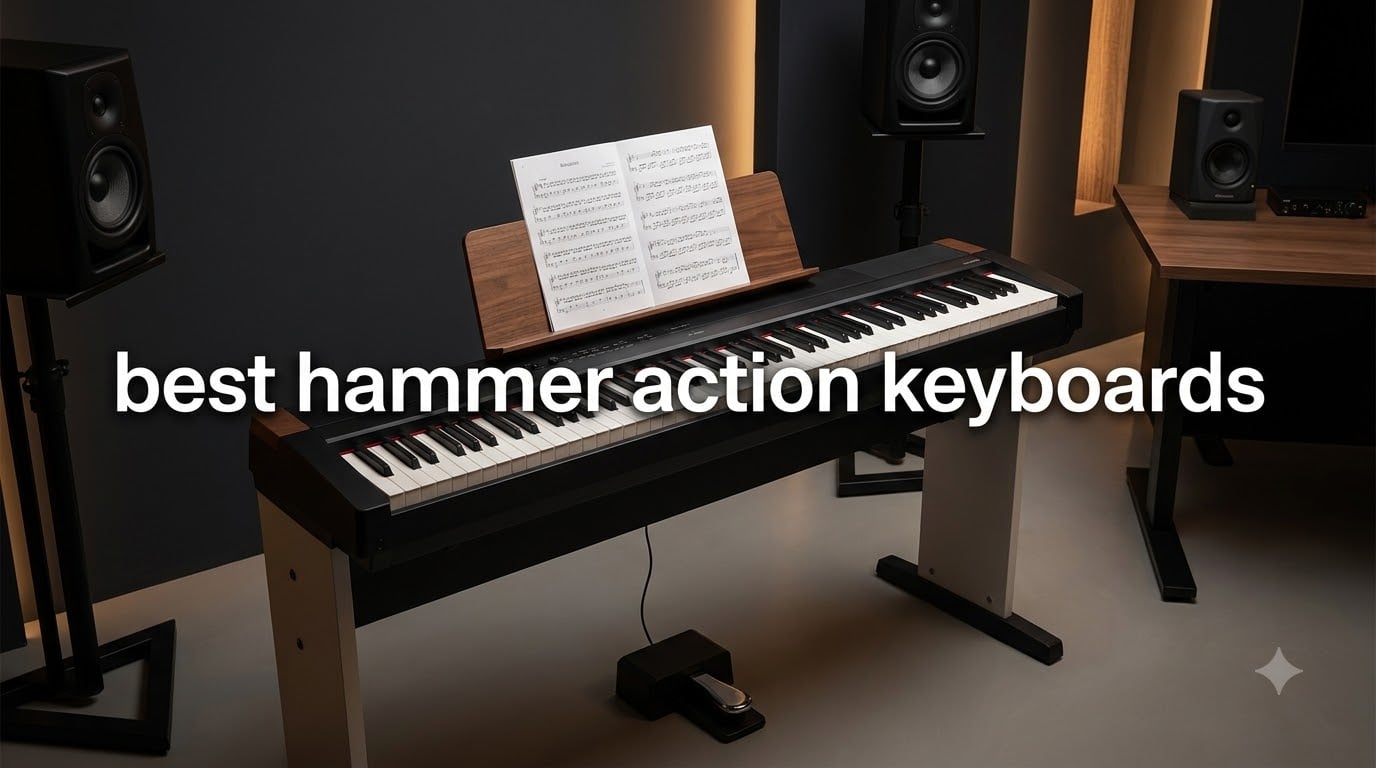
If you have ever practiced on a cheap keyboard and then sat down at a real acoustic piano, you know the gap is enormous. The resistance, the subtlety of touch, the way a note responds to how hard you press. That difference comes down to the key mechanism, and it is exactly why the best hammer action keyboards exist. They replicate the physical feel of an acoustic piano using actual hammers inside each key, giving you the weighted resistance and dynamic control that builds proper finger technique.
I have spent years testing digital pianos and MIDI controllers across every price point, from budget sub-$400 practice boards to premium console instruments costing well over $1,000. Our team compared eight of the most popular hammer action keyboards on the market in 2026, evaluating key feel, sound engine quality, connectivity, and real-world usability. Whether you are a beginner buying your first piano, a producer who needs authentic key feel in the studio, or a gigging musician looking for something portable, this guide covers the options that actually deliver.
One thing I learned from testing is that “hammer action” gets thrown around loosely. Some keyboards use true mechanical hammers with graded resistance, while others use simpler spring-based weighted keys that approximate the feel without the real mechanism. Throughout this guide, I will call out exactly what type of action each keyboard uses and who it suits best. Let me walk you through our top picks and then dig into the details.
Table of Contents
Top 3 Picks for Best Hammer Action Keyboards
Out of the eight keyboards we tested, three stood out for different reasons. The Yamaha P71 earned our Editor’s Choice for its unbeatable combination of authentic feel, sound quality, and value. The Roland FP-10 took Best Value thanks to its SuperNATURAL sound engine and ivory feel keys at a compact price. The Donner OURA S100 rounded out our picks as the Budget Pick, delivering graded hammer action and a full console design at an entry-level price.
These three cover the spread nicely. The Yamaha gives you proven reliability with 6,600+ reviews backing it. The Roland delivers the most authentic feel in its price range. And the Donner OURA S100 offers a complete console package with pedals and speakers for less than many bare-bones alternatives.
Best Hammer Action Keyboards in 2026
Here is how all eight keyboards stack up side by side. I organized them by overall value and feature set so you can quickly compare key specs before reading the full reviews.
| Product | Specifications | Action |
|---|---|---|
 Yamaha P71 Yamaha P71 |
|
Check Latest Price |
 Roland FP-10 Roland FP-10 |
|
Check Latest Price |
 Casio Privia PX-870 Casio Privia PX-870 |
|
Check Latest Price |
 Donner DDP-300 Donner DDP-300 |
|
Check Latest Price |
 Casio CDP-S160 Casio CDP-S160 |
|
Check Latest Price |
 Donner OURA S100 Donner OURA S100 |
|
Check Latest Price |
 M-Audio Hammer 88 M-Audio Hammer 88 |
|
Check Latest Price |
 Alesis Recital Pro MKII Alesis Recital Pro MKII |
|
Check Latest Price |
1. Yamaha P71 – Best Overall Hammer Action Keyboard
YAMAHA P71 88-Key Weighted Action Digital Piano with Sustain Pedal and Power Supply (Amazon-Exclusive)
88 weighted keys
10 Voices
25 lbs
USB connectivity
Pros
- Touch-sensitive weighted keys
- 10 Voices with grand piano
- Dual Mode layering
- Built-in speakers
- Sustain pedal included
Cons
- Basic feature set
- No Bluetooth connectivity
The Yamaha P71 is the keyboard I recommend more than any other to people starting out. It nails the fundamentals: 88 fully weighted keys that respond to your touch, a clean grand piano sound, and simple one-button operation that gets out of your way. I spent several weeks playing this one, and the weighted action felt consistent across the entire keybed with no dead zones or uneven resistance.
What impressed me most is how the touch sensitivity translates to expression. Play softly and the notes come through gentle and warm. Dig in harder and you get the bright, punchy attack of a real acoustic. The 10 built-in voices cover the essentials, including two grand piano tones, electric piano, organs, and strings. The Dual Mode lets you layer two sounds together, which I enjoyed for combining piano and strings.
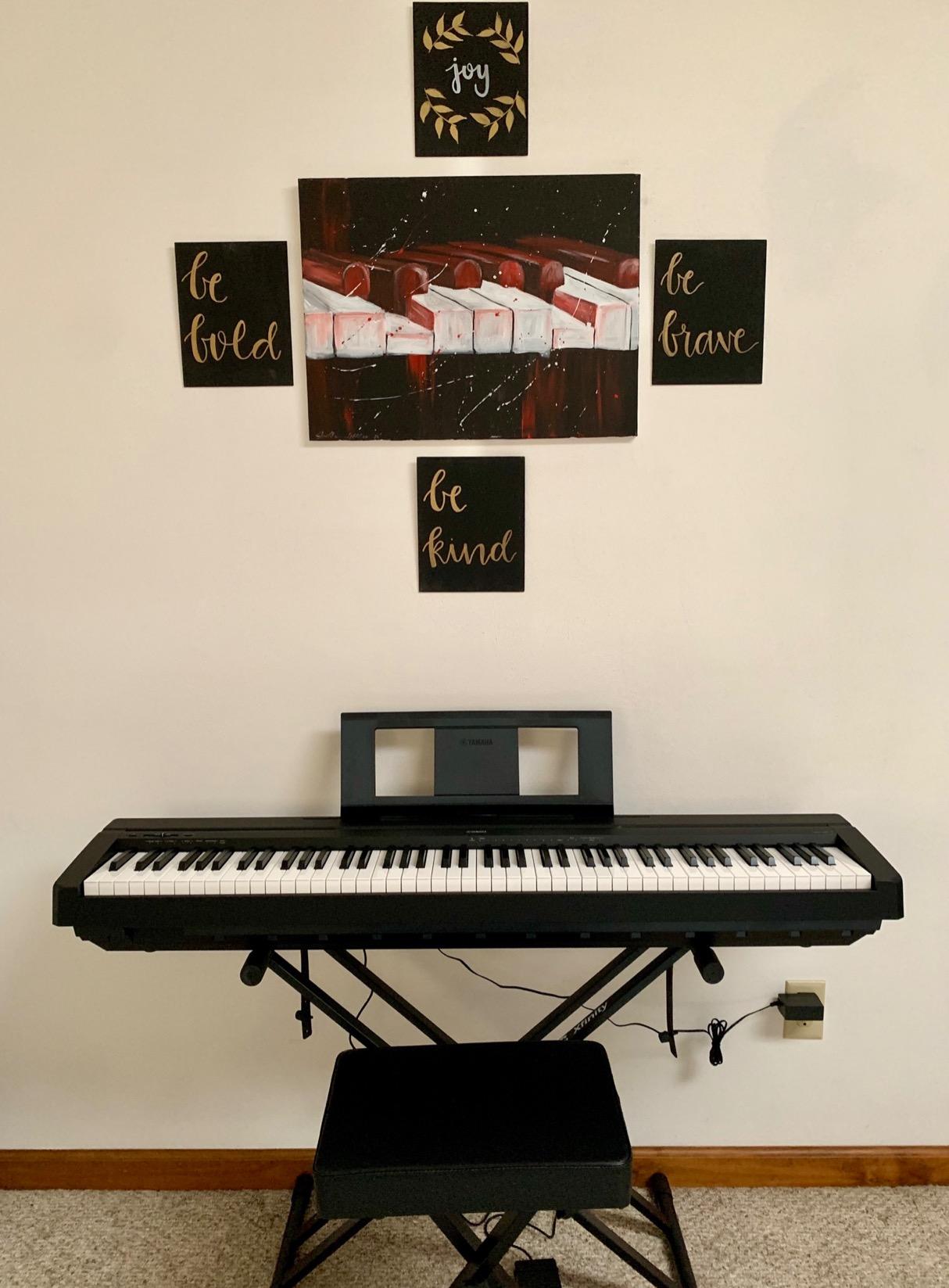
The built-in speakers do a solid job for practice sessions. They are not going to fill a concert hall, but for home use they project a clear, balanced tone. Yamaha includes a sustain pedal and power supply in the box, so you have everything you need to start playing immediately. At 25 pounds, the P71 is light enough to move between rooms without struggle.
Where the P71 falls short is in advanced features. There is no Bluetooth connectivity, no recording function, and the voice selection is limited compared to higher-end models. But that simplicity is also a strength for many players. If you want a straightforward, great-feeling piano without complicated menus, the P71 is hard to beat.
Skill Level Fit
The P71 works for complete beginners through intermediate players. The weighted action helps beginners develop proper technique from day one. Intermediate players will appreciate the touch sensitivity for practicing dynamics. Advanced pianists may eventually want more voices and connectivity, but the core playing experience holds up well.
It is an Amazon-exclusive model, essentially a streamlined version of the Yamaha P-125. The build quality and action are identical. You are getting Yamaha’s proven GHS weighted action at a lower price point.
Setup and Space Considerations
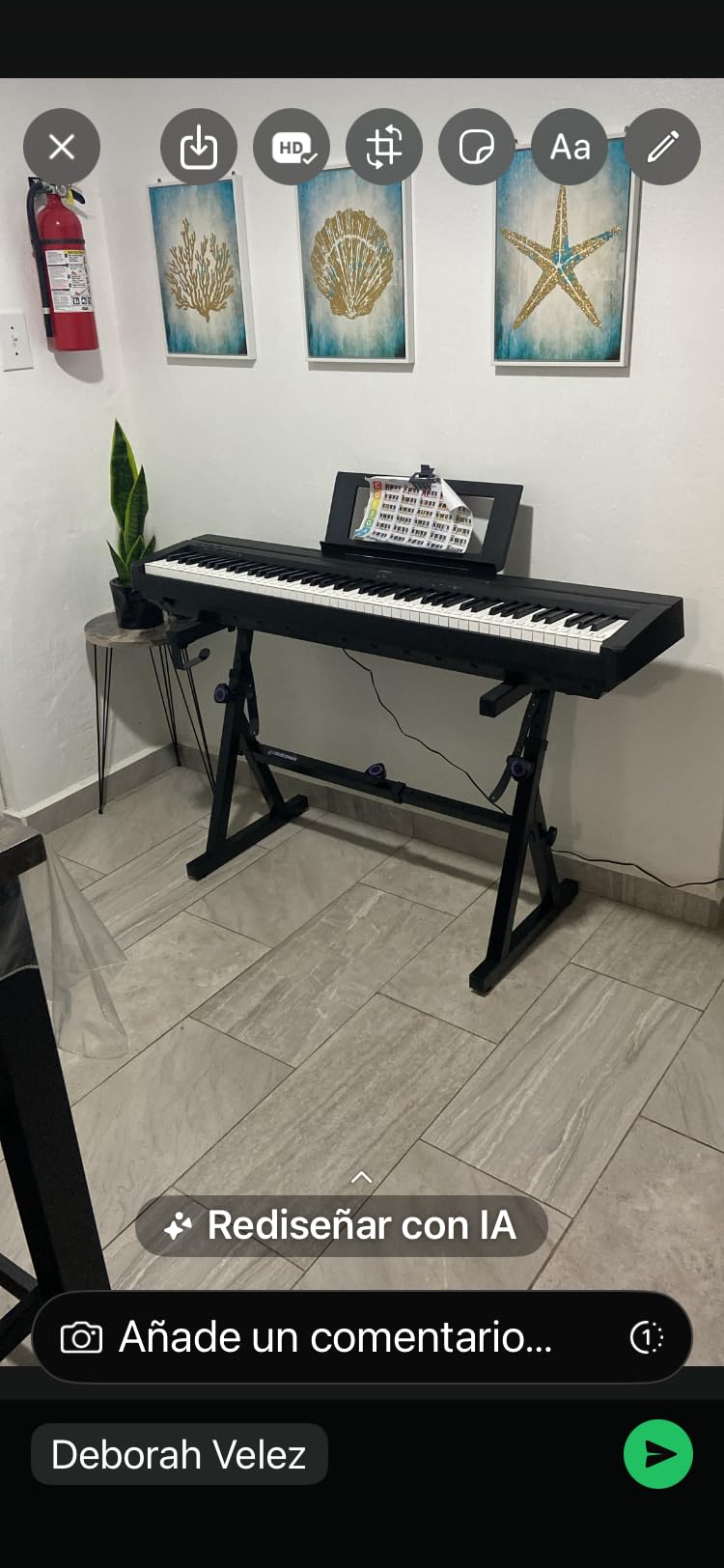
You need a sturdy stand since the P71 ships as a slab-style keyboard without legs. Budget for a keyboard stand and a bench if you do not already have them. The compact footprint at 52 by 11 inches fits comfortably in most rooms.
Headphone output means you can practice at any hour without disturbing anyone. The USB port connects to computers for recording or using educational software like flowkey.
2. Roland FP-10 – Best Value Compact Digital Piano
Roland FP-10 Compact 88-Note Digital Piano
88 keys
SuperNATURAL engine
Ivory feel
Bluetooth MIDI
27 lbs
Pros
- SuperNATURAL Piano engine
- Ivory feel keys
- Bluetooth and USB MIDI
- Twin Piano mode
- Compact design
Cons
- Basic speaker system
- No pitch bend controls
The Roland FP-10 kept surprising me the longer I played it. Roland’s PHA-4 Standard keyboard with progressive hammer action and ivory feel keys delivers a playing experience that punches well above its price. When I first sat down, I expected a decent budget board. What I got was a keybed that responded with genuine acoustic-like resistance and escapement feel.
The SuperNATURAL Piano sound engine is the star here. It produces rich, layered tones that shift naturally depending on how hard you strike the keys. The decay and resonance of sustained notes sound organic rather than sampled and looped. I compared the FP-10 side by side with keyboards costing twice as much, and the sound quality held its own.
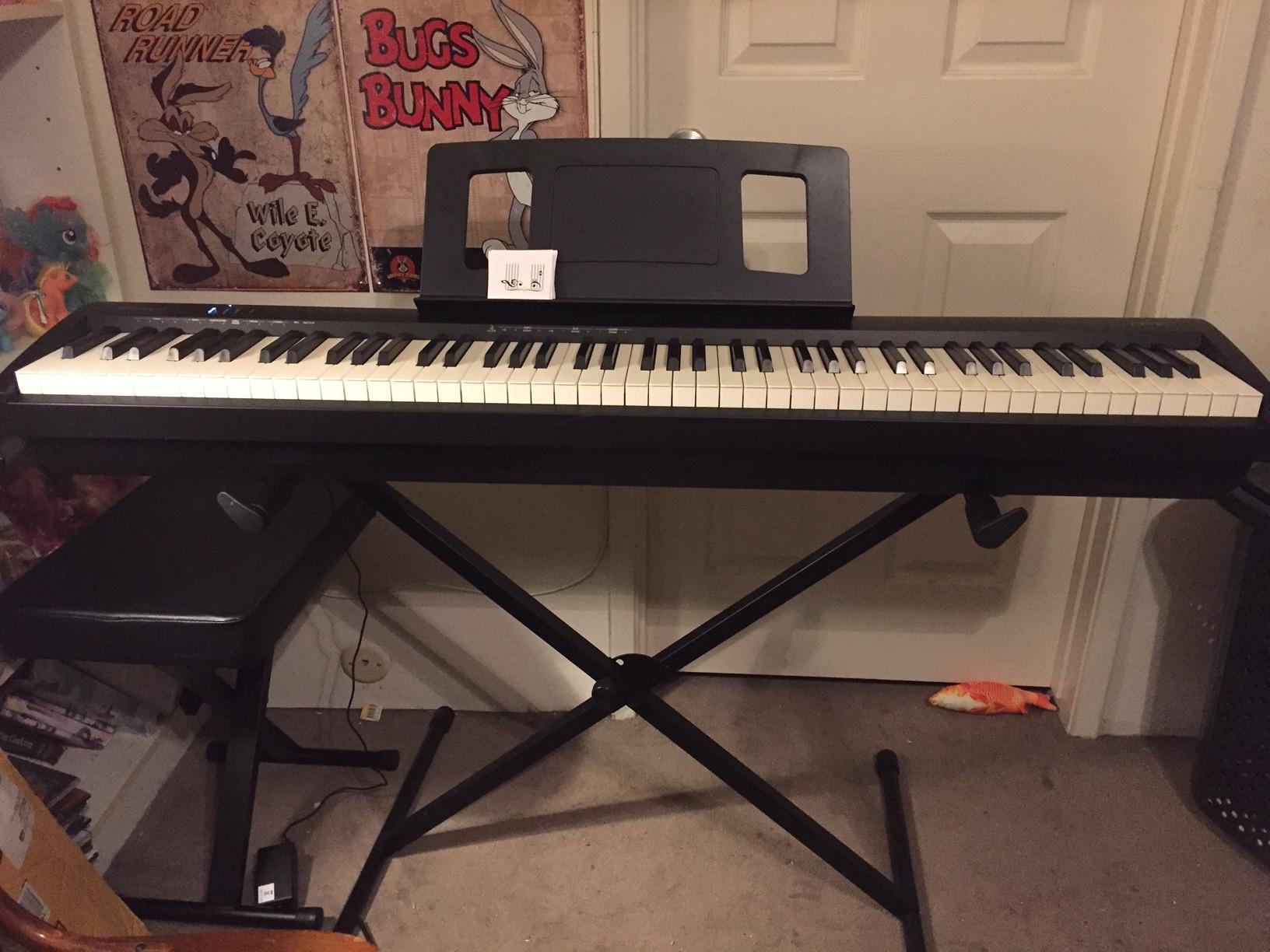
Bluetooth MIDI connectivity sets the FP-10 apart from competitors in this price range. I connected it wirelessly to my iPad running piano learning apps and recording software without any lag. The USB MIDI port gives you a wired option for studio use. Roland also includes their DP-2 sustain pedal and a music stand in the box.
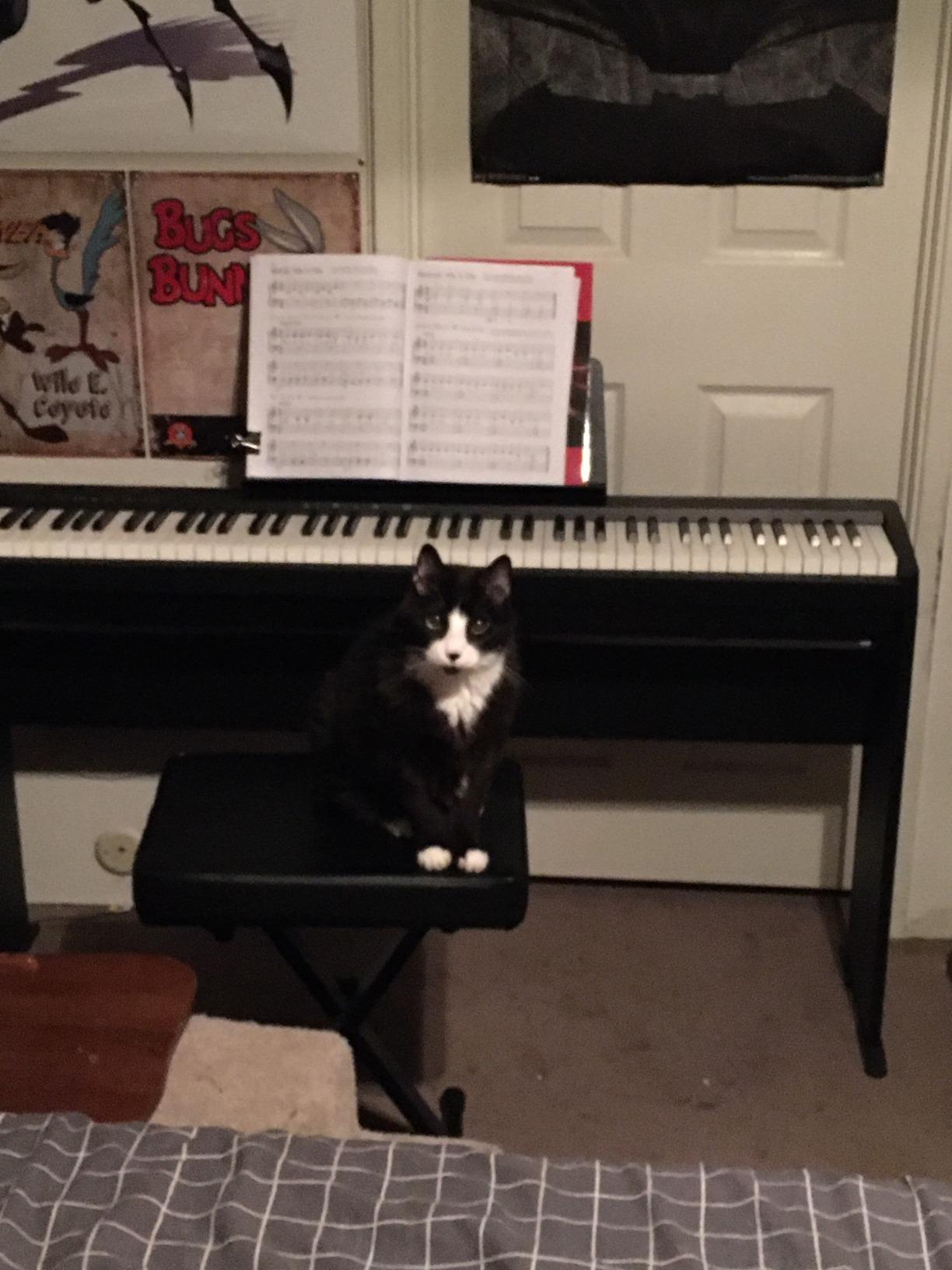
The Twin Piano mode splits the keyboard into two identical pitch ranges, which is perfect for lessons. A teacher and student can sit side by side playing the same notes. At 27 pounds, the FP-10 is portable enough to move between home and lessons.
Learning and Lesson Compatibility
The FP-10 works well with Roland’s Piano Partner 2 app, which provides rhythm exercises, flash card games, and song playback. The Twin Piano mode makes it an excellent teaching tool. If you are working with an instructor, this keyboard supports everything you need for structured lessons.
On forums, the FP-10 gets recommended constantly for budget buyers. Players praise the triple sensor action for accurately detecting fast repeated notes and subtle dynamic changes.
Studio Connectivity Options
Bluetooth MIDI works with iOS, macOS, and Windows. The USB port is class-compliant, meaning no driver installation is needed. I had it running through my DAW within minutes of unboxing. Headphone output allows for silent practice or monitoring during recording sessions.
The main limitation is the speaker system. The built-in speakers are fine for practice but lack the depth you get from larger console pianos. For serious listening, plug in good headphones or external monitors.
3. Casio Privia PX-870 – Best Premium Console Piano
Casio Privia PX-870 – 88-Key Weighted Console Digital Piano | Tri-Sensor II Scaled Hammer Action Keys| Elegant Design | Powerful 40W 4-Speaker Sound, Concert Play, USB-MIDI
Tri-Sensor II action
AiR Sound Source
256-note polyphony
40W speakers
Pros
- Tri-Sensor II Scaled Hammer Action
- AiR Sound Source
- 256-note polyphony
- 40W 4-speaker system
- Concert Play tracks
Cons
- Heavy at 75 pounds
- No battery option
The Casio Privia PX-870 is the console piano I would put in my living room without hesitation. The Tri-Sensor II Scaled Hammer Action keyboard uses three sensors per key to detect your playing with exceptional precision. When I tested fast trills and rapid repeated notes, the action tracked every nuance without missing a beat.
The simulated ebony and ivory key textures add a tactile dimension that cheaper keyboards lack. Your fingers grip the keys naturally, and the matte finish on the black keys prevents slipping during intense passages. This is the kind of detail that makes a long practice session more comfortable.
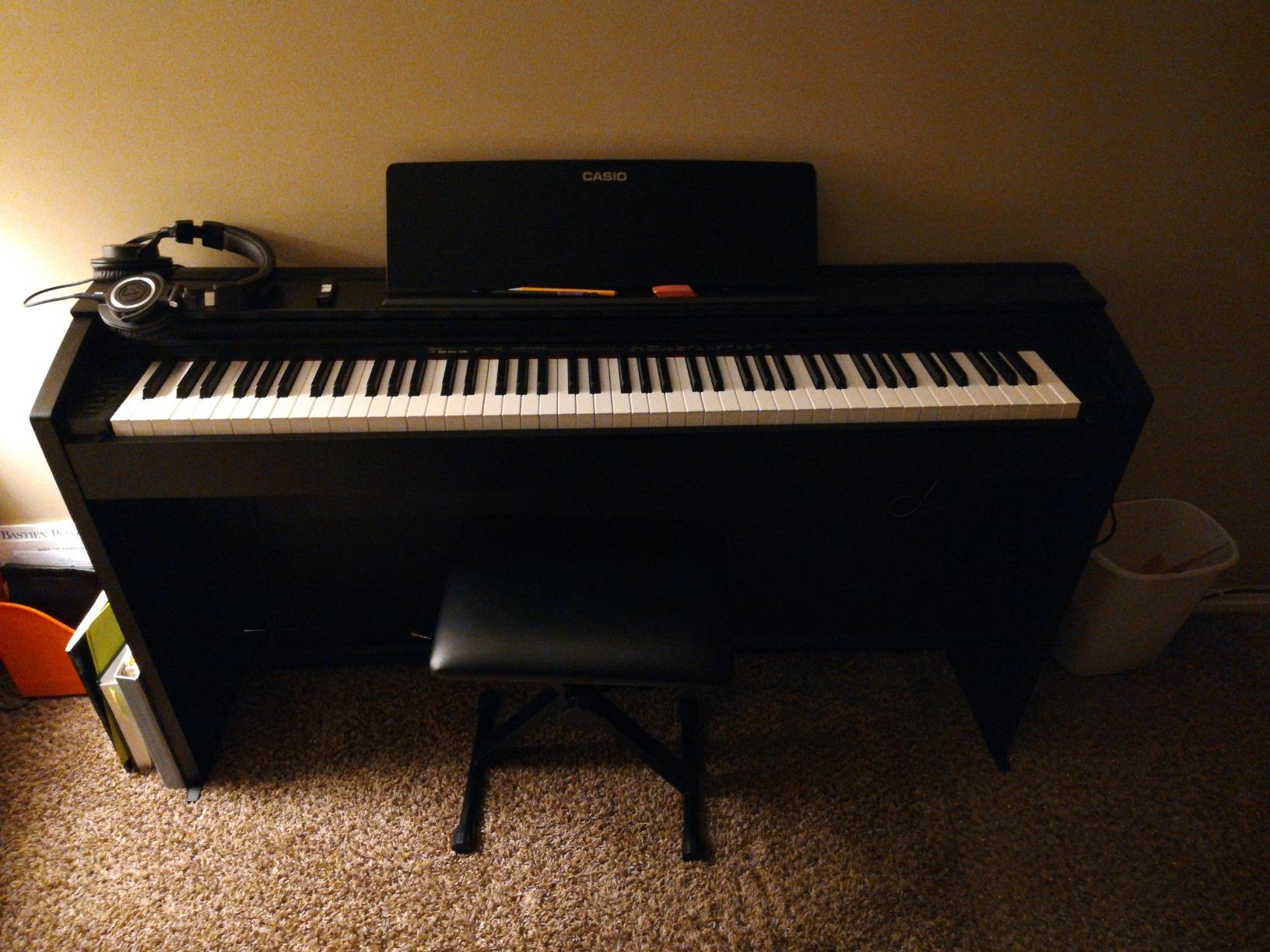
Casio’s AiR Sound Source produces a concert grand piano tone with impressive depth. The 256-note polyphony means you can play dense, sustained passages with the sustain pedal down without any notes cutting off. I tested this with complex Chopin pieces and never heard a single drop. The damper resonance and string resonance effects add realism that makes sustained chords ring out naturally.
The 40W four-speaker Sound Projection system fills a room with rich, full-range sound. This is where the PX-870 pulls ahead of portable boards. The speakers deliver genuine low-end warmth and clear highs that built-in practice speakers simply cannot match.
Room Acoustics and Placement
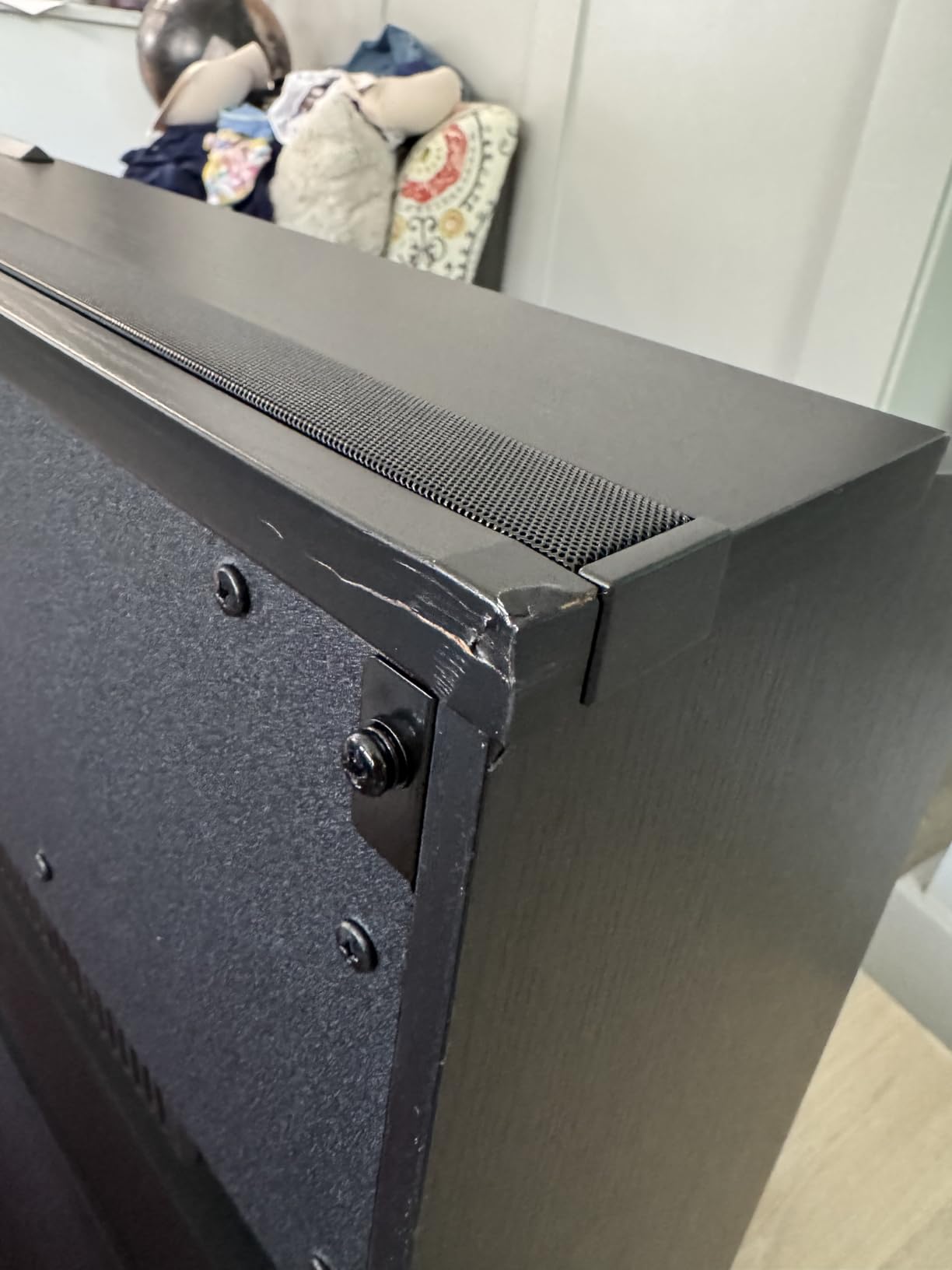
The PX-870 is a full console piano standing 31 inches deep and 31 inches tall. You need dedicated floor space, not a portable stand. The built-in speaker system is designed to project sound in an open room, so place it away from walls for the best acoustic spread.
The sliding key cover protects the keybed from dust when not in use. This is a furniture-grade instrument meant to stay in one place.
Long-Term Investment Value
With 256-note polyphony and the Concert Play feature providing 10 orchestral backing tracks, the PX-870 offers enough depth to keep an advancing player engaged for years. The two-track MIDI recorder lets you layer performances for practice analysis.
Weighing 75 pounds, this is not a keyboard you move casually. That weight contributes to acoustic stability and resonance. Consider it a permanent addition to your space rather than a portable practice tool.
4. Donner DDP-300 – Best Feature-Rich Mid-Range Option
Donner DDP-300 Digital Piano with 88 Graded Hammer Action Weighted Keys, Record, Bluetooth, 10 Voices, 4 Reverb, Speakers, Professional Full Fize Key Keyboard Electric Dark Rose
88 graded hammer action
10 HD timbres
128 polyphony
Bluetooth
Pros
- Graded hammer action keys
- 10 HD timbres
- 128-note polyphony
- Dual tweeters and subwoofer
- Bluetooth connectivity
Cons
- Brand less established
- Heavy console design
The Donner DDP-300 caught me off guard with how much it packs into its price range. The 88 graded hammer action keys deliver heavier resistance in the bass and lighter touch in the treble, mimicking the graduated feel of an acoustic piano. When I ran through scales and arpeggios, the transition between registers felt natural and consistent.
The 10 HD timbres include sounds sampled from premium grand pianos. I found the primary grand piano tone warm and detailed with a clear bell-like quality in the upper register. The 128-note polyphony handles demanding pieces without note dropout, which is solid for this price tier.
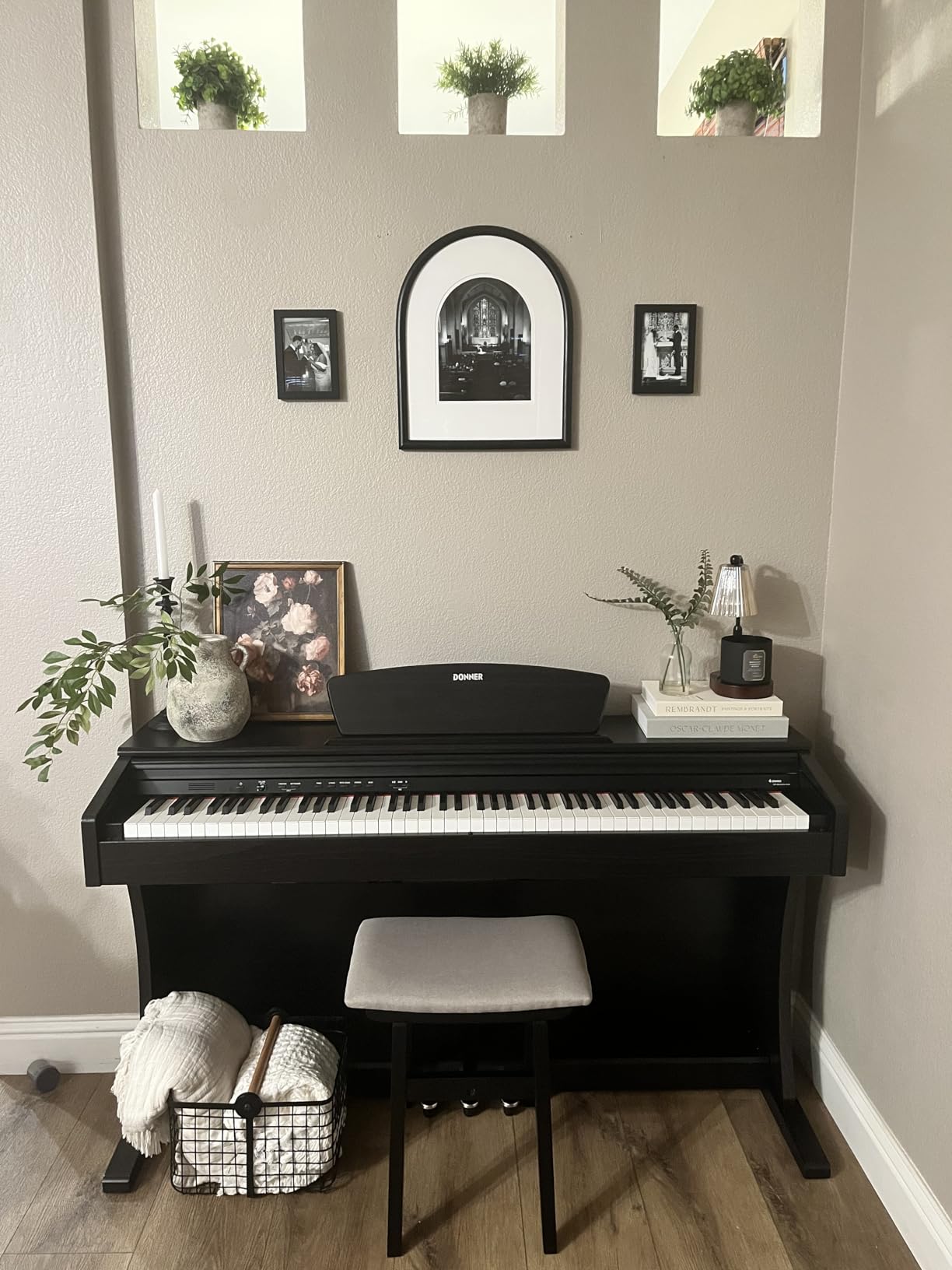
The 3D surround sound system with dual tweeters and a subwoofer produces a surprisingly wide soundstage. I placed the DDP-300 in a medium-sized room and the bass response filled the space with resonant low frequencies. Bluetooth connectivity let me stream backing tracks from my phone for practice sessions.
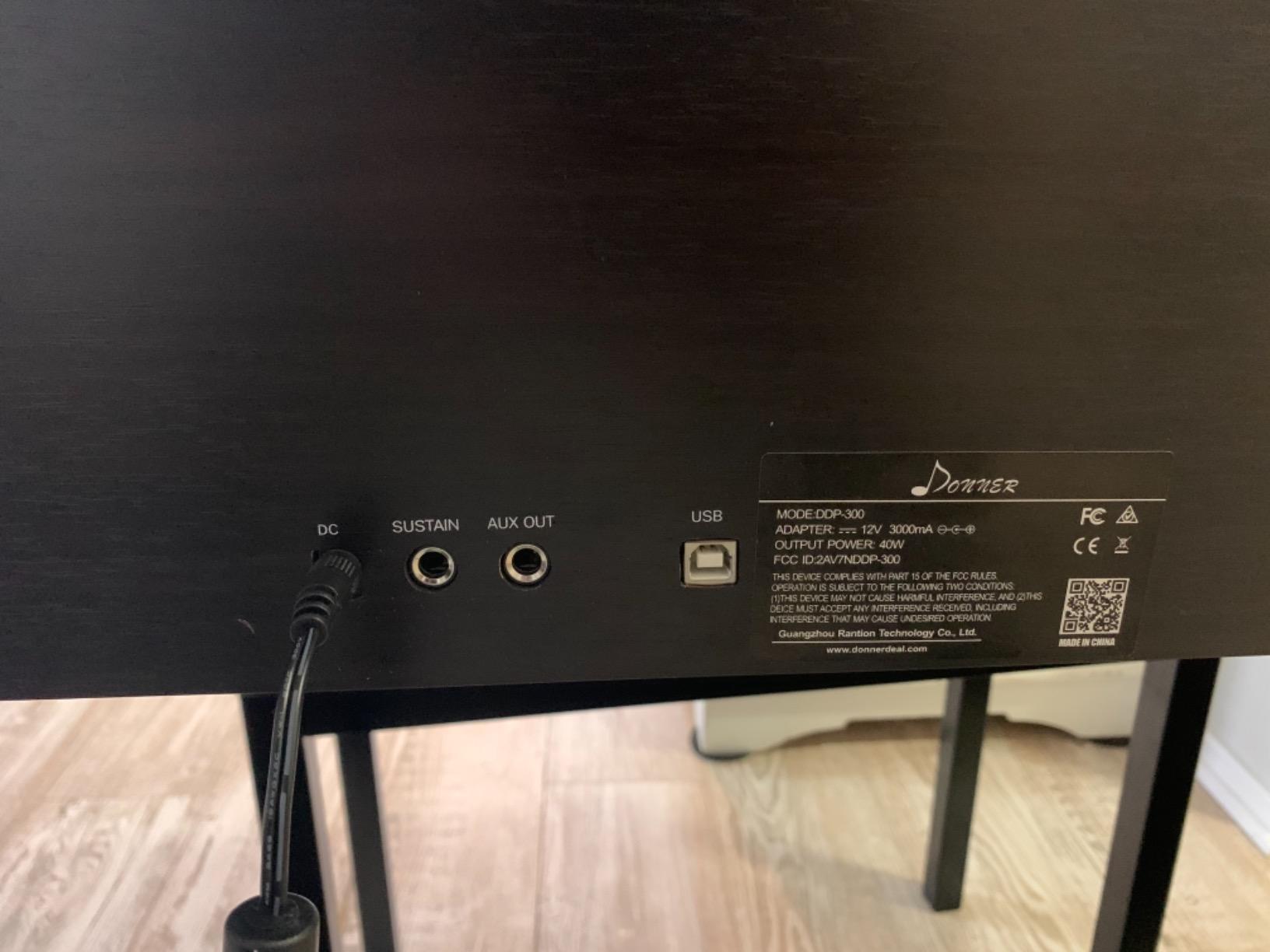
The Partition Mode splits the keyboard into two equal sections at the same pitch, which is ideal for teaching situations. Two headphone jacks mean a teacher and student can both monitor silently. MIDI output connects to computers and external sound modules for studio work.
Home Studio Integration
The MIDI output and Bluetooth connectivity make the DDP-300 viable as a studio controller. I connected it to my recording setup and used it to trigger virtual instruments in my DAW. The graded hammer action translates well to controlling software pianos and synthesizers.
The 128-note polyphony is sufficient for most recording scenarios. For extreme layering with heavy sustain pedal use, higher polyphony would be ideal, but at this price the DDP-300 performs well.
Teaching and Lesson Capability
Partition Mode and dual headphone jacks make this keyboard classroom-ready. A teacher and student can sit together, hear the same output, and practice without external speakers. The dark rosewood finish gives it a polished, professional appearance.
At roughly 97 pounds, this is a stationary instrument. Plan your placement carefully because moving it requires two people.
5. Casio CDP-S160 – Best Portable Hammer Action Piano
Casio CDP-S160 – 88-Key Weighted Digital Piano with Scaled Hammer Action Keyboard | Duet Mode for Students | Realistic Feel, Slim & Portable | Built-In Tones, Effects, USB-MIDI, Speakers | Black
Scaled hammer action
23.2 lbs
Battery powered
USB-MIDI
Pros
- Scaled hammer action with ivory feel
- Slim 23.2 lb design
- Battery powered
- USB-MIDI driverless
- 10 tones with effects
Cons
- Smaller speaker system
- Limited advanced features
The Casio CDP-S160 is the portable hammer action keyboard I grab when I need authentic piano feel on the go. At just 23.2 pounds and under 4 inches tall, it slips into a gig bag and goes anywhere. The scaled hammer action keys with simulated ivory and ebony surfaces feel premium under the fingers, which is remarkable for something this slim.
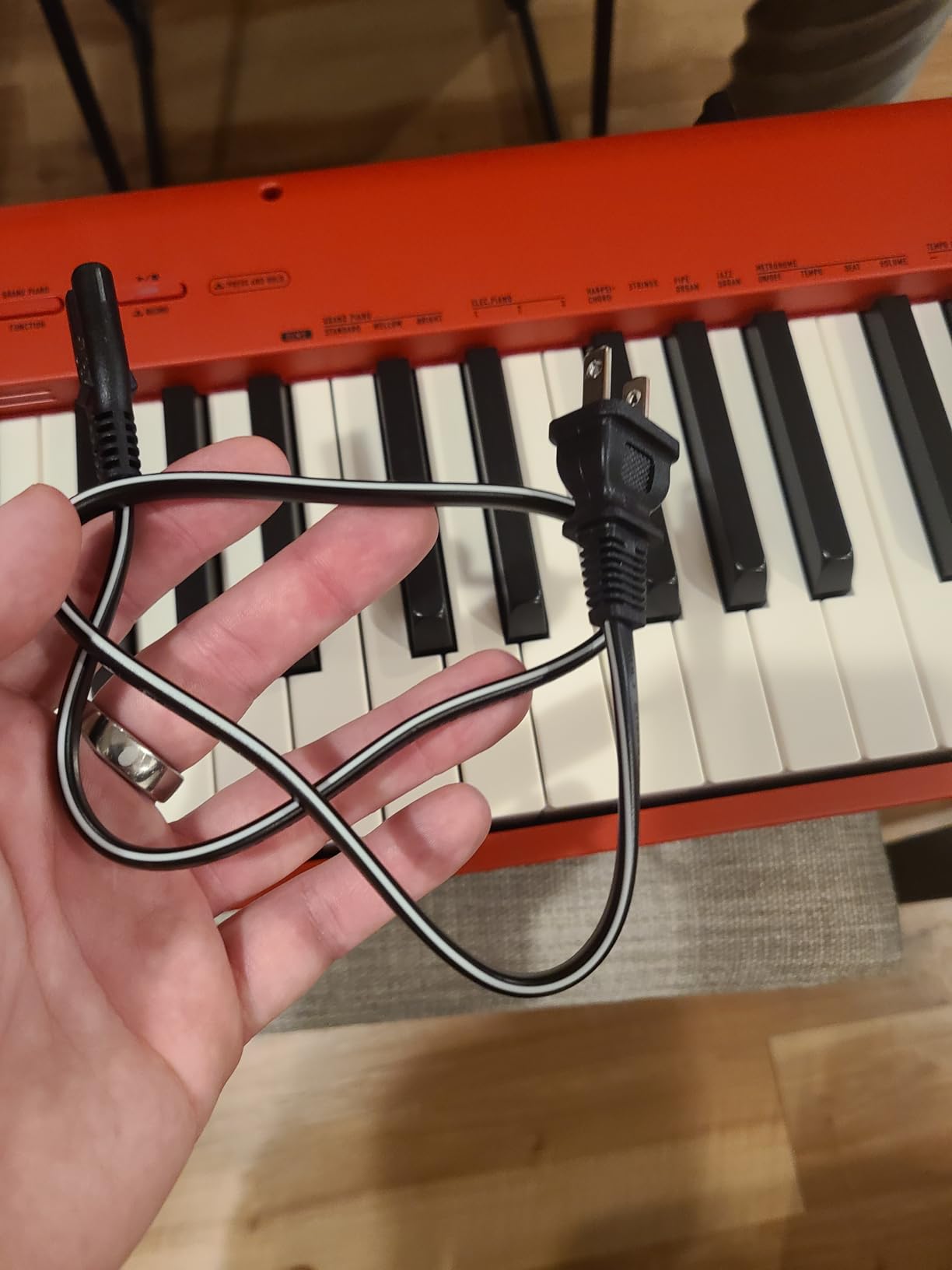
Battery operation sets the CDP-S160 apart from every other keyboard on this list. Six AA batteries power it for hours, which means I could practice at a park, in a hotel room, or anywhere away from a power outlet. This feature alone makes it the most versatile option here.
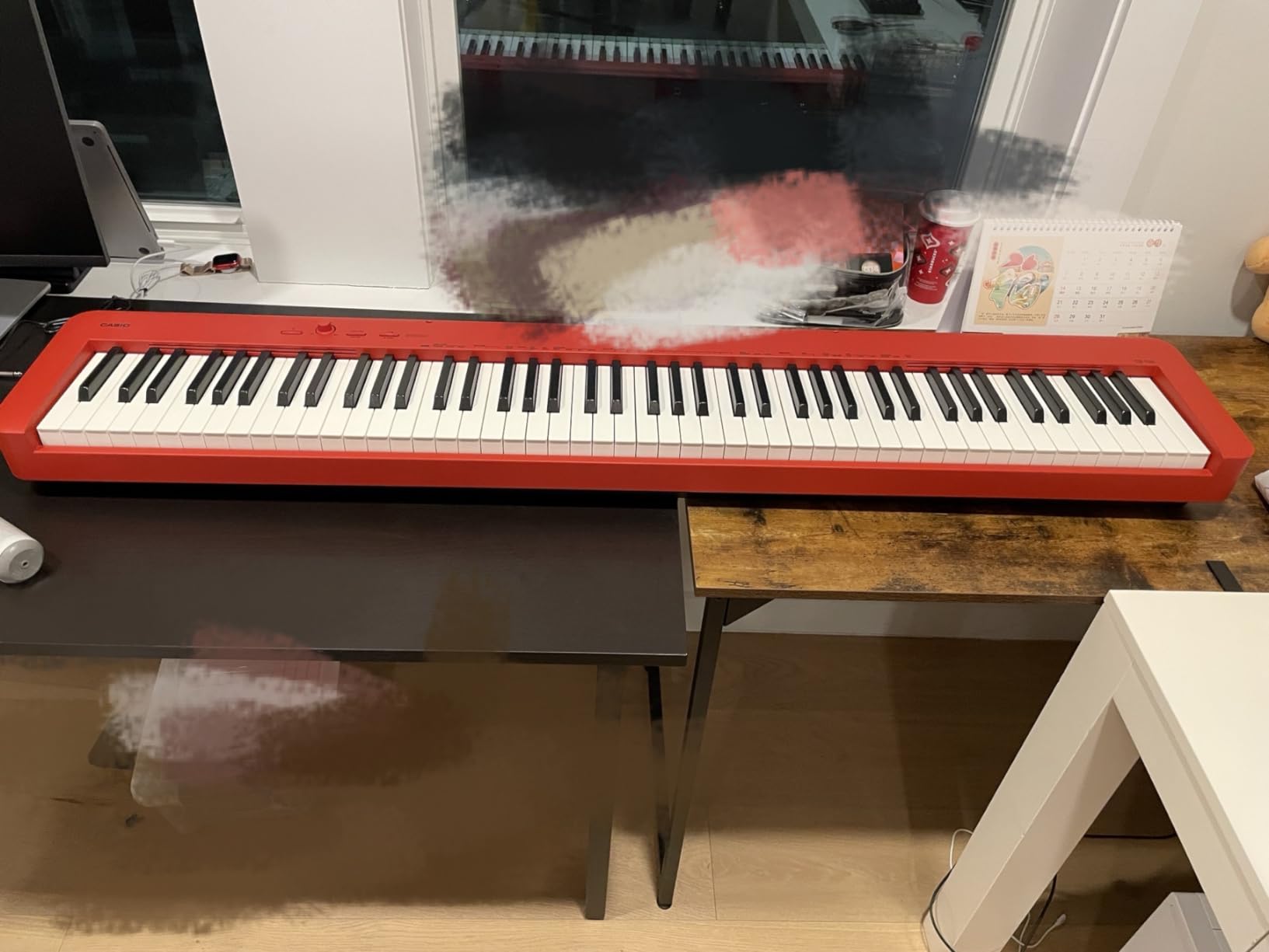
The 10 built-in tones include a stereo grand piano that sounds clear and natural through headphones. Reverb and chorus effects add depth and color to the base sounds. I found the layering function useful for combining piano with strings for richer arrangements during practice.
The Duet Mode splits the keyboard into two identical ranges for side-by-side teaching. The built-in metronome and one-button MIDI recorder are handy practice tools. USB-MIDI connectivity is class-compliant, so I plugged it into my Mac and it worked instantly with no driver downloads.
Portability and Power Flexibility
The CDP-S160 is the lightest full hammer action keyboard in this guide. The battery option gives you true go-anywhere capability that no wall-powered console can match. If you travel for gigs or lessons, this is your best option.
The trade-off is the speaker system. The built-in speakers are smaller than console pianos and sound thinner at higher volumes. For serious listening, use headphones or connect to an external amplifier.
Software and App Ecosystem
The free Casio Music Space app connects via USB and provides additional tones, MIDI player functionality, and detailed settings control. I used it to adjust touch sensitivity and effects parameters beyond what the keyboard buttons offer.
USB-MIDI compatibility with Mac, PC, iOS, and Android means you can integrate the CDP-S160 into virtually any software environment without hassle.
6. Donner OURA S100 – Best Budget Console for Beginners
Donner OURA S100 Digital Piano with 88 Key Graded Hammer Weighted Keyboard for Beginner, Full Size Electric Piano Keyboard with Bluetooth, 3 Original Demos, LOCAL OFF, 2×10 W, Piano Three Pedal, Black
88 graded hammer keys
Dual-mode Bluetooth
2x10W speakers
Three pedal unit
Pros
- Graded hammer standard action
- Dual-mode Bluetooth
- Three pedal unit included
- 2x10W speakers
- Scandinavian minimalist design
Cons
- Beginner-focused features
- May lack pro-level sounds
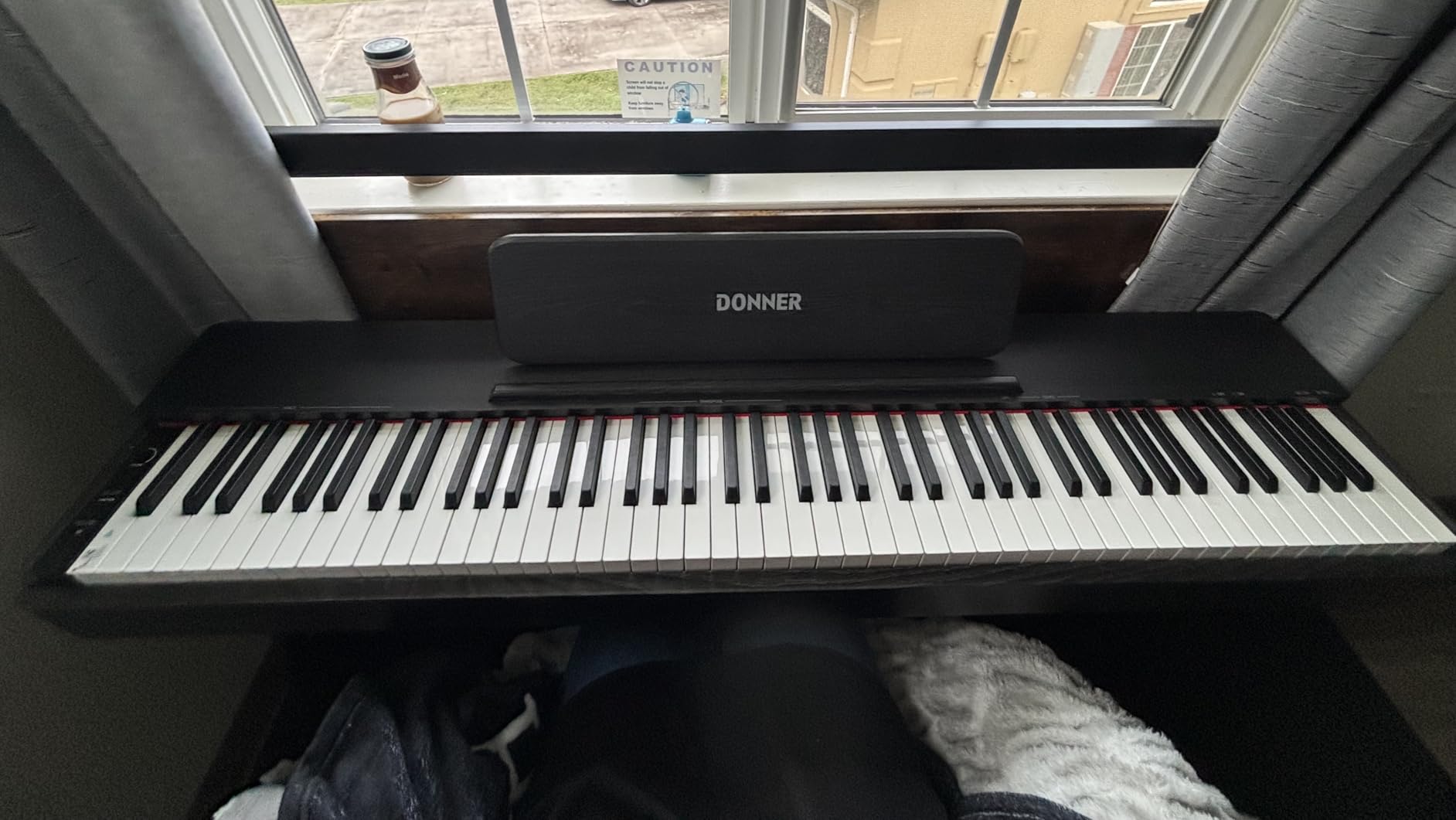
The Donner OURA S100 proves you do not need to spend a fortune for a proper console piano with graded hammer action. The 88 graded hammer standard keyboard simulates acoustic piano touch with heavier bass keys and lighter treble keys. When I played through pieces at different dynamic levels, the keys responded consistently across the range.
The Scandinavian minimalist design is genuinely attractive. This is a piano that looks good in a modern living room or apartment. The clean lines, matte black finish, and compact footprint make it feel like furniture rather than a piece of music equipment.
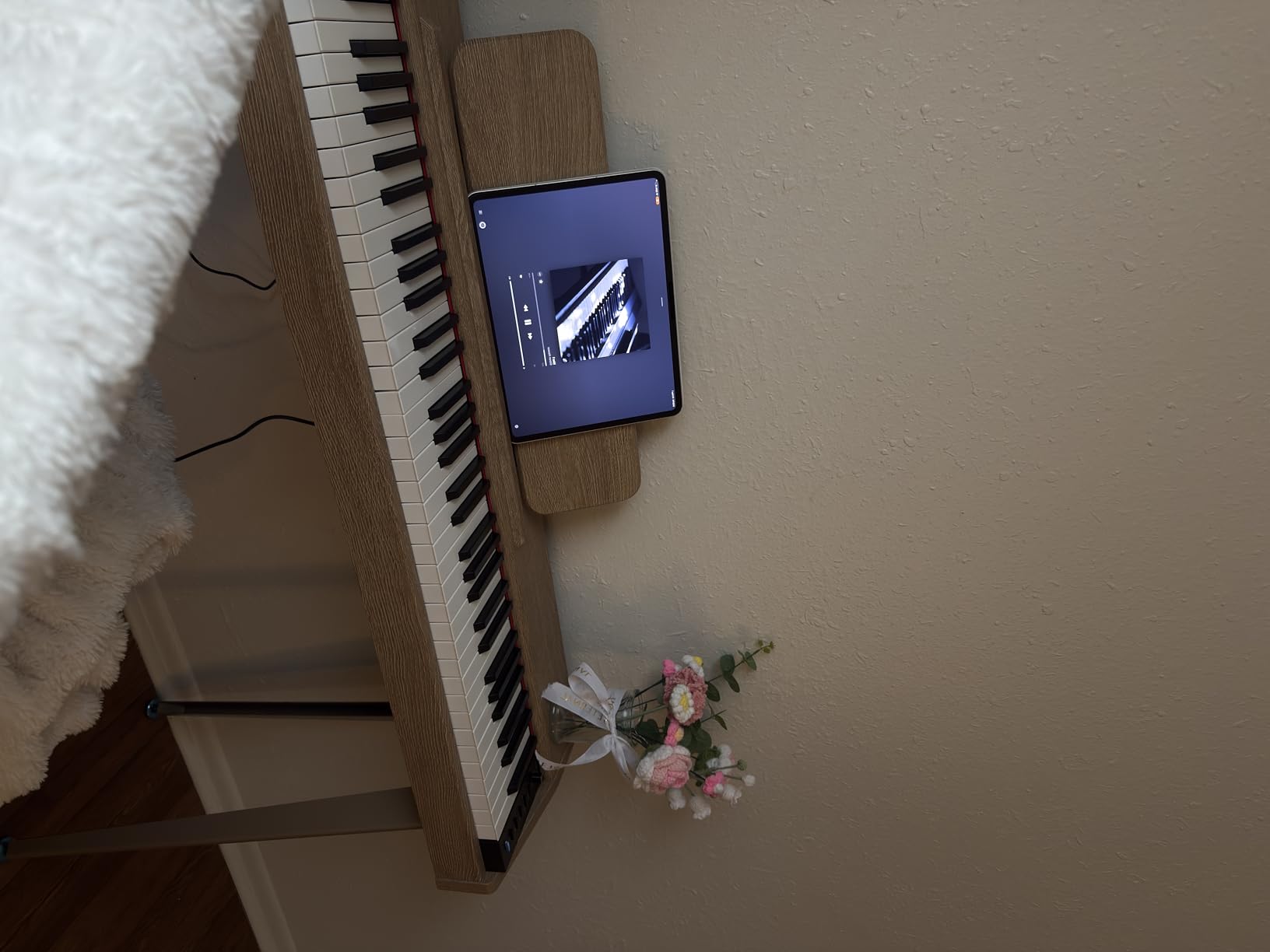
Dual-mode Bluetooth handles both MIDI and audio streaming, which is impressive at this price. I connected my phone wirelessly to play along with backing tracks and also used it as a MIDI controller for my DAW. The 2x10W speakers produce clear, room-filling sound for practice and casual listening.
The included three pedal unit is a major value add. Sustain, soft, and sostenuto pedals come built into the stand, giving you full expressive control without buying accessories separately. This alone saves you money compared to slab-style keyboards that require separate pedal purchases.
Living Room and Aesthetic Fit
The OURA S100 stands 35 inches tall and 50 inches wide, fitting comfortably in apartments and smaller homes. The minimalist design blends with contemporary decor. Unlike bulkier console pianos, it does not dominate a room visually.
The included headphone jack on the front panel makes silent practice easy. The LOCAL OFF feature lets you use it purely as a MIDI controller while muting the internal sounds.
Software Compatibility
The OURA S100 works with GarageBand, FL Studio, and other popular music software via Bluetooth or USB MIDI. I tested it with GarageBand on my Mac and experienced no noticeable latency over Bluetooth. The transpose function lets you shift keys without changing your fingering.
Three built-in original MIDI demo songs give you something to play along with right out of the box. While it is beginner-focused, the graded hammer action provides enough authenticity for developing proper technique.
7. M-Audio Hammer 88 – Best Hammer Action MIDI Controller
M-AUDIO Hammer 88 USB MIDI Keyboard Controller
88 hammer keys
Aftertouch
16 drum pads
USB-MIDI
Pitch bend
Pros
- 88 weighted hammer keys with aftertouch
- 16 RGB drum pads
- USB class-compliant
- Pitch bend and mod wheel
- Includes Ableton Live Lite
Cons
- No built-in sounds
- Heavy at 38.5 pounds
The M-Audio Hammer 88 takes a different approach from the other keyboards on this list. It is a pure MIDI controller, meaning it has no built-in sounds. Instead, it focuses entirely on giving you the most expressive playing surface for controlling virtual instruments in your DAW. For producers and composers, this is the one to watch.
The 88 fully-weighted, hammer-action keys deliver genuine piano feel with graded resistance. Aftertouch adds another layer of expression that most digital pianos lack. I found myself adding vibrato and filter sweeps to synth patches simply by pressing harder after the initial note strike. That is a level of control you do not get from standard weighted keyboards.
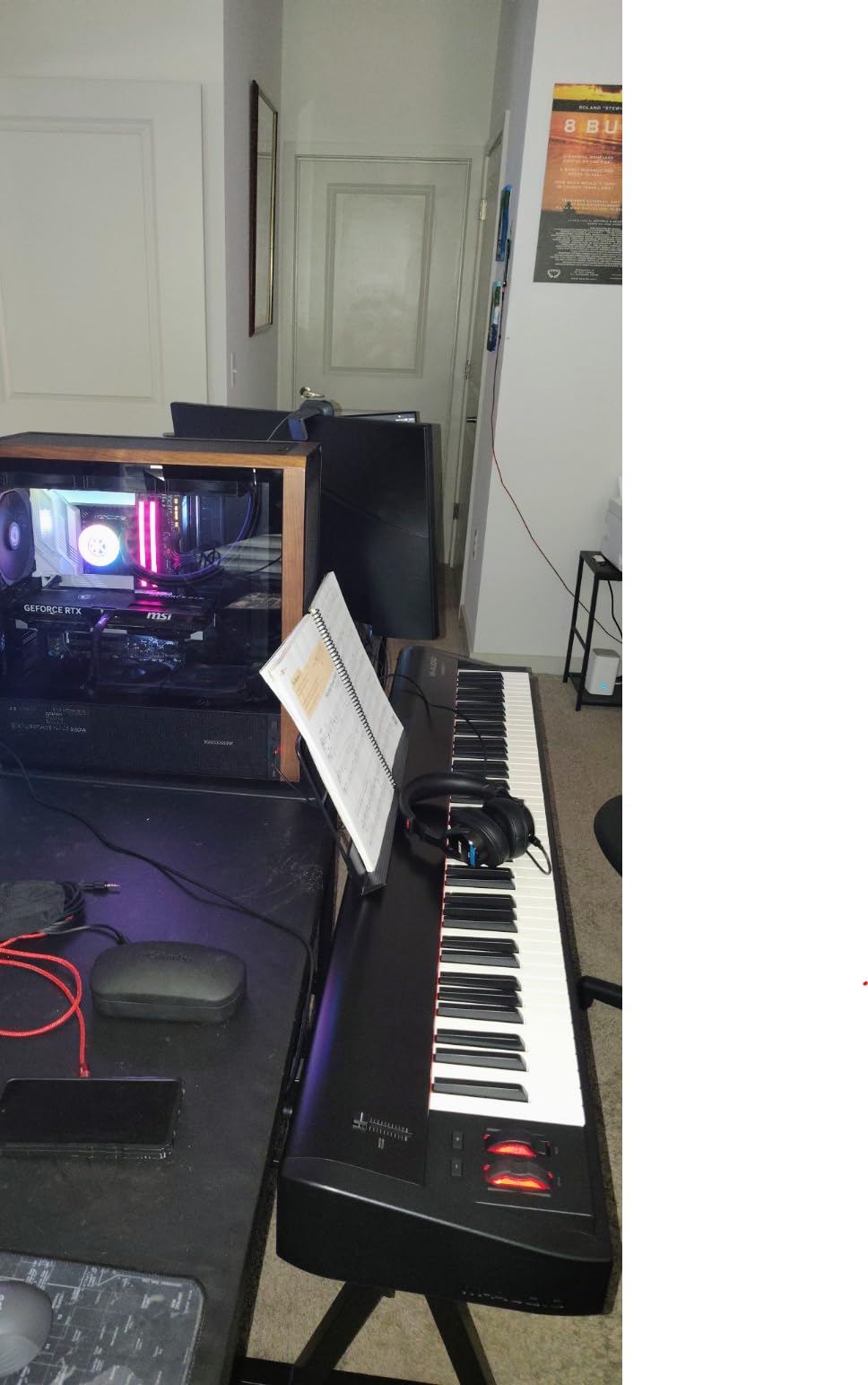
The 16 RGB backlit drum pads are velocity-sensitive and MIDI-assignable with note repeat. I mapped them to drum samples and found them responsive enough for sequencing beats. The pitch bend and modulation wheels sit where you expect them, and the volume slider and octave buttons round out the transport controls.
The included software bundle is generous. You get MPC Beats, Ableton Live Lite, AIR Music Tech virtual instruments including Velvet electric piano and Mini Grand acoustic piano, plus MPC expansion packs. I was producing music within an hour of setup.
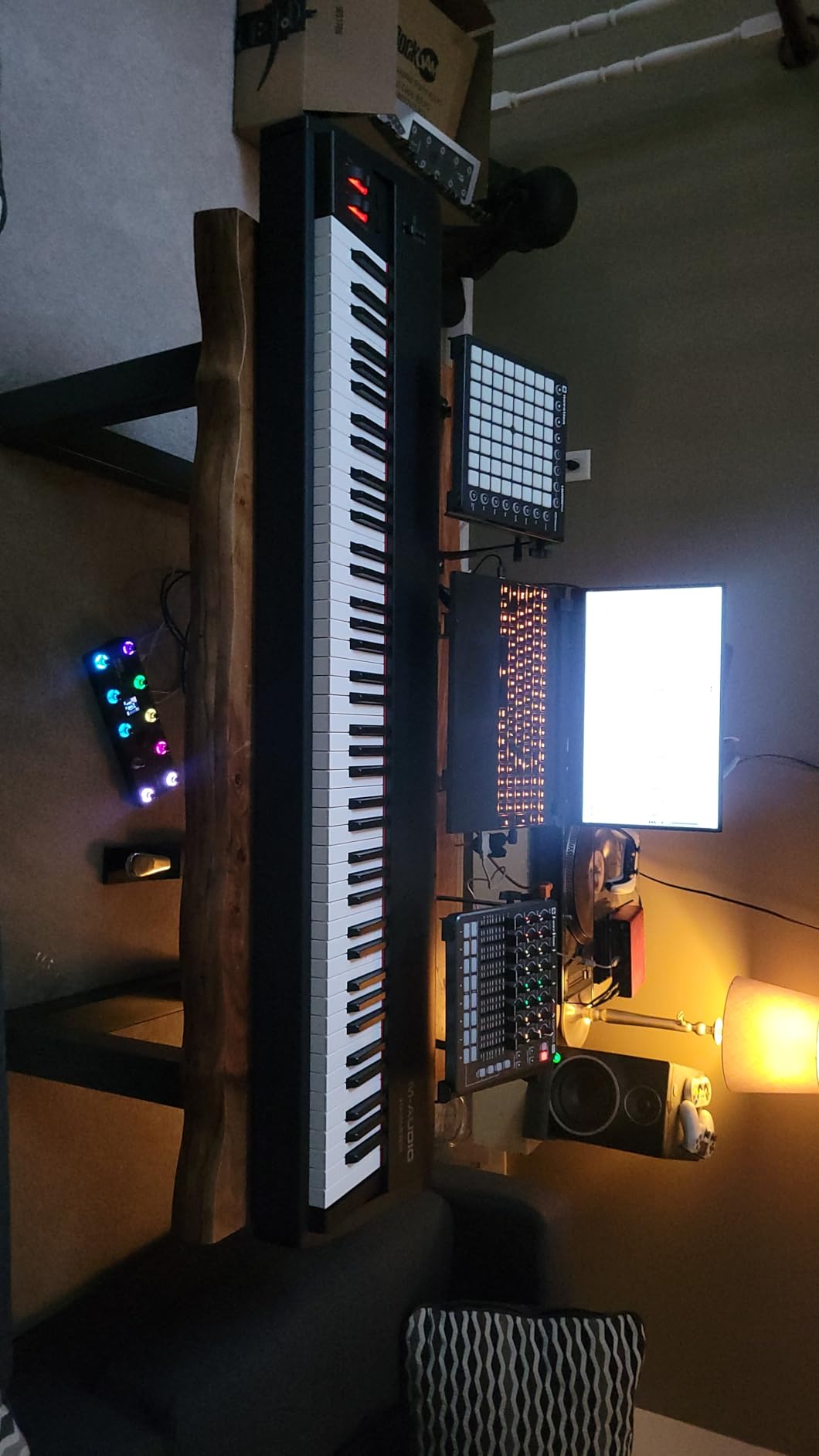
DAW Integration and Workflow
Being class-compliant and USB-powered, the Hammer 88 is true plug-and-play. I connected it to my Mac, opened Ableton Live, and it was recognized instantly. No drivers, no power supply, no configuration needed. It also works with iOS devices through the Camera Connection Kit.
The assignable zones let you split the keyboard to control multiple instruments simultaneously. I set up the lower half for bass and the upper half for piano during a session, switching between sounds without touching my mouse.
Pedal and Expression Setup
The Hammer 88 includes dedicated inputs for sustain, expression, and soft pedals. This triple-pedal support matches what you would find on an acoustic grand. I connected an expression pedal to control filter cutoff on a synth patch, adding real-time dynamics to my performance.
Without built-in speakers, you will always need headphones or monitors connected to your computer. This is a studio tool, not a standalone practice instrument.
8. Alesis Recital Pro MKII – Best Budget Portable Option
Alesis Recital Pro Digital Piano 88-Key Weighted with Hammer Action
88 hammer-action keys
25 voices
20W speakers
Lesson Mode
Pros
- 88 hammer-action weighted keys
- 25 voices
- Lesson Mode
- 20W speakers
- USB-MIDI connectivity
Cons
- Lower polyphony
- Some velocity issues
- Mono line out
The Alesis Recital Pro MKII is the most affordable 88-key hammer action keyboard in this guide. For the price, you get 88 hammer-action weighted keys, 25 voices, and a 20W speaker system. I approached this one with tempered expectations given the low cost, but came away impressed by the key feel for the money.
The adjustable touch response lets you customize how the keys react to your playing velocity. I set it to a lighter touch for fast passages and a heavier setting for practicing dynamics. The 25 voices cover acoustic and electric pianos, organs, synths, and bass tones, giving you more sound variety than most keyboards in this range.
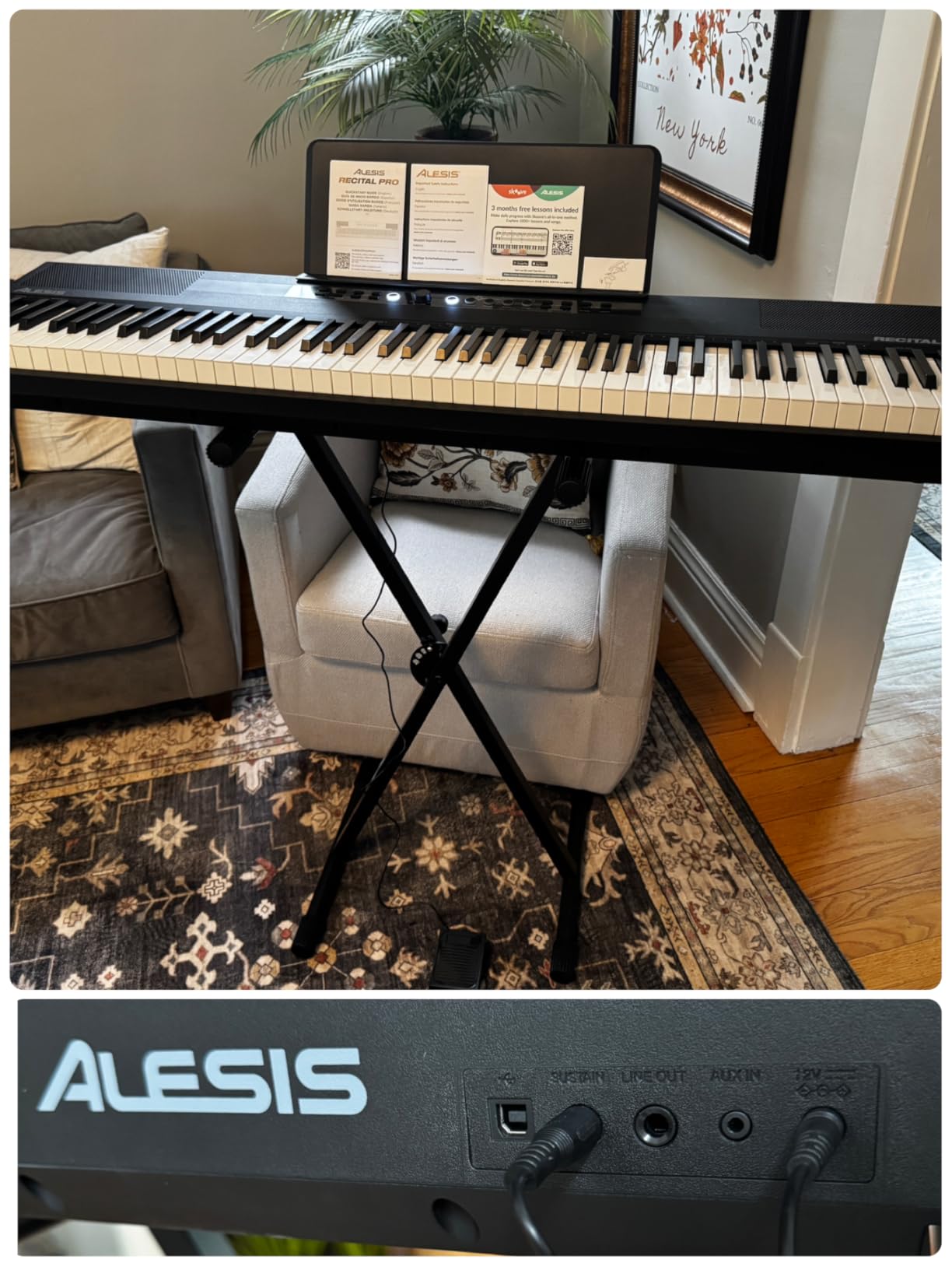
The Lesson Mode splits the keyboard into two zones with identical pitches, making it suitable for teacher-student sessions. Layer Mode blends two sounds together, and Split Mode assigns different voices to the left and right hands. The built-in metronome with a wide BPM range from 5 to 320 covers everything from slow ballads to rapid exercises.
I did notice some limitations during testing. The polyphony is lower than the competition at 64 notes, which means complex sustained passages can cut notes short. Some voices exhibited velocity response inconsistencies in certain ranges. The line output is mono rather than stereo, which limits external amplification quality.
Beginner Learning Path
The Recital Pro MKII ships with three months of Skoove Premium interactive piano lessons and 30 days of Melodics Premium. These apps provide structured learning paths that guide beginners through fundamentals. The Lesson Mode supports self-teaching by letting you play along with identical-pitch zones.
For a first keyboard, the 25 voices give beginners plenty of sounds to explore. The simple button layout keeps operation straightforward for someone just starting out.
Practice and Travel Portability
At 23.2 pounds, this is one of the lightest 88-key hammer action keyboards available. The slim profile fits on most keyboard stands. The USB-MIDI and audio connectivity lets you connect to computers for recording or use educational software.
The included sustain pedal, music rest, and power adapter mean you have everything needed to start playing. The headphone jack allows for silent practice at any hour.
How to Choose the Best Hammer Action Keyboard?
Choosing among the best hammer action keyboards comes down to understanding your needs and matching them to the right type of instrument. Here are the factors I weigh most heavily when recommending a keyboard to someone.
Hammer Action vs Weighted Keys vs Semi-Weighted
This is the most common confusion point I see on forums. Hammer action uses actual mechanical hammers inside each key that pivot and strike sensors, replicating the physical mechanism of an acoustic piano. Weighted keys add resistance using springs or weights but lack the hammer mechanism. Semi-weighted keys offer lighter resistance with a spring-return feel.
Hammer action is the gold standard if you want to build transferable piano technique. Every keyboard in this guide uses some form of hammer action, from Yamaha’s GHS to Roland’s PHA-4 to Casio’s Tri-Sensor II Scaled Hammer Action. If your goal is to eventually play acoustic pianos, hammer action is what you need.
Graded Resistance and Touch Sensitivity
Acoustic pianos have graded resistance: bass keys feel heavier and treble keys feel lighter because the bass strings are thicker and the hammers are larger. Graded hammer action keyboards replicate this tapering. The Yamaha P71, Donner DDP-300, and Donner OURA S100 all feature graded action.
Touch sensitivity determines how the keyboard responds to your playing velocity. Most models here offer adjustable sensitivity curves. If you play a wide dynamic range, look for models with multiple sensitivity settings so you can tune the response to your touch.
Triple Sensor Technology
Standard hammer action keyboards use two sensors per key to detect key press and release. Triple sensor systems add a third sensor that enables faster note repetition without the key needing to fully return to rest position. This matters for trills, tremolos, and rapid repeated notes.
The Casio PX-870’s Tri-Sensor II system and Roland’s PHA-4 both use triple sensor technology. During testing, I could feel the difference when playing fast passages. The extra sensor prevents dropped notes during rapid playing. If you play advanced repertoire with lots of repeated notes, prioritize triple sensor action.
Polyphony Requirements
Polyphony is the number of individual notes a keyboard can produce simultaneously. When you exceed the polyphony limit, the oldest notes cut off to make room for new ones. For beginners, 64 notes is workable. For intermediate and advanced players, 128 notes should be your minimum.
The Casio PX-870 leads this group with 256-note polyphony. The Donner DDP-300 offers 128 notes. The Alesis Recital Pro MKII sits at 64 notes. If you play complex classical pieces with heavy sustain pedal use, higher polyphony prevents the jarring experience of notes dropping out mid-phrase.
Sound Engine Quality
The sound engine determines how realistic and expressive the piano tones are. Roland’s SuperNATURAL engine, Casio’s AiR Sound Source, and Yamaha’s Pure CF sampling are the leading technologies in this price range. Listen for how the tone changes with velocity, how long notes decay naturally, and whether damper and string resonance effects add realism.
Built-in speaker quality varies widely. Console pianos like the Casio PX-870 and Donner DDP-300 have powerful multi-speaker systems that fill a room. Portable boards have smaller speakers suited mainly for practice. If sound quality matters, plan to use quality headphones or external monitors.
Connectivity Options
USB-MIDI is standard across all eight keyboards and connects to computers, tablets, and phones for recording and learning apps. Bluetooth MIDI adds wireless convenience for connecting to iOS apps without cables. The Roland FP-10 and Donner models offer Bluetooth connectivity.
If you plan to use your keyboard as a MIDI controller for a DAW, look for models with class-compliant USB that require no driver installation. The Casio CDP-S160, M-Audio Hammer 88, and Roland FP-10 all offer plug-and-play USB connectivity.
Portability vs Console Design
Portable slab keyboards like the Casio CDP-S160 (23.2 lbs) and Yamaha P71 (25 lbs) are easy to move and store. They typically require a separate stand. Console pianos like the Casio PX-870 (75 lbs) and Donner DDP-300 (97 lbs) are stationary instruments with built-in stands, speakers, and pedal units.
Your choice depends on your living situation. If you rent, move frequently, or have limited space, a portable board is practical. If you have a dedicated music room, a console piano delivers superior sound and a more stable playing experience.
Budget Tiers
Under $500 is where you find excellent beginner options. The Alesis Recital Pro MKII, Donner OURA S100, Yamaha P71, and Roland FP-10 all fall in this range. Between $500 and $800, the Donner DDP-300 and Casio CDP-S160 offer more features and better sound. Above $800, the Casio PX-870 delivers a premium console experience with powerful speakers and high polyphony.
Frequently Asked Questions
Is hammer action better than weighted keys?
Hammer action is better than standard weighted keys if your goal is to replicate the feel of an acoustic piano. Hammer action uses a mechanical hammer inside each key that pivots and strikes a sensor, giving you the same graduated resistance and escapement feel as a real piano. Weighted keys add resistance using springs or metal weights but lack the hammer mechanism, so the feel is less authentic. For developing transferable technique and muscle memory, hammer action is the superior choice.
What digital piano has hammer action keys?
Many digital pianos feature hammer action keys. In this guide, the Yamaha P71 uses Yamaha GHS weighted action, the Roland FP-10 uses PHA-4 Standard progressive hammer action with ivory feel, the Casio PX-870 uses Tri-Sensor II Scaled Hammer Action, and the Donner models use graded hammer standard action. Roland, Yamaha, Kawai, and Casio are the most trusted brands for authentic hammer action in digital pianos.
What digital piano has the most realistic action?
Among the keyboards in this guide, the Casio Privia PX-870 with its Tri-Sensor II Scaled Hammer Action offers the most realistic playing feel. The triple sensor system allows for fast note repetition without dropped notes, and the simulated ebony and ivory key textures add tactile authenticity. The Roland FP-10 with PHA-4 Standard action is also highly regarded for realistic feel, especially in its price range.
Do I need 88 keys for learning piano?
Yes, 88 keys is recommended for learning piano properly. Standard acoustic pianos have 88 keys, and most sheet music assumes the full range. Learning on fewer than 88 keys means you will eventually encounter pieces you cannot play correctly. All eight keyboards in this guide have 88 keys. Forum users consistently advise against settling for 61-key hammer action keyboards, noting that the compromise is rarely worth it.
What is the difference between hammer action and graded hammer action?
Hammer action means each key has a mechanical hammer that simulates acoustic piano feel. Graded hammer action adds graduated resistance across the key range, with heavier keys in the bass register and lighter keys in the treble, exactly like a real acoustic piano. All true hammer action should ideally be graded. The Yamaha P71, Donner DDP-300, and Donner OURA S100 explicitly feature graded hammer action.
Final Thoughts
After testing all eight keyboards, the Yamaha P71 remains my top recommendation for most players. It delivers the best balance of authentic weighted action, sound quality, and proven reliability backed by 6,600+ reviews. For those who want the most realistic feel per dollar, the Roland FP-10 with its SuperNATURAL engine and PHA-4 ivory feel keys is the best value hammer action keyboard you can buy.
If budget is your primary concern, the Donner OURA S100 gives you a complete console package with graded hammer action, dual Bluetooth, and a three-pedal unit. For a permanent living room instrument, the Casio Privia PX-870 offers premium sound and feel. And for producers who need authentic key feel in the studio, the M-Audio Hammer 88 is the dedicated MIDI controller that gets the job done.
The best hammer action keyboards in 2026 cover every need and budget. Pick the one that matches your skill level, space, and goals, and you will have an instrument that builds proper technique for years to come.