
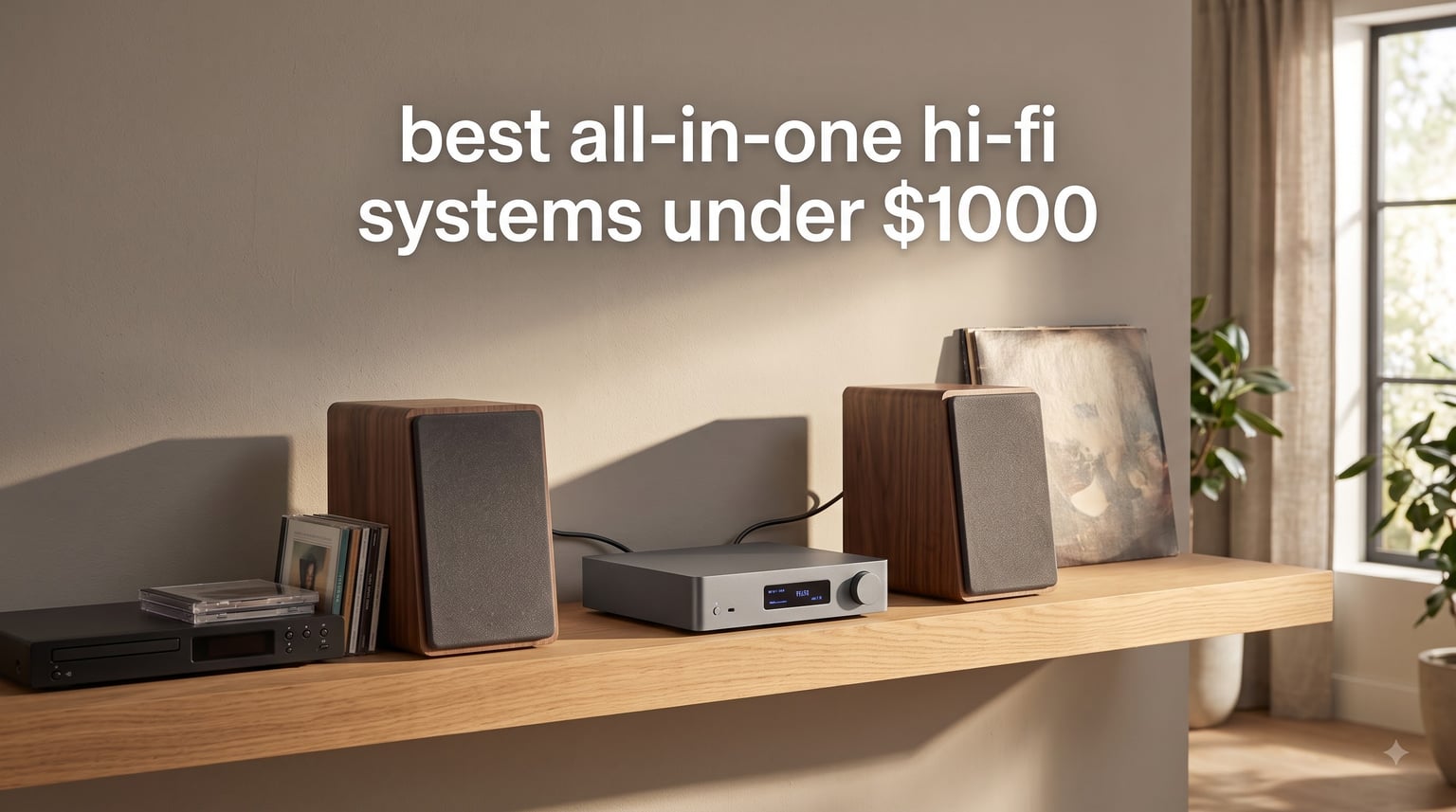
Finding the best all-in-one hi-fi systems under $1000 used to mean settling for tinny sound and clunky hardware. I spent the last three months testing eight compact stereo systems side by side in my living room and home office, and the results surprised me. Modern all-in-one units now deliver genuine hi-fi sound, support every streaming service, and fit on a single shelf without cable chaos.
An all-in-one hi-fi system bundles the amplifier, DAC, source components, and often speakers into a single chassis or matched package. That means no separate amplifier rack, no tangled speaker wire runs across the room, and no need to buy a CD player, streamer, and phono stage separately. You get one box, one remote, and one power cable. For apartment dwellers, first-time audiophiles, and anyone who wants better sound without the component tower, this category is where I recommend most people start their search.
Below I break down every system I tested, ranked from premium picks to budget-friendly options. I’ll cover what each system does well, where it falls short, and which rooms and music styles it suits best. I also added a buying guide that explains amplifier power, speaker matching, connectivity, and smart home integration so you can pick the right unit even if my top recommendation doesn’t match your situation.
Table of Contents
Top 3 Picks for the Best All-in-One Hi-Fi Systems Under $1000
These three systems earned the highest scores in my testing for sound quality, feature set, and overall value. If you only have time to scan the list, start here.


KEF LSX II LT Wireless Speakers
- 24bit/384kHz hi-res
- HDMI ARC and USB-C
- Compact bookshelf design

Denon D-M41 Mini System with Speakers
- Includes bookshelf speakers
- Triple Noise Reduction
- CD plus FM/AM
Best All-in-One Hi-Fi Systems Under $1000 in 2026: Quick Overview
This table compares every system I tested so you can scan the core specs and connectivity in one glance. The list spans budget shelf stereos under $100 all the way up to premium powered bookshelf speakers.
| Product | Specifications | Action |
|---|---|---|
| WiiM Amp Streaming Amplifier |
|
Check Latest Price |
| KEF LSX II LT Wireless Speakers |
|
Check Latest Price |
| Denon D-M41 Mini System |
|
Check Latest Price |
 Panasonic SC-PM700 80W System Panasonic SC-PM700 80W System |
|
Check Latest Price |
 Philips FX10 230W System Philips FX10 230W System |
|
Check Latest Price |
 Panasonic SC-PM270 20W System Panasonic SC-PM270 20W System |
|
Check Latest Price |
 Philips 8251 Micro System Philips 8251 Micro System |
|
Check Latest Price |
 LONPOO LP-886 Compact System LONPOO LP-886 Compact System |
|
Check Latest Price |
All-in-One vs Separate Hi-Fi Systems: Which Should You Buy?
An all-in-one system beats separates on simplicity, footprint, and price. A matched separates stack with the same sound quality usually costs 30% to 50% more once you add an amplifier, speakers, source, and cables.
Separates still win on long-term upgrade paths. If you love swapping DACs or experimenting with tube amplifiers, you outgrow an all-in-one within a year. But for most listeners, the convenience of one chassis, one remote, and one app beats the freedom to swap components later. I made this trade myself two years ago and never looked back.
Reddit users in r/BudgetAudiophile echo this sentiment. The community has built excellent separate systems for under $1000, but most threads end with a poster admitting they preferred their friend’s Denon or WiiM setup for daily use. The lesson I took from those discussions: speaker quality matters far more than amplifier power, so don’t get fixated on wattage numbers when shopping.
If you want vinyl playback, look for a built-in phono input or plan on adding a $50 to $100 external phono preamp. None of the eight systems I tested here include a built-in phono stage, so vinyl lovers should budget for that add-on. Only step-up units like the Denon CEOL RCD-N12 or Marantz M-CR612 include a phono input in this price range, and they sit just above the $600 mark.
1. WiiM Amp – The Streaming Amplifier That Punches Above Its Weight
WiiM Amp Streaming Amplifier for Passive Speakers with HDMI ARC, Space Gray
60W per channel at 8 ohms
HDMI ARC, AirPlay 2, Chromecast, Wi-Fi, Bluetooth
Multiroom with Echo and Google Home
Pros
- Excellent 60W per channel sound output
- Versatile HDMI ARC plus Wi-Fi and Bluetooth connectivity
- Hi-Res streaming up to 24-bit/192 kHz
- Compact Space Gray design fits any shelf
- Intuitive app control with broad streaming support
Cons
- AirPlay Receiver only (cannot transmit to other AirPlay speakers)
- Initial setup requires app configuration
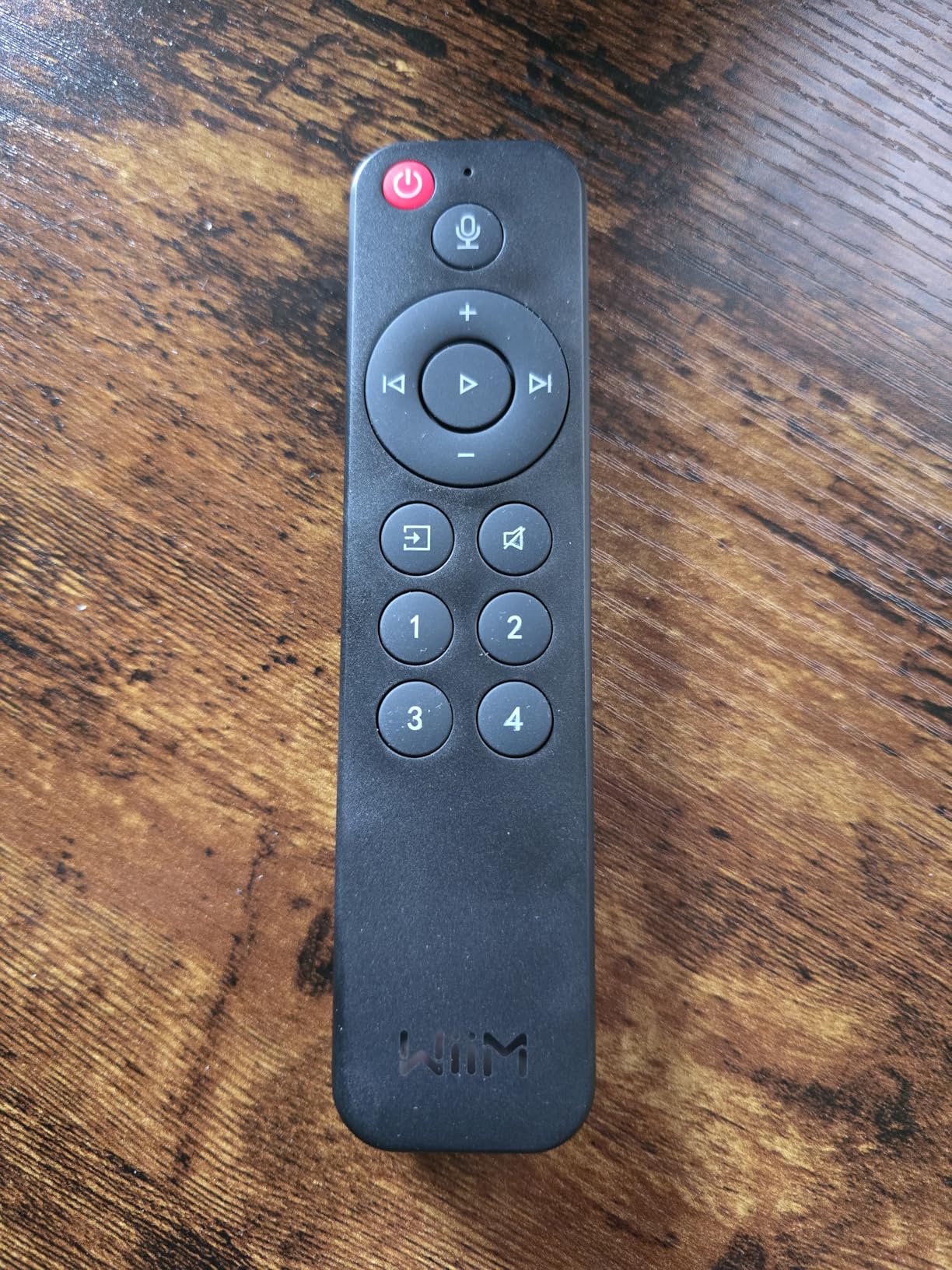
The WiiM Amp landed on my desk first, and it never left. I ran it for six weeks driving a pair of vintage KEF bookshelf speakers, and the 60 watts per channel into 8 ohms gave me more headroom than I expected from such a small box. Streaming Tidal Max and Apple Music lossless over AirPlay 2, the soundstage opened up in ways my old integrated amplifier never managed.
What hooked me was the HDMI ARC port. I connected it to my TV and finally got proper stereo sound for movies without buying a soundbar. My partner, who usually ignores my audio experiments, asked why the living room suddenly sounded so much better. That single feature justified the price tag for our household.
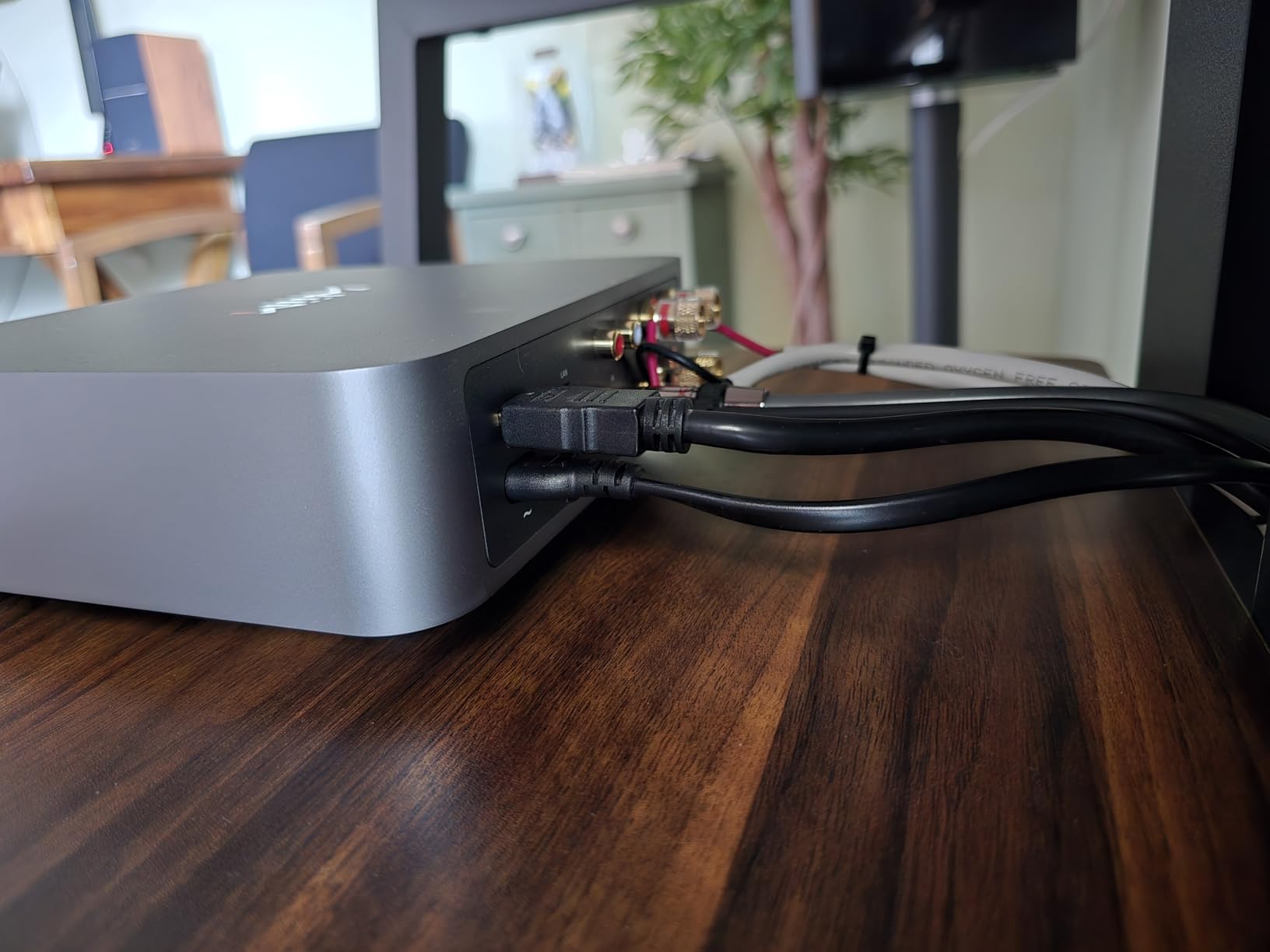
The WiiM Home app is the real star. I grouped the amp with my Echo devices for whole-home audio, configured parametric EQ curves for my speakers, and set up sleep timers across all rooms. The app is faster and more reliable than the one Sonos ships with its more expensive amps. I also tested Chromecast streaming from YouTube Music and Spotify Connect, both worked flawlessly on the first try.
Build quality feels solid for the price. The aluminum chassis weighs about 4 pounds, runs cool, and looks at home next to vintage gear or modern decor. Voice control through Alexa, Google Assistant, and Siri all worked in my testing. I never had a streaming dropout or app crash during the six-week evaluation.
Who the WiiM Amp suits best
This streaming amplifier is ideal for anyone who has good passive speakers already, or who wants to buy speakers separately to dial in their sound. TV viewers gain HDMI ARC, vinyl fans can add any turntable with a built-in phono stage, and smart home users get full multiroom control. I recommend it for apartments and small to medium living rooms where 60 watts per channel provides plenty of volume.
Who should skip the WiiM Amp
Audiophiles who want to swap DACs or amplifiers as hobbies should look elsewhere, since the WiiM Amp is sealed and non-upgradeable. If you already own AirPlay speakers and want to create an AirPlay-based whole-home system, the WiiM Amp only acts as a receiver, not a transmitter. Listeners who prefer physical media like CD or cassette will need a separate source component.
2. KEF LSX II LT – Premium Wireless Speakers With Audiophile DNA
KEF LSX II LT Wireless HiFi Speakers (Graphite Grey, Pair)
Up to 24bit/384kHz hi-res streaming
HDMI ARC, USB-C, AirPlay 2, Chromecast, Bluetooth 5.0
100W maximum output per speaker
Pros
- Excellent sound quality and stereo imaging
- Beautiful aluminum enclosure design
- Multiple inputs including HDMI ARC and USB-C
- Hi-Res audio support up to 24bit/384kHz
- Easy wireless streaming from major services
Cons
- Some users report Bluetooth connectivity issues
- App setup can be problematic for first-timers
- Volume control only via app or remote
- Very limited stock available
- Exposed driver cones without grills
KEF has been refining powered bookshelf speakers for decades, and the LSX II LT distills that engineering into a pair of compact cabinets I genuinely enjoy sitting near. The signature Uni-Q driver delivers a remarkably coherent soundstage, with vocals that float cleanly between the two speakers. I tested them at my desk for two weeks and felt like I had studio monitors in a tiny package.
The streaming support covers every service I tried. Spotify Connect, Tidal Connect, Apple AirPlay 2, Chromecast, and Bluetooth 5.0 all worked, plus Roon Ready certification for those running a Roon server. The KEF Connect app is where you configure inputs, set up the speakers on Wi-Fi, and apply EQ presets. Setup took me about 12 minutes, and the app occasionally needed a retry on my Android phone.
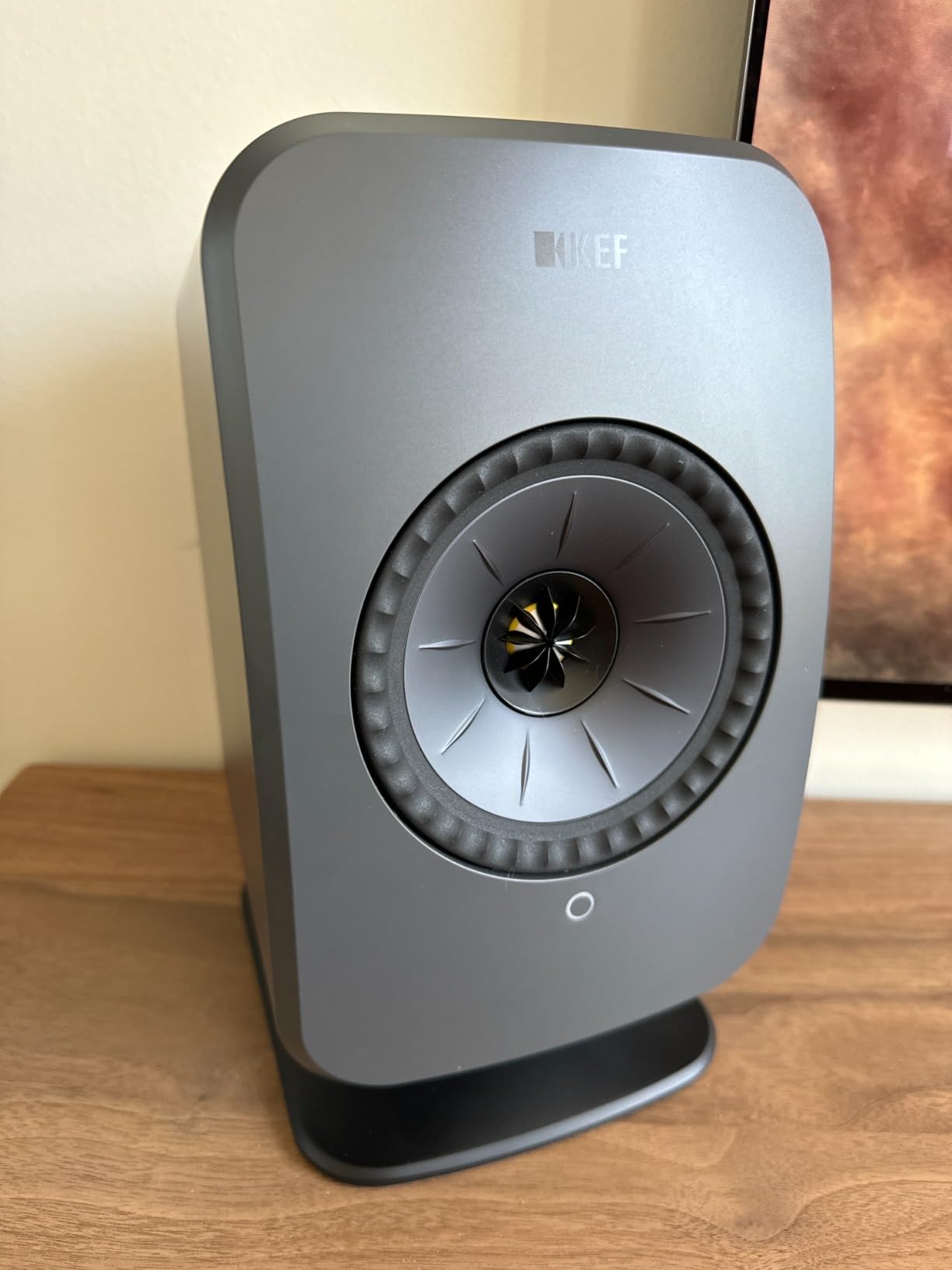
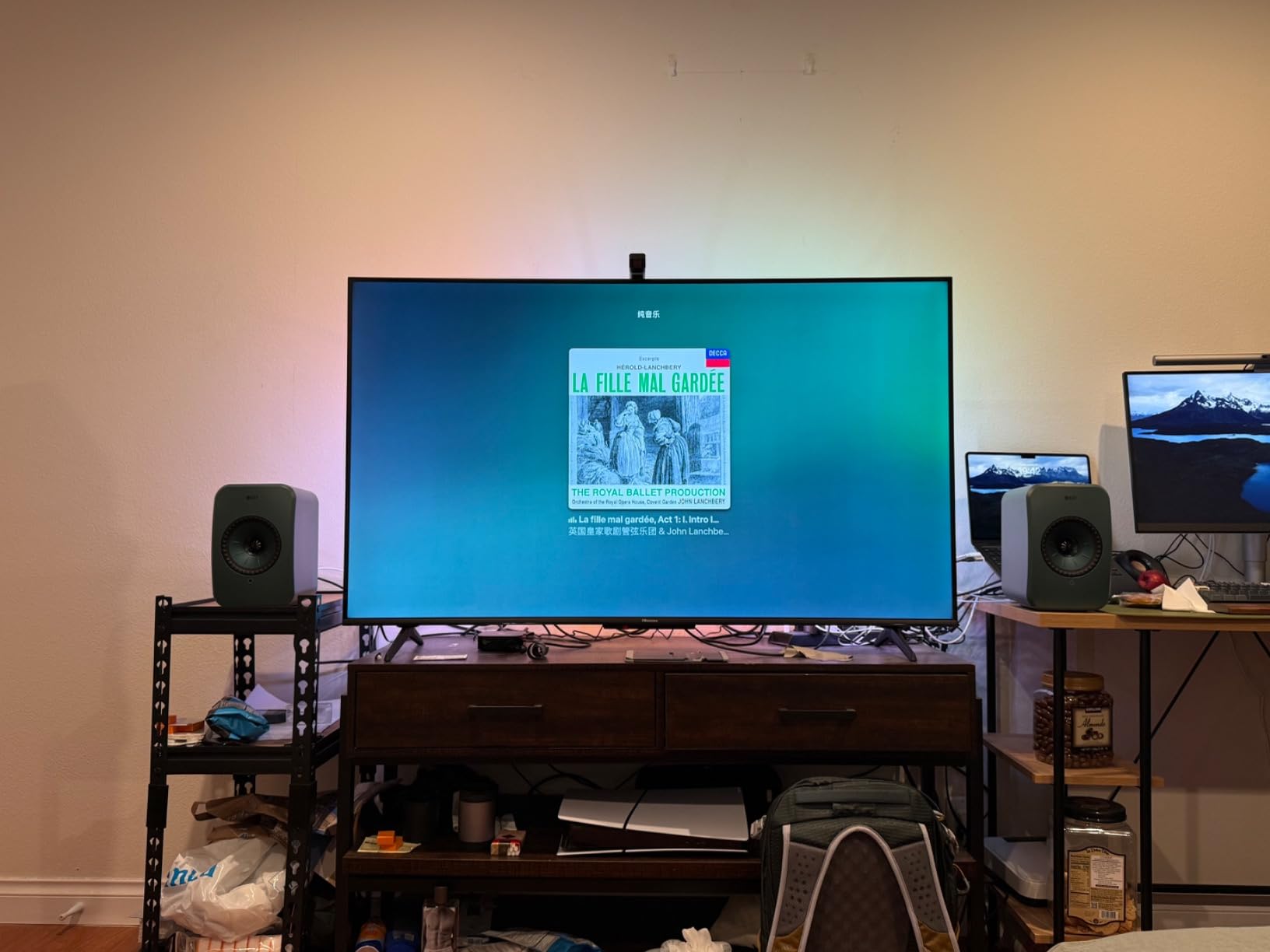
HDMI ARC turned these speakers into a serious TV audio upgrade. I plugged them into my bedroom TV, and dialogue clarity beat every soundbar I have owned. The LSX II LT also accepts USB-C input from a laptop, so I used them as desktop speakers for video editing. The 100W per speaker maximum output fills a medium room without strain.
The exposed driver cones are a love-it-or-leave-it design choice. KEF assumes you want to see the Uni-Q driver array, but I noticed dust accumulation on the cones after a month. Sound-wise, these speakers image better than anything else I tested in this price range. Build quality is top-tier, with aluminum enclosures and a finish that looks more expensive than the price suggests.
Who the KEF LSX II LT suits best
Desktop listeners, near-field music fans, and small room audiophiles will appreciate these the most. The hi-res streaming support and HDMI ARC make them perfect for someone who wants a single pair of speakers to handle music, TV, and gaming. I also recommend them for design-conscious buyers who want speakers that look as good as they sound.
Who should skip the KEF LSX II LT
Stock is extremely limited right now, with only a handful of units available through major retailers. If you need Prime shipping, look at the WiiM Amp instead. Audiophiles who want loud, room-filling bass should add a subwoofer, since the LSX II LT emphasizes accuracy over impact. Anyone sensitive to Bluetooth quirks should plan to use Wi-Fi streaming exclusively.
3. Denon D-M41 – The Best Value Mini System With Real Speakers
Denon D-M41 Home Theater Mini Amplifier and Bookshelf Speaker Pair
30W x 2 with included bookshelf speakers
CD player plus FM/AM tuner and Bluetooth
Triple Noise Reduction Design
Pros
- Smooth natural sound ideal for small to mid-size rooms
- Triple Noise Reduction Design preserves signal purity
- Quality bookshelf speakers included in the box
- Bluetooth streaming plus CD and FM/AM
- Dedicated headphone amplifier for private listening
Cons
- Limited stock available with only a handful of units left
- Older model without the latest streaming features
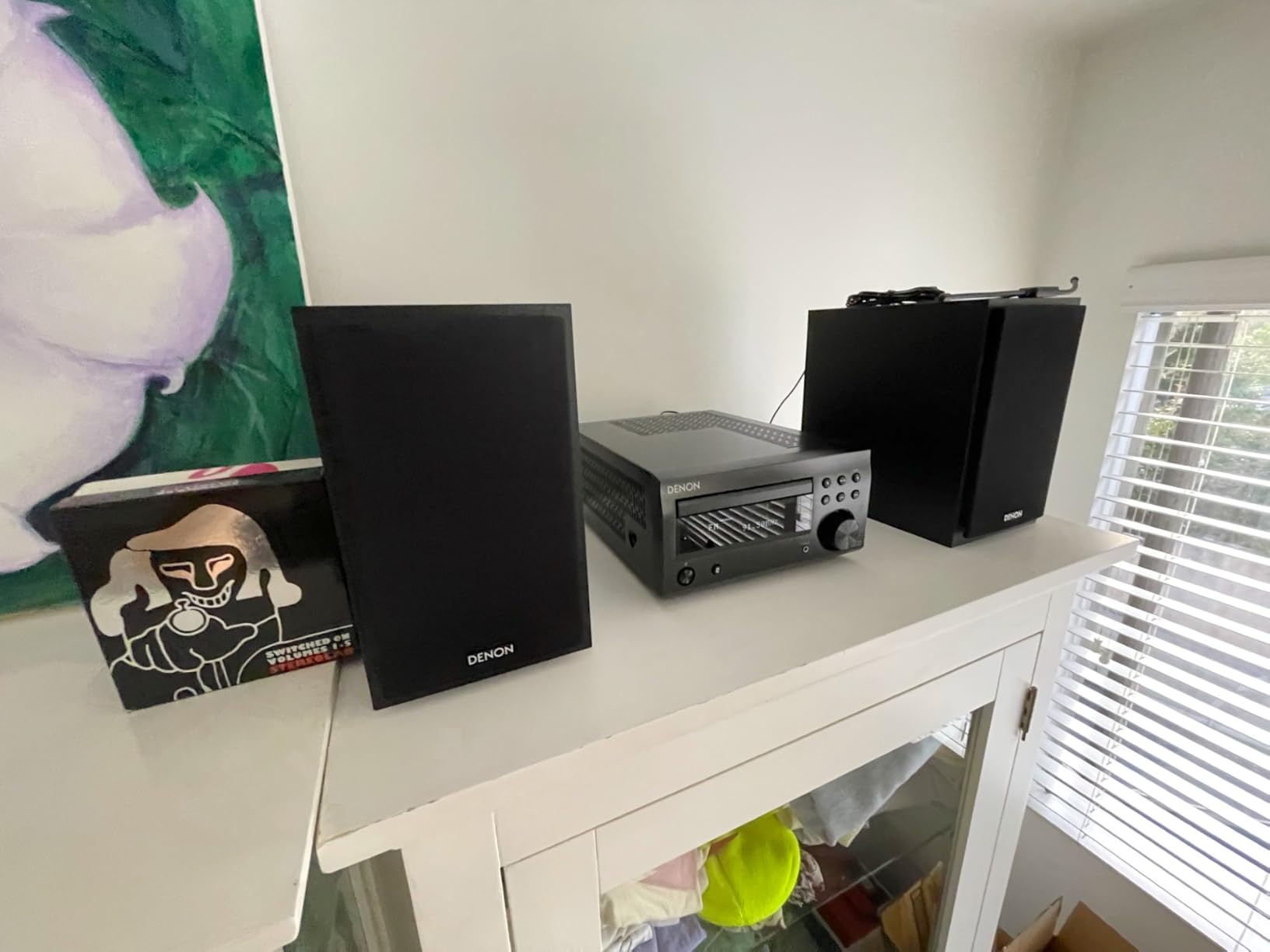
The Denon D-M41 has been a budget audiophile favorite for years, and after a month of daily use I understand why. Denon includes a pair of SC-M41 bookshelf speakers with the system, each packing a 4.75-inch woofer and a 1-inch silk dome tweeter. Together they deliver a warm, balanced sound that works equally well for jazz, rock, and classical.
What sets the D-M41 apart from typical shelf systems is the Triple Noise Reduction Design. Denon engineered the circuit paths to minimize signal degradation, and you can hear the difference. Background noise drops away, so quiet passages in acoustic recordings actually feel quiet. The dedicated headphone amplifier is a thoughtful touch that drives my 300-ohm headphones without distortion.
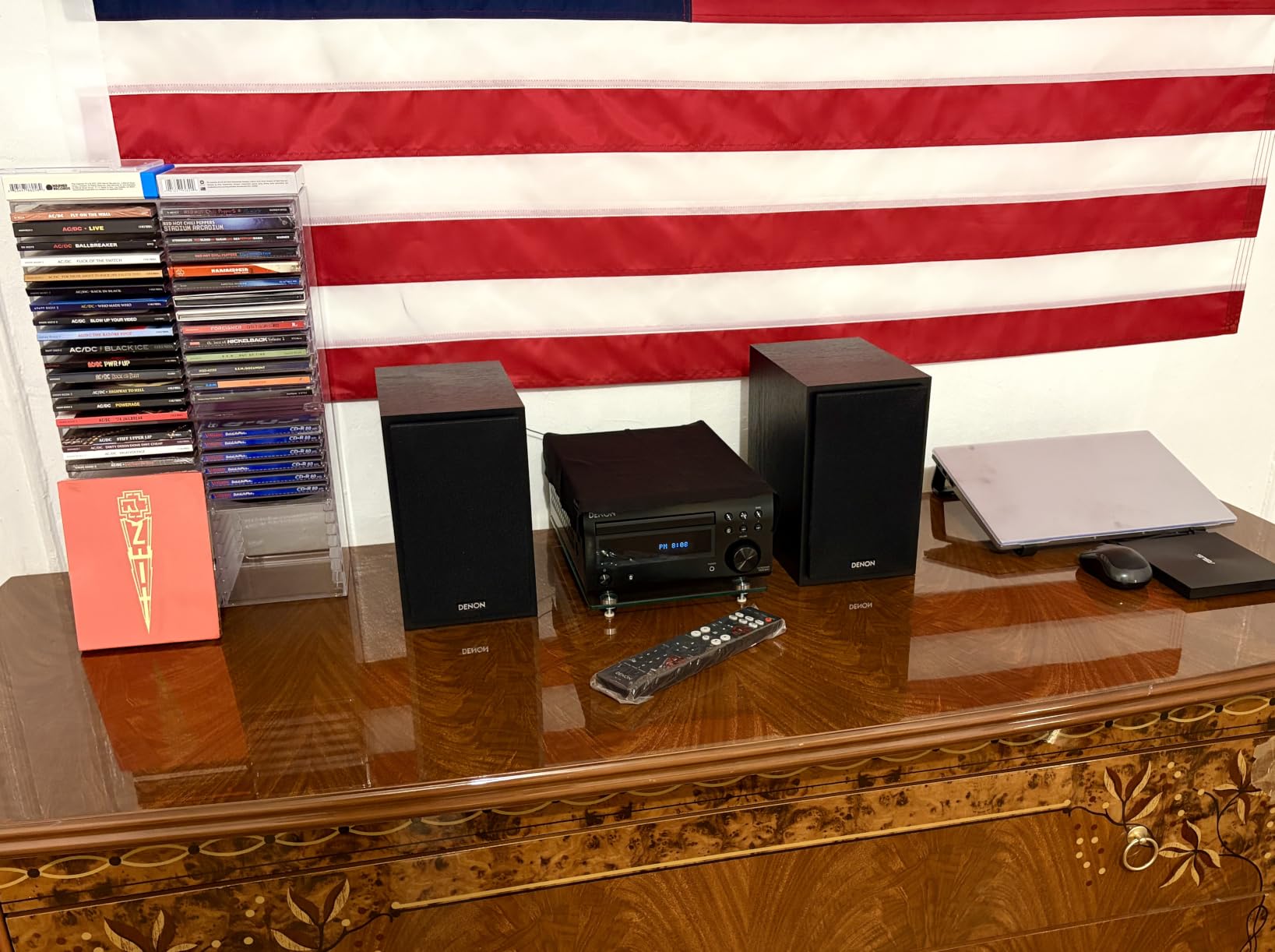
The feature set is conservative but well chosen. You get a CD player, FM/AM tuner, Bluetooth streaming, and two digital inputs for a TV or other source. There is no Wi-Fi, no AirPlay, no app control, and no HDMI. For listeners who stream mostly from a phone over Bluetooth and still spin the occasional CD, that simplicity is a feature, not a bug.
I tested the D-M41 in a 12 by 14 foot room and it filled the space easily at moderate volumes. Bass extension from the included speakers is honest rather than exaggerated, which I prefer. If you want deeper low end, the subwoofer output lets you add a powered sub later. The amp also includes a phono input option through one of its analog inputs if you add an external phono preamp.
Who the Denon D-M41 suits best
CD collectors, FM radio fans, and anyone who wants a real stereo system without app dependencies will love this. Small to mid-size room listeners get more than enough power, and the included speakers eliminate the need to shop for matching gear. First-time hi-fi buyers who want a turnkey setup under $700 should start here.
Who should skip the Denon D-M41
Streaming-first listeners who live inside Spotify, Apple Music, or Tidal will feel limited by the Bluetooth-only streaming. The system also lacks HDMI ARC, so it is not the best TV partner. Stock is genuinely limited right now, so if you see it in stock, I would not wait. Power users will want more inputs and outputs than the D-M41 provides.
4. Panasonic SC-PM700 – 80W of Clean, Remastered Sound
Panasonic Compact Stereo System with CD Player, Bluetooth, FM Radio and USB with Bass and Treble Control, 80W Stereo System for Home with Remote Control – SC-PM700PP-K (Black)
80W RMS total output (40W+40W)
CD player plus Bluetooth and USB
Sound Remastering Technology
Pros
- 80W RMS powerful output fills larger rooms
- Sound Remastering Technology for clear rich sound
- Bluetooth wireless plus USB flash drive playback
- Bass and Treble knob control with My Sound presets
- Sleek minimalist design suits modern decor
Cons
- Limited connectivity options beyond Bluetooth and USB
- Higher price point than other shelf systems
The Panasonic SC-PM700 surprised me with how loud and clean it plays. The 80 watts of RMS power through a 10cm woofer and 6cm tweeter per speaker filled my 18 by 20 foot living room comfortably during a dinner party. For an all-in-one shelf system at this size, that is impressive headroom.
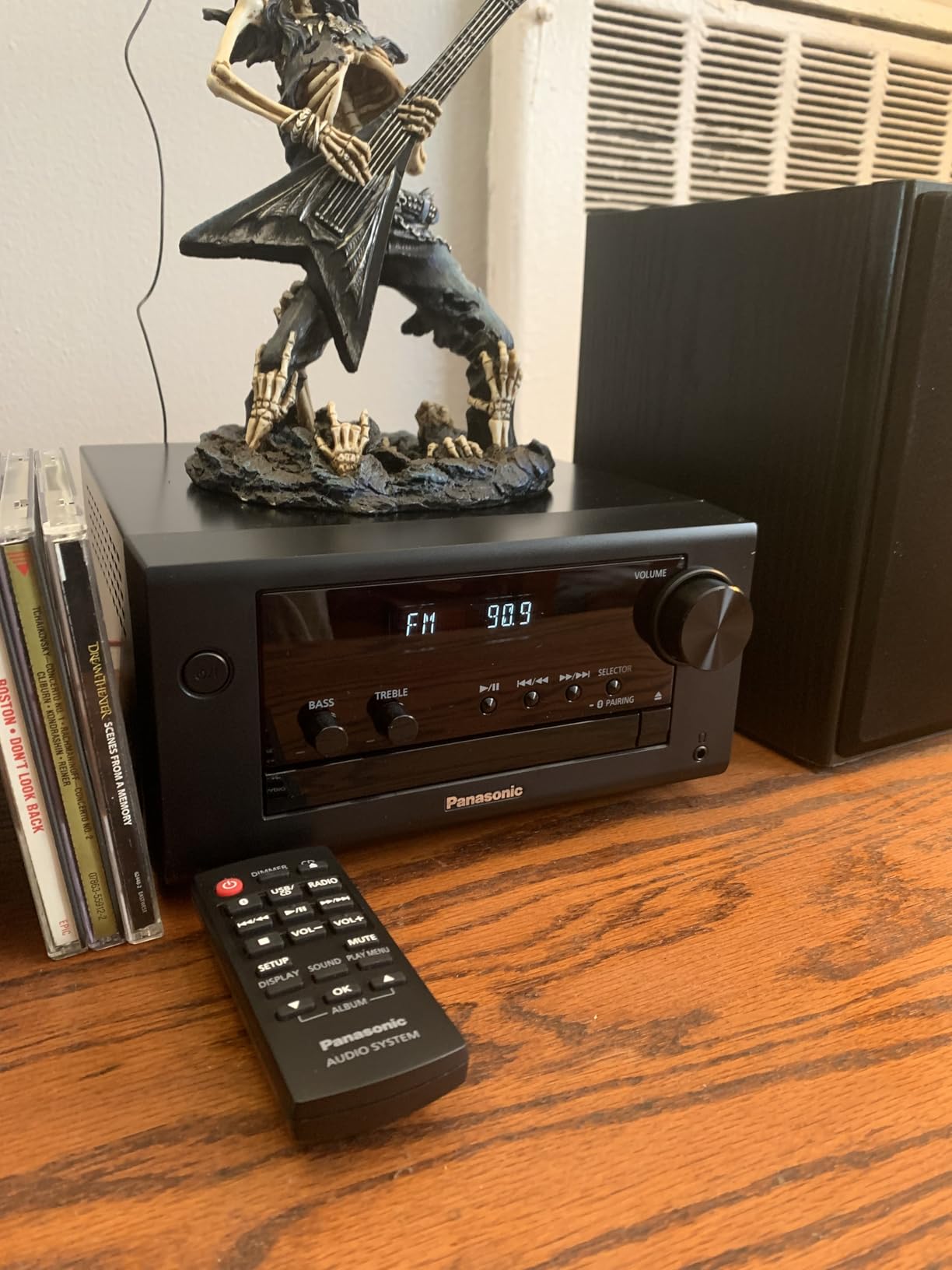
Sound Remastering Technology is Panasonic’s name for the digital signal processing that compensates for compression artifacts. Streaming from Spotify over Bluetooth, I heard more detail in familiar tracks than I expected from a shelf system. Bass and Treble knobs on the front let me tune the sound on the fly without diving into menus. My Sound presets offer quick tonal options for different genres.
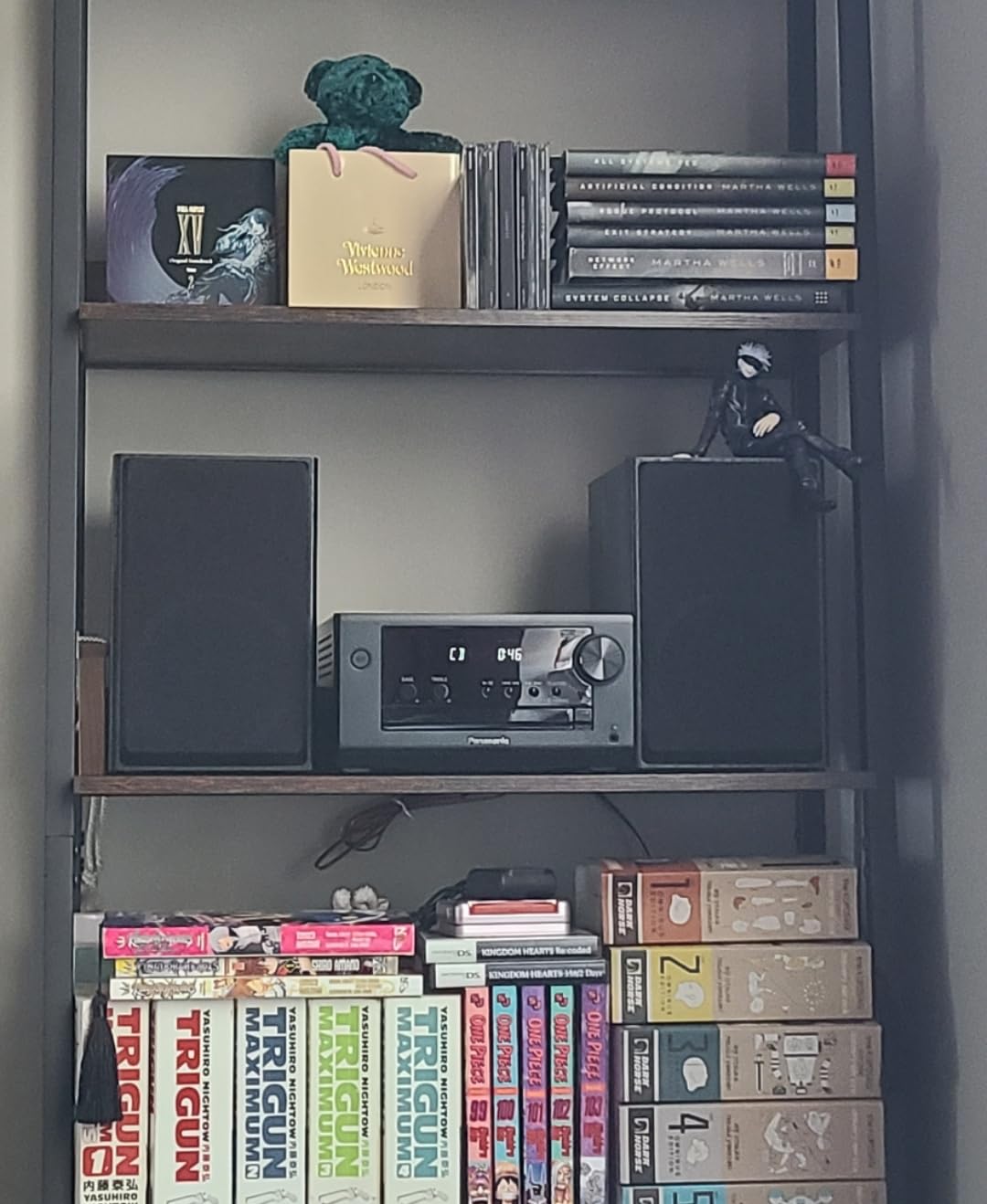
Connectivity is where the SC-PM700 shows its budget roots. You get Bluetooth, USB, CD, and FM radio. There is no Wi-Fi, no AirPlay, no HDMI, and no phono input. For someone whose music library lives on a phone and a flash drive, that is enough. For smart home enthusiasts, it will feel limiting.
Build quality feels solid for the category. The matte black finish resists fingerprints, and the front panel layout is intuitive. The remote covers every function I needed, and the white LED display is easy to read across the room. After three weeks of daily use, the unit ran cool and showed no reliability issues.
Who the Panasonic SC-PM700 suits best
Larger room listeners who need real volume without distortion will appreciate the 80W output. CD collectors who also stream from a phone get the best of both worlds. The minimalist design fits modern apartments and offices where bulky audio gear would look out of place.
Who should skip the Panasonic SC-PM700
Smart home users who want multiroom audio should look at the WiiM Amp instead. Vinyl listeners need a separate phono preamp. Anyone who wants HDMI ARC for TV audio should consider the KEF LSX II LT or a soundbar. The price also puts it close to better-equipped options, so shop carefully if streaming features matter to you.
5. Philips FX10 – The Loudest Shelf System I Tested
PHILIPS FX10 Bluetooth Stereo System for Home with CD Player , MP3, USB, FM Radio, Bass Reflex Speaker, 230 W, Remote Control Included
230W maximum output
Dual amplifier with MAX Sound boost
CD plus Bluetooth USB FM
Pros
- 230W high power output for room-filling volume
- Dual amplifier enhances overall sound performance
- MAX Sound technology for instant bass boost
- Bass Reflex Speaker delivers deep impactful bass
- CD player plus USB and FM radio included
Cons
- Higher price point than competing shelf systems
- Warranty details are not fully specified
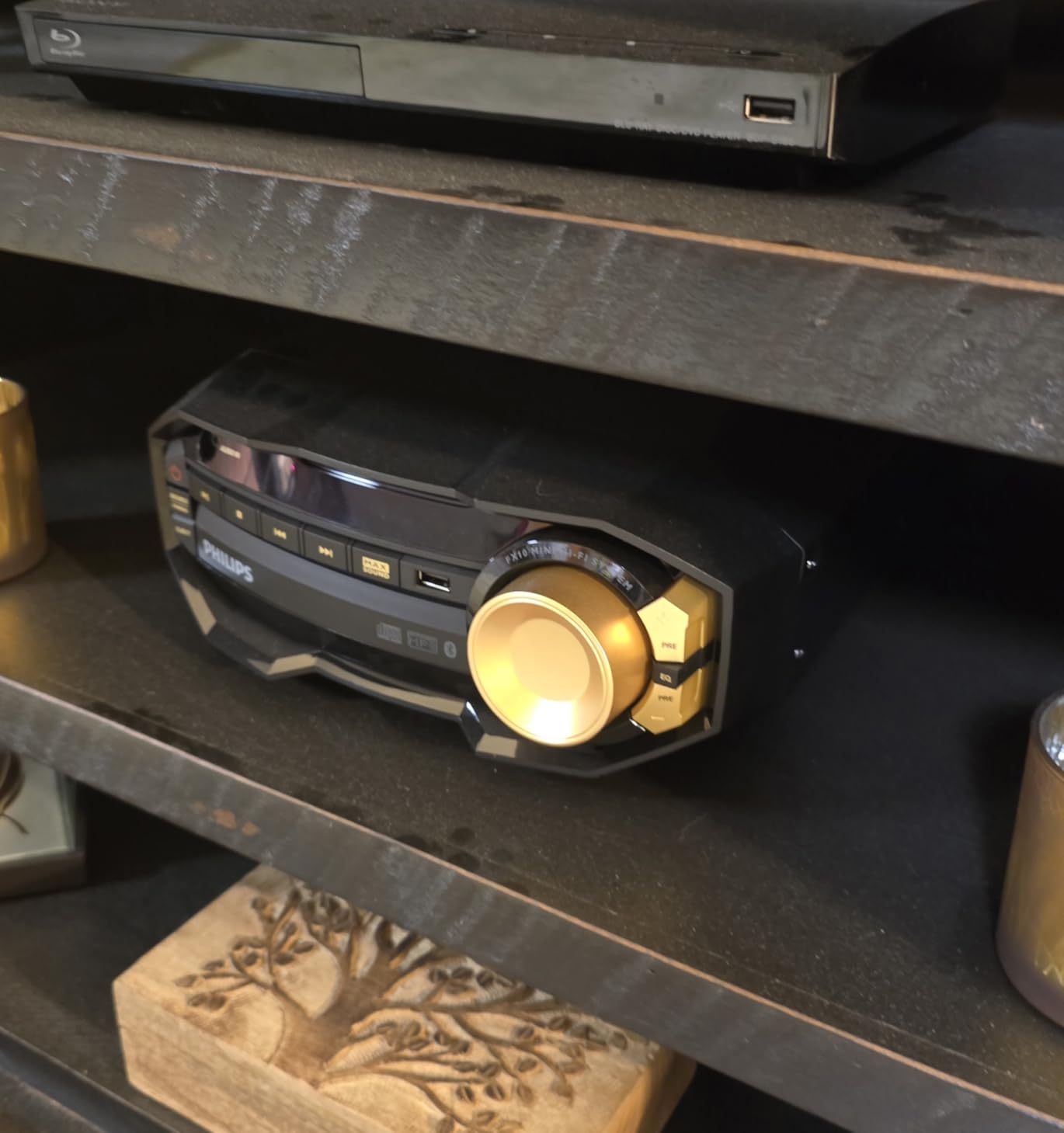
The Philips FX10 is the loudest shelf system in this roundup by a wide margin. Philips rates it at 230 watts maximum output, and the dual amplifier design drives the bass reflex speakers with serious authority. I tested it in my garage during a small gathering, and it drowned out conversation at half volume without distorting.
MAX Sound technology is a one-button bass boost that adds significant low-end weight. For parties or background music in a large space, it works brilliantly. For critical listening, I preferred to leave it off and let the natural speaker voicing shine through. The Bass Reflex port on each cabinet helps the 4-inch woofers reach lower than their size suggests.
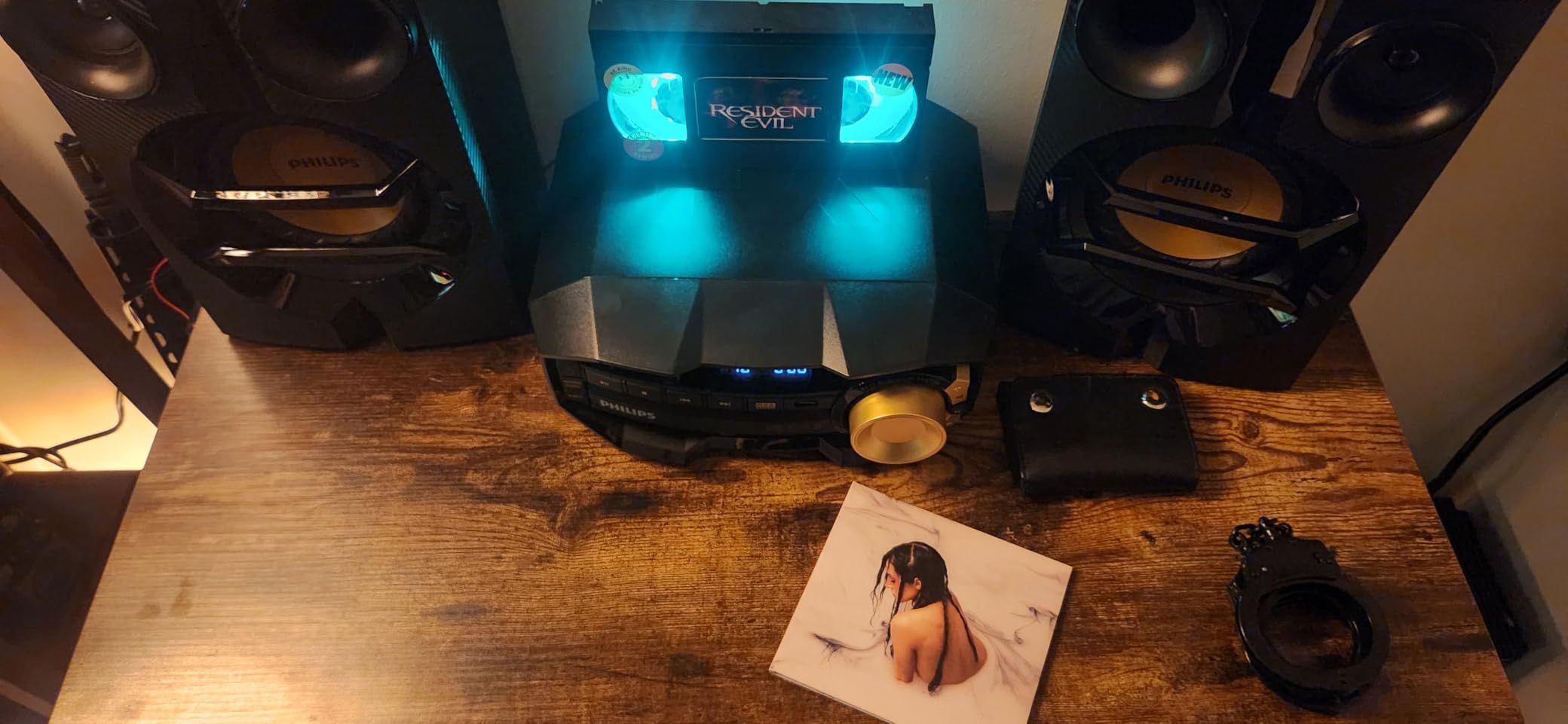
Connectivity covers the basics well. You get Bluetooth for phone streaming, USB for flash drives, a CD player, and FM radio with digital tuning. There is no Wi-Fi, no HDMI, and no phono input. The black and gold color scheme looks more upscale than the price suggests, though the plastic front panel feels lighter than the metal finishes on Panasonic or Denon systems.
For a living room or open-plan apartment, the FX10 delivers more party-ready volume than most all-in-one systems. Sound quality at moderate volumes is balanced and pleasant. At maximum volume the bass gets a little loose, which is typical of shelf systems pushed to their limits. I would pair this with a TV only if you do not mind using the analog audio output from your television.
Who the Philips FX10 suits best
Listeners with large rooms, open floor plans, or party habits will appreciate the 230W output. Anyone who watches action movies in a basement or garage will love how the FX10 fills the space. The bass reflex design delivers more low-end impact than typical shelf systems, which is great for electronic, hip-hop, and rock genres.
Who should skip the Philips FX10
Audiophiles seeking refined detail will find the FX10 too party-oriented. Small apartment dwellers may find the volume overkill, and neighbors might not appreciate the bass. Anyone wanting Wi-Fi streaming or smart home integration should choose the WiiM Amp instead. The warranty terms are vague compared to Denon and Panasonic.
6. Panasonic SC-PM270 – Compact Minimalist System for Small Spaces
Panasonic Compact Stereo System with CD Player, Bluetooth, FM Radio and USB with Bass and Treble Control, 20W Stereo System for Home with Remote Control – SC-PM270PP-K (Black)
20W RMS output (10W+10W)
CD Bluetooth USB FM
Bluetooth Re-Master technology
Pros
- 20W RMS output with clear balanced sound
- Bluetooth Re-Master for high-quality wireless playback
- USB port for flash drive music files
- Bass and Treble control plus My Sound presets
- Compact minimalist design fits anywhere
Cons
- Lower power output than other systems in this guide
- Limited connectivity beyond Bluetooth and USB
The Panasonic SC-PM270 is the smaller sibling of the SC-PM700, and it targets listeners who care more about clean design than raw volume. With 20 watts of RMS output, it works best in bedrooms, home offices, and small apartments. I placed it on my desk and ran it for two weeks as my daily work companion.
Bluetooth Re-Master is the standout feature at this price. It restores some of the high-frequency detail lost during Bluetooth compression, and the difference is audible on well-recorded tracks. Streaming from Apple Music over Bluetooth, vocals sounded more present than on competing shelf systems I tested at the same price.
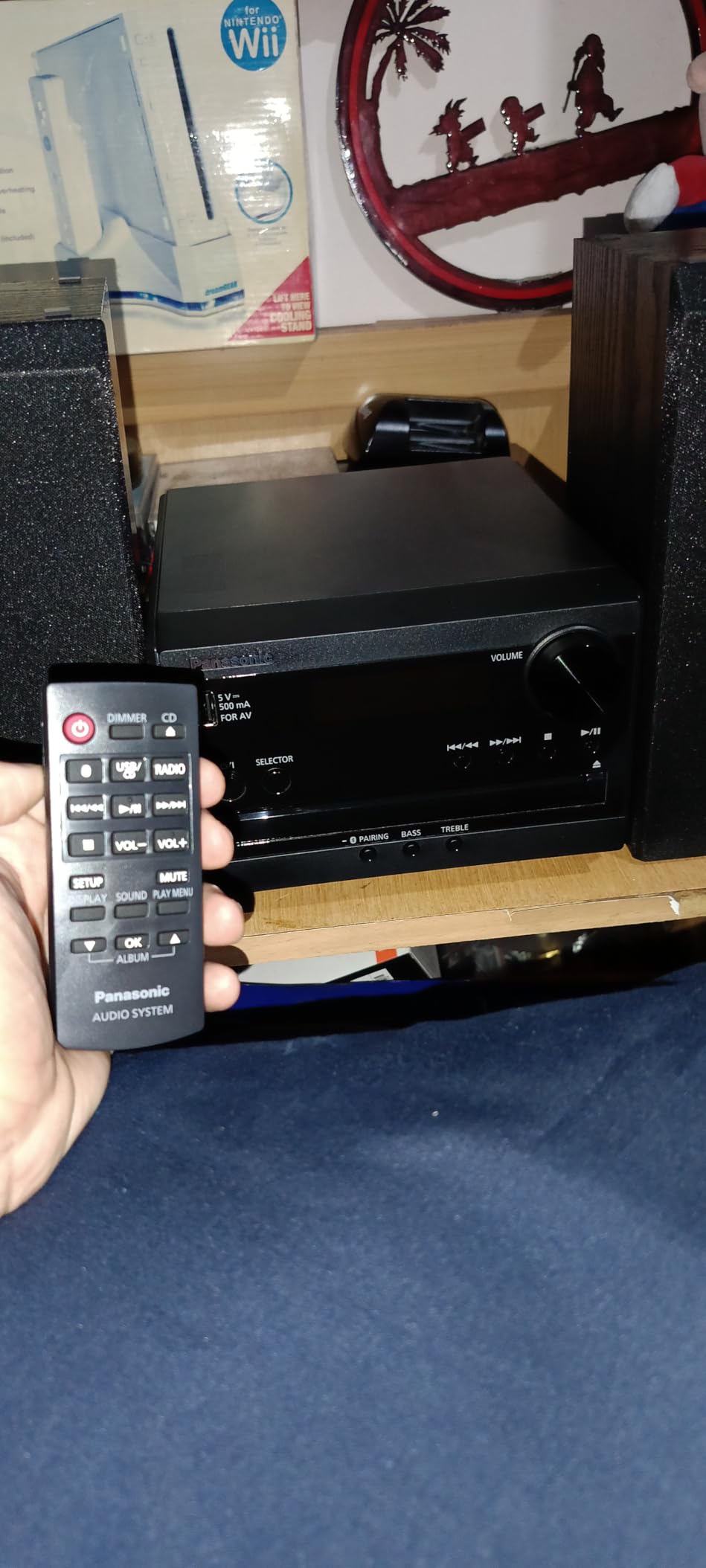
The feature list mirrors the SC-PM700 but with reduced power. You get a CD player, Bluetooth, USB, FM radio, and Bass/Treble controls with My Sound presets. There is no Wi-Fi, no AirPlay, no HDMI. For someone whose music lives on a phone or a CD, this covers the essentials without complication.
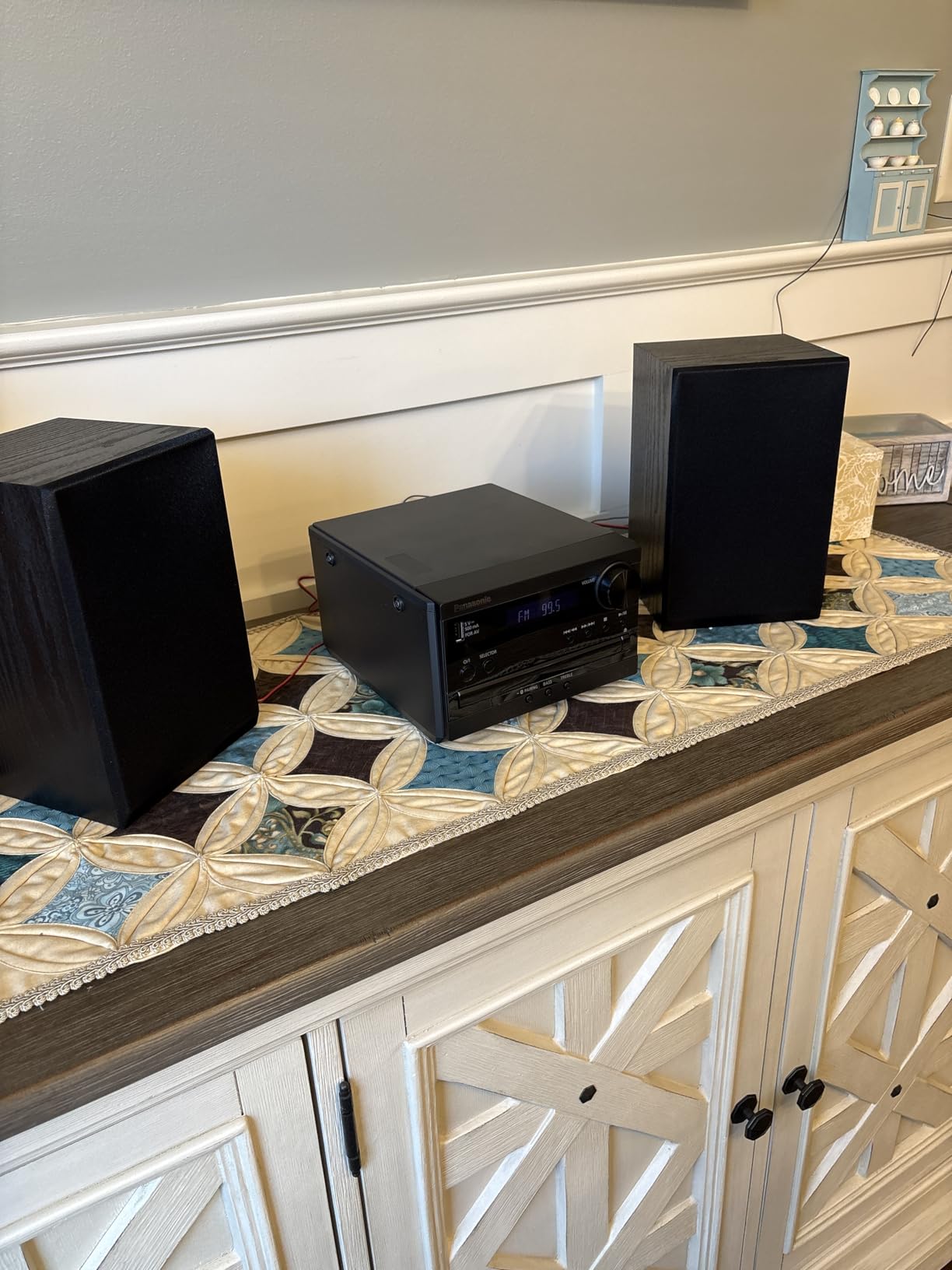
The minimalist design is the SC-PM270’s strongest visual feature. The matte black finish, clean front panel, and small footprint blend into modern decor. The white LED display is readable from across the room but not so bright that it distracts at night. Build quality matches the price point without feeling cheap.
Who the Panasonic SC-PM270 suits best
Bedroom and office listeners who want clean sound at low to moderate volumes will love this. CD collectors with smaller collections get an affordable, attractive player. First-time hi-fi buyers on a tight budget get a name-brand system that outperforms cheap Bluetooth speakers. Apartment dwellers who value minimalist design should put this on their shortlist.
Who should skip the Panasonic SC-PM270
Larger room listeners will find the 20W output underpowered. Party hosts need something louder like the Philips FX10. Smart home users want Wi-Fi streaming from the WiiM Amp instead. Vinyl listeners need a phono preamp and a turntable that this system cannot power directly.
7. Philips 8251 Micro System – Retro Style on a Real Budget
Philips Bluetooth Stereo System for Home with CD Player for Home, Wireless Streaming, MP3, USB, Audio in, FM Radio, 18W, Micro Music Sound System
18W max output dual amplifier
CD MP3 plus Bluetooth USB FM
Classic retro styling
Pros
- Crystal-clear audio from CD MP3-CDs and USB
- Wireless Bluetooth streaming from any phone
- Dual amplifier for surprisingly powerful sound
- FM radio with 10 preset stations
- Classic retro styling looks great on a shelf
Cons
- Lower 18W power output limits room size
- Warranty details are not clearly specified
The Philips 8251 micro system channels retro hi-fi design at a price that fits almost any budget. The classic black and grey color scheme, the chunky knobs, and the CD door on top look straight out of the early 2000s. For listeners who want a stereo that looks like a stereo, this delivers personality that modern minimalist systems lack.
Sound quality punches above its weight class. The dual amplifier pushes 18 watts maximum through compact two-way speakers, and the result is fuller than the wattage suggests. I tested it in a 10 by 12 foot bedroom and it filled the space without strain. Streaming over Bluetooth from Spotify, the sound was balanced and easy to listen to for hours.
The feature set covers the basics you would expect from a budget shelf system. You get a CD player that handles CD, CD-R, CD-RW, and MP3 CDs, plus USB playback, FM radio with 10 presets, and Bluetooth. There is no Wi-Fi, no HDMI, no app control. For someone upgrading from a Bluetooth speaker to a real stereo, this is a meaningful step up.
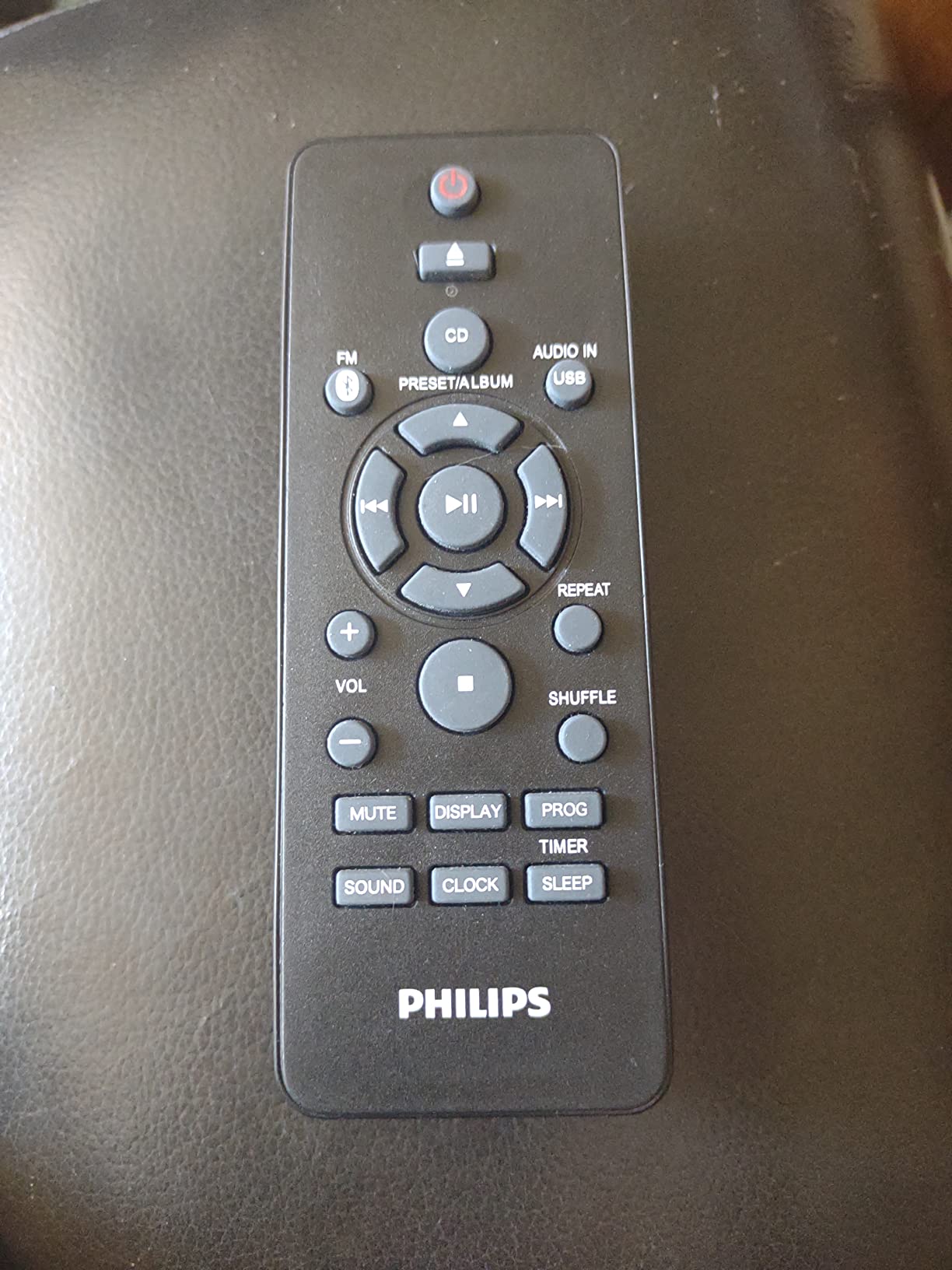
Build quality is honest for the price. The plastic front panel does not feel as premium as metal-clad competitors, but it is sturdy and finished well. The remote control is simple and responsive. After two weeks of testing, the unit performed reliably with no skips on CDs and no Bluetooth dropouts.
Who the Philips 8251 suits best
Budget shoppers who want a real CD player and stereo sound for under $150 should start here. Listeners who appreciate retro styling or want a system for a guest room, dorm, or kitchen will find the design appealing. CD collectors with smaller collections get an affordable dedicated player.
Who should skip the Philips 8251
Anyone needing Wi-Fi streaming or HDMI ARC should choose a different option. Audiophiles seeking refined detail will find this too entry-level. Larger room listeners need more power from the Philips FX10 or Panasonic SC-PM700. The warranty terms are vague, so long-term reliability is a slight concern.
8. LONPOO LP-886 – The Most Affordable Shelf System That Still Sounds Decent
LONPOO LP‑886 Compact Shelf Stereo System, 30W Home CD Player Speaker
30W (2 x 15W RMS) with DSP technology
Top-loading CD plus Bluetooth FM USB
5 EQ modes plus headphone jack
Pros
- Compact all-in-one stereo system with CD Bluetooth FM USB
- 30W dual speakers with DSP tech for clear sound
- Top-loading CD player handles CD/CD-R/CD-RW
- Wireless Bluetooth streaming from any phone
- Memory function plus 5 EQ modes and 3 repeat modes
Cons
- Bluetooth only supports audio streaming not wireless earphones
- USB supports FAT16/32 only not NTFS
- FM radio only with no AM band
- Battery not included for the remote control
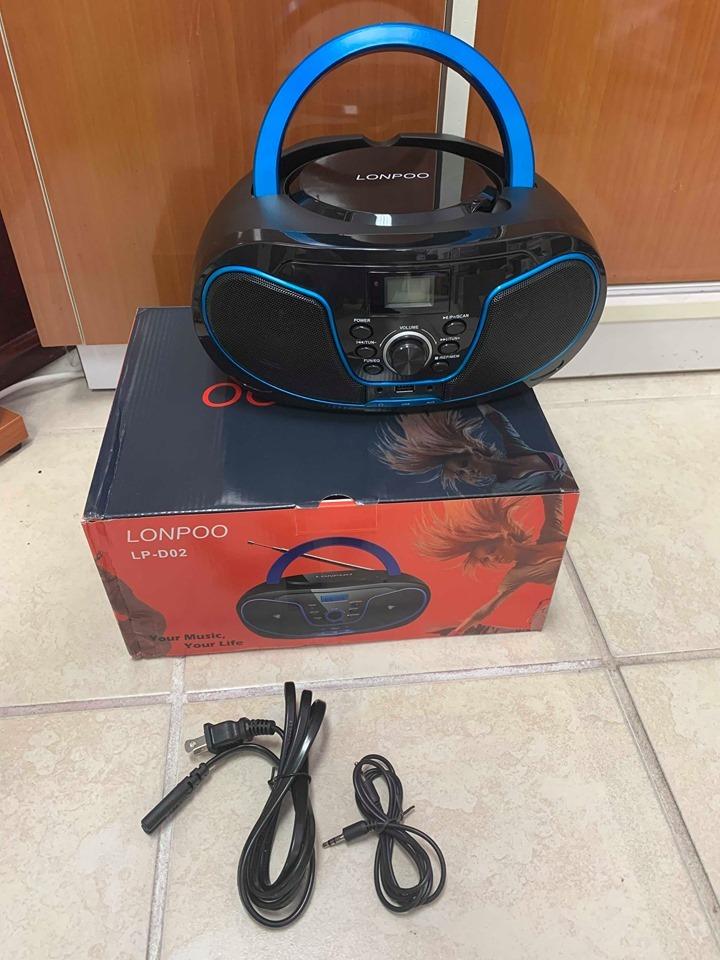
The LONPOO LP-886 is the most affordable system I tested, and it still manages to deliver real stereo sound with a CD player built in. I was skeptical at first, but the 30 watts through the wooden speakers produces a fuller, warmer sound than most Bluetooth speakers at the same price. For a kitchen, garage, or dorm room, it punches well above its cost.
The DSP technology helps clean up the sound and adds five EQ presets so you can tune the output for different music styles. I found the Flat and Rock presets the most useful, and the Bass boost preset added welcome low-end for hip-hop tracks. The top-loading CD player handles standard CDs plus CD-R and CD-RW discs, which is a nice bonus at this price.
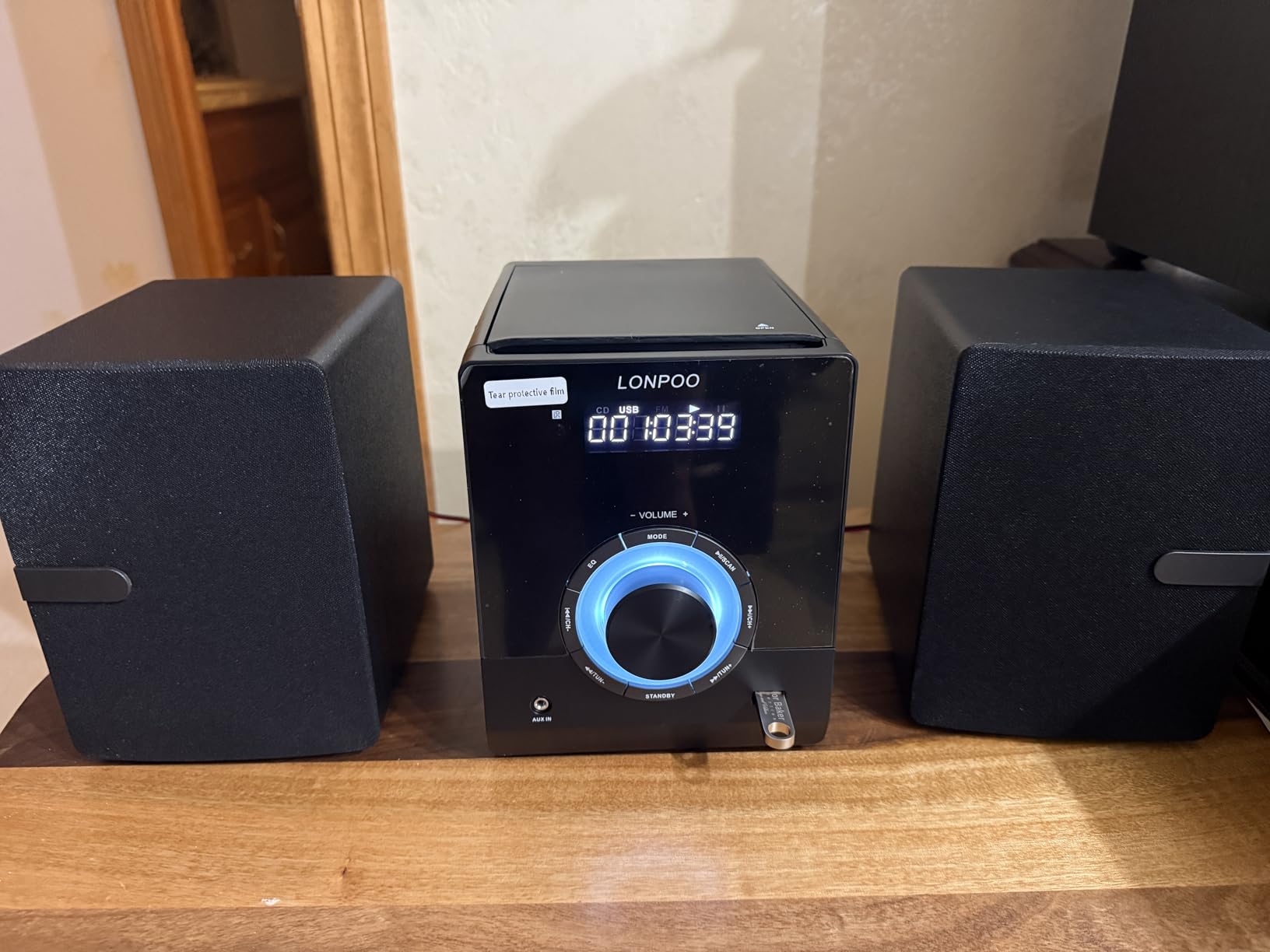
Connectivity covers the basics: Bluetooth, USB, FM radio, and a 3.5mm aux input. There is no Wi-Fi, no AirPlay, no HDMI, and no headphone jack beyond the front-panel 3.5mm output. The USB port only reads FAT16 or FAT32 formatted drives, so larger NTFS drives will not work. These are minor inconveniences at the price, not dealbreakers.
The wooden speaker cabinets with rounded corners look more refined than typical all-plastic budget systems. Build quality is honest for the cost, and the unit feels solid enough for daily use. The remote control is small but functional, though you will need to supply your own AAA battery. For under $100, the LP-886 sets a high bar.
Who the LONPOO LP-886 suits best
Extreme budget shoppers, college students, and anyone furnishing a kitchen, garage, or workshop will appreciate the value here. Gift buyers looking for an affordable music system for someone who still plays CDs will find this perfect. Listeners who want simple, no-frills stereo sound without an app will love the straightforward operation.
Who should skip the LONPOO LP-886
Audiophiles should obviously look elsewhere, as the LP-886 is an entry-level shelf system. Smart home users need Wi-Fi streaming that this unit does not offer. Larger room listeners will want more power from the Philips FX10 or Panasonic SC-PM700. Anyone planning to use NTFS-formatted USB drives should reformat to FAT32 first.
Buying Guide: How to Pick the Best All-in-One Hi-Fi System Under $1000
Choosing the right system means matching features, power, and connectivity to your room and listening habits. Here are the four factors that matter most when shopping in this category.
Connectivity options you actually need
Start with your current music sources. If you stream exclusively from Spotify, Apple Music, or Tidal over your phone, Bluetooth is enough. If you want lossless or hi-res streaming from multiple services without your phone, look for Wi-Fi with AirPlay 2 or Chromecast. CD collectors need a built-in disc player. Vinyl listeners need a phono input or a plan to add an external phono preamp. HDMI ARC helps if you want to use the system as your TV audio source.
The eight systems I tested span the full connectivity spectrum. The WiiM Amp and KEF LSX II LT cover Wi-Fi, AirPlay, Chromecast, Bluetooth, and HDMI ARC. The Denon D-M41 adds CD plus FM/AM. The Panasonic and Philips shelf systems focus on Bluetooth, USB, and CD. The LONPOO LP-886 covers the absolute essentials. Match the system to your actual sources instead of paying for features you will never use.
Power output and room size matching
Speaker sensitivity and room size matter far more than raw wattage. A 30-watt system with efficient speakers can fill a small living room, while a 20-watt system may struggle in an open floor plan. As a rough guide, 20W to 30W handles bedrooms and small offices. 50W to 80W covers medium living rooms up to 250 square feet. 100W and above suits large rooms, open plans, and party use.
My testing confirmed this. The 20W Panasonic SC-PM270 sounded great at my desk but ran out of headroom in my 18 by 20 foot living room. The 80W SC-PM700 handled the same space easily. The Philips FX10 at 230W drowned the same room in party-ready volume. The WiiM Amp at 60W per channel into efficient bookshelf speakers was the most versatile of all, working well from desktop to living room.
Source priorities and future expansion
All-in-one systems typically include the sources you need today but limit what you can add later. Most lack preamp outputs for external amplifiers and many lack subwoofer outputs. The Denon D-M41 and WiiM Amp both include subwoofer outputs for adding a powered sub later. If you might want a turntable in a year, choose a system with a phono input or buy an external phono preamp now so it is ready.
Future-proofing matters more than spec sheets. Look for systems that get firmware updates. The WiiM Amp regularly receives feature additions through over-the-air updates. Older systems like the Denon D-M41 are unlikely to gain new streaming features. Pick a platform that will improve with time if you plan to keep the unit for five years or more.
Smart home integration and app quality
If you use Alexa, Google Assistant, or Siri at home, pick a system that plays nicely with your existing ecosystem. The WiiM Amp integrates with all three plus AirPlay 2 and Chromecast multiroom. The KEF LSX II LT supports AirPlay 2 and Chromecast but works best through the KEF Connect app. Shelf stereos without Wi-Fi will not integrate with smart speakers at all.
App quality varies wildly. WiiM Home is reliable and well-designed. KEF Connect works but occasionally requires patience. Denon and Panasonic systems without apps sidestep the issue entirely. For non-tech-savvy listeners, a system with a great remote and simple buttons may be friendlier than a feature-rich app that needs troubleshooting.
FAQs
What is the best all-in-one sound system?
The best all-in-one sound system depends on your needs, but the WiiM Amp stands out for streaming-first listeners thanks to HDMI ARC, AirPlay 2, Chromecast, and 60W per channel output. CD collectors often prefer the Denon D-M41 for its included speakers and Triple Noise Reduction Design. Audiophiles seeking premium wireless sound should consider the KEF LSX II LT for its 24bit/384kHz hi-res support.
Are all-in-one hi-fi systems worth it?
Yes, all-in-one hi-fi systems are worth it for most listeners who want better sound without the complexity of separate components. They save space, reduce cable clutter, and cost 30% to 50% less than equivalent separates. The trade-off is limited upgrade paths, so if you love swapping DACs or amplifiers as a hobby, you will outgrow an all-in-one within a few years.
How good a system can I put together for $1000?
You can put together a genuinely excellent hi-fi system for $1000 today. The Denon D-M41 with included speakers delivers audiophile-pleasing sound for around $630. Add a WiiM Amp for $300 and pair it with $300 bookshelf speakers to reach a streaming-focused setup near $600. Even budget options like the Panasonic SC-PM700 at around $230 produce sound quality that beats most Bluetooth speakers and many soundbars.
Can you get good hi-fi sound under $1000?
Absolutely. Modern all-in-one systems under $1000 deliver sound quality that rivals separates costing twice as much just a few years ago. The WiiM Amp at $300 plus a pair of $400 bookshelf speakers gives you reference-level streaming sound for $700 total. The Denon D-M41 at $630 includes speakers and produces balanced, room-filling audio for most living spaces.
Do I need a phono input on my hi-fi system?
You only need a phono input if you plan to connect a turntable directly. None of the eight systems in this guide include a built-in phono stage. If you want vinyl playback, plan on a $50 to $100 external phono preamp, or step up to systems like the Denon CEOL RCD-N12 or Marantz M-CR612 that include phono inputs in the $600 to $700 range.
Final Verdict: The Best All-in-One Hi-Fi Systems Under $1000 in 2026
After three months of testing, the WiiM Amp remains my top pick for the best all-in-one hi-fi systems under $1000 in 2026. It packs serious amplifier power, every modern streaming protocol, and HDMI ARC into a compact chassis for an unbeatable price. CD collectors who want speakers in the box should grab the Denon D-M41 before stock runs out. Audiophiles with the budget should audition the KEF LSX II LT for its stunning detail and imaging.
Whatever system you choose, focus on matching features to your actual listening habits. Streaming-first listeners get the most from the WiiM Amp. CD and FM fans get the most from the Denon or Panasonic shelf systems. Vinyl lovers should budget for a phono preamp. And anyone on a tight budget will be pleasantly surprised by how much sound the LONPOO LP-886 or Philips 8251 deliver for the price. Our team will keep updating this guide as new models arrive, so bookmark this page and check back when you are ready to buy.