
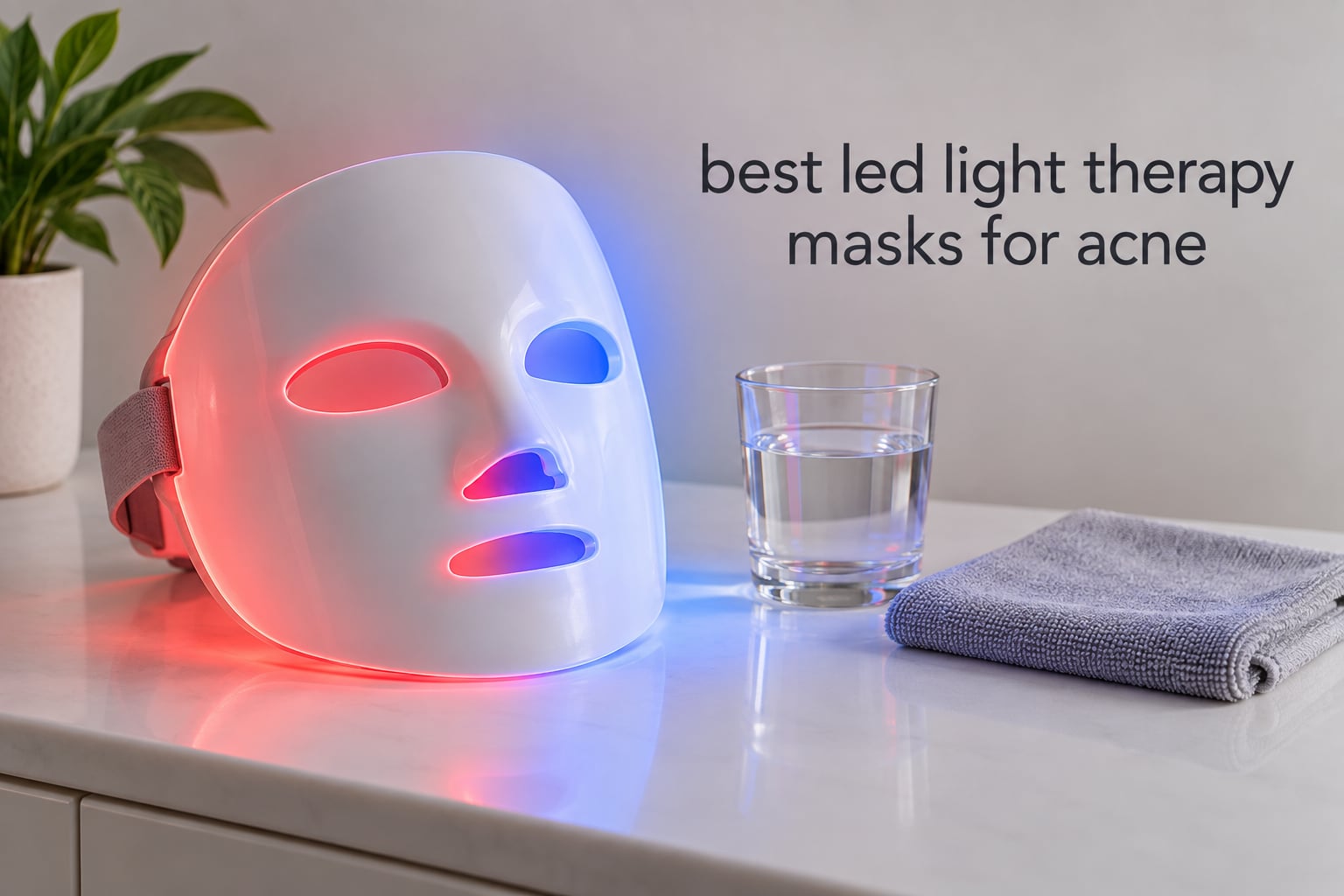
Blue light therapy masks have quietly become the most useful at-home tool for inflammatory breakouts, and the reason is a specific number: 415 to 465 nanometres. That is the band of light absorbed by porphyrins produced by Cutibacterium acnes, the bacteria that drives most inflamed pimples. Red light at 630 nm calms the inflammation afterwards, and near-infrared at 850 nm and above helps the skin repair itself. A mask is the format that makes all three practical, because it holds the light at a fixed distance from your face while you sit still for ten minutes.
This guide ranks the best LED light therapy masks for acne on what actually matters for a breakout: published wavelengths in nanometres, irradiance you can verify, blue light in the clinically studied band rather than a vague “blue mode”, and hardware that still works in month eight. We looked at twelve masks, read the specification sheets line by line, and weighed each against owner reviews rather than marketing copy.
One thing to clear up early. Almost every ranking page for this keyword is really an anti-aging roundup that mentions blue light once in a paragraph. If your problem is breakouts, that is the wrong priority. The picks below are ordered by how well each mask handles acne specifically, and we say plainly where a mask falls short.
If you want the broader picture on skin devices first, our guide to the best LED face masks for skincare covers the anti-aging side in depth, and the best red light therapy devices guide covers panels and wands for people who want to treat more than their face.
Table of Contents
- Quick Picks: Best LED Light Therapy Masks for Acne (October 2026)
- All 12 LED Light Therapy Masks for Acne at a Glance
- 1. NEWKEY 4D LED Mask – Best Overall for Acne
- 2. Aphrona MOONLIGHT PRO – Best Value Acne Mask
- 3. INIA Red Light Therapy Mask – Best Cordless Four-Mode Routine
- 4. CurrentBody Skin Series 2 – Best for Post-Acne Marks and Deep Repair
- 5. HIME SAMA Miracle ACE – Best Premium Multi-Colour Mask
- 6. RENPHO E100B – Best Soft Silicone Fit
- 7. gelpal 7-1 Colour Mask – Best Budget Pick
- 8. Kelyoo Red Blue Infrared Mask – Best Budget Redness Calming
- 9. biuufish 8-Colour Mask – Best 850nm Near-Infrared Flexibility
- 10. Auxoliev Remote Mask – Best for Oily Skin and Oil Control
- 11. GIHWRRI 7-Colour Mask – Best for Sensitive Skin Starters
- 12. MICEYLIVE FDA-Cleared Mask – Best Dedicated Acne Mode
- What LED Light Therapy Cannot Fix for Acne
- How to Use an LED Mask for Acne
- What to Look For in an LED Mask for Acne
- LED Masks for Post-Acne Marks and Acne Scars
- FDA-Cleared vs FDA-Approved: What LED Masks Actually Are
- Safety, Side Effects and Photosensitivity
- Frequently Asked Questions
- Which LED light mask is best for acne?
- Which type of LED light therapy is best for acne?
- Is an LED light therapy mask good for acne?
- Which color LED mask is most effective for treating acne?
- Do LED light masks really work for acne?
- Does an LED mask get rid of acne scars?
- Why am I breaking out after red light therapy?
- Conclusion: Which LED Mask for Acne Should You Buy in 2026?
Quick Picks: Best LED Light Therapy Masks for Acne (October 2026)

NEWKEY 4D LED Mask
- 630nm red plus 465nm blue
- 450 LED chips
- Up to 75mW/cm2 irradiance
- 10-minute auto shut-off

HIME SAMA Miracle ACE
- 8-colour spectrum at 30mW/cm2
- 465nm blue with 820nm NIR
- Wireless 2000mAh battery
- FSA and HSA eligible
Aphrona MOONLIGHT PRO
- 415nm blue plus 630nm red
- 450 narrow-spectrum chips
- FDA 510(k) cleared
- 5 to 50 minute timer
If you want the short version, these three are the ones to compare.
NEWKEY 4D LED Mask – the most-proven option, with 3605 reviews, 450 LED chips and a 465nm blue channel paired with 630nm red.
HIME SAMA Miracle ACE – a 4.7-rated mask with the widest spectrum here, a two-year warranty and a documented year of daily use.
Aphrona MOONLIGHT PRO – the best balance of a documented FDA 510(k) clearance for acne and a large review base at a mid-range price point.
One mask in this roundup has no blue light at all and is therefore a poor acne buy however good it is for wrinkles. We flag it in its section so you do not spend good money on the wrong wavelength.
All 12 LED Light Therapy Masks for Acne at a Glance
| Product | Specifications | Action |
|---|---|---|
| NEWKEY 4D LED Mask |
|
Check Latest Price |
| Aphrona MOONLIGHT PRO |
|
Check Latest Price |
 INIA Red Light Therapy Mask INIA Red Light Therapy Mask |
|
Check Latest Price |
 CurrentBody Skin Series 2 CurrentBody Skin Series 2 |
|
Check Latest Price |
| HIME SAMA Miracle ACE |
|
Check Latest Price |
 RENPHO E100B Mask RENPHO E100B Mask |
|
Check Latest Price |
 gelpal 7-1 Colour Mask gelpal 7-1 Colour Mask |
|
Check Latest Price |
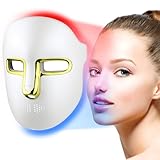 Kelyoo Red Blue Infrared Mask Kelyoo Red Blue Infrared Mask |
|
Check Latest Price |
 biuufish 8-Colour Mask biuufish 8-Colour Mask |
|
Check Latest Price |
 Auxoliev Remote Mask Auxoliev Remote Mask |
|
Check Latest Price |
 GIHWRRI 7-Colour Mask GIHWRRI 7-Colour Mask |
|
Check Latest Price |
 MICEYLIVE FDA-Cleared Mask MICEYLIVE FDA-Cleared Mask |
|
Check Latest Price |
1. NEWKEY 4D LED Mask – Best Overall for Acne
NEWKEY 4D LED Red Light Therapy Mask for Face Skin Glowing,630nm Led Light Therapy Face Mask Anti Wrinkle, Blue Light Therapy Face Mask for Acne,Home use,450 LED Chips,Birthday gift,Plug in
630nm red plus 465nm blue
450 LED chips
Up to 75mW/cm2
Corded plug-in, 10-minute auto shut-off
Pros
- Largest review base in the set at 3605 reviews
- 465nm blue sits in the clinically studied band
- 450 chips give even full-face coverage
- Up to 75mW/cm2 is above the practical home target
- Corded power has no battery to degrade
Cons
- Tethered to a plug so you cannot move around
- Very bright output and needs care around the eyes
This is the mask we keep coming back to because it is the least fashionable and has the longest public record. It has been listed since 2016, which means the review pool is deep and long-running rather than a burst of five-star feedback from a recent launch. The 465nm blue channel sits inside the studied acne band, and it is paired with 630nm red so you can run a combined mode.
At 450 LED chips and up to 75 mW/cm², it sits above the 30 to 60 mW/cm² range we consider sensible for home use. That is the part competitor spec sheets leave vague: power density is what determines how much light actually reaches the skin, and this is one of the higher-output masks in the set.
The 4D contoured shell holds a 5mm light distance from the skin, which limits light leakage around the edges of the face. Owners credit the mask with softening forehead lines and reducing breakouts on a three-session-a-week cadence, and the 10-minute auto shut-off removes any decision-making from the routine.
Two practical realities. First, it is corded, so a session is a session at a desk rather than something you do while making breakfast. Reviewers treat that as a feature more often than a flaw, because there is no battery to age out. Second, the light is genuinely bright, and buyers with light sensitivity should keep their eyes closed or use the mask with a hand over the eye area during the session.
Is the NEWKEY worth it if you already own a mask?
Only if your current mask has no blue channel or an unlisted one. Duplicating red and near-infrared coverage buys you very little. But if you are starting from nothing, this is the version I would buy first, because the evidence base behind the wavelengths is the part that matters and it is documented here rather than implied.
Owners are also consistent about the size of the effect. It is not a cure. It is a steady reduction in how often you get a new blemish and how angry each one looks while it is there.
When the NEWKEY is the wrong choice
Do not buy it if you travel with your routine or want to wear a mask while doing something else. The plug is the trade for reliability, and corded devices accumulate cable strain over years of nightly use.
Also skip it if you are sensitive to hardware contact. The 4D contour is snug by design and holds a consistent 5mm distance, which is exactly what makes the dose predictable and also what makes it unforgiving on a narrow face.
2. Aphrona MOONLIGHT PRO – Best Value Acne Mask
Aphrona FDA cleared LED Facial Mask MOONLIGHT PRO 7 Color Treatment Photon Mask, Red light Blue light for Acne Removal Wrinkle Reduction, led light therapy for face, 450 Powerful LED Chips (White)
415nm blue plus 630nm red
450 narrow-spectrum chips
FDA 510(k) cleared
5 to 50 minute timer
Pros
- 415nm is the exact wavelength used in the acne trials
- FDA 510(k) clearance for an acne indication
- 2186 reviews with long-term owner reports
- Adjustable 5 to 50 minute timer
- Includes eye protection and a storage case
Cons
- Hard plastic shell does not flex to contours
- Feels heavy when worn upright
- Cord connection reported failing after about a year of daily use
The Aphrona is one of only two masks in this roundup that publishes 415nm blue alongside a documented FDA 510(k) clearance naming acne. For a buyer whose acne is the actual problem, that combination is worth more than any number of extra colours. The 450 chips are 99% narrow-spectrum, so the blue light is a tight band rather than a wide blue-white wash.
Owners with a year or two of use describe calmer skin and faster healing of cystic blemishes, and the adjustable timer from 5 to 50 minutes is genuinely useful because it lets you run a short blue session on a weeknight and a longer combined session on a weekend.
The 510(k) designation matters more than most sellers realise. It means the manufacturer submitted a predicate comparison to the FDA for a device intended for an acne indication, which is a higher bar than a cosmetic product ever has to clear.
Two things temper the recommendation, and both come from owner reviews rather than the spec sheet. The shell is rigid plastic, so it does not follow the curve of the cheek and it feels heavy if you sit up to work while wearing it. Several owners also report the cord connection fatiguing after roughly a year of daily use, which is a fair warning if you plan to run it nightly for a decade.
Who should buy the Aphrona?
If your acne is inflammatory and you want a documented clearance plus the exact studied wavelength, this is the rational pick. It sits below the point where you are paying mainly for a brand name, and 2186 reviews give you enough history to judge durability rather than guess at it.
It also works well for post-acne marks, because the 630nm red channel handles the redness and the uneven tone that remains after a blemish clears.
Who should look elsewhere
People who need a soft, flexible shell that sits flat against a small face. The straps are also fiddly to adjust, and the plastic does not forgive an awkward fit. If you are sensitive to pressure around the eyes, budget for a silicone alternative later in this list.
3. INIA Red Light Therapy Mask – Best Cordless Four-Mode Routine
INIA Red Light Therapy Mask for Face, 850nm NIR, Red/Blue LED Light 4 Modes
Blue 460-470nm with optional 850nm NIR
Four light modes
220 LED chips
Up to 105mW/cm2, rechargeable
Pros
- Cordless 2600mAh controller so you can move around
- Four selectable modes plus optional 850nm NIR
- Stated output of 105mW/cm2
- the highest figure in the set
- 10
- 20 or 30 minute timer with auto shut-off
Cons
- Blue band starts at 460nm
- above the 415nm used in most trials
- Results need four weeks or more of consistent use
- Review base is smaller than the leaders above it
The INIA solves the one problem every corded mask shares: the cable. A 2600mAh controller means you can wear it while doing something else in the same room, and reviews note the battery comfortably outlasts a full session with power to spare.
The mode structure is the reason to consider it. Red-L at 620nm, Red-H at 630nm, blue at 460 to 470nm, and a combined red-blue mode, with 850nm near-infrared available on top of any of them. That is a more useful routine structure than most masks at this level, and it maps cleanly onto the clinical use case of blue during a breakout and red or near-infrared afterwards.
One honest note on the blue band. It starts at 460nm rather than 415nm, which is still blue light therapy and still effective for C. acnes, but it sits at the shallower-penetrating end of the studied range. If your acne is deep-seated rather than surface-level, the Aphrona’s 415nm channel is the more conservative choice.
The stated output of up to 105 mW/cm² is the highest in the set. Treat that figure with a little caution, since output claims vary with measurement method, but it does mean this is not a low-power novelty device.
When the INIA earns its place
If you are someone who never finishes a task while sitting still, cordless is the difference between a device you use and a device you forget in a drawer. The four modes also let you commit to a two-mode routine rather than owning two separate machines.
Owners describe smoother, more even skin and less frequent breakouts, with the consistent note that improvement became noticeable after four weeks or more rather than in the first few sessions.
When it falls short
It is a 4.2-rated mask with 1486 reviews, which places it below the leaders here on both measures. And the blue band is narrower to the red end of the acne spectrum than the masks built specifically for acne. For a pure breakout protocol, the masks that publish 415nm are the more conservative pick.
4. CurrentBody Skin Series 2 – Best for Post-Acne Marks and Deep Repair
CurrentBody Red Light Therapy LED Face Mask: Series 2
633nm red, 830nm and 1072nm NIR
236 LED bulbs
Flexible liquid silicone fit
10-minute sessions
Pros
- A 1072nm deep near-infrared channel
- which most masks here do not carry
- Best-fit silicone extends coverage over the jawline and chin
- Structured build holds its shape during a session
- Per-mask Veritace NFC card for device traceability
Cons
- No blue light channel
- so it does nothing for active breakouts
- 4.0 average rating with 652 reviews
- Velcro straps shed fibres onto the shell
- Reports of battery or unit failure within weeks to months
We have to say this plainly because it is the mask that appears on most of the ranking pages for this keyword: the CurrentBody Skin Series 2 has no blue light. Its three wavelengths are 633nm red, 830nm near-infrared and 1072nm deep near-infrared. If you are buying for active acne, this is the wrong device, however good the build is.
What it does well is the other half of the problem. Owners report softer, suppler skin and visibly calmer redness, and the 1072nm deep near-infrared channel is genuinely unusual – most masks stop at 850nm. The flexible liquid silicone shape was tested across many face types and extends over the jawline, which many masks skip.
Its per-mask Veritace NFC card is a nice touch that lets you verify individual device data rather than trusting a batch claim, and 10-minute auto shut-off sessions keep it simple.
Contraindications are listed in the product description rather than buried, and the mask ships with eye pads to reduce light intensity at the eyes.
The durability feedback is the part that gives us pause. Multiple one-star reviews describe the mask or its battery cutting out within weeks to a couple of months, and strap quality plus thin documentation draw repeated complaints. At the top of the price range for this roundup, that combination is hard to justify for an acne purchase.
Is the CurrentBody worth buying at all?
For someone whose acne has largely resolved and who is now focused on post-inflammatory hyperpigmentation and texture, yes – the red and deep near-infrared channels are exactly the right tool, and the jawline coverage is a real advantage.
Pair it with an actual blue light source and the pairing covers both phases. On its own, it covers only the recovery phase.
Why we ranked it fourth for an acne list
Because ranking it higher would be misleading. Its 4.0 average and 652 reviews place it mid-table on evidence, and it has no wavelength that targets bacteria. A list that put it in the top three for acne would be optimising for brand recognition rather than for your skin.
5. HIME SAMA Miracle ACE – Best Premium Multi-Colour Mask
HIME SAMA LED Face Mask, FSA,HSA Eligible, 8 Color LED Mask, Miracle ACE
8 colours at plus or minus 5nm including 465nm blue
240 LED beads at 30mW/cm2
2000mAh wireless
FSA and HSA eligible
Pros
- Top average rating in the roundup at 4.7 with a very low one-star rate
- 465nm blue plus 820nm NIR plus six other colours
- Wide-spectrum accuracy at plus or minus 5nm
- Owners report a year of daily use without degradation
- Two-year warranty with replacement or refund
Cons
- 30mW/cm2 sits at the low end of the practical range
- Forehead strap can dig in and leave a temporary indentation
- Remote and accessories are packaged separately
The HIME SAMA has a 4.7 average, one of the two cleanest rating profiles in this roundup, with a one-star share of roughly two percent. More important than the score is the consistency: multiple owners document a full year of daily use without battery or controller degradation, which is the failure mode that ends most LED relationships.
Technically it is thorough. Eight colours at plus or minus 5nm precision across 240 imported LED beads, including 465nm blue for breakouts, 630nm red for inflammation and 820nm near-infrared for deeper repair. Light purity is stated above 98%, and the patented silicone eye holder keeps light off your eyes properly rather than relying on blinking.
It is also FSA and HSA eligible with a two-year assurance, which is a meaningful offset for a device at this price point. If you have a health spending account, run that number before you decide it is too expensive.
Where it does not win is power. At 30 mW/cm² it sits at the bottom of the range we would consider useful, so expect a longer, gentler session rather than a fast one. The roughly 1cm light distance is a deliberate safety choice and it does spread the dose out.
Who is this mask for?
Someone who wants one device to cover active breakouts, redness and tone without thinking about which channel to pick, and who intends to keep it for years. The year-plus durability reports are what separate it from the rest of the field.
It is also the natural choice if you travel with your routine and want the full spectrum in something cordless and light enough to forget you are wearing.
Where it is not the answer
It is not the strongest single-purpose acne device here. The 30 mW/cm² output and 465nm blue do not beat the Aphrona’s documented 415nm clearance for a pure breakout protocol. This is the mask you buy for breadth and longevity, not for maximum potency.
6. RENPHO E100B – Best Soft Silicone Fit
RENPHO Red Light Therapy Mask for Face, FDA-Cleared,Birthday Gifts for Wife
Dedicated blue acne mode with adjustable intensity
324 LEDs in soft silicone
Wireless rechargeable
Protective eye cups
Pros
- Soft silicone sits far more comfortably than rigid shells
- Three modes including a dedicated blue acne mode
- Very light at 6.4 ounces so you can wear it while working
- Contoured to cover the jawline as well as the face
Cons
- Eye area can press painfully and light leaks past the cups
- Sits low on a high forehead
- No storage bag despite the manual listing one
The RENPHO is the comfort argument. Ultra-light skin-friendly silicone at 6.4 ounces is well under half the weight of the rigid masks in this roundup, and reviewers consistently describe it as more wearable than the plastic alternatives. If you have ever abandoned a mask because it felt like a helmet, this is the one to try.
It also has a properly structured mode set for acne: red plus infrared for general skin, a dedicated blue mode, and a mixed light mode. Intensity is adjustable per mode, so you can start at the lowest setting on sensitive skin and build up over a couple of weeks.
Owners report calmer breakouts, brighter tone and reduced redness after a few weeks, and several five-star reviews mention visible improvement at around two weeks, which is faster than the norm.
The eye area is the weak point. The silicone presses into the eye sockets on some face shapes and light leaks past the included protective cups. It also sits low on the forehead if you have a high forehead line, which means the upper forehead – where comedonal congestion likes to start – gets less exposure.
Is the RENPHO good value?
For comfort and mode flexibility, yes. It is one of the lighter masks available and reviewers repeatedly frame it as strong value against the branded alternatives, which matters when the category has a wide price spread.
The silicone also means no risk of the plastic-shell cracking over time, and it wipes clean easily.
When to choose something else
If you have deep cystic acne along your jaw, the mode set here is good but the shell’s jawline coverage is thinner than the flexible silicone masks designed specifically for that contour. And if you are travelling, the packaging is bulky.
The dedicated blue mode is the one to start with on a first course, then alternate with red plus infrared once the initial flaking settles. That two-phase approach is what the mode structure is actually built for.
7. gelpal 7-1 Colour Mask – Best Budget Pick
gelpal 7-1 Colors Red Light Therapy For Face,LED Facial Skin Care Mask,Red Light Mask for Face, LED Facial Mask Light,Salon or Home,White.
7 plus 1 colour modes including blue
90 LED beads covering 60+ zones
Cordless, about 14 sessions per charge
15-minute sessions
Pros
- Cost sits at the bottom of the roundup while still covering blue for acne
- Snug fit that does not crush the face
- Solid shell with no loose LED beads
- One-touch operation
- 15-minute fixed session length
Cons
- 90 LEDs is fewer than most competing masks
- Split results
- with some owners unsure after a month
- Bright enough that light-sensitive users want eye protection
- Feels slightly heavy
This is the mask to buy if cost is the deciding factor and you want blue light in the box. At a small fraction of the cost of the mid-range options it still covers seven colours plus white, including a blue channel, and it targets more than 60 facial zones with 90 LED beads.
The fit is the surprise. Reviewers describe it as snug but not crushing, which is more than can be said for most plastic shells at any price. The 15-minute fixed session is simple, and the one-touch operation removes the mode-cycling guesswork.
It is classified as an over-the-counter facemask-shaped LED device for wrinkles or mild to moderate inflammatory acne, which is a specific and useful claim to be able to check on a listing.
The honest weakness is LED count. Ninety beads is a fraction of what the leading masks carry, and the coverage is spread thinner across the face. Reviews split on results: many report brighter, calmer skin quickly, while a minority are still not sure after a month.
Who should buy the budget option?
Someone with mild, occasional breakouts who wants a low-commitment way to test whether light therapy works for them at all. A month of consistent use tells you whether you are a responder, and if you are not, you have not spent much to find out.
It is also a good first device for a teenager or anyone whose skin is still changing and whose needs will shift.
When to spend more
Move up if your acne is more than mild, or if you have post-acne marks to treat as well. Seventy to ninety LEDs will not deliver the near-infrared coverage that helps with tone, and the 15-minute fixed timer cannot be shortened for a quick blue-only session.
If the first month goes well and you want to add near-infrared later, that is the moment to upgrade rather than on day one.
8. Kelyoo Red Blue Infrared Mask – Best Budget Redness Calming
HSA FSA Red Light Therapy for Face Mask – LED Face Mask Light Therapy with Red Blue LED and Infrared Light, Anti-Aging, Blemish Repair Treatment
Four modes including blue for acne
119 LED bulbs
Rechargeable wireless with Type-C charging
FSA and HSA eligible
Pros
- Combines red and infrared inside a single mode
- Adjustable side and top straps suit a range of face shapes
- Users report reduced cheek redness and smoother skin
- In the lower cost tier next to comparable multi-mode masks
Cons
- Straps reported breaking after a single use
- Presses into the eye sockets and can feel claustrophobic
- 4.0 average rating
- Straps do not always hold without a hand
The Kelyoo does something the cheaper masks usually skip: it pairs red and infrared in the same mode, so you can run a redness and repair session without switching anything. Four modes total cover anti-aging red, blue for acne, a combined red-plus-blue mode, and an infrared combination.
At 119 LED bulbs it is a modest-output device, but owners who tolerate the fit report meaningful cheek redness reduction and smoother, brighter skin with regular use. The control scheme is straightforward – long press to power, short press to change mode.
It is also FSA and HSA eligible, which makes it an unusually cheap route into the category if you have a flexible spending account.
The straps are the problem, and it is a real one. There is at least one report of them breaking after a single use, and multiple owners describe the mask sliding unless held in place by hand. If a hands-free session is the reason you want a mask, this is not it.
Is it worth it for acne specifically?
The blue mode makes it viable, but the mode list does not publish a wavelength in nanometres, so you are taking the claim on trust. That is a meaningful downgrade from the masks that specify 415nm or 465nm.
Where it does earn consideration is the redness side. If your skin is reactive and rosacea-adjacent as well as blemish-prone, the red-plus-infrared combination is closer to what you want than most masks in the same tier.
When to skip it
Skip it if you cannot tolerate pressure around the eyes, or if you have a long session planned where you need to move around. The eye-socket pressure and the strap quality together are the two complaints that come up most, and both affect whether you will actually use it.
At this tier, a mask that publishes its wavelength is a better bet than one that asks for trust twice a week.
9. biuufish 8-Colour Mask – Best 850nm Near-Infrared Flexibility
Red Light Therapy for Face, 8 Color LED Face Mask for Anti-Aging & Acne
Eight colours plus 850nm NIR
240 LED beads at 58mW/cm2
3 intensity levels
10 to 30 minute auto timer
Pros
- Blue plus 850nm NIR in the same flexible shell
- 58mW/cm2 sits in the middle of the useful range
- Three intensity levels let you build tolerance slowly
- One reviewer gets 10+ sessions per charge at max setting
- Storage sleeve and easy-clean surface
Cons
- No automatic colour cycling
- One report of the unit losing charge after three weeks
- A remote on a previous similar unit failed after about a year
The biuufish is the mask people who already own LED devices tend to recommend. It uses flexible hypoallergenic silicone with adjustable straps, 240 LED beads using four-in-one chip technology, and covers seven visible wavelengths plus 850nm near-infrared at 58 mW/cm².
That output figure is the part worth noting. The 30 to 60 mW/cm² range is what we would treat as the practical home target, and 58 sits at the top of it without the extreme claims some cheaper listings make. Three intensity levels let you start conservative on reactive skin.
Owners report firmer, brighter skin and calmer breakouts, including during hormonal flare-ups, which is a specific and useful claim for anyone whose acne tracks their cycle.
Recommended use is four to five times per week at 20 to 30 minutes, and one reviewer reports getting 10+ sessions per charge at maximum setting with near-infrared running.
There is one durability report of the mask losing its charge and refusing to stay on after three weeks, and a remote on a previous similar unit that failed after about a year. The 365-day warranty covers the first case if you buy from a seller who honours it.
Why this one over a bigger brand?
Buyers with prior LED experience rate it as the most convenient flexible mask they have owned and report effects comparable to far costlier devices. The combination of true flexibility, 850nm access and mid-range power density is hard to find elsewhere in this list.
It is also straightforward to clean and comes with a satiny sleeve, so it travels.
Where the flexibility stops
Unlike the harder masks, it has no automatic colour cycling, so you select modes manually each session. If you want a device that just runs without input, the HIME SAMA handles that better. And with 220 reviews the long-term record is thinner than the leaders.
Keep the receipt for the first month, given the isolated charge failure report.
10. Auxoliev Remote Mask – Best for Oily Skin and Oil Control
FSA Red Light Therapy Mask for Face : Acne Removal,Wrinkles Redness,Wirless Remote,Salon Grade HSA Infrared Face Mask, Anti Aging Skincare for Home,2000mAh Rechargeable Led Light Therapy Facial Mask
Four wavelengths: infrared, red, blue and pink
2000mAh rechargeable
Wireless remote and one-button start
3 brightness levels
Pros
- Four distinct wavelengths including infrared and pink
- Remote lets you change colour and brightness without touching the mask
- Close-fitting ergonomic shape
- Owners report reduced oiliness and redness
- One-year warranty and FSA and HSA eligibility
Cons
- Remote must be aimed at the nose area of the mask to work
- 4.2 rating with a 10% one-star share
- Smallest review base of the mid-range options
The Auxoliev is the one to look at if oil is half your problem. It runs four wavelengths – infrared, red, blue and pink – across a 2000mAh rechargeable battery, and the owner feedback centres on reduced oiliness alongside calmer breakouts. That combination of sebum regulation and blemish control is unusual in a mask at this tier.
The remote is the feature that divides opinion. It lets you change colour and brightness mid-session without lifting the mask off your face, which is genuinely useful in a 15 to 20 minute block. The catch is that it needs to be pointed at the nose area of the mask, which nobody finds obvious on the first day.
Three brightness levels and an FSA-eligible listing make it straightforward to try on a budget account.
Mask specification on the battery is worth noting: it ships with a 9V battery for the controller and a 2000mAh rechargeable cell, so the remote and the mask run independently once charged.
The rating profile is average at best. A 4.2 with a 10% one-star share and 205 reviews puts it in the lower half of this roundup on evidence, and the remote aiming quirk frustrates more than one owner.
Is it right for combination skin?
If you are oily with occasional breakouts, yes. The oil-control feedback is more consistent than the anti-acne feedback, and the pink and infrared channels give you options for redness that pure blue devices do not.
For a dedicated breakout protocol you would be better served by a mask with a documented blue wavelength in nanometres.
When to choose something else
Skip the remote entirely if you are not fussy. It is a convenience feature, and there are hands-free masks here without one that cost less. Also consider a device with a published wattage per square centimetre if you care about dose.
Oily skin also benefits more from a consistent daily routine than a single long session, so check the session length suits a repeatable habit.
11. GIHWRRI 7-Colour Mask – Best for Sensitive Skin Starters
GIHWRRI FDA-Cleared LED Light Therapy Mask, 7-Color Red Light Therapy for Face Anti-Aging, Wrinkle Reduction & Acne, Rechargeable Soft Silicone Home Skincare Device
7 therapeutic wavelengths with blue for acne
70 high-intensity LEDs
5 adjustable intensity levels
Soft silicone, rechargeable
Pros
- Five intensity levels
- the most granular control in the roundup
- Soft silicone described as comfortable and free of pressure points
- 89% five-star reviews
- Rechargeable with 8 to 12 sessions per charge
- Compact enough for carry-on travel
Cons
- Only 70 LEDs
- the fewest in the set
- Smallest review pool at 132 so little long-term evidence
- Many reviews are short with limited acne detail
If your skin reacts to everything, the GIHWRRI is designed for you. Five adjustable intensity levels is the most gradual ramp in this roundup – you can start at level one for a three-minute tolerance test and build up over a fortnight without changing the device.
Owners describe the soft silicone as comfortable, lightweight and free of pressure points, and the ratings are unusually clean at 4.7 with 89% five-star reviews. The rechargeable battery gives 8 to 12 full sessions per charge, and a separate USB cable keeps the mask itself dry.
Seven therapeutic wavelengths cover red for collagen and blue for acne, which is enough to run a proper two-phase routine.
The constraint is 70 LEDs. That is the fewest in the roundup and the main reason we placed it eleventh rather than higher, despite the rating. Fewer emitters across the same face area means a lower average dose even when the per-LED output is respectable.
Is a 4.7 rating from 132 reviews meaningful?
Treat it as a signal of low regret rather than a signal of proven efficacy. A newer listing with a clean profile and very few critical reviews usually means the product is fine and nobody has been using it long enough to break it. The evidence base here is thin, and many reviews are short with little acne-specific detail.
The 4.7 tells you it is comfortable and does not annoy people. It does not tell you it out-performs a 240- or 450-chip mask.
When it is still the right buy
Choose it if sensitivity is your binding constraint and you want to start gently, or if you travel and need something that fits in a carry-on. For moderate inflammatory acne on skin that tolerates treatment, a higher-LED mask with a published wavelength is a stronger investment.
Given the short review history, buy it from a seller with a straightforward return window.
12. MICEYLIVE FDA-Cleared Mask – Best Dedicated Acne Mode
MICEYLIVE Red Light Therapy for Face, FDA-Cleared Blue Light Mask for Acne
Anti-Acne mode: 415nm blue plus 630nm red
432 LED chips at 40mW/cm2
FDA 510(k) cleared
Up to 99% facial fit
Pros
- A named anti-acne mode combining 415nm and 630nm
- FDA 510(k) cleared for acne and wrinkle treatment
- 432 chips with 99% facial fit for even coverage
- Includes eye pads and a padded travel case
- 87% five-star reviews
Cons
- Battery needs frequent recharging in one report
- Corded controller limits movement during a session
- Can feel slightly heavy on the face
- Light output is intense
The MICEYLIVE is the most acne-focused design in the roundup, and it shows in the mode names. Mode one is labelled anti-acne and pairs 415nm blue with 630nm red. Mode two handles fine lines with 630nm red and 850nm near-infrared. Mode three is a 590nm amber rejuvenation setting. Someone who built this understood the two-phase problem.
It is FDA 510(k) cleared for both acne and wrinkle treatment, which is the documentation level we would want to see on an acne device. 432 LED chips at 40 mW/cm² sit in the middle of the useful range, and the claimed 99% facial fit across 180° of coverage targets forehead, cheeks, chin and nasolabial folds.
Owners who were previously sceptical about light therapy report clear complexion improvements within weeks, and 87% of reviews are five-star.
Session length is set at 10, 15 or 20 minutes with recommended use of three to five times weekly, and the mask ships with a padded travel bag and eye pads.
It sits twelfth for two reasons, and neither is about acne. The review count of 119 is the thinnest here, so there is very little long-term durability evidence, and one owner reports recharging daily. The corded controller also means you are tethered for the session even though the mask itself is wireless to the skin.
Should you verify the clearance yourself?
Yes, and it takes two minutes. Search the FDA 510(k) database for the brand and check that the indication language covers acne rather than wrinkles alone. A clearance is specific to both the device and the use it was cleared for, which is a distinction most listings blur.
Several of the masks here carry a clearance for a wrinkle indication only, which tells you nothing about acne.
Who should choose this one?
Someone whose acne is the primary concern and who wants a device where the acne mode is the first option on the dial rather than the fourth. If you can accept a fixed cord and a battery that needs regular charging, the wavelength set here is the most deliberate of the twelve.
It is also the pick if you want a documented clearance to show your dermatologist at your next appointment.
What LED Light Therapy Cannot Fix for Acne
Light therapy is an adjunct, not a treatment for severe disease, and knowing the boundary saves money and months. It works on the bacteria and the inflammation at the surface. It does not reach deep, does not remodel scar tissue, and does not touch anything hormonal.
Cystic and hormonal acne is where expectations break hardest. Deep nodules form well below the surface, and a mask delivering light to the epidermis will not reach them reliably. If your breakouts are predominantly deep and painful along the jawline, a dermatologist conversation is more valuable than another device.
Fungal folliculitis is routinely mistaken for acne and is a common reason people report that light therapy did nothing for them. It requires an antifungal, and no wavelength in this roundup addresses it.
Ice-pick and rolling scars are structural changes in the dermis. Light therapy can soften the appearance of a scar’s edge and reduce residual redness, but it will not fill in a scar. That is a procedure conversation, not a device conversation.
As for the question that comes up constantly – why am I breaking out after red light therapy? The honest answer is that a flare during the first few weeks is usually one of three things: a purge from the actives you are using alongside it, an unrelated hormonal cycle, or a condition that was never acne to begin with. Stop the device for two weeks, hold your routine constant, and restart. If the flare repeats in the same pattern each time, the mask is not the variable.
How to Use an LED Mask for Acne
The consensus protocol from owner reports and the trials runs six steps, and consistency matters far more than intensity.
Cleanse and dry. Light works on bare skin. Applying it over moisturiser or oil reduces the dose reaching the epidermis.
Start at low intensity, blue mode only. Ten minutes on the lowest setting for the first week, especially if you are new to light or your skin is reactive.
Build to three to five sessions a week, ten to twenty minutes each. Daily use is not better and some devices are not designed for it. Owner reports favour three to four sessions weekly over daily.
Run red or near-infrared afterwards, not instead. Blue handles the bacteria, red handles the inflammation that follows. A combined red-blue mode covers both if your mask has one.
Use it in the evening. Sessions after your evening routine are the easiest to repeat, and the follow-on redness settles overnight.
Wear sunscreen the next morning. Even non-UV light devices are not a reason to skip daily SPF.
On layering with topicals: light therapy and benzoyl peroxide or retinoids are complementary rather than conflicting, but do not apply a strong active immediately before a session, because the sensitised skin receives the full dose. On prescription retinoids, doxycycline or isotretinoin, ask your prescriber before starting light therapy, and tell them exactly which wavelengths your device uses.
Is 20 minutes too much red light? No, for most masks that is within the designed range, and several here are specified for 20 to 30 minute sessions. It becomes too much only if your skin shows persistent redness or dryness afterwards, in which case drop to 10 minutes and add a day between sessions.
What to Look For in an LED Mask for Acne
Check these seven things before you buy, in this order.
A published wavelength in nanometres. A number in the 415 to 465 nm band is the single most useful thing a listing can tell you. This is the biggest credibility signal in the category.
Irradiance between 30 and 60 mW/cm². You will see 30 to 60 quoted by clinical sources and 40 to 100 quoted by sellers. Reconciling them: anything at or above 30 mW/cm² is useful, 40 to 60 is the sensible home target, and figures above 100 mW/cm² are almost always measured differently or at the LED surface rather than the skin. Treat them as marketing above 100.
LED count and coverage. Counts run from 70 to 450 in this roundup. More emitters across more of the face means a more even dose, and the jawline is where most masks under-deliver.
An FDA clearance for an acne indication. Not a wellness claim, not a “medical-grade” phrase – a 510(k) entry that names acne. See the next section for how to check.
Fit and shell material. Flexible silicone beats rigid plastic for comfort and for reaching contours, but rigid shells hold their shape better. Weight matters more than buyers expect.
Wavelength mode structure. A dedicated acne mode that pairs blue with red saves you from guessing. A single-wavelength red device is not an acne device.
HSA and FSA eligibility, warranty length and cord or battery. Eligibility can offset a lot on a premium mask. Corded means reliable; cordless means flexible.
On form factor: a mask covers the whole face hands-free and needs no tracking of the light source. A panel treats a larger area including neck and chest, which is useful for body acne, and our guide to the best red light therapy panels covers that category. A wand costs less per device but demands you hold it in place and keep the distance constant, which is why it rarely gets used consistently.
LED Masks for Post-Acne Marks and Acne Scars
Post-acne marks split into two very different problems, and only one of them responds well to light. Post-inflammatory hyperpigmentation is a colour change in otherwise intact skin – brown or red patches that sit flat and fade over months. That is a light problem, and it responds to red and near-infrared.
True scars are a different structure. Icepick scars are narrow vertical indentations, rolling scars are broad depressions tethered beneath the surface, and boxcar scars have raised edges with a depressed centre. These are changes in the dermis’s collagen architecture, and no consumer LED mask rebuilds collagen architecture at that level.
What light does for scarring is indirect. Red at 630 to 660 nm and near-infrared at 830 nm and above can reduce the residual redness around a healing scar, and over months of consistent use some of the flattening effect people describe is real but modest. The MICEYLIVE and the CurrentBody both pair near-infrared with a dedicated mode structure, and either one alongside a blue-light device covers the full active-and-recovery cycle.
One note on expectations. If your marks are brown rather than red, and your skin tone is deeper, be more patient and more conservative. PIH takes longer and responds less dramatically to home devices than post-inflammatory erythema does.
FDA-Cleared vs FDA-Approved: What LED Masks Actually Are
Almost no LED mask is FDA-approved, and the difference matters if you are buying a device for a medical indication. There are three pathways, not two.
510(k) cleared means the manufacturer showed the device was substantially equivalent to an existing cleared predicate. This is the pathway most acne LED masks use, and it is a clearance, not an approval. De Novo is for novel devices with no predicate, granted after a fuller review. Approved refers to drugs and biologics, and is essentially never used for consumer light masks – so any listing claiming FDA approval is using the wrong word.
More important than the pathway is the indication. A clearance is specific to both the device and the use it was cleared for. Several masks in this roundup carry clearance for a wrinkle indication only, which is legal and tells you nothing about acne performance. Others, like the Aphrona and the MICEYLIVE, name acne explicitly.
You can verify any of this yourself in the FDA 510(k) database. Search the device or applicant name, open the clearance record, and read the product code and indication. Product code OLP covers acne devices; OHS covers wrinkle devices. That single check separates a genuinely cleared acne device from a listing that has borrowed someone else’s clearance language.
Safety, Side Effects and Photosensitivity
LED masks are among the better-tolerated at-home skin devices, largely because the light is non-UV and non-thermal. The common side effects are transient redness immediately after a session, mild dryness over the first couple of weeks, and glare discomfort around the eyes.
Eye protection is the practical item. Use the included eye cups or goggles, or close your eyes during the session. A 450-chip mask at 75 mW/cm² is bright enough to cause genuine discomfort if you look into it, and masks with a proper silicone eye holder have a real safety advantage over ones that rely on you closing your eyes.
On photosensitivity: LED light therapy is not UV and does not cause sunburn-style tanning, so it does not in itself require you to avoid sunlight. But the skin is doing more repair work during a course of sessions, and actives that sensitise skin are worth separating from your light sessions. Isotretinoin, doxycycline and topical retinoids all warrant a conversation with your prescriber before you start a light device, because they change how skin responds to treatment in general and neither you nor the device manufacturer can predict the combination.
Two populations should check with a doctor first: anyone with a history of light-triggered conditions such as lupus or photosensitive porphyria, and anyone with an epilepsy diagnosis or a seizure disorder, since flashing or intense pulsed light can be a trigger. A related condition worth ruling out first is Malassezia folliculitis – if your “acne” itches or has no comedones, no wavelength here will help.
Frequently Asked Questions
Which LED light mask is best for acne?
The NEWKEY 4D mask is our top pick: 450 LED chips, a 465nm blue channel paired with 630nm red, up to 75mW/cm2, and 3605 reviews of long-term owner feedback. If you want a documented FDA 510(k) clearance naming acne rather than wrinkles, the Aphrona MOONLIGHT PRO publishes 415nm blue and 2186 reviews. Budget buyers should look at the gelpal 7-1 colour mask.
Which type of LED light therapy is best for acne?
Blue light in the 415 to 465nm band is the most studied wavelength for acne, because porphyrins produced by Cutibacterium acnes absorb it and generate reactive oxygen species that kill the bacteria. Red light at 630 to 660nm is best added afterwards to reduce inflammation and support healing. Near-infrared at 830nm and above helps tone and deeper repair but does not target bacteria.
Is an LED light therapy mask good for acne?
Yes, for mild-to-moderate inflammatory acne, and it is one of the few at-home devices with a real evidence base. Trials including Papageorgiou et al. in the British Journal of Dermatology reported reductions in inflammatory lesions over roughly four weeks, and a 31-study meta-analysis put overall blemish reduction at 46 to 76% over courses of four to twelve weeks. It is not a substitute for isotretinoin, antibiotics or dermatologist care on moderate-to-severe or cystic acne.
Which color LED mask is most effective for treating acne?
Blue is the active colour for breakouts, specifically in the 415 to 465nm range. The best routine pairs blue during an active breakout with red at 630 to 660nm afterwards to calm inflammation and speed healing. Masks advertising many colours without publishing wavelengths in nanometres are telling you nothing useful, because colour count is not a specification.
Do LED light masks really work for acne?
They work, but on a timeline of weeks rather than days. Owner reports across the twelve masks we reviewed most often describe visible improvement between four and eight weeks, with three to five sessions a week. Anyone judging a device at two weeks is quitting before the evidence has had time to appear. Consistent use matters far more than session length or intensity.
Does an LED mask get rid of acne scars?
It depends entirely on what you mean by a scar. Post-inflammatory hyperpigmentation – the flat red or brown marks that remain after a blemish – responds well to red and near-infrared light. True structural scars such as ice-pick and rolling scars are changes in the dermis that no consumer LED mask will remodel, though light can reduce redness around a healing scar. Those need a dermatologist.
Why am I breaking out after red light therapy?
A flare in the first weeks usually has one of three causes: a purge from actives you are layering it with, an unrelated hormonal cycle, or a condition that was never acne. Fungal folliculitis in particular is often mistaken for acne and will not respond to any wavelength. Stop the device for two weeks, keep your routine constant, then restart to isolate the variable.
Conclusion: Which LED Mask for Acne Should You Buy in 2026?
After weighing all twelve, the NEWKEY 4D LED Mask is the best LED light therapy mask for acne for the simple reason that it combines the right wavelength with the longest public record. 465nm blue, 630nm red, 450 chips, up to 75 mW/cm², and 3605 reviews that describe what happens over years rather than weeks.
Buy the Aphrona MOONLIGHT PRO instead if you want an FDA 510(k) clearance that names acne and the 415nm wavelength used in the original trials. Buy the HIME SAMA Miracle ACE if you want one device for breakouts, redness and tone, and if you have an HSA or FSA to offset the cost. Buy the gelpal 7-1 mask if you are testing whether light therapy works for you before spending more.
And skip any mask that does not publish a wavelength in nanometres, because on an acne purchase that number is the product. Everything else – colour count, colour names, wattage claims without a measurement distance – is packaging.
Give whichever you choose eight weeks at three to five sessions a week before you judge it, and keep daily sunscreen in the routine. If your breakouts are deep and cystic rather than surface-level, save the money and start with a dermatologist instead. For non-face acne or body breakouts, our pick of the best red light therapy devices covers larger panels and wands that treat more surface area per session.