
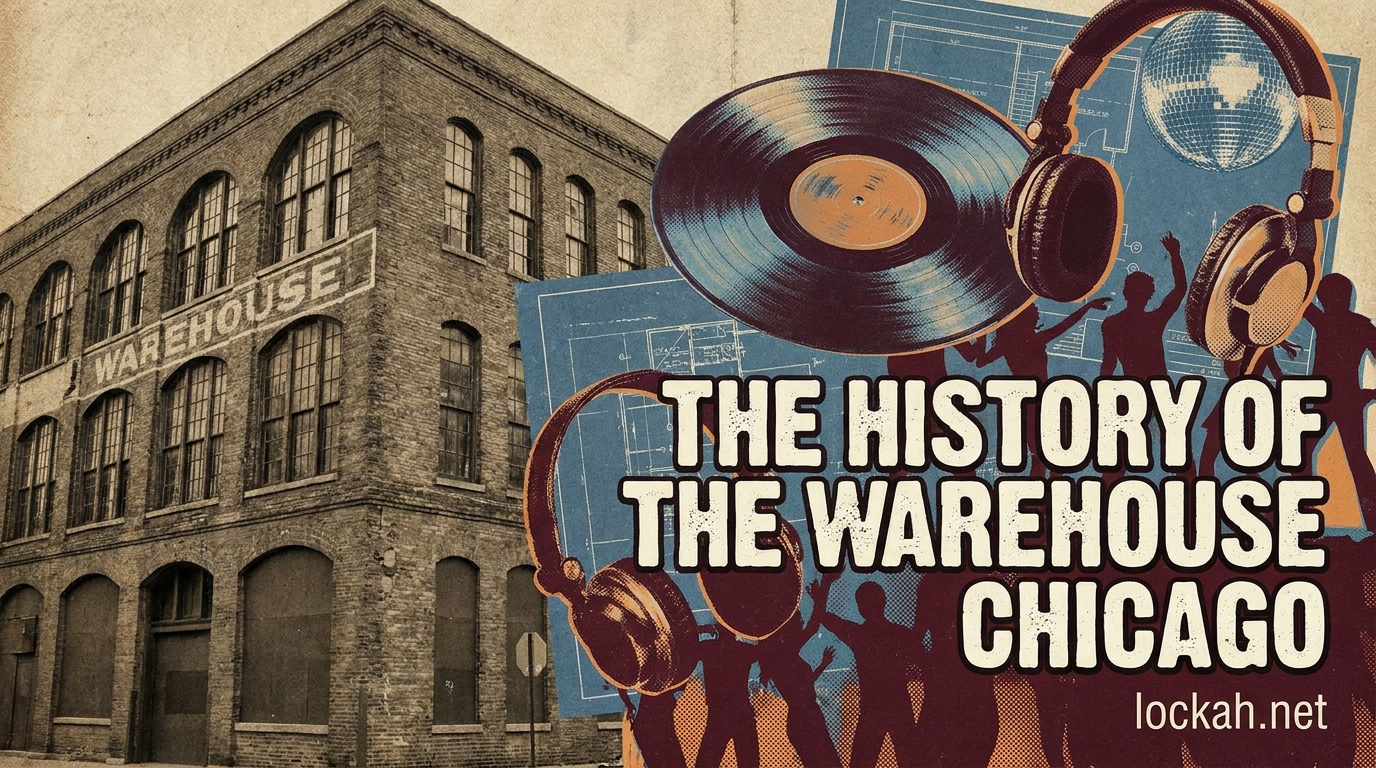
The Warehouse at 206 South Jefferson Street in Chicago gave birth to an entire genre of music. House music literally takes its name from this unassuming brick building in the city’s West Loop. What began as an underground club for Black and LGBTQ communities in 1977 would transform global music culture forever.
Our team spent months researching the origins of house music, interviewing historians, and poring over archival accounts from the 1970s Chicago nightlife scene. The story of The Warehouse reveals how one visionary club owner and a brilliant DJ created something entirely new from existing musical elements.
Between 1977 and 1982, The Warehouse operated as a private after-hours club where Frankie Knuckles pioneered techniques that would define electronic dance music. The club closed over four decades ago, yet its influence resonates through every beat drop at modern music festivals.
Table of Contents
The Warehouse Origin Story: How a Chicago Nightclub Changed Music History?
Robert Williams never set out to create a musical revolution. As a juvenile counselor working in New York City during the early 1970s, he witnessed the emergence of disco culture at clubs like Studio 54 and the Paradise Garage.
Williams moved to Chicago in 1977 with a specific vision. He wanted to create a space where marginalized communities could gather safely and experience something different from mainstream nightlife. The location he chose was a three-story former factory building at 206 South Jefferson Street in what was then an industrial section of the West Loop.
The building itself shaped the experience. High ceilings, industrial architecture, and ample space allowed for both dancing and socializing. Williams installed a private membership system that created exclusivity while maintaining accessibility for the communities he wanted to serve.
The Warehouse operated from midnight Saturday until noon Sunday, with marathon parties that defined the weekend for its regulars. Admission cost four dollars at the door, and the juice bar served non-alcoholic beverages to keep dancers hydrated through hours of continuous movement.
The crowd reflected Williams’ intentional community building. Black, gay, and alternative Chicagoans found refuge here during an era when mainstream venues often rejected or marginalized them. This demographic reality would fundamentally shape the sound and culture that emerged from The Warehouse.
Robert Williams described his motivation in a 2018 interview: “I wanted to create something that was missing in Chicago. I saw what Larry Levan was doing at the Paradise Garage in New York, and I knew Chicago needed that same kind of space for our communities.”
Frankie Knuckles and the Musical Innovation That Created House Music
Williams knew he needed the right musical director to realize his vision. He recruited Frankie Knuckles from New York City in 1977, where Knuckles had been learning his craft alongside Larry Levan at the Continental Baths and later the Paradise Garage.
Knuckles arrived in Chicago with crates of records and an experimental mindset. He immediately began reshaping the disco sound that dominated mainstream clubs, pushing into territory that would eventually be recognized as house music.
The musical innovation at The Warehouse relied heavily on technical infrastructure. Williams commissioned Richard Long and Associates, the same sound design firm that equipped the Paradise Garage, to install a custom system at 206 South Jefferson. This investment in audio quality allowed Knuckles to manipulate sound in ways that standard club equipment couldn’t support.
Knuckles developed several signature techniques that defined the emerging house sound. He blended disco foundations with funk bass lines, layered European electronic pop synthesizers, and incorporated drum machines to extend and enhance tracks. The four-on-the-floor bass drum pattern became the rhythmic foundation, providing steady momentum that kept dancers moving for hours.
His editing skills transformed existing records into something new. Knuckles would take disco tracks and strip away excess elements, isolating drum breaks and bass lines while adding his own synthesizer parts. He used a reel-to-reel tape machine to create extended versions that maintained energy on the dance floor.
The sound effects became part of The Warehouse’s signature atmosphere. Knuckles would drop in train sounds, simulating the sensation of a locomotive passing through the station near the club. Brass stabs and orchestral hits punctuated the extended mixes, creating dramatic moments that the crowd anticipated and celebrated.
Lori Branch, a regular patron from those early years, recalled the experience: “When Frankie played, the entire building felt like it was breathing. The bass would hit your chest, and those sound effects he used made you feel like you were somewhere else entirely. It wasn’t just dancing. It was transformation.”
Frederick Dunson, who would later document Chicago’s underground club history, described Knuckles’ approach: “Frankie wasn’t just playing records. He was creating an environment where the music became a living thing. He understood that the dance floor was a communal space, and he built the soundtrack for that community.”
These innovations at The Warehouse between 1977 and 1982 established the template for house music production. The emphasis on rhythm, the extended format, the electronic elements, and the community-focused atmosphere all originated here.
Cultural Impact: The Warehouse as a Sanctuary for Chicago’s Underground Communities
The Warehouse opened during a pivotal moment in American cultural history. The disco backlash of 1979, culminating in Chicago’s infamous Disco Demolition Night at Comiskey Park, created a hostile environment for dance music and the communities that embraced it.
While mainstream culture rejected disco, The Warehouse provided continued refuge for those who found meaning and community in dance music culture. The club’s private membership model and after-hours operation insulated it from the commercial pressures and cultural backlash affecting public venues.
The intersection of Black and LGBTQ identities defined The Warehouse’s community. During the late 1970s and early 1980s, spaces that welcomed both demographics simultaneously were rare. The Warehouse intentionally created an environment where Black and brown queer Chicagoans could express themselves freely.
This intersectionality shaped house music’s emotional character. The genre carries the urgency of marginalized experience, the celebration of survival, and the communal release of collective dancing. These elements emerged directly from The Warehouse’s specific cultural context.
The marathon parties fostered deep community bonds. When dancers spent eight to twelve hours together in continuous movement, relationships formed that extended beyond the club walls. The Warehouse became a social hub where people met partners, formed friendships, and built chosen families.
The juice bar rather than alcohol service kept the focus on dancing rather than drinking. This policy supported the endurance dancing that defined Warehouse culture and created an atmosphere distinct from typical nightlife venues.
Frankie Knuckles recognized this community dimension as essential to the music. He programmed his sets to build emotional arcs that reflected the collective experience of the crowd. The music responded to the dancers, and the dancers responded to the music, creating a feedback loop of energy and expression.
Timeline of The Warehouse: 1977-1982
1977: Robert Williams opens The Warehouse at 206 South Jefferson Street. Frankie Knuckles arrives from New York City to serve as musical director and resident DJ. The private membership club begins operating Saturday midnight to Sunday noon.
1978: Richard Long and Associates completes installation of the custom sound system. The technical infrastructure enables the sonic experimentation that defines early house music. Regulars establish the patterns of marathon dancing that characterize Warehouse culture.
1979: Disco Demolition Night at Comiskey Park marks the peak of anti-disco backlash. The Warehouse becomes increasingly important as mainstream venues abandon dance music. Frankie Knuckles refines his editing techniques and begins incorporating more electronic elements.
1980: The Warehouse reaches peak attendance and cultural influence. The house sound crystallizes as Knuckles perfects the blend of disco, funk, and European synthesizer music. Word spreads beyond the original community, attracting curious music fans from across Chicago.
1981: Musical innovation accelerates with increased use of drum machines and synthesizers. The distinction between disco and the emerging house sound becomes apparent to regulars. Other Chicago DJs begin attempting to replicate The Warehouse’s atmosphere at different venues.
1982: The Warehouse closes its doors. Frankie Knuckles moves to a new venue called the Power Plant, located in the Chicago Loop. The original building at 206 South Jefferson transitions to other commercial uses, but its musical legacy continues growing.
From Chicago to the World: How House Music Spread Globally?
When The Warehouse closed in 1982, the culture it created did not disappear. Frankie Knuckles brought the sound to the Power Plant, where he continued developing the genre. Other Chicago DJs who had experienced The Warehouse began opening their own venues and producing records.
The term “house music” emerged organically from this period. Record stores in Chicago began categorizing the music Knuckles and others played as “house” music, referencing its origin at The Warehouse. The name stuck and eventually described an entire genre.
Local high school parties and basement events spread house music throughout Chicago’s South and West Sides during the early 1980s. Teenagers who couldn’t access the original Warehouse experienced the music at these underground events, becoming the next generation of DJs and producers.
Jesse Saunders released “On & On” in 1984, widely recognized as the first house music record produced specifically for the genre. The track incorporated drum machines and synthesizers in the style Knuckles pioneered, proving that house music could exist as recorded material rather than just live performance.
Other Chicago pioneers emerged during this period. Chip E, known as the “Godfather of House Music,” helped codify the genre through his productions and advocacy. Farley Jackmaster Funk brought house music to radio, broadcasting the sound to wider audiences.
The international breakthrough came in 1986 when Farley Jackmaster Funk’s “Love Can’t Turn Around” became a hit in the United Kingdom. British audiences embraced Chicago house enthusiastically, developing their own variations including acid house.
From the UK, house music spread across Europe and eventually returned to the United States as part of the rave movement of the 1990s. Each regional adaptation retained elements of the original Warehouse sound while incorporating local influences.
The evolution continued into modern electronic dance music. Trance, drum and bass, techno, and contemporary EDM all trace lineage back to the innovations at 206 South Jefferson Street. The four-on-the-floor beat remains the foundation of global dance music 2026.
Legacy and Modern Recognition: The Warehouse Today
The building at 206 South Jefferson Street received official recognition as a Chicago Landmark on June 21, 2023. The designation ceremony acknowledged the site’s role in creating house music and preserving Black and LGBTQ cultural history.
This landmark status protects the building’s exterior and ensures recognition of its historical significance. While the interior no longer functions as a nightclub, the structure itself remains preserved as a physical monument to musical innovation.
Chicago had previously honored Frankie Knuckles through city council action. In 2004, the city declared August 25 as Frankie Knuckles Day, commemorating the DJ’s birthday and his contributions to Chicago’s cultural heritage.
The Frankie Knuckles record collection now resides at the Stony Island Arts Bank on Chicago’s South Side. This archive preserves thousands of records that Knuckles played during his residency at The Warehouse and throughout his career. Musicologists and fans can access this material to study the sources that shaped house music.
Chicago continues celebrating house music through annual events. The Chicago House Music Festival brings thousands of attendees to Millennium Park each summer. The Chosen Few Picnic, hosted by the DJ collective of the same name, gathers house music pioneers and contemporary artists.
Modern venues in Chicago maintain connections to Warehouse traditions. Smartbar, operating since 1982, continues the tradition of extended DJ sets and community-focused dance floors. ARC Music Festival, launched in 2021, brings international electronic artists to Chicago while acknowledging the city’s foundational role.
Frankie Knuckles passed away in 2014, but his influence persists through every DJ who blends tracks, extends mixes, and creates community through dance music. The techniques he developed at The Warehouse remain standard practice in electronic music production 2026.
Educational institutions now recognize house music’s significance. Universities offer courses on electronic music history that inevitably center Chicago and The Warehouse. Music production programs teach the techniques Knuckles pioneered using modern digital tools.
Frequently Asked Questions
Is Chicago the birthplace of house music?
Yes, Chicago is universally recognized as the birthplace of house music. The genre emerged from The Warehouse nightclub at 206 South Jefferson Street between 1977 and 1982. Frankie Knuckles, the club’s resident DJ, pioneered the techniques that defined house music by blending disco, funk, and electronic elements.
Is The Warehouse the birth of house music?
The Warehouse is specifically associated with the birth of house music. The genre takes its name from this Chicago club, where Frankie Knuckles served as musical director from 1977 to 1982. The building was designated as a Chicago Landmark on June 21, 2023, recognizing its role in creating house music.
Who is the founding father of house music in Chicago?
Frankie Knuckles is considered the founding father and “Godfather of House Music” in Chicago. As the resident DJ at The Warehouse starting in 1977, he developed the techniques that defined the genre, including blending disco with electronic elements, using drum machines, and creating extended dance mixes.
Why is Chicago considered the birthplace of house music?
Chicago is the birthplace of house music because The Warehouse nightclub, located at 206 South Jefferson Street, gave the genre its name and its foundational sound. Between 1977 and 1982, Frankie Knuckles pioneered the musical techniques that defined house music while serving as the club’s resident DJ.
What came first, Chicago house or Detroit techno?
Chicago house came first. The Warehouse opened in 1977, and house music was already taking shape by the early 1980s. Detroit techno emerged later, in the mid-1980s, pioneered by artists like Juan Atkins, Derrick May, and Kevin Saunderson who were influenced by European electronic music and Chicago house.
Why is the Warehouse a Chicago landmark?
The Warehouse at 206 South Jefferson Street was designated a Chicago Landmark on June 21, 2023, because it is the birthplace of house music. The club operated from 1977 to 1982 and gave the genre its name. Frankie Knuckles developed the techniques that defined house music during his residency there.
Conclusion: The Enduring Legacy of The Warehouse
The history of the Warehouse Chicago and the birth of house music represents one of the most significant cultural innovations of the late twentieth century. What began as an underground refuge for marginalized communities transformed into a global musical movement that continues shaping popular culture 2026.
Robert Williams’ vision and Frankie Knuckles’ musical genius combined at 206 South Jefferson Street to create something unprecedented. The techniques, community values, and sonic innovations developed between 1977 and 1982 established foundations that still support electronic dance music worldwide.
Understanding this history matters because it recognizes the Black and LGBTQ pioneers who created house music while facing marginalization themselves. Their artistic innovations emerged from specific cultural struggles and triumphs that deserve acknowledgment and respect.
The next time you hear a four-on-the-floor beat at a music festival, remember The Warehouse. Remember Frankie Knuckles blending records in that industrial building in Chicago’s West Loop. The sound you’re hearing started there.