
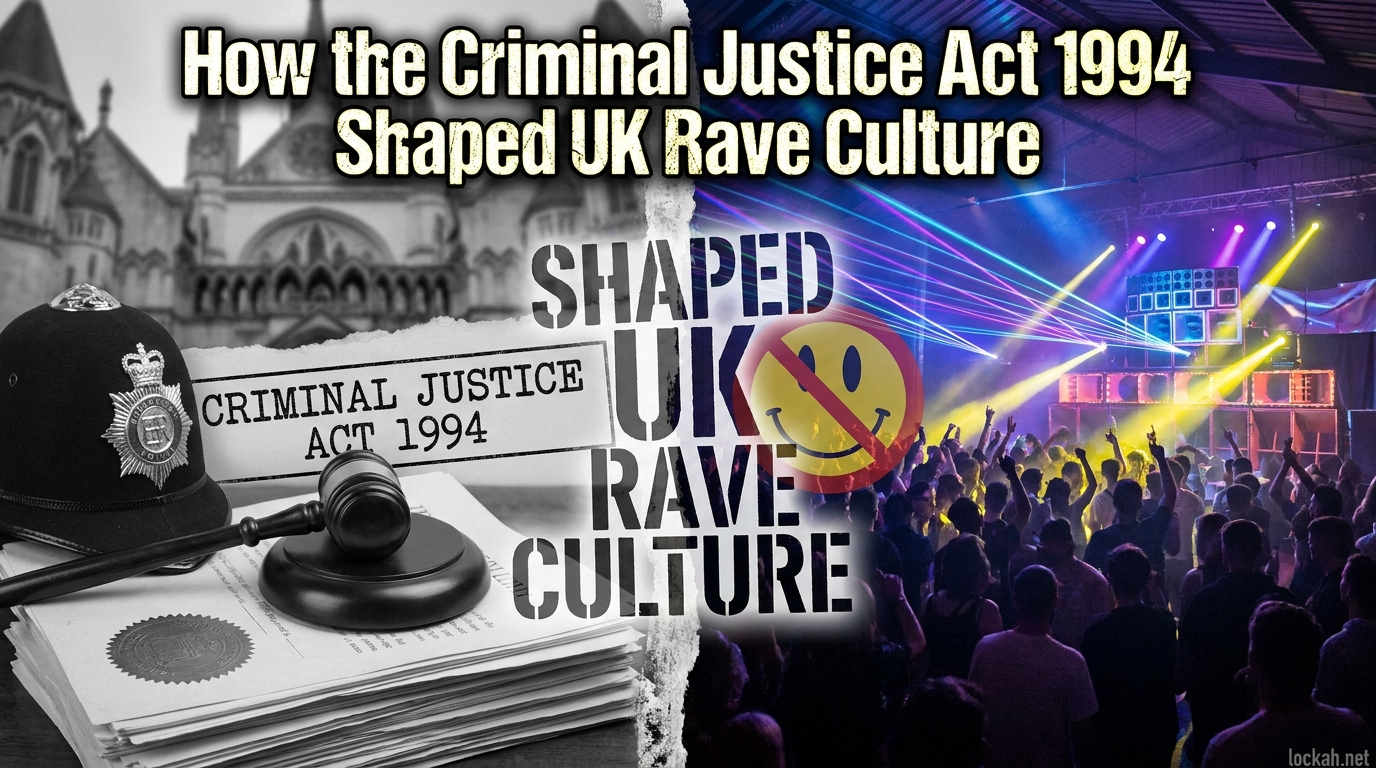
In 2026, it is difficult to imagine a law so specific it defines a genre of music. Yet thirty years ago, the British government did exactly that. The Criminal Justice and Public Order Act 1994 became the first legislation in British history to criminalize not just a gathering, but a sound. The now-infamous phrase “a succession of repetitive beats” entered legal vocabulary, and with it, the entire landscape of UK dance music changed forever.
Our team has spent months researching the events that led to this landmark legislation. We have spoken to those who were there, pored over archive footage, and traced how a single festival in the Malvern Hills sparked a cultural crackdown that resonates through British nightlife to this day.
This article explains what the act actually said, why it was introduced, and how it reshaped UK rave culture into what we know now. Whether you are a historian, a dance music enthusiast, or simply curious about this peculiar chapter of British law, you will find everything you need here.
Table of Contents
What Was the Criminal Justice and Public Order Act 1994?
The Criminal Justice and Public Order Act 1994 was a sweeping piece of legislation introduced by Home Secretary Michael Howard under John Major’s Conservative government. While the act covered many areas of criminal law and public order, Section 63 specifically targeted what it called “raves”.
The law defined a rave as a gathering of 100 or more people listening to music at night. Under its provisions, a police superintendent could order the event to stop, turn back ravers within a five-mile radius, and seize sound equipment. Anyone refusing to comply faced up to three months imprisonment or a £2,500 fine.
The legislation was remarkably broad. It covered any gathering of 20 or more people preparing for a rave, and extended police powers to stop people on their way to suspected events. The act also strengthened trespass laws, making it easier to evict travellers and squatters.
What made this law unique was not its severity but its specificity. Previous public order legislation had targeted gatherings broadly. The 1994 act named the exact type of music being played. This precision was unprecedented.
The ‘Repetitive Beats’ Legal Definition
The most famous section of the act is the definition of the music it sought to suppress. Section 63 defines music at a rave as:
“Sounds wholly or predominantly characterised by the emission of a succession of repetitive beats.”
This wording has been mocked for over three decades. The absurdity is obvious. By this definition, the military march Colonel Bogey qualifies as rave music. So does reggae, house, techno, drum and bass, and most pop music produced since 1980.
The legal vagueness was deliberate. The government wanted a definition broad enough to cover any electronic dance music event, without being so specific that organisers could simply switch genres to evade the law. Yet in doing so, they created something almost parodic.
Electronic music producers quickly spotted the loophole. If the law targeted repetitive beats, what about music that avoided repetition? This legal absurdity would later inspire direct artistic responses.
Castlemorton: The Catalyst
To understand why the Criminal Justice Act became law, you must understand what happened at Castlemorton Common in May 1992. This was the festival that scared the British establishment into action.
Castlemorton was meant to be a small gathering. The Avon Free Festival had been running for years without major incident. But when police pressure forced the event to relocate, it collided with Spiral Tribe, a nomadic sound system travelling the country. The result was unlike anything Britain had seen before.
Between 20,000 and 40,000 people descended on the Malvern Hills in Worcestershire. For a week, the common became a temporary city of sound systems, tents, and dancers. There were no tickets, no sponsors, and no official permission. The gathering operated on principles of free access and mutual aid.
The authorities were unprepared. Local residents complained about noise. The media descended, producing sensationalist coverage of the “raver invasion.” Politicians watched with alarm as a self-organised youth event demonstrated that thousands of young people could live, work, and party outside state control.
The government response was swift. Within months, the Conservative Party began drafting legislation specifically designed to prevent another Castlemorton. The festival had proven that the free party movement could scale beyond anyone’s expectations. That scared them.
Sound System Culture Under Threat (2026)
The Criminal Justice Act did not target raves in the abstract. It targeted a specific way of living and organising culture. Sound systems like Spiral Tribe and DiY Sound System represented something more threatening than loud music. They represented a culture outside wage labour and consumerism.
Spiral Tribe were not merely DJs. They were a collective of artists, builders, and activists who travelled in convoys of repurposed trucks and buses. They set up their own events, ran their own power, and lived communally. Their ethos was DIY in the truest sense.
DiY Sound System, based in Nottingham, took a similar approach. They were political. They were vocal. They refused to operate within the licensed club economy. This rejection of commercialism made them targets.
The class dimensions are hard to ignore. The free party scene was predominantly working class and traveller. These were young people without property or conventional prospects, creating their own culture with their own resources. The legislation that followed was drafted by wealthy politicians who had never attended such an event and saw only disorder.
The act’s provisions against trespass particularly hurt traveller communities. By strengthening landowner rights and police eviction powers, it attacked the mobile lifestyle that sound systems depended upon. The law was as much about who could live how as it was about noise.
The Anti-CJB Protests of 1994
The Criminal Justice Bill, as it was then known, did not pass without resistance. Throughout 1994, protests erupted across the country. The most significant were three major demonstrations in London.
The first took place on May 1, 1994. Thousands marched through central London, dancing through the streets to sound systems mounted on trucks. The protest was colourful, musical, and defiant. It demonstrated that the community the bill sought to suppress was not going quietly.
Police response was heavy-handed. At Acton Lane in West London, officers used a JCB digger to try to stop sound systems from reaching the protest. There were clashes. There were arrests. Images of police violence against peaceful protesters appeared in newspapers the next day.
The second major protest came in July 1994. This was angrier, more confrontational. The third, in October, was smaller but still significant. Each demonstration drew thousands, many of whom had never attended a rave but objected to the criminalisation of youth culture.
Notably, the Labour Party did not oppose the bill. Tony Blair’s New Labour was in the process of repositioning itself as tough on crime. The parliamentary opposition that might have been expected simply was not there. This left the protests to the streets.
Music Industry Response: The ‘Repetitive Beats’ EP
The music community responded in the best way they knew how. Through sound. The most direct response came from Autechre, the pioneering electronic duo from Rochdale.
In 1994, Autechre released the Anti EP. The final track, “Flutter,” was deliberately composed to evade the legal definition. The beat changes every 16 bars, never settling into repetition. It was electronic dance music that was technically legal under the act’s wording.
The sleeve notes explained the reasoning. Autechre wanted to demonstrate the absurdity of legislating music. They also wanted to give DJs a track they could play without technically breaking the law.
Orbital, then riding high on the success of Halcyon and their Glastonbury performances, also voiced opposition. The brothers Hartnoll attended protests and spoke against the bill in interviews. They were at the height of their commercial success, which lent their opposition weight.
The Prodigy took a different approach. Their album Music for the Jilted Generation, released in 1994, was conceived partly in response to the act. Tracks like “Their Law” explicitly referenced the conflict between ravers and police. The album became an anthem for a generation feeling targeted by their own government.
Other protest tracks emerged. Mixmag released a compilation titled Repetitive Beats featuring artists who wanted to make their opposition known. The music industry, often portrayed as purely commercial, showed solidarity with the underground.
The Legacy: Underground Persistence vs. Superclub Rise
The Criminal Justice Act passed in November 1994. It did not kill rave culture. Instead, it transformed it. Two distinct paths emerged from the crackdown.
The first was the rise of the superclub. Ministry of Sound, Cream, Gatecrasher, and others built massive venues with proper licenses. They offered a controlled version of the rave experience. Entry was ticketed, security was present, and profits were declared. These clubs thrived in the late 1990s and early 2000s.
The second path was underground persistence. Free parties continued, but became harder to find. Sound systems developed sophisticated methods for avoiding police detection. The culture went deeper underground, becoming more secretive and more resilient.
Some of the scene moved abroad. The European teknival movement, particularly in France and the Czech Republic, became the continuation of British free party culture. Spiral Tribe relocated to France, where they helped establish the teknival tradition that continues today.
The modern festival industry owes its DNA to this era. The techniques of site management, the ethos of temporary autonomous zones, and even the music itself all trace back to the free party movement the act tried to suppress. Glastonbury’s dance music areas, the commercial success of Creamfields, and the entire EDM festival economy emerged from this culture.
Most importantly, the law failed in its primary objective. The free party scene was never eliminated. It was pushed underground, changed shape, and became harder to track. But it never died. Today, if you know where to look, you can still find gatherings operating on the same principles as Castlemorton. They are smaller, more careful, but still alive.
FAQs
What did the Criminal Justice Act 1994 say about raves?
The Criminal Justice and Public Order Act 1994 defined a rave as a gathering of 100 or more people listening to music at night. Section 63 gave police superintendents powers to order such events to stop, turn back attendees within a five-mile radius, seize sound equipment, and arrest those who refused to comply. Penalties included up to three months imprisonment or a £2,500 fine. The act specifically defined the music as ‘sounds wholly or predominantly characterised by the emission of a succession of repetitive beats.’
Why was the Criminal Justice Act 1994 introduced?
The act was introduced following the Castlemorton Common Festival in May 1992, where 20,000 to 40,000 people gathered for a week-long free festival. The Conservative government under Home Secretary Michael Howard viewed this as a threat to public order. The media portrayed the event as an ‘invasion’ by lawless ravers, creating political pressure to act. The government sought to suppress the free party movement and strengthen powers against trespass, particularly affecting traveller communities.
How did the Criminal Justice Act affect rave culture?
The act split rave culture into two paths. First, it drove the rise of licensed superclubs like Ministry of Sound and Cream, which offered a commercial, legal alternative. Second, it pushed the underground free party scene deeper into secrecy. Sound systems developed methods to avoid detection. Some of the culture relocated to Europe, particularly France and the Czech Republic, where the teknival movement flourished. The act failed to eliminate the scene but fundamentally altered its structure.
What happened at Castlemorton festival?
Castlemorton Common Festival took place in May 1992 in Worcestershire, England. What began as the relocated Avon Free Festival collided with the Spiral Tribe sound system, attracting between 20,000 and 40,000 people. The week-long event had no official organisation, tickets, or sponsors. Police were unprepared for the scale. Media coverage was sensationalist, portraying ravers as a threat to local residents. The festival became the catalyst for the Criminal Justice Act, demonstrating to politicians that free parties could scale beyond control.
What is the ‘repetitive beats’ definition in UK law?
Section 63 of the Criminal Justice and Public Order Act 1994 defines music played at a rave as ‘sounds wholly or predominantly characterised by the emission of a succession of repetitive beats.’ This definition was intended to target electronic dance music but was so broad it technically included most popular music genres. The phrase became infamous and was later mocked by artists, including Autechre who composed the track ‘Flutter’ specifically to evade this legal definition.
Conclusion
The Criminal Justice Act 1994 was a failure by its own standards. It did not stop free parties. It did not eliminate sound system culture. It did not prevent another Castlemorton. What it did do was reshape UK dance music into the commercial and underground forms we recognise today.
How the Criminal Justice Act 1994 shaped UK rave culture is a story of suppression and survival. The law tried to criminalise a generation’s music, and that generation responded by going deeper, moving abroad, or building legitimate institutions. The beats were never truly silenced. They just found new ways to play.