
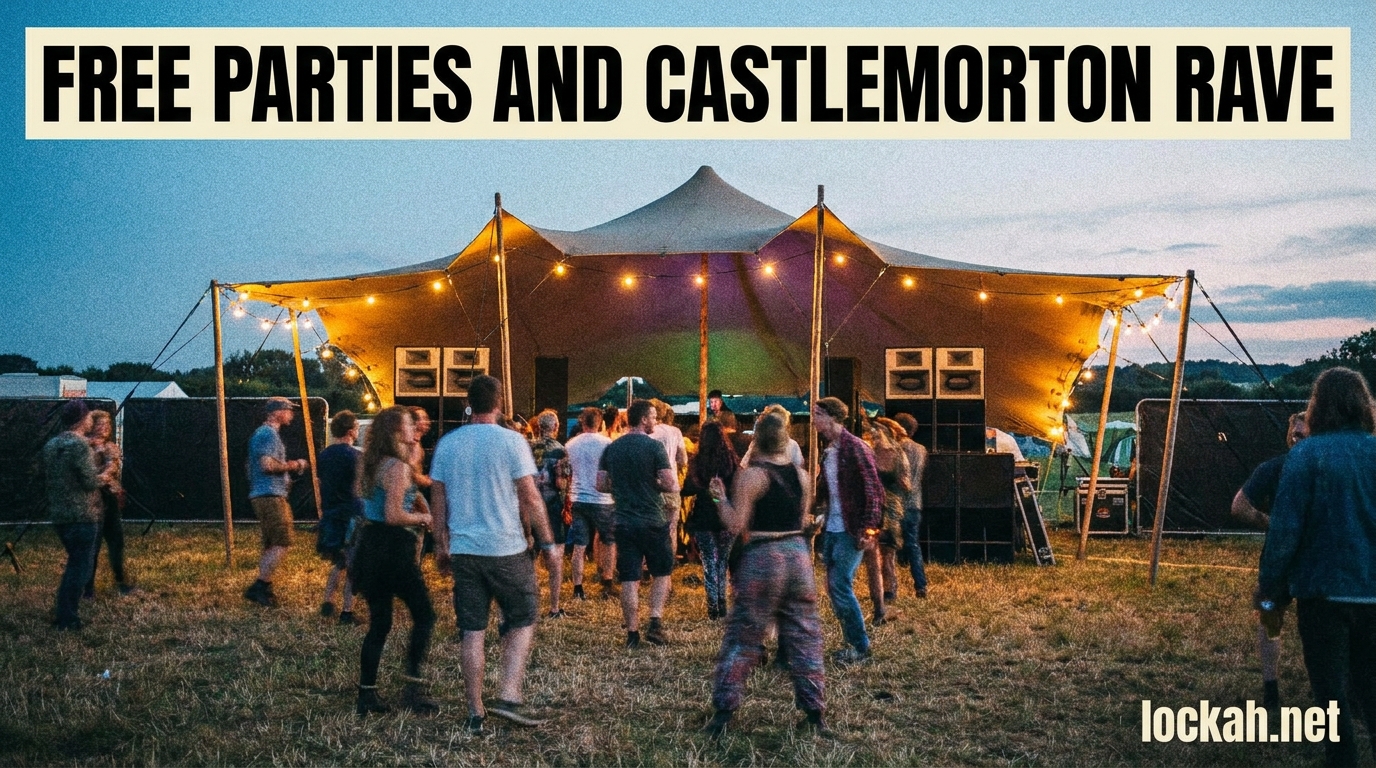
Imagine a field in rural England where 40,000 people gather for an entire week. No tickets. No sponsors. No security gates. Just sound systems, dancing, and a community built on the radical idea that music should be free for everyone. This actually happened in May 1992 at Castlemorton Common in Worcestershire, and it changed British law forever.
The history of free parties and the Castlemorton rave represents one of the most significant moments in UK counterculture. It brought together New Age Travellers, acid house enthusiasts, and sound system crews in a collision between underground electronic music and establishment authority. What emerged from that week-long festival would shape not only rave culture but legislation that still affects public gatherings today.
In this guide, I will walk you through the origins of the free party movement, what actually happened at Castlemorton, the key players involved, and how the British government responded with the Criminal Justice and Public Order Act 1994. Whether you are researching UK cultural history, exploring electronic music roots, or simply curious about one of the most remarkable festivals ever held, this is the complete story.
The History of Free Parties and the Castlemorton Rave (2026)
The free party movement emerged from a unique convergence of cultural forces in Britain during the late 1980s. Understanding Castlemorton requires understanding what came before it.
Acid House and the Second Summer of Love
In 1988 and 1989, Britain experienced what became known as the second summer of love. Acid house music, imported from Chicago and Detroit, swept through warehouse parties in London, Manchester, and beyond. Events like Shoom and Spectrum drew thousands of young people to all-night gatherings characterized by the distinctive squelch of the Roland TB-303 bass synthesizer and the four-on-the-floor beats that defined the era.
These parties were largely unlicensed, often taking place in empty industrial spaces. They represented something new in British youth culture: a movement built around communal experience rather than consumption. The drug ecstasy played a significant role in shaping the atmosphere, creating a sense of unity and openness that contrasted sharply with the aggressive individualism of Thatcher-era Britain.
New Age Travellers and the Peace Convoy
Running parallel to the acid house explosion was the New Age Traveller movement. Beginning in the early 1980s, hundreds of people took to the roads in converted buses and trucks, living nomadically and following a seasonal circuit of free festivals. The peace convoy, as it became known, traced its roots to the hippie culture of the 1960s and the free festival scene that had grown around events like the Windsor Free Festival and the original Glastonbury Fayre.
These travellers lived outside conventional society, often squatting land and generating their own electricity through generators. They developed sophisticated mobile sound systems, powered by diesel generators, capable of delivering serious volume in remote locations. This infrastructure would prove essential to the free party movement that followed.
Birth of the Sound System Culture
By the late 1980s, several key sound systems had emerged that would define the free party scene. Spiral Tribe formed in London in 1990, bringing together a collective of DJs, artists, and activists committed to the ethos of free parties. Their name came from the idea that society operated in spirals rather than straight lines, and they embraced a DIY aesthetic that rejected commercial dance music culture.
Other crews like DiY Soundsystem from Nottingham, Bedlam, and Circus Warp developed their own followings. These were not just DJs playing records. They were mobile communities with their own generators, PA systems, lighting rigs, and crews who traveled together, setting up wherever they could find space.
The Road to Castlemorton
Understanding Castlemorton requires looking at what happened in the years before 1992. The free party scene had been growing steadily, but tensions with authorities were reaching breaking point.
Avon Free Festival Tradition
Since the early 1980s, a free festival had taken place annually in the Avon area during the spring bank holiday. These events were not centrally organized. Instead, they emerged organically as travellers and festival-goers converged on a particular location, often determined by word of mouth and informal networks.
By the late 1980s, these gatherings had grown substantially. The 1991 Avon Free Festival at Ashtead Meadow had drawn several thousand people. However, the event had also brought increased police attention, with authorities vowing to prevent future gatherings of this nature.
Battle of the Beanfield (1985)
The context for police attitudes toward traveller gatherings had been set seven years earlier at the Battle of the Beanfield. On June 1, 1985, a convoy of around 600 New Age Travellers heading to Stonehenge was stopped by police at a beanfield in Wiltshire. What followed became one of the most violent confrontations between police and civilians in modern British history.
Officers smashed vehicle windows, dragged people from their homes, and made mass arrests. The violence was documented by photographers including Alan Lodge, whose images would become iconic representations of state oppression against alternative culture. The Beanfield trauma remained fresh in the memory of travellers heading into the 1990s and shaped their expectations of how authorities might respond to Castlemorton.
Rising Tensions
By 1992, the Conservative government had made clear its intention to crack down on what it called illegal gatherings. The free party scene had grown throughout 1990 and 1991, with Spiral Tribe hosting increasingly ambitious events. The authorities were determined to prevent another Avon Free Festival from taking place.
What Was Castlemorton Common Festival
The Castlemorton Common Festival was a week-long free festival and rave held on common land in the Malvern Hills near Malvern, Worcestershire, England. It took place between May 22 and May 29, 1992, during the spring bank holiday weekend.
How the Gathering Formed
The event was not planned as such. Instead, it emerged from a convergence of different groups who had been prevented from gathering elsewhere. Police had blocked access to the traditional Avon Free Festival site, using vehicles to create roadblocks and diverting travellers away from the area.
As word spread that the Avon site was inaccessible, sound systems began redirecting toward Castlemorton Common. The location offered several advantages: it was common land with a legal right of access, it was accessible by road, and it was sufficiently remote to avoid immediate residential complaints. Spiral Tribe arrived and set up their sound system, and other crews followed.
What started as a few hundred people on Friday night grew exponentially through the weekend. By Sunday, thousands had arrived. By Monday, the bank holiday itself, estimates suggest between 20,000 and 40,000 people were on the site.
The Location: Malvern Hills, Worcestershire
Castlemorton Common sits in the Malvern Hills, an area of outstanding natural beauty in Worcestershire, near the border with Herefordshire. The common itself is open land that has historically been used for grazing and public access. In 1992, it provided a natural amphitheater with space for multiple sound systems, camping areas, and the infrastructure needed to support tens of thousands of people.
The site was not without its challenges. There was no running water, no sanitation facilities, and no medical infrastructure. Attendees brought their own supplies or relied on informal traders who arrived to sell food, water, and other necessities.
Attendance and Duration
The festival lasted seven full days, from Friday May 22 through Friday May 29. The exact number of attendees remains disputed. Conservative estimates suggest 20,000 people at the peak. Other sources claim up to 40,000 or even 50,000. What is clear is that it became the largest illegal rave in British history.
The crowd was diverse. New Age Travellers made up a significant portion, recognizable by their convoys of converted vehicles. Ravers arrived from cities across the UK, many having heard about the event through word of mouth or pirate radio. Local residents came to see what was happening. Journalists and photographers documented the scene.
The Sound Systems of Castlemorton
Castlemorton was defined by its sound systems. These mobile rigs provided not just music but the organizational structure around which the entire event coalesced.
Spiral Tribe: The Organizing Force
Spiral Tribe has become the name most associated with Castlemorton, and for good reason. The collective had been at the forefront of the free party movement since forming in 1990. They brought their entire operation to Castlemorton: generators, PA system, lighting, and crew.
The Spiral Tribe sound system played hardcore and breakbeat, the fast, energetic electronic music that defined the early 1990s rave scene. Their setup became one of the focal points of the gathering, drawing thousands to dance day and night.
After Castlemorton, Spiral Tribe faced significant legal consequences. Members were arrested and charged with public order offenses. The collective eventually left the UK, continuing to organize free parties across Europe where they helped spread the British free party ethos internationally.
DiY Soundsystem
DiY Soundsystem from Nottingham brought a different musical flavor to Castlemorton. While Spiral Tribe represented the harder edge of rave culture, DiY had roots in the house music scene and anarcho-punk culture. Their name explicitly referenced the DIY ethos of self-organization and rejection of commercial structures.
Founded by Harry Harrison and others, DiY had been building a following through events in the East Midlands. At Castlemorton, they provided an alternative to the harder sounds elsewhere on the site, playing deeper house and techno that reflected their different musical lineage.
Bedlam, Circus Warp, and Others
Bedlam was another significant presence at Castlemorton, bringing their own rig and crew to the event. Circus Warp, named for their distinctive yellow and black striped vehicles, also set up and played throughout the week. Other sound systems present included Circus Normal and the Techno Travellers.
Each sound system occupied its own area of the common, creating distinct zones with different music, atmospheres, and crowds. This decentralized structure was characteristic of free parties: there was no main stage, no headliners, no timetable. People moved between systems, following their preferences and the energy of the moment.
Life at the Festival
What was it actually like to be at Castlemorton? The testimonies from those who attended paint a picture of an extraordinary social experiment.
The Atmosphere
Attendees describe Castlemorton as unlike anything before or since. One person who was there for four days recalled sleeping perhaps six hours total, describing it as simply the best free party, festival, and rave in history. Others recall it as something out of Mad Max: movement, color, chaos, smoke from campfires, washing lines between vehicles, and constant dancing.
The atmosphere was remarkably peaceful given the numbers involved. With no alcohol license and a culture that favored ecstasy over aggression, the prevailing mood was one of openness and community. Strangers shared food, water, and shelter. The absence of commercial structures created a sense that everyone was in it together.
Music and Performance
The music at Castlemorton spanned the range of early 1990s electronic dance music. Hardcore and breakbeat dominated at Spiral Tribe and similar systems, with fast breakbeats and heavy bass lines designed for energetic dancing. House and techno played at DiY and other systems offered alternatives for those wanting something less intense.
There were no scheduled performances in the conventional sense. DJs played continuously, handing over to each other without announcement. Live performers occasionally joined, though the documentation of exactly who played remains incomplete.
Community Infrastructure
Despite the lack of formal organization, Castlemorton developed its own infrastructure. Food vendors arrived with mobile kitchens, selling cheap meals to hungry ravers. Informal medical support emerged, with people trained in first aid helping those who overexerted themselves or experienced drug-related difficulties. Sanitation remained a challenge, with trench latrines dug in appropriate areas.
The traveller community provided much of this infrastructure through experience gathered at previous festivals. They knew how to organize water distribution, manage waste, and keep large groups functional without external support.
Police Response and Political Fallout
The Castlemorton gathering did not go unnoticed by authorities. However, the police response was notably restrained compared to previous confrontations with travellers and ravers.
The Police Approach
Avon and Somerset Police had attempted to prevent the gathering by blocking access to the traditional Avon Free Festival site. When the event relocated to Castlemorton, responsibility shifted to West Mercia Police, who covered the Worcestershire area.
West Mercia adopted a containment strategy rather than direct confrontation. Recognizing that they lacked the resources to disperse 20,000 to 40,000 people, and mindful of the public relations disaster that had followed the Battle of the Beanfield, they opted to monitor the event and manage its eventual conclusion.
Police presence was visible but not aggressive. Officers set up observation posts and maintained checkpoints on access roads. There were arrests for drug offenses and vehicle-related crimes, but no attempt to shut down the event through force.
Media Coverage
The media response to Castlemorton was sensational and largely negative. Television news showed footage of ravers dancing in fields, portraying the event as a scene of chaos and lawlessness. Newspaper headlines emphasized drug use and the inconvenience to local residents.
However, coverage also acknowledged the peaceful nature of the gathering. Despite the numbers involved, there were few serious incidents of violence. The main complaints from locals concerned traffic, noise, and the absence of sanitation facilities.
Political Reaction
Castlemorton alarmed the Conservative government. The image of tens of thousands of young people gathering illegally, taking drugs, and rejecting mainstream society played into anxieties about social order. Michael Spicer, MP for West Worcestershire, raised the issue in the House of Commons, demanding action to prevent future occurrences.
The government concluded that existing legislation was insufficient to deal with free parties. Laws designed for traditional trespass and public order offenses did not address the specific nature of these gatherings: mobile, temporary, and involving technologies like sound systems that were not anticipated by older statutes.
The Criminal Justice and Public Order Act 1994
The most significant consequence of Castlemorton was legislative. The Conservative government set about drafting new laws specifically designed to prevent future free parties.
Section 63: Powers to Remove Trespassers
The Criminal Justice and Public Order Act 1994 received royal assent on November 3, 1994. Section 63 of the Act gave police new powers to remove trespassers from land. More significantly for the free party scene, Section 63(1)(b) defined the circumstances under which these powers could be exercised.
The Act allowed police to direct people to leave land if they were residing there in vehicles and if the police believed that they were likely to cause significant damage or disruption. This directly targeted the New Age Traveller lifestyle and the free party setup of vehicles, generators, and temporary encampments.
The Infamous Repetitive Beats Definition
Section 63(1)(b) became notorious for its attempt to define the music played at raves. The legislation gave police powers to shut down gatherings where sounds wholly or predominantly characterised by the emission of a succession of repetitive beats were being played.
This wording entered popular culture as a symbol of governmental overreach and misunderstanding of electronic music. Critics pointed out that many forms of music, from military marches to disco, could be characterized by repetitive beats. The phrase appeared on protest t-shirts, in songs, and in political commentary.
For the free party scene, the legislation was devastating. Police could now shut down gatherings before they even began, seizing sound equipment and arresting organizers. The threshold for intervention was lowered significantly, making it much harder to organize outdoor raves.
Broader Implications
The Criminal Justice and Public Order Act 1994 extended beyond music. It affected squatting rights, stop and search powers, and the rights of protesters. Critics argued that it represented an assault on civil liberties and targeted marginalized communities including travellers, ravers, and political activists.
The legislation also removed the obligation for local authorities to provide sites for travellers, worsening the already difficult living conditions for nomadic communities. Combined with the new powers against raves, the Act made the free party lifestyle increasingly precarious in the UK.
Legacy and Cultural Impact
Castlemorton and its aftermath shaped British cultural life in ways that continue to resonate 2026.
Impact on Festival Culture
The crackdown on free parties forced the dance music scene to adapt. Many of the energies that had fueled free parties flowed into the licensed festival scene. Events like Tribal Gathering, which began in 1993, attempted to capture the free party spirit within a legal framework. The explosion of superclubs in the mid-1990s offered indoor alternatives to outdoor raves.
By the late 1990s, the festival landscape had transformed. Licensed events like Creamfields and the revitalized Glastonbury Festival grew enormously, absorbing elements of rave culture while operating within regulatory frameworks. The free party scene never disappeared entirely, but it was pushed further underground and became more mobile and secretive.
Global Influence
The British free party ethos spread internationally, largely through the travels of crews like Spiral Tribe. France became a particularly significant location for free parties, with the Teknival movement hosting massive gatherings that drew inspiration from the UK model. The French authorities faced similar challenges, eventually developing their own legislative responses.
Eastern Europe, after the fall of communism, saw an explosion of free parties as young people embraced electronic music culture. The Czech Republic, Poland, and other countries hosted events that traced their lineage back to Castlemorton and the British scene.
Free Party: A Folk History
In 2023, a documentary titled Free Party: A Folk History was released, marking the 31st anniversary of Castlemorton. The film gathered testimonies from those who were there, creating an oral history of the event and its aftermath. It has become an important resource for understanding what Castlemorton meant to those who experienced it.
The documentary captures the tension between the euphoria of the free party scene and the repression that followed. Interviewees reflect on what was gained and what was lost, offering perspectives that have matured over three decades.
The Scene Today
Free parties still happen in the UK, though they are smaller and more secretive than in the early 1990s. Social media and encrypted messaging have replaced the word-of-mouth networks that organized Castlemorton. Police continue to monitor and shut down events, but the underlying desire for unmediated communal experience persists.
Contemporary discussions about the right to protest and public assembly have revived interest in the free party movement. Activists draw connections between the Criminal Justice Act and modern legislation like the Police, Crime, Sentencing and Courts Act 2022, arguing that the suppression of Castlemorton was part of a broader pattern of restricting public space.
Frequently Asked Questions
Where did free parties originate?
Free parties originated in the UK in the late 1980s, emerging from the intersection of acid house music culture and New Age Traveller communities. The movement combined electronic dance music with the traveller tradition of free festivals, using mobile sound systems to create temporary autonomous zones in rural locations. The first wave of free parties grew out of warehouse raves in London and the convoy culture of travelling communities.
When was the Castlemorton rave?
The Castlemorton Common Festival took place from May 22 to May 29, 1992. It lasted seven days, coinciding with the spring bank holiday weekend. The event began on a Friday when sound systems started arriving and setting up, reaching its peak attendance over the bank holiday Monday.
How many people attended Castlemorton?
Estimates of attendance at Castlemorton vary between 20,000 and 40,000 people, with some sources suggesting numbers as high as 50,000 at the peak. The exact figure is unknown because there were no gates, tickets, or official counting mechanisms. What is certain is that it was the largest illegal rave ever held in the UK.
What happened after Castlemorton?
After Castlemorton, the Conservative government passed the Criminal Justice and Public Order Act 1994, which gave police powers to shut down gatherings playing repetitive beats. Sound system crews faced arrests and legal action. Spiral Tribe left the UK and continued organizing free parties in Europe. The British free party scene was forced underground, eventually flowing into licensed festivals and superclubs.
Why was the Criminal Justice Act passed?
The Criminal Justice and Public Order Act 1994 was passed partly in response to Castlemorton. The government viewed the event as a breakdown of law and order, with thousands of people gathering illegally and using drugs. The Act specifically targeted the infrastructure of free parties, defining music characterized by repetitive beats and giving police powers to seize sound equipment and arrest organizers before events could begin.
What is the free party movement?
The free party movement was a countercultural phenomenon in the UK during the late 1980s and early 1990s. It involved mobile sound systems setting up temporary raves in rural locations, typically on common land or in disused spaces. Free parties had no admission charge, no commercial sponsorship, and no official organization. They were built around principles of autonomy, community, and free access to music and expression.
Conclusion
The history of free parties and the Castlemorton rave represents a pivotal moment in British cultural history. What began as a convergence of sound systems on a Worcestershire common became the largest illegal rave ever held in the UK, drawing tens of thousands of people into a week-long experiment in communal living and electronic music celebration.
The response to Castlemorton fundamentally changed the legal landscape for public gatherings in Britain. The Criminal Justice and Public Order Act 1994, with its infamous definition of music characterized by repetitive beats, gave authorities powers that continue to affect protest and assembly rights today. The free party scene was forced underground, but its influence spread globally through the travels of crews like Spiral Tribe.
For those who were there, Castlemorton remains a defining experience, remembered as a moment when something genuinely different seemed possible. For those studying it today, it offers lessons about the tension between state power and countercultural expression, the evolution of electronic music culture, and the enduring human desire to gather, dance, and create community outside commercial structures.
If you want to learn more, I recommend tracking down the documentary Free Party: A Folk History, reading the memoirs and oral histories from those who were there, and exploring the photography of Alan Lodge, whose images captured the visual reality of this remarkable moment in time.