
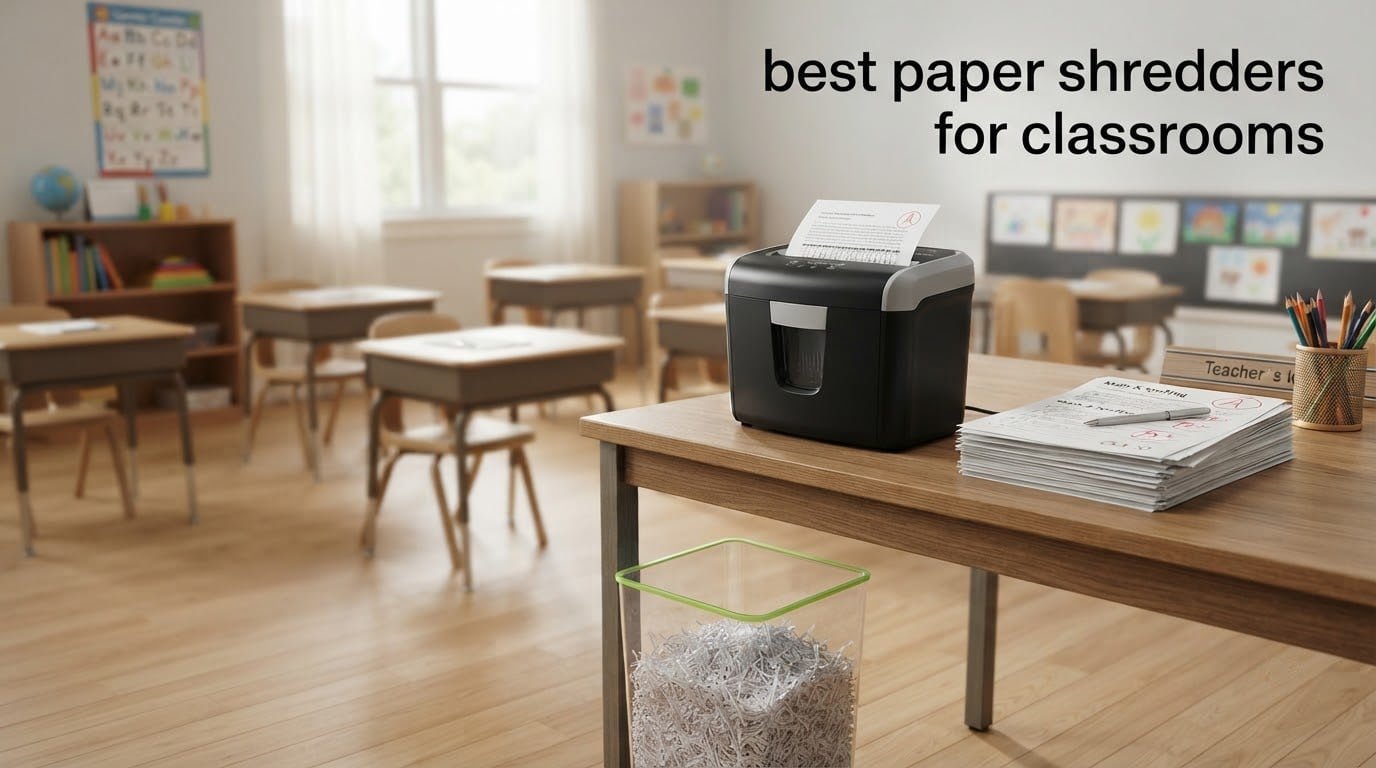
Quick answer: the Fellowes Powershred 99Ci is the best paper shredder for classrooms in 2026. It runs quietly at 62.1 dB, pulls 18 sheets per pass, cuts at P-4, and stops the blades the moment a hand gets close. Nine machines follow below, covering quiet shared rooms, elementary safety, high-security records and end-of-year purges.
Most paper shredder guides are written for a home office, where the machine lives behind a closed door and the only thing at risk is last year’s bank statements. A classroom is nothing like that. The machine sits in a room with 25 to 30 children, runs in the middle of a lesson, and destroys answer keys, graded work, student rosters, and IEP or 504 paperwork that carries real student information.
That changes what matters. Noise becomes the deciding factor rather than a footnote, because a shredder that talks over instruction gets unplugged by month two. Safety interlocks stop being a feature list item and start being the reason a machine is allowed to sit in a first-grade room at all. Bin size and duty cycle matter too, since a room that shreds a stack of assessments every Friday will not tolerate a three-minute run cycle.
We compared nine shredders against classroom-specific criteria: measured sound level where the manufacturer publishes one, security level, sheet capacity, continuous run time, bin volume, safety sensors and the physical footprint a teacher actually has room for. We read the full owner review history on each machine rather than relying on the star rating alone, because the complaints are where the classroom problems show up first. Every pick below is the same machine we would put in our own room, with the trade-off named honestly.
If your shredding needs are at a desk rather than in a classroom, start with our guide to paper shredders for home offices and our general home shredder roundup instead. The priorities are different in both cases.
Top 3 Picks for Classrooms in 2026
The three machines below cover the widest range of classroom duty. The 99Ci is the safe all-round pick, the Aurora is the security-first option, and the BONSEN is the one that survives a punishing end-of-year backlog.

Fellowes Powershred 99Ci
- 18 sheets per pass
- P-4 cross-cut
- 62.1 dB
- 9 gallon pull-out bin
- 30 min run time
Aurora AU1210MA Micro-Cut
- 12 sheets per pass
- P-4 micro-cut
- 60 min run time
- 5 gallon bin
- anti-jam auto reverse

BONSEN 20-Sheet Cross-Cut
- 20 sheets per pass
- P-4 cross-cut
- 60 dB or less
- 6.6 gallon bin on casters
All Best Nine Classroom Shredders at a Glance
The table below is the fast version. The full write-up on each machine follows, and the table is the one to screenshot if you are building a district purchasing list rather than shopping for a single room.
| Product | Specifications | Action |
|---|---|---|
| Fellowes Powershred 99Ci |
|
Check Latest Price |
| Aurora AU1210MA Micro-Cut |
|
Check Latest Price |
| BONSEN S3104 Cross-Cut |
|
Check Latest Price |
 Fellowes AutoMax 100MA Fellowes AutoMax 100MA |
|
Check Latest Price |
 Staples 12-Sheet Cross-Cut Staples 12-Sheet Cross-Cut |
|
Check Latest Price |
 Kitnery 400-Sheet P-5 Kitnery 400-Sheet P-5 |
|
Check Latest Price |
 Locksworth 110-Sheet Micro-Cut Locksworth 110-Sheet Micro-Cut |
|
Check Latest Price |
 Fellowes Powershred 12C15 Fellowes Powershred 12C15 |
|
Check Latest Price |
 Locksworth 6-Sheet Cross-Cut Locksworth 6-Sheet Cross-Cut |
|
Check Latest Price |
Quiet Enough for Classrooms: How to Read a Noise Number
Quick answer: yes, there are quiet paper shredders, and the ones rated around 56 to 62 dB can usually run without stopping instruction. A measured 75 dB machine is closer to a conversation at full volume, so it belongs in a resource room or office, not beside a reading group. For most classrooms, anything published at 60 dB or below is the safe target.
Decibels are logarithmic, so the numbers on packaging are less intuitive than they look. A 56 dB shredder is not a little louder than a 62 dB shredder; the gap is roughly a factor of two in perceived loudness. That is the difference between a machine a class tolerates and one a teacher switches off after a week.
Five of the nine machines in this roundup publish a noise figure, which is itself useful information. The Fellowes Powershred 99Ci is rated at 62.1 dB, the BONSEN S3104 at 60 dB or less, the Kitnery 400-Sheet at 56 dB, the Fellowes AutoMax 100MA at 75 dB and the Staples 12-Sheet at 72 dB. The Aurora AU1210MA, the Locksworth machines and the Fellowes Powershred 12C15 describe themselves as quiet without a number, so treat that as a marketing claim rather than a measurement.
Where a classroom is especially sensitive, a manual hand-crank shredder is worth a look. It makes no sound at all because it has no motor, and it removes the entire hand-injury question. The trade-off is speed, which is why we have not put one in the main list here: the fastest way to clear a ream of paper is still a motor, and a room with 30 students producing a stack of scored work is not a room where a teacher wants to crank.
Positioning matters as much as the number. A shredder on casters can be moved to the back of the room for the loud jobs and parked in a corner for routine use, which is one reason we favour pulled bins on wheels over fixed-head machines. If you want more on choosing for a home setup rather than a shared room, our home shredder guide covers the quiet-versus-fast trade-off in more detail.
1. Fellowes Powershred 99Ci: Best Overall Paper Shredder for Classrooms
Fellowes Powershred 99Ci 18-Sheet 100% Jam-Proof Heavy Duty Crosscut Paper Shredder Machine for Office and Home, Black/Gray 3229912
18 sheets per pass
62.1 dB
P-4 cross-cut
9 gallon bin
30 min run time
Pros
- P-4 cross-cut with SafeSense hand detection
- 18 sheets per pass clears thick stacks
- 30 minutes of continuous run time
- 9 gallon bin with LED full indicator
- 2 year warranty plus lifetime cutter warranty
Cons
- Casters are fiddly to install
- Bin plastic flexes if pushed hard
- Needs periodic blade oiling
Fellowes shredders are any good? For a classroom, yes, and the Powershred 99Ci is the reason. It carries an 18-sheet per pass cross-cut head at P-4 security, which is the combination most teachers end up wanting: enough capacity for a stack of graded worksheets, and small enough particles that a determined student cannot tape them back together. Owners also report long service lives on this head, with several describing machines still running after a decade of heavy use.
The 62.1 dB rating is the headline number here, and it is a measured figure rather than a marketing phrase. That puts it in the range a class can tolerate during instruction, which is unusual for a machine rated this high. The SafeSense hand-detection system stops the blades when it senses a hand near the entry slot, and that is the single feature that makes this machine defensible in a room with first graders in it.
Run time is 30 minutes before thermal cut-off, which comfortably covers a Friday stack-clearing session. The 9-gallon pull-out bin is the largest on most of this list and has an LED indicator that lights when it is full, so nobody has to lift the head and peer inside. The bin on casters means a teacher can empty it at a rolling bin rather than carrying shreds across the room, which is a bigger ergonomic win than it sounds like when you are doing it weekly.
Against the Aurora AU1210MA, the 99Ci wins on capacity, bin size and a published noise number, and loses on continuous run time and on particle size, since its cross-cut output is the coarser of the two. Against the smaller Fellowes Powershred 12C15, it is the same idea built for volume: more sheets per pass, a bigger bin and a proper caster system, at a step up in size. The 36.4-pound weight and 25.19 inch height mean this is a floor machine, not a desk machine, so plan the placement around that.
What the 99Ci handles that other machines choke on
The head takes staples, paper clips, credit cards, CDs and DVDs, plus unopened junk mail, which matters because junk mail arrives in a classroom post room in thick envelopes. Owners report using it on multi-year backlogs, not just daily destruction, so it holds up when a department finally does its filing cleanup.
Cross-cut particles at roughly 5/32 by 1-1/2 inches are coarse enough to sweep into a bin and coarse enough to see that the shredder worked. That is a practical advantage over micro-cut in a classroom, where shreds are handled by hand every week and dust-like output is a nuisance. It is a weaker answer to deliberate reconstruction than micro-cut, and for anything involving student health or special education records we would still look at the micro-cut options.
Where the 99Ci is the wrong choice
The complaints cluster around three things, and all three are fixable. Caster installation frustrates some owners, and the bin plastic flexes if it is shoved or dragged rather than rolled. The bin also fills faster than you would expect from a nine-gallon figure, because cross-cut output fluffs up rather than packing down.
Blade oiling is not optional on this machine. Owners who skip it and then complain about rough cutting are describing a maintenance problem rather than a defect, and the lifetime cutter warranty only means something if the oil schedule is kept. Plan for a light oil every few weeks of regular classroom use, and expect the thermal interlock to cut in after a long uninterrupted run.
2. Aurora AU1210MA: Best Paper Shredder for Confidential Student Records
Aurora AU1210MA Professional Grade High Security 12-Sheet Micro-Cut Paper/CD and Credit Card/ 60 Minutes Continuous Run Time Shredder
12 sheets per pass
P-4 micro-cut
60 min run time
5 gallon bin
LED status lights
Pros
- 4.7 average across 9k+ reviews
- 60 minutes of continuous run time
- Anti-jam auto reverse
- P-4 micro-cut handles cards and media
- 5 gallon pullout bin with LED indicators
Cons
- Noticeable first-use smell
- Stiff cord to route in tight spaces
The Aurora AU1210MA is the machine to buy when the paperwork is sensitive rather than merely confidential. P-4 micro-cut at 5/32 by 15/32 inches produces dust-like particles that are genuinely impractical to reassemble, which is the right standard for IEP and 504 plans, health information, discipline records and anything a family could reasonably expect to be protected. It runs on an AC adapter rather than a mains cord, which teachers notice when they are trying to route power to a corner.
It also holds a 4.7 average rating across more than 9,000 owners, matched only by the BONSEN in this group, and the volume of feedback matters here. At that review count, a problem would have shown up. What owners describe instead is consistency: strong jam resistance, long run time and quiet operation, with very little negative beyond first-use smell and cord handling.
The 60-minute continuous run time is the standout spec. Most compact shredders give you seven to twenty minutes before thermal cut-off, which means waiting through a cool-down period in the middle of a Friday cleanup. Sixty minutes means a teacher can put a whole box of scored work through without pausing, and a shared resource room can serve several teachers back to back. The anti-jam auto-reverse clears a misfeed on its own instead of requiring someone to open the head and pull the page out by hand.
Compared with the Fellowes Powershred 99Ci, the Aurora trades bin size and published noise data for security and run time: 5 gallons against 9, and micro-cut against cross-cut, with 60 minutes against 30. Where the 99Ci makes more sense is a room shredding ordinary graded work, where coarse particles are easier to sweep up and the bin gets emptied weekly anyway. Where the Aurora makes more sense is any room handling records that carry a legal weight.
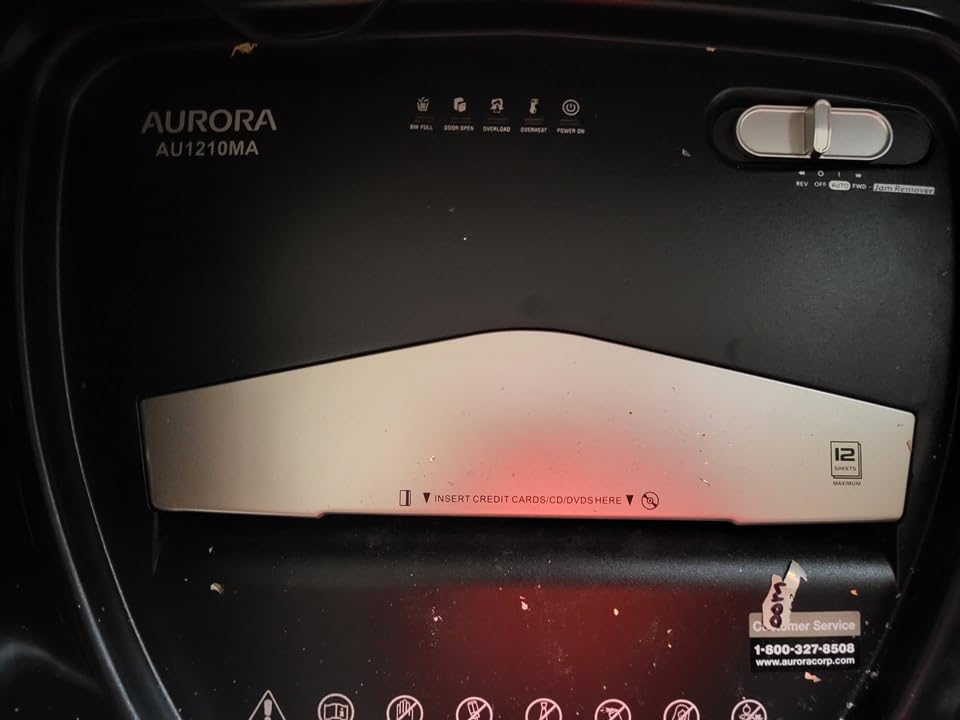
What the AU1210MA is built for
The head takes paper, CDs, DVDs, credit cards and small paper clips, so a room that destroys media along with paper does not need a second machine. The 5.0-gallon pullout bin carries LED status lights that report bin and jam conditions, which removes the most common classroom complaint about compact shredders: nobody knowing whether the machine is jammed or simply full.
At 22.4 pounds and 19.33 inches tall, this is a machine that can sit on a low cabinet rather than requiring a dedicated floor position. That matters in a self-contained special education classroom, where floor space is already spoken for and the machine needs to be close to the teacher rather than down a corridor.
Where the AU1210MA falls short
The two recurring complaints are both minor and both first-week issues. Owners report a burning or grease smell on first use, which comes from the cutters shedding factory residue and clears after a short run. The cord can be stiff, which is awkward when the machine needs to go on a shelf rather than beside an outlet.
The 1-year limited warranty is thinner than the 99Ci’s two-year terms plus lifetime cutter coverage, and that is worth weighing for a machine intended to stay in a classroom for years. The honest framing is that this is a high-security specialist rather than a capacity specialist: 12 sheets per pass is fine for records work, but it is not the machine for destroying a room’s entire filing backlog.
3. BONSEN S3104: Best Value Paper Shredder for Heavy Classroom Use
BONSEN 20-Sheet Cross-Cut P-4 High Security Heavy Duty Paper Shredder
20 sheets per pass
P-4 cross-cut
60 dB or less
6.6 gallon bin
60+ min run time
Pros
- 20 sheets per pass at P-4 security
- Over 60 minutes of continuous run time
- 60 dB or less for a 20 sheet head
- 6.6 gallon bin on casters
- Nitrided steel cutter for wear resistance
Cons
- Power button can be finicky
- Status light does not illuminate
- No bin-full indicator
The BONSEN S3104 does more per pass than anything else in this roundup. Twenty sheets at P-4, with 13/64 by 63/64 inch cross-cut particles, is the highest manual capacity in the group and it does it at 60 dB or less. For a classroom that clears a semester of scored work in one sitting, the sheet count alone changes how often the teacher has to stand there feeding paper.
Run time is the other headline. Owners report it cools well enough for more than 60 minutes of continuous use, which puts it level with the Aurora and far ahead of the 7 to 20 minute machines in this list. The nitrided steel cutter is specified for wear resistance, and in a machine that will chew through staple-bound packets and thick card every week, blade longevity is the difference between a four-year machine and an eight-year one.
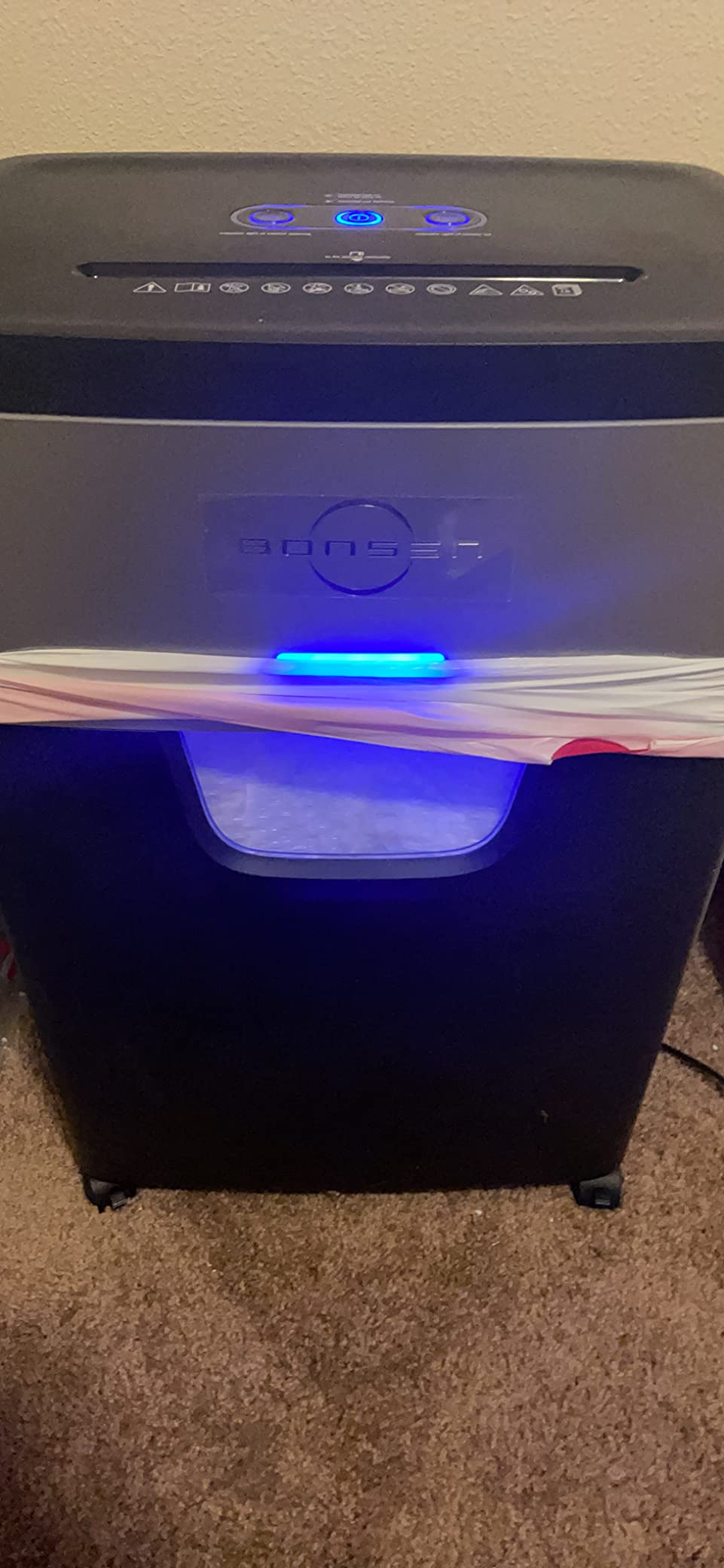
The bin is 6.6 gallons, roughly 25 liters, on a pull-out caster base. It sits under the cutting head, which keeps the machine footprint compact at 15.7 by 10.7 by 21.6 inches and means the whole thing rolls out for emptying rather than being lifted. At about 26.6 pounds it is heavy enough to stay put and light enough for one teacher to reposition, which is a real consideration in a room that gets rearranged for testing weeks.
Compared with the Fellowes Powershred 99Ci, the BONSEN pushes further on capacity and run time but gives up the SafeSense hand-detection system, the published decibel figure, the bin-full LED and the longer warranty. The honest read is that it is the more powerful machine bought on manufacturer specification rather than on review volume. Compared with the Aurora, it shreds more sheets and produces coarser particles, so it suits graded work rather than records.
Why the 20-sheet head matters more than it looks
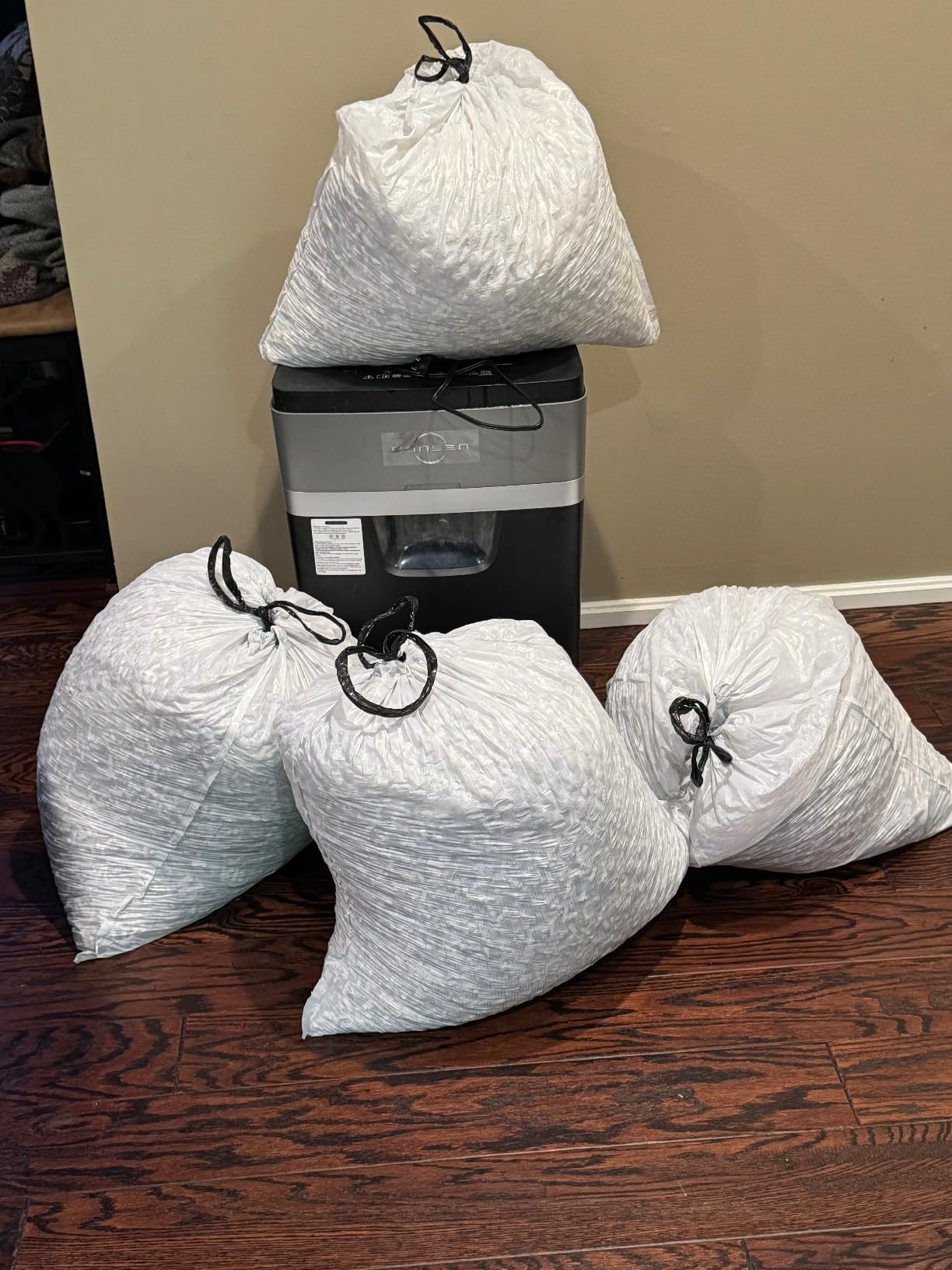
Sheet capacity is really a measure of how often someone has to stand and feed the machine. At 20 sheets, a teacher hands in a graded stack and walks away. At 12 sheets, the same stack takes two rounds and the second round is usually the one that gets skipped when a class is waiting. Owners also note the machine handles fewer than 20 sheets when the paper is heavier than standard-weight stock, so treat 20 as a ceiling rather than a guarantee.
It comes ready to plug in with no assembly, and the 6.6-gallon bin holds roughly 520 sheets of shredded output before it needs attention. In a mid-sized classroom shredding one stack a week, that is about a term between emptyings, which is the kind of detail that determines whether a machine stays in service or ends up quietly overfilled.
Where the BONSEN annoys its owners
Three control complaints recur, and all of them are about feedback rather than performance. The power button can be finicky and need a jiggle to start. The status light beneath the logo does not illuminate. And there is no bin-full indicator, so fill level is checked through a window on the bin.
None of that stops it shredding, and for a teacher who is present while the machine runs, none of it matters much. It does matter if the machine is shared with students unsupervised, which is precisely why we would not put this one in an elementary room with young children. There is also some paper dust when emptying the bin, so a small vacuum or a wipe-down is part of the weekly routine.
4. Fellowes AutoMax 100MA: Best Paper Shredder for High-Volume Classroom Jobs
Fellowes AutoMax 100MA 100-Sheet Micro-Cut Autofeed 2-in-1 Paper Shredder for Office/Small Office
100 sheet auto feed
P-4 micro-cut
75 dB
4.5 gallon bin
bin full sensor
Pros
- 2 in 1 auto feed and manual slot
- Up to 100 sheets in about 5 minutes
- Jam-free auto reverse
- 4.5 gallon bin with a bin-full sensor
- Metal housing with a small footprint
Cons
- 75 dB is loud for a shared room
- Auto feed capacity modest beside commercial machines
The AutoMax 100MA is built for one specific classroom moment: the end of a unit, when a teacher has a hundred worksheets, quizzes or scanned assessments to destroy and no intention of standing there feeding pages. The auto-feed tray takes up to 100 sheets and clears them in roughly five minutes while the teacher does something else, and a separate manual slot on the top handles cards, clips and staples at the same time.
Security is P-4 micro-cut, so the output is fine enough for confidential student records rather than just discouraging. The jam-free auto reverse handles a misfeed without anyone reaching into the cutting head, and the 4.5-gallon pull-out bin carries a bin-full sensor, which is a feature this price of machine rarely includes.
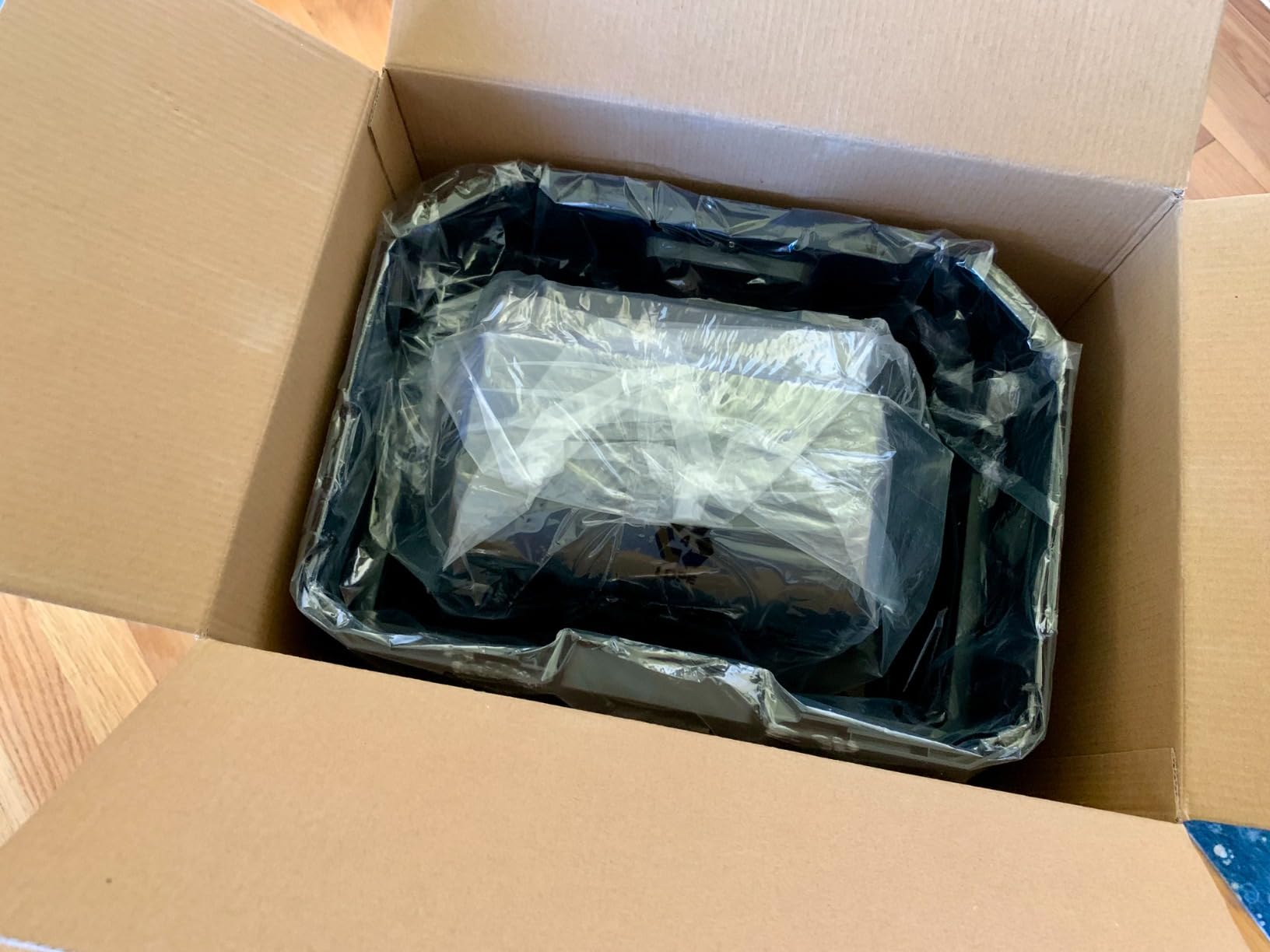
Run time is 7 minutes on the manual path and 10 minutes on auto-feed, which is the real limitation. A 100-sheet batch fits comfortably inside that, but a second full tray means waiting for the machine to cool. That is the trade you make for hands-free operation, and in a room where the shredder is used for a ten-minute purge once a month it is a good trade. In a room shredding continuously, it is not.
The 75 dB rating is the number to think about hardest here, and it is the highest in this roundup. At that level the AutoMax is a machine for a resource room, a library workroom or a back office, not for a room where reading instruction is happening. Compared with the Kitnery 400-Sheet machine, the trade is straightforward: the Kitnery triples the auto-feed batch and runs quieter, while the Fellowes is smaller, lighter and carries a one-year warranty with a bin-full sensor the Kitnery lacks.
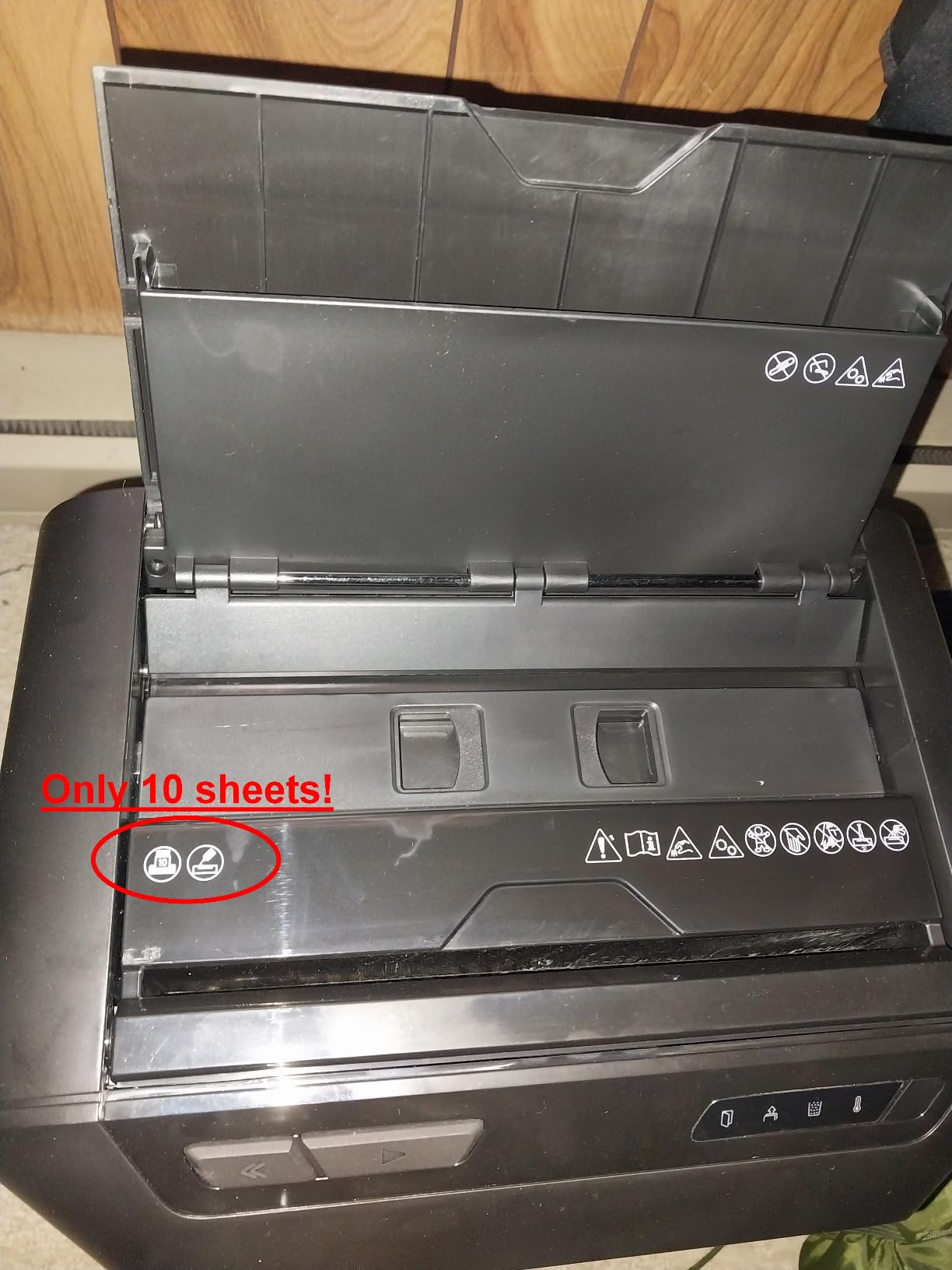
When auto-feed actually earns its price
Auto-feed pays for itself whenever the shredding job is bigger than the attention you are willing to give it. A stack of scanned assessments, a set of returned graded quizzes with student names on them, an end-of-year purge of a filing system, or a batch of answer keys after a common assessment. In those cases you load the tray, press once, and the machine works.
It also has value where supervision is the constraint. If a student helper is emptying the bin under teacher direction, nobody has to stand at the machine feeding sheets. The manual slot on top takes a card or a stapled corner while a batch is still running, so a teacher can clear a few loose items without waiting.
Where the AutoMax is the wrong tool
Noise is the first issue and it is not minor. At 75 dB this machine announces itself. It is a poor fit for a shared classroom during instruction and an obvious problem in an open-plan building where a nearby class would hear it clearly.
The 10-minute auto-feed run time is the second. It sounds generous until you load a full 100-sheet tray, do the maths, and realise you are running the machine right up against thermal cut-off. The 19.4-pound weight and 20.25 inch height are manageable, but the metal housing and AC adapter mean this is a semi-permanent spot on a counter rather than a machine you pull out when needed. If your volume is modest, a manual 20-sheet machine is quieter, simpler and cheaper to own.
5. Kitnery 400-Sheet P-5: Best Paper Shredder for High-Security School Offices
Kitnery Heavy Duty Paper Shredder 400-Sheet Auto Feed P5 Micro Cut
400 sheet auto feed
P-5 micro-cut
56 dB
50L bin
30 min run time
Pros
- 400 sheet auto feed runs hands-free
- P-5 micro-cut at 2 x 12 mm
- Under 56 dB operation
- 50L bin with a fill window
- Braked casters and overheat protection
Cons
- Large footprint needs floor space
- Popping sound on stapled auto-feed stock
- Some machines in the family report early motor failure
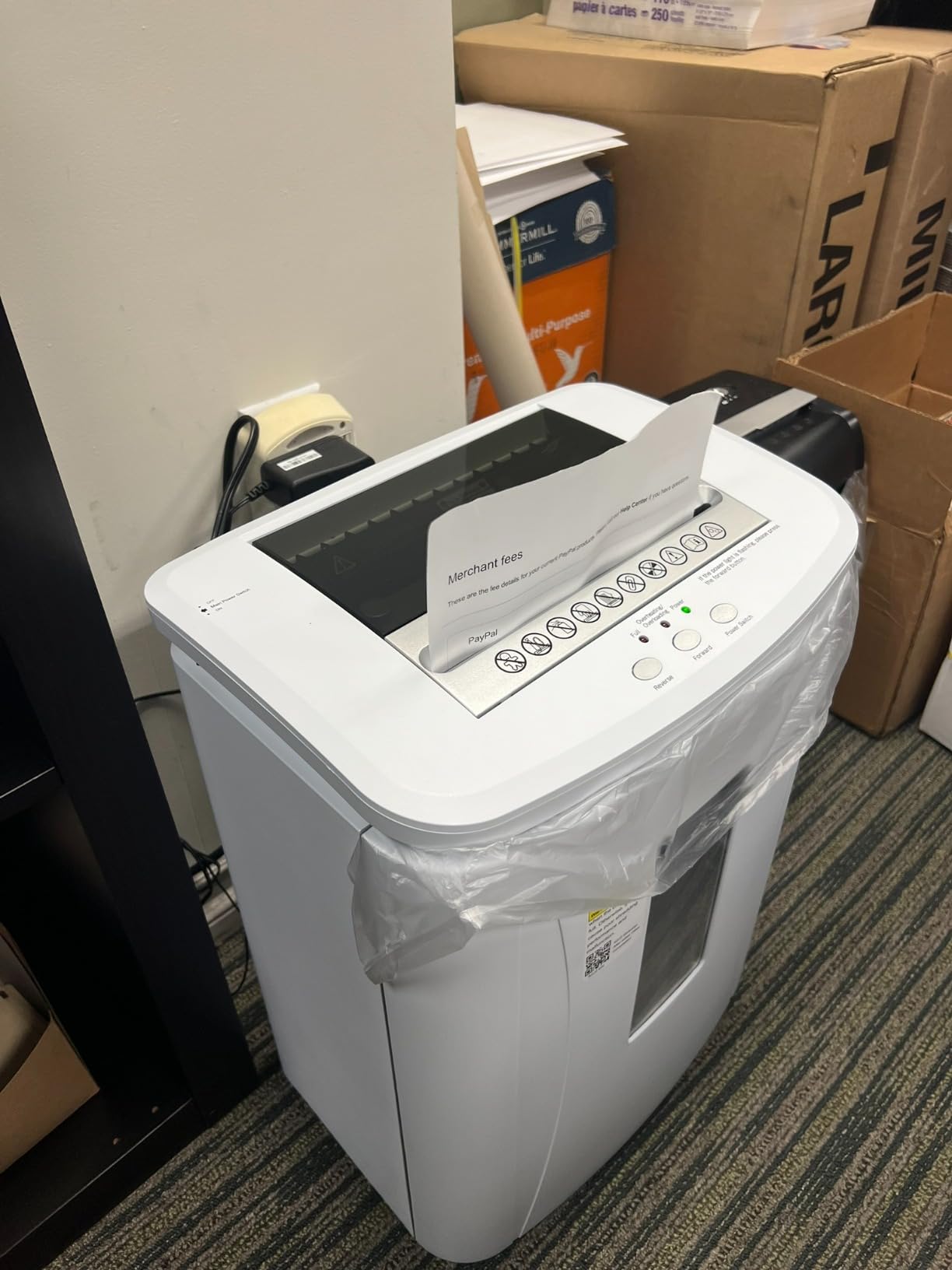
The Kitnery 400-Sheet is the security ceiling of this roundup. Its P-5 micro-cut particles measure 2 by 12 millimeters, smaller than anything else here, and that is the level used where records need to be unrecoverable rather than merely inconvenient to reassemble. For a school office, a special education department or a district records room, that head removes the argument entirely.
It is also the quietest machine in the group at under 56 dB, which makes it the most defensible pick for rooms where sound is genuinely constrained. Owners running small offices praise being able to take a phone call nearby while it works. The 50-liter bin, roughly 13.2 gallons, is the largest here and cuts down how often someone has to handle wet shreds.
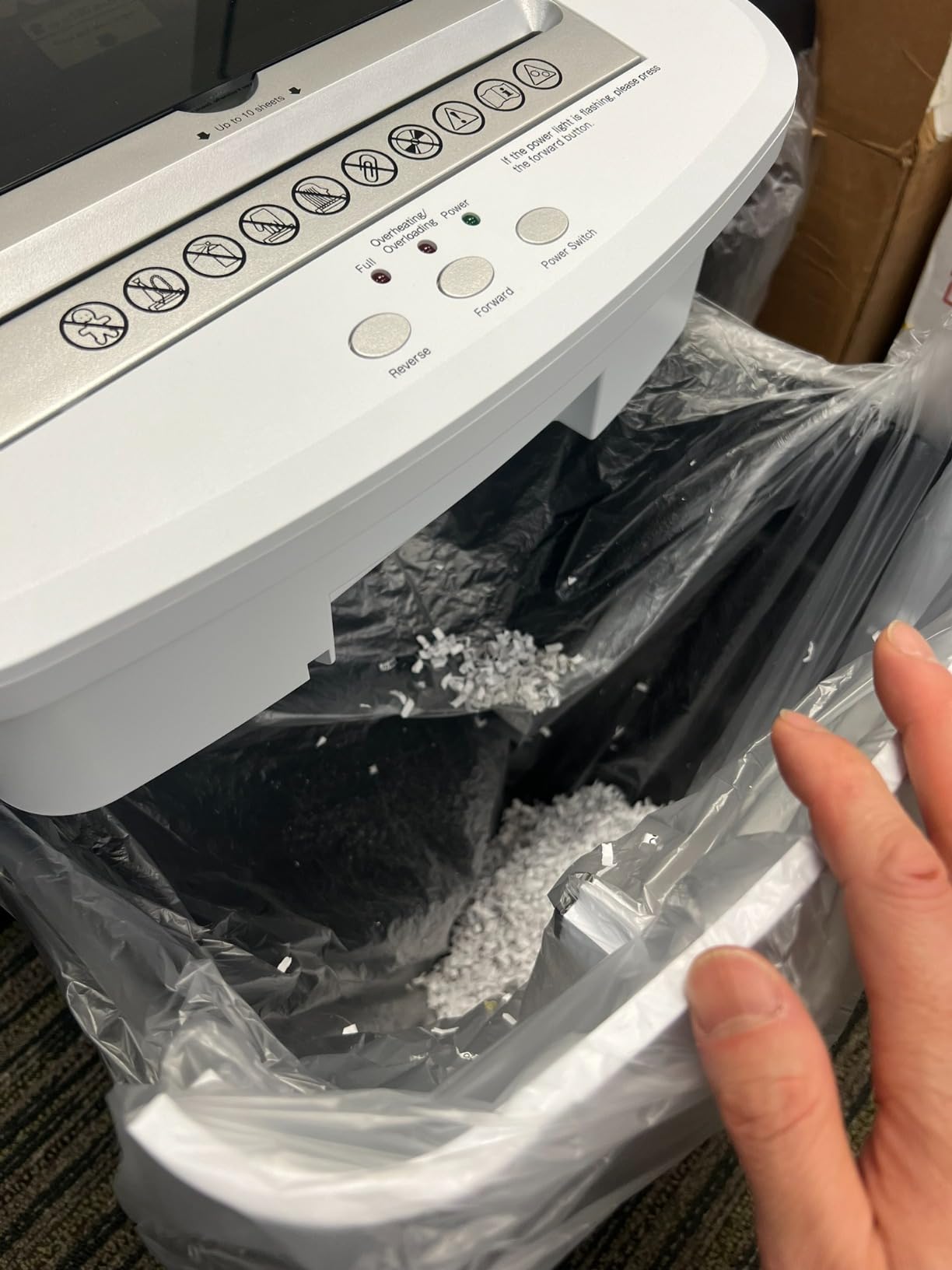
The auto-feed tray takes 400 sheets with 30 minutes of continuous run time, and there is a separate 8-sheet manual slot on top for cards, clips and stapled documents. Built-in wheels with front brakes let it be repositioned under a desk or beside a cabinet, and the overload and overheat alerts mean it tells you when to stop rather than simply dying mid-batch.
At 35.8 pounds and 18.8 by 14.3 by 24.6 inches, this is a floor machine in the most literal sense. Compared with the Aurora AU1210MA it is the same P-4-to-P-5 security argument taken further, with a much larger feed capacity, a much larger bin and a much quieter published rating, at the cost of a footprint that needs planning. Compared with the Locksworth 110-Sheet, it is the same design idea scaled up roughly four times on batch size.
What P-5 changes in a school setting
Security levels run from P-1 upward, and the jump from P-3 to P-4 is the one most schools care about. P-3 strips and rectangles are long enough to tape back into readable shapes, which is why the Staples machine in this roundup sits at P-3. P-4 cross-cut or micro-cut makes reconstruction impractical. P-5, where this machine sits, reduces particles further and is the level used for the most sensitive material.
For day-to-day classroom destruction that is arguably more than needed. For a records room holding personnel files, health information or long-term student records, it is the difference between shredding and destroying. The head also handles thick mail inserts and stapled stock without any removal step, which saves time when bulk destroying.
Where the Kitnery disappoints
The footprint is the first thing to accept. This is a large machine that needs a corner, and a small special education classroom or a first-grade room simply does not have one. Second, stapled paper pops loudly as each sheet pulls free of the staple during auto-feed, which sits oddly against an otherwise very quiet machine.
Third, and worth taking seriously, a minority of owners of the smaller capacity machine in the same family report motor failure within a few months. At 100 reviews the sample is small enough that this is not a pattern, but it is enough that we would buy this for an office with a backup plan rather than as the only shredder a department depends on. The counter-argument is the 50-liter bin, the 56 dB rating and the fact that the sibling machine’s complaints are the reason to check the warranty terms carefully.
6. Locksworth 110-Sheet Micro-Cut: Best Paper Shredder for Shared Resource Rooms
Locksworth 110-Sheet Micro Cut Shredder for Home Office, 6.9 Gallons Bin P-4 High Security Paper Shredder for Credit Card, Staple, Clip, Heavy Duty Commercial Shredders with Casters
110 sheet auto feed
P-4 micro-cut
60 min run time
6.9 gallon bin
four casters
Pros
- Auto mode up to 110 sheets
- 60 minutes of continuous auto run time
- P-4 micro-cut particles
- 6.9 gallon bin with a viewing window
- Reverse button plus auto-shutoff
Cons
- Auto path shreds paper only
- 60 minute cool-down after a full run
- Needs dedicated floor space
The Locksworth 110-Sheet is built for a room where more than one adult uses the machine, which is the situation in a resource room, a main office or a shared department. In automatic mode it takes 110 sheets and runs for 60 minutes continuously, and a 6.9-gallon bin with a transparent window means the person emptying it can see the fill level from standing height without lifting anything.
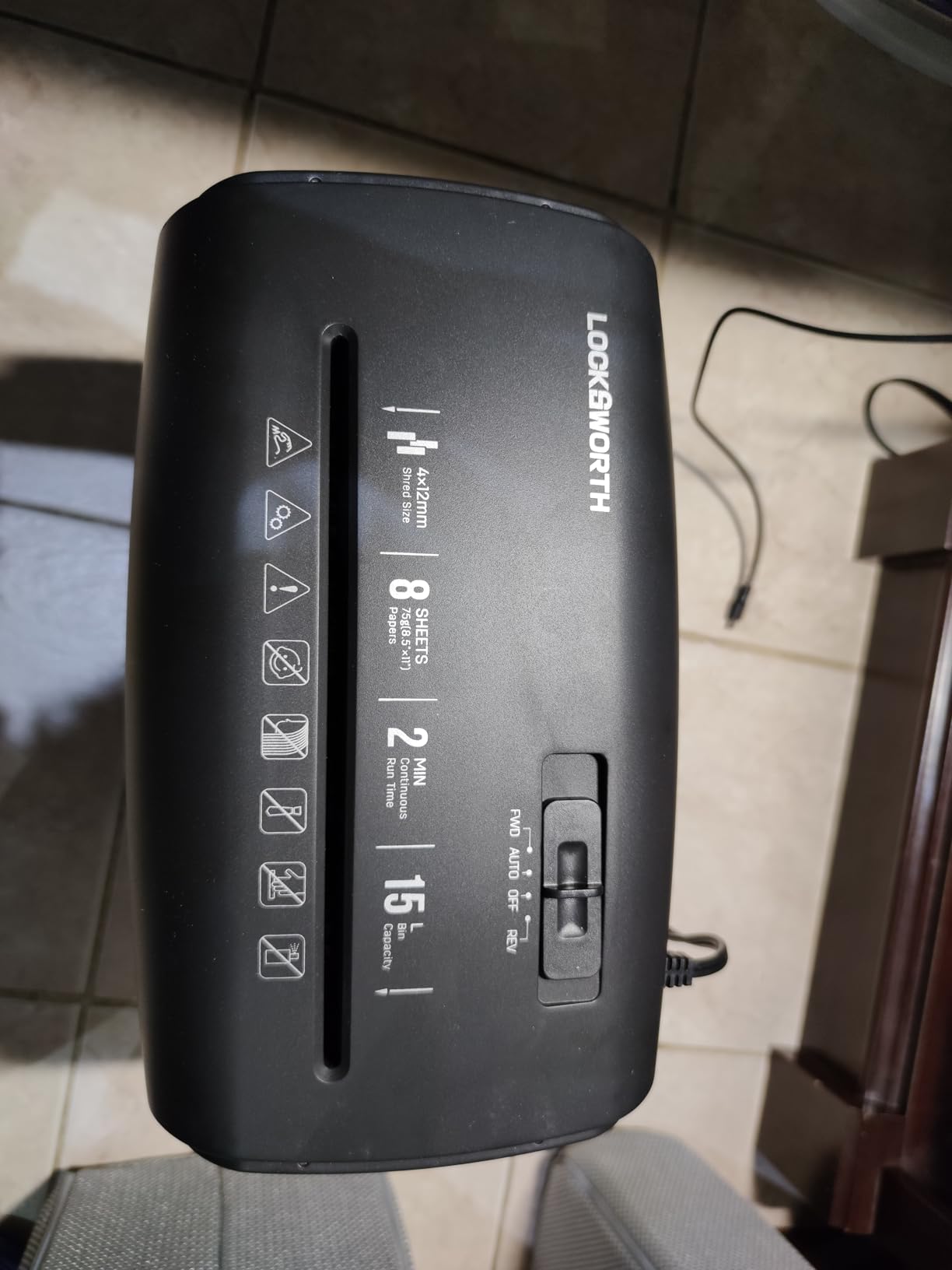
Security is P-4 micro-cut at 4 by 12 millimeters, the same particle size as the Aurora, so the output is fine enough for student records. Manual mode handles up to 12 sheets and 30 minutes, and takes the cards, staples and clips that the auto path cannot. Four smooth-rolling casters move the whole machine, which is the practical advantage when a resource room doubles as a testing space.
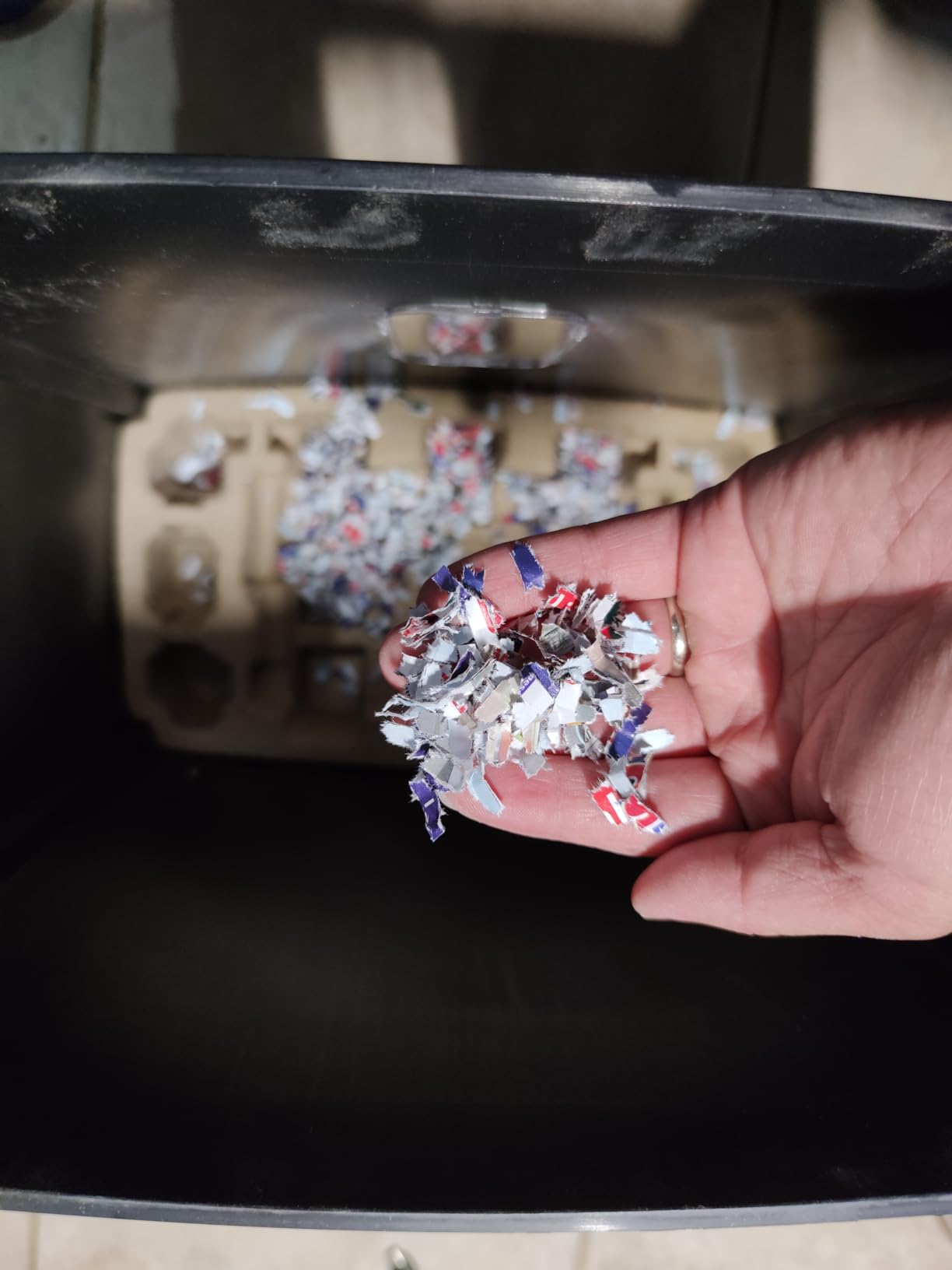
A reverse button and an auto-shutoff that triggers when the bin or lid is removed cover both the jam and the safety question. The shutoff is the part that matters in a shared room, because it means the machine cannot be running with its head open while someone else is reaching in to clear a jam. It is a basic interlock, not a hand-proximity sensor, so a teacher should still keep students away from the entry slot.
Compared with the Fellowes AutoMax 100MA, the Locksworth runs longer, holds a bigger bin, has a window to check it and costs less to run, but the AutoMax is quieter in design intent, lighter and has a bin-full sensor. Compared with the Aurora, it is faster in automatic mode and easier to move, while the Aurora is quieter by specification, better reviewed and has a bin you can lift rather than roll. For a shared resource room where one machine serves four or five teachers, we would take the Locksworth.
Why shared rooms change the specification
A single teacher shredding ten sheets a week can live with a small machine and a small bin. A resource room serving five staff and a printing duty changes the maths. Daily volume goes up, the bin fills during working hours rather than weekly, and the machine has to be moved for group testing sessions and put back afterwards. That is where a caster base, a viewing window and a long run time stop being extras.
The 60-minute automatic run time means one person can clear an entire week’s accumulated paper without a cool-down pause. The 30-minute manual run time covers the odd card or stapled corner. At 15.4 by 12.6 by 19.7 inches it is a floor machine rather than a desk machine, and the weight is not listed by the manufacturer, so plan for a two-person move if it has to cross a threshold.
Where the Locksworth falls short
The auto-feed path handles paper only. Cards, staples and clips need a switch to manual mode, and in a busy room that is an extra step people will forget, which is how a credit card ends up in a bin uncut. Teach the workflow rather than assuming it.
The 60-minute cool-down after a full continuous run is the second limitation, and it is a long one. It only matters if you actually run the machine flat out, but in a resource room that is exactly what happens before a records audit. Third, the listing does not state a noise figure, so quiet operation is a claim rather than a measurement, and the machine needs dedicated floor space. In a room where students sit right next to it, choose a model with a published number instead.
7. Fellowes Powershred 12C15: Best Paper Shredder for Small Classrooms and No-Outlet Rooms
Fellowes Powershred 12 Sheet Cross-Cut Paper Home Office Paper Shredder, 19.50″ H x 9.69″ W x 13.44″ D
12 sheets per pass
P-4 cross-cut
19.5 inch tall
5 gallon bin
20 min run time
Pros
- Compact footprint that fits beside a desk
- P-4 cross-cut particle size
- Handles staples clips cards and junk mail
- Patented Safety Lock for idle periods
- 5 gallon pull-out bin
Cons
- 12 sheets per pass limits throughput
- 20 minute run time is short
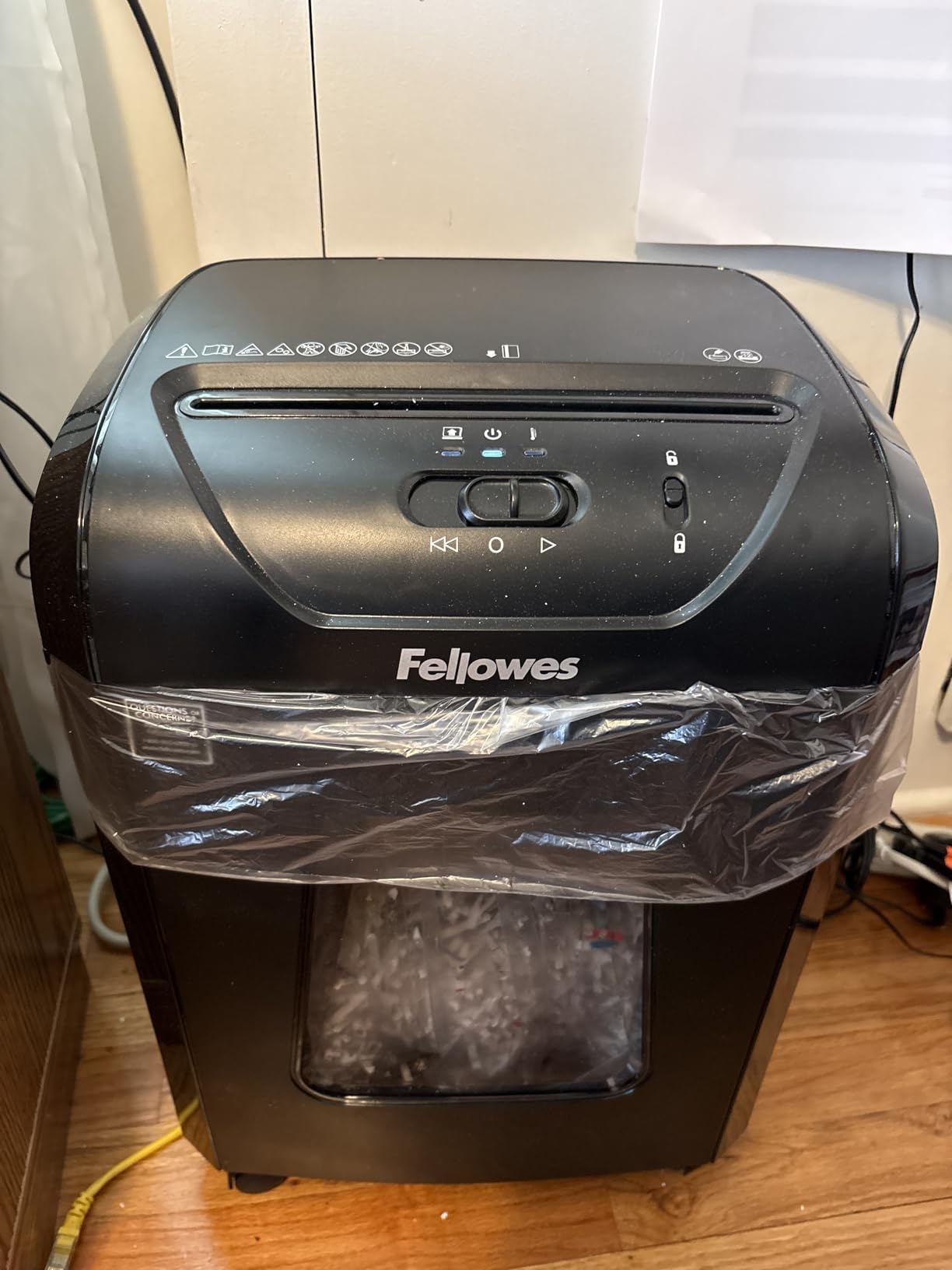
The Powershred 12C15 is the small-room answer, and it is the one most teachers will recognise. At 19.5 inches tall and 9.69 inches wide it fits on a cabinet or a low shelf, and at 17.2 pounds one person can move it. It runs from an AC adapter rather than a fixed mains lead, so it can go where the outlet is rather than where the machine happens to sit.
It also has one of the two deepest review bases in this roundup, with more than 6,500 owners, which makes it among the least risky picks in terms of knowing what you are getting. Security is P-4 cross-cut, so it meets the standard we would set for confidential student work, and it handles staples, paper clips, credit cards and unopened junk mail without any prep step.
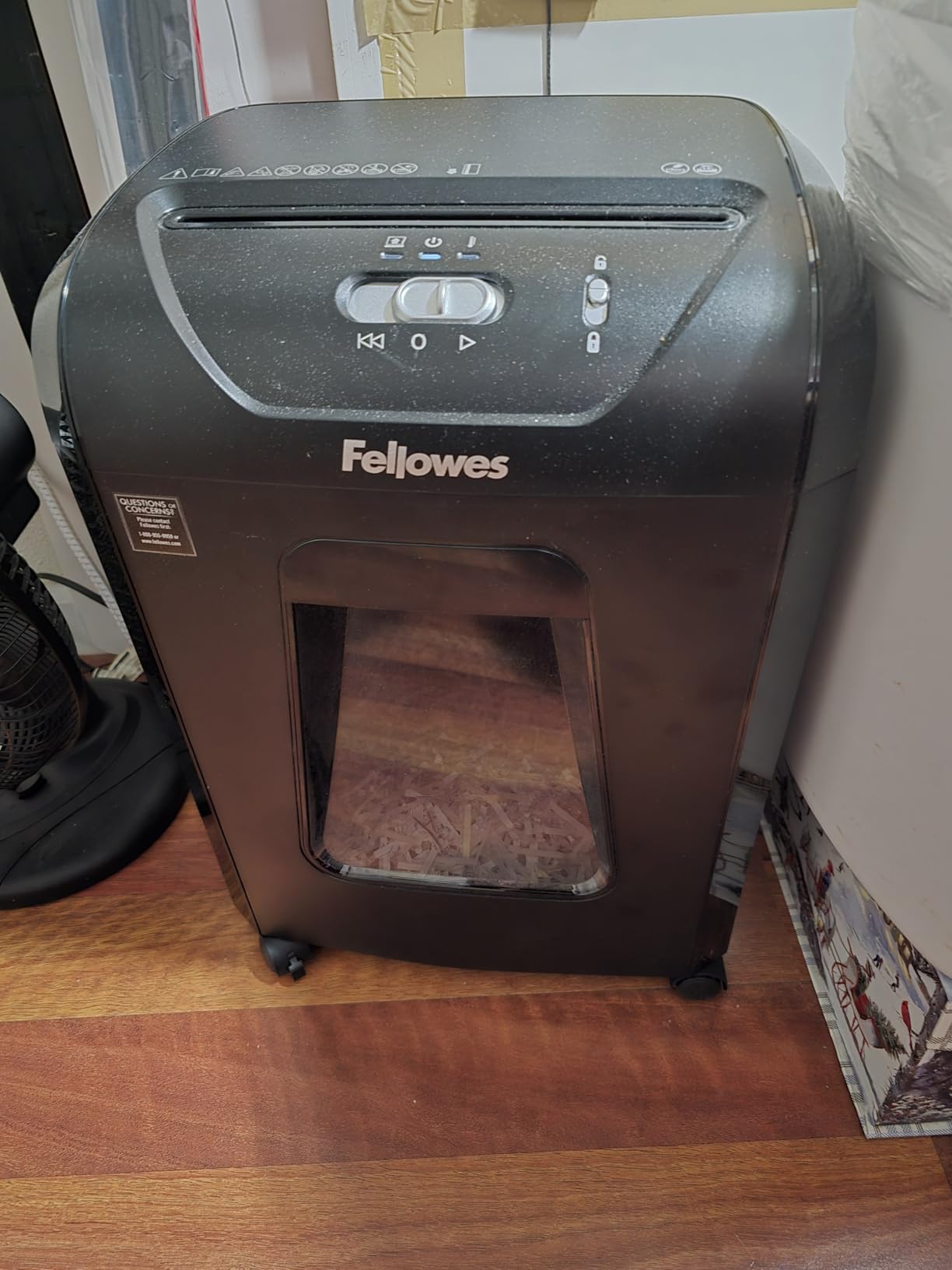
The patented Safety Lock disables the unit when it is not in use, and in a room with students that is worth more than it sounds. It removes the question of whether a curious child can put fingers into a live cutting head, and it means a machine left on a shelf over the summer is not a liability. The 5-gallon pull-out bin empties cleanly and does not need a cart to move.
Compared with the Fellowes Powershred 99Ci, this is the same design philosophy built for a desk rather than a floor. You give up six sheets of capacity per pass, ten minutes of run time and four gallons of bin, and you get a machine that fits in a space a desktop machine would. Compared with the Locksworth 6-Sheet, it doubles the capacity, doubles the run time and adds a safety lock, which makes it the more sensible of the two for any room with more than a handful of students.
Why a smaller machine still makes sense
There is a real class of classroom where a 20-sheet floor machine is the wrong answer. A self-contained room, a reading specialist’s space, a speech and language office, a teacher working in a room with no students present all day. In those situations the volume is a handful of records a week, and what matters is that the machine is safe, quiet and can be put away.
That is exactly what the 12C15 does. The 20-minute run time is ample for a stack of assessment printouts or a term’s worth of rosters, and the compact body means it does not become an obstacle during group work or fire drill routines. It is also light enough to carry between rooms, which matters for teachers who cover more than one room in a day.
Where the 12C15 runs out of room
Twelve sheets per pass is the ceiling, and on a stack of graded work with staple corners that is a real limit. Twenty minutes of run time is short enough that a large term-end purge will need a pause, and unlike the Aurora or the BONSEN the machine will not coast through a long session.
Bin volume is the quiet issue. Five gallons sounds generous until you calculate weekly volume, and cross-cut output fluffs, so the bin fills faster than the number suggests. A windowless bin means checking by lifting the head, which is a habit that gets skipped. If the room shreds every day rather than occasionally, step up to the 99Ci or the BONSEN and accept the larger footprint.
8. Staples 12-Sheet Cross-Cut: Budget Paper Shredder for Low-Volume Rooms
Staples 12-Sheet Cross-Cut Paper Shredder, Quiet, Anti-Jam, Black
12 sheets per pass
P-3 cross-cut
72 dB
4.6 gallon bin
7 min run time
Pros
- Cross-cut security at an entry spec
- Auto start/stop and auto reverse
- 7 minutes of run time then 30 minute cool-down
- 4.6 gallon pull-out bin
- Available in several sheet counts
Cons
- Slower throughput than larger models
- Shuts down quickly under sustained load
- 12 sheets per pass is modest for bulk work
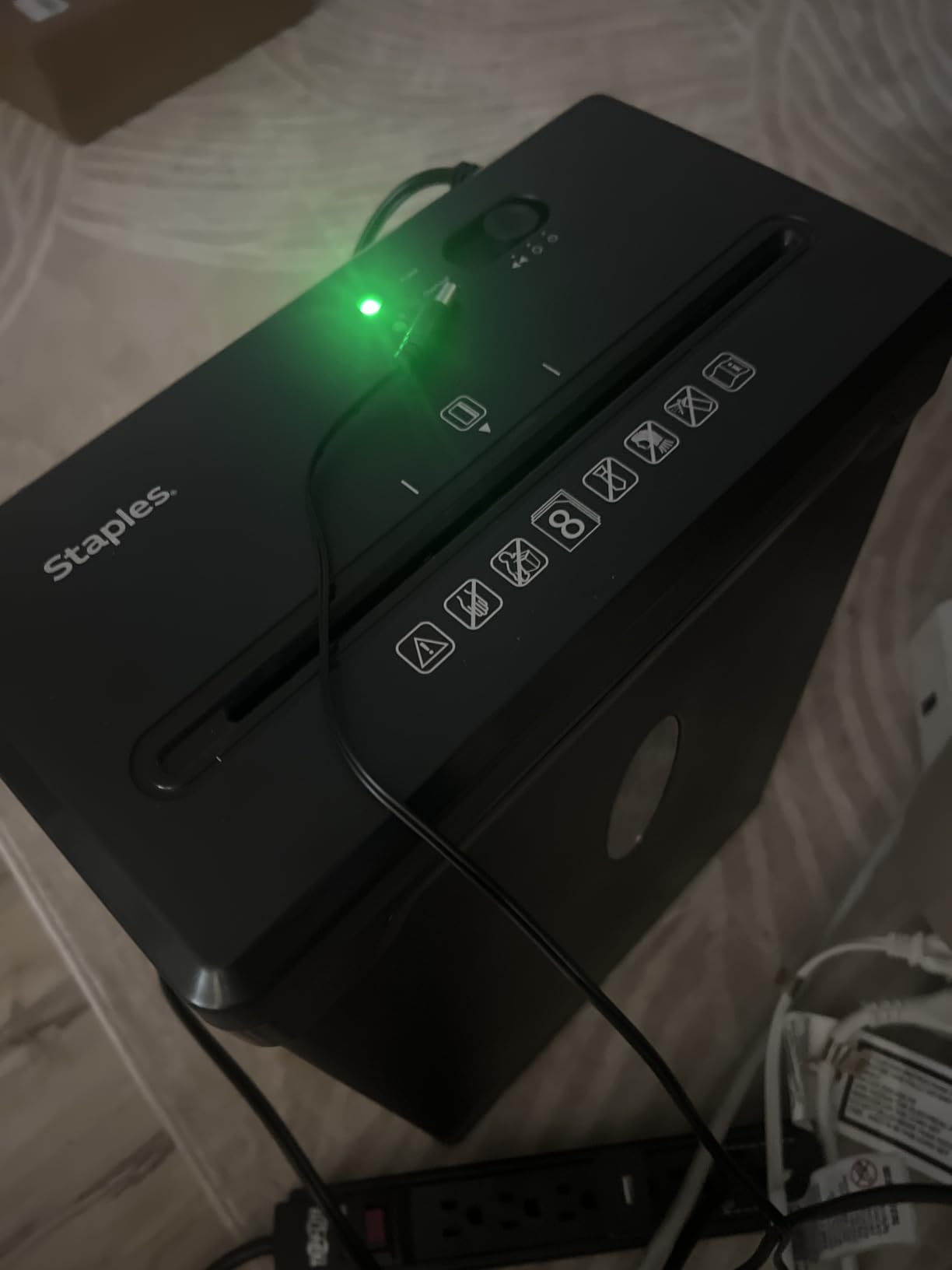
The Staples 12-Sheet is here for a specific case: a room that shreds occasionally, on a constrained purchasing budget, and where the paperwork is confidential but not sensitive. It cross-cuts rather than strip-cuts, which is a meaningful step up from the ribbon output of the cheapest machines on the market, and it will take staples, small paper clips and credit cards along with up to 12 sheets per pass.
Auto start/stop means the head only runs while paper is in the slot, so it does not sit chewing on an empty throat when a student walks past. Auto reverse handles the common misfeed, and overload protection cuts in if someone feeds more than the machine can take. The 4.6-gallon pull-out bin empties cleanly and does not need a cart.
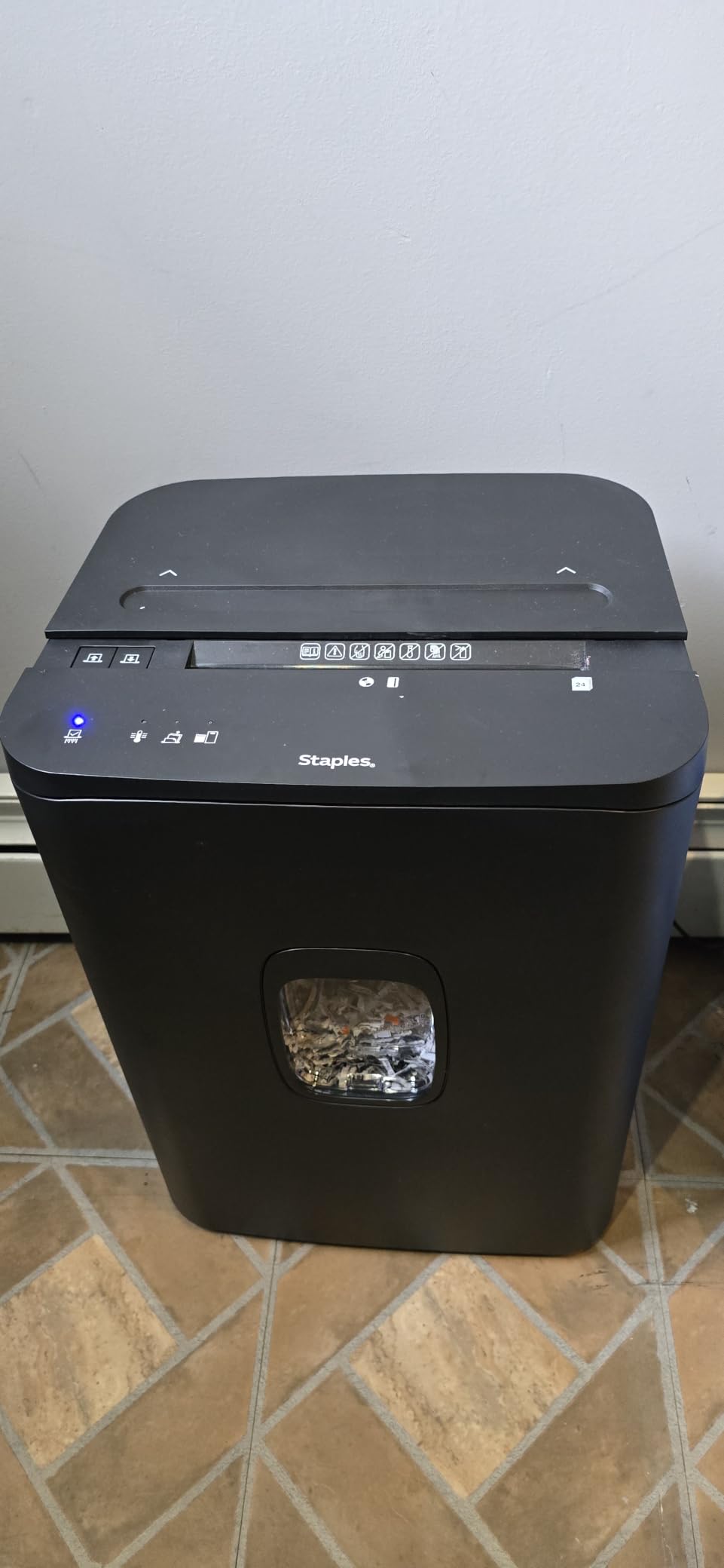
Two things to be honest about. First, the cut is P-3 at 4.3 by 33 millimeters, which is the weakest security in this roundup. That is adequate for graded work and internal paperwork, and it is not the level we would use for IEP plans, health information or anything a family could challenge. Second, at 72 dB it is one of the louder machines here, and owners note it is slow relative to larger models, which is what produces the heat that triggers thermal cut-off.
Compared with the Locksworth 6-Sheet, the Staples machine is a genuine step up: double the capacity, P-3 cross-cut rather than the same cut level, a 4.6-gallon bin rather than 3.43, and a 7-minute run time against 3. Compared with the Fellowes Powershred 12C15, it is a similar class of machine with weaker security and a longer cool-down, so we would pick the Fellowes whenever the budget stretches to it.
Where a budget machine still does the job
Plenty of school rooms shred very little. A part-time teacher’s classroom, a library with a small collection of duplicate records, a room that only needs to destroy a set of old rosters once a year. For those, the 12-sheet capacity is more than enough, and a machine that runs only when paper is present and stops itself before it overheats is a safe, low-effort addition.
At 11.7 pounds and 18.5 inches tall, it is also the most portable powered machine in the group after the Locksworth 6-Sheet, and at 14.17 inches wide it fits on a standard shelf. That makes it a reasonable shared purchase between two or three part-time staff who each use it a few times a month.
Where the budget trade-off bites
The 7-minute run time followed by a 30-minute cool-down is the practical limit. A stack of 40 sheets takes three feedings, and a serious end-of-term purge means waiting out the cooldown halfway through. Owners report the machine reaching thermal cut-off faster than expected under sustained load, which is the same complaint pattern you would expect from a small motor with a small head.
The P-3 cut is the other limit and it is not a small one. Strip-cut output can be reassembled at home; P-3 rectangles are longer but still wide enough to be taped into readable strips. If the room ever handles student health information, behaviour plans or accommodation paperwork, go up to a P-4 machine even if it means stretching the budget. The noise figure also means this is a poor choice for a room where quiet is the point.
9. Locksworth 6-Sheet: Light-Duty Paper Shredder for Rooms With Little Volume
6-Sheet Shredder for Home Office, 3.43 Gallon Cross Cut Shredder, P-4 High Security Paper Shredders for Credit Card Staple Clip, Portable Handle Design
6 sheets per pass
P-4 cross-cut
3.43 gallon bin
portable handle
3 year warranty
Pros
- P-4 cross-cut security in a very small body
- 3.43 gallon bin with a viewing window
- Portable handle for moving between rooms
- Reverse button clears jams and blade dust
- 3 year warranty
Cons
- 6 sheets per pass only
- 3 minutes of run time then a 60 minute cool-down
- Lid must be refitted before blades restart
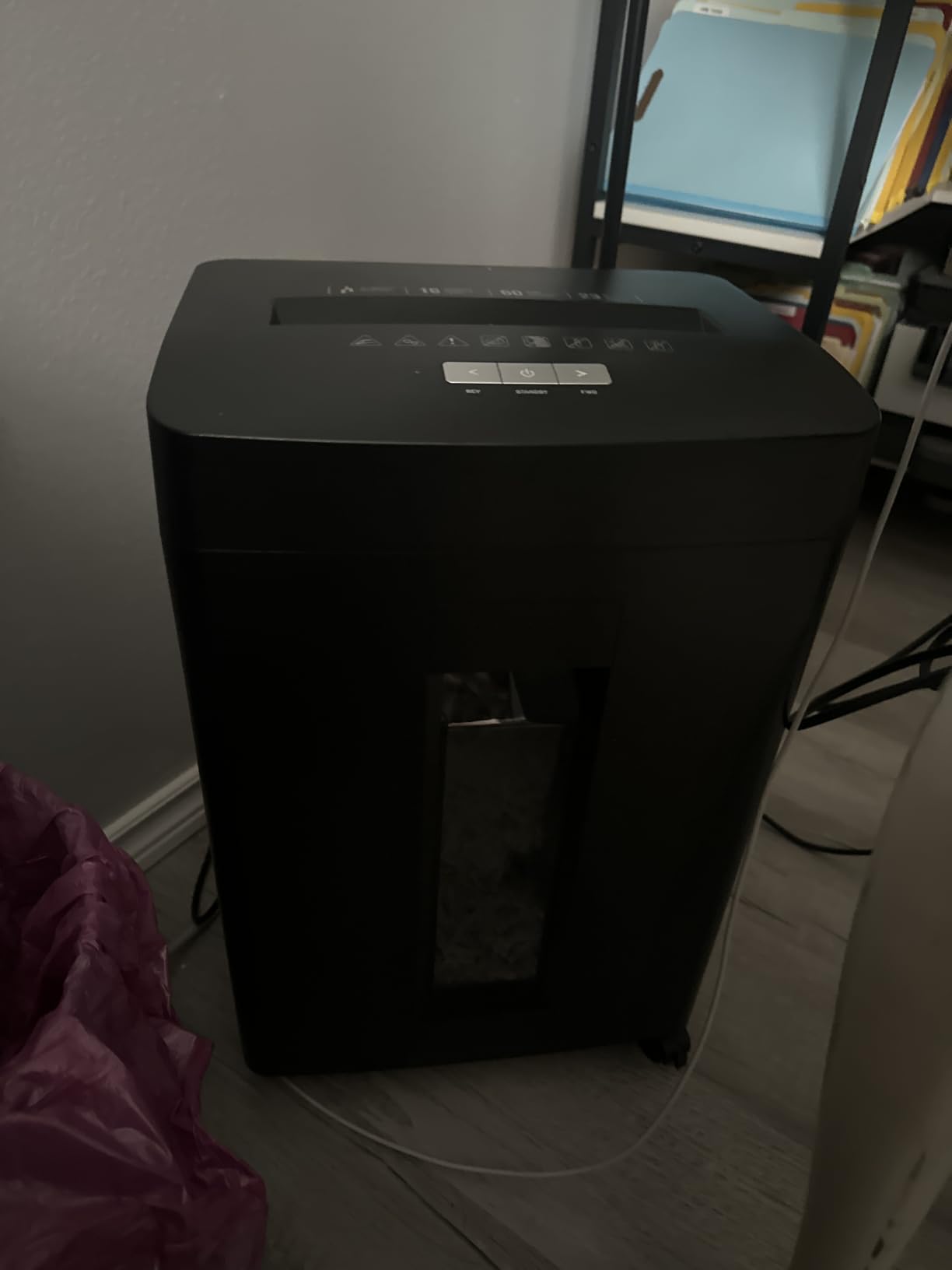
The Locksworth 6-Sheet is the smallest machine here, and the most surprising. It still cuts at P-4 security, producing 5 by 18 millimeter cross-cut particles, so the privacy level is genuinely classroom-appropriate despite the size. The 3.43-gallon bin has a transparent window for fill checks, and a lift-up handle on the bin itself for emptying.
A portable handle on the machine means it moves between a staff room, a resource room and a classroom without needing a cart. The reverse button clears jams and sweeps blade dust off the cutters, which is the single most useful control on a small machine, and a safety auto-shutoff stops the blades whenever the lid is removed.
Security is the reason to consider it at all, and the warranty is unusually good for the class. A 3-year warranty on a compact shredder is longer than most manufacturers offer at this level, and it is a real differentiator when the machine is shared among several part-time staff who each use it lightly.
Compared with the Staples 12-Sheet, the Locksworth has weaker capacity but stronger security, a longer warranty and a far smaller body, at the cost of a much shorter run time. Compared with the Fellowes Powershred 12C15, it is the same security level in a machine two thirds the size, which is a real advantage in a cramped room and a poor one if volume is anything more than occasional.
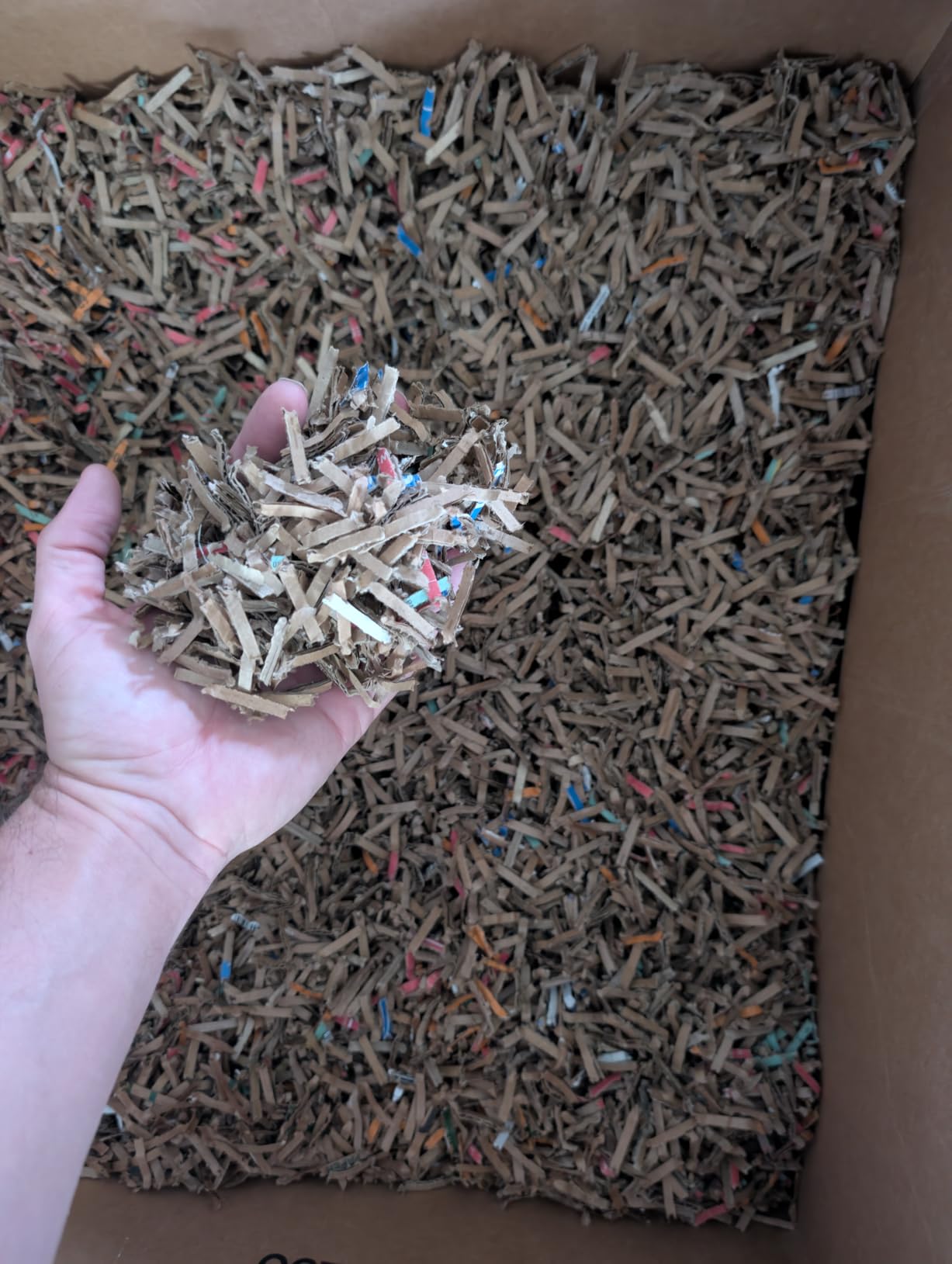
What a six-sheet head is actually for
Six sheets per pass sounds inadequate until you picture the job. A handful of duplicate assessments, a set of answer keys before they are reused, a small batch of graded work returned to families. These are the shredding jobs that happen in a small room, and they are what the machine is built for. It is not built for a filing backlog, and owners are clear about that.
At 6.97 inches tall it is short enough to sit under a desk or on a low shelf, and the bin lifts out by its handle rather than requiring the whole unit to be moved. That is the strongest reason to choose it: a machine you can hide away between uses is one nobody complains about.
Where the six-sheet machine frustrates owners
Three minutes of run time followed by a 60-minute cool-down is the defining weakness. It means the machine is effectively a single-staple device, and the waiting period rules out any session longer than a couple of minutes. For a teacher clearing a term of work this is a non-starter, and no amount of planning changes that.
Second, the lid must be refitted before the blades will restart, which is a safety feature but also a common source of confusion for anyone who has not used the machine before. It trips some users. Third, this machine has the highest share of one-star feedback in the group at 12%, and the complaints trace almost entirely to the capacity limit and the long cool-down rather than to build quality. Know the duty cycle before you commit, because the machine is honest about it.
How to Choose a Paper Shredder for Classrooms
Quick answer: for a classroom shredding student records, cross-cut or micro-cut at P-4 or higher is the correct choice, with a bin of at least 4 gallons and a run time long enough to clear a grading session. Machines below P-3 security are not suitable for anything containing student information, regardless of how convenient they are.
1. Start with what actually gets shredded
Classrooms produce a specific and limited set of documents: answer keys before and after an assessment, graded work returned to students, duplicate copies of tests, student rosters, seating charts, behaviour and attendance records, and the paperwork that comes with accommodations such as IEP and 504 plans. That last group is the reason security level is not optional.
Answer keys and graded work are volume problems. They are numerous, they are low sensitivity, and they are what fills the bin every Friday. Student records are security problems. They are fewer, they are high sensitivity, and the number of pages does not matter. A room that mostly does the first kind can run a P-3 or P-4 cross-cut machine; a room doing the second needs P-4 micro-cut or better, and the Aurora or the Kitnery are the right shapes for it.
2. Set your noise ceiling before you browse
Decide the maximum acceptable sound level before you start looking, because it removes half the lineup immediately. Around 60 dB or below is the workable target for a teaching room, which in this roundup means the Kitnery at 56 dB, the BONSEN at 60 dB or less, and the Fellowes 99Ci at 62.1 dB. At 72 to 75 dB you are looking at the Staples and the AutoMax, and both belong somewhere other than beside a reading group.
Two things narrow the choice further. Where a manufacturer publishes no number, treat quiet as unproven, and where the machine has an auto-feed motor running in a loop it will be louder than a manual shred on single sheets. If the room is genuinely silent-sensitive, a hand-crank shredder removes the question entirely at the cost of speed.
3. Match sheet capacity to weekly volume
Sheet capacity is a proxy for how much standing around the machine you have to do. Twelve sheets handles a grading session. Twenty handles a heavy week. Six handles a handful of documents. A hundred-sheet auto-feed handles a unit-end purge with no supervision at all, and only makes sense when those purges are a regular event rather than an annual one.
Run time matters as much as capacity, and the two are easy to confuse. A 20-sheet machine with a 7-minute run time will stop on you before a 12-sheet machine with 20 minutes does. The BONSEN and the Aurora, both at 60 minutes or more, are the machines that suit a teacher who wants to clear a queue and walk away, and that is the shape of most Friday afternoons.
4. Buy the bin for the emptying routine, not the spec sheet
Bin volume decides how often someone handles wet shreds, and shreds are unhygienic and dusty. Four to five gallons suits a room shredding weekly. Six to nine gallons suits a room shredding daily or a shared resource room serving several adults. A 50-liter bin, as on the Kitnery, suits a records room where a single teacher may not be the person emptying it.
Two details outrank capacity. A transparent window means checking the level without lifting the head, which is the difference between a bin that gets emptied on time and one that overflows. A bin on casters means the shreds travel on wheels to the rolling bin rather than across a room in a plastic tub. Both of those are on the machines we would choose for a working classroom.
5. Check the safety features against the students in the room
Three mechanisms matter. Hand-proximity detection, which on the Fellowes 99Ci is the SafeSense system, stops the blades before contact and is the strongest protection available here. A lid or head interlock stops the machine whenever the head or bin is removed, which prevents anyone reaching into a running machine, and is present on most of this list. A safety lock for idle periods, as on the Fellowes 12C15, disables a machine nobody is using.
Placement is half the safety case. Keep the machine out of student foot traffic, off the edge of a low counter and away from where children queue, and never below a seat where a foot can reach the entry slot. In a room with young students, either choose a machine with hand detection or supervise every shredding session. No product feature replaces supervision, and the strongest protection available is a shredder in a spot students cannot reach.
6. Budget for the whole lifecycle, not the machine
Every shredder in this roundup is designed to be oiled, and skipping it shortens blade life noticeably. Oil cross-cut heads roughly every 30 to 45 minutes of accumulated run time, micro-cut heads more often, and the schedule is easier to keep when the machine has a bin-full indicator or a visible window. For a school that owns several machines, a bottle of shredder oil and a five-minute monthly routine is a small cost against replacing cutters.
Consumables and parts are the other line. Belts, replacement heads and bin liners vary by model, and the machines with the largest footprints are the hardest to replace with an identical part later. If your procurement team buys in batches, consistency of model across a school is usually easier to support than one ideal machine per room, and it makes spare parts a non-issue. If your school is destroying paperwork on a far larger scale than a few classrooms generate, a chipper shredder built for bulk destruction is a different hardware category worth researching separately.
What not to shred, and what to do when it jams
Jams in a classroom are almost always a material problem, not a machine problem. Laminated sheets, glossy stock, cardboard, glue-bound book spines and plastic sleeves are the usual culprits, and most heads will slow or stop on them. Remove staples, paper clips and rubber bands from thick stacks before feeding, and feed a small stack of plain paper first to establish a running head. If a machine starts making a loud grinding noise, stop feeding and reverse rather than pushing more paper in.
A shredder that will not start usually has a simple cause: an overfilled bin, a head or lid not fully seated, or a machine that has hit thermal cut-off and is still cooling. A loud noise that appears only when there is no paper in the slot is usually a cutter or alignment problem worth reporting rather than working around. Oiling first is the correct response in the majority of cases, and WD-40 is the wrong product: it is a water-displacing lubricant, not a blade oil, and it will not do what a shredder oil does.
Frequently Asked Questions
What is the best paper shredder for a classroom?
The Fellowes Powershred 99Ci is the best all-round choice for a classroom. It shreds 18 sheets per pass at P-4 security, runs at a measured 62.1 dB so it can be used during instruction, offers 30 minutes of continuous run time, and has SafeSense hand detection that stops the blades when a hand gets close. For records work rather than graded paper, the Aurora AU1210MA adds P-4 micro-cut and 60 minutes of run time.
Are there quiet paper shredders?
Yes, and the difference matters more than the brand. The quietest machines in our roundup run at 56 dB, the BONSEN S3104 sits at 60 dB or less, and the Fellowes Powershred 99Ci is rated at 62.1 dB. Machines rated at 72 to 75 dB are noticeably louder and belong in a resource room rather than a teaching room. Because decibels are logarithmic, a 6 dB gap is roughly a doubling of perceived loudness, so check the number before you buy.
What is the best security level for a classroom paper shredder?
P-4 is the right minimum for a classroom. P-1 and P-2 strip-cut output can be taped back together at home. P-3 cross-cut makes reassembly harder but still possible for a determined student. P-4 cross-cut or micro-cut makes reconstruction impractical and is what we would use for answer keys, graded work and student records. P-5 micro-cut goes further and suits a school office or records room holding personnel and health paperwork.
Should a classroom shredder be strip-cut, cross-cut or micro-cut?
Cross-cut is the practical default. Strip-cut is the least expensive option and leaves long ribbons that can be reconstructed. Cross-cut cuts in two directions and produces small rectangles that sweep up easily and suit graded work. Micro-cut reduces particles further, at the cost of more heat, more frequent oiling and a bin that fills faster. For a room handling answer keys and returned work, cross-cut at P-4 is enough; for student records, use micro-cut.
Why is my paper shredder making a loud noise?
A grinding noise with paper in the slot usually means a hard material such as a staple, a clip, a laminated sheet or a glue-bound spine has reached the cutters. Stop feeding, use the reverse button, and remove the obstruction. A noise that appears with no paper in the slot often points to cutters that need oiling, so apply shredder oil rather than WD-40, which is a water-displacing lubricant and not a blade lubricant. If the noise continues after both, the cutter assembly likely needs service.
How do I stop my paper shredder from jamming?
Remove staples, paper clips and rubber bands from thick stacks, feed a small batch of plain paper first to start the head, and never force a sheet. Choose a machine with auto reverse so a misfeed clears itself, and with a jam or overload indicator so you know when to stop. Laminated sheets, cardboard, glossy stock and plastic sleeves should go in a separate destruction process, because most cross-cut heads will stall on them.
How often should I oil a paper shredder?
Oil cross-cut heads roughly every 30 to 45 minutes of accumulated run time, and micro-cut heads more often, because the finer cut runs hotter and generates more residue. In a classroom that shreds a grading session each week, that works out to roughly once every month or two. A monthly five-minute routine with a proper shredder oil keeps blades sharp and quiet. WD-40 is not a substitute: it displaces water but does not lubricate hardened steel cutters.
Final Verdict: The Best Paper Shredders for Classrooms in 2026
The Fellowes Powershred 99Ci is our pick for most classrooms in 2026. Eighteen sheets per pass, P-4 cross-cut, a measured 62.1 dB, 30 minutes of run time, a 9-gallon bin with a fill indicator and SafeSense hand detection is the combination nothing else in this roundup matches, and more than 11,000 owners have already tested that claim.
Where the paperwork is genuinely sensitive, the Aurora AU1210MA is the better machine: P-4 micro-cut, 60 minutes of continuous run time and the highest average rating in the group. Where volume is the problem rather than security, the BONSEN S3104 handles 20 sheets per pass at 60 dB or less with a 6.6-gallon bin on casters, and it is the machine we would trust with an end-of-term purge.
For a school office holding personnel and health records, the Kitnery 400-Sheet takes the security question off the table with P-5 particles at 2 by 12 millimeters, and it is the quietest machine here at under 56 dB. For a small or shared room, the Fellowes Powershred 12C15 gives you the same security level in a body that fits on a cabinet.
Set your noise ceiling first, buy at P-4 or better, size the bin for the emptying routine rather than the specification sheet, and put the machine somewhere students cannot reach. Get that right and the best paper shredders for classrooms stop being an office purchase and become ordinary classroom equipment, which is how they should have been all along.