
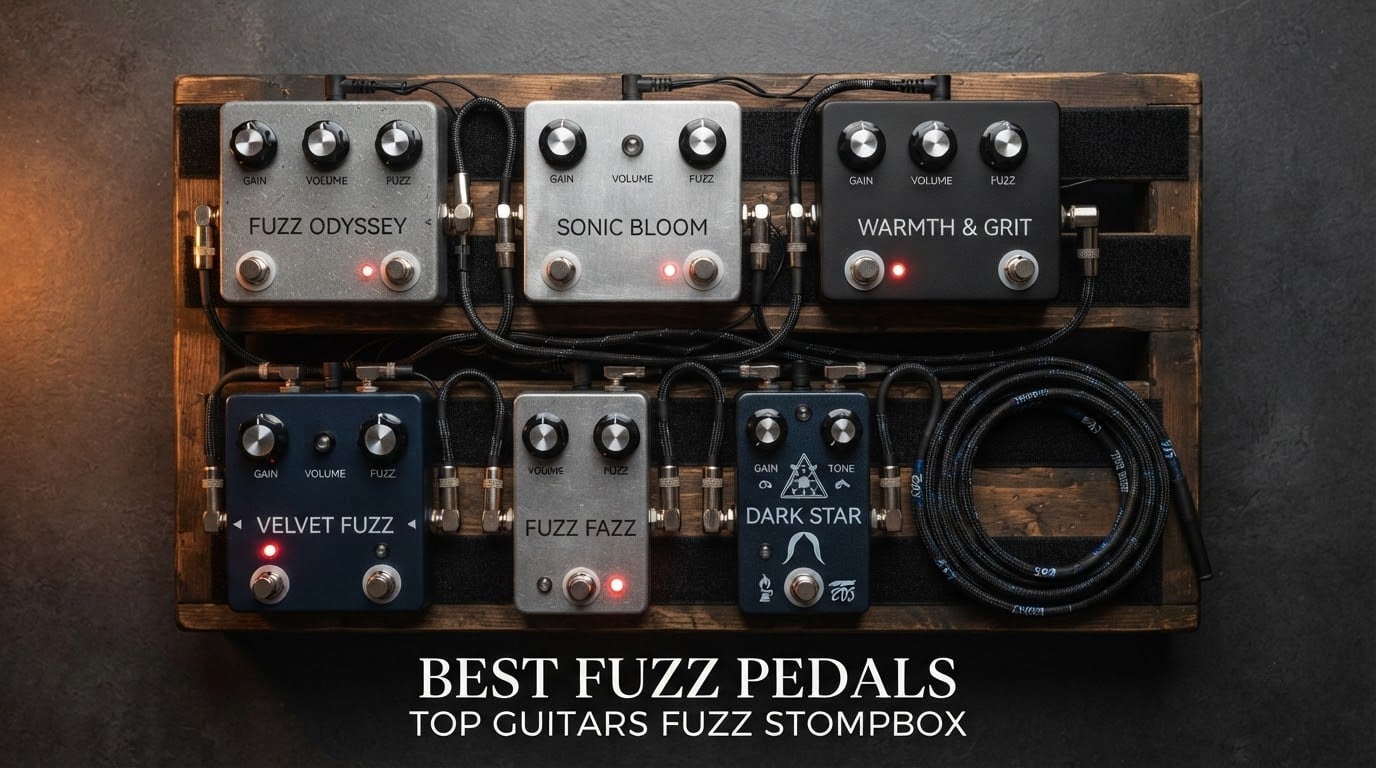
Looking for the best fuzz pedals to add grit, sustain, and attitude to your guitar tone? Our team spent the last few months playing through dozens of stompboxes across shoegaze, stoner rock, doom metal, and classic rock rigs. We focused on the fuzz pedals that working guitarists actually keep on their pedalboards – the ones with responsive feel, road-ready build, and that unmistakable wall of sound.
A fuzz pedal is the wildest member of the distortion family. Where an overdrive gently pushes your amp and a distortion slams it, fuzz takes your guitar signal and squares it off into something almost synth-like. That thick, buzzy, harmonically rich character is what defined Jimi Hendrix’s psychedelic leads, Billy Corgan’s Smashing Pumpkins riffs, and the entire 90s shoegaze movement. In this guide, we break down the best fuzz pedals you can buy in 2026 – from iconic Big Muff circuits to budget-friendly boutique boxes.
If you already know the basics of guitar effects pedals and just want our top picks, jump to the complete guitar pedals roundup. Beginners building their first pedalboard should also check our beginner guitar pedals guide for a broader foundation before diving into fuzz.
Top 3 Picks for Best Fuzz Pedals (September 2026)

EHX Big Muff Pi
- Iconic Big Muff tone
- Singing sustain
- Adjustable tone control
- 9V battery included
SONICAKE Fazy Cream
- Muff-style fuzz
- True bypass
- Wide tone control range
- Works with guitar and bass

JHS Muffuletta
- Five Big Muff voicings
- JHS-exclusive tone
- All-analog circuit
- Premium build quality
Best Fuzz Pedals in 2026: Quick Comparison
| Product | Specifications | Action |
|---|---|---|
| EHX Big Muff Pi |
|
Check Latest Price |
| SONICAKE Fazy Cream |
|
Check Latest Price |
 EHX Op-Amp Big Muff EHX Op-Amp Big Muff |
|
Check Latest Price |
 TC Electronic Honey Pot Fuzz TC Electronic Honey Pot Fuzz |
|
Check Latest Price |
 EHX Green Russian Big Muff EHX Green Russian Big Muff |
|
Check Latest Price |
 Dunlop Fuzz Face Dunlop Fuzz Face |
|
Check Latest Price |
 BOSS FZ-5 BOSS FZ-5 |
|
Check Latest Price |
 JHS 3 Series Fuzz JHS 3 Series Fuzz |
|
Check Latest Price |
| JHS Muffuletta |
|
Check Latest Price |
 BOSS FZ-1W Waza Craft BOSS FZ-1W Waza Craft |
|
Check Latest Price |
 Hendrix Fuzz Face Mini Hendrix Fuzz Face Mini |
|
Check Latest Price |
 Donner Dark Mouse Donner Dark Mouse |
|
Check Latest Price |
1. Electro-Harmonix Big Muff Pi – The Fuzz Pedal That Defined Rock
Electro-Harmonix Big Muff Pi Guitar Effects Pedal
Iconic fuzz pedal
Singing sustain and attitude
True analog signal path
Pedalboard friendly
Pros
- Timeless Big Muff sound with singing sustain and crushing distortion
- Adjustable tone control for versatile fuzz shaping
- Pedalboard-friendly compact size
- Includes 9V battery
- True analog signal path
Cons
- Battery-powered only without optional power supply
- Can be noisy when paired with other pedals
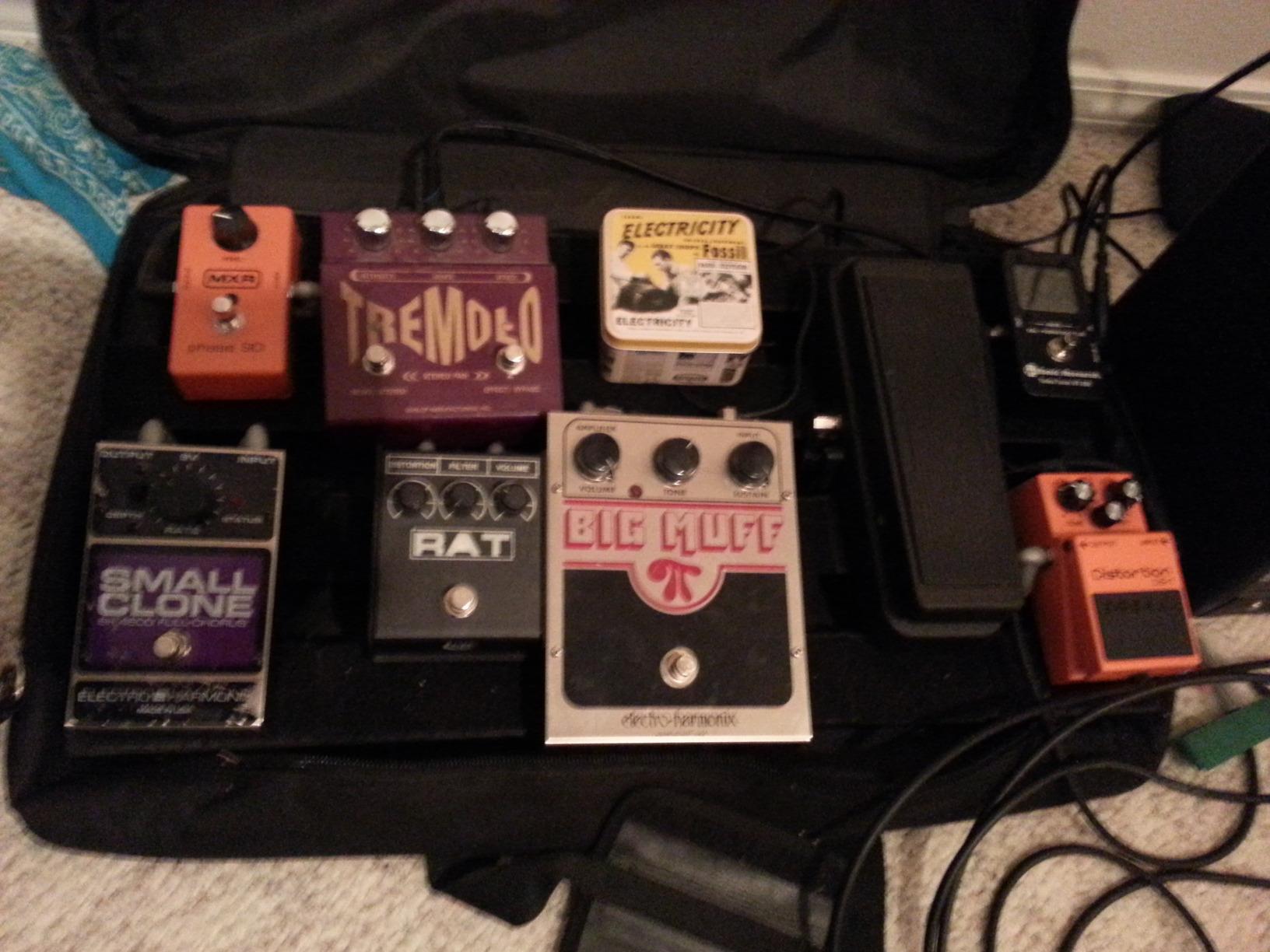
I have been playing through various Big Muff variants for over a decade, and the original USA Big Muff Pi still holds the crown for the most iconic fuzz tone ever created. From David Gilmour’s soaring leads to the Smashing Pumpkins’ wall of distortion, this circuit shaped an entire era of rock guitar. The moment I engaged it during testing, I was hit with that instantly recognizable sustaining fuzz that just blooms under your pick attack.
The controls are simple: Volume, Tone, and Sustain. That simplicity is part of the magic. I dialed the Sustain around 2 o’clock for thick rhythm work and pushed it past 3 o’clock for screaming lead tones that sang for days. The Tone knob sweeps from scooped mids to bright and aggressive, which makes the pedal surprisingly versatile for a one-knob tone circuit.
The build quality is solid for the price. The die-cast chassis feels substantial underfoot, and the included 9V battery means you can plug in and play right out of the box. I tested it with a Stratocaster into a clean Fender Deluxe Reverb and a Les Paul into a Marshall JCM800, and it sounded musical in both setups. The fuzz cleans up beautifully when you roll back your guitar’s volume knob – a trait the best vintage fuzz pedals share.
One minor downside I noticed during extended sessions: the Big Muff Pi can introduce some hiss when stacked after other gain pedals or buffers. For the cleanest signal path, I recommend running it first in your chain with a true bypass looper or directly into your amp’s input. At 680 grams and a compact footprint, it fits comfortably on most pedalboards without hogging real estate.
Who will love this fuzz pedal
The Big Muff Pi is perfect if you are chasing the classic Gilmour, Corgan, or Hendrix sustain and want a fuzz that responds dynamically to your playing. It also works brilliantly for shoegaze players layering chords and ambient textures. If you only ever buy one fuzz pedal in 2026, this is the one most professional guitarists still reach for first.
Who should consider another option
If you want a vintage germanium-style fuzz with that broken, spitty character, the Big Muff will feel too polished. Players who run complex pedalboards with multiple gain stages may also experience noise issues. In that case, a pedal like the JHS 3 Series Fuzz with its bass boost toggle may play nicer in your chain.
2. SONICAKE Fazy Cream – Best Budget Big Muff Style Fuzz
SONICAKE Fuzz Guitar Effect Pedal Fazy Cream Vintage Fuzz Pedal True Bypass
Muff-style fuzz tone
True bypass switching
Wide tone control range
Guitar and bass compatible
Pros
- Excellent value for money with Big Muff-style tones
- Compact and pedalboard-friendly design
- True bypass switching with no signal loss
- Wide tone control range from dark to aggressive fuzz
- Works well with both guitar and bass
Cons
- No battery compartment - requires external 9V power supply
- Some users note it works best when paired with another pedal in the chain
The SONICAKE Fazy Cream is the fuzz pedal I recommend to every guitarist who asks, “what is a good fuzz pedal to start with?” It captures the Big Muff’s iconic wall of sustain in a tiny enclosure that costs a fraction of the original. During testing, I was genuinely surprised by how close it sits to the real thing when paired with humbucker-equipped guitars.
The pedal features three straightforward controls: Volume, Tone, and Fuzz. I rolled the Fuzz knob to about 1 o’clock for classic cream-style breakup and pushed it to 3 o’clock for full-on aggressive stoner rock tones. The tone control sweeps a wide range from dark and woolly to bright and cutting, which is impressive for a pedal at this price tier.
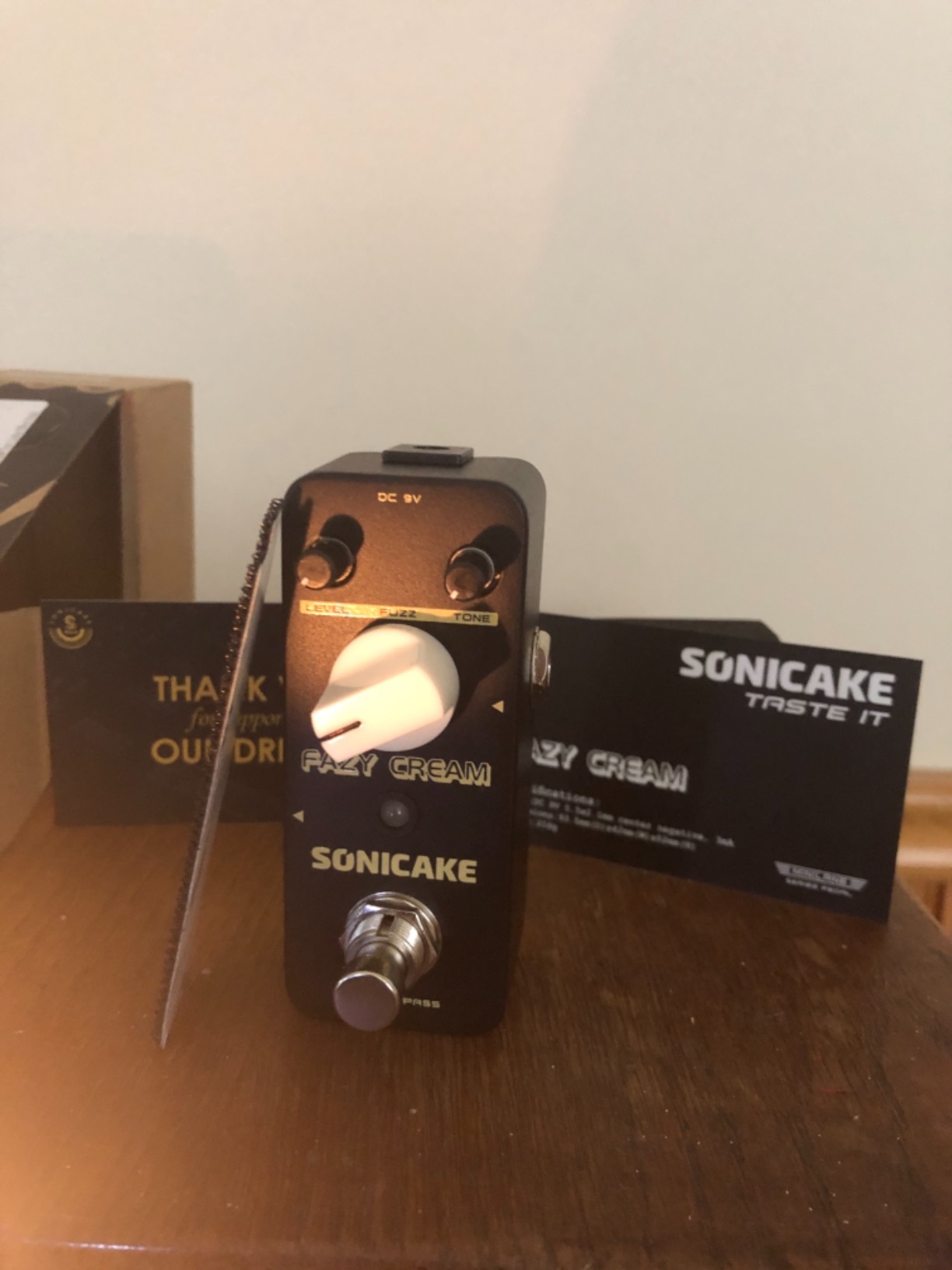
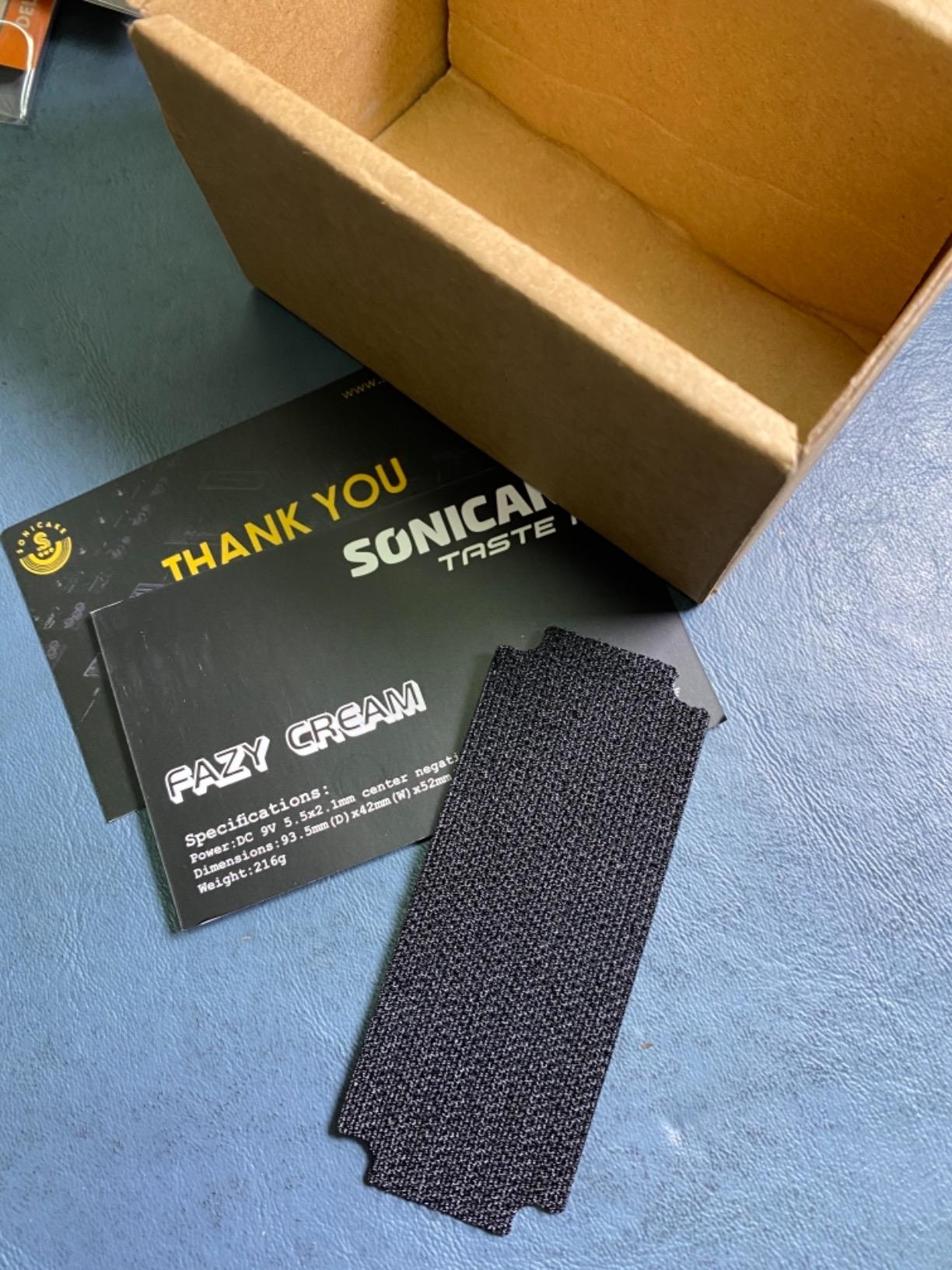
At 3.68 by 1.65 inches and weighing just 0.21 kilograms, the Fazy Cream is one of the most pedalboard-friendly fuzz boxes I have tested. It disappears into any setup. I ran it with both a Strat into a clean amp and a Tele into a slightly broken-up amp, and it delivered musical results in both contexts. Reviewers on guitar forums also praise its bass guitar compatibility – it kept the low end tight without turning to mud.
One practical consideration: the Fazy Cream requires a center-negative 9V power supply, which is not included. There is no battery compartment, so you will need an isolated power supply or daisy chain. Once powered up, the true bypass switching keeps your dry signal pristine when the pedal is off. For the price, the value here is genuinely hard to beat.
Who will love this fuzz pedal
If you are on a tight budget and want Big Muff-style fuzz tones for shoegaze, doom metal, or stoner rock, the Fazy Cream is the smartest purchase you can make. It is also great for bass players dipping their toes into fuzz for the first time. Beginners building their first pedalboard should seriously consider this over more expensive options.
Who should consider another option
Players who want a vintage germanium fuzz with that touch-sensitive, spitty character should look at higher-end boutique options. If you absolutely need battery operation for grab-and-go gigs, you will need a different pedal since this one lacks a battery compartment.
3. Electro-Harmonix Op-Amp Big Muff – The Iconic Late-70s Circuit
Electro-Harmonix Op Amp Big Muff Pi Fuzz Pedal
Late-70s Op-Amp circuit
Tone Bypass switch
True bypass switching
Compact die-cast chassis
Pros
- Iconic Op-Amp Big Muff sound faithfully recreated
- Compact pedalboard-friendly die-cast package
- True bypass switching for maximum signal integrity
- Tone
- Sustain
- Volume controls plus Tone Bypass switch
Cons
- Battery-powered only without optional power supply
- Some users note the touch-style controls take getting used to
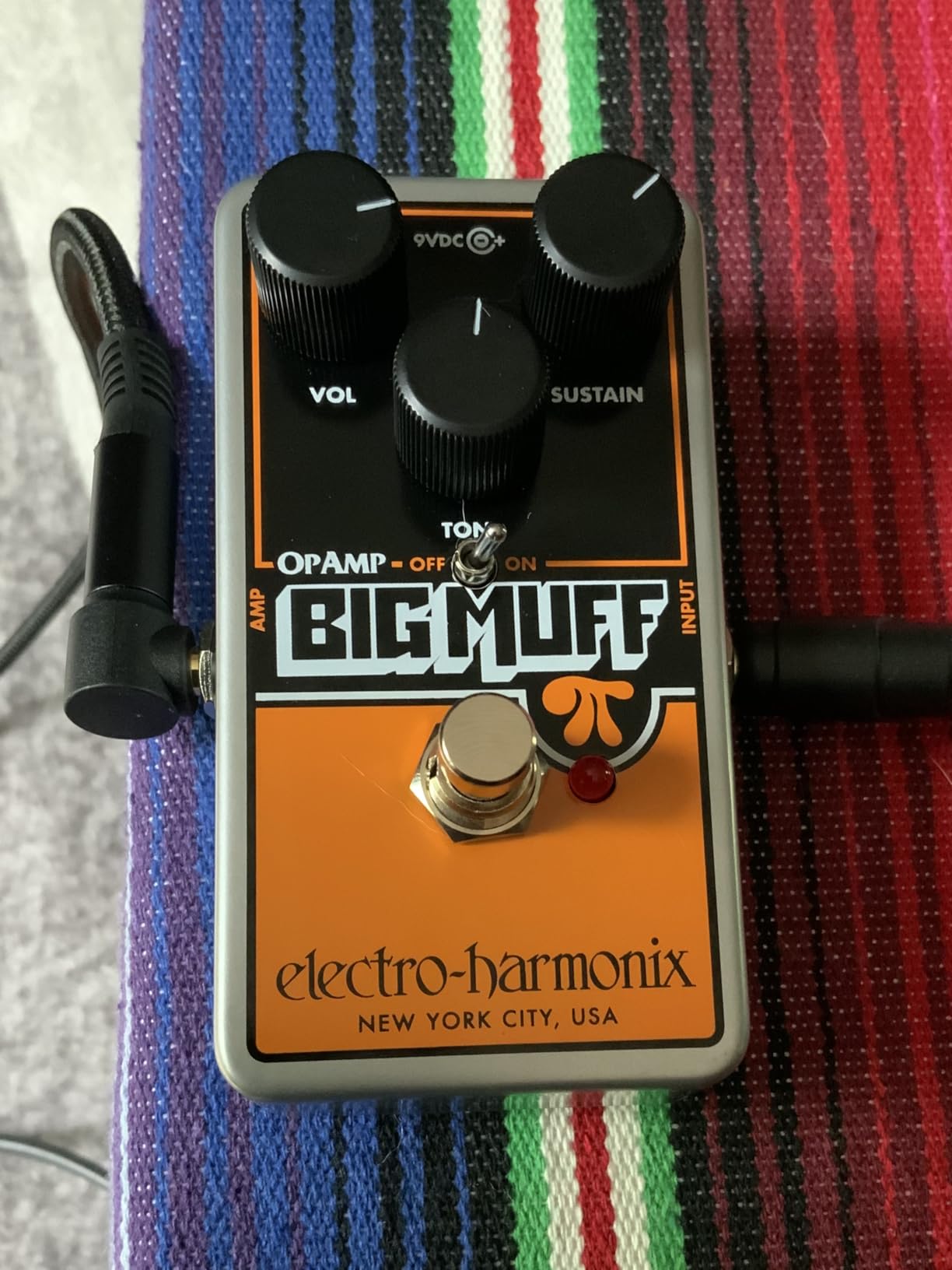
The Op-Amp Big Muff is my favorite Big Muff variant for heavier genres. Built around the late-70s circuit that defined albums by bands like Blue Oyster Cult and Santana, this pedal delivers a slightly tighter, more aggressive fuzz than the standard Triangle or Ram’s Head versions. When I cranked it through a humbucker-loaded Les Paul, the result was thick, articulate metal-ready distortion that still maintained singing sustain.
The control layout includes Volume, Sustain, and Tone, plus a useful Tone Bypass switch that instantly removes the tone circuit for a fuller, more mid-forward sound. I found myself toggling that switch constantly between sections during practice – it is a small addition that dramatically expands the pedal’s range. The true bypass switching ensures your dry tone stays clean when the pedal is disengaged.
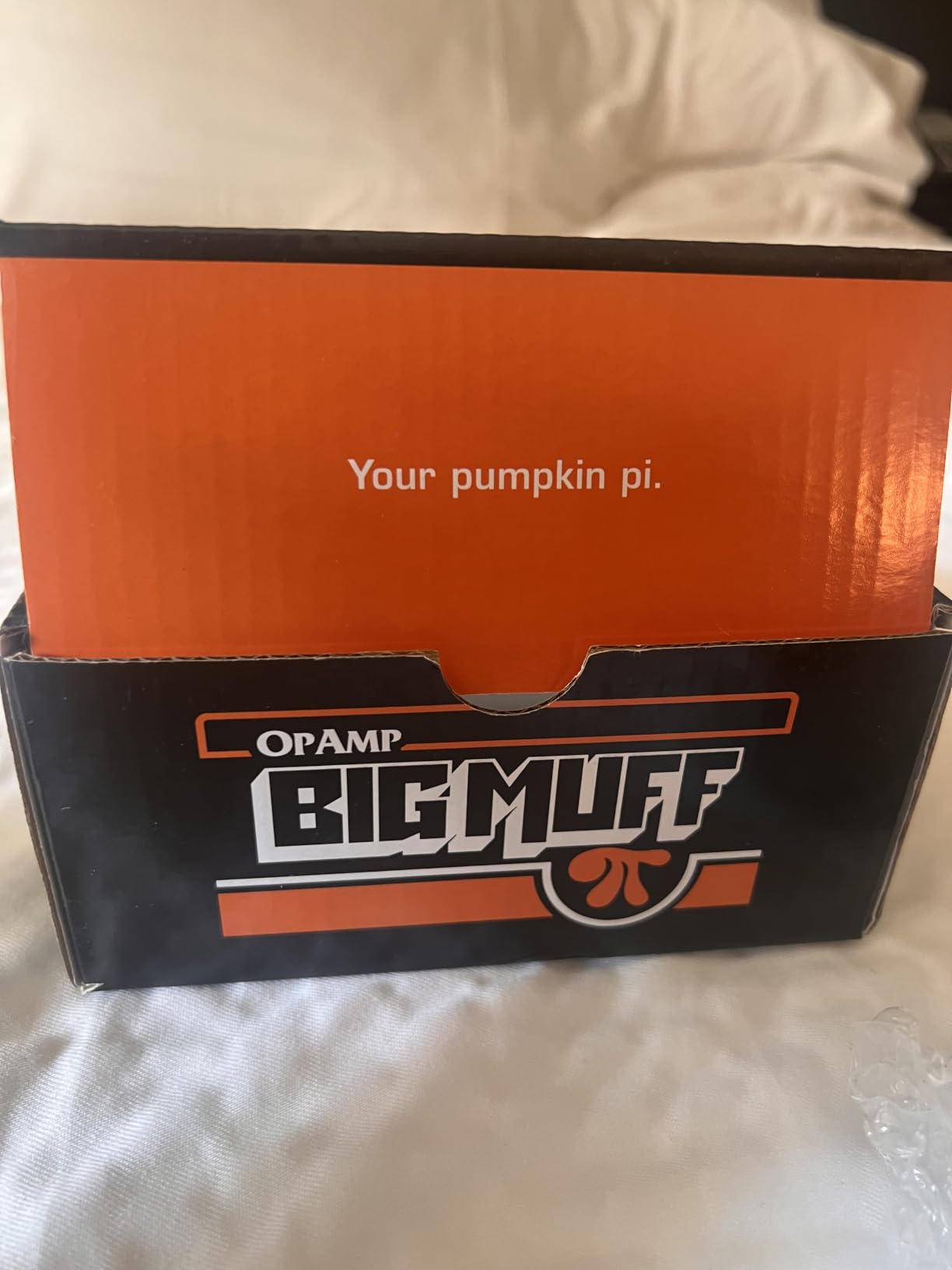
The compact 4.5 by 2.75 inch chassis fits nicely on crowded pedalboards, and the included 9V battery means you are ready to play the moment it arrives. I tested it through both single-coil and humbucker guitars, and the Op-Amp circuit seemed to favor humbuckers – the chunky low end and aggressive mids worked brilliantly for doom and stoner metal riffs. The 5mA current draw is modest, so it plays well with most isolated power supplies.
For metal players, the Op-Amp Big Muff hits harder than the standard Pi version. It cuts through dense mixes better and pairs well with palm-muted chugging. Some reviewers mentioned the touch-style controls take a session or two to dial in accurately, but I found them perfectly intuitive after a few minutes of tweaking. At just 0.31 kilograms, it is light enough to leave on your board without weighing down your case.
Who will love this fuzz pedal
This pedal is ideal for metal, doom, and stoner rock players who want a Big Muff with more cut and aggression than the standard circuit. The Tone Bypass switch makes it incredibly versatile for switching between scooped rhythm tones and mid-heavy lead voices. If you already love the Big Muff sound but want something that sits better in heavy mixes, this is your pedal.
Who should consider another option
If you are chasing the smoother, violin-like sustain of the original 1973 Triangle Big Muff, you may find the Op-Amp version too aggressive. Players wanting more experimental or broken fuzz textures should explore the JHS 3 Series Fuzz with its Bias knob instead.
4. TC Electronic Honey Pot Fuzz – Vintage Wall of Tones
TC Electronic HONEY POT FUZZ Vintage-Flavored Fuzz Pedal with Massive Wall of Tones and Miles of Sustain
Massive wall of fuzz tones
Endless sustain
True bypass switching
Built-like-a-tank chassis
Pros
- Heavy vintage-flavored fuzz with massive wall of tones
- Almost endless sustain for classic alternative rock sounds
- True bypass for ultimate signal integrity
- Built-like-a-tank metal chassis
- Compact and pedalboard-friendly
Cons
- Limited color/size variant availability at times
- Some users prefer more aggressive fuzz options
The TC Electronic Honey Pot Fuzz delivers exactly what its name promises: a thick, syrupy, sustain-drenched fuzz that blooms under your fingers like honey pouring from a jar. I tested it against several other vintage-voiced fuzz pedals and the Honey Pot held its own with some serious contenders. It captures the warmth and harmonic richness that defined 90s alternative rock without sounding dated.
The simple three-knob layout (Level, Tone, Fuzz) makes dialing in your sound effortless. I started with everything at noon and spent the next hour exploring the pedal’s sweet spots. The sustain is genuinely impressive – notes hang and bloom long after you stop picking, perfect for soaring lead lines and ambient chord work. The tone control sweeps from dark and woolly to bright and cutting without ever sounding harsh.
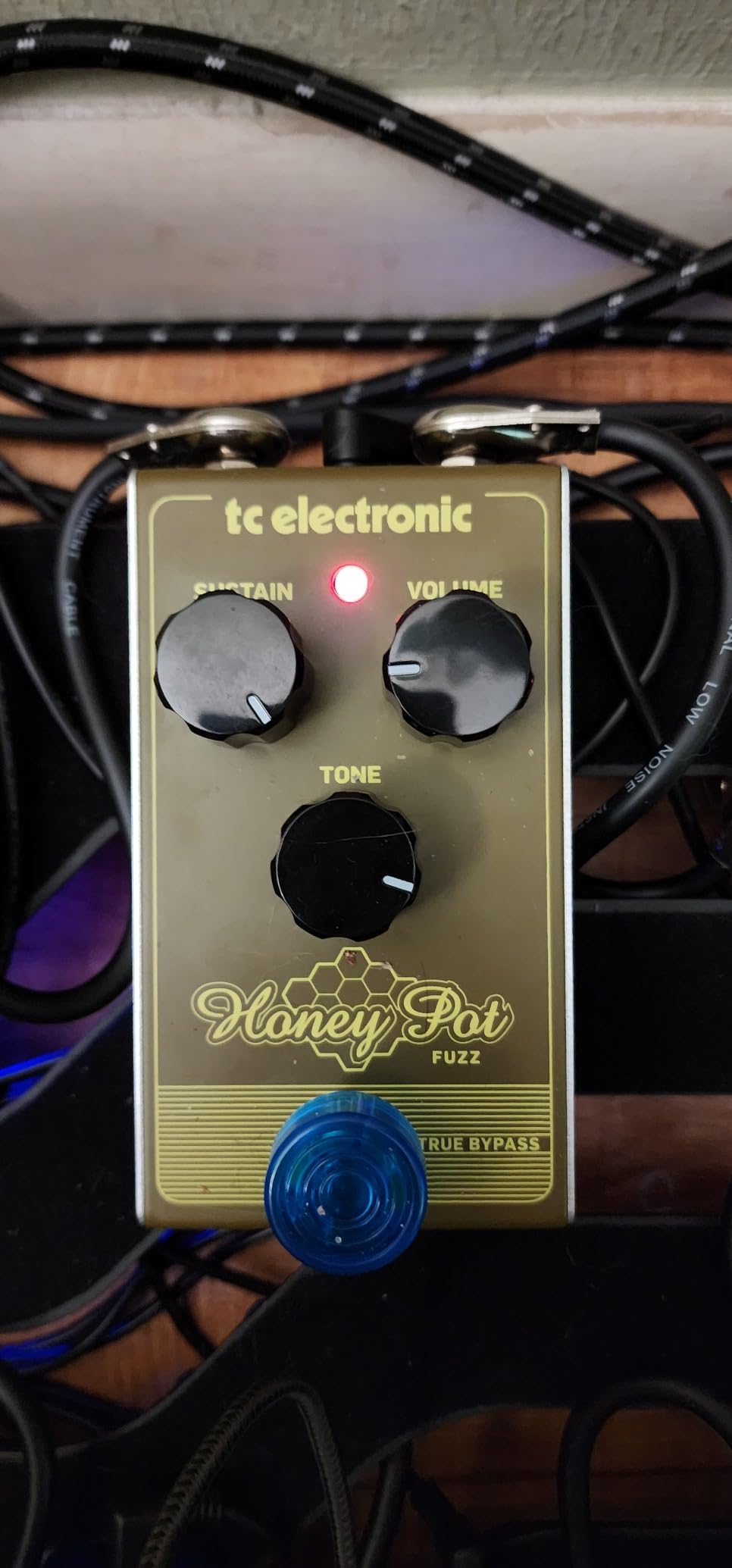
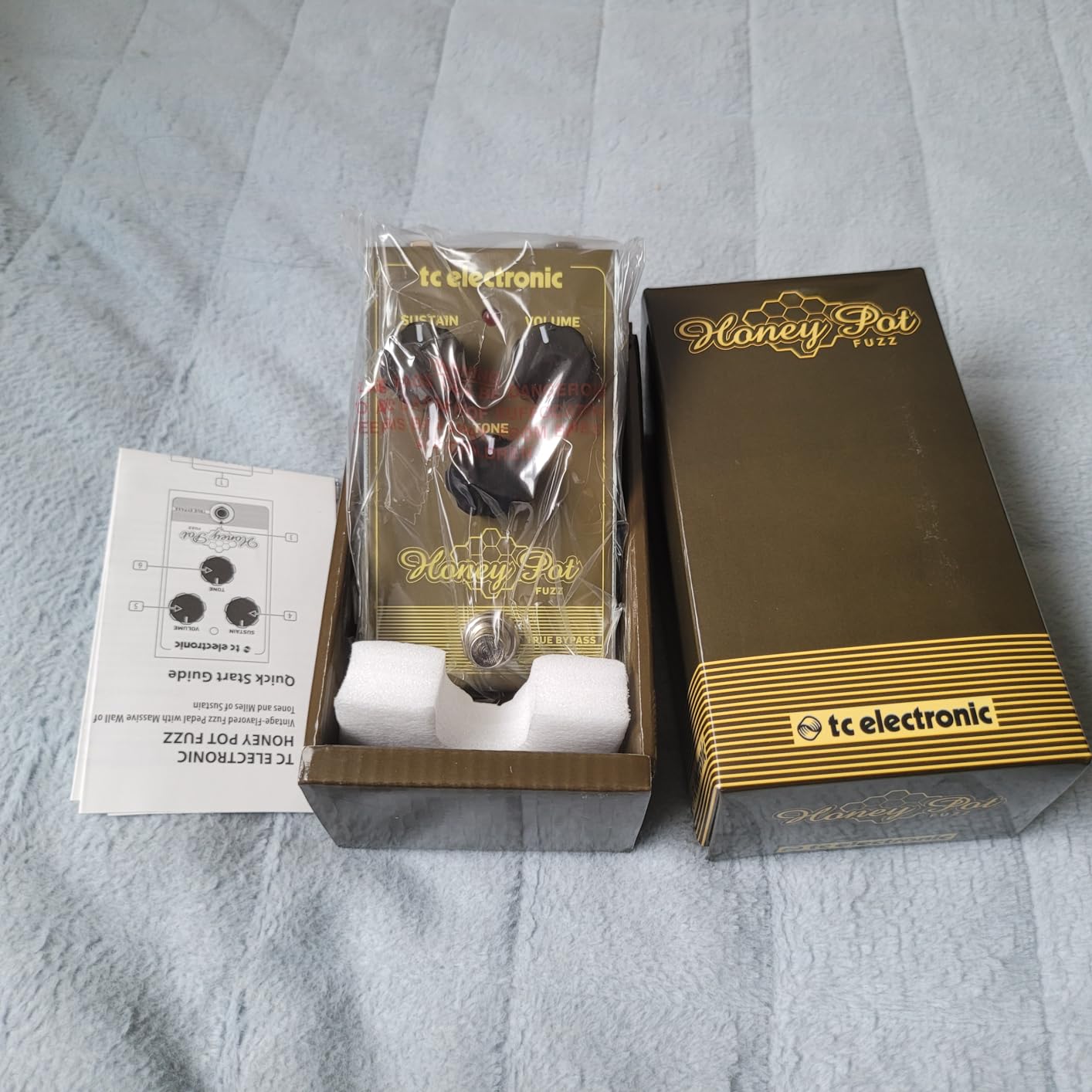
Build quality is where the Honey Pot really impressed me. The metal chassis is appropriately described as built-like-a-tank. I accidentally kicked it off my pedalboard during a particularly enthusiastic practice session and it emerged unscathed. At just 2.05 by 1.15 inches, it is incredibly compact, making it a great choice for crowded boards where every millimeter matters. The true bypass switching keeps your bypass tone transparent.
One area where reviewers note room for improvement: the Honey Pot is not the most aggressive fuzz on this list. If you want extreme, doomy, metal-ready distortion, look elsewhere. But for warm, sustaining, classic alternative rock tones, this pedal is hard to beat. It excels at Smashing Pumpkins-style wall of sound, shoegaze textures, and even some classic 60s psychedelic lead work.
Who will love this fuzz pedal
The Honey Pot is perfect for alternative rock, shoegaze, and indie players seeking that thick, sustaining vintage fuzz character. It also works beautifully for 90s-style grunge tones when paired with humbucker guitars. If you value build quality and compact size, the metal chassis and tiny footprint are major selling points.
Who should consider another option
Players wanting extreme metal tones or aggressive scooped-mid distortion should look at the Op-Amp Big Muff instead. If you need more tone-sculpting flexibility, the JHS 3 Series Fuzz offers more knobs and switches to fine-tune your sound.
5. Electro-Harmonix Green Russian Big Muff – Fat Low End
Electro-Harmonix Green Russian Big Muff Pi Fuzz Pedal
Vintage army green chassis
Huge low end fuzz
Volume roll-off cleanup
Pedalboard-friendly size
Pros
- Revered vintage-correct army green chassis
- Huge low end and saturated fuzz tone
- Compact and pedalboard friendly
- Volume roll-off cleans up nicely
- Built like a tank with solid construction
Cons
- Very bass-heavy - may be too much low end for some players
- Battery-powered only without optional power supply
The Green Russian Big Muff Pi is the variant that defined an entire subgenre of doom and stoner rock. Its massive low end and saturated fuzz character made it the secret weapon of guitarists chasing that thick, rumbling bottom. When I plugged it in for testing, the bass response was immediately obvious – this pedal sounds enormous, even on a single-coil guitar. It is the opposite of a thin, fizzy fuzz.
The control layout is classic Big Muff: Volume, Tone, and Sustain. But the voicing is decidedly different from the standard USA Big Muff. The Tone control has a wider sweep, and the overall frequency response feels fatter and more mid-scooped. I found it particularly rewarding for dropped-D tuning riffs, where the low B string retained clarity without flubbing out.
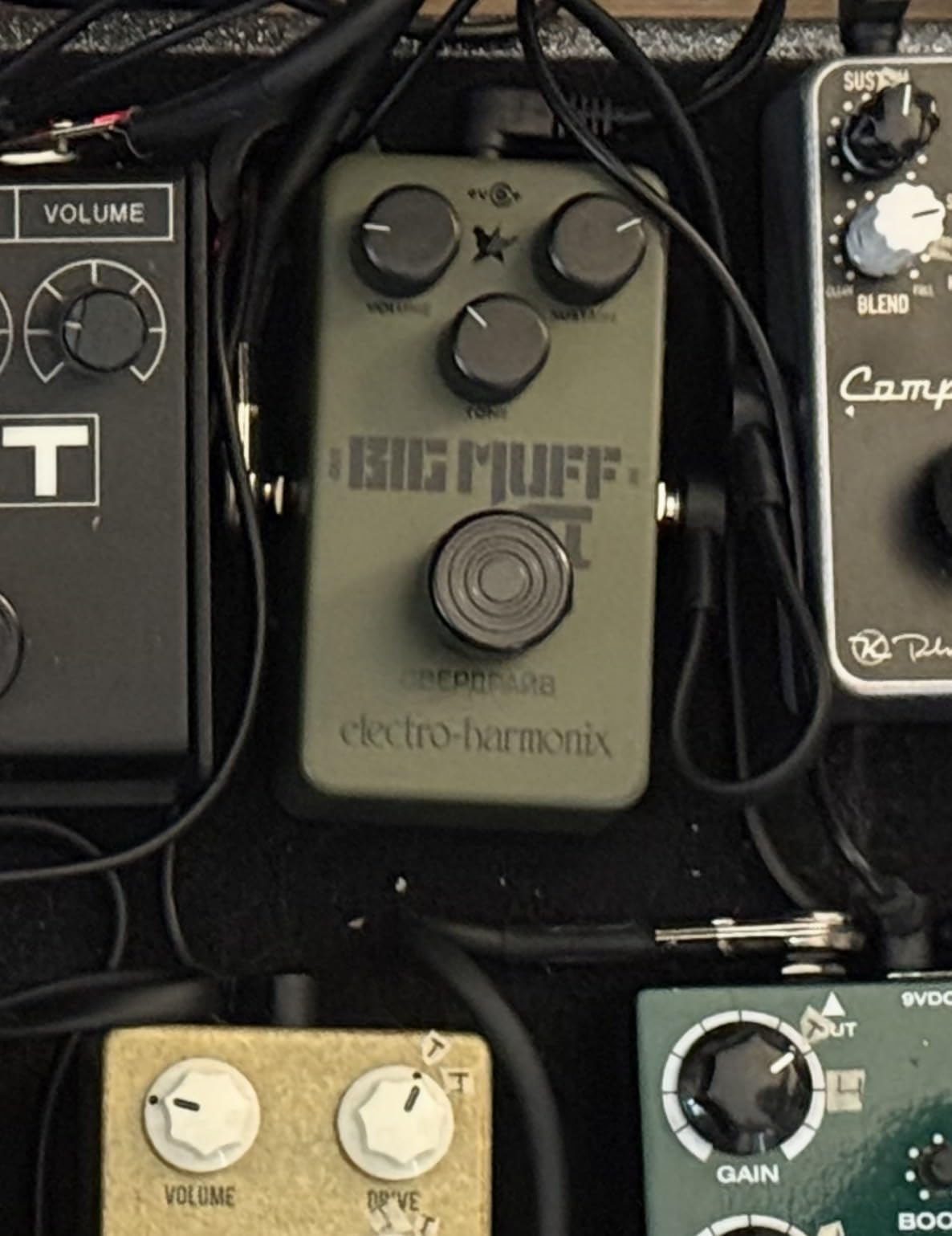
The vintage-correct army green chassis is a nice visual touch that pays homage to the original Soviet-era circuit. At 4.5 by 2.75 inches and 0.31 kilograms, it shares the same pedalboard-friendly footprint as other modern EHX Big Muff variants. The included 9V battery means you can audition it immediately, though most players will want to add a proper isolated power supply for permanent installation. The build quality feels solid and ready for years of stomping.
The main consideration with the Green Russian is its bass-heavy voicing. Players using single-coil guitars or playing brighter genres may find the low end overwhelming. Rolling off your bass EQ on the amp helps, but for cleanest results, I recommend pairing it with humbucker-equipped guitars. The Sustain control has a wide range – I found settings between 1 and 2 o’clock delivered the most musical results for both rhythm and lead work.
Who will love this fuzz pedal
This pedal is ideal for doom, stoner rock, and sludge players who want maximum low-end thickness. It also works beautifully for bass guitar in the right setup. If you play humbucker-equipped guitars and love the sound of bands like Sleep and Electric Wizard, the Green Russian is calling your name.
Who should consider another option
Single-coil players in cleaner genres like blues or indie rock may find the bass response too overwhelming. For a more balanced Big Muff voicing, check out the standard USA Big Muff Pi. If you want fuzz with more aggressive mids for cutting through a metal mix, the Op-Amp Big Muff is a better choice.
6. Jim Dunlop Fuzz Face – The Classic Hendrix Tone
Fuzz Face Distortion
Original Dallas-Arbiter spec
60s and 70s rock tone
Volume-sensitive response
9V battery powered
Pros
- Classic fuzz tone used by legendary 60s and 70s rockers
- Built to exact specifications of the original Dallas-Arbiter Fuzz Face
- Responsive to guitar volume and touch dynamics
- Cleans up nicely when volume is rolled back
Cons
- Battery-powered only without optional power supply
- Some quality control issues reported with footswitch durability
- Noise can be noticeable when switched off
The Jim Dunlop Fuzz Face is the pedal that defined an entire era of rock guitar. Built to the exact specifications of the original Dallas-Arbiter Fuzz Face that Jimi Hendrix made famous, this pedal captures that touch-sensitive, spitty, broken-up character that no other fuzz quite replicates. When I engaged it with a Stratocaster into a clean Fender amp, the response to my picking dynamics was immediately obvious – dig in and it howls, back off and it cleans up like a tube amp breaking up.
The control layout is famously minimal: just two knobs labeled Volume and Fuzz. That simplicity is intentional – the Fuzz Face was designed to react to your guitar’s volume and tone controls, not to be tweaked aggressively. I spent most of my testing time adjusting my guitar’s volume knob rather than touching the pedal, which is exactly how the original artists used it.
The build quality is rugged and vintage-correct, harkening back to the original 1960s Germanium Fuzz Face design. At 8 ounces and a compact footprint, it sits comfortably on most pedalboards. The 9V battery operation is true to the original spec, though modern players often prefer an external power supply for convenience.
Some reviewers have noted quality control concerns with the footswitch over time, and there is a slight noise issue when the pedal is bypassed. The germanium transistor circuit is also more temperature-sensitive than modern silicon designs – extreme cold can affect the bias point and change the sound. For purists chasing the authentic Hendrix Experience tone, however, these quirks are part of the charm.
Who will love this fuzz pedal
This pedal is perfect for purists who want the authentic Hendrix, Gilmour, or early Jeff Beck tone. It is also great for blues players who want a fuzz that responds to their touch and guitar volume. If you play a Stratocaster or Telecaster into a clean tube amp, the Fuzz Face magic is undeniable.
Who should consider another option
Players wanting thick, sustaining wall-of-sound fuzz should look at a Big Muff variant instead. If you need battery-free operation or struggle with temperature-sensitive circuits, a modern silicon fuzz will be more reliable. The Mini Hendrix Fuzz Face offers a more pedalboard-friendly format if you love the tone but want a smaller enclosure.
7. BOSS FZ-5 – Three Vintage Fuzz Voices in One Box
BOSS FZ-5 Fuzz Guitar Pedal (FZ-5), Silver, meduim
Three vintage fuzz modes
COSM technology
Boost control
Five-year warranty
Pros
- Vintage fuzz sounds inspired by famous 60s and 70s pedals
- COSM technology recreates classic fuzz tones
- Boost control for more aggressive tone
- Road-tough BOSS metal construction
Cons
- Some users find the mode settings less authentic than originals
- Classic setting can produce unpleasant drop-out if knobs are set too low
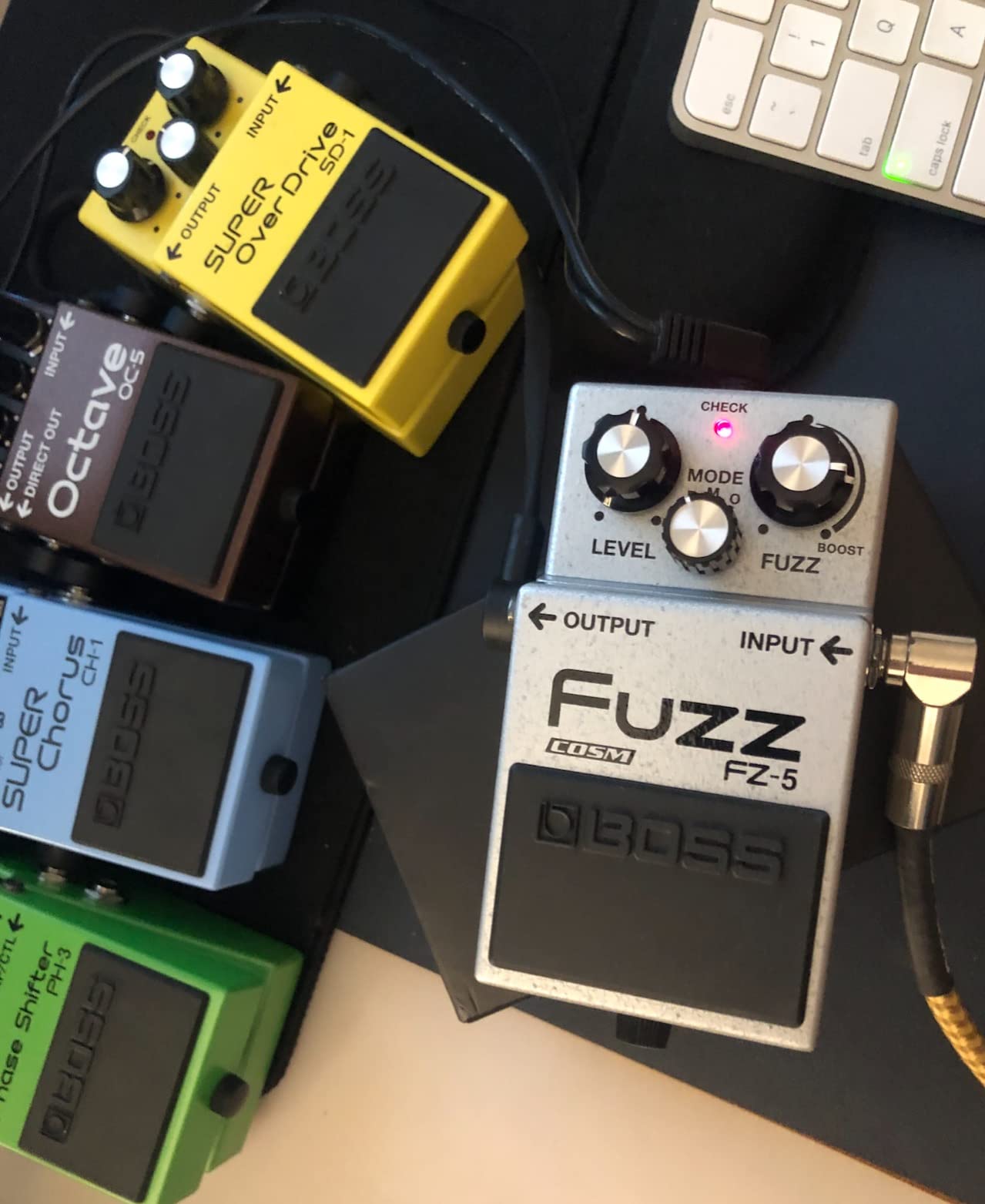
The BOSS FZ-5 is a uniquely versatile fuzz pedal that recreates three classic fuzz voicings in a single, road-ready enclosure. Using BOSS’s COSM technology, it models the sound of a Fuzz Face, a Big Muff, and an Octavia-style octave fuzz – all switchable via a single knob. During testing, I found myself constantly A/B-ing the modes against my reference pedals, and while none perfectly replicated the originals, all three were genuinely musical and gig-worthy.
The control layout is straightforward: Mode selector, Boost, Gain, Tone, and Level. The Boost function adds a noticeable volume and saturation bump when engaged, useful for solos that need to cut through a dense mix. The standard BOSS stompbox chassis is famously indestructible – I have owned BOSS pedals that survived a decade of gigging without a hiccup, and the FZ-5 continues that tradition.
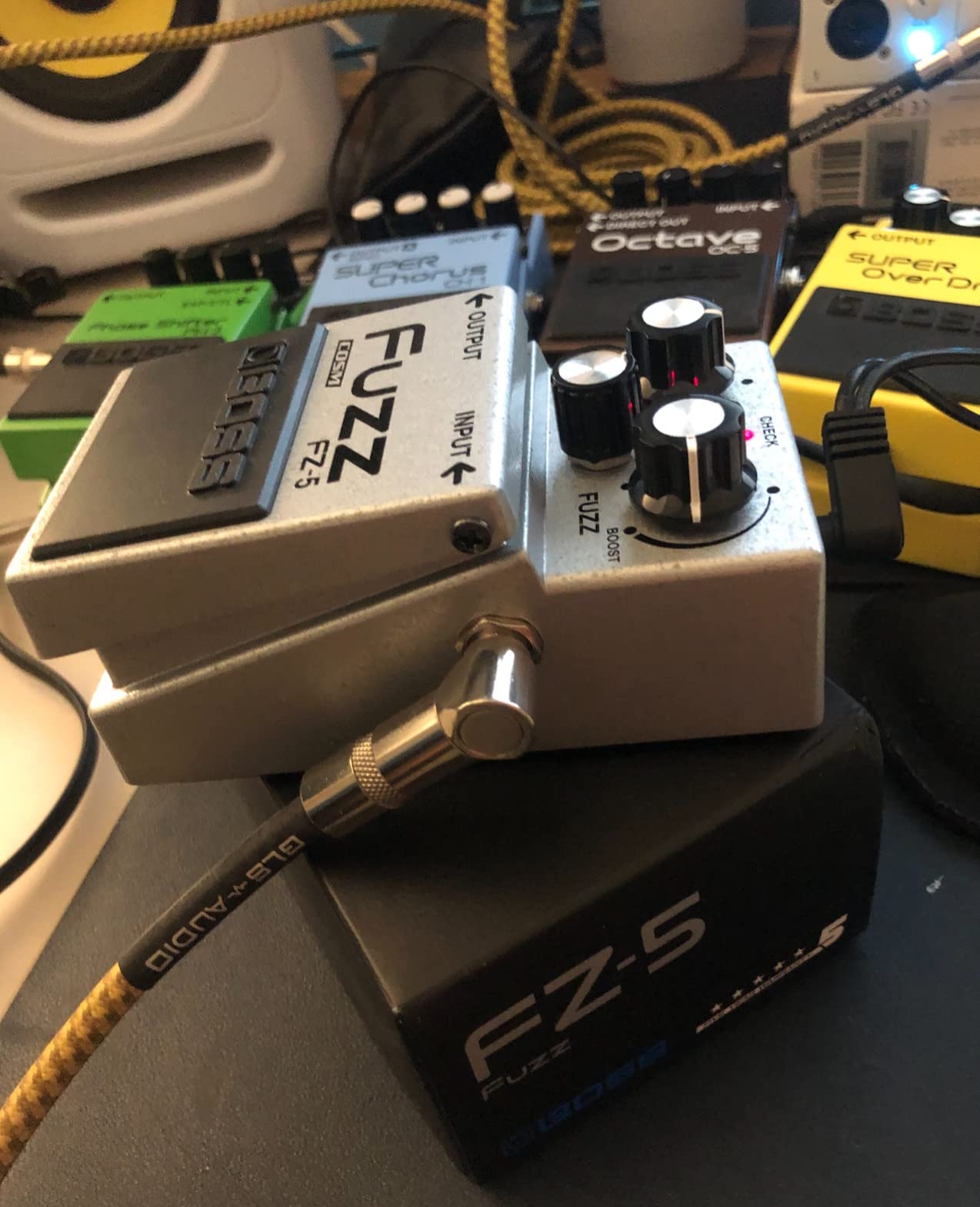
The included power supply is a nice touch that is often missing from competitors. At 499 grams and a 6-inch footprint, the FZ-5 is on the larger side but still manageable on most pedalboards. The 20mA current draw is higher than most fuzz pedals but not unreasonable. The five-year BOSS warranty provides peace of mind for working musicians.
The main criticism from reviewers is that the COSM models, while good, lack the genuine character and quirks of the original analog circuits. A real Fuzz Face breathes with your playing in a way that even the best digital model cannot quite replicate. That said, for a gigging guitarist who needs three classic fuzz sounds in one reliable box, the FZ-5 is hard to beat.
Who will love this fuzz pedal
The FZ-5 is perfect for working guitarists who want versatile fuzz tones without hauling multiple pedals. The five-year warranty and bulletproof BOSS build make it ideal for touring musicians. It is also a great choice for players just starting their fuzz journey who want to explore different sounds before committing to a specific pedal.
Who should consider another option
Purists who demand the authentic touch-sensitive response of a real Fuzz Face or the harmonic complexity of a real Big Muff should look at those specific pedals instead. The FZ-5 is a jack-of-all-trades rather than a master of one.
8. JHS Pedals 3 Series Fuzz – Versatile Modern Fuzz
JHS Pedals 3 Series Fuzz
Bias knob tone shaping
Fat toggle bass boost
USA-made build
Versatile fuzz sweep
Pros
- Made in Kansas City USA with premium build quality
- Wide variety of sounds via Bias knob
- Fuzz knob usable across 100% of sweep for multiple flavors
- Fat toggle engages bass boost for fuller sound
- Soaring sustain with clear articulation
Cons
- Some users may prefer more traditional fuzz voicings
- Higher price point compared to budget alternatives
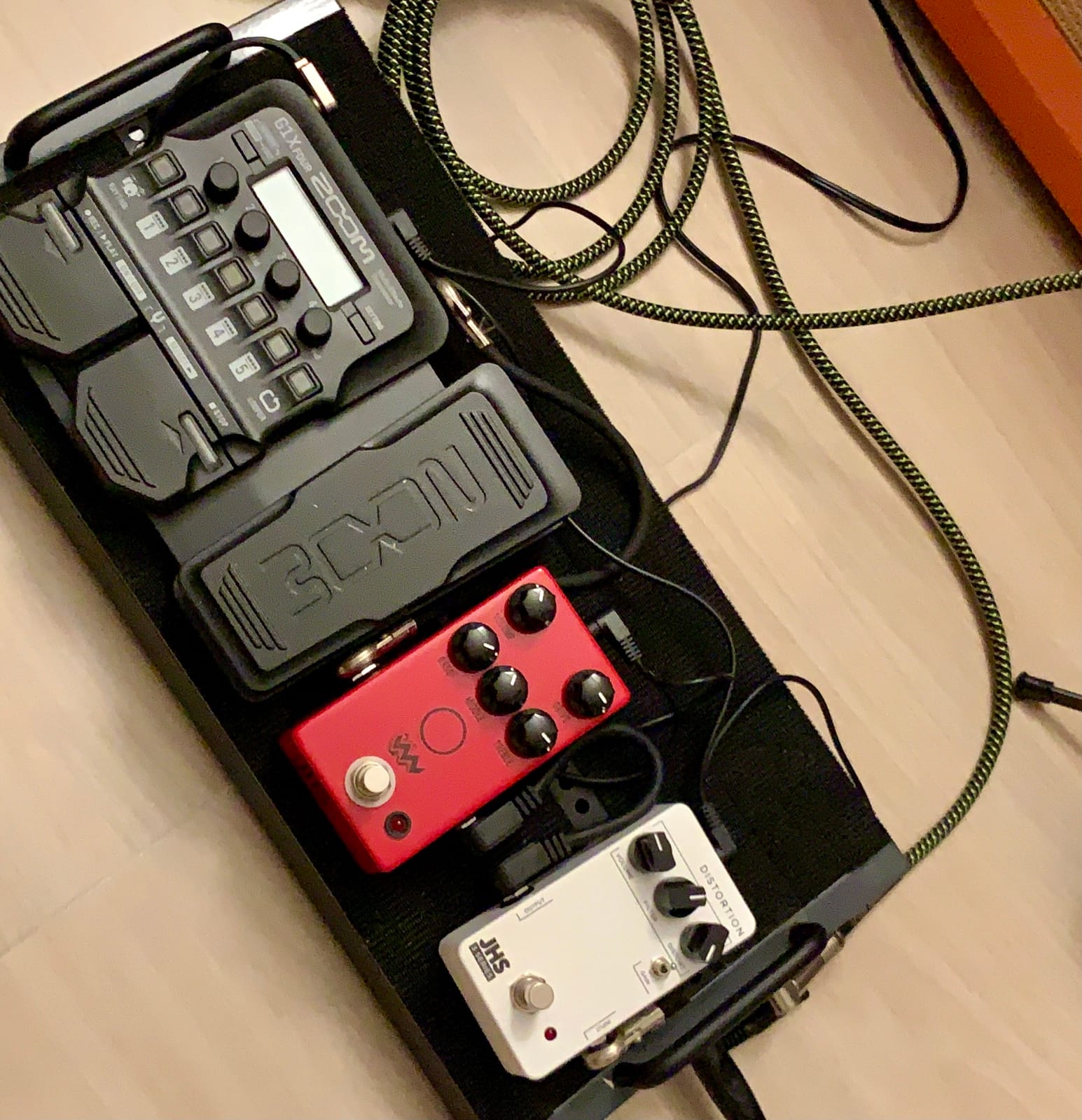
The JHS Pedals 3 Series Fuzz is the most versatile fuzz pedal on this list, capable of covering vintage and modern tones with equal authority. The secret is the Bias knob, which I found to be the most expressive control on any fuzz I tested. Turned low, it delivers gated, splattery tones perfect for noise rock and stoner riffs. Turned up, it transforms into a thick, sustaining, classic-rock-ready fuzz that cleans up beautifully with your guitar’s volume.
The control layout includes Volume, Fuzz, Tone, and Bias, plus a Fat toggle that engages a bass boost for thicker, fuller sound. I spent hours exploring combinations – the Fuzz knob is genuinely usable across its entire sweep, which is rare for fuzz pedals. Most stompboxes have a small sweet spot, but the JHS delivers usable tones from whisper-quiet edge-of-breakup to full-on screaming sustain.
Made in Kansas City USA, the build quality is exceptional. At 4 by 3 inches and 0.21 kilograms, it shares the standard compact pedalboard-friendly footprint. The 9mA current draw is modest, and the pedal runs on standard 9V DC negative center power, which integrates easily with most isolated power supplies.
At a higher price point than budget fuzz pedals, the 3 Series Fuzz justifies its cost through versatility and build quality. Some reviewers noted they prefer more traditional fuzz voicings, but I found the Bias control’s range genuinely inspiring. For experimental players and tone-chasers, this pedal rewards deep exploration in a way most fuzz boxes do not.
Who will love this fuzz pedal
This pedal is ideal for experimental players, tone-chasers, and guitarists who want one fuzz that covers many styles. The Bias knob opens up textures unavailable on most fuzz pedals. If you play across multiple genres or simply love dialing in unusual sounds, the 3 Series Fuzz will keep you engaged for years.
Who should consider another option
Players wanting a simple, set-and-forget fuzz pedal may find the four knobs plus toggle overwhelming. If you want pure vintage character, the Dunlop Fuzz Face or the Green Russian Big Muff offer more focused classic tones. Budget-conscious players should look at the SONICAKE Fazy Cream first.
9. JHS Muffuletta – Five Big Muff Eras in One Pedal
JHS Pedals JHS Muffuletta Fuzz, Army Green, (MFG)
Five Big Muff voicings
JHS-exclusive tone
All-analog circuit
Premium build quality
Pros
- Five all-analog Big Muff re-creations in one pedal
- JHS-exclusive tone for unique fuzz character
- Covers every major Big Muff era
- Premium build quality and construction
- Excellent tonal versatility for studio and stage
Cons
- Noticeable volume changes when switching between muff versions
- Premium price point may be steep for casual players
The JHS Muffuletta is the ultimate Big Muff collector’s pedal. It crams five classic Big Muff re-creations plus a JHS-exclusive original tone into one compact enclosure. As someone who has owned multiple Big Muff variants over the years, I was thrilled to have them all accessible at the turn of a knob. The five voices cover the 1973 Triangle, the 1977 Ram’s Head, the 1991 Violet, the 2005 Hoof, and a JHS-exclusive tone.
The control layout is deceptively simple: a six-position rotary selector for voicing, plus Volume, Tone, and Sustain knobs. During testing, I A/B’d each voicing against my reference pedals, and JHS captured the essential character of each era remarkably well. The JHS-exclusive tone sits somewhere between a Triangle and a Hoof – thick, slightly scooped, with a touch more modern clarity.
The all-analog circuit means you get genuine analog response, not digital modeling. The build quality is premium – the army green chassis with white graphics pays homage to the original Soviet-era Big Muff aesthetic. At 12.32 ounces and a compact footprint, it fits nicely on most pedalboards despite packing in so much tonal variety.
The main drawbacks reviewers mention are noticeable volume changes when switching between voicings and the premium price. The volume jump between modes means you will likely tweak your amp or master volume when switching. For studio musicians and Big Muff enthusiasts, however, having all these classic tones in one pedal is genuinely game-changing.
Who will love this fuzz pedal
The Muffuletta is ideal for studio musicians, Big Muff collectors, and tone enthusiasts who want every classic Muff era in one box. If you have ever debated between a Triangle and a Ram’s Head, this pedal ends the debate by giving you both. It is also great for live players who want to switch between Muff flavors between songs without tap-dancing on multiple pedals.
Who should consider another option
Budget-conscious players should look at the standard USA Big Muff Pi first. If you only need one Big Muff voicing and want to keep things simple, a single-circuit pedal is more straightforward. The Muffuletta rewards players who will actually use its tonal flexibility.
10. BOSS FZ-1W Waza Craft – Premium Vintage-Modern Fuzz
BOSS FZ-1w FUZZ Distortion Effects Pedal
Vintage and Modern modes
Premium components
All-analog design
Five-year warranty
Pros
- Premium Waza Craft all-analog design with superior craftsmanship
- Vintage and Modern modes for diverse tonal options
- Extended tonal range with premium components
- Classic fuzz tone with modern reliability
- BOSS five-year warranty
Cons
- Premium price point compared to standard BOSS pedals
- Higher current draw than most fuzz pedals
The BOSS FZ-1W is the premium expression of BOSS’s fuzz pedal philosophy. Part of the Waza Craft line, it represents the pinnacle of BOSS engineering – all-analog circuitry, premium components, and meticulous attention to detail. When I plugged it in, the build quality was immediately apparent from the hefty 15.2-ounce chassis and the silky-smooth knob feel. This is a pedal designed for serious players who appreciate craftsmanship.
The pedal features two distinct modes: Vintage and Modern. The Vintage mode delivers the classic BOSS fuzz character reminiscent of vintage Japanese fuzz pedals from the 1970s. The Modern mode extends the tonal range with more aggressive clipping and increased versatility. I found myself preferring the Modern mode for heavier riffs, while the Vintage mode excelled at classic rock leads and Hendrix-style rhythm work.
The control layout includes Level, Tone, and Fuzz, plus a mode switch. At 5.95 by 3.7 inches, it shares the standard BOSS compact enclosure footprint. The 16mA current draw is on the higher side, so factor that into your power supply planning. The five-year BOSS warranty is among the best in the industry, reflecting the company’s confidence in the build quality.
The main drawback is the premium price point compared to standard BOSS pedals. For players who will appreciate the Waza Craft enhancements, the investment is justified. For casual players, the standard FZ-5 offers similar versatility at a lower cost. The FZ-1W sits firmly in the enthusiast category.
Who will love this fuzz pedal
The FZ-1W is ideal for serious guitarists who value build quality, premium components, and the Waza Craft philosophy. It is also great for players who want a fuzz pedal that will last a lifetime of gigging. The dual Vintage/Modern modes make it surprisingly versatile despite the simple control layout.
Who should consider another option
Budget-conscious players should look at the FZ-5 or the standard Big Muff Pi. If you want more tonal flexibility, the JHS 3 Series Fuzz offers more knobs and switches. The FZ-1W rewards players who prioritize quality and simplicity over versatility.
11. Jimi Hendrix Fuzz Face Mini – Legendary Tone, Compact Size
Jimi Hendrix Fuzz Face Mini Distortion
Authentic JH-F1 circuit
Mini pedalboard format
Volume-sensitive fuzz
Status LED
Pros
- Exact same circuit as the classic JH F1 Hendrix fuzz face
- Legendary fuzz face tones in a pedalboard-friendly housing
- Status LED
- AC power jack and battery door
- Volume-sensitive tone from clean to full fuzz
Cons
- Battery door described as fragile by some users
- No AC adapter included
- Some users note it sounds best with both knobs dimed
The Jimi Hendrix Fuzz Face Mini packs the legendary JH-F1 circuit into a compact, pedalboard-friendly enclosure. As a long-time Stratocaster player, I have always been partial to the Hendrix Fuzz Face tone, and this mini version delivers it without hogging pedalboard real estate. The turquoise enclosure is a nice visual homage to the Hendrix era.
The control layout is identical to the full-size Fuzz Face: just Volume and Fuzz. I tested it with a 1962-style Strat reissue into a clean Fender Deluxe Reverb, and the response was immediately magical – the pedal breathes with your picking dynamics and cleans up beautifully when you roll back the volume knob. That touch-sensitive character is what makes the Fuzz Face so special, and it is fully present in the mini version.
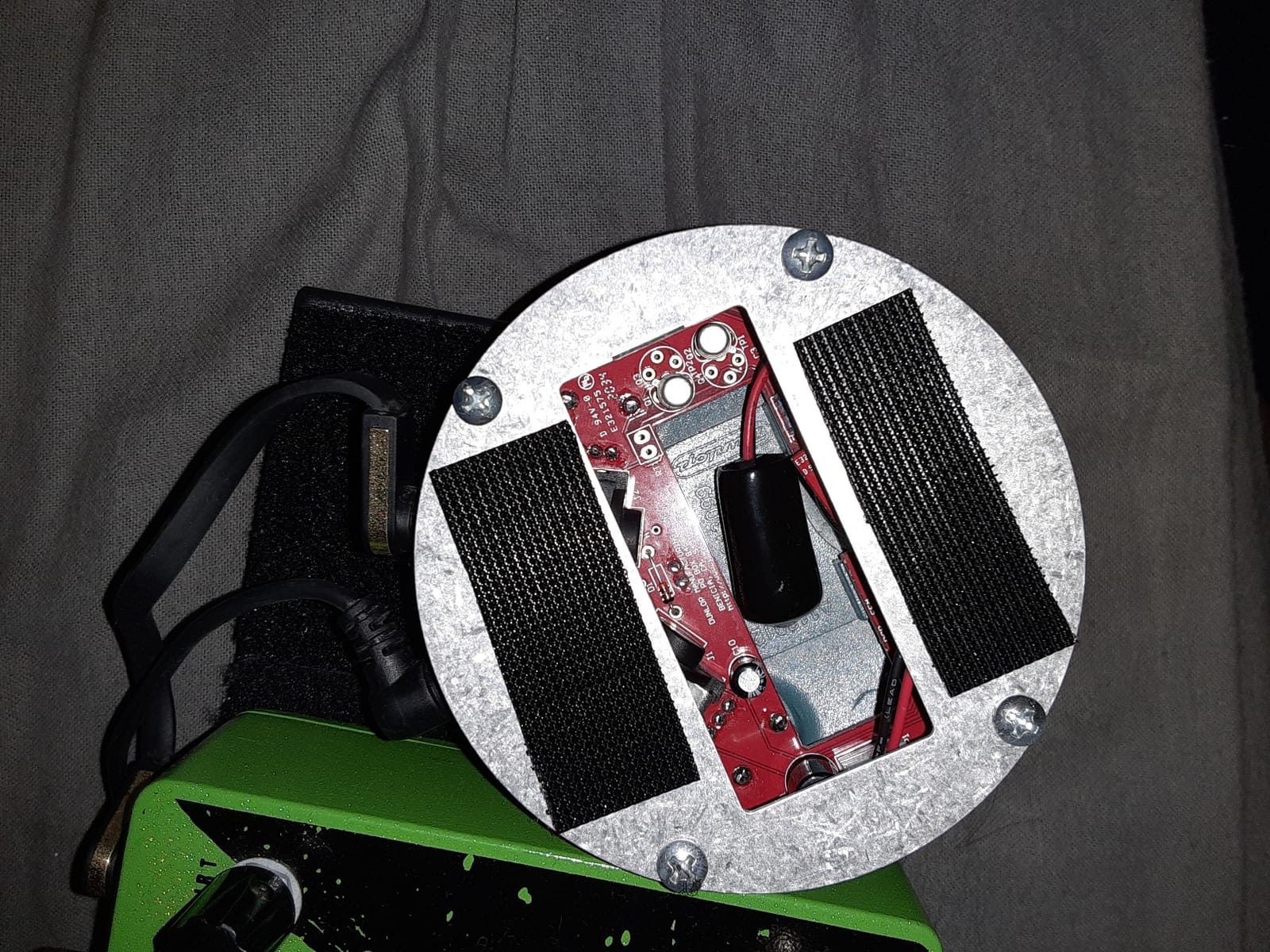
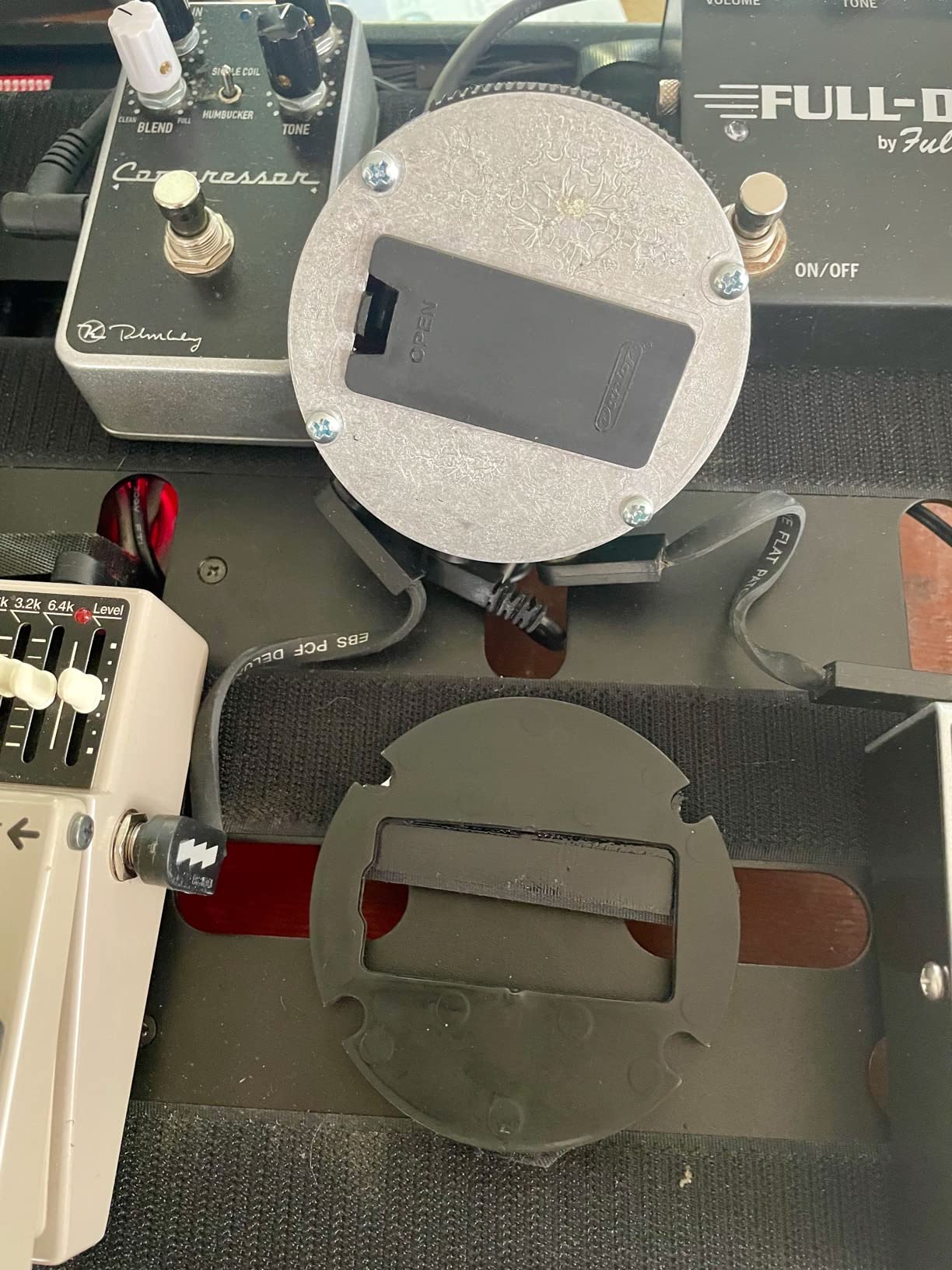
At 281 grams and a 4.5 by 5.5 inch footprint, it is genuinely compact for a fuzz pedal. The status LED and AC power jack are welcome additions that the original vintage Fuzz Face lacked. The battery door is convenient for grab-and-go playing, though some reviewers have noted it feels a bit fragile.
The main trade-offs are the lack of an included AC adapter and the fact that the pedal sounds best with both knobs dimed. That second point is not really a drawback – it is how the original Fuzz Face was designed to be used. For players who want Hendrix tones in a modern, pedalboard-friendly format, this pedal delivers exactly that.
Who will love this fuzz pedal
This pedal is perfect for Stratocaster and Telecaster players chasing authentic Hendrix, Gilmour, or classic rock tones. The compact size makes it ideal for crowded pedalboards. If you want true bypass switching and modern conveniences in a vintage-voiced fuzz, this is the sweet spot.
Who should consider another option
Players wanting thick, sustaining wall-of-sound fuzz should look at a Big Muff variant. If you prefer humbucker guitars or heavier genres, the Germanium Fuzz Face may not deliver enough low end. Budget-conscious players should consider the SONICAKE Fazy Cream for a versatile budget option.
12. Donner Dark Mouse – Rat Style Distortion With Fuzz Character
Donner Dark Mouse Distortion Pedal for Electric Guitar, 2 Modes Classic Hyper Crunch to Fuzzy Guitar Pedal True Bypass
Classic and Hyper modes
True bypass design
Aluminium-alloy build
Responsive dynamics
Pros
- Two practical modes: Classic warm distortion and Hyper powerful distortion
- True bypass design with transparent tone
- Durable aluminium-alloy construction
- Responsive to guitar volume roll-back
- Excellent value for the price
Cons
- Hyper mode can be too aggressive for some players
- Tiny knobs can be difficult to read without glasses
- Power supply not included
The Donner Dark Mouse is technically a distortion pedal, but its Classic mode delivers a fuzz-adjacent tone that earned it a spot on this list. It is based on the legendary ProCo Rat circuit, a pedal that has been on countless professional pedalboards since the late 1970s. For players who want a versatile pedal that can do both warm distortion and aggressive fuzz-like textures, the Dark Mouse is hard to beat at the price.
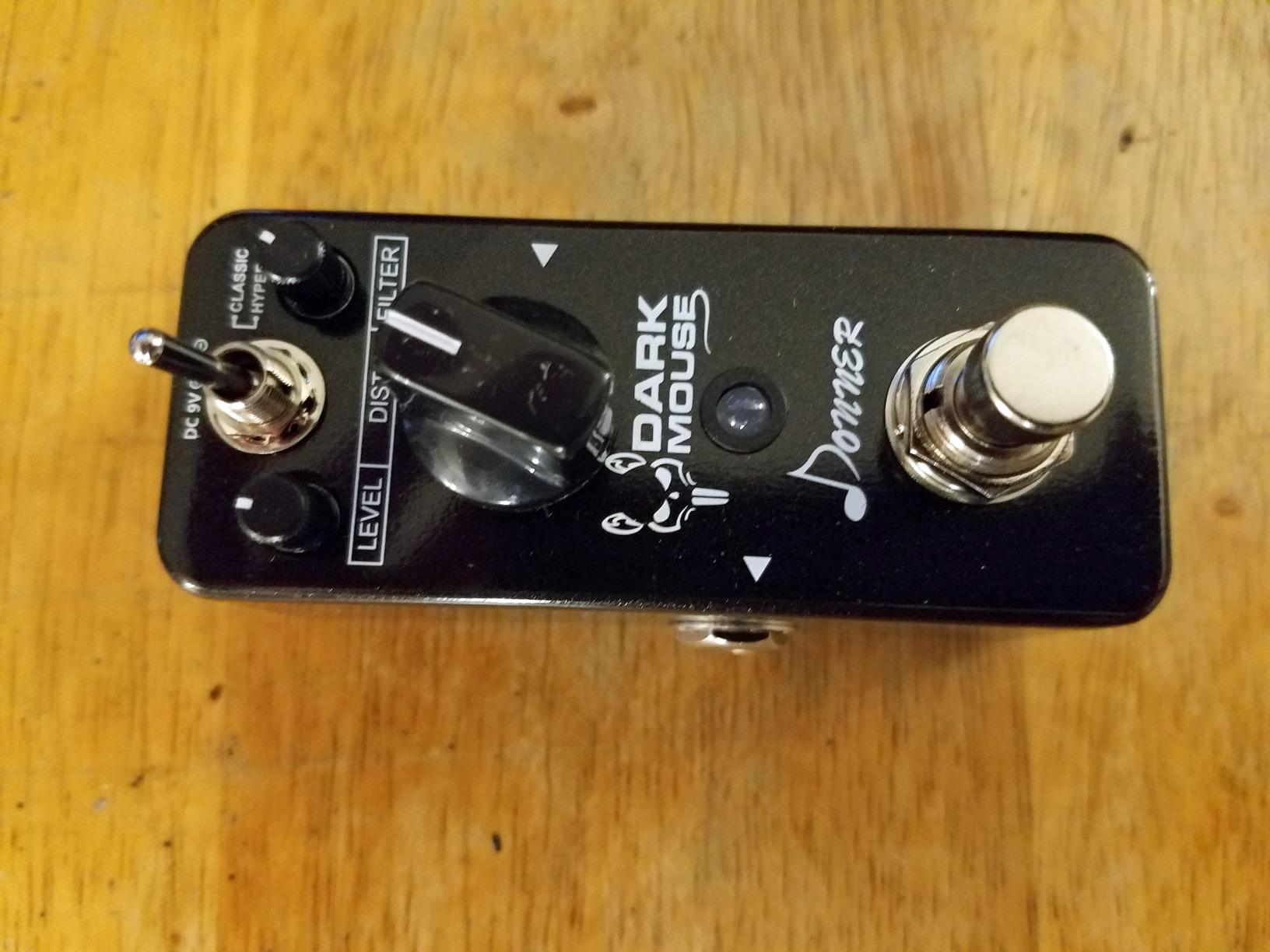
The two-mode design is genuinely useful. The Classic mode produces warm, saturated distortion with a touch of fuzz character – perfect for rock, blues, and classic rock leads. The Hyper mode delivers a more aggressive, fuzz-edged distortion that works well for heavier genres. I spent most of my testing time in Classic mode with humbucker guitars, where the response felt musical and dynamic.
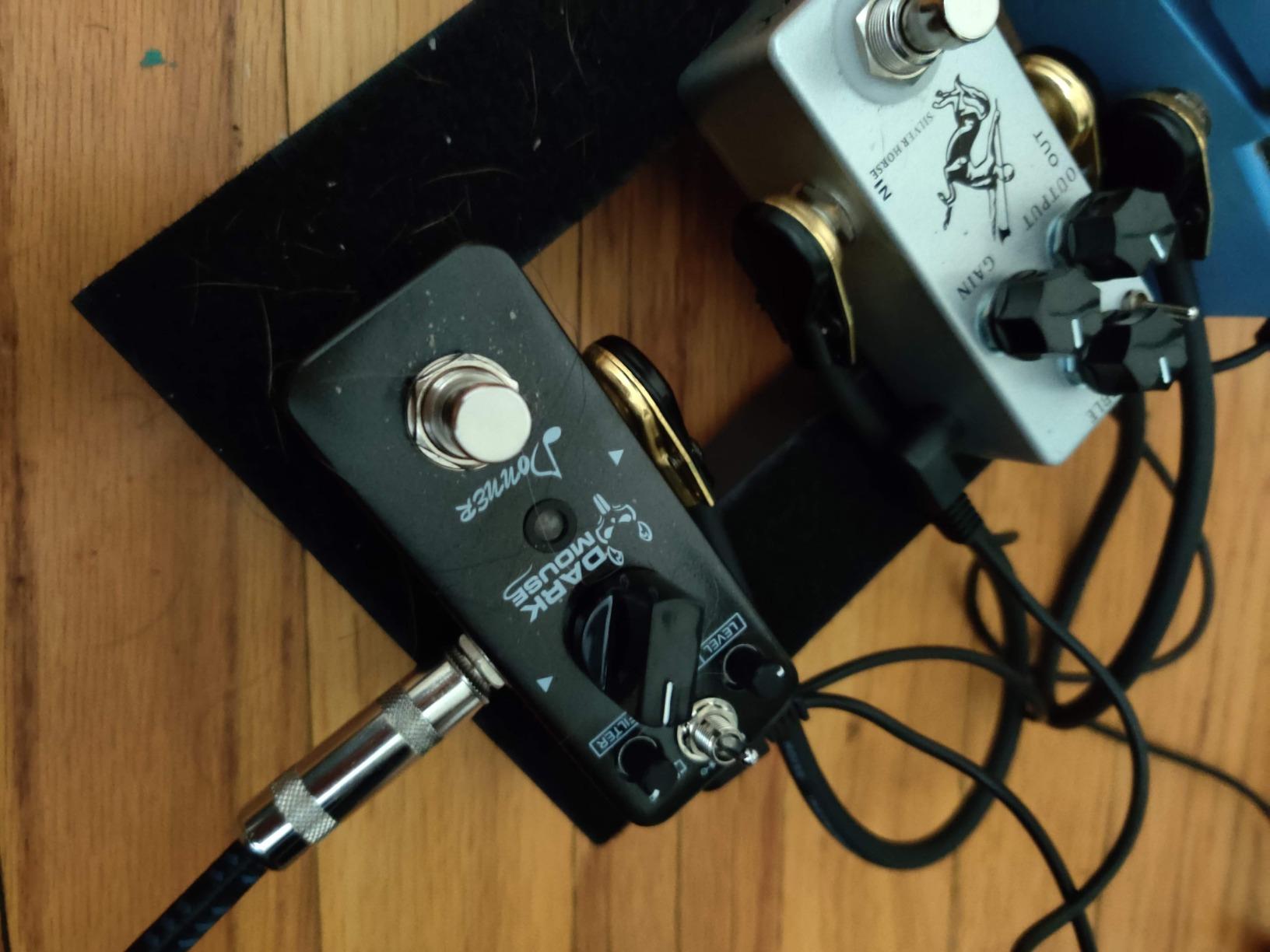
The aluminium-alloy construction feels solid and ready for the road. At 3.7 by 1.7 inches and 0.25 kilograms, it is compact enough for any pedalboard. The true bypass design keeps your dry signal pristine when the pedal is off. The pedal responds well to guitar volume roll-back, cleaning up to a slight edge-of-breakup tone at lower volumes – a trait that makes it feel more amp-like than many distortion pedals.
The main drawbacks are the tiny knobs (which can be hard to read without reading glasses) and the fact that the Hyper mode can be overly aggressive for some playing styles. The power supply is not included, so you will need to budget for one. For beginners and budget-conscious players, however, the value here is genuinely impressive.
Who will love this fuzz pedal
The Dark Mouse is ideal for beginners, budget-conscious players, and anyone wanting a versatile distortion/fuzz hybrid. It is also great for guitarists who play multiple genres and need one pedal that covers both classic rock and heavier styles. If you are building your first pedalboard, this is a smart starting point.
Who should consider another option
Purists wanting authentic Big Muff sustain or vintage Fuzz Face character should look at those specific pedals. If you need battery operation, the lack of a battery compartment is a drawback. Players wanting more fuzz-specific character will prefer a dedicated fuzz pedal.
How to Choose the Best Fuzz Pedal for Your Sound
Choosing the right fuzz pedal comes down to understanding what kind of fuzz character you want and how it will interact with your guitar and amp. Our team has been playing through these circuits for years, and these are the key factors that consistently matter most when making a decision.
Transistor type: germanium vs silicon vs op-amp
The first decision is the transistor topology. Germanium transistors produce a warmer, more vintage character with that touch-sensitive, spitty response that defined 1960s fuzz pedals. They are also temperature-sensitive and inconsistent batch to batch. Silicon transistors deliver a tighter, more aggressive tone with better consistency – think the modern Big Muff variants. Op-amp circuits like the late-70s Big Muff offer a different character entirely, with slightly scooped mids and aggressive sustain. For vintage Hendrix tones, germanium is the way to go. For modern rock and metal, silicon or op-amp circuits deliver better results.
True bypass vs buffered bypass
True bypass means your guitar signal passes directly through the pedal when it is off, preserving your guitar’s natural tone. Buffered bypass uses an electronic buffer to drive the signal through longer cable runs. Most tone-conscious fuzz players prefer true bypass because fuzz pedals are notoriously sensitive to impedance changes – putting a buffer before a fuzz can dramatically alter its character. All the pedals on this list use true bypass, which is one reason they made the cut.
Signal chain placement
Fuzz pedals are notoriously picky about signal chain placement. Most guitarists recommend putting fuzz first in the chain, before any buffers, modulation, or delay pedals. Some players even prefer running fuzz directly into a clean amplifier. Placing other gain stages before fuzz can thin out the low end and reduce sustain. If you must place other pedals before fuzz, a wah or volume pedal typically works better than overdrive or distortion. We tested each pedal on this list directly into a clean amp and found they all performed best in that configuration.
Number of controls and tone-shaping flexibility
Simple fuzz pedals like the Fuzz Face or the standard Big Muff offer just two or three knobs. This simplicity forces you to rely on your guitar’s volume and tone controls for expression – a very musical approach favored by purists. More complex fuzz pedals like the JHS 3 Series Fuzz or the BOSS FZ-5 offer more tone-shaping options for players who want to fine-tune their sound. Consider how you like to approach tone: do you want one great sound with simple controls, or do you enjoy exploring multiple voicings?
Build quality and form factor
Pedalboard real estate matters. Compact pedals like the SONICAKE Fazy Cream or the Mini Fuzz Face fit on crowded boards, while larger pedals like the BOSS FZ-5 or the standard USA Big Muff Pi demand more space. Build quality varies too – the BOSS metal chassis is famously indestructible, while boutique pedals often use heavier materials but with less rigorous QA. If you gig regularly, prioritize road-tested build quality. If you play mostly at home, build quality matters less than tone.
For more guidance on building a complete pedalboard, check our comprehensive best guitar pedals roundup. Players on a tight budget should also see our guide to the best guitar pedals under 100. If you want to add preamp character to your fuzz tone, our preamp pedals guide covers the best options for guitar and bass. And for players specifically looking for compact stompboxes, our mini fuzz pedal guide breaks down the best small-format options.
Frequently Asked Questions
What is a fuzz pedal and how does it differ from overdrive and distortion?
A fuzz pedal is a guitar effects stompbox that heavily clips the audio signal to create a thick, buzzy, harmonically rich tone with heavy sustain. It transforms a smooth audio wave into a saturated, square-wave-like sound. Overdrive gently pushes your amp into natural breakup, distortion slams harder for more aggressive saturation, and fuzz goes furthest – squaring off the waveform for that distinctive buzzy character heard in classic Hendrix and Smashing Pumpkins tones.
Which fuzz pedal is considered the best overall?
For most players, the Electro-Harmonix Big Muff Pi remains the best overall fuzz pedal thanks to its iconic tone, singing sustain, and pedalboard-friendly size. It has defined rock guitar for over 50 years and appears on countless professional pedalboards. Players wanting more versatility should consider the JHS 3 Series Fuzz with its Bias knob for experimental tones.
What are the top budget fuzz pedals under 100?
The SONICAKE Fazy Cream delivers Big Muff-style fuzz tones at a fraction of the cost. The Donner Dark Mouse offers versatile distortion with fuzz character at a budget price. The TC Electronic Honey Pot Fuzz provides vintage wall-of-sound fuzz in a compact metal chassis. All three deliver genuine musical value without breaking the bank.
Where should fuzz go in my signal chain?
Place your fuzz pedal first in the signal chain, before any buffers, modulation, or other gain stages. Fuzz pedals are sensitive to impedance changes – putting other pedals before fuzz can thin the low end and reduce sustain. The ideal setup is fuzz directly into a clean amp input. If you need other pedals before fuzz, a wah or volume pedal works better than overdrive or distortion.
Do fuzz pedals work with bass guitar?
Yes, many fuzz pedals work well with bass, though some circuits handle low frequencies better than others. The SONICAKE Fazy Cream, the EHX Green Russian Big Muff, and the Death By Audio Fuzz War are particularly bass-friendly. Big Muff variants with scooped mids tend to preserve bass clarity better than mid-heavy fuzz circuits. Place the fuzz first in your bass signal chain for best results.
What fuzz pedal did Jimi Hendrix use?
Jimi Hendrix famously used the Dallas-Arbiter Fuzz Face, a germanium transistor fuzz pedal known for its touch-sensitive response and iconic broken-up character. Today, the Jim Dunlop Jimi Hendrix Fuzz Face Mini and the standard Dunlop Fuzz Face both recreate that classic circuit. The Hendrix Fuzz Face is especially responsive to guitar volume and picking dynamics.
Final Verdict: Which Fuzz Pedal Should You Buy in 2026
After spending weeks playing through these 12 fuzz pedals across multiple guitars and amps, our team’s clear winner is the Electro-Harmonix Big Muff Pi. It remains the definitive fuzz stompbox for good reason – that iconic sustain, that pedalboard-friendly size, that 50-year legacy of defining rock guitar tone. Whether you play shoegaze, stoner rock, doom metal, or classic rock, the Big Muff delivers the goods.
For budget-conscious players, the SONICAKE Fazy Cream delivers Big Muff-style tones at a fraction of the cost. For players wanting maximum versatility, the JHS 3 Series Fuzz and the JHS Muffuletta open up sonic possibilities unavailable on simpler pedals. Vintage purists will love the Dunlop Fuzz Face and the Hendrix Fuzz Face Mini. And for touring musicians, the bulletproof BOSS FZ-5 and BOSS FZ-1W deliver road-ready reliability.
The best fuzz pedals all share one thing – they make you play differently. They invite you to dig in, to roll back your volume for cleaner tones, to explore the interaction between your pick attack and the circuit’s response. Whichever pedal you choose from this list, give it time to surprise you. In our experience, the right fuzz pedal becomes the heart of a player’s tone for decades. Happy fuzz hunting in 2026.