
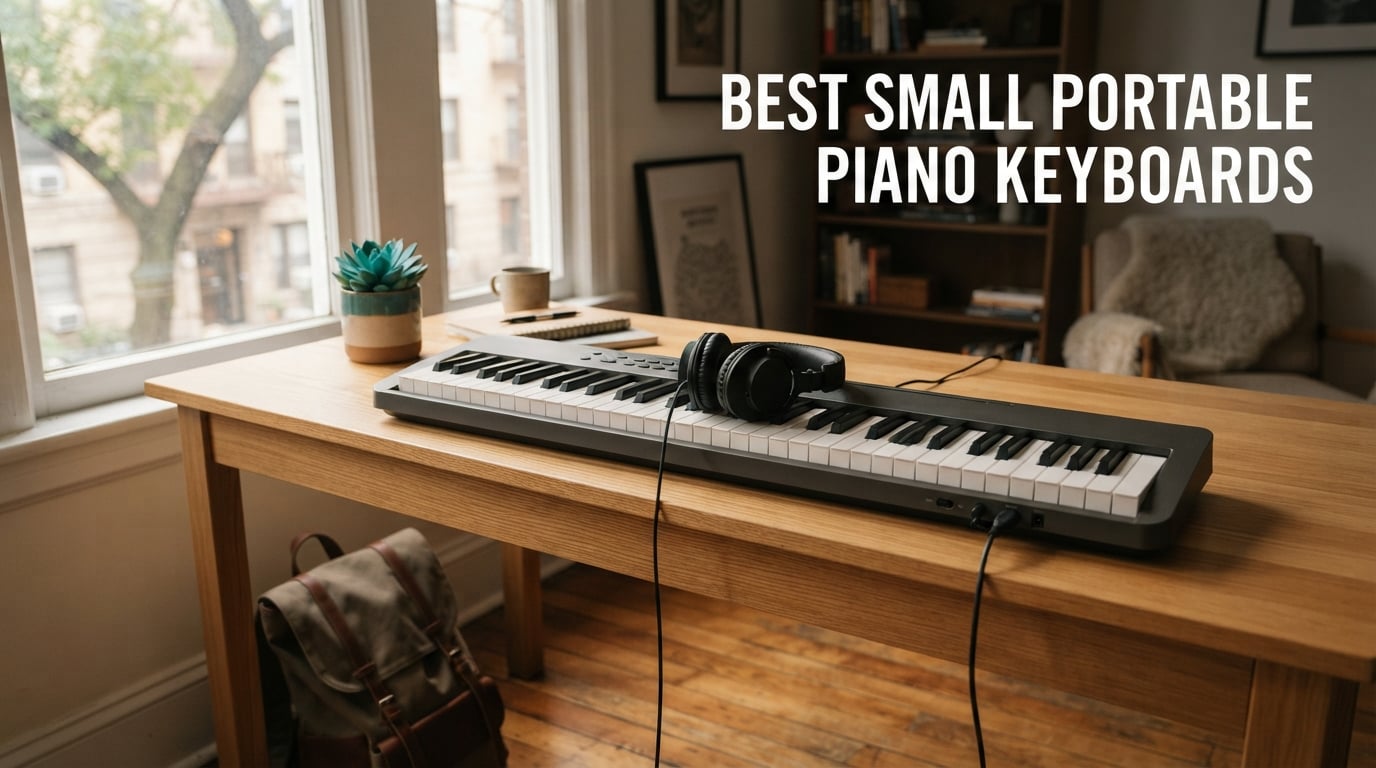
I have been hauling digital pianos into hotel rooms, dorm corners and tour vans for over a decade, and I have learned the hard way that a 36 lb slab with weighted keys is not actually portable. When shoppers ask for the best small portable piano keyboards, what they really mean is a board they can lift with one hand, slide behind a couch, or throw into a backpack – without giving up the piano tone and key feel that make practice worth the time.
This roundup is built around that idea. We pulled 10 boards from the strongest-selling lines on Amazon, weighed them against forum posts from r/piano and Keyboardforums.com, and sorted them by form factor rather than by price tier. You will find ultra-compact mini-key boards (25 to 49 keys), mid-size 61-key portables, and a MIDI controller hybrid for producers – all of them under 12 lbs, and most of them battery powered.
If you are also shopping for a beginner board, our beginner keyboards guide covers weighted consoles in more depth. Here, we focus on what “small” and “portable” really mean: weight, footprint, battery life, and the kind of key action you can still build technique on.
Top 3 Picks for Best Small Portable Piano Keyboards (September 2026)
Our top three picks cover the three most common small-portable use cases: a full beginner kit with stand and bench, a lightweight 61-key that survives being carried everywhere, and an ultra-compact mini board you can actually fit in a carry-on. If you only have time to scan the article, start here.

RockJam RJ5061 61-Key Kit
- Complete kit with stand and bench
- 61 full-size keys
- 200 tones and rhythms
- Simply Piano lessons
- 3.3 kg

Casio Casiotone CT-S200
- 7 lbs with carry handle
- 61 full-size keys
- 400 tones
- USB-MIDI
- battery or AC

Alesis Melody 32 Mini
- 1 kg mini keys
- 32 keys with USB/battery
- 300 voices
- headphone jack
- Melodics and Skoove included
Best Small Portable Piano Keyboards in 2026
Here is the full lineup at a glance. The table below lists every model in this guide with its key count, weight, power source and headline feature so you can compare them side by side before scrolling to the full reviews.
| Product | Specifications | Action |
|---|---|---|
| RockJam RJ5061 61-Key Kit |
|
Check Latest Price |
 RockJam RJ361 Compact 61-Key RockJam RJ361 Compact 61-Key |
|
Check Latest Price |
 RockJam RJ549 49-Key Starter RockJam RJ549 49-Key Starter |
|
Check Latest Price |
 Akai MPK Mini IV 25-Key MIDI Akai MPK Mini IV 25-Key MIDI |
|
Check Latest Price |
| Alesis Melody 32 Mini |
|
Check Latest Price |
| Casio Casiotone CT-S200 |
|
Check Latest Price |
 JIKADA 61-Key Teaching Bundle JIKADA 61-Key Teaching Bundle |
|
Check Latest Price |
 WOSTOO 61-Key Kids Board WOSTOO 61-Key Kids Board |
|
Check Latest Price |
 Donner DEK-610S 61-Key Kit Donner DEK-610S 61-Key Kit |
|
Check Latest Price |
 Yamaha YPT280 61-Key Yamaha YPT280 61-Key |
|
Check Latest Price |
1. RockJam RJ5061 61-Key Kit – Best Complete Beginner Bundle
RockJam RJ5061 61 Key Keyboard Piano Kit with Stand, Bench & Headphones
61 full-size keys
3.3 kg
200 tones, 200 rhythms, Simply Piano included
Pros
- Complete kit with stand
- bench
- headphones and note stickers
- 200 rhythms and 200 tones with pitch bend wheel
- Simply Piano lessons and keynote stickers included
- Headphone jack for quiet apartment practice
- Portable enough for small spaces
Cons
- Keys are not touch-sensitive or weighted
- Speakers can rattle at higher volume
- Sound is close to piano but not quite at the high end
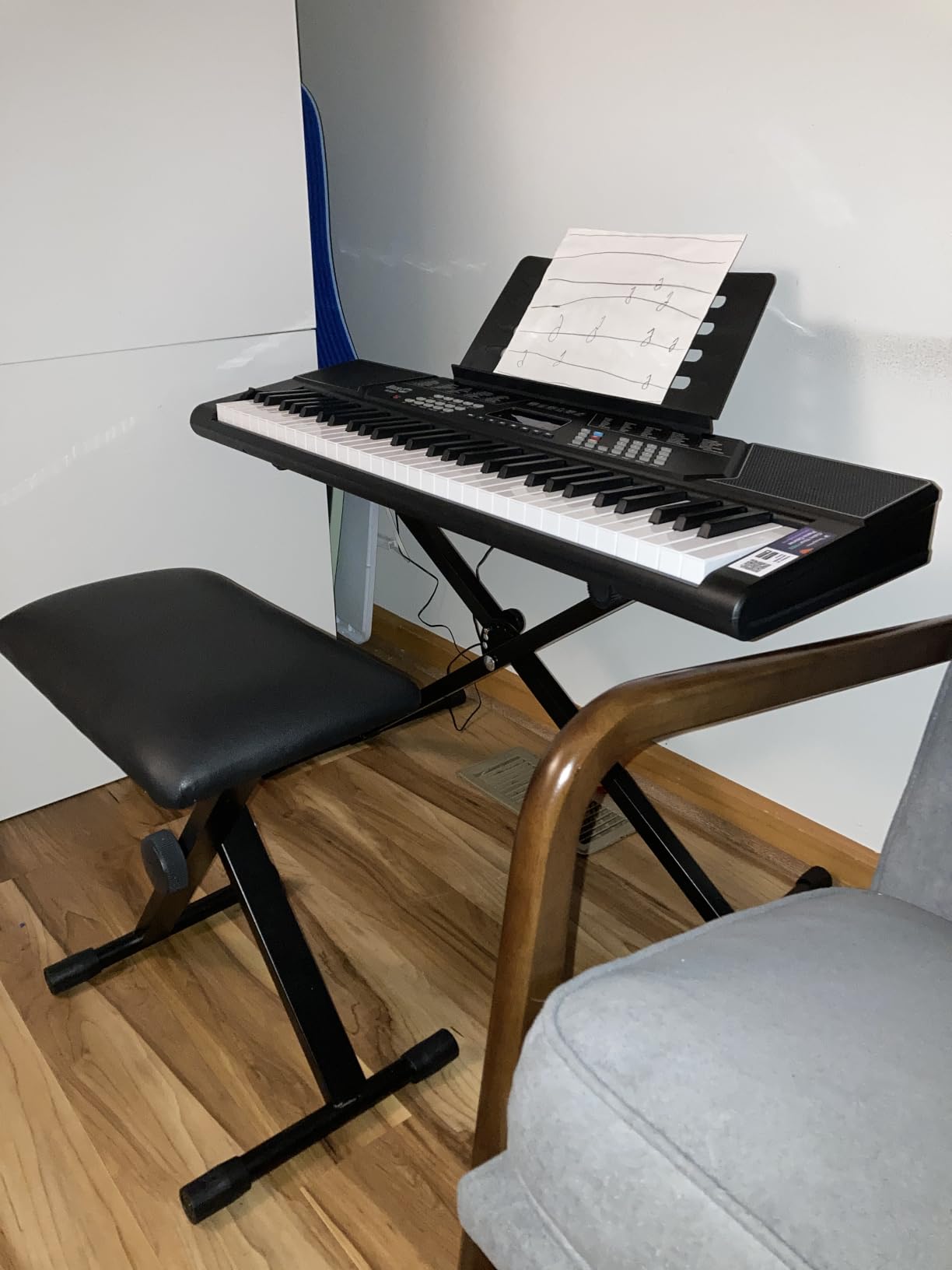
The RockJam RJ5061 is the kit I would buy for a friend who just told me “I want to learn piano” and meant it. The box arrives with everything: an X-shaped stand, an adjustable bench, a pair of headphones, note stickers, and a one-month hookup to Simply Piano. Reviewers on Amazon consistently call out how the all-in-one bundle removes the awkward first week of buying accessories separately, and that is exactly the friction point that derails most beginners.
At 3.3 kg (about 7.3 lbs) and roughly 37 inches across, it is light enough for me to carry one-handed from the closet to the desk and back. The 61 full-size keys are not weighted and not touch-sensitive, so dynamics come from the pitch-bend wheel rather than finger pressure, but the key spacing is correct. That means a beginner who practices here and later upgrades to a Yamaha P-45 or Roland FP-10 will not have to retrain their hand geometry.
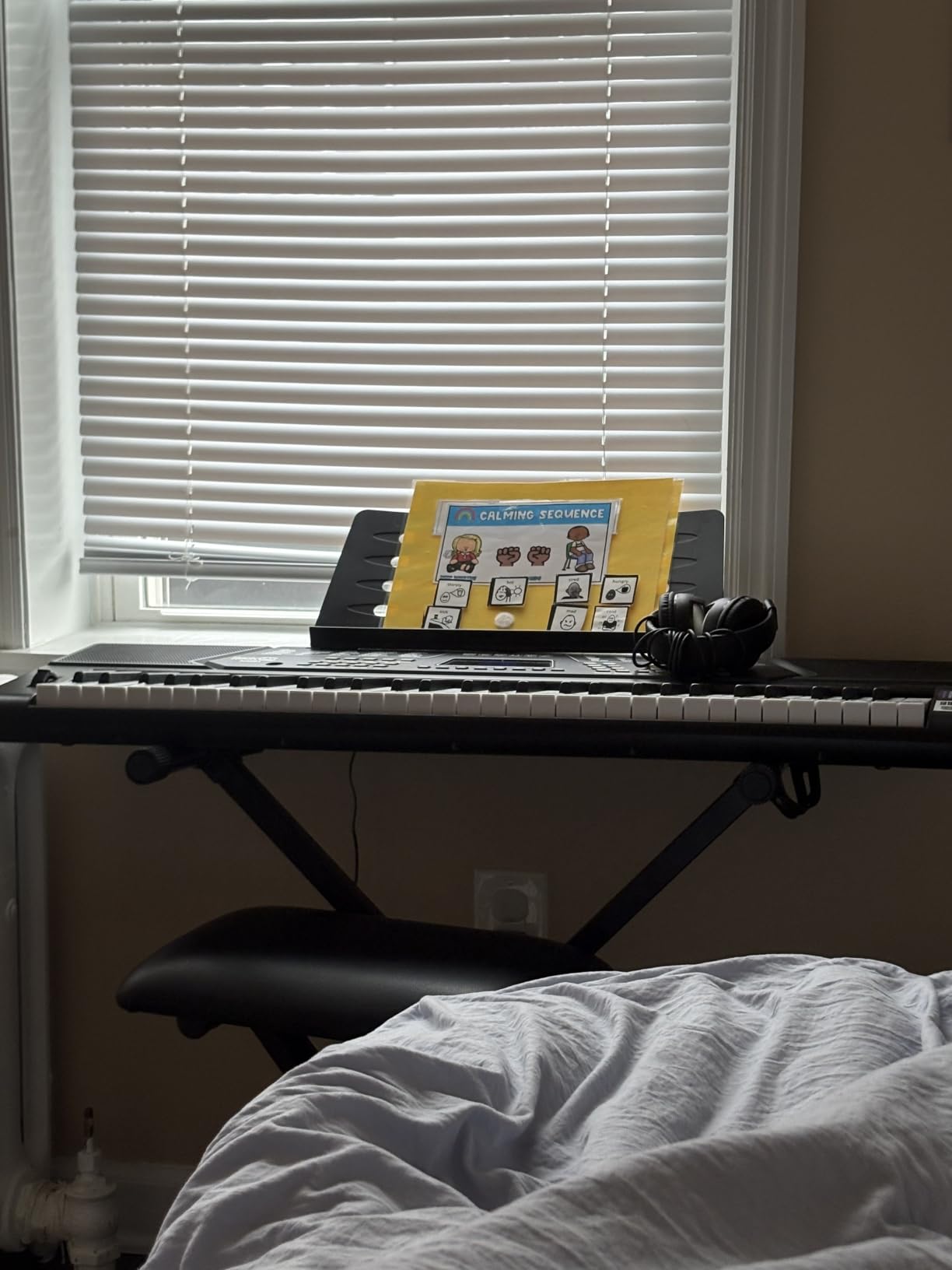
The 200-voice, 200-rhythm library is bigger than what you get on many entry-level Casios at twice the weight, and reviewers report that the headphone jack is the real hero for apartment dwellers. The biggest trade-off is sound quality above middle C, where some tones get a little shrill through the small built-in speakers. Headphones smooth that out completely. With 46,911 reviews averaging 4.5 stars and a #1 ranking in Portable & Arranger Keyboards, this kit is the safest starting point in the entire small portable category.
What we like about the bundle
The stand, bench, headphones and stickers arrive in one box, so the keyboard goes from parcel to playable in under 20 minutes. Simply Piano integration adds a structured path past the first month, when most beginners quit. For a household with kids, this is the lowest-friction way to find out whether piano is a passing phase or a real interest.
What holds it back
Unweighted keys mean a student who practices seriously for a year will eventually need a weighted upgrade. The built-in speakers are small and can rattle at high volume, so plan on headphones for any serious practice. None of this is disqualifying for a starter kit, but it is worth knowing where the ceiling sits.
2. RockJam RJ361 Compact 61-Key – Best Budget 61-Key for Small Spaces
RockJam RJ361 61 Key Compact Keyboard Piano for Beginners
61 keys
2.84 kg
200 sounds and rhythms, headphone jack
Pros
- Compact and lightweight for small rooms
- 200 sounds and 200 rhythms for varied practice
- Includes power supply
- music rest and Simply Piano lessons
- Headphone jack and built-in speaker for flexible practice
- Note stickers help beginners learn keys quickly
Cons
- Keys are not touch-sensitive (no velocity)
- Plastic build feels less durable than higher-end models
- Compact key size means narrower keys than standard piano
- No sustain pedal hookup
The RockJam RJ361 is the answer for shoppers who want the RJ5061 bundle minus the stand and bench, at a noticeably smaller footprint. At 2.84 kg (about 6.3 lbs) and 31.5 inches wide, it is roughly a quarter shorter than the full kit, which matters when the keyboard lives on a small desk or a kitchen table between sessions.
I have recommended this exact model to friends who live in studio apartments where the “piano corner” is really just a folding tray table. The 200 sounds and 200 rhythms match what the larger kit offers, and the Simply Piano hookup is the same. Reviewers consistently say it is the most approachable board for kids and teens because the smaller footprint makes it feel less intimidating.
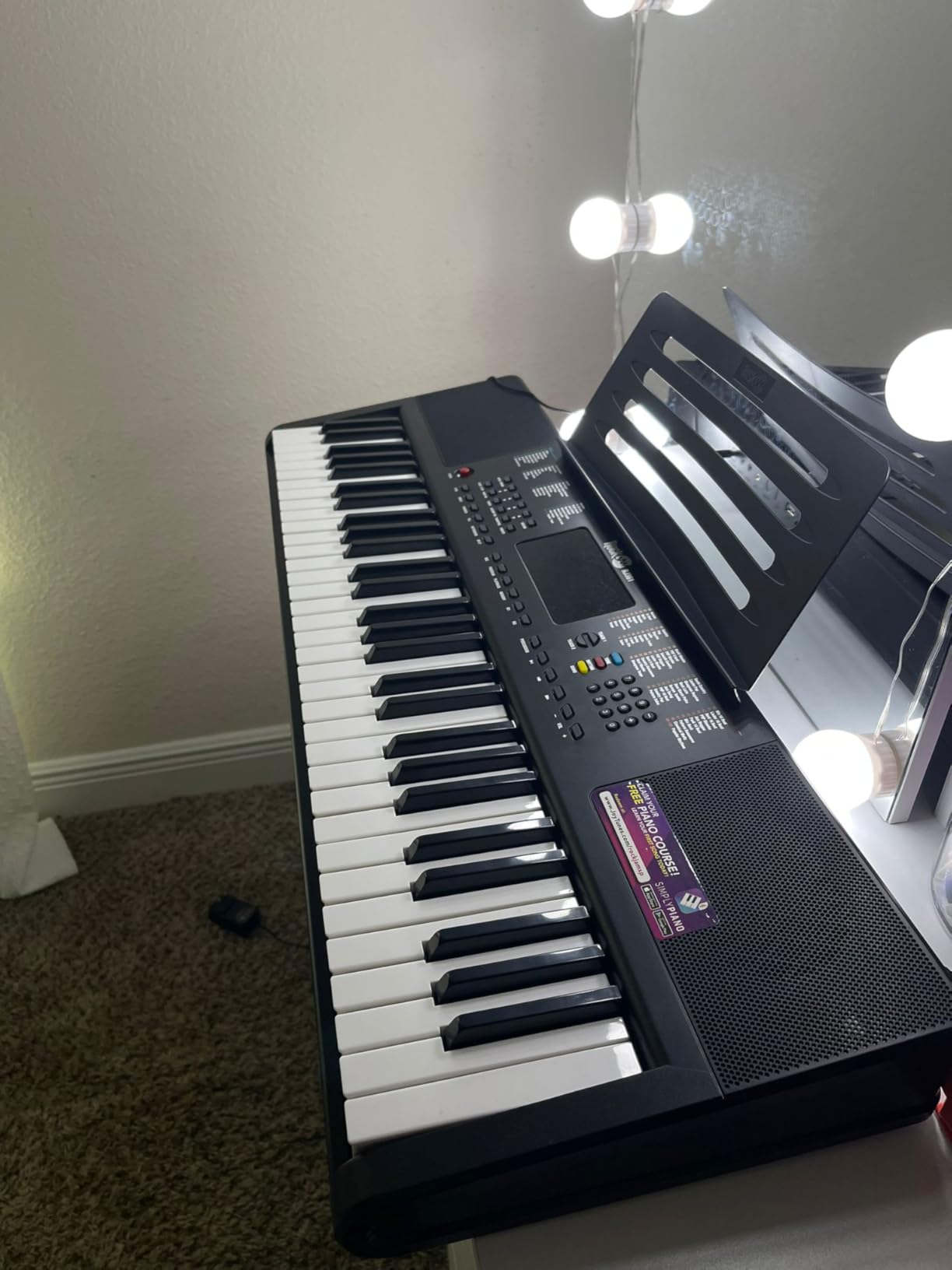
The honest trade-off is build quality. The chassis is plastic, the keys are not touch-sensitive, and the key width is a touch narrower than full-size piano keys. None of that is unique to this model – it is the cost of staying under 3 kg at this price point. With 13,282 reviews averaging 4.3 stars, the value proposition is well proven.
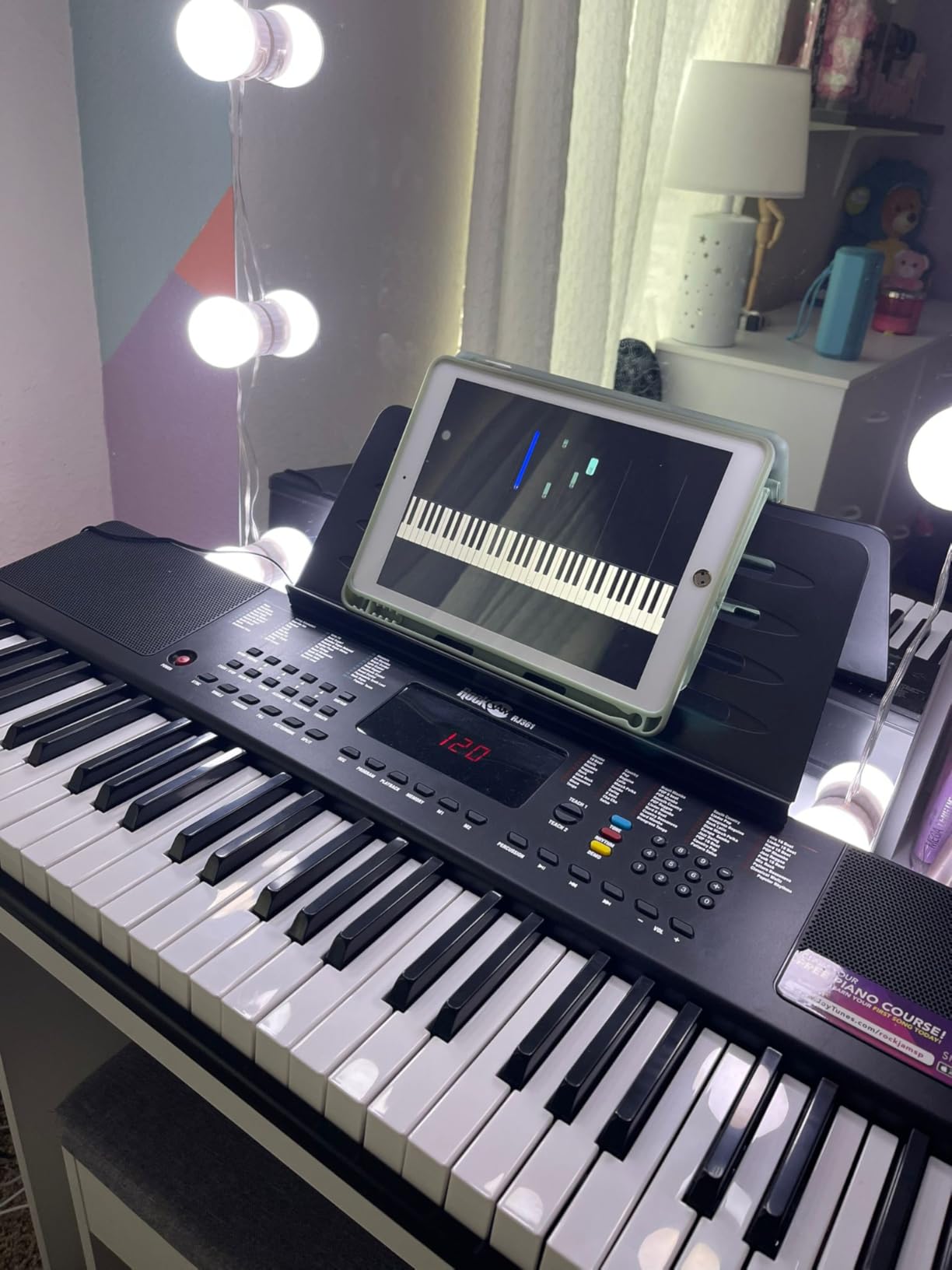
What we like about the footprint
31.5 inches is short enough to slide behind a couch or under a bed when not in use. Reviewers say it disappears into a closet more easily than any 61-key competitor at this size. For renters and dorm dwellers, that storage profile is often the deciding factor.
What holds it back
Unweighted, non-velocity-sensitive keys mean dynamics are limited. Sustain pedal support is missing, so any practice that needs pedal will not work. If a student plans to take graded exams, this is a stepping-stone board, not a forever board.
3. RockJam RJ549 49-Key Starter – Best Ultra-Budget Beginner Board
RockJam RJ549 49 Key Keyboard Piano for Beginners with Note Stickers
49 keys
1.66 kg
200 tones, 200 rhythms, Simply Piano included
Pros
- Affordable entry-level keyboard for beginners and kids
- 200 tones and 200 rhythms keep practice engaging
- Includes power supply
- music rest and Simply Piano lessons
- Compact and portable
- can run on batteries
- Headphone jack for quiet practice
Cons
- Keys are not full-size (smaller than a standard piano)
- Sound quality is basic compared to higher-end instruments
- Some users report units stopping working after a few months
- Build feels lightweight and plastic
The RockJam RJ549 is the cheapest board in this guide that I would actually let a child use unsupervised. At 1.66 kg (about 3.7 lbs) and 27.5 inches wide, it is light enough for a 7-year-old to move from the playroom to the bedroom, and the 49-key layout covers roughly four octaves – enough for one-handed melodies and basic two-handed exercises.
Reviewers in the Toys & Games category consistently describe this as the keyboard that “made my kid actually want to practice.” The 200 tones, 200 rhythms and Simply Piano hookup mirror the larger RockJam boards, just at a smaller scale. Battery operation is the sleeper feature: 6 AA cells turn it into a true tabletop instrument you can move between rooms without searching for an outlet.
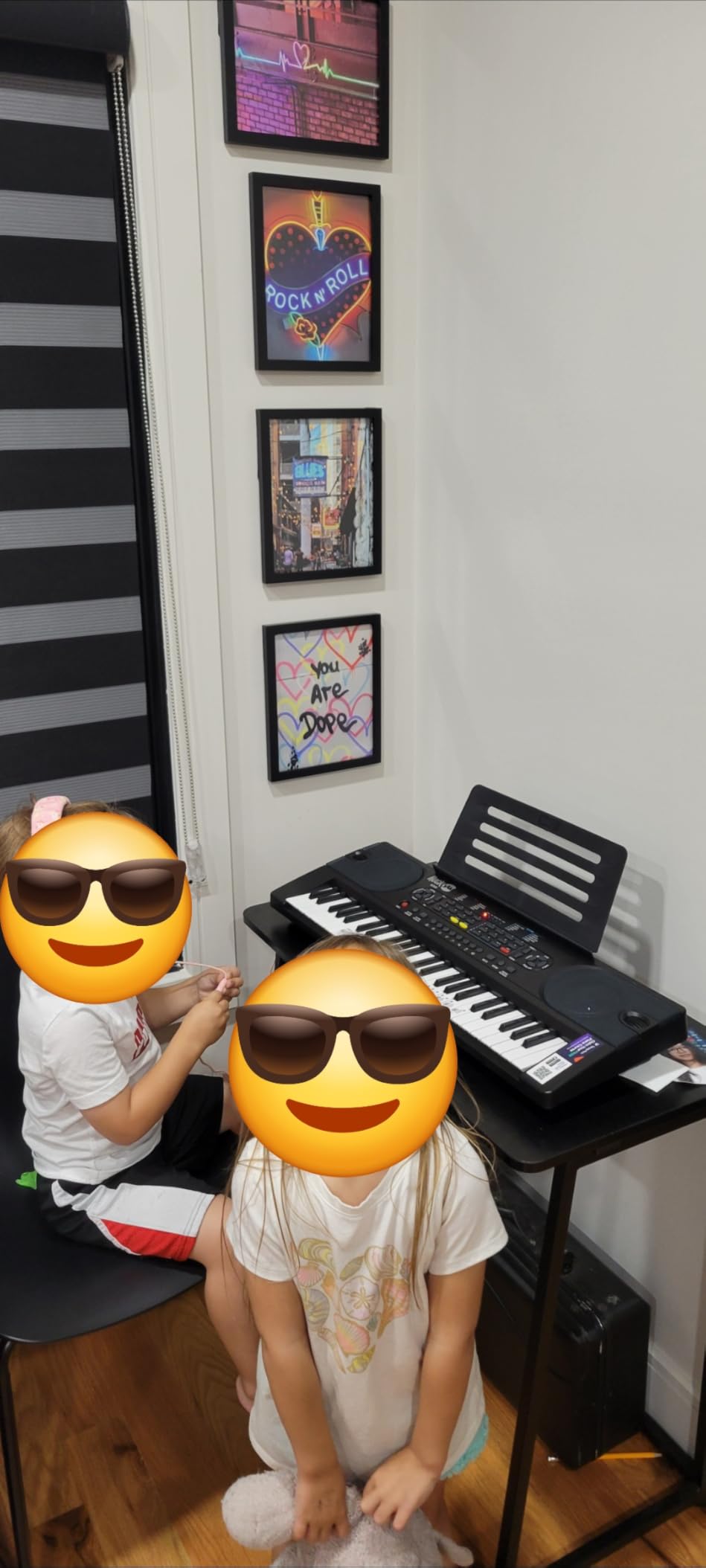
Where the RJ549 shows its price is in long-term durability. A meaningful minority of reviewers (roughly 10% by rating distribution) report units that stopped working after a few months, usually within the warranty window. The two-year manufacturer warranty covers that, but it is worth knowing the expected lifespan at this price is “a couple of years of regular kid use” rather than “decades.”
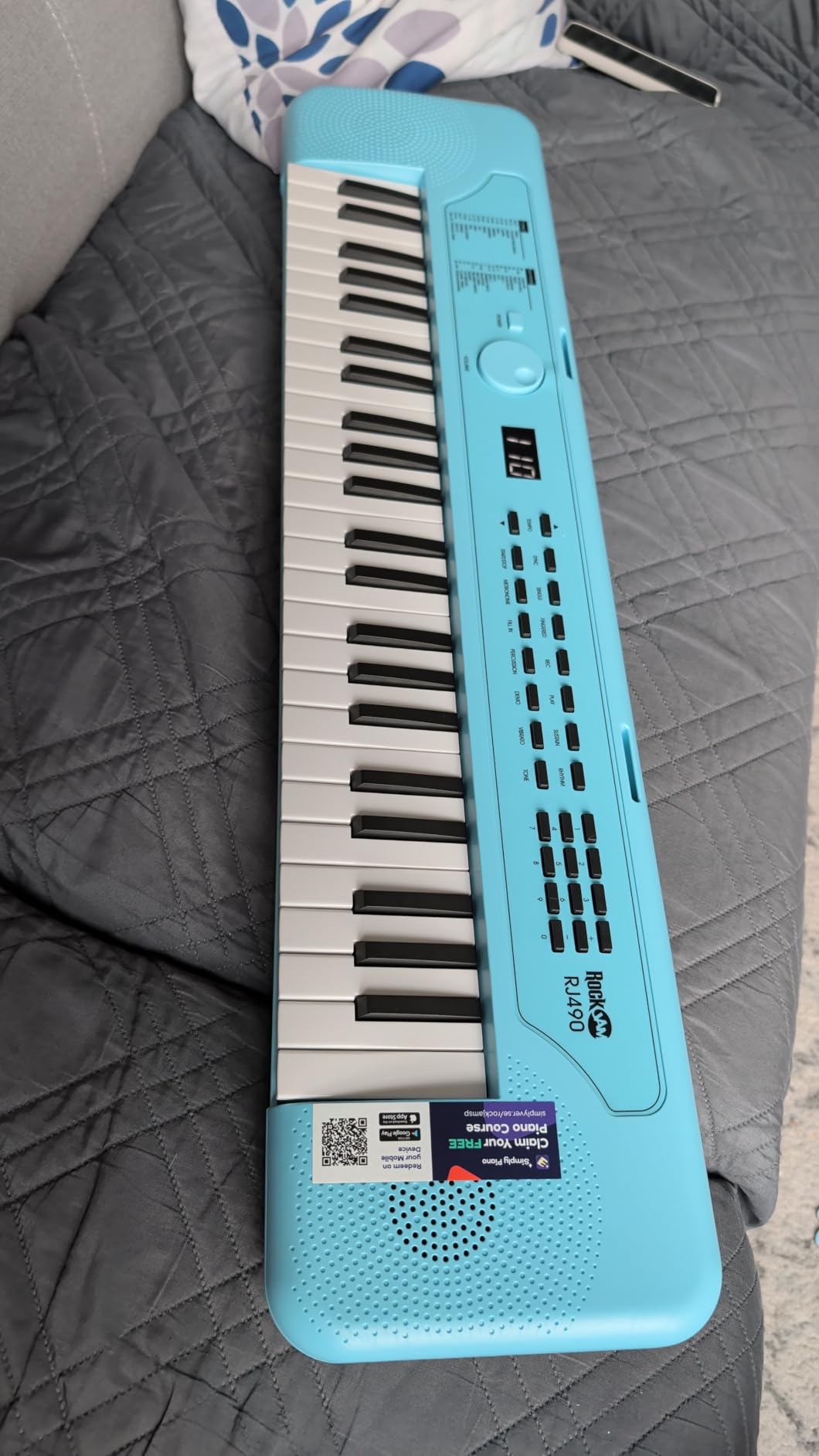
What we like about the size
49 keys means shorter arms can reach an octave comfortably, and the 1.66 kg weight is genuinely grab-and-go. Reviewers with small apartments say this is the largest board that still fits on a bookshelf when stored vertically. For toddlers and early-elementary kids, it is a kinder size than the 61-key boards.
What holds it back
49 keys will eventually feel limiting for any student working through method books that require a full keyboard range. The mini keys also mean a transition to a real piano later will require some hand retraining. This is a true starter, not a forever board.
4. Akai MPK Mini IV – Best MIDI Controller for Producers
Akai Professional MPK Mini IV 25-Key USB-C MIDI Keyboard Controller, Black
25 mini keys
1 kg
USB-C MIDI controller with 8 RGB pads and 8 knobs
Pros
- Velocity-sensitive mini keys plus 8 RGB MPC pads for expressive beat-making
- 8 assignable 360-degree knobs and full-color screen for hands-on control
- USB-C powered and plug-and-play with Mac
- PC and mobile
- Includes AIR
- Akai and Moog software bundle plus DAW integration
- Compact and durable form factor designed for portability
Cons
- Only 25 mini keys
- which is small for piano-style playing
- Mini keys are smaller than full-size piano keys
- Requires a computer or DAW to fully leverage MIDI controller features
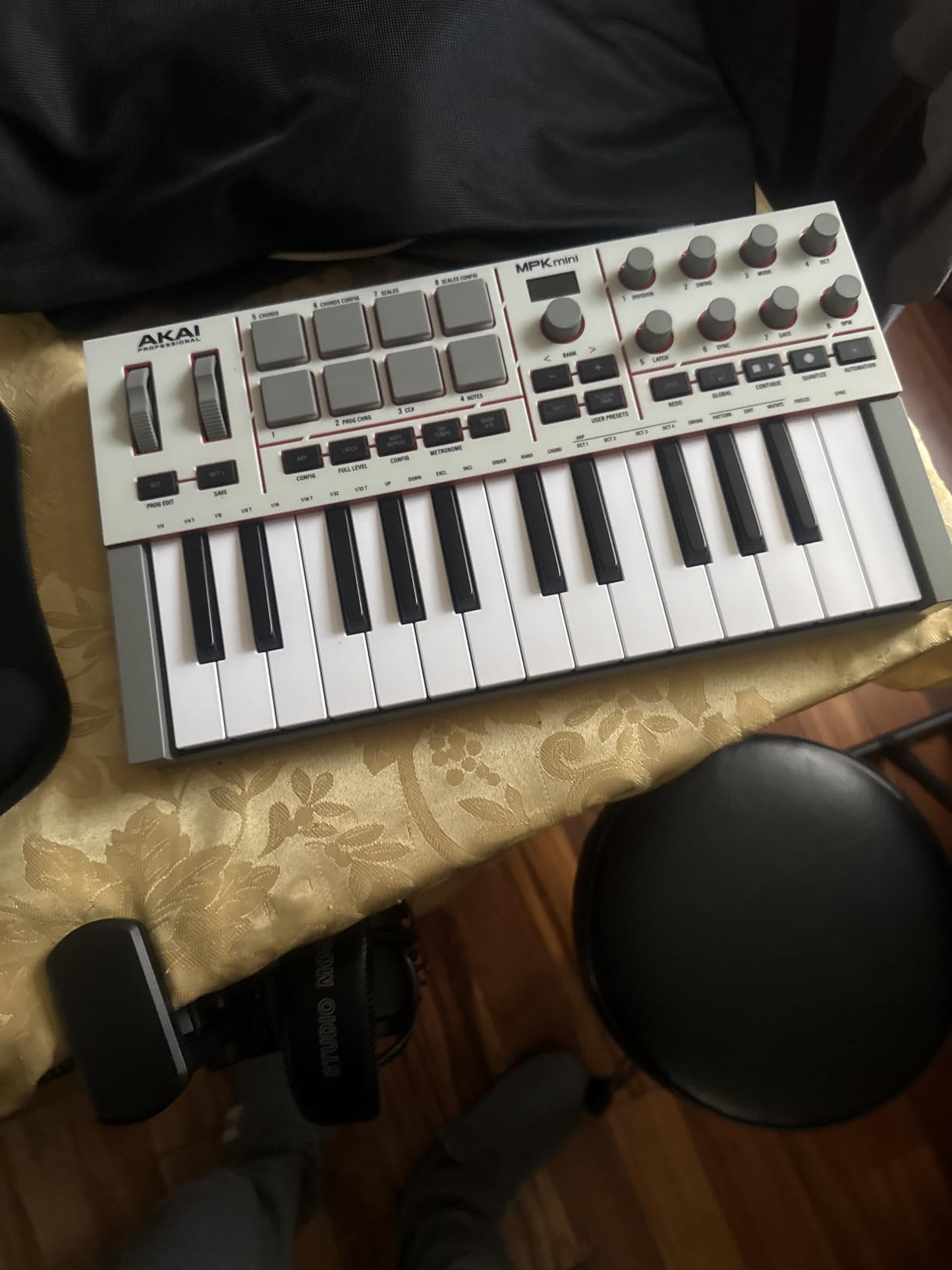
The Akai MPK Mini IV is the only board in this roundup that I would not describe as a “piano” – it is a MIDI controller first and an instrument second. For music producers, that distinction matters. At 1 kg (2.2 lbs) and barely larger than a paperback book, the MPK Mini IV slips into a laptop bag with room to spare, and it is the rare small board where the keys are actually velocity-sensitive.
The 8 RGB-backlit MPC pads are the headline feature for anyone producing hip-hop, lo-fi, or electronic music. Reviewers consistently describe the pads as responsive enough to finger-drumming for live performance. The 8 assignable 360-degree knobs and the full-color OLED screen put tactile control over synth parameters right at the player’s fingertips, which is the exact gap a touch-only laptop workflow leaves open.
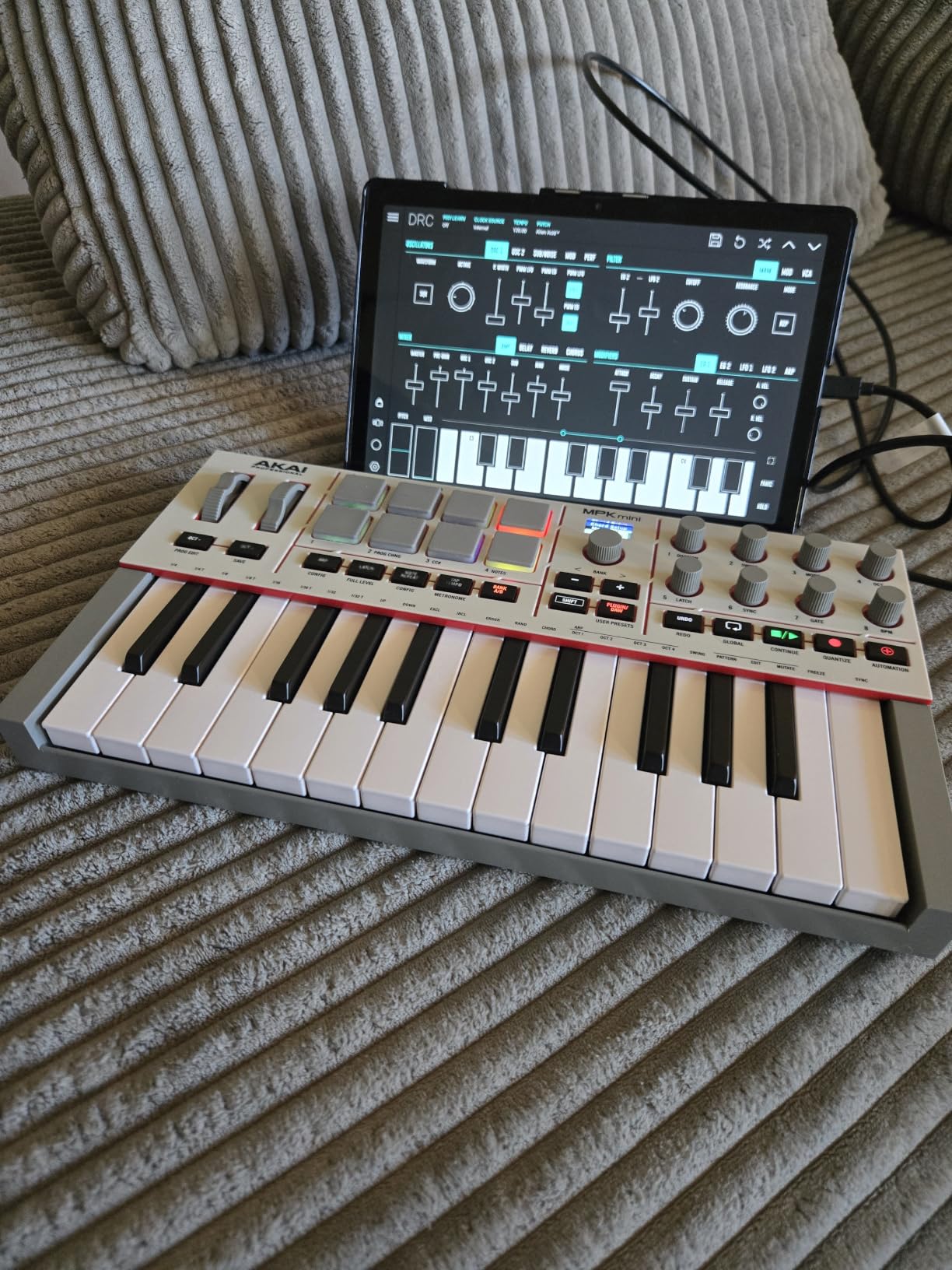
The software bundle is genuinely generous for the price: AIR, Akai and Moog instruments, Ableton Live Lite, a 30-day Melodics trial, and a 2-month Splice trial. A producer who starts here can sketch ideas on a hotel desk without dragging a full 49-key controller along. With 18,636 reviews averaging 4.6 stars, the durability story is also strong – several reviewers mention multi-year daily use without failure.
What we like for production
Velocity-sensitive keys plus MPC pads plus assignable knobs in a 1 kg package is a producer’s three wishes in one device. USB-C means a single cable powers it and connects to a Mac, PC or recent mobile device. This is the board I recommend to anyone making beats on a laptop and needing a tactile surface that does not eat into a backpack.
What holds it back as a piano
25 mini keys is two octaves, which means most piano repertoire simply will not fit. There are no built-in piano sounds – this is a controller, so without a computer running a DAW or plugin, it makes no sound at all. For pure piano practice, look at the Casiotone or RockJam sections above.
5. Alesis Melody 32 Mini – Best Mini Board for Travel
Alesis Melody 32 Mini Piano Keyboard
32 mini keys
1 kg
USB or 4 AA batteries, 300 voices
Pros
- Compact
- lightweight and battery or USB powered for portable use
- 300 voices including piano
- strings
- organ
- synth and drums
- Built-in speakers
- headphone jack
- 40 demo songs and record function
- Includes 1-month Melodics and 3-month Skoove premium subscriptions
- Affordable entry point for beginners
Cons
- Keys are not touch-sensitive or velocity-sensitive
- Only 32 keys and no octave transpose
- which limits the playable range
- Mini key size can be difficult for adult hands and chords
- Some built-in voices sound lo-fi or cheesy
If your definition of “small portable piano keyboard” is “fits in a carry-on,” the Alesis Melody 32 is the smallest stand-alone board in this guide that still plays actual piano sounds. At 1 kg and 22 inches across, it slides into a backpack sleeve that would not fit any 49-key board. Power comes from either a USB cable or 4 AA batteries, so it works on a hotel desk with no wall outlet nearby.
300 voices is generous for the price and weight class. The 40 demo songs and record function cover the basic learning loop: listen, copy, record, compare. Alesis also bundles a 1-month Melodics subscription and a 3-month Skoove subscription, which are both solid beginner apps. Reviewers say the headphone output is the cleanest in this price range.
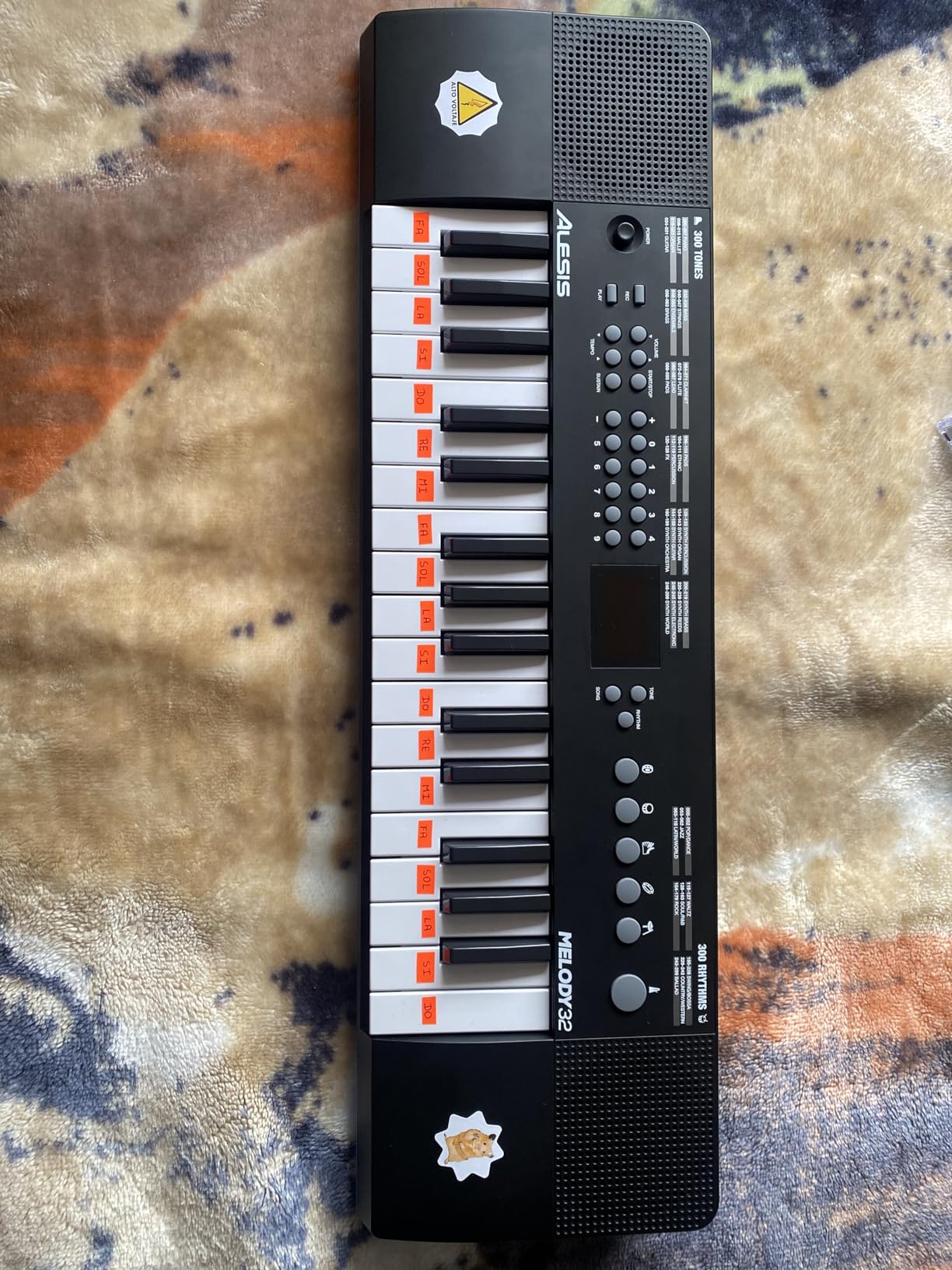
The honest ceiling is the 32-key range with no octave transpose. Playing most method-book pieces requires shifting octaves, and the absence of a transpose button means you cannot fake it. For younger learners and casual players, the limited range is fine; for an adult working through a graded syllabus, it is a hard wall. With 2,452 reviews averaging 4.3 stars, the consensus is exactly that: a great first board or travel board, not a forever board.
What we like about the size
1 kg and 22 inches wide means this board travels in luggage weight budgets that would push a 61-key board over airline limits. Reviewers who take it to lakes, cabins, and beach houses consistently say it is the only board they actually pack. For a child who wants a “real piano” on vacation, this is the answer.
What holds it back
Mini keys plus 32 keys plus no transpose is a triple limit. Adult hands will find chords cramped, and the lack of velocity sensitivity removes dynamic expression. Treat this as a travel and beginner board, not as a step toward graded repertoire.
6. Casio Casiotone CT-S200 – Best Lightweight 61-Key Portable
Casio Casiotone CT-S200 – 61-Key Portable Keyboard for Beginners | 400 Tones, 77 Rhythms, LCD Display, Dance Music Mode, USB-MIDI, Stereo Speakers | Includes Power Supply & Music Rest | Black
7 lbs with carry handle
61 full-size keys
400 tones, USB-MIDI
Pros
- Lightweight 7 lbs with built-in carry handle and battery or AC power
- 61 full-size keys with intuitive LCD interface and My Setup function
- 400 tones
- 77 rhythms and Dance Music Mode for creative play
- Class-compliant USB-MIDI works with Mac
- PC and mobile devices
- Includes 60 built-in songs with right and left-hand lesson support
Cons
- Keys are not touch-sensitive
- Uses non-standard Micro-B USB cable for MIDI (not included)
- Built-in speaker is small
- limiting standalone sound projection
- No weighted keys
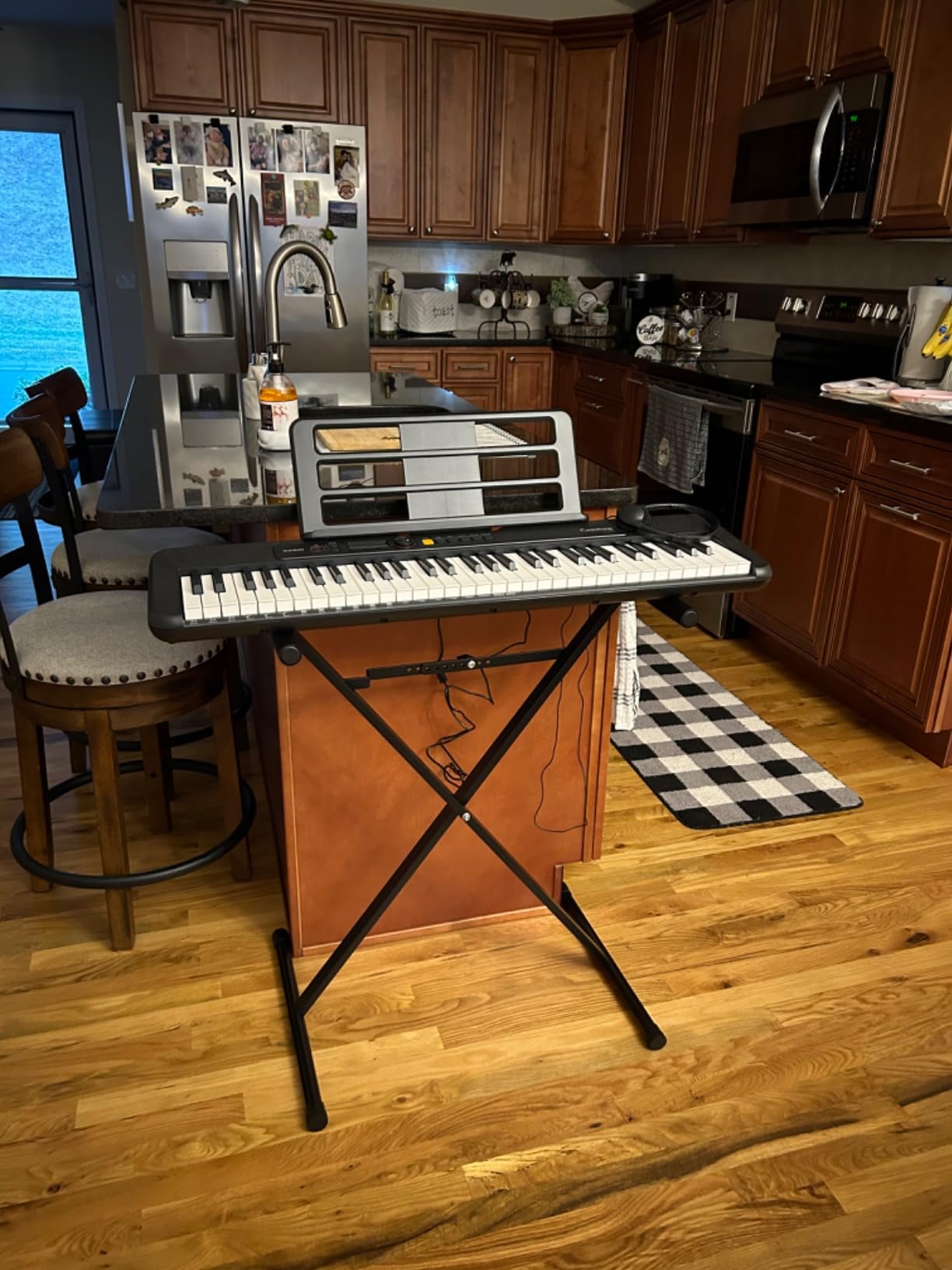
The Casio CT-S200 is the board I recommend when a shopper says “I want a real piano that I can carry one-handed.” At 7 lbs with a built-in carry handle, it is the lightest 61-full-size-key portable Casio makes, and it crosses the threshold from “tabletop” to “actually portable.” AC adapter or 6 AA batteries power it, so it works in hotel rooms and outdoors with equal ease.
400 tones and 77 rhythms are well above the price class. Dance Music Mode is a Casio-specific feature that lets you remix tracks on the fly by triggering drum, bass and synth phrases – it is the kind of thing that keeps a beginner practicing past the first month. The class-compliant USB-MIDI works with iPads, Macs and PCs without drivers, which makes it a natural fit for app-based lessons.
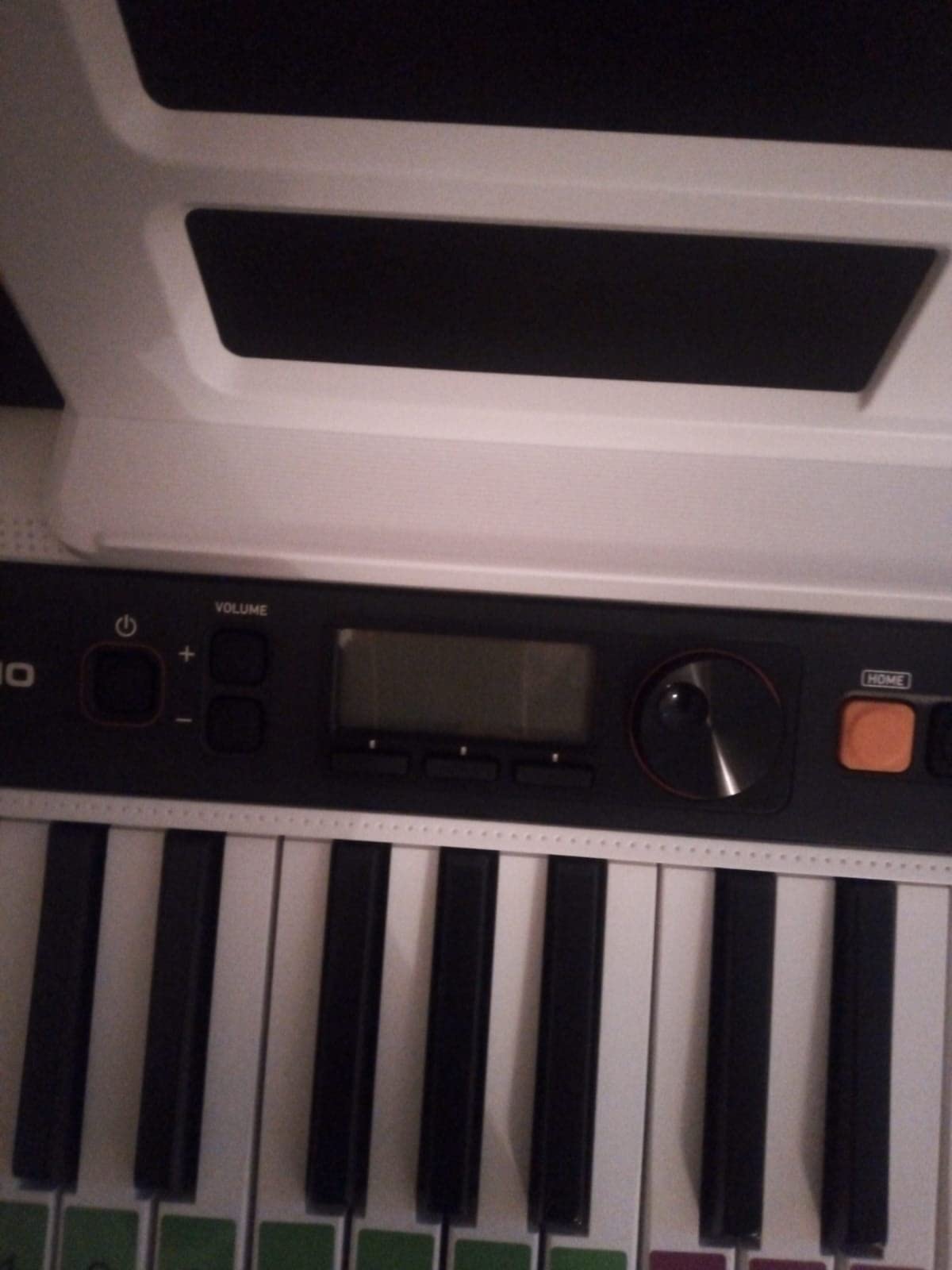
There are two practical quirks. The CT-S200 uses a Micro-B USB cable for MIDI, not the more common Mini-B or USB-C, and Casio does not ship one in the box. The built-in speaker is small, so for any serious practice you will want headphones. With 1,685 reviews averaging 4.6 stars, the satisfaction rate is the highest in this roundup alongside the Akai MPK Mini IV.
What we like about the portability
7 lbs and a built-in handle is the magic combination. Reviewers who commute by train or bus say this is the first 61-key board they actually carry daily. For a student who wants Casio’s app ecosystem without the bulk of a CT-S300, the CT-S200 hits the sweet spot.
What holds it back
No touch-sensitive keys means dynamics come from switch clicks rather than finger pressure. The non-standard USB cable is a minor but real annoyance. If weighted keys are a must, step up to the Casio CDP-S100 or the Yamaha P-145, both of which are heavier and more expensive.
7. JIKADA 61-Key Teaching Bundle – Best Light-Up Teaching Mode
JIKADA 61 Key Portable Electronic Keyboard Piano,3 Teaching Modes
61 full-size keys
3.5 kg
255 tones, light-up keys, complete bundle
Pros
- Complete bundle with stand
- stool
- headphones
- microphone and music rest
- 255 tones
- 255 rhythms and 50 demo songs for varied practice
- Light-up keys plus 3 teaching modes guide beginners step by step
- HD LCD display clearly shows function status
- Status memory function saves tone
- rhythm and tempo settings
Cons
- Instructions included are not very detailed
- Built-in demo songs only reach 49 then loop back
- Some find competing brands offer similar kits at lower prices
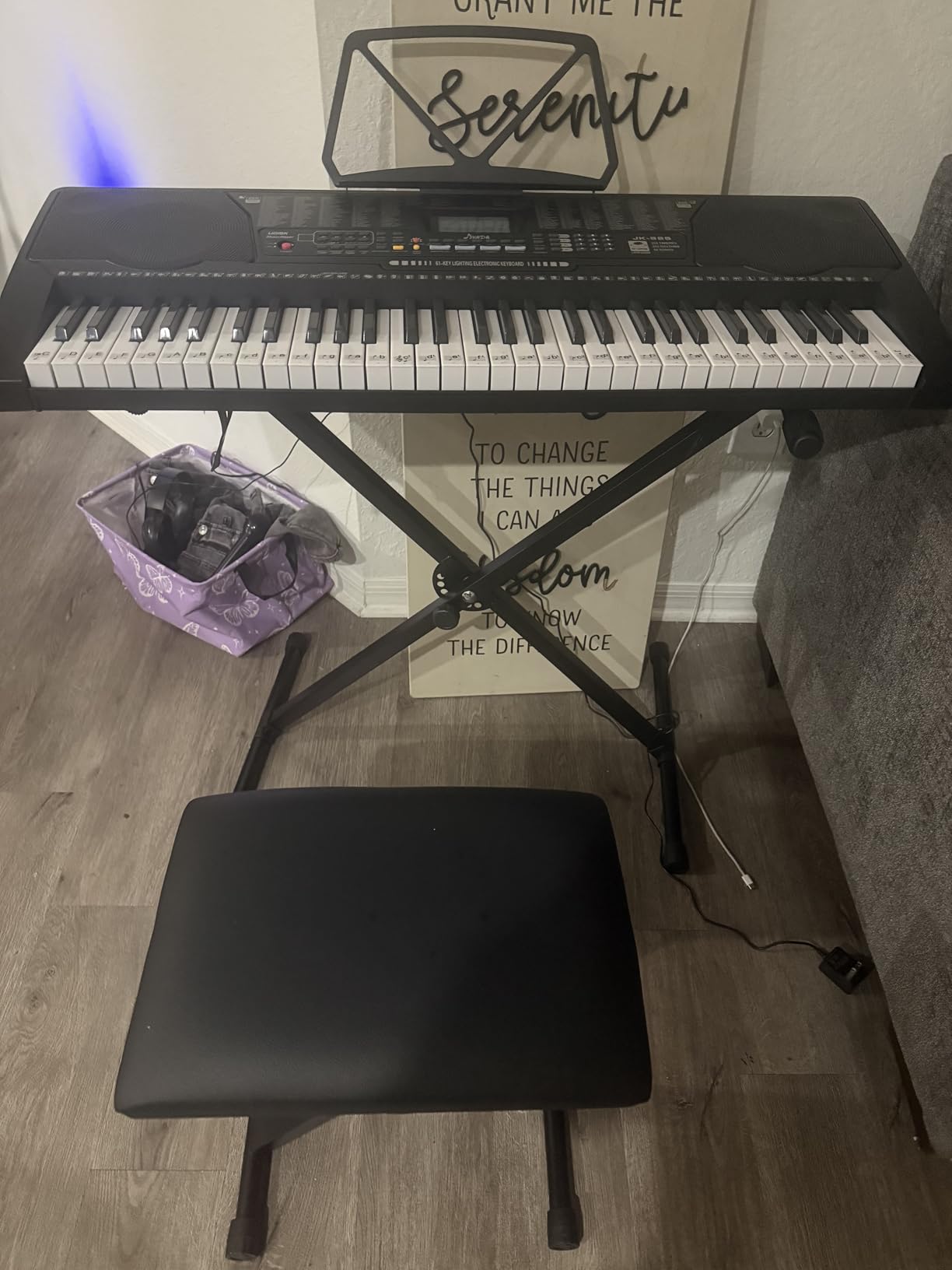
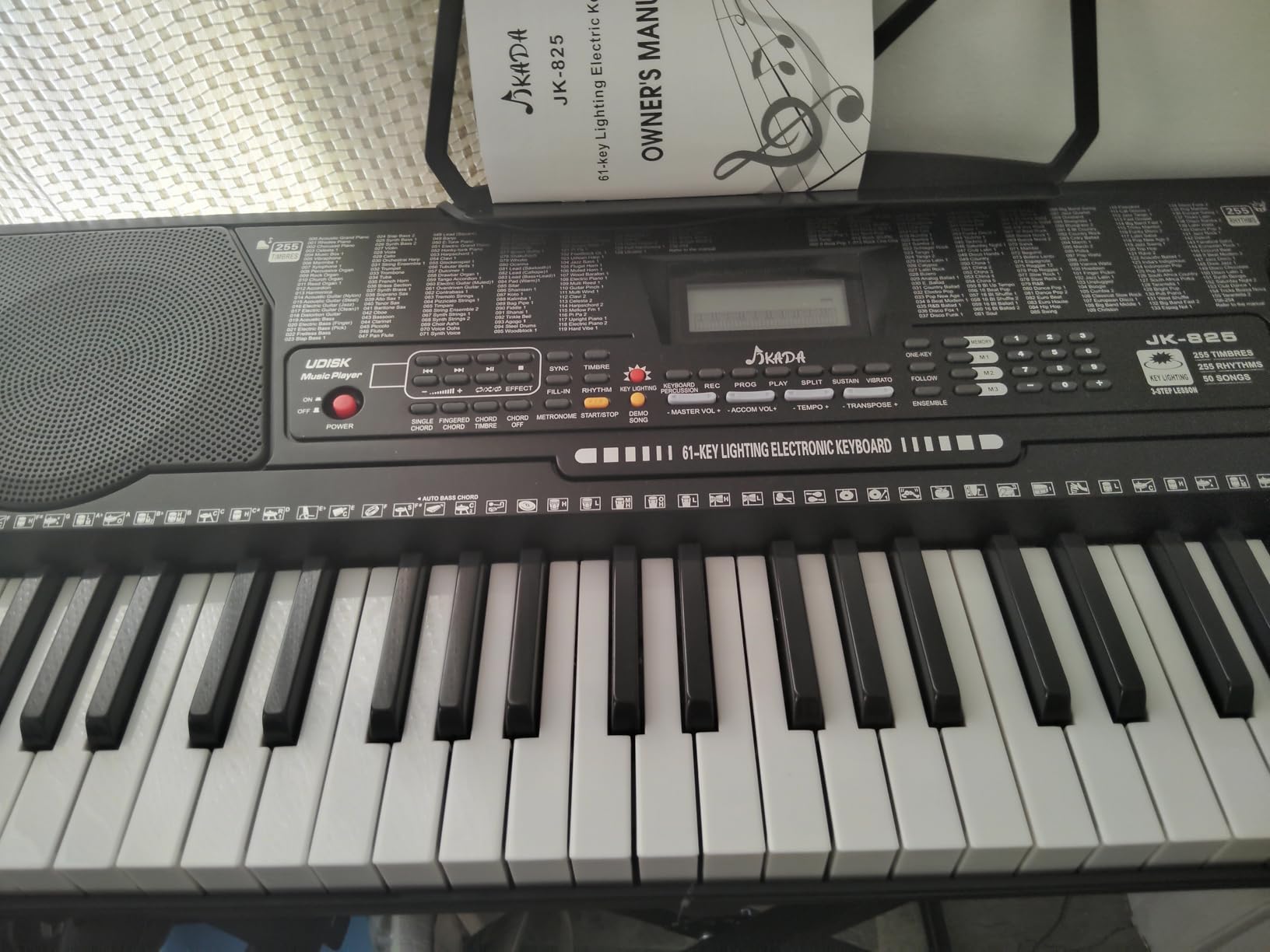
The JIKADA 61-Key is the strongest “all-in-one bundle that teaches you as you play” pick in the budget tier. The light-up keys plus 3 teaching modes are the headline: the keys illuminate to show which notes to press, in sequence, so a complete beginner can play a recognizable tune within the first 10 minutes. For kids, that early win matters more than any sound quality spec.
The bundle is genuinely complete: X-shaped stand, soft piano stool, headphones, microphone, music rest, and the AC adapter. For parents who would rather buy once than chase accessories, this is the lowest-friction route. Reviewers consistently say the included microphone adds surprising value for sing-along practice, which the kids love.
The two recurring complaints are minor but real. The instruction manual is thin, and the 50 demo songs loop only up to key 49, so a student playing two-handed pieces will outrun the demos quickly. None of that is fatal – the teaching modes still work with external apps. With 1,375 reviews averaging 4.6 stars, the satisfaction rate is excellent.
What we like about the teaching experience
Light-up keys plus 3 teaching modes is closer to a video game than a music lesson, and that is exactly the hook that keeps a reluctant kid coming back. The microphone and stand-bundle remove every excuse to delay setup. For families with one shared household keyboard, the bundle approach wins.
What holds it back
Unweighted, non-touch-sensitive keys limit long-term technique building. The demo songs top out at 49 keys, which means adult repertoire is mostly beyond the built-in lesson library. For a beginner’s first 6 months, this is a near-ideal match; after that, an upgrade path becomes likely.
8. WOSTOO 61-Key Kids Board – Best Rechargeable Board for Young Kids
Kids Piano Keyboard, 61 Key Portable Electronic Piano with Teaching Mode
61 mini keys
1.1 kg
Rechargeable lithium battery, microphone
Pros
- Rechargeable built-in battery for portable use
- 100 tones
- 100 rhythms and 50 demo songs keep kids engaged
- Includes detachable microphone for sing-along fun
- Recording and playback feature encourages practice
- Lightweight and compact for small children
Cons
- Cannot reliably play 3-note chords
- Keys are very small
- best for preschool-age kids
- Some buttons can be unresponsive
- Build feels lightweight and flimsy
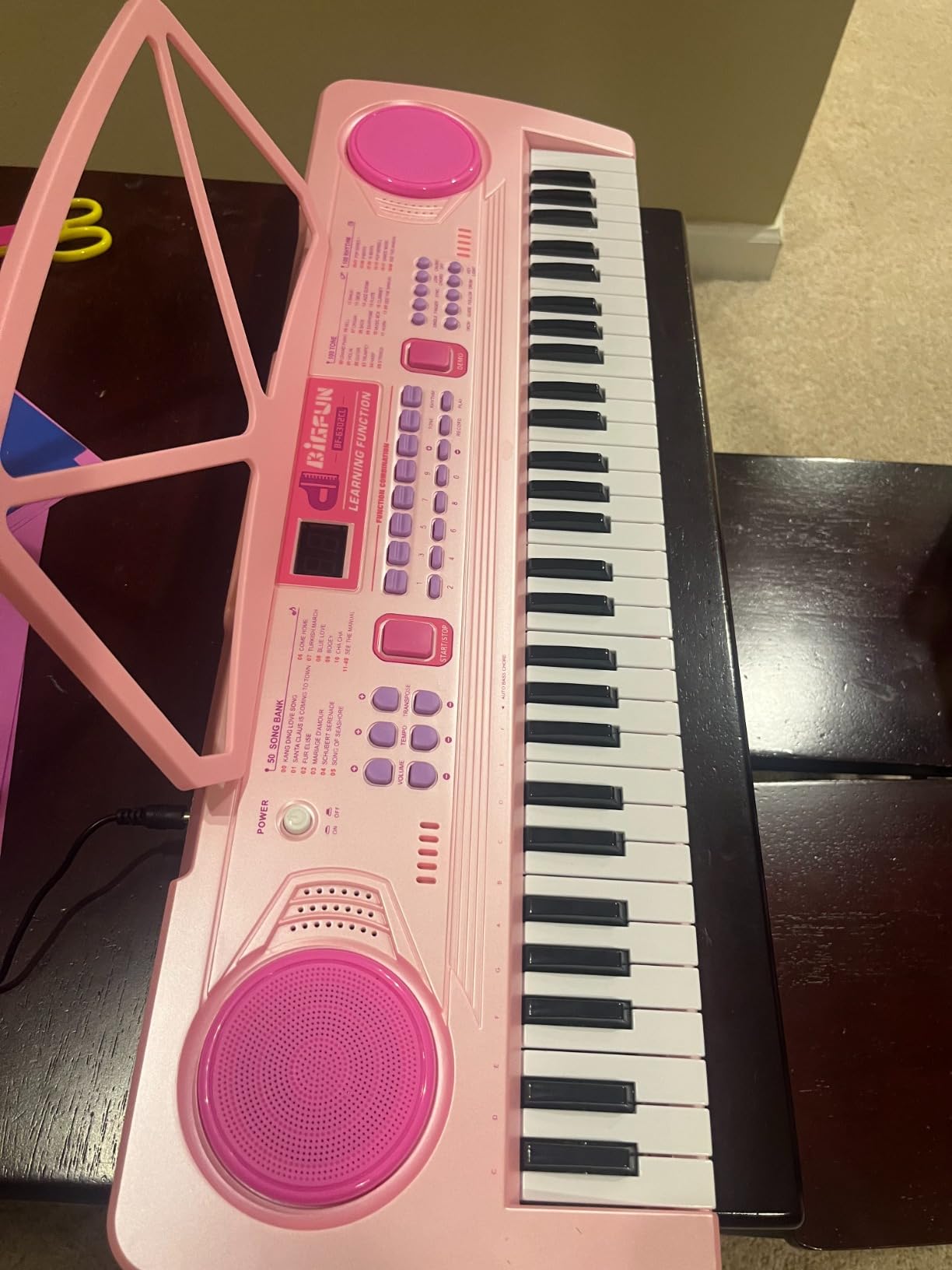
The WOSTOO 61-Key is a kid’s toy piano dressed as a portable music keyboard, and that is precisely why it makes this list. The rechargeable lithium-ion battery is the standout feature: 4 hours of charging delivers 10+ hours of play, which means no AA batteries to replace and no adapter to lose. For parents, that is the difference between a toy that gets used and a toy that sits in a drawer.
The pink color, the detachable microphone and the sing-along demo songs land this firmly in the “preschool entertainment” lane. Reviewers with 3 to 7-year-olds say the recording and playback function is the surprise hit: kids record themselves, play it back, and immediately want to do it again. That feedback loop is what makes the keyboard a daily-use toy rather than a one-weekend wonder.
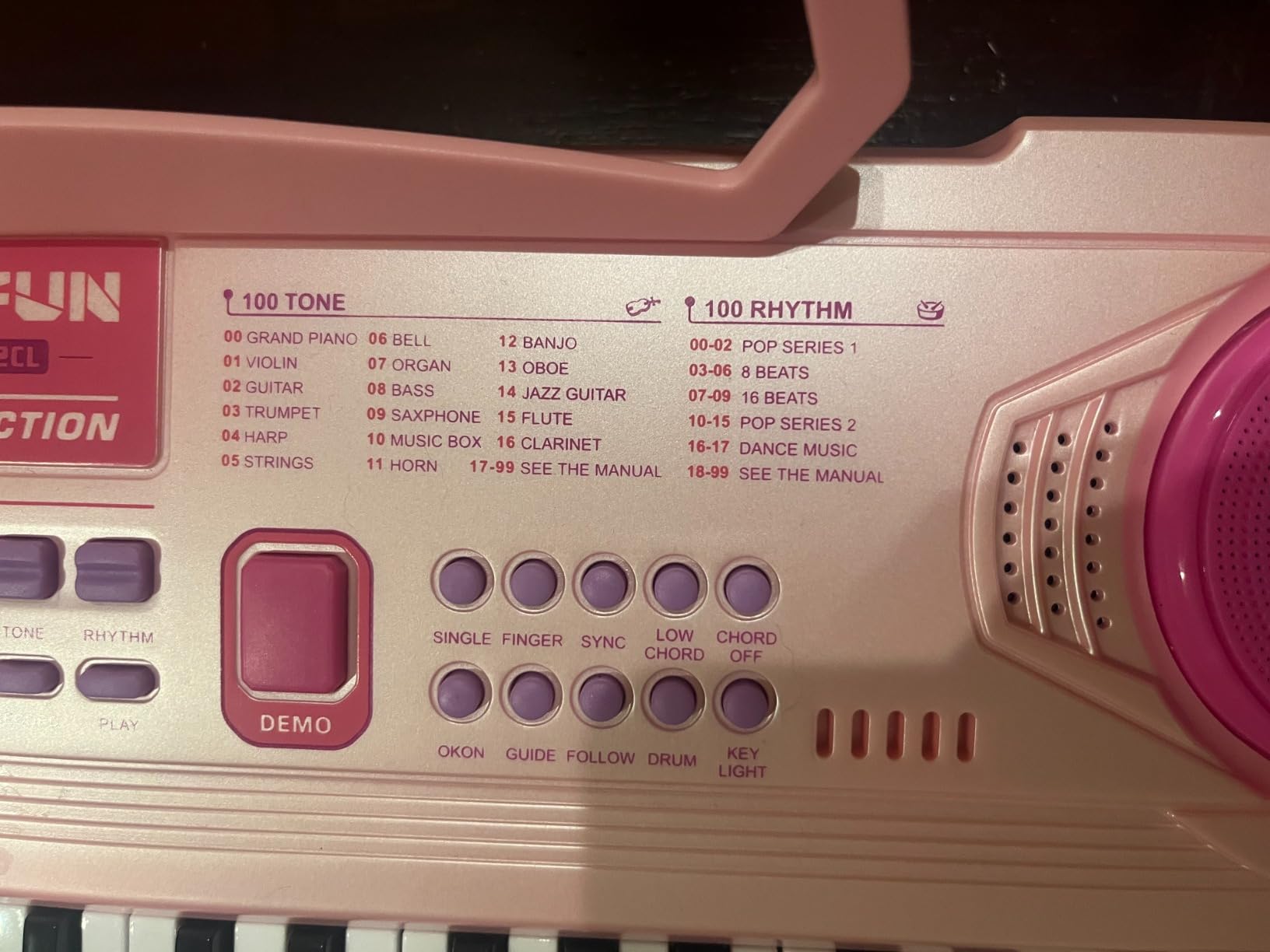
The ceiling is low by design. Three-note chords do not reliably trigger, so any chord-based song falls apart. The keys are too small for adult hands, and a meaningful slice of reviewers report buttons that get unresponsive over time. Treat this as a toy, not a learning instrument. With 1,151 reviews averaging 4.3 stars, the satisfaction rate matches its price class.
What we like for young kids
The rechargeable battery is the single biggest quality-of-life upgrade over AA-powered competitors. The microphone and the recording feature keep kids engaged far longer than a non-interactive keyboard. For a child’s first piano, this is a much better gift than a real instrument, because the toy phase has lower stakes.
What holds it back
Mini keys and limited chord support mean this is not a stepping stone toward real piano playing. It is fun, portable, and durable enough for a child, but it will not teach technique. For a slightly older child with sustained interest, look at the RockJam RJ549 or the JIKADA bundle instead.
9. Donner DEK-610S 61-Key Kit – Best All-Inclusive Bundle for Adults
Donner 61 Key Keyboard Piano, Electric Piano Keyboard Kit with 249 Voices, 249 Rhythms – Includes Piano Stand, Stool, Microphone, Gift for Beginners, Black (DEK-610S)
61 full-size keys
4.5 kg
249 voices, 2x 10W speakers, full bundle
Pros
- All-in-one kit with stand
- adjustable bench
- music rest
- microphone and adapter
- 249 voices
- 249 rhythms
- 50 demo songs and 3 teaching functions
- Two built-in 10W speakers deliver room-filling sound
- HD LCD display shows current functions clearly
- Donner Music APP offers structured learning content
Cons
- Heavier than many other portable keyboards at 9.9 lbs
- Slim body design limits depth of key travel
- Some users may prefer a more compact or lighter option
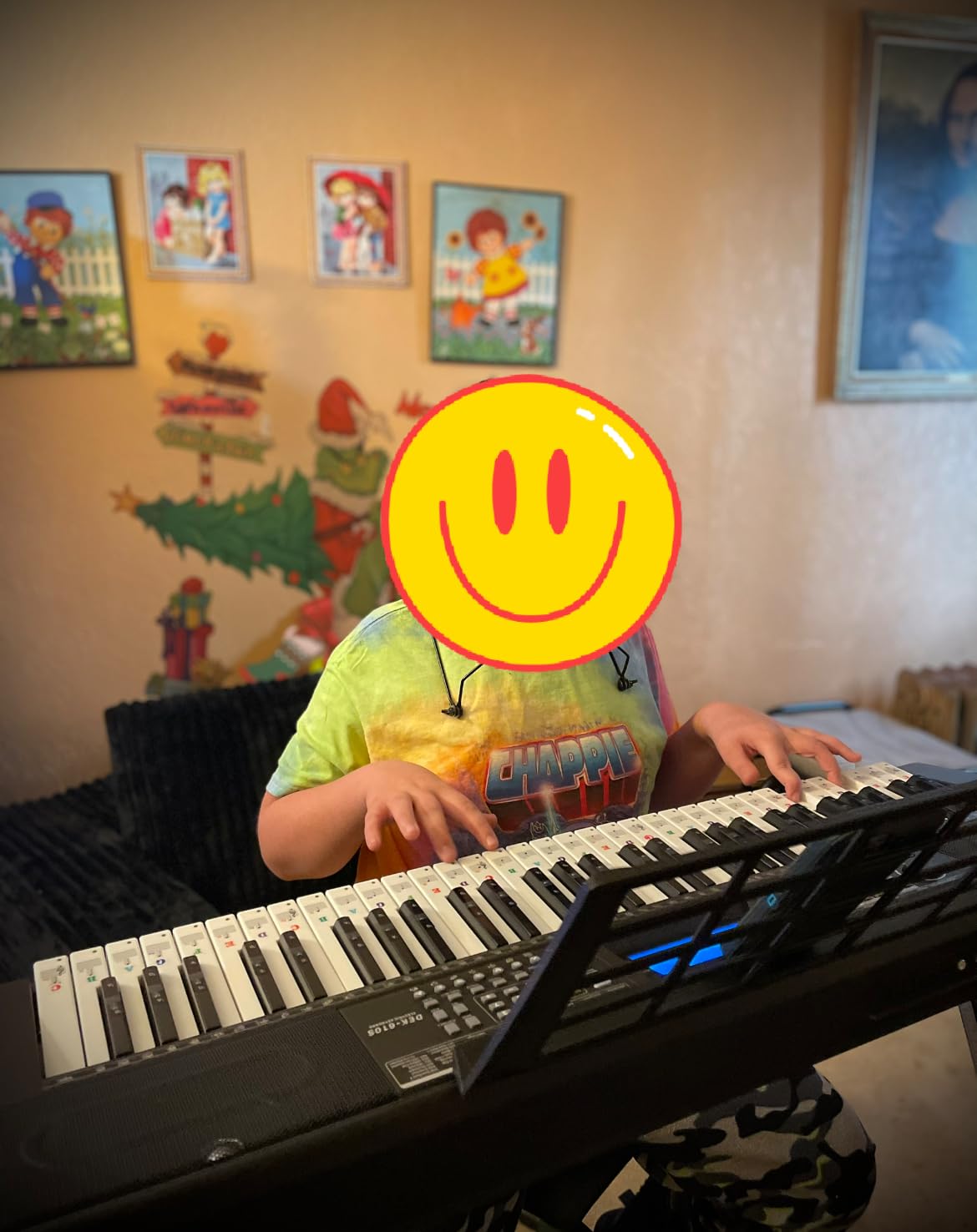
The Donner DEK-610S is the bundle I recommend to an adult who wants a “real piano setup” they can still move around the apartment. The two 10W built-in speakers are louder and fuller than anything else in this roundup, and the 249-voice library is the largest at the price. For a household where the keyboard is the household instrument, this is the bundle that actually fills a room with music.
Donner pairs the keyboard with an adjustable bench (not just a stool), a music rest, a microphone, and the Donner Music APP for structured lessons. The full bundle is genuinely useful for adult learners, not just for show. Reviewers consistently say the teaching functions plus the app feel closer to a Yamaha or Casio ecosystem than to a typical off-brand kit.
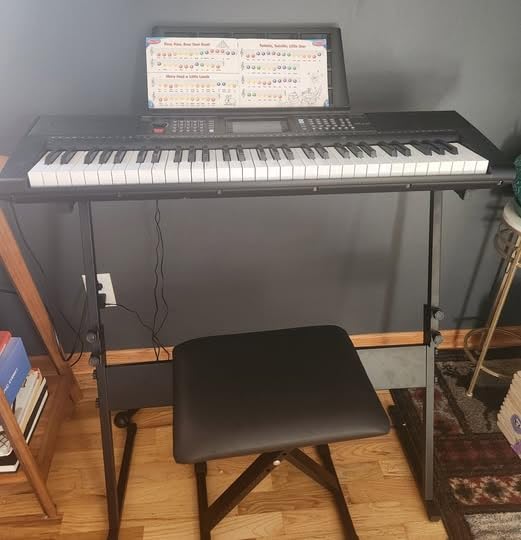
The portability tradeoff is honest. At 9.9 lbs, this is the heaviest board in this roundup, and the slim body limits key travel depth. If your definition of portable is “carry between rooms,” it still works. If your definition is “throw in a backpack,” step down to the Alesis Melody 32 or the Casio CT-S200. With 1,049 reviews averaging 4.4 stars, the satisfaction rate is solid for the price.
What we like about the full bundle
An adjustable bench, music rest, microphone and 2x 10W speakers in one box means a beginner can run a full practice session without buying anything else. The 249 voices and the Donner Music APP give the keyboard legs beyond the first month. For an adult beginner who does not want to piece together a setup, this is the most complete option.
What holds it back
9.9 lbs is the heaviest pick in this guide, so it is “apartment portable” rather than “travel portable.” Unweighted action limits long-term technique development. Think of this as a 61-key digital piano that happens to be light, not as a board you would take on a flight.
10. Yamaha YPT280 61-Key – Best Premium Portable for Beginners
Yamaha 61-Key Portable Keyboard for Beginners with Built-In Songs, Quiz Mode, Music Rest, with Power Adapter YPT280
61 full-size keys
8.8 lbs
Quiz Mode, Smart Chord, music rest included
Pros
- 61 full-sized keys suitable for developing proper technique
- Quiz Mode offers ear-training games for musical development
- Portable Grand Piano button delivers an expressive Yamaha piano sound
- Hundreds of built-in songs across popular
- children's and classical styles
- Smart Chord allows complex chords with one finger
Cons
- No visible power on or off indicator light
- Some users may want touch-sensitive keys (not on this YPT280 variant)
The Yamaha YPT280 is the highest-rated keyboard in this roundup, and for good reason. Yamaha’s Portable Grand Piano button delivers an expressive grand piano tone that is genuinely a step above the off-brand boards, and the 61 full-size keys have the right geometry for proper hand position. At 8.8 lbs and 37 inches across, it is at the heavy end of “portable,” but still liftable one-handed.
The headline features are Smart Chord and Quiz Mode. Smart Chord lets a complete beginner play complex chords – jazz voicings, pop triads, anything – with a single finger, which means a beginner can sound musical within minutes. Quiz Mode is the Yamaha-specific teaching hook: two ear-training games that connect sounds to keys, the way working musicians actually learn. Reviewers consistently call out how these two features keep their kids practicing voluntarily.
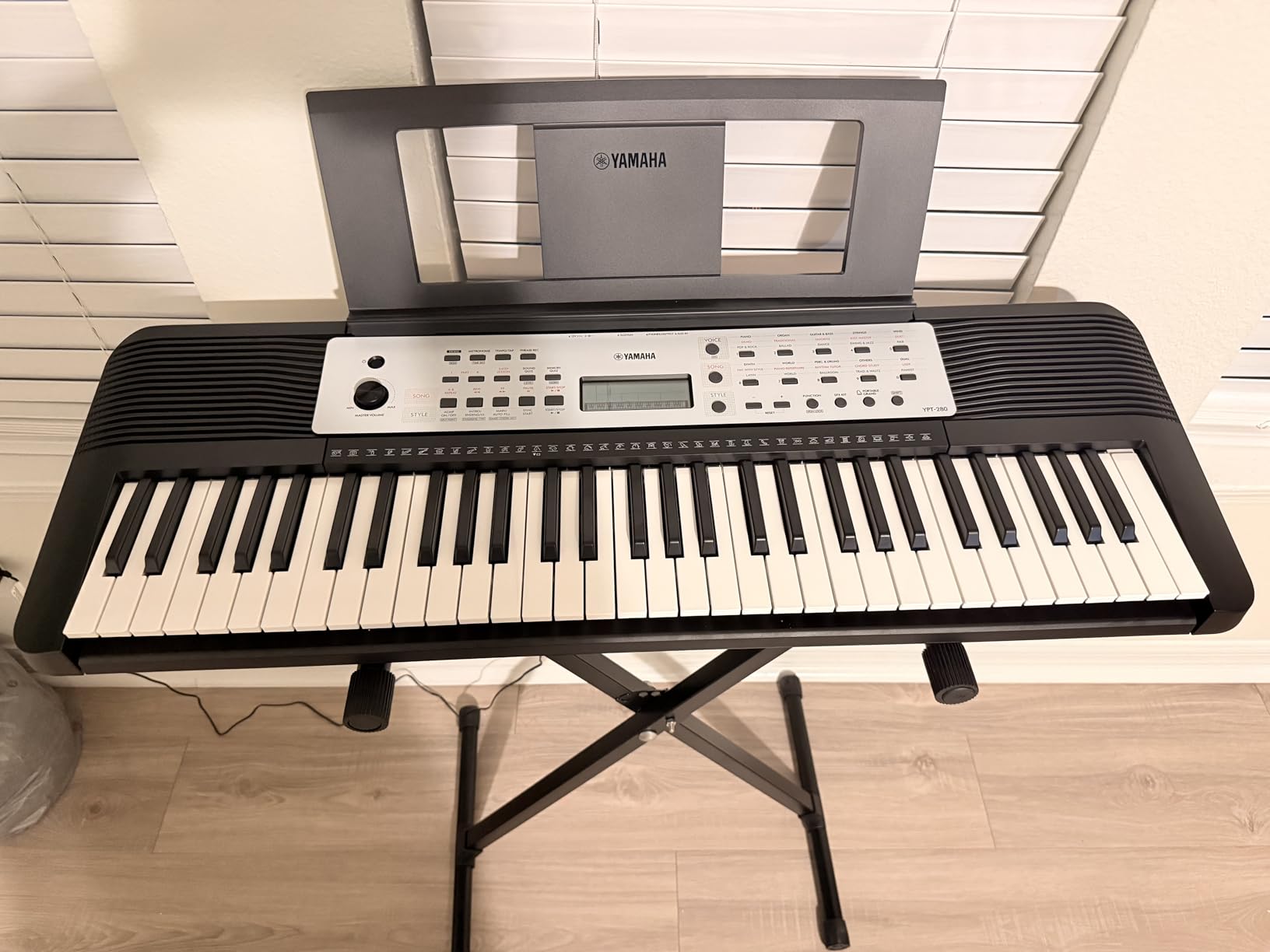
The two complaints are minor. There is no visible power indicator light, which can confuse first-time users. And the YPT280 variant is not touch-sensitive (other variants in the same line are – check the model number if you need velocity). With 281 reviews averaging 4.7 stars, the satisfaction rate is the highest in this roundup, and the Yamaha brand promise carries real weight.
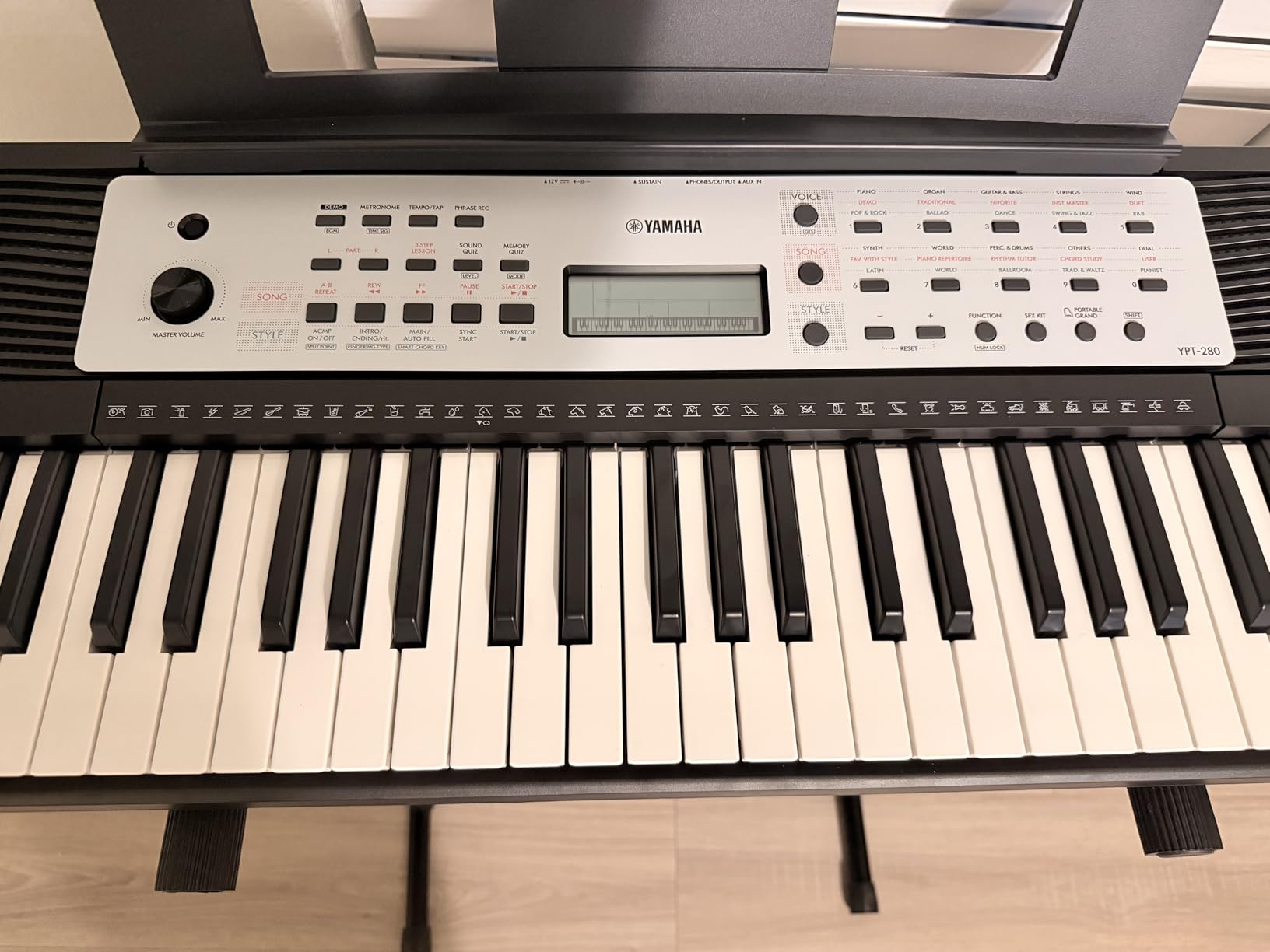
What we like about the Yamaha ecosystem
Yamaha’s sound engine is in a different class from off-brand competitors, and the Smart Chord plus Quiz Mode features turn practice into a game. For a household that wants a brand-name keyboard with reliable customer support and a deep accessory ecosystem, the YPT280 is the safest premium pick.
What holds it back
8.8 lbs is heavy for a “portable” 61-key, and the lack of touch sensitivity on this specific YPT280 variant limits dynamic expression. The price reflects the Yamaha premium. For shoppers on a tighter budget, the Casio CT-S200 or RockJam RJ5061 deliver 80% of the experience at a lower cost.
How to Choose the Best Small Portable Piano Keyboard
Buying a small portable piano keyboard is mostly about three decisions: how many keys, what kind of action, and how it will be powered. Get those three right and the rest is feature polish. The picks above cover most use cases, but here is how I think through each decision when I am advising a friend.
If you are shopping for a beginner or a household board, our beginner keyboards guide and budget headphones guide go deeper on weighted keys, sound engines, and quiet-practice setups. For more general keyboard coverage beyond the small-portable niche, see our portable keyboards roundup.
Key count and form factor
Key count is the single biggest factor in how a keyboard plays. 25-key and 32-key boards are ultra-compact and great for travel or kids, but they cannot play most piano repertoire because of limited range and (often) no octave transpose. 49-key boards cover four octaves, which fits basic method-book pieces one-handed, and they remain genuinely portable. 61-key boards hit the sweet spot for most learners: enough range for two-handed playing of beginner to intermediate pieces, while still being light enough to carry one-handed. 88-key boards are the only choice for classical repertoire, but they almost always push past 25 lbs, which puts them outside the “small portable” niche.
Key action and feel
Action describes how the keys respond when you press them. Synth-action keys are light and springy, common on mini boards and MIDI controllers. Semi-weighted keys add a bit more resistance, common on mid-tier 61-key boards. Fully weighted or hammer-action keys mimic the feel of an acoustic piano and are essential for building proper technique, but they add weight. If your goal is travel and casual practice, synth action is fine. If your goal is graded piano exams, weighted action is non-negotiable.
Sound engine and polyphony
Sound engine is what generates the piano tone. Higher-end boards use sampled or modeled grand pianos with multiple velocity layers; budget boards use simpler sample sets. Polyphony is how many notes the keyboard can play at once – 64-note polyphony is the modern minimum, 128 or 192 is better for layered sounds. None of the small portable boards in this roundup use weighted hammer action, so the sound engine is the main differentiator. Yamaha and Casio are noticeably better than off-brand competitors at this size class.
Weight, battery, and footprint
Weight is the actual definition of “portable.” Anything over 15 lbs is hard to carry one-handed, anything over 25 lbs needs two hands and a case. Battery operation matters more than most shoppers expect: AC-only boards are tethered to a wall outlet, while AA or rechargeable boards can be set up on a hotel desk, a kitchen table, or outdoors. Footprint is the third leg: a board that fits on a shelf when not in use is one a household will actually keep around.
Connectivity and apps
USB-MIDI is the standard way to connect a keyboard to a laptop, tablet, or phone for app-based lessons (Simply Piano, Flowkey, Skoove, Melodics). Bluetooth MIDI removes the cable, which matters on a cluttered desk. Bluetooth audio is a different feature – it lets the keyboard act as a speaker for streamed music, useful for play-along. Headphone jacks are essential for apartment and late-night practice. None of the small portable boards in this roundup combine all of these, so decide which ones matter to you before you buy.
Who is this for
Apartment dwellers who practice late at night should prioritize headphone jacks and small footprint over speaker volume. Travelers and digital nomads should prioritize weight under 8 lbs and battery operation. Music producers should look at the MIDI controller category (the Akai MPK Mini IV in this roundup) rather than a stand-alone piano. Beginners should prioritize bundled accessories (stand, bench, headphones) and lesson-app integration over raw specifications. Gigging musicians who need a backup board should look at the Casio CT-S200 or the Yamaha YPT280, both of which combine portability with quality sound engines.
Frequently Asked Questions
What is the best compact portable keyboard?
The best compact portable keyboard is the Casio Casiotone CT-S200. It weighs 7 lbs, has 61 full-size keys, 400 tones, class-compliant USB-MIDI, and runs on either the included AC adapter or 6 AA batteries, which makes it the strongest combination of portability and features in this roundup.
What is a good portable mini piano keyboard?
A good portable mini piano keyboard is the Alesis Melody 32. At 1 kg and 22 inches wide, it fits in a backpack sleeve, runs on USB or 4 AA batteries, and ships with 300 voices plus a 1-month Melodics subscription and a 3-month Skoove subscription for structured learning.
What is a good mini travel keyboard piano?
A good mini travel keyboard piano is the Akai MPK Mini IV for producers or the Alesis Melody 32 for casual players. The MPK Mini IV is a 1 kg velocity-sensitive MIDI controller that runs on USB-C, while the Melody 32 is a 1 kg stand-alone piano with built-in speakers and battery operation.
What is the best portable piano keyboard?
The best portable piano keyboard is the RockJam RJ5061 if you want a complete beginner kit with stand, bench and headphones included, or the Casio CT-S200 if you want the lightest 61-key portable with serious sound quality. Both are under 8 lbs and run on AC or batteries.
What is the best portable piano keyboard for travel?
The best portable piano keyboard for travel is the Yamaha YPT280 for a full 61-key experience or the Alesis Melody 32 for an ultra-compact 1 kg carry-on option. The YPT280 weighs 8.8 lbs with Yamaha-grade sound, while the Melody 32 fits in luggage weight budgets and runs on AA batteries.
What is a good mini keyboard piano for beginners?
A good mini keyboard piano for beginners is the JIKADA 61-Key Teaching Bundle. It has light-up keys plus 3 teaching modes that guide beginners note by note, ships with a stand, stool, headphones and microphone, and includes 255 tones and 255 rhythms to keep practice engaging.
What is a good small keyboard for travel?
A good small keyboard for travel is the Donner DEK-610S for a full 61-key bundle under 10 lbs, or the RockJam RJ361 for an even lighter 6 lb option. The Donner includes an adjustable bench and 2x 10W speakers, while the RJ361 is the smallest 61-key board in this roundup.
Final Verdict
After comparing all 10 boards by weight, key count, action, sound engine, battery, and price, the RockJam RJ5061 61-Key Kit remains the strongest all-around pick for the best small portable piano keyboards in 2026. The complete bundle, the 46,000+ review track record, and the Simply Piano integration make it the safest starting point for a beginner or a household.
For shoppers who already know what they want, the Casio CT-S200 is the best value 61-key portable, the Alesis Melody 32 is the best ultra-compact travel board, and the Akai MPK Mini IV is the best MIDI controller for producers. Each of those picks solves a different problem, and the right one depends on whether your priority is a complete bundle, maximum portability, or studio functionality. If you are still weighing options, our piano lamp guide covers the accessories that make any of these boards feel like a real practice space.