
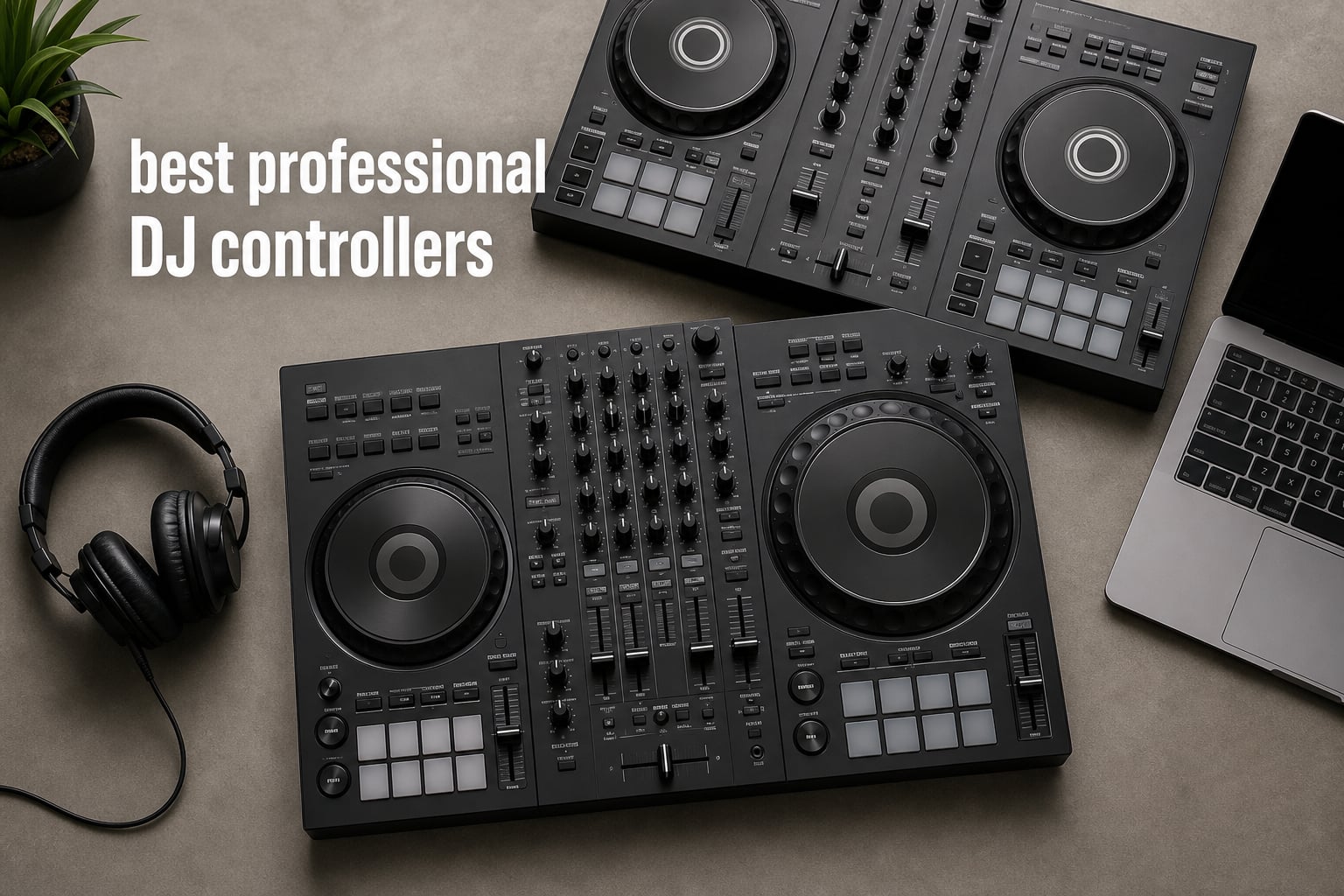
The best professional DJ controllers give you dependable physical control of software or a standalone library without making you relearn your performance habits at every booth. This guide compares eight professional-grade choices for working DJs, mobile performers, scratch specialists, and DJs moving toward club-style workflows in 2026.
A professional controller is more than a pair of jog wheels attached to a laptop. It should give you a usable mixer section, clear cue and loop access, solid outputs, dependable software support, and enough deck control for the way you actually perform.
There is one decision to make before comparing buttons: do you want a laptop controller or an all-in-one system? A laptop controller operates rekordbox, Serato DJ Pro, or another supported application, while a standalone unit reads USB or SD media and may add Wi-Fi streaming without a computer.
That distinction matters at gigs. A laptop controller can offer deep software tools and flexible libraries, while a standalone setup reduces the gear on the table and can keep a set moving when you do not want a computer in the chain.
Forum discussions repeatedly return to club preparation, build quality, and the rekordbox-versus-Serato question. The practical answer is not that one platform fits everyone: pick the layout and software that match the gigs, music sources, and performance techniques you expect to use.
Our selection is based only on the documented specifications, supplied feature lists, and customer ratings in the analyzed product data. I have not treated a high rating as proof that every workflow will suit you; a four-deck streaming unit and a two-deck scratch controller solve very different problems.
Here is the short version. Choose the XDJ-AZ for a full standalone, club-style workspace; choose the DDJ-FLX10 when you want four channels with rekordbox and Serato DJ Pro; and choose the RANE PERFORMER when motorized platters and Serato performance are at the center of your set.
Table of Contents
The three top picks answer the most common professional workflows

The AlphaTheta XDJ-AZ is the broadest no-laptop choice here because it combines four-deck USB playback, a large touchscreen, full-size jog wheels, and a club-standard layout. The Pioneer DJ DDJ-FLX10 is the strongest fit for a laptop-based DJ who needs both major software paths and track-separation controls.
The RANE PERFORMER takes a different route. Its motorized aluminum platters, adjustable faders, and Serato-focused stem controls are purpose-built for DJs whose transitions and routines depend on hands-on platter response.
The best professional DJ controllers in 2026 cover eight distinct setups
| Product | Specifications | Action |
|---|---|---|
 Denon DJ PRIME GO+ Denon DJ PRIME GO+ |
|
Check Latest Price |
 RANE PERFORMER RANE PERFORMER |
|
Check Latest Price |
| AlphaTheta XDJ-AZ |
|
Check Latest Price |
 Pioneer DJ DDJ-FLX10 Pioneer DJ DDJ-FLX10 |
|
Check Latest Price |
 Denon DJ SC LIVE 4 Denon DJ SC LIVE 4 |
|
Check Latest Price |
 Pioneer DJ DDJ-REV5 Pioneer DJ DDJ-REV5 |
|
Check Latest Price |
 RANE FOUR RANE FOUR |
|
Check Latest Price |
 AlphaTheta DDJ-GRV6 AlphaTheta DDJ-GRV6 |
|
Check Latest Price |
Use the overview as a workflow filter rather than a scorecard. The two standalone Denon options and the XDJ-AZ can reduce reliance on a laptop, the RANE choices put Serato controls first, and the Pioneer DJ or AlphaTheta controllers make more sense for DJs wanting a familiar club-inspired layout.
1. Denon DJ PRIME GO+ is the portable standalone choice
Denon DJ PRIME GO+ Standalone Portable DJ Controller
2 decks
Battery power
Wi-Fi streaming
7 inch display
Pros
- Battery-powered setup
- Wi-Fi streaming
- standalone Engine DJ OS
- balanced XLR outputs
Cons
- Two decks only
- stems need a separate license
The Denon DJ PRIME GO+ is the outlier in this lineup because portability is its main strength without abandoning professional connections. It has two decks, a built-in battery, a 7-inch display, SD and USB media inputs, Bluetooth input and output, plus balanced XLR outputs.
That combination makes sense for a ceremony, a compact bar setup, a backup system, or a DJ who needs to practice and prepare away from a fixed desk. At 8.11 pounds, it is far easier to move than the large four-channel units listed below.
Engine DJ OS lets the PRIME GO+ work without a laptop, and its Wi-Fi system is specified for access to more than 100 million tracks. The device also lists 26 main effects, two sweep effects, ten touch effects, RGB waveforms, and separation of vocal, melody, bass, and drum parts.
The limitation is clear: two decks leave less room for layered acapellas, loops, and long four-deck blends. Also, the supplied product data says standalone stem separation requires a one-time software license, so buyers should account for that feature requirement before treating stems as included.
Its best fit is the DJ who needs a self-contained travel rig
Pick the PRIME GO+ when battery operation, a small footprint, and media independence matter more than large jogs or four channels. It is also a credible choice for mobile work where Wi-Fi streaming, Bluetooth, and XLR outputs can simplify a compact setup.
Its Engine Lighting enhancements support Philips Hue, Nanoleaf, and DMX, which is unusual on a device this small. That gives event DJs a route to basic lighting coordination without adding another controller.
Its weaker fit is the DJ who builds every set around four decks
Do not select this as your main club-style practice deck if you need full-size controls or frequent four-channel layering. The 7-inch display is useful, but it does not make the compact two-deck format behave like a large booth installation.
The PRIME GO+ has the highest listed rating in this group at 4.8 from 35 reviews, though the smaller review count is still worth keeping in perspective. Its appeal is specific: serious standalone capability in a portable body.
2. RANE PERFORMER is the motorized Serato performance answer
RANE PERFORMER 4-Channel DJ Controller
4 channels
7 inch motorized platters
MAG Four fader
Serato DJ Pro
Pros
- High-torque motorized platters
- adjustable fader tension
- 29 main effects
- DVS-enabled
Cons
- Corded operation
- large and heavy
The RANE PERFORMER is for DJs who want moving platters rather than static jog wheels. Its 7-inch high-torque aluminum platters use magnetic acrylic discs, while the built-in displays show song information and waveforms without forcing a constant glance at the laptop.
Four channels make it practical for open-format routines, longer blends, and external-source use. The supplied connections include two combo XLR and quarter-inch microphone inputs, switchable line or phono inputs on channels three and four, XLR, quarter-inch TRS, RCA outputs, and USB Type-B.
The mixer is a strong part of the case. RANE specifies Precision Feel volume faders with adjustable tension and a MAG Four crossfader, then adds 29 paddle-triggered main effects and four knob-controlled channel effects.
For current performance ideas, it has Stem-Split, Stem Level, and Stem Pad Mode, plus Serato DJ Pro and Serato Pitch ‘n Time included. It is DVS-enabled, giving a DJ more room to bring turntables or media players into the same setup.
Its best fit is the scratch DJ who wants real platter movement
Choose the PERFORMER when platter inertia, fader feel, and Serato access are the deciding factors. The OLED pad-mode displays and 16 multi-color pads give routine-based DJs more visible control over performance modes during a set.
It is also a sensible option for the DJ who wants a controller that behaves more like a performance instrument than a compact laptop accessory. The metal construction and 12.8-kilogram weight point toward a fixed performance or gigging role rather than casual travel.
Its weaker fit is the DJ who wants a simple laptop-free system
The PERFORMER is corded and built around Serato software, so it does not replace a standalone USB player. A DJ who wants to arrive with a USB drive and no computer should look at the XDJ-AZ, SC LIVE 4, or PRIME GO+ instead.
It has a listed 4.7 rating from 88 reviews. The evidence supports a focused conclusion: this is one of the strongest choices here for a motorized DJ controller and detailed Serato work.
3. AlphaTheta XDJ-AZ is the full standalone club-style workstation
Pioneer DJ XDJ-AZ Professional 4-Deck All-in-One DJ System, 10.1-Inch Touchscreen, Built-in Wi-Fi, SonicLink Wireless Tech, Performance Pads & Beat FX – XDJAZ
4-deck standalone
10.1 inch touchscreen
Wi-Fi
206mm jog wheels
Pros
- Four-deck USB playback
- large touchscreen
- club-standard layout
- high specified audio figures
Cons
- Thirty-pound unit
- not designed for compact travel
The AlphaTheta XDJ-AZ is the best fit in this group for a DJ who wants a big, standalone workspace with a familiar club-oriented control scheme. It offers four-deck playback from USB, a 10.1-inch capacitive touchscreen, 206mm full-size jog wheels, and Jog Feeling adjustment.
The screen can display up to 13 tracks according to the product data. That matters when you are searching, checking phrases, and preparing the next move without a laptop screen beside the mixer.
Audio specifications are unusually clear here: AlphaTheta lists a 115 dB signal-to-noise ratio and 0.0018% total harmonic distortion. It also includes six Sound Color FX and 14 Beat FX, including Helix and Mobius, which puts creative effects control on the hardware.
Built-in Wi-Fi, Bluetooth 5.3, and SonicLink wireless technology round out the feature set. The unit is a standalone system rather than a conventional computer-dependent controller, but it belongs in a professional controller comparison because its workflow is directly relevant to DJs choosing an all-in-one alternative.
Its best fit is the DJ preparing for a larger booth workflow
Choose the XDJ-AZ when you want full-size jogs, USB-based performance, and four-deck access in one machine. The physical scale and club-standard layout make it a useful home practice center for DJs who value a large-format surface.
It is also a capable event-system centerpiece when you want to keep laptop hardware out of the booth. The touchscreen, library views, and hardware effects reduce the number of separate devices needed for a complete set.
Its weaker fit is the DJ who carries gear alone every week
At 30 pounds, this is not the sensible choice for someone who values quick travel and a small table footprint. It trades portability for a bigger interface, four-deck operation, and standalone depth.
The listed 4.7 rating comes from 47 reviews. I would treat the XDJ-AZ as the broadest professional all-in-one recommendation here, not as a substitute for a compact controller when mobility is the first priority.
4. Pioneer DJ DDJ-FLX10 is the flexible four-channel laptop controller
Pioneer DJ DDJ-FLX10 4-Channel DJ Controller, Track Separation, Black
4 channels
Track Separation
On Jog Display
rekordbox and Serato
Pros
- Dual software support
- track separation
- jog displays
- DMX lighting control
Cons
- Laptop required
- limited edition availability
The Pioneer DJ DDJ-FLX10 is the most balanced choice for a DJ who wants four channels and does not want to commit to only one of the two major software ecosystems. It supports rekordbox and Serato DJ Pro, connects by USB, and has a four-channel mixer layout.
Its defining feature is Track Separation, which isolates vocals, drums, and instruments for live mashups and remixes. Color-coded LEDs support those controls, making it easier to tell which separation function is in use during a fast transition.
The On Jog Display can show deck information, waveforms, artwork, or a DJ logo. This keeps key performance information closer to the hands and is useful when a laptop screen is not at the ideal height or angle.
The FLX10 also supports DMX lighting control with automatic music synchronization. DJs who run their own events can use that function to coordinate lighting without losing focus on a laptop-based music workflow.
Its best fit is the DJ who wants rekordbox and Serato options
Choose the DDJ-FLX10 if the software decision is still open or if you move between rekordbox and Serato DJ Pro environments. That flexibility makes it a strong professional controller for a DJ handling different venues, collaborators, or library habits.
It has the largest listed review count in this comparison among the higher-rated four-channel laptop options: 248 reviews with a 4.5 rating. The documented plug-and-play setup and four channels suit DJs who want to start mixing quickly after connection.
Its weaker fit is the DJ who refuses to bring a laptop
The FLX10 is not a standalone media player. Its strengths depend on connecting a PC or Mac, so it cannot offer the USB-only workflow of the XDJ-AZ or the Engine DJ devices.
Limited-edition availability is another practical point in the supplied product data. Check that the specific version and software support you want are available before making it the center of your rig.
5. Denon DJ SC LIVE 4 is the streaming-ready four-deck standalone option
Denon DJ SC LIVE 4 Standalone DJ Controller Black
4-deck standalone
7 inch touchscreen
Wi-Fi streaming
built-in speakers
Pros
- Laptop-free Engine DJ OS
- streaming access
- Serato and Virtual DJ support
- DMX control
Cons
- Speakers do not replace venue sound
- corded power
The Denon DJ SC LIVE 4 brings four-deck standalone playback to a controller-shaped unit with a 7-inch multi-gesture touchscreen. It runs Engine DJ OS and accepts two USB inputs and SD media, so a laptop is optional rather than required.
Wi-Fi streaming is specified for access to more than 100 million tracks, and the supplied product list names Amazon Music, Apple Music, and TIDAL among supported services. Bluetooth audio input can also be useful for requests, transitions, or an external source at an event.
Its built-in speakers are practical for home preparation and small spaces, not a replacement for a venue PA. Treat them as a convenience that lets you rehearse without separate monitors, while using the XLR and other outputs for serious sound reinforcement.
The SC LIVE 4 includes a three-band EQ mixer, RGB waveforms, star ratings, stem separation for vocal, melody, bass, and drum parts, plus Serato DJ Pro and Virtual DJ compatibility. This gives it an unusually broad path between standalone use and computer-based software.
Its best fit is the working DJ who wants streaming and fallback options
Choose this unit if you value USB or SD independence but also want Wi-Fi music access and the ability to use Serato DJ Pro or Virtual DJ. That versatility is useful for mobile DJs whose locations and music needs change from event to event.
Engine Lighting enhancements add DMX control, making it one of the options here with a documented route into light coordination. The four-deck design also helps DJs who layer stems, loops, or additional tracks instead of mixing in a strict two-deck pattern.
Its weaker fit is the DJ who wants the heaviest scratch-focused controls
This model is not presented as a motorized-platter instrument, and its value is in independent playback and connectivity rather than a battle-style fader-and-platter layout. For that kind of performance, the RANE PERFORMER, RANE FOUR, or DDJ-REV5 is a closer match.
It has a listed 4.5 rating from 168 reviews. The result is a persuasive all-round standalone choice when streaming services and a laptop-free safety net matter to your work.
6. Pioneer DJ DDJ-REV5 is the scratch-style two-channel performer
Pioneer DJ DDJ-REV5 2-Channel Scratch DJ Controller, On-Jog Display
2 channels
Scratch-style layout
Dedicated stems
Serato and rekordbox
Pros
- Long tempo sliders
- Auto BPM Transition
- Piano Play mode
- two USB Type-C ports
Cons
- Two-channel format
- lower listed rating than top picks
The Pioneer DJ DDJ-REV5 is built around a scratch-style layout rather than a conventional club-mixer arrangement. Long tempo sliders sit above the decks, while performance pads and Lever FX occupy the mixer area for quick open-format moves.
It is a two-channel controller, so it is not for a DJ who requires permanent access to four software decks. In return, the smaller channel count gives more attention to a direct, performance-centered layout for cuts, transitions, and pad work.
Dedicated Stems buttons let you make live mashups and remixes, and Auto BPM Transition is designed to move between tracks without an abrupt cut. Piano Play mode adds another way to turn pad inputs into musical performance gestures.
The DDJ-REV5 works with both Serato DJ Pro and rekordbox. Multiple inputs and outputs plus two USB Type-C ports make it more flexible than a minimal two-channel controller, especially when a working DJ needs a modern laptop connection.
Its best fit is the open-format DJ who wants a performance-first layout
Choose the DDJ-REV5 for a two-deck scratch-oriented setup with modern stems and transition tools. The long tempo faders, Lever FX, and pad placement are much more relevant to this workflow than a generic list of channel counts.
It weighs 14 pounds, which is a manageable size for DJs who want a more transportable laptop rig than the major four-channel models. The product data also highlights robust construction and noiseless audio connections.
Its weaker fit is the DJ who layers four decks all night
Two channels are enough for many open-format sets, but they are not a substitute for a four-deck mixer when you regularly keep loops, acapellas, and a third track live at once. Select the FLX10, RANE FOUR, SC LIVE 4, or XDJ-AZ for that requirement.
The listed rating is 4.4 from 137 reviews, lower than the leading options but still solid. Its recommendation comes from its purpose-built scratch-style workflow, not from claiming it is the right controller for every professional.
7. RANE FOUR is the four-deck Serato stems workhorse
RANE FOUR Professional Stems DJ Controller
4 decks
8.5 inch jog displays
Serato stems
dual USB
Pros
- Dedicated stems controls
- internal effects
- dual laptop connections
- phono and line inputs
Cons
- Lower listed rating than leading picks
- heavy controller
The RANE FOUR is a four-channel controller designed with Serato for creative performance work. Its 8.5-inch high-resolution jog wheels include central color displays that can show BPM, waveform, deck number, loop size, and pitch range.
Its stem workflow is direct. There are instant-access instrumental and acapella buttons, a STEMS pad mode, STEM LEVEL EQ control, and STEM-SPLIT, giving a DJ several documented ways to isolate and rebalance a track during a mix.
The internal effects section lists 24 paddle-triggered main effects and four knob-controlled channel effects. A full four-channel mixer supplies EQ control and effects assignment, while the MAG FOUR crossfader is included for professional fader performance.
Connections are a serious part of this unit: it has two USB laptop connections, switchable phono and line inputs, dual TRS/XLR microphone inputs, quarter-inch booth or zone output, and RCA plus XLR main outputs. Those details make it suitable for changeovers and more involved setups.
Its best fit is the Serato DJ who needs stems and laptop handoffs
Choose the RANE FOUR if you want a four-deck Serato controller with two laptop connections for a cleaner DJ handoff. Serato DJ Pro and Pitch ‘n Time are included, and the unit is DVS-enabled for DJs expanding beyond controller-only performance.
The product specifications also cite access to more than 100 million tracks through Serato DJ Pro integrations with Apple Music, TIDAL, and Spotify. Streaming access is useful only when your event connection and service access are dependable, so keep prepared local media for professional work.
Its weaker fit is the DJ who prioritizes the highest customer rating
The RANE FOUR has a listed 4.1 rating from 201 reviews, which trails the other RANE model and several alternatives here. That does not erase its connection set or stems tools, but it means you should match it to a specific Serato need rather than buying by specification count alone.
At 18.25 pounds, it is also more of a substantial gig controller than a lightweight travel option. Its strengths are depth, routing, and Serato performance control.
8. AlphaTheta DDJ-GRV6 is the club-layout remixing controller
AlphaTheta DDJ-GRV6 4-Channel DJ Controller, Groove Circuit, Black
4 channels
Groove Circuit
full-size jog wheels
mobile support
Pros
- Live drum remixing
- club-inspired layout
- four channels
- rekordbox and Serato support
Cons
- Lowest listed rating
- plastic construction
The AlphaTheta DDJ-GRV6 is a four-channel controller designed around a club-standard arrangement inspired by CDJ-3000 players and DJM-A9 mixers. It has 206mm full-size jog wheels, pads above the decks, Beat FX, and space for layered four-channel mixing.
Its individual feature is Groove Circuit. This function is described as a way to replace drum parts instantly, switch genres, and build energy through fills, rolls, and breakdowns while the music continues.
The controller supports rekordbox and Serato DJ Pro, and the specifications say it works with laptop, smartphone, and tablet devices. That mobile support gives it a different practical role from computer-only controllers, though a dedicated performance computer remains the more conventional choice for demanding professional work.
Large jogs and responsive pads support cues, loops, effects, and precise scratching. The benefit is an interface that feels close to a large club setup while putting a remix-focused tool within immediate reach.
Its best fit is the DJ who wants live drum rearrangement
Choose the DDJ-GRV6 when Groove Circuit is a feature you will actually use in your sets and you want four channels with a club-inspired control placement. It is also relevant to DJs who want rekordbox or Serato DJ Pro compatibility plus mobile-device support.
The controller weighs 4,599 grams and uses a plastic construction according to the supplied listing. That can help portability, but it is a different physical proposition from the metal RANE units.
Its weaker fit is the buyer who wants the safest rating-led pick
The DDJ-GRV6 has the lowest listed rating in this guide at 3.8 from 158 reviews, and the product analysis notes a meaningful share of one-star reviews. I would not make it the default recommendation when reliability confidence is the only criterion.
Its case is creative workflow, not broad consensus. If Groove Circuit and a club-style arrangement do not matter to you, the DDJ-FLX10 is the more established dual-software four-channel alternative in this group.
The right controller follows your software and performance method
Start with software because it shapes your library preparation, stems tools, streaming access, and how familiar the screen and performance modes feel. The DDJ-FLX10, DDJ-REV5, and DDJ-GRV6 support rekordbox and Serato DJ Pro; the RANE PERFORMER and RANE FOUR are the clear Serato-centered choices; the Denon units use Engine DJ OS for standalone operation while also offering specified software paths.
Do not assume a club-standard layout and software compatibility are the same thing. A controller can borrow a large-format club arrangement while still operating through a laptop, whereas the XDJ-AZ provides standalone USB playback in its own integrated system.
The first decision is whether you need a laptop at the gig
Standalone operation is the cleanest answer for a DJ who wants to use prepared USB or SD media with fewer devices on the table. The XDJ-AZ, SC LIVE 4, and PRIME GO+ fit that path, although their sizes and deck counts vary greatly.
A laptop controller remains a strong professional solution when its software features are central to your set. Track Separation on the FLX10, advanced Serato stem handling on the RANE units, and the DDJ-REV5 performance modes are examples of why many DJs choose that route.
The second decision is whether two or four decks match your sets
Two decks are enough for a large number of professional sets, particularly when the focus is clean phrasing, scratching, and disciplined transitions. The PRIME GO+ and DDJ-REV5 fit that narrower, intentional approach.
Four channels help when you regularly hold an acapella, a loop, a sampler source, or an additional track in reserve. The XDJ-AZ, DDJ-FLX10, SC LIVE 4, RANE PERFORMER, RANE FOUR, and DDJ-GRV6 make more sense for that layered workflow.
The third decision is whether jog response or motorized platters matter
Full-size static jog wheels are useful for cueing, nudging, and occasional scratching, and they appear on the XDJ-AZ and DDJ-GRV6. Motorized platters add spinning movement and a different tactile response; the RANE PERFORMER is the explicit motorized option in this list.
Scratch DJs should look beyond deck count and inspect fader details. The RANE PERFORMER specifies adjustable Precision Feel volume faders and a MAG Four crossfader, while the RANE FOUR also lists a MAG FOUR crossfader; the DDJ-REV5 uses a scratch-style placement with long tempo controls.
The fourth decision is whether your venue needs real routing
Working rigs need the outputs and inputs your jobs demand, not only a USB connection. The RANE PERFORMER includes mic inputs and switchable phono or line inputs, while the RANE FOUR adds dual laptop USB, phono or line inputs, multiple microphone inputs, booth or zone output, and RCA plus XLR mains.
For mobile and event work, balanced XLR outputs on the PRIME GO+ and the SC LIVE 4’s broad connection set are meaningful. Check your microphone, booth, external-player, and handoff needs before assuming every professional controller has the required ports.
The fifth decision is whether streaming is a bonus or a dependency
Wi-Fi streaming is documented on the PRIME GO+ and SC LIVE 4, and the RANE FOUR lists Serato integrations with Apple Music, TIDAL, and Spotify. It can make requests and library exploration easier, but it is not a replacement for prepared local music when a venue connection is uncertain.
The SC LIVE 4 and PRIME GO+ also offer Engine Lighting enhancements, while the FLX10 has DMX lighting control. These capabilities can simplify an event setup, though they should come after dependable audio, library preparation, and comfortable controls in your buying order.
The final decision is how this prepares you for club work
DJs in community discussions place a lot of weight on layouts that make the move to a club booth feel less foreign. The XDJ-AZ and DDJ-GRV6 explicitly cite club-standard layouts, and the FLX10 offers a four-channel Pioneer DJ workflow with jog displays and performance controls.
Still, skills transfer through practice habits more than brand names. Learn beat matching, phrasing, gain staging, headphone cueing, EQ discipline, and library organization on the system you own; those habits will matter on any professional DJ gear.
The frequently asked questions have practical answers
What controllers do professional DJs use?
Professional DJs use both laptop controllers and standalone systems. In this guide, the XDJ-AZ, SC LIVE 4, and PRIME GO+ support standalone workflows, while the DDJ-FLX10, RANE PERFORMER, RANE FOUR, DDJ-REV5, and DDJ-GRV6 are aimed at software-led performance.
Who makes the best DJ controllers?
AlphaTheta and Pioneer DJ offer club-inspired rekordbox and dual-software options, RANE focuses on Serato and performance control, and Denon DJ offers Engine DJ standalone systems with streaming features. The best maker depends on your software, deck count, and portability needs.
What do most professional DJs use?
Many professional DJs use a layout that matches their working environment: standalone USB playback for simplified booths, four-channel laptop controllers for software depth, or motorized systems for scratch performance. Build quality, outputs, and software compatibility matter more than a universal brand choice.
Which controller is best for DJ?
The AlphaTheta XDJ-AZ is the broadest standalone pick here, the Pioneer DJ DDJ-FLX10 is a strong four-channel rekordbox and Serato option, and the RANE PERFORMER is the focused motorized Serato choice. Select the controller that matches how you mix rather than copying another DJ’s setup.
The best professional DJ controller is the one that supports your actual sets
For the largest standalone, club-style experience, choose the AlphaTheta XDJ-AZ. For four-channel laptop flexibility across rekordbox and Serato DJ Pro, the Pioneer DJ DDJ-FLX10 is the sensible lead choice; for motorized Serato work, the RANE PERFORMER is the more direct answer.
The best professional DJ controllers in 2026 are not interchangeable. Pick the deck count, software, connections, portability, and control style you will use every week, then spend time preparing music and practicing the transitions that make the gear disappear from the audience’s attention.
1 thought on “8 Best Professional DJ Controllers (October 2026) Ranked”