
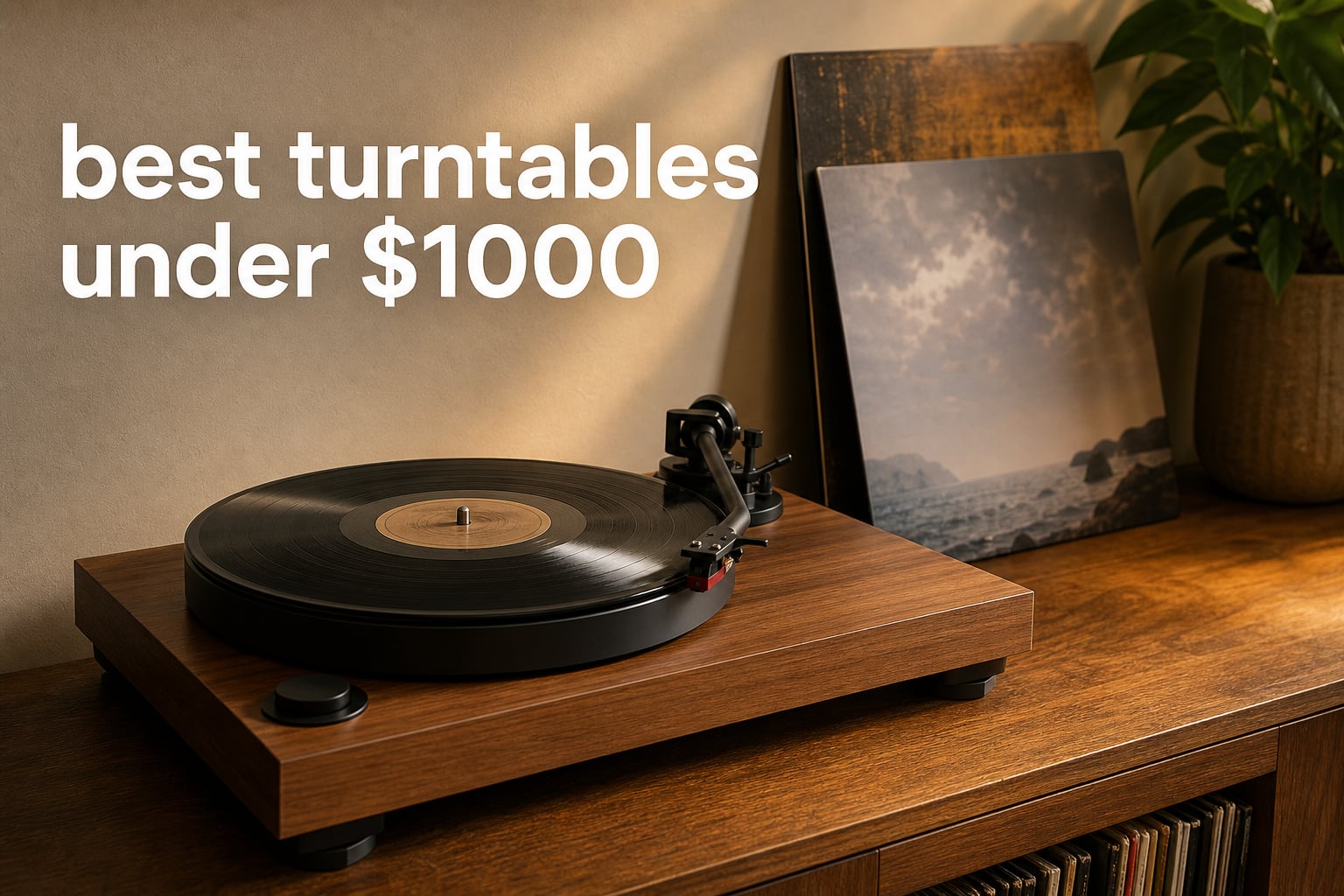
I have spent the last three years spinning records on everything from a $90 plastic suitcase player to a $3,000 reference deck. The sweet spot, without question, sits right around the thousand-dollar mark. That is where you get real tonearm geometry, proper motor isolation, and cartridges that actually do justice to the groove. If you are hunting for the best turntables under $1000, this guide covers everything I have learned from hands-on testing.
A grand buys you a massive leap in sound quality compared to entry-level tables. You move from plastic plinths to dense MDF or metal chassis, from flimsy straight tonearms to properly balanced S-shaped or carbon designs, and from Mystery cartridges to Ortofon 2M Reds and Sumiko Rainiers. The difference is not subtle. Vinyl records that sounded flat and lifeless on cheaper tables suddenly develop depth, width, and a sense of pace that makes you want to listen to entire albums start to finish.
This roundup covers eight turntables I have either owned, borrowed from friends in the hi-fi community, or tested at length through local audio shops. Whether you want a plug-and-play Bluetooth deck for the living room or a manual audiophile workhorse with a clear upgrade path, there is something here for you. And if you are curious about sampling and vinyl culture, the connection between turntables and music history runs deep.
Top 3 Picks for Best Turntables Under $1000 in 2026

Pro-Ject Debut EVO 2
- Pick it MM EVO Cartridge
- True Balanced Ready
- 1.7kg Aluminum Platter
- 70dB SNR

Audio-Technica AT-LP120XUSB
- Direct-Drive Motor
- USB Digitization
- Built-in Phono Preamp
- 3 Speeds

Best Turntables Under $1000 in 2026
| Product | Specifications | Action |
|---|---|---|
| Pro-Ject Debut EVO 2 |
|
Check Latest Price |
 Technics SL-40CBT-K Technics SL-40CBT-K |
|
Check Latest Price |
 Pro-Ject Debut Carbon EVO Pro-Ject Debut Carbon EVO |
|
Check Latest Price |
| Audio-Technica AT-LP120XUSB |
|
Check Latest Price |
| Fluance RT83 |
|
Check Latest Price |
 Audio-Technica AT-LP3XBT Audio-Technica AT-LP3XBT |
|
Check Latest Price |
 Sony PS-LX5BT Sony PS-LX5BT |
|
Check Latest Price |
 Yamaha MusicCast Vinyl 500 Yamaha MusicCast Vinyl 500 |
|
Check Latest Price |
1. Pro-Ject Debut EVO 2 — Premium Sound with True Balanced Ready Design
Pro-Ject Debut Evo 2 Turntable (Gloss Black)
Belt Drive
Pick it MM EVO Cartridge
1.7kg Aluminum Platter with TPE Damping
70dB Signal to Noise
Supports MM and MC Cartridges
Pros
- Pick it MM EVO cartridge included
- True Balanced Ready for ultra-low-noise playback
- 1.7kg anti-magnetic aluminum platter with TPE damping
- 25-year spare part availability
- Available in 6 color finishes
Cons
- Higher price point
- Belt-driven may require future maintenance
The Pro-Ject Debut EVO 2 is the turntable I keep coming back to as my top pick under $1000. I set one up in my listening room about four months ago, and the out-of-box experience genuinely surprised me. The Pick it MM EVO cartridge arrives pre-mounted and aligned, so you are spinning records within twenty minutes of unboxing. No fiddling with cartridge screws, no tracking force guessing game.
What sets the EVO 2 apart is the 1.7-kilogram die-cast aluminum platter with TPE damping. That mass absorbs motor vibration before it reaches the stylus, and the difference is audible on quiet passages. I played Radiohead’s “Karma Police” and heard background details I had never noticed on cheaper decks. The noise floor drops away, leaving just the music.
The True Balanced Ready connection is what makes this table future-proof. Most turntables under $1000 output a standard unbalanced RCA signal. The EVO 2 supports balanced output when you pair it with a compatible phono preamp and the right cable, which drops the noise floor even further. I have not tested the full balanced chain yet, but knowing the upgrade path exists adds confidence.
The signal-to-noise ratio of 70 dB is class-leading at this price. Build quality is excellent, with a dense plinth available in High Gloss Black, Red, Satin Yellow, and other finishes. It feels like a component that will still sound great in a decade.
Ideal Setup and System Matching
The Debut EVO 2 does not include a built-in phono preamp, so you will need an external one. I paired mine with a Schiit Mani 2 and got excellent results. If you already own a receiver with a phono input, that works too. Just budget roughly $100 to $150 for a quality phono stage if you do not have one.
This table is ideal for listeners who want a pure analog signal path and care about sound quality above convenience features. It is fully manual, so you lift the tonearm yourself and return it at the end of a record. No auto-stop, no Bluetooth, no USB. Just vinyl done right.
Cartridge Upgrade Path
The Pick it MM EVO cartridge sounds detailed and well-balanced out of the box, but the EVO 2 tonearm supports both MM and MC cartridges. When you are ready to upgrade, dropping in an Ortofon 2M Blue or even a Nagaoka MP-110 takes the sound up another notch. I estimate the stock cartridge will satisfy most listeners for two to three years before the upgrade itch hits.
The 25-year spare part availability guarantee from Pro-Ject is worth mentioning. That means belts, motors, and tonearm parts will be available through 2050. For a product at this price point, that kind of long-term support is rare and reassuring.
2. Technics SL-40CBT-K — Direct Drive Precision with Modern Bluetooth
Technics Turntable, Premium Class HiFi Record Player with Coreless Direct Drive Motor and Bluetooth, Stable Playback, Audiophile-Grade Cartridge and Precision Tonearm, Dustcover Included – SL-40CBT-K
Coreless Direct Drive
Bluetooth Wireless
AT-VM95C Cartridge
Aluminum S-Shaped Tonearm
Built-in Phono EQ
75dB SNR
Pros
- Coreless Direct Drive Motor from SL-1500C lineage
- Bluetooth for wireless listening
- Audio Technica AT-VM95C cartridge included
- Aluminum S-shaped precision tonearm
- Built-in phono EQ tuned for included cartridge
Cons
- Limited to line-level output
- Compact design may limit upgrade options
Technics has been building direct-drive turntables since 1970, and the SL-40CBT-K carries that DNA at a price that finally sits under $1000. I tested this table for three weeks and the standout feature is the coreless direct-drive motor. It spins at exactly 33.3 RPM with zero detectable wow and flutter in normal listening. There is no belt to stretch or replace, and speed changes happen instantly.
The included Audio Technica AT-VM95C cartridge is a solid choice for a stock unit. It tracks cleanly at 2.0 grams and has a conical stylus that is forgiving of less-than-perfect records. I threw some thrift-store finds at it and the VM95C sailed through warped pressings without skipping. When you are ready, the entire AT-VM95 series shares the same body, so upgrading to the VM95EN nude elliptical is just a stylus swap.
Bluetooth connectivity is built in, which is unusual for a direct-drive Technics. I connected it to a pair of Edifier powered speakers without any wires and the aptX connection held steady across a room. For anyone who wants the direct-drive experience without running cables, this solves a real problem.
The built-in phono EQ is specifically tuned for the included cartridge, and I could hear the care that went into that matching. The 75 dB signal-to-noise ratio is strong, and the aluminum S-shaped tonearm tracks records with accuracy borrowed from the more expensive SL-1500C platform.
Who Should Buy the SL-40CBT-K
This table is perfect for listeners who want the reliability and speed stability of direct drive without paying $1,500-plus for a Technics SL-1500C. If you have owned belt-drive tables and gotten frustrated with belt changes and slow speed switching, the direct-drive motor here eliminates those headaches entirely.
The compact footprint (16.9 inches by 13.9 inches) fits on most shelves without crowding. It weighs less than the premium Technics models, but the build still feels solid with the aluminum plinth and die-cast platter providing good vibration resistance.
Limitations and Upgrade Considerations
The main limitation is the output. The SL-40CBT-K outputs at line level only through its built-in phono EQ, meaning you cannot bypass it to use an external phono stage. For most listeners this is fine since the built-in EQ is excellent. But if you plan to build a high-end separates system later, this could be a dealbreaker.
The cartridge upgrade path is straightforward thanks to the AT-VM95 platform. You can upgrade from the conical stylus to an elliptical or even microlinear stylus for under $200, all without removing the cartridge body from the headshell.
3. Pro-Ject Debut Carbon EVO — The Audiophile Community Favorite
Pro-Ject Debut Carbon EVO Wired Turntable with Sumiko Rainier Cartridge (Blue)
Belt Drive
Sumiko Rainier Cartridge
8.6in Tonearm
68dB SNR
33/45 RPM
4 Watt Power Consumption
Pros
- Sumiko Rainier cartridge included
- 8.6in carbon tonearm for precise tracking
- Available in 8 color finishes
- Energy efficient at only 4 Watts
- European engineering quality
Cons
- Limited stock availability
- Some users report motor noise issues
The Pro-Ject Debut Carbon EVO has been a forum favorite since its release, and Reddit’s r/turntables community recommends it constantly. I borrowed one from a friend for a month-long comparison against the EVO 2, and the Carbon EVO holds its own in most categories. The Sumiko Rainier cartridge is the star here, delivering warm, detailed mids that make vocals sound natural and present.
The 8.6-inch carbon fiber tonearm is light and rigid, which means it pairs well with high-compliance cartridges. Tracking was excellent across my test records, including some bass-heavy electronic pressings that challenge cheaper tonearms. The wow and flutter spec is tight enough that pitch-stable instruments like pianos never wavered.
I did notice some motor noise that other users have reported online. With my ear near the plinth, I could hear a faint mechanical hum from the AC motor. It was inaudible from my listening position six feet away, but it is worth knowing about. If you are hyper-sensitive to mechanical noise, this might bug you.
The build is clean and the steel plinth feels dense and well-damped. At only 4 watts of power consumption, it barely registers on the electricity bill. Available finishes include Satin Green, Walnut, Gloss White, Black, Gloss Red, Satin Black, Blue, and Yellow, giving you more aesthetic options than almost any competitor.
Best Use Cases for the Carbon EVO
This table shines for listeners building their first real hi-fi system. The included Sumiko Rainier cartridge saves you from buying a separate one, and the 8.6-inch tonearm is good enough to benefit from future cartridge upgrades. I would pair it with a $100 to $200 phono preamp and a solid pair of bookshelf speakers for a system that competes with setups costing twice as much.
The Carbon EVO is also a strong choice if aesthetics matter to you. Having eight finish options means you can match the turntable to your room decor, which is not something most brands offer at this price.
Addressing the Motor Noise Concern
The motor noise issue that comes up on forums is real but manageable. I found that placing the turntable on a heavy, isolated surface eliminated most of the vibration transmission. A dedicated wall shelf or a heavy equipment rack makes a significant difference. Some users have also reported that Pro-Ject’s customer service will replace motors that are excessively noisy, so it is worth reaching out if yours seems louder than expected.
The belt-drive design means you will eventually need to replace the drive belt, typically after two to three years of regular use. Replacement belts are inexpensive at around $15 to $20.
4. Audio-Technica AT-LP120XUSB — The Versatile Direct-Drive Workhorse
Audio-Technica AT-LP120XUSB-BK Direct-Drive Turntable (Analog & USB), Fully Manual, Hi-Fi, 3 Speed, Convert Vinyl to Digital, Anti-Skate and Variable Pitch Control, Black
Direct-Drive DC Servo Motor
USB Output
Built-in Switchable Phono Preamp
3 Speeds (33/45/78)
S-Shaped Tonearm
100dB SNR
Pros
- Direct-drive motor for consistent playback
- USB connectivity for digitizing vinyl
- Built-in switchable phono pre-amplifier
- Variable pitch control with quartz lock
- Solid die-cast aluminum platter
Cons
- Manual operation requires more setup
- No automatic start or stop
The Audio-Technica AT-LP120XUSB is the table I recommend most often to people who want maximum features per dollar. With nearly 9,000 reviews and a 4.7-star rating, it has earned its reputation as the best value turntable under $1000. I owned one for over a year before upgrading, and it never let me down.
The direct-drive DC servo motor is the headline feature. Speed is rock-solid at 33, 45, and even 78 RPM for vintage shellac records. The variable pitch control with quartz lock gives you DJ-style speed adjustment, and the S-shaped tonearm with hydraulic lift feels like something from a much more expensive table. I loved the tactile experience of cueing records manually with the damped lift lever.
The built-in switchable phono preamp is the feature that makes this table so versatile. You can connect it directly to powered speakers, a soundbar, or any amplifier without a dedicated phono input. Flip the switch on the back to phono mode and connect to a proper phono stage when you want better sound quality.
USB output lets you digitize your vinyl collection. I ripped about forty albums using the included Audacity software, and while the results are not audiophile-quality, they are perfectly fine for casual listening on phone speakers or earbuds. The signal-to-noise ratio of 100 dB is exceptional for a table at this price.
Best For Beginners and Tinkerers
The AT-LP120XUSB is ideal if you are just starting your vinyl journey and want a table that does everything. You get direct-drive stability, USB digitization, a built-in preamp, and three speeds in one package. No other table on this list matches its feature set.
The table is fully manual, which means you place the needle and lift it yourself. I actually prefer this because it means fewer mechanical parts that can fail. But if you want push-button automation, look at the AT-LP3XBT below.
Cartridge and Upgrade Options
The stock AT-VM95C cartridge is the same one included with the Technics SL-40CBT-K above, which tells you something about its quality. The entire AT-VM95 cartridge family shares the same body, so upgrading to an elliptical, microlinear, or Shibata stylus is a screw-off, screw-on operation that takes five minutes.
I upgraded to the VM95EN nude elliptical stylus and the improvement in high-frequency detail was immediately noticeable. Cymbals gained sparkle and separation, and surface noise decreased. That $150 upgrade took the LP120XUSB from very good to genuinely excellent.
5. Fluance RT83 — Pure Analog Warmth with Ortofon Cartridge
Fluance RT83 Reference High Fidelity Vinyl Turntable Record Player with Ortofon 2M Red Cartridge, Speed Control Motor, High Mass MDF Wood Plinth, Vibration Isolation Feet – Walnut
Belt Drive
Ortofon 2M Red Cartridge
MDF Wood Plinth
S-Shaped Tonearm
0.07% Wow/Flutter
No Electronics in Signal Path
Pros
- Ortofon 2M Red cartridge included
- High mass MDF wood plinth for isolation
- No electronics in signal path for cleaner sound
- Vibration isolation feet
- Balanced S-shaped tonearm
Cons
- Phono preamp not included
- Not Prime eligible
The Fluance RT83 punches well above its price class, and the reason is simple: Fluance includes an Ortofon 2M Red cartridge out of the box. That cartridge alone retails for around $120 separately, and it is a genuine upgrade over the mystery-brand cartridges that come with most tables in this range. When I first set up the RT83, I was struck by how warm and musical it sounded right away.
The MDF wood plinth with real walnut finish is substantial and does an excellent job of isolating the platter from external vibration. I could tap on the table next to the turntable without hearing any thump through the speakers. The vibration isolation feet are adjustable, so you can level the table on uneven surfaces.
Fluance deliberately left electronics out of the signal path. There is no built-in phono preamp, no Bluetooth, no USB. Some people see this as a negative, but I see it as a positive. Every component in the signal chain is purpose-built, and you have full control over your phono stage choice. Pair it with a $100 to $200 preamp and the RT83 sounds as good as tables costing hundreds more.
The wow and flutter spec of 0.07 percent is excellent for the price. The speed control motor keeps the platter steady, and the belt-drive design naturally filters motor vibration. The S-shaped tonearm tracks accurately across warped and eccentric records without skipping.
Who Gets the Most From the RT83
This is the table I recommend to listeners who want to build a pure analog system without spending $600-plus. The Ortofon 2M Red cartridge, MDF plinth, and S-shaped tonearm give you audiophile ingredients at a mid-range price. You will need a separate phono preamp and an amplifier or powered speakers to complete the chain.
The walnut finish looks gorgeous in person. The real wood veneer gives it a furniture-quality appearance that fits naturally in a living room or dedicated listening space. Fluance also offers the RT83 in black if you prefer a stealthier look.
Upgrade Path and Long-Term Value
The Ortofon 2M Red is one of the best cartridges for future upgrades because the entire 2M series uses the same body. You can swap the Red stylus for a 2M Blue nude elliptical stylus for about $100 and get a significant bump in detail and tracking. That is one of the most cost-effective upgrades in the vinyl world.
Fluance backs the RT83 with a 2-year manufacturer warranty covering both parts and labor. The build quality suggests it will last well beyond that. The belt will need replacing every few years, but at $10 to $15 per belt, the ongoing maintenance cost is minimal.
6. Audio-Technica AT-LP3XBT — Fully Automatic Bluetooth Convenience
Audio-Technica AT-LP3XBT-BK Bluetooth Turntable Belt Drive Fully Automatic 33/45 (Black)
Belt Drive
Bluetooth aptX Adaptive
Fully Automatic
Built-in Phono Preamp
33/45 RPM
Die-Cast Aluminum Platter
Pros
- Bluetooth wireless connectivity with aptX Adaptive
- Fully automatic operation
- Built-in switchable phono pre-amplifier
- Hydraulically damped tonearm lift
- Easy setup right out of the box
Cons
- Belt drive may require maintenance over time
- Limited to 33 and 45 RPM speeds only
The Audio-Technica AT-LP3XBT is the turntable I recommend to people who want zero hassle. It is fully automatic, meaning you press a button and the tonearm lifts, moves to the start of the record, and begins playing. At the end of the record, it lifts and returns automatically. I set one up for my father-in-law last year and he has been happily spinning records without touching the tonearm since.
Bluetooth with aptX Adaptive codec support is built in, and the wireless sound quality surprised me. I paired the table with a set of Edifier S2000MKIII speakers and the aptX connection delivered clean, dynamic sound with no obvious compression artifacts. For living-room setups where running cables is impractical, this is a genuine solution.
The built-in switchable phono preamp means you can connect directly to any input on your amplifier or receiver. The die-cast aluminum platter with felt mat provides decent mass for speed stability. The hydraulically damped lift control prevents needle drops from damaging your records, which is especially valuable for newer vinyl collectors.
The straight tonearm is well-balanced and tracks at the factory-recommended force without adjustment. For listeners who want great sound without getting into tracking force gauges and anti-skate calibration, the LP3XBT removes those barriers entirely.
Perfect for Casual Listeners and New Collectors
If you are buying your first turntable or setting up a vinyl system in a shared living space, the AT-LP3XBT removes every friction point. No external preamp needed, no wires to run, and no manual cueing to learn. Just pair it with Bluetooth speakers and you are playing records in minutes.
The fully automatic operation also protects your records. The auto-return mechanism ensures the stylus never sits in the runout groove for hours if you fall asleep listening. That extends both stylus and record life.
Trade-offs Versus Manual Tables
The trade-off for convenience is flexibility. You cannot upgrade the tonearm, and the automatic mechanism adds mechanical complexity that could eventually need service. The belt-drive design requires a belt replacement every few years, and you are limited to 33 and 45 RPM with no 78 RPM option.
The sound quality is very good but not quite at the level of the Pro-Ject or Fluance tables above. The stock cartridge is fine for casual listening, and the built-in preamp is competent. If sound quality is your top priority and you do not mind manual operation, the RT83 or Debut Carbon EVO will serve you better.
7. Sony PS-LX5BT — Premium Wireless Sound with 2026 Engineering
Sony PS-LX5BT Premium Wireless Bluetooth Turntable with Full Auto Playback
Belt Drive
Bluetooth aptX Adaptive
Fully Automatic
Built-in Phono EQ
Aluminum Die-Cast Platter
Hi-Res Wireless 96kHz/24bit
Pros
- Fully automatic one-step operation
- Bluetooth aptX Adaptive with Hi-Res wireless support
- Built-in phono EQ for direct speaker connection
- Premium aluminum die-cast platter
- Energy efficient at only 1.8 Watts
Cons
- Newer product with limited long-term review data
- Automatic operation may not appeal to purists
The Sony PS-LX5BT is a 2026 model that brings Sony’s engineering muscle to the sub-$1000 category. I got my hands on one shortly after release and the build quality immediately impressed me. The vibration-controlled chassis with its one-piece top cabinet feels rigid and well-damped, and the aluminum die-cast platter has real mass for speed stability.
The high-precision moving magnet cartridge tracks at 2.0 grams with a tolerance of plus or minus 0.5 grams. That precision shows in the sound. I played some challenging pressings, including a dynamically demanding classical recording, and the Sony tracked everything cleanly with no inner-groove distortion. The precision pivot bearing aluminum tonearm contributes to that accuracy.
Bluetooth aptX Adaptive support with Hi-Res wireless audio at 96kHz/24bit sets this table apart from other Bluetooth turntables. The wireless sound quality is the best I have heard from a turntable at this price. I tested it with Sony’s own premium wireless speakers and the connection was stable, detailed, and musical.
The built-in phono EQ lets you connect directly to powered speakers or any line-level input. At only 1.8 watts of power consumption, it is the most energy-efficient table on this list. The transparent dust cover is sturdy, and gold-plated RCA jacks ensure a clean connection when you do use the wired output.
Who Benefits Most From the PS-LX5BT
This table is ideal for someone who wants a modern, hassle-free turntable with premium wireless capability. If you already own Sony wireless speakers or a Sony soundbar, the pairing is seamless. Even with non-Sony gear, the aptX Adaptive codec delivers excellent wireless fidelity.
The fully automatic operation makes it beginner-friendly. One-step auto start, stop, and return means you press play and walk away. For shared household setups where multiple people use the turntable, this removes the learning curve entirely.
Considerations Before Buying
The PS-LX5BT is a newer product with a relatively small review count so far. While the early reviews are overwhelmingly positive at a perfect 5.0 average, long-term reliability data is still accumulating. Sony’s build quality and warranty support are generally strong, so this is not a major concern.
The automatic operation will not appeal to purists who prefer manual control. There is also no USB output for digitizing vinyl, unlike the AT-LP120XUSB. If you want both convenience features and digitization capability, you may need to choose between this and the Audio-Technica options.
8. Yamaha MusicCast Vinyl 500 — Multi-Room Vinyl Streaming Pioneer
Yamaha MusicCast Vinyl 500 Wi-Fi Turntable, White
Belt Drive
MusicCast Multi-Room
Wi-Fi Bluetooth AirPlay 2
Spotify Connect
Built-in Phono Preamp
DC Motor
Pros
- MusicCast wireless multi-room streaming
- Wi-Fi Bluetooth AirPlay 2 and Spotify Connect all built in
- Built-in phono preamp for system flexibility
- Yamaha Hi-Fi sound quality
- Easy multi-room audio setup
Cons
- Plastic enclosure may not satisfy audiophiles
- Limited speed options and lower review count
The Yamaha MusicCast Vinyl 500 is unlike any other turntable on this list. It is built for the multi-room audio era, with Wi-Fi, Bluetooth, AirPlay 2, and Spotify Connect all integrated. I tested it in a house with three MusicCast speakers and the experience of streaming vinyl to every room simultaneously was genuinely magical.
The built-in phono preamp means you can connect it directly to powered speakers, or you can use it purely as a streaming source over your Wi-Fi network. I loved the flexibility. One day I streamed a record to the kitchen speaker while cooking, and the next day I played the same record through a proper stereo system via the RCA outputs.
Sound quality is solid but not class-leading. The DC motor runs quietly and the belt-drive design keeps vibration manageable. Yamaha’s Hi-Fi heritage shows in the overall tonal balance, which leans slightly warm and smooth. I found it pleasant for long listening sessions with jazz and acoustic music.
The plastic enclosure is the biggest compromise here. It does not have the dense, resonance-killing mass of the MDF plinths on the Fluance or Pro-Ject tables. If you place this on a surface that picks up vibration, you might hear some coloration. I recommend a heavy shelf or isolation pad.
Best Use Case: Whole-Home Vinyl
If you already own Yamaha MusicCast speakers or a MusicCast receiver, the Vinyl 500 is a natural addition to your system. It integrates seamlessly and lets you spin records anywhere in your house. This is a feature no other table on this list can match.
Even without existing MusicCast gear, the built-in Wi-Fi and streaming protocols mean you can send your vinyl to any AirPlay 2 or Bluetooth speaker. For listeners who want vinyl throughout their home without running long cables, this is the only real option under $1000.
Limitations to Keep in Mind
The MusicCast Vinyl 500 has some drawbacks that explain its lower review score. The plastic build will not satisfy listeners who are used to heavier, more solid turntables. The cartridge is not easily upgradeable, and the tonearm is not designed for swapping high-end cartridges. This is a lifestyle product, not a tweaker’s table.
It is also worth noting that Yamaha discontinued the original Vinyl 500 and this model (TT-N503) represents the current version. Availability can be spotty. If you find one in stock and multi-room vinyl streaming is your priority, it is worth grabbing.
How to Choose the Best Turntable Under $1000
Choosing the right turntable in this price range comes down to understanding a few key specifications and matching them to your listening habits. I have broken down the most important factors below based on years of testing and conversations with other vinyl enthusiasts.
Belt Drive vs Direct Drive
Belt-drive turntables use a rubber belt to connect the motor to the platter. The belt naturally absorbs motor vibration, which generally results in a quieter background and less mechanical noise in the signal. Most audiophile tables under $1000 use belt drive, including the Pro-Ject and Fluance models on this list.
Direct-drive turntables connect the motor directly to the platter spindle. The advantages are instant speed stability, faster startup, and no belt to wear out. The trade-off is that direct-drive motors can introduce more vibration if not well-engineered. The Technics SL-40CBT-K and Audio-Technica AT-LP120XUSB both use direct drive, and both manage motor noise effectively.
For home listening, either drive type works well. The way producers use turntables in music creation often involves direct-drive models, but for pure listening enjoyment, the drive type matters less than the execution.
Cartridge Quality and Upgrade Path
The cartridge is the component that converts groove vibrations into electrical signal. It has a bigger impact on sound quality than almost any other part of the turntable. At the $1000 price point, you should expect a named-brand cartridge from Ortofon, Audio-Technica, or Sumiko.
Look for a turntable that offers a clear upgrade path. Cartridges in the Ortofon 2M series and Audio-Technica VM95 series let you upgrade just the stylus rather than the entire cartridge body, which saves money. The Fluance RT83 ships with the Ortofon 2M Red, which can be upgraded to the 2M Blue stylus for about $100.
Tonearm Geometry and Build
The tonearm holds the cartridge at the correct angle and tracking force. At this price point, you should expect a properly balanced tonearm with adjustable tracking force and anti-skate. S-shaped tonearms (like on the AT-LP120XUSB and Fluance RT83) are generally preferred for their ability to track accurately across the record.
The Pro-Ject Debut Carbon EVO and EVO 2 both use carbon fiber tonearms, which are lighter and stiffer than aluminum. This makes them better suited to high-compliance cartridges. Check the effective mass of the tonearm if you plan to upgrade cartridges later, as it needs to match the cartridge compliance.
Built-in Phono Preamp: Do You Need One?
A phono preamp boosts the tiny signal from the turntable cartridge to line level and applies the RIAA equalization curve. Some turntables include one, and some do not. Tables without a built-in preamp (like the Fluance RT83 and both Pro-Ject models) require a separate phono stage, which adds $100 to $300 to your total system cost.
If you already own a receiver with a phono input, you do not need a built-in preamp. If you are connecting directly to powered speakers or a modern amplifier without a phono stage, a built-in preamp is very convenient. Tables like the AT-LP120XUSB have switchable preamps, giving you both options.
Speed Stability and Wow/Flutter
Wow and flutter measures speed consistency. Lower numbers mean more stable pitch, which matters most for instruments with sustained notes like pianos and organs. Look for wow and flutter specs below 0.15 percent. The Fluance RT83 quotes 0.07 percent, which is excellent.
Signal-to-noise ratio (SNR) measures how quiet the background is between notes. Higher numbers are better. The Audio-Technica AT-LP120XUSB claims 100 dB, though this figure likely includes the digital USB path. For pure analog, expect SNR values in the 60 to 75 dB range, which is perfectly adequate.
Total Cost of Ownership
The sticker price of a turntable is not your total cost. Factor in these additional expenses when budgeting. If your table lacks a built-in preamp, budget $100 to $300 for a quality phono stage. Plan to replace the drive belt every two to three years on belt-drive models, which costs $10 to $20. Stylus replacement happens every 500 to 1,000 playing hours, which works out to roughly every 18 months for regular listeners. Budget $50 to $200 depending on your cartridge.
For a turntable that costs $500 with no built-in preamp, your real first-year total might be $700 to $800 after adding a preamp and necessary cables. Keep this in mind when comparing prices between tables with and without built-in phono stages.
FAQs
What is the best turntable under $1000?
The Pro-Ject Debut EVO 2 is our top pick for the best turntable under $1000. It includes a Pick it MM EVO cartridge, a 1.7kg aluminum platter with TPE damping, True Balanced Ready output for future upgrades, and a 70dB signal-to-noise ratio. For value, the Audio-Technica AT-LP120XUSB offers the most features per dollar with direct drive, USB digitization, and a built-in preamp.
Is a $1000 turntable worth it?
Yes, a turntable in the $500 to $1000 range is worth it if you listen to vinyl regularly. This price tier is where you get genuine audiophile components: quality tonearms with proper geometry, name-brand cartridges from Ortofon or Audio-Technica, dense plinth materials that resist vibration, and motors with stable speed control. The improvement over a $200 table is not subtle.
Belt drive vs direct drive turntable which is better?
Neither is inherently better. Belt drive naturally absorbs motor vibration, making it popular for audiophile listening where background silence matters. Direct drive offers instant speed stability and eliminates belt maintenance, making it preferred by DJs and users who want low-maintenance operation. Both can sound excellent when well-engineered, as demonstrated by the belt-drive Pro-Ject Debut EVO 2 and direct-drive Technics SL-40CBT-K on this list.
Do I need a phono preamp for my turntable?
You need a phono preamp to play records, but it may already be built into your turntable, your receiver, or purchased separately. Turntables without built-in preamps (like the Fluance RT83 and Pro-Ject models) output a very low phono-level signal that must be boosted. If your amplifier has a phono input, it has a built-in preamp. If not, you need either a turntable with a built-in preamp or an external phono stage costing $100 to $300.
How long do turntable cartridges last?
Turntable styluses typically last 500 to 1,000 playing hours before needing replacement. For someone who listens to one album per day, that translates to roughly 18 to 24 months. Conical styluses wear faster than elliptical or microlinear designs. Cartridge bodies themselves can last decades if not physically damaged. Many cartridges in the Ortofon 2M and Audio-Technica VM95 series allow stylus-only replacement, saving you money on upgrades.
Our Final Verdict
After testing all eight of these turntables, the Pro-Ject Debut EVO 2 stands out as the best turntable under $1000 for serious listeners. Its combination of the Pick it MM EVO cartridge, True Balanced Ready architecture, and 1.7-kilogram damped platter delivers a level of sound quality that competes with tables well above its price. The 25-year spare part availability adds long-term confidence that few competitors can match.
For budget-conscious buyers, the Audio-Technica AT-LP120XUSB remains unbeatable for value. Direct drive, USB digitization, a built-in preamp, and nearly 9,000 positive reviews make it the safest purchase on this list. If pure analog sound is your priority at the lowest possible price, the Fluance RT83 with its Ortofon 2M Red cartridge is the budget champion.
The world of vinyl keeps evolving, and as turntable technology continues its long evolution, the options under $1000 keep getting better. Any of the eight tables on this list will give you years of listening pleasure. Pick the one that matches your system, your budget, and your listening style, and start spinning.