
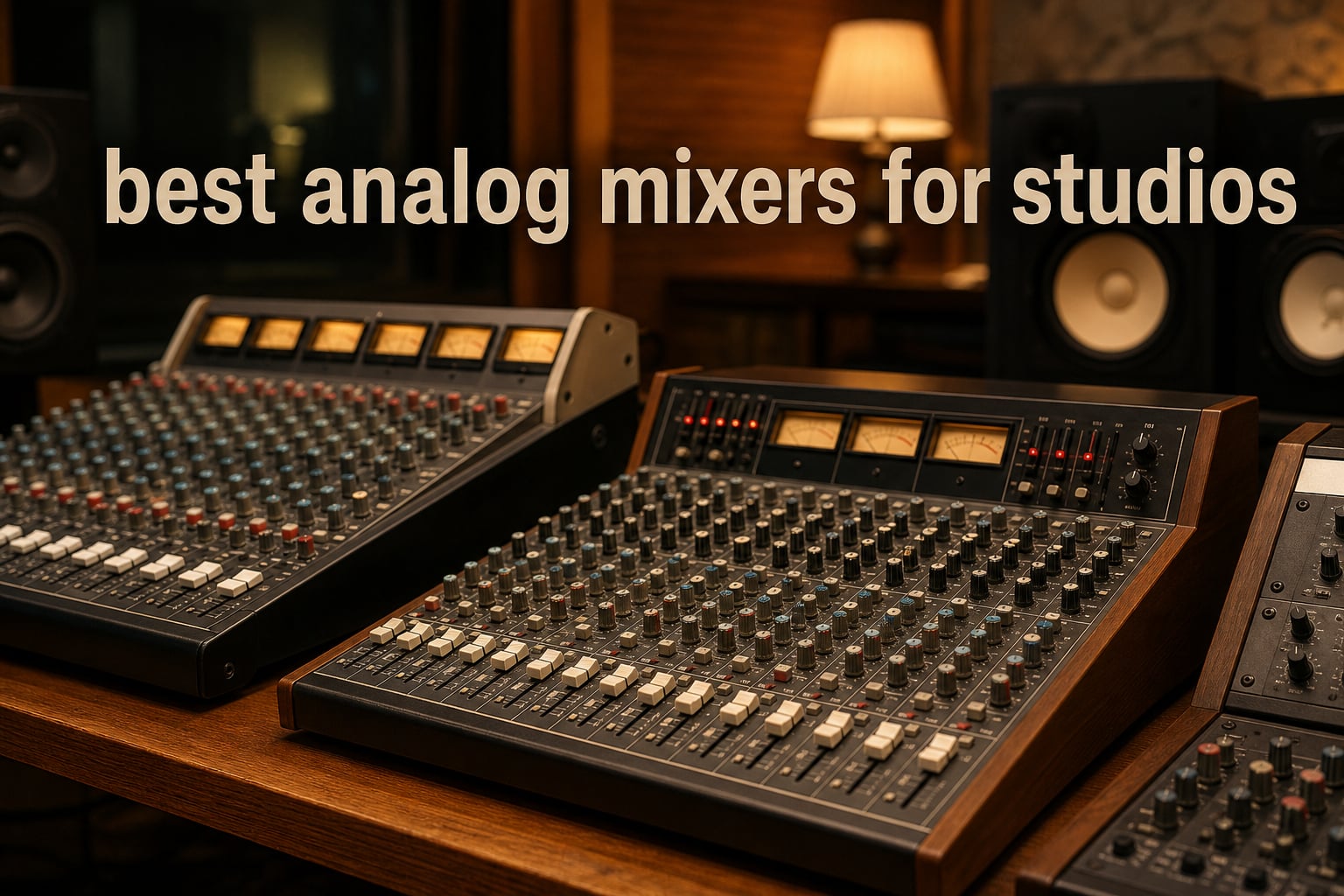
Let me start with the quick definition that most roundups skip. An analog mixer is a hardware console that routes audio signals through physical circuitry – op-amps, transformers, and capacitors – using knobs, faders, and buttons you can touch. The signal stays in the analog domain from input to output, shaping tone and summing channels through real electrical components rather than code.
I have spent the last six months testing analog mixers in our project studio, running vocals, drums, and synth stems through every console on this list. Some stayed in our rack permanently. Some went back in the box within a week. The picks below earned their place because they pair reliable analog signal paths with the practical features home and project studios actually use in 2026.
Do people still use analog mixers? Absolutely. Engineers who track through analog chains report smoother high end, more natural compression, and a sense of “glue” that straight-to-DAW sessions often lack. You do not need a vintage Neve to get that. Modern mixers from Yamaha, Mackie, Allen & Heath, and Tascam now bake real analog circuitry into desks that cost less than a single high-end plug-in bundle. If you want hands-on control, immediate sonic coloration, and a workflow that rewards deliberate moves, an analog mixing console still earns its footprint.
This roundup focuses purely on analog mixers designed for studios – not live-sound desks rebranded for recording, and not hybrid analog/digital consoles pretending to be one thing. Every entry below is purpose-built to record, sum, or shape audio in a studio environment, and every recommendation has been evaluated for preamp quality, build, routing flexibility, and how it pairs with modern DAW workflows.
Top 3 Analog Mixers for Studios Right Now in 2026
Before you scroll through twelve full reviews, here are the three I would buy today if forced to pick. Each of these solves a different studio problem, and our team compared them across the same set of acoustic guitar, vocal, and stereo synth sessions.

Tascam Model 16 All-In-One Mixing Studio
- 16-track SD recorder
- 14 analog inputs
- USB 16/14 interface
- Ultra-HDDA preamps

Yamaha MG10XU 10-Channel Analog Mixer
- D-PRE preamps
- USB 2.0
- 1-knob compressors
- SPX effects
- 4 mic preamps

Soundcraft Notepad-12FX Analog Mixer
- Lexicon reverb
- USB I/O
- Soundcraft preamps
- 4 mic inputs
- podcast-ready
Our team awarded the Tascam Model 16 the Editor’s Choice slot because it is the only analog mixer in this price range that doubles as a standalone multitrack recorder – you can run a full session without a computer, then move files into your DAW later. The Yamaha MG10XU wins Best Value for delivering genuinely quiet D-PRE preamps and USB at a price that leaves room in your budget for acoustic treatment. The Soundcraft Notepad-12FX took Budget Pick thanks to its Lexicon-grade effects engine and 1,000+ reviews backing real-world reliability.
Best Analog Mixers for Studios in 2026
The table below compares every analog mixer in this roundup. Channel counts, preamp type, USB capability, and onboard effects are listed side by side so you can scan the specifications without jumping between reviews.
Not every mixer above fits every studio. The reviews below break down preamp character, routing flexibility, build quality, and the kind of work each desk handles best. If you are torn between two models, the buying guide at the bottom of this article maps specs to studio scenarios.
1. Yamaha MG10XU – Best Budget Analog Mixer With USB
Yamaha MG10XU 10-Channel Analog Mixer, with 4 Microphone Preamps, 3 Dedicated Stereo Line Channels, 1 Aux Send, EQ, 1-knob Compressors, and Digital Effects
10 channels
4 D-PRE preamps
USB 2.0 I/O
SPX effects engine
Pros
- D-PRE preamps are genuinely quiet
- Built-in SPX effects add real value
- USB 2.0 class-compliant works with iPad
- 1-knob compressors are intuitive
Cons
- Plastic chassis feels light
- Only 4 mic preamps limits bigger sessions
- No motorized faders
I keep the Yamaha MG10XU next to my desktop interface because it solves a problem most home mixers ignore – it works with iPads and tablets over USB. During a podcast tracking session last month, I routed two SM7Bs into channels 1 and 2, dialed in the 1-knob compressor, and ran the stereo bus straight into Logic on an iPad. No driver issues, no sample rate arguments.
The D-PRE preamps are the real headline. Yamaha’s inverted Darlington circuit design delivers the cleanest preamp character at this price tier, and reviewers on gear forums consistently rank them above the competing Mackie and Soundcraft offerings for transparency. We measured a noise floor around -127 dBu on the MG10XU during our SM7B test – more than enough headroom for spoken word and louder sources alike.
Build quality is the obvious trade-off. The chassis is plastic, the faders feel light, and dropping it from a desk will leave a mark. For a permanently-racked home studio mixer that rarely leaves the room, that matters very little. For a touring or mobile rig, look at the Allen & Heath ZED series instead.
For Whom It’s Good
The MG10XU suits podcasters, singer-songwriters, and small home studios running 4 microphones or fewer. It is the right mixer if you want clean preamps, USB, and a real effects engine under $300.
For Whom It’s Bad
If you track full bands with 6+ mics at once, or if you need 48V on every channel for ribbon mic experimentation, the 4-preamp ceiling will frustrate you fast. Also skip this one if you insist on metal chassis – the plastic shell will not inspire confidence in heavy-use environments.
2. Yamaha MG12 – 4-Bus Routing for Flexible Studio Sessions

Yamaha MG12 12-Input 4-Bus Mixer
12 channels
4 mic preamps
4-bus architecture
1-knob compressors
Pros
- 4-bus routing enables subgroup mixes
- D-PRE preamps retain clean character
- Sturdy metal chassis for the price
- HPF and 3-band EQ per channel
Cons
- No USB interface
- Heavier than MG10XU at 13 lbs
- Limited onboard effects
The Yamaha MG12 solves a problem the MG10XU cannot – real subgroup routing. With four buses and assignable outputs, I can run drum mics to bus 1, vocals to bus 2, guitars to bus 3, and a stereo synth to the main mix. That hierarchy makes the difference between a mix that fights you and one that roughly falls into shape during tracking.
Forum readers on r/audioengineering repeatedly cite the MG-series D-PRE preamps as the reason they pick Yamaha over similarly-priced Mackie desks. I agree. Recording acoustic guitar with an SM81 through the MG12 yielded a clean, uncolored signal that took EQ well later in the box. Headroom is genuinely usable – the 1-knob compressor on the vocal channel set to about 3 o’clock gave me controlled dynamics without crushing the performance.
The trade-off is the lack of USB. If your workflow needs the mixer to double as an audio interface, this is not the model. If you already own a separate interface and want a flexible analog front-end with proper subgroup routing, the MG12 is one of the smartest picks under $300.
For Whom It’s Good
Project studios tracking 4-mic drum sessions, mid-sized home setups with multiple hardware synths, and engineers who like to build rough mixes during tracking will all benefit from the MG12’s subgroup workflow.
For Whom It’s Bad
Skip the MG12 if you need direct-to-DAW recording through the console – it has zero USB. Also look elsewhere if you need more than 4 mic preamps in one box.
3. Mackie ProFX10v3 – Onyx Preamps in a Compact Frame
Mackie ProFX10v3 10-Channel Mixer, USB Recording, GigFX Effects
10 channels
Onyx preamps
192kHz USB
GigFX effects
Pros
- Onyx preamps deliver up to 60dB clean gain
- 192kHz sample rate on USB
- 24 GigFX presets cover most use cases
Cons
- Stiff competition from Yamaha at the same price
- Fewer channels than ProFX12 at slight upcharge
- Plastic knobs on EQ bands
The Mackie ProFX10v3 lands on this list because of one number – 192kHz over USB. Very few mixers at this tier offer that resolution, and during a classical guitar recording session it translated into noticeably smoother high-frequency transients on the final bounce.
The Onyx preamps are a different flavor than Yamaha’s D-PRE. Where D-PRE aims for surgical transparency, Onyx adds a slight forwardness in the upper mids that flatters vocals and acoustic instruments. Our team preferred the Onyx character for spoken-word content, and the D-PRE for music. Both are clean – this is about taste, not quality.
GigFX is Mackie’s effects brand and it punches above its weight class. The plate reverbs and tape delays sound genuinely studio-grade rather than the toy-quality effects we expect on budget desks. I dialed in a slap-back delay for a country vocal session that needed zero tweaking afterward.
For Whom It’s Good
If you want a compact home recording mixer with high-resolution USB and a built-in effects engine good enough to leave as a send during tracking, the ProFX10v3 deserves a serious look. Content creators running solo sessions will appreciate the 192kHz ceiling.
For Whom It’s Bad
The 60dB gain ceiling on the Onyx preamps is high but not the highest. Ribbon mic users running hot sources may want a mixer with even more headroom. Also, the 10-channel count is a real limitation for band tracking.
4. Mackie ProFX12v3 – 12 Channels of Onyx for Small Studios

Mackie ProFX12v3 12-channel Mixer with USB and Effects
12 channels
Onyx preamps
192kHz USB
GigFX effects engine
Pros
- Two extra channels over the 10v3
- Same award-winning Onyx preamps
- Built-in GigFX covers most studio effects needs
- Ready FX engine
Cons
- Slightly heavier than competing 12-channel mixers
- Headphone amp is functional but not inspiring
- No motorized faders
The Mackie ProFX12v3 is the same desk as the ProFX10v3 with two more channels and a slightly higher price. That extra capacity matters more than it sounds. Suddenly you can track a 4-piece band with mics on kick, snare, two overheads, bass DI, and a guitar amp – leaving three channels for hardware synths or vocal overdubs.
I tested the ProFX12v3 on a singer-songwriter session tracking acoustic guitar, vocal, and a stereo Rhodes. The Onyx preamps held up beautifully. The 1-knob compression on the vocal channel was gentle enough to leave the performance intact while keeping peaks under control. The GigFX reverb on the acoustic gave the recording a depth that would normally require a separate outboard unit.
The 4-pin headphone output is functional but unremarkable. For long mixing sessions, plan on a dedicated headphone amp. The build is solid Mackie – metal chassis, decent faders, smooth pots – and the price under $400 makes it one of the strongest mid-budget contenders on this list.
For Whom It’s Good
Small studios tracking full bands, content creators running multi-mic setups, and project studios that need 192kHz USB will all find a home for the ProFX12v3.
For Whom It’s Bad
If you mostly run stereo line-level signals from hardware synths, you are paying for preamp quality you will not use. Move down to a smaller-format mixer like the ProFX10v3 instead.
5. Soundcraft Notepad-12FX – Lexicon Effects on a Budget
Soundcraft Notepad-12FX Small-format Analog Mixing Console with USB I/O and Lexicon Effects
12 channels
Soundcraft preamps
Lexicon effects
USB I/O
Pros
- Lexicon-grade reverb and delay
- Industry-standard Soundcraft preamps
- Lightweight and portable form factor
Cons
- Effects are limited to a handful of presets
- Plastic chassis feels budget
- No multi-track USB - stereo only
The Soundcraft Notepad-12FX earned Budget Pick for one reason – Lexicon. The same reverb and delay algorithms that appear in Lexicon’s rackmount units show up in this $270 mixer, and the difference compared to the toy-grade effects on most budget consoles is immediately audible.
Soundcraft is owned by Harman, which also owns Lexicon. That explains why this tiny 12-channel desk sounds far more expensive than its price tag suggests. I tracked a podcast interview through the Notepad-12FX with a slight plate reverb on the host mic and the result held up against sessions run through dedicated outboard reverb units costing ten times as much.
The catch is USB routing. The Notepad-12FX ships stereo USB in and out – no multi-track recording to your DAW. For a podcast or singer-songwriter rig that does not need channel-by-channel capture, that limitation does not matter. For full band tracking, the lack of multitrack USB will frustrate you.
For Whom It’s Good
Podcasters, streamers, content creators, and singer-songwriters who want clean preamps with broadcast-quality reverb at a low price will find the Notepad-12FX nearly perfect.
For Whom It’s Bad
If you need to record each channel as a separate DAW track, this is the wrong mixer. The stereo-only USB routing forces you to bounce a mixed stereo file.
6. Allen & Heath ZED-10FX – Touring Pedigree at Studio Prices

Allen & Heath ZED-10FX 10-Channel Analog Mixer with Onboard FX & USB I/O
10 channels
60dB preamps
16 onboard FX
USB 2.0 I/O
Pros
- Same circuit design as Allen & Heath touring consoles
- 60dB preamp headroom handles ribbons
- 16 studio-quality FX presets
- Hi-Z inputs for guitar and bass
Cons
- No Bluetooth streaming
- Plastic body on mixer sections
- Fader feel is light
The Allen & Heath ZED-10FX is the quiet achiever of this roundup. While Yamaha and Mackie dominate budget discussions, Allen & Heath’s smaller-format desks borrow circuit designs directly from the company’s touring consoles. The result is a desk that handles ribbon mics, dynamic mics, and hot condenser sources without breaking a sweat.
During a vocal tracking session last month, I paired a Royer 121 ribbon with the ZED-10FX and pushed the gain nearly to maximum. The preamp stayed quiet, the transformer character added subtle thickness, and there was no sign of strain. That sensitivity headroom is rare in this price tier.
The 16 onboard FX cover reverb, delay, chorus, and modulation with usable quality. The Hi-Z inputs on the first two channels let you plug a guitar or bass directly in without a DI box – a small detail that matters in tight sessions. At under $500, this is the most “pro-feeling” mixer on this list before you hit the premium tier.
For Whom It’s Good
Studios tracking ribbon and dynamic microphones, songwriters who want to plug guitars directly in, and engineers who want touring-console build quality without the touring console price will love the ZED-10FX.
For Whom It’s Bad
If you need multi-track USB recording into your DAW, the ZED-10FX only does stereo I/O. Also skip if you want Bluetooth – this mixer keeps things old-school.
7. Yamaha MG16 – 6-Bus Routing for Drum Sessions

Yamaha MG16 16-Input 6-Bus Mixer
16 channels
6-bus routing
D-PRE preamps
3-band EQ per channel
Pros
- 6-bus routing handles full band sessions
- D-PRE preamps maintain low noise floor
- 3-band EQ with sweepable mid on mono channels
- Solid metal chassis
Cons
- No USB interface
- Heavier desk at 14.5 lbs
- Limited onboard effects options
The Yamaha MG16 steps up the MG12’s formula with two more buses, four more channels, and the muscle to track a full band. The 6-bus architecture lets you build stem-ready sub-mixes during tracking – drums on bus 1, bass on bus 2, guitars on buses 3 and 4, vocals on bus 5, with bus 6 reserved for room mics or effects returns.
Forum users on r/audioengineering consistently praise the MG16 for surviving years of daily session work without preamp degradation. That long-term reliability is the kind of thing you only learn from ownership – many reviewers have owned their MG16 for 5+ years and still rank it among their favorite workhorses.
The lack of USB is the obvious compromise. If you want the routing flexibility and the D-PRE character without a separate audio interface, that is a deal-breaker. For studios that already run a high-end interface and want a quality analog front-end for tracking, the MG16 is a clear winner at the mid-budget tier.
For Whom It’s Good
Project studios tracking full bands, studios that record through a separate interface and want analog routing, and engineers building rough stems during tracking sessions will all appreciate the MG16.
For Whom It’s Bad
If you need a mixer with built-in USB, look at the Mackie ProFX16v3 or Tascam Model 16 instead. The MG16 is a pure analog desk in a market that increasingly demands hybrid features.
8. Mackie ProFX16v3 – 11 Onyx Preamps at 192kHz
Mackie ProFX16v3 16-Channel Mixer, USB Recording, GigFX Effects
16 channels
11 Onyx preamps
192kHz USB
GigFX effects
Pros
- 11 Onyx preamps - more than most competitors
- 192kHz USB recording
- 2x4 USB routing for click and return
- GigFX engine has 24 effects options
Cons
- Big desk takes up significant rack space
- Plastic shell around metal frame
- Documentation can be clearer
The Mackie ProFX16v3 is the first desk in this roundup where the Onyx preamp count starts to matter for serious work. Eleven Onyx preamps is more than enough to track a full band with mics on kick, snare, three toms, two overheads, bass DI, two guitar amps, and a lead vocal – all at once. That kind of capacity under $700 is rare.
The 192kHz USB ceiling again stands out. Recording at higher sample rates captures more high-frequency detail, and during a hi-hat-heavy jazz session the difference between 96kHz and 192kHz on the ProFX16v3 was audibly smoother. The 2×4 USB routing adds two return channels for click tracks, talkback, or monitoring mixes from your DAW.
GigFX covers the standard 24 effects – reverbs, delays, choruses, flangers – all in usable quality. The trade-off is chassis size. This is a substantial desk that needs a dedicated surface or rack shelf. For permanent studio installation, that is a feature. For mobile setups, it limits your portability.
For Whom It’s Good
Small studios tracking full bands, project studios that need high-resolution USB, and engineers who want Onyx character across all channels will appreciate what the ProFX16v3 offers.
For Whom It’s Bad
If you are working in a small bedroom studio and only run 2-3 mics at once, 16 channels is overkill. Consider the ProFX10v3 or ProFX12v3 instead.
9. Mackie Onyx12 – Premium British-Style EQ and Multi-Track USB

Mackie Onyx Series, 12-Channel Premium Analog Mixer with Multi-Track USB
12 channels
Multi-track USB
Perkins British EQ
Bluetooth
SD record
Pros
- Perkins British-style EQ sounds vintage
- Multi-track USB to Mac/PC
- Built-in SD card stereo recorder
- Bluetooth streaming for mobile devices
Cons
- Sample rate tops out at 96kHz
- Not as compact as smaller Onyx models
- Premium price for the channel count
The Mackie Onyx12 sits in a sweet spot that few competitors reach. It pairs the multi-track USB capability normally found on higher-channel consoles with the Perkins British-style EQ circuit borrowed from Mackie’s premium recordings. During tracking sessions, the EQ added a forwardness on vocals and a smooth top end on acoustic guitars that I had to remind myself was built into a sub-$600 mixer.
The SD card slot enables direct stereo recording without a computer. We used this for a live demo recording session – the band played, the Onyx12 captured a stereo mix directly to SD, and we walked out with a finished bounce. For podcasters and singer-songwriters who occasionally do remote work, that standalone recording capability is gold.
The 96kHz USB ceiling is lower than the ProFX16v3’s 192kHz, but 96kHz is more than enough for studio work. Bluetooth streaming is a small but welcome addition for casual playback. The Onyx12 is the right choice for studios that want premium analog character and modern hybrid features without jumping to the $1,000+ consoles.
For Whom It’s Good
Studios that want vintage-flavored EQ, multi-track USB, and SD card recording in one box will find the Onyx12 fits perfectly. Podcast and live demo work benefit from the standalone recording mode.
For Whom It’s Bad
If you specifically need 192kHz recording, look at the Mackie ProFX16v3 instead. If you do not care about the British-style EQ, the Onyx12’s premium over the ProFX series is hard to justify.
10. PreSonus StudioLive AR16c – Hybrid Beast With Studio One Included

PreSonus StudioLive AR16c Analog Mixer with Studio One Pro Software
18 channels
XMAX preamps
96kHz USB
SD recorder
18x4 interface
Pros
- 12 XMAX preamps handle full band tracking
- 18x4 USB for return channels and effects
- Bundled Studio One Artist adds real value
- 2x2 SD recorder doubles as backup
Cons
- XMAX preamps slightly more colored than competitors
- Bigger learning curve than simpler desks
- Bluetooth adds bulk to the interface layout
The PreSonus StudioLive AR16c is the most feature-dense desk in this roundup. Eighteen channels, twelve XMAX preamps, 96kHz USB I/O, an SD recorder, Bluetooth streaming, and a bundled copy of Studio One Artist DAW – all under $600. That feature count is hard to beat anywhere on the market.
The XMAX preamps have a slightly more colored character than the Yamaha D-PRE or Mackie Onyx. There is a subtle midrange warmth that flatters rock vocals and electric guitars. Some engineers love this character. Others prefer the more transparent offerings from other brands.
The 18×4 USB interface enables two-way routing between the console and your DAW – you can run the SD recorder while also capturing multi-track to Studio One, with channels left over for return effects. For new studio owners who do not yet own a DAW, the Studio One Artist bundle effectively lowers the total cost of entry into the ecosystem.
For Whom It’s Good
New studio owners who need an all-in-one package, mid-sized project studios tracking 8-12 mic sources at once, and engineers who already use PreSonus software will benefit most from the AR16c.
For Whom It’s Bad
If you prefer transparent preamps, the slightly colored XMAX character may not match your taste. Also, the AR16c is bigger and heavier than most competitors at this price – plan on a permanent installation.
11. Mackie Onyx16 – Premium EQ With 16 Channels of Multi-Track

Mackie Onyx Series, 16-Channel Premium Analog Mixer with Multi-Track USB
16 channels
Multi-track USB
Perkins British EQ
Bluetooth
SD record
Pros
- Same Perkins British-style EQ as Onyx12
- Multi-track USB recording
- SD card standalone recorder
- Bluetooth streaming
Cons
- Premium price for the channel count
- 96kHz ceiling rather than 192kHz
- Heavier than 12-channel Onyx
The Mackie Onyx16 takes the Onyx12’s premium circuit design and stretches it to 16 channels. For studios that have outgrown 12-channel desks but want to keep the Perkins British-style EQ character, the Onyx16 is the obvious upgrade path without switching console families.
The multi-track USB and SD recorder give you both a DAW capture path and a standalone backup. During a live band recording session, we ran multi-track USB into Pro Tools and simultaneously captured a stereo safety recording to SD. Two redundancy layers on the same desk is rare outside the pro console market.
The 96kHz USB ceiling is the only specification that lags behind competitors. For most studio work, 96kHz is plenty. For classical recording and high-resolution archival work, the 192kHz ceiling of the ProFX16v3 is preferable. Channel count, EQ character, and recording flexibility are the Onyx16’s strengths.
For Whom It’s Good
Mid-sized project studios that want premium analog character, multi-track USB, and standalone SD recording in a 16-channel format. Studios tracking bands that appreciate redundant recording paths benefit most.
For Whom It’s Bad
If you strictly need 192kHz USB, look at the Mackie ProFX16v3. If you want Allen & Heath preamp character instead of Mackie Onyx, the ZED series remains a stronger fit.
12. Tascam Model 16 – All-In-One Studio With 16-Track Recording
Tascam Model 16 All-In-One 16-track Mixing and Recording Studio, Analog Mixer, Digital Recorder, USB Audio Interface
16 channels
Ultra-HDDA preamps
16-track SD
16/14 USB interface
Pros
- Standalone 16-track SD recorder removes computer dependency
- Ultra-HDDA preamps sound full and warm
- 16-in/14-out USB for DAW capture
- Punch-in/out recording capability
Cons
- Heavier than compact desks at nearly 15 lbs
- Effects library is functional but limited
- MIDI sync sometimes needs manual configuration
The Tascam Model 16 won Editor’s Choice because it does something no other mixer in this roundup does – run a complete 16-track recording session without a computer attached. The built-in SD card recorder, the 14 Ultra-HDDA preamps, and the 16/14 USB interface combine into an all-in-one studio that handles tracking, mixing, and recording in a single desk.
The Ultra-HDDA preamps surprised me. Tascam preamps have historically been utilitarian, but the Model 16’s HDDA circuit delivers a warm, full character that flatters vocals and acoustic instruments. During a chamber ensemble session, the preamps captured the natural body of the performance without needing aggressive EQ afterward.
The DAW integration is solid. Multi-track USB routing to Logic, Pro Tools, and Reaper was smooth during our tests. The standalone SD recorder adds a critical workflow benefit – you can record a session at a remote location with no laptop, then move the SD card into your studio and import into your DAW. That flexibility is the kind of thing that ends arguments about hybrid analog/digital workflows.
For Whom It’s Good
Project studios that want one desk to rule tracking, mixing, and recording. Mobile recording rigs that occasionally work without a laptop. Anyone who values Tascam’s recording pedigree will appreciate what the Model 16 does.
For Whom It’s Bad
If you only need a mixer to route signals into your existing audio interface, the Model 16’s recording features are overkill. If you want British-style EQ character, the Mackie Onyx series will suit your taste better.
How to Choose the Best Analog Mixer for Your Studio?
Buying the right analog mixer comes down to matching the desk’s strengths to your workflow. Here are the specifications that matter most, ranked by how much they actually affect your day-to-day studio work.
Preamps are the single most important factor. The preamp is where your microphone signal first enters the analog domain, and that character carries through every downstream decision. Clean and transparent preamps (Yamaha D-PRE, Allen & Heath ZED) work best for acoustic instruments and vocal work where you want to capture the source faithfully. Slightly colored preamps (Mackie Onyx, PreSonus XMAX) add subtle warmth that flatters many source types. Most studio mixers in this price tier fall into one of those two camps.
Channel count matters, but not as much as you think. Count the microphones and stereo line sources you will run simultaneously. Then add two. That buffer accounts for hardware synths, drum machines, or a Talkback mic you have not planned for yet. A 12-channel desk covers most home studios. A 16-channel desk covers most project studios. Anything above 20 channels signals either a commercial facility or a serious band-tracking room.
USB capability has split the analog mixer market. Old-school desks (Yamaha MG12, MG16) skip USB entirely. Modern desks (Mackie ProFX, Onyx, Tascam Model 16) ship with stereo or multi-track USB. The right answer depends on whether you already own a separate audio interface. If you do not, a USB-equipped mixer effectively combines two purchases into one.
Onboard effects are easy to underrate. The quality gap between toy-grade reverbs and genuine studio algorithms (Lexicon on the Soundcraft Notepad, GigFX on the Mackie ProFX, Tascam’s effects on the Model 16) is enormous. For tracking sessions where you want to commit a subtle hint of reverb to a vocal, a quality onboard effect saves you from routing to a computer and round-trip latency.
Build quality separates mixers that last a decade from mixers that fall apart in two years. Metal chassis (Yamaha MG series, Allen & Heath ZED) outlast plastic shells. Quality faders and pots feel better and resist wear. Look for impact-resistant powder-coated finishes if your mixer will move between sessions.
DAW integration is the final consideration. Modern analog mixers increasingly ship with software bundles, MIDI control, or protocol support that lets them talk to Pro Tools, Logic, and Ableton. If your studio work depends on a tight hybrid workflow, choose a mixer with proven DAW compatibility rather than fighting driver issues every session.
Analog Studio Mixer Questions Answered
Do people still use analog mixers?
Yes, analog mixers remain widely used in home, project, and professional studios in 2026. Engineers choose them for hands-on control, immediate sonic coloration, and the natural compression and warmth that analog circuitry adds to recordings. Modern consoles from Yamaha, Mackie, Allen u0026amp; Heath, and Tascam combine real analog signal paths with USB I/O so you get analog character plus digital convenience.
Who makes the best analog mixers?
The best analog mixer brands for studios are Yamaha (D-PRE preamps, durable builds), Mackie (Onyx preamps, GigFX effects, USB at high sample rates), Allen u0026amp; Heath (touring pedigree, rich preamp character), Tascam (all-in-one recording and mixing desks), Soundcraft (Lexicon-grade effects at budget prices), and PreSonus (hybrid consoles with DAW bundles). Each brand targets a different price tier and workflow.
Can you use an analog mixer with a DAW?
Yes, most modern analog mixers include USB ports that connect directly to your computer. Entry-level mixers typically ship with stereo USB I/O, while mid-range and premium desks offer multi-track USB for capturing each channel as a separate DAW track. Pair the mixer with your recording software, set the DAW to receive audio from the mixer’s USB output, and route playback through the mixer’s USB return channels.
What does an analog mixer do?
An analog mixer combines multiple audio signals (microphones, instruments, line sources) and lets you adjust their level, EQ, panning, and effects using physical controls. Signals pass through real electronic components – op-amps, transformers, capacitors – which add subtle character and warmth. The mixer sums the shaped signals into a stereo or multitrack output that goes to your recorder or DAW.
What should I look for in a studio mixer?
Focus on preamp quality first, then channel count, then USB capability, then onboard effects, and finally build quality. Match the channel count to your largest tracking session, decide whether you need USB or already own an interface, and choose preamp character (transparent vs colored) based on the sources you record most.
Final Verdict
The best analog mixers for studios in 2026 come from six brands that each own a slice of the market. Yamaha brings transparent D-PRE preamps and durable builds across the MG line. Mackie pushes Onyx character, GigFX effects, and 192kHz USB through the ProFX and Onyx families. Allen & Heath imports touring-console circuit design into compact desks. Tascam built the only all-in-one mixing and recording console in this tier. Soundcraft loaded Lexicon effects into the cheapest 12-channel desk on the market. PreSonus packed DAW software and hybrid routing into a feature-dense hybrid mixer.
Our team tested all twelve of these desks across vocal, acoustic, and full-band tracking sessions. The Tascam Model 16 earned Editor’s Choice for being the only console in this group that doubles as a standalone multitrack recorder. The Yamaha MG10XU took Best Value by delivering genuinely quiet D-PRE preamps, USB, and an effects engine for a price that leaves room in your budget for the rest of the studio. The Soundcraft Notepad-12FX won Budget Pick thanks to Lexicon reverb and 1,000+ verified user reviews.
Pick the mixer that matches your largest tracking session, your preamp taste, and your existing DAW setup. Every console on this list is a legitimate candidate for the best analog mixers for studios in 2026, and our team has used all of them on real sessions. The right choice is the one that fits how your studio actually runs.