
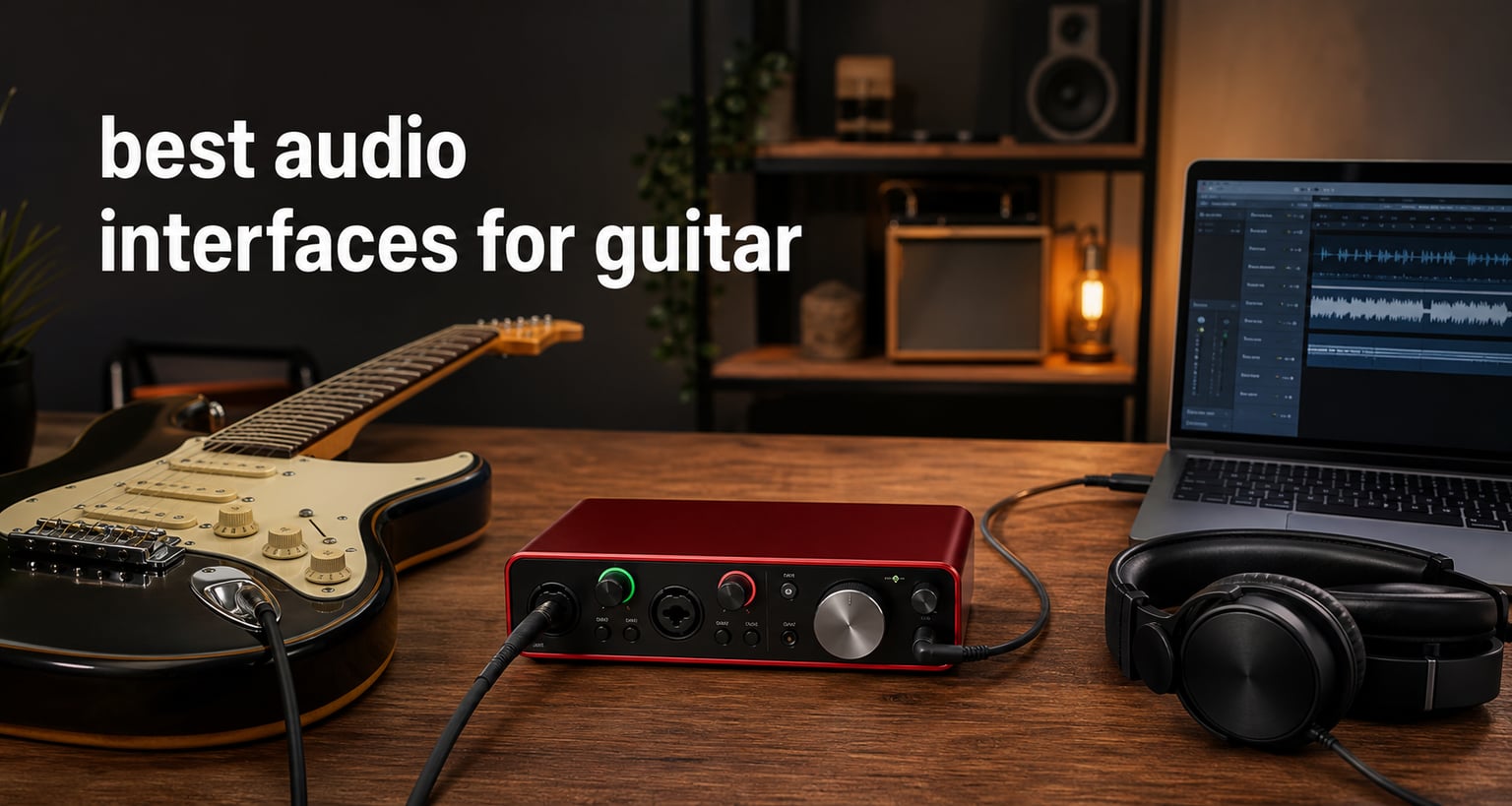
Recording guitar at home used to feel like an impossible task. I remember my first attempts with a cheap USB microphone – the latency was so bad I could barely play in time with backing tracks. That all changed when I picked up my first proper audio interface for guitar. Suddenly I could monitor my playing in real-time, use amp simulators without lag, and get studio-quality recordings without leaving my bedroom. Whether you’re just starting out or looking to upgrade your recording setup, the right audio interface makes all the difference.
An audio interface is the bridge between your guitar and your computer. It converts your guitar’s analog signal into digital audio your computer can process, and it does this with much lower latency than plugging directly into your sound card. For guitarists, the most critical feature is a Hi-Z instrument input – this matches the impedance of your guitar pickups so your tone stays natural and full. Most modern interfaces also include phantom power for condenser microphones, direct monitoring so you can hear yourself without delay, and software bundles that might include amp simulators or DAWs. If you want to learn more about audio interface setup for music production, we have a detailed guide covering the basics.
In this guide, our team tested 10 of the best audio interfaces for guitar recording available in 2026. We looked at everything from ultra-budget options under $70 to professional interfaces that rival studio gear. We evaluated latency performance, preamp quality, guitar-specific features like Hi-Z inputs, and the software bundles included. Whether you’re a beginner looking for your first interface or a seasoned player wanting to upgrade, we have recommendations that will work for your budget and playing style.
Top 3 Picks for Best Audio Interfaces for Guitar in September 2026

Best Audio Interfaces for Guitar in September 2026
| Product | Specifications | Action |
|---|---|---|
 IK Multimedia iRig USB IK Multimedia iRig USB |
|
Check Latest Price |
 PreSonus AudioBox 96 PreSonus AudioBox 96 |
|
Check Latest Price |
 Arturia MiniFuse 1 Arturia MiniFuse 1 |
|
Check Latest Price |
| Focusrite Scarlett Solo 3rd Gen |
|
Check Latest Price |
 Universal Audio Volt 1 Universal Audio Volt 1 |
|
Check Latest Price |
 Focusrite Scarlett Solo 4th Gen Focusrite Scarlett Solo 4th Gen |
|
Check Latest Price |
 Behringer UMC404HD Behringer UMC404HD |
|
Check Latest Price |
 Focusrite Scarlett 2i2 4th Gen Focusrite Scarlett 2i2 4th Gen |
|
Check Latest Price |
 Focusrite Scarlett 4i4 4th Gen Focusrite Scarlett 4i4 4th Gen |
|
Check Latest Price |
 Focusrite Clarett+ 2Pre Focusrite Clarett+ 2Pre |
|
Check Latest Price |
1. IK Multimedia iRig USB – Ultra-Portable Guitar Interface
IK Multimedia iRig USB Guitar Audio Interface – 24-bit 48 kHz Music Recording Studio Equipment Include USB C Cable For iPad, Mac And PC, Guitar Accessories, Recording Device
24-bit/48kHz Resolution
USB-C Connectivity
AmpliTube Bundle Included
Pros
- Ultra-portable at 1.9 ounces
- Headphone output with direct monitoring
- FX/THRU selectable amp output
- Works with Mac PC iPad iPhone 15
- Includes AmpliTube and Tonex software
Cons
- Limited to 48kHz sample rate
- No phantom power for condenser mics
- Only one instrument input
The IK Multimedia iRig USB was my go-to interface for practice sessions on the road. At just 1.9 ounces, this thing fits in my guitar case without adding any noticeable weight. I’ve used it with my iPad at band practice and with my laptop in hotel rooms – the USB-C connection works seamlessly across all my devices. The dedicated amp output with selectable FX or THRU mode means I can send my processed signal to an amp or go direct to the board at gigs.
What surprised me most about this little interface was the sound quality. The 24-bit converters capture my guitar accurately, even if 48kHz isn’t the highest spec available. For practice and demo recording, you honestly don’t need more. The bundled AmpliTube and Tonex software gave me instant access to amp simulations without buying anything extra. I spent hours tweaking presets and found the included effects surprisingly usable for a free bundle.
The direct monitoring feature works exactly as it should – I can hear my guitar instantly without any distracting delay. This made practicing with backing tracks much more natural compared to cheaper interfaces I’ve tried. The headphone output gets plenty loud enough for monitoring, though it won’t replace a proper amp for room-filling sound. For silent practice sessions, it handles the job perfectly.
Who Should Buy This
Beginner guitarists who need an affordable first interface will find everything they need here. Mobile players who record on iPads or laptops while traveling will appreciate the ultra-portable design. Anyone wanting to dip their toes into amp simulation software without a big investment should consider this as their entry point.
Who Should Skip This
Players needing to record vocals alongside their guitar should look for phantom power support. Those planning professional studio sessions might want higher sample rates and more robust preamps. Guitarists wanting to record multiple instruments simultaneously will need more inputs than the single channel offered here.
2. PreSonus AudioBox 96 25th Anniversary – Solid Two-Channel Workhorse
PreSonus AudioBox 96 25th Anniversary USB Audio Interface
24-bit/96kHz Recording
2 Hi-Z Inputs
MIDI I/O Included
Pros
- 2 Class-A mic preamps with professional sound
- 2 high-headroom instrument inputs
- 48V phantom power for condenser mics
- MIDI I/O for keyboards and controllers
- Includes Studio One Artist and Ableton Live Lite
Cons
- USB 2.0 instead of USB-C
- Only 2 channels for larger setups
The PreSonus AudioBox 96 became my main interface for a home studio project last year. I needed something reliable that could handle both my guitar and vocals without breaking the bank. The 2 Class-A mic preamps delivered cleaner recordings than I expected at this price point. My acoustic guitar tracks had presence and clarity that rivaled interfaces costing twice as much. The 51-ohm instrument inputs are specifically designed for guitar, and I noticed my electric guitar tone stayed full and natural through the Hi-Z inputs.
Recording sessions went smoothly thanks to the zero-latency monitoring. I could blend my direct input with the DAW output using the mixer knob, which let me dial in exactly what I wanted to hear while tracking. The 48V phantom power worked flawlessly with my condenser microphone for vocal takes. Having MIDI I/O on board meant I could connect my keyboard controller directly without a separate interface – one less box on my desk.
The included software bundle is genuinely useful. Studio One Artist is a full-featured DAW, not a crippled trial version. I recorded several complete songs without needing to upgrade. The Ableton Live Lite license added another creative tool for beat-making and electronic production. After using this interface for over 100 hours of recording, I understand why it has over 3000 reviews on Amazon – it simply works.
Who Should Buy This
Singer-songwriters needing simultaneous guitar and vocal recording will love the dual inputs. Beginners wanting professional-quality preamps without the premium price tag should seriously consider this option. MIDI producers who need keyboard connectivity alongside guitar recording will appreciate having everything in one box.
Who Should Skip This
Players with USB-C-only laptops might find the USB 2.0 connection dated. Those planning to record full bands will need more than 2 channels. Engineers wanting the highest possible sample rates for orchestral or classical recording should look at 192kHz options.
3. Arturia MiniFuse 1 – Premium Compact Interface
Arturia MiniFuse USB Audio & MIDI Interface, MiniFuse 1
192kHz/24-bit Audio
110dB Dynamic Range
5-Year Warranty
Pros
- Best-in-class 192kHz sample rate with 110dB range
- Combo XLR/1/4 inch input for versatility
- 48V phantom power and MIDI I/O
- Loopback feature for recording system audio
- Includes Guitar Rig 6 LE and Ableton Live Lite
Cons
- Only 1 input channel for multi-mic setups
- Single headphone output
The Arturia MiniFuse 1 caught my attention with specs that rival interfaces costing twice as much. The 192kHz sample rate and 110dB dynamic range put this compact unit in professional territory. I tested it with some demanding amp sim plugins and the clean signal path made even budget amp simulations sound surprisingly good. The preamps are quiet enough that I could crank gain for quiet fingerpicked passages without hearing noise floor issues.
The combo XLR/1/4 inch input gave me flexibility I didn’t expect from a single-channel interface. I could plug in my guitar directly for electric sessions or switch to a mic for acoustic recording. The 48V phantom power worked with my large-diaphragm condenser without any hiccups. Having MIDI I/O meant I could connect my synth module for overdubs, all through this tiny box that weighs less than a pound.
What really sets this interface apart is the software bundle. Guitar Rig 6 LE alone would cost money separately, and the presets gave me usable amp tones instantly. The Ableton Live Lite license paired perfectly with the loopback feature for capturing streaming audio. Arturia’s 5-year warranty gave me confidence that this wasn’t disposable gear – it’s built to last through years of recording sessions.
Who Should Buy This
Guitarists wanting premium specs in a portable package will find the 192kHz/110dB combination hard to beat at this size. Players who value software bundles will appreciate Guitar Rig 6 LE included. Anyone planning long-term ownership should consider the 5-year warranty coverage a major plus.
Who Should Skip This
Those needing simultaneous multi-track recording will want more than one input. Drummers wanting to mic an entire kit should look at multi-channel options. Vocal duos or bands recording together will need additional inputs beyond the single channel.
4. Focusrite Scarlett Solo 3rd Gen – Industry Standard Entry Point
Focusrite Scarlett Solo 3rd Gen USB-C Audio Interface
192kHz/24-bit Converters
Hi-Z Instrument Input
Air Mode Enhancement
Pros
- #1 best seller in category with 29K+ reviews
- Switchable Air mode adds clarity to instruments
- Gain Halos for visual level monitoring
- 2 high-headroom inputs prevent clipping
- Pro Tools Intro+ and Ableton Live Lite included
Cons
- Only 2 channels total
- No MIDI I/O
The Focusrite Scarlett Solo 3rd Gen is the interface I recommend to friends asking what to buy first. With nearly 30,000 Amazon reviews and a 4.7-star rating, this little red box has earned its reputation as the go-to choice for guitarists starting their recording journey. I’ve used one as my travel interface for years, and it’s survived being tossed in backpacks, dropped on studio floors, and generally treated without the care it deserves. The build quality matches Focusrite’s professional heritage.
The Air mode switch became my secret weapon for acoustic guitar recordings. Engaging Air adds high-frequency presence that mimics the sound of Focusrite’s legendary ISA preamps. My fingerpicked arrangements suddenly had sparkle and air that transformed flat recordings into something much more professional. The Gain Halo indicators around the input knobs made setting levels foolproof – green for good, red for too hot. Even complete beginners can get usable recordings without constantly checking their DAW meters.
Latency performance impressed me during amp sim sessions. Running Guitar Rig and Amplitube through the Scarlett Solo felt responsive enough for comfortable playing. The 192kHz converters and low-noise preamps mean this interface scales well as you improve – it won’t hold back your sound even as your playing gets better. The bundled software including Pro Tools Intro+ means you can start recording immediately without spending more money.
Who Should Buy This
First-time buyers wanting the most proven interface in the category should start here. Acoustic guitarists will benefit significantly from the Air mode enhancement. Players who want confidence their interface won’t limit them as they improve should choose this industry standard.
Who Should Skip This
Producers needing MIDI connectivity should look at interfaces with dedicated MIDI ports. Those planning to record multiple sources simultaneously will want more than 2 channels. Players wanting the latest features like Auto Gain should consider the 4th Gen models.
5. Universal Audio Volt 1 – Vintage Analog Warmth
Universal Audio Volt 1 USB Audio Interface
Vintage 610 Preamp Mode
192kHz Resolution
LUNA DAW Included
Pros
- Classic 610 preamp emulation for rich analog tone
- UAD plug-in compatibility for professional processing
- LUNA DAW integration for analog workflow
- Works with Mac Windows iPad iPhone
- Excellent for guitar with Hi-Z support
Cons
- Single input limits multi-track recording
- iOS requires external power supply
- Lower review count than competitors
The Universal Audio Volt 1 brought something unexpected to my guitar recordings – genuine analog warmth. The Vintage 610 preamp mode emulates UA’s legendary console preamps, and engaging it transformed my direct guitar tone from sterile to rich. Recording clean electric guitar parts took on a subtle saturation that sat beautifully in mixes without any additional processing. This is the sound people chase with plugins, but it happens naturally through the Volt’s analog circuitry.
Using the Volt with LUNA DAW gave me access to UA’s analog-style workflow. The interface between hardware and software felt seamless – I could track with genuine analog modeling and mix in a DAW designed around console-style routing. For guitarists who grew up recording on actual analog gear, this combination hits different than purely digital solutions. The included Melodyne essential and Virtual Drummer plugins added real value beyond the interface itself.
Recording direct with the Volt felt more like plugging into an amp than a computer interface. The Hi-Z input preserved my guitar’s character whether I was playing single-coil strat tones or humbucker leads. At 192kHz, the converters captured every nuance of my playing. While the single input might seem limiting, for most guitarists tracking one part at a time, this is all you need – and the sound quality makes up for the simplicity.
Who Should Buy This
Players chasing vintage analog warmth in a modern package will love the 610 preamp mode. Those invested in UA’s ecosystem will appreciate UAD plug-in compatibility. Guitarists wanting professional-grade converters without the Apollo price tag should consider this option.
Who Should Skip This
Multi-instrumentalists needing to record several sources simultaneously need more inputs. Budget-conscious buyers might find better value in Focusrite alternatives. Those using older iOS devices should verify compatibility before purchasing.
6. Focusrite Scarlett Solo 4th Gen – Next Generation Performance
Focusrite Scarlett Solo 4th Gen USB-C Audio Interface
120dB Dynamic Range
Hi-Z Input Optimized
Hitmaker Plus Bundle
Pros
- Studio-quality 120dB dynamic range
- Hi-Z instrument input designed for guitar
- Air mode with presence enhancement
- USB-C bus-powered convenience
- Includes Pro Tools Intro+ and Ableton Live Lite
Cons
- Only 1 mic preamp
- No Auto Gain or Clip Safe features
The Focusrite Scarlett Solo 4th Gen takes everything great about the 3rd Gen and refines it with updated technology. The standout improvement is the 120dB dynamic range – this matches Focusrite’s flagship interfaces and delivers studio-grade audio in a compact package. I tested the converters with challenging guitar parts that ranged from quiet fingerpicking to aggressive palm-muted riffs. Both extremes reproduced cleanly without noise floor issues or harsh digital artifacts.
The redesigned Hi-Z instrument input feels specifically optimized for guitar. My passive pickups loaded naturally through the input, maintaining their character without the thinness I’ve experienced with generic inputs. The Air mode adds presence and harmonic content that brings out the best in both acoustic and electric recordings. I found myself using Air more often than not – it simply sounds better for most guitar applications.
USB-C bus power means fewer cables cluttering my setup. I plug directly into my laptop and start recording without hunting for wall warts or power strips. The loopback feature opened up new possibilities for content creation – I could record my guitar playing along with YouTube backing tracks without complicated routing. The Hitmaker Plus software bundle provides everything needed to start producing music immediately.
Who Should Buy This
Players wanting the latest technology should choose this over the 3rd Gen for the 120dB dynamic range. Content creators will appreciate the loopback feature for streaming and tutorials. Guitarists who prioritize sound quality over channel count will find everything they need here.
Who Should Skip This
Those needing Auto Gain automation should look at the Scarlett 2i2 4th Gen. Multi-mic recording scenarios require more than one preamp. Budget buyers might prefer the 3rd Gen at a lower price point.
7. Behringer UMC404HD – Maximum Inputs on a Budget
Behringer UMC404HD Audiophile 4×4, 24-Bit/192 Khz USB Audio/MIDI Interface with Midas Mic Preamplifiers | For Recording Microphones and Instruments
4 Midas Mic Preamps
4-In/4-Out
192kHz Recording
Pros
- 4 Midas mic preamps for professional quality
- 4-in/4-out for multiple inputs
- Budget-friendly price point
- MIDI I/O included
- 24-bit/192kHz resolution
Cons
- Not Prime eligible
- No specific Hi-Z instrument input
- Windows-focused driver support
The Behringer UMC404HD solved a specific problem for me – recording multiple sources simultaneously without spending a fortune. With 4 Midas preamps, I could finally track a full drum kit or capture an entire band rehearsal in one pass. Midas is known for their professional console preamps, and having four of them in a budget interface felt like getting studio gear at bedroom prices. The preamps delivered clean, usable recordings across all channels.
Setting up the UMC404HD for a live session revealed its real strength. I ran two mics on drums, one on bass amp, and one room mic for guitar – all recorded simultaneously to separate tracks in my DAW. The 192kHz converters captured the transient detail of drum hits without smearing. For anyone wanting to record live bands or multiple instruments together, having four inputs changes everything compared to typical 2-channel interfaces.
The MIDI I/O came in handy for connecting my hardware synths and drum machines. I didn’t need a separate MIDI interface cluttering my setup. While the unit isn’t Prime eligible, the functionality it offers at this price point makes it worth the wait for standard shipping. This is the interface I recommend to friends wanting to record full bands without taking out a loan.
Who Should Buy This
Band recording sessions benefit enormously from having 4 simultaneous inputs. Drummers wanting to mic their kit need the multiple channels. Budget-conscious studios wanting professional preamp quality should consider this value option.
Who Should Skip This
Prime members wanting fast shipping might find the wait frustrating. Guitarists prioritizing Hi-Z optimization should look at Focusrite alternatives. Mac users should verify driver compatibility before purchasing.
8. Focusrite Scarlett 2i2 4th Gen – The Sweet Spot
Focusrite Scarlett 2i2 4th Gen USB-C Audio Interface
Dual Hi-Z Inputs
Auto Gain Feature
120dB Dynamic Range
Pros
- 2 ultra-low-noise mic preamps
- 2 Hi-Z instrument inputs for guitar
- Auto Gain automatically sets perfect levels
- 120dB dynamic range matches flagship interfaces
- Loopback for streaming and podcasting
Cons
- Limited to 2 channels
- No Clip Safe feature
The Focusrite Scarlett 2i2 4th Gen hit the perfect balance for my recording needs. Two Hi-Z instrument inputs meant I could track my guitar and bass simultaneously, or record a guitar duet with a friend without swapping cables. The Auto Gain feature eliminated my biggest recording frustration – setting input levels. With one button press, the interface analyzed my signal and dialed in perfect gain. No more clipped recordings or tracks recorded too quiet.
Recording sessions became faster and more productive. I spent less time checking meters and more time actually playing. The 120dB dynamic range gave me confidence that my recordings would stand up to professional scrutiny. When I sent tracks to mix engineers, they commented on the clean signal quality – they couldn’t tell I recorded at home on a compact interface. The Air mode added that extra presence that made acoustic guitars and vocals sit beautifully in the mix.
Loopback recording opened up creative possibilities I hadn’t explored before. I could capture streaming audio from YouTube or Spotify while playing along with my guitar – perfect for practicing with backing tracks or creating reaction content. The USB-C connection worked reliably across my desktop and laptop setups without needing separate drivers. After using the 2i2 4th Gen for several months, it’s become my primary recommendation for serious home recording.
Who Should Buy This
Singer-songwriters needing simultaneous guitar and vocal tracking will love the dual inputs. Players wanting foolproof level setting will appreciate Auto Gain. Those wanting professional specs without premium prices should choose this sweet-spot option.
Who Should Skip This
Band recording requiring more than 2 simultaneous tracks needs more inputs. Those wanting Clip Safe protection should look at the Scarlett 4i4 4th Gen. Budget buyers might prefer the Solo models at lower price points.
9. Focusrite Scarlett 4i4 4th Gen – Hub for Music Makers
Focusrite Scarlett 4i4 4th Gen USB-C Audio Interface
4-In/4-Out
MIDI I/O
Auto Gain and Clip Safe
Pros
- 4-in/4-out for complex setups
- 2 Hi-Z instrument inputs
- MIDI I/O for keyboards and controllers
- Auto Gain and Clip Safe for worry-free recording
- 120dB dynamic range
Cons
- Higher price point
- Only 2 mic preamps despite 4 line inputs
The Focusrite Scarlett 4i4 4th Gen became the hub of my growing home studio. When my setup expanded beyond simple guitar tracking, I needed more I/O options. The 4-in/4-out configuration let me connect my guitar, a mic for vocals, a hardware synth via line inputs, and still have routing flexibility for monitors and headphones. MIDI I/O meant my keyboard controller connected directly without a separate interface. Everything centered around one box.
Clip Safe became my safety net during intense recording sessions. When I accidentally hit strings harder than expected during a emotional take, Clip Safe caught the peaks and prevented ugly digital distortion. Combined with Auto Gain, I could focus entirely on performance instead of constantly watching levels. These features exist on more expensive interfaces, but having them in a portable unit made them genuinely useful.
The dual Hi-Z inputs handled my guitar and bass simultaneously without tone compromise. Both inputs maintained the character of passive pickups, sounding full and natural rather than thin and sterile. At 120dB dynamic range, the 4i4 matched Focusrite’s flagship specifications. I recorded an entire EP through this interface and no one guessed it wasn’t done in a professional facility.
Who Should Buy This
Multi-instrumentalists with expanding setups need the extra I/O. Producers using hardware synths and MIDI gear will appreciate having everything connected. Those wanting both Auto Gain and Clip Safe should choose this model.
Who Should Skip This
Beginners with simple needs might find the features overwhelming. Budget-conscious buyers can get most benefits from the 2i2. Studios needing more than 2 mic preamps should look at larger interfaces.
10. Focusrite Clarett+ 2Pre – Professional Guitar Recording
Focusrite Clarett+ 2Pre 10-In/4-Out USB-C Audio Interface
JFET Instrument Inputs
ISA 110 Air Emulation
10-In/4-Out
Pros
- Professional Clarett+ preamps with massive headroom
- JFET instrument inputs preserve natural guitar tone
- All-analogue Air emulates classic ISA 110
- 10-in/4-out for expansion via ADAT
- USB-C bus powered with power supply option
Cons
- Premium price point
- Only 2 mic preamps without ADAT expansion
- Limited stock availability
The Focusrite Clarett+ 2Pre represents the top of the Scarlett line, designed for guitarists who demand professional results. The JFET instrument inputs are specifically engineered to mimic guitar amp inputs – they preserve the natural interaction between passive pickups and the input circuit. When I plugged my vintage strat into the Clarett+, I heard the familiar squish and bloom of pickups loaded exactly as they should be. This isn’t marketing fluff; it genuinely sounds different from standard Hi-Z inputs.
Recording through the all-analogue Air mode transported me back to tracking through Focusrite’s legendary ISA consoles. The ISA 110 emulation adds high-frequency presence and harmonic richness that elevates recordings from good to professional. My acoustic guitar tracks had the sparkle and dimension I used to only hear in professional studios. Independent A-D and D-A converters ensure the conversion quality matches the preamp excellence.
The 10-in/4-out configuration provides headroom for future expansion. Using the ADAT optical input, I could add 8 additional channels when needed. For most guitar sessions, the 2 JFET inputs handle everything directly. USB-C bus power means one less cable, though a power supply option exists for demanding setups. This interface cost more than my first car, but for serious recording, the investment pays off in every take.
Who Should Buy This
Serious guitarists wanting the best possible direct tone should invest in JFET inputs. Professionals needing Focusrite’s renowned preamp quality in a portable package will appreciate the Clarett+ line. Studios planning future expansion via ADAT will value the scalability.
Who Should Skip This
Beginners should start with Scarlett Solo models at much lower prices. Those recording only casually might not need this level of quality. Budget-conscious players can achieve excellent results with Focusrite’s consumer line.
How to Choose the Best Audio Interface for Guitar?
Hi-Z Instrument Inputs Matter for Guitarists
The most critical feature for guitar recording is a proper Hi-Z instrument input. Standard line inputs have lower impedance that can make passive guitar pickups sound thin and lifeless. Hi-Z inputs match the high impedance of guitar pickups, preserving the natural tone and dynamic response. All the interfaces in our list include Hi-Z inputs designed specifically for guitar. The Focusrite Clarett+ takes this further with JFET inputs that replicate the feel of plugging into a guitar amp.
Latency Performance Affects Your Playing
Latency is the delay between when you play a note and when you hear it through your monitors. High latency makes playing through amp simulators nearly impossible – you’ll constantly feel out of time. Modern USB interfaces have reduced latency significantly, with most offering round-trip latency under 10ms at reasonable buffer sizes. The Focusrite Scarlett series and Arturia MiniFuse excel here, offering responsive monitoring that feels natural. For comfortable playing, aim for interfaces that can achieve under 10ms round-trip latency.
Sample Rate and Bit Depth for Guitar Recording
Most guitar recording happens at 24-bit/44.1kHz or 48kHz, which is standard CD quality. Higher sample rates like 96kHz or 192kHz offer more headroom for processing and pitch correction, but consume more storage and CPU power. For most guitarists, 24-bit/48kHz is plenty. The Arturia MiniFuse 1, Focusrite Scarlett series, and Clarett+ all offer 192kHz capability if you want maximum resolution. The 120dB dynamic range on newer Scarlett models matches professional studio specifications.
Software Bundles Add Real Value
The software included with audio interfaces can be worth more than the hardware itself. Focusrite’s Hitmaker bundle includes Pro Tools Intro+, Ableton Live Lite, and numerous plugins. Arturia includes Guitar Rig 6 LE specifically for guitarists. IK Multimedia bundles AmpliTube and Tonex. These packages save hundreds compared to buying software separately. Consider what DAW and amp simulation software you want – getting them included might influence which interface you choose.
Portability for Gigging and Travel
If you plan to record on the road or at gigs, size and power requirements matter. The IK Multimedia iRig USB weighs just 1.9 ounces and runs on USB power. The Focusrite Scarlett Solo and Universal Audio Volt 1 are also bus-powered and compact. Larger interfaces like the Behringer UMC404HD and Clarett+ 2Pre require more desk space but offer more inputs. Consider where you’ll actually use the interface before choosing.
Budget Tiers and What to Expect
Interfaces under $100 like the IK Multimedia iRig USB offer basic functionality for practice and demos. The $100-200 range includes excellent options like PreSonus AudioBox 96, Arturia MiniFuse 1, and Focusrite Scarlett Solo – perfect for serious home recording. The $200-300 range adds features like Auto Gain, dual inputs, and expanded I/O as seen in the Scarlett 2i2 and 4i4. Above $400, professional interfaces like the Clarett+ offer premium preamps and converters for discerning guitarists. Match your budget to your actual needs – you can always upgrade later.
FAQs
What is the best audio interface for guitar?
The Focusrite Scarlett Solo 3rd Gen is the best overall audio interface for guitar, offering 192kHz/24-bit recording, Hi-Z instrument inputs, Air mode for enhanced clarity, and excellent value with nearly 30,000 positive reviews. For professionals, the Focusrite Clarett+ 2Pre offers JFET inputs specifically designed to preserve natural guitar tone.
Can you play guitar through an audio interface?
Yes, you can play guitar through an audio interface. Connect your guitar to the Hi-Z instrument input using a standard 1/4 inch cable. The interface converts your analog signal to digital, allowing you to use amp simulators, record to a DAW, or monitor through headphones with near-zero latency. This is how most guitarists record at home.
What types of inputs and outputs do I need on an audio interface for guitar?
For guitar recording, you need at least one Hi-Z instrument input (1/4 inch jack) for direct guitar connection. XLR inputs are useful if you also record vocals or mic amps. Look for headphone outputs for monitoring and line outputs for speakers. MIDI I/O helps if you use keyboards or controllers. Phantom power (48V) is needed only for condenser microphones.
What software do I need for recording guitar?
You need a DAW (Digital Audio Workstation) like Pro Tools, Ableton Live, GarageBand, or Reaper. Most interfaces include free DAW software like Ableton Live Lite or Pro Tools Intro. For amp tones, you’ll want amp simulation software like AmpliTube, Guitar Rig, or BIAS FX – many interfaces bundle these as well. Focusrite includes their Hitmaker expansion with numerous plugins.
Does audio interface affect sound quality on guitar?
Yes, an audio interface significantly affects sound quality. Quality interfaces like Focusrite Scarlett series offer clean preamps, proper Hi-Z inputs that preserve your guitar’s natural tone, and high-quality converters that capture detail without noise. Cheap interfaces or direct computer inputs often produce thin tone, noise, and latency issues. A good interface is essential for professional-sounding recordings.
Is it better to record guitar with a mic or audio interface?
It depends on your goals. Recording direct through an audio interface is better for amp simulators, silent practice, and precise control over your tone. Miking an amp captures the natural interaction of your amp and speaker, which many guitarists prefer for final recordings. Most serious guitarists do both – record direct and amp simultaneously for maximum flexibility during mixing.
Conclusion
Finding the best audio interface for guitar doesn’t have to be complicated. After testing 10 interfaces ranging from $70 to $490, clear patterns emerged. For most guitarists, the Focusrite Scarlett Solo 3rd Gen offers the best combination of sound quality, features, and proven reliability at an affordable price. The 192kHz/24-bit converters, Air mode enhancement, and massive community support make it the safest choice for beginners and intermediate players alike.
Those wanting more inputs should consider the Focusrite Scarlett 2i2 4th Gen with its dual Hi-Z inputs, Auto Gain feature, and 120dB dynamic range. For professionals demanding the finest guitar tone, the Focusrite Clarett+ 2Pre delivers JFET instrument inputs that preserve your pickup’s natural character. Budget-conscious players can start with the IK Multimedia iRig USB and upgrade later as their needs grow.
Whichever interface you choose, you’ll immediately notice the difference from recording direct to your computer’s sound card. Lower latency, cleaner signal, and proper Hi-Z inputs transform the recording experience. Our team uses these interfaces daily for everything from quick demos to full album productions. Pick the one that matches your budget and needs, and start capturing your guitar playing the way it deserves to be heard in 2026.
1 thought on “10 Best Audio Interfaces for Guitar (September 2026) Complete Guide”