
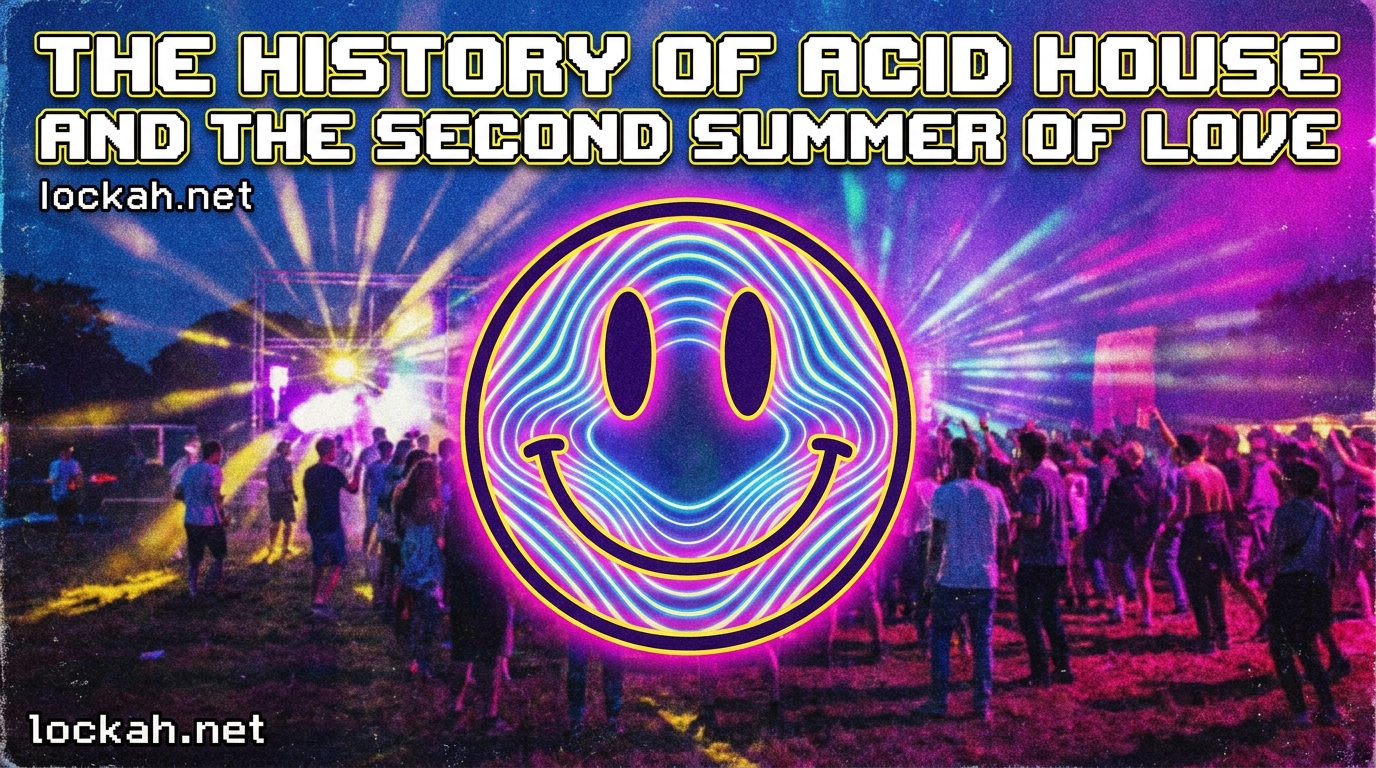
The history of acid house and the Second Summer of Love represents one of the most transformative moments in modern British culture. In 1988 and 1989, a generation of young people discovered a new sound, a new drug, and a new way of being together that would reshape music, fashion, and social attitudes for decades to come.
The Second Summer of Love was a social phenomenon in the United Kingdom that saw the explosive rise of acid house music and unlicensed rave parties. It earned its name by drawing a deliberate parallel to the original Summer of Love of 1967 in San Francisco. Both movements shared a spirit of generational rebellion, communal euphoria, and a belief that music and consciousness could create a better world.
Unlike the guitar-driven psychedelia of the Sixties, the Second Summer of Love was built on synthesizers, drum machines, and the distinctive squelching bass of the Roland TB-303. It emerged from the industrial cities of the American Midwest before finding its spiritual home in the warehouse parties, clubs, and fields of Thatcherite Britain. This article traces that journey from Chicago basements to the M25 orbital motorway.
Table of Contents
What Was the Second Summer of Love?
The Second Summer of Love refers to the period between 1988 and 1989 when acid house music and rave culture exploded across the United Kingdom. It was characterized by all-night warehouse parties, the widespread use of the drug MDMA (ecstasy), and a fashion aesthetic built around baggy clothing and the now-iconic yellow smiley face.
The movement was deliberately named to evoke the spirit of the 1967 Summer of Love in San Francisco, when hippies gathered in Haight-Ashbury to celebrate peace, love, and psychedelic rock. The connection was both spiritual and practical. Both movements represented young people seeking transcendence through music and communal experience. Both faced establishment backlash and media panic. Both left permanent marks on popular culture.
However, the Second Summer of Love was distinctively British and distinctively working-class. It emerged from the industrial cities of the North and the suburbs of London, not from bohemian California. Its soundtrack was machine-made, not organic. Its participants were the children of Thatcher’s Britain, shaped by unemployment, deindustrialization, and a desire for something different.
Origins of Acid House in Chicago (2026)
To understand the history of acid house and the Second Summer of Love, you must start in Chicago in the mid-1980s. House music was already thriving in the city’s Black and gay clubs, built on drum machines, synthesizers, and the four-on-the-floor beat that would become the foundation of electronic dance music.
The Warehouse, a club on Chicago’s South Side, gave house music its name. DJ Frankie Knuckles played extended mixes of disco, soul, and electronic tracks, creating a hypnotic, repetitive sound that kept dancers moving for hours. But it was a different Chicago club, the Muzic Box, that would incubate the harder, stranger sound that became acid house.
Ron Hardy was the resident DJ at the Muzic Box, and his sets were legendary for their intensity and experimentation. He would pitch records up and down, create feedback loops, and layer sounds in ways that transformed familiar tracks into something alien and new. The crowd at the Muzic Box was predominantly Black and gay, and they came to lose themselves in the music.
Meanwhile, a group of young producers were experimenting with a piece of equipment that had been designed for bass accompaniment in rock bands. The Roland TB-303 was a bassline synthesizer with a built-in sequencer. It had been a commercial failure, discontinued by Roland in 1984 after just 18 months of production. Music stores could not give them away.
In 1985, three Chicago producers named DJ Pierre, Spanky, and Herb Jackson formed a group called Phuture. They had acquired a TB-303 cheap and began experimenting with it. When they turned the resonance and cutoff filters to extreme settings, the machine produced a distinctive squelching, bubbling sound that would define acid house.
The sound was entirely accidental. The TB-303 was designed to provide simple bass accompaniment, not to create the distorted, hypnotic patterns that Phuture discovered. But that accidental discovery would change music forever. In 1986, Phuture recorded “Acid Tracks,” a twelve-minute journey into the new sound that would give the genre its name.
The Detroit Connection
While Chicago was developing house music, Detroit was creating techno. Pioneers like Juan Atkins, Derrick May, and Kevin Saunderson were blending European synthesizer music with funk and soul to create a sound that was simultaneously harder and more melodic than Chicago house.
Derrick May’s 1987 track “Strings of Life” became a bridge between the two cities and would prove crucial to the UK scene. When British DJs discovered this music, they often did not distinguish between Chicago house and Detroit techno. They saw it all as part of a new electronic sound that was unlike anything they had heard before.
The Ibiza Connection
The history of acid house and the Second Summer of Love cannot be told without Ibiza. In the summer of 1987, a group of British DJs and club promoters traveled to the Spanish island and had their minds blown by what they discovered.
Ibiza had long been a destination for bohemian travelers, but by the mid-1980s it had developed a unique club scene. The clubs Amnesia and Pacha were playing a mixture of Chicago house, European synthesizer music, and soulful disco known as Balearic beat. The sound was eclectic and open-minded, and the crowd was a mixture of locals, tourists, and expatriates.
What made Ibiza different was the atmosphere. The clubs stayed open all night. The crowd was mixed and welcoming. And crucially, MDMA had begun to appear on the island, though it was still rare and expensive. The British visitors experienced something that felt like the original Summer of Love, a sense of communal joy and acceptance that was unlike anything they knew back home.
Among the travelers were Danny Rampling, Paul Oakenfold, Nicky Holloway, and Johnny Walker. Each would return to London determined to recreate what they had experienced. Rampling launched Shoom, Oakenfold started Spectrum, and Holloway opened The Trip. Together, these clubs would form the nucleus of London’s acid house explosion.
The Balearic influence was crucial because it provided a template for how acid house could be presented. It was not just about the music. It was about the lighting, the decoration, the attitude, the sense of being somewhere special. The British pioneers took these lessons and adapted them for a UK audience.
London’s Acid House Explosion
By late 1987 and early 1988, London was ready to explode. The city had been in a clubbing recession after the closure of many discos in the early 1980s. Young people were hungry for something new, and the combination of acid house music and MDMA provided it.
Shoom, launched by Danny and Jenni Rampling in late 1987, became the most influential of the early clubs. It was tiny, holding only a few hundred people, but its impact was enormous. The dress code was baggy and colorful. The lighting was minimal, with strobes and smiley faces everywhere. The music was relentless acid house, played at high volume.
The club’s atmosphere was unlike anything London had seen. Regulars speak of a sense of family and community, of strangers hugging each other, of an overwhelming feeling of love and acceptance. The drug was part of this, but it was not the whole story. The music, the lighting, the crowd, and the attitude all combined to create something that felt genuinely revolutionary.
Paul Oakenfold’s Spectrum, held at Heaven in Charing Cross, was larger and more commercial but equally important. It brought acid house to a wider audience and helped establish the sound as something that could fill major venues. The Trip, at the Astoria on Charing Cross Road, was another key venue, mixing acid house with rare groove and hip hop.
Future, run by promoters Genesis, was where the warehouse rave scene began to take shape. These events were often held in industrial spaces, empty warehouses, or hired halls. They were advertised by word of mouth and pirate radio, with the location revealed only hours before the event.
Fashion and the Smiley Face
The visual identity of acid house was as distinctive as the sound. The yellow smiley face, originally designed in 1963 for an insurance company advertisement, became the unofficial symbol of the movement. It appeared on t-shirts, flyers, and backdrops, its blank euphoria perfectly capturing the MDMA experience.
Fashion was deliberately anti-fashion. Baggy clothes were essential for dancing all night without overheating. Bright colors and Day-Glo accessories stood out under UV lighting. White gloves allowed dancers to create trails of light as they moved. Ice pops and Lucozade became unofficial accessories, helping ravers stay hydrated.
This look was partly practical and partly symbolic. It marked acid house as something separate from mainstream club culture, something deliberately naive and utopian in contrast to the sophisticated dress codes of West End nightclubs.
Manchester and The Haçienda
While London was the center of media attention, the North of England was developing its own acid house culture with a distinctively Mancunian flavor. The Haçienda, the club owned by Factory Records and New Order, became the spiritual home of northern acid house.
Mike Pickering, a DJ and A&R man for Factory Records, had been playing house music at the Haçienda since 1986. His Nude nights, which began in 1987, were among the first regular house music nights in the UK. When acid house arrived, Pickering was ready.
Graeme Park, another Haçienda resident, became one of the most influential DJs of the era. His Hot nights, held in the Haçienda’s smaller upstairs room, were legendary for their intensity and musical quality. The Haçienda’s sound system, designed by New Order’s money and expertise, was among the best in the country.
The Manchester scene had a different character from London. It was grittier, more working-class, and closely connected to the city’s thriving indie music culture. Bands like Happy Mondays and The Stone Roses were part of the same world as the acid house DJs, and their music began to incorporate house beats and psychedelic influences.
This crossover would eventually lead to the Madchester scene of 1989 and 1990, when indie rock and acid house merged into something new. But in 1988, the Haçienda was simply the best place in the North to hear acid house played properly, by DJs who understood the music.
The North-South Divide
The history of acid house and the Second Summer of Love often focuses on London, but the movement was genuinely national. Cities like Liverpool, Sheffield, Leeds, and Glasgow all developed their own scenes with their own characteristics.
Blackburn in Lancashire became particularly associated with warehouse raves, with local promoters organizing events that attracted thousands from across the North. Nottingham and Birmingham had their own clubs and scenes. Even smaller towns had their acid house moments, often in village halls or borrowed spaces.
This regional variation is often overlooked in accounts that focus on London and Manchester, but it was crucial to the movement’s spread and character. Acid house was not just a metropolitan phenomenon. It reached into the suburbs, the small towns, and the industrial cities of Britain.
The Sound of Acid House: The Roland TB-303
No piece of equipment is more central to the history of acid house than the Roland TB-303 Bass Line synthesizer. Its story is one of commercial failure transformed into legendary status through accidental discovery.
Roland released the TB-303 in 1981 as a bass accompaniment device for guitarists. It was designed to be simple to use, with buttons for entering notes and knobs for adjusting the sound. Roland expected to sell thousands to working musicians who needed bass backup for practice or small gigs.
The reality was different. The TB-303 was difficult to program, the sounds it produced were thin and artificial, and guitarists preferred to play with drum machines or bass players. Roland discontinued the 303 in 1984, and remaining stock was sold off cheaply.
This commercial failure made the TB-303 affordable for the young Chicago producers who were experimenting with electronic music. They discovered that when you pushed the machine beyond its intended parameters, something magical happened. By adjusting the cutoff frequency and resonance while notes were playing, you could create a distinctive squelching, bubbling sound that seemed to move and breathe.
That squelch is the defining sound of acid house. It appears on classic tracks like Phuture’s “Acid Tracks,” Sleezy D’s “I’ve Lost Control,” and hundreds of others. It is instantly recognizable and remains popular in electronic music today.
The TB-303’s legacy extends beyond acid house. Its sequencer influenced how electronic music is programmed. Its sound has been emulated in countless software synthesizers and hardware clones. And its story remains a testament to how creative misuse can transform a failed product into a cultural icon.
Iconic Tracks of the Second Summer of Love
The history of acid house and the Second Summer of Love can be traced through its essential tracks. These records defined the sound, spread the movement, and remain classics of electronic music.
“Acid Tracks” by Phuture, released in 1987, is the foundational text. Its twelve-minute runtime allows the TB-303 bassline to evolve and mutate, creating a hypnotic journey that is simultaneously repetitive and constantly changing. DJ Pierre’s spoken word intro, “This is the acid track,” is iconic.
“Your Love” by Frankie Knuckles and Jamie Principle predates acid house but became a staple of the scene. Its emotional, soulful vocals and house beat provided a contrast to the harder acid tracks, showing the range of the music.
“Can You Feel It” by Mr. Fingers (Larry Heard) is another Chicago classic that crossed over into acid house. Heard’s beautiful, melancholic synthesizer work created a template for deep house that remains influential.
“Voodoo Ray” by A Guy Called Gerald was the first British acid house track to achieve mainstream success. Released in 1988, it reached number 12 in the UK charts and proved that acid house could be both underground and commercial.
“I’ve Lost Control” by Sleezy D, produced by Marshall Jefferson, is another Chicago acid classic with a vocal that perfectly captures the sense of surrender that the music encouraged. Jefferson was one of the most prolific and important producers of the era, and his influence on British acid house cannot be overstated.
Other essential tracks include “Strings of Life” by Derrick May, “Energy Flash” by Joey Beltram, “Big Fun” by Inner City, and “Promised Land” by Joe Smooth. Each contributed to the evolving sound of acid house and its successor genres.
The Role of MDMA and Ecstasy
Any honest account of the history of acid house and the Second Summer of Love must address the role of MDMA, commonly known as ecstasy. The drug was not incidental to the movement. It was a crucial component of the experience that made acid house different from what had come before.
MDMA had been synthesized in 1912 by the German pharmaceutical company Merck, but it remained obscure until the 1970s when it was rediscovered by chemist Alexander Shulgin. By the mid-1980s, it was appearing in Dallas and then spreading to other American cities.
The drug reached the UK in 1988, just as acid house was taking off. MDMA produces feelings of euphoria, empathy, and energy. It makes users want to dance, to touch, to connect with others. Combined with repetitive electronic music and a crowd of like-minded people, it created experiences that many participants describe as transformative.
The physical culture of acid house was shaped by the drug’s effects. Clubs became extremely hot as thousands of people danced for hours without stopping. Water became essential, and many venues began distributing it free or selling it cheaply. Lucozade and ice pops were popular for their combination of sugar and fluid.
The sense of community that acid house participants describe, the feeling of love and acceptance, was partly chemical. MDMA reduces social anxiety and increases empathy. It made it easier for strangers to connect, for inhibitions to drop, for the barriers between people to dissolve.
However, it is important not to reduce the Second Summer of Love to mere drug use. The music, the fashion, the venues, and the attitude were all independently important. Many participants did not use drugs, or used them only occasionally. The movement was about more than chemical intoxication.
It is also important to acknowledge the risks. MDMA can cause overheating, dehydration, and in rare cases, death. The unregulated nature of rave events meant that medical emergencies were sometimes poorly handled. The history of acid house includes tragedies alongside the celebrations.
Warehouse Raves and the M25 Scene
As acid house grew beyond the capacity of London clubs, a new phenomenon emerged: the warehouse rave. These events were typically held in industrial spaces on the outskirts of cities, advertised only through word of mouth and pirate radio, and often technically illegal.
The promoters Genesis became famous for organizing some of the largest and most ambitious raves. They would hire a warehouse or field, set up a sound system, and spread the word. The locations were kept secret until the last minute, with participants calling phone lines on the night to get directions.
The M25 motorway became the distribution network for these events. Ravers would drive around the orbital, receiving updates through car phones and CB radios, until the location was revealed. This became known as the M25 scene, and it defined the public image of acid house for many in Britain.
Sunrise, another major promotion company, organized even larger events. Their 1989 Second Birthday event at an airfield near Ascot attracted an estimated 20,000 people. These were no longer underground events. They were mass gatherings that required serious organization and infrastructure.
The warehouse rave scene had its own culture. It was more mixed in terms of class and race than the exclusive London clubs. It was explicitly anti-commercial, with many events raising money for causes or operating on a non-profit basis. And it was deliberately mysterious, with the secrecy adding to the excitement.
However, the scale of these events also brought problems. Noise complaints, traffic chaos, and occasional violence brought police attention. The organizers were operating in legal gray areas, and some were prosecuted for various offenses. The era of massive unlicensed raves was relatively brief, effectively ending with the 1990 Entertainments Bill.
Media Backlash and Moral Panic
The British tabloid press discovered acid house in 1988, and their reaction was predictable and ferocious. Headlines screamed about “acid house horror,” “evil of ecstasy,” and “death by acid.” The Sun, Daily Mail, and other papers ran sensationalized stories that painted the scene as a criminal underworld of drug dealers and dangerous behavior.
The term “acid house” was deliberately misunderstood. Journalists implied that the music was connected to LSD, playing on fears of the 1960s psychedelic drug. In reality, the “acid” referred to the squelching TB-303 sound, which was said to be “acidic” in character. But the confusion served the purposes of those who wanted to demonize the scene.
The moral panic had several components. There was the drug angle, with ecstasy portrayed as a killer substance that would destroy young minds. There was the class angle, with working-class ravers gathering in fields portrayed as a threat to respectable society. And there was the simple fear of youth culture, of young people gathering without adult supervision.
The media coverage had real effects. Police began to crack down on raves more aggressively. Local councils passed bylaws to prevent events. Parents were warned to keep their children away from acid house. The establishment response was swift and hostile.
Yet the panic also served to spread awareness of acid house. Young people who had never heard of the music saw it on the news and sought it out. The smiley face became a badge of rebellion. The history of acid house and the Second Summer of Love includes this paradox: the backlash helped make the movement bigger.
The Entertainments Bill and Legal Response
In 1990, the British government passed legislation specifically targeting the rave scene. The Entertainments (Increased Penalties) Act, commonly known as the Entertainments Bill, gave police new powers to shut down events and increased penalties for organizers.
The bill was a direct response to the growth of acid house and the public concern about unlicensed raves. It allowed police to stop events with more than a hundred people from taking place if they were associated with “repetitive beats.” This was an explicit attempt to target acid house music.
The rave community responded with the Freedom to Party rally in 1990. Thousands gathered in London to protest the legislation, arguing that it criminalized young people and violated civil liberties. The rally was one of the largest demonstrations of youth in British history, though it received limited media coverage compared to the moral panic.
The Entertainments Bill effectively ended the era of massive unlicensed raves. Organizers either went underground with smaller events, or they professionalized and obtained proper licenses. The wild, anarchic period of 1988 and 1989 was over.
However, the legislation did not stop acid house. It simply forced it to evolve. The superclubs of the 1990s, like Ministry of Sound and Cream, were direct descendants of the acid house scene. They operated legally but preserved much of the culture and music of the warehouse raves.
Legacy and Lasting Impact
The history of acid house and the Second Summer of Love is not merely historical. The effects of that brief, intense period continue to shape music and culture today. Acid house was the foundation upon which electronic dance music was built.
In the immediate aftermath, bands like The Prodigy and Orbital brought acid house sounds to mainstream audiences. The Prodigy’s early tracks like “Charly” and “Everybody in the Place” were explicitly acid house, while Orbital’s “Chime” became an anthem of the early 1990s rave scene.
The subsequent genres of electronic music all owe something to acid house. Jungle and drum and bass developed from the breakbeat elements of acid tracks. UK garage and grime emerged from the same London club culture that had incubated acid house. Even today’s global EDM phenomenon traces its roots back to those Chicago warehouses and British fields.
Beyond music, acid house changed British culture. It helped break down class barriers, even if only temporarily. It created new forms of communal experience. It introduced concepts like harm reduction and drug education that would become standard in later years. And it left a visual legacy in the continued use of the smiley face and neon colors.
The Second Summer of Love is remembered with nostalgia by those who lived through it, and with curiosity by those who did not. Documentaries, books, and exhibitions continue to explore the era. The music remains popular, with classic tracks still played in clubs and festivals around the world.
In the context of British history, the Second Summer of Love represents a moment when a generation sought escape from the harsh realities of Thatcherite Britain. It was utopian, naive, and short-lived, but it was also genuine. For a brief period, thousands of young people believed that music and community could create something better than the world they had inherited.
That spirit has never entirely died. Every generation of ravers, clubbers, and electronic music fans inherits something from 1988 and 1989. The history of acid house and the Second Summer of Love is still being written, in warehouses and fields and clubs, wherever people gather to dance to repetitive beats.
Frequently Asked Questions
What is the Second Summer of Love?
Why do they call it acid house?
Who is the godfather of acid house?
What is the connection between the 1967 Summer of Love and the Second Summer of Love?
What was the Roland TB-303 and why was it important?
What clubs were famous for acid house in the UK?
What was the Entertainments Bill?
What are the essential acid house tracks?
Conclusion
The history of acid house and the Second Summer of Love matters because it represents a genuine cultural revolution. In just two years, a new form of music spread from Chicago warehouses to British fields, transforming how generations would dance, dress, and gather. The Second Summer of Love was more than a musical movement. It was a social phenomenon that challenged class boundaries, created new communities, and left a lasting mark on British culture.
Its legacy is visible in every nightclub, every festival, every DJ set that follows the four-on-the-floor beat established in those Chicago clubs. It is audible in the squelching TB-303 sounds that still appear in contemporary electronic music. And it is felt in the continuing desire for communal experiences that transcend ordinary life.
The Second Summer of Love was brief, idealistic, and flawed. It was also transformative. Understanding its history helps explain where modern electronic music came from and why it continues to matter. The spirit of 1988 lives on wherever people gather to dance, to connect, and to seek something beyond the everyday.