
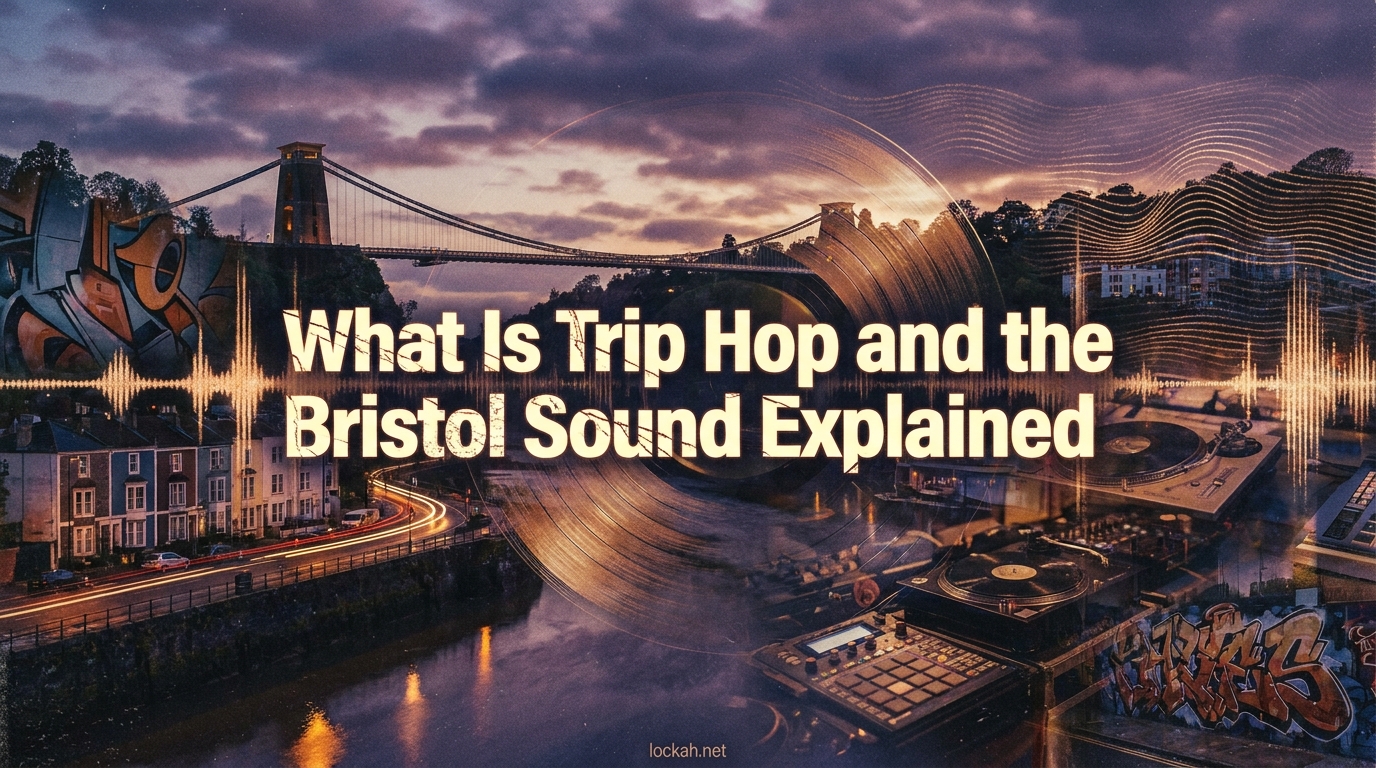
Trip hop is a genre of electronic music that emerged from Bristol, England in the early 1990s, blending hip-hop inspired grooves with atmospheric production, dub influences, and melancholic moods. The term itself carries controversy among the artists who created the sound, yet it has become the accepted label for what many simply call the Bristol Sound.
I have spent years exploring the nuances of this genre, from dusty vinyl shops in Stokes Croft to late-night listening sessions with Massive Attack on repeat. This guide will give you everything you need to understand trip hop’s origins, characteristics, and why it still matters 2026.
Whether you are new to downtempo electronica or looking to deepen your appreciation of this British musical export, you will find clear answers here.
Table of Contents
What Is Trip Hop?
Trip hop is a psychedelic fusion of hip-hop and electronica with dub influences, typically operating at tempos between 80 and 100 beats per minute. The genre draws from multiple musical traditions, combining sample-based production techniques with live instrumentation to create something entirely new.
The sound is characterized by smoked, dark textures and heavy thumping beats that create an immersive listening experience. Unlike mainstream hip-hop of the 1990s, which pushed toward higher energy and faster tempos, trip hop slowed things down and explored more introspective territory.
At its core, trip hop is a mash-up of so many different things. Punk, funk, soul, hip hop, blues, and electronic music all find their way into the mix. This hybrid nature makes the genre difficult to pin down precisely, which is part of why the definition remains contested among music enthusiasts.
The Bristol Sound: Origins and History (2026)
The story of trip hop begins in Bristol during the late 1980s and early 1990s. This port city in southwest England developed a unique musical identity shaped by its racial diversity and cross-cultural exchange. Sound system culture from Caribbean communities met hip-hop influences from American imports, creating fertile ground for experimentation.
The Wild Bunch, a Bristol soundsystem collective, served as the incubator for what would become the Bristol Sound. Members including Grantley Marshall, Andrew Vowles, and Robert Del Naja eventually formed Massive Attack. Their 1991 album Blue Lines became the blueprint for the genre, though the group themselves rejected the trip hop label.
Other collectives and artists emerged from the same scene. Portishead, named after a nearby coastal town, brought a cinematic darkness to the sound. Tricky, another Wild Bunch affiliate, pushed into even more experimental territory with his 1995 debut Maxinquaye. Together, these three acts form what many fans call the holy trinity of trip hop.
The geography mattered. Bristol’s relative isolation from London’s music industry machine allowed artists to develop their sound without commercial pressure. The city’s multicultural makeup meant that reggae, dub, and soul sat comfortably alongside hip-hop and electronic music in local clubs.
Musical Characteristics of Trip Hop
Understanding what makes trip hop distinct requires breaking down its constituent elements. The genre is defined less by strict rules and more by a particular approach to sound and atmosphere.
Tempo and Rhythm
Trip hop operates at a slower tempo than mainstream hip-hop, typically falling between 80 and 100 beats per minute. This downtempo approach creates space for atmospheric elements to breathe. The rhythm section draws heavily from hip-hop breakbeats but processes them through dub techniques, often adding reverb and echo.
Drum machines and sampled breaks provide the foundation. Artists frequently used the Akai S-series samplers and drum machines like the Roland TR-808. The result is a groove that feels simultaneously mechanical and organic.
Instrumentation and Sound Design
The production techniques define trip hop as much as the compositions themselves. Sample-based production is fundamental, with producers often drawing from obscure vinyl sources including soul, jazz, and soundtrack records. Turntable scratching appears occasionally, used more as a textural element than a rhythmic device.
Dub influences manifest through heavy use of reverb, delay, and bass emphasis. The low end carries significant weight in trip hop mixes, often occupying more sonic space than in other electronic genres. This creates the characteristic heavy thumping that defines the physical experience of the music.
Mood and Atmosphere
The emotional register of trip hop tends toward the melancholic and introspective. Lyrics often explore themes of alienation, love, and urban anxiety. Vocalists like Beth Gibbons of Portishead and Martina Topley-Bird, who collaborated extensively with Tricky, brought a haunting quality that became synonymous with the genre.
This atmospheric quality made trip hop particularly suited for film soundtracks. Directors found that the music could create tension and mood without overwhelming visual content. The genre’s cinematic quality remains one of its defining characteristics.
Pioneering Artists and Essential Albums
Three acts stand at the center of the trip hop story, each contributing distinct flavors to the genre. Understanding their work provides the clearest path into the Bristol Sound.
Massive Attack’s Blue Lines (1991) represents the commercial breakthrough. Tracks like “Unfinished Sympathy” combined orchestral arrangements with hip-hop beats and soulful vocals. Protection (1994) and Mezzanine (1998) expanded the sound into darker, more guitar-heavy territory.
Portishead’s Dummy (1994) brought a noir-ish sensibility to the genre. Geoff Barrow’s production, Beth Gibbons’ fragile vocals, and Adrian Utley’s guitar work created a sound that felt like it belonged in a black-and-white film. Their self-titled follow-up in 1997 and Third (2008) maintained this distinctive aesthetic.
Tricky’s Maxinquaye (1995) pushed the sound into more experimental territory. His whispered vocals and Martina Topley-Bird’s ethereal singing created an unsettling atmosphere that influenced countless artists. Albums like Pre-Millennium Tension (1996) continued his boundary-pushing approach.
Other notable contributors include the label Mo’ Wax, which championed trip hop and related sounds through releases by artists like DJ Shadow and UNKLE. The label helped spread the Bristol Sound internationally, particularly to American audiences.
The Term: Origin and Controversy
Here is where the story gets complicated. The artists who created this music largely reject the term trip hop.
According to most sources, the term was coined by journalist Andy Pemberton in Mixmag magazine during the early 1990s. It was a marketing label, a portmanteau meant to capture the psychedelic “trip” quality combined with hip-hop roots. The term stuck with audiences and the media even as the creators disavowed it.
Massive Attack have consistently distanced themselves from the label. In interviews, Robert Del Naja has called it a “media invention” that failed to capture what they were actually doing. Portishead have expressed similar sentiments, preferring to be considered simply as a band rather than a genre representative.
This rejection makes sense when you consider the diversity within the Bristol Sound. Massive Attack’s soulful, collaborative approach differs significantly from Portishead’s focused, cinematic aesthetic. Tricky’s abrasive experimentalism stands apart from both. Lumping them together under one label obscures their individual achievements.
Some fans and critics argue that trip hop does not exist as a coherent genre at all. They see it as a combination of various influences rather than a distinct musical form. This perspective has gained traction in online discussions, where users note that the definition is so vague that it barely holds meaning.
Despite these objections, the term persists. For better or worse, trip hop has become shorthand for a specific moment in British music history and a recognizable sonic palette. When someone describes something as “trip hoppy,” listeners generally understand the reference even if the artists themselves would disagree.
Trip Hop vs Downtempo: What’s the Difference
Confusion often arises between trip hop and downtempo, and for good reason. The terms overlap significantly.
Downtempo is a broader category describing any electronic music with slow tempos, typically below 100 bpm. It includes trip hop but also encompasses ambient, chillout, and other relaxed electronic genres. Think of downtempo as the umbrella and trip hop as one specific style beneath it.
Trip hop maintains stronger connections to hip-hop through its breakbeat rhythms and sample-based production. Downtempo might use four-on-the-floor beats, ambient textures, or other approaches that diverge from hip-hop roots. The Bristol Sound specifically carries that hip-hop DNA in a way that generic downtempo might not.
In practice, the terms are often used interchangeably by casual listeners. A Spotify playlist labeled downtempo might include plenty of trip hop, and vice versa. For purists, the distinction matters. For everyone else, both terms point toward relaxed, atmospheric electronic music suitable for focused listening or background ambiance.
Legacy and Modern Scene
The influence of trip hop extends far beyond its 1990s heyday. Film composers adopted its moody atmospherics for soundtracks ranging from The Matrix to House of Cards. Electronic artists continue to reference the Bristol Sound in contemporary productions.
A revival has emerged in recent years, with new artists explicitly drawing from the trip hop palette. Acts like Portico Quartet, Submotion Orchestra, and various artists on labels like Ninja Tune carry forward the tradition. The sound has also influenced genres like future garage and witch house.
The enduring appeal lies in the emotional resonance. Trip hop created a space for melancholy and introspection within electronic music that remains vital. As long as listeners seek music that matches rainy days and late nights, the Bristol Sound will find an audience.
Streaming has made the classics more accessible than ever. New listeners discover Blue Lines or Dummy daily, often through algorithmic recommendations that connect trip hop to contemporary chillout and lo-fi hip-hop. The genre lives on both as historical document and living influence.
Frequently Asked Questions
What is the meaning of Bristol trip hop?
Bristol trip hop refers to a style of electronic music that originated in Bristol, England during the early 1990s. It combines hip-hop inspired breakbeats with atmospheric production, dub influences, and melancholic moods. The term Bristol Sound is often used interchangeably, describing the unique musical identity that emerged from the city’s multicultural scene.
What is the trip hop controversy?
The controversy centers on the term itself, which was coined by journalists rather than artists. Many creators of the music, including Massive Attack and Portishead, reject the label trip hop as a marketing invention that fails to capture the diversity of their work. Some critics argue the genre does not exist as a coherent category at all, viewing it merely as a combination of existing influences.
How to explain trip hop to someone new?
Trip hop is slow, atmospheric electronic music that grew out of Bristol in the early 1990s. Imagine hip-hop beats slowed down and wrapped in dark, smoky textures with soulful or haunting vocals. Key artists include Massive Attack, Portishead, and Tricky. The music works well for focused listening, film soundtracks, or setting a moody atmosphere.
What does trip hop sound like?
Trip hop sounds like smoked rooms and rainy city streets. It features slow tempos between 80-100 bpm, heavy bass lines, atmospheric textures, and elements borrowed from hip-hop, dub reggae, and soul. The mood is typically melancholic and introspective. Vocals range from soulful to haunting. Think of it as the sonic equivalent of a black-and-white film noir.
Why do they call it trip hop?
Journalist Andy Pemberton coined the term trip hop in Mixmag magazine during the early 1990s. The name combines trip suggesting psychedelic or mind-expanding qualities with hop from hip-hop, referencing the genre’s rhythmic foundations. It was intended as a marketing label to describe the emerging Bristol Sound, though the artists themselves largely rejected it.
Is trip hop similar to downtempo?
Trip hop is a subgenre of downtempo, sharing the slow tempo range of 80-100 bpm and atmospheric qualities. However, trip hop maintains stronger connections to hip-hop through its breakbeat rhythms and sample-based production techniques. Downtempo is a broader category that includes ambient and chillout music beyond the Bristol Sound specifically.
Conclusion
Trip hop and the Bristol Sound represent one of the most distinctive contributions to electronic music history. Born from the multicultural melting pot of 1990s Bristol, this genre fused hip-hop, dub, and electronica into something entirely new. The result was atmospheric, melancholic music that continues to resonate with listeners decades later.
Whether you call it trip hop, the Bristol Sound, or simply great music, the work of Massive Attack, Portishead, and Tricky deserves attention. Their innovations influenced film scores, electronic music production, and countless artists who followed. The genre may have faded from mainstream prominence, but its impact remains woven into contemporary music.
For those discovering trip hop 2026, the essential albums remain Blue Lines, Dummy, and Maxinquaye. Start there and explore the connections to dub, hip-hop, and electronic music that make this genre so rich. The smoky, heavy sound of Bristol awaits.