
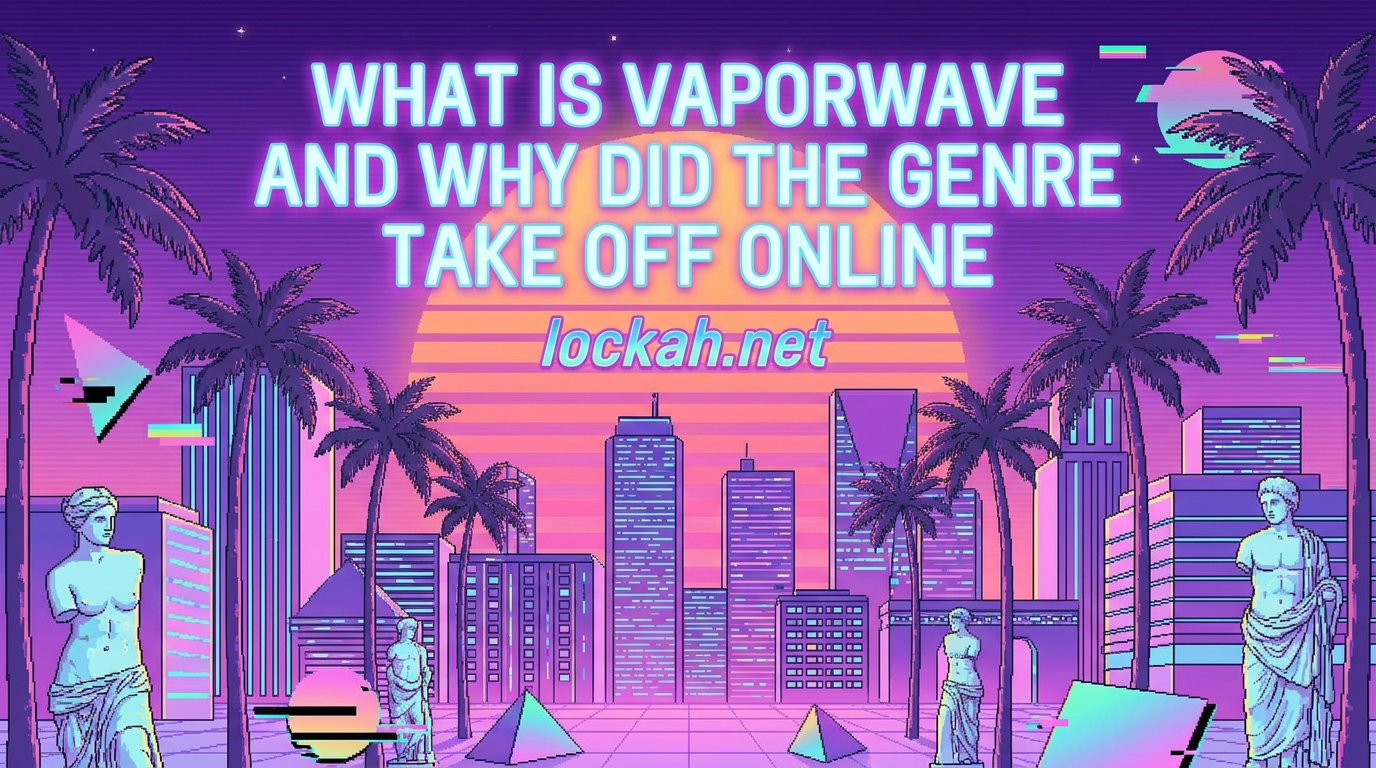
Vaporwave is an internet-born microgenre of electronic music that emerged in the early 2010s, characterized by slowed-down, chopped and screwed samples of 1980s and 1990s pop music, smooth jazz, and elevator music. It functions simultaneously as a musical style, a visual aesthetic, and an ironic commentary on consumer capitalism and manufactured nostalgia.
What makes vaporwave uniquely fascinating is that it represents the first music genre to originate entirely on the internet. Unlike punk, hip-hop, or electronic dance music, which evolved through physical scenes and local communities, vaporwave was born, grew, and spread through digital platforms like Bandcamp, Reddit, and Tumblr.
This guide explains exactly what vaporwave is and why the genre took off online. We will explore its musical characteristics, its distinctive visual language, the cultural forces that drove its popularity, and why it remains significant even as its mainstream moment has passed.
Table of Contents
What Is Vaporwave?
Vaporwave is a microgenre of electronic music that transforms familiar sounds from 1980s and 1990s consumer culture into something simultaneously nostalgic and unsettling. The genre takes its name from “vaporware,” a term describing software or hardware products that are announced but never actually released, evoking the hollow promise of futuristic technology.
Musically, vaporwave is defined by its use of slowed-down, chopped and screwed samples. Artists take audio from sources like smooth jazz, elevator music, corporate training videos, television commercials, and pop hits from the Reagan and Bush eras. These samples are then manipulated through pitch shifting, time stretching, and the addition of reverb and other effects to create a hazy, dreamlike quality.
The typical vaporwave track operates at reduced BPM, often 60-80 beats per minute compared to the original recordings at 110-130 BPM. This slowing creates an uncanny valley effect. The music sounds familiar but wrong, like a half-remembered dream or the background noise of a deserted shopping mall at 2 AM.
The Sound of Vaporwave
The sonic palette of vaporwave draws heavily from what musicologist Adam Harper termed “plunderphonics” – the practice of creating new music entirely from existing recordings. Vaporwave artists rarely record original instrumentation. Instead, they function as sonic archaeologists, excavating forgotten audio fragments from the recent past.
Common source material includes early digital synthesizer presets, MIDI instrumentation, saxophone solos from smooth jazz radio, new age spa music, and the jingles that played behind television commercials for cars, vacations, and luxury goods. The production technique known as “chopped and screwed,” originally developed by Houston hip-hop DJ Screw in the 1990s, serves as a foundational influence.
Audio manipulation in vaporwave typically involves several techniques working together. Pitch reduction lowers the sample by several semitones, creating a deeper, more melancholic tone. Time stretching elongates the audio without changing pitch, producing that characteristic slowed-down effect. Reverb and delay effects add spatial depth, suggesting vast, empty spaces. Looping creates hypnotic repetition, often isolating just a few seconds of a source track and repeating it for minutes at a time.
The Aesthetic Dimension
Vaporwave is inseparable from its visual aesthetic, which is as carefully constructed as its sound. The visual language draws from early internet graphics, 1990s corporate design, and classical imagery in deliberately jarring combinations. Roman busts, particularly the Helios head that appeared on the iconic Floral Shoppe album cover, appear against backgrounds of neon grids, palm trees, and checkerboard patterns.
Color palettes emphasize pinks, cyans, purples, and teals – colors associated with 1980s sunset gradients and early computer monitors. Japanese text appears frequently, not necessarily because artists understand Japanese, but because it evokes the Western perception of Japan as a futuristic yet foreign technological power. Images of shopping malls, corporate logos, old technology, and luxury goods serve as recurring motifs.
This visual language emerged organically through platforms like Tumblr, where users began collecting and sharing images that fit an emerging “aesthetic” that had no name yet. When the music and the visuals collided around 2011, vaporwave as a complete cultural package crystallized.
The Origins and History of Vaporwave (2026)
The vaporwave story begins in 2010, though its exact birthplace is difficult to pinpoint. Unlike musical movements that emerge from specific cities or scenes, vaporwave emerged from distributed online experimentation. Multiple artists were independently developing similar approaches, gradually discovering each other through platforms like Bandcamp and SoundCloud.
The Foundational Releases (2010-2011)
Three albums from 2010-2011 established the template for vaporwave as a recognizable genre. Daniel Lopatin, now better known as Oneohtrix Point Never, released “Chuck Person’s Eccojams Vol. 1” in 2010 under a pseudonym. This cassette-length release featured looped, slowed samples from 1980s pop hits like Chris de Burgh’s “Lady in Red” and Steve Winwood’s “Valerie,” treated with echo and degradation effects to suggest the deterioration of magnetic tape.
James Ferraro’s “Far Side Virtual,” released in 2011, took a different approach. Rather than slowing and degrading samples, Ferraro composed original music using preset sounds from early digital synthesizers and General MIDI soundbanks. The result sounded like the hold music for a 1990s tech company’s customer service line – aggressively optimistic, artificially cheerful, and subtly dystopian.
But the release that defined vaporwave for a generation arrived in December 2011. Vektroid, a prolific producer from Portland, released “Floral Shoppe” under the alias Macintosh Plus. The album cover featured the now-iconic image of a classical Roman bust with glitch effects and Japanese text. The opening track, “リサフランク420 / 現代のコンピュー” (Lisa Frank 420 / Modern Computing), slowed Diana Ross’s “It’s Your Move” to 60% speed and looped a brief section, creating something that felt simultaneously like a joke and a profound artistic statement.
From Joke to Genre
Initially, vaporwave was understood partly as an internet joke. The deliberately kitschy album covers, the obscure Japanese text, the appropriation of corporate Muzak – all of this suggested irony and parody. Early listeners debated whether artists were sincerely appreciating these sounds or mocking them. This ambiguity would become central to vaporwave’s appeal.
By 2012, a recognizable community had formed around the genre. Reddit’s r/Vaporwave community launched in 2012 and quickly became a hub for sharing new releases, discussing aesthetics, and debating what “counted” as vaporwave. Bandcamp emerged as the primary distribution platform, offering artists free or low-cost ways to release music directly to fans without record label involvement.
The genre’s name itself reflects its internet origins. “Vaporwave” combines “vaporware” with “wave,” the suffix attached to numerous electronic music genres. The term was apparently coined via an anonymous blog post or forum discussion around 2011, spreading organically until it became the accepted label.
Musical Lineage
Vaporwave did not emerge from nowhere. It draws on several preexisting musical traditions. The chopped and screwed technique, pioneered by DJ Screw and the Screwed Up Click in Houston, provided the template for slowing and manipulating source material. The plunderphonics movement of the 1980s and 90s, particularly artists like John Oswald and Negativland, established the artistic legitimacy of creating music entirely from samples.
The British “hauntology” scene of the 2000s, including artists like The Caretaker and Boards of Canada, explored similar territory of nostalgia, decay, and half-remembered sounds from the past. French electronic duo Air’s 1998 album “Moon Safari” mined similar territory of smooth, nostalgic retro-futurism. Even muzak and elevator music themselves, originally designed by companies like Muzak Holdings to manipulate shopper behavior, serve as foundational elements.
Why Did Vaporwave Take Off Online?
Understanding why vaporwave specifically took off online requires examining the unique confluence of technological, cultural, and generational factors that existed in the early 2010s. No previous music genre had grown so rapidly and completely through internet platforms. Vaporwave’s success demonstrates how digital infrastructure can birth and sustain artistic movements.
Platform Synergy: Bandcamp, Reddit, and Tumblr
Three platforms created the ecosystem that allowed vaporwave to flourish. Bandcamp, launched in 2008, provided free hosting for artists to release music directly to listeners, bypassing traditional gatekeepers like record labels and distributors. For vaporwave artists working with sampled material that existed in legal gray areas, this direct distribution was essential.
Reddit provided the discussion infrastructure. The r/Vaporwave subreddit became the genre’s town square, where fans shared new releases, debated aesthetic boundaries, and built community. Reddit’s upvoting system meant that quality releases could gain visibility organically without traditional music journalism gatekeepers.
Tumblr served as the visual engine. The platform’s emphasis on image sharing and aesthetic curation made it perfect for spreading vaporwave’s distinctive visual language. Tumblr users who had never heard the music began sharing vaporwave-style images, creating visual interest that drove musical discovery.
This three-platform synergy created a feedback loop. Artists released on Bandcamp, shared to Reddit, where fans created Tumblr posts with album art, which brought new listeners back to Bandcamp. No traditional music industry infrastructure was required.
Meme Culture and Shareability
Vaporwave’s aesthetic was perfectly suited to meme culture. The visual language was distinctive enough to be recognizable, simple enough to replicate, and strange enough to provoke curiosity. Internet users could create vaporwave-style images using free software and share them immediately.
The genre’s inherent irony also aligned with 2010s internet humor. The juxtaposition of classical busts with 1990s computer graphics, the use of Japanese text by non-Japanese speakers, the simultaneous appreciation and mockery of consumer culture – all of this resonated with an internet culture that had developed sophisticated appreciation for layered irony and postmodern reference.
Music critics and journalists eventually noticed the growing online buzz. By 2012-2013, articles in Pitchfork, The Guardian, and other outlets introduced vaporwave to broader audiences. Each article drove new traffic to the online communities, creating a snowball effect.
Low Barrier to Entry
Vaporwave’s production requirements made it accessible to anyone with basic digital audio workstation software. Unlike rock music requiring instruments and recording spaces, or electronic dance music requiring complex synthesis knowledge, vaporwave primarily required the ability to slow down existing audio and add effects.
This low barrier meant that hundreds of artists could begin creating immediately. The genre experienced explosive growth in releases between 2012-2014, with some artists releasing multiple albums per year. Vektroid alone released dozens of albums under various pseudonyms. This flood of content kept communities active and gave listeners constant novelty.
The DIY ethos extended to distribution and marketing. Artists designed their own album covers using freely available tools like GIMP and Photoshop. They wrote their own promotional copy. They engaged directly with fans in comment sections and forums. This direct connection between creator and audience, enabled by internet platforms, created intense community loyalty.
Generational Timing
Vaporwave emerged at a precise cultural moment when millennials were reaching their twenties and beginning to process their childhood nostalgia. The 1980s and 1990s source material that vaporwave samples came from the childhoods of people born between 1985-1995. These listeners recognized the sounds of their parents’ car radios, mall visits, and television commercials.
However, vaporwave did not simply celebrate this nostalgia. It complicated it. The slowed, degraded sound suggested that nostalgia itself was artificial, manipulated, perhaps even dangerous. This resonated with a generation coming of age during the 2008 financial crisis, who had been sold promises of prosperity that failed to materialize.
The aesthetic of abandoned malls, obsolete technology, and broken promises of the future spoke to economic anxieties. The “vaporware” concept – products announced but never delivered – mirrored the experience of being promised stable careers and home ownership that evaporated upon graduation.
Algorithmic Discovery
Streaming platforms and recommendation algorithms played a significant role in vaporwave’s spread. YouTube’s recommendation system, in particular, became notorious for leading users from mainstream pop videos to obscure vaporwave tracks. A user watching a 1980s music video might find “リサフランク420” in their recommended videos within a few clicks.
Spotify and other streaming services, once they added vaporwave to their catalogs, included the genre in algorithmic playlists for studying, relaxing, and sleep. This introduced vaporwave to listeners who had never heard of the genre but simply wanted background music. The genre’s ambient, non-intrusive qualities made it perfect for these contexts.
The algorithmic amplification meant that vaporwave could reach audiences far beyond its original community. A teenager in 2015 might discover Floral Shoppe through YouTube recommendations without ever visiting Reddit or knowing what Bandcamp was.
Musical and Visual Elements of Vaporwave (2026)
Vaporwave’s distinctive character comes from specific technical and aesthetic choices that work together to create its unique effect. Understanding these elements helps explain why the genre feels simultaneously familiar and alien.
Production Techniques
The core vaporwave production workflow involves several standard techniques applied to source material. First, artists select samples from 1980s and 1990s sources. These might be pop songs, smooth jazz tracks, corporate training video soundtracks, or television commercial jingles. The selection favors music that evokes a specific period of consumer optimism.
Pitch reduction follows, typically lowering the sample by 2-4 semitones. This creates a deeper, more melancholic tone that sounds like the original performer is singing from underwater or through a wall. Time stretching elongates the audio without changing pitch, creating the characteristic slowed effect. A track originally at 120 BPM might be stretched to 70 BPM.
Effects processing adds spatial and textural qualities. Reverb suggests large, empty spaces – the titular abandoned mall. Phaser and flanger effects add swirling, disorienting motion. Bit-crushing and other degradation effects suggest aged media: VHS tapes, cassettes, or early digital formats. The final result should sound like a degraded copy of a copy, several generations removed from the original.
Visual Language
Vaporwave visuals draw from a specific vocabulary of images that evoke 1980s and 1990s consumer culture and failed technological promises. Classical sculpture, particularly Greco-Roman busts, appears frequently. This classical imagery represents enduring civilization contrasted with disposable consumer goods.
Japanese text appears on album covers and in artwork, often without the creator understanding its meaning. This reflects both Western exoticism toward Japan as a technological leader and the reality that 1980s consumer electronics were frequently Japanese products. The text might be meaningless, copied from Wikipedia articles or product manuals, or it might be actual Japanese phrases describing the work.
Corporate logos and consumer goods appear prominently. Windows 95 interfaces, old Macintosh computers, early video game consoles, and cassette tapes serve as visual shorthand for a specific technological moment. Luxury items like champagne bottles, sports cars, and designer clothing appear in ironic juxtaposition with cheap consumer electronics.
The color palette emphasizes what designers call “retrowave” colors: hot pink, cyan, teal, purple, and yellow. These colors appeared in 1980s sunset photography, neon signage, and early computer interfaces. The gradients and geometric patterns suggest early digital art and video game graphics.
Vaporwave Subgenres and Evolution
As vaporwave grew, it splintered into numerous subgenres that emphasized different aspects of the original template. These subgenres sometimes attracted distinct audiences and developed their own communities.
Future Funk
Future funk took vaporwave’s sampling approach but applied it to disco, funk, and city pop rather than smooth jazz and elevator music. The result was more upbeat and danceable than classic vaporwave. Artists like Yung Bae and MACROSS 82-99 built substantial followings with energetic tracks that sampled Japanese city pop from the 1980s.
Future funk maintained vaporwave’s visual aesthetic but often added anime imagery to the mix. The subgenre became popular on YouTube, where creators made endless “aesthetic” videos pairing future funk tracks with anime clips and vintage footage. This subgenre arguably became more popular than the original vaporwave template.
Mallsoft and Mallwave
Mallsoft (also called mallwave) took the concept of abandoned mall ambience literally. These tracks emphasized field recordings of mall environments: footsteps on tile, distant conversations, the hum of fluorescent lights, the clatter of food courts. Music became environmental, suggesting the experience of wandering through empty commercial spaces.
Artists like Cat System Corp. and Hantasi built discographies exploring these liminal spaces. The subgenre attracted listeners interested in “liminal spaces” as an aesthetic category – transitional, empty places that feel haunted by absence.
Hardvapour and Dark Ambient
Hardvapour emerged as a darker, more aggressive offshoot. Drawing on industrial music and dark ambient, hardvapour maintained vaporwave’s technological themes but abandoned the nostalgic warmth. The result was colder, more dystopian, suggesting cyberpunk futures rather than abandoned malls.
This subgenre reflected vaporwave’s potential to comment on technological anxiety rather than just nostalgia. Artists like 2 8 1 4 (also Vektroid) explored these darker territories.
Political Offshoots and Controversy
Perhaps the most controversial subgenre development was the emergence of “fashwave” (fascist wave) and “trumpwave” in the mid-2010s. These appropriated vaporwave’s aesthetic language for far-right political messaging, combining classical imagery with fascist symbols and nationalist rhetoric.
The vaporwave community largely rejected these offshoots, but their existence complicated the genre’s cultural position. Critics argued that vaporwave’s ambiguity – its refusal to clarify whether it was celebrating or mocking consumer capitalism – had created space for genuinely toxic interpretations. This controversy contributed to vaporwave’s decline as a coherent cultural movement.
Oversaturation and Decline
By 2015-2016, many original vaporwave fans felt the genre had become oversaturated. The low barrier to entry that enabled explosive growth also meant that thousands of low-effort releases flooded the market. Listeners complained that every album sounded the same, that the joke had stopped being funny, and that the community had become toxic through gatekeeping and drama.
The original artists largely moved on to other projects. Daniel Lopatin became a critically acclaimed experimental composer. James Ferraro continued exploring different conceptual territories. Vektroid released music under numerous aliases across many genres. The genre did not end so much as dissipate, its energy dispersing into related electronic music communities.
Cultural Impact and Meaning
Beyond its musical characteristics, vaporwave represents a significant cultural moment. It demonstrates how internet platforms can birth artistic movements and provides a lens for understanding millennial and Gen Z relationships with consumer capitalism and nostalgia.
Consumer Capitalism Critique
Vaporwave functions as a critique of consumer capitalism, though the exact nature of that critique remains ambiguous. By slowing down and recontextualizing the sounds of advertising, shopping, and corporate optimism, vaporwave suggests that the promises of consumer culture were hollow. The “abandoned mall” aesthetic literalizes the hollowness of retail spaces when consumption stops.
However, the critique is complicated by the fact that vaporwave is enjoyable to consume. Listeners genuinely like the sound of slowed-down smooth jazz. The visual aesthetic has been used to sell actual products, from clothing lines to soft drinks. This raises postmodern questions about whether vaporwave successfully critiques consumerism or merely reproduces it in ironic form.
Some theorists have described vaporwave as “accelerationist” art – art that pushes capitalist logic to its absurd conclusion in order to reveal its contradictions. Others see it as simply nostalgic, yearning for a past that was never as good as memory suggests. The ambiguity may be the point.
Manufactured Nostalgia
Vaporwave reveals something important about nostalgia in the digital age. The genre creates nostalgia for eras that its primary audience (millennials and Gen Z) barely experienced or did not experience at all. A listener born in 1998 has no authentic memory of 1980s mall culture, yet can feel genuine nostalgia for it through vaporwave’s mediation.
This suggests that nostalgia no longer requires personal experience. Digital media allows us to develop emotional attachments to past eras we never knew. Vaporwave both exploits and comments on this phenomenon. It creates synthetic nostalgia while simultaneously suggesting that all nostalgia is synthetic.
Sampling Ethics and Appropriation
Vaporwave raises significant questions about sampling ethics. The genre’s reliance on unauthorized use of existing recordings exists in legal and ethical gray areas. Unlike hip-hop, which developed sampling practices that eventually gained legal frameworks, vaporwave largely operates outside copyright clearance systems.
Most vaporwave releases sell in small quantities through Bandcamp, flying under the radar of major copyright holders. However, significant releases on streaming platforms sometimes face takedown notices. The genre’s existence depends on the assumption that sampling old smooth jazz and corporate music will not provoke legal action.
Cultural appropriation questions also emerge, particularly regarding the genre’s use of Japanese imagery and language by non-Japanese artists. Critics have argued that this represents exoticism and orientalism, treating Japanese culture as a source of “weird” aesthetic material without genuine engagement.
Legacy and Influence
Despite its decline as a coherent movement, vaporwave’s influence persists. The visual aesthetic has become ubiquitous in internet culture, influencing graphic design, fashion, and advertising. The term “aesthetic” itself, used as a noun to describe a specific visual style, gained popularity through vaporwave communities.
Musically, vaporwave established the viability of internet-born genres. It proved that music scenes could form entirely online without physical venues, record labels, or geographic centers. This model has been repeated by numerous subsequent genres.
The genre also established slowed and manipulated audio as a legitimate approach to production. Contemporary pop music regularly uses techniques that vaporwave pioneered, from pitched-down vocals to degraded audio effects. What began as an obscure internet joke has become part of mainstream musical vocabulary.
Frequently Asked Questions
What is the point of vaporwave?
Vaporwave serves multiple purposes simultaneously: it functions as genuine ambient music for relaxation and studying, as ironic commentary on consumer capitalism and manufactured nostalgia, and as an aesthetic movement exploring the visual language of 1980s and 1990s consumer culture. The ‘point’ remains deliberately ambiguous, allowing listeners to engage with it as seriously or ironically as they prefer.
Why is it called vaporwave?
The name combines ‘vaporware’ (software or hardware announced but never released) with the ‘wave’ suffix common in electronic music genres. It evokes the hollow promises of futuristic technology and consumer goods that never materialized, matching the genre’s themes of failed futures and abandoned commercial spaces.
Is vaporwave considered EDM?
No, vaporwave is not typically considered EDM (Electronic Dance Music). While both use electronic production, EDM is designed for dancing and high-energy environments, while vaporwave is downtempo, slow, and ambient. Vaporwave is better categorized as ambient, plunderphonics, or experimental electronic music.
What is the controversy with vaporwave?
Vaporwave has faced several controversies: debates about unauthorized sampling and copyright infringement, accusations of cultural appropriation regarding Japanese imagery, and the emergence of far-right subgenres like ‘fashwave’ that appropriated the aesthetic for political messaging. The genre’s inherent ambiguity has made it susceptible to conflicting interpretations.
Is vaporwave still popular?
Vaporwave as a coherent movement peaked between 2012-2016 and has since fragmented. However, its influence persists through streaming playlists, visual aesthetics that remain popular online, and successor genres. While the original community has largely moved on, new listeners continue discovering classic releases.
What are the best vaporwave albums?
Essential vaporwave albums include Macintosh Plus’s ‘Floral Shoppe’ (2011), Daniel Lopatin’s ‘Chuck Person’s Eccojams Vol. 1’ (2010), James Ferraro’s ‘Far Side Virtual’ (2011), and works by 2814, Blank Banshee, and Saint Pepsi. These releases established the genre’s template and remain its most influential works.
Conclusion
Vaporwave represents a pivotal moment in internet culture, demonstrating how online platforms can birth, sustain, and spread artistic movements without traditional gatekeepers. What began as obscure experiments in slowing down 1980s pop samples became a global phenomenon that influenced music, visual art, and internet culture.
The genre took off online because it was perfectly suited to the infrastructure that existed in the early 2010s. Bandcamp provided free distribution, Reddit built community, and Tumblr spread the visual aesthetic. The low barrier to entry meant hundreds of artists could participate immediately, while the meme-friendly visual language ensured shareability.
Understanding what vaporwave is and why the genre took off online helps us understand broader shifts in how culture spreads in the digital age. As we continue into 2026, vaporwave’s legacy persists in the aesthetic language of the internet, the normalization of slowed and manipulated audio, and the proof that artistic movements can form entirely through digital connection.